The Man Without a Map (燃えつきた地図, Hiroshi Teshigahara, 1968)

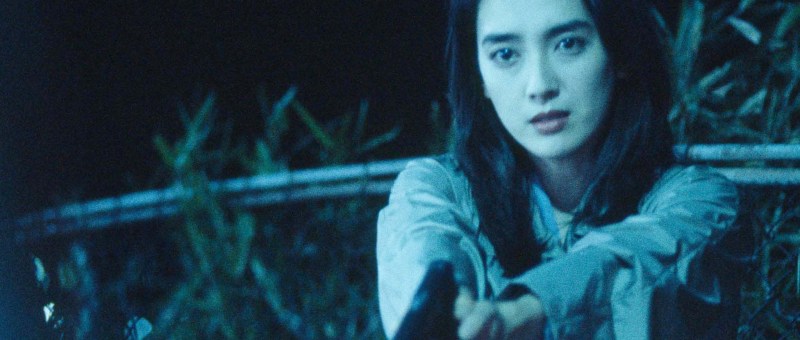
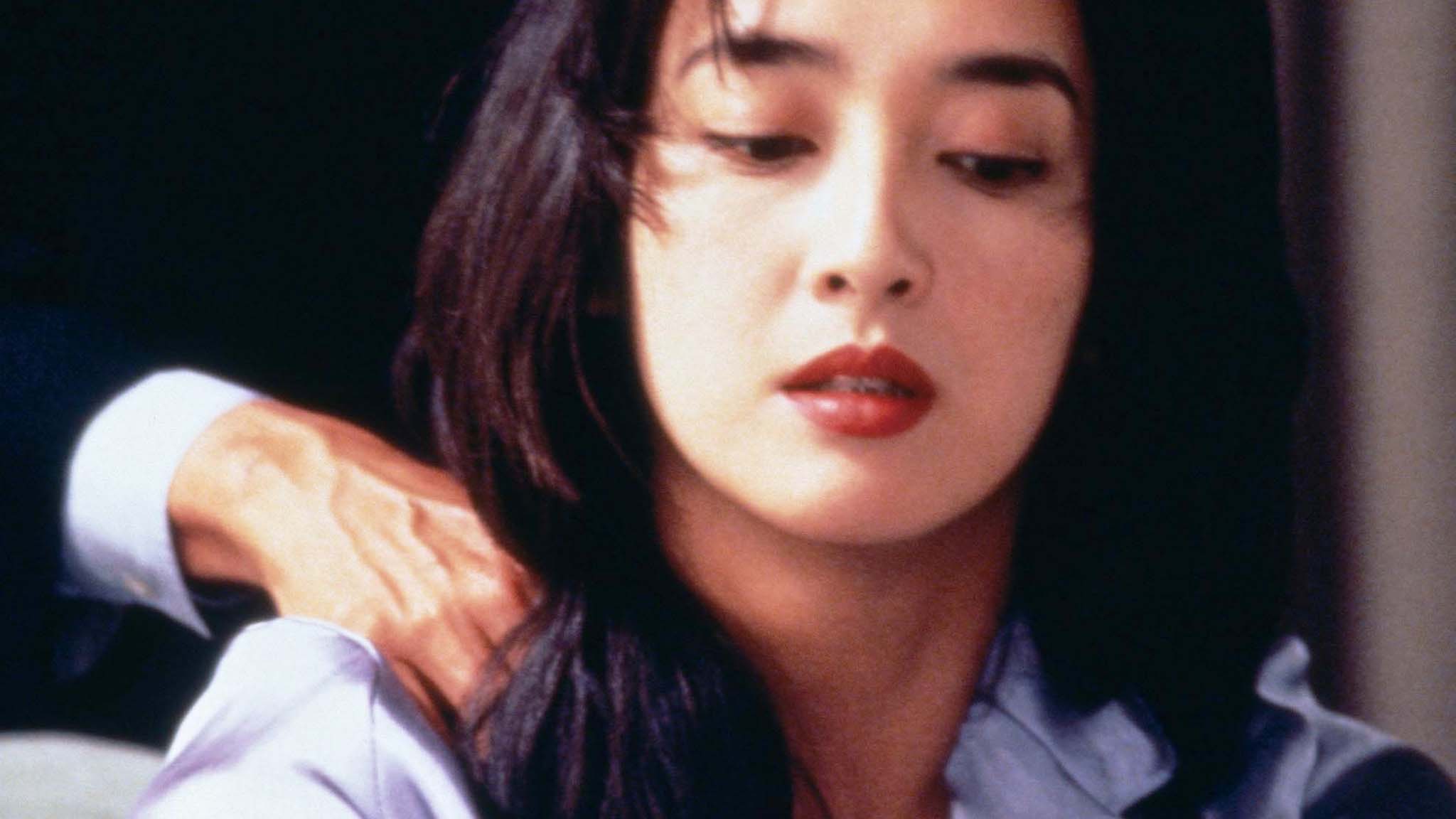
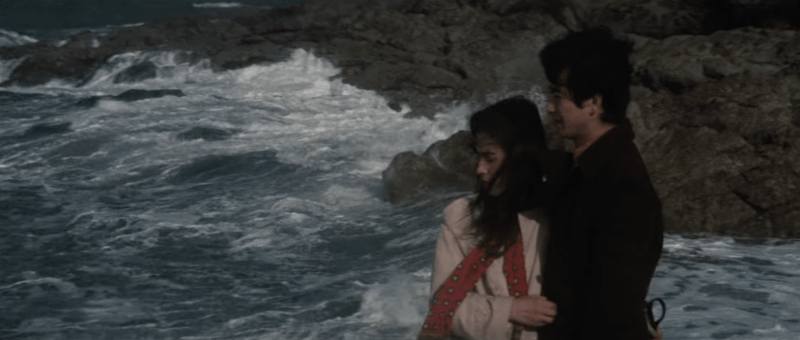
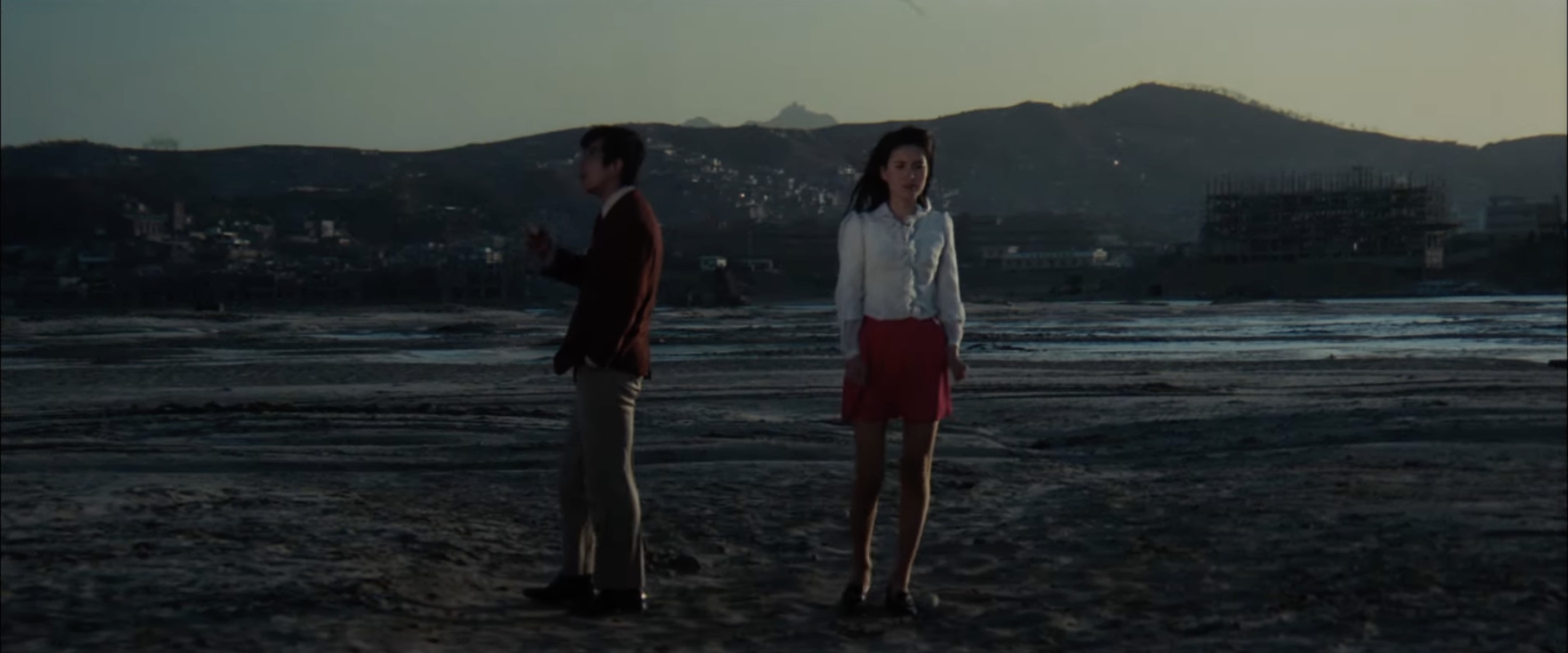
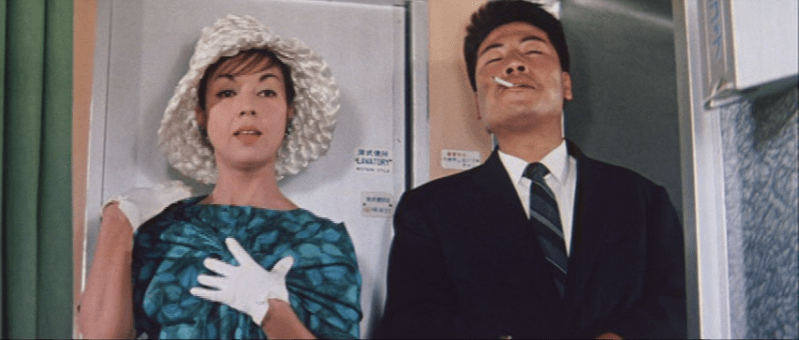
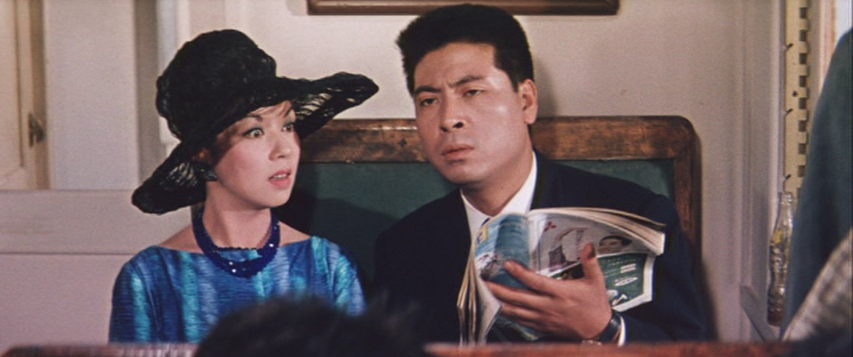
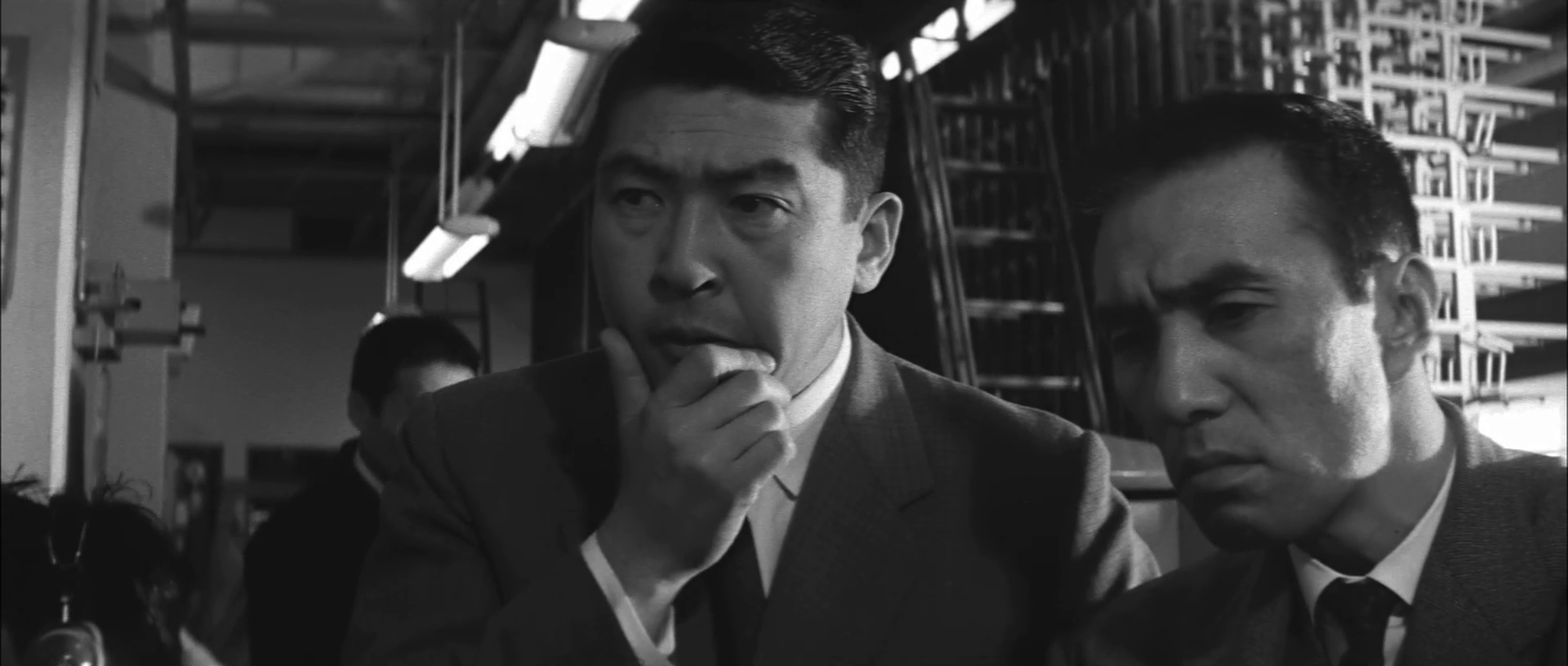
Hired to find a missing person no one really wants found, a detective begins to chase his own tail amid the impersonal vistas of the contemporary city in Hiroshi Teshigahara’s The Man Without a Map (燃えつきた地図, Moetsukita chizu). The fourth and final in his series of Kobo Abe adaptations and the only one in colour, the film’s Japanese title “burned-up map” may also, in its way, refer to the city of Tokyo which appears blurred out and indistinct in the sepia-tinted opening and is thereafter frequently shot from above as a depersonalised space where anonymous cars shuttle along highways like so many ants moving in rhythm with the momentum of the metropolis.

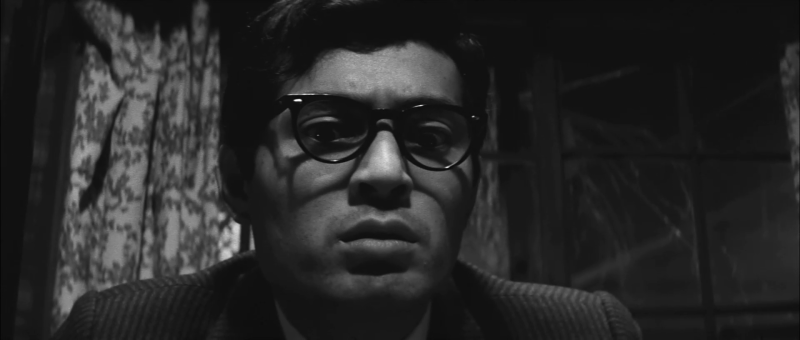
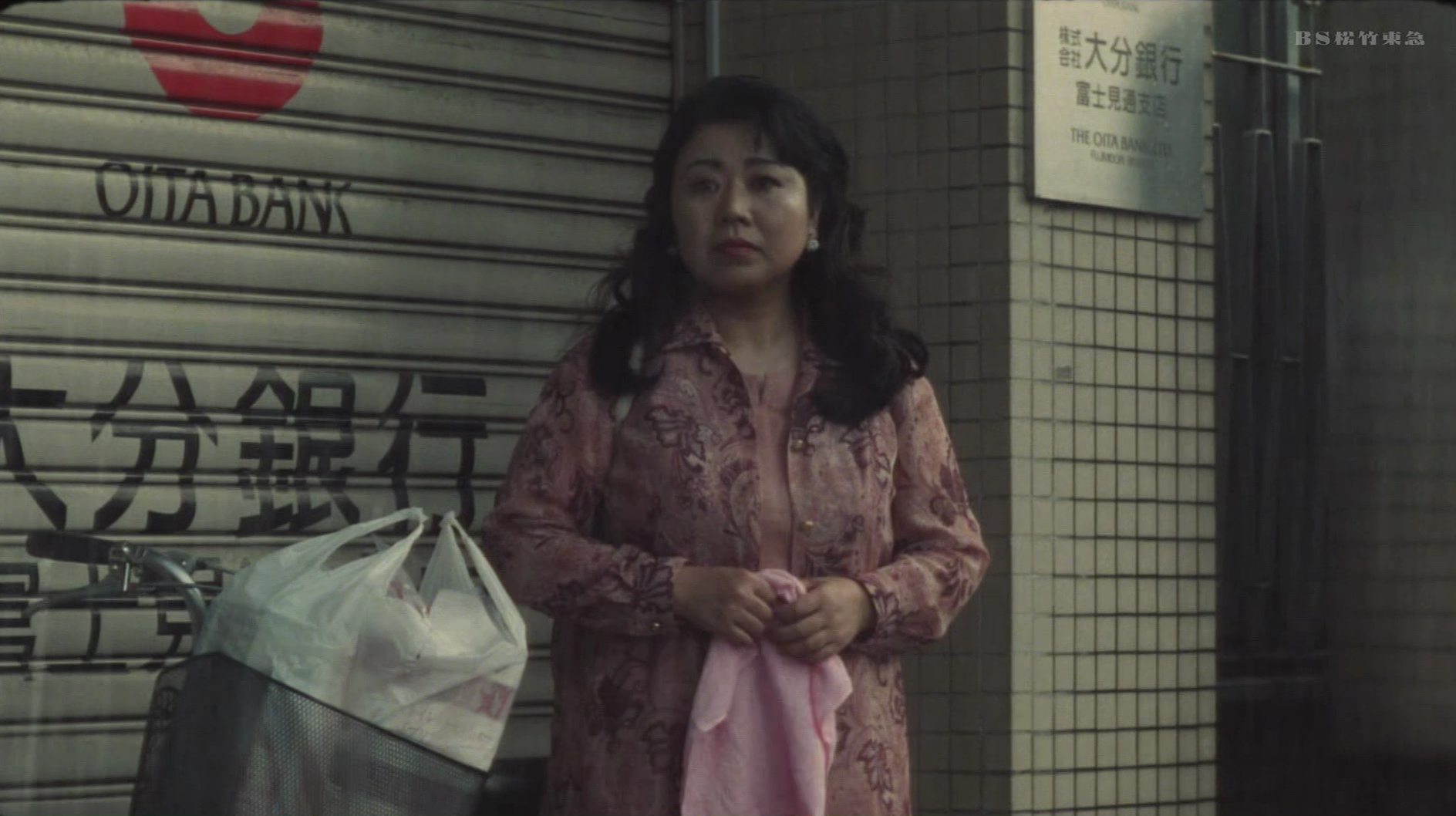
We follow a nameless detective (Shintaro Katsu) as he’s charged with investigating the disappearance of a 43-year-old salaryman, Hiroshi Nemuro, who turns out to have myriad other personalities and hasn’t been seen for six months. The man’s wife, Mrs Nemuro (Etsuko Ichihara), is not terribly helpful and the detective comes to wonder if the investigation itself is intended to further disguise the man’s whereabouts and prove that he really is a “missing person”. Yet this Tokyo is full of “missing people” including the detective who, we later learn, is a kind of fugitive himself. He apparently walked out on his wife (Tamao Nakamura), the owner of a successful boutique, because he couldn’t find his place there any more. He was once a salaryman too, and became a detective because it was the furthest thing he could think of from a regular job. 

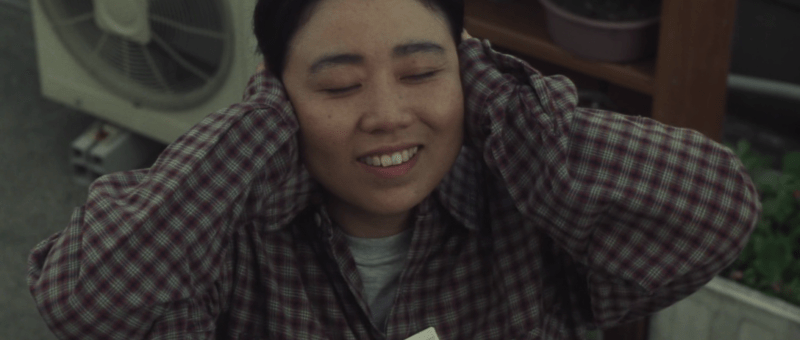
It confuses him that no one really seems to be interested in where Nemuro is or if he’s alright, only in the reason behind his disappearance. The more he chases him, the more he begins to take on Nemuro’s characteristics as if he were intended to slide into the space Nemuro has vacated. Toru Takemitsu’s eerie harpsichord score only seems to add to the hauntingly gothic quality of this quest. The question is whether such a thing as identity even exists any more. The detective puts on Nemuro’’s jacket, though it’s too small, and is mistaken for him, while a colleague of Nemuro’s insists that he’s seen him in the street and is sure it was Nemuro simply because of the unusual colour of his suit without ever seeing his face. Tashiro (Kiyoshi Atsumi) tells the detective that Nemuro had a secret hobby taking nude photos at a specialist club that caters to such things. The two of them are confident they’ve identified the woman in the picture based on her haircut, but the girl they speaks laughs and takes off her wig explaining that she was merely asked to wear it, so the woman in the photo could be anyone, including Nemuro’s own wife.

Nemuro apparently had a series of hobbies for which he’d obtained certificates because he said that having them helped him to feel anchored in his life, though he’s apparently unmoored now. Like the detective, he may have been trying on different personalities from car mechanic to school teacher looking for the right fit and a place he felt he belonged in rebellion against the depersonalisation of the salaryman society in which one man in a suit is as good as another. The detective finds an opposite number in the missing man’s brother-in-law (Osamu Okawa), a very modern, apparently gay gangster connected with a network of male sex workers sold on to influential elites, and a commune of similarly displaced people working as casual labourers that is overcome with corporate thugs and eventually trashed.

The trashing of the commune may have something to do with a man named Maeda who is a councillor in a town no one’s heard of, but was possibly involved in some shady business over which Nemuro may have been intending to blackmail him or blow a whistle with the assistance of his brother-in-law who helped him land a big contract at work. The more the detective investigates, the more confused he becomes. It’s impossible to follow the case as we might expect in a conventional noir thriller, but we’re not supposed to be looking at Nemuro’s disappearance so much as the detective’s gradually fracturing sense of self as he becomes lost in the anonymous city. He sees himself bury Mrs Nemuro in leaves only for her body somehow reduce itself to its component parts and sink into the street. Later her face is superimposed on the buildings as if she were looking down on him while he is lost and alone. Nemuro’s face also appears on buildings, though more as a metaphor as if the salaryman and the office building were one and the same and the reason the detective can’t find him is because he doesn’t really exist as a concrete identity. The detective spots a dead cat in the road and laments that he never thought to ask its name, but will try to think up a good one later. He might as well be talking about himself, now displaced, unmoored, and pursued among the city streets, a man without a map lost amid the simulacrum of an imaginary city.


Human Resource (Nawapol Thamrongrattanarit, 2025)

Fren (Prapamonton Eiamchan) has been having trouble sleeping. The doctor she visits to confirm her pregnancy tells her that she’ll have to stop taking her sleeping tablets, but to try gentle exercise such as walking on a treadmill instead. But Fren’s whole life is walking on a treadmill. The reason that she can’t sleep is that she works in HR for a terrible company and is knowingly bringing people into this world of cruelty and exploitation. She doesn’t really want to do the same for her baby, which is one reason she hasn’t told her husband Thame (Paopetch Charoensook) about the pregnancy even though they’ve been trying for two years.

Nawapol Thamrongrattanarit’s Human Resources paints a fairly bleak picture of contemporary Thailand which is all the more chilling for its seeming normality. Fren listens to radio hosts talk about how the economy is tanking, there are floods in the north and no one’s doing anything about it, and also apples might be full of microplastics. You should also fit a filter in your shower because there’s cadmium in the water despite the government’s assurances that it’s safe. No wonder everyone feels on edge. Fren is increasingly uncomfortable with her own complicity, but sees no real way around it.

The main problem is that she works for a bully for who demands an apology from her when she has to have a word with him about his workplace behaviour which includes throwing piles of paper in the face of employees. June hasn’t been coming to work, and according to Fren’s colleague Tenn (Chanakan Rattana-Udom), a few other employees quit their jobs like this too because they just couldn’t live this way any more. Between Jak’s rages, low wages, and the demand to work six days a week, they know they can’t keep staff and feel bad about trying to recruit people. Tenn laments that given the economy, someone will desperate enough to bite, while the pair of them make themselves feel better by deciding to be upfront in interviews about the working culture and letting the candidates decide for themselves.

But how much do you really get to decide? When Thame finds out about the pregnancy, the couple to go look around an expensive international school. Fren agrees that’s very nice and the children seem happy, but it wasn’t their choice to be here and no one’s ever asked them if their parents’ idea of a “decent” person is what they really want to be. To Fren, the international school seems like another level of complicity in perpetuating the inequality in society that’s fuelling the violence and resentment all around them. The candidates might not have the option of turning down these jobs, and Fren doesn’t really have the option to leave, either. But Tenn comes from money and he could always get a job at his family’s company, so in the end only he has the choice of whether to stay or go.

Lectures Fren attends talk about the working revolution and the threat of AI, insisting that the “average” worker is dead because those jobs are gone, so the only way to make a mark is to work yourself to death and make use of personal connections. That seems to be the route Thame is taking after becoming chummy with the police chief in the hope of selling him some of their ultra thin stab vests that are comfortable to wear all day long as if implying the world has already got to that point that you need to be wearing armour at all times. He has a worryingly authoritarian streak and is incensed by the moped drivers who keep going the wrong way up their one-way street. Thame refuses to back up and let them pass, though isn’t so brave when one of them jumps off his bike and begins pounding the windscreen with his helmet. Humiliated by his inability to combat this kind of violence despite having brought it on himself, Thame later runs the guy over deliberately and then gets the police chief to make it go away. 

Meanwhile, Fren feels as if all she can do is carry on walking the treadmill. The shutter at the car wash comes to symbolise that of the furnace at the crematorium where a colleague who took their own life because of overwork and bullying was laid to rest as if Fren’s life were a kind of living death. A famous woman convicted of a crime reveals she’s had an abortion because she didn’t want her son to be born in prison or to bring a child into that world. Fren isn’t sure she wants to either, but like everything else, she might not have much choice.


Human Resource screens as part of this year’s BFI London Film Festival.

Trailer (English subtitles)

A Pale View of Hills (遠い山なみの光, Kei Ishikawa, 2025)

A young woman returns home at a moment of crisis, but finds herself with only more questions in an attempt to understand her mother and her decision to leave Nagasaki for the UK 30 years previously in Kei Ishikawa’s adaptation of Kazuo Ishiguro’s debut novel, A Pale View of Hills (遠い山なみの光, Toi yama-nami no Hikari). Set alternately in 1952 and 1982, the film positions the Greenham Common anti-nuclear protests as a point of connection between the two nations and the reason that Niki (Camilla Aiko) is currently so interested in her mother’s story seeing as there’s increased interest surrounding the atomic bomb, even if her editor keeps asking her about “Hiroshima”.

Another reason for Niki’s sudden return is that the editor is a married man Niki has been having an affair with. It seems she’s made a significant investment in the relationship by dropping out of university to work as a reporter, but despite saying he would, he has not left his wife and Niki suspects she may now be pregnant. All of which encourages her to investigate the relationship she has with her mother, Etsuko (Yo Yoshida / Suzu Hirose), and her late sister Keiko with whom she did not seem to get on, through tracing back her Japanese roots and trying to understand her familial history.

But what Etsuko, who is abruptly selling the family home, tells her is confusing and indistinct. Much of Etsuko’s story doesn’t line up, and we understand in part why later, but it seems almost as if the lacunas and contradictions are intentional and designed to hint at the ways we paper over cracks in our identities or create new mythologies for ourselves in an attempt to escape the traumatic past. Etsuko found a more literal escape in coming to the UK, but there’s something a little poignant about the way she says she thought there’d be more opportunities here and that Keiko would have had the chance to be anything she wanted which Japan would have denied her. Later she suggests that she always knew the UK wouldn’t be good for Keiko, but she came anyway. 

Now she’s selling the house, literally unpacking the past, Etsuko has begun dreaming about a woman she knew, Sachiko (Fumi Nikaido), and her daughter, Mariko, who lived near her in Nagasaki when she was pregnant with Keiko. Whereas Etsuko and her salaryman husband Jiro (Kohei Matsushita) live in a flat on a “danchi”, aspirational post-war housing estates for young families, Sachiko lives in a rundown shack across the way where the neighbours gossip about her for entertaining American soldiers who are still in the country post-Occupation because of the Korean War which is also what’s fuelling the economic recovery. Sachiko has met a man called Frank who says he’ll take her to America, but she doesn’t really believe him. 

On the one level, it seems that Etsuko and Sachiko are mirror images of each other yet they are in other ways alike, while their stories share several details in common. What unites them is that they both experienced the aftermath of the bomb, though Etsuko has been careful not to disclose the extent of her exposure and is now fearful of what effect it may have on the baby along with on her relationship with her husband who appears to share some of the prevailing social prejudice against those who were exposed to radiation. Jiro, meanwhile, is a distant workaholic who criticises Etsuko for not being more “motherly” and sees her as little more than a domestic servant. He has a damaged hand from his wartime service that seems to reflect his wounds, but still rolls in drunk occasionally singing war songs with his inconsiderate friends. 

When his father, Ogata (Tomokazu Miura), announces he’s coming to stay with them, Jiro is pleased to see him but rebuffs his request that he talk to an old school friend, Matsuda (Daichi Watanabe), about an article he published claiming that it’s a good thing that teachers like Ogata were let go after the war. Ogata evidently feels hard done by, but it’s also true that the cause of his son’s animosity towards him is that he was a card-carrying militarist who cheered when he left for the front and indoctrinated children with imperialist ideology in his job as a teacher. He is the past Japan must move on from, and a representative of the wartime generation by which the young of today feel betrayed. As Matsuda tells him, it’s a new dawn. Ogata has to change, and so does everyone else including Etsuko who may not be as happy in her marriage as others might assume and may well be seeking other paths towards self-fulfilment rather than allow herself to become another miserable, self-sacrificing housewife.

Even so, the contradictory message seems to be that perhaps you can’t actually move on from this past and Keiko, in particular, may have been changed by her exposure not to the bomb but it’s aftermath, the terrible things she heard and saw amid the wreckage and the stigma she faced afterwards. The artificiality of the Japanese sets might speak to the slipperiness of Etsuko’s memory, as if she were observing a film of herself rather than recalling real events or else reimagining them differently so they play out a little more cinematically, in comparison to the concrete reality of the Sussex bungalow which perfectly captures a lived-in Britishness of the early 1980s. In many ways, Niki might not have clarified very much at all, or perhaps begun to accept the idea that not knowing doesn’t matter in coming to understanding of her relationship with her mother and along with it of herself as she too decides it’s time for change.


A Pale View of Hills screens 16/18th October as part of this year’s BFI London Film Festival.

Trailer (English subtitles)

No Parking (주차금지, Son Hyeon-woo, 2025)

A small negligence can come back to bite you, according to the violent stalker at the centre of Son Hyeon-woo’s No Parking (주차금지, Juchageumji). Ho-jun (Kim Roi-ha) likes to punish the “rude”, though some might like to argue that whacking people with wrenches is also at the very least impolite, while his overall manner is distinctly unfriendly. It is, however, inconsiderate parking practices that eventually do for him when he becomes fixated on a neighbour of his wife’s who asks him to move her car while he’s in the process of murdering her. 

Yeon-hee (Ryu Hyun-kyung) was already fed up with the parking situation and has been trying to move though is struggling to do so for a variety of reasons. There’s a lot going on in her life, including a recent divorce and starting again after returning to Korea and the workforce after a 10-year absence. That’s perhaps why she’s stuck in a contract worker position which means she won’t be approved for the loan she needs for a lease on another property until she’s made a full-time employee. But, as someone suggests to her, her boss may have had an ulterior motive for offering her the job and, sure enough, begins sexually harassing her immediately after her welcome party. 

Hae-cheol (Kim Jang-won) and Ho-jun are both, in their ways, representatives of the patriarchal society. They both berate Yeon-hee for being “rude” to them, and react angrily when they feel disrespected. Hae-cheol is in fact already married with children, and repeatedly stresses his secure financial position and assets he insists would be Yeon-hee’s if she came over to him. He later describes his wife as a “fat pig” and moans that she let herself go after the marriage and children. “Yeon-hee needs to meet a guy like me,” he says, while refusing to take her refusal seriously. She asks him why he’s doing this to her and says that she’s going to quit her job, but that doesn’t stop him wandering around outside her home and declaring he’ll stay there until she comes out. 

Ho-jun hangs around outside her house too, though unfortunately, you can’t report someone to the police for loitering. He gets her name from a business card she’s left in the window of her car, which seems ill-advised, but he obviously knows where she lives anyway. He insists on having an apology for her having been “rude” to him when she asked him to move the car, though as she points out, it was “rude” not to park it properly and in any case she’s at the end of her tether with the traffic, her work situation, and precarious living conditions. Nevertheless, Ho-jun’s attitude is reflective of a wider misogyny in which he expects subservience from women and becomes violent when he doesn’t get it. He’s evidently been stalking his ex-wife and murders her on realising that she’s found another man. 

Yet Ho-jun also resents Hae-cheol, insisting that it’s because of men like him that women have become “arrogant”. Hae-cheol too expects Yeon-hee’s deference and repeatedly stresses that he’s a nice guy and can’t understand why she’s treating him this way. He doesn’t leave her any room to refuse and rejects her right to choose. Like Ho-jun, he fixates on her “rudeness” in not stopping to say goodbye to him when she was trying to leave work after realising he lured her there on false pretences at the weekend when no one else’s around so he could pressure her into going to dinner. He describes her as a “gift” from the universe to cure his loneliness, complaining that his family don’t care about him because he prioritised work and now has no emotional outlets. He repeatedly drops hints about making Yeon-hee full-time, while misusing his power and suggesting that doing so is contingent on her agreeing to the affair with him. Nevertheless, when rumours spread around the office it’s Yeon-hee who gets suspended even though none of it is true and it was Hae-cheol who was harassing her.

The film seems to suggest it’s this general level of frustration and anger with the contemporary society that leads to acts of violence over things which might be thought “trivial” such as parking provision, but then again inconsiderate parking is also a sign of selfishness or at least that everyone is so consumed by their own problems that they don’t have time to consider the effects of their actions on others. Or, maybe some people are just rude or like Ho-jun trying to assert their dominance by flouting the rules. In any case, small acts of negligence may indeed come back to strike you from unelected directions and the only real cure is to try to treat other people as people who are also tired and frustrated but whose lives would be made infinitely easier if people didn’t keep parking in front of their driveways.


Trailer (Korean subtitles only)

Dawn Chorus (暁の合唱, Hiroshi Shimizu, 1941)

“Before me flows a wide and serene river of life,” a young woman writes in an unexpectedly poetic essay, “I beg you to pray for my just and happy future.” Yet Tomoko (Michiyo Kogure) does appear to be pretty happy with her choice, even if the just future she’s forging for herself might not be what others see as just. Though she cites her family’s poverty and a minor disability as her reason for giving up on education, there seems to be another side of her that eagerly embraces independence and looks for it in unexpected places.

That would be her desire to become a bus driver, an occupation then thought to be inherently masculine. Perhaps in that way, it reflects her desire to be in control of her own destiny, while her apparent love of life on the bus hints at another for travel and ever-expanding horizons. Another of Shimizu’s travelling films, he often as in Mr Thank You includes scenes shot through the bus’ rear window including that of a flock of boys off to school on their bikes that makes Tomoko think of her stepbrother Ginjiro (Giichi Okita) who has a voracious appetite despite their family’s poverty. There are indeed all kinds of people who get on the bus, including, at one point, a melancholy woman in a bridal outfit who nevertheless pitches in when the bus gets stick in a ditch and needs a push. Tomoko fixes the bride’s makeup and gives her her compact, but there’s no avoiding the fact that she looks miserable despite the joy of the older women accompanying her.

Even Tomoko remarks that she isn’t sure whether her tears were in joy or sorrow even while wishing her a broad-shouldered husband. Later the bus catches her again trailing behind the man to whom she was married, older than her and not particularly handsome, pulling a cart. She still doesn’t look very happy, and is presumably bound for a life of drudgery over which she has little say. Her fate contrasts with that of Tomoko who is actively choosing her way forward even if the bride’s plight forces Tomoko to think about marriage and her womanhood as does the birth of a baby on the bus. Everyone is always telling Tomoko that she ought to get married quickly, and not least among them Eiko (Kiyoko Hirai) who declares herself tired by life. Working for a newspaper, she had apparently been the girlfriend of Saburo (Toshiaki Konoe) whose late brother once owned the company while now he runs a cinema. Saburo has apparently tired of her, though he appears to have developed a fondness for Tomoko which might seem slightly problematic to modern eyes because of Tomoko’s relative youth while she is in the process of coming of age and into herself uncertain if marriage is even something that she’s interested in.

On the other hand, her tomboyish qualities leave her in a slightly liminal space as reflected in her desire to become a driver, rather than a conductress. In learning to drive, she mostly wears trousers while Eiko remarks on her “big hands” and she prides herself on her physical strength when engaging in an impromptu arm wrestling match with Yoneko (Hiroko Kawasaki), the widow of Saburo’s brother who now manages the bus company and has a crush on handsome driver Ukita (Shin Saburi) who also had to drop out of university for undisclosed reasons. Tomoko loses the match because she’s overcome by tears without really knowing why, which might in its way be a manifestation of her returning femininity along with her maturity, but there’s also something strangely transgressive about the scene featuring two women under mosquito net randomly arm-wrestling in the middle of the night.

Nevertheless, Tomoko’s life seems otherwise happy and pretty care free even if there are signs of corruption all around her. One of her first challenges while working as a conductress is an old woman (Choko Iida) who tries to get out of paying. It seems like the old woman probably can’t really afford to pay, but puts on a show of having tried to cheat them deliberately to save face. She suggests to Tomoko that she simply neglect to punch a ticket and pocket the money she’s already given her, until the bus driver, a man, gets out to exert his authority and tell her off despite Tomoko’s offer to make up the shortfall out of her own money. Later it’s discovered that two of the other conductresses have been made unhappy enough to consider quitting their jobs and are deliberately avoiding riding with one particular driver because he’s forcing them to embezzle ticket money in this way on his behalf, hinting at a kind of greed and immorality that might not necessarily be motivated by abject poverty.

It is though a presence Tomoko is able to dispel, bringing on Kimie (Chiyoko Fumiya) as her own conductress when she finally becomes a driver in her own right. Though the film hints at her feelings for Saburo, it does not end on marriage but with Tomoko’s personal fulfilment if tempered by the idea that a woman must now be useful and productive in the wider world while the men are away which might be how it gets around the censors despite otherwise avoiding overtly patriotic or imperialistic themes. Based on a novel by Yojiro Ishizaka, the film rather validates Tomoko’s desire to take charge of her life and drive off towards the future as an independent woman.


Exit 8 (8番出口, Genki Kawamura, 2025)

Shinjuku Station is notoriously difficult to escape. The endless labyrinthine corridors all look the same, lending the environment a degree of surreality that leaves you feeling anxious that actually you’re making no progress at all merely walking in circles and may do so until you die. It becomes a more literal hellscape for one “lost man” in Genki Kawamura’s elliptical adaptation of the popular video game in which the hero finds himself trapped in the same looping corridor where he is told he must turn back if he spots anything that isn’t as it should be and that he should do this eight times so that he can reach Exit 8 (8番出口, Hachiban Deguchi) and leave the station.

The figure 8 is an ellipsis in itself while simultaneously recalling the Noble Eightfold Path of Buddhism in which one must complete the eight steps to find Nirvana and escape the painful cycle of life and rebirth. It’s birth that most occupies the Lost Man (Kazunari Ninomiya) as, shortly before he enters the tunnel, he receives a call from the girlfriend (Nana Komatsu) he’s just broken up with telling him she’s pregnant. She says knows he always had an anxiety about becoming a father, but wants to know what he wants to do. Kawamura films this opening sequence in POV, at once recalling the film’s video game origins and placing us directly into this world in which we feel the Lost Man’s shock and disorientation as he stops suddenly and staggers while the world carries on around him. 

The tunnel is then a manifestation of his mental destabilisation as he tries to process impending fatherhood and make a decision about whether or not he wants this child. This is to an extent reflected in his name in which he is both geographically and mentally “lost” while unable to reach a decision. Inside the tunnel, he’s told not to “overlook” anything that seems like an anomaly as if he were trying to remake the world and teach himself which is the right path to take. Though as his equally unnamed girlfriend says in a sequence that may be a fantasy, future echo, or fractured memory, no one can really know which path is right and life is a continual act of faith that we will not come to regret the decisions we have made or the ones we failed to make. 

This is most obvious when the Lost Man encounters a little boy with a scratch on his face in the tunnel and immediately decides he’s an anomaly, only to discover he isn’t when the counter resets to zero meaning he made the wrong decision and has to start again. The boy seems to be another person trapped in the loop, though not previously on the same cycle as the Lost Man, but at the same time he comes to represent both the son the Lost Man may have and himself as a little boy. Likewise, the Walking Man (Yamato Kochi) that he encounters also seems to become the father that Lost Man fears becoming, and the one he never met. While the Walking Man eventually abandons the boy on discovering what could be Exit 8 to make his own escape, the Lost Man refuses to do so and begins to come to an accommodation with his own role as a potential father as well a responsible member of society. 

In the opening sequence, he’d stood by and done nothing as an obnoxious salaryman laid into a mother holding her crying baby on the train, the only white-dressed figure on this funereal carriage filled with people dressed in back on their way to work. Another loopee asks the Walking Man if being trapped in this purgatorial hellscape is really any different than his life in which he repeats the same actions every day in the daily grind of the salaryman and it does seem as he is looking for an escape from the soul-destroying meaninglessness of the corporate life otherwise hinting at his own failed paternity and flight from domestic obligation. Meanwhile for the Lost Man, he fears he isn’t ready to become a father in part because he’s only a temp worker and hasn’t anchored himself safely enough within adulthood to be able to support a wife and child. Still, he resents himself for not having stood up for the woman and her baby in being cowed into submission by the paternal figure of the salaryman and the fear of putting his own head above the parapet by refusing to mind his own business like everyone else with their heads buried in their phones.

But then again, how could you ever really know that you’ve found the “real” Exit 8 and it’s not just another “anomaly” presented by the loop. Perhaps you never actually escaped this labyrinth, only ventured deeper inside it. Or perhaps, you escape the loop when it’s time for you to do so because your mind is clear and you know which path to take. There’s a minor irony in some the decor with the subway etiquette poster reading “are you alright?” while intending to ask the reader if they’re sure they’re behaving appropriately on public transport, but also hinting at the Lost Man’s failure to intervene and the Walking Man’s indifference to others. In any case, the tunnel has its hellishness and terror but it can also lead you where you’re supposed to go, if only you allow it.


Exit 8 screens 8/9th October as part of this year’s BFI London Film Festival.

Trailer (English subtitles)

Samurai Fury (室町無頼, Yu Irie, 2025)

Retitled Samurai Fury (室町無頼, Muromachi Burai) for it’s US release, Yu Irie’s Muromachi Outsiders is indeed a tale of righteous anger though like many jidaigeki the rage is directed towards the corrupt samurai class and wielded by a ronin with a noble heart. Based on a novel by Ryosuke Kakine, it recounts a rebellion that took place five years before the Onin War that would lead to the end the Ashikaga Shogunate and initiate the Sengoku or warring states period that lasted until the Tokugawa era began. 

The cause is, really, the incompetent government of shogun Ashikaga Yoshimasa (Aoi Nakamura) who is largely seen here gazing out at his view from the palace in Kyoto which he is obsessed with rebuilding. Meanwhile, famine has taken hold following a period of drought that ended with a typhoon and flooding of the river Kamo, and the starvation has also led to a plague. Between the lack of food and disease, 82,000 people will die, but the government doesn’t really do anything because they don’t think the lives of peasants are all that important. This is of course very shortsighted because someone has to plant all that rice that gets delivered to the palace and they can’t do that if they’re too busy starving to death. In the opening sequences, peasants are whipped and beaten as they transport a giant rock for the shogun’s new garden, though when it gets there he doesn’t like it. Meanwhile, a giant pile of bodies in approximately the same shape is dumped at the edge of the river where they’re burning the dead.

The farmers are forced to take such onerous jobs for extra money because they can’t produce enough to pay their taxes which the samurai keep putting up. To make up the shortfall, they have to take out loans from usurious monks who seize their property or take their wives and daughters when they can’t pay. A young man pressed into working for debt collectors from the temple is told to kill a man who owed them money but hits the barrel beside him instead and exposes him for keeping his seed grain without which he won’t be able to plant more rice but they’re going to take that anyway which means that in the end everyone is going to starve. A village favoured by the hero, Hyoe (Yo Oizumi), is also subject raids from disenfranchised ronin who’ve taken to banditry to survive. 

Hyoe is also a ronin, but in his life of wandering he’s found a kind of freedom even as he straddles an awkward line, sometimes working with an old friend from the same clan, Doken (Shinichi Tsutsumi), who has turned the other way and is now the security chief for the government in Kyoto with his own gang of bandit dent collectors. Hyoe’s role is, ostensibly, to stop peasant uprisings, which he does, but mostly because he knows they’re pointless and the farmers armed with little more than hoes and stolen armour will simply be massacred, but he’s also secretly plotting a giant rebellion of his own, harnassing the forces of the ronin and the fed up peasants to storm the capital, burn the debt agreements, and rescue the women taken in lieu of payment. 

But to do so means he’ll have to betray his oldest friend and that he likely won’t survive. Still he thinks someone’s got to do something about this rotten world and sees a better one beyond it if only they can throw off the yoke of the samurai class that thinks peasants are the same bugs to squeezed dry under their boots. That’s perhaps why he trains a young successor, knowing that can’t remake the world with just this one assault on the mechanisms of government and that even if they get rid of the drunken fool Lord Nawa (Kazuki Kitamura), someone not all that different will pop up in his place. “Tax is supposed to improve people lives,” one of the revolters screams at a young soldier, not pay for a new wing at the palace, though it’s a lesson the young shogun seems incapable of learning even as the city burns all around him. 

Taking a leaf out of The Betrayal’s book, the climax is a lengthy action sequence in which Hyoe’s apprentice Saizo (Kento Nagao) takes on half the Kyoto garrison single-handed armed only with his staff. Though the themes are common enough for jidaigeki, though in truth jidaigeki mainly refers to films set in the Edo era under the Tokugawa peace, Irie modernises the way battle is depicted to incorporate wuxia-style wirework and rooftop chases along with martial arts training sequences for the young Saizo who learns the way of the warrior from a cackling old man with a long white beard (Akira Emoto) who has also taken in a young Korean woman (Rina Takeda) who was sold to a brothel by her father in just another one of the injustices of the era but has now become a badass archer and another of Hyoe’s righteous avengers. Solidarity is it seems the best weapon, along with biding your time and knowing when to retreat because this is a war that’s never really won but only held back while the powers that be never really learn.


Samurai Fury is released Digitally in the US Oct. 7 courtesy of Well Go USA.

Trailer (English subtitles)

The Villagers (동네사람들, Im Jin-soon, 2018)

Trying to make a fresh start after being fired as a boxing coach in Seoul for challenging match fixing practices, a rookie teacher finds himself embroiled in small-town conspiracy in Im Jin-soon’s Ma Dong-seok vehicle, The Villagers (동네사람들, Dongnesaramdeul, AKA Ordinary People). Unlike the big bad city, this rural backwater is mired in feudalism and corruption as if it were stuck in the authoritarian past in which everyone keeps their head down and minds their own business rather than challenging injustice or trying to improve the lives of those around them.

What Ki-chul (Ma Dong-seok) and high schooler Yu-jin (Kim Sae-ron) have in common is that they’re both outsiders. Yu-jin transferred to the high school from Seoul and has been branded a troublemaker by the judgmental teachers. But despite the school’s seeming authoritarianism, the pupils have little respect for the school system and openly flout the rules by smoking on school premises and being rude to the staff. It transpires that Ki-chul has basically been hired as a kind of muscle, charged with getting students who haven’t paid their fees or dinner money to cough up ahead of an upcoming audit of the school’s finances. Many of the students he approaches brush him off as if they simply don’t intent to pay, but the school doesn’t seem to be interested in finding out why they might not be able to or if there are problems at home. Yu-jin too rolls her eyes he asks her, but in her case she’s unwilling to finance an institution that’s not doing anything for her even if as Ki-chul advises her they won’t let her graduate if she doesn’t.

Ki-chul seems uncomfortable with his new role and tries to do what he can to help, but encounters resistance from the teachers who tell him there’s no point worrying about kids like these. If they skip school, they’re branded runaways and no attempt is made to look for them. The teaching staff lowkey threaten Ki-chul by reminding him his job’s to get the money and he doesn’t want to make trouble for himself when he was lucky to be employed here in the first place. And so he finds himself conflicted when he spots Yu-jin in town getting herself into dangerous situations trying to find out what’s happened to her friend Su-yeon (Shin Se-hwi) who’s been missing for days but the police won’t seem to do anything. Yu-jin tells him that adults can’t be trusted, especially not the police, but he thinks it’s teenage alienation before trying to report the case again himself through a friend on the force and having it rejected.

The fierce resistance to even mentioning Su-yeon ought to tip them off that’s something bigger’s going on, but everyone is focussed on the upcoming election in which the headmaster of the school is standing for governor that nothing’s getting done at all. Ki-chul tries to report another teacher for harmful behaviour towards students, but is yelled at for exposing the school’s business by going to the police “over some runaway”. He’s reminded to keep his head down and mind his own business, even while Yu-jin continues to be in danger and Su-yeon is still missing. An orphan whose parents had massive debts to loansharks, Su-yeon was forced to work in a bar to support herself and her grandmother. She dreamed of being beautiful and free as an adult, but was badly let down by many of those around her including the school who decided that girls like her weren’t worth helping.

Of course, Ki-chul can’t help standing up for justice through the medium of his fists and smashing his way to the truth while trying to keep Yu-jin safe. If someone disappeared Su-yeon, they won’t think twice about doing the same to Yu-jin, though she of course thinks she’s invincible and is too young to think sensibly about her own safety while desperate to find out what’s happened to her friend. They are both, however, trapped by the legacy of an authoritarian era in which the police works only for the powerful and dirty local politics taints everything around it as everyone desperately tries to ingratiate themselves with the new regime while avoiding stepping out of line and endangering themselves. Ki-chul, however, has not much interest in that and is determined to smack some sense into gangsters and law enforcement alike in an effort to show that the world doesn’t necessarily need to be this way if only more people were willing to stand up to cronyism and exploitation.


The Villagers is released Digitally in the US Oct. 7 courtesy of Well Go USA.

Trailer (English subtitles)

Maru (まる, Naoko Ogigami, 2024)

Taken to task by a coworker (Riho Yoshioka) for allowing himself to be exploited as an assistant to an internationally famous artist who views them as little more than tools and takes all the credit for their work, Sawada (Tsuyoshi Domoto) asks if she knows who built Horyu Temple. He has to supply the answer himself, Prince Shotoku. But of course, he didn’t. It wasn’t  as If he drew up the plans or cut the wood with his own hands. 1300 carpenters built it, but no one thinks about them. Only about Prince Shotoku, because he commissioned the work and paid for it. Sawada doesn’t think what he’s doing is all that different, and that times haven’t really changed all that much. Not many people get to make a living doing what they love, so perhaps that’s enough for him. 

But his colleague asks if he sees himself more as a worker than an artist, as if she were unintentionally making a value judgement on the nature of art. The line between artist and artisan maybe so thin as to not exist, but why is it that we think of art which is perceived to have a practical application differently from that which we assume is intended only as a means of self-expression? “What about your own art?” she asks Sawada, but he doesn’t really have a notion of it because he’s been so focussed on earning a living as part of a wider capitalist superstructure in which art too is a commodity. Akimoto (Kotaro Yoshida) is basically running an art sweatshop mass-producing pieces for an international market and operating it like a brand in which everything is released under his own name. When Sawada falls off his bike and breaks his dominant arm, Akimoto simply fires him.

But then, things begin to get strange. Sawada draws some circles with his left hand and includes them with a few things he plans to sell to a second-hand shop where they’re picked up by a strange man who describes himself as a “magician who can’t do magic” and offers him fantastic amounts of money for his work even though all he did was draw a circle. Sawada discovers what he drew is called an “enso” and represents “serene emptiness”, but at the same time others seem to project whatever they want to see in the hole inside while Sawada himself is uncertain what should be there. The magician tells him that his follow-up work is no good because his enso are full of desire in his newfound lust for fame and riches, but at the same time he and his art have also become a commodity and like Akimoto he’s locked into producing more of what people want rather than expressing himself or finding artistic fulfilment. 

His colleague returns to attack him again. Now she criticises him for exploiting art to make money. “Art that’s expensive and just for a few wealthy people isn’t real art,” she says. She sticks to her message that the labour of those like her is being exploited and the world is set up for a few wealthy elites. Their chant of “we want sushi too” might seem flippant, but it represents the world that they’re locked out of. Sawada’s incredibly intense, struggling mangaka neighbour is obsessed with getting sushi too, though there’s plenty of it on the buffet at Sawada’s show which Sawada eyes hungrily. Eventually he’s reduced to grabbing some to eat on his own in a stairwell, signalling his liminal presence within this space. He’s the artist and it’s his show, but he isn’t really part of this world and no one’s really interested in him except when he’s giving mystical quotes as part of his marketing brand. 

The conclusion that he comes to that his art at least should exist for art’s sake. That all he ever wanted to do was paint as a means of being true to himself, only that simple desire has got lost amid the complications of modern life. It’s very hard to draw circles of serenity when you’re living in a rundown apartment block with a worrying subsidence problem and your neighbour screams all night in despair before punching a hole in your wall which you’ll probably have to pay to have fixed. Nevertheless, through Ogigami’s elliptical tale, Sawada does perhaps begin to find a path back to his own art or at least what art means to him which is after all what’s in the middle circle even if all anyone looks at is the edges. 


Maru screened as part of this year’s Camera Japan.

Trailer (no subtitles)

The Man Who Failed to Die (死に損なった男, Seiji Tanaka, 2025)

Feeling hopeless in his professional life and surrounded by a city of frustrated, angry people, comedy writer Ippei (Mizukawa Katamari) decides to end it all by throwing himself under the evening train, but as fate would have it, services are interrupted because of an incident at the previous station. Reconsidering his decision, he refunds his ticket and goes back to his life, but he soon finds himself haunted, in literal and figural senses, by the other person who died and, in some ways, ended up saving his life.

Like his earlier film Melancholic, Seiji Tanaka’s The Man Who Failed to Die (死に損なった男, Shini sokonatta otoko) is partly about the things we don’t see which in this case is that many people are struggling and have fallen into despair believing they have no one and nowhere to turn. Before he decides to die, Ippei is knocked over by a cyclist who curses at him for being in his way before riding on, while a woman out running has no option but to jump over him and then carries on her way. Later, he bumps into a man at the station who becomes angry and aggressive, ironically telling him that he should “fuck off and die”. The implication is that in this city everyone is so busy rushing about and overworked that it’s left them frazzled and impatient, overly focussed on the demands placed on them and unable to notice or reach out to others. 

It’s another minor irony that Ippei works in comedy which is supposed to entertain people, cheer them up, and relieve their stress, but it’s actually very hard work and incredibly competitive. When he returns after his failed attempt to die, he’s cornered by his manager and a comedian who is annoyed that she hasn’t been given as many lines as the men and feels she’s being discriminated against on the grounds of her gender. Ippei tries to explain that she’s got the punchlines and there are fewer of them because of the comedic rhythm, but it’s something that’s difficult to explain without performing the piece in front of an audience. He’s also been dumped by one of the groups he works with because they’ve chosen to go with a bigger producer who has better TV connections. The duo he’s working with now are struggling with some material that’s not really hitting home while preparing for a competition that’s only a couple of weeks away. Ippei suggests completely reworking the routine, but is obviously difficult for everyone and not least himself who’s going to have to come up with a killer idea in record time. 

Which is all to say he’s under a lot of stress, and if he did just hallucinate the ghost of the man who died in place of him, Tomohiro (Bokuzo Masana), that would be understandable. Tomohiro has unfinished business, and thinks that Ippei should take care of it for him seeing as he technically saved his life, but what he wants him to do is kill the abusive ex who’s started stalking his daughter again now the restraining order’s expired. The film sort of suggests that Wakamatsu (Yutaka Kyan) became violent because of these same stresses after losing his businesses during the pandemic, but nevertheless he’s a frightening and controlling presence while Aya (Erika Karata) is quite clearly terrified of him. Once again, when Ippei interrupts Wakamatsu in the street trying to force his way into Tomohiro’s house, another passerby picks up his dog and walks on without stopping to check if everything’s alright. Perhaps it’s fair enough that they didn’t want to get involved in a dangerous situation, but to speaks to the ongoing indifference of society in which few are willing step in and help women like Aya and men like Wakamatsu are allowed to go on bullying and tormenting those around them.

Getting involved in Tomohiro’s quest does however help Ippei to get a handle on his life and an acceptance that having failed to die he’s still here and has a chance to start again. He begins to realise that the reason he wanted to die was that although he had achieved his dreams of working in comedy, it all seemed quite meaningless and he’d lost sight of what took him there in the first place. Rather than contribute to the angry society around him, he resolves to be happy for other people’s successes and understand that even if someone appears to be successful it doesn’t necessarily mean they aren’t struggling or in need of help too. Filled with a gentle absurdity and good humour, the film is despite its darker themes an argument for a little more compassion and solidarity in the face of the constant pressure of a fast-paced society.


The Man Who Failed to Die screened as part of this year’s Camera Japan.

Trailer (no subtitles)