Sekigahara (関ヶ原, Masato Harada, 2017)

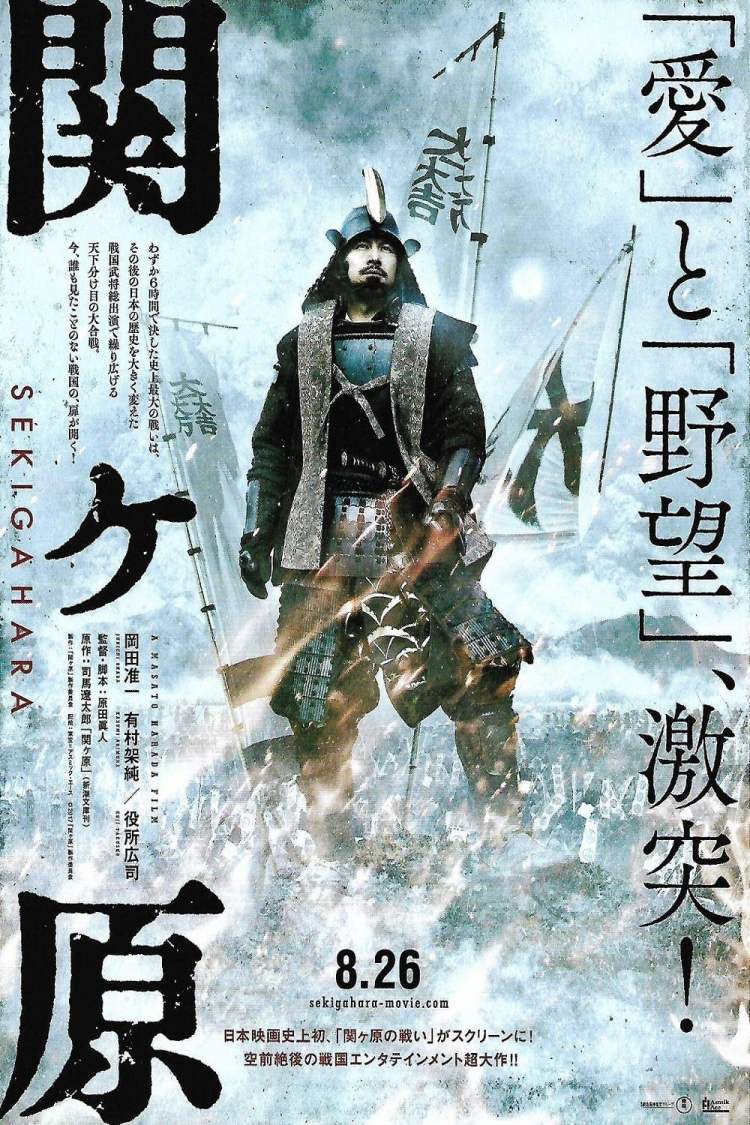
Sekigahara posterWhen considering a before and an after, you’d be hard pressed to find a moment as perfectly situated as the Battle of Sekigahara (関ヶ原). Taking place on 21st October 1600 (by the Western calendar), Sekigahara came at the end of a long and drawn out process of consolidation and finally ended the Sengoku (or “warring states”) era, paving the way for the modern concept of “Japan” as a distinct and unified nation. In actuality there were three unifiers of Japan – the first being Oda Nobunaga who brought much of Japan under his control before being betrayed by one of his own retainers. The second, Toyotomi Hideyoshi, continued Oda’s work and died a peaceful death leaving a son too young behind him which created a power vacuum and paved the way for our third and final creator of the modern Japanese state – Tokugawa Ieyasu whose dynasty would last 260 years encompassing the lengthy period of isolation that was finally ended by the tall black ships and some gunboat diplomacy.

Loosely, we begin our tale towards the end of the rule of Toyotomi Hideyoshi (Kenichi Takito) though, in a nod to the novel, director Masato Harada includes a temporal framing sequence in which our author depicts himself as a boy during another war sitting in these same halls and hearing stories of heroes past. As well he might given where he was sitting, the narrator reframes his tale – our hero is not the eventual victor, Tokugawa Ieyasu, but a noble hearted retainer of the Toyotomi, Mitsunari (Junichi Okada).

Riding into battle, Mitsunari reminds his men that this is a war of “justice and injustice” – they cannot lose. Yet lose they do. The narrator recounts Mitsunari’s improbable rise as an orphan taken in by Hideyoshi on a whim who nevertheless became one of the most powerful men in late 16th century Japan. Despite his loyalty to his master, Mitsunari cannot abide the cruelty of the samurai world or its various modes of oppression both in terms of social class and even in terms of gender. He resents the subversion of samurai ethics to facilitate “politics” and longs to restore honour, justice, and fairness to a world ruled by chaos. Rather than the bloody uncertainty and self-centred politicking that define his era, Mitsunari hopes to enshrine these values as the guiding principles of his nation.

On the other hand, his opponent, Tokugawa Ieyasu (Koji Yakusho) is famed for his intelligence and particularly for his political skill. Hoping to swoop into the spot vacated by Hideyoshi which his young son Hideyori is too weak to occupy, Ieyasu has been playing a long game of winning alliances and disrupting those other candidates had assumed they had secured. Unlike Mitsunari, Ieyasu is ruthless and prepared to sacrifice all to win his hand, caring little for honour or justice or true human feeling.

The framing sequence now seems a little more pointed. Sekigahara becomes a turning point not just of political but ideological consolidation in which Mitsunari’s ideas of just rule and compassionate fair mindedness creating order from chaos are relegated to the romantic past while self interest triumphs in the rule of soulless politickers which, it seems, travels on through the ages to find its zenith in the age of militarism. Mitsunari is the last good man, prepared to die for his ideals but equally prepared to live for them. His tragedy is romantic in the grander sense but also in the more obvious one in that his innate honour code will not let him act on the love he feels for a poor girl displaced from Iga whose ninja service becomes invaluable to his plan. With a wife and children to consider, he would not commit the “injustice” of creating a concubine but dreams of one day, after all this is over, resigning his name and position and travelling to foreign lands with the woman he loves at his side.

Working on a scale unseen since the age of Kurosawa, Harada patiently lays the groundwork before condensing the six hours of battle to forty minutes of fury. The contrast between the purity of the past and the muddied future is once again thrown into stark relief in the vastly different strategies of Ieyasu and Mitsunari with Ieyasu’s troops armed to the teeth with modernity – they fire muskets and shout cannon commands in Portuguese while Mitsunari’s veteran warriors attempt to face them with only their pikes and wooden shields. Unable to adapt to “modern” warfare and trusting too deeply in the loyalty of his comrades, Mitsunari’s final blow comes not by will but by chance as a young and inexperienced vassal vacillates until his men make his decision for him, betraying an alliance he may have wished (in his heart) to maintain. Goodness dies a bloody death, but there is peace at last even if it comes at a price. That price, for some at least, may have been too great.


Original trailer (no subtitles)
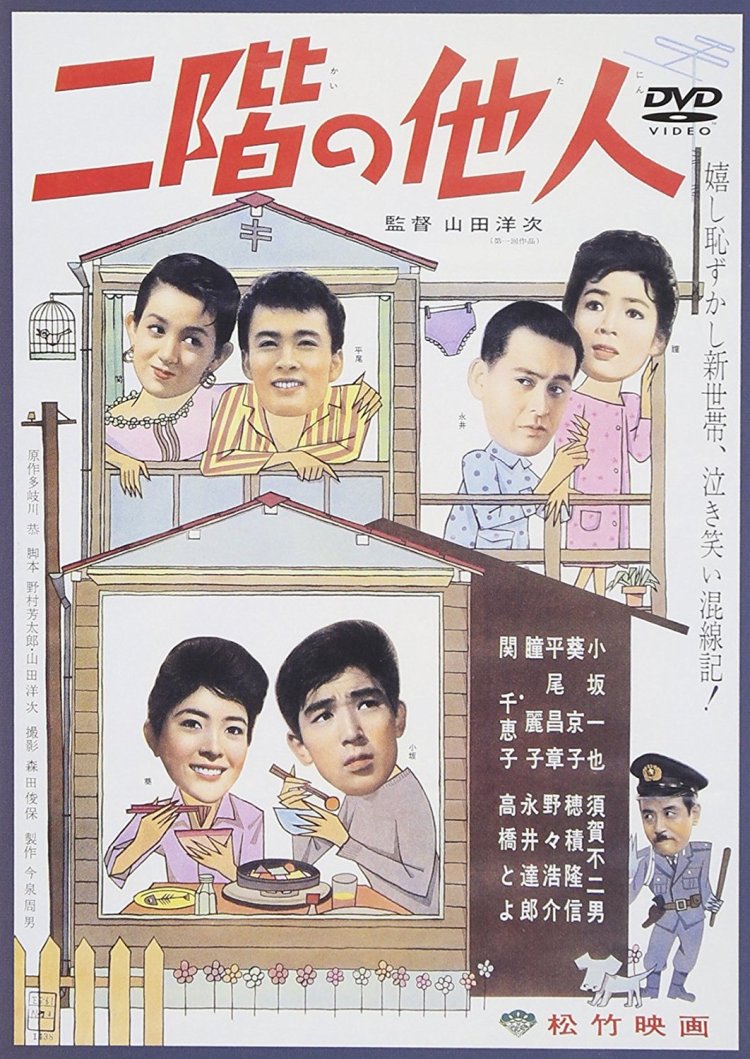
The Strangers Upstairs (二階の他人, Yoji Yamada, 1961)

strangers upstairsLate into his career, veteran Japanese director Yoji Yamada has become synonymous with a particular brand of maudlin comedies and tearjerking dramas often starring veteran actress and long standing collaborator Sayuri Yoshinaga. He is, however, most associated with the iconic long running Tora-san series which revolved around the heartwarming adventures of the titular travelling salesman. Tora-san does indeed epitomise Yamada’s general philosophy which leans towards realistic humanism, finding resolution in kindness and decency yet accepting that oftentimes the rules may need to be bent in order to accommodate them. In this respect his Shochiku debut, featuring a script written by his mentor Yoshitaro Nomura, is a good indicator of Yamada’s future career in its humorous tale of a newlywed couple filled with ambitions of social mobility in the rapidly modernising post-war economy.

Salaryman Masami (Kazuya Kosaka) has taken out a huge loan to build a new house for himself and his new wife, Akiko (Kyoko Aoi), but, to keep costs manageable, they’ve decided to do without a bathroom (there’s a bathhouse across the street) and added an extra floor with the intention of renting it out for a little extra money. So far, married life is going pretty well – Masami and Akiko are a nice, well matched young couple happy in each other’s company and committed towards forging a harmonious future.

The problem is their lodgers are a little, well, difficult. Not having anticipated any “difficulty”, Masami and Akiko are becoming worried that their upstairs neighbours are already a few months behind on the rent and seeing as their contract also includes food, they’ve been eating for free. Not really wanting to broach this difficult subject, Masami and Akiko try gentle prodding to remind their lodgers they need to pay their dues only for the couple to act embarrassed and claim they’d forgotten because they’d always lived with their parents in the past. Finding out that the central concern is that the husband, Hisao (Masaaki Hirao), is currently unemployed, Masami decides to help him find a job but quickly finds out that working is just not Hisao’s thing. Meanwhile, Hisao’s wife, Haruko (Chieko Seki), is picking up extra money working as a hostess in a bar, rolling in roaring drunk in the middle of the night and singing loudly as she does so.

With their patience wearing thin, Masami and Akiko ponder the best way to evict lodgers who refuse to leave but they have another problem on their hands in the form of Masami’s cantankerous mother, Tomi (Toyo Takahashi), who has arrived from the country without warning for an “indefinite” visit after falling out with another of her daughter-in-laws. An unsophisticated country bumpkin with a wicked tongue and serious hanafuda habit, Masami’s mum does not quite fit with the couple’s upwardly mobile aspirations and, annoyingly, immediately sides with Hisao and Haruko whose self-centred laziness is more in keeping with her backstreet ways.

If Masami and Akiko disliked Hisao and Haruko essentially for being too common, their second set of lodgers present the opposite problem. Taizo (Tatsuo Nagai) and Yoko (Reiko Hitomi) seemingly have money to burn, so why are they renting an upstairs room in an “up and coming” area of the city? Akiko is quickly taken with their small luxuries, in awe of her lodgers’ sophistication and upperclass elegance and obviously happy that they won’t be having the same kind of troubles that they had with Hisao and Haruko. When Taizo and Yoko offer to front the money to build a bathroom, Masami and Akiko are surprised but eventually grateful even if taking a “loan” from the people who are renting from you presents a definite shift in power dynamics.

The dynamic shifts even further with another crisis sparking the return of Masami’s mum who has once again been kicked out by a disgruntled relative. Masami’s older brother, who put up some of the money for the house, insists that he honour a vague promise he made that family members in need of refuge would be free to stay with him by kicking out his lodgers and letting his mother live in the upstairs room. Not really wanting to take responsibility for his troublesome mother, and feeling friendly with Taizo and Yoko, Masami refuses and promises to pay his brother back instead – ironically borrowing the money from Taizo.

As predicted Taizo and Yoko are not quite all they seem, but like Masami and Akiko, they are a fairly new couple trying to make a go of it in the often cruel post-war world. On finding out the scandalous secret about their lodgers, Masami and Akiko are torn – they like Taizo and Yoko, plus they’re massively indebted to them thanks to the loan and the money for the bathroom, but they also worry about becoming an accessory or being accused of aiding and abetting. Their first reaction is to feign politeness and carry on as normal pretending not to know whilst asking around to see if they can borrow more money from other friends to pay back Taizo and Yoko before asking them to leave quietly.

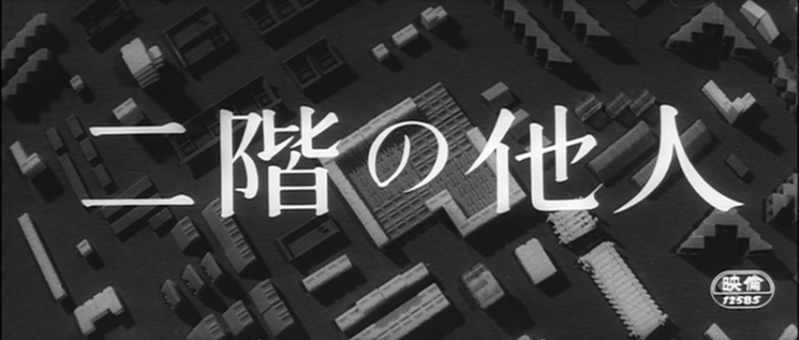
Masami and Akiko, like many of their peers, have aspirations beyond their current pay level and have put themselves at a huge disadvantage trying to live up to the salaryman dream. Yamada opens with an ironic title sequence featuring a series of “Lego” model houses – something which Masami later plays with while lamenting the seemingly small possibility of hanging on to his new home. Homeowning is unexpectedly complicated and becoming a landlord even more so. Masami and Akiko wanted their own mini castle – a status symbol (the policeman’s wife from behind is very jealous), but also a space to call their own which reflects their individual hopes, dreams, and aspirations. They’ve forgone the convenience of a bathroom for the impact of a second floor all while hoping it will pay for itself until they’re ready to use it to expand their family. Until then, they’re content to live in one room and share a kitchen, even providing communal meals if necessary.

The money, however, is a constant worry – the original debt which they accrued to build the house quickly brings its own share of troubles, shifting from one creditor to another as the couple try to invest their fortunes with “nicer” or “worthier” people. Not everyone is nice, as Akiko finds out when she asks Masami’s lecherous boss if he’d mind lending them the money only for him to hint at an extremely indecent proposal. Though Masami seems to be a decent and honest sort who wants to work hard and get on, he is still subject to the salaryman chain of command which means doing his boss’ bidding out side of work hours which turns out to entail further “alibi” duties when he discovers they’re virtually neighbours (though the boss’ house is obviously far more impressive).

Despite all their difficulties, the goodness of Masami and Akiko eventually pays off, their one and only row quickly resolving itself without rancour. Taizo and Yoko, neatly matched in kindness with their former landlords, are grateful for the brief time they spent in the upstairs room and resolved not to bring any trouble into the lives of the nice young couple from downstairs. Masami and Akiko, equally grateful for the consideration, commit themselves to moving forward with a little more temperance, saving the money to pay back Taizo and Yoko and help them in turn when they might need it. Hard work, honesty, and a kind heart, it seems, are what you need to be happy in the burgeoning post-war economy and Masami and Akiko are happy indeed.


Original promo roll (no subtitles)

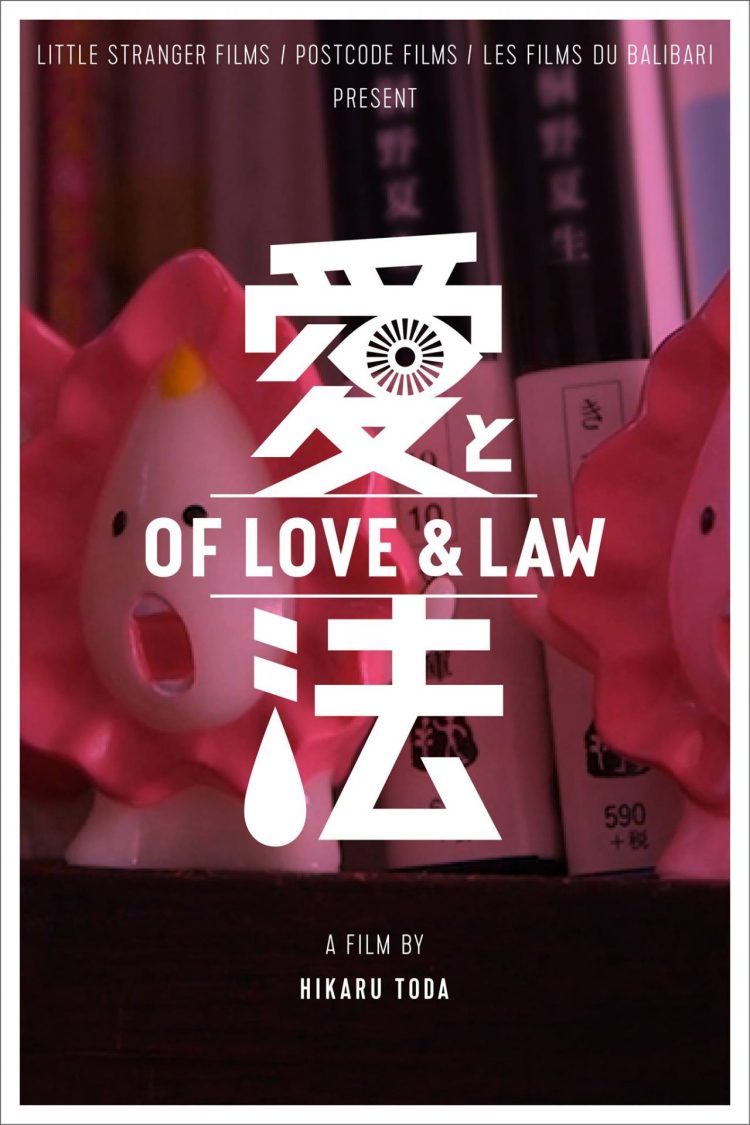
Of Love & Law (愛と法, Hikaru Toda, 2017)

of love and law posterIn Japan the nail which sticks out is hammered down. Conformist societies promise mutual support, but all too often only when it suits the collective – those not deemed part of the club are wilfully left to fend for themselves with the dangled promise of readmission if one promises to reform and abide by the rules. We first met the couple at the centre of Hikaru Toda’s Of Love & Law in her previous documentary, Love Hotel, which documented their struggles with discrimination in frequently being turned away by establishments who did not wish to rent a room to two men. A same sex married couple in Japan’s second city of Osaka, Kazu and Fumi run their own law firm and operate under the mission statement of representing those who often find themselves without a voice in a culture which favours silence.

Opening at a local Pride event, the camera attempts to capture some talking heads but no one will bite. Asked for comments, the visitors each refuse to show their faces, revealing that they aren’t fully out, fearing that it might cause problems for them at work, or just embarrassed to go on the record about something so taboo. Though the law practice is not limited to representing LGBT issues, they are clearly a key concern to Fumi and Kazu who spend their “free” time engaging in outreach projects trying to foster a little more education and understanding of sexual minorities. Kazu brings this home when he tells his own coming out story in which his stunned mother exclaimed that she’d never heard of anything like this and therefore could not understand it. The problem wasn’t prejudice, it was ignorance mixed with fear.

Ignorance mixed with fear could equally well describe most of the cases brought against Kazu and Fumi’s clients. The protagonist of the second strand – artist and mangaka Rokudenashiko whose legal troubles even made the foreign press, attributes many of these issues to an inability to “read the air” or aquedately understand the unspoken rules of society and then silently abide by them. The law firm makes a point of defending those who have chosen to fly in the face of social convention, flying a flag for the freedom of choice in a society which often deliberately suppresses it.

The freedom of choice is certainly a key issue for the teacher suing the Osakan school that fired her for refusing to stand for the national anthem. Arguing that standing when one is forced to stand is hardly a declaration of patriotism and fearing the lurch to the right which has made even implicit indifference to the Imperial family a hot button issue, the teacher puts her foot down but finds that few will listen. Similarly, Rokudenashiko finds herself arrested for obscenity regarding her vagina themed artwork while the court undermines its own argument by accidentally proving that her work has socio-political merit.

Yet Rokudenashiko and the teacher have each, in a sense, made a firm decision to challenge the intransigence of their society, hoping to prevent a further decline even if not overly hopeful of improvement. Other clients on the roster include a fair few who are accidentally undocumented through no fault of their own thanks to Japan’s arcane and idiosyncratic legal system which makes it difficult to register births of children born out of wedlock or in difficult family circumstances meaning that youngsters sometimes grow up without the proper papers leading to problems with accessing education, employment, healthcare and welfare provisions. Getting someone a birth certificate who doesn’t currently “exist” can prove a taxing ordeal, especially as government officials often regard children born to “immoral” women as “unworthy” of care or attention.

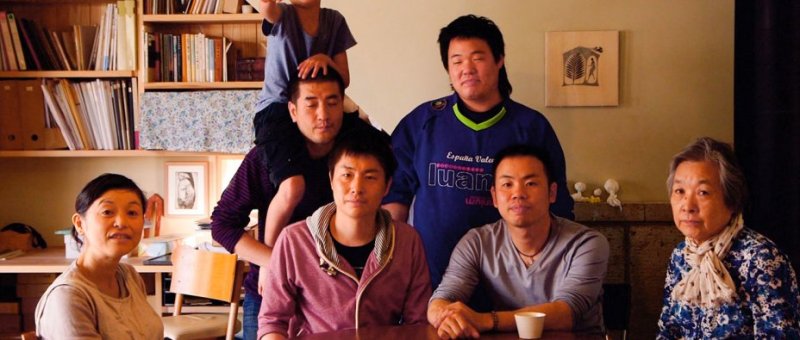
Getting a call from the mother of a victim, Fumi is shocked when she makes a point of enquiring about the nationality of the perpetrator. He is unsurprised but disappointed in witnessing the various ways one oppressed person (both the victim and plaintiff are from impoverished, single parent backgrounds) can turn their oppression back on others as an odd kind of social revenge. Luckily, however, there are good people everywhere such as the fine young man Fumi and Kazu end up temporarily fostering after his care home is unexpectedly closed down. Kazuma accepts their relationship without a second thought, enjoys learning to cook from Fumi and blends right into Kazu’s extended family who each seem as warm and accepting as the couple themselves. Family is not about a register, it’s having a place to go where they’ll always take you in. Fumi doesn’t trust society because society shirks its responsibilities, but thankfully there are those who know better and continue on in hope tempered with patience.


Screened at BFI Flare 2018.

Korean Film Nights 2018: Korean Novels On Screen

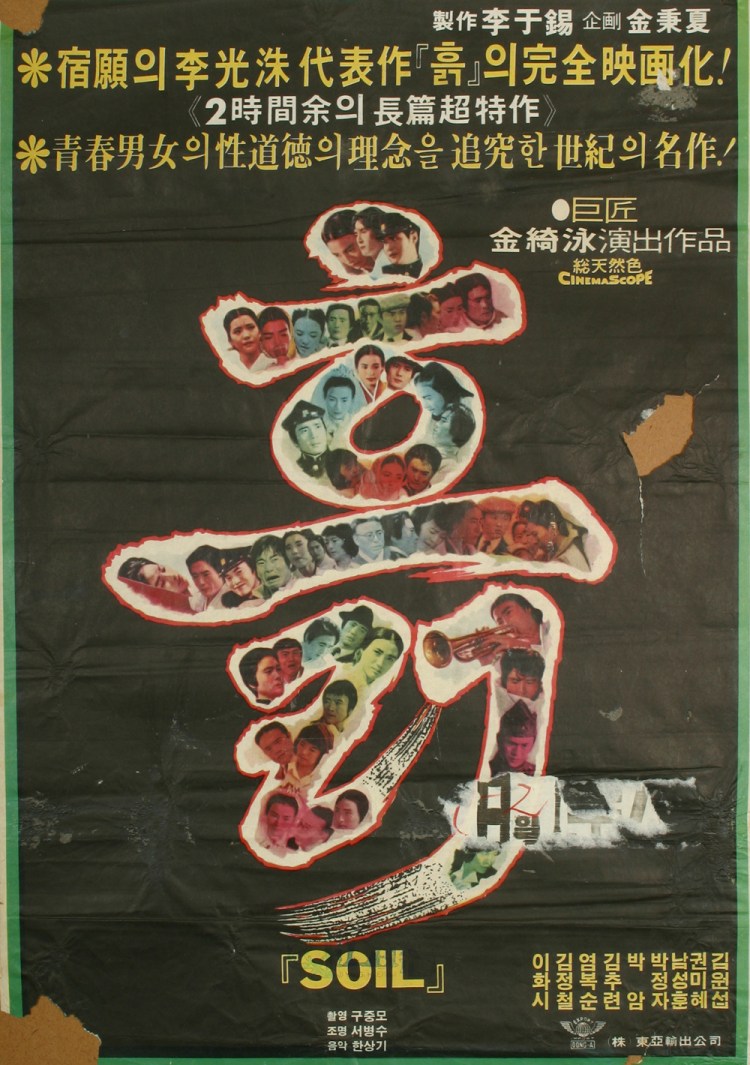
Kim Ki-young earth posterAfter a brief pause, the Korean Cultural Centre London is set to resume its series of free film screenings with a brand new strand celebrating literary adaptations. Running from March to June, Korean Film Nights 2018: Korean Novels on Screen will showcase a diverse selection of films inspired by books from the “literary films” of the golden age to the recent hits of today.

29th March – Earth 

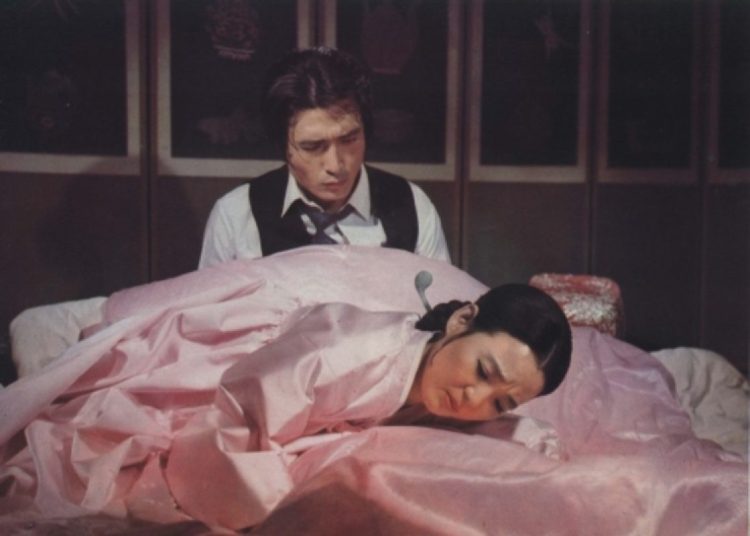
Earth-02Housemaid director Kim Ki-young adapts Yi Kwang-su’s 1932 novel of resistance in which a poor boy studies law in Seoul and marries the daughter of the landowner he once served only to decide to return and help his home village suffering under Japanese oppression.
Also screening at Deptford Cinema, 16th April, 7pm.

12th April – The Descendants of Cain

Descendants of Cain poster 2

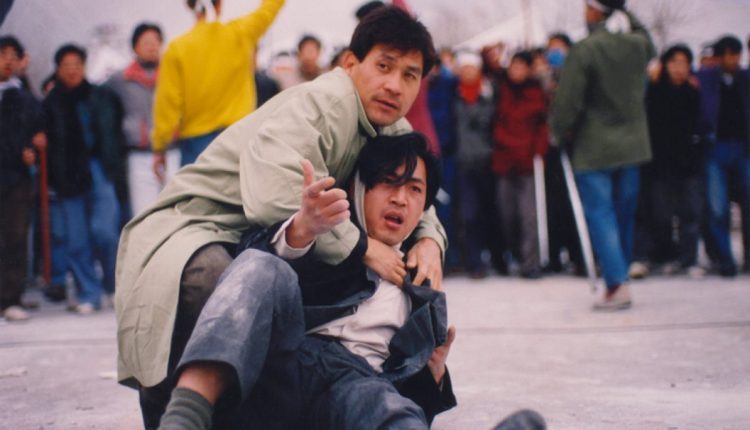
Yu Hyun-mok (Aimless Bullet) adapts Hwang Sun-won’s autobiographical anti-communist novel in which a struggle over the means of production plays out against an impossible love story between the estranged wife of a communist agitator and the noble hearted founder of the school the communists have commandeered as their base.

26th April – White Badge

White Badge still 1Directed by Chung Ji-young, White Badge adapts Anh Junghyo’s autobiographical Vietnam novel in which a traumatised writer (played by Ahn Sung-ki) is forced to address his wartime past when an old comrade comes back into his life.
10th May – A Petal

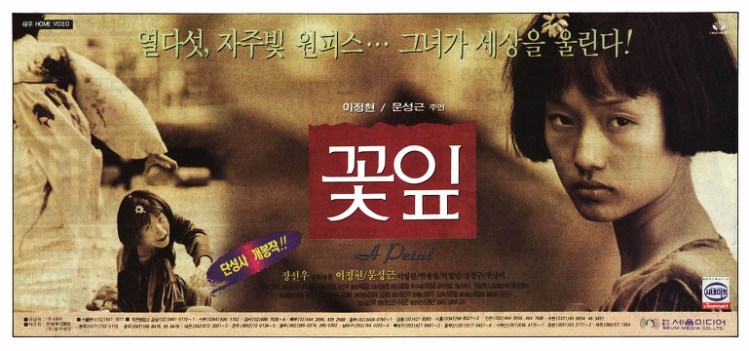
a petal horizontalAdapting the novel by Choe Yun, Jang Sun-woo examines the legacy of the Gwangju Massacre through the story of a little girl who refuses to leave the side of a vulgar and violent man no matter how poorly he treats her.
Also screening at Deptford Cinema, 22nd May, 7pm.

24th May – The Old Garden

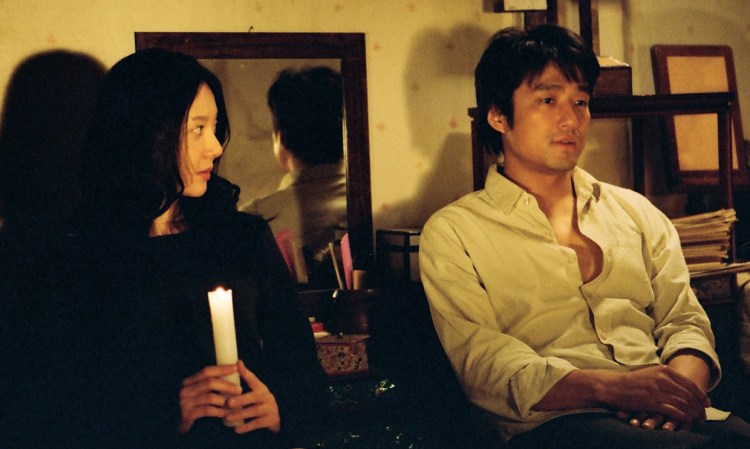
the old garden still 1Adapted from a novel by writer and activist Hwang Sok-young, Im Sang-soo’s The Old Garden follows an activist released from prison after 17 years who cannot forget the memory of a woman who helped him when he was a fugitive in the mountains.
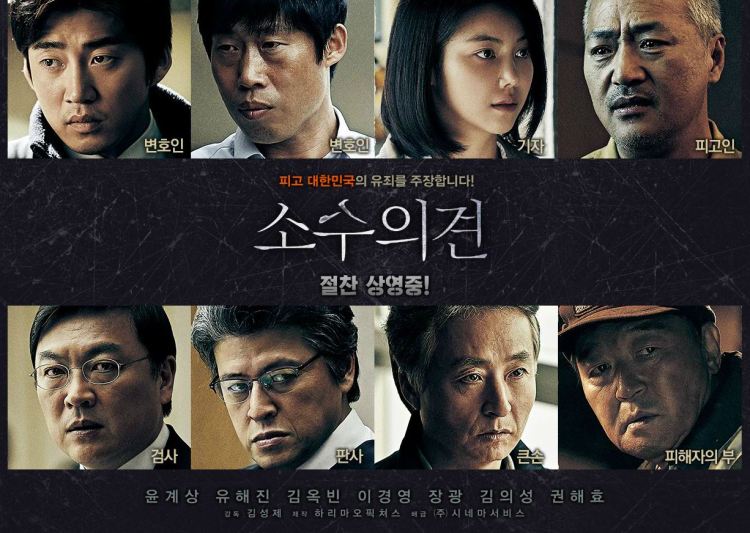
7th June – The Unfair

The unfair horizontalThe debut feature from Kim Sung-je, the Unfair is an adaptation of Son Aram’s courtroom thriller which draws inspiration from the Yongsan Tragedy in which residents protesting redevelopment were forcibly evicted and several lives were lost including one of a police officer.
Also screening at Deptford Cinema, 19th June, 7pm.

28th June – My Brilliant Life + Q&A with author Kim Ae-ran

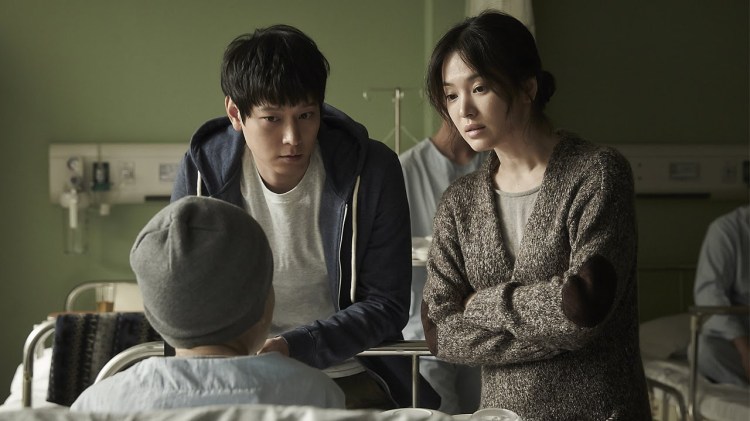
my brilliant life still 1An adaptation of the novel by Kim Ae-ran who will also be present for a Q&A, E J-yong’s My Brilliant Life stars Gang Dong-won and Song Hye-kyo as teenage parents raising a son who turns out to have a rare genetic condition which causes rapid ageing.
All of the screenings take place at the Korean Cultural Centre at 7pm and are free to attend but must be booked in advance via the links above. You can keep up to date with all the latest screening news via the Korean Cultural Centre and London Korean Film Festival websites and be sure to follow the festival on Twitter, Facebook, Flickr, Instagram and YouTube channels for the most up to date information.

Tickets are also now on sale for the first of the 2018 Teaser Screenings for the upcoming London Korean Film Festival – Be With You which takes place at Picturehouse Central on 25th April at 9pm.

Malila: The Farewell Flower (มะลิลา, Anucha Boonyawatana, 2017)

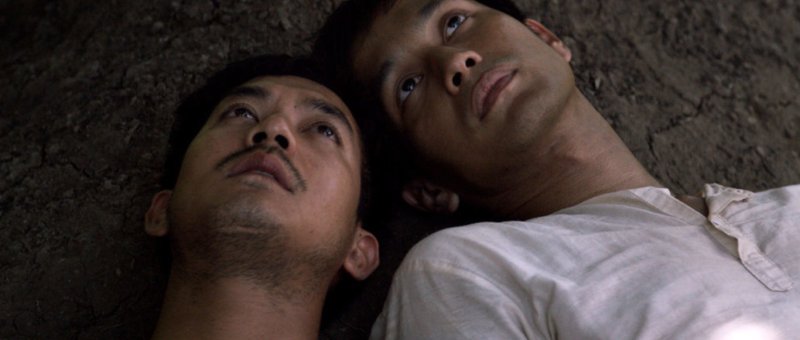
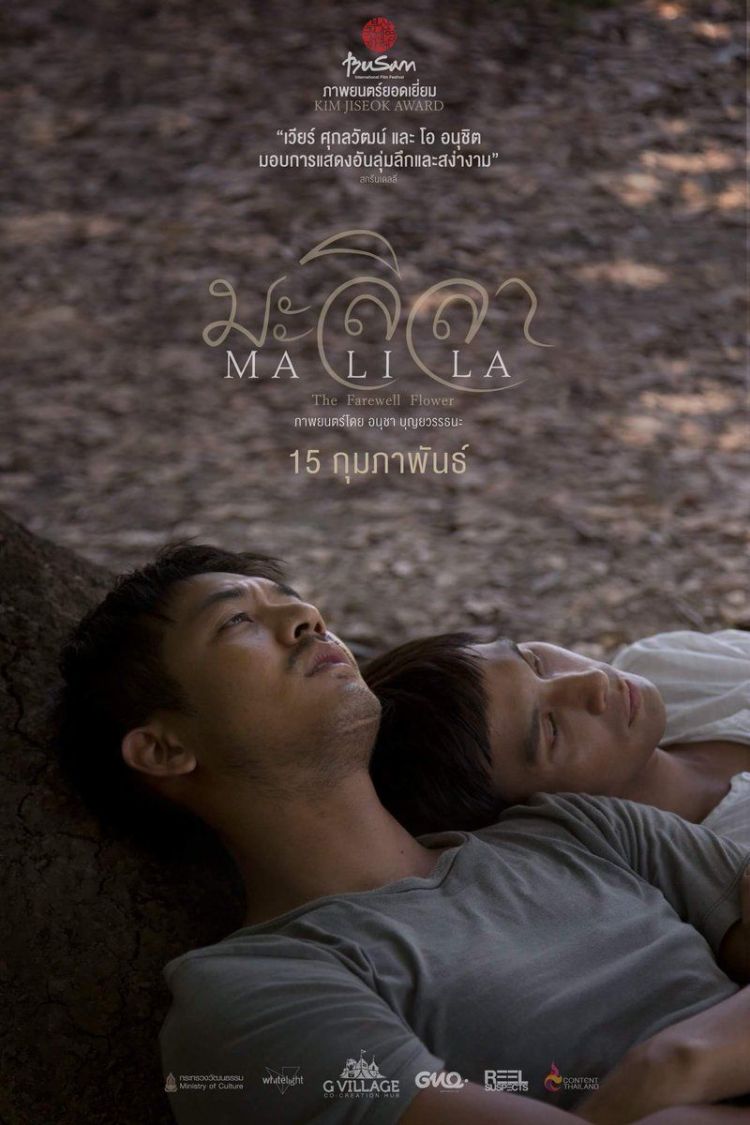
Malila posterAnucha Boonyawatana’s second feature, Malila: The Farewell Flower (มะลิลา), opens with a quotation from a 19th century poem. The poem laments that even a Baisri painstakingly created to honour the gods will eventually be cast away once it has served its purpose. No longer divine, its soul departed, the ornament is just another thing to be disposed of. Like the beautiful Baisri, two men’s souls will briefly intertwine only for the flowers of their love to wither on the vine, fading away with the great work still incomplete. This incompleteness, the lingering sense of absence and irreconcilable longing, propel the one left behind onto a spiritual journey hoping to discover if the answers to his need lie within or are not to be found at all.

Shane (Sukollawat Kanarot), the owner of a jasmine plantation, has recently begun to rebuild his life following a period of heavy drinking during which his wife left him and his young daughter was killed by a python in the jungle. Reuniting with his former lover, Pich (Anuchit Sapanpong), Shane is distraught to find out that he is terminally ill with lung cancer and has decided to give up on conventional medicine and devote the rest of his life doing the things that make him happy. Pich’s one form of “treatment” is in his constant making and dispatching of “Baisri” – ornaments constructed from leaves and flowers for ceremonial occasions which, painstakingly created, must be sent away on the river after they have fulfilled their purpose.

Jasmine flowers are, as Pich remarks, too weak – they wither before the Baisri is completed. Though the two men are able to rekindle their romance, their time is limited. Shane contemplates becoming a monk in the hope that his good karma can be transferred to Pich but it is not to be. Alone, he sets out on a spiritual journey guided by another monk hoping to encounter the ghosts of himself and of his loves to absolve himself of his guilt and loneliness.

Set against the beautiful Thai landscape, Malila is a tale of fading flowers and eternal regrets. The art of Baisri requires intense focus and dedication in order to repurpose and reorder nature into something essentially manmade but beautiful. Later, during his quest, Shane will be met with a terrifying though no less intense experience when his guide and fellow monk instructs him in the art of corpse meditation. The sight of the body, putrid and infested with hungry maggots busily going about their business, presents a strong contrast with the otherwise idyllic scenery and forces a more literal contemplation of the process of decay as the human form dissolves leaving only memory and a ghost of past emotion in its place.

Ironically, or perhaps not, a Baisri is intended to mark a new beginning – a “farewell” on an onward journey. Shane sets off on a spiritual quest, suffering nobly in the forests with their frequent rainstorms and learning to be in the moment in the company of the comparatively better experienced monk who guides him, a former soldier now on the spiritual path. His search is internal but illuminated by the world around him and his gradually increasing connection with it.

Eventually transcending this world for another, Shane begins to find his answers and finally cleanses himself of his loss and suffering. Mixing lyrical poetry with beautifully photographed naturalism, Anucha Boonyawatana tells a painful tale of love lost and found, hearts broken and repaired, and finally of acceptance both of one’s self and of the transience of all things. Malila: The Farewell Flower is a parting gift to a departing love, filled with sorrow and regret but also with beauty even in decay.


Screened at BFI Flare 2018.

Original trailer (English subtitles)

The Ballad of Narayama (楢山節考, Shohei Imamura, 1983)

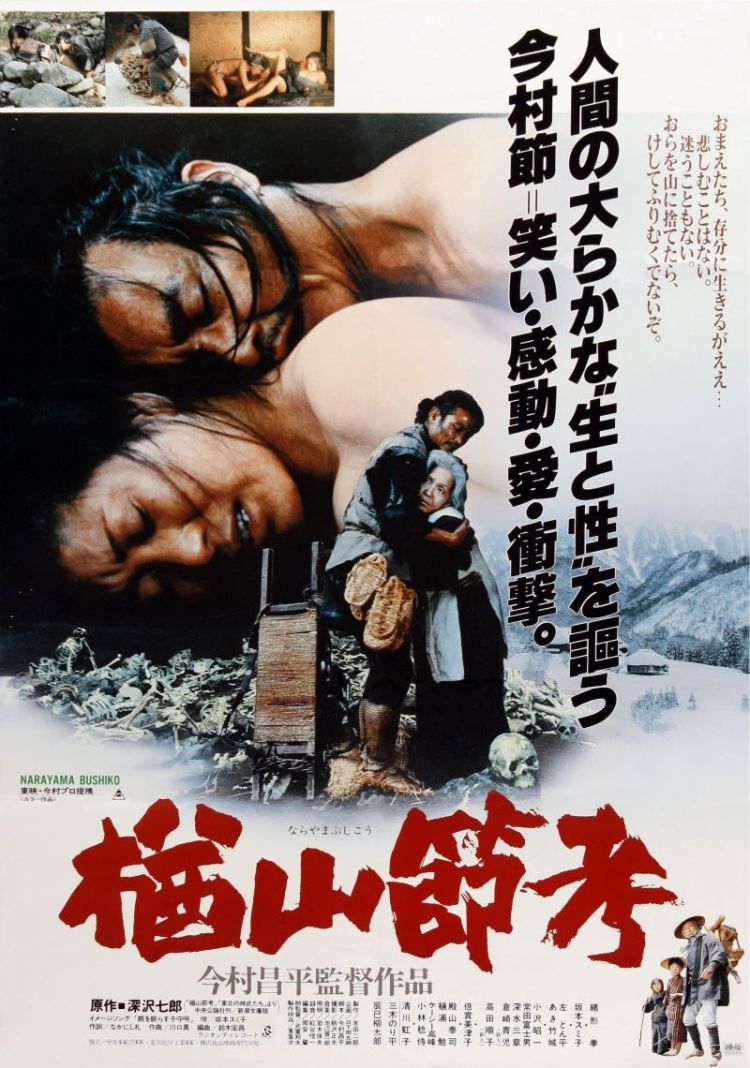
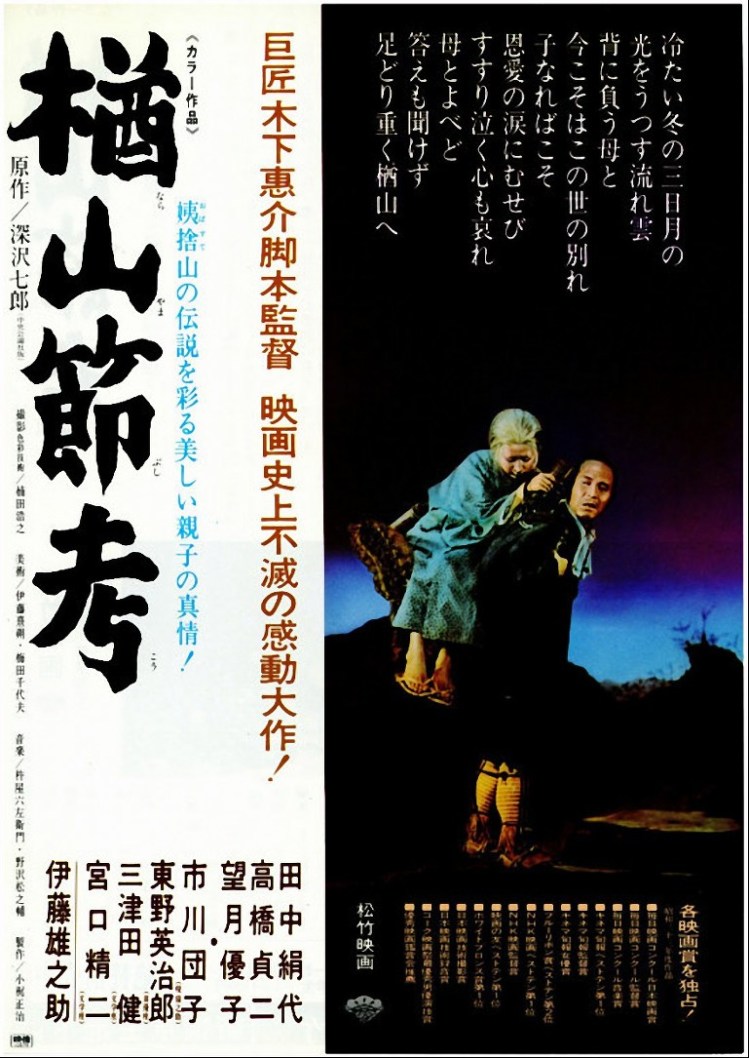
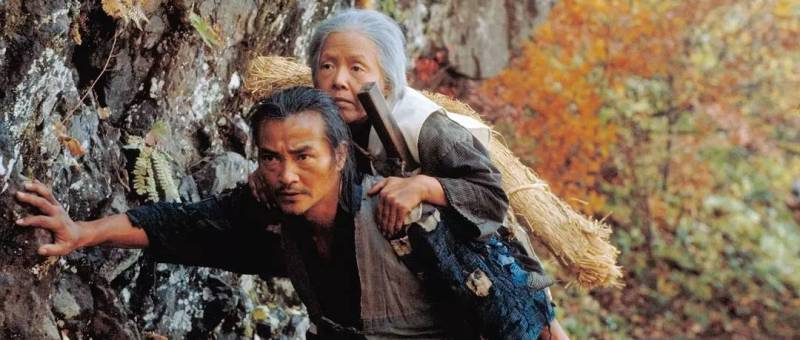
ballad of narayama imamura 1983 posterWhen Keisuke Kinoshita decided to dramatise The Ballad of Narayama (楢山節考, Narayama Bushiko), adapted from a recent novel inspired by the ancient legend of “ubasute”, he recast it is as myth – a parabolic morality play adopting the trappings of kabuki to tell a timeless tale of transience and sacrifice. As much as Kinoshita praised the heroine’s kindness and altruistic sense of duty, he also questioned her failure to question the cruel and arbitrary social codes which defined her life, sacrificing her deep familial love for the cold austerity of religious reward. Shohei Imamura, slightly younger than Kinoshita, had also read the novel when it came out though he was not sufficiently progressed in his career to have considered adapting it for the screen. Unlike Kinoshita’s highly stylised approach, Imamura opts for his trademark sense of realism, exposing nature red in tooth and claw as he attempts to restore rural earthiness to the rarefied cinema screen.

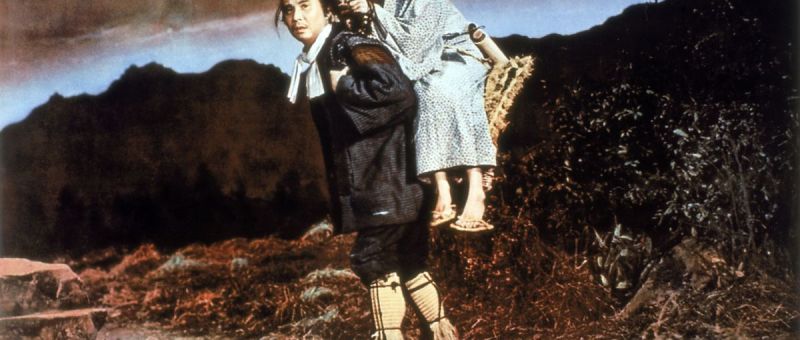
Deep in the mountains, a small village does what it can to survive in harsh terrain. 69-year-old Orin (Sumiko Sakamoto) is as strong as they come but she is preparing to meet her end. In the villages of these parts, men and women of 70 are carried by their children to summit of Mount Narayama where they are left as a sacrifice to the god, praying for snow to hasten an otherwise long and drawn out death. Orin’s husband disappeared 30 years ago, the laughing stock of the village for his sentimental aversion to carrying his own mother up the mountain, and her son, Tatsuhei (Ken Ogata) seems equally reluctant to accept that Orin will making her own journey as soon as the next snows arrive.

Existence is indeed cruel. The custom of “obasute” or “throwing away” one’s old people, originated because of a lack of food. There not being enough sustenance to support a large population, the old sacrifice themselves in the name of the young. Life is cheap and of little consequence. Tatsuhei’s simple-minded younger brother, Risuke (Tonpei Hidari), notices the body of a newborn baby emerging from the melting snow to the edge of his rice paddy but the sight does not disturb or sadden him – he is annoyed that someone has “dumped” their “rubbish” on his land. Baby boys, oddly, are worthless – just another mouth to feed until it becomes strong enough to work, but baby girls are a boon because they can be sold. Orin herself sold her baby daughter in desperation following a bad harvest, and when the salt seller calls in unexpectedly Orin is at pains to tell him they’ve still not made a decision as to whether to sell her granddaughter who has been left without a mother following the death of Orin’s daughter-in-law in a freak accident.

She needn’t have worried however because the salt seller is bringing good news – a new wife for Tatsuhei, meaning Orin can make her final journey with an unburdened heart knowing that the household will be taken care of. Tamayan (Aki Takejo), a kind and cheerful woman much like Orin herself, fits right in despite the objections of Tatsuhei’s teenage son, Kesakichi (Seiji Kurasaki), who has got his girlfriend pregnant and wants to “marry” her – bringing not one but two extra mouths into his household. Orin loves him dearly, but all Kesakichi can do is make fun of his granny for still having all her teeth and resentfully enquire if she isn’t needed somewhere up a mountain sometime about now.

Kesakichi’s coldness and selfishness is contrasted with the goodness and warmth of Orin and her son. Hardship, far from bringing people together in their shared struggle, has made beasts of all. Imamura splices in frequent shots of animals copulating or feasting on each other – rats gnawing on the body of a snake giving way to a snake swallowing the body of a twitching grey mouse. Yet it is nature that will win in the end. Early on the village men chase a hare in the snow, Tatsuhei shooting it dead, only for an eagle to swoop down and make off with the prize. On the mountain, strewn with bones, a host of flapping crows emerges from a battered rib cage. 

Catching a thief is no different to catching a hare. Convinced that the thief’s family is a curse on the village, the villagers determine that they must all be eliminated – the roots of a poisoned tree must be burned away. Breaking into the home, friends and former neighbours tie up and kidnap an entire family, burying them alive and then redistributing all their worldly goods in “recompense” for what they’d “lost”. The cycles of loss and redistribution continue, as Tatsuhei observes finding Orin’s belongings draped around other shoulders. Kesakichi, having lost one lover, quickly takes another forgetting the first while Tatsuhei struggles to come to terms with the loss of his mother and the knowledge that someday he too, and Kesakichi, and the sons of Kesakichi, will make this same journey to this same spot.

Kinoshita’s secondary concern had been with the cruelty of the custom and the mechanisms of social conformity which enforced it, but Imamura almost seems to be in agreement with the villagers, finding horror but also beauty in the sacrifice of Orin who accepts her fate with transcendent beatification and willingly sacrifices herself to the mountain gods. The world is cruel, and tender. A son’s acceptance of his mother’s sacrifice becomes the greatest expression of a love he must destroy by honouring.


Original trailer (no subtitles)

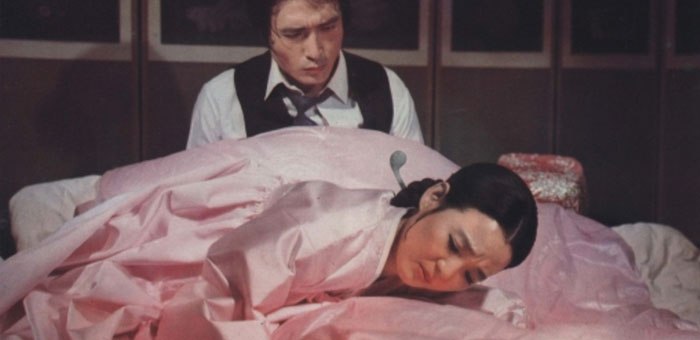
The Ballad of Narayama (楢山節考, Keisuke Kinoshita, 1958)

ballad of narayama kinoshita 1958 posterMany naughty children running low on filial piety have probably been told the folktale about a man who took his son along when he abandoned his senile father on a mountain to die only to have his son later do the same thing to him. In Japan, the mythical practice of “obasute” or “ubasute” is a kind of Logan’s Run equivalent in which elderly people elect to remove themselves from society in order to reduce the burden on the young. The Ballad of Narayama (楢山節考, Narayama-bushi Ko) has, perhaps, taken on an additional degree of pathos in ageing Japan in which many elderly people find themselves metaphorically cast out from a society in which they have become the majority, but the idea of “obasute” is intended to be a lesson to the young to treasure their elders and accept the responsibility to care for those who can no longer care for themselves in the knowledge that they too will one day be old.

Keisuke Kinoshita is sometimes criticised for his supposed sentimentalism but his central concern was always in the redemptive power of the relationships between people, that there is always kindness even in the worst of circumstances and that this is enough for hope to survive. In telling the sorry tale of Narayama in which those of over 70-years-of-age are forced into a ritual suicide by social convention, Kinoshita opts for alienation in deliberately shifting into a theatrical register inspired by kabuki featuring obvious studio sets, stylised action, and traditional narration, but his decision to pull back makes the message all the more painful, as does the insistence on the timelessness of his tale.

Long ago in the distant feudal past, 69-year-old Orin (Kinuyo Tanaka) knows that it will soon be time for her widowed son, Tatsuhei (Teiji Takahashi), to carry her to Narayama where she hopes to die of exposure in the New Year snows. She has made her peace with this, it is the will of the gods and she has no call to disobey. Her son, however, is distraught to think of the time he will be expected to carry his elderly mother to a remote spot in the mountains and leave her there, alone, to die of cold and starvation. When a messenger arrives from Orin’s home village to propose a match for Tatsuhei, a recently widowed woman of exactly the same age – Tama (Yuko Mochizuki), Orin is overjoyed – she can go to Narayama without fear or worry, her son and grandsons will be looked after even after she is gone.

The tradition began because the villages in this region are extremely poor. Tatsuhei and Orin will be enjoying their one and only bowl of white rice for the year in celebration of Bon. Orin’s self-centred grandson Kesakichi (Danko Ichikawa) has made up a horrible song about his grandma in which he criticises her for still having all her own teeth at 70 – implying that, as she is not malnourished enough to have lost them, she must have been greedy and taken more than her fair share of food. Unable to bear such reproach, Orin smashes out her own front teeth to better conform to the conventions of her society and make herself a more acceptable sacrifice to the gods as a good and pious woman.

This early horrific act is perhaps the key in illuminating Kinoshita’s gentle critique of social conformity as a tool of social control – something which had become increasingly apparent during the militarist era. Orin, a kind and decent woman, is herself complicit in this abhorrent custom – her acceptance of it is part of her goodness, a sign of her altruistic self-sacrificing nature, but her own unwillingness to challenge the darker aspects of the society in which she lives leads only to their perpetuation and an ongoing descent into unkindness and cruelty.

Tatsuhei, a good and pious son, cannot reconcile himself to his mother’s fate, while his own son, Kesakichi, openly mocks his grandmother for not going sooner and Kesakichi’s pregnant girlfriend (Keiko Ogasawara) looks on enviously at the extra beans on offer if there were one less mouth to feed. Old and bent, Orin still plays a vital part in her community – she harvests the rice while Kesakichi lounges in trees, and she alone knows the best place to catch trout, a valuable skill in a village where food is scarce. Despite the possibility for disaster, Orin and Tama bond instantly as kindred spirits, both kind people in an often unkind world. It’s to Tama that Orin finally divulges her knowledge – something the village will be poorer for when she is gone, having passed her familial responsibilities to another woman and seen her son happily settled with a perfectly suited second wife.

When Tatsuhei returns, broken, after having performed the dreaded ritual he watches his own cruel son laughing and joking from within their shared home, caring only for himself and his easy pleasures. Tama, equally upset over the loss of Orin with whom she had bonded as mother, tries to comfort her husband but is eventually overcome by the tragedy of life, taking comfort only in the fact that, when they are 70, she and Tatsuhei will climb Narayama together.

Hardship, far from bringing people together in the famous harmony that Japanese society praises itself for, has forced them apart, infected them with a sense of mutual distrust and a them or us mentality. Orin feeds the senile old man cast out from his own unfeeling family, but she also urges him towards making a sacrifice of himself on Narayama, genuinely believing that both of their existences have become inappropriate, a greedy usurpation of time which rightfully now belongs to others. Kinoshita respects Orin for her stoicism and righteousness, but pities her for the cruelty of the world in which she lived and was so powerless to resist that it never occurred to her that she should. There is a painful sensitivity around those who willingly went to their deaths in service of something they believed to be right because their society said it must be so, never daring to consider the ways in which their society may be mistaken.

Heavily stylised and markedly experimental for a mainstream Shochiku melodrama of the late 1950s, Kinoshita’s The Ballad of Narayama is a heartrending tale of transience and inevitability, but it’s also one of the various ways a stringent society erodes the bonds between people. The intense love of Tatsuhei for his mother is destroyed by a terrible custom that no one is brave enough to defy, leaving the family rudderless and the village poorer for having been robbed not only of Orin’s wealth of experience but of her warmth and kindness. Kinoshita ends on an ambiguous image showing us the modern train station which stands on the former village of “Obasute”, demonstrating the passage of time and arrival of “modernity” but also that ancient customs are never quite as “ancient” as they seem.


Scene from near the end of the film (English subtitles)

Noh Mask Murders (天河伝説殺人事件, Kon Ichikawa, 1991)

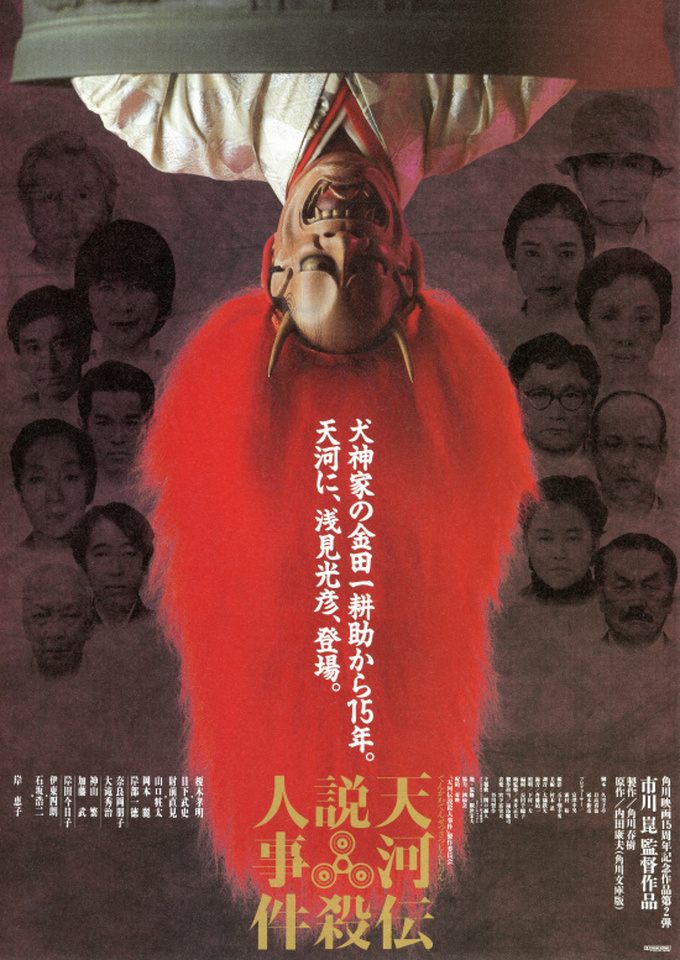
noh mask murders posterFor one reason or another, Japanese mystery novels have yet to achieve the impact recently afforded to their Scandinavian brethren. Japan does however have a long and distinguished history of detective fiction and a number of distinctive, eccentric sleuths echoing the European classics. Mitsuhiko Asami is just one among many of Japan’s not quite normal investigators, and though Noh Mask Murders (天河伝説殺人事件, Tenkawa Densetsu Satsujin Jiken) is technically the 23rd in the Asami series, Kon Ichikawa’s adaptation sets itself up as the very first Asami case file and as something close to an origin story.

Ichikawa, though he may be best remembered for his ‘60s arthouse masterpieces, was able to go on filmmaking where others perhaps were not precisely because of his forays into the populist with a series of mystery thrillers including several featuring top Japanese detective Kindaichi (who receives brief name check in Noh Mask Murders). Published by Kadokawa, Noh Mask Murders is produced by Haruki Kadokawa towards the end of his populist heyday and features many of the hallmarks of a “Kadokawa” film but Ichikawa also takes the opportunity for a little formal experimentation to supplement what is perhaps a weaker locked room mystery.

Asami (Takaaki Enoki) begins with a voice over as four plot strands occur at the same temporal moment at different spaces across the city. In Shinjuku, a salaryman drops dead on the street, while a young couple enjoy a secret tryst in a secluded forest, a troupe of actors rehearse a noh play, and Asami himself is arrested by an officious policeman who notices him walking around with a dead bird in his hand and accuses him of poaching. As he will later prove, all of these moments are connected either by fate or coincidence but setting in motion a series of events which will eventually claim a few more lives before its sorry conclusion.

To begin with Asami, he is a slightly strange and ethereal man from an elite background who has been content to drift aimlessly through life to the consternation of his conservative family which includes a police chief brother. He harbours no particular desire to become a detective and is originally irritated by a family friend’s attempts to foist a job on him but gives in when he learns he will have the opportunity to visit Tenkawa which is where, he’s been told, the mysterious woman who helped him out with the policeman in the opening sequence keeps an inn. Hoping to learn more about her, he agrees to write a book about the history of Noh and then becomes embroiled in a second murder which links back to the Mizugami Noh Family which is currently facing a succession crisis as the grandfather finds himself torn over choosing his heir – he wants to choose his granddaughter Hidemi (Naomi Zaizen) who is the better performer but the troupe has never had a female leader and there are other reasons which push him towards picking his grandson, Kazutaka (Shota Yamaguchi).

As with almost all Japanese mysteries, the solution depends on a secret and the possibilities of blackmail and/or potential scandal. The mechanics of murders themselves (save perhaps the first one) are not particularly difficult to figure out and the identity of the killer almost certainly obvious to those who count themselves mystery fans though there are a few red herrings thrown in including a very “obvious” suspect presented early on who turns out to be entirely incidental.

Ichikawa attempts to reinforce the everything is connected moral of the story through an innovative and deliberately disorientating cross cutting technique which begins in the prologue as Ichikawa allows the conversations between the grandchildren to bleed into those of Asami and his friend as if they were in direct dialogue with each other. He foregrounds a sad story of persistent female subjugation and undue reliance on superstition and tradition which is indirectly to blame for the events which come to pass. Everyone regrets the past, and after a little murder begins to see things more clearly in acknowledging the wickedness of their own actions as well as their own sense of guilt and complicity. Noh is, apparently, like a marriage, a matter of mutual responsibility, fostering understanding between people and so, apparently is murder, and one way or another Asami seems to have found his calling.


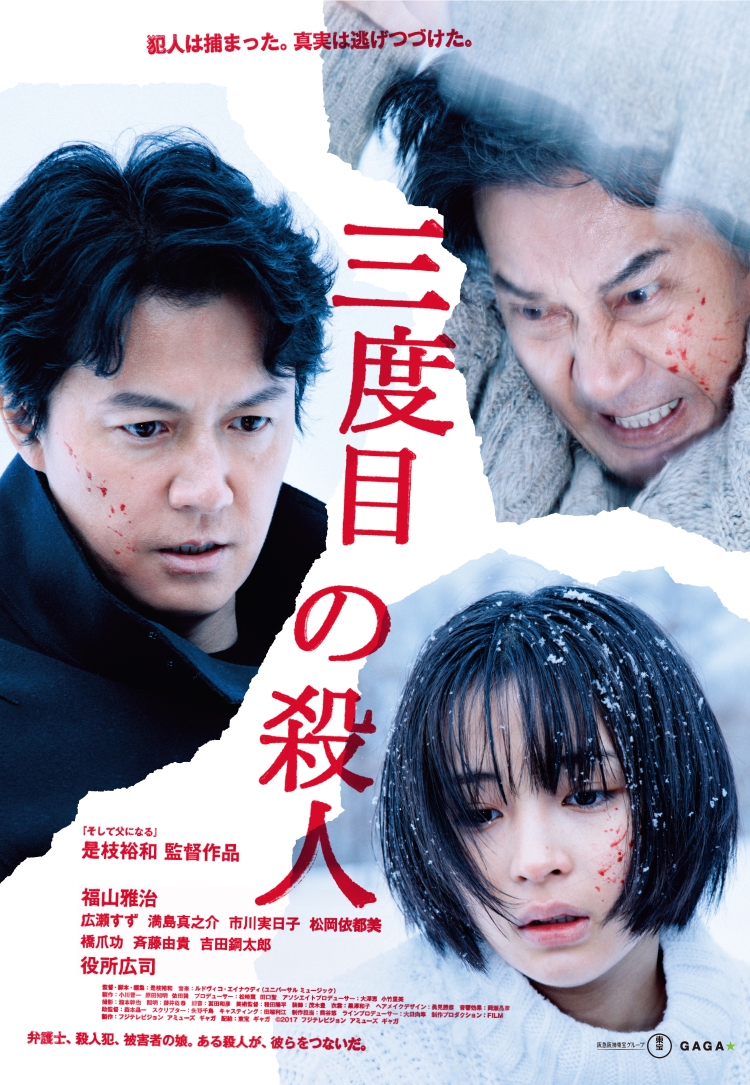
The Third Murder (三度目の殺人, Hirokazu Koreeda, 2017)

Third Murder posterJapanese cinema has often put the justice and legal system on trial and found it wanting. From Yoji Yamada’s Flag in the Mist in which a “selfish” lawyer contributes to the death of an innocent man, to Yoshitaro Nomura’s spiralling, feverish The Incident, Yoshimitsu Morita’s Kafka-esque Keiho, Gen Takahashi’s pointed Court of Zeus, and Masayuki Suo’s comparatively more straightforward I Just Didn’t Do It, the entire justice system takes on an almost spiritual quality of absurdity, tormenting the accused for the sake of a pantomime of justice, little caring for his or her guilt or innocence and intent only on propping up its own sense of absolute authority.

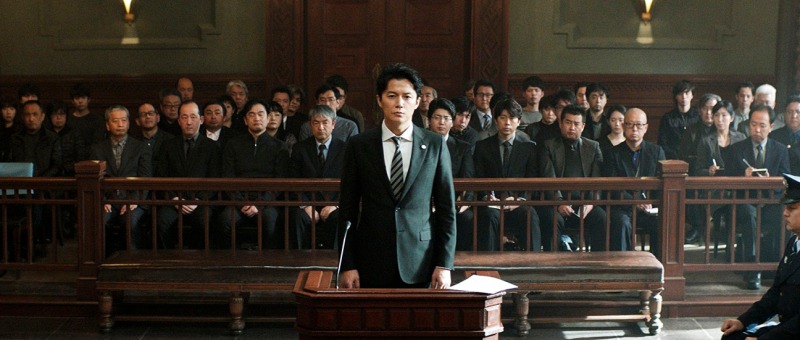
Like Yoji Yamada in Flag in the Mist, The Third Murder (三度目の殺人, Sandome no Satsujin) finds director Hirokazu Koreeda in unfamiliar territory though, at heart, it all comes back to family. A top lawyer, Shigemori (Masaharu Fukuyama), currently in the middle of a divorce, is asked to represent a man who has freely confessed to murder. As the son of the original judge who sentenced the accused, Misumi (Koji Yakusho), to the 30 year sentence he had not long been released from before (allegedly) committing the crime, Shigemori feels a responsibility to act but is frustrated by his client’s constantly shifting story. Nothing he says adds up, and every new angle Shigemori uncovers provokes only more doubt as to the true nature of the case at hand.

Shigemori, somewhat condescendingly, criticises the junior lawyer in the office for his naivety in wanting to to investigate the crime. Understanding and empathy are “unnecessary” in defending a client. The business of a lawyer, on either side, is to assess the evidence at hand, create an argument that withstands scrutiny, and eventually triumph in debating one’s opponent. In the face of the law, the “truth” is an irrelevance.

Shigemori’s cynicism is however rocked by the eerie presence of Misumi who seems to carry with him a kind of deepening emptiness. Misumi has already served 30 years in prison for the murder of two loansharks, the theft of their money, and an act of arson committed on their property to disguise the crime. Shigemori’s father, now a much older man, laments his youthful naivety in handing down a compassionate judgement which took into account the mitigating circumstances – Misumi’s troubled childhood, his poverty, the dire economic situation in which the closure of the local mines had led to mass unemployment and provided fertile ground for unscrupulous money lenders, and a series of personal tragedies which may have unbalanced his mind, but now he thinks some people are just bad and Misumi’s third murder is, in a sense, also his responsibility in allowing him the freedom to commit it.

Yet, there is also a doubt that Misumi’s first crimes are even his. We are told that, like the current case, Misumi couldn’t stick to one story – a common phenomenon with those who confess under duress, saying yes to everything in order to make the questioning stop but later forgetting what exactly they confessed to. Misumi later says he confessed only because he was told that confessing was the only way to avoid the death penalty which, ironically enough, is what he now faces. He also claims he was intimidated by the (admittedly stern) prosecutors, and when it looks as if a new trial may be necessary, the judge opts for the most “judicially economical” solution to incorporate the new demands into the current trial for reasons which the lawyers attribute to his personal need to get the case off his docket in good time so as not to muddy his own reputation. Japan’s 99% conviction rate is less an endorsement of judicial efficiency than a worrying indictment of the legal process in which trials are mere formalities held for show, a pantomime intended to reinforce an idea of “justice” which does not quite exist.

The weight of justice itself is called into question. We learn that the victim was guilty of several crimes, some of them more forgivable than others. Yet is his death “justice” or “murder”, was he “killed” or was the act one of “salvation” for his victims? There are no easy answers and the uncomfortable fact remains that one kind of justice may not necessarily be any different from another. Misumi remains a cypher, his motives for committing the crime(s) (if he even did commit them at all) unclear yet there is also something in him that suggests he is merely a reflection of ourselves, a projection of our own primal need to see justice done that our civil selves have tried and failed to codify into a universally recognised system of fairness known as law. Then again perhaps all we really want is a story we can understand and empathise with, perhaps we don’t want justice at all – we want narrative, a strategy for defence against the cruel and arbitrary charges of an unforgiving world. Shigemori stands at a crossroads, cleansed of his cynicism but unsure what to replace it with, as, perhaps, as we.


Currently on limited release in UK cinemas courtesy of Arrow Academy.

International trailer (English subtitles)

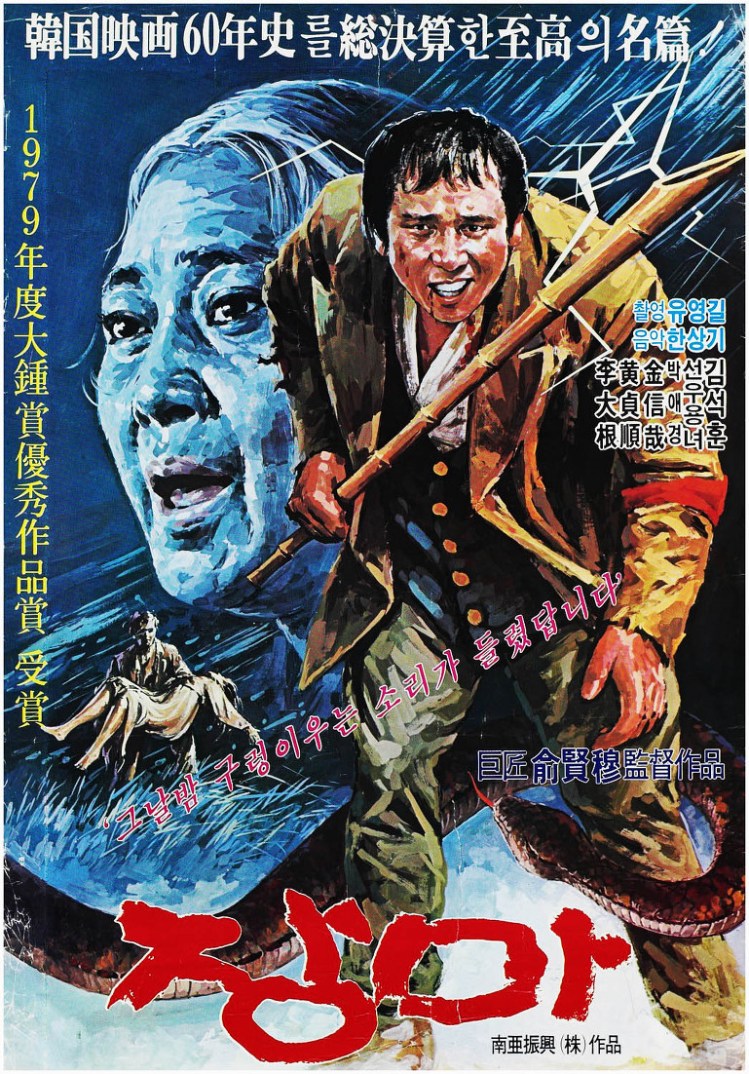
Rainy Days (장마, Yu Hyun-mok, 1979)

Rainy Season posterOften regarded as an “intellectual” filmmaker, Aimless Bullet’s Yu Hyun-mok returns to one of his central preoccupations in 1979’s Rainy Days (장마, Jangma). Released close to what would be an abrupt end to the oppressive and authoritarian rule of Park Chung-hee (which would be followed by another repressive military regime), Yu’s literary film falls into the anti-communist subgenre though Yu is careful to reframe his tale not as one of left versus right but of right versus wrong and of the dangerous gulf in-between. As it would in 1979, the political wind shifts without warning and then reverses itself leaving few untouched by the chaos and confusion of a government in flux. Rainy Days is a season of silence and tension, waiting for the sun but weathering a storm which may never end.

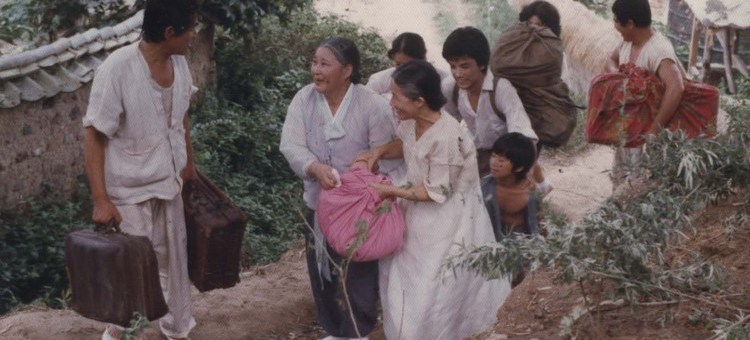
In the early 1950s, a family moves from Seoul to stay with relatives including Dongman (Choi Yong-weon) – the grandson of the older woman who is coming to live with her daughter’s family along with her university educated son Giljun (Kang Seuk-woo) and student daughter Gilja (Ju Hae-kyeong). Towards the end of the war, Maternal Grandmother (Hwang Jung-seun) has a prophetic and traumatic dream of trying to pull her own tooth which she interprets as a warning that Giljun, a serving soldier fighting for the South, has been killed in action. Sure enough, the next day a telegram arrives carrying the dreadful news back to the family. Maternal Grandmother tries to comfort herself as best she can, pretending to have grown used to the news thanks to her dream but in reality heartbroken and distraught by the loss of her only son.

Meanwhile, Dongman’s other uncle, the son of Paternal Grandmother (Kim Shin-jae), is off fighting for the North as a communist partisan hiding in the mountains. Suncheol (Lee Dae-geun) was once so kind hearted that as a boy he released the fish he caught in the local river, but when the communists took his village he was quickly seduced by their recently acquired power. While Giljun was forced to hide in a makeshift hollow covered by leaves in the woods, Suncheol was busy getting in with communists and though he claims to want to protect his family eventually informs on his brother-in-law only to find it blowing back on him when they doubt his commitment to the cause in not having turned the “Southern Sympathiser” in sooner. A simple man, Suncheol joins the communists and turns on Giljun as a reaction against his feelings of inferiority in the face of urban sophistication. Suncheol is cheerful and goodhearted, broadly liked by those around him, but he is also like a child who acts on impulse and takes things too far without considering the consequences of his actions just as he does when instigating a little “mob justice” against a villager who had tried to crack down on the trafficking of illegal moonshine much to the consternation of his neighbours.

The central conflict is dramatised by the sparky relationship between the two grandmas who have each passed into the age in which it becomes appropriate to voice one’s concerns openly without particularly caring how those views will be received. Paternal Grandmother, having opened her house to Maternal Grandmother and her children, feels herself to be in a position of superiority and is often wilfully unkind to her guests, offering a series of truly unforgivable words to the bereaved Maternal Grandmother who has, quite reasonably, cursed all the communists who are responsible for the death of her son. Seeing as Paternal Grandmother’s son Suncheol is a communist partisan she takes exception to this which provokes a fierce, accidentally political family row which may be eternally irreparable.

The North is, however, beaten back and the village retaken by the South. Suncheol is now a fugitive hiding in the mountains who has killed many men and fears he will not be forgiven even if he gives himself up to the authorities in the hope of rejoining his family. Proud Paternal Grandmother remains proud of her brave son, refusing to believe what they say about the partisans and secretly hoping for a resurgence of the North though like Maternal Grandmother before her she cannot say these words plainly for fear of getting into trouble with the authorities. When Suncheol makes a brief visit back to the family home, broken and desperate, to float the idea of turning himself in, it has grave consequences for little Dongman who is tricked into to informing on his uncle and earns the wrath of Paternal Grandmother in the process. Maternal Grandmother, however, has had more time to come to terms with her grief and is sympathetic to her grandson’s plight, knowing that he is just a child and did not understand the consequences of his actions.

Played by the wonderful Hwang Jung-seun, Maternal Grandmother becomes the heart of the drama. Having lost everything – her only son, her life in Seoul, her hopes for the future, she remains stoic, repeating the mantra that everything is fine because she knew all along how it would be. Following her painful outpouring of grief and war of words with Paternal Grandmother she comes to terms with her situation and tries to carry on as best she can with warmth in her heart. She even tries to forgive Paternal Grandmother and expresses sympathy for her as another mother losing a son in a stupid and senseless war. Paternal Grandmother cruelly pointed out that Maternal Grandmother would have no son to perform her funeral rites, but it is Maternal Grandmother who eventually performs the shamanistic ritual at the film’s conclusion in place of Paternal Grandmother, provoking a reconciliation of the two women and a banishment of the rancour which had existed between them.

Focussing tightly on the realistic emotions of the contemporary villagers who hold no particular political views but are caught in the middle of a war and simply trying to survive, Yu dramatises the tragedy of division not in a question of “good” Southerners, and bad “Communists”, but of bereaved grandmothers and broken families, ruined futures and fractured pasts. Yet once again he departs from the tragic ending of the novel for one which allows hope for the future. Little Dongman, put on house arrest by his irritated father, is finally allowed to go out to play with the other village children, rejoicing in the sunny skies and beautiful forrest scenery, returning to a childhood idyll now free of wartime confusion.


Available on DVD as part of the Korean Film Archive’s Yu Hyun-mok boxset. Also available to stream via the Korean Film Archive’s official YouTube Channel.