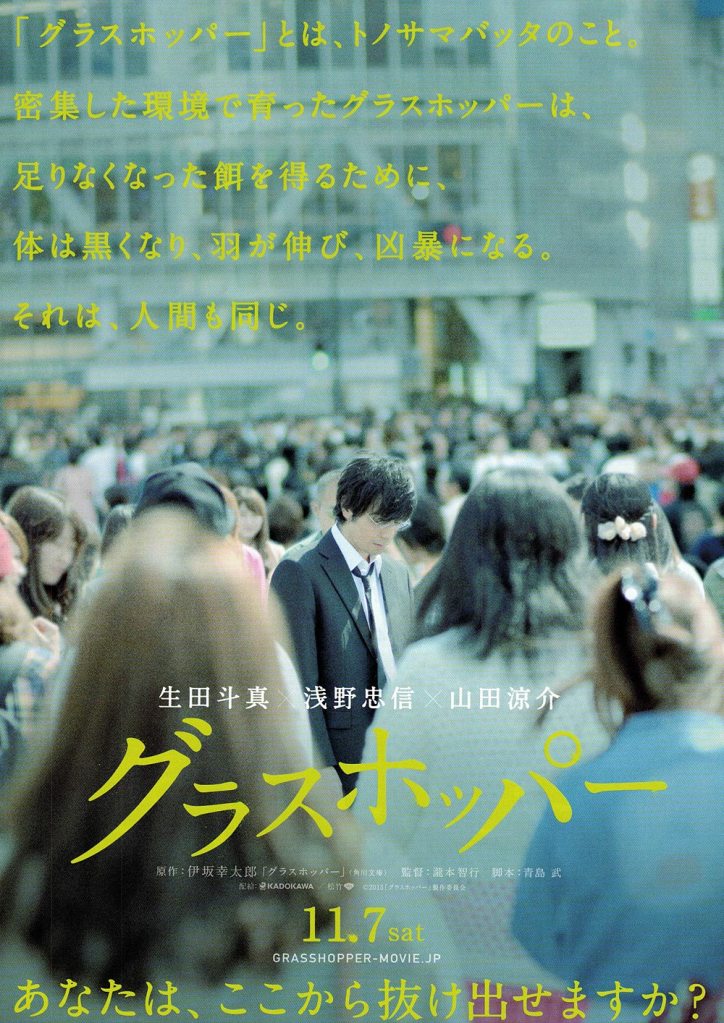
 The best revenge is living well, but the three damaged individuals at the centre of Tomoyuki Takimoto’s Grasshopper (グラスホッパー) might need some space before they can figure that out. Reuniting with Brain Man star Toma Ikuta, Takimoto moves away from the more overtly sci-fi elements but maintains a level of everyday strangeness that adds weight to this standard B-movie affair. A revenge thriller in which revenge itself is shown to be a fallacy, Grasshopper manages to mix its grimy grind house violence aesthetic with an oddly hopeful view of human nature.
One tragedy connects three very different people. Halloween, Shibuya – a crazed man at the wheel of a 4×4 receives a phone call instructing him to “crush all those bugs”, because he’s “the saviour”. The man obeys and plows into the holiday revellers crushing them like insects under his wheels. One victim, Yuriko (Haru), who died pushing a child out of harm’s way happened to be the fiancée of middle school science teacher, Suzuki (Toma Ikuta). Revisiting the spot where she fell, Suzuki unexpectedly receives a letter informing him that the events which occurred at Halloween were not as straightforward as the media asserts and he should set about investigating the father and son working at “Fraulein”. His mind burning with thoughts of vengeance, Suzuki abandons his old life and launches himself headlong into the criminal underworld in search of answers.
Meanwhile, the evil kingpins at the centre of things have sent their ace hitman with a difference, Kujira (Tadanobu Asano), to silence a troublesome reporter. Kujira’s unusual assassination method involves a kind of hypnosis in which he forces his victims to acknowledge their darkest sins and eventually commit suicide. Though this sounds like the ideal plan for evading detection, the gangsters are nervous that Kujira has learned to much through his near death conversations with his targets and send a duo of slightly less competent killers on his trail. This leads us to our third strand – sociopathic blade wielding killer, Semi (Ryosuke Yamada), and his stray cat rescuing handler, Iwanishi (Jun Murakami).
Suzuki finds himself out of his depth in the murky, crime ridden underworld. Talking to yet another hitman he crosses paths with, Suzuki is offered the grasshopper analogy which lies at the centre of the film. Pusher (Hidetaka Yoshioka) tells him that unlike regular migratory locusts which are generally green, there is a mutant breed which undergoes a “swarm phase” in which their wings grown darker and longer, becoming ever more destructive in the quest to feed themselves in a crowded environment. People, Pusher claims, are no different. The film is filled with these mutant insects, crushing their fellow humans like roaches under boots, yet there’s something to be said for the migratory guys who keep moving and oppose the mutant breed through stealth and cunning.
Each of the three men is looking for a kind of revenge even if it’s ultimately self inflicted. Unusual hitman Kujira has hit the assassin’s version of angel wings in that he can see the faces of all the men and women he has killed, quite literally haunting his every move and offering a running commentary on his life. Setting out for vengeance against the men who’ve ordered his death, Kujira knows he’s nearing the end of his path yet before he gets there he will have to face off against Semi with whom he has no particular quarrel despite having just given Semi a reason to seek vengeance against him. Semi’s quest for revenge is pointed at Kujira but their mutual need for satisfaction will destroy each of them whilst also bringing them together as equals.
Everything prior to the fateful Halloween is bathed in golden light where warm colours predominate in Suzuki’s fond memories of his fiancée, but everything after is dark, reds and blacks tinged with insect green as grasshoppers swarm like harbingers of a great evil. Revenge itself is constantly frustrated and ultimately swept away from each party by shadowy forces secretly working against the darkness. Nothing is quite as it seems, no one is quite telling the truth. Yet as deep as the original conspiracy goes, the counter conspiracy consistently exceeds it.
Filled with impressive action sequences from Semi’s well choreographed balletic knife displays to large scale crowd scenes and good old fashioned fist fights, Grasshopper owns its down and dirty origins but reinvigorates them with a degree of modern sophistication. Yuriko, a soup chef, insists that the true secret ingredient in her cooking is genuine emotion – that this is what’s left behind when everything else is gone. Suzuki could choose to dive inside his cocoon of unresolved vengeance for the rest of his life but that would not have been what Yuriko wanted for him. In this anti-revenge drama, vengeance is the fallacy that detracts from the truth – that the ultimate form of revenge is learning to live with the past rather than wasting time settling scores.
Original trailer (no subtitles)

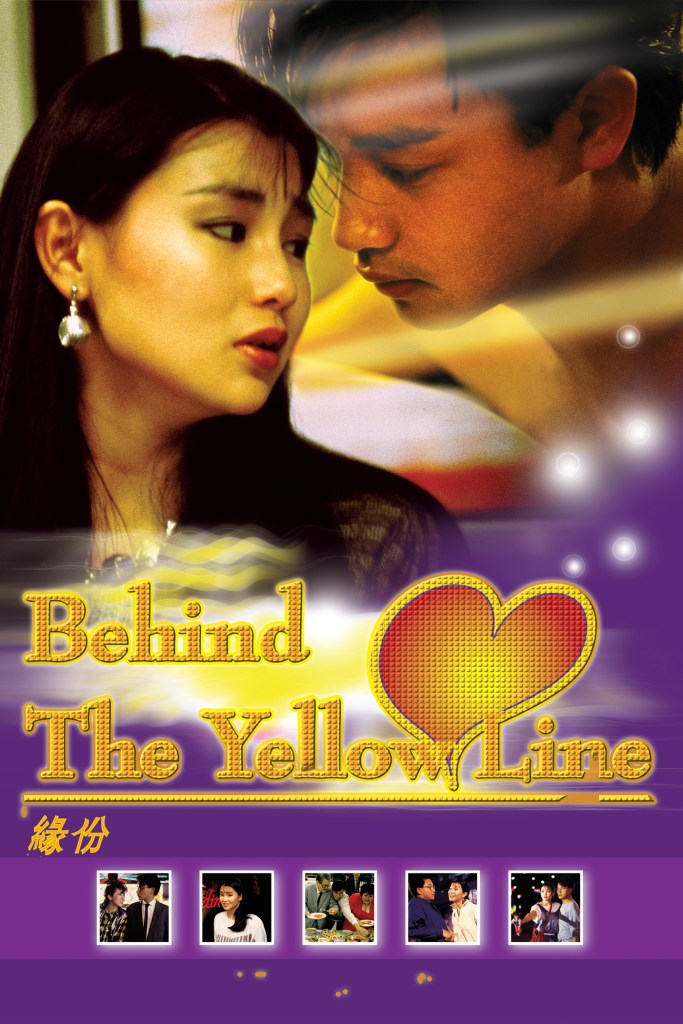 Back in the 1980s, you could make a film that’s actually no good at all but because of its fluffy, non-sensical cheesiness still manages to salvage something and capture the viewer’s good will in the process. In the intervening thirty years, this is a skill that seems to have been lost but at least we have films like Taylor Wong’s Behind the Yellow Line (緣份, Yuan Fen) to remind us this kind of disposable mainstream youth comedy was once possible. Starring three youngsters who would go on to become some of Hong Kong’s biggest stars over the next two decades, Behind the Yellow Line is no lost classic but is an enjoyable time capsule of its mid-80s setting.
 A Double Life (二重生活, Nijyuu Seikatsu ), the debut feature from director Yoshiyuki Kishi adapted from Mariko Koike’s novel, could easily be subtitled “a defence of stalking with indifference”. As a philosophical experiment in itself, it recasts us as the voyeur, watching her watching him, following our oblivious heroine as she becomes increasingly obsessed with the act of observance. Taking into account the constant watchfulness of modern society, A Double Life has some serious questions to ask not only of the nature of existence but of the increasing connectedness and its counterpart of isolation, the disconnect between the image and reality, and how much the hidden facets of people’s lives define their essential personality.
 Innocence is a fairly nebulous concept and one often misused but if you were expecting an “innocent” tale of youthful romance, Hirokazu Kai’s Innocent15 (イノセント15) is out to wrong foot you from the get go. Kai does not shy away from the darker sides of human nature in examining abusive parenting and forced prostitution as well as the damage done when a secret is broken after long years of being unable to be honest about who you really are. This is a bleak tale, but one with with hope shining round the edges, even if uncertainly.
 Hur Jin-ho’s A Good Rain Knows (호우시절, Howoosijeol) was originally developed as a short intended to form part of the China/Korea collaborative omnibus film Chengdu, I Love You which was created as a tribute to the area following the devastating 2008 earthquake. However, Hur came to the conclusion that his tale of modern day cross cultural romance required more scope than the tripartite omnibus structure would allow and decided to go solo (Chengdu, I Love You was later released with just Fruit Chan and Cui Jian’s efforts alone). Very much Korean in terms of tone and structure, Hur uses his central love story to explore the effects time, memory, culture, and personal trauma on the lives of everyday people.
 There are two very distinct sides to the career of Tatsushi Omori. Brother of the well known actor, Nao, Omori may be best known to certain audiences for his hard hitting, often gloomy and pessimistic dramas of human misery such as festival favourite Ravine of Goodbye or the little seen
  It’s tough being young. The Boss’ Son At College (大学の若旦那, Daigaku no Wakadanna) is the first, and only surviving, film in a series which followed the adventures of the well to do son of a soy sauce manufacturer set in the contemporary era. Somewhat autobiographical, Shimizu’s film centres around the titular boss’ son as he struggles with conflicting influences – those of his father and the traditional past and those of his forward looking, hedonistic youth.
 Ohara Shousuke-san (小原庄助さん) is the name of a character from a popular folk song intended to teach children how not to live their lives. The Ohara Shosuke-san of Aizu Bandaisan has lost all his fortune but no one feels very sorry for him because it’s his own fault – he spent his days in idleness, drinking, sleeping in, and bathing in the morning. The central character of Hiroshi Shimizu’s 1937 film has earned this nickname for himself because he also enjoys a drink or too and doesn’t actually do very much else, but unlike the character in the song this a goodhearted man much loved by the community because he’s a soft touch and just can’t refuse when asked for a favour. An acknowledgement of the changing times, Shimizu’s Mr. Shousuke Ohara is a tribute to the soft hearted but also an argument for action over passivity.
 Johnnie To is best known as a purveyor of intricately plotted gangster thrillers in which tough guys outsmart and then later outshoot each other. However, To is a veritable Jack of all trades when it comes to genre and has tackled just about everything from action packed crime stories to frothy romantic comedies and even a musical. This time he’s back in world of the medical drama as an improbable farce develops driven by the three central cogs who precede to drive this particular crazy train all the way to its final destination.
 Windows on Worlds