 For the world’s more full of weeping than you can understand – the residents of Goksung, the setting for Na Hong-jin’s nihilistic horror movie The Wailing (곡성, Goksung), might be inclined to agree with Yeats if only because the name of their town is also a homonym for the “sound of weeping”. There is plenty to weep over, and in places Na’s film begins to feel like one long plaintive cry reaching far back to the dawn of time but the main wounds are comparatively more recent – colonisation, not only of a landscape but of a soul. When it comes to gods, should you trust one over another simply because of its country of origin or is your faith to be bestowed in something with more universal application?
Goksung is a sleepy little rural town way up in the mountains. This is the kind of place where nothing much ever happens but today all of that is about to change as a local man has committed a series of bloody murders and is now in a dissociative state. Bumbling policeman Jong-goo (Kwak Do-won) arrives late to the crime scene but quickly finds himself pulled in to the ongoing investigations as bodies begin piling up in the previously quiet town.
The rational explanation for the spate of violent killings is blamed on a tonic containing some funny mushrooms but others have another idea. All of this started happening after a Japanese guy (Jun Kunimura) moved to the town. Some say he’s a professor, some say he’s a Buddhist monk, but there also those who hold him responsible for the rape of a local woman, and there are even reports of him running about the forest dressed only in a loincloth and feasting on the remains of fallen animals.
Eventually, Jung-goo’s young daughter Hyo-jin (Kim Hwan-hee) falls under the curse, giving him an unavoidable impetus to find the truth. As well as the “suspicious” Japanese visitor, Jung-goo also comes into contact with a mysterious young woman dressed in white (Chun Woo-hee) who may be either friend or foe, whilst shamans and the Catholic Church are each approached for their advice on this singularly supernatural phenomenon.
This being quite a sleepy town, Jung-goo’s days most likely involved a lot of napping, eating, and card playing, broken up with chatting to old ladies. So unaccustomed to crime are they, they didn’t quite remember to put their gloves on before investigating a crime scene. Jung-goo and his partner are constantly branded “morons” by their boss and if the night they end up guarding the police station during a thunderstorm is anything to go by, they aren’t exactly the bravest of souls either. Not the best pair to be investigating a complex, supernatural mystery they decide to heed the rumours and pay a visit to the Japanese guy living way out in the woods.
Known only by the derogatory term “the Jap”, the new addition to the village quickly falls under suspicion thanks to the old fashioned crime of not being from around here. Whether out of resentment for historical crimes or simply because of being an outsider, everyone decides the Japanese visitor must, in some way, be responsible. Suspicions are compounded when Jung-goo, his partner, and his partner’s nephew who happens to be a Catholic priest in training with a solid command of Japanese, discover some very odd things whilst snooping around the man’s home. Is the mysterious visitor really, literally, a “Japanese devil” or just the victim of an ongoing campaign of intense xenophobia and the supernatural elements attributed to him a manifestation of that extremely offensive term?
Na keeps us guessing. Meanwhile, ancient remedies are sought when ancient ones are awakened, hence Jung-goo’s mother-in-law turns to shamanism to try and cure her granddaughter of her increasingly serious illness. The shaman (Hwang Jung-Min) arrives more like a TV evangelist than a witch doctor – smart suit and turtleneck, topped of with long hair tied into a bun. The exorcism scene itself is a furious battle between light and darkness (or so we presume) as the shaman dances wildly to the pulsating drum beats of his orchestra, sacrificing a chicken here and a goat there, all while Hyo-jin writhes in agony in the next room and his enemy performs a counter ritual from his recently refurbished lair.
“Believe in me and you shall be saved” is a message Jung-goo receives from just about everyone during the course of the film. The Catholic Church, however, is resolutely opposed to the idea of this demonic threat and informs Jung-goo that this is not a religious matter – he ought to take his daughter back to the hospital and instil his “faith” in modern medicine. Faith appears to be the central question, in what or whom should one believe? Can Jung-goo trust his shaman, is the Japanese guy an ally, threat, or just a neutral, ordinary man, and what of the oddly intense woman dressed in white? In the end, Jung-goo’s faith is questioned but he pays dearly for his final decision. Had he placed more faith in the old gods, his fate might have been very different but Jung-goo chose real world logic (not his strongest suit) over spiritual intuition and failed to heed the warnings.
Jung-goo, though presented as a broadly sympathetic presence, is partly responsible for his own downfall through his willingness to embrace the baser elements of his nature. In contrast to his otherwise laid-back character which sees him late to work because of family meals, Jung-goo has a violent streak first seen when he takes defending himself from an angry dog far further than he needed to. Later he rounds a group of friends to help him take out the Japanese man in a worrying stab at mob justice. Neither quality is very endearing but Jung-goo’s position as a slightly dim bruiser who mistakenly thinks he can smash his way out of a spiritual conundrum makes him an unlikely choice of saviour.
Na offers nothing in the way of hope, the forces of darkness are set to conquer the world helped only by humanity’s propensity towards doubt, its selfishness, and its fear. The dark humour fades as the pace increases until the film approaches its bleaker than bleak finale. This is a land of ghosts, both fleshy and otherwise but in order to bid them goodbye you must first accept their presence. In the end it’s all a question of faith but those most worthy of it may be among the most difficult to believe.
Reviewed at 2016 BFI London Film Festival
Original trailer (English subtitles)
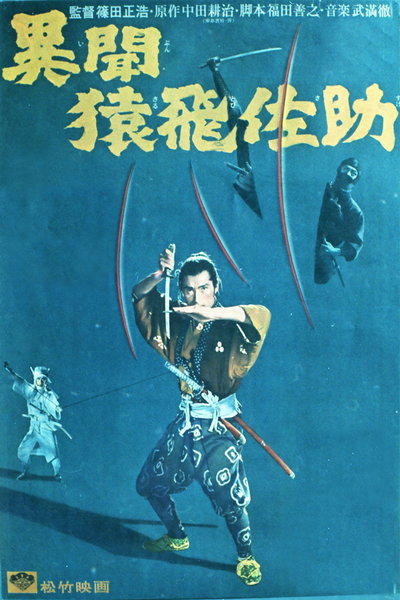 Nothing is certain these days, so say the protagonists at the centre of Masahiro Shinoda’s whirlwind of intrigue, Samurai Spy (異聞猿飛佐助, Ibun Sarutobi Sasuke). Set 14 years after the battle of Sekigahara which ushered in a long period of peace under the banner of the Tokugawa Shogunate, Samurai Spy effectively imports its contemporary cold war atmosphere to feudal Japan in which warring states continue to vie for power through the use of covert spy networks run from Edo and Osaka respectively. Sides are switched, friends are betrayed, innocents are murdered. The peace is fragile, but is it worth preserving even at such mounting cost?
 When
When 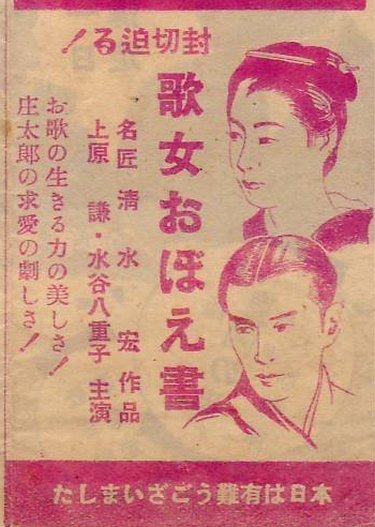 Filmed in 1941, Notes of an Itinerant Performer (歌女おぼえ書, Utajo Oboegaki ) is among the least politicised of Shimizu’s output though its odd, domestic violence fuelled, finally romantic resolution points to a hardening of his otherwise progressive social ideals. Neatly avoiding contemporary issues by setting his tale in 1901 at the mid-point of the Meiji era as Japanese society was caught in a transitionary phase, Shimizu similarly casts his heroine adrift as she decides to make a break with the hand fate dealt her and try her luck in a more “civilised” world.
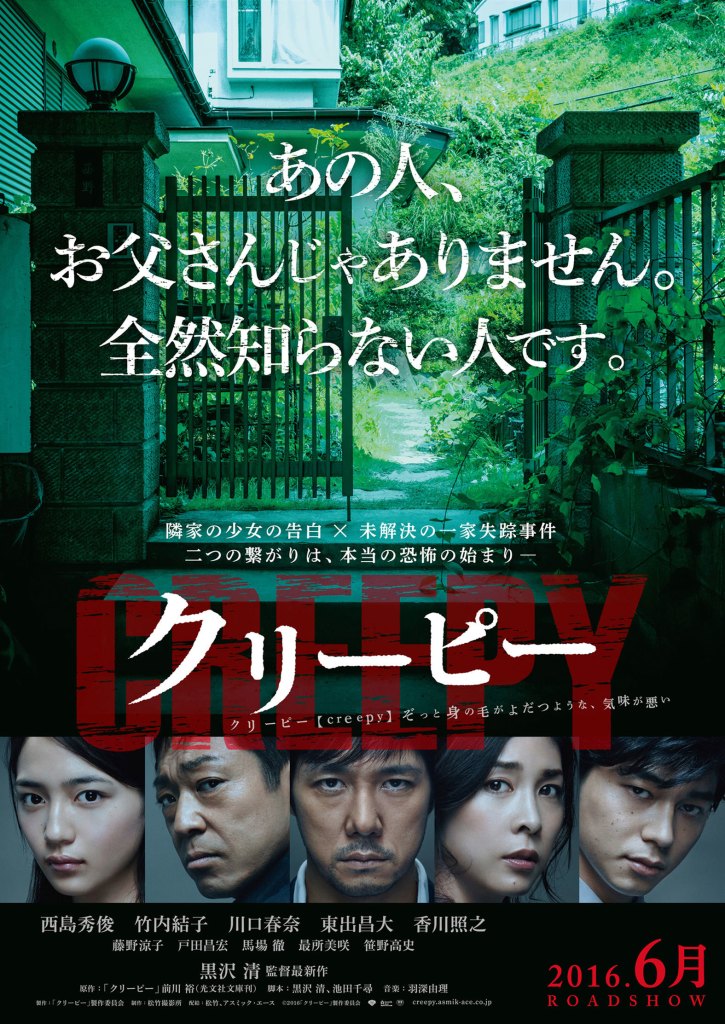 How well do you know your neighbours? Perhaps you have one that seems a little bit strange to you, “creepy”, even. Then again, everyone has their quirks, so you leave things at nodding at your “probably harmless” fellow suburbanites and walking away as quickly as possible. The central couple at the centre of Kiyoshi Kurosawa’s return to genre filmmaking Creepy (クリーピー 偽りの隣人, Creepy Itsuwari no Rinjin), based on the novel by Yutaka Maekawa, may have wished they’d better heeded their initial instincts when it comes to dealing with their decidedly odd new neighbours considering the extremely dark territory they’re about to move in to…

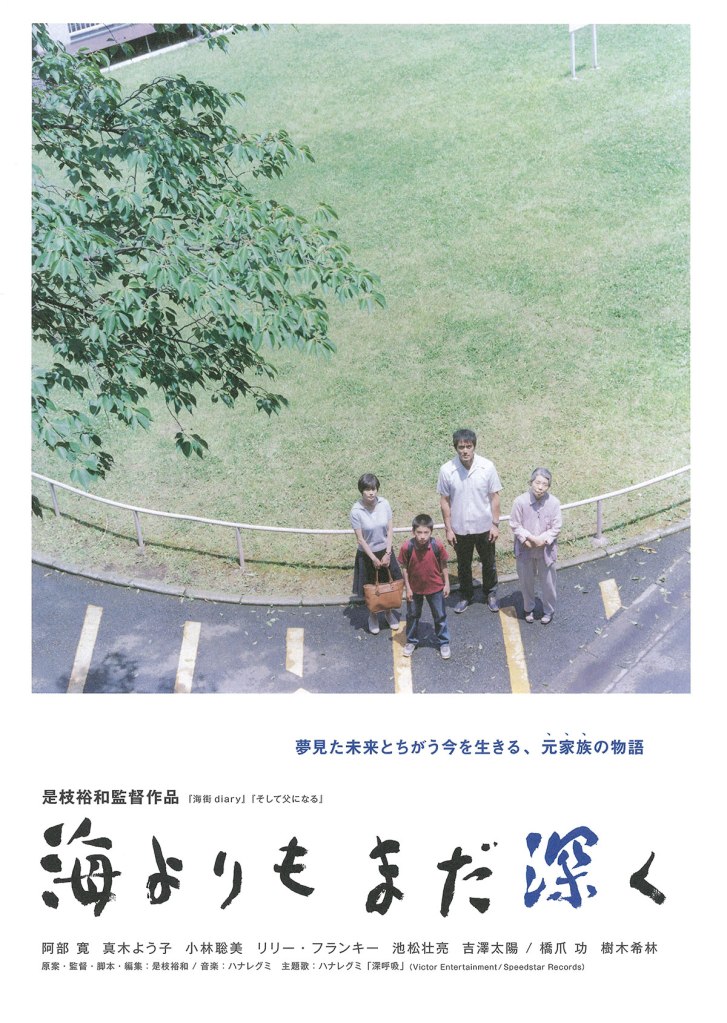 It’s never too late to be what you might have been – a statement attributed to George Eliot which may be as fake as one of the promises offered by the protagonist of Hirokazu Koreeda’s latest attempt to chart the course of his nation through its basic social unit, After the Storm (海よりもまだ深く, Umi yori mo Mada Fukaku). Reuniting Kirin Kiki and Hiroshi Abe as mother and son following their star turns in
  Rather than a Maenad in a divine frenzy driven by drunkenness, lust, and hedonistic fury, a “Bacchus Lady” is a humorous nickname used for the older women who solicit men in Korean parks by euphemistically offering to sell them a bottle of Bacchus energy drink. E J-yong reteams with veteran Korean actress Youn Yuh-jung to tell the tragic story of Youn So-young, hooker with a heart of gold and now a member of the older generation permitted to slip through the cracks in the absence of familial connections.
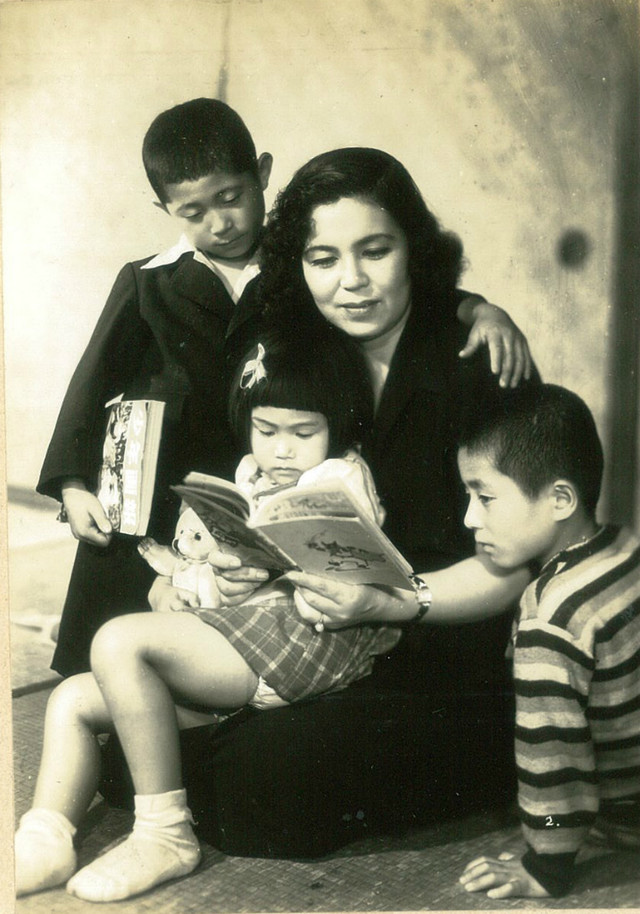 Shimizu’s depression era work was not lacking in down on their luck single mothers forced into difficult positions as they fiercely fought for their children’s future, but 1950’s A Mother’s Love (母情, Bojo) takes an entirely different approach to the problem. Once again Shimizu displays his customary sympathy for all but this particular mother, Toshiko, does not immediately seem to be the self sacrificing embodiment of maternal virtues that the genre usually favours.
 Nobuhiko Obayashi is no stranger to a ghost story whether literal or figural but never has his pre-occupation with being pre-occupied about the past been more delicately expressed than in his 1988 horror-tinged supernatural adventure, The Discarnates (異人たちとの夏, Ijintachi to no Natsu). Nostalgia is a central pillar of Obayashi’s world, as drenched in melancholy as it often is, but it can also be pernicious – an anchor which pins a person in a certain spot and forever impedes their progress.
 Windows on Worlds