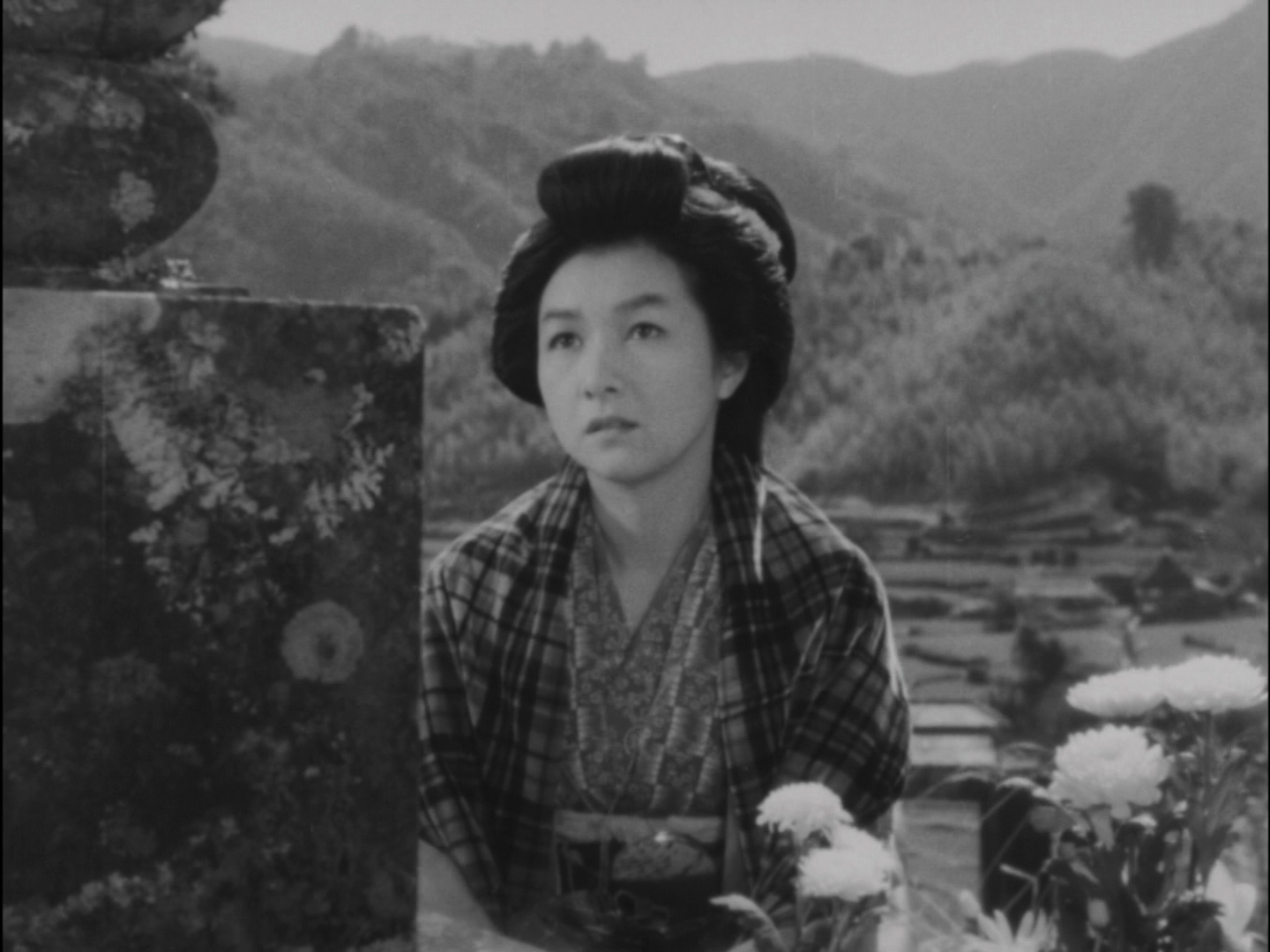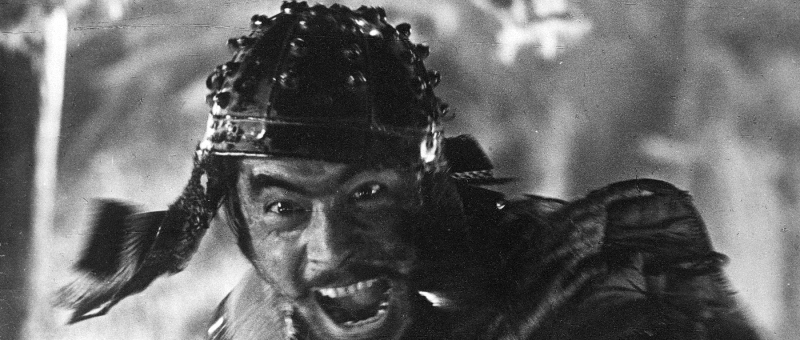
The Hidden Fortress (隠し砦の三悪人, Akira Kurosawa, 1958)

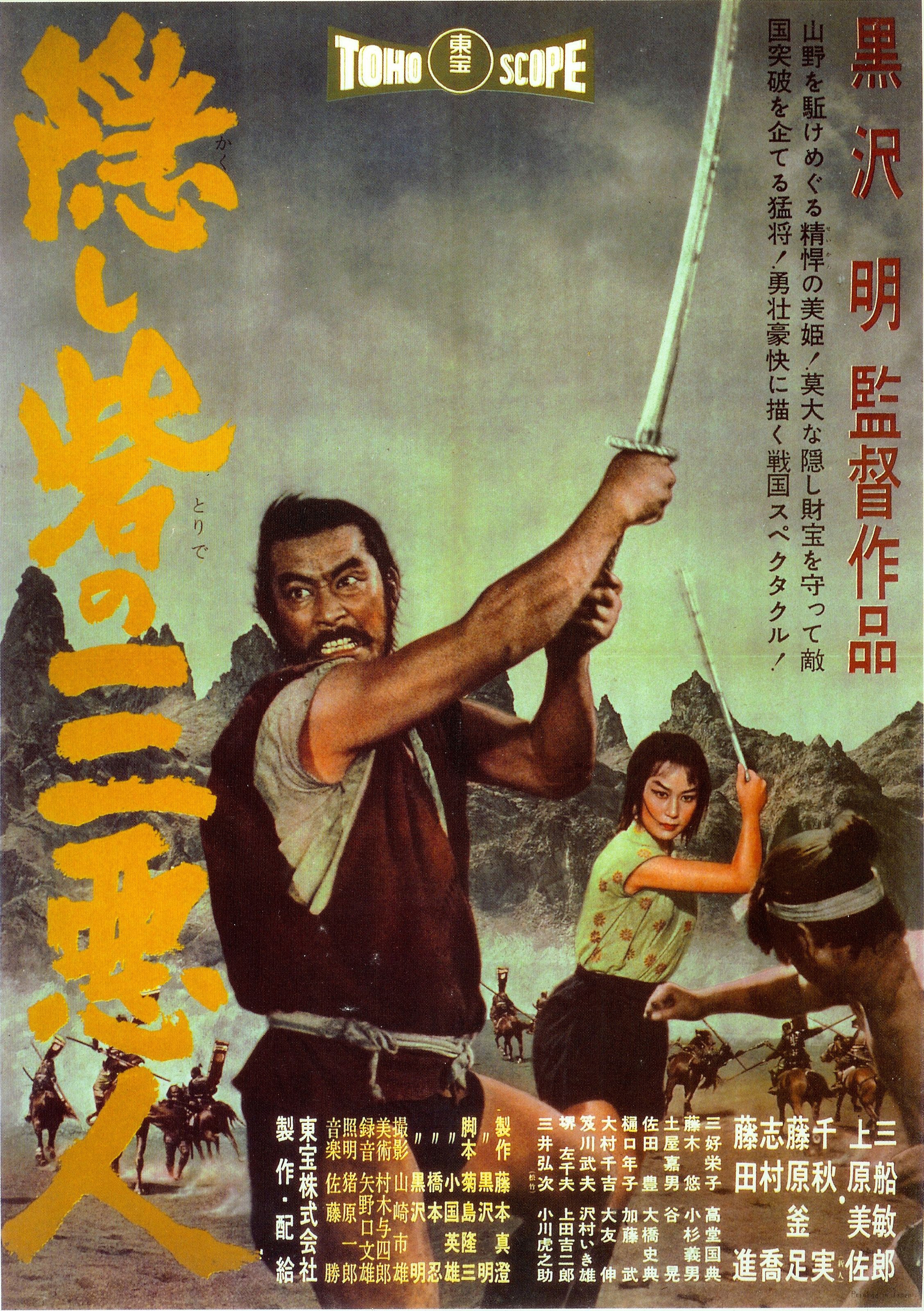
“Your kindness will harm you” a well-meaning retainer advises his charge, but in the end it is her kindness which saves her along with numerous others in Akira Kurosawa’s Sengoku-era epic, The Hidden Fortress (隠し砦の三悪人, Kakushi Toride no San Akunin). Largely told from the point of view of two bumbling peasants trying to get rich quick by exploiting the hierarchal fluidity of a time of war, the film nevertheless cuts against the grain of the democratic era in advocating not so much the destruction of the class-bound feudal order as benevolent authority. 

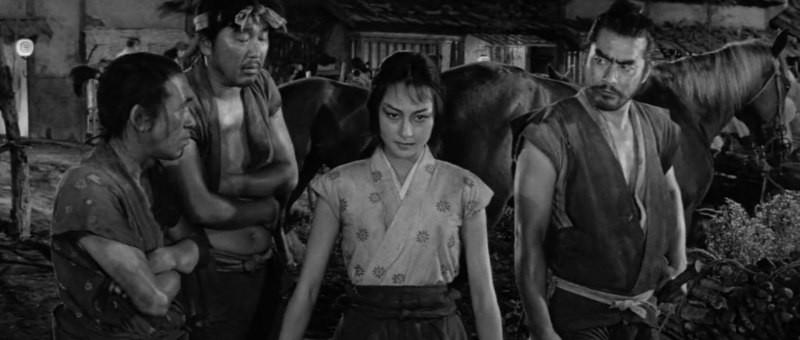
This can quite clearly be seen in the dynamic figure of displaced princess Yuki (Misa Uehara), the successor of her routed clan protected by a hidden fortress in the mountains which she must eventually leave. Her female servant laments that her father raised her as a boy which has given her a haughty and dominant manner at odds with the polite submissiveness usually expected of upperclass women. While often exerting her authority, she is otherwise uncomfortable with the uncritical servitude of her retainers, chief among them the talented general Makabe (Toshiro Mifune) who sacrificed the life of his own sister, allowing her to be executed in Yuki’s place buying them some time. “Kofuyu was 16. I am 16. What difference is there in our souls?” she asks, yet even if she believes their souls are equal she is not quite so egalitarian as to forget her position or the power and privilege that comes with it. 

Nevertheless, hers is an authority that is tempered by compassion and in the end chosen. Her salvation comes in speaking her mind to an enemy retainer, Tadokoro (Susumu Fujita), who has been savagely beaten by his own lord for losing a duel with Makabe who, to the mind of some, humiliated him with kindness in refusing to take his life leaving him to live in defeat. Yuki says she doesn’t know who is stupider, Tadokoro or his lord, for never would she punish a man in such a way simply for losing to an enemy. She tells him that there is another way, and that he need not serve a lord who does not serve him leading Tadokoro to defect and choose to follow her instead. 

She also inspires confidence in a young woman she insists on redeeming after discovering that she is a former member of the Akizuka clan sold into sexual slavery after being taken prisoner by the Yamane. Kurosawa presents the girl with a dilemma on realising that the mysterious woman who saved her is the fugitive princess, knowing that she could betray her and pocket the gold, but finds her resolving to serve Yuki all the more. In a moment of irony, we learn that the girl was bought for five silver coins, the same amount of money a wealthy traveller offers for Makabe’s horse, but displeases her master in refusing to speak or serve customers. For Yuki he offers gold, though withdraws on being told that she is mute. Knowing that she would be unable to disguise her speech or accent which would instantly give her away as a haughty princess, Makabe convinces her to stay silent though as she tells him he cannot make her heart mute too. 

Even the peasants, oblivious to her true identity, view Yuki as part of the spoils insisting that they should be entitled to a third of her too and at one point preparing to rape her only to be fought off by the rescued girl. “We can rely on their greed” Makabe had said, knowing that their material desires make them easy to manipulate and that their loyalties are otherwise fickle. Matashichi (Kamatari Fujiwara) and his friend Tahei (Minoru Chiaki) sold their houses in their village to buy armour in the hope of achieving social mobility through distinguishing themselves in war, but have largely been humiliated, robbed of their armour, mistaken for captured members of the enemy, and forced to dig the graves of others. They pledge eternal friendship but their bond is continually disrupted by the promise of monetary gain. They fall out over a moral quandary, one willing to plunder the body of a fallen soldier and the other not, while even on reuniting squabbling about how to divide the money first deciding it should be equal and immediately disagreeing as soon as they get their hands on it. At the film’s conclusion it rests on Yuki to play mother, telling them that they must be good and share the boon she’s given them equally without complaint each then too only quick to be generous insisting that the other can keep it. 

The implication is still, however, that Matashichi and Tahei should return to their village to live as peasants while Yuki assumes her place in a castle no longer hidden as its ruler. Order has returned and the old system remains in place, all that changes is that this is now a compassionate autocracy ruled by a benevolent lord who views her subjects lives as equal to her own yet not perhaps their status. Where it might prompt Tadokoro to conclude that he need serve no lord at all for there should be no leaders only equals, the film concludes that a leader should be just and if they are not they should not be followed. Then again, the disagreement between firm friends Matashichi and Tahei is ended when they each have enough and no longer find themselves fighting for a bigger slice of the pie content in the validation of their equality. As Makabe puts it, heavy is the head that wears the crown. Yuki’s suffering is in the responsibility of rebuilding her clan though she does so with compassion and empathy ruling with respect rather than fear or austerity. Kurosawa utilises the novel scope format to hint at the wide open vistas that extend ahead of the peasants as they make their way towards the castle in search of gold only to leave with something that while more valuable may also shine so brightly as to blind them to the inherent inequalities of the feudal order. 


The Hidden Fortress screens at the BFI Southbank, London on 20th & 27th January 2023 as part of the Kurosawa season.
Untamed (あらくれ, Mikio Naruse, 1957)

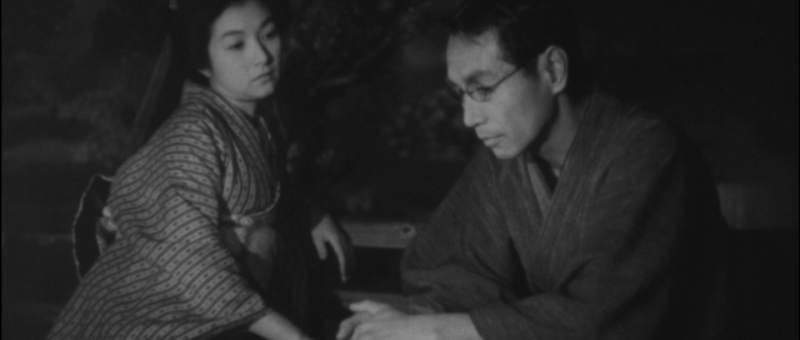
“Don’t let guys control you. You have to make them men” the heroine of Mikio Naruse’s Taisho-era drama Untamed (あらくれ, Arakure, AKA Untamed Woman) advises a former rival, yet largely fails to do so herself in the fiercely patriarchal post-Meiji society. Based on a serialised novel by Shusei Tokuda published in 1915 but set in late Meiji rather than early Taisho, Naruse’s adaptation essentially drops a contemporary post-war woman into a by then almost unrecognisable Japan, but finds her hamstrung firstly by feckless and entitled men and then by complicit women who themselves cannot accept her transgressive femininity. 

As the film opens, a teenage Shima (Hideko Takamine) has just married wealthy grocery store owner Tsuru (Ken Uehara) but the marriage is already a failure. Though Shima is compared favourably with Tsuru’s previous wife who was apparently in poor health, presumably suffering with TB which required a sojourn by the sea, it soon becomes clear that Tsuru is as trapped by the archaic patriarchal social system as she is. He was apparently in love with a woman from a higher social class he was too afraid to pursue and despite still seeing her also has a mistress near their factory in Hokkaido whom he often visits under the guise of a business trip. Yet when Shima tells him she thinks she may be pregnant, he is unimpressed, immediately questioning the paternity of the child while harping on about her having been married before which it seems is not quite true. Perhaps the reason that she has ended up a second wife despite her youth and beauty, Shima ran out on a marriage to a childhood friend arranged for her by her adoptive parents the night before the wedding not realising they had already registered the union without her knowledge or consent. 

This transgressive act at once signals Shima’s total disregard for conventionality and insistence on her own autonomy, yet it is also indicative of the fact she married Tsuru in search of a better life, knowing that to marry her adoptive parents’ choice meant only a life of servitude on the family farm. She is not always a terribly likeable figure, coldly explaining that she didn’t mind being fostered out because the adoptive family were wealthier and could give her a better life than she had with her birth parents. Yet it’s this sense of familial dislocation and the liminal status it gives her that allow her to take agency over her life in the way other women might not, unwilling to lose the familial security Shima may not feel she ever had. Tsuru is also an adopted son, but the price for disobedience for him may be even higher and indeed as we later hear his inability to sort out his love life eventually sees him out on his ear. His pettiness in refusing to accept the child is his leads to an argument which causes Shima to slip on the stairs and miscarry, the implication being that she may not be able to bear more children leaving her unlikely to remarry and thereby spurring her desire for a tempered independence. 

The fall is the last straw. Tsuru divorces Shima citing her inability to play the role of the proper wife while her birth family, from whom she is emotionally estranged, refuse to take her back as do the adoptive parents because of the embarrassment she caused them with the marriage stunt. She is often described as “like a man”, unable to win as Tsuru at once insists she wear the frumpy kimonos left behind by his previous wife who was a decade older, complains she wears too much makeup, and tells her to loosen her kimono belt to de-emphasises her figure, while criticising her for being unfeminine in her refusal to simply put up with his bad behaviour as is expected for a wife in this era. Shima fulfils all her wifely duties and as we see is in fact running his business as the women of the family are often seen to do while their husbands spend the money they earn for them on other women whether drinking with geishas or supporting mistresses in second homes. When her husband hits her, she fights back rather than shrinking away chastened as intended. 

Yet she cannot overcome the sense that a man is necessary for her success which cannot be accomplished alone. Cast out from her family, her brother installs her in the mountains to work in a geisha house if only as kitchen staff but soon does a flit to reunite with his married lover who has left her husband for him. While there she falls for the quiet and sensitive inn owner Hamaya (Masayuki Mori), also an adopted heir, whose wife is again ill with TB. Hamaya may be treating his wife a little better than Tsuru did his, but quite clearly assumes she’ll die in starting an affair with Shima who is then sent away to an even more remote inn to avoid a potential scandal. As Tsuru did with the woman he apparently loved, Shima continues to see Hamaya until he too succumbs to TB as an ideal of an impossible love while simultaneously accepting that he failed her in being too weak and cowardly to fight for their romance, outright refusing to become his mistress. 

This may be one reason she is determined never again to be an employee but to own her own store which is why she ends up marrying tailor Onoda (Daisuke Kato) who introduces her to textiles and seamstressing at which she quickly proves adept having mastered the modern sewing machine. She marries Onoda in believing him “reliable”, but soon comes to regard him as lazy and feckless. The first shop fails because he can’t keep up with her. The male employees are always taking breaks to drink tea and play shogi, Onoda complaining that he’s tired while she does all his work for him and the housework too. Yet he also criticises her for a lack of femininity, snapping back that it must be her time of the month when she berates him in front of their employees while later after they’ve become successful complaining it’s “embarrassing” that his workhorse wife doesn’t know the things a sophisticated society woman would such as ikebana while flirting with the teacher he’s hired ostensibility to teach her. He even forces her to wear a frumpy and already somewhat dated classically Edwardian dress with a fancy bonnet which more resembles something a country girl might wear to church than the latest in Western fashions in an attempt to advertise their tailoring which seems primed to backfire. 

That she learns to ride a bicycle in this rather ridiculous outfit is again a symbol of her desire to seize and manipulate modernity even giving rise to a piece of innuendo from her much younger assistant Kimura (Tatsuya Nakadai) as to the pounding she’s been getting from the saddle. Kimura seems to think the problem with the business is that Onoda’s patterns are outdated, offering her a new modernity while she prepares to cut Onoda out on catching him with his mistress taking their best employee with her to ruin his business and start another of her own. Though once again she cannot leave alone only with a man the ending is perhaps more hopeful than might be expected from a Naruse film allowing Shima to commit herself fully to the sense of industry she embodies always ready to start again, work harder, and achieve her desires unwilling to be bound by conventional ideas of femininity or to simply put up with useless men who refuse to accept her for all she is. Yet she largely fails to make men of them, each of her various suitors failing to live up to her, ruined by an oppressive social system that encourages them to exploit female labour while taking it for granted in their intense sense of patriarchal entitlement. 


Seven Samurai (七人の侍, Akira Kurosawa, 1954)

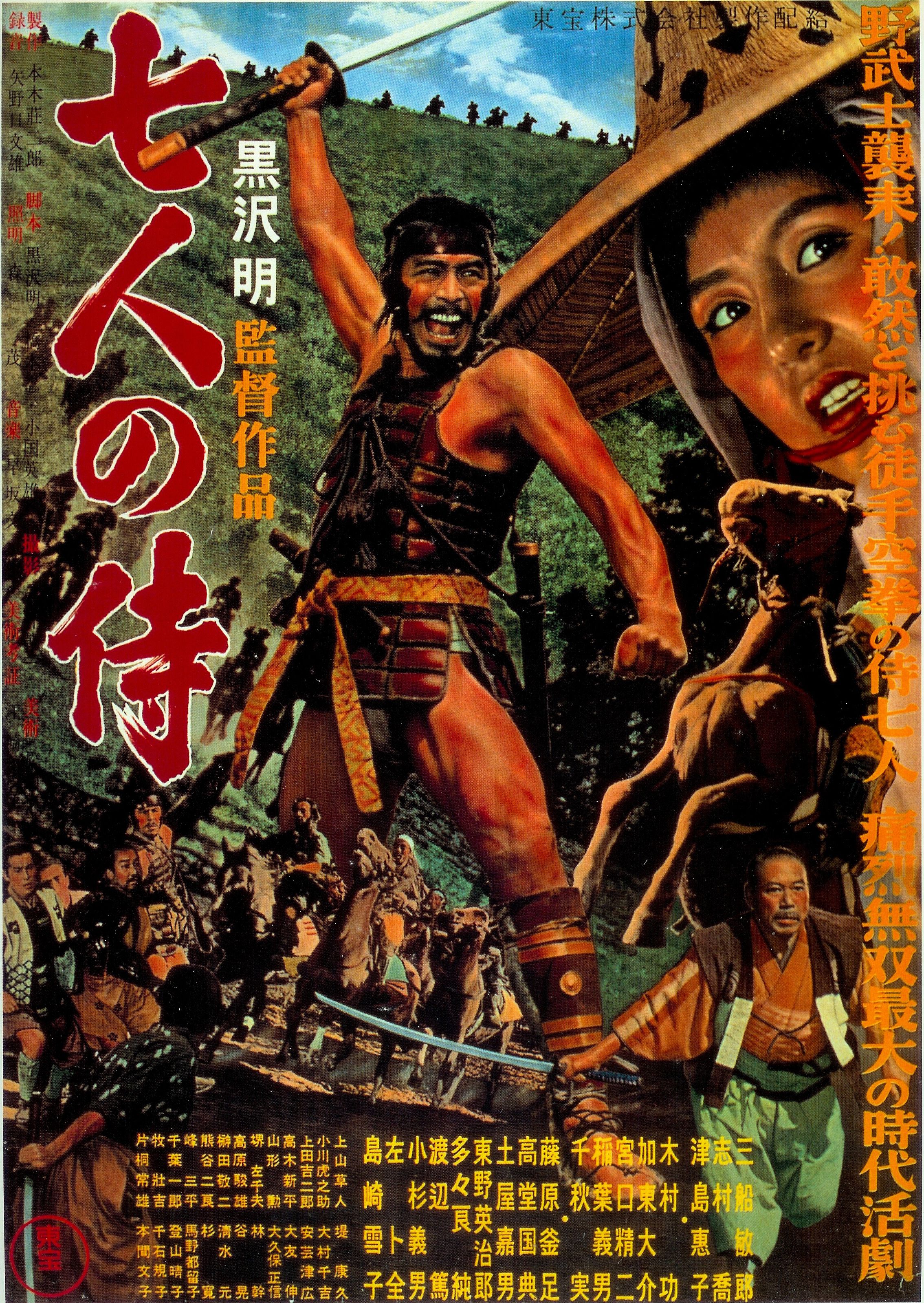
An eclipse of the accepted order allows a temporary truce in the ongoing class conflict that defines feudal society in Akira Kurosawa’s seminal post-war historical epic, Seven Samurai (七人の侍, Shichinin no Samurai). Set in the late 16th century, the action takes place in a world on the brink of collapse. The Sengoku era is drawing to a close but is also in a moment of intense crisis which has left large numbers of highly skilled warriors essentially orphaned, wandering the land torn between their basic needs for food and shelter and their dignity as members of a theoretic aristocracy. 

Plagued by bandits, many of whom may be these orphaned swordsmen, a small village contemplates the unthinkable in hiring samurai, otherwise their oppressors and uniquely responsible for the chaos which surrounds them, for protection. “Land tax, forced labour, drought…and now bandits!” one woman exclaims shortly before suggesting they simply surrender all their grain and then hang themselves. As they can offer only expenses in the form of rice, the only samurai they can hope to recruit are already desperate, so hungry that they may be willing to deign to defending their social inferiors with whom they would not usually mix unwilling to accept that they are both victims of the inherently corrupt social order. This explains why the villagers’ early entreaties are met with such scorn and cynicism, either rudely rejected out of hand or ending only in deception. 

In this there is an echo of the world of 1954 which was beginning edge away from the chaos and privation of the immediate post-war society, bandits standing in for thieves and profiteers themselves a product of intense food insecurity. Yet here it’s desperation that allows a temporary merging of the world of lord and peasant, brokered finally by unexpected compassion on the part of a noble samurai who, in an act of extreme transgression, symbolically erases his elite status by shaving his head in order to save a child taken as a hostage by another desperate man. Kambei (Takashi Shimura) may be somewhat reduced in circumstances but refuses to give in to the immorality of the world around him, finally agreeing to help the villagers essentially out of a sense of pity willing to accept only the gift of sustenance moved by the villagers’ sacrifice in discovering that they give him the last of their white rice while subsisting only on millet. 

Yet having taken this step, the villagers remain uncertain they can really trust the men they’ve hired to protect them who are after all each trained in death. Later we discover that they have, like many of the time, occasionally finished off the odd lone samurai fleeing the battlefield in order to loot the bodies as a large stockpile of samurai armour later discovered by the samurai-pretender Kikuchiyo (Toshiro Mifune) testifies. On being confronted with this uncomfortable reality, the samurai fall silent knowing this armour was stripped from men much like themselves, but can ultimately offer little by way of defence when presented with an angry rant from Kikuchiyo who points out that they are themselves responsible in having created this world of chaos through their internecine quests for power. “In war you burn their villages, trample their fields, steal their food, work them like slaves, rape their women, and kill ‘em if they resist. What to you expect ‘em to do?”

When Kambei and the others first arrive in the village, there is no welcoming committee. The villagers all hide, frightened to leave their homes partly because of paranoia spread by widowed father Manzo (Kamatari Fujiwara) convinced that randy samurai are going ravish all of their daughters who will, doubtless, be overcome with awe by these sophisticated men of the elite. In an echo of Kambei’s transgression, Manzo forces something similar on his teenage daughter Shino (Keiko Tsushima), roughly cutting her hair while she cries and resists before dressing her up as a boy so that she’ll be safe from lusty samurai. The plan, however, backfires in that she later engages in a doomed romance with the young Katsuhiro (Isao Kimura). Their eventual union is the symbolic merging of the two worlds, a moment of eclipse in the usual hierarchy, but it’s born of the same impulses than brought Kambei and the others to the village. In fear and desperation, they behave as if there’s no tomorrow, only tomorrow must come and just as sun and moon must eventually move apart and resume their regular orbits so the relationship between Katsuhiro and Shino is an impossibility. 

Like Kambei, Katsuhiro had occupied a slightly liminal position because of his relative youth, neither boy nor man. He first encounters Shino while marvelling at the natural beauty of the forest, only to berate her for doing the same. “Is this any time for an able-bodied man to be picking flowers?”, he ironically asks her, yet he is repeatedly forced back towards conventional masculinity as marker of adulthood virtually ignoring her when tasked with carrying a dummy to the ridge, while she later returns the same gesture reassuming her femininity in joining the rice planting, a peasant woman once again. “What’s wrong with two people in love?” the wounded Rikichi (Yoshio Tsuchiya) asks Manzo, trying to smooth over this moment of cross-class crisis, only for Monzo to ask what he’s supposed to now his only daughter has become “damaged goods”, unfit for marriage in a fiercely patriarchal society in which it is impossible to survive without a husband. 

Katsuhiro cannot marry her, this sense of solidarity if not quite equality can be only temporary. Kambei himself admits as much as he reflects that the battle has been won but the victory belongs not to them but to the peasants, anticipating his a sense his own obsolescence the end of the Sengoku era bringing about a change in the nature of the samurai that two centuries later will lead to its abolition. Our sympathies might shift, witnessing Kambei’s obvious disapproval of the peasants’ relish in taking revenge on the bandits who have caused them so much misery in their own way perhaps perpetuating the cycle of violence and resentment that drives the feudal engine. One cannot help but pity him, displaced once again returning to a life of ceaseless wandering, his presence in the village now no longer necessary and in fact inappropriate. 

Returning to the world of 1954, there might be something a little uncomfortable in this lament for the death of the samurai who can have no place either in the modern society or in a peasant village in 1587, as there may be in the implication that the peasants are savage and vindictive while Kambei alone is good and kind even if the roots of his compassion lie in his willingness to literally sever himself from his elite status. The roles had in a sense been reversed, the samurai hired hands to peasant bosses, but the inversion can be only temporary. In insisting that only by protecting others can one hope to protect oneself, Kambei may be advocating for a more compassionate society but as much as he has attempted to remove himself from the class system he can not in the end overcome it. Nevertheless, in the gruelling battle scene that closes the film, all rain, mud, death and misery, Kurosawa himself deals the final blow to the samurai in the nihilistic futility of violence manifesting itself once again in the lingering feudalism of the mid-century society. 


Seven Samurai is re-released in UK cinemas in its recent 4K restoration as part of BFI Japan on 29th October.

BFI re-release trailer (English subtitles)

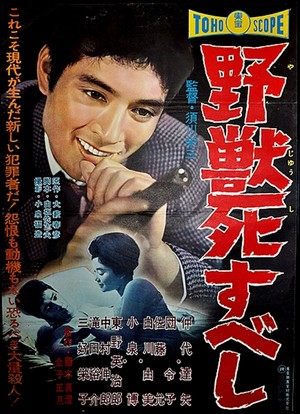
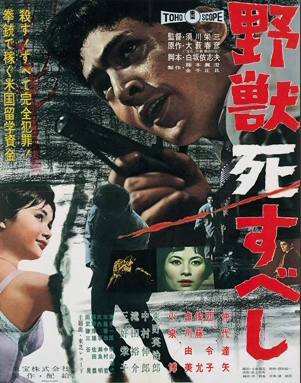
The Beast Shall Die (野獣死すべし, Eizo Sugawa, 1959)

“He’s not a beast. No, he’s a robot. A machine created by a modern, twisted society” according to a frustrated policeman acknowledging that a sociopathic killer is going to get away with his crimes because when it comes right down to it he’s just that good. Eizo Sugawa’s The Beast Shall Die (野獣死すべし, Yaju Shisubeshi) is the first of several adaptations of the hardboiled novel by Haruhiko Oyabu, Sugawa would himself direct a “sequel” 15 years later while a better-known version would prove a hit for Toru Murakawa in 1980 with action star Yusaku Matsuda in the leading role, and a two-part V-cinema adaptation would follow in 1997. The 1959 edition however is very much an expression of the anxiety of its times, a slightly reactionary take on the post-Sun Tribe phenomenon hinting at a generational divide between the nihilistic, hyper individualist post-war generation and their confused though morally compromised forbears. 

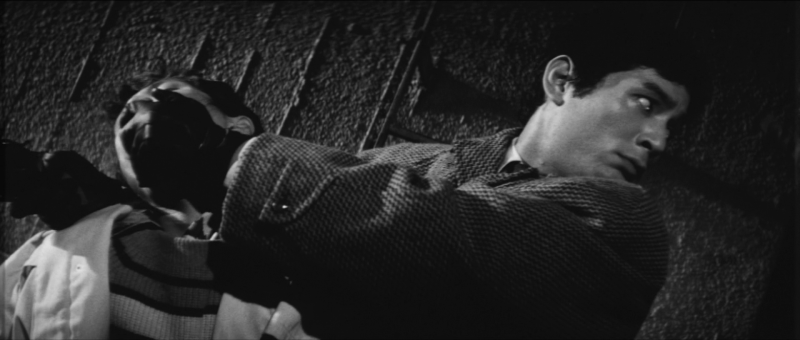
As the film opens, three policemen meet in a pub one of whom proudly shows off a Robby the Robot toy he’s picked up for his young son and is intending to give him on returning home from work. Sadly, however, Okada (Akira Sera) will never make it home because, for largely unexplained reasons, he is shot dead by nihilistic American literature student Date (Tatsuya Nakadai) who bundles the body into the boot of a car which he then simply abandons. Date never reveals much of a motive for this first murder, but he does later use Okada’s warrant card and service weapon to facilitate later crimes. 

The problem, at least for earnest policemen Kawashima (Eijiro Tono), a veteran cop and father of seven, and idealistic rookie Masugi (Hiroshi Koizumi) who is engaged to barmaid Yoko (Yumi Shirakawa) but drags his feet over the marriage because of his precarious life as a law enforcement officer, is an ideological divide within the contemporary police force. “Investigations are about science. And science is the best” according to their boss, reflecting a new faith in forensics prioritising physical evidence from the crime scene over a policeman’s intuition. From a modern perspective, this seems to be the right call though Kawashima and Masugi appear to find it both restrictive and mildly insulting as if their experience on the job now counts for nothing. They also worry that such rigid thinking prevents thorough investigation, and they might have a point in the boss’ continued insistence that the crimes must be down to “gang activity” even though the evidence clearly points at someone connected to the university or perhaps a disgruntled salaryman with access to the uni gun club. 

Kawashima and Masugi lament that they feel powerless to act because they don’t have the right to arrest someone on the basis of a “hunch”, and the film seems to agree with them as Date continues to commit his crimes unbothered by law enforcement though really who wants to live in such an authoritarian society that the police can haul you in solely because they think there’s something odd about you and “feel” you must be guilty of a crime even in the absence of conclusive evidence? Nevertheless it’s precisely these ideological divides that Date wilfully exploits while planning his hits, his second targets also reflecting the continuing Sinophobia of post-war cinema in impersonating a police officer to rob, but interestingly not kill, a pair of Chinese gangsters running an illegal gambling racket. 

Hearing Date’s back story, we realise that society has in a sense warped him in witnessing an injustice done to his father which later led to his suicide while his mother was apparently engaging in an affair with the man who framed him. He strongly argues that the only response to the “chaos, madness, and contradictions” of the modern society is to “show our beastly nature”, wilfully abandon humanistic morality and conventional civility in favour of an individualistic satisfaction of one’s personal desires above all other concerns. Date is certainly an amoral man who has no problem with sacrificing those he determines to be lesser beings for his own gain, but as even Masugi reveals his thinking may not be out of line with that of his generation. Many people are driven to murderous rage, he argues, but do not act on it because of a social taboo. 

As the film opens, a group of left-wing students is holding a rally in support of the anti-ANPO protests ahead of the treaty’s imminent renewal, though the professors mock them from inside insisting that their politics is not genuine only a reflection of the despair they feel in their society knowing that even if they graduate all that awaits them are low-level salaryman jobs with little promise of advancement. Those who can’t even manage that, they joke, turn to academia. Date’s professor (Nobuo Nakamura) affects sympathy with his poverty but also wilfully exploits him, getting him to do translations of novels which will later be published under his own name while it seems to be an open secret that he owes much of his success to the fact that he married into a prominent family which allowed him to spend five years studying abroad in America. 

Meanwhile, his students philosophise on the psychology of crime insisting that a “robotic, truly ruthless personality” can only come from a “mechanistic society like the US” while Japanese criminals are generally “emotional” in that crimes are committed because of “love affairs, resentment, finances”, “petty humanistic motives” which society can easily understand if not exactly condone. Date, admittedly a student of American literature with his eyes firmly set on going abroad, entirely disproves this theory. His crimes appear to be dispassionate and committed largely for practical reasons, the later ones at least with money as the motive even if he also derives a thrill from his amoral rebellion against the system. His poverty is offered as a justification yet we also see him abuse and manipulate those weaker than himself, humiliating an old lady trying to sell flowers in the bar where Yoko works while later talking a fellow student suffering with TB and unable to pay his tuition into helping him commit a robbery. 

Perhaps in someways uncomfortably in continuing a motif associating homosexuality with sadistic criminality, it’s also heavily implied that Date is bisexual, encountering an effeminate young man on the street with whom it is clear from their conversation he has previously been intimate to later use him as cannon fodder when engaging in a firefight with Chinese gangsters, while there is also an obvious homoerotic charge to his relationship to the student who later becomes a temporary accomplice. His relations with women are somewhat caddish and perfunctory, his sometime girlfriend Tae (Reiko Dan) telling the police that Date is a player who only sleeps with the same woman three times before becoming bored with her. Date’s attitude, though interestingly enough not his crimes, may reflect a societal misogyny, impoverished medical student Tae later refused access to the morgue because it’s not something a woman should see, though Tae herself later claims that it’s Date’s coldness and cruelty that draw her to him. Seemingly unable to feel genuine emotion for others, it nevertheless appears that Date is in a sense moved enough by Tae’s ability to embrace his inner darkness to eventually decide to alleviate her poverty on realising he no longer needs his ill-gotten gains because he’s secured his passage to America through more legitimate means. 

A reaction to the post-Sun Tribe sense of moral panic about disillusioned post-war youth, The Beast Shall Die suggests that for the moment at least those like Date are in an unassailable position thanks to an overly liberal justice system as the two policemen lament their inability to prevent his escape through judicial means while turning their attention to Tae though there’s no real way they can know that Date gave the stolen money to her rather than taking it with him or depositing it in some other location even if she’s walking around with an ugly handbag that might be full of cash. Alternating between an acceptance of Date’s nihilistic, crypto-fascist philosophy in implying that those who obey the rules of civility are doing so solely because they are too weak to break them, and advocating for a more authoritarian society in which policemen are free to act on their “hunches”, Sugawa’s take on Oyabu’s hard boiled tale of societal corruption and warped post-war morality has its reactionary qualities even as it ends on a note of ambiguity that implies order will eventually triumph though not, it seems, today. 


Original trailer (no subtitles)

Snow Country (雪国, Shiro Toyoda, 1957)

Closely associated with literary adaptation, Shiro Toyoda had been wanting to adapt Yasunari Kawabata’s Snow Country (雪国) since its serialisation and apparently spent four years preparing his treatment ahead of the 1957 film starring Ryo Ikebe as the solipsistic aesthete at the novel’s centre. Characteristically, however, he takes several liberties with the source material, notably introducing an entirely different conclusion which perhaps helps in re-centring the tale away from the hero Shimamura to the melancholy geisha who apparently falls for him because of his intense loneliness. 

A brief reference to a failed military insurrection in Manchuria sets us firmly in the mid-1930s as do repeated mentions of the ongoing depression which causes additional anxiety to local business owners in a small holiday resort town. Mimicking the novel’s famous opening, Toyoda opens with a POV shot of a train exiting a tunnel into the snow-covered landscape, the hero Shimamura (Ryo Ikebe) sitting sadly gazing out of a window and eventually captivated by the reflection of a young woman devotedly caring for a young man who appears to be in poor health. Meanwhile, another young woman, Komako (Keiko Kishi), gazes at her own reflection in a train station window, waiting once again as if unable to depart. As we discover, Shimamura has returned with the intention of seeing Komako with whom he’d struck up a relationship during a summer trip but is somewhat disappointed to learn that she has since become a geisha.

In a flashback to their first meeting, Komako asks Shimamura if he has come for “escape”, a question he doesn’t exactly answer while petulantly complaining about his lack of artistic success as someone who paints pictures apparently out of step with his times. When the head of the local commerce association tries to involve him in conversation about the failed insurrection, he bluntly tells him that he’s an artist and as such has no interest in such things, but it does indeed seem that he is looking for some kind of escape from the turbulent times, expressing that here the war seems very far away as does “the depression”. Komako, a more modern and perhaps prophetic figure than it might at first seem, is the only one to bring up the war directly speculating that it may be about to intensify while the frustrated affair between the two seems to be informed by the mounting tensions against which they are attempting to live their lives. 

Rather self-absorbed, Shimamura in a sense may even identify with Komako explaining that he too has a “patron” and implying that his flight is perhaps a response to his sense of powerlessness, that he feels constrained by his financial dependency presumably on his father-in-law though his relative economic superiority which leads Komako to frequently remark on his “extravagance” obviously affords him the freedom to make these random solo trips to ski resorts and indulge his career as a painter regardless of its capacity to support himself and his family. Komako must know on some level that the relationship is a fantasy, yet she believes in it enough to end her connection with an elderly patron on suspecting that she is carrying Shimamura’s child only to have her hopes dashed when he does not turn up for a local festival as promised with the consequence that all of her dependents are turfed out of the home he had provided for her. 

Komako is not “free” in the same way that Shimamura evidently is, her entire life dictated by the fact that she is poor and female. Fostered by a shamisen teacher, she may have been technically engaged to the young man, Yukio (Akira Nakamura), Shimamura saw on the train being cared for by Yoko (Kaoru Yachigusa), Komako’s foster sister in love with him herself, but intensely resents the burdens she is expected to bear quite literally with her body. She later tells Shimamura that she didn’t become a geisha for Yukio in order to pay his medical bills but out of a sense of obligation, while she is also responsible for her birth family, the now bedridden shamisen teacher, and Yoko who intensely resents her for her callous treatment of Yukio and generally “dissolute”, selfish way of living. During the famous fire in a cinema that closes the novel (but not the film), Komako even exclaims that her life would be easier if Yoko burned to death, but on witnessing her either fall or jump from the burning building she can do nothing other than run to her side. 

Indeed, the novel’s climax finds Shimaura standing alone indifferent to the fate of Yoko, a young woman he had come to admire if only for her contrary qualities, admiring instead the beauty of the night sky. In Toyoda’s characterisation, Yoko is in one sense the conventionally good woman whose selfless devotion to the sickly Yukio so captivates Shimamura, but her goodness is nevertheless undercut by the degree of her animosity towards Komako even as the two women remain trapped in a complex web of frustrated affection and intense resentment, each perhaps knowing they neither can have the man they want and are condemned to an eternal unhappiness as the snow mounts all around them in this perpetually cold and depressing moribund resort town. Switching between studio matte paintings ironically mimicking Shimamura’s art and on-location footage of the deepening snows, Toyoda’s sense of near nihilistic melancholy evoking the atmosphere of Japan in the mid-1930s hints at grand tragedy but finds resolution only in stoicism as the heroine picks up her shamisen and trudges onward amid the quickening blizzard.  


Wife (妻, Mikio Naruse, 1953)

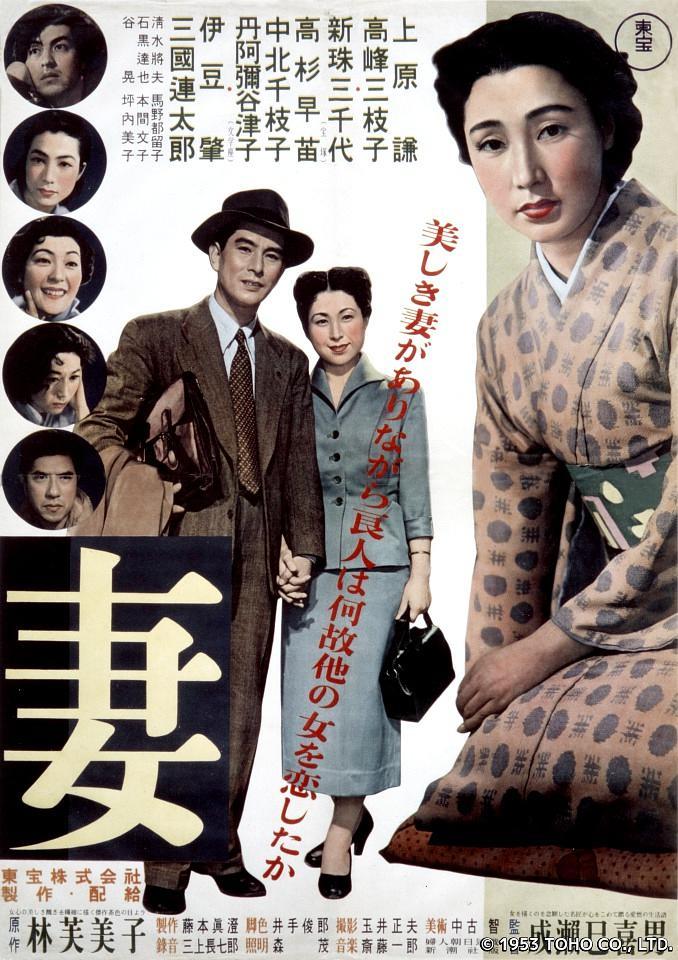
The post-war world, to a certain way of thinking at least, promised a greater degree of freedom in which it might no longer be necessary to go on stoically bearing unhappiness in service to a social ideal. Then again, old habits are hard to break and not everyone is quite so equipped to acknowledge that misery can in a sense be a choice. Mikio Naruse’s Wife (妻, Tsuma) finds itself at a moment of transition in which the meaning of everything the word meant was perhaps beginning to change while the idea that a woman might choose to reject the role was no longer a taboo but an increasingly viable possibility. 

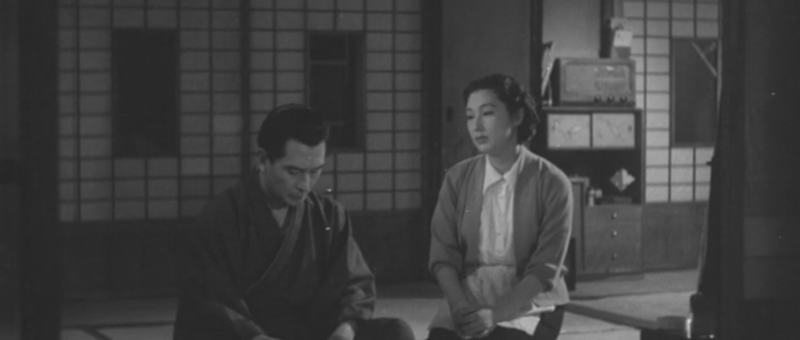
To the unhappily married Mineko (Mieko Takamine), however, the idea of independence remains somewhat distasteful. Each morning her husband, Nakagawa (Ken Uehara), leaves the house without a word. In fact, he doesn’t even look at her before silently walking away. She complains that she has no idea what he’s thinking, all he ever tells her is that he’s “tired” but she also resents him for failing to provide for her in the way that she perhaps expected. The couple live in a sizeable home, but Mineko has to rent out the upstairs to a series of lodgers as well as taking in sewing as a side job to make ends meet. What seems perfectly apparent is that the couple are ill suited, both in terms of temperament and of personal desires. Nakagawa is a soft hearted, romantic sort of man who isn’t particularly bothered if their lodgers pay their rent or not, while his wife is emotionally distant and infinitely practical as perhaps life has taught her to be. 

The peculiarities of life in Japan in 1953 place considerable strain on not only on the Nakagawas but on each of the other couples that we see. Those who married in haste during the war may be regretting their choices, while others, like Eiko (Chieko Nakakita) who rents the upstairs room with her husband Matsuyama (Hajime Izu), complain that the men they waited so long for came back changed. That Matsuyama cannot find a job in the difficult economic circumstances of the post-war society may not be his fault, but the necessity of relying on his wife for economic support has nevertheless eroded his sense of masculinity and left him a resentful drunk, destroying his wife’s love for him. Mineko is slightly scandalised when another tenant, art student Tanimura (Rentaro Mikuni), reveals that Eiko works not in a store but in a bar in Ginza, that being in truth the only kind of job that pays enough to support a married couple and a mother-in-law that a woman can get in 1953. Eventually Eiko leaves her husband, something else that scandalises Mineko, and resolves to live an independent life rather than remarry.

The idea of independence is repeatedly mentioned to her, but Mineko continues to reject it. Her sister jokingly suggests going into business together, while another customer, a widow with a young son, floats the idea of leaving the home of her late husband and opening a shop to support herself independently. She believes remarriage is not a viable option because she has a child, a thought echoed by another widow, Fusako (Yatsuko Tanami), who eventually decides to do something similar by returning to her hometown and going into business with a friend. Opening a shop is a popular option, but it of course requires investment and relies on having strong support, in Fusako’s case from female solidarity in teaming up with another woman in a similar situation. 

It might be easy enough to say that becoming financially independent is a choice on offer only to widows with children who have, in some way, already fulfilled their social obligations, while women like Eiko who chose childless self-sufficiency would still struggle to find acceptance even if their career were not dependent on an industry still itself taboo. That Nakagawa and Mineko have no children perhaps places an additional strain on the marriage. Nakagawa tells a colleague complaining about his family that he wonders if children might have made his life easier, while his only moment of contentment seems to be in playing with Fusako’s young son on the morning after spending an illicit night with her in an inn at Osaka. She sadly tries to ask what might be next for them, but he only wants to live in that moment knowing that their future is an impossibility. 

Despite his unhappiness, Nakagawa doesn’t seem motivated towards ending his marriage, perhaps out of guilt or because as friend later suggests it’s not so much Fusako that he loves as the possibility of a different future. On his return from his Osaka trip, he encounters a new tenant, Mineuchi, who has found her own way to be independent in becoming a mistress. Nakagawa seems to find the arrangement mildly distasteful, though it’s perhaps not so far off what he’s planning to do with Fusako. Mineuchi paid premium for the room and has even brought her own refrigerator and an electric gramophone so she is in a sense living the dream, especially as her “patron”, a furniture store owner, only visits twice a month. 

After learning that Nakagawa has fallen in love with Fusako, Mineko wonders if she should pay her a visit, but then receives one herself from the furniture store owner’s tearful wife who reveals that he is not a wealthy man and has ruined himself, and therefore her, after being bewitched by a Ginza bar hostess. Later, Mineko discovers that the furniture store owner’s wife took her own life in humiliation, lamenting that she didn’t have to go so far just because of her husband’s indiscretion, but also threatens to do the same herself to try and guilt Fusako into giving up her husband. 

Yet, pretty much everyone seems to tell Mineko that this is all her own fault and the reason her perfectly good husband has looked elsewhere is because she has failed as a wife. Sharp and emotionally distant, she alienates those around her but is devastated to realise that she’s lost her husband’s love and will most likely never be able to regain it. Her decision to talk not to him but to Fusako hints at the way in which women see each other as rivals and not as friends, actively holding each other back, as her sister Yoshimi (Michiyo Aratama) also does in insisting on the social order over personal feeling, rather than attempting to find understanding or mutual support. It doesn’t seem to occur to her that ending her husband’s dream of romantic escape through emotional manipulation is unlikely to improve the quality of her married life. 

Mineko, however, never contemplates independence. She tells Fusako that she won’t consent to a divorce just to claim alimony, but privately wonders what would become of her if she left her husband. She might be able to put a stop to it this time, but who’s to say he won’t find someone else. What she seems primed to choose is socially mandated misery, rejecting the “freedoms” of the post-war age to end an unhappy marriage because she can’t conceive of herself as anything other than a “wife” and being miserable is apparently better than being nothing at all. 


A Woman’s Place (女の座, Mikio Naruse, 1962)

“A woman’s life is so dreary” laments a disappointed woman as she sits awkwardly at a funeral in Mikio Naruse’s A Woman’s Place (女の座, Onna no Za, AKA The Wiser Age). What exactly is “a woman’s place” in the changing post-war society? The continuing uncertainties of the age begin to burrow into the Ishikawa household as it becomes plain that the house is already divided, in several senses, as daughters and sons find themselves pulled in different directions, each of them perhaps banking on an inheritance to claim a different future. 

As the film opens, the sons and daughters of the Ishikawa family have been sent telegrams to come home at once because dad is at death’s door. Thankfully, that turns out to be premature. All he’s done is put his back out overdoing it in the garden by trying to lift a big rock in defiance of his age. Oldest daughter Matsuyo (Aiko Mimasu), who runs a boarding house, is quite put out to have rushed over for nothing, but everyone is obviously relieved that there turned out to be nothing to worry about after all. Widowed daughter-in-law Yoshiko (Hideko Takamine) realises that she needs to wire Michiko (Keiko Awaji) who moved to Kyushu when she got married that there’s no need to come, but she later turns up anyway along with her goofy husband Masaaki (Tatsuya Mihashi), claiming they’ve decided to make the trip a kind of honeymoon though it seems obvious to everyone that there must be reasons they seem intent on overstaying their welcome. 

“They depend on us, everyone does when they return home” mother/step-mother Aki (Haruko Sugimura) chuckles as Matsuyo and only remaining son Jiro (Keiju Kobayashi) pocket some paper towels from the family shop on their way out. Everyone is indeed depending on the family, not least for a clue as to where they stand as much as for a permanent place to return to. Three daughters of marriageable age still live at home. The oldest, Umeko (Mitsuko Kusabue), the daughter of patriarch Kinjiro’s (Chishu Ryu) first wife, has renounced the possibility of marriage and has made a career for herself as an ikebana teacher, a traditionally respectable occupation for “independent” women. In her 30s, she has become cruel and embittered, sniping at her sisters and always smirking away in a corner somewhere being aggressively miserable (nobody in the family seems to like Umeko very much, but still they accept her). Later she offers a sad, surprisingly romantic explanation for her decision in her unrequited love for a middle school classmate who died in the war, but is in someway revived by an unexpected attraction to a young man Matsuyo brings to the house who claims to be the infant boy Aki was forced to give up when she left her former husband’s family and married Kinjiro. 

The unexpected reappearance of Musumiya (Akira Takarada) destabilises the family across several levels, firstly in highlighting Aki’s awkward status as a second wife and step-mother to the two oldest children, and then by inciting a false romantic rivalry between the widowed Yoshiko and the unmarried Umeko. Umeko at one point cruelly describes Yoshiko as the only “outsider” in the household, viewing her connection to them now that her husband has died solely through the lens of being the mother of the only male grandchild, Ken (Kenzaburo Osawa). Yoshiko, only 36 years old, is repeatedly urged to remarry, but she like Aki would be forced to leave Ken behind if she did, though he is now a teenager and perhaps old enough not to feel abandoned. Ken in fact joins in encouraging his mother to find a second husband, but partly because she is always nagging him to study harder (something which will have have tragic, unexpected consequences). Yoshiko’s “place” in the household is therefore somewhat liminal, part of the family and yet not, because her status depends on solely on her relationships to others rather than blood. 

Nevertheless, Yoshiko is clearly in charge as we witness all of the other women disturbing her while she’s cooking to enquire after missing items, whether the bath is ready, or to attend to something in the store. Umeko has built her own smaller annex on another part of the property and mostly keeps to herself, while the two younger daughters busy themselves with a series of romantic subplots. Despite her sister Matsuyo’s eye-rolling that she should “forget about working and get married”, Natsuko (Yoko Tsukasa) is trying to find another job after being laid off when the company she worked for went bankrupt. Her brother, meanwhile, is experiencing the opposite problem in that it’s impossible to find and keep delivery staff at his ramen shop and he desperately needs help because his wife is pregnant again. Natsuko is convinced to “help out” though it’s clear that working in a ramen shop wasn’t what she had in mind, but it does bring her into contact with an eccentric friend of her sister Yukiko’s (Yuriko Hoshi) while she works on the box office of a nearby cinema. 

A crisis occurs when Natsuko is presented with the prospect of an accelerated arranged marriage to a man who took a liking to her while working at the company which went bust and has since got a job which requires him to relocate to Brazil. The ramen shop guy, Aoyama (Yosuke Natsuki), meanwhile is also getting a transfer but only to the top of Mount Fuji. Natsuko is torn, but also wonders if Yukiko actually wants Aoyama herself and only tried to set them up as a sort of test. In any case, both of these younger women also feel that their “place” is defined by marriage and their status conferred by their husbands even if they are exercising a personal preference in their choice, Yukiko’s in romance while Natsuko’s is perhaps a little more calculation in that she knew and liked her suitor but would not go so far as to call it “love”. 

In her own strange way, Umeko may be the most radical of the women in that she has attempted to define her own place through rejecting marriage and making enough money to buy her own home (albeit still on the family property) in a kind of independence, later deciding that perhaps she does want marriage after all but only on her own terms. Unfortunately, she is drawn to Musumiya whose presence poses a threat to the family on several levels, the most serious being that he is quickly exposed as a conman guilting Aki into assisting him financially while also trying some kind of car sale scam on the smitten Umeko who wants to add to her independence through learning to drive. Musumiya, it seems, prefers Yoshiko and his affection may well be genuine, but she is trapped once again. While she and Aki privately express their doubts about Musumiya, they have no desire to hurt Umeko’s feelings and cannot exactly come out and say that he is no good seeing as he is Aki’s son. Yoshiko stoically keeps the secret, perhaps also attracted to Musumiya but loyal to the Ishikawas and wanting no trouble from such a duplicitous man. Still, Umeko regards Yoshiko’s attempts to discourage her as “jealousy” and wastes no time embarrassing them both in a nasty public altercation. 

While all of this going on, there has been some talk that the shop may be compulsory purchased to make way for an Olympic road, and each of the Ishikawa children is eagerly awaiting their share of the compensation money, not least Michiko and her feckless husband who turns out to have fled Kyushu after getting fired from his job for assaulting a client. The “heir”, technically is Ken as the only male grandchild and Yoshiko’s tenuous status in the household is entirely conferred on her as his mother. When that disappears, her “place” is uncertain. Most of the others are for kicking her out, she’s not a “real” member of the family and so deserves none of the money with only Natsuko stopping to defend her. But, as so often, the widowed daughter-in-law turns out to be the only filial child. Mum and dad feel themselves displaced in their own home, somehow feeling they must stand aside, but it turns out they have plans of their own and Yoshiko is very much included. They want to take her with them, and if one day she decides to marry again then that’s perfectly OK and they will even provide a dowry for her as if she were one of their own daughters. 

“We have many children but they only think of themselves” Kinjiro laments, “let’s not worry about them and live peacefully by ourselves”. It’s easy to see their decision as a strategic retreat, as if they’re being left behind by a future they cannot be a part of, but it’s also in some ways an escape from the increasingly selfish post-war society. Yoshiko may not have actively chosen her “place” but she does at least have one and reserves the right to choose somewhere else in the future. The older Ishikawas choose to be happy on their own, freeing their children and giving them their blessing so long as they’re “doing their best”. It’s a strangely upbeat conclusion for a Naruse film, if perhaps undercut with a mild sense of resignation, but nevertheless filled with a hope for a happier future and an acknowledgement that “family” can work but only when it is defined by genuine feeling and not merely by blood. 


The Last Gunfight (暗黒街の対決, Kihachi Okamoto, 1960)

“Times may change but there’s always a bunch of greed-blinded old men to rip you off” according to the sidelined noble yakuza pushed into the shadows of Kihachi Okamoto’s anarchic gangster romp The Last Gunfight (暗黒街の対決, Ankokugai no Taiketsu). Another of Okamoto’s early crime movies, Last Gunfight, adapted from the novel by hardboiled king Haruhiko Oyabu, as its name implies finds a stranger in town arriving at the tail end of a gang war in which the wrong side seems to have won hoping to offer a course correction for the post-war future. 

Branded a “dirty cop” and demoted to small-town Kojin, Fujioka (Toshiro Mifune) is a maverick officer exploring the local landscape by getting into fights with foot solders from differing outfits, quickly finding out that the Ooka gang are currently in the ascendent while old school Kozuka flounders. Improbably enough, the local flashpoint is over control of the gravel dredging business currently operated by Kozuka but contested by Ooka. Fujioka meanwhile is caught in a complex web at the nexus of which is Tetsu (Koji Tsuruta), a former Kozuka man who now runs a bar while he plots revenge for the death of his wife in a traffic accident he suspects may have been foul play possibly at the hands of Ooka man Niki, brother of brassy bar girl Sally (Yoko Tsukasa). 

Arriving on the same train as dodgy lawyer Tendo (Akihiko Hirata) and an exotic dancer destined for the club, Fujioka keeps his cards close to his chest leaving his loyalties all but clear. The station are less than thrilled to have him, especially as he spends his first night in town in one of their cells after starting a bar fight, waking up right under a sign which reads “stop violent crime”, while another earnest young officer reminds him that “policemen should never be involved in violence”. Fujioka continues to play both sides, cosying up to both Ooka and Tetsu, walking the line between cop and thug while seemingly scoping out the terrain on either side of the tracks. 

Meanwhile, the town is mired in a battle for its soul as the amoral Ooka gang slowly take over. As Kozuka foot soldier Yata (Makoto Sato) puts it, his boss is the sort who won’t have anything to do with yakuza who don’t obey the code which is why he won’t simply cut a deal with Ooka. According to Kozuka (Jun Tazaki), others might lump him in with “fools and trash” but he’s the old school kind of yakuza providing a genuine service to the community. He dredged the river to stop it flooding and was given the gravel business as a thank you so he resents having it stolen out from under him by the likes of Ooka who makes his money primarily through the drugs trade trafficking “China White” and has seemingly corrupted the entire city council. 

Then again, as Kozuka points out ties based on greed are the most fragile of all and it appears Ooka has secrets he’d rather weren’t exposed. Living in a Western-style mansion complete with open fireplaces and hunting trophies on the walls Ooka is laying claim to a fiefdom as the new inheritor of the feudal legacy. Tetsu’s bar, meanwhile, seems to have a Wild West theme which perhaps speaks of his love of freedom and independence as opposed to Ooka’s elitist authoritarianism. As a representative of legitimate authority Fujioka walks a tightrope between the two but eventually shuns a potential love interest in bargirl Sally, currently Ooka’s squeeze but playing her own game hoping to find out what happened to her brother, in favour of a bromance with the wounded Tetsu.  

Like Okamoto’s other gangster movies from this era however and in contrast to the heaviness of the title, Last Gunfight is imbued with a strong sense of irony and the director’s characteristically cartoonish sense of humour with its ridiculous fight scenes, elaborate production design, and playful subversion of gangster movie tropes right down to the frequent musical numbers starring a trio of minions clad in black suits and lip-syncing to songs about killing the moon. Ending as it began, Okamoto’s elliptical narrative sees the strangers leaving town, job done, but laying themselves bare as they go now shorn of their cover identities and headed back into the heart of corruption in search of new destinations.


Original trailer (no subtitles)

The Scarlet Camellia (五瓣の椿, Yoshitaro Nomura, 1964)

Little known outside of Japan, Yoshitaro Nomura is most closely associated with post-war noir and particularly with adaptations of Seicho Matsumoto’s detective novels, yet he had a wide and varied filmography directing in several genres including musicals and period dramas. The son of silent movie director Hotei Nomura, he spent the bulk of his career at Shochiku which had and to some degree still has a strong studio brand which leans towards the wholesome even if his own work was often in someway controversial such as in the shocking child abuse drama The Demon or foregrounding of leprosy in Castle of Sand. Part of the studio’s series of double-length epics, 1964’s Scarlet Camellia (五瓣の椿, Goben no Tsubaki) is nevertheless an unusual entry in Nomura’s filmography, adapting a novel by Shugoro Yamamoto essentially setting a policier in feudal Japan and perhaps consequently shot largely on stage sets rather than on location. 

Nomura opens with artifice as Shino (Shima Iwashita) stares daggers at an actor on the stage but later returns to his rooms every inch the giggling fan before finally offing him with her ornate silver hairpin leaving behind only the blood red camellia of the title. The first in a series of killings later branded the Camellia Murders, we later realise that the actor had to die because of his illicit relationship with Shino’s mother whom he brands a “nympho” and as we later discover had several extra-marital lovers. Extremely close to her father who, as we’re told, perished in a fire while resting in the country due to his terminal tuberculosis, Shino is apparently on a quest for revenge against the faithless men who humiliated him though her feelings towards her mother seem far more complex. 

Indeed, Shino regards her mother’s carrying on as “dirty” and seems particularly prudish even as she wields her sex appeal as a weapon in her quest for vengeance. Yet it’s not so much the free expression of sexuality which seems to be at fault but excess and irresponsibility. Shino resents her mother primarily for the ways in which she made her father suffer, off having fun with random men while he shouldered the burden of her family business which, Shino might assume, has contributed to his illness. Aoki (Go Kato), the Edo-era policeman to whose narrative perspective the second half turns, advances a similar philosophy in that there’s nothing wrong with having fun, he has fun at times too, but people have or at least should have responsibilities towards each other which the caddish targets of the Camellia Killer have resolutely ignored. He can’t say that he condones the killer’s actions, but neither can he condemn them because her motivations are in a sense morally justifiable. 

Realising the end is near, Shino indulges in a very modern serial killer trope in leaving a note for Aoki alongside one of her camellias in which she claims that she is exacting vengeance for “crimes not punishable by law”. There was nothing legally wrong in the way these men treated her mother or any other woman, but it is in a sense a moral crime. “You’re a woman and I’m a woman too” she later tells another scorned lover, a mistress thrown over by her patron with two small children after he tired of her, as she hands over a large sum of money and encourages her to return to her family in the country. Shino’s quest is essentially feminist, directed against a cruel and patriarchal society in which the use and abuse of women is entirely normalised, yet it is also slightly problematic in her characterisation of her mother as monstrous in her corrupted femininity for daring to embrace her sexuality in exactly the same way as her male counterparts though they, ironically, mainly seem to have been after her money rather than her body. 

Shino’s mother’s death is indeed regarded as “punishment from heaven” presumably for her sexual transgressions and neglect of her family, rejecting both the roles of wife and mother in a ceaseless quest for pleasure. Yet even in her resentment, Shino’s ire is directed firmly at the men taking the last of her targets to task when he justifies himself that women enjoy sex too and are therefore equally complicit by reminding him that he gets his moment of pleasure for free but the woman may pay for it for the rest of her life. Just as Shino’s mother neglected her family, the men harm not only their wives in their illicit affairs but cause concurrent damage to the mistresses they may later disown and the illegitimate children they leave behind. Abandoning the naturalism of his contemporary crime dramas for something much more akin to a ghost film with his eerie lighting transitions and grim tableaux of the skewered victims, Nomura crafts a melancholy morality tale in which the wronged heroine turns the symbol of constrained femininity back on the forces of oppression but is eventually undone by the unintended consequences of her quest for vengeance even as she condemns the architect of her misfortune to madness and ruin. 


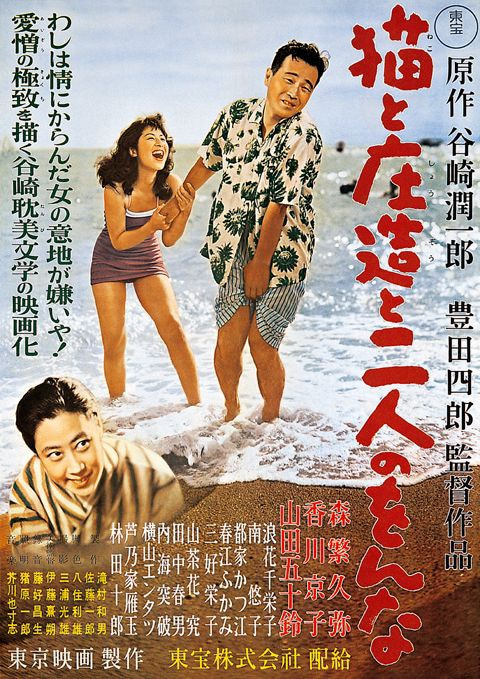
Shozo, a Cat and Two Women (猫と庄造と二人のをんな, Shiro Toyoda, 1956)

Post-war melodrama is largely concerned with the place of women, in particular, in a rapidly changing society, but given the centrality of domestic life, were men yearning for “independence” too? Shiro Toyoda was closely associated with comedic tales of strong women and weak men, and Shozo, a Cat and Two Women (猫と庄造と二人のをんな, Neko to Shozo to Futari no Onna) is as its title implies no exception. Adapting the novel by Tanizaki, Toyoda offers a subtle critique of the traditional family as its hapless hero finds himself caught between the conflicting demands of his feudalistic mother, stoic first wife, hedonistic second, and his much loved but perhaps mercenary feline, Lily. 

Shozo (Hisaya Morishige) is perhaps a typical spoiled only son, lazy, feckless, and essentially passive. Shinako (Isuzu Yamada) who agreed to an arranged marriage with him four years previously is walking out, thoroughly fed up with her mother-in-law Orin’s (Chieko Naniwa) constant complaints not least among them that the couple have no children. Unbeknownst to Shinako, however,  Shozo has been carrying on with his slightly younger cousin, Fukuko (Kyoko Kagawa), who is a free spirited modern woman. In fact, Fukuko has already run away from home three times in the company of various men so her wealthy father would be only too pleased to see her settle down and is so desperate to offload her that he’s even offering a huge dowry. All of this is complicated by the fact that Fukuko’s father already owns the mortgage on Shozo’s family store, which presents a serious challenge to typical family dynamics. 

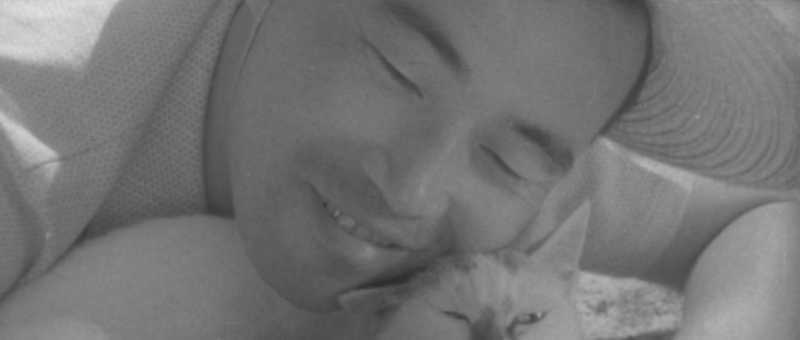
Shozo, meanwhile, is only really interested in his pet cat, Lily, something which was a bone of contention in his failed marriage to Shinako (and perhaps a reason they have not been blessed with children). On learning that Orin has already moved Fukuko into the family home mere seconds after she vacated it, Shinako is suddenly struck by remorse and feels the need to vindicate her pride through revenge. Plotting how best to drive a wedge between Fukuko and her new husband, she settles on petitioning Shozo to give her custody of Lily, and then suggests the same thing to her rival knowing that whatever happens it will cause a series of problems in the Oyama household. 

The irony is, in a sense, that it’s Shozo who has been displaced from his own home. Perhaps surprisingly, he often tries to help out with household tasks but his mother always stops him, insisting that housework isn’t something a man should pay attention to. Orin is of course perpetuating outdated ideas of traditional gender roles, but there is also an obvious anxiety in her need to protect her territory from possible incursion. She doesn’t necessarily trust the idea that she and Shozo are connected by anything deeper than practicality and filial obligation and her only currency is her ability to provide the services that Shozo “cannot” provide for himself. His learning to take care of himself is an existential threat to her position as his caregiver even though he is a grown man in his 30s perfectly capable of doing his own laundry and preparing his own meals (as he already does for Lily who particularly enjoys grilled chicken). 

When they brought Shinako into the house, they did so apparently because she was known to be a “good worker” at her job as a maid for a wealthy family. Since then she has indeed worked hard, but is viewed as little more than a glorified servant by Orin who has delegated much of the feminine labour to the younger woman, while Shozo emotionally neglects her in favour of the cat and apparently satisfies his carnal urges outside the home. They accept Fukuko for her money, but take the opposite approach, treating her as the lady of the manor. Fukuko does no housework (a cupboard is later discovered where she’d thrown all the washing she couldn’t be bothered to do), but Orin simply picks up her share and more, becoming maid to her daughter-in-law who frequently reminds them that it’s her money paying for everything so she is the one who is really in charge. 

Shozo does not seem to react too closely to these assaults on his masculinity, but only wants to escape to be alone with Lily whom he believes is the only one who really loves him. In this he is perhaps the truly modern man who wanted his family relations to be “real” rather than defined by social obligation, but he’s also self-centred and childish, still seeing the women (even Lily) as providers of service rather than fellow human beings. His mother satisfied his hunger, Shinako kept him financially by managing the business, and Fukuko sated his passion, but he feels oppressed by all of them in different ways and in the end does not want the responsibility of dealing with human emotions. Lily may be capricious, but her needs are easily satisfied and to that extent she is dependent on him. His desire to be “independent” and find emotional fulfilment only with his cat is just as much of a challenge to the social order as a woman who rejects marriage or seeks to fulfil herself outside of the home. 

Shozo’s dilemma is however presented as comedic until its unexpectedly melancholy conclusion which reduces him to the status of a stray cat as the women come to literal blows, fighting not quite over him (he isn’t worth fighting over) but for their own self-esteem and particular brand of womanhood. Shinako sits at home and calculates all the back pay she’d be entitled to for the labour she performed at the Oyama household in recognition that being a wife is also a job and they treated her as a maid anyway (which is to say as an outsider with no intention of love or loyalty), while Fukuko begins to see the “emptiness” in her party girl lifestyle but prefers to be pampered and resents being “beaten” by a mere housemaid. This system traps everyone, forcing them to manipulate the desires of others while suppressing their own. Shozo and his cat are left out in the cold, trapped between tradition and modernity but no more free than they were before even in their mutual dependency.