A Colt is My Passport (拳銃は俺のパスポート, Takashi Nomura, 1967)

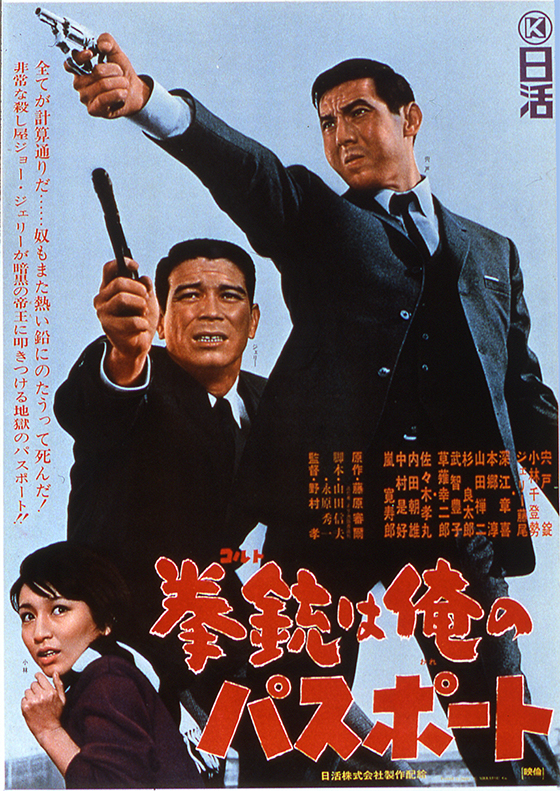
colt is my passport posterJo Shishido played his fare share of icy hitmen, but they rarely made it through such seemingly inexorable events as the hero of Takashi Nomura’s A Colt is My Passport (拳銃は俺のパスポート, Colt wa Ore no Passport). The actor, known for his boyishly chubby face puffed up with the aid of cheek implants, floated around the lower end of Nikkatsu’s A-list but by 1967 his star was on the wane even if he still had his pick of cooler than cool tough guys in Nikkatsu’s trademark action B-movies. Mixing western and film noir, A Colt is My Passport makes a virtue of Japan’s fast moving development, heartily embracing the convenience of a society built around the idea of disposability whilst accepting the need to keep one step ahead of the rubbish truck else it swallow you whole.

Kamimura (Joe Shishido) and his buddy Shiozaki (Jerry Fujio) are on course to knock off a gang boss’ rival and then get the hell out of Japan. Kamimura, however, is a sarcastic wiseguy and so his strange sense of humour dictates that he off the guy while the mob boss he’s working for is sitting right next to him. This doesn’t go down well, and the guys’ planned airport escape is soon off the cards leaving them to take refuge in a yakuza safe house until the whole thing blows over. Blowing over, however, is something that seems unlikely and Kamimura is soon left with the responsibility of saving both his brother-in-arms Shiozaki, and the melancholy inn girl (Chitose Kobayashi) with a heart of gold who yearns for an escape from her dead end existence but finds only inertia and disappointment.

The young protege seems surprised when Kamimura tosses the expensive looking rifle he’s just used on a job into a suitcase which he then tosses into a car which is about to be tossed into a crusher, but Kamimura advises him that if you want to make it in this business, you’d best not become too fond of your tools. Kamimura is, however, a tool himself and only too aware how disposable he might be to the hands that have made use of him. He conducts his missions with the utmost efficiency, and when something goes wrong, he deals with that too.

Efficient as he is, there is one thing that is not disposable to Kamimura and that is Shiozaki. The younger man appears not to have much to do but Kamimura keeps him around anyway with Shiozaki trailing around after him respectfully. More liability than anything else, Kamimura frequently knocks Shiozaki out to keep him out of trouble – especially as he can see Shiozaki might be tempted to leap into the fray on his behalf. Kamimura has no time for feeling, no taste for factoring attachment into his carefully constructed plans, but where Shiozaki is concerned, sentimentality wins the day.

Mina, a melancholy maid at a dockside inn, marvels at the degree of Kamimura’s devotion, wishing that she too could have the kind of friendship these men have with each other. A runaway from the sea, Mina has been trapped on the docks all her adult life. Like many a Nikkatsu heroine, love was her path to escape but an encounter with a shady gangster who continues to haunt her life put paid to that. The boats come and go but Mina stays on shore. Kamimura might be her ticket out but he wastes no time disillusioning her about his lack of interest in becoming her saviour (even if he’s not ungrateful for her assistance and also realises she’s quite an asset in his quest to ensure the survival of his ally).

Pure hardboiled, A Colt is My Passport is a crime story which rejects the femme fatal in favour of the intense relationship between its two protagonists whose friendship transcends brotherhood but never disrupts the methodical poise of the always prepared Kamimura. The minor distraction of a fly in the mud perhaps reminds him of his mortality, his smallness, the fact that he is essentially “disposable” and will one day become a mere vessel for this tiny, quite irritating creature but if he has a moment of introspection it is short lived. The world may be crunching at his heels, but Kamimura keeps moving. He has his plan, audacious as it is. He will save his buddy, and perhaps he doesn’t care too much if he survives or not, but he will not go down easy and if the world wants a bite out of him, it will have to be fast or lucky.


Original trailer (no subtitles)

Cruel Gun Story (拳銃残酷物語, Takumi Furukawa, 1964)

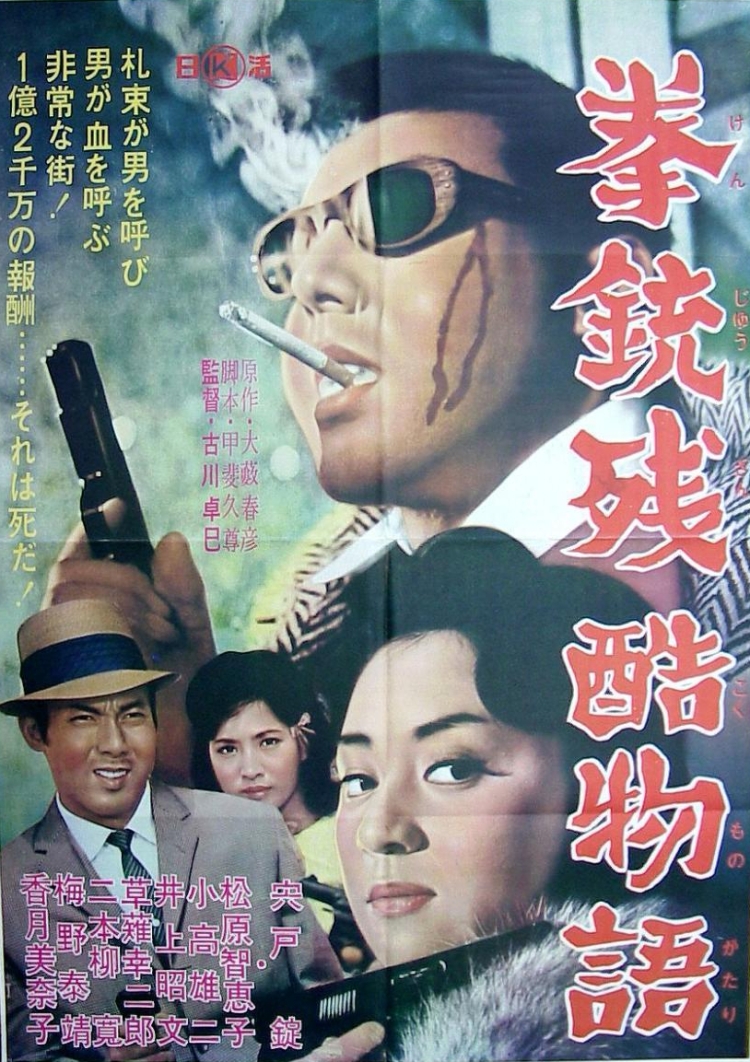
cruel-gun-story-poster.jpgIn the history of Japanese noir, the name Haruhiko Oyabu looms large. Oyabu’s gritty, pulp infused tales of tough guy heroes found their clearest expression in the hardline ‘70s with Toru Murakawa’s unique brand of macho action as seen in Resurrection of the Golden Wolf or The Beast Must Die, but a decade earlier they were also finding fertile ground in Nikkatsu’s harder B-movie noir. Based on a novel by Oyabu, Cruel Gun Story (拳銃残酷物語, Kenju Zankoku Monogatari) seems to owe more than a little to Kubrick’s The Killing in its crime never pays tale of honest crooks undercut by their unscrupulous comrades but the central message is that the gun is a cruel master and those living under its control will pay a heavy price.

Togawa (Jo Shishido) has just been (unexpectedly) given early release from a prison sentence incurred when he took revenge on the truck driver who knocked down his little sister (Chieko Matsubara) and confined her to a wheelchair for the rest of her life. Middle rank gangster Ito – formerly a crooked lawyer with a pencil mustache a supercilious air, has a job for him the gang thinks only he can do. The payout is 120 million yen – not to be sniffed at, but Togawa has reasons to be suspicious. He takes some convincing but finally relents when he finds out an old and trusted friend, Shirai (Yuji Kodaka), has already agreed. The gang have another three guys lined up but Togawa rules the third one out when he tests him and confirms he’s an untrustworthy blabbermouth. The other two are a former boxer with mild brain damage whose girlfriend has just left him, and an unscrupulous but clever chancer named Teramoto (Kojiro Kusanagi).

Following the general pattern, Furukawa walks us through the heist as it’s supposed to go if everything goes to plan complete with a 3D diagram and plastic toy cars but, of course, not everything goes to plan. The job is to steal the ticket money from the Japan Derby (much like the race course robbery in The Killing). The gang will set up fake road signs and station a “policeman” to divert the armoured car onto a small country lane where they will kill the police motorcycle escort, get rid of the guards, and load the truck onto a bigger lorry that they will then take to a disused US airbase they’ll use as their lair.

Disused American airbase could easily apply to the entirety of the surrounding area. Jets fly ominously overhead while the world Togawa and his guys inhabit is one of noirish jazz bars filled with foreigners, grimy boxing clubs, signs in English and the relics of destruction everywhere. This is a place for those who’ve already fallen through the cracks, even the gangsters are only really small fry – not yakuza but hoodlums ripped straight from the Edward G. Robinson playbook. This giant heist is the most audacious in living memory, pulling it off would be the finest achievement any of them would ever make, taking them out of their dead end environments and catapulting them into the criminal high life.

Togawa knows there’s something not right about this – he almost turns it down because he wants to be around to take care of his sister, but he also wants the money to pay for an operation he hopes will restore her mobility to assuage his guilt over having sent her out on the fateful day she was injured. Rie now lives in the care of kindly nuns and is a goodhearted, religious woman hoping for her big brother’s reformation. Togawa and his sister are also victims of war having lost their parents during the evacuation from Manchuria and have been essentially on their own ever since. Rie has become a living symbol of Togawa’s failures – his inability to protect her, to keep them both safe and together, and to free them of the ruined post-war landscape within which they both remain trapped. Rie pins her hopes on God, but Togawa says to hell with that – where has He been so far?

Having pinned his hopes on the gun, Togawa intends this to be the heist to end all heists. After this, he’ll be free to give his sister the life she deserves away from crime and the rundown town strewn with mementos of a distant, dethroned occupying power. The gun, however, is a divisive weapon and engenders nothing but mistrust among men. Resentful of Togawa’s solid friendships, the other guys turn on him as do his shady employers sending Togawa even further along the dark path to moral ruination than he already was. All that’s waiting for Togawa is a hollow victory and the intense disappointment of those whose faith in him was ultimately misplaced.


Take Aim at the Police Van (13号待避線より その護送車を狙え, Seijun Suzuki, 1960)

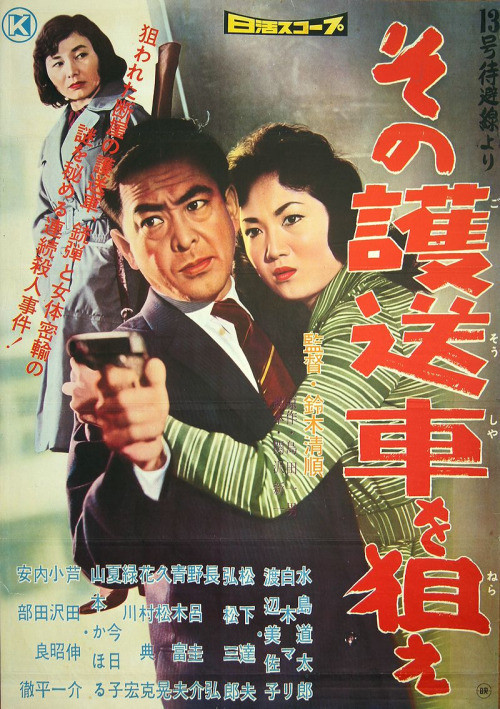
o0500070913581105946Nikkatsu’s main stock in trade during its 50s/60s heyday was the youth movie – films which captured the frustrations of being young (and usually male) in the scrappy post-war years. It’s a surprise then that the hero of Seijun Suzuki’s “action” movie Take Aim at the Police Van (13号待避線より その護送車を狙え, Jusango Taihisen Yori: Sono Gososha wo Nerae) is a genial middle-aged man who’s more Cary Grant in North by Northwest than Japanese James Dean. A programme picture, there’s nothing particularly interesting about the movie on paper but it’s among the first in which Suzuki indulges his talent for the surreal including a number of fantastically choreographed action sequences.

The film opens with a warning as a sniper trains his sights on a set of road signs which state that many accidents have occurred in this area. The one which is about to befall unlucky prison warden Tamon (Michitaro Mizushima) is however entirely man made. Momentarily confused by the figure of a woman watching the bus from the roadside, Tamon is blindsided when the sniper opens fire and kills several of the passengers while another, Goro (Shoichi Ozawa), cowers in the back. Tamon is suspended for six months but isn’t particularly upset about it. He’s not a detective and he knows he should leave it to the professionals, but he’s desperate to know why someone would bother attack such a lowly crew of petty criminals. Wondering who the woman was and how she fits into the case, who the snipers were aiming for and if they got them, and perhaps wanting to assuage his own feelings of powerlessness during the attack Tamon gets on the case.

Tamon is not your typical Nikkatsu action hero. He’s a little on the old side for starters – hardly the marquee face the studio was beginning to favour with its collection of “Diamond Guys”. He’s also not a policeman or a detective, he has no idea what he’s doing or what he’s getting himself into. What Tamon is is a righteous man. Almost immediately he’s sucked into the seedy underbelly of late ‘50s Tokyo with its strip clubs, trafficked women, and petty gangsters. This world is alien to him and he’s disgusted by it. Meeting the female manager of the “talent agency” which supplies in-room strippers to sleazy hotels where businessmen go when they’ve told their wives they’re at a conference, Tamon is horrified to hear her admit she thinks of the girls as “merchandise”. He pauses to explain to her that he always thought of the felons he looked after as “humans” rather than “criminals”, no matter what it was they’d done. Such naive humanitarianism is too much for Yuko (Misako Watanabe) – she’s instantly smitten, which is a problem because it means she needs to play both sides of her own game.

The pair end up in an uneasy alliance as Tamon’s goodness begins to work its magic. An unlikely white knight, Tamon finds himself wanting to save all the ladies threatened by “Akiba’s” dastardly plan from the icy charms of Yuko to Goro’s cabaret girl Tsunako (Mari Shiraki), and another young one, Shoko (Kyoko Natsu), about to get sucked into the Akiba web. What he discovers is a nasty trail of exploitation running from the bars and clubs of the city centre to the genial holiday spa towns where the moderately wealthy travel to pursue their discrete pleasures.

Tamon may be a little older than your average Nikkatsu action star, but he’s also a perfect fit for a film noir hero in wrong man mould. Tamon is not on the run, but he is out of place in this world, perhaps harking back to a presumably more innocent age where honesty and compassion still counted for something. He views his job as a prison warden as a public service, believing that there is goodness in everyone and it’s the job of people like him to find it and bring it to the surface. This he does at least seem to accomplish with Yuko who (despite her role in events so far) seems to have “reformed” and intends to follow Tamon’s lead in taking her “talent agency” in a more legitimate direction. 

Suzuki often claimed that Youth of the Beast was the first of his films where he was able to fully embrace his madcap desires, but Take Aim at the Police Van contains a fair few Suzuki touches of its own from the bold opening sequence shot through the sights of a sniper rifle, to the show girl killed by an arrow to her bare breast, bizarre murder by petrol tanker set piece, and exciting train station finale. Keeping the camera fluid, Suzuki captures a world in motion, seemingly running away from our noble hero until justice, in the form of an unstoppable steam train, finally arrives.


Attack on the police van clip (English subtitles)

https://www.youtube.com/watch?v=D2FcJY003HA

Rusty Knife (錆びたナイフ, Toshio Masuda, 1958)

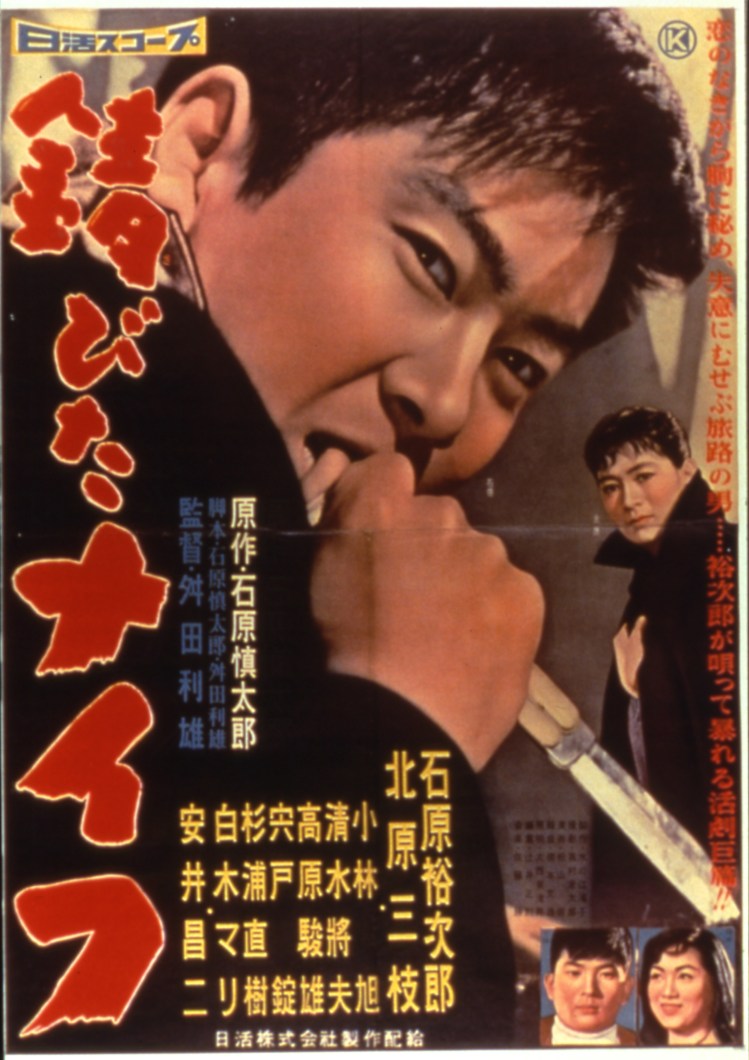
rusty knife posterPost-war Japan was in a precarious place but by the mid-1950s, things were beginning to pick up. Unfortunately, this involved picking up a few bad habits too – namely, crime. The yakuza, as far as the movies went, were largely a pre-war affair – noble gangsters who had inherited the codes of samurai honour and were (nominally) committed to protecting the little guy. The first of many collaborations between up and coming director Toshio Masuda and the poster boy for alienated youth, Yujiro Ishihara, Rusty Knife (錆びたナイフ, Sabita Knife) shows us the other kind of movie mobster – the one that would stick for years to come. These petty thugs have no honour and are symptomatic parasites of Japan’s rapidly recovering economy, subverting the desperation of the immediate post-war era and turning it into a nihilistic struggle for total freedom from both laws and morals.
Public support is, largely, behind this new force of order as seen in the local uproar when top gangster Katsumata (Naoki Sugiura) is arrested in connection with an assault. Things being what they are, Katsumata is soon released to laugh at law enforcement from a safe distance but the past is coming for him. Some years ago Katsumata killed a local councillor, Nishida (Ikunosuke Koizumi), and made it look like suicide but three guys from a local gang saw him do it. He paid them to keep quiet, but now one of them feels like talking and thinks Katsumata might like to pay a little more to reseal the deal.

Chatty Tokyo thug Shima (Jo Shishido) gets pushed off a train for his pains but Katsumata is worried enough about the other two to send his guys out to make some enquires. He’s particularly worried about Tachibana (Yujiro Ishihara) – a “sleeping lion”, Tachibana is a hot head who’s now gone straight after coming out of jail for murdering a guy he thought was a direct cause of his girlfriend’s death. Luckily enough, Tachibana now runs a bar where he employs the other witness, Terada (Akira Kobayashi), to whom he acts as a stern big brother hoping to keep them both on the straight and narrow. Tachibana is unlikely to talk, he wants out of the gangster world for good, but Terada is young and ambitious with a girlfriend to impress. He takes more hush money from Katsumata, not realising what he’s getting himself into, and then lets it go to his head.

Tachibana is the rusty knife of the title. After letting his rage consume him in murdering a petty mobster in revenge for the rape of his girlfriend who later committed suicide, Tachibana has vowed to quell his anger and live a decent, peaceful life. Angry outbursts are, however, never far from the surface and following recent revelations, a rusty knife may find its cutting edge once again.

Keiko (Mie Kitahara), a customer at Tachibana’s bar, is making a documentary about violence in the city which coincidentally turns up a few clues as to Tachibana’s past, not to mention her own. The daughter of the murdered councilman, Nishida, and the niece of another powerful politician, Keiko is a figure of righteousness, charting her own course through the difficult post-war world and attempting to do so with dignity and elegance while refusing to abandon her sense of decency and compassion. Later a real life married couple, Kitahara and Ishihara were a frequent on screen romantic pairing though this time around the connection is more subtle as Keiko begins to sympathise with Tachibana’s plight and commits herself to saving him from destroying himself in becoming consumed by his barely suppressed rage.

Tachibana is indeed raging, though his rage is understandable. As someone later puts it “nothing in this city makes sense”. The systems are corrupt, the wartime generation continue to run the show and run it badly, or at least for their own ends, robbing youth of its rightful place at the forefront of economic recovery. Yet even if Ishihara is a symbol of youthful alienation, his rage is one which must be quelled. Even in this city where nothing makes sense, self control is one’s greatest weapon. If youth is to walk forward into the exciting post-war future, it will have to drop its rusty knives.


Original trailer (English subtitles)

I Am Waiting (俺は待ってるぜ, Koreyoshi Kurahara, 1957)

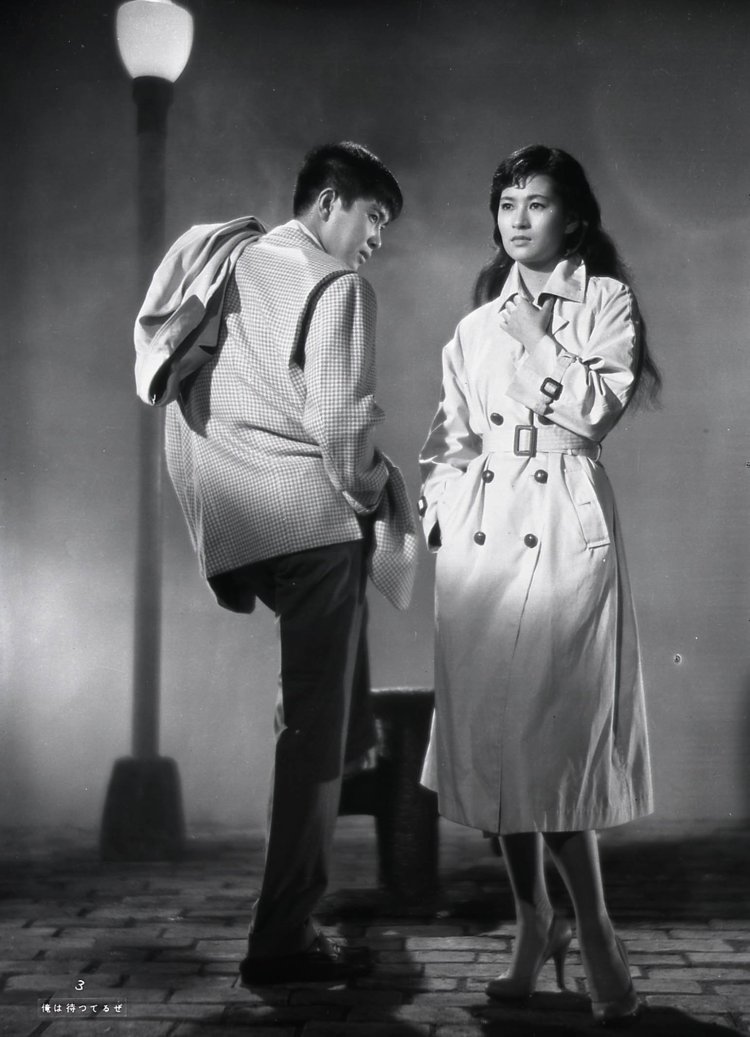
img_0Return to sender – address unknown. For the protagonists of I Am Waiting (俺は待ってるぜ, Ore wa Matteru ze), the debut feature from Koreyoshi Kurahara, all that’s left to them is to wait for uncertain answers, trapped in the limbo land of the desolate post-war landscape. With nothing to hope for and no clear direction out of their various predicaments, the pair bide their time until something, good or bad, comes for them but luckily enough what finds them is each other and suddenly a path towards resolution of their troubles. Reuniting newly minted matinee idol Yujiro Ishihara and future real life wife Mie Kitahara fresh off the red hot success of the youth on fire drama Crazed Fruit, I Am Waiting is an altogether more melancholy affair set in the down and out depression town of the American film noir.

One fateful night, Joji Shimaki (Yujiro Ishihara) steps out onto the Yokohama Harbour clutching a letter he nervously drops into a post-box, but is struck by the figure of a distressed young woman hanging around ominously close to the water’s edge. For reasons he doesn’t quite understand, Joji approaches the woman and convinces her to come back with him to the small cafe he runs right by the railway line. The girl, Saeko (Mie Kitahara), confesses to him that she thinks she may have killed a mobster who was making the moves on her and has no idea what to do now. Joji suggests she hide out with him, check the morning paper for news of a body, and then figure out the rest later. Left with no other options, Saeko agrees but it seems the past has a hold on them both which not even Joji’s powerful fists will be able to break.

Joji has been “waiting” for a letter from his older brother, supposedly in Brazil buying farmland. “Brazil” has become Joji’s main escape plan, but while he waits and waits his Japan life stagnates. A former prize fighter, Joji has been fighting his past self for the past couple of years ever since he lost his temper and killed a man in a bar brawl. Joji is afraid of his rage, convinced that he’s no good, a toxic influence to all around him, which explains why he’s so often abandoned by those he loves. When the letters he’d been sending to Brazil start coming back “no such person”, he fears the worst – that his brother has run off with their money and started a new life on his own without him.

In a noirish coincidence, Joji’s fate is bound up with that of melancholy nightclub singer Saeko. Once a respected opera singer, Saeko has been relegated to jazz cabaret in seedy harbour bars after losing her voice to illness and having her heart broken by her singing teacher whose affections were not as true as he claimed. “A canary that’s forgotten how to sing”, Saeko fears that her life is already over, there will be no escape from the gangsters who claim to own her and the only path left to her is the one she ruled out taking when she bopped the shady mobster on the head with a nearby vase. Saeko had no escape plan because she thought escape was impossible, but the unexpected nobility of a man like Joji has begun to change her mind, if only Joji’s heart weren’t already so battered and bruised.

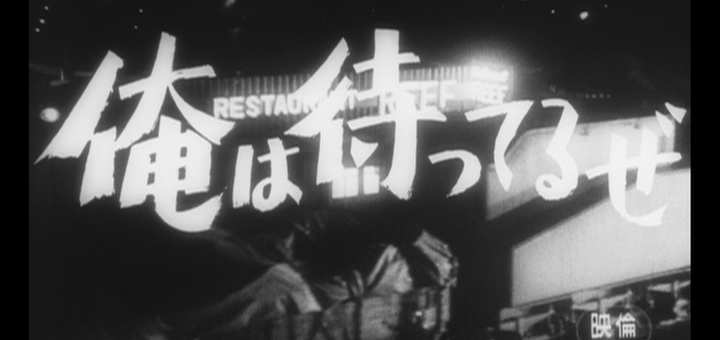
Joji’s bar, the Reef Restaurant, is the gathering place for the battered and bruised. Located right on the railway line, it’s a literal waiting room through which pass all those who aren’t quite sure where they’re going. Everyone here is nursing the wounds of broken dreams – Joji’s chef used to be racing driver until he got injured, the doctor is a drunk, Joji’s an ex-boxer with anger issues, and Saeko’s a bird with a broken wing. This is not the departure lounge, it’s arrivals – the end of the line when there is no place else to go.

Still, a waiting room is a place you can choose to leave, no one has to wait forever. In meeting Saeko, Joji has already begun to move forward even if he doesn’t know it. Suddenly giving up on their melancholy passivity, the pair spur each other on towards a killer finale which offers them, if not exactly a way out, a possibility of a better life having resolved to leave the past in the past and reject its continuing hold over them. Kurahara co-opts the fatalism and lingering existential angst of the film noir with its rolling fog and permanent drizzle clouding the darkened horizons for our two pinned protagonists who relive their most fearful moments with the force of silent movie scored by the intense jazz soundtrack suddenly turned up to 11. An important missive to the post-war young, I Am Waiting offers the message that the past can be beaten, but only once one comes to believe in the existence of the future and makes a decision to walk towards it rather than waiting for it to arrive unbidden.   


Clip (English subtitles)

https://www.youtube.com/watch?v=7xHcW-4mZ1c

Street Without End (限りなき舗道, Mikio Naruse, 1934)

Street Witout EndNaruse’s final silent movie coincided with his last film made at Shochiku where his down to earth artistry failed to earn him the kind of acclaim that the big hitters like Ozu found with studio head Shiro Kido. Street Without End (限りなき舗道, Kagirinaki Hodo) was a project no one wanted. Adapted from a popular newspaper serial about the life of a modern tea girl in contemporary Tokyo, it smacked a little of low rent melodrama but after being given the firm promise that after churning out this populist piece he could have free reign on his next project, Naruse accepted the compromise. Unfortunately, the agreement was not honoured and Naruse hightailed it to Photo Chemical Laboratories (later Toho) where he spent the next thirty years.
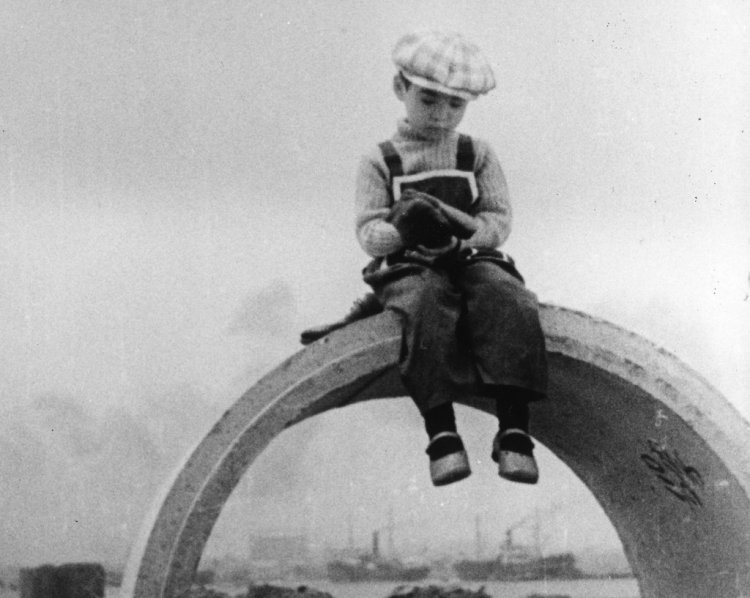
Although Street Without End is a conventional melodrama in many senses, it’s also quite a complex one playing with multilayered dualities and symbolic devices. After beginning with some brief pillow shots of the real city streets, we meet the stars of the show, Sugiko and Kesako, who are both waitresses in a local tea room. Whilst walking together, Sugiko is presented with an offer from a movie studio currently looking for new talent but isn’t really convinced, though the money would come in handy for her younger brother’s college tuition. A little while later she gets another offer from her boyfriend, Harada, who wants to get married as his parents are trying to pressure him into an arranged marriage at home. Sugiko agrees but is knocked over by a car on her way to meet him with the result that Harada thinks she’s changed her mind and goes home alone. Slowly she grows closer to the man who knocked her over, Yamanouchi, and eventually marries him instead but quickly finds herself out of place in his upperclass world.

Kesako, by contrast, ends up picking up on Sugiko’s job offer and joining the studio herself. She takes her unsuccessful artist boyfriend with her though their relationship suffers as she falls in with the studio crowd. Both women get what they thought they wanted, only to discover it to be not what they wanted at all.

Sugiko’s story is the main thrust of the narrative as she marries up through misfortune after Yamanouchi carelessly runs her over. He himself plays the part of the sensitive nobleman who’s bullied by his more conservative mother and sister who’ve picked out a girl exactly like them for him to marry. In a gesture that’s probably born out of rebellion rather than love, Yamanouchi brings Sugiko home as his wife but then leaves her to the mercy of the people he most feared himself. An ordinary working class woman, Sugiko quickly angers her mother in law by treating the servants like actual people and not having the poise expected of a Yamanouchi wife. Yamanouchi is too soft to defend himself, let alone his choice of wife, and so Sugiko’s life eventually becomes untenable sending Yamanouchi off the rails with it. Naruse includes a less than subtle intertitle here which states “EVEN TODAY, FEUDAL NOTIONS OF FAMILY CRUSH THE PURE LOVE OF YOUNG PEOPLE IN JAPAN”, which makes his position plain but seems a little strong for the anti-romantic nature of the relationship between the rebound Sugiko and the “getting back at mother” Yamanouchi.

Both Yamanouchi and Harada were interested in Sugiko as shield against an unwanted arranged marriage. Sugiko was unconvinced by both offers but her decision to marry Yamanouchi is one which ultimately went against her unconventional nature (as borne out by her unconventional decision to leave it). Sugiko and Kesako appear as mirrors of each other as Kesako nabs Sugiko’s job offer and starts to climb the studio ladder. Just as Sugiko finds the life of an upperclass housewife is not all she thought it would be, so Kesako begins to find the acting profession, which she’d previously dreamed of, equally unfulfilling. By the time we loop round the end, we arrive at the beginning again with both ladies in pretty much the same space they were in before though perhaps a little clearer about what it is they want from life. The final scene is one more of acceptance and self realisation than it is about moving forward, but then there’s a curious reappearance of a familiar face on a passing bus. It remains to be seen if this is hope leaving town or merely circling.


Street Without End is the fifth and final film included in Criterion’s Eclipse Series 26: Silent Naruse box set.

Every-Night Dreams (夜ごとの夢, Mikio Naruse, 1933)

Every Night DreamsFollowing on from Apart From You, Naruse returns to his exploration of working class women struggling to get by in a male dominated world in Every-Night Dreams (夜ごとの夢, Yogoto no Yume) also released in 1933. This time we meet weary bar hostess Omitsu who has a young son she’s raising alone after her deadbeat husband ran out on them a few years previously.

Omitsu doesn’t particularly like working in the bar, but as her mama-san grudgingly admits, she is quite good at it. She’s a modern woman who can drink and smoke and flirt to keep the guys buying drinks and wanting more though she’s finding it increasingly difficult to deflect some of the more intense interest such as that from a sleazy boat captain that her boss is eager to keep happy. Whilst at work, her son is looked after by a kindly older couple in her building who urge her to find a nicer line of business or get married again to a more reliable man.

The gentle rhythms of her life are disrupted when her long absent husband finally reappears. After first rejecting him outright, Omitsu eventually relents and lets him back into her life. However, despite his seemingly sincere pledges to change, get a proper job, start being a proper husband and father, Mizuhara fails to achieve any of his aims and also becomes increasingly jealous about Omitsu’s job at the bar. When their son, Fumio, is injured in an accident and requires expensive medical treatment, events reach a tragic climax.

Naruse would return to women alone facing a difficult economic future in many of his films but Omitsu’s situation is only made worse by the ongoing depression. Realistically speaking, there are few lines of work available to a woman in Omitu’s position and the more well regarded of them probably wouldn’t pay enough to allow her to keep both herself and her son, even as it stands she tries to borrow money from the bar to “reward” the older couple who watch Fumio while she’s working (though of course they wouldn’t take it). Omitsu herself feels there’s something degrading about her work and when her friend advises her to remarry, she exclaims any man worth a damn would run from a woman like her. Unfortunately, she may, in some senses, be right.

The man she ended up with, Mizuhara, is most definitely not worth a damn. It’s not entirely his fault he can’t find work – he does look for it and appears to want to find a job but in this difficult economic environment there’s not much going. Applying at factory, he’s turned down almost on sight because he’s a weedy sort of guy and doesn’t look like he’s cut out for physical labour. His inability to get ahead and provide for his wife and child sends him into a kind of depression and self esteem crisis which has him thinking about leaving again, especially as his increasing jealousy threatens his wife’s bar job which is their only form of income (whether he likes it or not). Fumio’s accident forces his hand into a series of bad decisions taken for a good reason but which again only cause more trouble for his family.

Naruse is a little flashier here than in Apart From You using canted angles, faster editing and even more zooms to hint at the panic felt by Omitsu in the increasingly distressing situations she finds herself in. Like the train accident in Flunky, Work Hard, the news that Fumio has been hit by a car is delivered in an expressionistic style beginning with his father putting down the boy’s toy car as a troupe of kids arrive and the screen is stabbed with a series of rapidly edited, alternating angle shots of intertitles mingled with the shocked reaction of the parents and the other children. If Naruse felt compelled to provide an ending with some sort of hint of far off promise in previous films, here he abandons that altogether as Omitsu laments her sad fate and instructs her son to grow up strong, not like his father, but like the mother who is doing everything she can to ensure his life won’t always be like this.


Every-Night Dreams is the fourth of five films included in Criterion’s Eclipse Series 26: Silent Naruse box set.

Apart From You (君と別れて, Mikio Naruse, 1933)

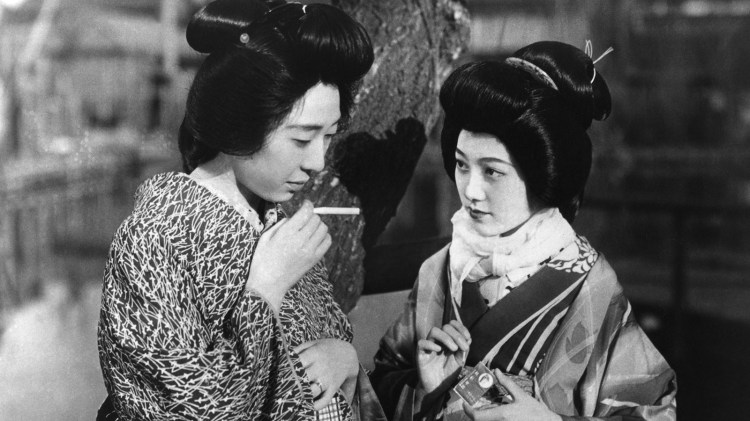
Apart From YouNaruse’s critical breakthrough came in 1933 with the intriguingly titled Apart From You (君と別れて, Kimi to Wakarete) which made it into the top ten list of the prestigious film magazine Kinema Junpo at the end of the year. The themes are undoubtedly familiar and would come dominate much of Naruse’s later output as he sets out to detail the lives of two ordinary geisha and their struggles with their often unpleasant line of work, society at large, and with their own families.
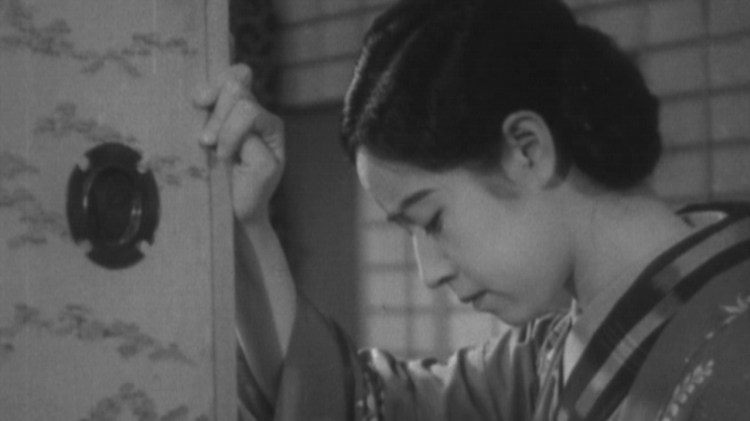
The older woman, Kikue, begins the film by asking her much younger friend and almost daughter figure, Terugiku, to pluck a grey hair from her head. Kikue also has a teenage son, Yoshio, who is becoming progressively rebellious, filled with anger and resentment over his mother’s line of work. Ignoring Kikue’s many sacrifices for him, Yoshio drinks, skips school and messes around with a gang of delinquents.

Feeling sorry for her mentor, Terugiku makes use of her good relationship with Yoshio to convince him that he should be more grateful for the kindness his mother shows him. Taking him on a trip to visit her impoverished family, Terugiku shows him the oppressive environment in which she grew up. Resenting having been sold to a geisha house to finance her drunken father’s violent outbursts, she is even more outraged that they now want to force her sister to undergo the same treatment. Terugiku is not prepared to allow this to happen and has decided to do whatever it takes to save her sister from suffering in the same way as she has had to.

Naruse highlights both the problems of the ageing geisha who sees her ability to support herself declining in conjunction with her looks, and the young one who only looks ahead to the same fate she knows will come to be her own. Both women are subjected to the humiliating treatment of their drunken clients who horse around and occasionally pull violent stunts with little to no regard for those who may even have been their wives, sisters, or daughters with a different twist of fate.

Kikue does at least have Yoshio, though their relationship is currently strained, but Terugiku has no one else to rely on. Her greatest fear is that her sister will also be sold off and have to endure the same kind of suffering as she has. In order to avoid this turn of events she agrees to undergo something far worse than even the unpleasantness of the geisha house to earn double the money in her sister’s place. She faces a future even bleaker than Kikue’s, yet in some sense it is a choice that she herself has made, actively, in sacrificing herself to save her sister.

Apart from You is much less formally experimental than either Flunky, Work Hard or No Blood Relation with its elegant, beautifully composed mise en scène. That said Naruse frames with a symbolist’s eye such as in a late scene where he shoots through the cast iron footboard of a sick bed to show the two women divided yet each imprisoned. This is a world filled with subtle violence, flashes of knives from clients and delinquents alike, raining blows from drunken fathers, and innocents wounded by misdirected arrows. Maternal love is both a force for salvation and of endless suffering but romantic love is always frustrated, ruined by practical concerns. Naruse rejects the kind of fairytale ending he succumbed to in No Blood Relation for something altogether more complex and ambiguous where there is both hope and no hope at the same time as a train departs in an atmosphere of permanent anxiety.


Apart From You is the third of five films included in Criterion’s Eclipse Series 26: Silent Naruse box set.

Clip featuring Terugiku’s visit to her family (with English subtitles)

No Blood Relation (生さぬ仲, Mikio Naruse, 1932)

No blood relationNaruse apparently directed six other films in-between Flunky, Work Hard and No Blood Relation (生さぬ仲, Nasanunaka) but we’ll likely never see any of them again. Adapting a “Shinpa” play (a new kind of Western style melodrama focusing on the real lives of everyday people), Naruse addresses a theme which later becomes central to his cinematic output – the trials and tribulations of women in contemporary society. This time we have two fully grown women tussling over the affections of a little girl who herself seems to have little input into the situation.
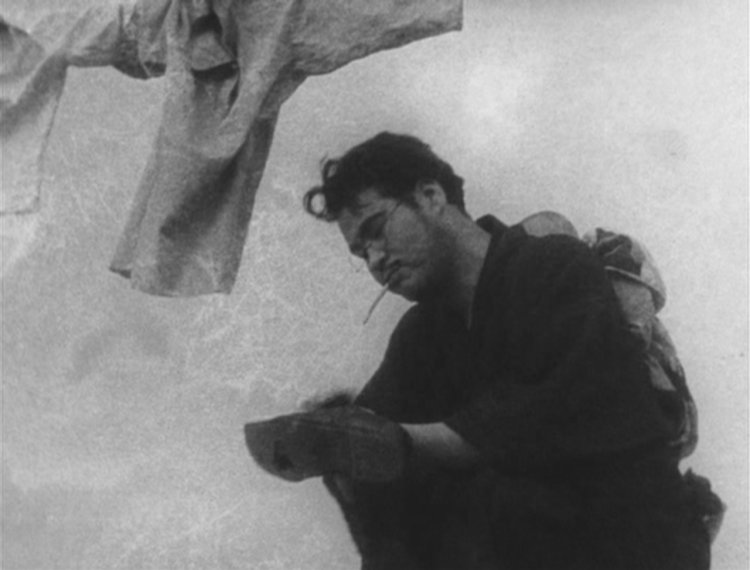
After a brief introductory sequence in which we witness the accidentally humorous escapades of a pair of petty crooks, we meet the sister of one of them who happens to be returning ex-pat and successful Hollywood actress, Tamae. It turns out that Tamae has come back to Japan after making her fortune in the movies hoping to reunite with the daughter she left behind six years ago.

However, her ex-husband, Atsumi, has remarried and the daughter, Shigeko, believes the second wife, Masako, is her real mother. Although the family are very happy together there is tension in the air as Atsumi’s company is running into trouble in this period of economic instability and he’s about to reveal he’s gone bankrupt. Atsumi’s mother does not take this well as she’s used to the upper middle class lifestyle and throws something of a hissy fit at being shamed in this way. Masako, by contrast, remains stoic and says she can bear the worst of what comes only she doesn’t want Atsumi to do anything illegal to try and solve their money problems and she doesn’t want to see Shigeko suffer. Her maternal feelings are further borne out when she is injured diving in front of an oncoming car which threatens to hit her daughter as she stops to pick up her doll in the middle of the road.

The problems continue pile up and Tamae uses her money as a lever to try and prise Shigeko away from her step-mother via the greedy grandma but the little girl was an infant when her birth mother left so she simply doesn’t remember Tamae and repeatedly asks to be allowed to go home to her “mother”. It’s understandable how much this would hurt Tamae who claims she’s only returned to Japan because she’s been unable to forget her daughter, yet her daughter never even knew her. If she was expecting some kind of cosmic connection it does not occur and if she truly wanted to rebuild a relationship with her child, what amounts to a virtual kidnapping was probably not the best way to go about it.

At heart it’s a tug of love between two women – the one who gave birth to a child and then abandoned it (perhaps harsh words, but no concrete reason other than a man and America are ever revealed), and the one who later raised it and came to love it as her own though shares no blood connection. Masako is the faithful Japanese wife, devoted to her family and just a very good, decent person which contrasts nicely with the ferocity of her rival – a modern woman, adulteress and movie star who thinks her money can enable her to take back what she previously gave up. For all that, it’s difficult to not to feel sorry for Tamae as her daughter continues to reject her. Even if the way she’s going about things is not sensible, her maternal emotions and the passion, desperation and even in part grief and regret are all too real.

Of course, what gets forgotten here is the plight of little Shigeko who never had any reason to believe Masako, who obviously loves her dearly, was not her real mother. Extremely confused and probably frightened, she just doesn’t understand why she’s being separated from her mum and being forced to hang out with this strange woman. Masako can’t get to see Shigeko after grandma has removed her from the house, but no one else stops to think about what sort of effect this is all having on a confused little girl who just wants to go home.

The depression is more of a backdrop here and even if Atsumi ultimately ends up feeling the brunt of it, money troubles are only a small part of the question at hand. Naruse doesn’t experiment as much as in Flunky, Work Hard but throws in a few impressive tracking sequences across open rooms and adds some rapid zooms as the two women have silent arguments over their relationships to Shigeko. Without giving too much away, the ending undercuts the degree of nuance Naruse had been trying add in ensuring that both women were drawn in a suitably complex manner, provoking sympathy and understanding for everyone caught up in this complicated situation (well, except perhaps for the bumbling crooks who are a little surplus to requirements).

The finale itself almost feels tacked on from an entirely different film with its sudden cheerfulness and abrupt closure as the original family is repaired thanks to a sudden monetary atonement and subsequent self-exile from the originally corrupting influence of the first wife. In many ways a standard melodrama of the time, No Blood Relation perhaps doesn’t have much more to recommend it than as an early example of Naruse’s development but does offer strong performances from its leading ladies and an interesting take on an age old question.


No Blood Relation is the second of five films included in Criterion’s Eclipse Series 26: Silent Naruse box set.

Flunky, Work Hard (腰弁頑張れ, Mikio Naruse, 1931)

flunky work hardMikio Naruse is often remembered for his female focussed stories of ordinary women trying to do they best they can in often difficult circumstances, but the earliest extant example of his work (actually his ninth film), Flunky, Work Hard (腰弁頑張れ, Koshiben Ganbare), is the sometimes comic but ultimately poignant tale of a lowly insurance salesman struggling to get ahead in depression era Japan.

Okabe is the lowly insurance agent of the title. He works hard for his money, but there are slim pickings round here to begin with and a lot of competition from rival agents so Okabe struggles to provide for his wife and his little boy, Susumu, in the way that he would like. Okabe subjects himself any sort of humiliating behaviour on offer to try and get a contract including engaging in leap frog with a well to do lady’s children to try and seem more “friendly” than his rival broker.

Susumu, by contrast is a rebellious little boy and is aways getting into scraps with the neighbourhood kids who tease him because of his parents’ money problems. This wouldn’t usually be too much of a problem and Okabe even tells him it’s OK to defend himself when the other kids start in on him. Only this time Susumu has been fighting with the well to do lady’s sons which is going to make Okabe look bad and make it more difficult to convince her to take out a policy with his firm over another.

Okabe loses his temper and scolds the boy who runs off in anger and confusion only to get into a serious accident. His father, not knowing it’s his son that’s been injured, uses the news of a little boy getting hurt to try and convince the other mothers to take out insurance policies on their children. Later he feels bad about shouting at Susumu and decides to buy him a present, only he might already be too late…

Flunky, Work Hard starts out like the nonsense comedies Shochiku were known for at the time with a little of their common man approach thrown in, but quickly heads into melodrama territory as Susumu meets with his unfortunate destiny. This sequence is the most notable in the film as it’s far more experimental in nature than anything found in Naruse’s later work. Dipping into a montage of kaleidoscopic images, diagonal splits and the awful momentum of a train hurtling along a predetermined track only to meet with a horrifying, unexpected obstacle, this extremely complex sequence is the perfect cinematic expression of the blood draining from a father’s face as he contemplates the fact that he might have just lost his son through having lost his temper over something as trivial as a few shiny coins. Okabe is not a bad man, or even a bad father, but just another ordinary guy trying to make it through the depression. Even so, he may be about to pay a terrible price for failing to side with his son in favour of businesses prospects.

Like many silent films from this era, almost all of Naruse’s early work appears to be lost. Flunky, Work Hard is somewhat atypical when considered alongside his later career which had a strong female focus and leant more towards social commentary than the slapstick humour seen here. However, its tale of a father desperately trying to find a way to support his son in difficult economic circumstances only to find that his efforts may cost him the very thing that he was trying to protect all along is one which is instantly recognisable in any era.


Flunky, Work Hard is the first and earliest of the five films included in Criterion’s Eclipse Series 26: Silent Naruse box set.