The Woman in the Rumour (噂の女, Kenji Mizoguchi, 1954)

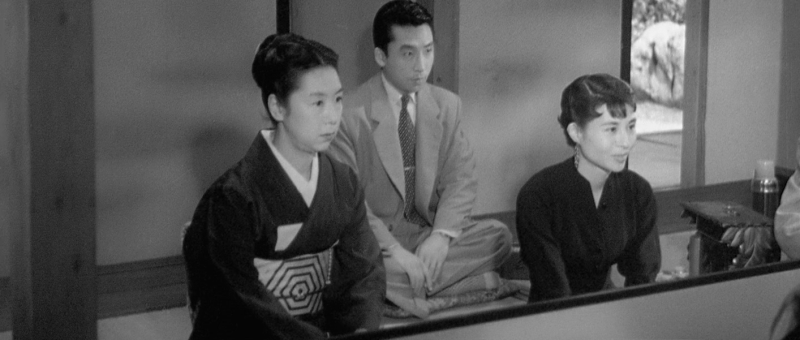
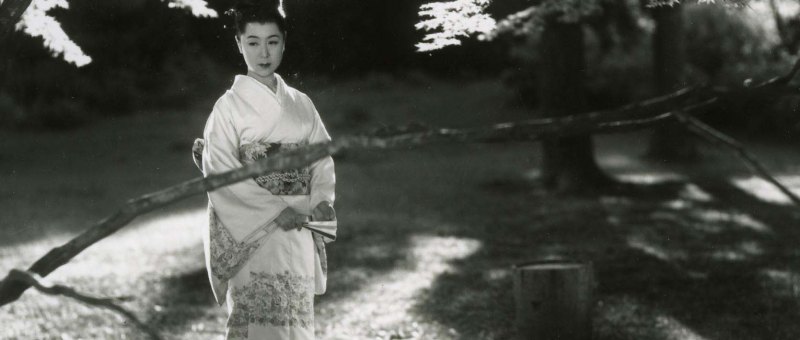
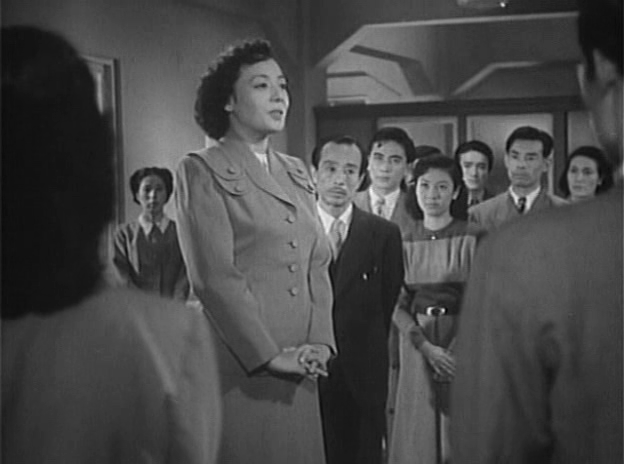
A mother and daughter find themselves deceived by the same man, each hemmed in by realities which cannot be altered but eventually coming to a place of mutual understanding that allows them to restore their relationship not only as parent and child but as women in Kenji Mizoguchi’s 1954 melodrama, The Woman in the Rumour (噂の女, Uwasa no Onna). The first question we might ask ourselves is to which of the women the title refers, or indeed to which rumour, though in a sense rumours matter little for either of them when the problem is the constraints which each of them feel as women in the contemporary society. 

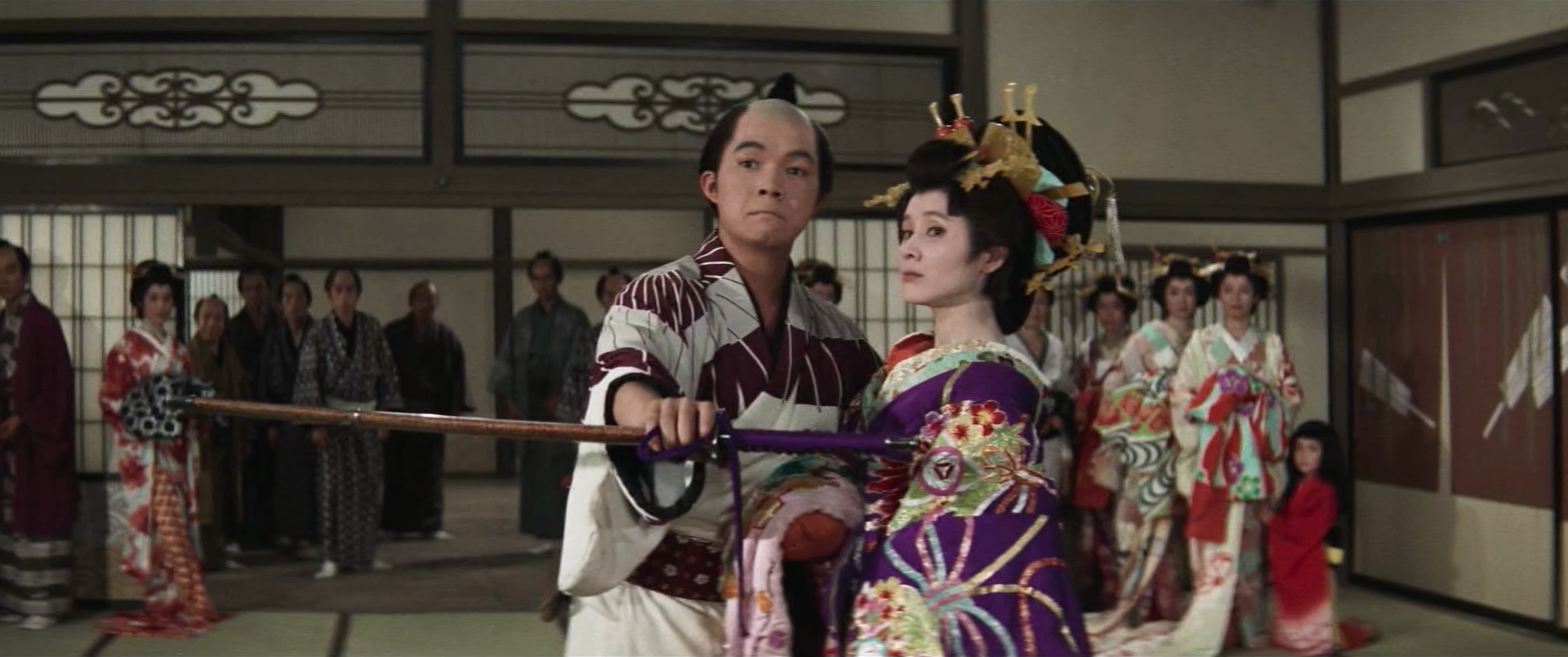
Even so, the sense of shame is evident when Yukiko (Yoshiko Kuga) is brought back to the geisha house run by her mother Hatsuko (Kinuyo Tanaka) after having attempted to take her own life in Tokyo. As we learn, the reason for her despair is in part heartbreak. She had been engaged but her fiancé’s family convinced him to end their relationship when they discovered that her mother ran a geisha house. Thus the suicide attempt is also a reflection of her sense of futility. She will always be the daughter of a woman who earned her living in the sex trade. This is a fact that cannot be changed and may lead her to think that her situation is hopeless because the same thing is likely to happen again leaving her unable to marry in a society in which there are few options for a single woman to make a life for herself not to mention the loneliness of living without romantic love. 

Hatsuko, meanwhile, is uncertain how seriously she should take the situation in part believing that it’s a product of youthful naivety in her daughter’s first romantic heartbreak. When a young doctor with whom she is close, Matoba (Tomoemon Otani), explains to her that Yukiko is depressed because she feels deep shame, self-loathing, and hopelessness due to her mother’s occupation, Hatsuko struggles to understand it and does not fully believe him. Nevertheless, she took care to bring her daughter up largely outside of the geisha world, sending Yukiko to Tokyo to study music implying that she herself to some degree sees her work as improper. The other girls view Yukiko with a degree of disdain, realising that her refinement was bought with their exploitation and noticing her animosity towards them. 

Hatsuko is mother both to Yukiko and the young women under her care who are always quick to point out that this is one of the better geisha houses because they are well looked after. When one of the women, Usugumo (Kimiko Tachibana), is taken ill, Hatusko calls in the doctor and allows her time off to rest which likely would not be granted at another house. She is reluctant to send her to hospital, but would if the situation called for it. In a sense it’s this solicitation that eventually allows Yukiko to find accommodation with her mother’s profession as she grows closer to the other women while nursing Usugumo herself and comes to understand their particular circumstances that have left them no choice but to live as geisha. Usugumo is reluctant to go to hospital because she is worried about the money she’d usually send to her sister Chiyoko (Sachiko Mine) who works the family farm and cares for their sickly father, but when she dies Chiyoko herself is left with little option other than to petition the geisha house to take her sister’s place. 

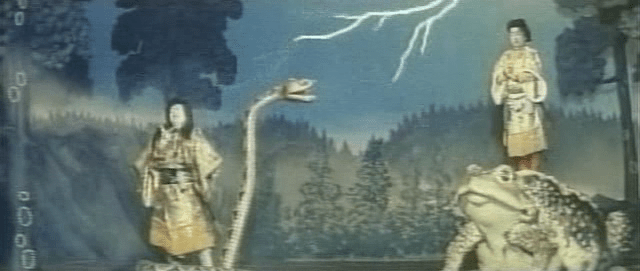
On seeing Chiyoko sitting on the step and pleading to be taken on, another of the women laments as she’s leaving that she wonders when there will be no more need for women like them. The geisha world is perhaps an unchangeable reality, just like Yukiko’s birth and her mother’s age. The rumours that surround Hatsuko are to do with her closeness with Matoba with whom she has clearly been in an intimate relationship, dreaming of becoming his wife and even considering selling the geisha house to buy a large property where they could live together as a couple while he runs a private clinic. Matoba predictably decides he prefers the younger Yukiko, Hatsuko increasingly desperate after overhearing their conversation about leaving her behind to move to Tokyo together where Matoba ponders finishing his education. The play they’ve gone to see almost feels like a personal attack as an actor intones that feelings of love at 20 are fine but at 60 it’s merely shameful. “Even carp know better than to fall in love at this age”, he adds, the old woman a figure of ridicule in her romantic delusion leaving Hatsuko feeling both humiliated and resentful.

When Hatsuko finally confronts Matoba, she does it as a scorned woman rather than as a mother, while Yukiko in turn first turns on her rather than Matoba even as she begins to realise the reality of the situation that the man who seduced her had been using her mother for his own gain in total disregard of her feelings. In short, even if Hatsuko were not her mother which certainly makes this a very complicated situation, he is not the sort of man she’d want to make a life with. Acutely aware of her own experiences of heartbreak, she fears for her mother’s wellbeing and comes to an understanding of her as a woman while accepting that “men are all alike” and in that at least perhaps her mother’s profession is the most honest of all. Mutually betrayed, mother and daughter are able to repair their familial bonds while Yukiko finds herself taking refuge in the geisha house as a space of female solidarity and bulwark against a cruel and patriarchal society. 


Tengu Priest (お坊主天狗, Yasushi Sasaki, 1962)

Disparate denizens of Edo are united in one thing in Yasushi Sasaki’s light hearted jidaigeki, Tengu Priest (お坊主天狗, Obozu tengu), revenge. Like many jidaigeki, what they really want is revenge against the evils of feudalism to which they have each fallen victim, but also acknowledge that they have found something better in being outside it in the solidarity that exists between them as outsiders free from the obligations of samurai society if also with loose ends waiting to be tied.

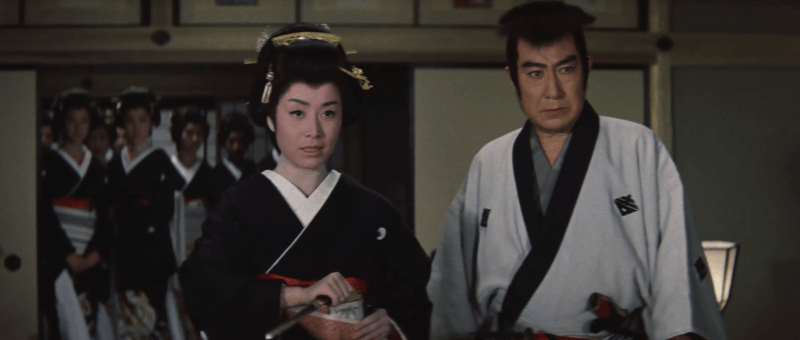
Once a hatamoto with a 1000 Koku stipend, Obo Kichiza (Chiezo Kataoka) is now a much feared figure keeping order in Edo. When some yakuza toughs are hassling the geisha Kozome (Hibari Misora) at the theatre, insisting that she serve them sake even as she reminds them she’s off the clock, one look from him stops them dead though Kichizo is also impressed with Kozome’s nerve. Like him, Kozome is also in Edo for revenge. Formerly a samurai’s daughter, she became a geisha to look for the man who killed her father in a stupid quarrel over a fencing duel. Kichiza, meanwhile, seeks revenge against the local lord, Honda Etsu (Masao Mishima), who killed his father in a fit of temper when he ordered him to commit seppuku for causing his son-in-law to fall off his horse but he refused. 

Loyal retainer Kinpei (Ryutaro Otomo) had begged for his forgiveness and insisted that he could get Etsu to reform but three years have passed and not only has he bribed his way to head office but his behaviour has declined still further. We see him cruelly cut down a maid seemingly for no reason, simply ordering his men to get rid of the body. Etsu has a reputation for random violence while drunk, but as he is the lord, there are no real consequences for him. His retainers cover up his crimes, and Kinpei’s sole attempt to talk some sense into him goes nowhere, meanwhile his chief adviser Shichinosuke (Sentaro Fushimi) is basically running the show telling others the lord is not in his right mind and cannot make decisions so he must make them for him.

They are all, including Etsu himself, victims of the feudal order in which the systems of power are necessarily corrupt. In his yakuza persona, Kichiza has struck up a friendship with another geisha, Kozuru (Naoko Kubo), who was actually a lady in waiting working as a maid at his estate. She has long been in love with him, but the class difference would have made any union impossible. Ironically, she remarks to Kozome that even in their present state they are still a Hatamoto and a lady in waiting so she dare not express her love for him. Only once his revenge is concluded and he’s fully abandoned his samurai status can Kichiza truly be free to embrace a relationship with Kozuru while conversely Kozome regains her life as a samurai’s daughter by avenging the death of her father.

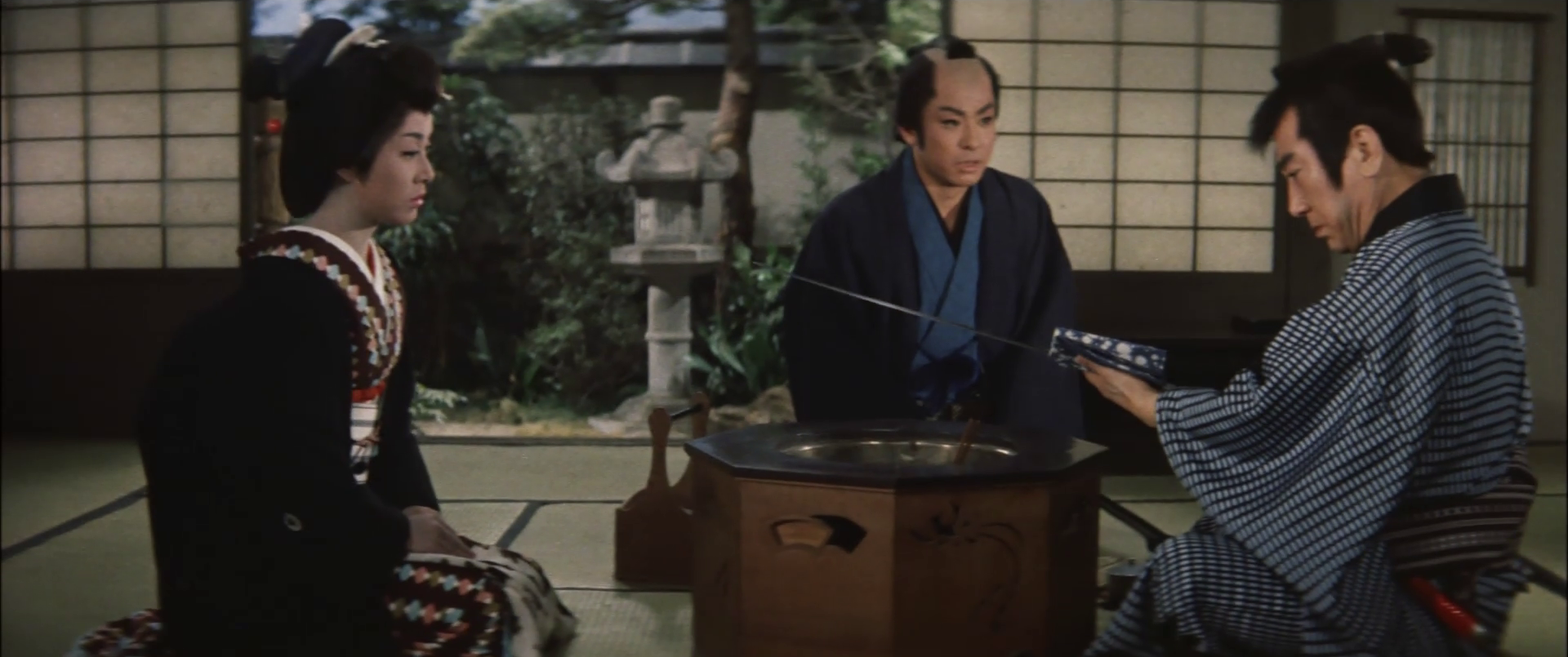
Kozome asks for Kichiza’s help to track down the target of her revenge, but he also respects her wishes and understands that it’s something she must do herself as does eccentric sword sharpener Shinzaburo (Hashizo Okawa ) who actively stands back so she, another wronged woman, can stick the knife in. Hibari Misora’s role in the film is smaller than one might expect as her revenge subplot is secondary to Kichiza’s and she has relatively little screen time with only a brief musical sequence during a naginata dance though she does participate in the high octane final showdown in which all grievances are exorcised and a kind of order returned to the samurai realm even if it must be destroyed to so as Kinpei resolves to protect both the lives and livelihoods of their many retainers and the integrity of Kichiza, going so far as to congratulate Kozome on the successful completion of her revenge. 

Yet what made the whole thing possible was Kichiza’s own band of outlaw drifters whom he allowed to live in his home he later says just so that they would have a place to come and be together so that they might more easily reintegrate into mainstream society. He might have lost his domain and samurai status but has discovered something better in this accidental community. They may be in a sense almost like retainers to him, but if so they stay by choice rather than obligation and help out of a genuine sense of loyalty and affection. In essence, in taking his revenge, he frees himself from the oppressive nature of the samurai code and is able to live like an ordinary man lamenting that if only he and Kinpei had both been ronin they could have enjoyed their time together for longer. Lighthearted and cheerful despite its dark themes, the film is nevertheless a condemnation of the hypocrisies and abuses of a feudal society in which freedom is to be found only among those who live outside it.


Wind, Woman and Road (風と女と旅鴉, Tai Kato, 1958)

Tai Kato joined Toei’s Kyoto studio in 1956 having made his directorial debut at the independent production house Takara Productions in 1951 shortly after being letting go from Daiei in 1950 during the Red Purge (he had been chief secretary for studio’s the labour union). Heavily influenced by and a great admirer of Daisuke Ito, Kato had a passion for chanbara and jidaigeki which were Toei’s mainstays at the time, but even while making what were essentially programme pictures his approach was anything but conventional. With 1958’s Wind, Woman, and Road (風と女と旅鴉, Kaze to Onna to Tabigarasu), Kato embarked on what would become a signature style of “realistic” period drama otherwise at odds with the formulaic nature of the genre. 

As he would continue to do, Kato instructed his cast not to wear makeup and while casting kabuki actor/chanbara megastar Kinnosuke Nakamura insisted on a more modern performance style than the sometimes mannered theatricality of the traditional samurai film. Ginji is cocksure young man living on the road after being kicked out of the hometown he is now travelling towards because of a crime supposedly committed by his long absent father. On the way, he runs into Sentaro (Rentaro Mikuni), a middle-aged man recently released from prison who is struck by his appearance and immediately asks how old he is realising that Ginji is about the same age as his own son who died as a result of a fight. 

The two begin walking together and Ginji tells Sentaro that his village sends gold to the governor around this time every year as a bribe to get lower taxes which doesn’t make a lot of economic sense but evidently works for them. Last year, the gold was stolen by notorious bandit Hanzo the Shark (Eitaro Shindo) and two villagers were killed during the robbery. Ginji half jokes about teaming up to steal it, and then playfully attacks Sentaro leading the entourage escorting this year’s payment to flee in terror leaving the gold behind. Sentaro encourages Ginji to take the money back to the village, but he is later shot by the returning villagers who think they must be Hanzo’s henchmen pulling the same stunt as last year. 

Unlike the typical chanbara hero, Ginji is petulant and resentful. He has a very modern way of speaking and is rebellious in character as you might well expect him to be given his life experiences. The other villagers are not happy to see him and continue tar him with his father’s brush, sure that the son of a thief can’t be any better while Ginji pines for his late mother claiming that the villagers’ harassment along with the inability to support herself economically led her to take her own life. Once a member of Hanzo’s gang he vacillates between a desire to be accepted by the village and that to take his revenge on it. Sentaro meanwhile is determined to save him, regretful that he could not save his own son from the life that he had led as a yazkuza and petty criminal. 

There is a persistent sense that everyone here is at heart a wanderer. The doctor’s daughter Ochika (Yumiko Hasegawa) who develops a fondness for both men relates that she was lured away from the village by an itinerant actor and fell into a life of ruin before returning to discover that her mother had passed away. The headman’s adopted daughter Oyuki (Satomi Oka) with whom Ginji falls in love tells him that she too is an orphan, her father was a medicine pedlar who dropped dead in the village which then took her in. Echoing a sense of rootlessness in the post-war world, they are all in someway displaced and looking to restore connections which have previously been broken but largely failing or unable to do so. Ginji is torn between his criminal past and the reformed future offered to him by the more positive paternal relationship he develops with Sentaro who, unlike his own father, is readily accepted by the village which is unaware that he previously spent time in prison. 

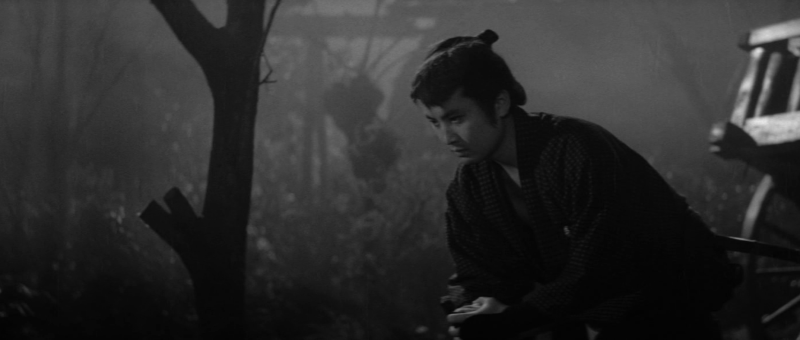
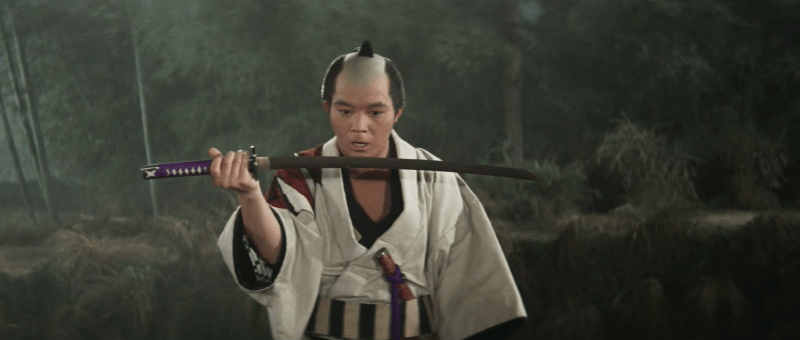
The final showdown takes place in a windswept clearing filled with Kato’s trademark mist as Ginji finally picks a side only to realise that that in the end he will always be a wanderer, a rootless figure whose only home is the road. Kato shoots a little higher than he would subsequently but still rests a little lower than the norm, emphasising a sense of destabilisation in Ginji’s volatility along with a painful longing that keeps him a lonely soul lost in the fog and on perpetual journey towards a long forgotten home. 


Miss Oyu (お遊さま, Kenji Mizoguchi, 1951)

“I never realised how heavy this kimono was” a young woman exclaims towards the conclusion of Kenji Mizoguchi’s Miss Oyu (お遊さま, Oyu-sama), adapted from the Junichiro Tanizaki short story The Reed Cutter, finally collapsing under its weight having committed what amounts to an act of spiritual suicide in an internalised betrayal. Mizoguchi’s highly selective adaptation excises much of Tanizaki’s trademark perversity and targets instead the repressive social codes of the era which proceed to ruin three lives in frustrated affection, shame, and self-harming guilt. 

The trouble begins when Shinnosuke (Yuji Hori), a young man in search of a wife, mistakes his prospective bride for her sister and is forever smitten. Oyu (Kinuyo Tanaka), a widow with a young son, is only accompanying her younger sister, Oshizu (Nobuko Otowa), but is perhaps herself taken with the handsome suitor whom she repeatedly brands a “fine gentleman”. Having objected to all of Oshizu’s previous matches, she encourages her sister to marry this one not least because of his physical proximity that would allow the pair to visit each other regularly. The pain on Oshizu’s face is however readily apparent as Oyu relates the amusing incident to their brother, the younger sister clearly consumed with an inferiority complex in the shadow of the beautiful and elegant Oyu. 

It’s never quite clear to what extent Oyu is aware of her sister’s feelings, if she says these things thoughtlessly or with an intent to wound though she obviously cares deeply for Oshizu. Similarly the extent of her feelings for Shinnosuke remains oblique. As a woman well aware of her beauty and its power, perhaps she simply enjoys being desired or is so accustomed to male attention as to barely notice that Shinnosuke has fallen in love with her. Then again perhaps she knows all too well and for the sake of politeness pretends not to though in that case the decision to encourage her sister to marry him would seem perverse or suggest that she is attempting to deny her own feelings which she may not even understand by rendering Shinnosuke a “brother” in an attempt to remove him from the pool of potential romantic suitors. 

Even so there is an underlying quality of incestuous desire of Oshizu for her sister to whom she remains devotedly besotted, willing to sacrifice her own happiness in the hope of ensuring Oyu’s. After agreeing to marry Shinnosuke, she explains to him that she intends their marriage to be purely symbolic. She refuses to consummate their union on the grounds that it would be a betrayal of Oyu whom she knows to be in love with Shinnosuke while realising that he has married her only to be connected with her sister. When the trio take a trip together the strangeness of the ménage à trois is brought home by the confusion of the hotel maid who assumes that Oyu and Shinnosuke are the married couple, commiserating with Oshizu for being a third wheel. While Oyu childishly makes light of it, Oshizu is hurt and confused, jealous in two directions but pleading with Shinnosuke to be only his sister rather than a wife. 

Yet the wrongness of the arrangement is signalled on Oyu’s return home when she discovers not only that her son, Hajime, has fallen mortally ill in her absence but that rumours have begun to circulate about her unusual relationship with her brother-in-law. It is impossible to avoid the implication that Oyu is being punished firstly for betraying her maternity in having gone on holiday without her son to experience freedom as a woman, secondly for feeling sexual desire, and thirdly for feeling it for a married man who is now technically a brother in being her sister’s husband though as we know no one’s sexual desires are currently being fulfilled in this incredibly complicated and destructive arrangement. 

Though Tanizaki might have been more interested in exploring the darker aspects of human sexuality, Mizoguchi pulls back from the author’s trademark perversity to take aim at the repressive social codes of a patriarchal society which brought such a fraught situation into being. Oyu is unable to marry Shinnosuke because she is bound to her late husband’s family and by the responsibility to her son whom she would have to leave behind even if she were given permission to take another husband. Once her son dies, her ties to marital family are severed and they, disapproving of the rumours surrounding her unconventional relationship with her sister and brother-in-law, send her back to her brother who is also reluctant to accept her. On learning of the reality of her sister’s marriage, she decides to accept a proposal from a sake merchant in another town but the separation breeds only more destruction. Oshizu and and Shinnosuke move to Tokyo and three years later are living in poverty, Shinnosuke now dishevelled and dressing in Western suits with a modern haircut and a scraggly, half-hearted moustache. Oshizu’s eventual pregnancy which confirms that theirs is now a “full” union while Oyu’s is “symbolic” only the slows implosion of the trio’s repressed desires. 

Mizoguchi stops short of arguing for a transgressively new arrangement that would have allowed the trio to live together as a family but nevertheless attacks the repressive social codes that prevent them from speaking honestly about their feelings and force them into self-sacrificing acts of subterfuge which create only more suffering. He dramatises the claustrophobia of their lives through the obvious artificially of the stage sets which stand in such stark contrast to the expansive beauty of nature albeit sometimes unruly but always free, while lending their tragic tale a hint of the parabolic in its mists and rugged gardens as Shinnosuke finds himself alone under the cold light of the moon on a distant shore, a romantic exile from a repressive society. 


Drunken Angel (酔いどれ天使, Akira Kurosawa, 1948)

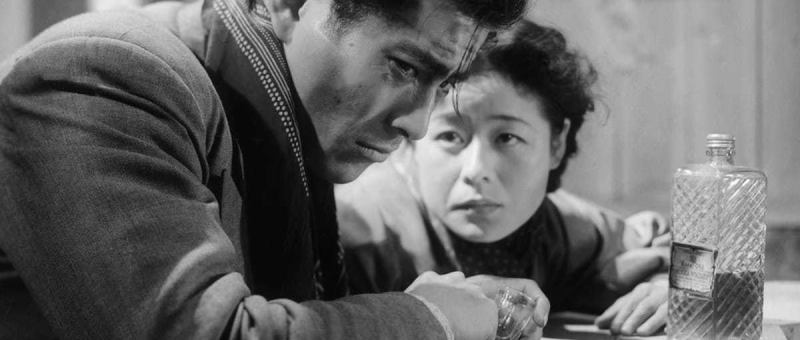
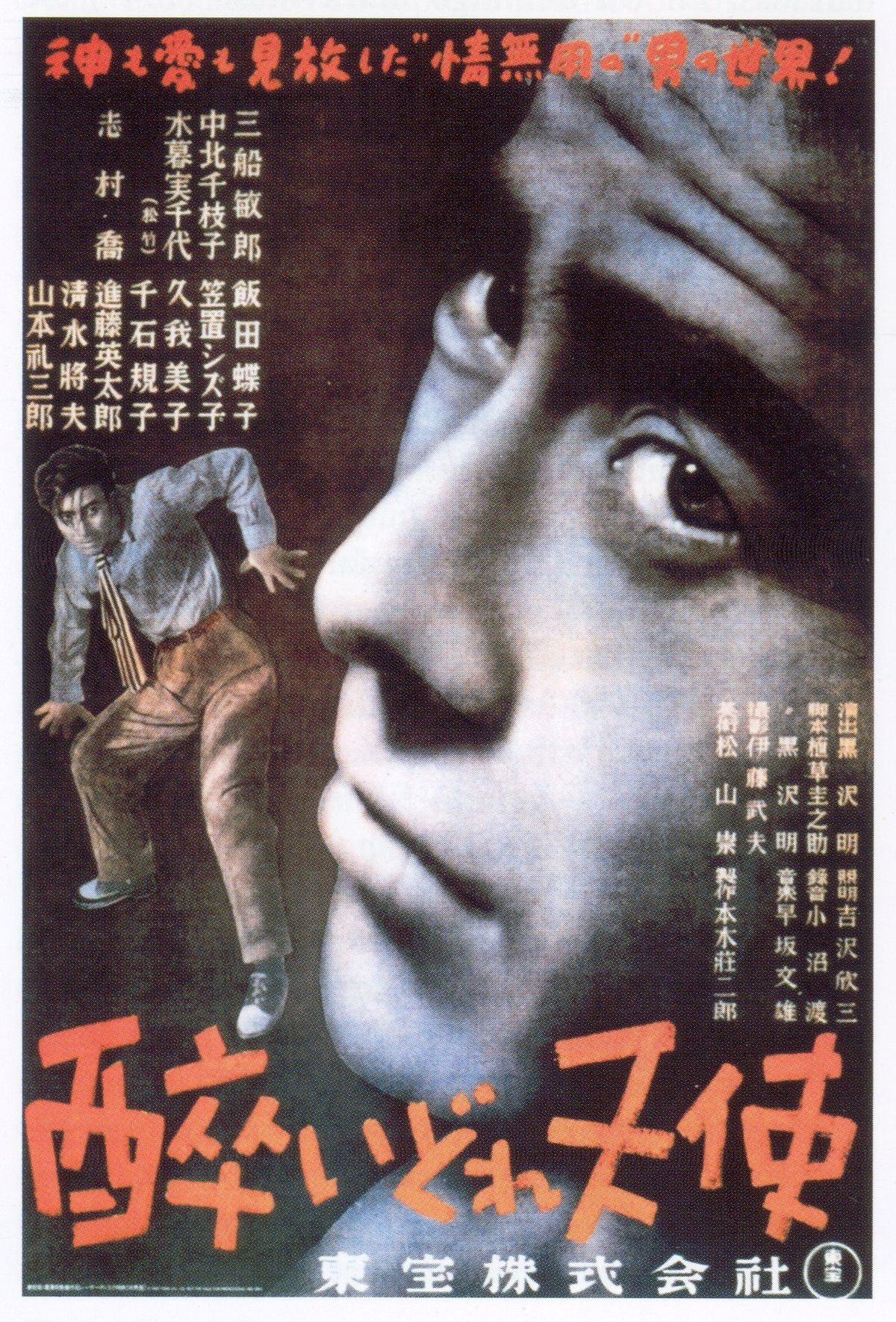
A gruff yet well intentioned doctor does his best to cure the ills of post-war Japan in a rundown slum on the edge of a fetid swamp in Akira Kurosawa’s noir tragedy, Drunken Angel (酔いどれ天使, Yoidore Tenshi). The doctor is most obviously the drunken angel of the title though it could equally apply to the unhappy yakuza he tries so hard to redeem whom most agree is not suited to that kind of life and trapped by the feudalistic thinking of the pre-war past.

Matsunaga (Toshiro Mifune) is the big man around town, but jaded physician Sanada (Takashi Shimura) sees straight through him. “He acts tough and swaggers around but I know in his heart he’s incredibly lonely,” Sanada tells his assistant, Miyo (Chieko Nakakita), a young woman he took in to help her escape the clutches of the violent yakuza ex who left her with syphilis. Miyo bemoans Sanada’s terrible bedside manner and tendency to bully his patients but praises his dedication and remarks that few doctors go as far for those under their care as he does especially ones like these who don’t often have the money to pay. This is a little ironic given Matsunaga’s original objection that he doesn’t trust doctors because it’s not in their best interests to cure you, something which Sanada jokingly acknowledges while expressing the futility he feels in the face of the mass sickness that confronts him. 

When Matsunaga first comes into his office, Sanada remarks that’s its not just his lungs that are sick, he’s sick to the core. But still he seems to think that Matsunaga can be saved, not just physically but spiritually redeemed if only he can coax him away from the yakuza underworld. Matsunaga is suffering from tuberculosis, a common disease of the post-war era and closely linked to the squalid conditions in which he lives which are themselves symbolised by the swamp in the centre of town onto which Sanada’s clinic backs. Sanada tries to warn the local children not to play in it because of the risk of typhus not to mention the mosquitos it attracts but the kids don’t really listen to him and shout back that he’s “just a drunk”. Yet the swamp represents a world upside-down, the neon sign for the No. 1 cabaret bar constantly reflected in its bubbling waters while as the film opens we see a trio of sex workers preparing to head into the red light district and a pair of petty thugs fighting while a young man plays Spanish guitar on the ruins of a bomb damaged building. 

It’s as if it were this world that is slowly consuming Matsunaga, an old-school yakuza who insists “we still believe in things like honour and loyalty” certain that the big boss will side with him against the returned upstart Okada (Reizaburo Yamamoto), Miyo’s yakuza ex, even as Sanada tells him it’s money that matters and Matsunaga no longer makes any. Everyone tells him that he already looks like a ghost, his appearance increasingly gaunt in his parallel decline as the illness takes hold and he begins to lose his status to Okada only to overhear his boss call him an “amateur” that he was only keeping around as a potential sacrifice. In the end, Matsunaga is too good for this world. Naively believing in things like honour and loyalty which no longer mean anything in the dog-eat-dog post-war society he is left with nothing other than a nihilistic bid for vengeance and a desire to repay Sanada’s faith in him if only in the most ironic of ways. 

Like Matsunaga, Sanada sometimes says the opposite of what he means claiming that he doesn’t care what happens to Matsunaga but is determined to wipe out the TB inside him to stop it spreading it to others. He’s on a mission to “sterilise this contaminated town” by eradicating the twin threats of disease and the yakuza, calling Matsunaga a coward for failing to face his fear and loneliness succumbing to the quick fixes of his hedonistic yakuza lifestyle. He’s not perfect either, a doctor who drinks his medical ethanol supplies and berates his patients when he them catches out them out drinking when he told them not to, but is also very at home with who he is and doing his best with it. His disappointment in Matsunaga is mainly in his swagger, the false bravado that masks his human frailty and unwillingness to face his fear of death which manifests itself in a hauntingly expressionistic dream sequence. Using silent cinema composition and canted angles Kurosawa conjures a world of constant uncertainty amid the vagaries of the post-war society in which the only sign of salvation is a drunken doctor and his “rational approach” to the sickness of the age.


Drunken Angel screens at the BFI Southbank, London on 2nd & 10th February 2023 as part of the Kurosawa season.

Battle of Roses (薔薇合戦, Mikio Naruse, 1950)

Mikio Naruse was famously unhappy with most of his ’40s work, believing that his career did not begin to revive until the release of Ginza Cosmetics in 1951. The late ‘40s were indeed a difficult time in terms of the industry as Naruse’s home studio, Toho, became entrenched in a series of labour disputes which eventually led to the creation of new studio “Shin Toho” (lit. “new Toho”). Naruse meanwhile though sympathetic to the cause kept a low profile working in theatre and thereafter with other studios such as Shochiku which is where he made 1950’s Battle of Roses (薔薇合戦, Bara Kassen) .

Perhaps because of its turbulent production genesis, Battle of Roses is a distinctly unpolished and surprisingly reactionary take on female liberation adapted from a newspaper serial following the lives of three sisters pursuing different paths in the complicated post-war society. The action opens with the death of the husband of the eldest sister, Masago (Kuniko Miyake), who had been the head of cosmetics studio White Lily but is currently under-investigation for large-scale embezzlement of which it appears he is almost certainly guilty. After he dies, Masago inherits the company but is pursued by massive debts to the film’s villain, Mogi (Toru Abe), who is also after the most pure hearted of the sisters, Hinako (Setsuko Wakayama). Masago makes some kind of shady arrangement with her husband’s former associate Kasahara (Eitaro Shindo), pays off the debt, and starts her own rival company Nigera where she is the CEO. Youngest sister Chisuzu (Yoko Katsuragi), meanwhile, also works at Nigera but is a fully modern woman who wants “to be free and know everything about life”, resentful of her sister’s authority and planning to move out into her own apartment where she later begins a “trial” marriage with Ejima (Shiro Osaka), a journalist from Fashion and Films magazine who turns out to be no good at all.

The sisters are each, in a sense, punished for a perceived naivety in the way they pursue their goals, the implication being that they are mere women thrown unprepared into a male world they lack the skills to navigate. This is most obviously true of Masago who is shown to be a surprisingly astute business woman but a bad judge of character while also criticised for wielding her femininity by leveraging her business affairs through Kasahara who nevertheless declares that he wants to keep their business and personal relationships separate which is why the original loan comes with interest. Masago then gives an accountancy job to her inexperienced boyfriend who proves up to it, but also creates tension in the office seeing as she is unwilling to go public about their relationship even after they agree to marry while he remains resentful of Kasahara.

After spotting her with Mogi who continues to pursue her despite her obvious dislike of him, Masago contrives to have Hinako marry a trusted assistant, Hinatsu (Mitsuo Nagata), pushing her into a marriage against her will to prove her sisterly loyalty while Hinako herself has taken a liking to divorced advertising executive Sonoike (Koji Tsuruta) who is the film’s only real “good” man. Hinatsu, however, turns out to be less reliable than Masago thought, resentful that his marriage to Hinako while guaranteeing continued employment has actually adversely affected his career prospects with Masago unwilling to promote him for fear of claims of nepotism. To avoid “ending up like Hinako”, Chisuzu agrees to a weird quasi-marriage with Ejima in which she insists that they live separately so that he won’t “meddle” in her life because “men only want to stay in a superior position”.

Chisuzu is later taken to task for attempting a take a “male” role in terms of her sexual agency, Ejima’s wife (Noriko Sengoku) suddenly turning up with a child on her back to refer to her husband as a “male mistress” and demand money from Chisuzu who has already been guilted into handing over vast sums to Ejima to prove her love. Ejima later threatens to blackmail the whole family with a tell all book detailing what he’s learned about the “immoral” lives of the three sisters behind Nigera cosmetics. Meanwhile, Hinako’s marriage has also gone south the extent that Hinatsu eventually tries to steam her to death by locking her in the bathroom and stoking up the fire only to think better of it in the nick of time, causing her a miscarriage and landing her in the hospital for three months during which Sonoike continues to send her flowers while Hinatsu struggles to understand why she might not want to accompany him on the job transfer he is forced to accept after he’s discovered to have committed fraud while having an affair with a woman from sales.

Hinako is punished, essentially, for excessive womanliness in trying to make everyone happy by suppressing her own feelings, rejecting her agency in deference to her sister who is punished for being too “manly” in business while Chisuzu is punished for being sexually liberated and behaving “like a man” in terms of her desire to maintain romantic independence. Sonoike’s ex-wife is seemingly punished for the same thing, desperately trying to win her husband back after cheating on him but is rejected for her transgression in her foolishness at being taken in by a faithless man. The sisters are forced to acknowledge the mistakes they’ve made, making a fresh start with more humble ambitions pushed back towards the feminine norms, e.g. a “small shop” for Masago rather than a big company while Chisuzu returns “home”. Only Hinako is given the possibility of a more positive future in seizing her own agency to follow her heart’s desire, ending her marriage to the adulterous Hinatsu and perhaps finally entering a romance with the patient Sonoike. Somewhat different in style from typical Naruse with its shorter scenes echoing fast paced city life, inelegant cuts and abrupt scene transitions, Battle of Roses lands less as a condemnation of male manipulation and duplicity than a subtle implication that women aren’t equipped for independence and are best defended by “good” men, Sonoike on hand to sort out each of the women’s problems with rational calm, even while offering the sisters the possibility of starting over once the storm has passed.


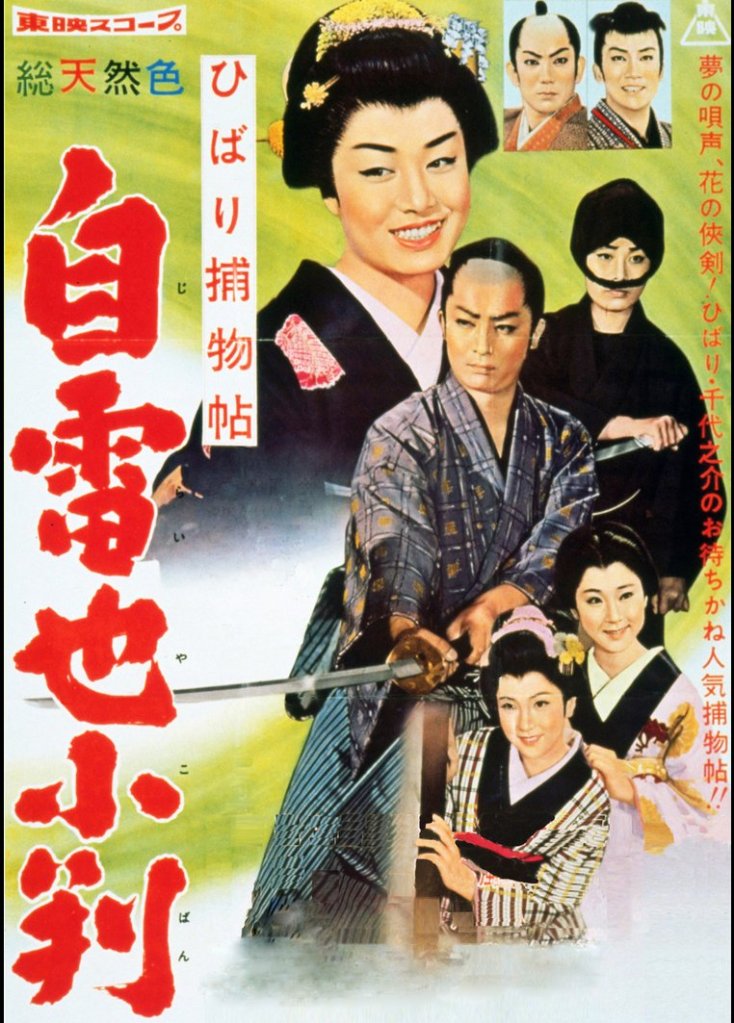
Detective Hibari 2: Secret of the Golden Coin (ひばり捕物帖 自雷也小判, Kinnosuke Fukada, 1958)

Oshichi returns! Two years after her first adventure, the princess in hiding has moved on, still living in the city hiding from the burdens of privilege but fiercely opposing injustice wherever she finds it as a detective in her own right. Unlike Mysteries of Edo and in keeping with Case of the Golden Hairpins, this Oshichi undergoes much less of a softening, remaining largely disinterested in the idea of romance, and cooly rebellious in her refusal to be cowed while strangely OK with Shogunate oppression as a quasi-agent of the state. 

As the film opens, a young woman impersonates Oshichi in order to gain entrance to a prison where her boyfriend is in jail for rebelling against the Shogunate. Meanwhile, Oshichi (Hibari Misora) is teaching a singing class as a favour to her boss who had to go out on an errand, after which she discovers that Hyoma (Chiyonosuke Azuma), currently a retainer of her brother’s, has been sent to bring her home. Once again she refuses because she likes her “ordinary” life. Shortly thereafter, a fire breaks out in the prison and the rebels escape. Oshichi becomes a prime suspect in the jailbreak, not only because the accomplice borrowed her name but because it’s advantageous to the plotters to blame her because they can use her guilt to tarnish her brother’s reputation and get him fired, usurping his position in the process. 

Oshichi, now working as a detective, is technically an agent of the Shogunate against which the rebels are rebelling for reasons which aren’t stated here but are probably easy to guess. They are, in many ways, the same sorts of reasons that Oshichi chose to become a detective, even if she’s coming at them from the other side. She doesn’t like bullies, or corruption, injustice or unfairness. Oshichi won’t stand for unkindness either, which is perhaps why she aligns so strongly behind the woman who blackened her name by impersonating her, knowing that she did it all for love and a little bit for justice, while also forgiving the rebel Seinosuke (Kotaro Satomi) who was preparing to kill the woman he loved because the corrupt samurai had kidnapped his dad and threatened to kill him if he didn’t. 

Despite all that however, Oshichi still insists that “the Shogunate can be compassionate too”, encouraging Seinosuke and his girlfriend Namiji (Hiromi Hanazono) to tell all so she can help them safe in the knowledge that they will be forgiven. It’s a slightly strange position for to her take, essentially authoritarian but arguing for a benevolent paternalism that is just and fair and kind, insisting that the corrupt samurai are bad apples which must be expelled rather than a product of an inherently oppressive social system as they are generally depicted in post-war jidaigeki. 

This insistence on the “compassion” of the Shogunate is perhaps the concession to Oshichi’s femininity which she has otherwise rejected in rejecting her life as a cosseted princess. As Kawashima had in Mysteries of Edo, Oshichi’s “protector” Hyoma asks her how she can take on all those men before challenging her to a contest of masculinity as mediated through a drinking competition which she does not exactly “win” but makes a minor victory all the same. Rather than rely on her brother or Hyoma, Oshichi vows to clear her name herself and starts investigating on her own dressing as a man and fighting bad guys while insisting on her independence. 

Nevertheless, she is but a pawn in a game of courtly intrigue, manipulated as a means of getting to her brother. The corrupt samurai think nothing of killing anyone who gets in their way, be they princesses or peasants, even going far as to mount an attack on the stage of a theatre mid-performance in front of a room full of spectators, many of whom join Oshichi by throwing projectiles as she tries to fend them off. Once again, she isn’t quite permitted to save herself but is “rescued” by the patriarchal forces representing the greater Shogunate including her protector Hyoma, and her brother, the embodiment of state authority. She is, however, the primary motivator in unmasking the corruption as she both clears her own name, and creates a better future for Namiji in which she can be with the man she loves, reminding her to always remember the compassion the Shogunate has shown her (in case she was minded to mount any more rebellions). As for herself, she manages to slip the loop once again, running off into the wild to claim her independence rather than be forced back into the golden cage of her princesshood while the loyal Hyoma contents himself with following her lead. 


Short clip (no subtitles)

Chikamatsu’s Love in Osaka (浪花の恋の物語, Tomu Uchida, 1959)

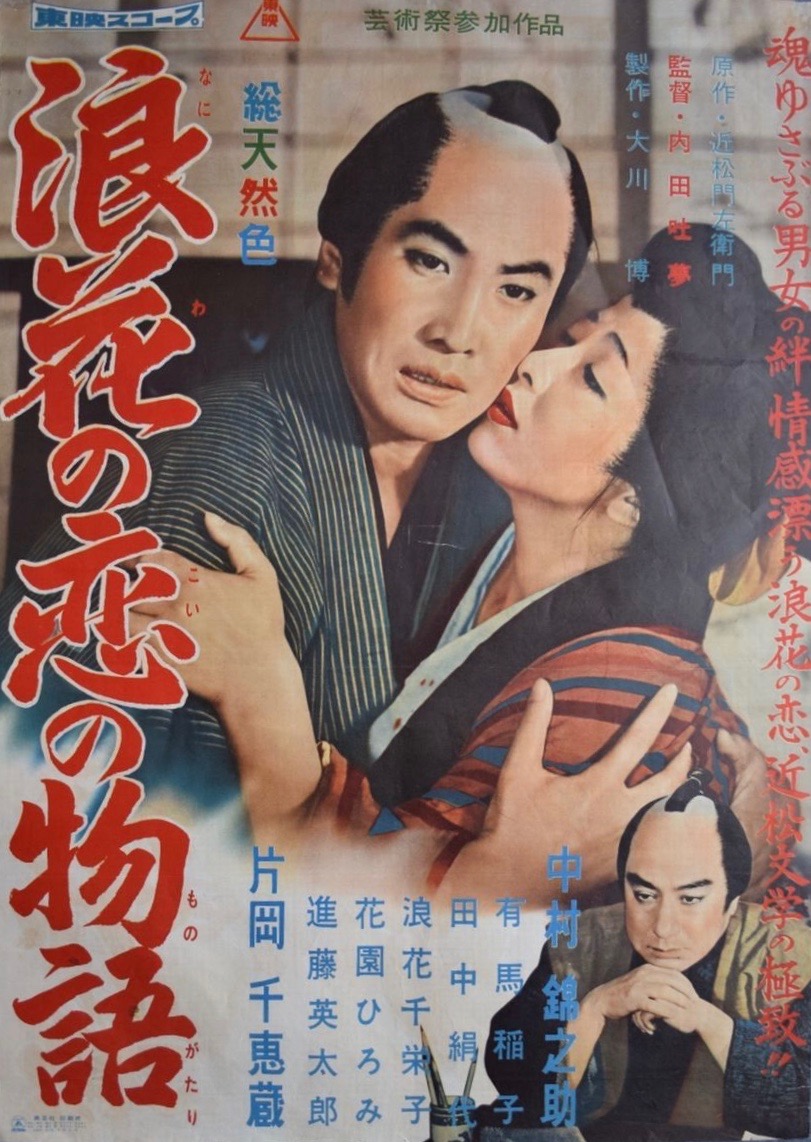
Chikamatsu's love in Osaka poster“Money is the enemy” a dejected geisha declares in an attempt to explain her desperate circumstances to a naive young man part way  through Tomu Uchida’s Chikamatsu’s Love in Osaka (浪花の恋の物語, Naniwa no Koi no Monogatari). Before a wartime flirtation with the militarist far right, Uchida had been closely involved with the leftwing “tendency film” movement and his post-war work perhaps displays much the same spirit only with a world weary resignation to the inherent unfairness of human society. Chikamatsu, as cited in the slightly awkward English language title, was a Japanese playwright of the 17th/18th century who also specialised in tales of social oppression, most notably in frustrated romance and eventual double suicides.

Uchida’s masterstroke is that he retells Chikamatsu’s well known bunraku play The Courier for Hell and its kabuki counterpart Couriers of Love Fleeing to Yamato from the inside out. Among Chikamatsu’s most famous works the play was in fact inspired by a real life event which took place in Osaka (then known as “Naniwa”) in 1710. Uchida places the grumpy, worldweary figure of the playwright directly into the action as a powerless observer, trapped on the wrong side of the stage able only to observe and comment but, crucially, with the ability to remake reality in altering his tale in the telling.

The tale is familiar enough and possibly a little too close to that of Chikamatsu’s previous hits including Love Suicides at Sonezaki which is given a grim namecheck as events begin to mirror one of his plays. Our hero, Chubei (Kinnosuke Nakamura), is an earnest young man who has been adopted into the Kameya family with the intention that he will marry its only daughter and take over the courier business now being run by stern widow Myokan (Kinuyo Tanaka). Early foreshadowing reminds us that immense responsibility is regularly placed in Chubei’s hands and he must remain above suspicion. Embezzlement is a capital offence in the increasingly austere 18th century society.

Chubei is an honest man, but meek. Unable to risk offending a bawdy client, he allows himself to be bamboozled into the red light district where Hachiemon (Minoru Chiaki) buys him the prettiest courtesan in the place, Umegawa (Ineko Arima). Chubei tries to leave as soon as Hachiemon disappears but is convinced to stay by Umegawa’s entreaties that his sudden exit will reflect badly on her and possibly result in censure or punishment. Struck by her predicament, Chubei falls in love. He makes repeated returns, dips into his savings, and finally makes the fateful decision to spend money not his own when he discovers that a lascivious magnate has made an offer to buy out Umegawa’s contract.

Meanwhile, Chikamatsu hovers on the edges conducting “research” for a new play to save his failing theatre company which itself is suffering due to lack of monetary receipts seeing as audience members obviously prefer the heartrending melodrama of Sonezaki to the more artistic fare he’s currently running. Though he is obviously a frequenter of the red light district and its surrounding drinking establishments, Chikamatsu has a noticeably ambivalent stance towards its existence. His sympathy is instantly caught by the melancholy Umegawa when he notices her tenderly bandage the hand of a little girl who serves in the brothel, only to have her beautiful gesture of human kindness immediately mocked by the lascivious magnate who witnesses the same thing but chooses to ask her to repeat the act on him.

Chikamatsu was supposed to come to the teahouse in order to schmooze the magnate so that he will invest in the theatre company which perhaps generates an odd commonality between the playwright and courtesan both at the mercy of wealthy patrons who, one might say, are all money and no class. Umegawa, however, as Chikamatsu is painfully aware is in no way free and entirely dependent on pleasing men like the magnate whether she likes them or not. As she tells Chubei, Umegawa didn’t choose this line of work but people judge her for it anyway. She has no bodily autonomy and is bought and sold daily with no right to refuse. She is “merchandise” that “talks, laughs, cries, and gets angry” and the sole concern in all of her life is money which she now regards as “the enemy” for the subjugated position in which the need for it has placed her.

Of course, the playwright (our stand-in) has been listening all along. He too would like to free Umegawa from her torment, but he is powerless and can only blame the world that created the circumstances that trap her. Chubei is no hero either, he is weak and feckless even if his eventual willingness to damn himself by embezzling other people’s money (and ruining his adopted family in the process) proves the depth both of his love and of his rage at the social injustice which prevents him from pursuing his romantic desires. Chikamatsu can’t save his fatalistic heroes, but he can create a more fitting vision of their love imbued with all world nearly grandeur of tragic romance that returns our eyes to the cruelty of the world that wouldn’t let them be. A stunning final shot pulls us from Chikamatsu once again in the background as he watches his own play onto the other side of the stage and then back again as the playwright’s eyes burn with silent rage and impotence as he offers the only kind of resistance he can in the face of a cruel and indifferent society.


Actress vs. Greedy Sharks (小判鮫 お役者仁義, Tadashi Sawashima, 1966)

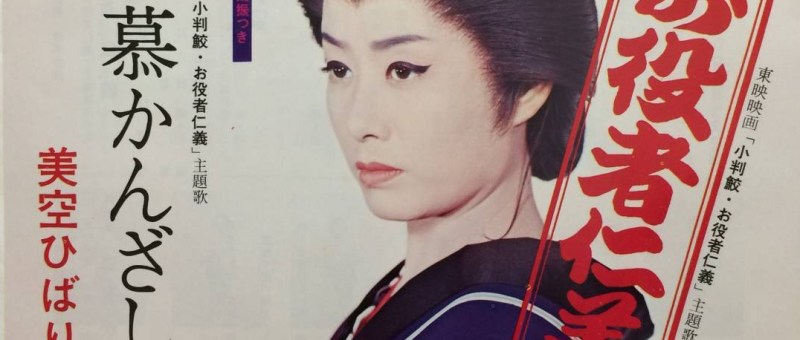
actress vs greedy sharks soundtrack albumA studio director at Toei, Tadashi Sawashima is best remembered for his work in the studio’s ninkyo eiga genre – prewar tales of noble gangsters, and samurai movies but he also made the occasional foray into the world of musical drama, teaming up with top name singing star Hibari Misora on a few of her historical action musicals. In 1966’s Actress vs. Greedy Sharks (小判鮫 お役者仁義, Kobanzame Oyakusha Jingi) Hibari once again plays a dual role though this time her casting is entirely arbitrary and the visual similarity of the legit actress and the acrobatic outlaw is never explicitly remarked upon.

The action opens with Shichi (Hibari Misora), an acrobat and member of a Robin Hood style band of outlaws (they don’t so much give to the poor as “share” with the less fortunate) interrupting the plot of Yamitaro (Yoichi Hayashi) – a nobleman in disguise to pursue revenge against corrupt lord Doi (Eitaro Shindo) who exiled his father to Convict Island when he began to raise questions about judicial corruption. Meanwhile, Yuki (also played by Hibari) is a top stage actress who is plotting against Doi for sending her father to Convict Island 20 years previously on a trumped up charge. Just as the “tomboyish” Shichi is beginning to fall for the mysterious Yamitaro, he teams up with Yuki to pursue their mutual quests for revenge which has Shichi feeling (needlessly, as it turns out) betrayed and vengeful.

Once again, the samurai order is shown to be corrupt beyond redemption. Doi, a greedy lord, is planning to sell off his only daughter, Ran (Yumiko Nogawa), as a concubine to the shogun. Meanwhile, he is also engaging in a rice profiteering scheme in order to bolster his financial resources. He is also still misusing his influence, just as he did when he had Yuki’s father sent to prison and got rid of Yamitaro’s so he couldn’t expose him.

As in her other movies, Hibari cannot allow this corruption to continue and becomes a thorn in the side of authority. However, the situation this time around is further complicated by her double casting in which she plays two visually identical characters who are, nevertheless, entirely unrelated and the resemblance between them entirely unremarked upon. The “tomboyish” Shichi, apparently falling in love for the first time much to the confusion of herself and others who regarded her lack of traditional femininity as a barrier to romance, becomes awkwardly resentful of the graceful Yuki whose charms she assumes will sway the handsome Yamitaro. Shichi does not seem to consider a class barrier between herself and Yamitaro as a problem but fears his natural affinity with a woman she perceives as superior to herself in her refinement, yet Yuki proves herself as staunch a fighter as Shichi and just as feisty. She appears to have little romantic interest in Yamitaro even if she resents Shichi’s rather blunt instructions to back off, and aside from concentrating on her revenge, spends the rest of the film dealing with the rescue of Doi’s daughter Ran who has drawn inspiration from her stage performances to rebel against her cruel fate and father.

Ran is just another symptom of her father’s corruption in his obvious disregard for her feelings as he prepares to send her off as a concubine to buy himself influence with only the mild justification that her ascendence to the imperial court is an honour even if she will never be a wife, only one of many mistresses. Unlike Ran, Yuki and Shichi have managed to seize their own agency, living more or less independently and as freely as possible within the society they inhabit. Experiencing differing kinds of bad luck and betrayal, they find themselves at odds with each other yet on parallel paths despite their obvious dualities.

With less space for song, Hibari’s dual casting does at least offer twice the fight potential as the outlaw and the actress finally find themselves on the same side to tackle the persistent injustice of Edo era society as manifested in the corrupt Doi and his slimy cronies gearing up for the mass brawl finale in which the wronged take their revenge on the wicked lord by proving him a villain in the public square and earning themselves not a little social kudos in the process. All of which makes the strangely melancholy ending exiling one aspect of Hibari to the outer reaches somewhat uncomfortable but then it does provide an excuse for another song.


Hibari’s musical numbers

Bloody Spear at Mount Fuji (血槍富士, Tomu Uchida, 1955)

Bloody Spear Mount Fuji posterThere was a reason that the occupation authorities were suspicious of period films, but the jidaigeki of the post-war years are not generally interested in nationalistic pride so much as in interrogating the myths of the samurai legacy in order to pick apart the compromises of the modern era and the follies of the immediate past. Tomu Uchida had been among the most prominent directors of pre-war cinema but left to join the Manchurian Film Cooperative in 1942, remaining in China until 1953. Bloody Spear at Mount Fuji (血槍富士, Chiyari Fuji) was his “comeback” film, brought into existence through the good offices of fellow directors Yasujiro Ozu, Hiroshi Shimizu, and Daisuke Ito who had been the pioneer of samurai movies in the silent era. Like the later films of Masaki Kobayashi, Uchida takes aim at the hypocritical falsehoods of the samurai order and at a series of still prevalent social codes which oblige one human to oppress another in order to avoid acknowledging the fact that one is oneself oppressed.

Ironically enough we begin on the road to Edo as a goodhearted but compromised samurai, Sawaka (Teruo Shimada), makes the journey to the capital to make his name with a precious teacup in tow. He may be a samurai, but he’s making this lengthy journey on foot and accompanied by only two retainers – veteran spearman Genpachi (Chiezo Kataoka), and manservant Genta (Daisuke Kento). While on the road, the trio come across various other travellers including a shamisen player (Chizuru Kitagawa) and her daughter, a cheeky orphan who wants to be a samurai, and a melancholy father and daughter en route to visit a relative in the hope of financial assistance. There is also a notorious bandit on the loose going by the name of Rokuemon, which is one reason that the “recently wealthy” miner Tozaburo (Ryunosuke Tsukigata) is arousing suspicion with local law enforcement.

In contrast to many a jidaigeki epic, the travellers on the road to Edo are mostly good people if wise enough to be wary and on the look out for trouble. Genta and Genpachi have been given strict instructions that Sawaka is not to drink during the journey. Though he’s a nice enough soul when sober, Sawaka is a mean drunk with a tendency to start random fights and his mother doesn’t want him messing up his big chance by causing trouble on the road. This maternal solicitude can’t help but annoy Sawaka who overhears Genta complaining to a servant at the inn as he enjoys a quick glass of solo sake in the kitchen. There may be a sword on Sawaka’s belt, but he’s a middle ranker at best – something rammed home to him when the party is held up by a roadblock which turns out to be solely caused by three elite samurai having a picnic who wish to enjoy the view uninterrupted. Later he grips the handle on his sword in rage and desire to help a young woman in trouble before his hand begins to slip as he realises how little power he really has. The only thing to help her was money, and money is something Sawaka evidently does not have.

Sawaka’s “power” is entirely illusionary and dictated by the complex hierarchies of the samurai era. Breaking all the rules, he considers selling his “priceless ancestral spear” to get money to help the girl, but is told that the spear is a fake and hardly worth anything. With the help of the plucky little boy Jiro, Genpachi helps to apprehend a wanted criminal but it’s Sawaka who gets a commendation – something which causes him not a little consternation but his attempts to transfer the praise onto the rightful parties falls on deaf ears. In any case, the reward is just a piece of paper filled with more empty words and not much practical use to anyone. A fake spear begets a fake reward, he quips, becoming ever more disillusioned with the rights and responsibilities of the samurai order while somewhat romanticising the lives of the “ordinary” who might be more “free” in one sense but then Sawaka is never going to worry about being hungry or have to think about selling his daughter to avoid certain ruin even if he resents the ways in which is social class obliges him to affect coldheartedness.

Sawaka’s rejection of “samurai” values eventually leads to his downfall when an invitation to a servant to join him at his drinking table as an equal provokes outrage in a fellow nobleman who feels his own status threatened by this genial act of meaningless equality. Sawaka’s attempts to insist that he and his servant are both human beings only makes things worse and it doesn’t take long to figure out that he has picked the wrong battle if what he wanted was to strike a blow at samurai hypocrisy. Sawaka himself is no innocent in this game, terrorising a trio of peasants simply because one of them had an interesting nose and the drink was in him. Sawaka’s servant eventually pays the price for his mistake, bearing out his earlier frustrations with the chain of “shadows” that defines the samurai order and seemingly has no end.

Genpachi is the embodiment of the good retainer, but he’s also a kind and sympathetic man who takes an interest in the lonely orphan boy and, to a lesser extent, the shamisen player and her little daughter. The four of them form a kind of makeshift family, but the samurai order destroys even this small slice of happiness as the road prepares to force them apart. Having bloodied his spear but had his act of rage “approved” by the powers that be, Genpachi emerges broken and masterless, his fatherly attentions to Jiro relegated to a literal instruction not to follow in his footsteps and never to become a “spear carrier”, a mere tool at the mercy of a cruel and corrupt regime. Uchida begins in comedy complete with a whimsical contemporary score but makes clear that his ending is inevitable tragedy only made worse by the superficial rubber stamping that neatly sanctions the hero’s moment of madness as one perfectly in keeping with his moral universe.


Bloody Spear at Mount Fuji is available on blu-ray from Arrow Academy with a typically expansive feature commentary by film scholar Jasper Sharp including a minor digression into the career of director Hiroshi Shimizu – another sadly neglected figure of pre-war/golden age Japanese cinema. Other on-disc extras includes a series of interviews ported over from the French release – though it is nice to have them, it’s a shame that they are presented with the hardcoded French subtitles blurred out and English ones placed over the top which is less than ideal but perhaps cannot be helped. First pressing also includes a booklet featuring a lengthy essay by James Oliver which duplicates much of the information from the commentary while also situating the film within the context of Uchida’s career and the wider post-war world, as well as a complete filmography both for Uchida’s directing and acting work compiled by Sharp.

Short clip from an unrestored version of the film (no subtitles)