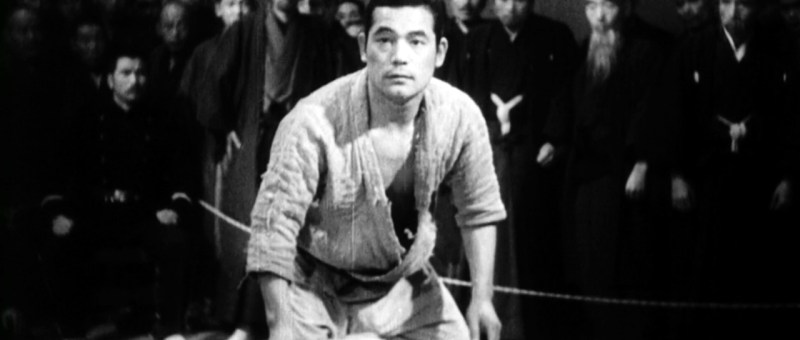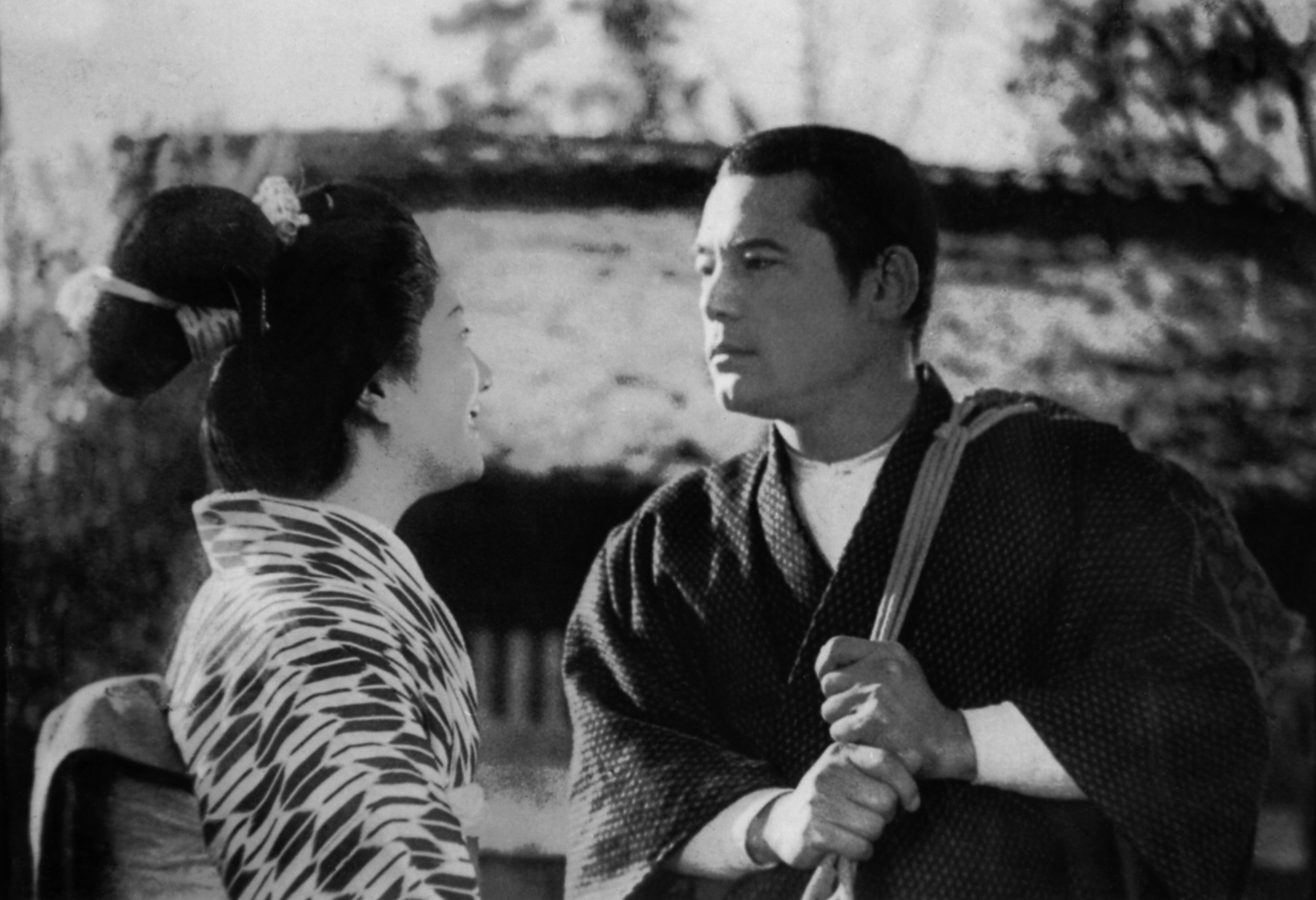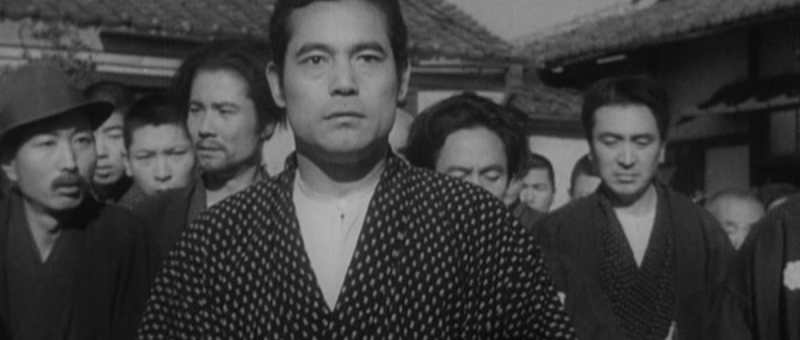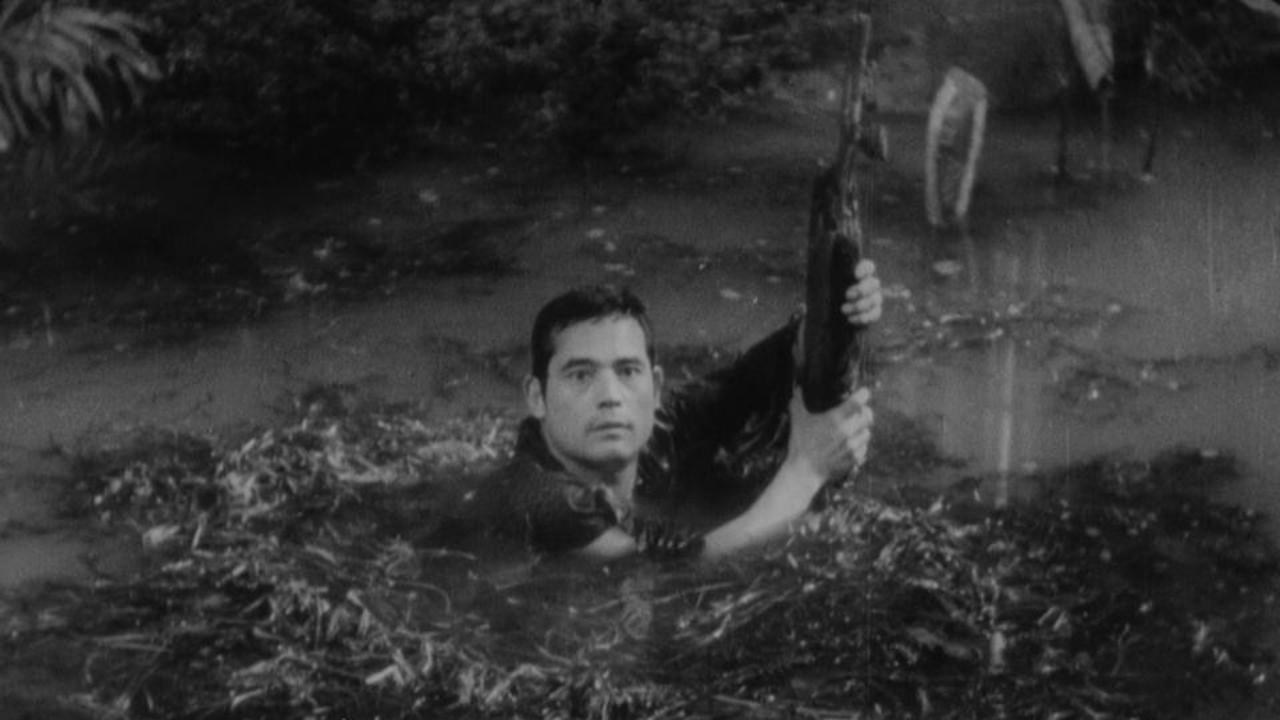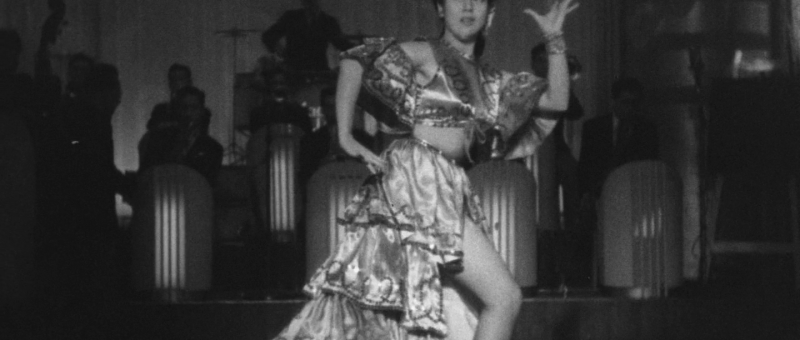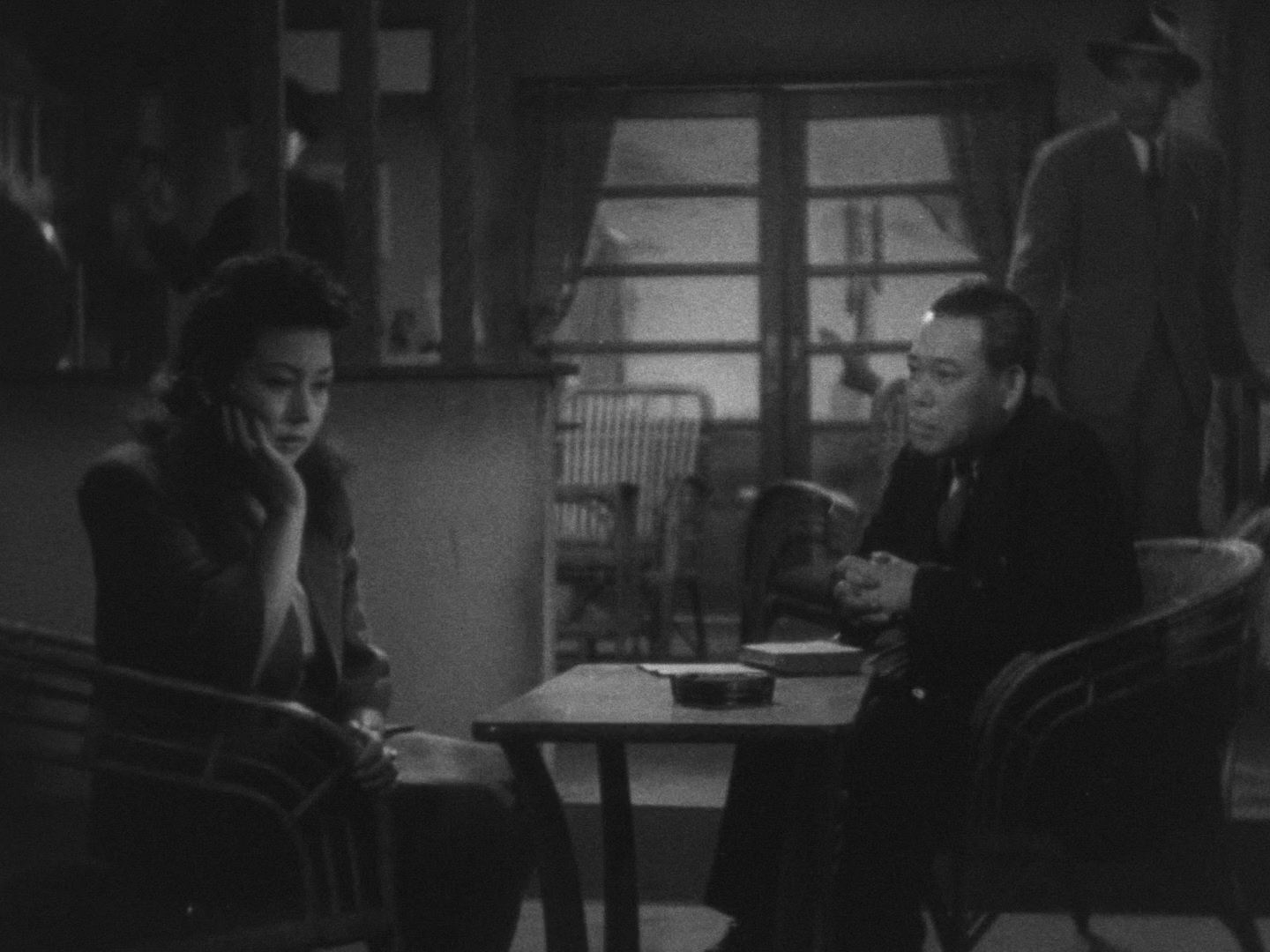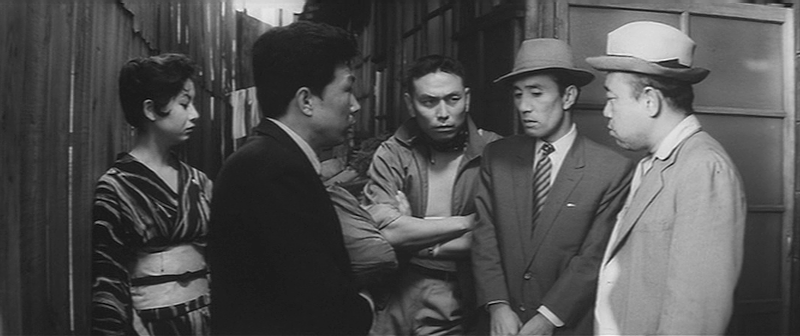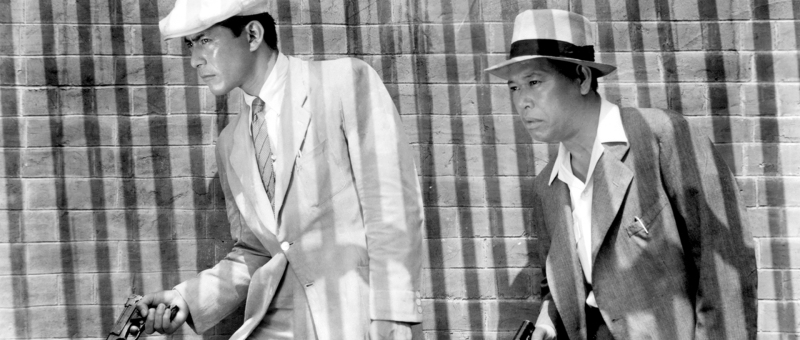
Sanshiro Sugata Part Two (續 姿三四郎, Akira Kurosawa, 1945)

Sanshiro Sugata had not especially pleased the censors who took a scalpel to it, excising a few elements they found problematic, but the film proved popular enough with audiences for the government to commission a sequel. Apparently somewhat reluctantly, Akira Kurosawa returned to the world of Sanshiro Sugata picking up almost in real time two years later with a conflicted Sanshiro (Susumu Fujita) still wandering around Yokohama avoiding the woman he loves whose father may have died due to injuries inflicted on him during his fight with Sanshiro. Yet where the first film had essentially presented a spiritual odyssey through the medium of judo, part two is a much more nakedly propagandistic affair. 

It some ways it’s a little ironic that Sanshiro has almost become a folk hero who stands up for the oppressed Japanese against the looming threat of Western imperialism as mediated through the contest between Japanese martial arts and American boxing. The film opens with a drunken American sailor berating the teenage boy pulling his rickshaw and eventually attacking him only to run into Sanshiro and get a swift hiding. The thankful boy recognises his name and decides that he wants to learn judo too so he can defend himself against external threat, but Sanshiro isn’t sure he should be teaching anyone because he still has a lot to learn and is otherwise unable to escape his guilt over having contributed to the deaths of others through the practice of his art. His internalised shame is only deepened when he’s asked to participate in a spectacle match against a top American boxer and declines only to be told off by the guy who decided to accept. He used to be a jiujitsu champ, but ever since Sanshiro brought about the judo revolution no one cares about jiujitsu anymore and it’s ruined his livelihood. 

There is it seems a degree of shame in fighting for money, but more so in fighting for the entertainment of others. When Sanshiro visits the boxing ring, the sport is depicted as vulgar and primitive. The baying crowd are there largely for blood, riled up by the violent spectacle and eager to see a man in the extremities of a bodily struggle. For Sanshiro, it’s a depressing and offensive sight and to participate in it is to bring shame on Japanese martial arts. Meanwhile, the judo school is also threatened by two thuggish brothers keen to prove the superiority of karate over judo by defeating Sanshiro. They are also brothers of the first film’s villain Higaki who was reformed after his fight with Sanshiro but has since apparently fallen into ill health and listlessness, but so certain that Sanshiro is the only man who can save Japanese martial arts that he gives him the secrets of his brothers’ techniques. 

The final battle mimics that of the first film save taking place amid heavy snow and howling wind. Sanshiro once wins over his opponents through his kindness, taking them into the warm and looking after them until they begin to recover. One of the brothers briefly picks up a meat cleaver before thinking better of it as the two of them grin and admit defeat. Yet Sanshiro’s real battle is indeed against the American imperialists, wilfully breaking Yano’s cardinal rules by deciding to agree to the spectacle fight and easily defeating the American boxer who ends up just passing out from the force of Sanshiro’s aura. The jiujitsu practitioner who seemed to resent him before breaks down in tears and offers his sincere thanks to Sanshiro for standing up for Japan against the Americans.

The contemporary context is clear, this time around judo is much less about spirituality than it is about victory as much as Sanshiro likes to say that it isn’t winning and losing that’s important. Sanshiro becomes the saviour of Japanese martial arts, now endangered by the rising popularity of Western boxing, but also indirectly of the Japanese people in standing up against an encroaching external threat in direct contrast to the slimy Fubiki (Ichiro Sugai), a dandyish interpreter to the Americans forever dressed in foppish suits and seemingly content to do their bidding. “You haven’t changed at all,” Yano scoffs of Sanshiro’s two years of fruitless travelling and it’s clear he still has a lot to learn, putting his romance with the long-suffering Sayo once again “on the back burner”, while remaining true to himself even if not quite the monster the children sing of, a relentlessly honest man and seemingly the lone defender giving hope to an increasingly anxious Japan.


Sanshiro Sugata (姿三四郎, Akira Kurosawa, 1943)

It might seem curious in some ways to make a film about the importance of humanity in martial arts during a time of war, but Akira Kurosawa’s debut feature Sanshiro Sugata (姿三四郎, Sugata Sanshiro) does just this in depicting the hero’s coming of age as a gradual progress towards awakening as he learns to attain control over body and mind through the modern discipline of judo. Based on a novel by Tsuneo Tomita, the film is in many ways a typical martial arts drama in which a young hopeful seeks a master and must eventually face a rival, but lends a note of poetry to the tale which is in other ways perhaps out of keeping with its times. 

The times of the film, however, are late Meiji as demonstrated in the lively opening sequence which ventures into a town in transition where policemen in Western-style uniforms walk the streets alongside townspeople dressed largely in kimono as is the hero, Sanshiro Sugata (Susumu Fujita), who’s come looking for a famous jiujitsu master. Taken on as a pupil, he overhears the master, Momma (Yoshio Kosugi), disparaging a rival, Yano (Denjiro Okochi), who has come up with a new martial art he calls judo which is fast gaining both respect and popularity. Momma thinks it’s all just a branding exercise and Yano’s “judo” is just repackaged jiujitsu, irritated that he seems primed to take a prestigious position as a trainer to the police force which runs its own martial arts contest. Sanshiro goes with them when they attempt to ambush Yano and teach him a lesson only to be easily defeated and humiliatingly thrown in the local river. Sanshiro immediately switches his allegiance, discarding his geta to give Yano a ride home in his rickshaw.

As Yano repeatedly tries to teach Sanshiro, judo is more than a martial arts discipline and places humanity at the centre of everything. This is a difficult lesson for the hot-headed Sanshiro to learn, quickly falling foul of his new master after brawling in the red light district and dramatically throwing himself into the pond. Clinging to a pole, he refuses to get out until Yano forgives him, but in true master fashion Yano merely says that getting out of the pond or not is entirely up to him. It’s while he’s in there, and after a few words from a Buddhist monk, that he witnesses a lotus flower slowing unfolding and achieves a kind of enlightenment that allows him to realise he’s been childish and petulant, finally getting out of the water to submit himself to the rigorous discipline of the martial arts life. 

The flower motif recurs several times, not least being its subversion when antagonist Higaki (Ryunosuke Tsukigata) sprinkles the ash of his cigarette over it. Making his first appearance in dandyish Western dress, Higaki is described as a snake-like villain, his evilness emphasised by his non-Japanese attire in contrast to pretty much everyone else who continues to dress in kimono. Higaki vows that his fight with Sanshiro must be to the death, in part a fight between the nascent art of judo originating in the post-feudal society and the traditional art of jiujitsu, but echoing Sanshiro’s first fight with former master Momma which resulted in his death and plunged the hero into spiritual conflict. He then experiences something similar when realising that he has inadvertently fallen in love with Sayo (Yukiko Todoroki) the pure-hearted daughter of another rival, Murai (Takashi Shimura), who also desires to fight him but as it turns out only in his desire to face a worthy opponent. Sanshiro wants to back away, afraid that he may humiliate or even kill the father of the woman he loves but is brought back to himself by more words from the monk who tells him that he must be as innocent as she is and engage in the fight in a sportsmanlike fashion as a spiritual as well as physical contest. 

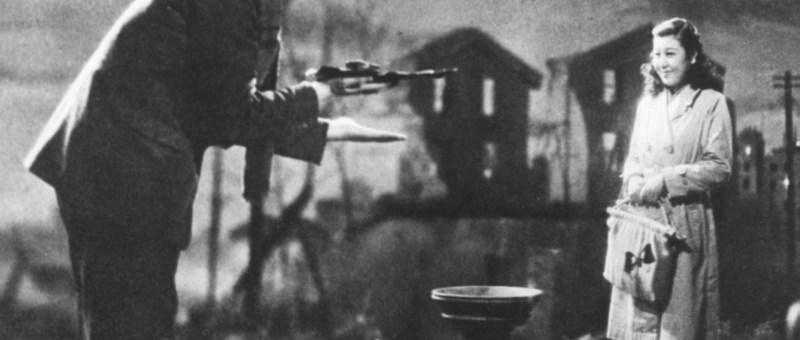
This is also to some degree true of his final confrontation with Higaki which too is a confrontation with the evils of the age if less comfortably also satisfying the censors by allowing Higaki to stand in for foreignness in general. Higaki is indeed often accompanied by the sound of the wind which echoes his modernity, the fight taking place in a large windswept field below roiling clouds as the two men grapple despite the advice of their intermediary to call it off before one of them really dies. Higaki does in a sense die a sort of death in that we’re told after the fight he reformed and also managed to find a similar kind of enlightenment to Sanshiro who is then bashful and romantic while heading off on another journey from which he assures Sayo he will soon return. It’s true enough that there doesn’t seem to be much that would appeal to the censors of 1943 save the implied defeat of Western powers and celebration of Japanese martial arts given that humanity is repeatedly emphasised as the core component of judo and that Sanshiro achieves an individual enlightenment rather than finding peace as a member of a team or community, but they did otherwise decide to cut a substantial amount of the film said to contain a love scene and references to alcoholism that they deemed improper. Nevertheless, there are shades of Kurosawa’s later greatness even here in his dramatic composition and expressionistic use of nature to detail one boy’s journey into manhood through the spiritual rather than physical gymnastics of the philosophy of judo. 


A Bullet Hole Underground (地下街の弾痕, Kazuo Mori, 1949)

Produced by Daiei Kyoto under the guidance of the Osaka Police, Bullet Hole Underground (地下街の弾痕, Chikagai no Dankon) is keen on selling a vision of order in a new Japan in which the police force employs all the latest technology to solve crimes calmly and methodically. We see them approach the crime scene forensically and conduct a series of scientific tests with microscopes and gadgets such as lie detector machines and code breaking equipment as they proceed towards the truth while earnest policeman Minagawa (Hiroshi Nihonyanagi) battles the ghosts of his past on realising that the dead man’s wife is his own lost love.

In any case, the film opens with a noirish scene at Umeda Station, Osaka, which then turns strangely comic. A man stumbles toward the exit and we assume that he is probably drunk but another man soon comes up behind him and pushes a pistol into his back. The second man pulls the trigger, then again to make sure, before calmly walking up the steps and leaving the station. A little while later, another drunk man arrives and has a little banter with the body before covering it with a signboard which is one reason it isn’t spotted until the shoeshine boys turn up in the morning. 

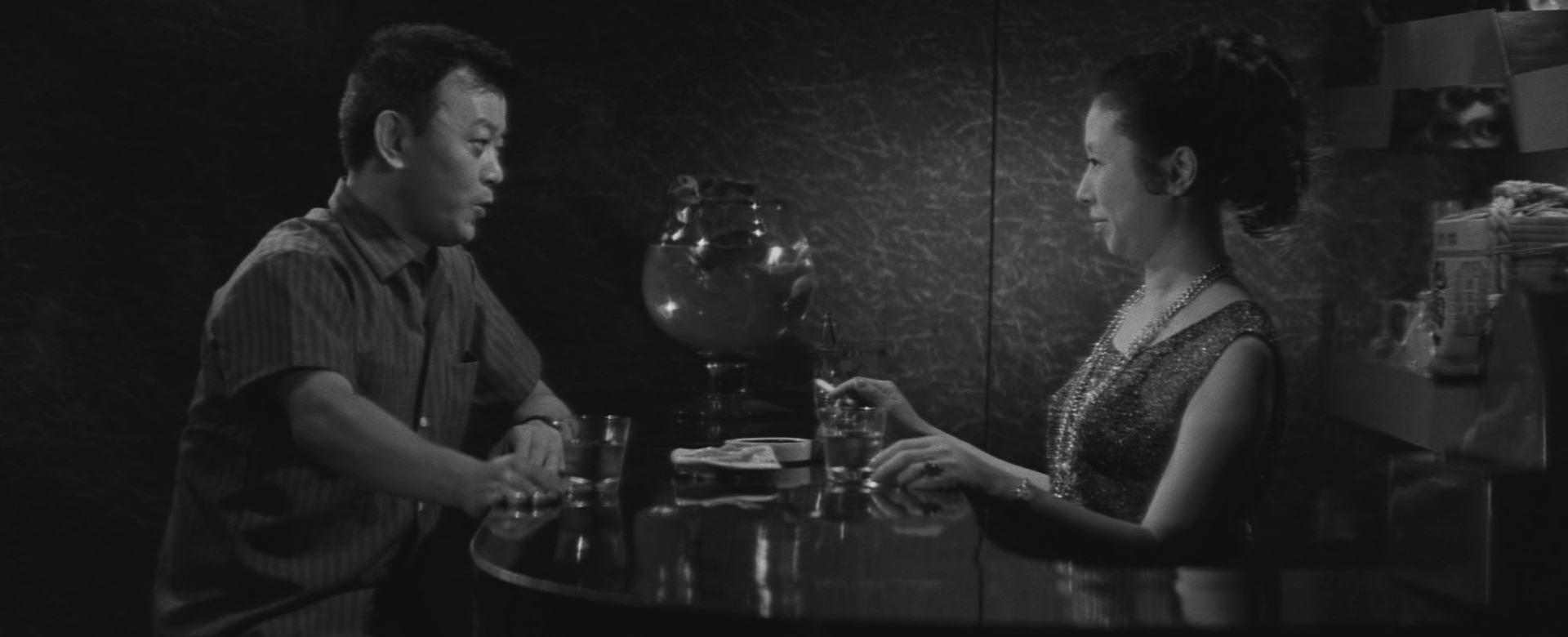
This sudden influx of children at rush hour is another symbol of the destabilisation of the post-war society in which the war orphans try to support themselves amid the still difficult economic environment. The lack of economic opportunities is also posited as a reason that the deceased, later identified as Kaneko, may have turned to crime by getting involved with a criminal gang smuggling drugs and money to destabilise the society even further. Yet the rot may have set in a little earlier than that. Before the war, Minagawa had wanted to marry Michiko (Machiko Kyo), the sister of his friend Sekiguchi (Toshiaki Konoe), but she later threw him over to marry the wealthy son of a family running a pharmacy. She admits she married him for the money, but after the war he lost everything. Unable to find work, Kaneko became a wastrel while Michiko gained employment at a cabaret bar as a dancer. He told her that he’d found a job at a company, but this turned out to be a lie and chief investigator Fujimoto (Takashi Shimura) assumes he must have been working for the gang. 

Still, to begin with it seems like it may have been a case of mistaken identity. Kaneko’s clothes turned out to belong to other people, a fact easily explained by Michiko that they were second hand, but also suggesting that someone may have set him up to take their fall. The gang needed the skills he learned in the navy but maybe they didn’t need him anymore. The root of the evil is located, ironically enough, in a jewellery store presenting a front of affluence and elegance but in reality founded on crime and misery when so many are still struggling to rebuild their lives. Michiko too seems to have turned cynical. She snarls and pushes Minagawa away, but privately cries and appears to regret her youthful decision to reject love for material comfort.

Perhaps because of its genesis as a film designed to promote the local police force, it has a much more upbeat conclusion and particularly for Michiko who is, unusually, allowed to redeem herself and gain a second chance to make a better decision by reuniting with Minagawa who does not and never has held her past against her. The pair of them look out over the fracturing city and remark at how it just carries on as if nothing had happened which feels like advice intended for the post-war society that it should do the same and try to leave the past behind to start a new life in this new era. Meanwhile, huge numbers of policemen swarm the harbour to crack down on the smuggling gang sending the not altogether comforting message that this city is well protected against all kinds of crime and the police force is a well-trained, modern institution that has the latest technology at its disposal along with astute and compassionate officers. There may be sleazy clubs, duplicitous men and heartless gangsters, black markets and smuggled dangers, but there are, the closing scenes with their wide-open vistas in which scorched trees stand behind the burgeoning city imply, better days to come.


A Brother and His Younger Sister (兄とその妹, Yasujiro Shimazu, 1939)

A young man’s love of go ends up getting him into hot water at work in Yasujiro Shimazu’s surprisingly progressive shomingeki, A Brother and his Younger Sister (兄とその妹, Ani to Sono Imoto). It seems office politics might not have changed all that much in the last 80 years even if many other things have, but conversely the film seems to have more to say about the changing nature of gender roles and attitudes towards women in a time in which it was becoming possible for a woman to live a fully independent life. 

This window wouldn’t last very long and the situation largely reversed itself even amid the supposed equality enshrined in the post-war constitution, but Fumiko (Michiko Kuwano) at least has a well paying job as a secretary at a large company and consequently little desire to marry even at the comparatively late age of 24. Her earning capacity is later put forward as a reason that there “aren’t many opportunities” for marriage as men apparently feel threatened and embarrassed especially if their salary is lower than hers. It’s not exactly that she’s against marriage, but as she can support herself and is otherwise happy living with her brother Keisuke (Shin Saburi) and his wife Akiko (Kuniko Miyake). She doesn’t see the need to rush into such an important decision. Though she might change her mind if the right person came along, for the moment she just isn’t interested. Then again, Akiko’s sucking of her finger when she’s ironically cut by a thorn on a bouquet of roses from an unwanted admirer might suggest another reason marriage is not on her radar.

Her suitor, Michio (Ken Uehara), despite his handsomeness is a little creepy in his courtship and cannot seem to take a hint that Fumiko isn’t interested in him. A friend of her boss, he has a habit of dropping into the office for no real reason and attempts to ask her out when the boss isn’t there. She lies and tells him she’s married already (to a penniless painter!) but after the boss reveals the truth it doesn’t seem to occur to Michio that if she made up a story like that it’s because she doesn’t want to go out with him. We’re told that Michio studied at Oxford and is attracted to Fumiko because he’s impressed by her language skills, but he’s also some kind of stockbroker which quickly paints him as no good seeing as the film seems to have a minor message about how dabbling in stocks and shares is little better than gambling and definitely dangerous.

One of Keisuke’s colleagues has been given a warning because there’s a rumour that he’s into shares while another has apparently been demoted because it came to light that he had a fondness for horse racing. More than a moral judgement, it seems the reason is that these sorts of hobbies may eventually lead someone towards embezzling from the company to cover their debts. Keisuke’s supervisor is also worried that his 18-year-old son is refusing to go to university and apparently wants to join some kind of “investment society” which admittedly does not sound like a good idea so he wants Keisuke to talk him out of it. The big boss, meanwhile, who is also Michio’s uncle, turns out to be into shares himself which makes him a very compromised authority figure. 

Keisuke is not into shares, but he is very into the game of go which causes him to stay out until late at night playing with his bosses. He does this because he genuinely likes playing, but Fumiko worries that his colleagues will come to resent him assuming that he does so to curry favour. Apparently, something similar happened at his previous job which is why he ended up quitting abruptly. As he was quite lucky to get this one despite how impressed everyone seems by his capabilities, it would be better if that didn’t happen again. Nevertheless, the perspicacious Fumiko turns out to be right as as his co-worker Yukito (Reikichi Kawamura) becomes increasingly jealous of his success fearing that he will leapfrog him to take the shortly to open up supervisor position which he believes to be his simply because he’s been there longer (which is generally how things work at Japanese companies). Consequently, starts a series of rumours that Keisuke is a snitch who got the horse racing guy demoted and is only in his position thanks to schmoozing with the bosses.

This obviously leaves him with a huge dilemma when his boss asks him to put in a good word for Michio with Fumiko whom he is pretty sure won’t be interested. To his credit, Keisuke maintains that it’s up to her and his career is nowhere near as important as her happiness though he is also aware it’s going to be embarrassing for him when she says no. Fumiko knows this too, and it’s clear that she also feels incredibly awkward when he puts it to her but only asks for a few minutes to think before offering her primary justification for refusing which would be that she fears Keisuke’s colleagues will resent him even more if they come to the conclusion that he sold his own sister in the hope of career advancement. This does in fact turn out to be the case as Yukito has already started a rumour about a dynastic marriage that turns the rest of Keisuke’s colleagues against him especially as he’s given the promotion immediately before he was going to tell the boss Fumiko isn’t interested. 

Confronted by the horse racing guy, Keisuke ends up quitting again after getting into a physical confrontation with a seemingly remorseful Yukito who probably didn’t mean for it to go that far. Keisuke quits because he won’t have people think he was gossiping behind their backs and is offended by this attack on his integrity, but his decision is also a rebuke against this infinitely corrupt employment regime in which hypocritical bosses hand out jobs to their favourites and maybe do expect that Keisuke will persuade his sister to sacrifice herself for his career. She meanwhile is portrayed as an independent woman, but ironically rejects the marriage to save her brother’s reputation though perhaps equally she feared her “no” would not be enough on its own. Then again, she had apparently turned down several suitors already and no one really expected her to say yes this time unless she’d suddenly begun to feel anxious about her age and declining prospects. 

Nevertheless, it’s refreshing that the film does not force Fumiko into accepting marriage as so many others would and in fact legitimises her opposition to it and right to live as an independent woman for as long as she chooses. Keisuke is also in some ways rewarded for quitting his job at the corrupt company in immediately getting another one from a former co-worker who’s since started his own business and wants to expand to Manchuria. But this final scene almost seems tacked on for the censor’s benefit. It is perhaps a little unusual for 1939 that the film has so far made no mention of Japan’s imperial ambitions nor made any kind of patriotic appeal. It’s even been quite pro-internationalist in the talk of people speaking English and engaging in European trade (even if the currency trading Michio’s doing is definitely framed as bad). Fumiko spots a little patch of grass clinging onto the plane as they take off for Manchuria with Keisuke remarking that he hopes this little piece of Japan will take root on the continent. On one level, it suggests that contemporary Japan was too corrupt for an “honest” man like Keisuke to prosper while Manchuria will offer greater freedom for himself and the independent modern girl Fumiko (who declares she won’t marry until Keisuke’s successful), but it’s also of course an unpalatable advocation for the ongoing imperialist expansion which seems so out of keeping with everything that’s gone before. Even so, the message is clear that it’s Keisuke and Fumiko who are in the right and should be allowed to live just as they are in a society free of judgement and hypocrisy.


The Wolves (狼, Kaneto Shindo, 1955)

Post-war desperation drives a collection of otherwise honest men and women towards a criminal act that for all its politeness they are ill-equipped to live with in Kaneto Shindo’s biting social drama The Wolves (狼, Okami). “Wolves” is what the criminals are branded, but the title hints more at the wolfish society which threatens to swallow them whole. After all, it’s eat or be eaten in this dog eat dog world, at least according to a cynical insurance salesman hellbent on exploiting those without means. 

Each of the five “criminals” is an employee at Toyo Insurance where they’re immediately pitted against each other, reminded that in order to qualify for a full-time position they need to meet their quotas for six months. The orientation meeting is cultilke in its intensity, the boss insisting that only in insurance can you become a self-made man while recounting his own epiphany as to the worthiness of his profession. They are told that the only two things they need are “faith and honesty”, and then “faith and pursuasion”, while encouraged to think of their work as an act of “worship”, “for the salvation of everyone”. 

Yet they’re also told to exploit their friends and family by pressuring them into taking out life insurance policies in order to help them meet their quotas. As one man points out, friends and relatives of the poor are likely to be poor themselves, but these are exactly the kind of people they’re expected to target. They’re told there’s no point going after the weathly because they’re already insured, but there’s something doubly insidious in trying to coax desperate people who can’t quite afford to feed themselves into paying out money they don’t have on the promise of protecting their families from ruin. One man even asks if the policy covers suicide and is told it does if you pay in for a year, sighing that he doesn’t want to wait that long.

“Suicide or robbery, choose one,” one of the salespeople reflects after failing to make their quota once again. They each have reasons to be desperate, all of them already excluded from the mainstream society and uncertain how they will find work if the job falls through. Akiko (Nobuko Otowa) is a war widow with a young son who is being bullied at school because of his cleft palate for which he needs an expensive operation. She’s already tried working as a bar hostess but is quiet by nature and found little success with it. Fujibayashi (Sanae Takasugi) is widowed too with two children and five months behind rent for a dingy flat in a bomb damaged slum where the landlord is about to turn off her electric. Harajima (Jun Hamamura) used to work in a bank but was fired for joining a union and is trapped in a toxic marriage to woman looking for material comfort he can’t offer. Mikawa (Taiji Tonoyama) too is resented by his wife, a former dancer, having lost his factory job to a workplace injury while the ageing Yoshikawa (Ichiro Sugai) was once a famous screenwriter but as he explains people in the film industry turn cold when you’re not hot stuff any more. 

Their unlikely descent into crime has its own kind of inevitability in the crushing impossibility of their lives. They may rationalise that what they’re doing is no different from the insurance company that exploits the vulnerable for its own gain, thinking that if they can just get a little ahead they’d be alright while feeling as if robbery and suicide are the only choices left to them and at the end of the day they want to survive. Perhaps you could call them “wolves” for that, but they’re the kind of wolves that give the guards from the cash van they robbed their train fare home after bowing profusely in apology. The real wolves are those like Toyo who think nothing of devouring the weakness of others, promising the poor the future they can’t afford while draining what little they have left out of them. As the film opens, Akiko looks down at a bug writhing in the dirt attacked by ants from all sides and perhaps recognises herself in that image as the sun beats down oppressively on both of them. Breaking into expressionistic storms and unsubtly driving past a US airbase to make clear the source of the decline, Shindo paints a bleak picture of the post-war world as a land of venal wolves which makes criminals of us all. 


Endless Desire (果しなき欲望, Shohei Imamura, 1958)

In the noir films of the immediate post-war era, the protagonists are often haunted by an inescapable past that prevents them from moving on into the new democratic Japan. But in Shohei Imamura’s Endless Desire (果しなき欲望, Hateshinaki Yokubo) the situation is ironically reversed as a group of former soldiers who on the surface of things at least seem to have made moderately successful lives for themselves reunite to dig up buried treasure from the dying days of the war greedy for a little more glamour than the world has seen fit to show them.

Their venal amorality is directly contrasted with the bumbling earnestness of Satoru (Hiroyuki Nagato), a young man who fears his childhood sweetheart, butcher’s daughter Ryuko (Sanae Nakahara), is going to marry another man because he is unemployed and cannot find a job in the still difficult if steadily improving post-war economy. As such, he’s incredibly excited by the opportunity to get into the real estate business, wandering around town dressed in a suit and carrying a briefcase to scout properties or otherwise doing odd jobs for the gang, which is a shame because unbeknownst to him the business is a sham set up as a front by the crooks who’ve rented a vacant shop from Satoru’s land shark dad so they can tunnel their way to the treasure which they think is buried under Ryuko’s butcher’s shop. 

The changing nature of the times is rammed home by the fact that the shopping district, which stands atop the site of the former military hospital where the gang buried a barrel full of stolen morphine at the end of the war ten years previously, is itself about to be torn down. Effectively a post-war shantytown, the area is now ripe for redevelopment with the economy beginning to bounce back thanks to the stimulus of the Korea War. The post-war era is not quite “over”, but it’s definitely on its way out which makes the gang’s determination to recover the stolen morphine all the more ironic especially as the market for hard drugs may not be as a lucrative as it once was not to mention to the logistical difficulties of turning it into cash. 

Nevertheless, the desire for it immediately sets the gang against each other. The problem is that the lieutenant, Hashimoto, who set the whole thing up has apparently died and extra person has turned up to claim some of the loot despite the gang members having been told there should only be three of them. They were not particularly close in the war and cannot exactly remember each other while Hashimoto had them all work separately without knowing who else was on board so they don’t even know which one of them is the potentially uninvited guest. Meanwhile, the presence of a woman, Shima (Misako Watanabe), who claims to be Hashimoto’s sister sets them all on edge with masculine jealously as she sometimes gleefully plays the femme fatale later even trying to seduce the innocent Satoru, convincing him she’s a victim of domestic violence in need of rescue in an attempt to quiet his concerns over what might be going on at the shop. 

The fact is that none of the gang members can really claim to be desperate, all are simply greedy and selfish silently plotting to keep all the money for themselves rather than share it. One of them is eventually crushed under the barrel, an embodiment of their insatiable desire, but with their dying breath insists it’s theirs and no one else can have any. As old man later says, this kind of greed only leads to a bad end unlike the greed he’s patiently practiced over decades which seems to be taking a little here and there where you find it such as asking Shima for some extra money for “helping” her before asking the police about a reward and turning her in anyway.

Even Satoru’s dad is “greedy”, renting the crooks a shop he new would soon be knocked down and then complaining when his tenants try to take the tatami mats and shoji doors they’d paid for themselves out of his property. Greed maybe the way of the world, at least for those who unlike the diffident Satoru do not lack for self-confidence, but endless desire has only one reward. Darkly comic and often deeply ironic, Imamura plays with a noirish sense of fatalistic retribution but finally returns to a sense of childish innocence in the bumbling courtship of Satoru and Ryuko who may be her own kind of femme fatale playing two suitors against each other while refusing to be dominated by any man but nevertheless riding off into the sunset on her bicycle with a diffident Satoru chasing along behind her.


The Angry Street (怒りの街, Mikio Naruse, 1950)

As its opening text explains, Mikio Naruse’s The Angry Street (怒りの街, Ikari no Machi) takes place in a world in which a love of justice and faith in others has been crushed under foot. That might equally apply to any other of Naruse’s films and well enough reflects his generalised philosophy that the world in which we live betrays us, but in this case it’s more than usually true as he adopts the trappings of film noir to consider the series of reversals that have taken place amid post-war chaos chief among them class and gender. 

Sociopathic student Shigetaka’s (Yasumi Hara) primary motivation is to earn money for his family, once upper middle-class but now fallen on hard times, but he’s also engaged in an act of class warfare taking revenge on the “nouveau riche” who he feels have usurped his class privilege. His chief weapon is his good looks along with his seductive charm which he puts to full use on the dance floor flirting with naive young women to whom he sells sob stories of his poverty to extort money out of them. He and his friend Mori (Jukichi Uno) have an “agreement” that what they’re doing’s alright as long as they only take advantage of the women financially rather than sexually though at this point Shigetaka seems to have little interest in that anyway insisting that women are just business to him so he little cares for their feelings. 

Their sense of class resentment is rammed home by their mocking of their classmates who have to do “humiliating” jobs to support themselves such as selling lottery tickets in the streets. Trying to get them to attend a meeting about student employment, their classmates describe them as “privileged” suggesting they may feel it’s not their problem because they don’t need to work little knowing that each of them is impoverished and dependent on exploiting women for their income.

There is however also a gender reversal in play as Shigetaka misogynistically takes on a feminised role, playing the gold digger in attempting to manipulate women, who are now in a position of power, into supporting him financially. He even tells some of them that he’s being forced into a financial marriage by his “old-fashioned” family, playing the damsel in distress and hoping that his target will swoop in to rescue him. When one of the women writes to his home after he abandons her, his grandmother is scandalised by the idea that he might have formed an attachment to a woman to whom he had not been formally introduced but equally that he might have been frequenting “effeminate” places such as dance halls. Unmanliness is something he’s accused of several times but also the tool which he uses to seduce women who are taken in by his feminine features and graceful dancing. Closely echoing Alfred Hitchcock’s Rope, it’s near impossible not to read both Shigetaka and Mori as queer coded and the relationship between them filled with homoerotic tension as Mori looks on in jealously while Shigetaka goes about his business seducing naive young women they’ll swindle together. 

A point of crisis arrives when the pair bite off more than they can chew in getting involved with a woman who is slightly older and sophisticated in her dealings with men. An independent woman, Tagami (Yuriko Hamada) claims to be a dentist but actually makes her money through smuggling and the black market if drawing her line at drugs. Shigetaka thinks he’s using her, but Mori warns him she’s really the one in charge and playing him at his own game planning to drop him once she’s got what she wanted which in this case is his youthful flesh (realistically the only thing he could possibly offer her). Tagami draws him into a wider and more dangerous world of crime than he’s equipped to deal with just as Mori receives twin blows that break the spell and encourage him to want out of Shigetaka’s schemes firstly in discovering that one of their targets, Kimiko (Mayuri Mokusho), is the sweetheart of an old war buddy, and then into running into Shigetaka’s earnest sister Masako (Setsuko Wakayama) who is the film’s de facto moral authority pulling him away from Shigetaka’s dark machinations back towards a more conventional morality. 

In a series of flashbacks, he remembers more innocent times before the war when he too sold tickets on the street and worked in a shop washing windows while going on innocent dates with Masako. The implication is that it’s his wartime service along with the world he came back to that have filled him with nihilistic cynicism while he later says that he indulges in Shigetaka’s schemes as a means of staying close to him and earning his favour. But Shigetaka is already far too corrupt, filled with class resentment over his lost privilege along with a deep-seated misogyny as a reflection of his sense of emasculation in this new world in which young women wield significant economic power. Kimiko in particular is brash and insensitive even aside from her naivety remarking on the piles of money that turn up at her home every day before virtually throwing cash at Shigetaka with seemingly no thought as to how that might make him feel even if he weren’t conning her in offending his pride and masculinity. 

Mori wonders how he can save himself if Shigetaka remains so irredeemable and is instructed by Masako that they must work together and live honestly though even she hangs on to her ideas of social class scandalised by the revelation that her mother too has begun selling things in the street, in her case knitted socks which is a fairly labour intensive activity for an incredibly small profit margin. Echoing film noir, Naruse opens and closes with scenes of the present day city teeming with life yet in a way that seems more ominous than exuberant even in the myriad dance halls where youngsters come to look for love but soon find themselves lost amid the contradictions and confusions of a rapidly changing city.


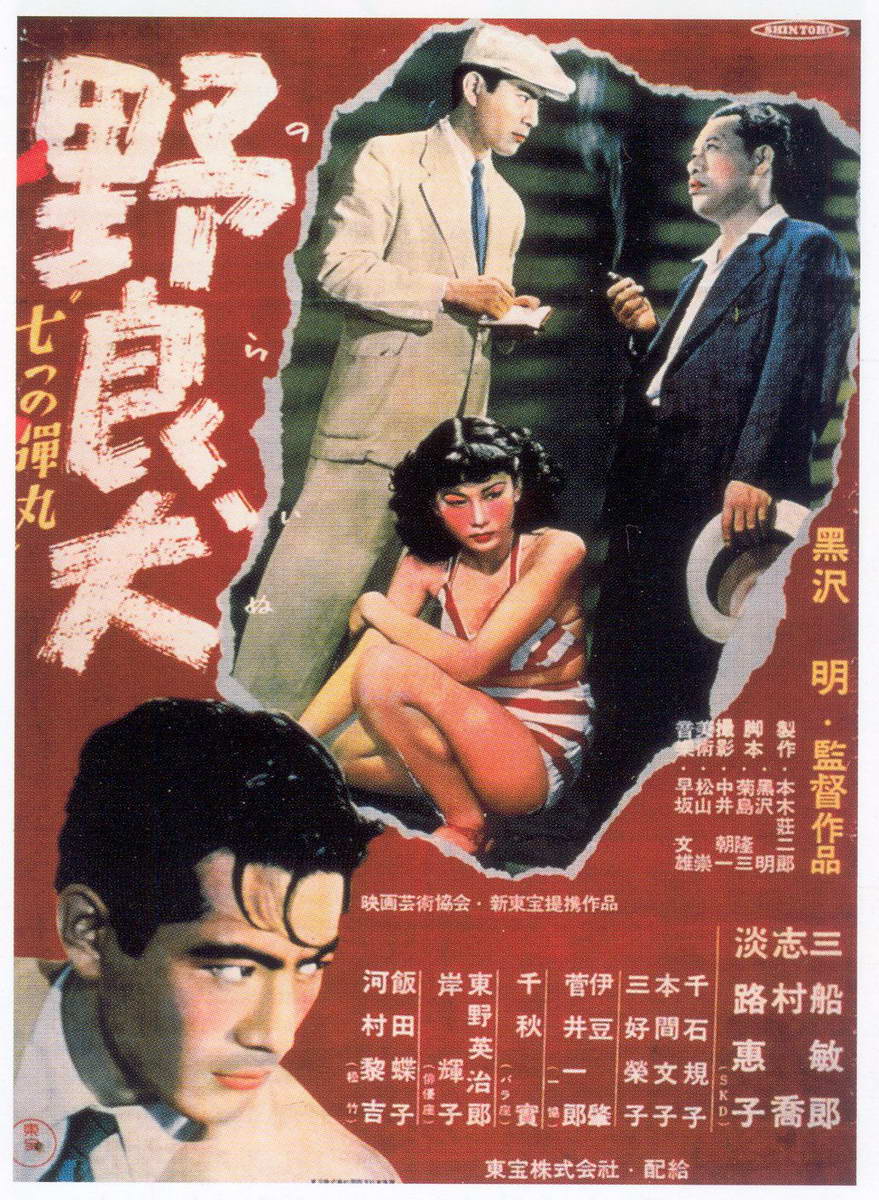
Stray Dog (野良犬, Akira Kurosawa, 1949)

“And, yes, I think the world’s not right. But it’s worse to take it out on the world” the conflicted policeman at the centre of Akira Kurosawa’s Stray Dog (野良犬, Nora Inu) explains as he struggles to reacquire his sense of authority while weighing up its limits and his own right to pass judgement on what is right or wrong or merely illegal. He must ask himself how he can enforce the law while faced with the reality that the man he chases is an echo of himself, the him that took another path amid the chaos, confusion, and despair that followed in the wake of defeat and occupation even as his well-meaning mentor insists that some people are good and others bad and he won’t be able to do his job if he gives it much more thought than that.

The policeman, Murakami (Toshiro Mifune), is perhaps the stray dog of the title who can only follow the straight path towards his missing gun taken from him on a sweltering bus in the middle of summer while he was distracted not only by the heat but by exhaustion having been up all night on a stakeout. As we later discover, Murakami is a rookie cop and recently demobbed soldier trying to make a life for himself in the post-war society. In this he is quite lucky. Many men returned home and struggled to find employment leaving them unable to marry or support families, a whole pack of stray dogs lost in an ever changing landscape. This must have weighed quite heavily on his mind as he made the decision to resign from the police force to take responsibility for the laxity that led to the gun possibly ending up in the wrong hands only to discover his superiors don’t regard it as seriously as he does. His boss tears up the letter and tells him to turn his defeat into something more positive by trying to do something about it, which might in its own way be a metaphor for the new post-war society. 

So closely does Murakami identify himself with his gun that on hearing it has been used in a violent robbery it’s almost as if he has committed the crime and is responsible for anything it might do. There is an essential irony in the fact that this weapon that was supposed to prevent crime is being subverted and used in its service as if mirroring the paths of the two men who both returned to a changed Japan and had their knapsacks stolen on their way back home. Murakami has chosen the law, while the thief Yusa (Isao Kimura) is thrown into nihilistic despair unable to make a life for himself. Murakami’s sense of guilt is further compounded on realising that he may have frustrated Yusa’s attempt to turn back, returning the gun to the underground pistol brokers who make their living through selling illegal weapons stolen from police or bought from occupation forces.

As he admits, Murakami could have ended up committing a robbery but realised he was at a dangerous crossroads and made a deliberate choice to join the police instead. He literally finds himself walking the other man’s path when he’s told by a pickpocket, Ogin (Noriko Sengoku), that the underworld pistol dealers will find him if he walks around downtown looking like he’s at the end of his rope. Ogin, the woman reeking of cheap perfume who stood next to him on the bus, was once known for her fancy kimonos but is now in western dress, signalling perhaps a further decline. In this age of privation, only kimonos and rice have held their value and it’s not unreasonable to assume that she’s sold all of hers and joined the modern generation. Ogin doesn’t have anything to do with the theft, but seems to take pity on Murakami seeing him as naive and essentially unable to understand the way things work on the ground. His mentor, Sato (Takashi Shimura), seems to understand too well, on one level looking down on those like Ogin as simply bad but otherwise happy in her company knowing exactly how to get what he wants through their oddly flirtatious conversation as they suck ice lollies and smoke illicit cigarettes in the interview room. 

Dressed in a ragged military uniform, Murakami wanders around the backstreets of contemporary Tokyo past street kids and sex workers and groups of men just hanging around. Kurosawa employs montage and superimposition to reflect the endless drudgery and maddening circularity his of passage under the stifling heat of summer in the city that allows him a better understanding of what it is to live in this world. Even so, the boy who eventually makes contact seems to see through him pointing out that he looks too physically robust to pass for a desperate drifter. Yusa meanwhile is wiry and hollow, a frightened man who uses Murakami’s gun to affect an authority he does not own which might explain why both of his victims are women. Sato emphasises the worthiness of their victimhood, explaining that the first was robbed of the money she’d saved over three years for her wedding meaning she might have to wait even longer at which point there would be no point getting married at all, while the second woman was killed at home alone and defenceless. We’re also told that her body was nude when discovered which raises the question of whether she might have been assaulted before she died which would cast quite a different light on Yusa’s crimes no longer an accidental killer but a crazed rapist well beyond salvation. 

Yet the accidental nature of Yusa’s fall does seem to be key. The trigger seems to have been a childhood friend he’d fallen in love with gazing at a dress he could never afford to buy for her, pushed into a corner by his wounded masculinity and taking drastic action to reclaim it in much the same way Murakami later does in searching for his missing gun. In their final confrontation they grapple violently in existential struggle in a small grove behind some posh houses where a woman plays a charming parlour tune on the piano pausing only for a few moments to peer out of the window on hearing gunshots. Murakami retrieves his gun and the pair fall to the ground side by side to be met by the sound of children singing, provoking a wail of absolute despair from a defeated Yusa suddenly hit by the full weight of his transgressions. He too was a stray dog heading straight in one direction driven out of mainstream society by the unfairness of the post-war world. Sato tells Murakami that he’ll eventually forget all about Yusa, that he’ll become “less sentimental” and accept the world is full of bad guys and those who fall victim to them, but Murakami doesn’t seem too convinced, for the moment at least unable to forget that Yusa was man much like himself only less lucky or perhaps simply less naive.


Stray Dog screens at the BFI Southbank, London on 1st & 13th February 2023 as part of the Kurosawa season.

One Wonderful Sunday (素晴らしき日曜日, Akira Kurosawa, 1947)

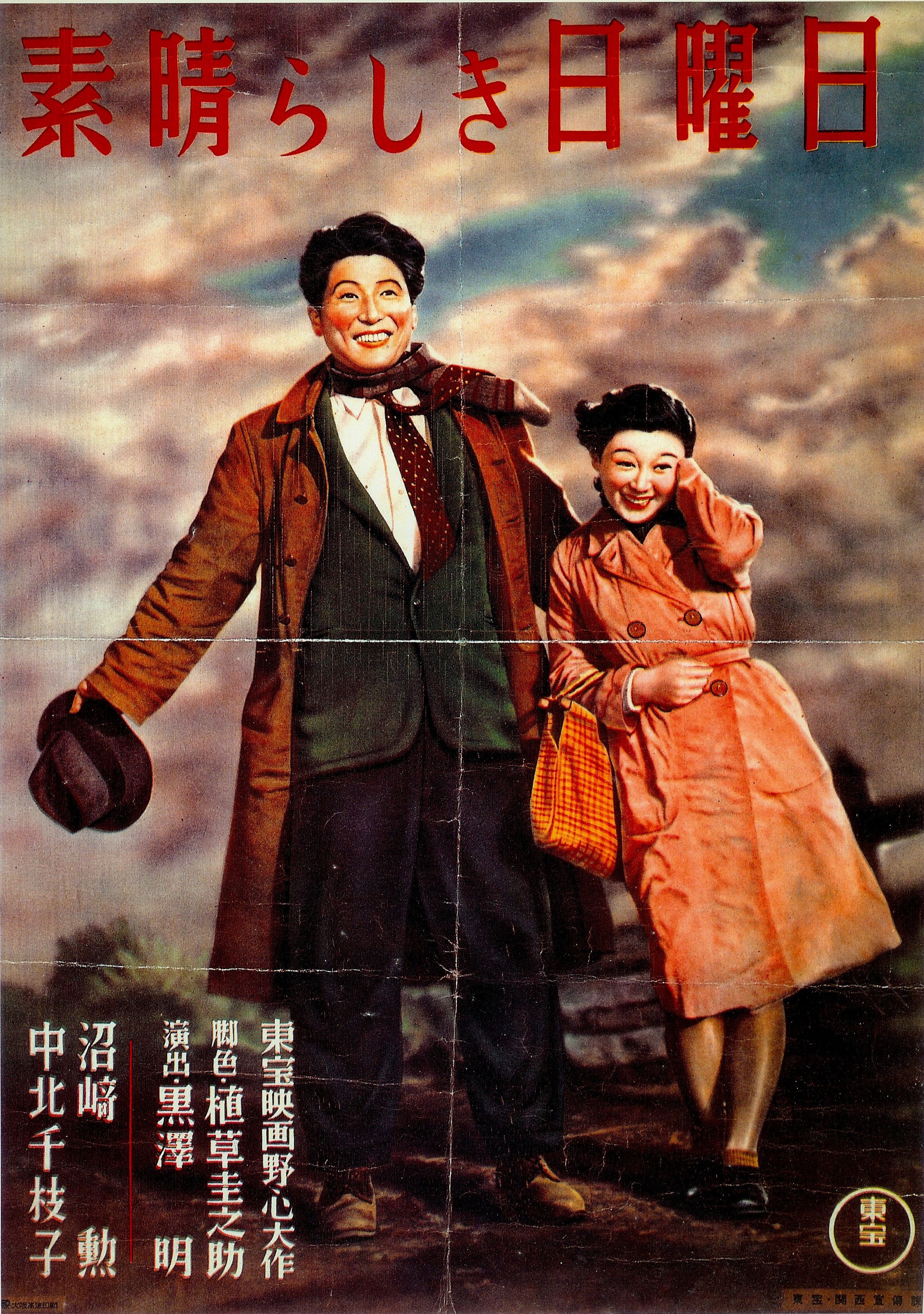
A young couple attempt to have a nice day out in Tokyo for only 35 yen but eventually discover something much more valuable in Akira Kurosawa’s surprisingly upbeat voyage through the backstreets of the post-war city, One Wonderful Sunday (素晴らしき日曜日, Subarashiki Nichiyobi). Though it may begin with frustration and progress to abject despair, the film allows its dejected heroes to find renewed hope for the future in the ashes of their defeat if only through the power of make-believe. 

Yuzo (Isao Numasaki) and Masako (Chieko Nakakita) are a young(ish) couple who’ve been together since before the war but are unable to marry because their precarious financial situation prevents them from finding a home in which they can live together. Though they are each in full employment, Masako currently lives with her sister and Yuzo with a friend. They can only spend Sundays together, but this particular Sunday Yuzo is fulled with frustration and resentment. He has only 15 yen, not much of a date as he tells Masako with irritation explaining that she’s had a wasted journey. She reveals that she has 20, but Yuzo has his male pride and is reluctant to take “a woman’s money” while internally humiliated not to be able to take her out on the town. Just before she had arrived, Yuzo had stared at an abandoned cigarette butt on the pavement. His desire soon overcame his shame. He picked it up and smoked it, only for Masako to bat it out of his hand as if insisting that he’s better than that. 

For her part, Masako is defiantly upbeat. Perhaps she’s putting on a brave face for Yuzo, but does her best to buoy his spirits so they can have a nice day together. It may be her only nice day all week. While she looks forward, he cannot move beyond the dissatisfying present. Masako begins by suggesting they check out a show home advertised on a billboard as a new kind of residence which is cheaper to build and available for only 100,000 yen for the first 100 buyers. She imagines how their life might be together in this space, while Yuzo merely sulks in the corner and points out the shoddiness of the build amid declining modern standards. It’s advertised as affordable, but they can’t afford it. Meanwhile, another man wanders in with a woman who is clearly his mistress. She exclaims that the place is a dump, “I hate matchbox houses”, while he agrees that it’s cheap for a reason and you get what you pay for. Presumably he already owns a home where his wife and family live and is about to drop a small fortune on a discreet love nest while his mistress, not unreasonably, attempts to haggle her way up to something a bit more fancy. Yuzo knows he won’t ever be able to afford even this “inexpensive” home that a wealthy man disdains as not worthy of his bit on the side. They’ve just come from seeing a crummy flat a few streets away which Masako asks directions to only to be put off by the doorman who warns them that the flat isn’t even really habitable and the landlord is heartless but they couldn’t afford that either even on the assumption they would both keep working (which depending on Masako’s job might not possible once she marries).

The landscape around them is in ruins. Yuzo and Masako wander through a bombed out city not yet ready for reconstruction looking for somewhere to stay out of the cold without eating into their 35 yen. He wants to give up and go home, but she convinces him to attend a concert of the music they heard on their first date before the war only when they get there all the cheaper tickets have been bought up by touts who sell them on at 50% markup. Beaten up for challenging the touts’ uncompromising cynicism, Yuzo hits rock bottom returning to his flat in a rundown tenement where a woman mopping the corridor gives Masako serious side eye. Frustrated, he tries to pressure her into premarital sex, her rock bottom coming a few minutes later when she firstly leaves in outrage and then returns as if admitting that their situation will never improve. 

“The war destroyed that dream” Yuzo had said of Masako’s attempt to rekindle his hopes for the future in the plan they made to open a cafe together after they married, but the reality of their mutual defeat finally seems to inspire defiance in the face of the world’s hostility. On their journey through the city, they’d encountered a ragged street kid who thought them fools after they refused his offer of ten yen for one of their rice balls and simply gave it to him out of human kindness. Yuzo felt himself a fool after trying to visit an old friend who’s done well for himself with a swanky cabaret bar only to be rebuffed and see his own image reflected in a mirror with his threadbare overcoat and battered hat juxtaposed with the image of a fine young couple eyeing him with disdain and suspicion. In the end Masako can only appeal to us, breaking the fourth wall in a moment reminiscent of Peter Pan asking us to clap if we believe in fairies as she tries to revive Yuzo’s sense of naive possibility to conduct an unfinished symphony of their imagined life together in a happier future of post-war Japan. Refusing to give in to their baser instincts, to become cynical and selfish or else simply to give up, this wonderful Sunday does seem to have given them a childish sense of hope that better days are on their way and until then there’s always next week. 


One Wonderful Sunday screens at the BFI Southbank, London on 3rd & 15th January 2023 as part of the Kurosawa season.

The Most Beautiful (一番美しく, Akira Kurosawa, 1944)

“One can’t improve productivity without improving one’s character” the manager of a factory crafting lenses for the military repeatedly insists, though by “character” he largely seems to mean a total erasure of the self in favour of service to the state. Kurosawa’s second feature is a National Policy Film intended to foster a spirit of patriotic fervour in which not only the factory girls at its centre but everyone else too must “become an outstanding human being” forgoing all human feeling to ensure Japan will win a war even the film seems to concede is already lost. 

Indeed, even for a relatively late propaganda film, The Most Beautiful (一番美しく, Ichiban Utsukushiku) makes little attempt to gloss over the undercurrent of defeat. At one point names of foreign territories fallen to the Americans briefly flash up on the screen leaving the girls looking increasingly bereft if resolving to work even harder. Then again even in the opening which sees all the workers lined up in military fashion it’s obvious that the factory is staffed by those who have not been deployed to more pressing duties, overwhelmingly teenage girls along with boys too young for the army, old men and those otherwise unable to serve in the military. 

Even so the atmosphere among the young women is often cheerful though the film is keen to show them overcoming their loneliness while bowing to photos of their far off parents, often farmers, in distant parts of Japan. They are looked after by a kind of nurse/chaperone, Mrs Mizushima (Takako Irie) whose husband has already been killed in the war marking her out as an example of the self-sacrifice that is being asked of the girls. Many of them have come of their own volition expressly to support the war effort and take their work incredibly seriously especially as the factory manager reminds them that the lenses they make are crucial to to production of military instrumentation and without them there would be no fighter planes or sniper rifles. 

So self-sacrificing are they that the girls go into huff when it’s announced that the factory will be entering a period of increased productivity (another thinly veiled hint that the war is not going well), yet they are upset not because they resent being asked to work harder, nor by the implication that they have more to give than they have been giving, but by the fact they’ve been underestimated having had their quotas increased by only 50% as opposed to the men’s 100%. Their leader, Watanabe (Yoko Yaguchi), explains that, though they know they cannot match the men, they are sure they can do better and will produce at least 2/3 more rather than just half. The managers seem to think that this is naive, but are wary of talking the girls down in fear of damaging their morale which they see as the most crucial thing when it comes to generating “productivity”. Yet that notion of “morale” is mostly a kind of internecine peer pressure brokered by petty competition and a desire not to be the one who lets everyone else down. Hence the girls continue working while they’re sick, which is no good at all for productivity if all they do is spread it around while unable to work at full capacity, afraid to tell anyone in case they get sent home to recover. 

Watanabe is tempted to to take a trip to see her family after receiving a letter from her father to say that her mother has been taken ill, though her parents are also fiercely patriotic and insist that she should not leave but stay and do her duty. She is guilted out of her temptation by another girl, Yamaguchi (Shizuko Yamaguchi), who is sickly by nature but has been hiding her suffering in order to be allowed to stay. Being out of the line fosters feelings of guilt and failure, not only in having let the country down but in increasing the burden on their friends who will now have to work harder in their stead. The “character” that they are supposed to be building, is in the end only in service of their “productivity” that they work to the point of collapse with no thought for themselves or their feelings wilfully sacrificing the opportunity to see dying relatives to prove their dedication. 

In what now might seem like subversive touches but just as well may have been sincere, Kurosawa often flashes signs and slogans which appear in the factory including one urging the girls to “follow the example of the war dead” suggesting that the only real way to prove your devotion is to die in the service of the emperor. On the other hand, the girls don’t actually seem to do a lot of factory work but are otherwise expected to participate in band practice banging out military marches on the drum or else improving their physicality through playing volleyball. In any case as they begin wear themselves out tempers begin to fray leaving the girls at odds, tired and resentful if not actively hopeless in beginning to realise they probably won’t make their overly ambitious quota as a tacit acceptance that Japan most likely is not going to win the war and all their efforts are for nothing. At the film’s conclusion, Mrs Mizushima exclaims that Watanabe has become “such a good girl”, ironically forced to abandon the directly filial for the national in prioritising her role as an imperial daughter rather than a biological one. Even so, the film discovers a much more comfortable sense of solidarity between the young women even if brokered by militarist fervour and a nihilistic bid for self-destruction in perpetual servitude. 


The Most Beautiful screens at the BFI Southbank, London on 1st & 9th January 2023 as part of the Kurosawa season.