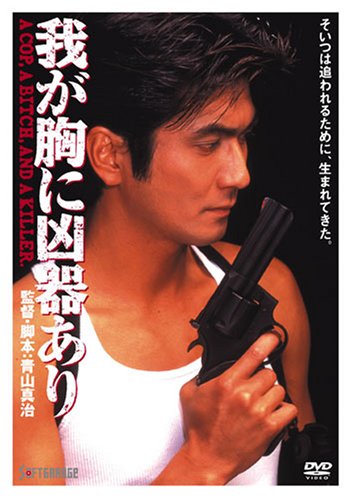
 Shinji Aoyama would produce one of the most important Japanese films of the early 21st century in Eureka, but like many directors of his generation he came of age during the V-cinema boom. This relatively short lived medium was the new no holds barred arena for fledgling filmmakers who could adhere to a strict budget and shooting schedule but were also aching to spread their wings. After a short period as an AD with fellow V-cinema director now turned international auteur Kiyoshi Kurosawa, Aoyama directed his first straight to video effort – the sex comedy It’s Not in the Textbook!. Released just after his theatrical debut, Helpless, A Weapon in My Heart (我が胸に凶器あり, Waga Mune ni Kyoki Ari, AKA A Cop, A Bitch, and a Killer) is a more typically genre orientated effort with its cops, robbers, and femme fatale setup but like the best examples of the V-cinema trend it bears the signature of its ambitious director making the most of its humble origins.
Call girl Alice has ripped off her gangster bosses for a large amount of heroine only her accomplice has got cold feet and called a relative in the police force. The kid gets shot as officers Goro and his partner Yoshioka wade in all guns blazing but Alice calmly allows herself to be taken into custody. Yoshioka is a strangely cheerful chap who informs Alice that he has a game running where he gives suspects odds to bet on their likelihood of escape. Hers are brilliant because there is no way she is getting away. However, the trio are ambushed by crazy gangster Matsumura and his gang forcing Goro and Alice onto the run. In addition to avoiding Matsumura and his dastardly schemes, Goro and Alice are also being stalked by a mysterious hitman, Hoshi, who claims to be “watching from up above” and has his own motives for his bizarrely heroic hunting style.
This being a V-cinema effort, the production values are low, shot in widescreen but on the kind of cheap video cameras common to the V-cinema movement. Nevertheless, Aoyama makes the most of what he has to create a stylish genre throwback which recalls the Nikkatsu action films of years gone by only a little less madcap even if leaning towards the surreal. Told in a non-linear fashion, exposition is delivered largely through flashbacks but each of these is innovatively offered such as in a touching scene in which Goro remembers a conversation with Yoshioka in which only the lighting darkens to let us know that the happy memory has ended and the melancholy present has resumed. Similar techniques mark Alice’s frequent flashbacks to her traumatic crime, though in line with their much more pressing nature Alice’s memories are given harsher, more abrupt entrances and exits, lacerating the screen as they do her mind.
The genre elements may be familiar enough but Aoyama ensures each of the major players is fully drawn despite the necessarily tight running time. Good cop Goro is arguably the least explored but it’s antagonist Hoshi who leaves the biggest mark. A joke that’s somewhat lost in translation runs on the fact that “Hoshi” means star which lends an oddly comic dimension to his frequently uttered catch phrase in which he promises to be watching “from up above”. Having once abandoned the killing game, Hoshi has found himself forced back into the life in order to earn the money to pay for an operation to restore the sight of his blinded son – something he feels karmically responsible for. Frequently letting our heroes go out of a debt of honour, Hoshi nevertheless has his mission to complete, no matter how much it might offend him to do so.
Our policemen also seem to operate from a mysterious antique shop where they keep the records for their escape based betting games. Add in weird dirt bike riders, mysterious statues, and strange phone calls not to mention a horror movie inspired sequence where our two heroes are trapped in a shed while the enemy looms large in a thunderstorm outside and there are plenty of interesting quirks to be going on with. Deaths are dramatic, slow motion falls and set pieces become remarkably elaborate but there’s also a sort of childish innocence as a fearsome killer tries and fails to unwrap one of his beloved boiled sweets even as he dies. Very much part of the fast and loose V-cinema universe, A Weapon in My Heart is also pure Aoyama, filled with strange details and surrealist touches but ultimately imbued with his own strange brand of humanity.
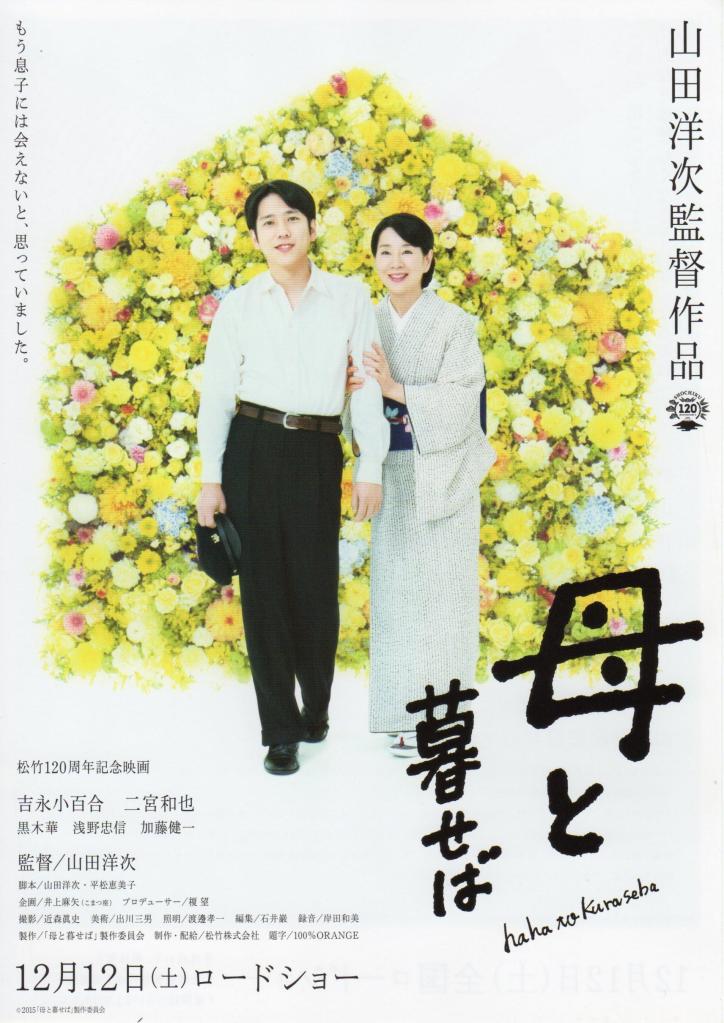 After such a long and successful career, Yoji Yamada has perhaps earned the right to a little retrospection. Offering a smattering of cinematic throwbacks in homages to both Yasujiro Ozu and Kon Ichikawa, Yamada then turned his attention to the years of militarism and warfare in the tales of a struggling mother,
 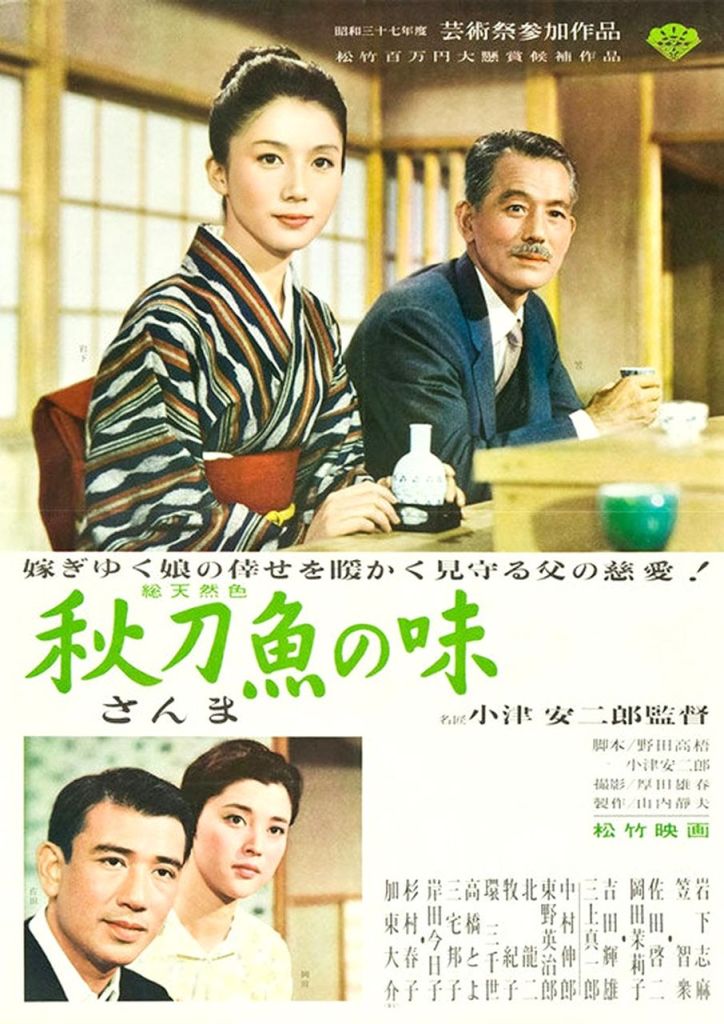 An Autumn Afternoon (秋刀魚の味, Sanma no Aji) was to be Ozu’s final work. This was however more by accident than design – despite serious illness Ozu intended to continue working and had even left a few notes relating to a follow up project which was destined never to be completed. Even if not exactly intended to become the final point of a thirty-five year career, An Autumn Afternoon is an apt place to end, neatly revisiting the director’s key concerns and starring some of his most frequent collaborators.
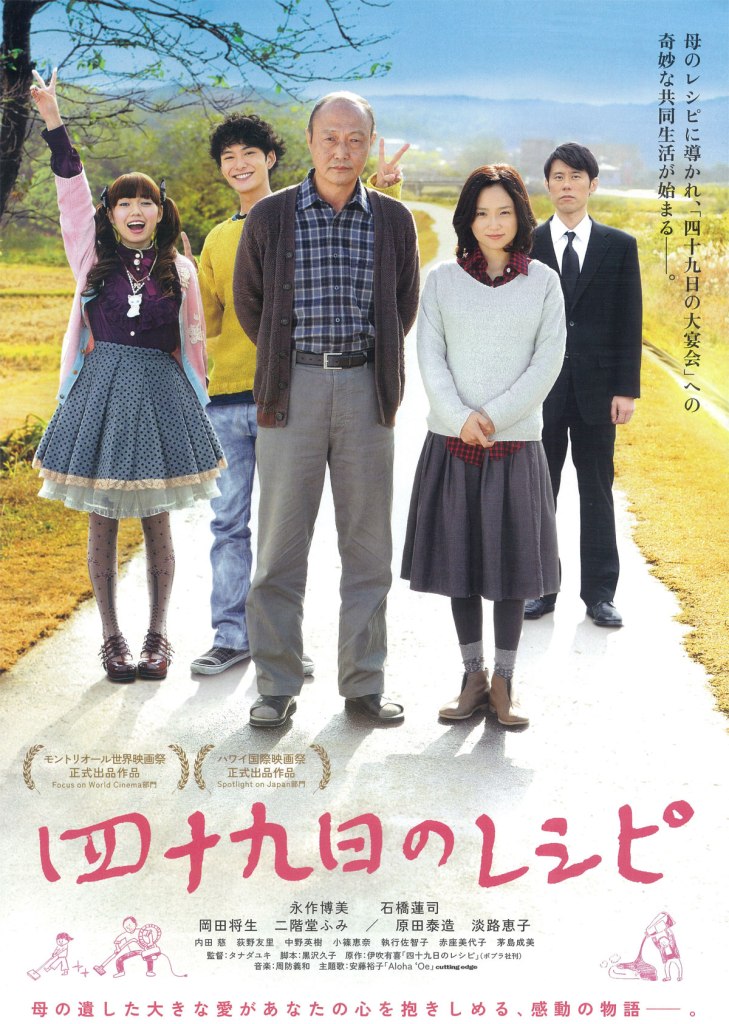 When everything goes wrong you go home, but Yuriko, the protagonist of Yuki Tanada’s adaptation of Yuki Ibuki’s novel might feel justified in wondering if she’s made a series of huge mistakes considering the strange situation she now finds herself in. Far from the schmaltzy cooking movie the title might suggest, Mourning Recipe (四十九日のレシピ, Shijuukunichi no Recipe) is a trail of breadcrumbs left by the recently deceased family matriarch, still thinking of others before herself as she tries to help everyone move on after she is no longer there to guide them. Approaching the often difficult circumstances with her characteristic warmth and compassion, Tanada takes what could have become a trite treatise on the healing power of grief into a nuanced character study as each of the left behind now has to seek their own path in deciding how to live the rest of their lives.
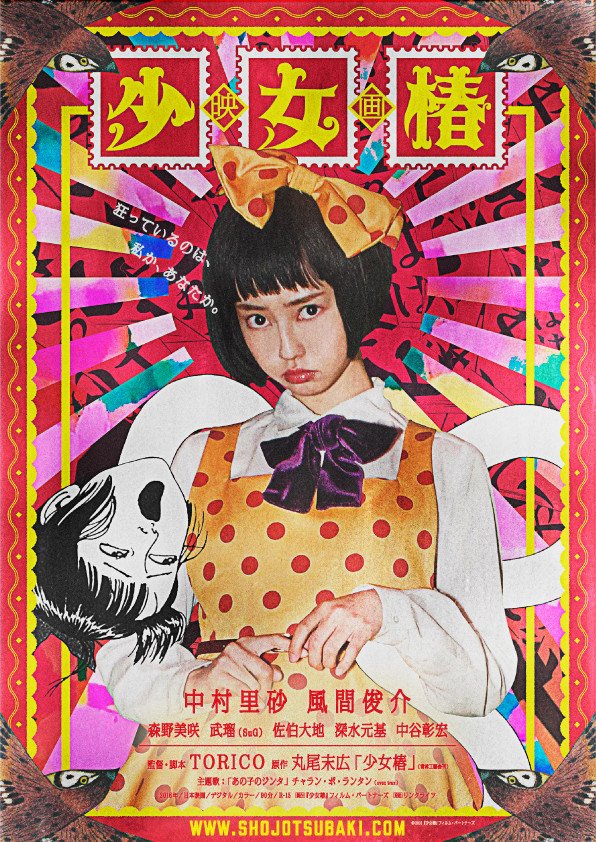 Picking up on the well entrenched penny dreadful trope of the tragic flower seller the Shoujo Tsubaki or “Camellia Girl” became a stock character in the early Showa era rival of the Kamishibai street theatre movement. Like her European equivalent, the Shoujo Tsubaki was typically a lower class innocent who finds herself first thrown into the degrading profession of selling flowers on the street and then cast down even further by being sold to a travelling freakshow revue. This particular version of the story is best known thanks to the infamous 1984 ero-guro manga by Suehiro Maruo, Mr. Arashi’s Amazing Freak Show. Very definitely living up to its name, Maruo’s manga is beautifully drawn evocation of its 1930s counterculture genesis – something which the creator of the book’s anime adaptation took to heart when screening his indie animation. Midori, an indie animation project by Hiroshi Harada, was screened only as part of a wider avant-garde event encompassing a freak show circus and cabaret revue worthy of any ‘30s underground scene.
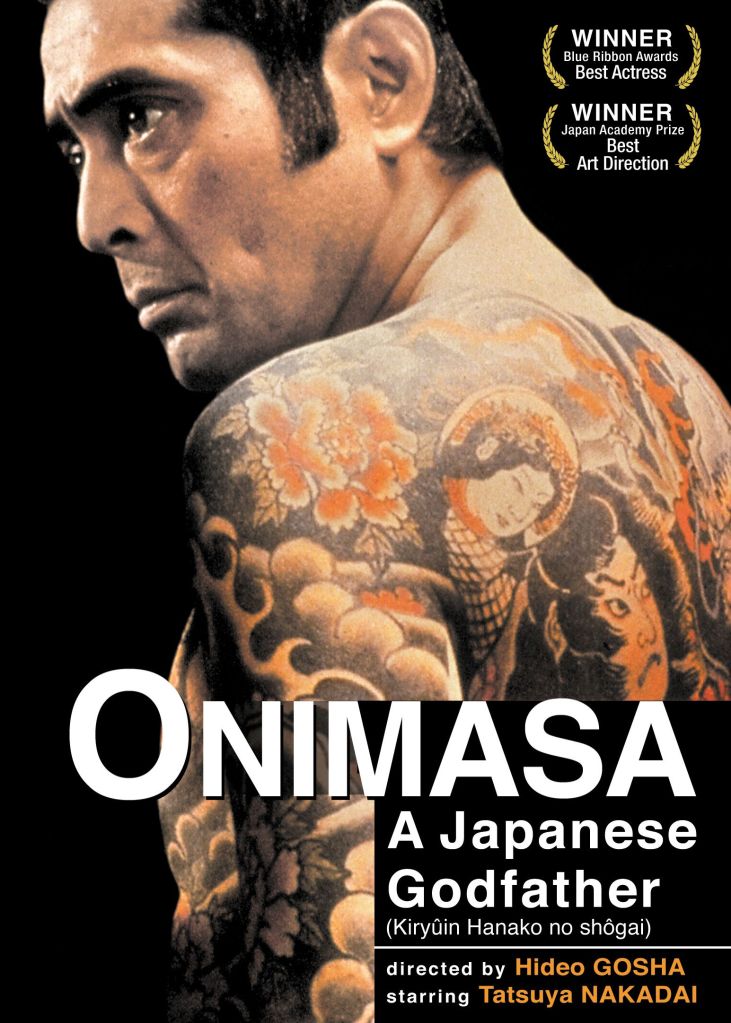 When AnimEigo decided to release Hideo Gosha’s Taisho/Showa era yakuza epic Onimasa (鬼龍院花子の生涯, Kiryuin Hanako no Shogai), they opted to give it a marketable but ill advised tagline – A Japanese Godfather. Misleading and problematic as this is, the Japanese title Kiryuin Hanako no Shogai also has its own mysterious quality in that it means “The Life of Hanako Kiryuin” even though this, admittedly hugely important, character barely appears in the film. We follow instead her adopted older sister, Matsue (Masako Natsume), and her complicated relationship with our title character, Onimasa, a gang boss who doesn’t see himself as a yakuza but as a chivalrous man whose heart and duty often become incompatible. Reteaming with frequent star Tatsuya Nakadai, director Hideo Gosha gives up the fight a little, showing us how sad the “manly way” can be on one who finds himself outplayed by his times. Here, anticipating Gosha’s subsequent direction, it’s the women who survive – in large part because they have to, by virtue of being the only ones to see where they’re headed and act accordingly.
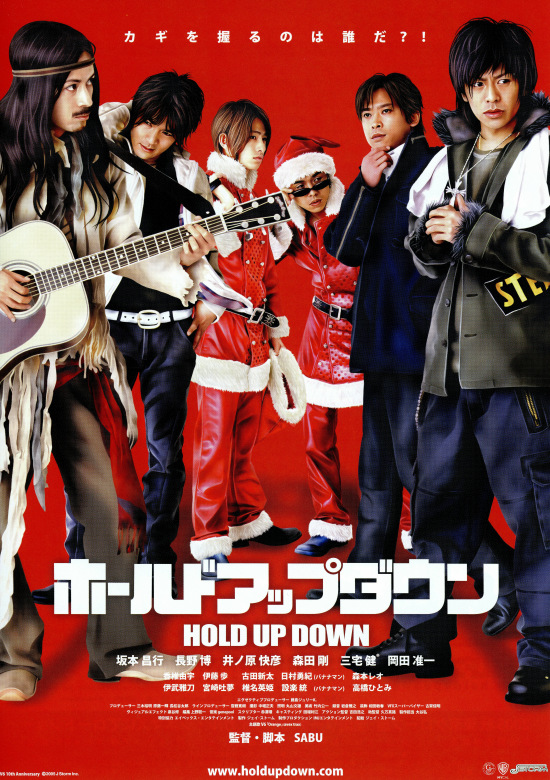 Reteaming with popular boy band V6, SABU returns with another madcap caper in the form of surreal farce Hold Up Down (ホールドアップダウン). Holding up is, as usual, not on SABU’s roadmap as he proceeds at a necessarily brisk pace, weaving these disparate plot strands into their inevitable climax. Perhaps a little shallower than the director’s other similarly themed offerings, Hold Up Down mixes everything from reverse Father Christmasing gone wrong, to gun obsessed policemen, train obsessed policewomen, clumsy defrocked priests carrying the cross of frozen Jesus, and a Shining-esque hotel filled with creepy ghosts. Quite a lot to be going on with but if SABU has proved anything it’s that he’s very adept at juggling.
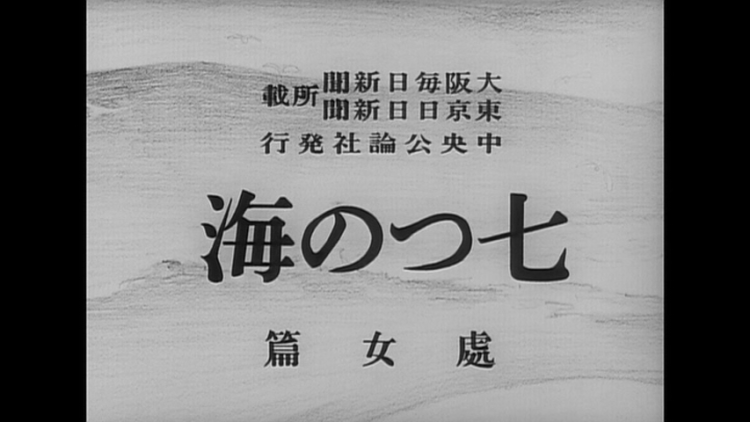 Hiroshi Shimizu is best remembered for his socially conscious, nuanced character pieces often featuring sympathetic portraits of childhood or the suffering of those who find themselves at the mercy of society’s various prejudices. Nevertheless, as a young director at Shochiku, he too had to cut his teeth on a number of program pictures and this two part novel adaptation is among his earliest. Set in a broadly upper middle class milieu, Seven Seas (七つの海, Nanatsu no Umi) is, perhaps, closer to his real life than many of his subsequent efforts but notably makes class itself a matter for discussion as its wealthy elites wield their privilege like a weapon.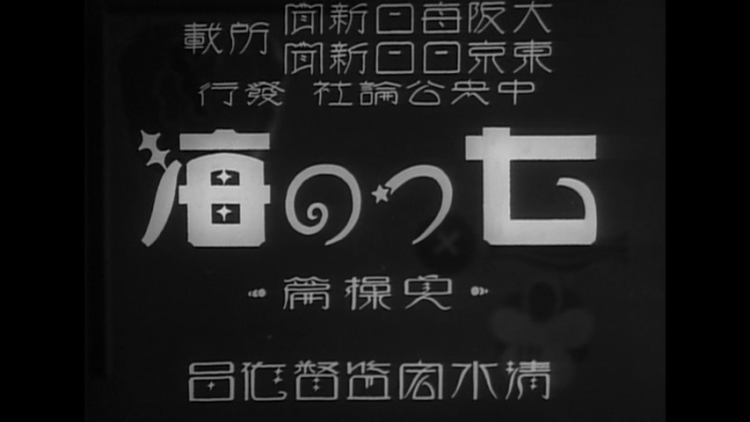
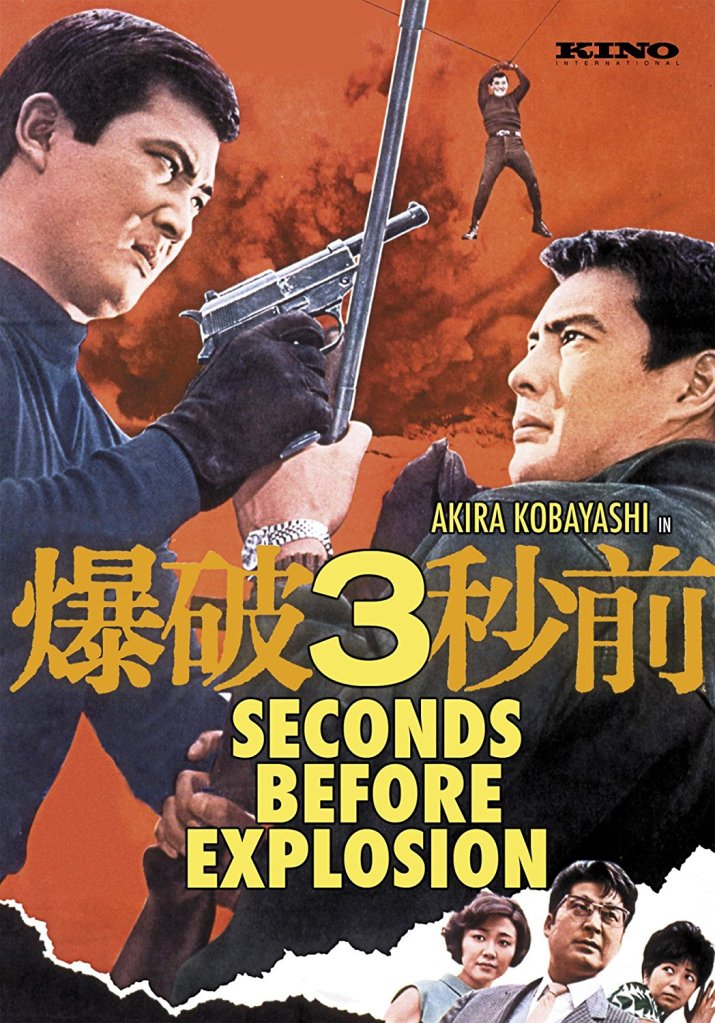 If Nikkatsu Action movies had a ringtone it would probably just be “BANG!” but nevertheless you’ll have to wait more than three rings for the Kaboom! in the admittedly cartoonish slice of typically frivolous B-movie thrills that is 3 Seconds Before Explosion (爆破3秒前, Bakuha 3-byo Mae). Once again based on a novel by Japan’s master of the hard boiled Haruhiko Oyabu, 3 Seconds Before Explosion is among his sillier works though lesser known director Motomu Ida never takes as much delight in making mischief as his studio mate Seijun Suzuki. What he does do is make use of Diamond Guy Akira Kobayashi’s boyish earnestness to keep things running along nicely even if he’s out of the picture for much of the action.
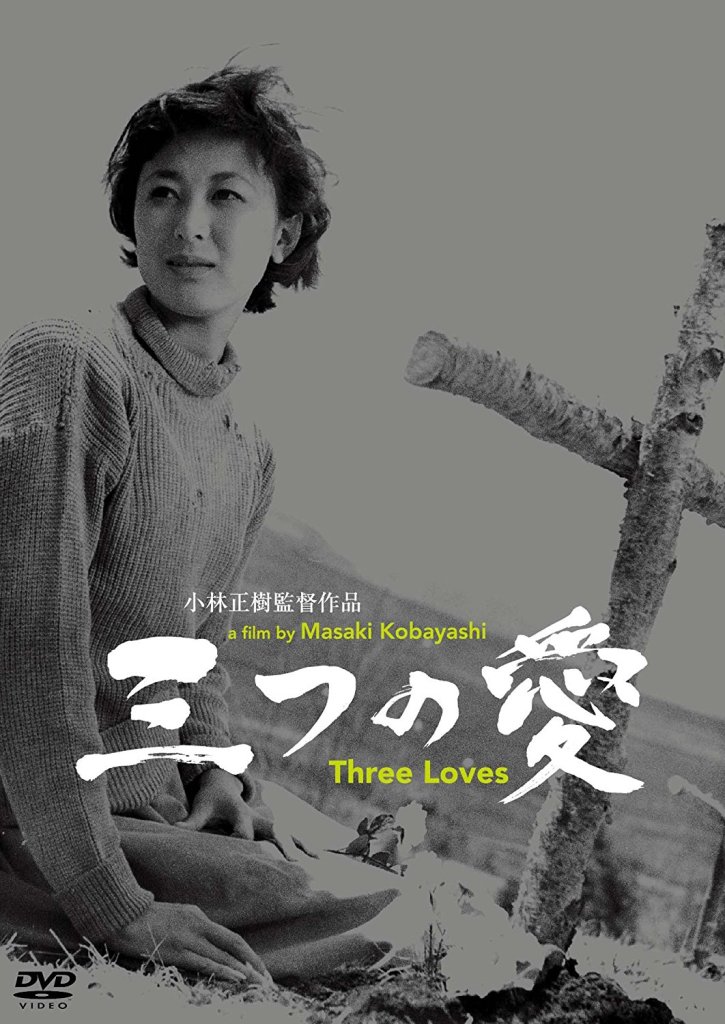 Masaki Kobayashi had a relatively short career of only 22 films. Politically uncompromising and displaying an unflinching eye towards Japan’s recent history, his work was not always welcomed by studio bosses (or, at times, audiences). Beginning his post-war career as an assistant to Keisuke Kinoshita, Kobayashi’s first few films are perhaps closer to the veteran director’s trademark melodrama but in 1953 Kobayashi struck out with a more personal project in the form of
  Windows on Worlds