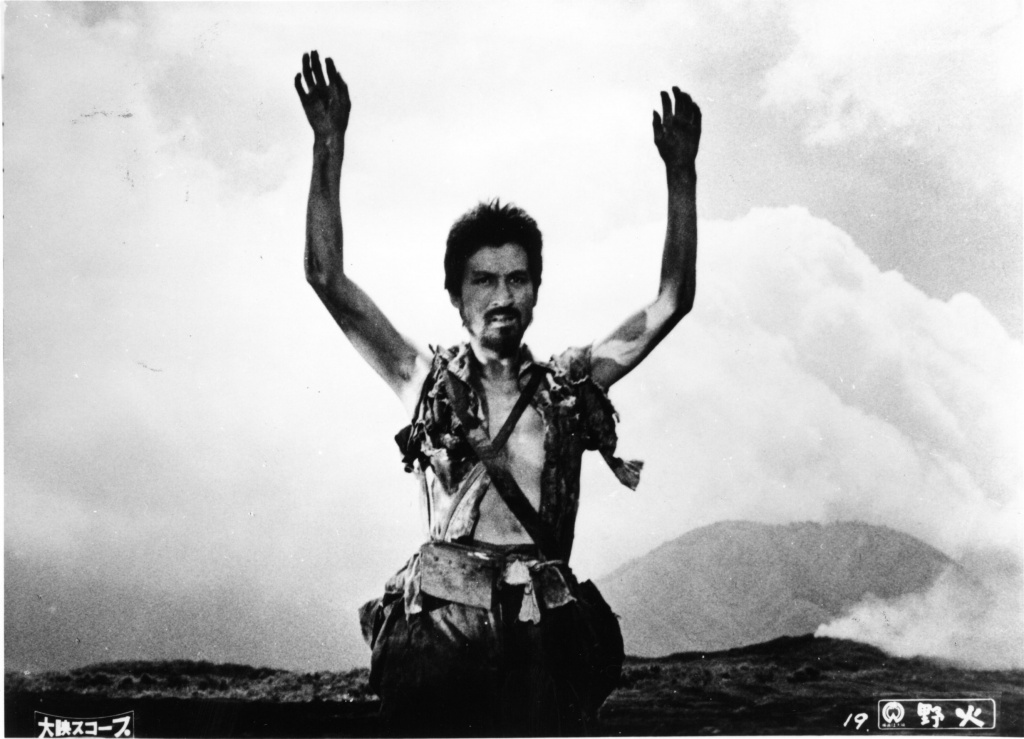
Nobi: Fires on the Plain (野火, Kon Ichikawa, 1959)

86485840228b9d174ae44b6a189f8c0bIt’s a fallacy to think Japan doesn’t make war films. Or perhaps, more that they didn’t make them until the recent swing to the right in Japanese politics seems to have made it OK to make Hollywood style war movies. Up until the sixties, Japanese cinema was willing and able to engage with the darkness of the recent past and several wonderful films such as Kobayashi’s The Human Condition (Ningen no Jouken 人間の条件) or Okamoto’s The Human Bullet (Nikudan 肉弾) not to mention Ichikawa’s own The Burmese Harp (Biruma no Tategotoビルマの竪琴) presented the still fresh sorrow and regret associated with Imperialist ’30s onwards. None of them, however, come close to the hellish world of Fires on the Plain (Nobi 野火).

Based on Shohei Ooka’s novel of the same name, Fires on the Plain begins with the beleaguered conscript Tamura (Funakoshi Eiji) being berated (at length) by his commanding officer for returning from the field hospital earlier than expected. Despite having been given five days food, Tamura has returned after just three days because the hospital refused to admit him. Sick with TB, Tamura is told the hospital feels its duty is to the battlefield wounded – not those who’ve been unlucky enough to catch a debilitating and often terminal condition. Of course, his CO doesn’t want him back either – with only so many resources left and staring defeat in the face, why waste food and effort on a man who can’t pull his weight and is probably going to die anyway. And so, Tamura is sent back to the field hospital with no additional food and instructed to wait there until they let him in or alternatively, there’s your grenade – isn’t there? Do the decent thing. Thus begins Tamura’s bleak odyssey into the depths of human depravity, trying desperately to survive in the unforgiving Philippine jungle.

Legend has it that Funakoshi was so dedicated to the part that in true method fashion he’d been living on a starvation diet prior to the film’s starting and in fact actually caused it to be halted almost immediately when he collapsed from severe malnutrition. That might in part explain his miraculous performance with vacant, staring eyes like someone whose soul has gone somewhere far away. His halting and confused speech, understanding and not understanding, desperate to survive but terrified of what he might become – Tamura has no choice but to keep on walking, trying to find something to cling on to. Everybody knows the war is lost, yet there’s nothing they can do but keep on fighting. Tamura even considers the unthinkable – surrender, but another soldier beats him to it and is promptly mown down by a machine gun wielded by a Filipina resistance fighter working with the Americans. The most pressing problem is the lack of food. There is very little to live on left on the island which has been well and truly wrecked by every side. You can steal food from the indigenous people (if you can find any) or there’s ‘monkey meat’. The great taboo – cannibalism. Ultimately Tamura decides sometimes the price for survival is just too high if you won’t be able to live with what you’ve done.

In the west, particularly in the US, the film was criticised for its ‘sympathetic’ portrayal of Japanese soldiers – that it was another instance of Japan ‘playing the victim’ which was a common American reaction to the more contemplative war films of Post War Japan. It is true, the films glosses over the immediate situation of the Japanese occupied Philippines though the film largely takes with the Japanese on the run from American troops and the Philippine resistance. The fact there have been atrocities is never directly addressed though it hangs in the background like a grim, guilty spectre. It might explain why Tamura’s early meeting with a pair of villagers who’ve made a stealthy visit to their abandoned home to retrieve a parcel of salt buried under the floor becomes so fraught. In the first instance, Tamura was foolish to enter the house and approach them – even his disordered mind he must have known it was very unlikely they’d react kindly to his presence. If he just wanted to know what was buried under the floorboards, he had only to fire a warning shot and scare them off before they could dig it up and then retrieve it himself. When he does show himself the male villager runs off but the female is so scared she can barely move and can’t stop screaming. Tamura shoots her and takes the salt for himself. Disgusted with his actions he throws his rifle into the nearest pond. That isn’t to say the film lets Tamura, or indeed the other men or the whole Japanese war machine, off the hook. Only that they’ve become this way because of what war reduces you to – less than animals, surviving by any means even if that means betraying your fellow men.

Fires on the Plain was adapted from Shohei Ooka’s novel of the same name by Ichikawa and his screen writing wife Wada Natto who, while keeping broadly to the tone and spirit of the book, made several changes. The most obvious being to the structure of the novel which has more of a framing sequence, an unreliable first person narrator and a complicated structure. In the novel Tamura, a fictionalised version of the author, is a Christian and the book is written with a Christian view of the world rather than the traditionally Japanese viewpoint common to the majority of soldiers. Therefore, Ichikawa decided to remove the Christian themes from the film in order to present Tamura as more of an everyman though the Tamura of the book is presented much more ambiguously. This also explains the changes to the film’s ending which is bleaker and less forgiving that than that of the novel.

One of the most horrifying depictions of war ever put on screen, Fires on the Plain lays bare the true horror of warfare. Trapped in a sort of purgatory, forced to wander the jungle waiting for the inevitable yet desperately clinging on to life, Tamura’s story can’t be described as anything less than hellish. Wading past corpses, mud, blood and those who’ve already gone mad – this is humanity at its lowest point. Even if you meet another soldier, they can’t be trusted – it’s every man for himself. Ichikawa’s world is bleak beyond belief with no hope in sight, the only possibility of salvation lying in the large fires that appear at distant points along plains. Everyone assumes them to be a signal of some kind but nobody knows what they mean or for whom they are intended. A descent into hell, Ichikawa’s Fires on the Plain is one of the most realistic and most powerful anti-war films in cinema history.

Fires on the Plain is unavailable in the UK but is available in the US from the Criterion Collection. Shohei Ooka’s book is likewise unpublished in the UK but is available in English in its original 1957 translation by Ivan Morris currently in print from Tuttle in the US though it should be noted that Morris’ translation is itself heavily edited. 
 

Wings of the Kirin 麒麟の翼

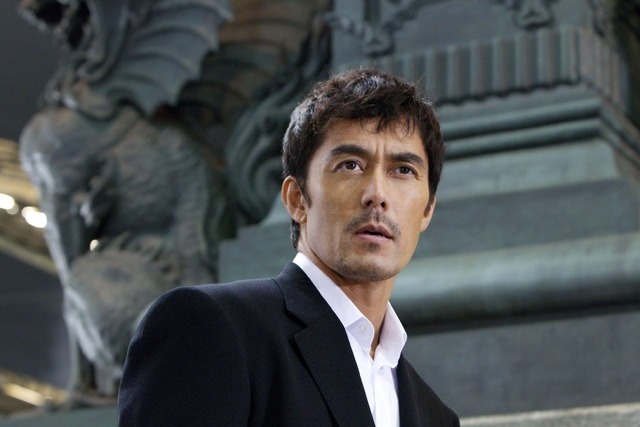
Wings_of_the_Kirin-002Based on the novel by Keigo Higashino (The Devotion of Suspect X), Wings of the Kirin is the latest big screen outing for Higashino’s famous detective Kaga. Previously played on TV by Hiroshi Abe who reprises his role as the much loved sleuth here, this latest instalment sees Kaga’s particular expertise put to use in the case of a salary man who appears to have staggered some distance from the subway tunnel where he was stabbed only to die right under the famous Kirin statue on Nihonbashi Bridge. Around the same time, a younger man calls his girlfriend to tell her he’s in ‘big trouble’ before being chased out into the road by police, whereupon he’s suddenly mown down by an oncoming truck. As this man had the salaryman’s briefcase the case seems open and shut – a mugging gone tragically wrong leading to the death of both perpetrator and victim. Kaga though feels differently and as always, the case is not quite as straightforward as the authorities would like to believe.

As with many of Higashino’s stories, the mystery itself is almost a macguffin as Higashino is more interested in investigating human behaviour and psychology with half an eye on traditional morality. Wings of the Kirin is no different in this respect as it has a heavy interest in the relationship between fathers and sons and the importance of taking personal responsibility for your own transgressions. However, that isn’t to downplay the mystery element as Higashino once again proves himself a master at wrong footing the audience. Many viewers may feel they have a pretty solid idea of who did it and why fairly early on the film only for it takes off in an entirely different direction in the final third. That said, although it is heavily pushing your intuition in one direction, there are perhaps an over abundance of subplots including illegal work practices and unfeeling employers, the difficulties faced by young people coming out of the foster system, complicated teenage friendships and misunderstandings brought about by people’s own sense of guilt. Consequently the film does run quite long as it manages to pack in just about as many wrong turns and red herrings as possible, however it largely earns its right to run as each of the characters and sub-plots manages to be compelling in its own right.

Though Wings of the Kirin is technically the big screen spin off of the Detective Kaga TV drama, no previous knowledge of Kaga and co is strictly necessary though familiarity with some of the peripheral characters may help. Hiroshi Abe excels once again as the slightly distant if all seeing detective who alone is capable to putting all the pieces together in the right order. Perhaps due to its TV roots, the film has a rather strange and quirky soundtrack which is frequently at odds with the serious nature of the drama yet it never quite tips over into being distracting enough to derail the film. Occasionally it does feel like more like a big budget TV special than a major feature but again perhaps that’s in keeping with the previous instalments in the series. Like all good mysteries, the solution involves a great deal of improbable coincidences yet watching Kaga shuffling them all into place to reveal the overall solution is quite masterful.

However, Higashino’s moralising does take over at times and there was at least one instance where it seemed Kaga had gone too far, or at least the actions of one character did seem reasonable. After all, if you can ‘save’ one person when there’s nothing to be done for another, is it really so wrong to try and help the people who are left behind? The actions in that case did seem altruistic, not born of any desire to ‘cover-up’ wrong doing but only to try and prevent more lives being ruined. Yes, Kaga’s assertion that you’ve effectively taught someone that it’s OK not to admit you’ve done wrong or that it’s OK to let others take the blame for your own mistakes is obviously true, but the consequences here are perhaps too extreme and dramatically neat to bear it out. Occasionally the film does feel preachy and its message is anything but subtle, however, thankfully it never manages to disrupt the pleasure of its finely constructed mystery. A little bit long and necessarily meandering, The Wings of the Kirin is another impressive crime thriller from the pen of Higashino that manages to entertain with a finely crafted central narrative but is also unexpectedly moving in its curiously small scale climax.

Library Wars (図書館戦争, Shinsuke Sato, 2013)

library-wars-2013-dojo-and-kasahara


Based on a series of light novels by Hiro Arikawa, Library Wars is another adaptation of a popular multimedia franchise from the director of the live action Gantz movies. Like Gantz, it’s another bug budget, tentpole style block buster with a subtle (though not insubstantial) desire to inject a bit of social commentary into what can be an entirely trivial genre. The manipulative forces at play here, however, are far less mysterious and unfortunately much more plausible than the mysterious black orbs of Gantz as they come in the form of crypto fascist censorship enthusiasts known as The Media Betterment Force. Having achieved the kind of success Mary Whitehouse could only dream of, The Media Betterment Force managed to pass the Media Betterment Act in the alternate Japan of 1989 which required all books containing ‘objectionable’ material to be destroyed. All is not lost though as the last bastion of intellectual freedom, the library, takes up arms and defends its right to disseminate whatsoever information anyone might desire with a government mandated assurance that library property can be safeguarded – with military force if necessary. Thirty years later in the near future of 2019, a young girl joins the LDF (Library Defence Force) full of idealistic zeal for protecting literature and a not so altruistic mission of finding the LDF officer who once saved her favourite book for her during in a MBF raid on a bookshop. Politics, romance, action! It’s all here for your edification and enjoyment.

If this all sounds a bit silly, well it is – but only in the best possible way. This is not a film about the evils of censorship, or how intellectual discourse and freedom of information are essential parts of any fully functioning society, though those themes are there if only in passing, so much as a big glossy blockbuster with just about every genre you can think of vying for the spotlight. The creeping totalitarianism is more backdrop than anything else but perhaps the absurdity of anyone picking up arms to defend access to information speaks to our unwillingness to prevent a gradual slide into a world of book burning and (not really) well meaning nannyism. First and foremost, Library Wars is science fiction action film modelled on the familiar boot camp genre following an underdog rookie recruit’s path to frontline glory. Yes we have training montages galore complete with the strained friendships and ‘you’re off the team!’ moments that appear in every film of this kind but the absurd premise and the film’s successful adoption of a warm comic tone help smooth over over any genre clichés and thankfully the film also manages to impress with several large scale battle scenes.

The romantic comedy element is arguably the least successful as it lacks the traditional climax many fans of the genre maybe hoping for (though one suspects a sequel may well put that right). That said the central relationship definitely falls into the ‘cute’ category and cleverly avoids the melodramatic nature of most blockbuster romances. Yes, the audience knows right away who the much sought after prince is but that only makes it more fun even if the post-idealistic bitterness of the man in question is another genre cliché. Supporting characters are also nicely fleshed out and each enjoys a decent amount of time in the spotlight creating a nice ensemble feel which is often rare in a blockbuster. As in Gantz the acting style remains fairly grounded rather the bigger, TV inflected performances which have been creeping into mainstream cinema and the strong performances from a fairly high profile cast help to lift Library Wars above some of its cinematic brethren.

Viewers expecting another Fahrenheit 451 or 1984 will obviously be disappointed in Library Wars’ fairly superficial examination of its themes but those hoping for a rip roaring, if slightly ridiculous, adventure are in line for a treat. Though the subject matter is itself absurd, such care has gone into the world building that it all makes a curious kind of sense assuming you’re willing to let yourself go with it. Most importantly, it’s remarkably self assured in terms of its tone – it knows exactly what it is and isn’t afraid to embrace its own nature. With much more heart than your average blockbuster, Library Wars is a warm and funny action comedy that also manages to be genuinely romantic. Now if they can only hurry up with Library Wars 2 so we can all enjoy the romantic resolution we’ve been waiting for!

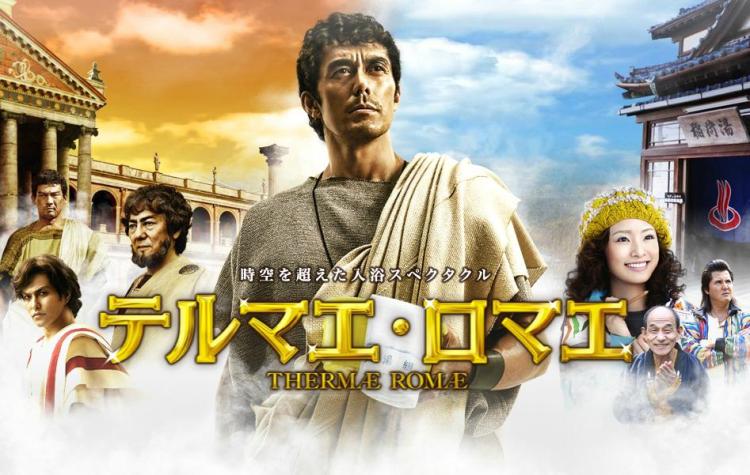
Thermae Romae

THERMAE ROMAE-T

Lucius ambulat in Tokyo? Review of improbable time travel comedy Thermae Romae up at UK-anime.net.


Pop quiz – what do modern day Japan and Ancient Rome have in common? Fish sauce? Emperor worship? Sandals? More than you thought, wasn’t it? Well, the correct answer is public bath houses and sure enough the people of modern day Tokyo still love going to the public bath even though they enjoy the luxury of being able to bathe at home! Of course, bath house culture with all its social and political uses and divisions was one of the things the Roman Empire took with it wherever it went. However, there must have been a time when some Romans began to feel their baths were getting a bit stale and in need of a new ‘modern’ twist, but what to do? What if they could leap forward in time and learn from the 21st century bath culture of modern Japan! Enter down on his luck architect Lucius who suddenly finds himself in a strange land full of strange looking people who seem to have taken bath technology to its very zenith.

Lucius Modestus (Hiroshi Abe) is a once successful bath architect with a case of serious designer’s block. Replaced on a prime project because he’s been unable to come up with any ideas he decides to go for a soak at the local bath house but whilst clearing his head underwater he finds himself sucked through a passage way only to reappear in a very strange looking place – it’s a bath house alright, but not as we know it! As they’re speaking a strange language he doesn’t understand, Lucius assumes the elderly men bathing here must be slaves and he’s been sucked into the “slaves only” part of the baths. Some of this stuff is kind of cool though – what are these funny spigot like things for, and these handy little buckets? Wait – they have baskets for their clothes?! We could do with some these in our bit! And so Lucius experiences the wonder of public bathing in Japan to the extent that it makes him cry with joy at which point he returns to Ancient Rome and begins to put some of these techniques to use in his designs. Travelling back and fore, Lucius always seems to run into the same Japanese girl who wants to make him the star of a manga and group of kindly old men. Can Lucius finally build the bath house of his dreams and stop a conspiracy against his beloved Emperor Hadrian at the same time?

Based on Mari Yamazaki’s manga of the same name (which also received an anime treatment from DLE), Thermae Romae sticks fairly closely to a fish out of water format for the the first half of the film as Lucius becomes by turns confused and then entranced by the various pieces of modern bathing technology he encounters on his travels. As a Roman encountering other people who are obviously not Roman, he of course adopts a superior attitude and assumes these people are either slaves or ought to be and so is extremely bewildered that their advancements seem to have eclipsed those of his own beloved Rome. These situations obviously provide a lot of room for humour as Lucius encounters various things that seem perfectly normal to us but strange and alien to him – his pure joy at discovering the wonder of the multifunctional Japanese toilet being particularly notable. It does though become fairly repetitive as Lucius finds himself in different situations which are essentially the same joke in different colours but then when the plot element begins to kick in later in the film it too fails to take off and feels a little too serious when taken with the wacky time travelling antics we began with.

Aided in his quest Lucius meets several amusing supporting characters including the group of elderly men from the baths who didn’t really need the help of an improbable ancient Roman to get themselves in trouble and Mami who functions as a kind of love interest who’s cast Lucius as the hero in her next manga. Mami begins learning about the Roman Empire and takes a course in Latin which helps a lot when she too finds herself in Ancient Rome and facilitates a kind of cross cultural exchange as she steals ideas from Rome for her manga as Lucius stole for the baths. However, the romantic comedy element never really comes together and even as Mami continues to pine over her noble Roman, Lucius remains aloof in the universal belief that all non-Romans are inferior. Though he does come to grudgingly acknowledge that the ‘flat faced people’ as he calls them have particular strengths such as their willingness to work as a team and put collective success ahead of personal gain, he never quite sheds his Roman arrogance.

It’s all very silly but undeniably quite funny if often absurd. We hear everyone in Rome speaking in Japanese and Lucius continues to think in Japanese wherever he actually is but obviously once he gets to Japan he can’t understand what anyone’s saying and attempts to communicate with them in Latin (whilst still giving his interior monologue in Japanese). Likewise, when Mami learns Latin she uses it to communicate with Lucius in Japan but once they get to Rome, all their ‘Latin’ is Japanese too which causes problems when the old men arrive because they’re speaking the same language as everyone else yet can’t understand anyone or be understood – which might be why they don’t get to say very much other than to Mami. It’s all quite strange and disorientating but kind of works as does the largely Puccini based score which screams 19th century Italy much more than Ancient Rome but helps to give the film the air of classical pomposity it’s aiming for. Big, ridiculous, silly fun – no one could accuse Thermae Romae of having any kind of serious message but it does provide genuinely entertaining silliness for the majority of its running time.


The Snow White Murder Case (白ゆき姫殺人事件, Yoshihiro Nakamura, 2014)

Review of The Snow White Murder Case (白ゆき姫殺人事件, Shiro Yuki Hime Satsujin Jiken) published on UK-anime.net


The sensationalisation of crime has been mainstay of the tabloid press ever since its inception and a much loved subject for gossips and curtain twitchers since time immemorial. When social media arrived, it brought with it hundreds more avenues for every interested reader to have their say and make their own hideously uniformed opinions public contributing to this ever growing sandstorm of misinformation. Occasionally, or perhaps more often than we’d like to admit, these unfounded rumours have the power to ruin lives or push the accused person to a place of unbearable despair. So when the shy and put upon office worker Miki Shirono (Mao Inoue) becomes the prime suspect in the brutal murder of a colleague thanks some fairly convincing circumstantial evidence and the work of one would-be microblogging detective, the resulting trial by Twitter has a profound effect on her already shaky sense of self worth.

The body of Miki Noriko (Nanao) has been found in a wood burned to a crisp after being viciously stabbed multiple times. Beautiful, intelligent and well connected, Noriko seems to have been well loved by her colleagues who are falling over themselves to praise her kind and generous nature, proclaiming disbelief that anyone would do such a thing to so good a person. One of these co-workers, Risako (Misako Renbutsu), happens to have gone to school with TV researcher, Akahoshi (Go Ayano) who’s a total twitter addict and can’t keep anything to himself, and decides to give him the lowdown on the goings on in her office. Apparently the offices of the popular beauty product Snow White Soap was a hotbed of office pilfering filled with interpersonal intrigue of boy friend stealing and complicated romantic entanglements. Working alongside Noriko and Risako was another ‘Miki’, Shirono (Mao Inoe), who tends to be overshadowed by the beautiful and confident Noriko who shares her surname. Shy and isolated, Shirono seems the archetypal office loner and the picture Risako paints of her suggests she’s the sort of repressed, bitter woman who would engage in a bit of revenge theft and possibly even unhinged enough to go on a stabbing spree. Of course, once you start to put something like that on the internet, every last little thing you’ve ever done becomes evidence against you and Shirono finds herself the subject of an internet wide manhunt.

In some ways, the actual truth of who killed Noriko and why is almost irrelevant. In truth, the solution to the mystery itself is a little obvious and many people will probably have encountered similar situations albeit with a less fatal outcome. Safe to say Noriko isn’t quite as white as she’s painted and the film is trying to wrong foot you from the start by providing a series of necessarily unreliable witnesses but in many ways that is the point. There are as many versions of ‘the truth’ as there are people and once an accusation has been made people start to temper their recollections to fit with the new narrative they’ve been given. People who once went to school with Shirono instantly start to recall how she was a little bit creepy and even using evidence of a childhood fire to imply she was some kind of witch obsessed with occult rituals to get revenge on school bullies. Only one university friend stands up for Shirono but, crucially, she is the first one to publicly name her and goes on to give a lot of embarrassing and unnecessary personal details which although they help her case are probably not very relevant. Even this act of seeming loyalty is exposed as a bid for Twitter fame as someone on the periphery of events tries to catapult themselves into the centre by saying “I knew her – I have the real story”.

Of course, things like this have always happened long before the internet and social media took their primary place in modern life. There have always been those things that ‘everybody knows’ that quickly become ‘evidence’ as soon as someone is accused of something. Some people (usually bad people) can cope with these accusations fairly well and carry on with their lives regardless. Other people, like Shirono, are brought down in many ways by their own goodness. What Risako paints as creepy isolation is really mostly crippling shyness. Shirono is one of those innately good people who often puts herself last and tries to look after others – like bringing a handmade bento everyday for a nutritionally troubled colleague or coming up with a way for a childhood friend to feel better about herself. These sorts of people are inherently more vulnerable to these kinds of attacks because they already have an underlying sense of inferiority. As so often happens, this whole thing started because Shirono tried to do something she already thought was wrong and of course it turned into a catastrophe which resulted in her being accused of a terrible crime. The person who manipulated her into this situation likely knew she would react this way and that’s why meek people like Shirono are the ultimate fall guy material.

Like Yoshihiro Nakamura’s previous films (Fish Story, The Foreign Duck, The Native Duck and God in a Coin Locker – both available from Third Window Films), The Snow White Murder Case is full of intersecting plot lines and quirky characters and manages to imbue a certain sense of cosmic irony and black humour into what could be quite a bleak situation. The Twitter antics are neatly displayed through some innovative on screen graphics and the twin themes of ‘the internet reveals the truth’ and ‘the internet accuses falsely’ are never far from the viewer’s mind. It’s testimony to the strength of the characterisation (and of the performances) that Shirono can still say despite everything she’s been through ‘good things will happen’ in attempt to cheer up someone who unbeknownst to her is the author of all her troubles, and have the audience believe it too. A skilful crime thriller in which the crime is the least important thing, The Snow White Murder Case might quite not have the emotional pull of some of the director’s other work but it’s certainly a timely examination of the power of rumour in the internet age.


Original trailer (English subtitles)

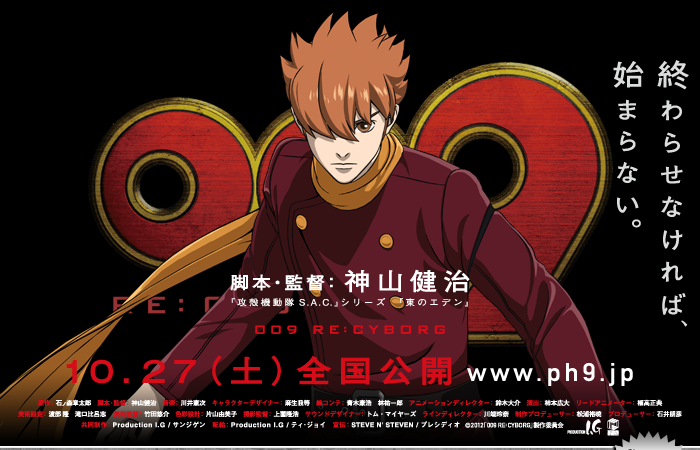
009 Re:Cyborg

branding

Cyborg 009 by Shotaro Ishinomori is one of the most widely read and well regarded manga series in Japan. It has been adapted as an anime movie and TV series several times, most recently in 2001 where it ran for fifty-one episodes. Although the manga dealt with some complex themes, most of these adaptations had leant decidedly to the family friendly with the team of nine cyborgs squaring off against various deadly enemies and saving the world week after week. For this new adaptation, however, director Kenji Kamiyama – the creator of Ghost in the Shell: Stand Alone Complex, Eden of the East and Moribito, famed for his willingness to engage mature, topical subject matter has decided to take the film back to the manga’s darker heart.

This is a world of mass destruction, sky scrapers fall, buildings explode, people run and scream yet it is normalised – this is the way of the world. Joe Shimamura is a bored high school student who feels as if he’s living his life in repetition. Recently he’s begun to hear a voice – His Voice that’s offering him a new purpose and a new path if he will only follow it. Follow it he must though what His Voice is asking him to do is something truly abhorrent. Thankfully, before he can accomplish the task he’s been charged with, a large Native American turns up and begins to beat the stuffing out of him seemingly with the guidance of a French woman giving instructions from an aircraft hovering above. Luckily for all concerned, Shimamura’s survival instincts kick back in and he remembers his true identity just in time to catch said French woman after she’s rather riskily jumped out of her plane. Shimamura isn’t a high school student at all, he’s the head of a nine cyborg crime fighting team and there’s something very wrong in the world. His Voice is reaching more and more people and convincing them to do awful things in His name – who is He, what does He want and how are they going to stop him?

It’s a truly international cast with each of the cyborgs representing a different nation – 001 Ivan (Russia), 002 Jet (America), 003 François (France), 004  Heinrich (Germany), 005 Geronimo (Native American), 006 Changku (China) 007 Great Britain (British), 008 Pyunma (Africa), 009 Joe Shimamura (Japan). Tellingly, Jet and Shimamura have had some kind of bust up prior to the action of the film and tension still lingers – is America behind these attacks? Why are the NSA so suspiciously present and why does it seem they’re so keen to scapegoat the cyborgs as a terrorist group? Can Jet still be trusted or has he become involved with this dark plot? If the team are going to succeed in figuring out just what is going on its going to need an awful lot of international cooperation.

A familiarity with the source material doesn’t feel a necessity whilst watching the film, however though those cognisant of Kamiyama’s typically complex themes may feel a lack of depth in some of the imagery used. Christian religious allusions abound with fossilised angels and biblical sounding pronouncements from our unknown assailant but the overarching mythology is never really addressed or explained in any significantly explicit manner. Despite this the dialogue sometimes leans towards clunkyness overloaded with the weight of complicated exposition. The lack of clarity in the cosmology at play may leave some scratching their heads as the film ends in its rather ambiguous fashion, few would deny though that it’s been fun getting there.

Alongside its cerebral offerings 009 Re: Cyborg also serves up its fair share of pedal to the floor action sequences. Making the most of its 3D production and accompanied by Kenji Kawai’s energetic score the film succeeds in providing some genuinely thrilling set pieces. The use of 3D here is truly inspired and provides a welcome level of depth and inclusivity which showcases the best use of the medium. Though it wears its 3D badge proudly, the animation has been rendered with a 2D, cel shaded look much favoured by Production I.G. in the past.  It may look hand drawn but it has of course been created with computer technology – this has its benefits but more than a few costs. Though the look of the piece is striking, the computerisation is at times overly obvious and detracts from the otherwise traditional aesthetic. Characters sometimes move oddly or lack expression – which might be accounted for when concerning the cyborgs themselves but is less easy to explain away when it occurs with characters intended to appear 100% human. Still, these are minor problems and if one is able to adjust to the stylisation of the film they shouldn’t overly effect the enjoyment of it.

009 Re: Cyborg is not without its faults but it is still a very enjoyable experience. Its use of 3D, unusual visual style and innovative technology mark it out as essential viewing for anyone interested in the future of anime film making. Fans of Kamiyama’s previous work may feel short changed that the confined format of a feature film hasn’t allowed him free reign to fully explore his complex ideas yet what 009 has provided is the opportunity to showcase his talents as a director whilst crafting an entertaining and intelligent action extravaganza.

Rebirth (Youkame no semi) 八日目の蝉

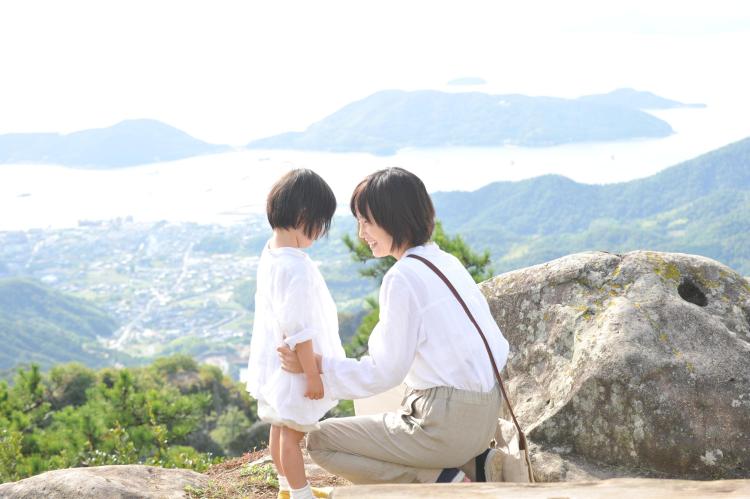
高解像度寒霞渓First of the Japan Foundation Touring Film Programme for this year up on UK-Anime.net. I’m going to do a general round-up later in the week but this was the best of the (impressive) bunch.


Kiwako has been having an affair with a married man who swears he’s going to leave his wife (just not right now) but now things have come to a head as she finds out she’s carrying his child. Despite her being desperately happy and excited about it – planning to call the child Kaoru and designing visions of the a domestic bliss, Kiwako’s married lover is decidedly less enthusiastic and persuades her to opt for a termination. However, complications from the procedure leave her unable to have any more children and she also begins being harassed by her lover’s wife who finally turns up on her doorstep one day, heavily pregnant, to taunt her – going so far as to remark that her ‘barren womb’ is a direct result of her immoral relations with her husband. One day Kiwako just snaps and in an act of madness abducts her lover’s newborn baby and raises the child as her own for four years until she is finally caught.

In the present day, Erina – who was Kaoru, raised by Kiwako for the first four years of her life, has grown up and is in college. She is deeply scarred by the traumatic events of her early childhood and seems to have difficulty with forming relationships with people, not that she seems to want to make any. After being returned to her birth parents she struggled to adapt to her new life and her birth parents struggled to come terms with everything that had happened. Now, as a young woman, Erina finds history begin to repeat itself in more ways than one and she’s forced to consider who she really is and what she wants out of life. In order to do that, she’ll finally have to confront her traumatic past and all of the complex questions and emotions that will inevitably arise.

In a Chalk Circle-esque way, Rebirth wants to ask a lot of questions about motherhood. Who is the mother of this child really? The woman who gave birth to it or the one who has cared for it all its life and who the child regards as its parent? It is obviously a terrible situation for all involved – the birth parents have lost their child, something truly awful, but the child now believes her abductor to be her mother and ‘returning’ her to a pair of ‘strangers’ she has no recollection of is beyond cruel. Being cruelly ripped away from everything she knew would be traumatic enough, let alone being dragged away from her ‘mother’ in a car park late at night and bundled into car by a harsh woman who tells her she’s being taken to her ‘mummy’ when her total understanding of that word is being handcuffed and taken away.

At only four years old you might think she’d be young enough to gradually ease back into her birth family, and you might be right had her natural parents been better equipt themselves to cope with the situation. Erina’s mother is very definitely of the ‘carry on as if nothing happened’ school so any allusion to the first four years of the girl’s life provokes a hysterical fit that only further exacerbates the confusion already ripping apart the poor child’s soul. So jealous is she that she’s effectively projecting all her resentment and bitterness towards Kiwako’s actions onto the child itself – as if she can’t forgive her for the crime of growing older or having spent so much time with the other woman. The child is a reminder of the trauma of its disappearance, of her husband’s infidelity, and subsequently of her own fear of not measuring up as a mother.

Izuru Narushima has crafted an intense and deeply layered character study that neatly sidesteps the risk of becoming as overblown or melodramatic as the plot description might sound. He approaches the subject matter with great sensitivity and with as even a hand as is humanly possible. His camera is incredibly non-judgemental and treats each of the characters with the same level of sympathy and understanding. Surprisingly, it is the birth parents that become the most difficult to sympathise with but even they are presented with a great deal of compassion.

Rebirth is certainly a very complex film that raises all sorts of uncomfortable moral questions from the nature of motherhood to the treatment of the women of society. If I had one criticism it would be that the male characters don’t come out of this well at all – which may be slightly unfair given the deliberate similarity between the two prominent male characters, but certainly the portrait it paints of masculinity is far from flattering. The performances are astounding, particularly those of Mao Inoue (probably still best known for Hana Yori Dango) as the damaged Erina and Hiromi Nagasaku as the desperately maternal Kiwako. Excellently shot and fantastically well conceived Rebirth is one of the best Japanese films of recent times.


I Wish (Kiseki) 奇跡

IMG_0227

Review up over at UK-A for the latest Kore-eda  to fetch up on out shores. Well, actually, I reviewed this at the LFF in 2011 as well but I like to think I’ve come on as a writer since then (maybe not though, oh well, I still have a ways to go). If this is playing anywhere near you I very much urge you to go and see it even if just to show there is still an audience out there for seeing Asian films in the cinema. It’s a great movie though!