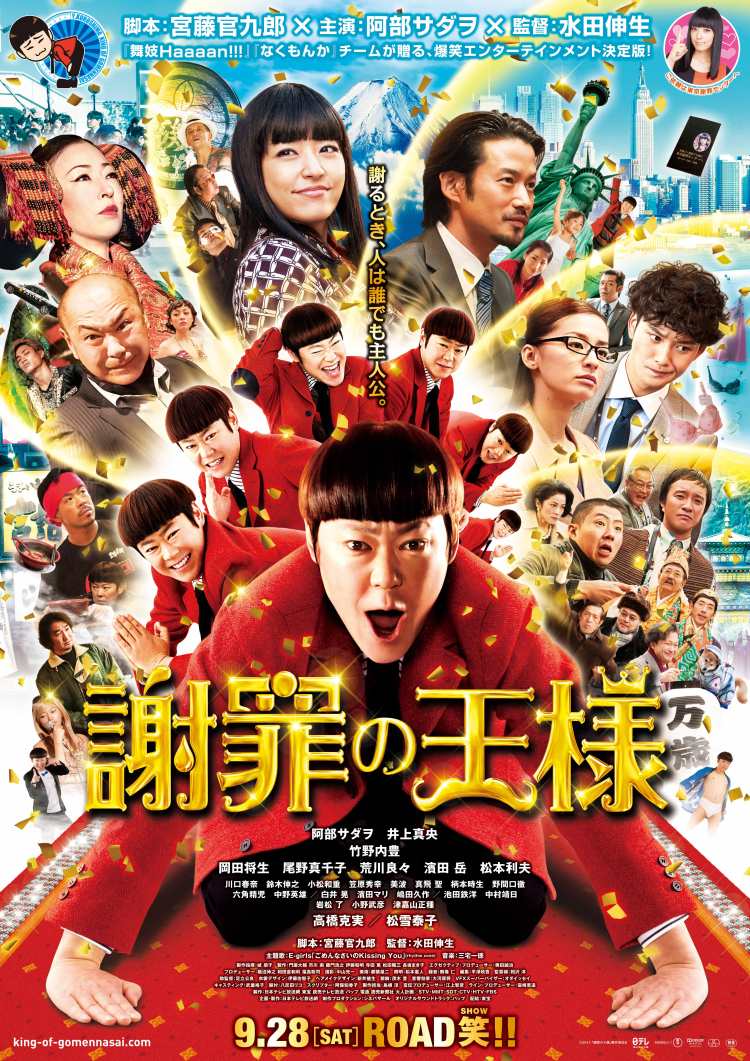
 There are few things in life which cannot at least be improved by a full and frank apology. Sometimes that apology will need to go beyond a simple, if heart felt, “I’m Sorry” to truly make amends but as long as there’s a genuine desire to make things right, it can be done. Some people do, however, need help in navigating this complex series of culturally defined rituals which is where the enterprising hero of Nobuo Mizuta’s The Apology King (謝罪の王様, Shazai no Ousama), Ryoro Kurojima (Sadao Abe), comes in. As head of the Tokyo Apology Centre, Kurojima is on hand to save the needy who find themselves requiring extrication from all kinds of sticky situations such as accidentally getting sold into prostitution by the yakuza or causing small diplomatic incidents with a tiny yet very angry foreign country.
Kurojima promises to know an even more powerful form of apology than the classic Japanese “dogeza” (falling to your knees and placing your head on the ground with hands either side, or OTL in internet lingo), but if you do everything he tells you to, you shouldn’t need it. His first case brings him into contact with Noriko (Mao Inoue) whose awful driving has brought her into contact with the yakuza. Not really paying attention, Noriko has signed an arcane contract in which she’s pledged herself to pay off the extreme debts they’ve placed on her by entering their “employment” at a facility in Osaka. Luckily, she’s turned to Kurojima to help her sort out this mess, which he does by an elaborate process of sucking up to the top brass guys until they forget all about Noriko and the money she owes them in damages. Impressed, Noriko ends up becoming Kurojima’s assistant in all of his subsequent cases, helping people like her settle their disputes amicably rather allowing the situation to spiral out of control.
Mizuta begins with a neat meta segment in which Kurojima appears in a cinema ad outlining various situations in which you might need to apologise including allowing your phone to go off during the movie, or attempting to illegally film inside the auditorium etc ending with a catchy jingle and dance routine pointing towards the contact details for his apology school. Kurojima’s instructions are also offered throughout the film in a series of video essays in which he outlines the basic procedures for de-escalating a conflict and eventually getting the outcome you’re looking for.
Of course, all of this might sound a little manipulative, which it is to a degree, but the important thing to Kurojima lies in mutual understanding more than “winning” or “losing” the argument. The second case which comes to him concerns a young man who has some very outdated ideas and has, therefore, been accused of sexual harassment. Unfortunately, Numata (Masaki Okada) is a classic sexist who only makes the situation worse for himself and completely fails to understand why he was at fault in the first place. Even following Kurojima’s expertly crafted instructions, Numata further insults his female boss whilst attempting to apologise meaning Kurojima has to come up with an even more elaborate plan to smooth the situation which involves pretending to be the ghost of a man who threw himself under a train after being accused of harassing a young woman at work who did not return his affections. This seems to do the trick and the relationship between Numata and his boss appears to have improved even if Numata still has a long way to go in the person stakes, though it does perhaps make light of a serious workplace problem.
Numata follows all of Kurojima’s instructions but still gets everything wrong because he refuses to understand all of the various social rules he’s broken and therefore why and how the apology process is intended to make amends for them. Understanding and sincerity are the keys to Kurojima’s ideology but Numata, after a quick fix, fails to appreciate either of these central tenets and so is unable to work things out for himself. Similarly, in another case the parents of an actor are required to make a public apology when their son is captured on CCTV getting into a street fight. Only, being actors, they find genuine sincerity hard to pull off on the public stage either resorting to chewing the scenery or overdoing the dignified act, not to mention plugging their latest appearances at the end of the speech. The public apology is an important part of the Japanese entertainment industry though it might seem odd that the famous parents of a “disgraced” celebrity would be expected to apologise to the nation as a whole, but as it turns out all that was needed to settle the matter was a quick chat between the people involved, fully explaining the situation and reaching a degree of mutual understanding.
The innovative structure of Apology King neatly weaves each of the cases together as they occur in slightly overlapping timeframes but each contribute to the final set piece in which Kurojima becomes an advisor during a diplomatic incident caused when a film director unwittingly offends the small nation of Mutan by accidentally turning their crown prince into an extra in his film. Mutan is a nation with many arcane rules including a prohibition on filming royalty as well as on drinking and eating skewered meat, all of which the crown prince is seen doing in the movie. Matters only get worse when the film crew travel to Mutan to apologise but make even more faux pas, especially when it turns out that Japanese dogeza is actually incredibly rude in Mutanese culture. Revisiting elements from each of the previous cases, Kurojima is only able to engineer a peaceful solution by convincing the Japanese authorities to utter a set phrase in Mutanese which means something quite different and very embarrassing in their own language. Apologies are, of course, always a little humiliating, but then that is a part of the process in itself – placing oneself on a lower level to those who’ve been wronged, as symbolised in the dogeza.
Full of zany, madcap humour and culminating in a gloriously unexpected pop video complete with dancing idols of both genders exhorting the benefits of a perfectly constructed (and sincere) apology, The Apology King is a warm and innocent tribute to the importance of mutual understanding and its power to ease even the deepest of wounds and most difficult of situations. Hilarious but also heartfelt, The Apology King is a timely reminder that unresolved conflicts only snowball when left to their own devices, the only path to forgiveness lies in recognising your own faults and learning to see things from another perspective. Kurojima’s powers could be misused by the unscrupulous, but the most important ingredient is sincerity – empty words win no respect.
Original trailer (no subtitles)
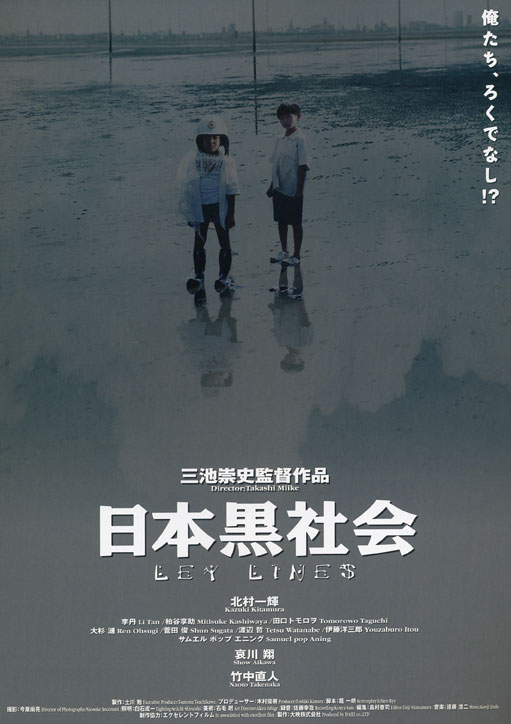 The three films loosely banded together under the retrospectively applied title of the Black Society Trilogy are not connected in terms of narrative, characters, tone, or location but they do all reflect on attitudes to foreignness, both of a national and of a spiritual kind. Like Tatsuhito in the first film,
 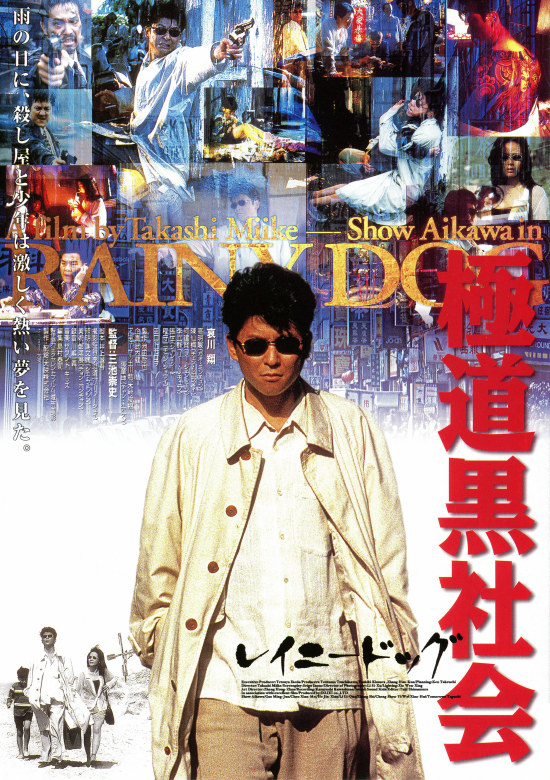 They say dogs get disorientated by the rain, all those useful smells they use to navigate the world get washed away as if someone had suddenly crumpled up their internal maps and thrown them in the waste paper bin. Yuji (Show Aikawa), the hero of Rainy Dog (極道黒社会, Gokudo Kuroshakai) – the second instalment in what is loosely thought of as Takashi Miike’s Black Society Trilogy, appears to be in a similar position as he hides out in Taipei only to find himself with no home to return to. Miike is not generally known for contemplative mood pieces, but Rainy Dog finds him feeling introspective. A noir inflected, western inspired tale of existential reckoning, this is Miike at his most melancholy but perhaps also at his most forgiving as his weary hitman lays down his burdens to open his heart only to embrace the cold steel of his destiny rather than the warmth of his redemption.
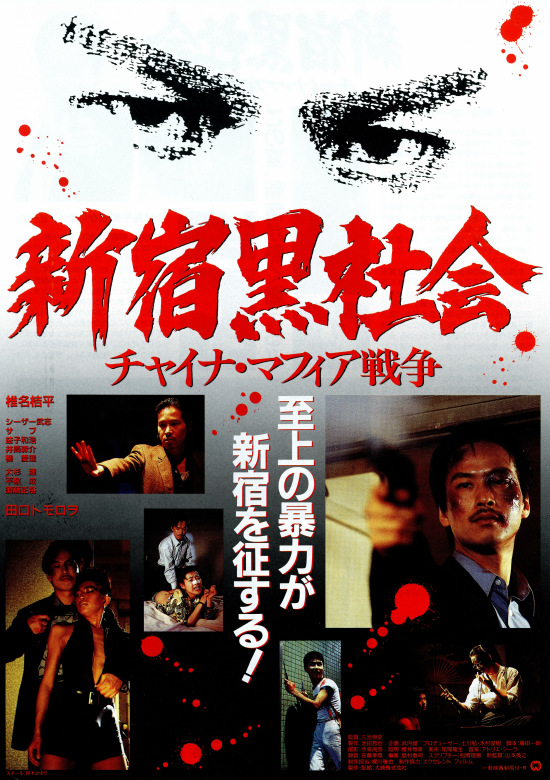 These days Takashi Miike is known as something of an enfant terrible whose rate of production is almost impossible to keep up with and regularly defies classification. Pressed to offer some kind of explanation to the uninitiated, most will point to the unsettling horror of
 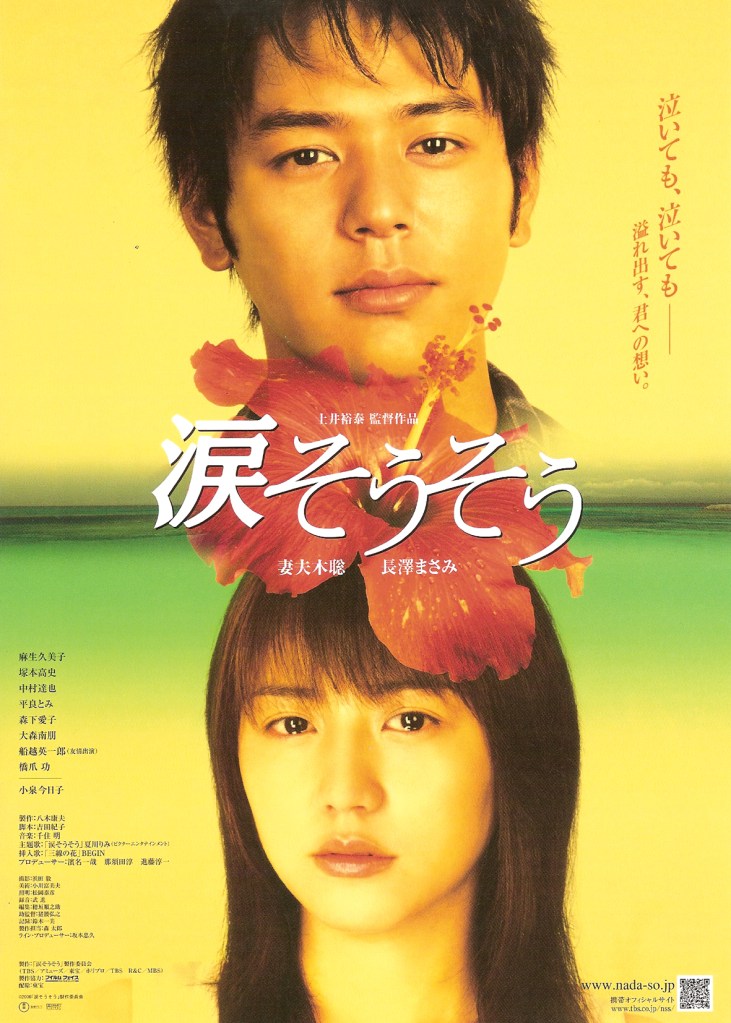 Coming in at the end of the “pure love” boom, Nobuhiro Doi’s second feature, Tears for You (涙そうそう, Nada So So) is presumably named to tie in with his smash hit debut
 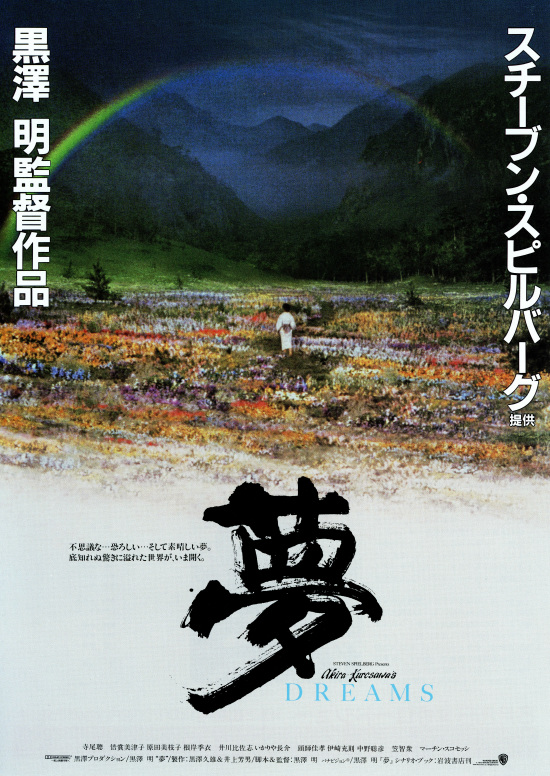 Despite a long and hugely successful career which saw him feted as the man who’d put Japanese cinema on the international map, Akira Kurosawa’s fortunes took a tumble in the late ‘60s with an ill fated attempt to break into Hollywood. Tora! Tora! Tora! was to be a landmark film collaboration detailing the attack on Pearl Harbour from both the American and Japanese sides with Kurosawa directing the Japanese half, and an American director handling the English language content. However, the American director was not someone the prestigious caliber of David Lean as Kurosawa had hoped and his script was constantly picked apart and reduced.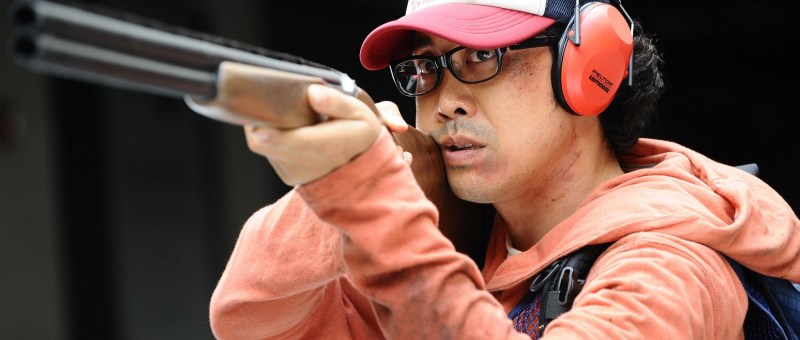
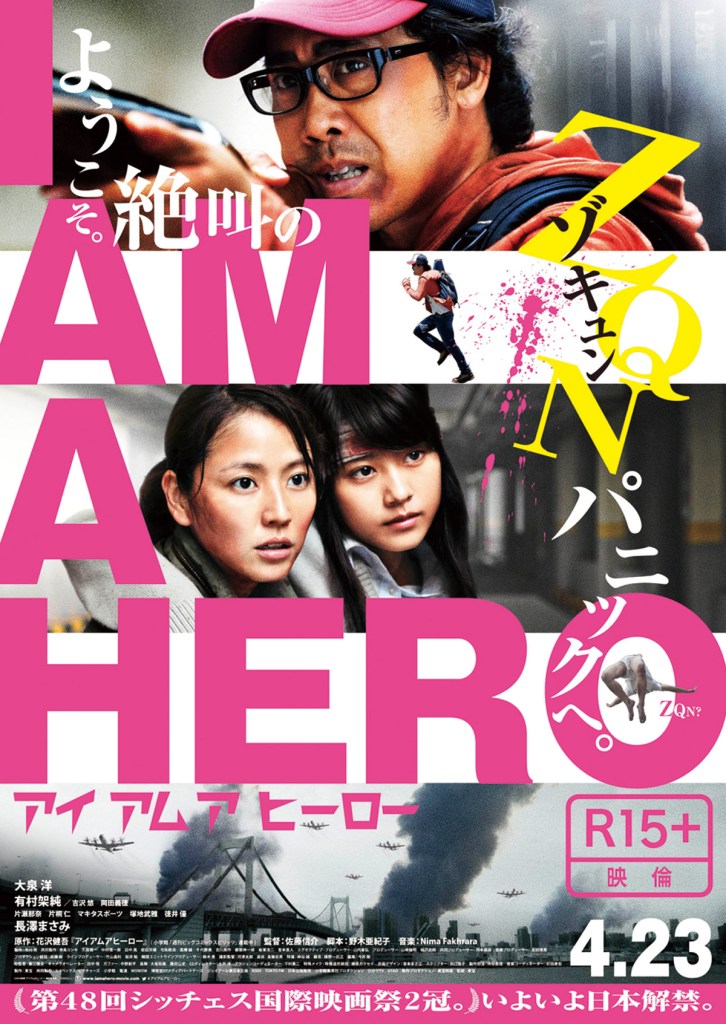 Japan has never quite got the zombie movie. That’s not to say they haven’t tried, from the arty Miss Zombie to the splatter leaning exploitation fare of Helldriver, zombies have never been far from the scene even if they looked and behaved a littler differently than their American cousins. Shinsuke Sato’s adaptation of Kengo Hanazawa’s manga I Am a Hero (アイアムアヒーロー) is unapologetically married to the Romero universe even if filtered through 28 Days Later and, perhaps more importantly, Shaun of the Dead. These “ZQN” jerk and scuttle like the monsters you always feared were in the darkness, but as much as the undead threat lingers with outstretched hands of dread, Sato mines the situation for all the humour on offer creating that rarest of beasts – a horror comedy that’s both scary and funny but crucially also weighty enough to prove emotionally effective.
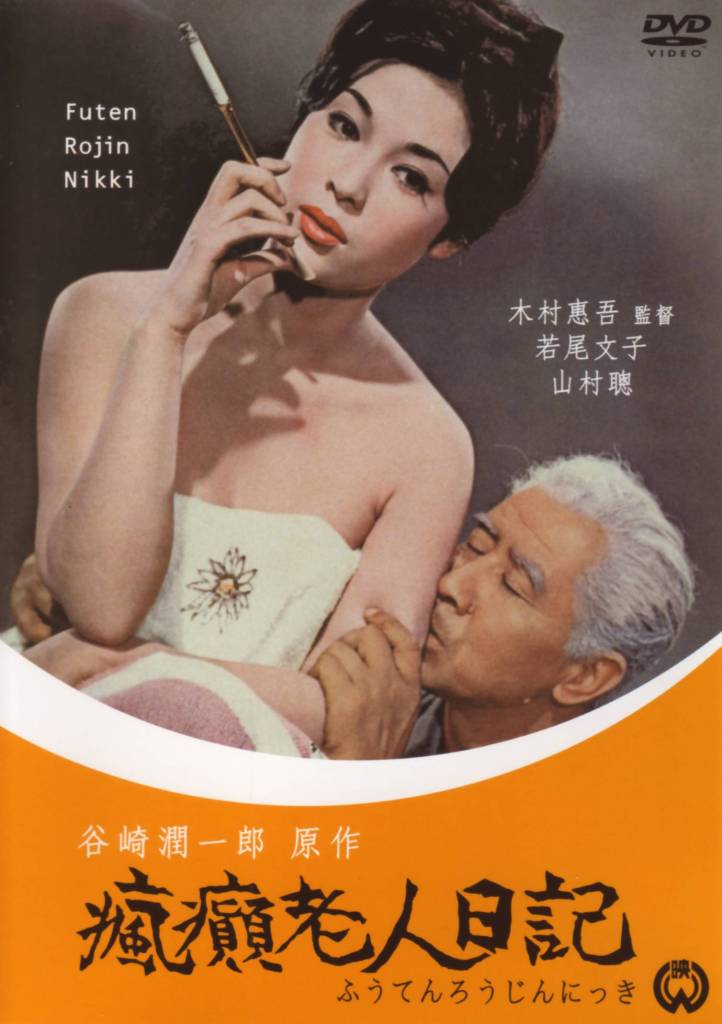 Junichiro Tanizaki is giant of Japanese literature whose work has often been adapted for the screen with
  Terra Formars – Terror for Mars? It’s all about terror in the quest for terra and reform in Takashi Miike’s bug hunt extravaganza adaptation of Yu Sasuga and Kenichi Tachibana’s manga. In fact, much of the plot is more or less the same as Aliens, but our motley crew is not a crack team of space marines headed by a recently awoken from stasis super survivor who proves unexpectedly dextrous in a robotic forklift exoskeleton, but a collection of human “bugs”, parasitical criminals who’ve each been made an offer they can’t refuse. High budget and boasting a starry cast, Terra Formars (テラフォーマーズ) definitely falls into the throwaway Miike category and proves curiously dull despite its ridiculous set up, but then if you happen to be into bugs there’s really a lot to like here.
 Yukio Mishima’s Temple of the Golden Pavilion has become one of his most representative works and seems to be one of those texts endlessly reinterpreted by each new generation. Previously adapted for the screen by Kon Ichikawa under the title of
  Windows on Worlds