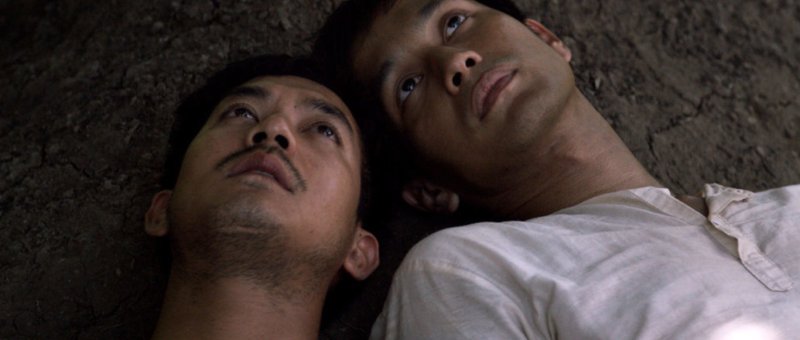
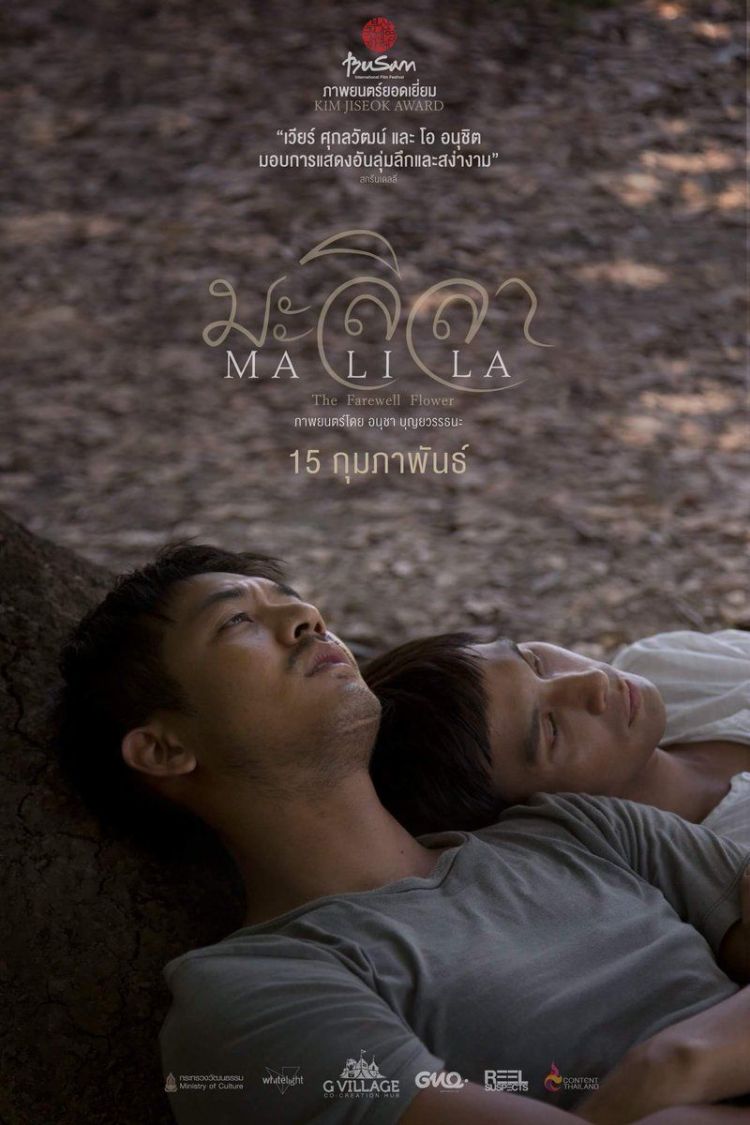
 Anucha Boonyawatana’s second feature, Malila: The Farewell Flower (มะลิลา), opens with a quotation from a 19th century poem. The poem laments that even a Baisri painstakingly created to honour the gods will eventually be cast away once it has served its purpose. No longer divine, its soul departed, the ornament is just another thing to be disposed of. Like the beautiful Baisri, two men’s souls will briefly intertwine only for the flowers of their love to wither on the vine, fading away with the great work still incomplete. This incompleteness, the lingering sense of absence and irreconcilable longing, propel the one left behind onto a spiritual journey hoping to discover if the answers to his need lie within or are not to be found at all.
Shane (Sukollawat Kanarot), the owner of a jasmine plantation, has recently begun to rebuild his life following a period of heavy drinking during which his wife left him and his young daughter was killed by a python in the jungle. Reuniting with his former lover, Pich (Anuchit Sapanpong), Shane is distraught to find out that he is terminally ill with lung cancer and has decided to give up on conventional medicine and devote the rest of his life doing the things that make him happy. Pich’s one form of “treatment” is in his constant making and dispatching of “Baisri” – ornaments constructed from leaves and flowers for ceremonial occasions which, painstakingly created, must be sent away on the river after they have fulfilled their purpose.
Jasmine flowers are, as Pich remarks, too weak – they wither before the Baisri is completed. Though the two men are able to rekindle their romance, their time is limited. Shane contemplates becoming a monk in the hope that his good karma can be transferred to Pich but it is not to be. Alone, he sets out on a spiritual journey guided by another monk hoping to encounter the ghosts of himself and of his loves to absolve himself of his guilt and loneliness.
Set against the beautiful Thai landscape, Malila is a tale of fading flowers and eternal regrets. The art of Baisri requires intense focus and dedication in order to repurpose and reorder nature into something essentially manmade but beautiful. Later, during his quest, Shane will be met with a terrifying though no less intense experience when his guide and fellow monk instructs him in the art of corpse meditation. The sight of the body, putrid and infested with hungry maggots busily going about their business, presents a strong contrast with the otherwise idyllic scenery and forces a more literal contemplation of the process of decay as the human form dissolves leaving only memory and a ghost of past emotion in its place.
Ironically, or perhaps not, a Baisri is intended to mark a new beginning – a “farewell” on an onward journey. Shane sets off on a spiritual quest, suffering nobly in the forests with their frequent rainstorms and learning to be in the moment in the company of the comparatively better experienced monk who guides him, a former soldier now on the spiritual path. His search is internal but illuminated by the world around him and his gradually increasing connection with it.
Eventually transcending this world for another, Shane begins to find his answers and finally cleanses himself of his loss and suffering. Mixing lyrical poetry with beautifully photographed naturalism, Anucha Boonyawatana tells a painful tale of love lost and found, hearts broken and repaired, and finally of acceptance both of one’s self and of the transience of all things. Malila: The Farewell Flower is a parting gift to a departing love, filled with sorrow and regret but also with beauty even in decay.
Screened at BFI Flare 2018.
Original trailer (English subtitles)
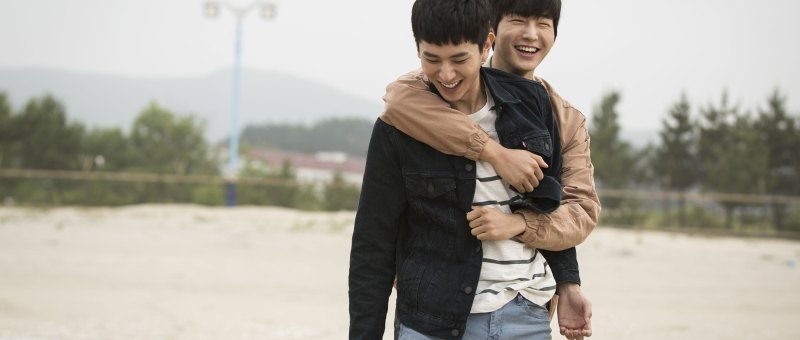
 Some situations are destined to end in tears. Kaze Shindo’s Love Juice adopts the popular theme of unrequited love but complicates it with the peculiar circumstances of Tokyo at the turn of the century which requires two young women to be not just housemates but bedmates and workmates too. One is straight, one is gay and in love with her friend who seems to get off on manipulating her emotions and is overly dependent on her more responsible approach to life, but both are trapped in a low rent world of grungy nightclubs and sleazy hostess bars.
 In
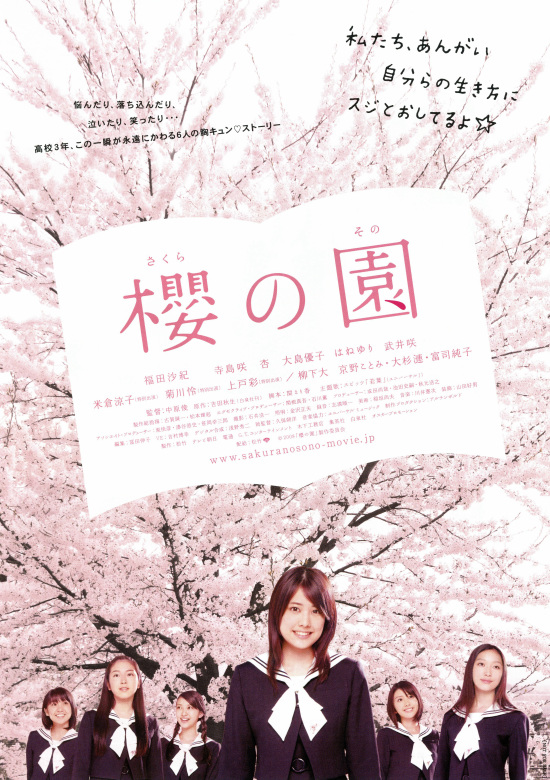
In  Chekhov’s The Cherry Orchard is more about the passing of an era and the fates of those who fail to swim the tides of history than it is about transience and the ever-present tragedy of the death of every moment, but still there is a commonality in the symbolism. Shun Nakahara’s The Cherry Orchard (櫻の園, Sakura no Sono) is not an adaptation of Chekhov’s play but of Akimi Yoshida’s popular 1980s shojo manga which centres on a drama group at an all girls high school. Alarm bells may be ringing, but Nakahara sidesteps the usual teen angst drama for a sensitively done coming of age tale as the girls face up to their liminal status and prepare to step forward into their own new era.
 Every keen dramatist knows the most exciting things which happen at a party are always those which occur away from the main action. Lonely cigarette breaks and kitchen conversations give rise to the most unexpected of events as those desperately trying to escape the party atmosphere accidentally let their guard down in their sudden relief. Adapting his own stage play titled Trois Grotesque, Kenji Yamauchi takes this idea to its natural conclusion in At the Terrace (テラスにて, Terrace Nite) setting the entirety of the action on the rear terraced area of an elegant European-style villa shortly after the majority of guests have departed following a business themed dinner party. This farcical comedy of manners neatly sends up the various layers of propriety and the difficulty of maintaining strict social codes amongst a group of intimate strangers, lending a Japanese twist to a well honed European tradition.
 While studying in the US, director Naoko Ogigami encountered people from all walks of life but on her return to Japan was immediately struck by the invisibility of the LGBT community and particularly that of transgender people. Close-Knit (彼らが本気で編むときは, Karera ga Honki de Amu Toki wa) is her response to a still prevalent social conservatism which sometimes gives rise to fear, discrimination and prejudice. Moving away from the quirkier sides of her previous work, Ogigami nevertheless opts for a gentle, warm approach to this potentially heavy subject matter, preferring to focus on positivity rather than dwell on suffering.


 Following the surreal horror film
  Windows on Worlds