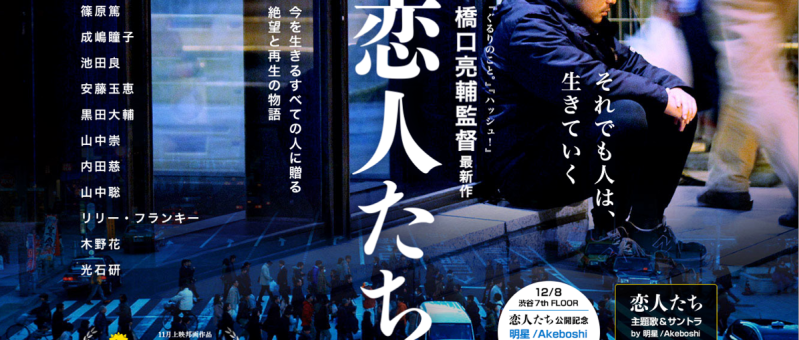
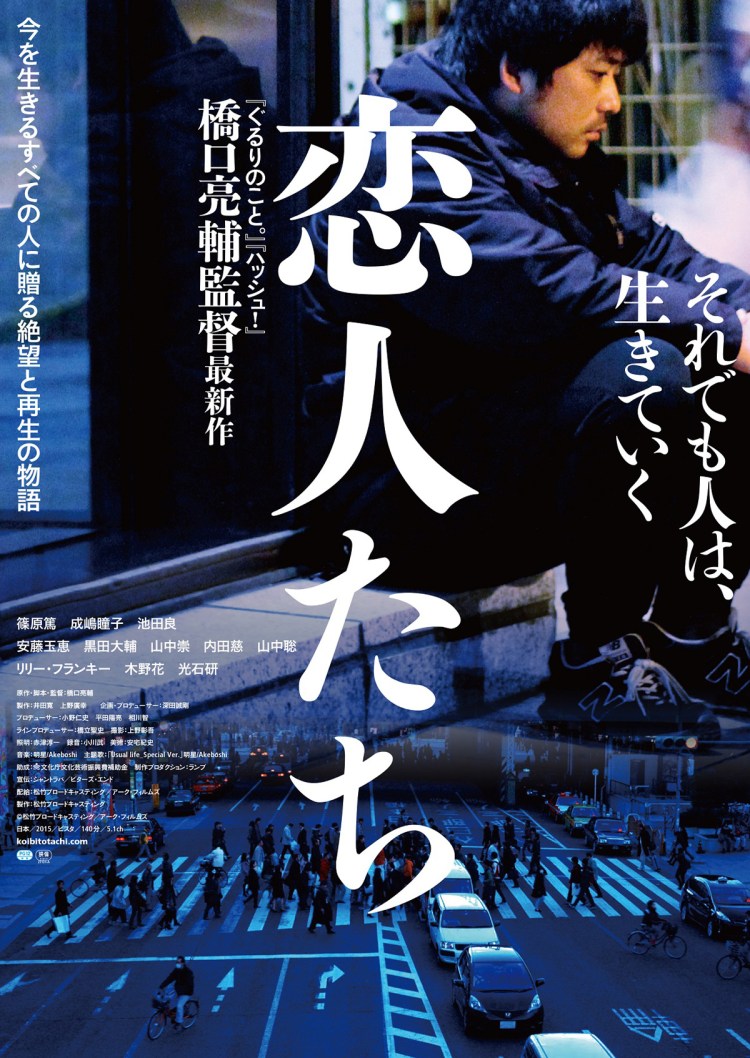
 Ryosuke Hashiguchi began his career with a collection of sometimes melancholy but ultimately hopeful tales of gay life in contemporary Japan. In 2008 he branched out with the finely tuned emotional drama All Around Us which followed an ordinary couple’s attempt to come to terms with the loss of a child. Three Stories of Love (恋人たち, Koibitotachi) finds him in much the same territory as he takes three very different yet equally burdened romantics and sets them on a path towards a kind of acceptance while suffering inside a system where everyone seems to be intent on exploiting other people’s unhappiness.
The first of our heroes, Atsushi (Atsushi Shinohara), is a bridge inspector whose wife was murdered in a random street attack three years previously. Ever since then he’s suffered with depression and found it difficult to hold down a job or a life and has become obsessed with getting personal revenge on the killer who pleaded the insanity defence and was committed to psychiatric care rather than to prison. Meanwhile, across town, listless housewife Toko (Toko Narushima) is trapped in a loveless marriage to a domineering husband and living with her snooty mother-in-law. Toko’s only outlet is compulsively rewatching a shaky video of the time she and her friends witnessed Princess Masako briefly exit a building. The third of our heroes, Shinomiya (Ryo Ikeda), is a self involved lawyer with a longstanding crush on his straight best friend from college who has since married and had a young son.
The three strands are only loosely interconnected, occurring as they do in the same city at the same time, though they do each share a sense of defeat and impossibility as each of our heroes struggles either to escape from or come to terms with their difficult circumstances. Atsushi’s case is perhaps the most extreme as he deals not only with his grief and anger but with the persistent stigma of being involved with violent crime. Visited by his bubbly sister-in-law he idly remembers to ask after the man she was about to marry last time they met only to be told that he abruptly dumped her after her sister’s death and not only that, all her friends abandoned her too. Getting revenge has become Atsushi’s only reason for living – he stopped paying his health insurance to get money together for fancy lawyers like Shinomiya who convinced him he could lodge a civil case but were only ever stringing him along to fleece him of money he never really had.
Shinomiya is, in a sense, our villain. He listens dispassionately to his wealthy clients – including one woman seeking a divorce (Chika Uchida) because her husband forgot to tell her he was burakumin until after they were married, but privately mocks them and is so unpleasant to his colleagues that someone eventually pushes him down a flight of stairs, breaking his leg. Intensely self-involved, he cares little for other people’s feelings save for those of his forlorn love Satoshi (So Yamanaka). Satoshi’s wife Etsuko, originally friendly and understanding, eventually takes against Shinomiya either because she doesn’t like the way he fiddled with her son’s ears or resents the two men cooing over the child and accidentally making her feel like an unwelcome outsider. Introducing his much younger boyfriend only seems to make matters worse, though the relationship does seem to have its problematic dimensions even if not in the way Etsuko decides to interpret them as Shinomiya takes pains to run down his partner in public and berate him at home. It’s difficult to resist the interpretation that Shinomiya prefers younger lovers because he can boss them around and, in truth, he doesn’t even seem very attached to this one, but he’s about to get a very rude awakening when it comes to learning that he’s not as permanent a part of everyone else’s lives as he seems to think.
Atsushi is fleeced by the Shinomiyas of the world and his heartless health insurers, but he’s wily enough to spot the obvious scam in the lovelorn office boy’s sudden enthusiasm for magical beautifying water which turns out to be part of a bar lady’s (Tamae Ando) nefarious scheme to resell the tapped variety with some of her own glamour shots attached to the front. Toko is wily enough to see it too, though she eventually succumbs when would-be-chicken-farmer Fujita (Ken Mitsuishi), whom she met at work during a difficult moment with her boss, delivers her some on spec. Lonely and insecure, Toko appreciates the unexpected interest but Fujita is not the white knight she first assumes him to be and is eventually exposed as yet another scam artist gunning for the little money she might have been able to hide away in her rabidly penny pinching home.
Shinomiya might feel himself proud to be among the fleecers rather than the fleeced, but he soon gets a comeuppance in realising he has wilfully pulled the wool over his own eyes, blinded in a sense by love. Toko, meanwhile, has learned to accept the latent feudalism of the modern society in her obsession with royalty though a brief attempt to transcend her feelings of innate inferiority seems destined to end in failure if perhaps engineering a mild improvement in her familial circumstances. Atsushi alone, a man whose job it is to assess the foundations, begins to find a degree of equilibrium thanks largely to nothing more than a good friend willing to listen and share his own suffering. Exploitation of others’ misfortunes and a series of social prejudices conspire against our three lovers but perhaps there is something to be said for learning to find the blue sky from whichever vantage point you happen to be occupying no matter how small and distant it may be.
Three Stories of Love was screened as part of the 2019 Japan Foundation Touring Film Programme.
Original trailer (no subtitles)





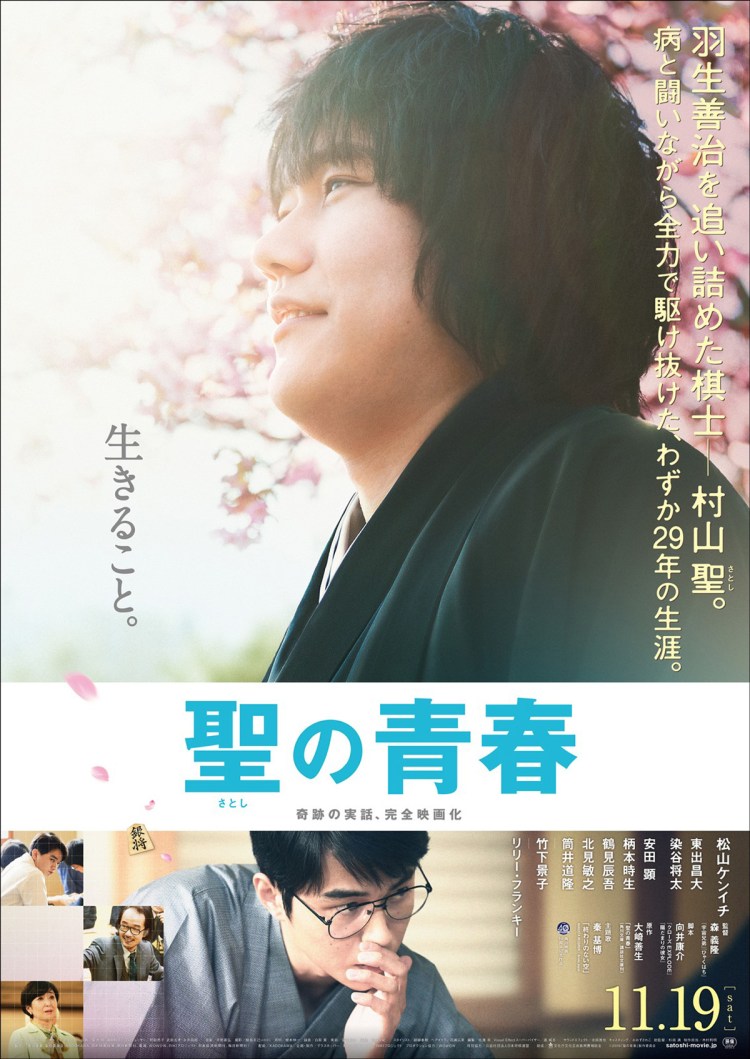 There’s a slight irony in the English title of Yoshitaka Mori’s tragic shogi star biopic, Satoshi: A Move For Tomorrow (聖の青春, Satoshi no Seishun). The Japanese title does something similar with the simple “Satoshi’s Youth” but both undercut the fact that Satoshi (Kenichi Matsuyama) was a man who only ever had his youth and knew there was no future for him to consider. The fact that he devoted his short life to a game that’s all about thinking ahead is another wry irony but one it seems the man himself may have enjoyed. Satoshi Murayama, a household name in Japan, died at only 29 years old after denying chemotherapy treatment for bladder cancer in fear that it would interfere with his thought process and set him back on his quest to conquer the world of shogi. Less a story of triumph over adversity than of noble perseverance, Satoshi lacks the classic underdog beats the odds narrative so central to the sports drama but never quite manages to replace it with something deeper.
 Hitoshi One has a history of trying to find the humour in an old fashioned sleazy guy but the hero of his latest film, Scoop!, is an appropriately ‘80s throwback complete with loud shirt, leather jacket, and a mop of curly hair. Inspired by a 1985 TV movie written and directed by Masato Harada, Scoop! is equal parts satire, exposé and tragic character study as it attempts to capture the image of a photographer desperately trying to pretend he cares about nothing whilst caring too much about everything.
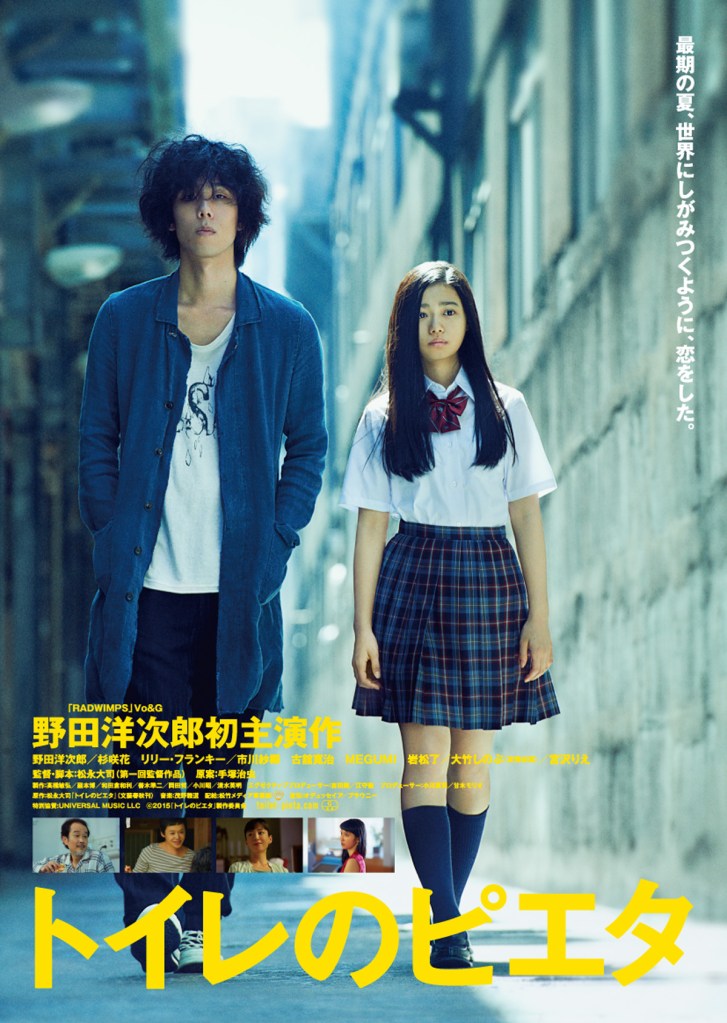 Somewhere near the beginning of Daishi Matsunaga’s debut feature, Pieta in the Toilet (トイレのピエタ, Toire no Pieta), the high rise window washing hero is attempting to school a nervous newbie by “reassuring” him that the worst thing that could happen up here is that you could die. This early attempt at black humour signals Hiroshi’s already aloof and standoffish nature but his fateful remark comes back to haunt him after he is diagnosed with an aggressive and debilitating condition of his own. Noticeably restrained in contrast with the often melodramatic approach of similarly themed mainstream pictures, Pieta in the Toilet is less a contemplation of death than of life, its purpose and its possibilities.
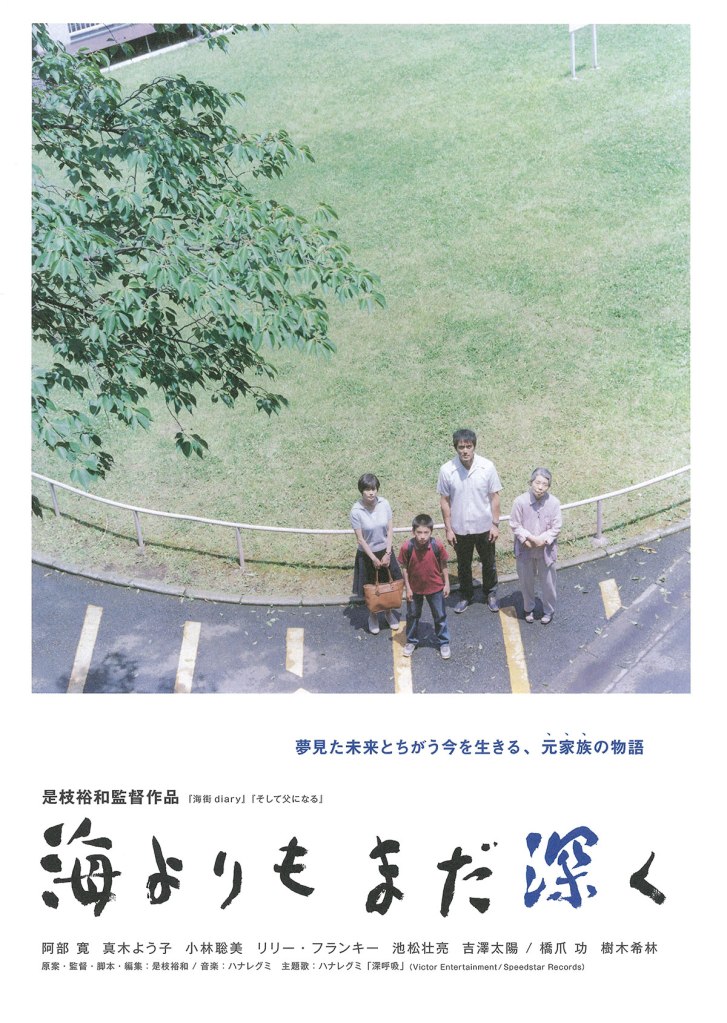 It’s never too late to be what you might have been – a statement attributed to George Eliot which may be as fake as one of the promises offered by the protagonist of Hirokazu Koreeda’s latest attempt to chart the course of his nation through its basic social unit, After the Storm (海よりもまだ深く, Umi yori mo Mada Fukaku). Reuniting Kirin Kiki and Hiroshi Abe as mother and son following their star turns in
  A Double Life (二重生活, Nijyuu Seikatsu ), the debut feature from director Yoshiyuki Kishi adapted from Mariko Koike’s novel, could easily be subtitled “a defence of stalking with indifference”. As a philosophical experiment in itself, it recasts us as the voyeur, watching her watching him, following our oblivious heroine as she becomes increasingly obsessed with the act of observance. Taking into account the constant watchfulness of modern society, A Double Life has some serious questions to ask not only of the nature of existence but of the increasing connectedness and its counterpart of isolation, the disconnect between the image and reality, and how much the hidden facets of people’s lives define their essential personality.
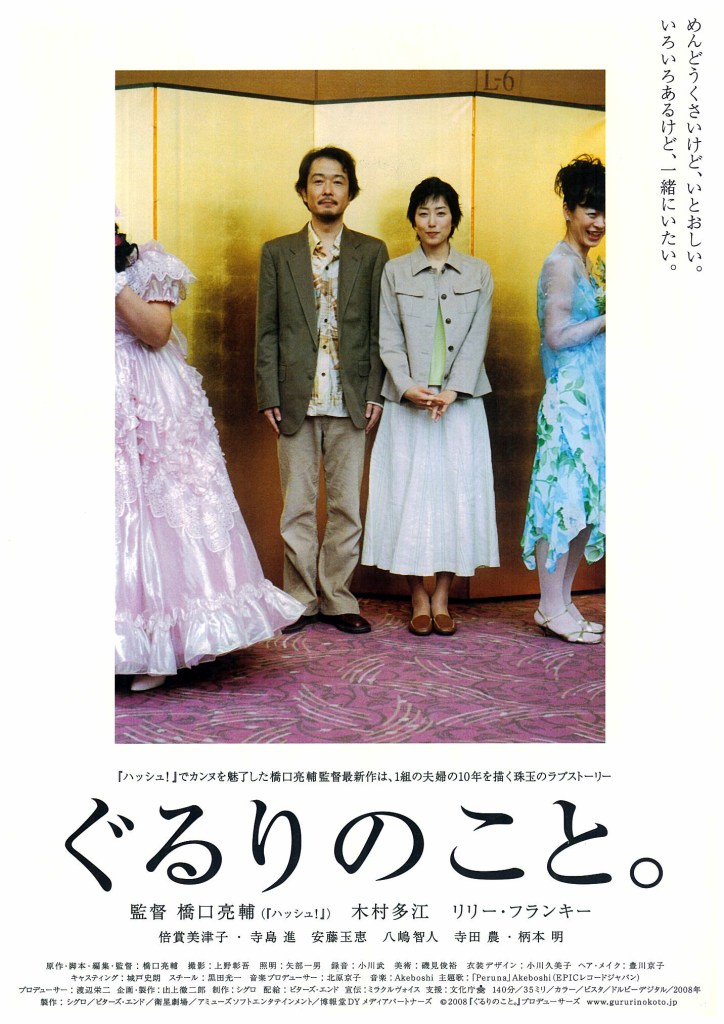 Ryosuke Hashiguchi returns after an eight year absence with All Around Us (ぐるりのこと。Gururi no Koto) and eschews most of his pressing themes up this by point by opting to depict a few “scenes from a marriage” in post-bubble era Japan. Set against the backdrop of an extremely turbulent decade which was plagued by natural disasters, terrorism, and shocking criminal activity Hashiguchi shows us the enduring love of one ordinary couple who, finding themselves pulled apart by tragedy, gradually grow closer through their shared grief and disappointment.
 Belated review from the 2015 London Film Festival – Yakuza Apocalypse is released in UK cinemas for one day only on 6th January 2016 courtesy of Manga who will also be releasing on home video at a later date.
