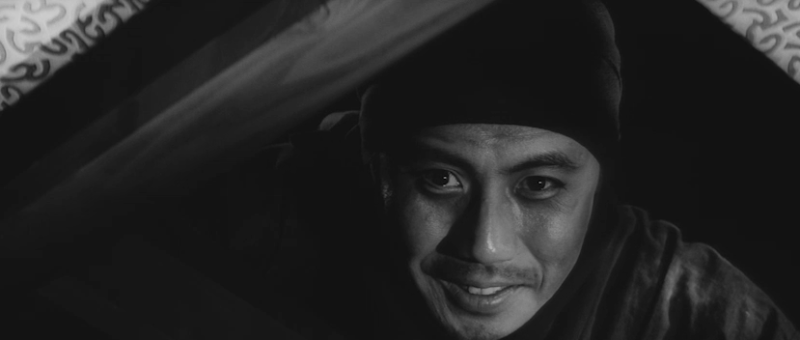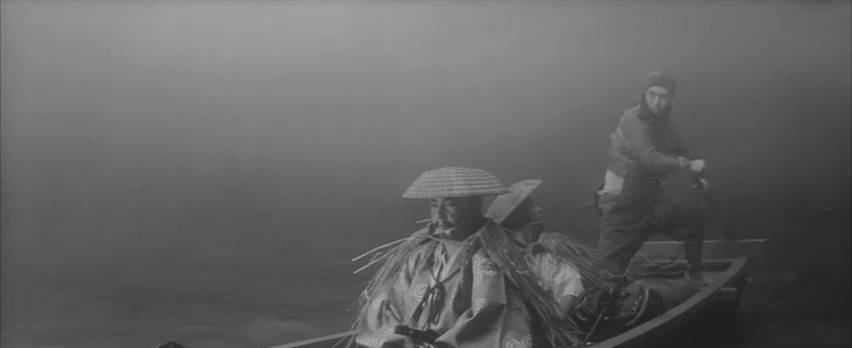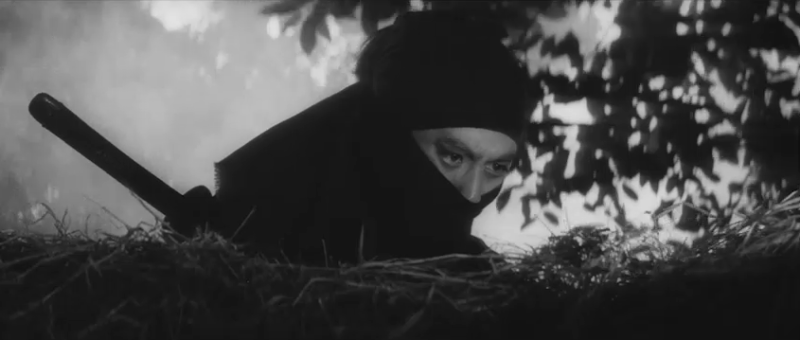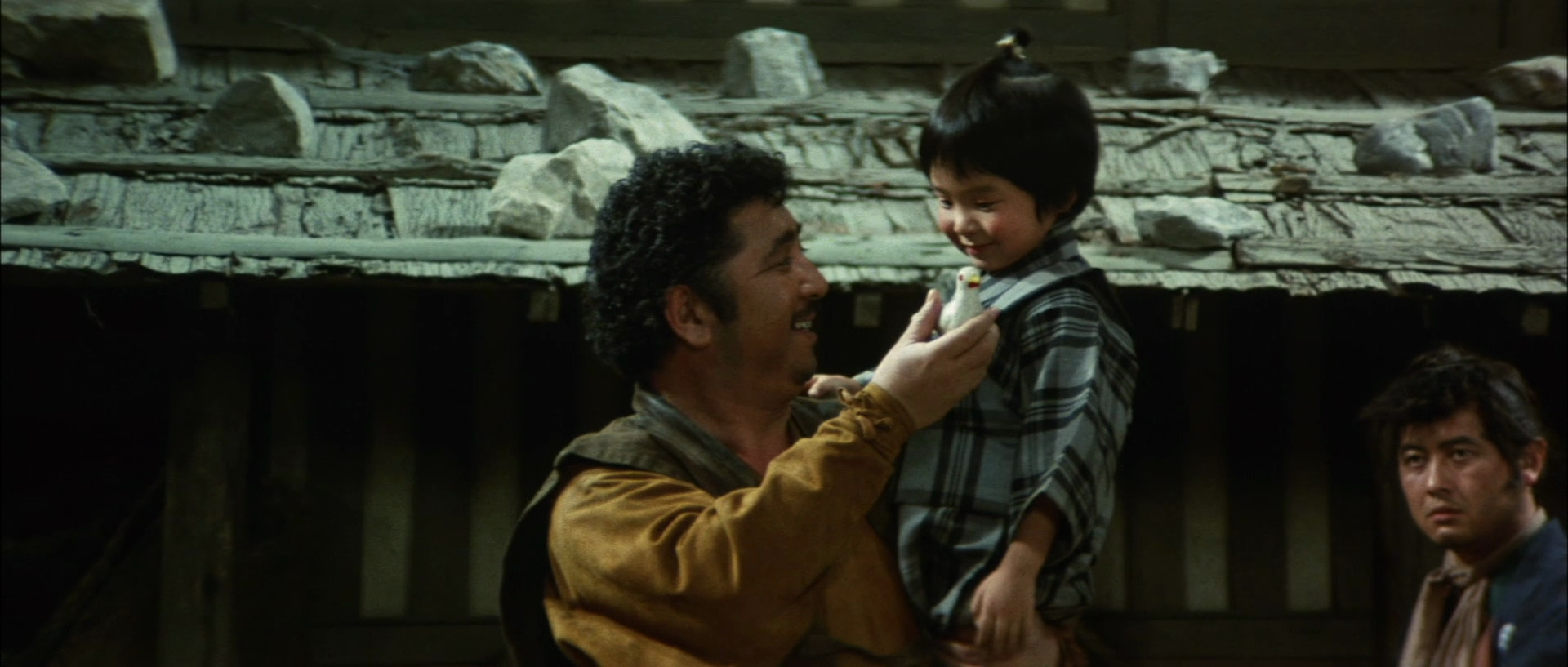
Shinobi No Mono 5: Return of Mist Saizo (忍びの者 続・霧隠才蔵, Kazuo Ikehiro, 1964)

At the end of the previous instalment, Saizo (Raizo Ichikawa) had escaped from the fall of Osaka Castle spiriting away Sanada Yukimura (Tomisaburo Wakayama) who, in contrast to what the history books say, did not die. The pair make their way towards Shimazu, where they are also not well disposed to Ieyasu (Eitaro Ozawa), but as Saizo is informed the Tokugawa clan will never die. Knocking off Nobunaga put an end to the Oda clan, getting rid of Hideyori took the Toyotomi out of the running, but killing Ieyasu will make little difference because another retainer will swiftly take his place.

As a reminder, that’s bad for Saizo because what he wanted was the chaos of the Warring States era back to restore the ninja to their previous status. Nevertheless, at the end of the previous film he claimed to have rediscovered a human heart in his devotion to Yukimura though it may of course be simply another ruse to meet an end. In any case, Ieyasu seems to be putting his ninjas to good use and is once again waiting it out apparently aware that Yukimura is alive and well in Shimazu.

Meanwhile, times are changing. Yukimura is convinced the future of warfare lies in firearms and whoever controls Tanegashima where the weapons are made will prove victorious. They think they can gain it by figuring out how they get access to high-quality iron when trading with anyone outside of Portugal is illegal and the Portuguese don’t have any. It’s access to foreign trade which is becoming a crunch issue as Ieyasu tries to solidify his power, later giving a deathbed order to ban Christianity to stop European merchants taking over the country. Saizo travels to Tanegashima to investigate and figures out that the secret is they’re trading with China, which is pretty good blackmail material, but also encounters two sisters who turn out to be the orphaned daughters of a Tokugawa ninja with vengeance on their mind.

In a surprising turn of events, it turns out that his main adversary is Hanzo Hattori (Saburo Date) but the fact he keeps outsmarting him eventually convinces Ieyasu that the ninja have outlived their usefulness. Hanzo becomes determined to kill Saizo to restore his honour, filling the palace with various ninja traps though unlike Goemon Saizo seems to be one step ahead of them. This lengthy final sequence is played in near total silence, and ironically finds Goemon just waiting, after dispatching several of Hanzo’s men, to see if his poison dart has taken effect and Ieyasu is on his way out. Only in the end Ieyasu just laughs at him. He’s 75. Saizo’s gone to too much effort when he could have just waited it out. Ieyasu has already achieved everything he wanted to. His control over Japan is secured given he’s just been appointed chancellor. He can quite literally die happy because nothing matters to him anymore. A title card informs us that when Ieyasu did in fact die, no one really cared. The Tokugawa peace continued. 

Here, once again, the Ninja too are powerless victims of fate despite their constant machinations. Yukimura tells Saizo to live and be human, advice he gives to the sisters in Tanegashima but does not take for himself staking everything on his revenge against Ieyasu which is, as he points out, pointless for Ieyasu was at death’s door anyway and his demise changed nothing. In his first of two entries in the series, Kazuo Ikehiro crafts some impressive set pieces beginning with a mist-bound underwater battle as Saizo and Yukimura make their escape by water to an epic flaming shuriken battle, though this time around the deaths are noticeably visceral. Men are drowned, stabbed, or caught on wooden spikes. Those who do not obey the ninja code are stabbed and pushed off cliffs while once again emotion is a weakness that brings about nothing more than death. Ikehiro’s frequent use of slow dissolves adds to the dreamlike feel of Saizo’s shadow existence even as the ninja themselves seem to be on the point of eclipse for what lies ahead for them in a world of peace in which there is no longer any need for stealth?


Shinobi no Mono 4: Siege (忍びの者 霧隠才蔵, Tokuzo Tanaka, 1964)

When he began what would become the Shinobi no Mono series, Satsuo Yamamoto had wanted to put a more realistic spin on the ninja movie, shifting from the fantasy-esque wuxia with which the genre had been associated since the silent days to something that was largely devoid of romanticism. In the films he directed, the ninja are powerless manipulators doomed to live unhappy lives defined by a cruel and heartless code. Though still based on the same novel, the third film began to compromise that vision in the hero’s miraculous escape from certain death, ending on a note of ambivalent positivity in which Goemon declines the offer to join Ieyasu and instead walks out into independent freedom. 

The first three films had covered all of the action in Tomoyoshi Murayama’s serialised novel, and so the following four are based on original ideas by screenwriter Hajime Takaiwa save for episode six which is scripted by Kei Hattori and Kinya Naoi. Many of the same actors appear but in different roles while the action has moved on 15 years, skipping ahead from the unseen battle of Sekigahara to the siege of Osaka and the end of the Toyotomi. Raizo Ichikawa stars as another displaced Iga ninja nominally in the service of the Toyotomi but secretly longing to bump off Ieyasu not for reasons of revenge but because there is no place for ninja in his new and peaceful society. If they’re able to unseat him, they assume the situation will revert to the civil war society with the effete Hideyori (Junichiro Narita) too ineffective to assume control over the nascent nation. 

It has to be said, this version of events has rather misogynistic overtones with frequent speeches from Sanada Yukimura (Tomisaburo Wakayama) avowing that it’s all Lady’s Yodo’s (Otome Tsukimiya) fault for giving her son bad advice that he is too naive to know not to follow. In negotiating to end the siege at Osaka castle, Yukimura had advised it was better to strike back against Ieyasu and kill him as soon as possible, but Lady Yodo vetoed it and insisted she and her son remain locked up in relative safety. His conviction is somewhat born out seeing as Ieyasu had deliberately targeted the area of the castle where they assumed she was staying in order to further frighten her.

Nevertheless, he’s astute in realising it was all essentially a ruse and part of Ieyasu’s plan to force the Toyotomi into submission. The attack on the castle was only ever intended to engineer a peace treaty which Ieasyu himself presented and forced Hideyori to sign. Then again, there’s some strange symmetry in play. When Saizo enters the castle in an attempt to assassinate Ieyasu he mangles to trick him into killing his double instead, then when Ieyasu’s ninja try to assassinate Yukimura after following Saizo having known he would pretend to be dead and dig himself out of his own grave they also kill his double much to Ieyasu’s consternation. 

It’s this similarity that Saizo hints at when he pities a retainer of Ieyasu’s explaining that Nobunaga and Hideyoshi had tried to eliminate them but they survived while Ieyasu now wants to use them for his own ends but will likely do the same when they are no longer necessary to him. Thus what they want is a kind of chaos, desperate to assassinate Ieyasu to return to the world in which the ninja are able to influence events from the shadows. Even so his conviction is apparently shaken. As in the previous series, Saizo gains a love interest, Lady Akane (Midori Isomura), who has become a sex worker as an apparent act of self-harm after being raped by Tokugawa soldiers during the fall of Osaka castle. But as we’ve been repeatedly told, a ninja’s heart lies under the blade. Born in darkness, they shall die in darkness and are not permitted to fall in love. Thus Saizo rejects her affections, but eventually declares himself corrupted by wanting to die alongside Yukimura as a loyal soldier. The in-film lore would have us believe that Yukimura did not in fact die during the final assault but was spirited away by Saizo to plot Ieyasu’s downfall in the shadows. 

Directed by Tokuzo Tanaka in his only instalment in the series, the film is shot more like a conventional jidaigeki but returns something of the fantasy aesthetic to the ninja as they somersault through the forest. Saizo’s surname effectively means “hidden in the mist”, which is partly ironic seeing as Akane also describes her rape as being overcome by a thick fog, but is also symbolic of his frequent use of smoke bombs as a disappearing trick which again undermines the sense of realism with which the series began. Yukimura is fond of declaring that the clock cannot be turned back, a sentiment echoed by Akane and emphasising the sense of melancholy fatalism that cannot be avoided in a historical drama in which the outcome is already very well known, imbuing Tanaka’s take with the sense of elegy and legend Yamamoto had so deliberately rejected. 


Eight Men to Kill (賞金首 一瞬八人斬り, Shigehiro Ozawa, 1972)

In the first instalment of the Bounty Hunter series, Shikoro Ichibei (Tomisaburo Wakayama) had been a shogunate spy intent on putting down rebellion to their oppression, but by the third, it seems he’s thoroughly fed up with the ills of feudalism and apparently no admirer of the Tokugawa who he feels to have failed in their responsibility to the people along with their personal greed and desire to hold on to their power.

Ichibei’s chief objection is their lack of healthcare provision, seeing as he is a doctor who mainly cares for the poor. That’s one reason he agrees to the job, asking for a large percentage of the gold he’s been asked to retrieve by a worried retainer who explains that the Edo government is relying on it to bridge a gap on their finances. If the gold’s not returned, the entire economy may crash. The government’s heartlessness is further borne out by the retainer’s words that it’s not the time to be concerned about one boy whose importance pales in contrast to that of the Tokugawa Shogunate when a rogue ronin kidnaps the son of the man responsible for the theft of the gold from a local mine. 

In a repeated motif, men attempt to swallow the gold as a means either of stealing or hiding it but it gets stuck in their digestive system and causes them a great deal of pain that could lead to death. The cruel mine owner Kanoke Tatsu (Minoru Oki) forces Ichibei to cut open the man’s stomach to get the gold out, while he insists on sewing him back up again because as a doctor it would be wrong not to. What he’s really performed maybe a kind of gold-ectomy, removing the toxic substance from the men’s stomachs even if he may not be able to save their lives or improve their circumstances.

Ichibei tells the bandit, Yasha the Wolf (Kenji Imai), who is held responsible for the theft of the gold, that he is as bad as him and is only looking for a fast way to make money, yet he wants it to use to build better hospitals for the poor, ironically using the government’s cash to make up for their failing. Meanwhile, he finds himself coming up against a man much like himself only inverted in the form of wandering assassin Yajuro (Shigeru Amachi), a former secret policeman in the rebellious Bishu domain who doubt crosses everyone he comes across in an attempt to get his hands on the gold. Ichibei asks the man who hired him why they don’t want to use government spies but he tells him that it’s because they’d run out. The ones they sent to investigate have all been killed, presumably by the treacherous Yajuro.

All around him, Ichibei discovers only omnipresent greed. A geisha he comes across is working with the mine owner to steal the cash, but simultaneously seducing Ichibei and the apparently won over by his bedroom prowess though it’s difficult to know which is an act, her fondness for Ichibei or pledges to sell him out to Kanoke. Meanwhile, Kanoke vacillates when presented with a binary choice by Yajuro, his adorable three-year-old son, or the gold. As always, it’s the innocent who suffer while personal greed and governmental indifference leave ordinary people little room to manoeuvre. 

This time around, the righteous Ichibei cuts a solitary figure. He no longer has a posse and is supported only by an older gentleman who is mute. As a result of his mission, he even ends up on a wanted poster himself with the shogunate, presumably unwilling recognise him, yet eventually congratulating him on a job well done, much to his shame and embarrassment having witnessed shogunate soldiers committing an atrocity. Very much in the western vein, Ozawa lends the dusty old mining town a sense of dread and decay as it rots from the inside out thanks to the corrupt authority of a weakened shogunate seeking only ways to cement its own power. The red-tinted final taking place during a solar eclipse seems to emphasise the hellishness of the situation even as Ichibei announces that they can all go to hell but he’s sending the money to heaven where it can be put to better use. 


Hoodlum Soldier (兵隊やくざ, Yasuzo Masumura, 1965)

The opening voiceover of Yasuzo Masumura’s Hoodlum Soldier (兵隊やくざ, Heitai Yakuza) explains to us that the settlement we’re looking at is effectively a huge prison in the desert inhabited only the Japanese military from which there is no escape. To ram the point home, the camera lingers on the decomposed skeleton of Japanese infantrymen half-buried in the mud only a short distance from the fort’s borders. This is the fate of the soldier, it seems to tell us with nihilistic futility as if in effect all of these men are already dead while imprisoned inside the death cult that is militarism. 

Yet, our heroes will eventually escape. At least that’s how it seems at the end of the film though there are a further eight instalments in this series. A mismatched pair who develop something akin to a sadomasochistic relationship, they each resist this system in opposing ways. “College boy” Arita (Takahiro Tamura) is just waiting out the end of his contract, continually refusing promotions so that he will be discharged at the end of his three-year term and allowed to return to Tokyo a free man. Omiya (Shintaro Katsu), by contrast, is a man who has no real concept of hierarchy or authority. As he later says, he doesn’t do anything he doesn’t want to do and it’s not so much that he resists authority but is simply indifferent to it.

As Arita explains, the the army is a hierarchy that’s founded on violence. The mildest infraction is dealt with through a process of slapping in which those of higher status assert their authority by inflicting violence on those below. We’re told that laws have recently been put in place to regulate the violence implemented as disciple with excessive force now apparently frowned upon leaving this culture of slapping as the only accepted form of judging an action right or wrong though it’s also clear that these rules are not always respected even by those who made them. The very system is then itself corrupt and unfair, which Arita knows and therefore contrives to live outside of it in so much as he does not participate in this chain of violence.

Neither does Omiya but in an opposing way. On joining the unit, he simply does not react to being slapped by his superior officer and in that way makes it clear that he cannot be controlled by violence. He does not fight back, but only uses to violence to oppose what he sees as injustice and it’s this refusal to just accept the unfairness of army life that makes him a thorn in the side to army command. They assign a reluctant Arita as his mentor, much to his chagrin because he fears that Omiya will get him into trouble and damage his chances of making it to his discharge without incident. But the funny thing is that Omiya does submit himself to Arita’s authority precisely because he does not brutalise him and never uses violence as a means of control. Omiya respects Arita, and therefore listens to him when he explains why a particular course of action is disadvantageous to himself and will only result in further violence. 

To Arita, Omiya at times seems like a bullheaded brawler who thinks a fight is over when someone is knocked out or surrenders and is unable to see the potential for reprisals, but he’s smarter than he gives him credit for and the bond between them is quite genuine even at times homoerotic as they each declare they don’t want to be parted from each other seemingly the only two sane men marooned amid the folly of war in Manchuria. Omiya respects Arita because he does not use violence against him, but in other senses perhaps craves it and is willing to inflict violence on himself in order to save Arita from being forced to do so by the system under which they live which would obviously cause him mental anguish. The power dynamics between them shift as the fortunes of the war decline with Arita eventually declaring that Omiya is now his superior and may issue him orders which he will then obey.

The statement may however be ironic in that they are in the process of escaping the hierarchal society by hijacking its most potent symbol, a train. Omiya declares themselves free of it in pointing out that China stretches to the borders of Russia and Europe as if the whole world were now open to them that they are no longer bound by the walls of the literal prison that is the army camp and the symbolic ones of the militarist society ruled by violence. As Arita had pointed out, the camp ran itself like a prison and was akin to a yakuza society with the different factions often at war with each other. Goverened by macho posturing, every transgression must be solved through violence to approve each man’s status with Omiya’s perpetually high in part because he doesn’t really care very much for the hierarchy only for what he sees as righteousness. 

The two men bond with a Japanese sex worker who they realise is just as trapped as they are by the force that underpins militarism, violent patriarchy. She also feels her situation to be futile, that even if she should return to Japan there will no future for her because of her past in sex work while she currently has no more control than they do and is simply pulled around by her employers to wherever the army goes now that the frontlines are in constant flux and the retreat south has begun. Arita and Omiya free themselves by decoupling from the train leaving the sleeping soldiers yet to awake from the cruel spell of militarism inside while they seek freer futures. Our heroes are men who in effect simply choose to remove themselves from an absurd and destructive social order which speaks just as well to the contemporary society of docile salarymen living in a different kind of prison but perhaps no more free than previous generations while tied to a feudalistic, patriarchal social hierarchy. 


Hoodlum Soldier screened as part of this year’s Camera Japan.

Original trailer (no subtitles)

Blood End (天狗党, Satsuo Yamamoto, 1969)

When the black ships appeared off the coast of Japan in 1853, it provoked a moment of crisis which eventually led to the fall of the Tokugawa Shogunate and the Meiji Restoration. Between those two events however lay a period of intense confusion as several groups and movements attempted to lay claim to the future direction of the nation. Many, such as the legendary figure Sakamoto Ryoma, held that above all else Japan needed to Westernise as quickly as possible in order to defend itself against foreign powers now far more technologically advanced than the Japan which had attempted to hold back time for over 200 years. Others felt quite the opposite, that what was needed was an end to the corrupt rule of the Shogunate and the restoration of power to the emperor while expelling foreign influence and going back into isolation. 

Satsuo Yamamoto’s Blood End (天狗党, Teng-to) dramatises this debate through the melancholy tale of the Mito Rebellion as a brutalised peasant farmer is sucked in by the idea of revolution but eventually betrayed by it in discovering that the samurai, even revolutionary samurai, will never change. They may claim they want an end to the feudal caste system and to live in a world where all men are equal, but continue to feel themselves entitled to more equality than others and insist on deference from those they still believe to be inferior. 

The action begins with a scene familiar from many a jidaigeki in that a small farming community is being pressed to provide the usual amount of rice despite the failure of the harvest. Revolutionary yakuza Jingoza (Kanemon Nakamura) and egalitarian samurai Kada (Go Gato) stumble on the scene of a “stubborn” peasant being subjected to 100 blows as punishment for the village’s raising the unfairness of their situation with the local lord. Surviving his ordeal, Sentaro (Tatsuya Nakadai) asks only for water but is denied by his cruel samurai tormentor. Jingoza intervenes and offers him his flask along with some money by way of an apology on behalf of these savage nobles, a gesture for which Sentaro remains grateful. While many of his friends are exiled and lose their lands, Sentaro disappears from the village and becomes a yakuza himself, learning the art of the sword in preparation for his mission of revenge. 

Meeting Jingoza by chance, he takes the opportunity to thank him and agrees to transport some money back to his family in a nearby village while he engages in urgent business in the mountains. While there, Sentaro ends up defending Jingoza’s steely daughter Tae (Yukiyo Toake) who is running something like an orphanage for children rendered fatherless by the ongoing chaos. It’s at Tae’s that he ends up running into Kada, who is a member of revolutionary movement “Tengu-to”, named for the mythical ogres with long noses and bright red faces. Sentaro ends up joining the movement, but gradually discovers that Tengo-to is not all he thought it to be. In the modern parlance, many of their actions are terrorist, they care little for human life and have no issue with looting wealthy houses as they prove after helping Sentaro assassinate the man who beat him, killing the man’s wife and servants and making off with his money as “military funds”. Sentaro is shocked, but only manages to get some of the money for himself to take back to Tae as a way of making amends. He continues to associate with Tengu-to despite his growing disillusionment with their philosophy. 

The Mito clan were perhaps outliers in the great Bakumatsu culture war, running under the “Sonno Joi” banner but doing so alone and forcefully advocating that the emperor’s instruction to expel all foreigners with immediate effect be enforced. At least as far as Yamamoto’s revolutionaries go, they advocate for this not so much because they reject foreign influence but because they resent the country’s elites maintaining a stranglehold on the riches to be gained by foreign trade. Kada, however, claims to have a more revolutionary spirit in that he wants to improve conditions for farmers like Sentaro, protecting them from the “corrupt system” but he’s still a product of his society and finds the programming increasingly hard to break. Having recruited vast numbers of peasants to their cause and witnessing the failure of their campaign, the other leaders want to go to Kyoto to talk to the emperor but are embarrassed to go there in the company of so many men who are not samurai. The solution is that they simply kill them, because peasants aren’t really people anyway. 

Sentaro thought they were “doing something good for peasants and the poor”, but samurai will always be “samurai” and eventually they will betray him. He wavers when Kada and the others ask him to assassinate Jingoza because he’s gone over to the Westernising cause, and is half talked round by his insistence that he’s acting blindly without thinking far enough ahead but himself finds it hard to break with the idea that samurai are honest and know what they’re doing. 

Yamamoto is perhaps making a direct allusion to the imminent failure of the student movement in Japan which finds itself in much the same place as the Tengu-to, torn apart by infighting and increasingly corrupted by duplicitous dogma. Kada has a lot of fine ideas but he doesn’t act on them, doubling down on ruthlessness in complaining that Sentaro is too sentimental, insisting that emotion is the enemy. Sentaro, however, has figured out that the enemy is the sword and everything it represents. Jingoza’s “Restoration” is the one he should have been fighting for if he wanted to see a classless Japan, but the Tengu-to have misused his idealism for their own ends and turned him into a defender of his own oppression. Still, the Tengu-to are the ones who pay the price, their entreaties to the emperor falling on deaf ears with 353 retainers beheaded as punishment. Sentaro lives on, vowing he will never die, as he walks towards the “Restoration” of the future and away from the Blood End of an inherently corrupt insurrection. 


The Wandering Princess (流転の王妃, Kinuyo Tanaka, 1960)

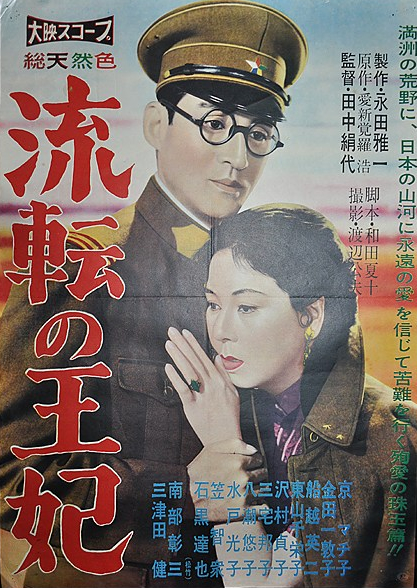
Wandering Princess posterAs in her third film, The Eternal Breasts, Kinuyo Tanaka’s fourth directorial feature, The Wandering Princess (流転の王妃, Ruten no Ouhi), finds her working with extremely recent material – in this case the memoirs of Japanese noblewoman Hiro Saga which had become a bestseller immediately after publication in 1959. Tanaka’s filmic adaptation arrived mere months later in January 1960 which was, in an ironic twist, a year before the real life tale would meet something like the conventional romantic ending familiar from classic melodrama. Nevertheless, working with Daiei’s top talent including Kon Ichikawa’s regular screenwriter (and wife) Natto Wada, Tanaka attempts to reframe the darkness of the preceding 20 years as the defeat of compassionate idealism at the hands of rigid austerity and unstoppable oppression.

Tanaka opens with a scene taking place in 1957 which in fact depicts a somewhat notorious incident already known to the contemporary audience and otherwise unexplained on-screen in which the older Ryuko (Machiko Kyo) tenderly bends over the body of lifeless schoolgirl. The camera then pulls back to find another girl in school uniform, Ryuko, twenty years earlier. A young woman with innocent dreams, Ryuko’s life encounters the usual kind of unwelcome disruption in the unexpected arrival of a marriage proposal but this is no ordinary wedding. Ryuko, as the oldest daughter of a prominent noble family, has been selected as a possible bride for the younger brother of the former Qing emperor now installed as the symbolic leader of the Japanese puppet state of Manchuria. Against the odds, Ryuko and her new husband Futetsu (Eiji Funakoshi) are well matched and endeavour to build a happy home together just as they intend to commit themselves to the creation of a new nation born from the twin legacies of the fallen Chinese empire and the resurgent Japan.

Foregrounding Ryuko’s experience, the film does its best to set “politics” aside but the inescapable truth is that each of our protagonists is a prisoner of the times in which they live. The second scene finds Ryuko in 1937 as an innocent schoolgirl gazing at the young men in uniform as they march past her. She remains out of step with them, walking idly and at her own uneven rhythm while they keep rigorous and seemingly unstoppable time. The family are understandably wary of the implications of the marriage proposal, especially as it comes with a military escort, with Ryuko’s beloved grandmother the only one brave enough to ask to see whoever’s in charge of this outrage only to be told that their fates are in the hands of the nebulous concept known as “army” which knows no individual will.

Assured by her family that the decision rests with her, Ryuko consents – not only to becoming a stranger’s wife (which would have been her fate in any case) but to being a kind of ambassador, the presentable face of imperial ambition. On her marriage she’s presented with a deep red cheongsam and continues to dress in Chinese fashion for remainder of her life in Manchuria where she learns to speak Mandarin and devotes herself to becoming as Chinese as it’s possible to be. Meanwhile, her husband Futetsu busies himself with a complementary desire to become Japanese, intensely worried that the sometimes degrading treatment he and his family receive is exclusively caused by his problematic nationality. When their daughter, Eisei, is born, the couple determine to raise her as the child of a new world, the embodiment of idealised cultural integration.

The world, however, is not so kind and the blunt force of militarism continues to present a barrier to familial harmony. Futetsu is prevented from seeing his brother by the officious forces of the military police while the lonely, paranoid “emperor” suspects that Ryuko is nothing more than a Japanese spy sent to undermine his rule. Ryuko was sent to Manchuria to be the bridge between two cultures. Her, in a sense, feminine energy which attempts to build connection through compassion and understanding is consistently contrasted with the prevailing male energy of the age which prizes only destruction and dominance. Filled with the naivety of idealism, she truly believes in the goodness of the Manchurian project and is entirely blind to the less altruistic actions of her countrymen engaged in the same endeavour.

Confronted by some children in a park while pushing the infant Eisei in a pram, Ryuko is identified as a Japanese woman by her accent while conversing in Mandarin. She assures the children that Eisei is Manchurian like them, and that seeing as she married a Manchurian she is now too despite her Japanese birth. The kids are satisfied, so much so that they warn her that some Manchurians were killed recently in this park by Japanese soldiers, adding a mild complaint that it upsets their parents when Japanese people come to their restaurant and leave without paying. Mortified, Ryuko decides to use some of her (meagre) resources to buy all of the kids and everyone else in the park some sweets from a nearby stand, fulfilling her role as a Japanese ambassador even while insisting that she is a proud citizen of the newly born state of Manchuria.

Nevertheless the Manchurian project is doomed to fail, the kind of idealism fought for by Ryuko and Futetsu crushed under the boot of militarism. Despite everything, Ryuko still wants to be the bridge if only to prevent a catastrophe of this kind happening again (while perhaps refusing to engage with some of the reasons it happened in the first place) but in Eisei’s eventual death, foreshadowed in the melancholy opening, a deeply uncomfortable implication is made that the kind of cross-cultural harmony that Ryuko dreams of may not be viable. In contrast to the salaciously reported real life events (somewhat alluded to by presence of a schoolboy’s cap next to the body) which hinted at a suicide pact or murder, Ryuko attributes Eisei’s decision to end her life to an inability to reconcile her twin heritage coupled with the heavy burden of being the last descendent of the Qing Dynasty. Despite this minor misstep of tying the fate of Eisei to the failure of the Manchurian dream and the loss of its misplaced idealism, Ryuko ends her account on a hopeful note in admiring the flowers she planted finally in bloom and looking forward to a more hopeful age governed by warmth and compassion rather than violence and austerity.


The Wandering Princess was presented by Japan Foundation London as part of a series of events marking the publication of Tanaka Kinuyo: Nation, Stardom and Female Subjectivity.

Lone Wolf and Cub: Sword of Vengeance (子連れ狼 子を貸し腕貸しつかまつる, Kenji Misumi, 1972)

lone-wolf-and-cub-sword-of-vengeanceWhen it comes to period exploitation films of the 1970s, one name looms large – Kazuo Koike. A prolific mangaka, Koike also moved into writing screenplays for the various adaptations of his manga including the much loved Lady Snowblood and an original series in the form of Hanzo the Razor. Lone Wolf and Cub was one of his earliest successes, published between 1970 and 1976 the series spanned 28 volumes and was quickly turned into a movie franchise following the usual pattern of the time which saw six instalments released from 1972 to 1974. Martial arts specialist Tomisaburo Wakayama starred as the ill fated “Lone Wolf”, Ogami, in each of the theatrical movies as the former shogun executioner fights to clear his name and get revenge on the people who framed him for treason and murdered his wife, all with his adorable little son ensconced in a bamboo cart.
The first instalment in the series, Sword of Vengeance (子連れ狼 子を貸し腕貸しつかまつる, Kozure Okami: Kowokashi Udekashi Tsukamatsuru), begins with Itto Ogami’s fall from grace when he’s framed by a rival clan, Yagyu, who have their eyes on his family’s historical position as the Shogun’s official “executioner”. In fact, when we first meet Ogami he’s in the middle of an unusual job – he’s to be the “second” in the seppuku of a noble lord, only this noble lord is a toddler whom Ogami must behead (the child will obviously be spared the horror of cutting his own stomach, but not excused the execution). Returning home after completing his grim task with seemingly no reaction at all, Ogami embraces his own young son, not so different in age from the boy whose head he just removed, and talks warmly with his wife who describes to him an ominous nightmare she’s been having in which some of the lords Ogami has been the second for come back for revenge.

Though Ogami decries his wife’s fears as ridiculous, his house is indeed raided, his wife killed and a tablet bearing the Shogun’s crest placed on his memorial altar neatly incriminating him for plotting against his master. Ogami manages to defeat the Yagyu clan members who’ve been sent to arrest him and sets off on a quest for vengeance, wandering the land as a swordsman for hire with his little son, Daigoro, also apparently for rent too.

Despite his cool exterior and lack of outward expression, Ogami is clearly attached to his son both as the head of his clan and as a father. In deciding what to do with the child, he gives Daigoro a simple test in which he positions a sword and a ball on the floor and instructs his infant son to choose one, even knowing that he can’t understand well enough to make anything other than an instinctual choice. Had he chosen the ball, Ogami would have sent him to meet his mother but Daigoro chooses the way of the sword and so the pair are forced onto the “Demon Way”, a path filled with blood and violence as they journey onward to avenge the death of a wife and mother, and restore the good name of their clan unfairly tarnished by a dark plot.

Though his quest is for bloody vengeance, Ogami is not a cruel man as evidenced by the first job the pair receive which is for little Daigoro who finds himself seized by a woman driven mad by grief following the death of her own infant son but seems to calm down a little after being allowed to breastfeed Ogami’s boy. Though the woman’s mother apologises and offers to pay for “borrowing” Daigoro as it says on the large sign attached to his cart, Ogami refuses to take the money seeing as Daigoro needed feeding anyway. Similarly, when the pair find themselves swordless and trapped among vicious bandits, Ogami saves the life of a prostitute who just attempted to stick up for him by giving in to the bandits’ demands and publicly sleeping with her.

This earns him the woman’s eternal admiration, not only for “degrading” himself by sleeping with such a lowly woman as herself and in such a public way, but apparently making quite a success of it for someone supposedly terrified into silence. No one, she says, could be so considerate and bring such satisfaction to a woman in a state of fear. Indeed, Ogami has been playing the long game, pretending to be just another terrified hostage of this tiny hot spring town but when the bandits suddenly declare it’s time to get rid of anyone who’s seen their faces, Ogami leaps into action with a series of cleverly hidden tools secreted about Daigoro’s cart.

That is to say, he’s there on a job, saving the townspeople is more of a happy byproduct than his ultimate intention. On his entrance into the town, Ogami comes across the scene of a local woman failing to escape the bandits’ clutches before being stripped, molested, raped and murdered in front of the father who has come to try and save her and is also murdered for his pains. Ogami, end game in mind, does nothing. The bandits eventually find their comeuppance on the edge of Ogami’s sword, but it’s too late for a poor young woman and her elderly father.

Inhabiting a similar cinematic world to the also Koike scripted Lady Snowblood, Sword of Vengeance is a Leone-esque, western-tinged tale of a mysterious wandering assassin, albeit one pushing a baby cart. Complete with the more expressionist aesthetics of the Japanese ‘70s exploitation film from the colourful ice and fire opening to the exaggerated blood spray in the genre’s characteristically thick, too bright red, Sword of Vengeance is a worthy start to the cycle which casts Ogami downwards from his elite samurai roots and onto the “Demon Way”, bound for hell by way of vengeance, and all with a smiley faced toddler peeking out from a constantly moving cart.


Original trailer (English subtitles)

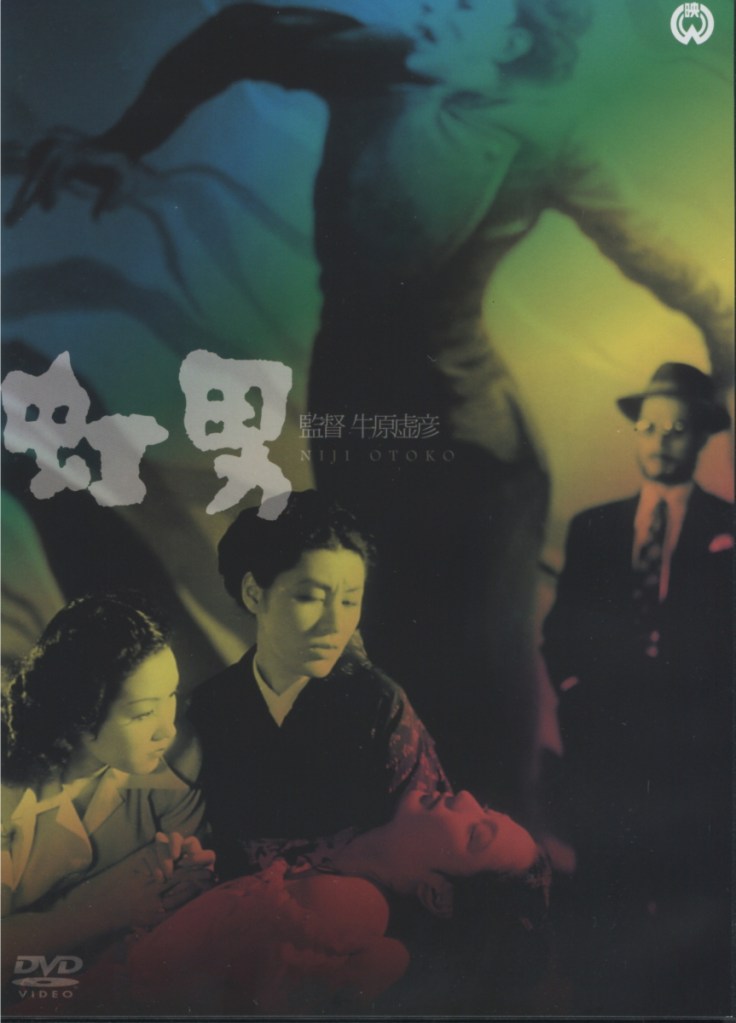
The Rainbow Man (虹男, Kiyohiko Ushihara, 1949)

The Rainbow Man“The Rainbow Man” sounds like quite a cheerful fellow, doesn’t he? How could you not be excited about a visit from such a bright and colourful chap especially as he generally turns up after the rain has ended? Daiei have once again found something happy and made it sinister in this 1949 genre effort which is sometimes called Japan’s first science fiction film though there isn’t really any sci-fi content here so much as a strange murder mystery with a weird drug at its centre.

The story begins with lady reporter Mimi beating her rival Akashi to an important scoop but soon after she runs into an old school friend who seems about to become a major story herself. Yurie has been taken in for questioning regarding a mysterious incident in which a rural cottage burnt down with the body of a murdered man hidden inside it. Heading into town with her maid, Yurie was taken ill near the crime scene and the maid left to go get help meaning Yurie can’t account for the hour or so that she was alone there and being so ill her memories aren’t clear either.

The case at hand concerns the extremely strange Maya family which is led by the mad scientist father who insists on studying artificial rainbows despite an ancient curse on his family which makes this a very bad idea. He is joined by his equally mad artist son Katsuto who creates disturbing, psychedelic paintings, younger son Toyohiko who has recently returned after a five year absence, and his second wife who likes Yurie and cats but not much else. The murdered man, Hachiro, was also connected to the family and was the first to fall victim to the curse of the Rainbow Man!

Unlike some of Daiei’s other genre pictures from this period, Rainbow Man (虹男, Niji Otoko) is a little more straightforward and doesn’t feature any particularly complex special effects. That said, the most notable feature of the film is the rainbow effect itself – right before the murders occur, the victims start shouting about the Rainbow Man whilst hallucinating bright rainbow-like colours. At this point, the screen erupts with psychedelic colours in strong contrast to the regular black and white footage of the rest of the movie. As surprising as this effect is now, it must have been truly shocking to the audience of 1949 who were understandably much less used to colour movies let alone the use of colour in films otherwise monochrome.

Though The Rainbow Man is tagged as sci-fi or horror, it’s really much more of a regular murder mystery with a scientific bent. In the end, it all comes down to the effects of the perfectly natural real world drug mescaline which though unusual is not a scientific fiction. The only instance of strangeness is in the bizarre rainbow man curse in which the Maya family is not supposed to be asking questions about rainbows, which is fairly odd thing to be cursed with, but then they are a very odd family in all aspects. There is, however, a strong mad scientist vibe which, mixed with the creepy old Western style house and persistent stormy weather, makes for an excitingly gothic atmosphere.

The special effects were once again designed by Eiji Tsuburaya and, even if this isn’t such a FX heavy film as some of Daiei’s other movies from the period, are always quite exciting. Director Kiyohiko Ushihara does a nice job of keeping the tension up and provides several interesting set pieces filled with unusual compositions which also make good use of gothic lighting.

The Rainbow Man is also quite interesting as an example of female led genre cinema as lady journalist Mimi takes the central investigator spot and is presented as a talented reporter who always seems to outsmart her male counterpart from a rival newspaper, Akashi. The police too, who are also depicted as competent and open minded, take Mimi seriously by valuing her investigative skills and her desire to protect her presumably innocent friend from harm. The Rainbow Man might not be the sci-fi/horror film it is often supposed to be, but it does provide an intriguing murder mystery with gothic overtones and light layer of genre inflected strangeness.


Can’t find any clips of the movie but here’s a recording of the main theme plus some stills: