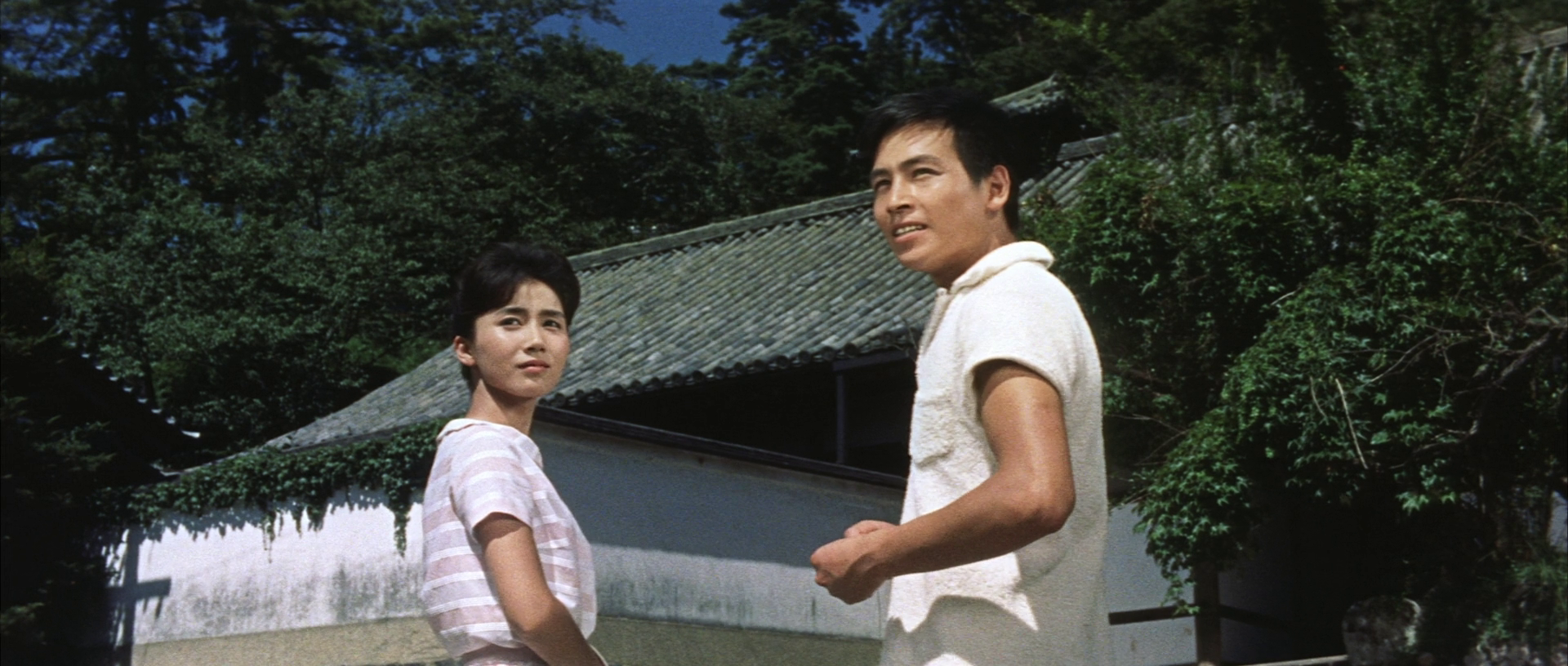
A Good Man, A Good Day (好人好日, Minoru Shibuya, 1961)

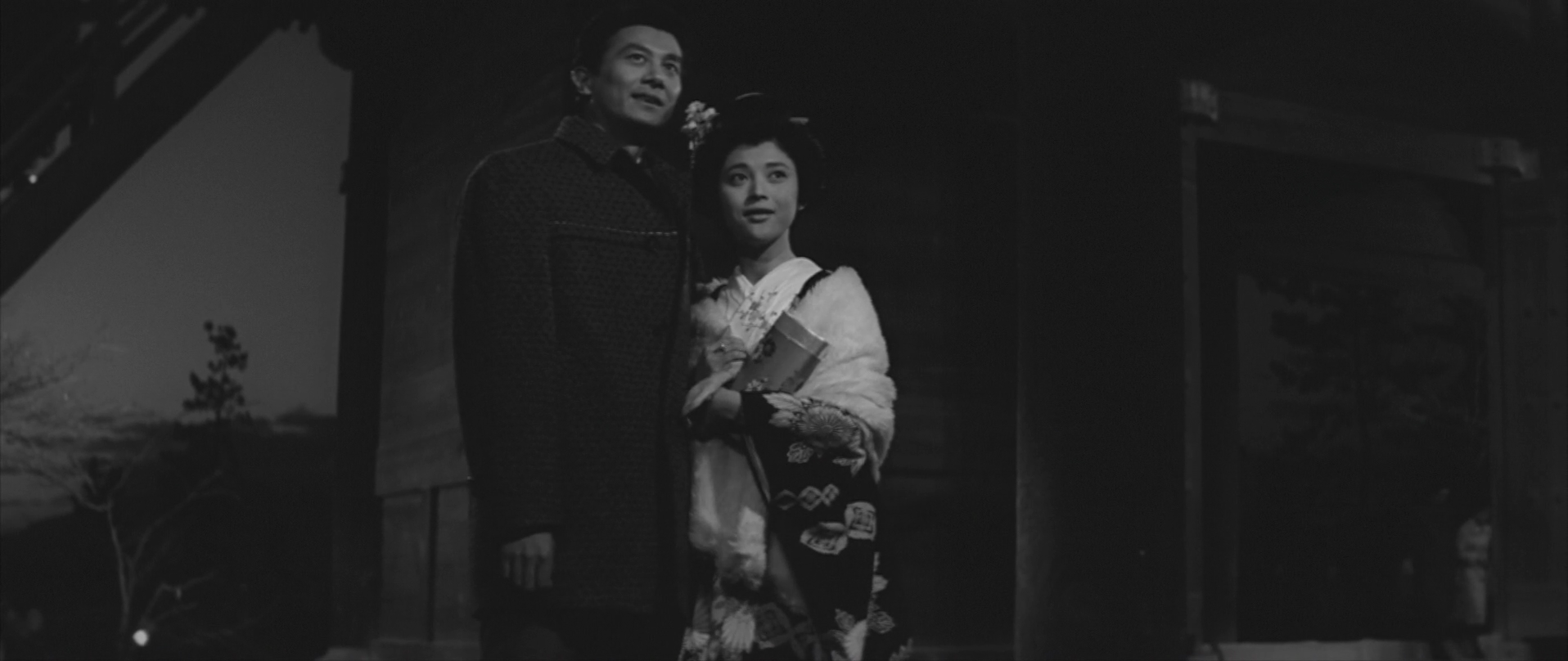
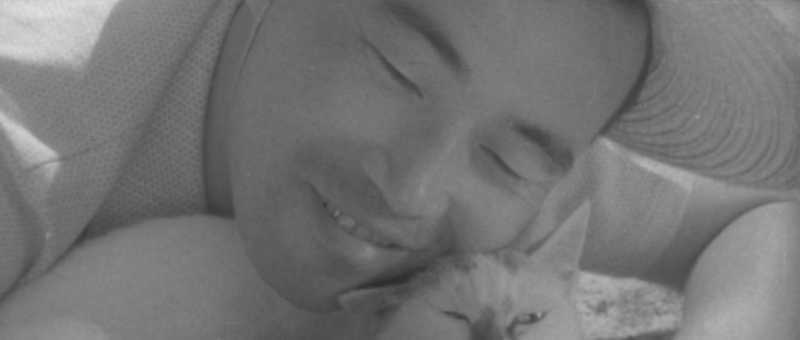
It’s funny, in a way, that life can hold so much goodness in it even with an underlying, barely visible melancholy. Goodness does indeed breed goodness for the sometimes misunderstood heroes of A Good Man, a Good Day (好人好日, Kojin Kojitsu) who struggle to adjust themselves to changing times but at the end of the day just want each other to be happy and for life to be blissfully dull and free of complication.

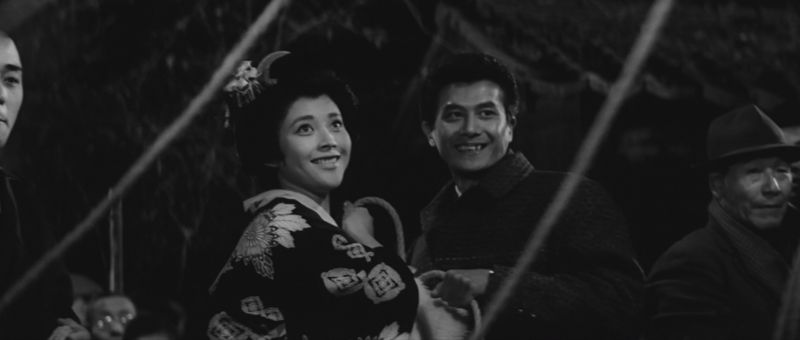
The obvious point of friction is that 20-something daughter Tokiko (Shima Iwashita) has had a proposal. She behaves as if it’s an arranged marriage, but in reality Ryuji (Yusuke Kawazu) is actually her boyfriend and the two of them have mutually decided to formalise their union but are doing things the “proper” way perhaps in part because Ryuji’s family run a 200-year-old ink shop and are intensely conservative. Though it’s Tokiko’s fuddy-duddy professor father Hitoshi (Chishu Ryu) who is often regarded as the sticking point, it’s equally Ryuji’s family and particularly his traditionalist grandmother (Tanie Kitabayashi) who isn’t sure that Tokiko is really good enough. She is however the only member of the family who thinks it’s not a big deal after discovering that Tokiko is adopted while others regard her with an increased suspicion and the prejudice often held towards orphans that they don’t want to let someone into their family whose familial lineage they don’t know.

It’s most likely for their benefit that Tokiko and Ryuji are intent on compromising by doing everything the “proper” way rather than as her mother Setsuko (Chikage Awashima) tells her just get married on their own without worrying about what anyone thinks. But in this awkward mix of tradition and modernity we can see that times have changed and Ryuji and Tokiko have decided their future for themselves. They firmly believe it will work out so they’re remaining patient, but should that patience run out they will decide to prioritise their own happiness. 

For his part, Hitoshi later says that he never actually objected to the marriage but just hates the idea of big weddings which he regards, not without reason, as stupid and pointless. In any case he warms to Ryuji when he loses his temper and calls him an “old fart,” realising that he’s a young man with a backbone and possibly worthy of Tokiko. A professor of mathematics, Hitoshi is an awkward man who doesn’t quite fit into polite society but has a good heart even if he has a funny way of showing it. When he wins an important medal from the government for his contribution to scholarship and it gets stolen, he won’t let the hotel owner report it because of his embarrassment but when the chastened thief brings it back he sends Tokiko after him with money for his train fare and a little more as a thank you. 

Still, he was probably not an easy man to live with and Setsuko’s not so secret sake habit is likely a result of the strain of dealing with him and his constant faux pas in the boredom of a rural life in which she says all she does is make pickles. But despite that, she still tells Tokiko that marriage is essential to a woman’s happiness if also encouraging her to fight for what she really wants. Tokiko is already doing just that, but has lingering doubts over her parentage and wants to know who her birth parents may have been partly out of curiosity but also a mild fear of the implications it may have. But what Hitoshi eventually tells her is that she is a war orphan which makes her a kind of everywoman and a symbol of the young, post-war generation which is making a break with the past. 

The film in fact includes a small satirical, anti-war sequence in which Hitoshi is accosted by a snooty nationalist who shouts out that he lacks “patriotism” for allowing the medal the emperor so generously gave him to be stolen. The man tells him he should face the direction of the Imperial Palace and apologise all which makes him look quite mad and paints Hitoshi as the figure of exasperated sanity. He also rejects contemporary consumerist culture in continuing to live like a student counting every last yen and rejecting the TV set Ryuji buys him because it would deprive him of going to the coffee shop to watch baseball games instead (though he does regret it later). In any case, Hitoshi’s guileless goodness does seem to ameliorate the world around him in making others, like the thief, want to live up to it as he, like Tokiko, defiantly does what he wants and though at times perhaps insensitive generally has his heart in the right place.
Like a Savage (野蛮人のように, Toru Kawashima, 1985)

Hiroko Yakushimaru had been the breakout star of Haruki Kadokawa’s idol cinema in the early 1980s, but as she approached her 20th birthday had developed an increasing desire to retire and leave the showbiz world behind. Having won the prestigious Blue Ribbon Best Actress award for her role in W’s Tragedy, she ended her contract with the studio but following the outcry over news of her intention to retire ultimately set up on her own as an independent performer with her own management company. 

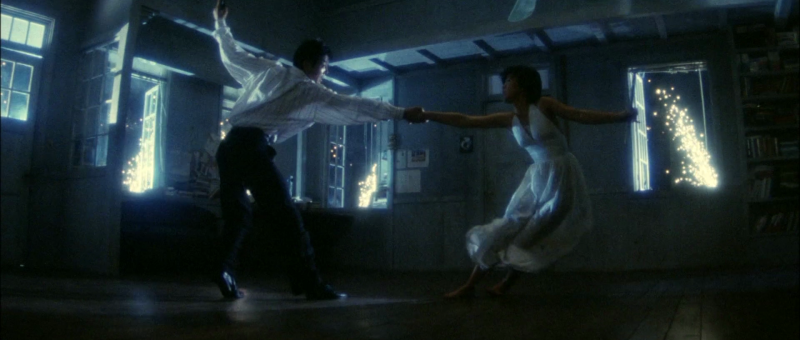
Like a Savage (野蛮人のように, Yabanjin no Youni) was her first project after moving on from Kadokawa and was intended to signal a new phase in her career though incorporating many of the elements that had made her teen idol films so successful. This time around, she plays a character seemingly a few years above her actual age though in other ways childlike and something of a fantasist. Tamako is a blocked novelist in her mid-20s who had tremendous success with her first work published when she was only 15. Ostensibly, she leads an incredibly aspirational life living in a beautiful cabin on the beach where she tries to write sitting out in the sun on her terrace. In the opening sequences, we see her taking a break by reading a novel in English while she also shows a knowledge of French which adds to her intellectual credentials and sense of contemporary sophistication. 

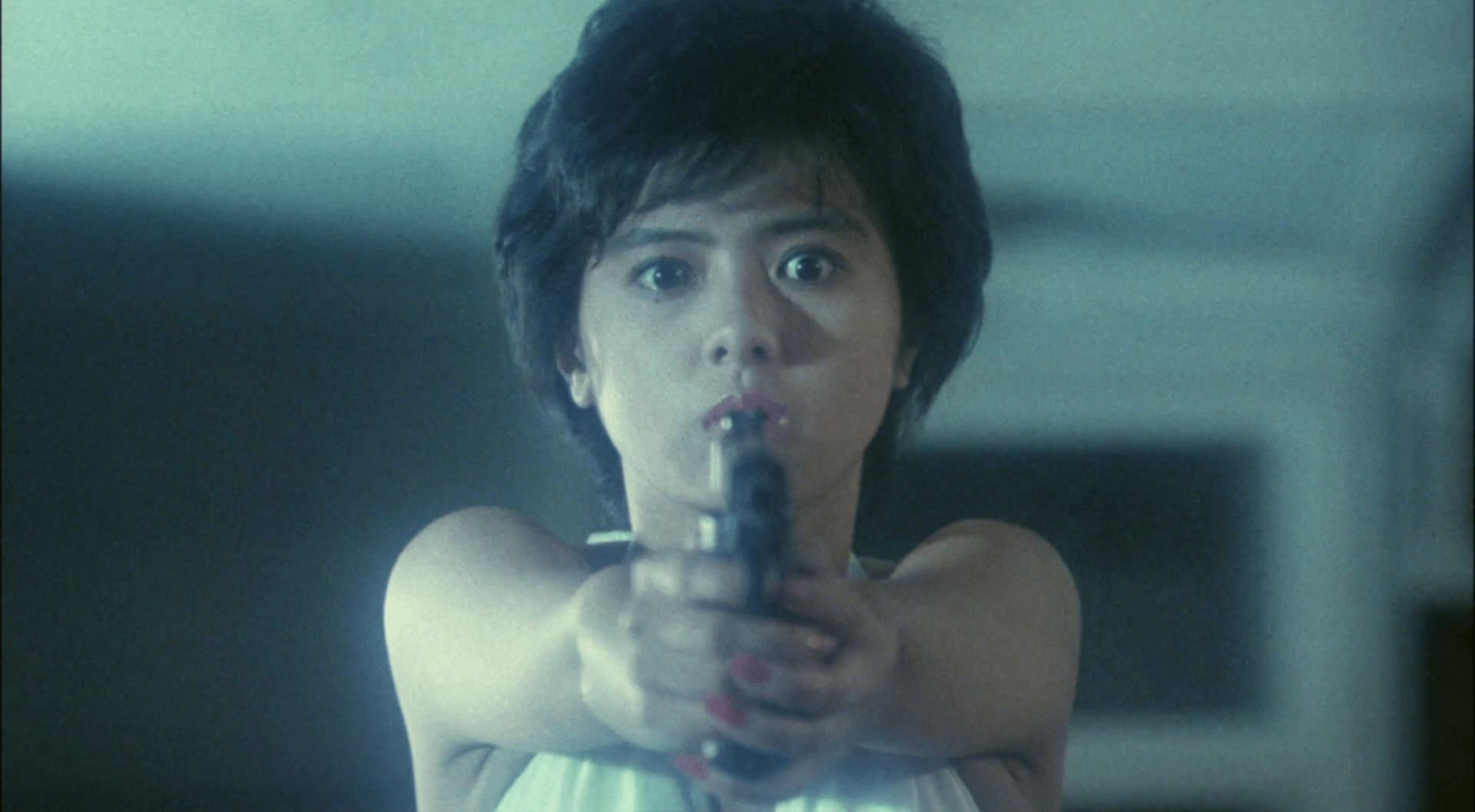
But it seems that she may be bored with this seemingly charmed life and is having trouble gaining inspiration because she’s become too comfortable. She also has a capricious selfish streak, randomly abandoning her friends who’ve come for a fireworks party by driving her open-topped jeep all the way into the centre of Roppongi “to find adventure in the night”. Adventure ends up finding her when she’s unwittingly drawn into underworld intrigue after being mistaken for a sex worker who was with a yakuza boss immediately before he was assassinated, as it turns out by one of his own men intent on succession but trying to disguise his ham-fisted bid for power as turf war. Teaming up with yakuza-adjacent fixer Eiji (Kyohei Shibata) she finds herself on the run before eventually taking him back to the cabin to hide out and recuperate from a stab wound. 

Yakushimaru had played similar roles as a teen star, but adds an adult edge as Tamako chain smokes and is almost always drinking, in fact being seven sheets to the wind while driving the jeep to the city. In other ways, however, she retains a childlike quality most obviously in the film’s repeated to references to Alice in Wonderland which paint the contemporary capital as a fantastical place coloured by her own literary imagination. In her flight through the city, she passes what seems to be a Mad Hatter’s Tea Party, while there’s also a neon sign featuring what looks like the Cheshire Cat grinning wildly in the Cabaret-influenced drag bar where Eiji works in which a performer dressed as Sally Bowles sings in French and many of the waiters are implied to be trans or gay. When the gangsters finally surround the beach house in the final act, a pottery figurine of a rabbit with a stopwatch is obliterated by their bullets as if to remind her that she’s not in Wonderland anymore and all of this is “real” rather than the romanticised fantasy she may have bought into while nursing a handsome yakuza back to health by the sea. 

Even so, the city has its darkness. The girl who really was with the yakuza boss when he died twice gives her age as only 15, one of many Eiji shepherded around as part of his yakuza-adjacent job. The head yakuza has an eerie presence deepened by the use of a strange voice effect whenever he speaks, while Kawashima captures a fantastical side of Bubble-era Tokyo lit by the warm glow of hazy neon. In a moment of irony, a large sign on the building where the yakuza boss met his end reads “Desire” with its letters finally flickering out to leave just “Die” as if to tell us this rampantly consumerist city of darkness will eventually consume all those who cannot escape its allure. 

In any case, Tamako finds herself literally blowing up her world to cure her existential crisis reflecting that life is like a firework destined to burn out bright. What she experiences is another kind of rebirth, the climactic shootout occurring on her birthday which Eiji, who does not know his date of birth presumably having been abandoned as a baby, later adopts as his own. Surprisingly stylish and generally upbeat despite the darkness around its edges, Kawashima’s zeitgeisty action drama captures something of an age of ennui in which fantasy is the only escape from the emptiness of a neon-lit Tokyo. 


Original trailer (no subtitles)

This Year’s Love (今年の恋, Keisuke Kinoshita, 1962)

The friendship between two underachieving teenage boys hints a series of conflicts in a changing society while accidentally bringing their respective siblings together in Keisuke Kinoshita’s cheerful romantic comedy, This Year’s Love (今年の恋, Kotoshi no Koi). In many ways, it’s the older siblings who appear to be stuck while the parents are largely content to let life be and the boys rejecting the conventional paths laid out for them while attempting to overcome their loneliness and sense of despair through the sincerity of their interclass friendship. 

As the film opens, high school boys Hikaru (Masakazu Tamura) and Ichiro (Ryuji Ishikawa) have been lured to a patch of grass above the city where they’re assaulted by an older bully who for some reason resents the fact that they weren’t wearing their traditional students caps even though such things are perhaps already outdated in the rapidly changing society of 1962. In any case, Hikaru vows revenge, deciding to give up golf club and a series of other things to take up boxing, instructing Ichiro to abandon the “girly” sport of basketball and join him. Neither boy is currently doing very well at their studies, with Ichiro’s prim and proper sister Mikako (Mariko Okada) convinced that Hikaru is a bad influence on her brother assuming that he is another spoilt rich kid set on leading him astray. 

In fact, she’s not entirely wrong. Hikaru does seem to be somewhat aimless probably because his family is wealthy and he doesn’t see much urgency in the situation nor hold that kind of anxiety for his future though is fond of telling people that he feels quite depressed. While Ichiro lives in Ginza where his family run a successful restaurant, Hikaru lives in a large townhouse in nearby Yokohama cared for largely by their kindhearted housekeeper (Chieko Higashiyama) and a live-in maid while his older brother Tadashi (Teruo Yoshida) is currently a graduate student heading towards a regular salaryman job. Their mother having died some time ago and their father always away on business, care for Hikaru has largely fallen to Tadashi who is nevertheless a young man himself with his own life to be getting on with. Similarly Mikako has largely taken on a maternal role when it comes to caring for Ichiro because her parents are always busy with the restaurant. Part of the reason she’s resentful of Hikaru is that she’s the one the school keeps calling in about her brother’s poor academic performance while Ichiro is always off messing around with his rich kid friend. 

Mikako seems to take against Hikaru in part because he is rich, assuming that wealthy people are necessarily decadent and lazy while concerned that Ichiro’s head is being turned by seeing the way the other half live without understanding what it takes to live that way. The Aikawas aren’t exactly poor, they also have a live-in maid and their quarters behind the restaurant are spacious enough, though they couldn’t quite claim to be middle class because they work in the hospitality sector which is still somewhat looked down upon. In any case, dressing exclusively in kimono Mikako is extremely uptight and obsessed with properness. She further takes against the Yamadas after an awkward first meeting with Tadashi who is dumped by his fed up girlfriend in her restaurant and ends up getting beer thrown in his face, while his father later turns up with his secret longterm mistress, a maid from an inn in Atami, leaving Mikako scandalised and embarrassed. 

Ironically enough, Tadashi’s name quite literally means “correct” though even if he isn’t quite as hardline as Mikako he also wants the best for his brother. Because of the realities of life in post-war Japan, both boys explain that they find it hard to study in part because they are lonely often left home alone with no one to talk to which is one reason they value their friendship so deeply. Hikaru’s mother has passed away and his father is largely absent, while Ichiro’s parents are always working in the restaurant as is Mikako even if she’s largely been delegated other maternal duties. Tadashi and the housekeeper attempt to set Hikaru straight that he needs to do well in school because he’ll have to be able to get a good job to support himself, but Hikaru is part of a new generation that doesn’t the see point in the emptiness of the salaryman lifestyle. Tadashi might not either, but he’s going along with it anyway whereas as Mikako is completely wedded to the idea of aspirational respectability intent that Ichiro should do his best to get into college and catapult himself into the middle classes.

Her cheerfully laidback parents meanwhile barely finished school and have done alright for themselves with restaurant. They aren’t that bothered if Ichiro isn’t academically inclined because they can train him up as a chef even if that isn’t quite the future Mikako had envisaged for him in her upwardly mobile worldview. Nevertheless, she’s not quite as prim as she makes out, sneaking the odd cigarette here and there, and despite herself begins to fall for Tadashi’s goofy charms while bonding in shared love for their siblings. In the end she’s the one who has to learn that it’s alright to have a little fun now and then and if longtime widower Mr Yamada has a girlfriend that’s probably alright too. The boys’ teacher hints that he finds it strange they aren’t more into girls, Hikaru apparently so popular that the phone at his house never stops ringing but he turns them all down because he’s too consumed with ennui to date, introducing an additional transgressive element to their friendship along with their bid for manliness with their new obsession with boxing which as Mikako’s maid points out does feature a series of shirtless musclebound men. Perhaps Mikako’s newfound appreciation for romantic freedom wouldn’t stretch that far, but it does seem to have opened her up to new possibilities in a less judgemental future as she rings in the new year in the old capital of Kyoto. 


Black Rain (黒い雨, Shohei Imamura, 1989)

Caught in a moment of transition, post-war Japan struggles to free itself from the lingering feudal legacy and the trauma of the immediate past in Shohei Imamura’s contemplative adaptation of the novel by Masuji Ibuse, Black Rain (黒い雨, Kuroi Ame). As many things change others stay the same, the Shizuma family burdened not only by the anxiety of a ghostly illness symptomless until it isn’t and the unfair prejudice of a wounded society, but the pressure of outdated patriarchal social codes along with a sense of filial failure in the inability to protect their ancestral estate. 

Imamura opens on the fateful morning the atomic bomb struck Hiroshima, voiceovers from 20-year-old niece Yasuko (Yoshiko Tanaka) and her uncle Shigematsu (Kazuo Kitamura), a soldier severing at a factory in the city, detailing what they were doing on that very ordinary day. What unfolds is a scene of hell, the train Shigematsu is riding on blown apart while he crawls free and tries to look for his wife, Shigeko (Kazuo Kitamura), packing up their house preparing for evacuation, eventually reuniting with Yasuko who had come into town to find them. Hoping to get to the factory, they make their way past charred and hideously warped bodies, a woman cradling her carbonised infant, a little boy overjoyed to have found his big brother only to go unrecognised because his face is melted away while skin hangs painfully from his forearms and fingertips. The brother only accepts him after checking his belt which has somehow miraculously survived. The trio eventually make it to comparative safety at the factory with relatively few injuries, only later learning of the implications of having been in such close proximity to the blast. 

Jumping ahead five years, the Shizumas are living quite comfortably in their ancestral home on a mountain estate largely spared the post-war agricultural land reforms because of its location, though Shigematsu attributes his mother’s dementia to an inability to accept the changing times not only their loss of a semi-aristocratic status but the essential failure of having proved unable to protect their ancestral lands. His immediate problem is however the marriage of the now 25-year-old Yasuko. We see him triumphantly leave a doctor’s office with a certificate stating that Yasuko is in good health he hopes will reassure her current suitor’s family in the face of persistent rumours that she too was a direct victim of the “flash”, rather than an indirect victim simply of the rain which Shigematsu mistakenly believes to have been less dangerous. 

At 25 this is Yasuko’s last chance, she’s aged out of the arranged marriage market. She has also had a promising job offer from the local post office but is minded to turn it down in the hopes of being married. Taking the post office job may be the most sensible option, but it also seems like defeat, an acceptance that she is unfit for marriage and a clear sign that Shigematsu and Shigeko have failed in their patriarchal duties to ensure that Yasuko finds a good husband and will be well looked after for the rest of her life. In this age, it is difficult for a woman to support herself alone even leaving aside the social stigma of being an unmarried woman. A marriage is therefore also a job, and the families fear one Yasuko may not be able to perform if as the rumours suggest her exposure to radiation may have left her unable to bear children. The situation is further complicated seeing as Shigematsu and Shigeko were not able to have children of their own, and with Yasuko’s mother Kiyoko having died young Yasuko is the last of the Shizuma line even if she technically may not bear their name. 

Lost in old memories and mistaking Yasuko for her mother, grandma (Hisako Hara) may have it right when she tells her not to marry for marriage only leads to death. Yet in an odd way, Yasuko’s liminal status perhaps grants her the right to turn away from these old-fashioned patriarchal expectations in making her own decision not marry even if she orients herself back towards the filial in requesting to stay with the aunt and uncle who raised her in order to care for them should they suddenly begin to experience symptoms of their exposure to “the flash”. Shigematsu continues to treat the notion of radiation sickness with an almost supernatural mentality, convinced that having seen the light or not is all that matters constantly trying to provide evidence that Yasuko was not there when the bomb went off while ignoring her exposure to the black rain which fell afterwards even while himself filled with the anxiety of not knowing if he may someday become ill even if he and Shigeko are in otherwise good health. 

He watches friends with secondary exposure become ill and die before him, recalling being asked to read sutras for the dead in the aftermath of the bomb though feeling himself unqualified, while some in the village perhaps jokingly accuse them of playing on their status as bomb victims as if they are merely lazy rather than actively sick. Meanwhile, across the way a young man with intense PTSD suffers flashbacks every time he hears an engine running and is compelled to throw himself in front of it as if it were an enemy tank. Yuichi (Keisuke Ishida) is ironically enough “a veteran of the suicide squad”, otherwise alright if fragile spending his days carving Buddhist Jizo statues may of which have grotesque, anguished expressions in contrast to the comforting, almost cute faces such statues usually bear. Just as the wider society distances itself from the survivors of the bomb, so they reject men like Yuichi. When Yuichi’s mother comes to propose an unlikely marriage between the two lonely youngsters who have become close after bonding through their shared anxieties, Shigematsu is offended, resenting the implication that they must believe Yasuko is a poor catch if daring to suggest she marry a man of a lower social class who is also in need of assistance in living with his mental illness. 

Yet her marriage continues to weigh heavily on Shigeko’s mind, feeling as if she has failed the Shizuma family in being unable to provide an heir and subsequently failing to secure a match for Yasuko. It is perhaps this anxiety that finally makes her ill, taking strange medicines provided by a dubious Shinto priestess who tells her it’s all her own fault for not being able to visit Kiyoko’s grave because someone has to stay at home to look after grandma. Only Shigematsu sees the writing on the wall, advising Yasuko that after grandma dies she should sell the estate and take the money as her dowry freeing her from the feudal and familial legacy and giving her permission to move into the modern post-war future even as she begins to doubt that the future has a place for her. 

Shooting in black and white and in a much more classical style than that which is found in his other work, Imamura adopts the aesthetics of Golden Age cinema to comment on the contemporary era now perhaps feeling itself sufficiently distanced from the toxicity of wartime trauma, suggesting that the entire society is in a sense soaked in black rain its inability to confront the recent past a poison slowly eating away at its foundations. “An unjust peace is better than a just war” Shigematsu is fond of saying, quoting Cicero dismayed by the heated geopolitical debates he hears on the radio he uses to set the clock, his friend dying without ever really understanding why the bomb was dropped, why on Hiroshima, why at that particular moment. Imamura denies us closure too, leaving on a note of anxiety if tempered with an all but forlorn hope for signs of a miracle on the horizon that the sickness can be healed and a better world will someday arrive.


Black Rain screens at the BFI on 28th December as part of BFI Japan and is also available on blu-ray as part of Arrow’s Imamura boxset or to stream in the UK via Arrow Player

Fire Festival (火まつり, Mitsuo Yanagimachi, 1985)

By 1985 the Japanese economy was approaching its zenith yet along with increasing economic prosperity had come social change of which small-town Japan was either casualty or sacrificial victim. “Nigishima will stay as it is” declares the last holdout of an increasingly obsolete way of life in Mitsuo Yanagimachi’s intense modernity drama, Fire Festival (火まつり, Himatsuri), a manly mountain man and animalistic force of nature by several metrics unsuited to life in the contemporary society into which he is ultimately unable to progress. 

There are many things which it seems have not changed in Nigishima for generations, one being the animosity between the cohorts of its bifurcated community, those who live by land and those who live by sea. Rural depopulation may have forced them to come closer but it has also increased their sense of mistrust while both industries continue to suffer in an economy which no longer prizes their humble rural output. Despite being catapulted into a promised modernity by the advent of the railway to great fanfare in 1959, it now seems that Nigishima cannot survive without a new road which could be paid for by the development of a marine park only mountain man Tatsuo (Kinya Kitaoji) owns the property right in the middle of the earmarked area and has hitherto refused to sell further increasing the tension between the two communities. 

Tatsuo is thought of, and thinks of himself, as a big man in the area quite literally it seems as part of the reason he enjoys this status is down to his being unusually well-endowed. He believes himself to have a special relationship with the mountain goddess, often joking to the other men about having a sexual relationship with her while sometimes describing her as his girlfriend. Several times he is mistaken for an animal, firstly by the boatman bringing his childhood sweetheart and sometime mistress Kimiko (Kiwako Taichi) back to the island who assumed he was a monkey crawling along the cliff edge thoughtlessly throwing rocks at them, while he often gambols through the forest whooping like some kind of Tarzan. Entirely unreconstructed, his worldview is patriarchal and misogynistic. All of his banter with the other men is sexual, constantly referring to his penis while greeting his friends with lewd hand gestures thrusting his fist into his pocket as if waving with an erection. The cure for offending the goddess he tells his young protege Ryota (Ryota Nakamoto) is to drop his trousers and display his manhood, Tatsuo strangely believing this would appease her for taking wood from a sacred tree or killing without permission. 

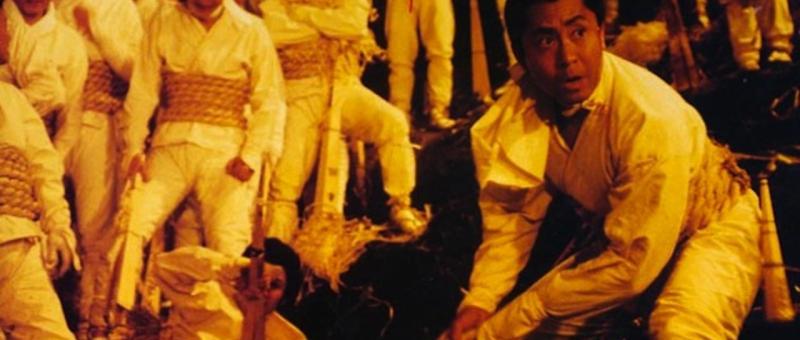
Smearing the blood of a sacrificial animal over his chest and forearms he dedicates the death to the goddess, a gesture he will repeat in the film’s violent and tragic conclusion yet there is also arrogance in his conduct as if he believes himself above natural law, protected as the goddess’ favourite even as he describes himself as “suffocated” by the women in his life from his mother and five older sisters all of whom indulge him to his wife, kids, and mistresses. He has trained his dogs to hunt wild boar without the use of guns in a method he admits even other hunters describe as “cruel” while breaking a local taboo shooting monkeys in the forest well aware of nature red in tooth and claw. As such, there is little nobility to be seen in his determination to preserve this already obsolete way of life. His virility maybe contrasted with that of the ageing land broker Yamakawa (Norihei Miki) and his failed attempts to bed sex worker Kimiko who tricks him into paying off her debts, but he at least knows the way the wind is blowing explaining to her that towns such as Nigishima survive only through things like marine parks or hotels or even nuclear power plants. Without the road, the town will die. 

Yet in 1959 they were told the railway would save them and it seems it did not. Tatsuo’s love making with Kimiko in a boat borrowed from a treacherous fisherman who later agrees to sail it transgressively into sacred waters is intercut with memories of the rail line’s opening ceremony, two teenagers who might have been them or at least of around the same age ride an elephant on the jetty while the townspeople arrange themselves into the formation of the character for “celebration” captured by the aerial photographer above. For Tatsuo as a boy, was this a rebirth of Nigishima or the beginning of its demise as the coming modernity began to eat away at its foundations? 

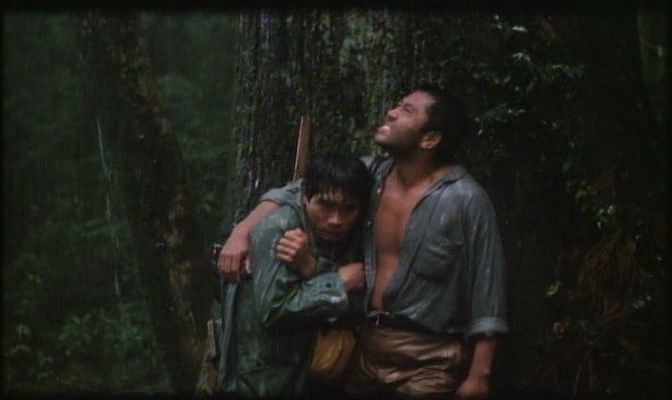
The fire festival is “for men”, according to Tatsuo, “to drive out evil spirits”, his manliness getting the better of him as he disrupts the proceedings to attack a man he accuses of having brought “false fire”. These are the lessons he teaches to surrogate son Ryota whose devotion to him borders on the homoerotic, Tatsuo cradling him during the climactic rain storm and he seeming to develop a fascination for Kimiko as a kind of indirect fixation. Ryota has learned Tatsuo’s chauvinism mimicking his lewd hand gestures and swaggering walk, his cruelty in sacrificing 1000 yen to trick Yamakawa into injuring his hand in a bear trap, and his arrogance ensuring that his problematic masculinity will survive into another generation presumably no more capable of halting the march of modernity than he has been. Tatsuo poisons the waters with fuel oil which as one of the greek chorus of fish wives points out does not catch fire, Tatsuo himself smouldering until an inevitable explosion. Receiving some kind of epiphany during a mystical congress with the goddess in the middle of a storm, he knows what he must do and accepts that he cannot progress into the modern society. Smoulderingly intense in its small-town animosity and primeval sensibilities, Yanagimachi’s poetic tragedy of futility and the broken promises of a badly distributed modernity may accept the the sacrifice but mourns it all the same. 


Fire Festival screens at the BFI on 20/27 December as part of BFI Japan.

Clip (English subtitles)

The House of Hanging (病院坂の首縊りの家, Kon Ichikawa, 1979)

Unlike many directors of his generation who either shifted into television or saw their careers stall, Kon Ichikawa was able to continue working throughout the difficult 70s and 80s precisely because he was less averse to taking on commercial projects such as 1976’s The Inugami Family, an ensemble mystery adapted from the bestselling book by Seishi Yokomizo and starring his famed detective Kosuke Kindaichi. The film proved an unexpected hit, an early success for Haruki Kadokawa’s new multimedia marketing model which would allow him to dominate cinema screens throughout the bubble era, and spawned a series of Kindaichi adaptations produced for Toho boasting a host of A-list stars. By 1979, however, the age of the prestige country house mystery was perhaps coming to a close and The House of Hanging (病院坂の首縊りの家, Byoinzaka no Kubikukuri no Ie) would be the last in the cycle of movies starring Koji Ishizaka who would eventually return to the role in Ichikawa’s 2006 remake of the original Inugami Family. 

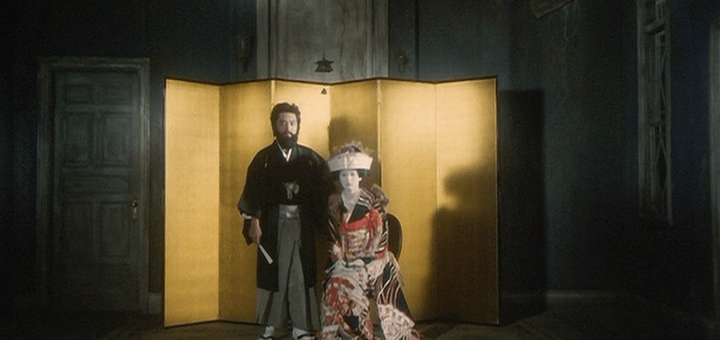
Set quite specifically in 1951 (Showa 26), House of Hanging is among the more complex of Kindaichi’s cases and rests not on war trauma, which is only a background presence in the present venality of the post-war society, but on the decline of a once noble house ruined, as we find out, through the legacy of sexual immorality and abuse. For the moment, however, Kindaichi gets roped into the mystery after visiting an author friend (played by Seishi Yokomizo himself in a cameo) who recommends a photo studio he could visit in order to get a picture taken for his passport as he plans to travel to America. The photographer, Naokichi (Koji Shimizu), takes on an odd job from a strange young woman who asks them to take wedding photos of her sister but abruptly leaves explaining she’ll send a car later to bring them to an undisclosed location. That turns out to be the bombed-out former home of the Hogen family who own the local hospital. Escorted by a creepy young man, Naokichi finds himself in front of a traditional gold screen backdrop but feels uncomfortable because the bride does not seem to be very present and he worries that perhaps she’s been drugged and something untoward may have been going on. He shows the photo to Kindaichi for advice and is later called back to the same location to discover the severed head of the groom hanging from a ceiling light.  

In slightly comedic fashion, the circumstances of the case are so confusing that they have even Kindaichi admitting that he doesn’t quite follow while his temporary sidekick, photographer’s apprentice Mokutaro (Masao Kusakari), proudly holds up a chart he’s made to help keep track. Though the why is in this case more important than it might usually be, it boils down to the same old problem of buried secrets and past shame. We learn that the Hogen family is descended from a line of prominent doctors, though the family tree is complicated because it appears many of the sons of previous generations had illegitimate children, some of whom were later adopted or married to other adopted children in a quasi-incestuous union. With no one quite sure whose children are whose, incest appears to be the original sin which condemns the family, though as we later realise it’s another kind of abuse which sets the present events in motion.

The murdered man, Toshio (Teruhiko Aoi), was apparently part of travelling jazz band earning their living playing on American bases (the photographer also has a sideline in blackmarket army surplus). Aside from the original sin that connects the murders with melancholy fatalism, the additional victims damn themselves through their amoral greed, foolishly engaging in blackmail in the hope of improving their circumstances. Nevertheless, the sin remains the same, the theory being that Toshio was murdered by missing sister Koyuki who killed him in order to escape his inappropriate romantic obsession with her. The additional complication is that Koyuki looks near identical to Yukari (Junko Sakurada), daughter of the Hogen family, connecting the crime with the traumatic events of some years’ previously which led to the cottage becoming known as the “house of hanging” when the body of a young woman was found there having taken her own life. 

As in many of the other Kindaichi mysteries, the detective has only sympathy for those caught up in this complicated murder plot, many of whom are also victims acting simply to protect themselves ironically enough from the past trauma that has in a sense led to this sorry turn of events. Justice, in the end, takes care of itself though Kindaichi will also do his bit to protect those in need acting from a place of moral compassion rather than judicial censure. This final instalment in the Kindaichi cycle has slightly lower production values and a much less starry ensemble but sees Ichikawa adding a few idiosyncratic touches such as his fast, multi-angle cuts to a single person’s speech and a brief theatrical reconstruction sequence, while making time for the return of bumbling inspector Todoroki (Takeshi Kato) and the ironic comedy the series is known for. “Old things pass, that’s when new things are born” Yokomizo sagely advises in his cameo, Kindaichi apparently taking his leave from a corrupted post-war Japan for the bright lights of San Francisco, perhaps never to return. 


Original trailers (no subtitles)

Shozo, a Cat and Two Women (猫と庄造と二人のをんな, Shiro Toyoda, 1956)

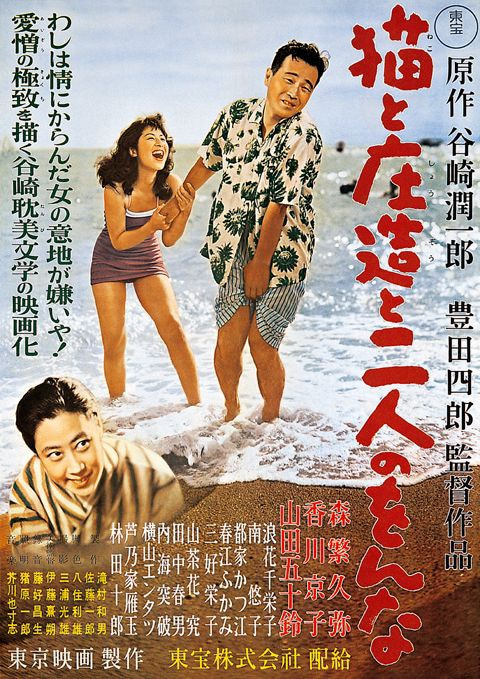
Post-war melodrama is largely concerned with the place of women, in particular, in a rapidly changing society, but given the centrality of domestic life, were men yearning for “independence” too? Shiro Toyoda was closely associated with comedic tales of strong women and weak men, and Shozo, a Cat and Two Women (猫と庄造と二人のをんな, Neko to Shozo to Futari no Onna) is as its title implies no exception. Adapting the novel by Tanizaki, Toyoda offers a subtle critique of the traditional family as its hapless hero finds himself caught between the conflicting demands of his feudalistic mother, stoic first wife, hedonistic second, and his much loved but perhaps mercenary feline, Lily. 

Shozo (Hisaya Morishige) is perhaps a typical spoiled only son, lazy, feckless, and essentially passive. Shinako (Isuzu Yamada) who agreed to an arranged marriage with him four years previously is walking out, thoroughly fed up with her mother-in-law Orin’s (Chieko Naniwa) constant complaints not least among them that the couple have no children. Unbeknownst to Shinako, however,  Shozo has been carrying on with his slightly younger cousin, Fukuko (Kyoko Kagawa), who is a free spirited modern woman. In fact, Fukuko has already run away from home three times in the company of various men so her wealthy father would be only too pleased to see her settle down and is so desperate to offload her that he’s even offering a huge dowry. All of this is complicated by the fact that Fukuko’s father already owns the mortgage on Shozo’s family store, which presents a serious challenge to typical family dynamics. 

Shozo, meanwhile, is only really interested in his pet cat, Lily, something which was a bone of contention in his failed marriage to Shinako (and perhaps a reason they have not been blessed with children). On learning that Orin has already moved Fukuko into the family home mere seconds after she vacated it, Shinako is suddenly struck by remorse and feels the need to vindicate her pride through revenge. Plotting how best to drive a wedge between Fukuko and her new husband, she settles on petitioning Shozo to give her custody of Lily, and then suggests the same thing to her rival knowing that whatever happens it will cause a series of problems in the Oyama household. 

The irony is, in a sense, that it’s Shozo who has been displaced from his own home. Perhaps surprisingly, he often tries to help out with household tasks but his mother always stops him, insisting that housework isn’t something a man should pay attention to. Orin is of course perpetuating outdated ideas of traditional gender roles, but there is also an obvious anxiety in her need to protect her territory from possible incursion. She doesn’t necessarily trust the idea that she and Shozo are connected by anything deeper than practicality and filial obligation and her only currency is her ability to provide the services that Shozo “cannot” provide for himself. His learning to take care of himself is an existential threat to her position as his caregiver even though he is a grown man in his 30s perfectly capable of doing his own laundry and preparing his own meals (as he already does for Lily who particularly enjoys grilled chicken). 

When they brought Shinako into the house, they did so apparently because she was known to be a “good worker” at her job as a maid for a wealthy family. Since then she has indeed worked hard, but is viewed as little more than a glorified servant by Orin who has delegated much of the feminine labour to the younger woman, while Shozo emotionally neglects her in favour of the cat and apparently satisfies his carnal urges outside the home. They accept Fukuko for her money, but take the opposite approach, treating her as the lady of the manor. Fukuko does no housework (a cupboard is later discovered where she’d thrown all the washing she couldn’t be bothered to do), but Orin simply picks up her share and more, becoming maid to her daughter-in-law who frequently reminds them that it’s her money paying for everything so she is the one who is really in charge. 

Shozo does not seem to react too closely to these assaults on his masculinity, but only wants to escape to be alone with Lily whom he believes is the only one who really loves him. In this he is perhaps the truly modern man who wanted his family relations to be “real” rather than defined by social obligation, but he’s also self-centred and childish, still seeing the women (even Lily) as providers of service rather than fellow human beings. His mother satisfied his hunger, Shinako kept him financially by managing the business, and Fukuko sated his passion, but he feels oppressed by all of them in different ways and in the end does not want the responsibility of dealing with human emotions. Lily may be capricious, but her needs are easily satisfied and to that extent she is dependent on him. His desire to be “independent” and find emotional fulfilment only with his cat is just as much of a challenge to the social order as a woman who rejects marriage or seeks to fulfil herself outside of the home. 

Shozo’s dilemma is however presented as comedic until its unexpectedly melancholy conclusion which reduces him to the status of a stray cat as the women come to literal blows, fighting not quite over him (he isn’t worth fighting over) but for their own self-esteem and particular brand of womanhood. Shinako sits at home and calculates all the back pay she’d be entitled to for the labour she performed at the Oyama household in recognition that being a wife is also a job and they treated her as a maid anyway (which is to say as an outsider with no intention of love or loyalty), while Fukuko begins to see the “emptiness” in her party girl lifestyle but prefers to be pampered and resents being “beaten” by a mere housemaid. This system traps everyone, forcing them to manipulate the desires of others while suppressing their own. Shozo and his cat are left out in the cold, trapped between tradition and modernity but no more free than they were before even in their mutual dependency.


Suspicion (疑惑, Yoshitaro Nomura, 1982)

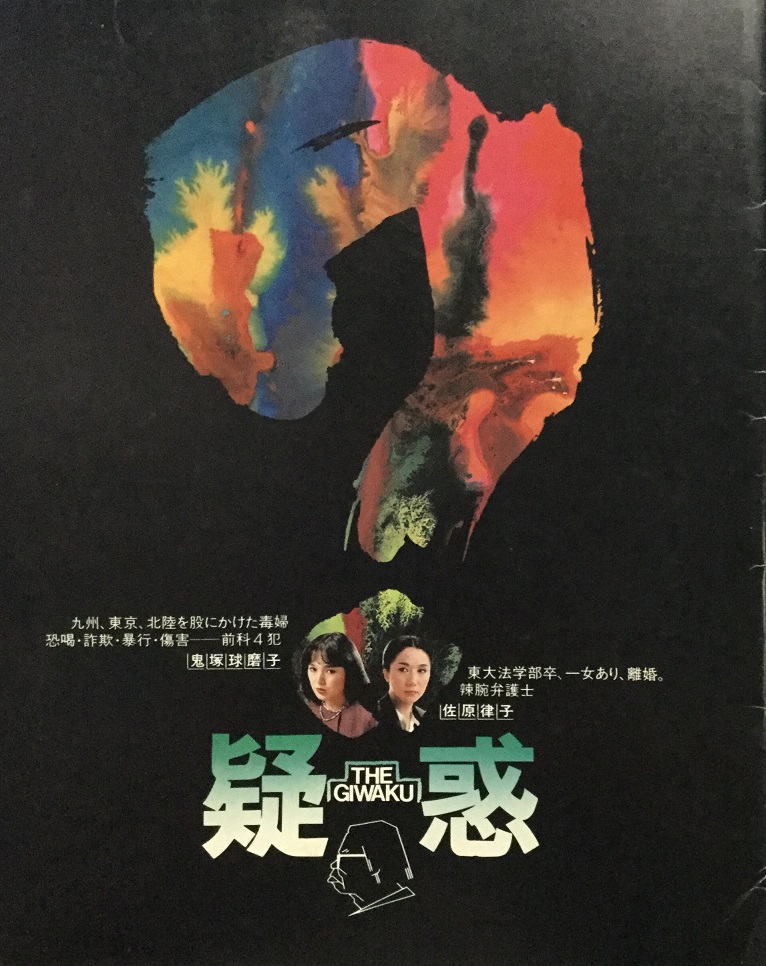
Suspicion posterBy the early ‘80s, Japan had successfully shaken off post-war desperation for burgeoning consumerism, but even as the nation rocketed into a more comfortable future, social equality proved slow to arrive. Once again adapting a novel by Seicho Matsumoto, Yoshitaro Nomura’s Suspicion (疑惑, Giwaku) makes allies of two very different women who are each in one way or another rejected by the conservative, infinitely rigid society in which they live.

Former bar hostess Kumako (Kaori Momoi) falls under suspicion when she alone survives the car accident that takes her husband’s life. A brassy, aloof woman, Kumako does not behave in the way the police might expect a recently bereaved spouse to behave which instantly turns them against her. This becomes a real problem once they discover that her husband, Shirakawa (Noboru Nakaya), was an extraordinarily wealthy man on whom she had recently taken out a number of life insurance polices. Shirakawa’s public profile ensures that the potentially salacious case is taken up by the newspapers who waste no time proclaiming Kumako a gold digging murderess while openly baying for her blood. Intimidated by the public outcry, the police are determined to charge Kumako with her husband’s murder despite the only existing evidence being extremely circumstantial.

After a prominent lawyer declines to take her case, her legal council stands down citing his poor health leaving Kumako entirely undefended. The court eventually appoints her a new lawyer, a woman – Ritsuko Sahara (Shima Iwashita), more practiced in civil than criminal law and just as much of an outcast as Kumako though in very different ways. Ritsuko has divorced her husband and he has custody of their young daughter whom Ritsuko makes a point of seeing once a month. Though the arrangement seems to suit her well enough, her status as a career woman who has “rejected” the roles of wife and mother also makes her one viewed with “suspicion” by those around her.

The central issue is indeed Kumako’s character. A former bar hostess with a traumatic childhood, Kamako has four previous convictions including assault and blackmail as well as an abrasive personality and a tendency to rub people up the wrong way. She doesn’t do herself any favours, but no kind of justice would be served if she were sentenced to death not for her husband’s murder but for the crime of being an “unpleasant” woman in a society which expects women to be docile and polite.

The papers, however, are very invested in the story of the coldblooded, gold digging murderess. Akitani (Akira Emoto), a local reporter, cosies up to the police for insider information, and does his best to root out Kumako’s sordid past including a sometime boyfriend who might have been her “pimp”. Ritsuko makes “trial by media” a key part of her defence strategy, arguing that her client’s case has been unfairly prejudiced by the image the press has sought to construct of her, but is unaware of the extent to which the police investigation has been distorted by the desire to appease the media or the various ways in which a venal press has gently perverted the course of justice in search of a better story.

Cool and efficient, Ritsuko isn’t really sure whether Kumako did it or not but is determined to ensure she is tried by the codes of law and not of conventional morality. A disgraced Akitani later barks at her that he sees no need to defend “a woman like that” in the papers, but Ritsuko’s having none of it – the purpose of the law is precisely to ensure guilt or innocence is assessed rationally on the basis of the evidence presented, as free of personal prejudice as it’s possible to be. An idealistic claim, given Japan’s famously implacable legal system, but one that sits well with a functioning democracy.

Ritsuko’s defence of Kumako is not particularly a feminist exercise, though a grudging kind of mutual respect eventually arises between the two women who have each in one sense or another rejected socially defined gender roles. While Ritsuko proclaims herself happy enough to be a mother once a month on Sundays, her husband’s new wife is a more territorial sort, eventually asking her to stop seeing her own daughter because she would rather raise her believing that she is hers alone. Kumako, however, is entirely unrepentant, even emboldened, vowing that she will continue using men until the day she dies. The two women remain mirror images of each other, both rejected, viewed with “suspicion” for the choices they have made, and forever at odds with a society which has already found them each “guilty” in the court of public opinion.


Original trailer (no subtitles)

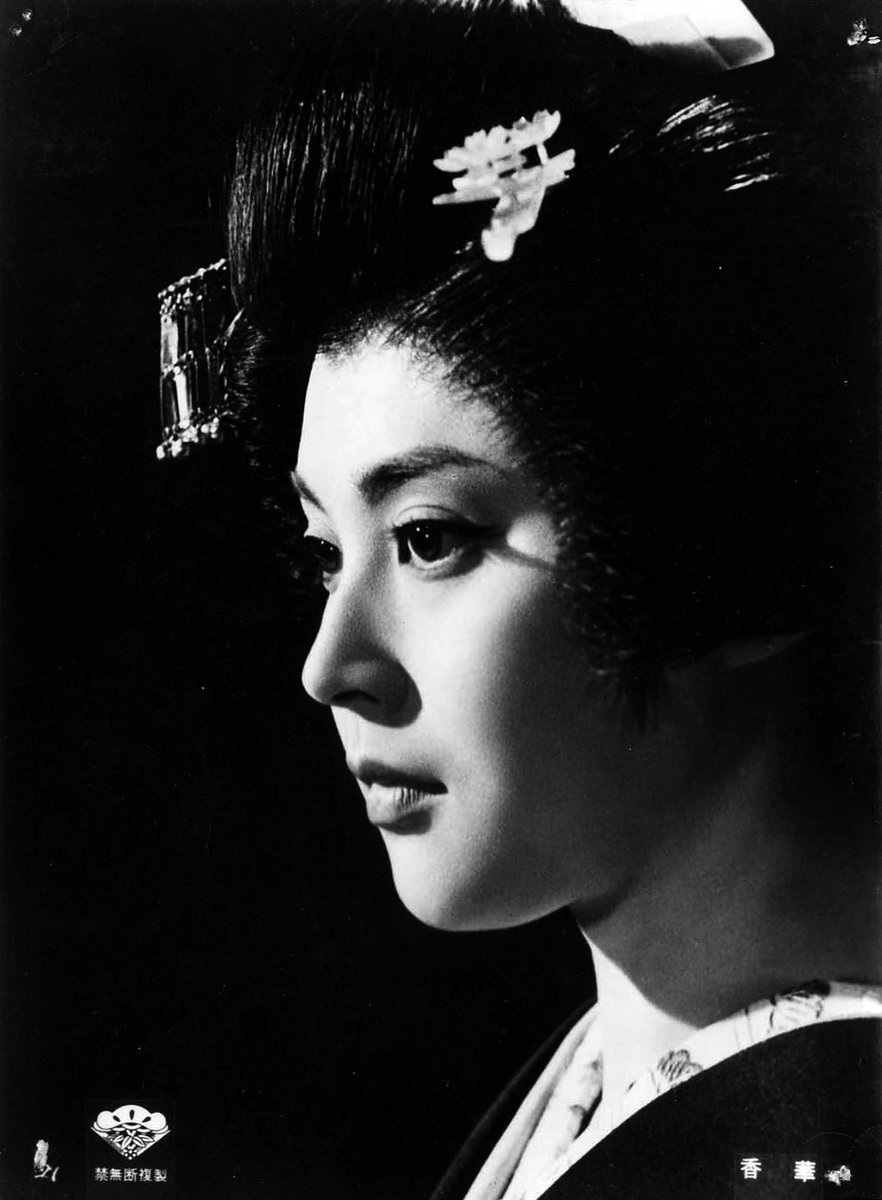
The Scent of Incense (香華, Keisuke Kinoshita, 1964)

Scent of Incense still 1Sometimes regarded as overly sentimental, Keisuke Kinoshita’s later career grew progressively harder around the edges, as if he began to lose faith in the efficacy of human goodness but never it seems in its capacity for endurance. Spanning more than 50 years in the turbulent history of mid-20th century Japan, The Scent of Incense (香華, Koge) reverses the path of the hahamono in dramatising the complicated relationship of two women – a “selfish” mother and her “self-sacrificing” daughter who finds herself unable to give up on maternal approval despite the many disappointments of her life.

We open in late Meiji with a funeral interrupted by news from the Russo-Japanese war. Shortly after, young widow Ikuyo (Nobuko Otowa) argues with her mother, Tsuna (Kinuyo Tanaka), over custody of her five-year-old daughter Tomoko. Ikuyo is planning to remarry and her new husband has three children of his own. Fearing Tomoko would be an inconvenience, Ikuyo proposes to make her heir to her mother’s family, leaving her behind in her grandmother’s care. Though Tsuna loves Tomoko dearly, she resents her daughter’s intention to abandon them just because she’s got a better offer, and perhaps privately wonders how long she’ll actually stick it out for seeing as, as we later see, she has a strong tendency to give up when the going gets tough.

The prediction proves accurate. Ikuyo persuades her new husband to abandon his existing children and family home for the bright lights of Tokyo, while Tomoko and her grandmother live on alone in the country. Ikuyo has another daughter, Yasuko, but the couple quickly become impoverished without access to her husband’s family money. When Tsuna dies, Ikuyo decides to fetch Tomoko from the family residence, but then sells her to a geisha house. A few years later, she too falls into the sex trade but as a less exulted “oiran”, embarrassingly re-encountering her daughter from the other side of a brothel. Despite her abandonment and shame over her mother’s profession, Tomoko (Mariko Okada) continues to try to help her, maintaining an awkward familial relationship with a woman who only pays attention to her when she needs something.

Perhaps ironically, in one sense, Tomoko ends up becoming a successful, independent woman in pre-war Japan but is forever denied the kind of familial life she craves as a conventionally respectable wife and mother of the kind her own was not. In the course of her work, she meets dashing military cadet Ezaki (Go Kato) and, despite the warnings of her madam (Haruko Sugimura) who cautions her that she’s the type to fall in love too deeply, embarks on a longterm affair with him. Though he is obviously aware that she is a geisha, he is confident that his family would accept a marriage, but Tomoko’s hopes are later dashed when his pre-marital investigations turn up the fact that Ikuyo has worked as a “common prostitute”. Heartbroken, she resents once again paying the price for her mother’s transgressions, but does not break with her completely.

Tomoko’s liminal status is further brought home to her when her elderly patron, who has set her up with a geisha house of her own, suddenly dies and not only is she informed some days later by the madam at another house, but she’s not even permitted to attend the funeral. Another man, Nozawa (Eiji Okada), who’d had his eye on her but honestly admits that men of his class do not engage in “serious” relationships with geisha, asks her to become his mistress but she has had enough of the shadow life, vowing both that she doesn’t want to be “owned” anymore, and that her next man (if there is one) will have to marry her.

Loneliness renders that particular vow void as she finds herself embarking on a casual affair with Nozawa while Ikuyo considers getting married for the third time – this time, rather transgressively, with the family’s recently widowed former servant, Hachiran (Norihei Miki), who married into a wealthy family and apparently made something of himself. Hachiran, however, finds it difficult to shake off the old class attitudes, treating Ikuyo like a goddess while she bosses him around and makes a pretence of leaving every time she gets fed up.

Later we might wonder if Ikuyo’s sudden exit from Hachiran’s distant home is more that she missed her daughter than it was boredom with her husband. “I don’t think of her as a mother” each woman says, Ikuyo on learning that Tsuna is dangerously ill, and Tomoko when Nozawa suggests making a detour to visit Ikuyo and Hachiran. Ikuyo, it is true, is a cold woman who abandoned her daughter only to reclaim her in order to sell, later giving up two more children one of whom apparently disappears without trace. The proof of her love is found only in its end, while Tomoko suffers on all the long years otherwise alone, until in an immense act of circularity she at last becomes a kind of mother to another woman’s son.

Forever haunted by the spectre of soldiers, Tomoko loses everything in the Great Kanto Earthquake of 1923, but perseveres and rebuilds. She loses everything again in the firebombing of Tokyo, only later remembering her foresight in burying a large collection of crockery in the cellar which might allow her to open a restaurant. She resents her mother but keeps her close, while Ikuyo’s affections seem to ebb and flow as she disappears off to greener pastures only to resurface again when they’ve been thoroughly grazed. A flighty, perhaps selfish woman, Ikuyo too proves unable to sever connection from her daughter. Tomoko disapproves of her mother’s gaudiness, her unbridled lust for life and disregard of social conventions, but the two women are more alike than they first seem – each in their own way fiercely independent and unwilling to allow their desires to be defined or defeated by the world around them.


Original trailer (no subtitles)

Sada (SADA〜戯作・阿部定の生涯, Nobuhiko Obayashi, 1998)

Sada poster“Facts can easily become fiction when recounted by someone, even by oneself. But with a bit of sincerity lies can become truth”, our genial guide explains, paradoxically telling us that the heroine, a woman he regards as a loveable kid sister, wants to tell us her story herself. Apologising in advance for her “rudeness”,  he reveals to us that the woman is none other than the “notorious” Sada Abe, a woman who, apparently now forgotten, was once a front page sensation for having killed her lover and cut off his penis to carry him with her always.

Despite the narrator’s claims that Sada’s fame has faded, her story has proved fertile cinematic ground, most famously inspiring Oshima’s In the Realm of the Senses which sees her claustrophobic descent into sexual obsession as a reaction to the intense austerity of militarism. Obayashi, however, is keen to remember that that aside from the newspaper headlines, the salaciousness and peculiar romanticism of her story, Sada was a real woman who suffered in an intensely patriarchal society and was perhaps seeking something that the world was unable to give her.

As she reminds us, Sada too had a childhood. Obayashi opens the film with a young Sada innocently throwing hoops over a tall phallic object. Six years later, her life changes when a college boy drags her off the street into a nearby inn and rapes her, claiming that she is well known as a good time girl and that he is perfectly entitled to behave in the way he is behaving. Deed done, the college boy leaves but Sada (Hitomi Kuroki) is rescued by the gentlemanly figure of sickly medical student Okada (Kippei Shina) who has a patch over his eye and a romantic disposition. Okada gives her not only a lifelong and strangely erotic attachment to donuts, but a junai foundation in an eternally unrealisable longing for a pure and innocent love.

Okada, as Obayashi later tells us, is also a “real” person though he has no real evidence that he and Sada ever crossed paths. He gives her the knife she will later use to sever her lover’s penis and tells her to use it to cut out his heart, which belongs to her. Okada, claiming that he will forever watch over her, introduces a secondary theme in that he is a sufferer of Hansen’s disease, or leprosy, then thought incurable and “treated” only by exile. Sada loses her pure love and never knows why, but sadly chooses not take his advice to remember that she is an honest girl and refuse to be corrupted by her trauma. Now unable to marry and it remaining a virtual impossibility to enter any other kind of profession, Sada becomes a geisha, later giving that up for the more lucrative world of casual sex work.

Perhaps ironically, it’s through her life as a sex worker that Sada begins to find a degree of freedom amidst the impassioned atmosphere of increasing militarism. While the men are caught up in destructive games of martial glory, Sada is just trying to live her many lives and dreaming her dream of love. It’s that dream of love that brings her to Tatsuzo (Tsurutaro Kataoka), a married, poetic ladies’ man with whom she eventually retreats into an isolationist kingdom of two. Yet their intensely co-dependent relationship is never quite enough for her because it fails to marry her physical need with the emotional, and the figure of Okada, the innocent, romanticised white knight of her youth, lingers in her mind. Sada kills Tatsuzo not quite by accident, attempting to take ownership of something which can never be hers in her fiercely patriarchal world where her clients coldly chide her for not being “polite” enough and despite the earning potential of her profession, she remains dependent on men to escape it.

Sada’s “crime” might not quite be revenge for all she’s suffered but it is a pointed act of rebellion towards a conformist society. She laments that her notoriety soon faded, that if being forgotten is like dying then she died long ago, but for a short time all of Japan was captivated not by the outrageous horror of her transgression but by an idea of “romance” that stood behind it as if Sada had moved beyond double suicide into new territories of eternal love through seeking to possess her lover even in death. The narrator, Sada’s sometime pimp, tells us that few remember Sada now and suggests that Japan is once again in a dark age, stopping only to remark that people were beautiful then too despite or perhaps because of the darkness. Fittingly the figure of the “real” Sada retreats and we’re left again with her legend, an imagined future for a woman who faded into pre-war tragedy as a symbol of its dangerous intensity. Even so, Obayashi is intent to show us that there was indeed a woman named Sada Abe who found herself at the mercy of her times but tried to live all the same, dreaming of impossible love in a world of corruption.


Original trailer (English subtitles)