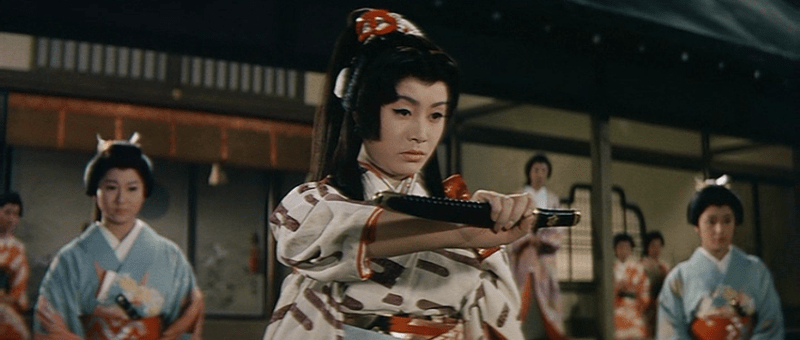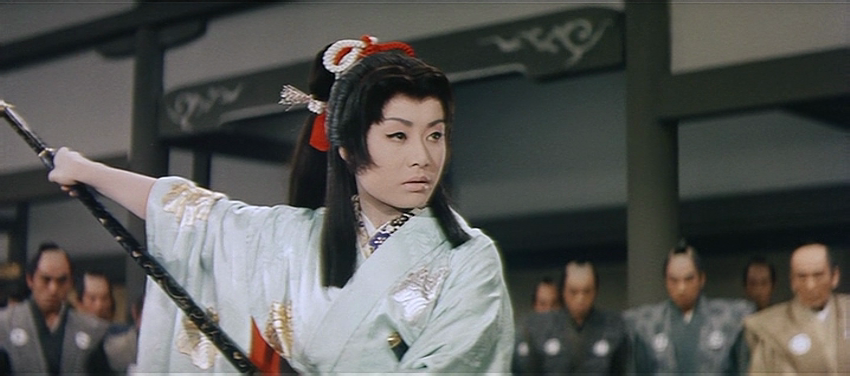
Silk Hat Boss (シルクハットの大親分, Norifumi Suzuki, 1970)

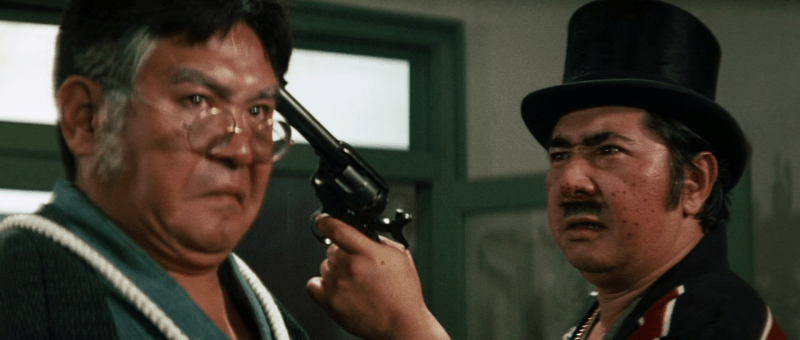
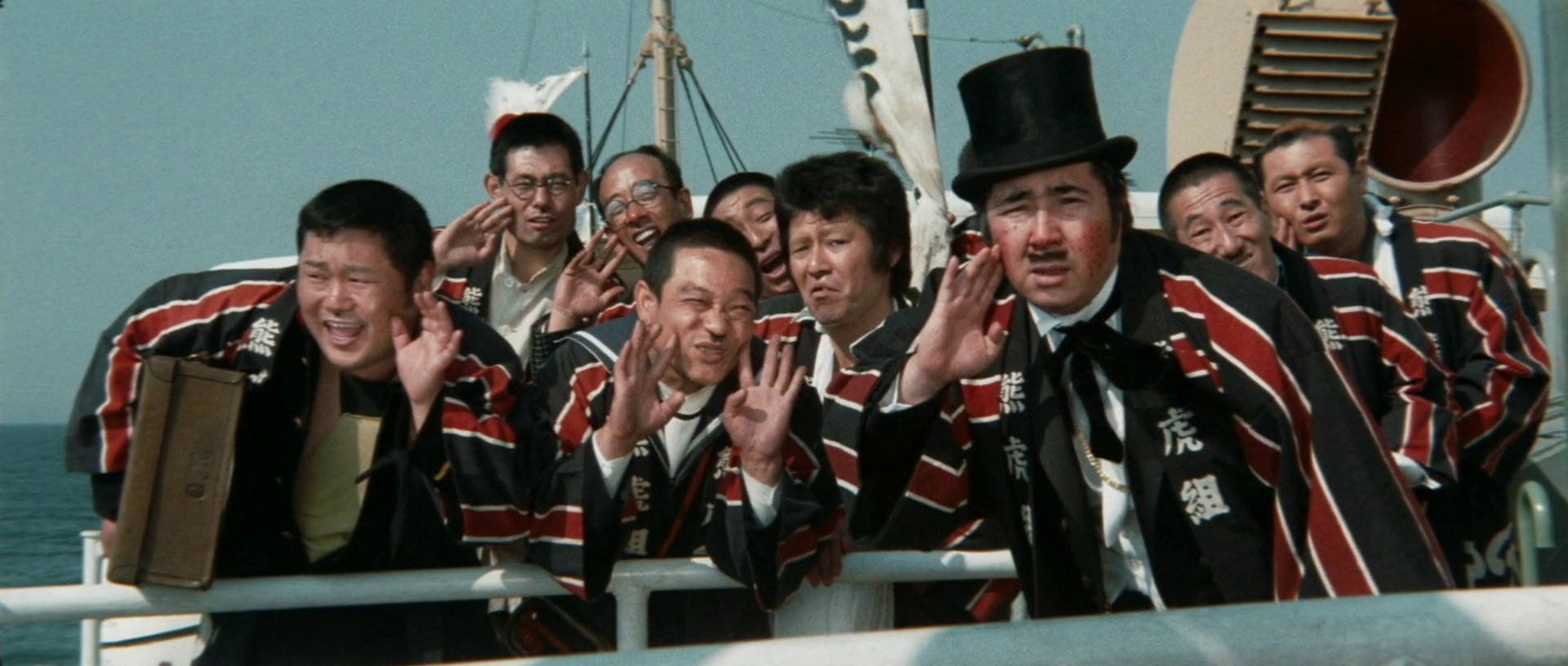
A true patriot squares off against a series of duplicitous nationalists in Norifumi Suzuki’s Red Peony Gambler spin-off, Silk Hat Boss (シルクハットの大親分, Silk Hat no Oooyabun) starring Tomisaburo Wakayama as top hat-wearing yakuza Komatora. Set in the world of 1905 in which Japan had just emerged victorious from the Russo-Japanese war, the film on one level attacks the rising militarism of late Meiji in which corrupt and arrogant military officers collude with venal yakuza to further the course of empire while lining their own pockets, but stops short of rejecting it outright.

Kumatora is about to return home in glory after taking his guys to the front to defeat the Russians and is expecting to receive a hero’s welcome when the boat docks in Kobe. Unfortunately, he is met only by his sister and an underling, Hansuke, who he immediately berates for the affront of having grown a magnificent moustache in his absence which is even bigger than his own. It turns out that evil yakuza rival Chindai has stolen all the credit for the work done by those like Kumatora and the ordinary foot soldiers who lost their lives defending Japan’s interests. 

Chindai has teamed up with corrupt military officer Kito who wastes no time throwing his weight around. Having fallen her during a brawl but been rebuffed, Kumatora searches for Osakan geisha Choko only to find her running away after Kito tried to assault her. Running around in his underwear, Kito rudely demands that Kumatora “return” Choko to him, but true to form Kumatora only tells him that he’s being unreasonable and the choice of whether to return or not belongs to Choko herself. Something similar occurs when Kumatora visits the family of a fallen comrade and discovers that his wife has been forced into sex work while the daughter, Satsuki, is seriously ill. Noticing the pock marks on her face which remind him of his own, Kumatora immediately decides to take the girl to a hospital at his own expense and, in fact, throws Kita out of a rickshaw in which he was riding because the girl’s need is greater. 

Kumatora is, perhaps unexpectedly, a great defender of the rights of women. After taking his guys to a brothel, he finds out that the girl assigned to him is only 14 and ends up cleaning her ears and singing a lullaby. Eventually he discovers that Chindai and Kita have been rounding up sex workers and tricking other women into sexual slavery with the intention of trafficking them and resolves to free all of them while looking for Satsuki’s mother to let her know she no longer needs to work in the red light district. Of course, Kumatora is very much in the throes of his unrequited love for Red Peony Gambler Oryu (Junko Fuji), running back to his lodgings mistakenly thinking she’s in town, but partially rejects Choko’s affections after she becomes besotted with him because he thinks it’s unfair to ask a woman to become the wife of a yakuza who might after all die any day.

Kumatora is also a fierce defender of his men, ceremoniously handing each of them a condom at the brothel and reminding them to stay safe before they head off with the women whom he has already rather comically inspected. He is very clear that the victory over the Russians was bought with the lives of ordinary workers who should be fairly rewarded with their share of the glory rather than allowing men like Chindai to exploit their heroism for their own gain. Kumatora finds an ally in good general Matsumoto who hands him a letter he can’t read from a general he admired who calls him the ideal Japanese man for his bravery and fighting spirit, but is as expected targeted by Kito and Chindai who are only interested in lining their own pockets. What it boils down to is that Kumatora is good because his patriotism is genuine while Kito and Chinda are bad because their nationalism is self-serving which does quite uncomfortably suggest that imperialism itself is not an issue only how it’s progressed. 

In any case, the corrupt officers are finally dealt a crushing blow by a resurgent Kumatora along with a little help from Oryu herself who eventually turns up to save the day in the bloody showdown which ends the film. Slightly absurdist in tone, the Silk Hat Boss has its fair share of offbeat humour beginning with Kumatora wearing his top hat in the bath and jokingly comparing various generals’ penis sizes to that of a loofah but is undeniably endearing in its hero’s guileless goodness. 

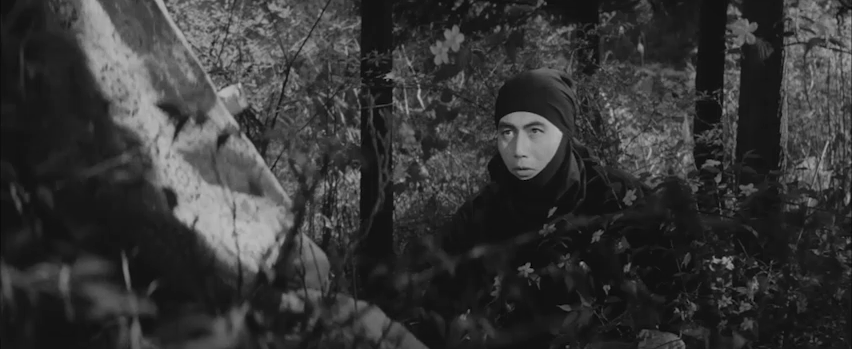
Shinobi No Mono 6: The Last Iga Spy (忍びの者 伊賀屋敷, Kazuo Mori, 1965)

Though there’s a clear divide between the first three films in the Shinobi no Mono series and those that followed, one thing that remained constant is that time passed. By the sixth instalment, we’re already in 1637 which is more than 50 years after the setting of the first film which began in 1575 at the tail end of the Warring States era. Hero of films four and five, Saizo had been desperate to return to the chaos of the pre-Seikgahara society in which the ninja could indeed hold sway though as he discovered the pax Tokugawa was definitely here to stay. 

Given that Saizo would now be an old man, the torch is passed to his son, Saisuke (Raizo Ichikawa), who like his father opposes the Tokugawa but also has a desire for revenge against the corrupt petty official who killed him during the battle of Shimabara which definitely sealed the Tokugawa victory. Ieyasu may be dead, but the regime has only become more oppressive while it seems there is still enough intrigue to provide work for the jobbing ninja only now it’s taking place largely within the palace in the de facto one party state of the feudal society. 

On the other hand, there is a degree of destabilisation and societal flux as the old class system struggles to adjust to a world of peace. The nation is filled with disenfranchised samurai and ronin who largely have no real options to support themselves other than becoming mercenaries or taking odd jobs from various lords in the hope of eventually being taken in as a permanent retainer. It’s these ronin that Saisuke, and the rebellion’s leader Yui Shosetsu (Mizuho Suzuki), hope to marshal in convincing them to rise up against Tokugawa oppression and regain at least a little of the freedom their immediate forebears enjoyed.

The evils of this system can be seen in an otherwise sympathetic lord’s insistence that his underling will have to take the blame and commit seppuku if his decision to help the rebels is discovered. As Saisuke later remarks, the era of human knowledge rather than weaponry is already here and battles are largely being fought over parlour games played in court. At this point, the shogun’s sudden demise leaving only an 11-year-old son has opened a power vacuum that allows unscrupulous lords, like Saisuke’s enemy Izu (Isao Yamagata), to exercise power vicariously. Izu has used it to enrich himself by exploiting desperate ronin and spending vast sums on personal projects, yet he proves himself a true politician in effortlessly covering up for the lord who tried to help the rebels doubtless knowing that he now has him in his pocket for life.

Seemingly returning to the low-key social principles of the first few films, Saisuke’s rebellion is also towards the inherently unfair system complaining that the battle for power is a monster that feeds on courage and will crush conscience like an insect. But as Izu says, times have changed and the struggle cannot be ended even if Saisuke argues that anything manmade can be dismantled. Saisuke has to admit that he’s been outplayed, the leader of the revolution also turns out to be corrupt, taking advantage of other people’s desperation and dissatisfaction to enrich himself while Izu’s plotting has left him largely blindfolded as a ninja clearly out of his depth in the new and confusing world of the Tokugawa hegemony. A powerful man is always looking for a victim, he reflects, perhaps echoing the plight of Goemon unwittingly manipulated by the duplicitous Sandayu while admittedly somewhat drunk on his own misplaced sense of self-confidence. 

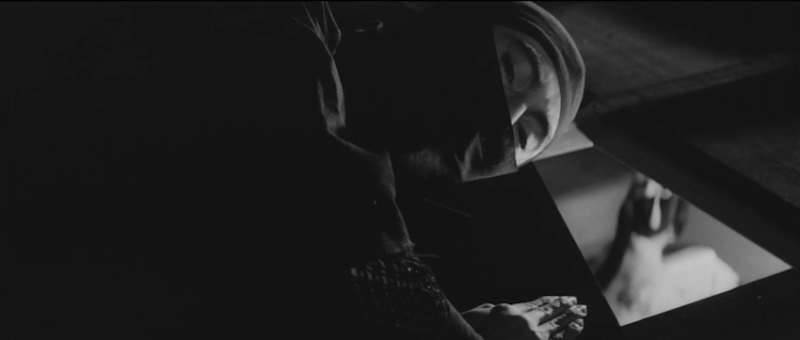
Deviating a little from the realism of the series as a whole, the film shifts into more recognisably jidaigeki territory revolving around corrupt lords and an exploited populace even if in this case it’s the disenfranchised warrior class experiencing a moment of mass redundancy though apparently unwilling to resist. Peep holes behind noh masks add a note of quirky innovation to the backroom machinations of the Tokugawa regime while silent ninja battles and flaming shuriken add to the sense of noirish danger even as it becomes clear that the ninja is approaching a moment of eclipse, no longer quite necessary in a world of constant duplicity.  


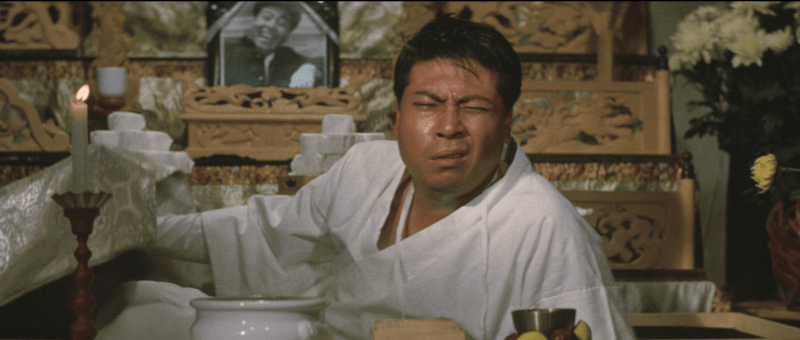
The Greatest Challenge of All (喜劇 一発勝負, Yoji Yamada, 1967)

A prodigal son rocks the social order in Yoji Yamada’s anarchic nonsense comedy, The Greatest Challenge of All (喜劇 一発勝負, Kigeki: Ippatsu Shobu). The greatest challenge may be trying to manage Kokichi (Hajime Hana), a roguish Del Boy-like figure with an impossible dream of striking it rich. While in some senses he anticipates the equally  anarchic yet basically goodhearted Tora-san, he also represents a modernising and aspirant Japan determined to leave behind dusty old tradition for a new “deluxe” future.

Having taken to the road after being disowned by his conservative father (Daisuke Kato), Kokichi returns 15 years  later a middle-aged man with seemingly nothing to show for his many years of wandering. He has no idea that he has a daughter, Mariko, by a local woman that his parents took in and raised as if she were theirs which was not an especially uncommon solution to the problem of illegitimate birth in the post-war era. Nor did he know his mother had passed away before walking in on her annual memorial service. This sense of parental disconnection one level reflects a lack of filiality that marks him out as a “modern” man uninterested in these familial obligations or a sense of duty towards his family, but it’s also true that it’s to family that he’s returned having mellowed in middle-aged and in a way looking to settle down.

In any case, his life seems to have been a series of crazy episodes from briefly becoming a sumo wrestler to meeting a mysterious woman on a bridge who gets him a job as a snake charmer. When two yakuza types kick up a fuss about not being able to have their usual room at the inn during his mother’s memorial service, Kokichi manages to frighten them off just with bluster, hinting at the way he may have lived for the last 15 years. He also has two friends who turn up to see him, one of whom is a former yakuza who refers to Kokichi as if were his boss and they were a little trio of crime-adjacent buddies.

But it does appear that Kokichi has come with a business plan in mind, convinced that he can find the source of a hot spring in the town and build a resort hotel on top of it. To do this, he tries to convince his father to sell him his land and the inn the family run so he can knock it down and build a “deluxe” modern, Western-style hotel in its place. Kokichi’s father obviously isn’t keen. This inn has been in the family for generations, he really wouldn’t want to ruin that and especially not for one of Kokichi’s harebrained schemes. Yet again this brings us back to the battle between the conservatism of Koikichi’s father, and Kokichi’s own consumerist modernism that is more individualistic and no longer sees beauty in the past, only backwardness and stagnation. When he finally does find his hot spring, he builds a vast modernist complex with a botanical water park housed in a giant Hawaiian-themed conservatory complete with dancing hula girls. 

His corrupting presence is most discernible in the changing role of Fumi (Tanie Kitabayashi), the family’s housekeeper who generally dressed in kimono but on moving to Kokichi’s mansion she begins wearing Western dress. Fumi had at one time left the family because Kokichi had unwittingly forced her to betray it in helping him get his hands on a precious family heirloom to pawn as capital for his new business venture. Having done so brings her to a confrontation with the contradictions of her role within the family, both a surrogate mother to Kokichi and also a servant who is expected to abide by a certain code with not stealing from your employers a key tenet. She feels she can no longer look Kokichi’s father in the eye and must now return to her home in the country even though she has likely not seen it since she was a young woman. Having undergone this change, she can no longer return to the inn but is brought back to Kokichi’s modernist home once he strikes it rich. 

But Kokichi too is later confronted by hypocrisies of his own position as a free-spirited man and finally a father on learning the truth about Mariko. Hanging out at the hot spring, the 16-year-old Mariko has attracted the attentions of a couple of fashionable young men and wants to leave with them to visit Tokyo. Despite the intrusion of the modern in the hot springs resort, Mariko doesn’t want to stay in this “deadbeat” town and longs for the bright lights of the big city. Kokichi’s father understandably says no, but Kokichi is originally all for it, perhaps seeing his own desire to be free of his father’s oppressive authority. However, he soon changes his tune on assuming his paternity. He too tells Mariko she can’t go and strikes her for talking back. But just as he had, she leaves anyway. His modernity is no longer modern enough, and the young will always walk towards the future.

One exception might be Kokichi’s painter sister Nobuko (Chieko Baisho) who appears to be happy enough living at the inn and with seemingly no intention of marrying which might be her own kind of rebellion against traditional mores. While other similarly themed films may have emphasised the importance of hard work and the reality of the salaryman dream, this one suggests that it really is possible to bumble along and then strike it lucky but also that you never really travel as far from home as you might think. The desire for patriarchal control rises in Kokichi, but is now ineffectual. Though he didn’t raise her, Mariko is a child of the world he’s created and simply chooses to leave with a final sock in the eye to traditional filiality. 


Trailer (no subtitles)

Tokyo Drifter (東京流れ者, Seijun Suzuki, 1966)

“Money and power rule now, honour means nothing” according to the new bread of upstarts gangsters in Seijun Suzuki’s Tokyo Drifter (東京流れ者, Tokyo Nagaremono). In many ways, what separates Nikkatsu’s youthful crime movies from Toei’s yakuza epics is that the nobility of Toei’s heroes is rarely questioned. In a Toei movie, it’s the world that’s wrong because the code is good and should be obeyed just as the hero obeys it, but in a Nikkatsu picture nihilism rules. The code isn’t right either, in fact it’s just another tool to manipulate and the hero, while noble, is wrong to follow it. 

That is in essence how Tetsu (Tetsuya Watari) will end up a Tokyo drifter, caught between the old world and a new consumerist Japan in which even the yakuza is attempting to corporatise and reform its image. His old boss, Kurata (Ryuji Kita), has done just that only he’s had to take out a sizeable loan from another former gangster turned real estate agent, Yoshii (Michio Hino), to do it. Realising his weakness, the upstart Otsuka gang sees an opportunity and stages an elaborate ruse that allows them to get their hands on Kurata’s valuable building and take out Yoshii at the same time though it results in Yoshii’s secretary (Tomoko Hamakawa), also the girlfriend of one of the Otsuka gang, getting caught in the crossfire. 

Tetsu describes his relationship with Kurata as like father and son and is sure he would never betray him. To preserve their new image, Tetsu does not fight back when ambushed by Otsuka goons and even puts himself on the hook for the secretary’s murder, but as much as Kurata insists he wouldn’t betray one of his “kids” to make things easier for himself perhaps he will if the situation calls for it. A defector from Otsuka’s gang, Shooting Star (Hideaki Nitani), tries to warn Tetsu that his faith in ideals like duty and loyalty is misplaced but Tetsu refuses to believe him. “Don’t shatter my dreams” Tetsu pleads, claiming that he cannot be around someone with “no sense of duty”.

Tetsu even feels sorry for Shooting Star, attributing his melancholy air to his having lost his sense of purpose in his disillusionment with post-war gangsterism. He might have a point in Shooting Star’s world weariness, but fails to realises that Shooting Star does in fact have a sense of duty and is in some ways the film’s only truly free man in forging it for himself from basic humanitarian values if tinged with a degree of cynicism. Though the pair clash, Shooting Star claims that he wants to save Tetsu from the pain of his inevitable betrayal and the disillusionment that will eventually come with it rendering him a perpetual wanderer and exile from mainstream society. 

Both men are in a sense lost amid the rapid social changes of their era, unable to move on from the post-war past into the new society even after breaking with the yakuza code in order to live by their own. In Suzuki’s complex colour scheme, Shooting Star is always clad in a forest-like green which echoes his freedom, while Otsuka is represented by a bloody red, and Tetsu dressed in an innocent powder blue suit until the final confrontation in which, along with his equally innocent love interest Chiharu (Chieko Matsubara) who had previously been associated with the colour yellow, is dressed in a pure white while all around him are now in black as representatives of those who have succumbed to the amoral capitalism of the the contemporary society. 

Suzuki even has Tetsu walk down an arched corridor reminiscent of a church into an abstract space expanding the stage at the club to lend this moment of existential struggle a little more theatricality. In a sense what Tetsu does is an act of suicide, severing his ties to the yakuza world by smashing Kurata’s glass and killing at least the image of him as a father figure to become a new man or perhaps a wandering ghost who no longer has a home and must even give up his romance with Chiharu in an acknowledgement of his exile. On Otsuka’s death, it’s almost like an alarm is switched off in the sudden shift from red to white in the giant statue standing behind Chiharu, the survivors united in white but rather than the wedding suggested by the colour of their clothes the atmosphere is funereal as Tetsu accepts he can no longer stay in this temporary space and must enter another sort of purgatory as lonely wander comforted only by his newfound freedom.


Tokyo Drifter screens at Japan Society New York on Feb. 4 as part of the Seijun Suzuki Centennial.

Original trailer (English subtitles)

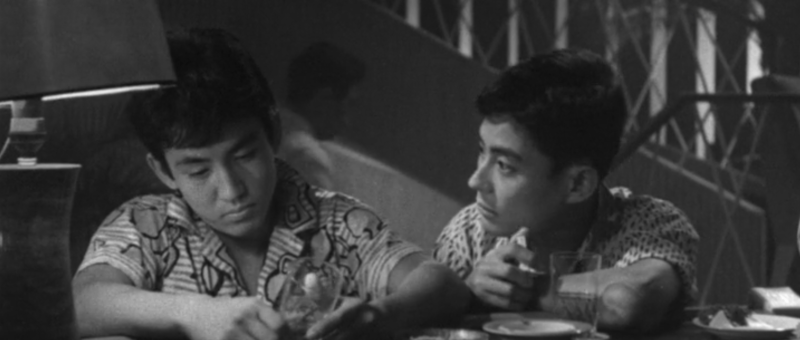
The Rose on His Arm (太陽とバラ, Keisuke Kinoshita, 1956)

In the mid-1950s, a minor moral panic took hold over the so-called “Sun Tribe” movies which, inspired by the novels of Shintaro Ishihara, depicted a world of crazed abandon in which a collection of bored rich kids lost themselves in the hedonistic pursuits of sex and drugs rejecting the stability the wartime generation had striven so hard to create for their children. Shochiku, at that time the home of polite melodrama, nevertheless attempted to get in on the youth movie boom mostly through commissioning a series of young directors such as Kiju Yoshida and Nagisa Oshima in the hope that they could speak directly to their generation. Meanwhile, the by that point well-established Keisuke Kinoshita also made his own, perhaps surprising, take on the genre with The Rose on His Arm (太陽とバラ, Taiyo to Bara), a youth movie melodrama which nevertheless anticipated the questions others were beginning to ask about the Sun Tribe movies in their very particular view of contemporary class dynamics. 

Our hero, Kiyoshi (Katsuo Nakamura), is like the (anti-)heroes of the post-Sun Tribe youth movies, a poor boy turned delinquent out of a sense of frustrated hopelessness. Quitting one job after another solely because the work is boring, he spends most of his days hanging out at the beach with other no good kids robbing unsuspecting bathers. Kiyoshi’s sense of inferiority is compounded by the fact that his mother (Sadako Sawamura) works as a maid for a wealthy family while making ends meet by crafting paper flowers by night. The young master of the house where his mother works, Masahiro (Akira Ishihama), never misses a chance to lord his wealth over him but later co-opts Kiyoshi into his group of wealthy friends as a source of entertainment (and because his delinquent friend, Yamanaka (Tamotsu Tamura), begins supplying them with drugs).

“I screwed up my life because I was poor, what’s your excuse?” Kiyoshi eventually asks an indifferent Masahiro after beginning to see him for what he is. Like the hero of Punishment Room, Kiyoshi’s internalised resentment is partly down to a paternal failure in that he is deeply ashamed of his late father who died, his mother claimed, saving him but also in the course of his activities as a black marketeer in which he’d forced his son to be complicit. The family had apparently tried to make a life for themselves in the new colonies, in this case Palau, but of course had to return to Japan and were then penniless. People did what they had to do, but no one trusts a black marketeer and it seems to be a stain Kiyoshi (whose name means “pure”) cannot wash off. As a poor boy with no education or prospects, he knows all that awaits him is drudgery, so why not make a fast buck stealing purses at the beach rather than slave away at the factory for a week making less than Masahiro gets in pocket money from his factory owner father? 

Convincing himself he’s no good, Kiyoshi consistently sabotages opportunities but resents himself for doing so. He begins to buckle down at the factory but quickly becomes “bored” and starts taking advantage of his supportive floor manager while sucked into Masahiro’s hedonistic lifestyle even after it becomes obvious that he’s keeping him around to be some kind of hired goon, good for punching other pasty rich boys and hooking him up with underworld thrills. Masahiro is a delinquent because his life is too easy, he has no economic imperative to be responsible and will most likely go to college and then either take over the factory or walk into a lucrative salaryman job. Kiyoshi is a delinquent because he’s desperate and has no other means of living. 

Meanwhile he resents his mother’s love, shamed, in more than one sense, by her continuing industry. She often tells him the story of how he fell ill on Palau only to make a miraculous recovery after which she collapsed into a rose a garden. To spite her, Kiyoshi gets the titular rose tattooed on his arm, something which forever marks him out as a ne’er do well in conservative Japanese society, all but guaranteeing he’ll never get an honest job (he even has to cover the tattoo with bandages in public places to avoid causing offence). Eventually he takes drastic action to end his sense of hopelessness, pursuing what is strangely a darker yet more romantic destiny than that of his post-Sun Tribe compatriots in taking a poetic stand, paper rose in hand, defying his despair only through embracing it. 


The Rose on His Arm is currently available to stream in the US via Criterion Channel.

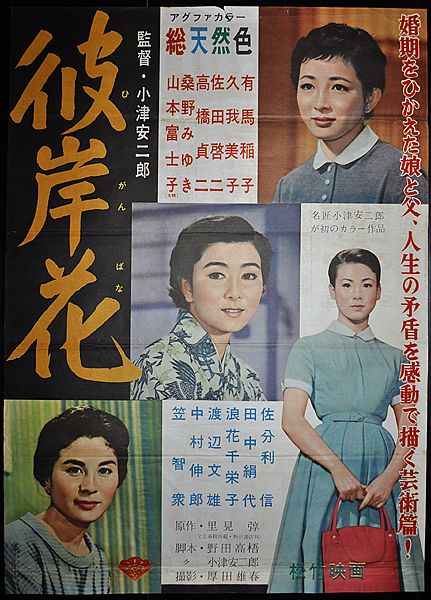
Equinox Flower (彼岸花, Yasujiro Ozu, 1958)

Japanese golden age cinema is famed for its centring of female stories, but while it’s true that many of Yasujiro Ozu’s family dramas revolve around a young woman’s feelings towards marriage, the perspective is often surprisingly male. Equinox Flower (彼岸花, Higanbana), his first film in colour, marks something of a change in direction in its spirited defence of the young, but at heart is still a story as much about impending old age, the responsibilities of fatherhood, and changing times as it is about contemporary family dynamics or female agency. 

The father in question, Hirayama (Shin Saburi), is a high ranking executive with two daughters. The older, Setsuko (Ineko Arima), is working at another company, and the younger, Hisako (Miyuki Kuwano), is still in school. Marriage is on his mind because he’s just attended the wedding of an old school friend’s daughter at which he gave a speech, with his wife Kiyoko (Kinuyo Tanaka) sitting awkwardly next to him, describing the arranged marriage he had with her as “pragmatic, routine” while he envies the young couple’s “fortunate opportunity” to indulge in romance. He and Kiyoko idly discuss the idea of Setsuko’s marriage, it seems as if there is a promising match on the horizon, with Hirayama conflicted while Kiyoko is very much in favour of doing things the traditional way. She’s already mentioned it to her daughter, but all she does is smile demurely which seems to provoke different interpretations from each of the parents. 

While thinking about all of that, Hirayama receives a visit from an old friend who was a notable absence at the wedding asking him to check up on his daughter Fumiko (Yoshiko Kuga) who ran away from home two months ago to live with a musician after he tried to veto her intention to marry without consulting him. Hirayama is sympathetic, perhaps thinking his friend has acted foolishly and pushed his daughter away. After visiting the bar where she works, he comes to the conclusion that as long as she’s happy with her choice then everyone else should be too. That all goes out the window, however, when a young man, Taniguchi (Keiji Sada), visits him unexpectedly at work and asks for permission to marry Setsuko. Hirayama quite rudely asks him to leave and then irritatedly talks the matter over with Setsuko before petulantly refusing his consent, not because he objects to Taniguchi, but because he is hurt on emotional level that she hadn’t talked to him about this first (not least so that they stop worrying about arranging a marriage) while resentful that she’s gone behind his back and undercut his patriarchal authority. 

In addition to the changing nature of family dynamics, Hirayama is perhaps conscious of his advancing age, feeling himself increasingly obsolescent and therefore additionally wounded by this assault on his authority as a father. The generation gap, however, is all too present. Both Setsuko and Fumiko feel as if they simply cannot talk to their parents because they wouldn’t listen and will never understand. Yukiko (Fujiko Yamamoto), the daughter of another friend, feels something similar in her exasperation with her well-meaning single mother who keeps hatching plans to set her up with various men she isn’t interested in. Intellectually, Hirayama sides with the young, envying them their freedoms and advising Yukiko firstly not to marry at all, and then encouraging her desire to resist arranged marriages despite trying to foist them on his own daughters. 

Even Kiyoko eventually describes her husband’s continuing petulance as “inconsistent”. It seems obvious that Kiyoko is siding with her daughter, immediately taking a liking to Taniguchi who politely brought her home after she stormed out following an argument with her father, but she continues to behave as a “good wife” should, politely minding her husband while gently hoping that he will eventually come round. Only once pushed does she try to explain to him, again politely, that he’s being selfish and unreasonable, but he continues on in resentment while causing his daughter emotional pain simply for trying to find her own happiness rather letting him decide for her. Kiyoko is afraid that if it carries on like this, then Setsuko will, like Fumiko, eventually leave and they’ll lose her completely, something which Hirayama either hasn’t fully considered or is actively encouraging through his petulance. 

In the end the conclusion he comes to is that the parents will eventually have to give way or risk losing their children entirely. He tells both Fumiko and Yukiko that all parents want is for their children to be happy and so nothing else matters, but struggles to put his advice into practice when it comes to his own daughter. Like pretty much everyone in an Ozu film, Hirayama is a good, kind person, even if one struggling against himself as he contemplates a loss of authority, a change in standing, and the difficulty of dealing with complex emotions as a man in a patriarchal society. Predictably, it’s women who essentially bully him into making better decisions, Yukiko “interfering” in the nicest of ways, while his wife makes it clear that though she thinks he’s wrong she will continue to stand by him if only in the hope he will eventually see the light. “Life is absurd, we’re not all perfect” he admits, only later realising how his stubborn foolishness may have caused unnecessary suffering to those he loves the most.


Currently streaming in the UK via BFI Player as part of Japan 2020. Also available to stream in the US via Criterion Channel.

Original trailer (no subtitles)

Lady Sen and Hideyori (千姫と秀頼, Masahiro Makino, 1962)

Son of cinema pioneer Shozo Makino, Masahiro Makino is most closely associated with the jidaigeki though he also had a reputation for highly entertaining, innovatively choreographed musicals some of which starred post-war marquee singing star Hibari Misora. The somewhat misleadingly titled Lady Sen and Hideyori (千姫と秀頼, Sen-hime to Hideyori), however, is pure historical melodrama playing fast and loose with the accepted narrative and acting as a star vehicle for Misora to showcase her acting talent in a rare dramatic role in which she neither sings nor engages in the feisty swordplay for which her otherwise generally lighthearted work at Toei was usually known. 

Lady Sen (Hibari Misora) is herself a well-known historical figure though Hideyori (Kinnosuke Nakamura) will not feature in the film beyond his presumed demise (his body was never found leading to various rumours that he had actually survived and gone into hiding) during the siege of Osaka in 1615. Born the granddaughter of Tokugawa Ieyasu (Eijiro Tono) who would later defeat the Toyotomi to bring Japan’s Warring States era to an end, Sen was sent to the Toyotomi as Hideyori’s future wife at seven years old (he was only four years older than she was and 21 at the presumed date of his death) and therefore perhaps far more Toyotomi that Tokugawa. In contrast to other portrayals of Sen’s life which centre on her understandable identity conflict and lack of agency in the fiercely patriarchal feudal society, Misora’s Lady Sen is clear in her loyalty to her husband whom she dearly loved and feels her father and grandfather who were directly responsible for his death are her natural enemies.  

Old Ieyasu and his son meanwhile do at least appear to care about Sen’s welfare, loudly crying out for a retainer to save her during their assault on the castle offering unrealistic rewards to any who manage a rescue. Unfortunately, however, having retrieved his granddaughter Ieyasu immediately marries her off to someone else demonstrating just how little control Sen has over her own destiny and how ridiculous it might be that she should have any loyalty to the family of her birth. His decision backfires on two levels, the first being that Dewa (Tetsunosuke Tsukigata), a lowly retainer responsible for Sen’s rescue from the falling castle, has taken a liking to her himself and fully expected to become her husband as a reward. While originally annoyed and hurt to think that perhaps she has rejected him because of the prominent facial scarring sustained while he was rescuing her, Dewa finally realises he just wants her to be happy only to be offended on realising that they’ve rerouted her bridal procession past his home which he takes as a personal slight. Nevertheless, in contrast with real life (Sen’s marriage to Honda Tadatoki was apparently amicable and produced two children though only one survived to adulthood) Sen’s relationship with her new husband is not a success, in part because she resents being used as a dynastic tool and in part because she remains loyal to Hideyori. In consequence, she makes full use of her only tool of resistance in refusing to consummate the marriage with the result that her new husband, Heihachi (Kantaro Suga), slowly drinks himself to death. 

Her other act of rebellion is however darker, striking down an old man who made the mistake of telling her with pride how he informed on retreating Toyotomi soldiers after the siege. Determining to become an “evil woman” she deliberately blackens the Tokugawa name by killing random commoners, chastened when confronted by a grieving widow but banking on the fact her relatives will not move against her and will therefore gradually lose public sympathy for failing to enforce the law against one of their own. The spell is only broken by the arrival of a former Toyotomi retainer (played by Misora’s frequent co-star in her contemporary films Ken Takakura) who reminds her of her loyalty to her husband’s legacy and prompts her retreat into religious life as a Buddhist nun mirroring the real Lady Sen who entered a convent after her second husband died of tuberculosis. Like most of Misora’s film’s Lady Sen ends with a softening, a rebuke to her transgressive femininity which in this case has admittedly turned worryingly dark her murder spree apparently a form of resistance to the entrenched patriarchy of the world around her and most particularly to her continued misuse at the hands of her father and grandfather. Despite the absence of large-scale musical numbers, Makino makes space for a fair few dance sequences along with festival parades and well-populated battle scenes but makes sure to place Misora centre stage as if countering the continual marginalisation of Lady Sen and all the women of feudal Japan. 


Clip (English subtitles)

Late Autumn (秋日和, Yasujiro Ozu, 1960)

“It’s people who complicate life. Life itself is surprisingly simple” according to a puffed up old man having just hugely overcomplicated an admittedly delicate situation in Yasujiro Ozu’s Late Autumn (秋日和, Akibiyori). A reinterpretation of his classic Late Spring, Late Autumn once again stars Setsuko Hara but this time as a widowed mother far more enthusiastic about marrying off her only daughter while enduring the sometimes unwelcome assistance of a group of middle-aged men stepping into the decidedly female realm of matchmaking and of course concluding that they are doing a fantastic job. 

The action opens at the seventh memorial service for Akiko’s (Setsuko Hara) late husband, Miwa, attended by his three old high school friends, Taguchi (Nobuo Nakamura), Hirayama (Ryuji Kita), and Mamiya (Shin Saburi) who’s turned up fashionably late in the hope of skipping most of the sutras. At the refreshments afterwards, talk turns to the marriage of Miwa’s daughter Ayako (Yoko Tsukasa) who is now 24 which is actually edging towards the late side by the standards of the time. The three old men offer to help find prospective matches with Taguchi instantly proposing an acquaintance to which Ayako smiles demurely but is later relieved to discover is already taken. Mamiya too has a lead, a nice young man from his office, Goto (Keiji Sada) who graduated from a good university and is not bad looking either. Though Akiko is excited, she’s surprised to discover that her daughter wants to shut the offer down immediately before even exchanging photos. She feels she’s not ready for marriage and is happy the way things are. Of course, if she fell in love it might be a different matter, but to her mind there’s no rush to get married just for the sake of it. 

Generally speaking, it’s other women who mostly enforce these restrictive patriarchal social norms, after all a daughter’s marriage is ironically the one area of a woman’s life over which she usually has total control. In this case, however, Ayako’s marriage becomes a kind of hobby for three eccentric old men who each have problems of their own they don’t seem to be in a big hurry to deal with. They each have a latent crush on Akiko from their youth though it was obviously Miwa who later married her. Hirayama is widowed with a teenage son, but Mamiya and Taguchi have wives and daughters of their own, Taguchi’s already married but apparently experiencing frequent bouts of “frustration” with her husband, and Mamiya’s still in school, while their wives are fully aware of their lingering affections for Akiko but mostly content to laugh at their ridiculousness. They are all certain that Ayako “needs” to get married as soon as possible and that they are “helping” her towards “happiness” though what they’re mostly doing is a father knows best routine in which they resolutely ignore her repeated desire for things to go on as they are until she decides that they shouldn’t. 

Ayako isn’t interested in arranged marriage, but does become interested in Goto after accidentally meeting him at Mamiya’s company and then discovering they have a mutual friend, all of which makes their relationship both “arranged” and “not”, giving Mamiya cause to think he’s responsible when he’s really just incidental. Thinking things aren’t moving fast enough, the guys decide the problem is Akiko and if they can persuade her to remarry then Ayako will be less reluctant to leave home. Their behaviour is in fact quite manipulative, something they are later called out on by Ayako’s feisty friend Yuriko (Mariko Okada) who is also trying to help but determined to do it in a less problematic way. The gang’s suggestion to Ayako that her mother is considering remarriage when in fact she had no such intentions at all places a rift between the two women with Ayako left feeling hurt and betrayed, as if her mother has offended her father’s memory and done something improper behind her back. 

Ayako is not alone in her lingering prejudice against second marriage even if Yuriko tries to explain to her that she’s being unreasonable. Hirayama too originally objects to the gang’s plan to get him to marry Akiko on the grounds that it would be “immoral” to marry his old friend’s wife, but is brought round when he puts the idea to his son and finds him wildly enthusiastic if only in part because he’s already thought ahead to his own marriage and is worried his dad will want to live with them and that would inconvenient for everyone. When it comes to Akiko’s marriage, there seems to be more wiggle room. Everyone wants her to be “happy” and so there’s a greater freedom to explore various options while completely ignoring her preference to remain a widow. As we see from Akiko’s life, she is already financially independent and really has no “need” to remarry unless she happened to fall in love though she remains attached to her husband’s memory. As she later confesses to Ayako, she has no desire to “climb that mountain” again, and in fact will be happier living in freedom as an independent woman. 

As so often, however, while remarriage is optional marriage is not. Ayako has to marry, she never really has the option to remain single even that was what she wanted. She falls in love with Goto and indeed wants to marry him if perhaps worried about leaving her mother behind, making the three old men partially correct in their conviction that her reluctance was more anxiety than it was opposition. Unfortunately, their “success” emboldens them towards the next match and possibly more unhelpful meddling, complicating what should be simple with their increasingly outdated ideas fuelled by a desire to rebel against their sense of impending obsolescence. “In marriage you just give up” an exasperated wife admits, but wouldn’t it be something if you didn’t have to?


Late Autumn is currently streaming on BFI Player as part of the BFI’s Japan season.

Original trailer (no subtitles)

Killing in Yoshiwara (妖刀物語花の吉原百人斬り, Tomu Uchida, 1960)

Killing Yoshiwara posterHaving led a somewhat floating life, Tomu Uchida returned to Japan in only in 1953 after a sustained period with the Manchurian Film Cooperative followed by a brief flirtation with Maoism. Before the war Uchida had been closely identified with the Keiko Eiga movement of broadly left-wing filmmaking but later fell hard for the inherent romanticism of militarist ideology during his time in Manchuria. Nevertheless it was apparently the Maoist doctrines of progress through contradiction that influenced his later dramatic philosophy in which he came to think of narrative as a series of conflicts which culminate in an explosive act designed to resolve them (or not, as we will see). 1960’s Killing in Yoshiwara (妖刀物語花の吉原百人斬り, Yoto Monogatari: Hana no Yoshiwara Hyakunin-giri, AKA Hero of the Red Light District) is perhaps a prime example as it takes a seemingly generic story inspired by a kabuki play and uses it to tell a melancholy tale of parallel yet mutually thwarted desires for vengeance against a cruel and oppressive society.

Ostensibly, our “hero” is Jiro (Chiezo Kataoka) – a successful silk merchant. A good and kind man, Jiro is beloved of all his staff for his careful consideration of them as people as well as employees. This concern is, however, perhaps not as wholly “good” as it seems. Jiro’s major problem in life is that he is an adopted child, taken in by his parents who auspiciously discovered him abandoned on the anniversary of their own child’s death. Jiro, apparently of noble birth, was abandoned because he has a prominent grey birthmark “staining” his face. This is the reason he has so far been unable to find a wife despite his good character and relative wealth. Desperately grateful to the couple who took him in “despite” his “imperfection”, Jiro feels this failure heavily in his current inability to provide them with a male heir to take over the family business.

Being good and earnest, Jiro has never dared to fritter money away in the red light district but is tempted when invited by a valued client whom he would not want to offend by refusing. Nevertheless, his first visit to the Yoshiwara is not an altogether pleasant experience as even the seasoned courtesans find it difficult to bear the sight of his “monstrous” face. Embarrassed, the innkeepers finally decide to employ a lowly servant, Otsuru (Yoshie Mizutani), who is not a trained courtesan but a woman convicted for illegal prostitution, to minister solely to Jiro. Otsuru does her work and is relatively unbothered by Jiro’s facial abnormality – something which endears her to Jiro’s heart and has the desired effect of hooking him through his weakness.

Otsuru, later “Tamarazu” the courtesan, is in many ways our villainess but she is also Jiro’s mirror and merely another outsider trying to escape oppression through any means possible. Uchida is careful to frame Otsuru not as a cruel and amoral adventurer, but someone who has decided to survive and can at least be honest about her intentions. We see her caged, imprisoned inside the Yoshiwara to do inside it what was declared “illegal” outside and acknowledging that she may well die here to met by a lonely funeral and rest unnamed in a communal grave. Otsuru decides that if she has to stay in the Yoshiwara then she will be its queen and then use that success to catapult herself into a more comfortable life even if she knows that it will be little more than a nicer kind of cage.

Jiro and Otsuru are each victims of the oppressive society in which they live as symbolised by the cruelly hypocritical worldview of the brothel owners who set out to exploit them both. Otsuru, worldly wise, is fully aware of the ways in which she is and will continue to be exploited but has chosen to be complicit within them as a means of effecting her escape. Jiro, meanwhile, is obviously aware that the “stain” across his face is the reason for his unhappy destiny but has only ever sought to minimise the distress his appearance causes to others. Thus he overcompensates by being relentlessly nice and infinitely humble, grateful for each and every concession which is extended to him as a fully human being rather than the “monster” which he is later branded by the innkeepers in a rare moment of candour which exposes their venial desires. 

This extreme desire for acceptance is in itself a symptom of his self loathing and internalised shame regarding his appearance which is after all merely an accident of birth over which he had no control. Abandoned by his birthparents who left him with a “cursed” destiny in the form of an unlucky sword, Jiro has been working overtime to overcome social prejudice but finding his path continually blocked. He latches on to Otsuru simply because she was nice to him without understanding the peculiar rules of interactions within the Yoshiwara, or as she later puts it “no money, no love”. Jiro ruins himself out of frustrated loneliness and a forlorn hope of repaying the debt he owes the couple who took him in by being able to provide them with a male heir to inherit the family business.

It is these mutual conflicts which eventually lead to the explosive finale hinted at by the violence of the title. Otsuru’s star rises while Jiro’s falls – not only is he fleeced by the innkeepers and an unrepentant Otsuru, his business also fails thanks to an act of God while his reputation lies in tatters once his associates get to know of his “frivolous” behaviour in the Yoshiwara. This in itself is doubly hypocritical as it was this same major client who introduced Jiro to the “pleasure” quarters in the first place only to remind him that business is a matter of trust and that they no longer trust him because he has broken his promise of keeping away from the Yoshiwara.

Pushed to the brink by successive humiliations, Jiro’s rage erupts in a singular act of violence which takes the sword not only to the Yoshiwara but the entrenched systems of oppression and exploitation which it represents. Otsuru, now an oiran, is literally trapped by her ostentatious outfit (in reality the very purpose it is designed to serve) as she struggles to escape male violence, her hand on the gate of the Yoshiwara which refuses to release her. Their parallel quests for revenge eventually converge only to defeat each other in a staggering act of futility which remains unresolved as the curtain falls on a moment of unanswerable rage.


Love Under the Crucifix (お吟さま, Kinuyo Tanaka, 1962)

Love Under the Crucifix cap 1A legendary screen actress, Kinuyo Tanaka completed only six films in her career as a director. The last film that she would ever make, Love Under the Crucifix (お吟さま, Ogin-sama), is the only one to be set in the historical past taking place against the backdrop of turbulent late 16th century politics just forty years or so before the nation would embark on 200 years of self imposed isolation undertaken in the name of preserving the national character while solidifying a political regime. As in her other films, however, Tanaka employs a standard melodrama narrative in order to subvert it. Her heroine defies all “for love”, but not so much in itself as for the right to it and to the legitimisation of her feelings as a human woman with all the rights and freedoms that ought to entail.

The film begins in the 15th year of Tensho (or 1587). Toyotomi Hideyoshi (Osamu Takizawa) is attempting to solidify his command over a Japan which is in a state of constant warfare. Meanwhile, foreign trade and influences, including Christianity, are flooding into the nation. There is growing suspicion among Hideyoshi’s advisors that Christian converts are nothing more than foreign spies working to undermine the social order and cannot be trusted. Therefore, Christianity is a spanner thrown in the works of Hideyoshi’s plans for peace and unification, only no one is quite sure as yet what to do about it except disapprove.

Meanwhile, our heroine, Ogin (Ineko Arima), is the step-daughter of prominent tea master Rikyu (Ganjiro Nakamura). She has long been in love with Ukon (Tatsuya Nakadai) – a young lord who has converted to Christianity and is in fact already married. Despite the impossibility of her love, Ogin holds fast to its purity and has refused all entreaties to marry. However, she is placed in a difficult position when it is made clear that a prominent suitor affiliated with the local lord desires her. Rikyu affirms that he will follow Ogin’s will, but Mozuya (Hisaya Ito) is too important a man to be refused out of hand and the consequences of turning him down may be severe. Ogin searches for a sign from Ukon, but he coldly tells her to marry, refusing any confirmation of the feelings which she believes to exist between them.

The film’s English title, Love Under the Crucifix, reminds us that this is not so much a story of religious freedom as social oppression. Divorced form its Christianising context, the crucifix was in this era the primary punishment for sexual transgression, most often for both men and women committing adultery or daring to love in places where society would not approve. Thus Ogin lives her life under it in being reminded of the potential costs of her inappropriate emotions. Even so, observing a young woman tied to the cross (Keiko Kishi) and apparently electing to go to her death rather than become the concubine of the local lord against her will, Ogin sees in it not censure but defiance and path towards personal empowerment if only in ultimate negation.

The literal crucifix becomes a noose around Ogin’s neck in the form of the necklace given to her by Ukon. Ogin remains unconvinced by Ukon’s religiosity even if she respects it but later resents the austerity it provokes in him while wondering if his friendship with her was only ever a pathway to conversion. Ukon’s troubles are multiple, not only is he oppressed by the social strictures of his time but also by an additional burden of Christianising morality which instructs him that his feelings are sinful and must be rejected.

Later, Ogin berates Ukon insisting that all of this suffering and the predicament they now find themselves in might have been avoided if only he had not kept his feelings hidden. Ukon’s religiosity obliges him to behave in ways which are cruel and selfish, and which ultimately bring him little other than additional suffering and unhappiness. This emotional tension has also played into the hands of the ruling regime who are content to use their feelings, and the prevailing tendency towards properness, against them as a plot against Rikyu and to prevent Ukon’s return as a military rival.

Despite Rikyu’s best efforts, Ogin has indeed become a pawn in the hands of men. Rikyu, as we’re reminded at the film’s conclusion, fell from favour and committed ritual suicide at the age of 70. Like Ogin, he remained true to himself even when politically unwise, advancing his philosophies of simplicity and respect for the natural world in the face of what he saw as Hideyoshi’s increasingly gaudy superficiality. Thus he councils Ogin that there is nothing wrong in her feelings and her only duty to him or to anyone else is to try to live happily even if that means she must live in hiding with the less courageous Ukon who refuses to abandon his faith but struggles to find the courage to fight for love, or more specifically for the right to love, as Ogin has done all her life.

Ogin is, in a sense, already on the cross as she continues to suffer not for faith but for faith in love and in her own right to her individual feelings and agency. Faced with being forced to surrender her body to a man she does not love because of a cruel game played by men for men, Ogin prefers death and finds in it the ultimate expression of her personal freedom and emotional authenticity.