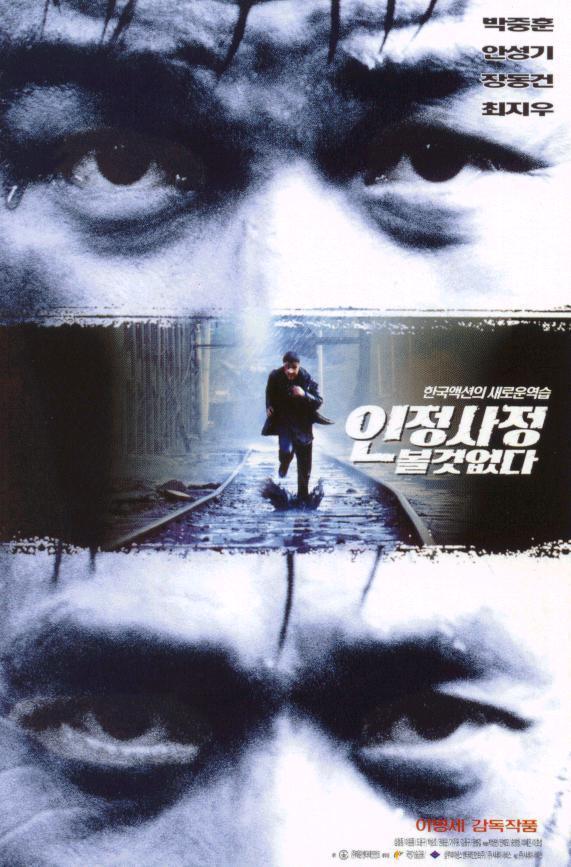
One of Korea’s foremost visual stylists, Lee Myung-se’s work has often been under appreciated at the time of its release. His desire to experiment finds fertile ground in the intensely kinetic ode to the police procedural, Nowhere to Hide (인정사정 볼 것 없다, Injeongsajeong bol Geos Eobsda). A tale of cops and robbers, Nowhere to Hide follows a cop who talks too much on the trail of a silent assassin who is, in fact, an expert at hiding in plain sight through the art of disguise. Moving quickly from one intense, beautifully choreographed set piece to the next, Lee draws inspiration from the crime-tinged tragedies of old Hollywood and beyond whilst embracing those of his home nation in the classic twin pairing of actors Ahn Sung-ki as the enigmatic assassin, and Park Joong-hoon as the bullheaded cop hot on his trail.
Lee opens in black and white with Inspector Woo (Park Joong-hoon) in full on gangster mode as he wanders through a ruined landscape, pausing only to tie his shoelace while the pulsing, punkish music continues in the background, before he walks in on an entire room of besuited gangsters and calmly sits down to introduce himself. Sometime later, Sungmin (Ahn Sung-ki), in sunshades and trench coat, patiently bides his time before committing a dramatic murder and making off with a mysterious briefcase.
What follows then is a game of cat and mouse as Woo chases the ghost of Sungmin through dingy back allies and neighbourhood dive bars, taking his more serious partner, Kim (Jang Dong-kun), whose more primary motivations include his family or more particularly his little girl, along for the ride. Woo lives only for his work, drawing more thrill from the chase than he is likely to admit. Through his pursuit of Sungmin, Woo draws closer to a side of himself he hoped to avoid, burying his natural rebelliousness in service of the law. We see him brutally interrogate suspects, even at one point trussing one up like a prize pig and suspending him between two desks in the middle of the police station. It is, in this sense, Woo who is left with “nowhere to hide”. As a young man, he had a violent streak which might well have led him into crime if his father had not pointed him towards the police, but he can no longer claim to be very much different than the quarry he pursues. His true nature has been laid bare by his opposing number.
Woo’s rage and unpredictable energy are tempered by Kim’s evenhandedness, but after a job goes wrong and Kim kills a suspect by mistake he starts to fall apart. Suddenly Woo cannot rely on Kim to save him from himself and then tragically fails to save Kim during another operation, leaving him open to serious injury. His quest is now as much one of vengeance and personal feeling as it is of justice.
Sungmin, by contrast, says not one word in the entirety of the film. A felt presence more than a seen one, he slips in and out of personas, escaping from the scene in various disguises as a figure more of legend than of reality. A close relationship with a bar hostess girlfriend is Woo’s way in to Sungmin’s world, correctly identifying a weakness and pressing it, pursuing a more concrete route to the centre of Sungmin’s existence than simply tracking him through the shady netherworld in which he lives.
The two men run from and mirror each other as pictures of action and stillness, resistance and urgency. Through a relentless pursuit of capture or escape, neither can evade the shadow of himself, each moving closer to their true selves as repressed elements surface and threaten to destroy the whole. Woo and Sungmin are each on a mutually destructive pursuit of the self as much as they are for their own, self defined goals.
Lee frames all of this within his characteristically ironic world view, painting the drama as comedy imbued with its own kind of cartoonish slapstick. Throwing in cinematic homages from a brief nod to Battleship Potemkin to an ending plucked straight out of The Third Man, Lee mixes freeze frames with an odd jump dissolve technique which lends his intensely beautiful choreography an impressionistic, fleeting quality. Two men chase the shadow of the other, engaged in a desperate game of hide and seek, but when the game is up neither may like what they see.
Screened at London Korean Film Festival 2017.
Robbery sequence (dialogue free)
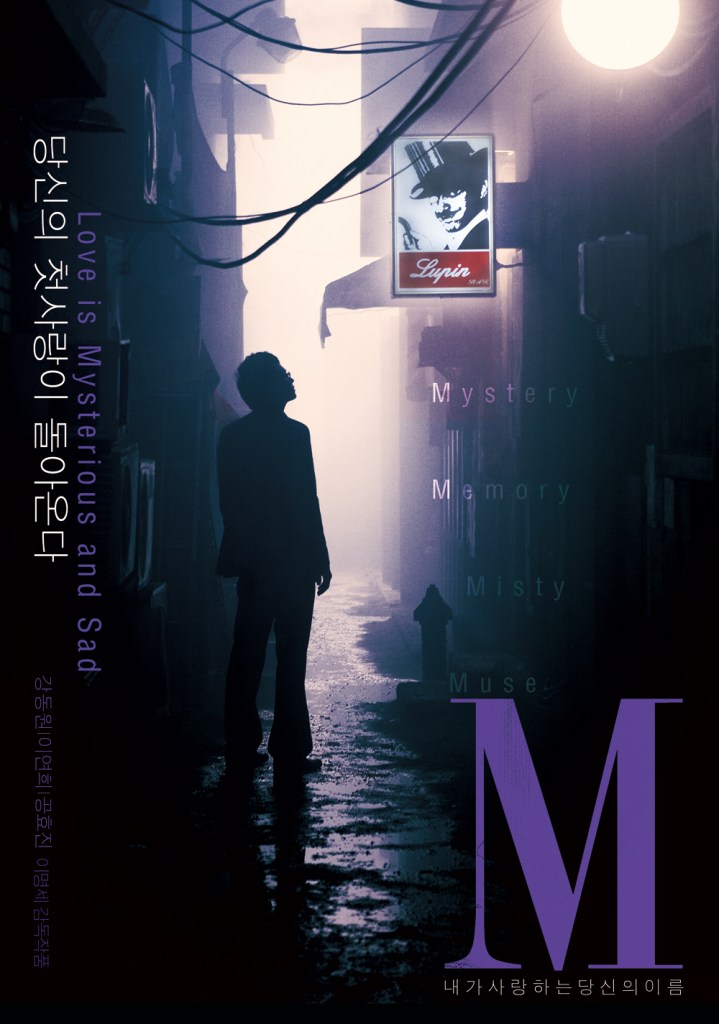 “More specific, less poetic” the distressed author hero of Lee Myung-se’s M (엠) repeatedly types after a difficult conversation with his editor. Almost a meta comment on Lee’s process, it’s just as well that it’s advice he didn’t take – M is a noir poem, a metaphor for an artist’s torture, and a living ghost story in which a man shifts between worlds of memory, haunted and hunted by unidentifiable pain. Reality, dream, and madness mingle and merge as a single kernel of confusion causes widespread panic in a desperate writer’s already strained mind.
 In a time of crisis, the populace looks to the government to take action and save the innocent from danger. A government, however, is often forced to consider the problem from a different angle – not simply saving lives but how their success or failure, decision-making process, and ability to handle the situation will be viewed by the electorate the next time they are asked who best deserves their faith and respect. Pandora (판도라) arrives at a time of particularly strained relations between the state and its people during which faith in the ruling elite is at an all time low following a tragic disaster badly mishandled and seemingly aided by the government’s failure to ensure public safety. Faced with an encroaching nuclear disaster to which their own failure to heed the warnings has played no small part, Pandora’s officials are left in a difficult position tasked with the dilemma of sacrificing a small town to save a nation or accepting their responsibility to their citizens as named individuals. Unsurprisingly, they are far from united in their final decision.
 Absolute power corrupts absolutely, but such power is often a matter more of faith than actuality. Coming at an interesting point in time, Han Jae-rim’s The King (더 킹) charts twenty years of Korean history, stopping just short of its present in which a president was deposed by peaceful, democratic means following accusations of corruption. The legal system, as depicted in Korean cinema, is rarely fair or just but The King seems to hint at a broader root cause which transcends personal greed or ambition in an essential brotherhood of dishonour between men, bound by shared treacheries but forever divided by looming betrayal.
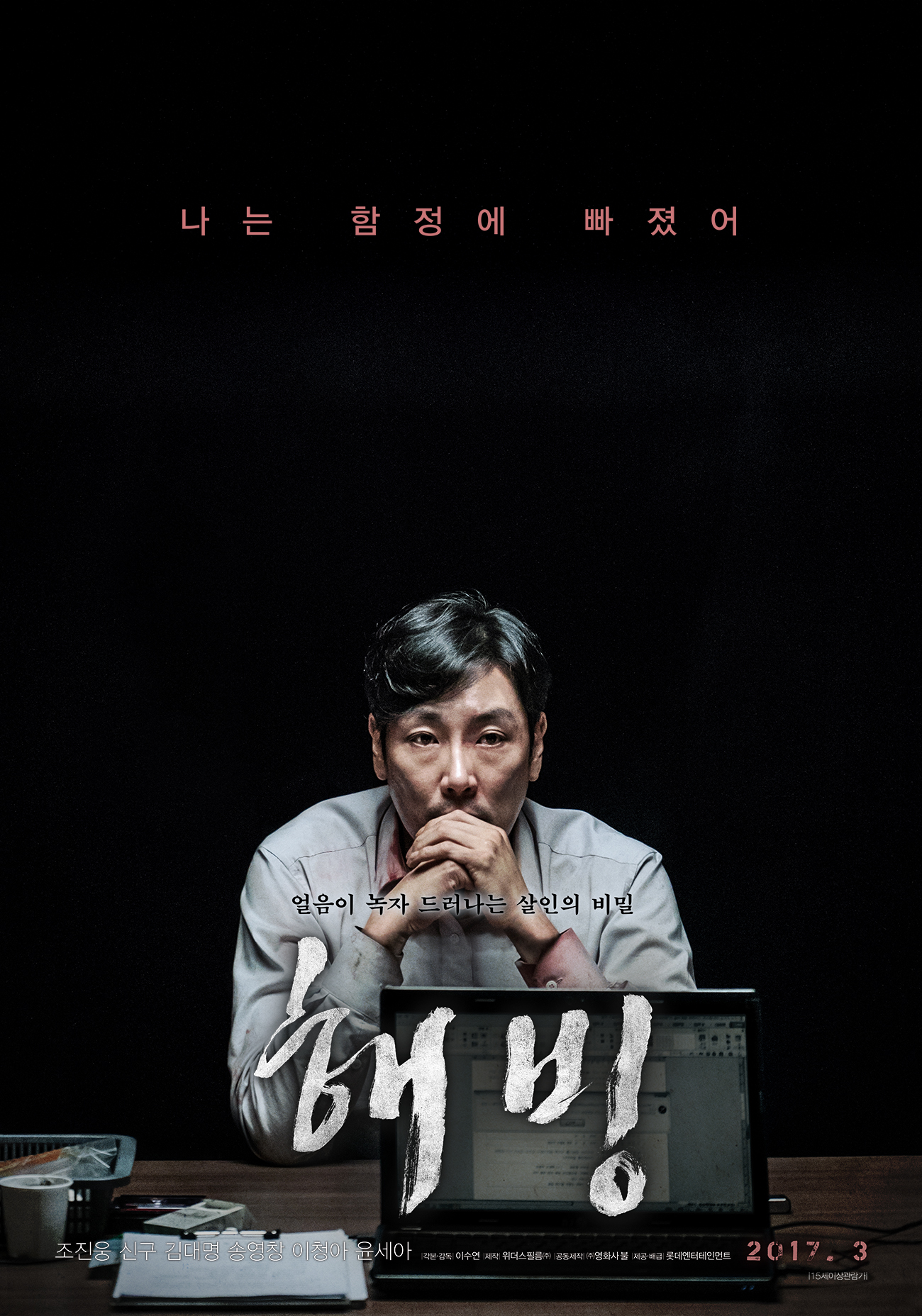 If you think you might have moved in above a modern-day Sweeney Todd, what should you do? Lee Soo-youn’s follow-up to 2003’s The Uninvited, Bluebeard (해빙, Haebing), provides a few easy lessons in the wrong way to cope with such an extreme situation as its increasingly confused and incriminated hero becomes convinced that his butcher landlord’s senile father is responsible for a still unsolved spate of serial killings. Rather than move, go to the police, or pretend not to have noticed, self-absorbed doctor Seung-hoon (Cho Jin-woong) drives himself half mad with fear and worry, certain that the strange father and son duo from downstairs have begun to suspect that he suspects.