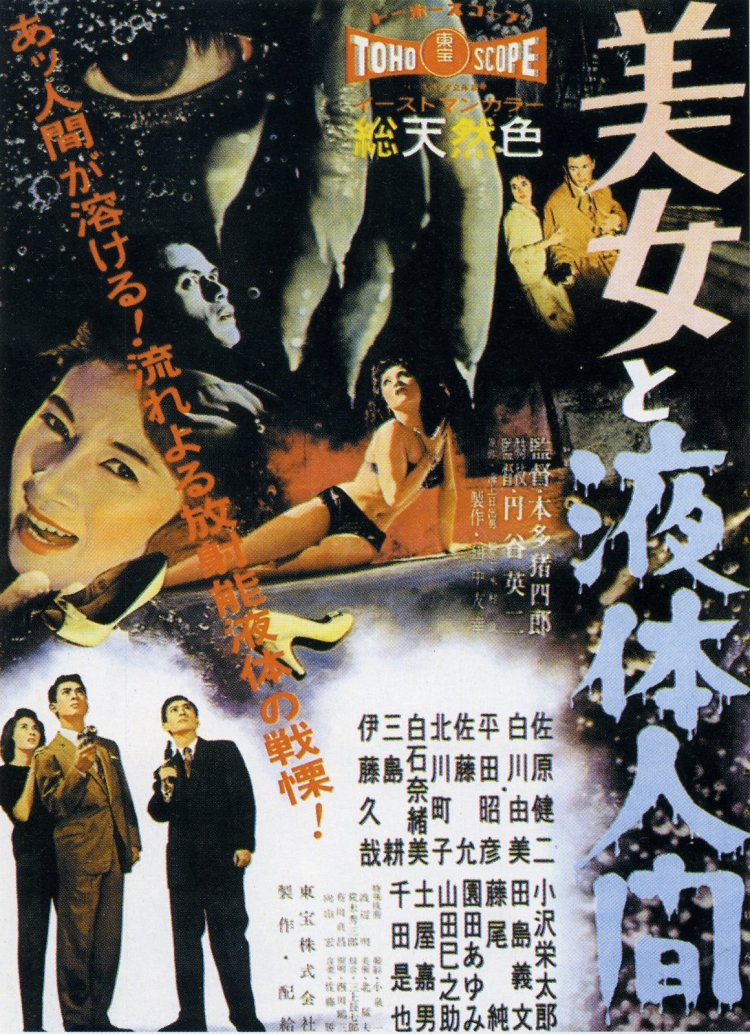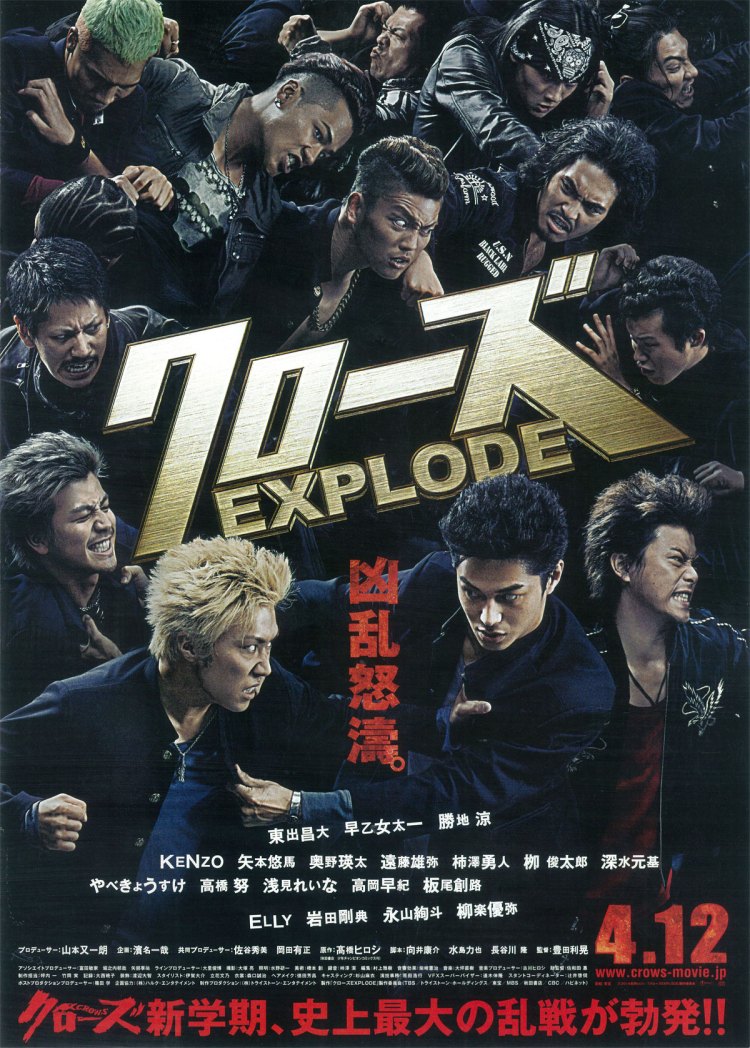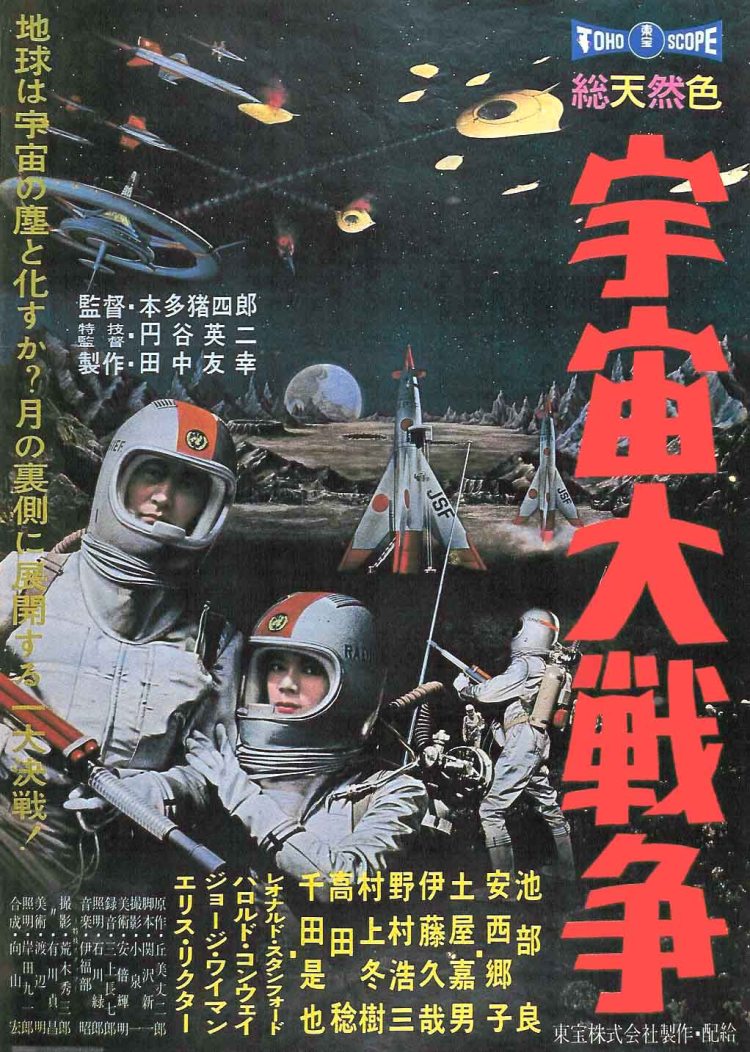
The H-Man (美女と液体人間, Ishiro Honda, 1958)

H-man
Toho produced a steady stream of science fiction movies in the ‘50s, each with some harsh words directed at irresponsible scientists whose discoveries place the whole world in peril. The H-man (美女と液体人間, Bijo to Ekitainingen), arriving in 1958, finds the genre at something of an interesting juncture but once again casts nuclear technology as the great evil, corrupting and eroding humanity with a barely understood power. Science may have conjured up the child which will one day destroy us, robbing mankind of its place as the dominant species. Still, we’ve never particularly needed science to destroy ourselves and so this particularly creepy mystery takes on a procedural bent infused with classic noir tropes and filled with the seedier elements of city life from gangsters and the drugs trade to put upon show girls with lousy boyfriends who land them in unexpected trouble.

Misaki (Hisaya Itou) is not a man who would likely have been remembered. A petty gangster on the fringes of the criminal underworld, just trying to get by in the gradually improving post-war economy, he’s one of many who might have found himself on the wrong side of a gangland battle and wound up just another name in a file. However, Misaki gets himself noticed by disappearing in the middle of a drugs heist leaving all of his clothes behind. The police immediatetely start hassling his cabaret singer girlfriend, Chikako (Yumi Shirakawa), who knows absolutely nothing but is deeply worried about what may have happened to her no good boyfriend. The police are still working on the assumption Misaki has skipped town, but a rogue professor, Masada (Kenji Sahara), thinks the disappearance may be linked to a strange nuclear incident…..

Perhaps lacking in hard science, the H-Man posits that radiation poisoning can fundamentally change the molecular structure of a living being, rendering it a kind of sentient sludge. This particular hypothesis is effectively demonstrated by doing some very unpleasant looking things to a frog but it seems humans too can be broken down into their component parts to become an all powerful liquid being. The original outbreak is thought to have occurred on a boat out at sea and the scientists still haven’t figured out why the creature has come back to Tokyo though their worst fear is that the H-man, as they’re calling him, retains some of his original memories and has tried to return “home” for whatever reason.

The sludge monster seeps and crawls, working its way in where it isn’t wanted but finally rematerialises in humanoid form to do its deadly business. Once again handled by Eiji Tsuburaya, the effects work is extraordinary as the genuinely creepy slime makes its slow motion assault before fire breaks out on water in an attempt to eradicate the flickering figures of the newly reformed H-men. The scientists think they’ve come up with a way to stop the monstrous threat, but they can’t guarantee there will never be another – think what might happen in a world covered in radioactivity! The H-man may just be another stop in human evolution.

Despite the scientists’ passionate attempts to convince them, the police remain reluctant to consider such an outlandish solution, preferring to work the gangland angle in the hopes of taking out the local drug dealers. The drug lord subplot is just that, but Misaki most definitely inhabited the seamier side of the post-war world with its seedy bars and petty crooks lurking in the shadows, pistols at the ready under their mud splattered macs. Chikako never quite becomes the generic “woman in peril” despite being directly referenced in the Japanese title, though she is eventually kidnapped by very human villains, finding herself at the mercy of violent criminality rather than rogue science. Science wants to save her, Masada has fallen in love, but their relationship is a subtle and mostly one sided one as Chikako remains preoccupied over the fate of the still missing Misaki.

Even amidst the fear and chaos, Honda finds room for a little song and dance with Chikako allowed to sing a few numbers at the bar while the other girls dance around in risqué outfits. The H-man may be another post-war anti-nuke picture from the studio which brought you Godzilla but its target is wider. Nuclear technology is not only dangerous and unpredictable, it has already changed us, corrupting body and soul. The H-men may very well be that which comes after us, but if that is the case it is we ourselves who have sown the seeds of our destruction in allowing our fiery children to break free of our control.


Original trailer (no subtitles)

Crows Explode (クローズ EXPLODE, Toshiaki Toyoda, 2014)

crows explodeToshiaki Toyoda made an auteurst name for himself at the tail end of the ‘90s with a series of artfully composed youth dramas centring on male alienation and cultural displacement. Attempting to move beyond the world of adolescent rage by embracing Japan’s most representative genre, the family drama, in the literary adaptation Hanging Garden, Toyoda’s career hit a snag. Despite the film’s favourable reception with critics, a public drugs scandal cost Toyoda his career in Japan’s extremely strict entertainment industry. Since his return to filmmaking in 2009 Toyoda has continued to branch out but 2014’s Crows Explode (クローズ EXPLODE) throws him back into that early world of repressed male energy as internalised rage and frustration produce externalised violence. Picking up the Crows franchise where Takashi Miike left off, Toyoda brings his unique visual sensiblilty to the material, swapping Miike’s irony for something with more grit but losing the deadpan depth of its adolescent posturing in the process.

The old gods have fallen and new ones must rise. Tough guys graduate, but the battlefields of Suzuran High endure eternally. Suzuran is the ultimate in delinquent schools. None of the boys here are under any misapprehension that the adult world holds any promise for them. Many will drop out without completing high school, condemning themselves to a precarious life of continually uncertain, low paid employment, but even those who do manage to leave with a certificate will be heading into another competition to find a steady job in economically straightened times.

That is, those of them who don’t end up in a gang. The thing at Suzuran is that your fate is determined by your fists. Boys roam the halls looking for a fight, each vowing to become the top dog and de facto leader by proving themselves the best and the strongest of the strapping young men all vying for the title. A new challenger arrives in the form of transfer student, Kaburagi (Masahiro Higashide), whose intense energy upsets the dynamic between presumed number one Goura (Yuya Yagira) and his challenger Takagi (Kenzo) but Kagami (Taichi Saotome), the loner son of a fallen yakuza, seems further set to pose a threat in this knife edge environment.

Toyoda has some interesting points to make about the legacy of violence and the importance of father son relationships as each of these young men is reacting in some sense against a father or just his father’s world. Kaburagi, the film’s protagonist, is nursing a deep wound of double abandonment after witnessing his father’s death and then being deposited in a foster home by his sorrowful mother who promises to return for him soon but makes do with occasional visits and monetary gifts. Kaburagi is an angry young man and like many angry young men, he is eager not to become his father – a situation complicated by the fact that his father was a prize fighter who died in the ring.

His “mirror” Kagami, has a similar problem only his father died in a yakuza turf war. A surrogate presents himself in the form of former Suzuran scrapper “Jarhead Ken” (Kyosuke Yabe), now an ex-yakuza helping out at a friend’s second hand car dealership but unable to escape gangland troubles when it emerges Kagami’s clan are intent on acquiring it in order to turn the place into some kind of “entertainment complex”. Ken, a tough guy but soft hearted, has a talent for paternalism which he turns on the fatherless little boy of the car dealership’s owner to whom he teaches the importance of a hefty punch but also of friendship and loyalty.

Miike’s world was a surreal one, inflected with a wry middle aged eye which sees all of this teenage rambunctiousness for the ridiculous posturing it really is. Toyoda’s attempts to be more in the moment, experiencing the adolescent angst with all of its immediate force but unlike his early protagonists the boys of Suzuran are forced to “explode” rendering that central tenet of repressed anger redundant. Externalising the internal war somehow makes it much less interesting as boys trade blows, mindlessly trying to work out a mental struggle which their ill drawn backgrounds will not support.

The environment which the boys inhabit is a grey and hopeless one. Toyoda paints it with his characteristic visual flair, returning to his trademark sequences of slow motion coupled with indie music, but his energy is very different from Miike’s and its more contemplative rhythm never quite gels with the pugilistic fury of the source material even as it gives way to his more expressionistic imagery. The franchise is feeling a little punch drunk by this point, and Toyoda finds it in a particular puddle of teenage malaise. Still, the fists fly and the boys of Suzuran rise and fall as always providing enough self consciously cool action to sustain interest despite the otherwise insubstantial quality.


International trailer (English subtitles)

Bandage バンデイジ (Takeshi Kobayashi, 2010)

Japan was a strange place in the early ‘90s. The bubble burst and everything changed leaving nothing but confusion and uncertainty in its place. Tokyo, like many cities, however, also had a fairly active indie music scene in part driven by the stringency of the times and representing the last vestiges of an underground art world about to be eclipsed by the resurgence of studio driven idol pop. Bandage (Bandage バンデイジ) is the story of one ordinary girl and her journey of self discovery among the struggling artists and the corporate suits desperate to exploit them. One of the many projects scripted and produced by Shunji Iwai during his lengthy break from the director’s chair, Bandage is also the only film to date directed by well known musician and Iwai collaborator Takeshi Kobayashi who evidently draws inspiration from his mentor but adds his own particular touches to the material.

High school girl Asako (Kie Kitano) is best friends with Miharu (Anne Watanabe) who likes all the same cool indie bands she does and is therefore upset to learn that she is dropping out of school because her parents have money problems. Luckily the girls run in to each other at a record store where Miharu works and bond again over the new CD of a band Miharu had recommended and Asako had fallen in love with – LANDS. Miharu also manages to get tickets to a LANDS concert and even swipes a couple of backstage badges from some retreating suits.

The girls sneak backstage and are immediately clocked by the band’s wily manager, Yukari (Ayumi Ito), but their adventure is derailed after they literally run into a band member and Asako loses a contact lens. The band’s lead singer, Natsu (Jin Akanishi), places a bandana across Asako’s temporarily blinded eye and rechristens her “Black Jack” before inviting both the girls to the post-show drinking session. Leaving early, Asako ends up arranging to meet Natsu at another bar later, beginning her long journey with the difficult, damaged musician as they navigate the turbulent “indie” record scene with all of its various traps and temptations.

Though Natsu and Asako may not actually be so far apart in age, you have to admit there’s a something not quite right in his sudden desire to befriend a starstruck high school girl. He does indeed seem to be after the obvious but after she resolutely turns him down, he keeps chasing her right until the end of the film. Despite remaining a little distant and afraid of this somehow very intense yet completely chilled out diva of a frontman, Asako becomes something like his only friend yet her presence continues to provoke tension within the group, particularly after she leaves high school and gets a job as a manager working alongside Yukari.

What first drew Asako to the music of LANDS was an identification with their melancholy lyrics echoing the alienation and loneliness she herself felt as a diffident adolescent. Her feelings towards Natsu are also driven by this same identification with his angst ridden lyrics but the qualities which attract him to her are those which she loathes in herself. Natsu, a narcissistic would be rock god, treats the band like his personal little empire, but deep down he knows he’s not its MVP. That would be the striking long haired guitar player, Yukiya (Kengo Kora), who the suits have pegged as the most likely to succeed. Natsu can write and his songs are good, if sometimes “uncommercial”, but he doesn’t quite have “it” in the same was as Yukiya does. Yukiya, by contrast, is (mostly) content to follow Natsu’s lead yet comes to resent his close relationship with Asako, regarding her as a kind of “Yoko” disrupting the band’s carefully crafted unity.

Yukiya’s attempt to destroy Asako is a calculated and cold one, motivated by his belief that she has “destroyed LANDS”. Laying bear his own pain and loneliness, Yukiya uses his internal darkness as an odd kind of seduction technique only to leave Asako on a barren shore sure of nothing other than the fear and confusion inside her heart. A dangerously violent confrontation with a drunken Natsu is the final trigger for Asako’s own moment of self realisation as she sees herself reflected in Natsu’s self destructive meltdown. United in mutual self loathing, the pair cement a melancholy though ultimately unrealisable bond which puts an end to Asako’s musical adventures.

Asasko is given a second opportunity to pursue a musical dream but one which is more on her own terms and reminds her of the potential and possibilities of music as art rather than the market driven mindset her agency job had done its best to instil. Natsu, it seems, has also rediscovered his artistry and may be in a better place to create away from the pressures that come with fronting an up and coming indie band. Defiantly exclaiming that the pain can’t reach him, Natsu might have found the “bandage” he’d been looking for which is, in a sense, his music – the dressing which staunches the weeping wounds of his pain and suffering. Music, like a bandage, is both salve and barrier – its message indirect but none the less deeply felt even if its effects are for internal use only. Asako and Natsu seem destined to walk on parallel paths but each has, at least, begun to discover their true selves as they continue to pursue their artistic dreams if perhaps at the expense of the personal.


Short scene from the film (no subtitles)

Swing Girls (スウィングガールズ, Shinobu Yaguchi, 2004)

There are two kinds of people in the world, those who swing and those who…don’t – a metaphor which works just as well for baseball and, by implication, facing life’s challenges as it does for music. Shinobu Yaguchi returns after 2001’s Waterboys with a film that’s…almost exactly the same only with girls instead of boys and concert halls instead of swimming pools, but it’s all so warm and charming that it hardly matters. Taking the classic sports movie formula of eager underdogs triumphing against the odds but giving it a teen comedy drama spin, Yaguchi’s Swing Girls (スウィングガールズ) is a fitting addition to the small but much loved high school girls vs music genre which manages to bring warmth and humour to its admittedly familiar narrative.
It’s summer and it’s hot and sunny but the school is filled with yankis and dreamers, forced to spend this lovely day indoors. While one group is busy ignoring their maths teacher, the school band is getting ready to accompany the baseball team on an important match. Unfortunately, the bus leaves before the bento boxes they’ve ordered are delivered so enterprising high school girl Tomoko (Juri Ueno) suggests they blow off the maths class and show solidarity with those representing the school by making sure their fellow students are well fed. Unfortunately, they fall asleep and miss their stop on the train meaning by the time they get there it’s a very late lunch and these bento boxes containing fish and eggs etc have all been in the hot sun for a fair few hours. After nearly killing all their friends, the girls are forced to join the band in their stead, despite having almost no musical experience between them.

As might be expected, the girls start to get into their new activity even if they originally dismiss sole boy Takuo’s (Yuta Hiraoka) interest in big band jazz as the uncool hobby of pretentious old men. However, this is where Yaguchi throws in his first spanner to the works as the original band recover far sooner than expected leaving our girls oddly heartbroken. This allows us to go off on a tangent as the girls decide they want to carry on with their musical endeavours and form their own band but lack the necessary funds to do so. Being a madcap gang of wilful, if strange, people the schemes they come up with do not go well for them including their stint as supermarket assistants which they get fired from after nearly setting the place on fire, and a mushroom picking trip which leads to an encounter with a wild boar but eventually holds its own rewards.

The girls’ embittered maths teacher, Ozawa (Naoto Takenaka), who just happens to be a jazz aficionado offers some key advice in that it’s not so much hitting the notes that matters as getting into the swing of things. It might take a while for the Swing Girls (and a boy) to master their instruments, but the important thing is learning to find their common rhythm and ride the waves of communal connection. Tomoko quickly takes centre stage with her largely self centred tricks which involve pinching her little sister’s games system to pawn to buy a saxophone, and almost messing up the all important finale through absentmindedness and cowardice. Other characters have a tendency to fade into the background with only single characteristics such as “worried about her weight”, or “hopelessly awkward”, or even with “folk duo in love with punk rockers”. Other than the one girl lusting after the baseball star and the two punk rockers annoyed by their earnest suitors, Yaguchi avoids the usual high school plot devices of romantic drama, fallings out, and misunderstandings whilst cleverly making use of our expectation for them to provide additional comedy.

What Swing Girls lacks in originality it makes up for with warmth and good humour as the band bond through their recently acquired love of music, coming together to create a unified sound in perfect harmony. Ending somewhat abruptly as the gang win over their fellow musicians after having overcome several obstacles to be allowed to play, the finale does not prove quite as satisfying as might be hoped but is certainly impressive especially considering the music really is being provided by the cast who have each learned to play their intstruments throughout the course of the film just as their characters have been doing. Warm, funny and never less than entertaining, Swing Girls lacks the necessary depth for a truly moving experience but does provide enough lighthearted fun to linger in the memory.


Original trailer (English subtitles)

Flowers (フラワーズ, Norihiro Koizumi, 2010)

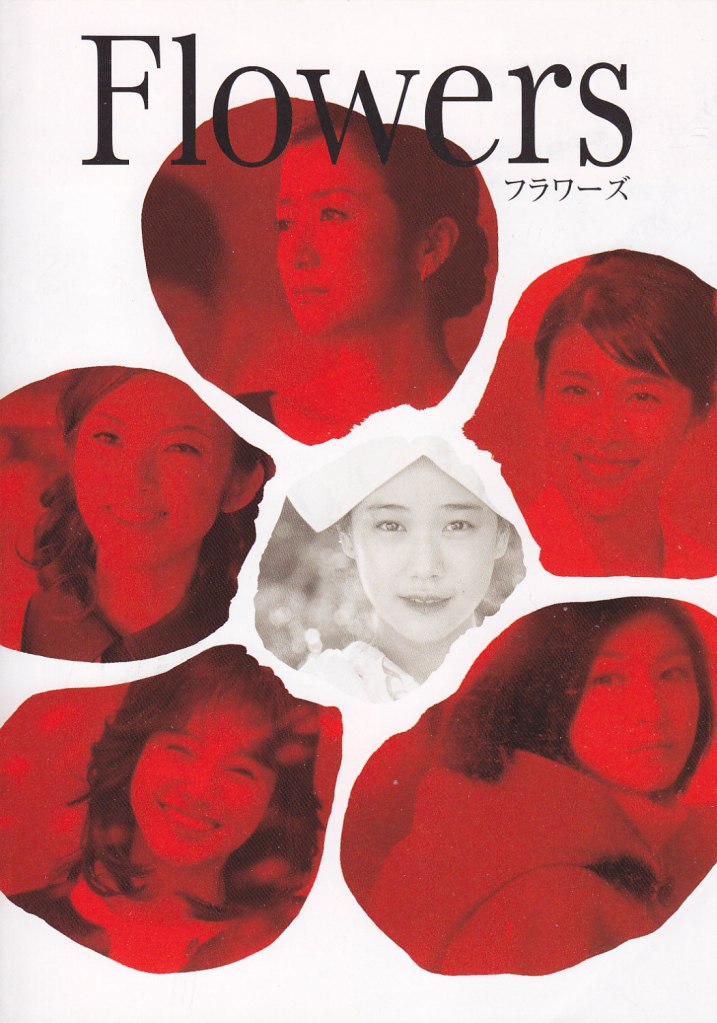
flowersThe rate of social change in the second half of the twentieth century was extreme throughout much of the world, but given that Japan had only emerged from centuries of isolation a hundred years before it’s almost as if they were riding their own bullet train into the future. Norihiro Koizumi’s Flowers (フラワーズ) attempts to chart these momentous times through examining the lives of three generations of women, from 1936 to 2009, or through Showa to Heisei, as the choices and responsibilities open to each of them grow and change with new freedoms offered in the post-war world. Or, at least, up to a point.

In 1936, oldest sister Rin (Yu Aoi) is to be married off against her will to a man picked by her father and whom she has never actually met. Bold and wilful, Rin finds herself more than usually torn between her intense resentment at being forced into a one time only life changing event simply on her father’s say so, and the guilt of rejecting centuries of tradition in rejecting her father’s authority. Minutes before the ceremony Rin makes a break for it fully done up in her wedding dress and makeup.

Flashing forward to her funeral in 2009, we learn that Rin did marry (someone, at least) and had three daughters. It’s her granddaughters we’re interested in now – happy mother Kei (Ryoko Hirosue), cheerful even at a wake, and the depressed Kanna (Kyoka Suzuki) – an unmarried former concert pianist who’s recently discovered she’s pregnant and is unsure what to do. In order to understand them we have to flashback a little again – to 1969, 1964, and 1977 to find out what happened to Rin’s three daughters – Kaoru (Yuko Takeuchi), Midori (Rena Tanaka), and Sato (Yukie Nakama).

Koizumi makes the most of his shifts in time periods to experiment with technical effects recreating the look of classic films of the era. Hence, 1936 is a desaturated monotone filled with classic silent movie compositions, seemingly owing a large debt to Ozu, Shimizu, and Mizoguchi. The difference between 1964 and 1969 might be thought slight but partly down to the different genre elements in the two vignettes, the contrast is marked with 1964 taking on the classic romantic melodramas of the period, and 1969 embracing bright and colourful salaryman comedy – only this time it’s a salary woman embarking on the era of having it all (though perhaps, tragically, ten too years to early to make the most of it). 1977 brings us back down with bump of realism as Sato lives an ordinary suburban life as a housewife and mother. Imbuing each of his eras with the warmth of nostalgia backed up with rich period detail, Koizumi has indeed framed his passage of womanhood narrative with an impressive degree of grounding.

This has been a period of intense social change, entirely for the better even if there is still a long way to go. Though marriages of 1936 were referred to as semi-arranged, families could and did place intense pressure on their children to consent or refuse to accept their refusal to do so (perhaps as true for sons as daughters, though sons were unlikely to find themselves in such a difficult position when things went wrong). Thus the course of Rin’s life is decided by her rigid, austere father leaving her with no possibility of choice in a world entirely controlled by men. Her daughters have more freedom and opportunities, marrying for love and choosing careers and/or motherhood as they see fit.

Midori, the most headstrong of the three sisters takes a job at a publishing house where she is the only female employee. Receiving a marriage proposal leads her to question her choices once again, wondering if accepting means jumping off the career ladder altogether. Wanting to get ahead, Midori has been behaving like her male colleagues – dressing in less feminine clothes and in subdued colours, heading off the inevitable sexist comments with aggression and violence but, eventually emboldened, she she finds herself blossoming when embracing her femininity within the workplace.

The world has moved on – women cannot be pushed in the same way Rin was pushed even if social mores can still be used to cajole them into conformity. The one big recent social change is in Kanna’s decision to proceed as a single mother. Though the question is still raised, there is broad approval for the idea which is met with no obvious stigma and only love and support from her immediate family. However, some things apparently don’t change as even if not all roads lead to marriage they all point towards motherhood which is still presented as the only marker of success as a woman. In this respect the closing montage accompanied by the odd choice of Olivia Newton John’s Have You Even Felt Mellow feels ill judged as the sister who’s experienced the ultimate heartbreak bounces around recreating the opening of Georgy Girl (only more successfully) with a new haircut and indulging in an ice-cream as a sort of antidote to eternal widowhood.

Nevertheless, Flowers does present a warm and broadly inspirational ode to the healing power of family and unbreakable female resilience even in the midst of such extreme social change. Painted with a keen eye for period detail and a deeply nostalgic longing for comforts long since passed, Koizumi’s exploration of womanhood through the ages is quick to acknowledge the pain and sacrifice experienced by women of all generations but is, in the end, too ready to accept it.


Original trailer (no subtitles)

My Love Story!! (俺物語!!, Hayato Kawai, 2015)

my-love-storyThey say the way to a man’s heart is through his stomach, but for some guys you’ll have to do a whole lot of baking. Based on the popular manga which was also recently adapted into a hit anime (as is the current trend) My Love Story!! (俺物語!!, Ore Monogatari!!) is the classic tale of innocent young love between a pretty young girl and her strapping suitor only both of them are too reticent and have too many issues to be able to come round to the idea that their feelings may actually be requited after all. This is going to be a long courtship but faint heart never won fair maiden.
Takeo (Ryohei Suzuki) has been best friends with next-door neighbour Suna (Kentaro Sakaguchi) ever since they were small and he made a point of becoming his defender when Suna was the new kid in town and the other boys made fun of him. However, Taeko is a big lug of a guy, adored by the his male classmates for his off the charts level of coolness, but often shunned by the ladies thanks to his impulsive nature and booming voice. Suna, by contrast, is massively popular and finds himself surrounded by swooning girls everywhere he goes. Being the big hearted guy he is, when Takeo notices his middle school crush confessing her love to Suna on graduation day, he makes sure Suna lets her down gentle and chooses to break his own heart instead.

You see, being the big guy is not exactly easy. A little slow on the uptake but also extremely sensitive, Takeo has been hearing gorilla jokes his whole life and so has internalised an intense feeling of being completely unloveable. Despite this, he remains an extremely good person who just wants everyone else to be happy even if he’s convinced himself he’s not allowed to be. Thus when he saves timid high school girl Rinko (Mei Nagano) from a persistent street harasser and falls in love at first sight, it doesn’t really occur to him that the same thing might have happened to her. Mistaking Rinko’s attempts to get his attention for a backhanded way to get to his more conventionally handsome friend, Takeo resolves to get the two together no matter what!

It would be difficult to find a romance quite as innocent as My Love Story!! which (successfully) strings out one wilful misunderstanding for around two hours. There are no great scenes of jealous exes or sudden arranged marriages to contend with, just two people entirely incapable of speaking plainly. Takeo is so invested in the idea of his own ugliness that it just doesn’t make sense to him that anyone would choose him over the conventionally handsome Suna. Likewise Rinko is quite a timid girl, bowled over by the cool way Takeo dealt with her street harasser and subsequent acts of heroism throughout the film. Though her friends may crack gorilla jokes behind her back, Rinko can see straight through to Takeo’s giant heart and is always ready to defend him, even if her own diffidence means she can’t just tell Takeo how she really feels in a way he understands.

Meanwhile, Suna is very bored by all of these missed messages as his well meaning buddy tries to foist the girl he himself loves on his obviously disinterested friend. As for why Suna is so disinterested, the film is also a somewhat coy. A little shy and awkward himself, Suna is uncomfortable with all the attention his ridiculous good looks bring him, as well as additional resentment from the other guys and often needing to deflect praise for Takeo’s heroism which people often seem to attribute to him. It may just be that Suna is over the superficial and is waiting for someone to see past his pretty boy face but his refusal to talk about the kind of girl he likes aside from going for “big and strong” perhaps hints at an altogether different reason. In any case, Suna getting fed up with being persistantly gooseberried becomes the final catalyst for finally explaining to Takeo what exactly has been going on these past few months.

Before you know it, enough baked goods to feed a small army have been consumed but Takeo is still having trouble realising that they each had a secret ingredient – love! Sometimes nice guys do get the girl, even if it involves shielding them from a falling coffin in a haunted house that’s on fire which is not as good of a metaphor as you’d think but it’ll do for now. Old fashioned and innocent, My Love Story isn’t going to set the world on fire, but it might just light a flame in your heart.


Original trailer (no subtitles)

April Fools (エイプリルフールズ, Junichi Ishikawa, 2015)

april-foolsIn this brand new, post truth world where spin rules all, it’s important to look on the bright side and recognise the enormous positive power of the lie. 2015’s April Fools (エイプリルフールズ) is suddenly seeming just as prophetic as the machinations of the weird old woman buried at its centre seeing as its central message is “who cares about the truth so long as everyone (pretends) to be happy in the end?”. A dangerous message to be sure though perhaps there is something to be said about forgiving those who’ve misled you after understanding their reasoning. Or, then again, maybe not.
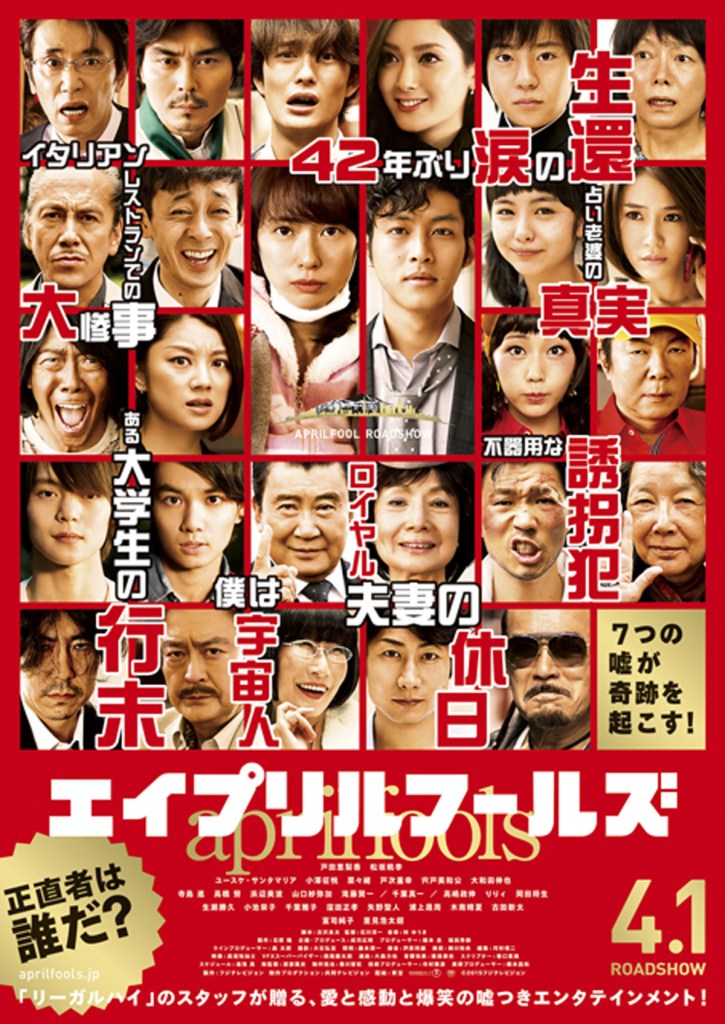
Juggling seven stories April Fools is never as successful at weaving them into a coherent whole as other similarly structured efforts but begins with an intriguing Star Wars style scroll regarding alien sleeper agents who can apparently go home now because they’ve accomplished everything they came for. Changing track, pregnant snack addict Ayumi (Erika Toda) decides to ring the still unknowing father of her child after witnessing an improbable reunion on TV only he’s in bed with someone else and assumes her call is a weird practical joke. Overhearing that he’s just arrived at a restaurant for a lunch date, Ayumi takes matters into her own hands and marches over there, eventually taking the entire place hostage. Meanwhile an older couple are having a harmless holiday pretending to be royalty and a grizzled gangster has “kidnapped” a teenage girl only to give her a nice day out at the fun fair. Oh, and the hikkikomori from the beginning who’s fallen for the whole alien thing has made a total fool of himself at school by taking out his bully, kissing his crush goodbye and racing up to the roof to try and hitch a lift from the mothership.

Importing this weird European tradition to Japan, the creative team have only incorporated parts of it in that they don’t call time on jokes at noon and it’s less about practical shenanigans and elaborate set ups than it is about wholesale lying which is frustrated by this famous non-holiday apparently created in celebration of it. All of the protagonists are lying about something quite fundamental and usually to themselves more than anyone else but at least their April Fools adventures will help them to realise these basic inner truths.

Then again some of these revelations backfire, such as in the slightly misjudged minor segment concerning two college friends who are repeatedly kicked out of restaurants before they can get anything to eat. One decides to “prank” his friend with an April Fools confession of love, only to find that his friend really is gay and is in love with him. Awkward is not the word, but then an April Fools declaration of love is about the worst kind of cruel there is and is never funny anyway, nor is the casual homophobia involved in this entire skit but that’s another story.

In fact, most of the other people are aware they’re being lied to, but are going along with it for various reasons, some hoping that the liars will spontaneously reform and apologise or explain their actions. Ayumi, who is shy and isolated by nature, always knew her handsome doctor suitor was probably not all he seemed to be but is still disappointed to be proved right, only be perhaps be proved wrong again in the end. Convinced to take a chance on an unwise romance by an older colleague who explains to her that many miracles begin with lies, Ayumi is angry with herself as much as with her lying Casanova of a baby daddy, and also feels guilty about an incredibly sight deception of her own. As in many of the other stories, now that everyone has figured out the real, important, truths about themselves and about the situation, they can excuse all of the lying. Sensible or not? The choice is yours.

Despite coming from the team who created some very funny TV dramas including Legal High, the comedy of April Fools never quite hits its stride. Weak jokes backed up with slapstick humour giving way to sentimentality as the “good reasons” for the avoidance of truth are revealed don’t exactly whip up the farcical frenzy which the premiss implies. The point may very well be that we’re the April Fools going along with this, but even so its difficult to admire a film which pushes the “lying is good” mantra right to the end rather than neatly undercutting it. Still, there is enough zany humour to make April Fools not a complete waste of time, even if it doesn’t make as much of its original inspiration as might be hoped.


Original trailer (English subtitles)

The Apology King (謝罪の王様, Nobuo Mizuta, 2013)

The Apology King.jpgThere are few things in life which cannot at least be improved by a full and frank apology. Sometimes that apology will need to go beyond a simple, if heart felt, “I’m Sorry” to truly make amends but as long as there’s a genuine desire to make things right, it can be done. Some people do, however, need help in navigating this complex series of culturally defined rituals which is where the enterprising hero of Nobuo Mizuta’s The Apology King (謝罪の王様, Shazai no Ousama), Ryoro Kurojima (Sadao Abe), comes in. As head of the Tokyo Apology Centre, Kurojima is on hand to save the needy who find themselves requiring extrication from all kinds of sticky situations such as accidentally getting sold into prostitution by the yakuza or causing small diplomatic incidents with a tiny yet very angry foreign country.
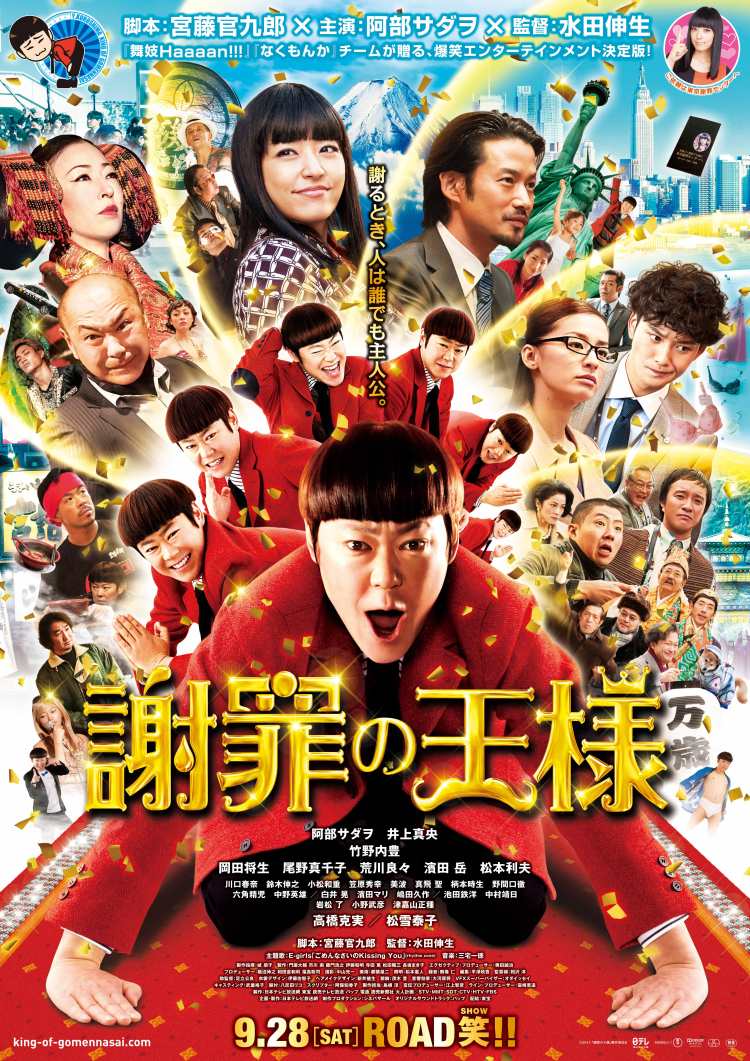
Kurojima promises to know an even more powerful form of apology than the classic Japanese “dogeza” (falling to your knees and placing your head on the ground with hands either side, or OTL in internet lingo), but if you do everything he tells you to, you shouldn’t need it. His first case brings him into contact with Noriko (Mao Inoue) whose awful driving has brought her into contact with the yakuza. Not really paying attention, Noriko has signed an arcane contract in which she’s pledged herself to pay off the extreme debts they’ve placed on her by entering their “employment” at a facility in Osaka. Luckily, she’s turned to Kurojima to help her sort out this mess, which he does by an elaborate process of sucking up to the top brass guys until they forget all about Noriko and the money she owes them in damages. Impressed, Noriko ends up becoming Kurojima’s assistant in all of his subsequent cases, helping people like her settle their disputes amicably rather allowing the situation to spiral out of control.

Mizuta begins with a neat meta segment in which Kurojima appears in a cinema ad outlining various situations in which you might need to apologise including allowing your phone to go off during the movie, or attempting to illegally film inside the auditorium etc ending with a catchy jingle and dance routine pointing towards the contact details for his apology school. Kurojima’s instructions are also offered throughout the film in a series of video essays in which he outlines the basic procedures for de-escalating a conflict and eventually getting the outcome you’re looking for.

Of course, all of this might sound a little manipulative, which it is to a degree, but the important thing to Kurojima lies in mutual understanding more than “winning” or “losing” the argument. The second case which comes to him concerns a young man who has some very outdated ideas and has, therefore, been accused of sexual harassment. Unfortunately, Numata (Masaki Okada) is a classic sexist who only makes the situation worse for himself and completely fails to understand why he was at fault in the first place. Even following Kurojima’s expertly crafted instructions, Numata further insults his female boss whilst attempting to apologise meaning Kurojima has to come up with an even more elaborate plan to smooth the situation which involves pretending to be the ghost of a man who threw himself under a train after being accused of harassing a young woman at work who did not return his affections. This seems to do the trick and the relationship between Numata and his boss appears to have improved even if Numata still has a long way to go in the person stakes, though it does perhaps make light of a serious workplace problem.

Numata follows all of Kurojima’s instructions but still gets everything wrong because he refuses to understand all of the various social rules he’s broken and therefore why and how the apology process is intended to make amends for them. Understanding and sincerity are the keys to Kurojima’s ideology but Numata, after a quick fix, fails to appreciate either of these central tenets and so is unable to work things out for himself. Similarly, in another case the parents of an actor are required to make a public apology when their son is captured on CCTV getting into a street fight. Only, being actors, they find genuine sincerity hard to pull off on the public stage either resorting to chewing the scenery or overdoing the dignified act, not to mention plugging their latest appearances at the end of the speech. The public apology is an important part of the Japanese entertainment industry though it might seem odd that the famous parents of a “disgraced” celebrity would be expected to apologise to the nation as a whole, but as it turns out all that was needed to settle the matter was a quick chat between the people involved, fully explaining the situation and reaching a degree of mutual understanding.

The innovative structure of Apology King neatly weaves each of the cases together as they occur in slightly overlapping timeframes but each contribute to the final set piece in which Kurojima becomes an advisor during a diplomatic incident caused when a film director unwittingly offends the small nation of Mutan by accidentally turning their crown prince into an extra in his film. Mutan is a nation with many arcane rules including a prohibition on filming royalty as well as on drinking and eating skewered meat, all of which the crown prince is seen doing in the movie. Matters only get worse when the film crew travel to Mutan to apologise but make even more faux pas, especially when it turns out that Japanese dogeza is actually incredibly rude in Mutanese culture. Revisiting elements from each of the previous cases, Kurojima is only able to engineer a peaceful solution by convincing the Japanese authorities to utter a set phrase in Mutanese which means something quite different and very embarrassing in their own language. Apologies are, of course, always a little humiliating, but then that is a part of the process in itself – placing oneself on a lower level to those who’ve been wronged, as symbolised in the dogeza.

Full of zany, madcap humour and culminating in a gloriously unexpected pop video complete with dancing idols of both genders exhorting the benefits of a perfectly constructed (and sincere) apology, The Apology King is a warm and innocent tribute to the importance of mutual understanding and its power to ease even the deepest of wounds and most difficult of situations. Hilarious but also heartfelt, The Apology King is a timely reminder that unresolved conflicts only snowball when left to their own devices, the only path to forgiveness lies in recognising your own faults and learning to see things from another perspective. Kurojima’s powers could be misused by the unscrupulous, but the most important ingredient is sincerity – empty words win no respect.


Original trailer (no subtitles)

Tears for You (涙そうそう, Nobuhiro Doi, 2006)

tears-for-youComing in at the end of the “pure love” boom, Nobuhiro Doi’s second feature, Tears for You (涙そうそう, Nada So So) is presumably named to tie in with his smash hit debut Be With You, and continues in the same general vein but with a much less satisfying melodrama at its core. A complicated love story centring on a pair of orphaned step-siblings, Tears for You edges into some difficult, perhaps unpalatable, territory but neatly skirts around it with a childish innocence intended to enhance its romantic credentials. Starring the jun-ai icon Masami Nasagawa, the tragic heroine at the centre of Crying Out Love in the Center of the World, alongside the then up and coming leading man Satoshi Tsumabuki, Tears for You is never quite as heartrending as it would like to be but does its best to wring its sorrowful narrative for all of its inherent tragedy.

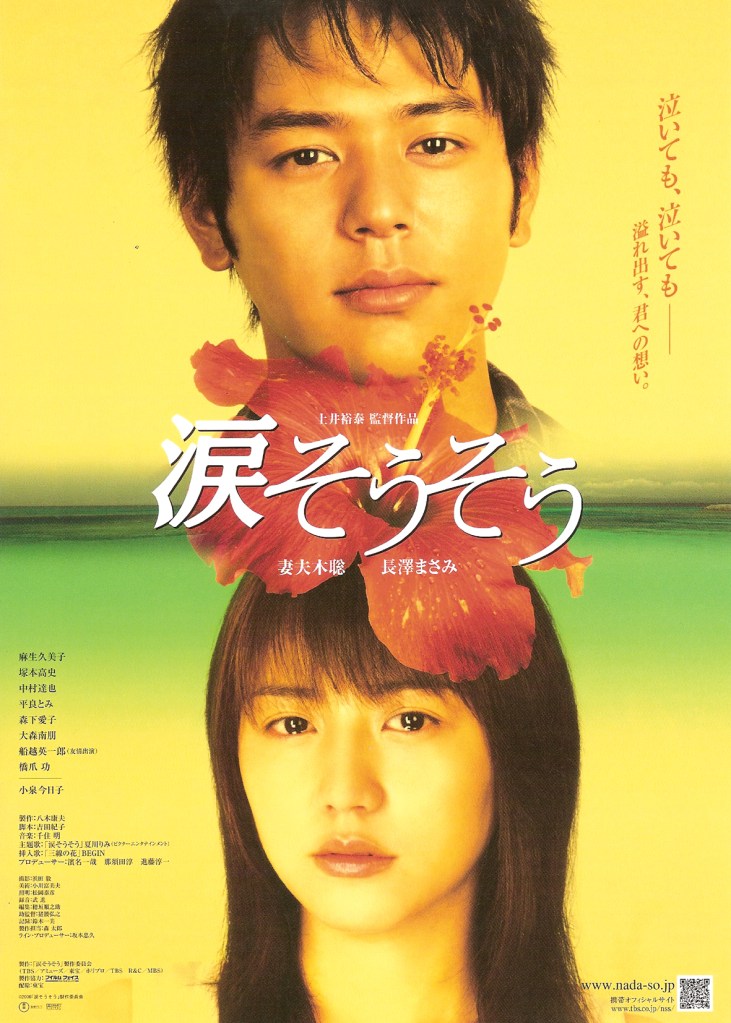
21yr old Yota (Satoshi Tsumabuki) is a young man with big dreams but he’s put lots of them on hold in order to take care of his younger step-sister, Kaoru (Masami Nagasawa), who has only him to depend on. Yota’s mother married Kaoru’s father when both the children were small but her new husband soon ran off leaving his daughter behind. The three of them continued as a tightly knit family until Yota’s mother became ill and passed away, making Yota promise to take care of Kaoru no matter what even whilst on her deathbed. The two then moved back to an Okinawan island to live with Yota’s grandmother until Yota came back to Naha for high school. Kaoru is now about to make that same journey but the siblings’ happy reunion also provokes a number of questions about the nature of their relationship and the course each of their lives will take in the future.

This being a “pure love” movie, tragedy is coming though Tears for You does its best to disguise where it’s coming from even if the eventual outcome is quite obviously signposted. The original barrier between Kaoru and Yota is raised by their nature as accidental siblings, not related by blood but raised alongside each other with a familial bond stronger than that of just childhood friends. This, of course, becomes a problem as they grow older and begin to find it difficult to draw the line between their familial love and a possibly romantic one which would allow their family of two to continue forever.

Yota, the self sacrificing older brother has indeed become everything to Kaoru – a brother, father, and friend all in one. Dropping out of high school early, Yota has been sending a pay check home since the age of sixteen, putting his own future to one side in order to provide for Kaoru. Determined that Kaoru should prosper and escape their lowly, poverty stricken island existence through getting to university and into a middle class profession, Yota has been working three different jobs. When it looks as if he’s about to be able to realise his own dream of opening a restaurant, it all comes crashing down around his ears as he realises he’s been duped by a con artist and is now on the hook to a gang of loansharks.

In addition to adding to his financial burdens, causing him embarrassment, and further deepening his worry about providing for Kaoru, the situation also creates instability in his romantic life when the father of his longterm medical student girlfriend finds out about his predicament and offers to help – but only at a price. Keiko (Isao Hashizume), he reminds him, is a middle class girl on track to take over her father’s clinic. Yota is a poor boy with limited expectations. The implications are clear and already known to Yota who has internalised a degree of shame over his lowly origins and lack of education which he overcomes through hard work and enthusiasm. Keiko is not the sort to worry about a petty class difference even if her father is, but his words get to Yota who has always felt Keiko is too good for him. She does, however, care slightly about Yota’s ongoing and complicated relationship with his younger sister whom, she fears, will always eclipse any other woman in his life.

As in all pure love stories, love is an impossibility, surrounded by unassailable walls of culture and fate. Though there is no blood relation between Yota and Kaoru, their familial circumstances make romantic love a taboo which leads the film into a rather odd corner in which the familial side of their relationship is the one which gains the upper hand as the love of a brother and sister eclipses that of a tragic missed opportunity. As such the nature of the heartrending conclusion does not reach the melodramatic heights of other genre hits, even if it adheres to the form in maintaining the “purity” of the love through the final impossibility of its realisation. Doi employs many of the same techniques he used so well in Be With You, artfully shifting between past and present and making the most of repeated motifs to bring home the circularity of the relationship between the pair of tragic lovers but never achieves the same kind of emotional depth. Nevertheless, Tears for You is a suitably melancholy weepy anchored by strong performances from its two leads which does ultimately prove moving even if not quite reaching the degree of melodrama implied by the title.


Original trailer (no subtitles)

And here’s the original song, Nada Sou Sou, in its cover version by Rimi Natsukawa which spawned a mini industry of its own encompassing two TV dramas and this standalone film (English translation):

I Am a Hero (アイアムアヒーロー, Shinsuke Sato, 2016)

i-am-a-heroJapan has never quite got the zombie movie. That’s not to say they haven’t tried, from the arty Miss Zombie to the splatter leaning exploitation fare of Helldriver, zombies have never been far from the scene even if they looked and behaved a littler differently than their American cousins. Shinsuke Sato’s adaptation of Kengo Hanazawa’s manga I Am a Hero (アイアムアヒーロー) is unapologetically married to the Romero universe even if filtered through 28 Days Later and, perhaps more importantly, Shaun of the Dead. These “ZQN” jerk and scuttle like the monsters you always feared were in the darkness, but as much as the undead threat lingers with outstretched hands of dread, Sato mines the situation for all the humour on offer creating that rarest of beasts – a horror comedy that’s both scary and funny but crucially also weighty enough to prove emotionally effective.

Strange things are happening in Tokyo. The news has just had to make a correction to their previous item – apparently, it was the woman who bit the dog and no, they don’t as yet know why. Hideo Suzuki (Yo Oizumi), sitting in the corner apart from his sardonic colleagues, is a 35 year old manga assistant with dreams of creating his very own franchised series. Sadly, his ideas are always shot down by the publisher who barely remembers his name but does note that there’s always the same problem with his protagonists. They’re just too…”normal’? Returning home to his previously patient girlfriend with the news that he has, once again, failed, Hideo is unceremoniously thrown out as Tekko (Nana Katase) charges him with exactly the same complaint as his publisher had – only special people can achieve their dreams, she says. You’re not special, you’re just ordinary. Throwing out his ridiculous shotgun purchased for “research” alongside him, Tekko slams the door with an air of frustrated finality.

A short time later, some of Hideo’s co-workers are feeling unwell, as is Tekko who calls him to apologise but when he arrives at her flat what he finds there is obviously not Tekko anymore. Returning to work, Hideo also finds one of his colleagues wielding a bloody bat next to the body of another assistant. Heroically cutting his own throat on realising he’s been bitten, his friend passes the bat(on) to Hideo, now on the run from a falling city. Teaming up with high school girl, Hiromi (Kasumi Arimura), he heads for Mt. Fuji where it’s hoped the virus may not be able to survive but the pair eventually run into another group of survivors holed up in a outlet mall where the undead may be the last of their worries.

Sato gleefully ignores the genre norms, refusing to give in to cinematic rules by consistently moving in unexpected directions. Thus, Hideo remains a cowardly fantasist throughout much of the film. In an odd kind of way, this refusal to engage is his manner of heroism. Though he is afraid and avoids reality through frequently trying write his way out of a situation, cleverly manifested by nicely integrated fantasy sequences, Hideo does not run away and consistently refuses to abandon those around him even if might be to his own advantage. Eventually he does get his hero moment, finally finding the courage to fire the shotgun which has so far remained an empty symbol of his unattainable dreams, stopping to pick up his all important hat as every bona fide hero must, but his true moment of realisation comes when he’s forced to acknowledge his own ordinariness. Having been accustomed to introduce himself with the false bravado that his name is Hideo – written with the character for hero, his post-zombie warrior persona can finally consent to just being “the regular kind of Hideo”. Heroes are not a magic breed, they’re regular guys who are OK with who they are and are prepared to risk all for someone or something else.

The fact that Hideo has a gun at all is a strange one when guns are so rare in Japan though his devotion to the precise rules of his license even in this quite obviously lawless environment proves an ongoing source of comedy. It also makes him an unwitting target for the unscrupulous and puts him in danger with the unpredictable leader of the survivor community he accidentally wanders into. As with any good zombie tale, the undead are one thing but it’s the living you have to watch out for. Holing up in an outlet store of all places can’t help but recall Dawn of the Dead and Sato does, indeed, make a little of its anti-consumerist message as expensive trinkets firstly seem pointless trophies, unceremoniously heaped together in Tupperware, but ultimately prove a kind of armour against zombie attack.

The ZQN are classic zombies in many ways – you need to remove the head or destroy the brain, but they’re also super strong and have a poignant tendency to engage in repetitive actions from their former lives or repeatedly make reference to something which was obviously in their mind as they died. Thus Tekko has enough time to ring Hideo before the virus takes hold and a politician to vent about the incompetence of his colleagues but the ZQN turns salarymen into babbling choruses of “thanks for everything”, dooms shop assistants to exclaim “welcome” for eternity and leaves baristas stuck with “What can I get you today?”. Unlike your usual zombies, the ZQN retain some buried consciousness of their inner selves, able to recognise those close to them but condemned to devour them anyway.

Placing character development ahead of the expected genre trajectory, Sato weaves a nuanced essay on the nature of heroism and humanity as Hideo is forced to confront himself in order to survive. Though he tantalises with a possible deus ex machina, Sato never gives in to its use – if our heroes are going to survive, they have to save themselves rather than wait for someone with the hero genes to suddenly appear. Of course, they do so in an elaborate blood soaked finale which more than satisfies in the zombie action stakes. Witty yet heartfelt, if I am a Hero has a message it’s that if I am a Hero then you can be too – no one is coming to save us, except us, but if we’re going to do so then we have to conquer ourselves first so that we might help each other.


Original trailer (English subtitles)