 Every love story is a ghost story, as the aphorism made popular (though not perhaps coined) by David Foster Wallace goes. For The Tale of Nishio (ニシノユキヒコの恋と冒険, Nishino Yukihiko no Koi to Boken), adapted from the novel by Hiromi Kawakami, this is a literal truth as the hero dies not long after the film begins and then returns to visit an old lover, only to find her gone, having ghosted her own family including a now teenage daughter. The Japanese title, which is identical to Kawakami’s novel, means something more like Yukihiko Nishino’s Adventures in Love which might give more of an indication into his repeated failures to find the “normal” family life he apparently sought, but then his life is a kind of cautionary tale offered up as a fable. What looks like kindness sometimes isn’t, and things done for others can in fact be for the most selfish of reasons.
Ten years prior to his death in a traffic accident, Yukihiko Nishino (Yutaka Takenouchi) has taken a (former?) lover and her little girl out for drinks and parfait at a lovely seaside cafe. The woman, Natsumi (Kumiko Aso), declines the offer of dessert but Nishino orders two anyway – one for himself and one for the little girl, Minami, though it seems neither of them really wanted one anyway. An odd flirtation exists between the adults but Nishino laments his ability to gain exactly what this situation might look like from the outside – a “normal” family. He wants to get married, have a daughter of his own, but his relationships always end in failure. Natsumi tells him why – he always gives women exactly what they want, which sounds good, but really isn’t.
Nishino’s problem is that he’s almost irresistible to women, but sooner or later they all leave him. He believes he has an almost telepathic ability to figure out what it is women want from him coupled with an intense need to satisfy their innermost desires. Ironically enough, it’s this strange kindness that eventually leads to his death when he runs into an old friend at a crowded marketplace. Excited to see him she calls and waves, dropping her shopping and losing one of her crutches in the process. Rushing to help, Nishino does not see an oncoming van and is run over. Quite literally the story of his life.
Reappearing as a ghost he attempts to pay a visit to Natsumi, having jokingly promised to do so while they were dating. Natsumi, however, is nowhere to be found and so Nishino is left to exorcise his demons with the now teenage Minami (Yurika Nakamura) who decides to attend his funeral in case her long absent mother decides to pay her respects. It’s here that she begins to learn a little of Nishino’s sad romantic history courtesy of an older woman who became a friend and confident rather than a lover (and consequently remained in his life a little longer).
The problem is, Nishino’s desire to be eternally helpful means that he’s always pulled in more than one direction. A slow burn affair with shy and retiring superior Manami (Machiko Ono) looks as if it could be the one, but she eventually points out to him that he’s not the sort of man who can have the life he craves because he never fully commits to any one person and never truly loves anyone. His irresistibility apparently even extends to one half of the lesbian couple from next door though, notably, not the half you’d expect.
Nishino first gets to know Tama (Fumino Kimura) and Subaru (Riko Narumi) when their cat, Nau, invites himself over, after which the feline Subaru decides to do the same, flirting away with her uptight girlfriend presumably going crazy in an adjacent room. Subaru is Nishino’s opposing number, the kind of girl that gets everything done for her, but there are obvious cracks in the strained relationship between the two women and it’s the neurotic Tama he finally bonds with after an unusually perceptive conversation over convenience store ice cream. Nishino, as he later puts it, is faithful in mind if not in body but satisfying immediate desires is not always the best idea. Trying to provide comfort, Nishino adds even more confusion to a messy situation and, even if it perhaps works out for the best, Nishino is left alone once again.
A botched proposal leads Nishino to let slip the real reason for his boundless desire to please – it’s because he’s lonely. Desiring to keep these women around him, he gives them whatever it is they want to stay. Just like Tama has effectively relegated Subaru to the same level as their cat – giving in to her every demand in the terror that she will leave, Nishino loses the women he loves by embracing his selfish desire to keep them rather than acting in their best interests and recognising the true depth of love which may not always work out in his favour. The interfering spectre of old girlfriend Kanoko (Tsubasa Honda) who can’t let go even though the relationship is over is a lingering hangover of this tendency as she too cannot seem to commit and wants to keep Nishino as a backup plan, resenting his interest in other women yet not willing to make a permanent decision to stay with him.
A whimsical fable of a man looking for love in all the wrong places, The Tale of Nishino is a long, melancholy journey through modern relationships in which not just romantic but platonic and familial love find themselves under the microscope. As Manami points out, you can’t share loneliness – Nishino’s need to be needed eventually drives a wedge between himself and everything he wanted. Natsumi’s words of wisdom for her injured daughter offer only that romantic love necessarily ends, whereas a mother’s love for her child is ever lasting even if it does not necessarily look that way. Iguchi’s style is typical of the “quirkier” end of Japanese indie, shooting with a deadpan abstraction, but the slight feeling of alienation works well with Nishino’s ultimate refusal to bare his heart in a more “straightforward” manner. A bittersweet story of love lost and found, Nishino may have given up the ghost but perhaps he did find that family after all, in a way, even if it was not his own.
Original trailer (no subtitles)
 Kiyoshi Kurosawa has taken a turn for the romantic in his later career. Both 2013’s Real (リアル 完全なる首長竜の日, Real: Kanzen Naru Kubinagaryu no Hi) and
  The Invisible Man is a frightening presence precisely because he isn’t there. The living manifestation of the fear of the unknown, he stalks and spies, lurking in our imaginations instilling terror of evil deeds we are powerless to stop. Daiei made
  Despite the potential raciness of the title, The Liar and his Lover (カノジョは嘘を愛しすぎてる, Kanojo wa Uso wo Aishisugiteru) is another innocent tale of youthful romance adapted from a shojo manga by Kotomi Aoki. As is customary in the genre, the heroine is cute yet earnest, emotionally honest and fiercely clear cut whereas the hero is a broken hearted artist much in the need of the love of a good woman. Innocent and chaste as it all is, Liar also imports the worst aspects of shojo in its unseemly age gap romance between a 25 year old musician and the 16 year old high school girl he picks up on a whim and then apparently falls for precisely because of her uncomplicated goodness.
 What would you give to live another day? What did you give to live this day? What did you take? Adapting the novel by Genki Kawamura, Akira Nagai takes a step back from the broad comedy of
  Fear of “broadcasting” is a classic symptom of psychosis, but supposing there really was someone who could hear all your thoughts as clearly as if you’d spoken them aloud, how would that make you feel? The shy daydreamer at the centre of The Kodai Family (高台家の人々, Kodaike no Hitobito) is about to find out as she becomes embroiled in a very real fairytale with a handsome prince whose lifelong ability to read minds has made him wary of trying to form genuine connections with ordinary people. Walls come down only to jump back up again when the full implications become apparent but there are taller walls to climb than that of discomfort with intimacy including snobby mothers and class based insecurities.
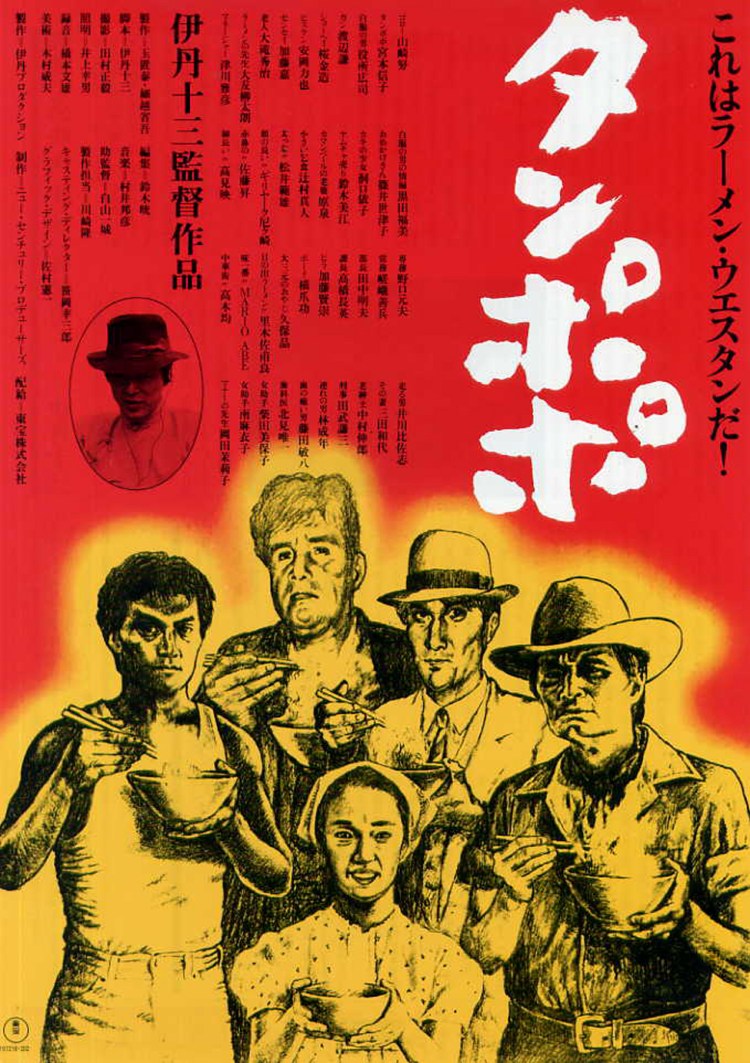 Some people love ramen so much that the idea of a “bad” bowl hardly occurs to them – all ramen is, at least, ramen. Then again, some love ramen so much that it’s almost a religious experience, bound up with ritual and the need to do things properly. A brief vignette at the beginning of Juzo Itami’s Tampopo (タンポポ) introduces us to one such ramen expert who runs through the proper way of enjoying a bowl of noodle soup which involves a lot of talking to your food whilst caressing it gently before finally consuming it with the utmost respect. Ramen is serious business, but for widowed mother Tampopo it’s a case of the watched pot never boiling. Thanks to a cowboy loner and a few other waifs and strays who eventually become friends and allies, Tampopo is about to get some schooling in the quest for the perfect noodle whilst the world goes on around her. Food becomes something used and misused but remains, ultimately, the source of all life and the thing which unites all living things.
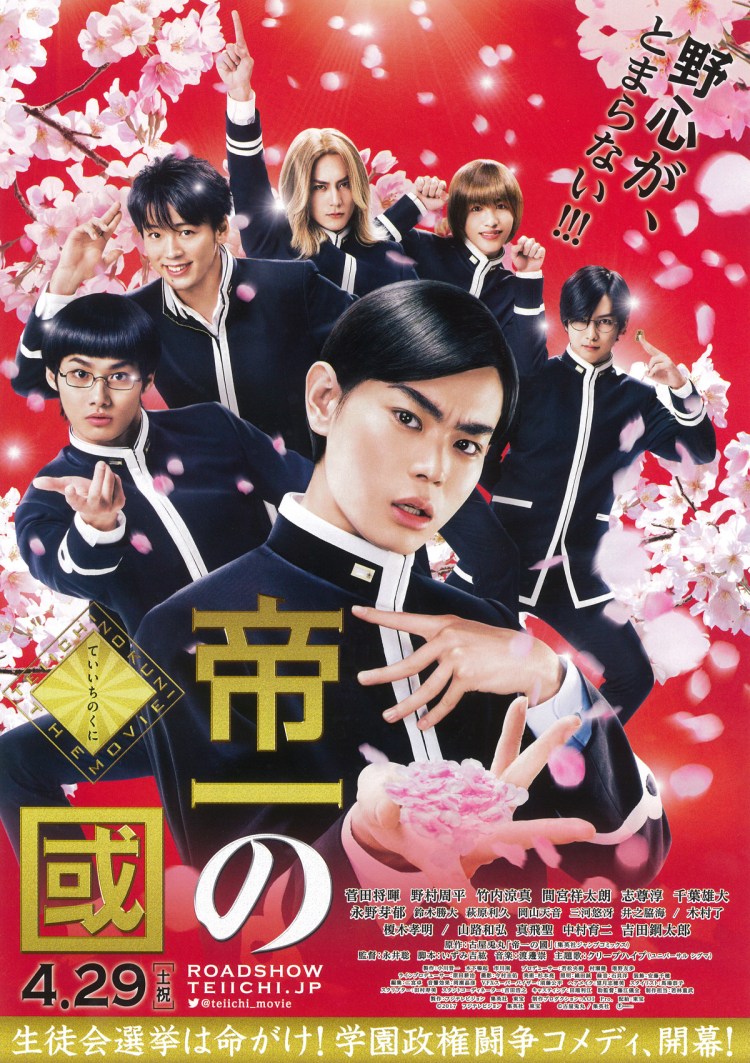 Back in the real world, politics has never felt so unfunny. This latest slice of unlikely political satire from Japan may feel a little close to home, at least to those of us who hail from nations where it seems perfectly normal that the older men who make up the political elite all attended the same school and fully expected to grow up and walk directly into high office, never needing to worry about anything so ordinary as a career. Taking this idea to its extreme, elite teenager Teiichi is not only determined to take over Japan by becoming its Prime Minister, but to start his very own nation. In Teiichi: Battle of Supreme High (帝一の國, Teiichi no Kuni) teenage flirtations with fascism, homoeroticism, factionalism, extremism – in fact just about every “ism” you can think of (aside from altruism) vie for the top spot among the boys at Supreme High but who, or what, will finally win out in Teiichi’s fledging, mental little nation?
 Hiroshi Nishitani has spent the bulk of his career working in television. Best known for the phenomenally popular Galileo starring Masaharu Fukuyama which spawned a number of big screen spin-offs including an adaptation of the series’ inspiration The Devotion of Suspect X and
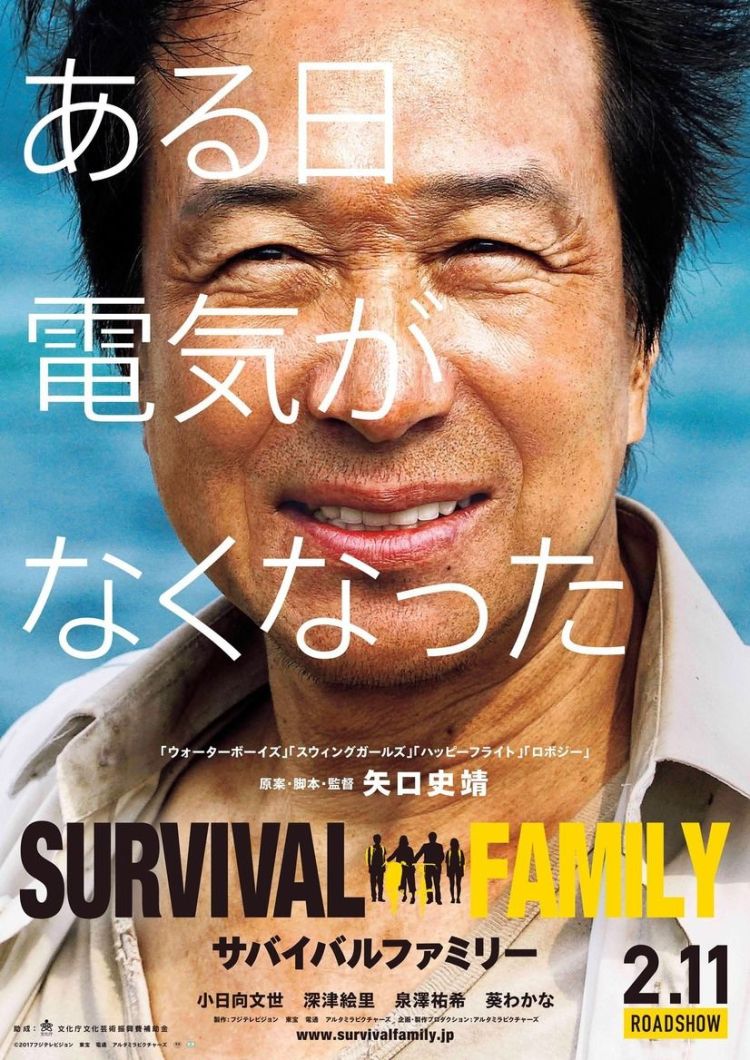 Modern life is full of conveniences, but perhaps they come at a price. Shinobu Yaguchi has made something of a career out of showing the various ways nice people can come together to overcome their problems, but as the problem in Survival Family (サバイバルファミリー) is post-apocalyptic dystopia, being nice might not be the best way to solve it. Nevertheless, the Suzukis can’t help trying as they deal with the cracks already present in their relationships whilst trying to figure out a way to survive in the new, post-electric world.
