New Female Prisoner Scorpion (新・女囚さそり 701号, Yutaka Kohira, 1976)

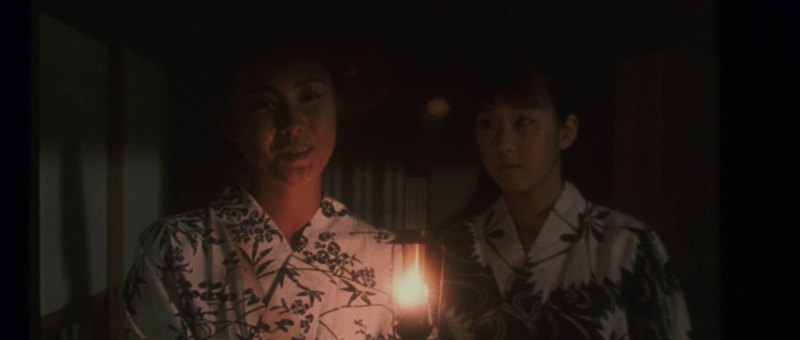
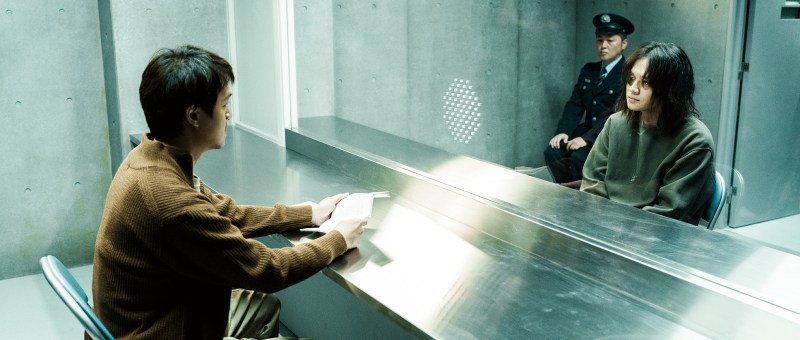
After the fourth film in the Female Prisoner Scorpion series, star Meiko Kaji decided to move on but Toei had other ideas and opted for a reboot as signalled by the addition “shin” or “new” to the otherwise identical title to the very first film. New Female Prisoner Scorpion #701 (新・女囚さそり 701号, Shin Joshu Sasori: 701-go) moves in a slightly different direction spinning a tale of a less straightforward revenge coloured by conspiracy cinema and a series of real life high-profile corruption cases including the Lockheed Scandal, itself name checked in the film. Just a few months earlier, Roman Porno actor and fervent nationalist Mitsuyasu Maeno had lost his life in a suicide attack on the home of underworld figure and right-wing fixer Yoshio Kodama who had been instrumental in “convincing” Japanese airlines to buy Lockheed planes over McDonnell Douglas.

In any case, this Nami Matsushima (Yumi Takigawa) is an ordinary young woman who becomes concerned about her sister Taeko (Bunjaku Han) when she uncharacteristically drops out of contact after behaving strangely. Taeko is a political secretary to assemblyman Miura (Ichiro Nakatani) who is currently the vice-minister for justice and at the centre of a burgeoning corruption scandal. After Nami and her fiancée Toshihiko (Yusuke Natsu) manage to meet up with Taeko, she is suddenly kidnapped from the hotel car park while the man who was with her, Sugino (Nenji Kobayashi), is gunned down. Sugino is found to be carrying his passport and two airline tickets to Paris which, along with Taeko’s strange behaviour, imply they were planning to flee the country together. Looking more closely at the wedding presents her sister had given her, Nami realises she’s left her a cassette tape with the instruction to leak its contents to the press should anything untoward happen to her. 

Nami uses the tape as leverage with Miura to try and rescue her sister but ends up learning some unpleasant truths before being framed for Taeko’s murder and sentenced to 15 years in prison. Toshihiko, who had originally been supportive, betrays her, testifying at her trial that she may have been resentful that Taeko was against their marriage only to later marry Miura’s daughter and go into politics apparently siding with the bad guys. Toshihiko may have seemed like a nice guy, but it’s also true that he tried to pressure her into premarital sex that she didn’t want by insisting that he couldn’t wait for marriage, suggesting they blow off her sister and go to a hot springs in Hakone instead. Most of the men in the film are equally spineless and duplicitous not least the guards who with the exception of one are all corrupt and/or abusing the inmates. 

Not content with sending her to prison, Miura tries to have Nami offed with the assistance of the warden who puts her in a cell with the prison’s most notorious offender. Fusae (Mitsuyo Asaka) orders her minions to beat and torture Nami, at one point gang raping her while the only way she can think of to save her life is by claiming there’s another tape so if they kill her they’ll never know where it is and run the risk of the contents leaking. 

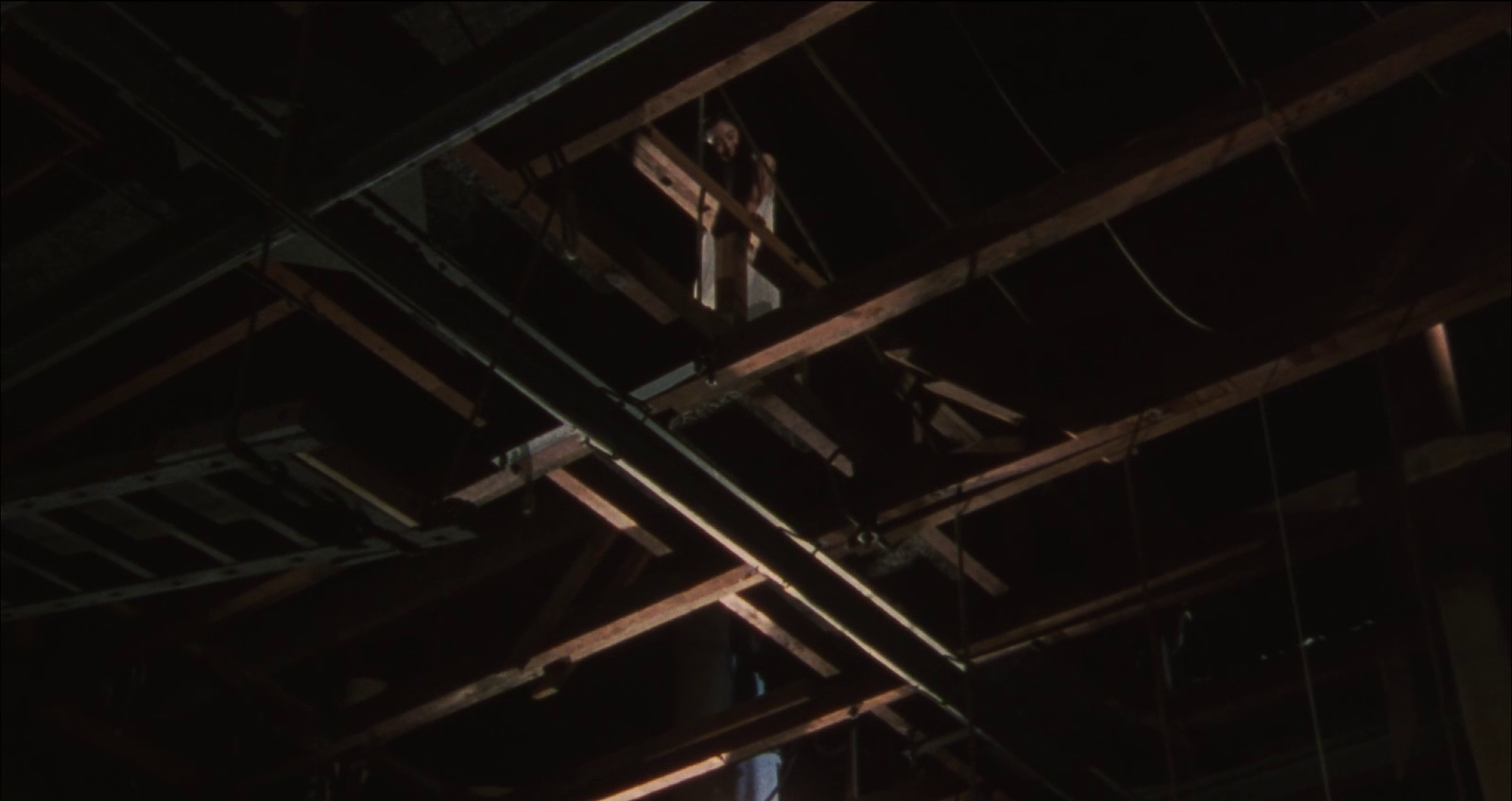
Meanwhile, she’s approached by a group of anarchists who tell her they need a leader which seems a little contradictory but nevertheless enables a jailbreak even as Nami develops a rivalry with the feisty prisoner number 804. Though she obviously didn’t commit the murder for which she was imprisoned, Nami is no pushover and in fact burns one of her tormentors alive not to mention stabbing another in the eye with a pencil and cunningly splitting a pair of scissors to gain twin knives. Rather than the classic scorpion look, she appears almost batlike, spreading her arms in her cape as she prepares to make her final act of revenge right outside the Diet building itself as if she were making a point about cleaning up politics aside from avenging her sister’s death and her own mistreatment. Director Kohira lends her a supernatural quality in her eerie silhouette as if she’s already become something else, a force of nature transformed by her righteous anger towards a corrupt society largely ruled by venal men willing to kill and use women for their own benefit or pleasure. Even Nami is forced to admit her complicity having learned her sister may have paid for her education through allowing herself to be traded by Miura as a political bargaining chip. She is not, however, willing to let it stand, resisting a controlling a patriarchal society with all of the resources available to her.


River Returns (光る川, Masakazu Kaneko, 2024)

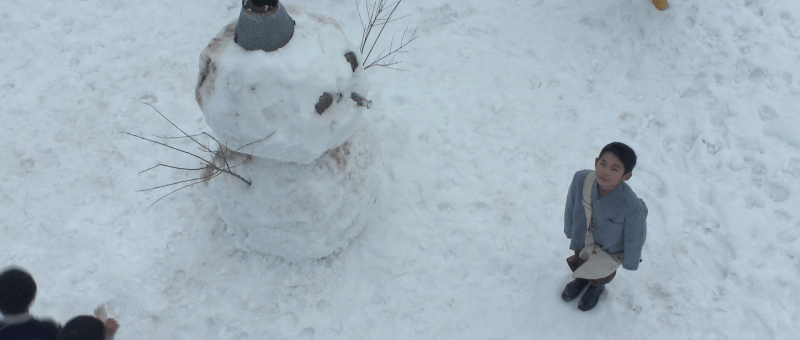
At the beginning of Masakazu Kaneko’s River Returns (光る川, Hikaru Kawa), a little boy asks his father where water comes from. It’s one of those questions that children ask but adults find difficult to answer. In any case, his father tells him that it comes from the sky, travels down leaves and branches, and then makes its way to the river. But what if all the trees are felled, the boy asks. His father tells him not to worry, they only cut down “useless” trees in order to plant “money-making” ones in their place.

This is the conflict at the centre of the film and to some extent that at the centre of all of Kaneko’s films so far in the changing relationships between man and landscape. The boy, Yucha (Sanetoshi Ariyama), is too young to fully understand what’s going on but has an inkling that might not be good for his beloved mountain which is somehow linked with the fate of his sickly mother, Ayumi (Kinuo Yamada). His father, Haruo (Tomomitsu Adachi), is one of the younger men in the village in favour of a plan to sell off the mountain for industrial construction with the building of a modern roadway and a dam project which he says will make everyone in the village rich. It’s 1958, and the nation is fast recovering from post-war privation. The population is increasing. New homes will need to be built so there’s money in timber. He wants to use some of it to treat Ayumi’s illness, but his mother has her doubts even if her son dismisses them as backward superstition. 

Haruo worries that their old-fashioned, rundown home may not survive a severe typhoon nor the flooding that often accompanies them. If you fear floods, then cutting down trees is obviously not a good idea and there is something quite unsettling about the imposition of the dam that would interfere in this ancient and natural process that keeps the rivers flowing. Yet this particular river also has a quasi-mystical quality that Yucha learns of from his grandmother and a kamishibai storyteller who recounts a local folktale about a girl who drowned herself in the pool at the river’s source after falling in love with a nomadic mountain woodcutter. It is said the girl’s despair sometimes brings about terrible floods and that the one who receives a wooden bowl from the river must return it full or a loved one will be taken by the waters.

Yucha had been worried about this before, frightened that his mother would not be able to escape the rising waters because of her illness. What he learns is that time flows differently at the source and in temporal terms, this river also flows backwards. He becomes a kind of conduit and saviour of the mountain in going back to right a wrong, ensuring that man and landscape are joined once again and can live in a more natural harmony. By saving the mountain, he can also save his mother whose condition it is implied is partly caused by a corrupted modernity. Haruo could not save her with money gained by nature’s destruction, only by restoring nature itself and making a commitment to keep the pool as clear and blue as the cormorant’s eye. 

The nomadic woodcutters after all know that too much felling ruins the mountain which would take generations to recover. They kneel and pray after felling their trees and respectfully move on at the full moon. Kaneko structures his tale elliptically, like a river that constantly returns in which all is a harmonious cycle that man threatens to interrupt, arrogantly thinking that it can improve upon nature. The middle part of the film is a lengthy flashback transitioning out of the kamishibai folktale set sometime in the feudal past in which even then there was division between the “civilisation” represented by the village and the natural world of the mountains which would be healed in the union of Oyo and the woodcutter Saku and is opposed both by the mountain nomads and Oyo’s widowed father Tsunekichi (Ken Yasuda). Only the mute boy can in the end resolve this romantic tragedy and ensure the river continues to flow. Elegantly lensed to capture the majestic quality of the mountain landscape, River Returns is a timely reminder of the importance of protecting the natural environment which in return will also protect us. 


River Returns screens as part of this year’s Cinema at Sea.

Trailer (English subtitles)

Heaven’s Story (ヘヴンズ ストーリー, Takahisa Zeze, 2010)

“When your family’s murdered, aren’t you entitled to happiness?” remarks a bereaved husband trying to move on from tragedy to a similarly bereaved little girl who is determined not to. “I don’t think so”, she coldly replies, dragging him back into a dark world of hate and vengeance. At that time perhaps best known for his career in pink film, Takahisa Zeze’s 4.5-hour epic Heaven’s Story (ヘヴンズ ストーリー) weaves a tale of interconnected hurts born of violence and its legacy, parental betrayals, and irreconcilable loss. The only victory is survival, but it’s a prize none of us will win. The best we can hope for is continuity, and perhaps leaving something more behind us than fear or rage. 

Our heroine, Sato (Moeki Tsuruoka), is orphaned when her parents and older sister are brutally murdered by a disgruntled employee exacting some kind of petty revenge on her father. The killer is later found dead in a hotel room, presumed to have taken his own life. The tragedy is however just one of many. Passing by a TV screen, Sato catches a report detailing the death of her family members and their murderer which is immediately followed by a press conference with a very angry young man whose wife and infant daughter were killed in random attack by a passing drifter who has been given an indeterminate sentence on account of the fact that he was underage and suffered greatly during his childhood. Tomoki (Tomoharu Hasegawa), the bereaved husband and father, vows revenge angrily insisting he won’t ask for the death penalty because he wants the killer, Mitsuo Aikawa (Shugo Oshinari), released as soon as possible so he can kill him with his own hands. Only eight years old, Sato identifies with his rage. The man she wants to kill is already dead and she’s been robbed of the chance of closure through vengeance so vicariously latches on to Tomoki’s quest for retribution, making him something of a personal hero. 

Tomoki’s words were offered in the raw pain of his loss. His reaction is understandable, but as he later says, people started to lose sympathy for him once he called for the killer’s death. As time moves on, he perhaps starts heal, marrying again and having another little girl, starting a new life in a new place which of course does not overwrite his past loss but is a new start. That’s something Sato can’t allow or understand. She feels irrationally betrayed by Tomoki’s decision to leave his loss in the past and move on to a new life. Rocking up at his tranquil island home, she accuses him of forgetting the dead, guilting him into thinking he’s betrayed the memories of his wife and child by not knowing that Mitsuo has been released from prison let alone not having taken his revenge. 

Mitsuo, however, has also attempted to move on. It can’t be denied that he committed a heinous, unforgivable crime, but he is also, in a sense, a victim himself. His mother took her own life when he was 13 because his father was abusive and he carries that abuse with him, which of course does not excuse his crime but might help to explain it. Kyoko (’70s folk singer Hako Yamasaki), a lonely doll maker, is taken by his enigmatic statement that he wants to be remembered by the unborn and begins writing to him in prison, eventually agreeing to adopt him as her son though she is already suffering with the early stages Alzheimer’s. Later in a tense conversation with Tomoki, Mitsuo describes Kyoko as a woman of great warmth and if it were not for her he might perhaps have killed again. Her positive maternal presence gives Mitsuo the sense of anchoring through parental love that he had never had, restoring him towards a more normal kind of existence as he diligently cares for her while her condition continues to deteriorate. 

Time swindles them all. Kyoko desperately tries to remember something she’s forgotten, while Sato is locked into a pleasant childhood memory of walking with her parents to see a newly completed housing estate which seems to be the very embodiment of a post-war utopia, a large green space surrounded by neatly arranged, identical blocks with well appointed family homes piled one on top of the other. The conclusion takes us somewhere similar, only inverted, in the empty shell of a disused danchi, once a home to a bustling mining community now abandoned by the modern era. In the monologue which opens the film, Sato recounts a folktale about a monster who lived in the hills and attacked people, but did so only accidentally in his loneliness and longing to be a part of the world around him, but the people were afraid and so they rejected him and his monstrousness intensified. Tomoki destroys his second family in an internecine need to avenge the first driven by Sato’s demonic need for vicarious retribution, while Mitsuo’s attempt to move into the light is frustrated by an inability to escape his past. All the fear, and hate, and suffering, breeds only more of the same. “Heaven’s Story” may be in many ways the story of violence, but violence is not its resolution. Sato makes a kind of peace with the past, but will also carry that legacy of pain back into the complicated urban world as far from the heavenly vistas of tranquility which exist now only in her memory as it’s possible to be. 


Original trailer (no subtitles)

Home Sweet Home (スイート・マイホーム, Takumi Saitoh, 2023)

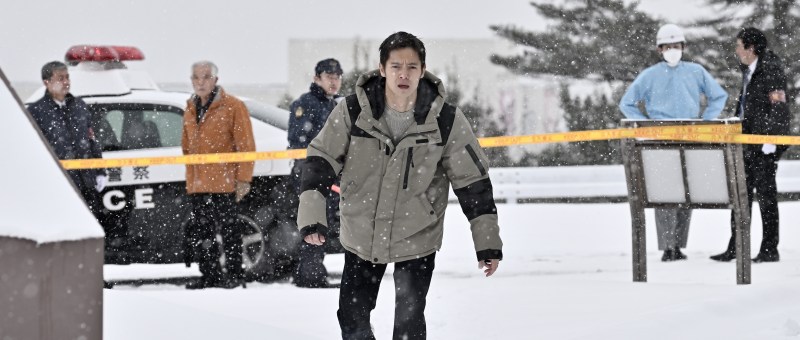
“The secret is in the basement” is not a phrase which inspires confidence when viewing a potential new living space, but as it turns out the cellar is the least of their worries in Takumi Saitoh’s eerie adaptation of Rinko Kamizu’s mystery horror novel, Home Sweet Home (スイート・マイホーム). The Kiyosawas are just looking for somewhere warm where they can enjoy life as a family in comfort and security, but if something sounds too good to be true then it usually is as they will discover to their cost. 

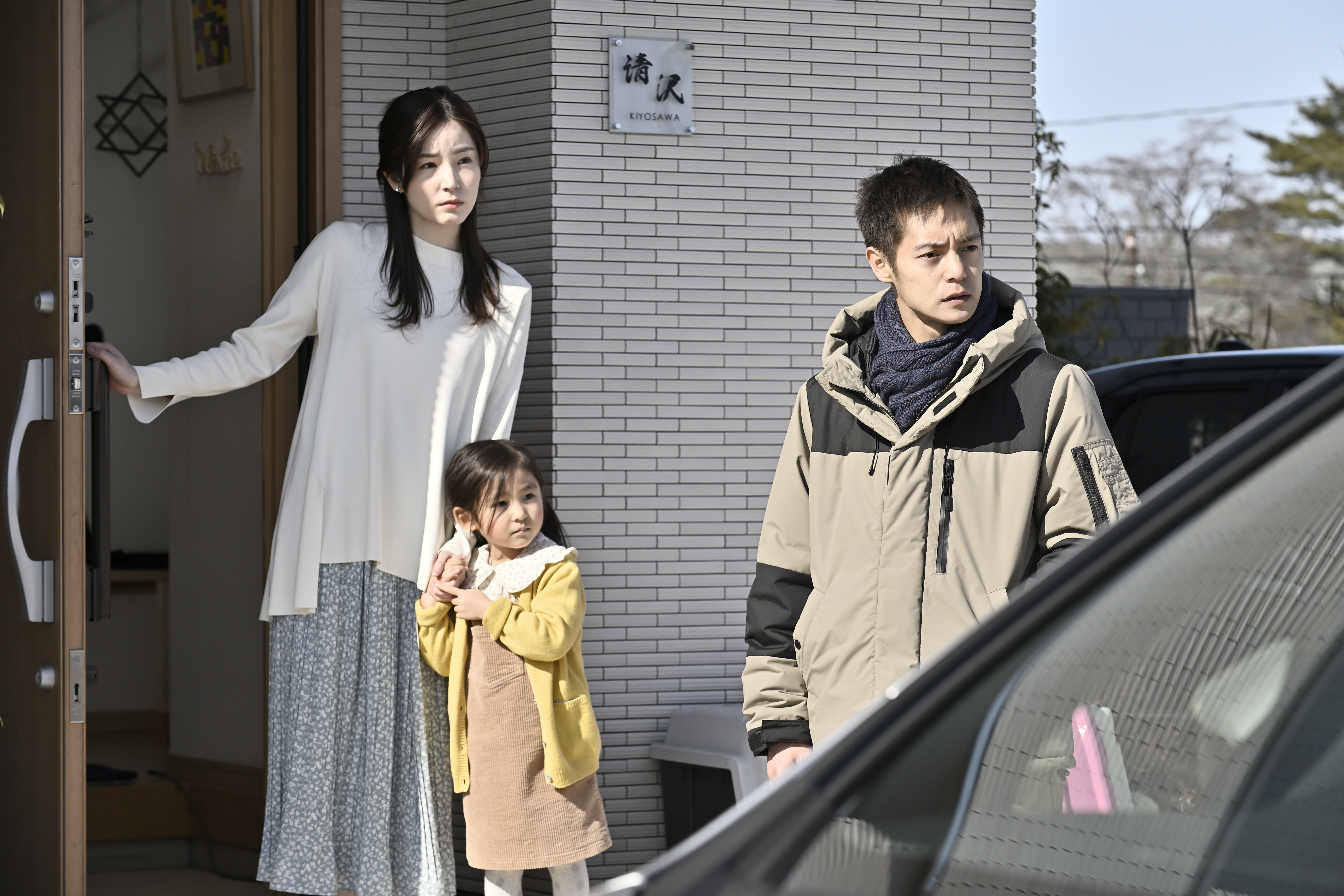
The saleswoman at Magic Homes describes the Kiyosawas as “the ideal family” for whom she is glad to build an “ideal” home. To many they may look “ideal” in that husband Ken (Masataka Kubota) has a steady job as a personal trainer while wife Hitomi (Misako Renbutsu) is a stay at home mum to four-year-old Sachi. But of course nothing’s quite as it seems and there are already cracks in the foundations of this happy family home as Ken has been having a years’ long affair with co-worker Yurie (Ririka). After finally deciding to take the plunge on the house, the affair comes to a natural end point as Yurie too decides to marry her longterm boyfriend with the aim of starting a family. But not long after the Kiyosawas have moved in to their new “magic home” complete with new addition Yuki, Yurie’s husband receives a video showing an unrecognisable Ken entering her apartment with the presumed motive of blackmail lending a note of anxiety to his moment of familial bliss. 

To begin with, the house itself takes on a eerie quality especially with the ominous rumble of the single AC unit in the pitch-black basement. The home does not seem to have been particularly well thought out for families with small children as the tiny doors leading to the hatch are at a toddler’s height and don’t appear to have any kind of safety locks in place. Everything else is run off the central smart system including a network of CCTV cameras sold to the family as a convenience that would allow them to keep an eye on the children wherever they might be in the house while getting on with other things, but also undoubtedly a privacy worry and no one likes to feel watched in their own home. Watched is exactly how they start to feel, Hitomi convinced someone’s been in the house while looking around realising how many vents and ducts there are ominously staring down at them in every room. 

Ken’s brother Satoru (Yosuke Kubozuka) is suffering with a mental illness that makes him paranoid, repeatedly insisting that there are people watching them and they need to protect the family because they are everywhere in the ceilings and the floors. Though it first seemed to us that the house was the problem, the family’s desire for conventional suburban living biting back at them, we wonder if the problem is Ken and his reckless endangerment of his family through his affair. When first viewing the house, the couple had been accosted by a creepy salesman, Amari (Yohei Matsukado), who makes barbed remarks about looking after the family that have Ken suspecting he’s got it in for them because they chose someone else to handle their sale or perhaps resents them for not being “ideal” enough to live in one of his “magic homes”. 

But then what is the “ideal” family, who gets to decide that? Why should the Kiyosawas have to fulfil a stereotypical ideal just to be judged worthy of homeownership? There might be something chilling in the uniformity of the house’s design, a utopian vision of suburban bliss founded on outdated patriarchal social norms of the nuclear family though in this case slightly adjusted for a new era, but then again the call is coming from within the house in more ways than one in Ken’s delayed response to traumatic childhood incident and concurrent anxiety around being able to protect his family in fulfilment in the social “ideal” for fatherhood. It’s the “ideal” that is the true enemy from the generic house design to the unfair expectations placed on the Kiyosawas to live up to a particular kind of suburban properness in order to qualify for the right to live there. Paranoid and eerie, Saito conjures a world of constant tensions in which we are all being “watched” if not to say judged and any bug in the system must be quickly removed so that the “ideal” may prevail.  


Home Sweet Home screens July 27 as part of this year’s New York Asian Film Festival.

Original trailer (no subtitles)

Images: ©2023 Rinko Kamizu, KODANSHA Ltd./ “Home Sweet Home” Film Partners

Rhapsody in August (八月の狂詩曲, Akira Kurosawa, 1991)

“People do forget everything, and quickly too” a teenage girl laments preparing to meet her half-American uncle and feeling a little awkward having been admonished by her parents for inadvertently confronting him with the realities of the wartime past. The middle generation in Kurosawa’s tri-generational tale of the legacy of warfare Rhapsody in August (八月の狂詩曲, Hachigatsu no Rhapsody) have it seems an ambivalent attitude they’re in the process of imparting to their children that views talk of the atomic bomb as almost taboo, tiptoeing around it with their newfound American relatives lest they offend them but mostly out of a desire for economic gain that reflects an early post-war mentality almost entirely alien to their Bubble-era teenage kids.

It’s the children who are keenest to learn about their past, staying with their elderly and seemingly frail grandmother Kane (Sachiko Murase) over the summer while their parents have travelled to Hawaii to investigate after receiving a letter from Kane’s long lost younger brother Suzujiro who emigrated in the 1920s and has since become a wealthy man running a pineapple plantation. The problem is that Kane had a large number of siblings, at least 11, and honestly doesn’t remember one called Suzujiro who did after all leave the country 60 years previously and was never seen again. The children, Tadao (Hisashi Igawa) and Yoshie (Toshie Negishi), think her refusal to visit him in Hawaii is partly down to a lingering resentment for the dropping of the atomic bomb which killed her husband, but as she later tells the grandchildren that was 45 years ago and she no longer has any strong feelings either way about the Americans adding only that it was all the fault of the war.

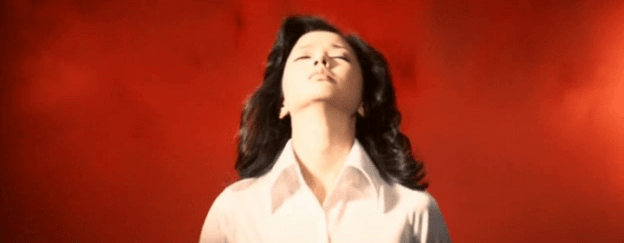
Nevertheless, it’s clear that Kane lives with a sense of loss and the continuing trauma of witnessing the flash that is expressed by the bald spot on the back of her head. As the grandchildren ask her questions she begins to reflect more on the past, remembering a younger brother, Suzukichi, who witnessed the flash with her and later had some kind of breakdown locking himself away endlessly drawing pictures of eyes that she later explains mimicked that of the flash itself. Kurosawa depicts this memory with surrealist imagery, a red sky splitting open just as Kane described exposing an eye which seemed to stare down at them. Youngest grandson Shinjiro (Mitsunori Isaki) draws such an eye on the blackboard in the study room in his grandmother’s house, an eye which continues to observe the children as they contemplate the recent past as well as an older Japan exemplified by their grandmother’s tales of the water imp living in a nearby pool who might once have saved Suzukichi’s life. 

In some ways, it’s almost as if the middle generation has been passed over. The grandchildren are very close to their grandmother and resentful of their parents, irritated by their constant references to their American relatives’ wealth with Shinjiro directly asking them why they haven’t asked how Kane has been or bothered to say hello to her before showing off photos of the Hawaiin mansion owned by Suzujiro. Kane also sets them right after deciding she’d like to visit after all, explaining that she couldn’t care less or if he’s rich or not she’d just like to see her brother. Her refusal to accept him was perhaps an expression of her own inability to make peace with the past, having literally forgotten only latterly coming to believe that Suzujiro really is her brother and wanting to reintegrate him into her life as an expression of peace between nations. 

Kane had said that Tadao’s conviction that they should avoid mentioning the bomb was illogical and ridiculous, an attitude later borne out by the unexpected arrival of Suzujiro’s half-American son Clark (Richard Gere) who speaks pigeon Japanese and is somewhat mortified by his own ignorance not having realised that his uncle must have died in the atomic bombing of Nagasaki until inadvertently tipped off by eldest grandson Tateo’s (Hidetaka Yoshioka) telegram. Clark bonds with Kane and sadly reflects on his own lack of knowledge after visiting the school where his uncle died and seeing scores of contemporary children flood into the playground where the twisted metal of a melted climbing frame serves as a memorial for the young lives that were lost. The intention is not however to provoke an apology or apportion blame only to mourn the folly of war while trying to put the past aside to ensure it never happens again.

The kids wear jeans and T-shirts with the logos of American universities on, but are determined to fix the out of tune harmonium in their grandmother’s parlour as if literarily setting the past to rights. The song they play sings of a red rose in a field, a rose that Shinjiro later sees near the shrine during the memorial service for the bombing that comes to resemble Kane in the closing frames as she charges through the rain with her blown umbrella while her children and grandchildren chase after her as the ants had trailed the rose. “People will do anything just to win a war,” Kane admonishes her son, “sooner or later it will be the ruin of us all” reminding him that dropping the bomb didn’t stop people killing each other, even 45 years later war continues to ruin people’s lives. Like the rose “blossoming in innocence” she stands for peace and mutual compassion amid an expressionist storm of fear and resentment.


Rhapsody in August screens at the BFI Southbank, London on 19th & 25th February 2023 as part of the Kurosawa season.

Original trailer (no subtitles)

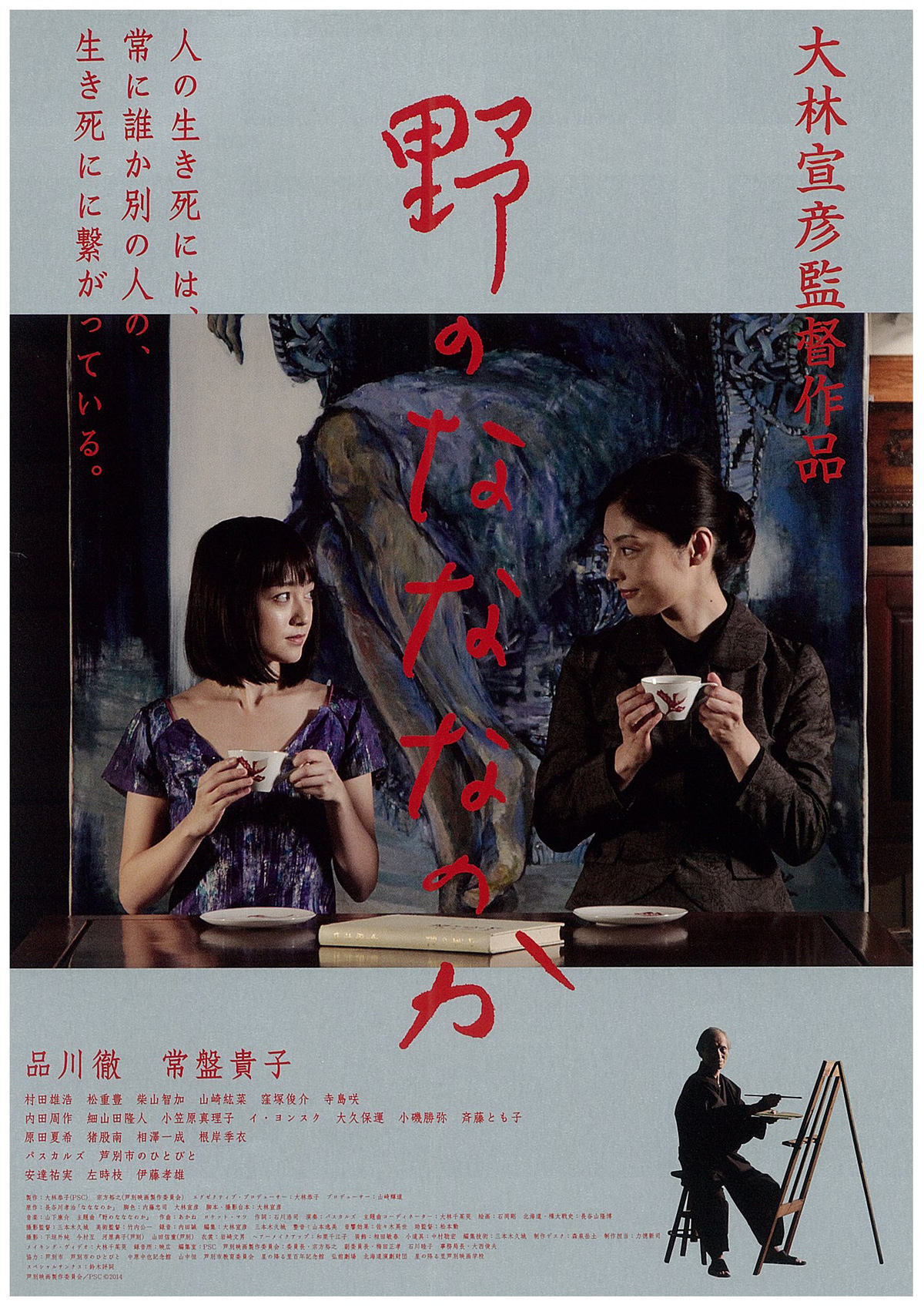
Seven Weeks (野のなななのか, Nobuhiko Obayashi, 2014)

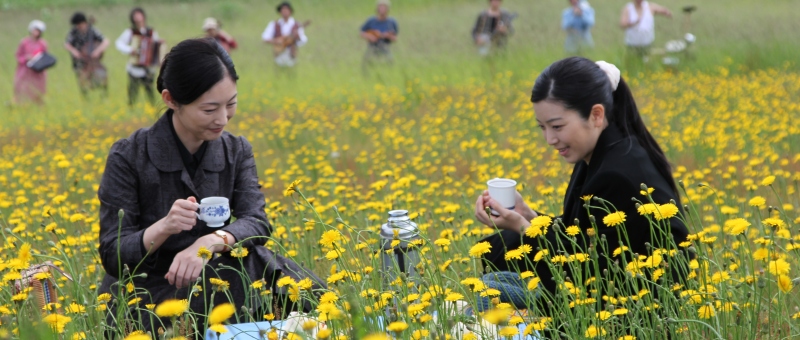
“A death is a history” runs an opening title card in Nobuhiko Obayashi’s poignant existential drama, Seven Weeks (野のなななのか, No no Nanananoka). Returning to some of the director’s key themes, Obayashi’s adaptation of the novel by Koji Hasegawa takes its name from the traditional Buddhist period of mourning reminding us that life and death is a continuous cycle in which all lives are necessarily tied to one another. Some may later ask if those connections are also constraints, thinking perhaps of the sometimes onerous burdens of family, but even they later reflect on the necessity of human ties while contemplating the confluence of the eternal and the transient. 

The death we’re being asked to witness is that of 92-year-old Mitsuo Suzuki (Toru Shinagawa), a former doctor and owner of what some view as a junk shop, who is discovered collapsed by his granddaughter Kanna (Saki Terashima) only to die a few days later at the time shown on his permanently broken wristwatch which also happens to be the time the Great East Japan Earthquake struck in 2011. Soon his extended family begin to arrive beginning with long widowed sister Eiko (Tokie Hidari), grandson Fuyuki (Takehiro Murata) and his daughter Kasane (Hirona Yamazaki), and Kanna’s brother Akito (Shunsuke Kubozuka) while Fuyuki’s brother Haruhiko (Yutaka Matsushige) and his wife Setsuko (Tomoka Shibayama) will make it only in time for the wake. Throwing all into confusion is the unexpected arrival of a mysterious young woman, Nobuko (Takako Tokiwa), later revealed to be a nurse who once lived with the family and fulfilled the role of mother for Kanna and Akito whose parents were killed in a car accident while they were still young. 

Nobuko is in many ways the key to a mystery yet also a cypher, more than one woman at the same time as if in a sense resurrected from Mitsuo’s traumatic memories of love and war in the time of his youth. At his wake, men of a similar age spin their own war stories, Eiko reminding the young that their youth was war and perhaps they’ve a right to romanticise it for all of its terrible cruelty. Mitsuo didn’t go to the front but found himself a victim of shifting borders, ironically a descendent of settler colonisers as a native of Hokkaido travelling to the disputed island of Sakhalin in search of a friend and in the company of the young woman who was engaged to him but with whom he was himself in love believing the war was over only to discover no one had told the Russians and that wars do not end at the same time for everyone, or for some at all. 

In an ironic touch, great-granddaughter Kasane participates in an excavation of an old mine once staffed largely by forced Korean labour, an elderly woman plaintively singing Arirang over the dig site, only to later visit a similar location which has become the “Canada World” tourist attraction including a replica of the house from Anne of Green Gables. As she, Eiko, and Kanna reflect on the changes in the town there’s a minor sadness that the mine has closed which seems somewhat incongruous, even as the wholesomeness of coal from the ground is favourably compared with the dangerously intangible qualities of nuclear energy. Nevertheless, conflicted nuclear engineer Haruhiko later stakes his future on renewable energy, neatly echoing the sense of circularity in a continuous cycle of death and rebirth in which one life is necessarily tied to another and therefore to all lives. 

“We got along with the Russians in Sakhalin before the war” Mitsuo’s friend Ono (Takao Ito) laments, musing on the senselessness of conflict in its propensity to draw lines between people which divide rather than connect. Mitsuo’s death is indeed “a history tying the past and future”, a minor allegory for that of his nation as he contemplates lost love and the end to wandering that is death which leads in turn to new beginnings. “You want to look away. You want to forget about it”, Mitsuo confesses, “but you can’t. You have to remember so that it’s never repeated”. Through their 49-day odyssey, the family members begin to edge their way towards a less anxious if still uncertain future. “We might lose people but not hope” Kanna expounds, recommitting herself to the hometown spirit while opening up to the possibility of romance, while her brother does something much the same, as does her uncle Fuyuki even as his daughter conversely gives up on a possibly inappropriate crush to shift into a more mature adulthood. “We will go on peacefully” runs the final title card, a mission statement for the foundation of a better world. 


Seven Weeks streams in the US July 9 – Aug. 6 as part of Japan Society New York’s Tragedies of Youth: Nobuhiko Obayashi’s War Trilogy season in collaboration with KimStim.

Original trailer (English subtitles)

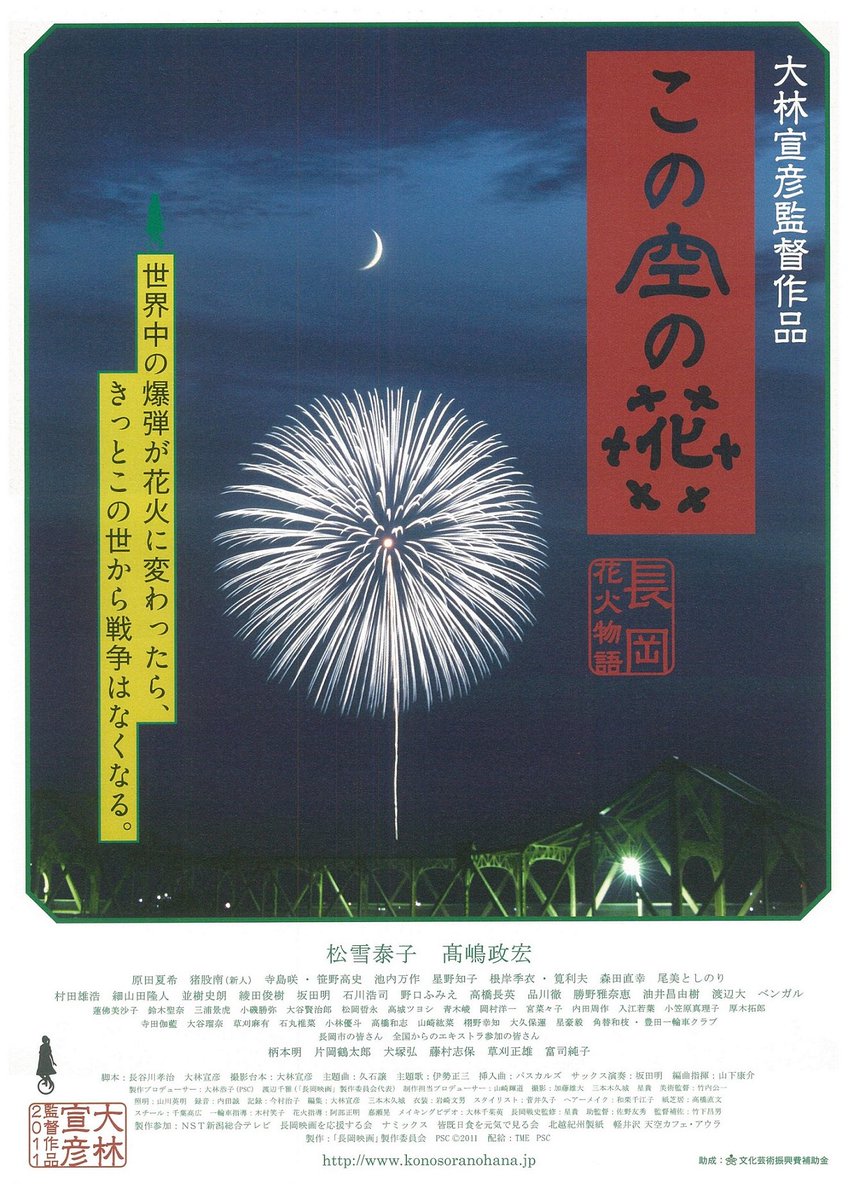
Casting Blossoms to the Sky (この空の花 長岡花火物語, Nobuhiko Obayashi, 2012)

“There’s still time until a war” runs the title of a play for voices at the centre of Nobuhiko Obayashi’s oscillating docudrama, Casting Blossoms to the Sky (この空の花 長岡花火物語, Kono Sora no Hana: Nagaoka Hanabi Monogatari). Asking why when presented with the opportunity to create something beautiful that gives joy and hope to all who witness it mankind chooses death and destruction, Obayashi considers responses to disasters manmade and natural and finds largely kindness and resilience among those determined to avoid the mistakes of the past while building a better tomorrow. 

Set in the immediate wake of the 2011 earthquake and tsunami and inspired by verbatim interviews with local people, Obayashi’s elliptical drama sends an emotionally arrested newspaper reporter to Nagoka having received a letter from an old lover that calls her back into the past. Reiko (Yasuko Matsuyuki) broke up with Katayama (Masahiro Takashima) 18 years previously uttering only the cryptic phrase “we have nothing to do with war”, but travelling through her “wonderland” begins to realise that she and everyone else is in that sense wrong. No one is really entirely unconnected or untouched by the destructive effects of conflict and pretending that it’s nothing to do with you will not in the end protect against it. 

“To the children of the future, from the adults who lived the past” runs the opening title card, making plain a fervent hope to connect the often unknowing younger generations who assume war is nothing to do with them with the traumatic past through the voices of those who directly experienced it. The play to which Reiko is invited is in itself a play for voices, an avant-garde theatre piece inspired by the verbatim speeches of residents of Nagaoka recounting their often harrowing experiences of the war apparently penned by a strange high school girl (Minami Inomata) who rides everywhere on a unicycle. The performance is set to take place in conjunction with the local summer festivals which include a series of fireworks displays commemorating lives lost in the bombing raids and symbolising a spirit of recovery following a destructive local earthquake some years earlier. 

Obayashi draws direct comparison between the natural disasters of earthquake and tsunami, and the manmade disaster of war but discovers that ordinary people often react to them in the same way with a furusato spirit of mutual solidarity and kindness. One of Katayama’s students is a displaced young man from Fukushima who remarks on the kindness he experienced having been taken in by the town of Nagaoka, a kindness he hopes to repay someday when he is finally allowed to return to his own hometown just as the people of Nagaoka have done following kindness shown to them after the earthquake. The discrimination he faces as someone from a town affected by radiation calls back to that experienced by Reiko’s parents who were survivors of the atomic bomb that fell on Nagasaki, a location chosen by pure chance on a whim when poor weather made the primary target unavailable. Among all the horror of the wartime stories Reiko uncovers, there is also selfless heroism such as that of the young man bravely throwing water over those trapped in a burning air raid shelter. 

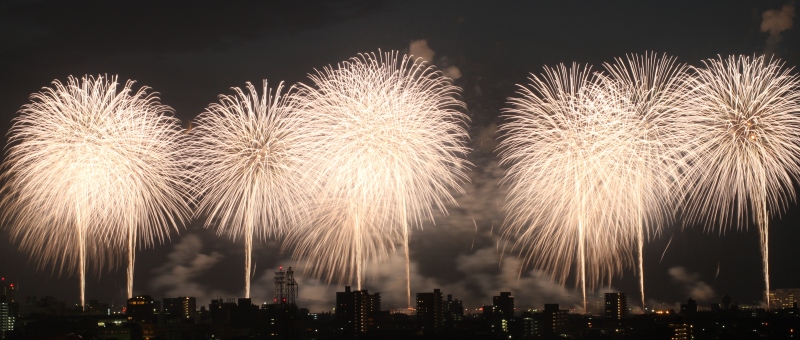
“If only people made pretty fireworks instead of bombs, there wouldn’t have been any wars” a poet laments drawing a direct line between these two very different uses of the same material, a connection further rammed home by twin visits to a fireworks factory and atomic bomb museum. The “phoenix fireworks” become a fervent prayer, blossoms cast to the sky, in hope of a better, kinder future without the folly of war. “There are adults who think war is necessary” Katayama explains, “but not the children, of course. That’s why it’s up to the children to make peace”. Some may complain that in the rapid economic development of the post-war society something has been lost, but in times of need people are still there for each other forging the furusato spirit in contemporary Japan. Opening with a series of silent-style title cards, Obayashi’s overtly theatrical aesthetics may be comparatively retrained even while incorporating frequent use of animation and surrealist backdrops, but lend an ever poignant quality to this humanist plea for a more compassionate world in which the only explosions in the sky are made of flowers and hope not hate or destruction. 


Casting Blossoms to the Sky streams in the US July 9 – Aug. 6 as part of Japan Society New York’s Tragedies of Youth: Nobuhiko Obayashi’s War Trilogy season in collaboration with KimStim.

Original trailer (English subtitles)

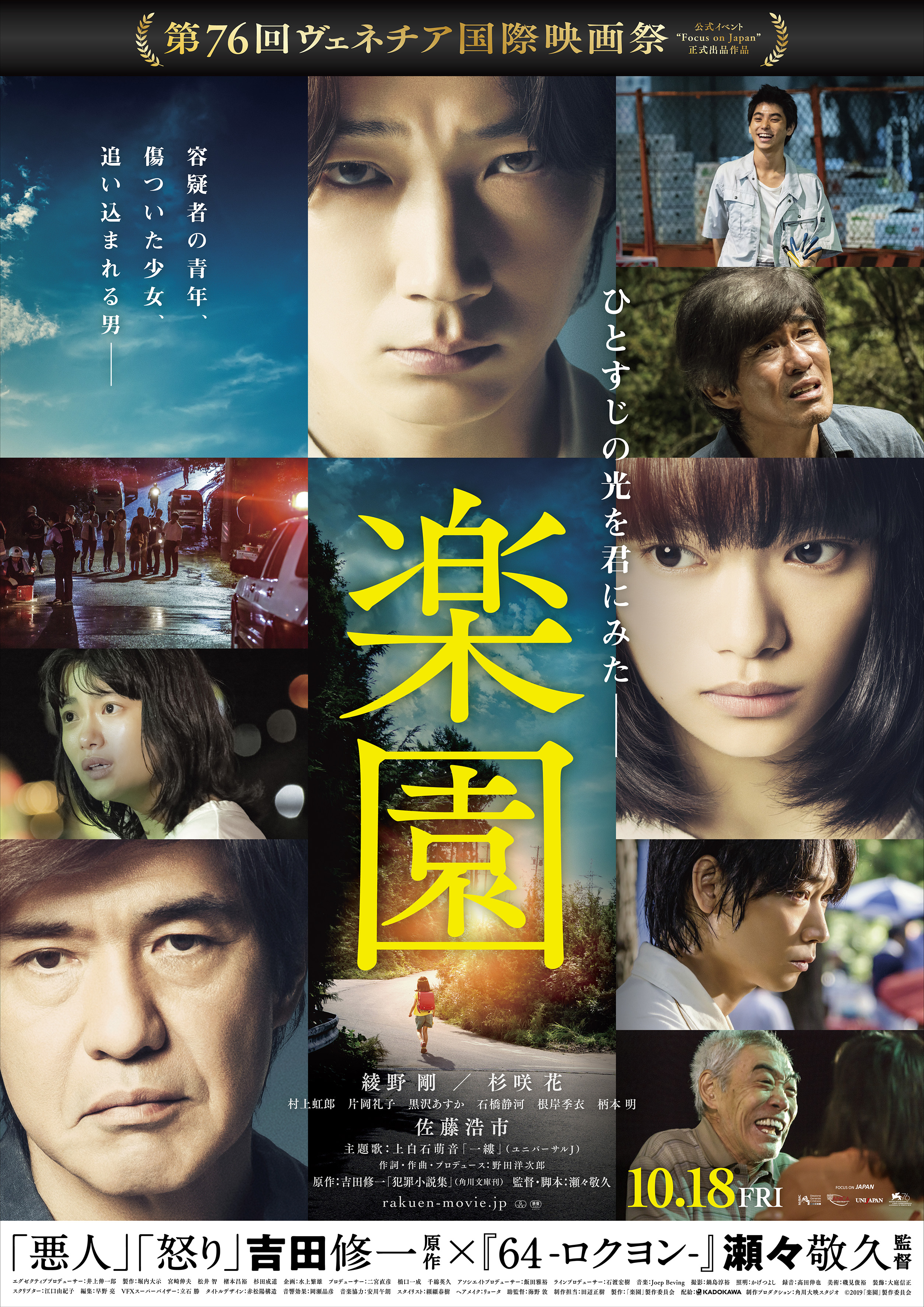
The Promised Land (楽園, Takahisa Zeze, 2019)

Small-town Japan is no Promised Land in Takahisa Zeze’s adaptation of a pair of short stories by mystery writer Shuichi Yoshida. Japanese cinema has often had an ambivalent relationship with the rapidly depopulating countryside, split between a sickly furusato idealisation of rural life as somehow purer than its urban counterpart and lampooning city slickers tired of that same sense of urban ennui but discovering that the traditional way of life is often hard especially when you don’t know how to do it and have no friends in communities which can often seem hostile to newcomers. 

What newcomers to the small town at the centre of The Promised Land (楽園, Rakuen) discover is latent racism, mutual suspicion, and toxic local politics which bends towards the feudal as those now old go to great lengths to cling on to their power. Hardly a rural idyll but a space of atavistic decay. The rot begins 12 years prior to the main action when a little girl, Aika, doesn’t come home for tea after playing with a friend. A search of the local area is organised, but only her little red school bag is found. 12 years later the other girl, Tsugumi (Hana Sugisaki), is consumed by a sense of survivor’s guilt feeling as if she is underserving of happiness in the knowledge that if she had only taken a different path that day Aika might not have disappeared. When another girl goes missing, suspicion falls on a wounded young man, Takeshi (Go Ayano), who speaks little and is intensely traumatised by his childhood experiences of xenophobic bullying having come to Japan with his non-Japanese mother (Asuka Kurosawa) at seven years old. 

Bystanders in the crowd preparing a search for the second missing girl are quick to blame the other, one loudly casting suspicion on “Africans” living nearby while another brings up a man who sells second-hand cars she feels is a little odd. Takeshi gets the blame because he exists to the side of the community but also because he is meek and vulnerable, unable to defend himself until pushed into a corner and provoked into an explosive act of self-destructive violence. “Suicide brings redemption” Aika’s grief crazed grandfather (Akira Emoto) shrieks as if urging a young man on towards his death based on nothing other than prejudice and bloodlust. Later he admits that he just wanted someone to blame as if that would bring an end to the matter but of course it didn’t, it only added to the burden. 

Meanwhile, middle-aged beekeeper Zenjiro (Koichi Sato) who returned to the village to look after his parents following the death of his wife (Shizuka Ishibashi) from leukaemia also finds himself under suspicion but mostly as part of a concerted harassment campaign conducted by two local elderly men who have appointed themselves village elders and resent his attempt to go directly to city hall in order to fund a new business venture without going through them. Zenjiro is originally from the village, this is his hometown, but he was also away a long time and is in a sense other as a new returnee at first courted as a potential suitor for the similarly returned widowed daughter of the local bigwig, Hisako (Reiko Kataoka), and then aggressively shunned to the point he begins to lose his mind leading to another shocking act of irrepressible violence. 

“No one trusts anyone” Tsugumi laments, angrily tearing away an annoying sign asking residents to report any “suspicious behaviour”. She insists they need to face the past in order to move on, something Zenjiro was ultimately in capable of doing, but later claims that she doesn’t need to know what happened to Aika, she’s going to live her own life. The path leads towards an acceptance that she wasn’t responsible for what happened to her friend and has no need to live her life in the shadow of guilt, yet she still falls victim to small-town attitudes more or less bullied into a romantic friendship with a distinctly creepy young man (Nijiro Murakami) who admits to slashing her bike tires so she’d be more likely to accept a lift from him. 

According to Takeshi, there’s no such thing as the “promised land”, a sentiment also expressed by Hisako who agrees that all places are the same save your hometown something which Takeshi seemingly never had. Tsugumi’s problematic suitor tells her she ought to create the promised land for all of them, which might be as close as the film comes to a mission statement in suggesting that the individual has agency to craft the world in which they live while subtly undercutting it in the melancholy stories of Takeshi and Zenjiro each hounded towards acts of self-inflicted violence by an intransigent community mired in a primitive us and them mentality. Far from paradise, small-town Japan is a land of fear and suspicion where outsiders are unwelcome and the old hold sway, complaining that their kids all end up in the city while secretly perhaps satisfied in the knowledge their authority will not be challenged. If there is a promised land, you won’t find it here. 


The Promised Land streams in Germany until 6th June as part of this year’s Nippon Connection.

Original trailer (no subtitles)

Images: © 2019 “The Promised Land” Film Partners

Family of Strangers (閉鎖病棟 それぞれの朝, Hideyuki Hirayama, 2019)

“Things happen to everyone” the hero of Hideyuki Hirayama’s Family of Strangers (閉鎖病棟 それぞれの朝, Heisa Byoutou: Sorezore no Asa, AKA Closed Ward) explains, not in an accusatory sense or attempt to limit someone else’s trauma response but in a gentle spirit of empathy, a reminder that everyone has their own load to carry and theirs are heavier than most. Empathy is indeed a minor theme of Hirayama’s drama as his wounded protagonists eventually find the strength to allow themselves to live again in the unconditional solidarity of their newly found family in defiance of the internalised shame and external stigma that plagues them in an admittedly conformist society. 

Hirayama opens with a flashback, shot in muted colour, as a man, Hide (Tsurube Shofukutei), is marched slowly towards the execution chamber where he is eventually hanged but, inconveniently for the prison authorities, does not die. Lacking a clear precedent for such an unusual event, they are at a loss as to how to proceed while Hide does not exactly seem overjoyed in his improbable survival. As hanging him again would be cruel and simply letting him off as if reborn to live a new life they feel not in the interests of justice, they opt for a fudge, palming the now wheelchair-using Hide off on the hospitals system by placing him in the secure ward of a psychiatric institution. 

A quiet man keeping himself to himself, Hide patiently crafts ceramics and meditates on his crime keeping others at arm’s length as if believing himself unworthy of human society. He may have been sentenced to death for something truly unforgivable, but he is not mentally ill and does not really belong in the hospital whereas many of the other patients are self-committals who are technically free to leave at a time of their own choosing. Chuya (Go Ayano), a young man with schizophrenia, has more or less learned to live with his condition and exercises a greater degree of personal freedom, often venturing into town and bringing back various items he cynically sells to others on the ward. He could leave if he wanted to, but stays partly out of a sense of internalised shame and partly in fear of the outside world. Yuki (Nana Komatsu), meanwhile, an 18-year-old woman committed by her mother (Reiko Kataoka) after becoming worryingly withdrawn, has little personal agency, first placed on the ward and then removed from it neither with her full consent. 

Though we can see that the hospital is a largely positive, supportive place where the patients are well cared for we do not see a great deal of treatment practices and it is in someways surprising that Yuki is allowed to leave in the company of a man who is quite clearly violent and abusive even if we can also infer that she herself has remained largely silent as regards the nature of her trauma. Her silence is perhaps her means of both defence and resistance with her first words offered to Hide largely because he does not ask her for them, merely sitting by giving her the space to choose to speak or not to. Despite his caution that the longer one stays on the ward the more one begins to think of oneself as a patient, she begins to think of the hospital of her safe place and the other patients as her surrogate family, touched by an old woman’s radiant happiness as she helps her back to her room mistaking her for her granddaughter. 

Yet as much as the hospital works for her, it does not necessarily work for others as in the case of Shigemune (Kiyohiko Shibukawa) whose antisocial and violent tendencies often endanger other patients not least because of lax supervision and questionable decisions made by members of staff. A direct parallel is perhaps being drawn between the jail and the ward, Chuya frightened he may never leave while Hide believes he does not deserve to and Yuki longs to stay only to have her new safe place ruined by another predatory man of violence. Yet there is also a sense that society views the hospital as a place to dump those it feels to be problematic, Hide hidden away in embarrassment, Chuya rejected by his family, and Yuki betrayed by a mother who has come to see her as a rival. Shopkeepers look at them askance, not altogether happy that “even crazy people have rights these days” while the trio struggle to accept themselves as having a right to a happier future even as they begin to bond in a newfound sense of family. While the closing scenes may engage in an uncomfortable ableism, there is an undoubtable sense of warmth and compassion in Hirayama’s egalitarian sense of solidarity as his wounded protagonists find strength in faith reflected in others to shake off their sense of internalised shame and claim their right to life in an often hostile society. 


Family of Strangers streams in Germany 1st to 6th June as part of this year’s Nippon Connection.

Original trailer (English subtitles)

his (Rikiya Imaizumi, 2020)

Though Japanese society is often regarded as comparatively liberal, that liberality can sometimes reflect a superficial politeness and respect of discretion more than true acceptance. Though several prefectures have now made local provision for same sex unions, Japan lacks a basic anti-discrimination law at the national level protecting the rights of LGBTQ+ people and has often been slow to accommodate social change especially when it comes to the organisation of the family unit. The journey of the two men at the centre of Rikiya Imaizumi’s his, a sequel to the TV drama of the same name set some years earlier, perhaps travels at a rapid pace from internalised homophobia to the acceptance of identity and foundation of a home but mirrors the path of society at large as it edges its way towards the truly liberal in which all are free to live in the way they choose. 

Beginning with an ending, Imaizumi opens in the “past” as Shun (Hio Miyazawa), now an isolated young man living alone in the country, dwells on ancient heartbreak as his first love Nagisa (Kisetsu Fujiwara) abruptly breaks up with him as they prepare to graduate from university. We subsequently discover that Shun got a regular salaryman job but remained in the closet only for rumours to circulate around him at work forcing him to endure the casual homophobia of his co-workers at the compulsory nomikai all the while denying his true identity. This seems to be the reason that he’s taken up the offer of cheap rural housing designed to bring the young back to the depopulated countryside and has been largely keeping himself to himself, growing his own produce and deliberately keeping the locals at arms’ length. All that starts to change, however, when Nagisa suddenly turns up on his doorstep with his six-year-old daughter Sora (Sakura Sotomura) in tow. 

Though not exactly overjoyed, Shun allows the pair to stay but remains conflicted unsure what it is Nagisa wants from him and also fearful of his new life being derailed should the local community discover what it is that he’s so obviously in hiding from. Nagisa, meanwhile, apparently broke up with him for the same reasons, afraid to continue into his adult life as an openly gay man eventually travelling to Australia where he drifted into a relationship with a Japanese woman, Rena (Wakana Matsumoto), working as an interpreter with whom he later conceived a child and formed a conventional family. Struggling with himself he tried to maintain the facade through casual relationships with men, but discovered that he couldn’t make it work and unlike Shun decided the only way out of his predicament was to embrace his sexuality and attempt to live a more authentic life with the man he never stopped loving. 

Having pursued contradictory solutions to the same problem, the two men find themselves still in some senses at odds even as they reunite in their obvious love for each other. Nagisa envisages for them a family life raising Sora together and with the help of his sympathetic, supportive lawyer intends to have his conviction vindicated by a verdict in law but his former wife, while not openly hostile if obviously hurt and feeling humiliated in having been deceived, wishes to retain custody of her daughter even though she was not the primary caregiver. The court battle opens a veritable can of worms in a fiercely patriarchal, conformist society, Nagisa’s lawyer reminding him that he has an uphill battle because society inherently believes that women are better suited to childrearing. Rena’s lawyer throws the homophobic book at them, describing the relationship between the two men as “eccentric”, implying it cannot be other than harmful to Sora not least because of the bullying and social stigma she may face as a daughter raised by two fathers. Even the judge agrees that the situation is “not exactly normal”, though in this he may have a point in the fact that Nagisa had been a househusband and his wife the breadwinner, still an extraordinarily unusual family setup in a society in which women are expected to shoulder the domestic burden sacrificing their careers in the process. 

Indeed, it’s this same paradox that Nagisa’s female lawyer eventually throws back at Rena, that she cannot claim to adequately care for her daughter while working especially as she is a freelancer whose hours are often unpredictable. Rena had been reluctant to involve her family because of the shame of admitting her marriage has failed and for the reason it has but is later forced to ask her mother for childcare assistance only to receive a curt “I told you so” which speaks volumes as to the quality of their relationship. Meeting in a coffeeshop Rena looks at her mother looking askance with mild though unvoiced disgust at two men holding hands, reflecting both on her unforgiving austerity and her relationship with her granddaughter. The two women obviously differ when it comes to childrearing philosophy, Rena not wanting her daughter to suffer in the same way she has suffered because of her mother’s unforgiving conservatism and is extremely worried on being called to the school and told that Sora, who had previously been so cheerful and outgoing, has become sullen and withdrawn. 

Yet Sora is perhaps the force which allows each of her parents to accept themselves for who they are and embrace their true identities. Worried that she might be a burden to her mother who often drinks and appears to resent her for interfering with her work, Sora wonders why everyone can’t just get along and live together happily. She sees nothing “weird” in her father’s new relationship, though perhaps fails to understand why the four of them might not be able to live together as a family. Supported by Sora, Shun begins accept himself for himself, eventually coming out to the community and finding them entirely unbothered by his revelation bearing out the commonly held belief that small rural communities are often far more liberal than the famously conservative capital. Filled with a sense of love and mutual support, his presents a perhaps idealistic view of the modern society but an infinitely hopeful one as the three adults resolve to be kinder to themselves and others as they move forward together into a happier, more authentic existence. 


his streamed as part of the 2021 Japan Foundation Touring Film Programme.

Original trailer (English subtitles)