 The ‘70s. It was a bleak time when everyone was frightened of everything and desperately needed to be reminded why everything was so terrifying by sitting in a dark room and watching a disaster unfold on-screen. Thank goodness everything is so different now! Being the extraordinarily savvy guy he was, Hiroki Kadokawa decided he could harness this wave of cold war paranoia to make his move into international cinema with the still fledgling film arm he’d added to the publishing company inherited from his father.
Adapted from a pessimistic, post-plague novel in the vein of Andromeda Strain penned by Japan Sinks’ Sakyo Komatsu, Virus (復活の日, Fukkatsu no Hi) was, at that time, the most expensive Japanese movie ever made. Using an international cast with the bulk of the dialogue in English, Kadokawa’s hopes were high but his dream was ultimately dashed when the film bombed at the box office and ended up being unceremoniously sold off to cable TV in a re-edited international version which removed almost all of the Japanese scenes. Since its original release, the film has accrued something of a negative reputation and left a stain on the resume of its otherwise popular director Kinji Fukasaku (whose other international effort, Tora! Tora! Tora! didn’t do him any favours either) but Virus is far from the disaster it’s often regarded to be, even if extremely flawed.
Seismologist Yoshizumi (Masao Kusakari) witnesses the ruined state of his homeland in December 1983 from the comfort of a British submarine. Reminiscing about the woman who left him because of his scientific obsessions, Yoshizumi becomes our catalyst for a flashback to learn exactly how the world was destroyed in just a couple of years. Genetic experiments to create new viruses were banned in 1981 but in the following February a dodgy deal goes down in East Germany and the most dangerous biological weapon ever created is accidentally unleashed when the plane it was travelling on crashes into the Alps. It’s not long before “Italian flu” is laying waste to half of Europe before reaching Asia and the Americas. The virus is all powerful and no serious attempts to combat it are possible given the lack of time, but, the virus is dormant at below zero temperatures so the antarctic polar research station becomes humanity’s last hope for survival.
Though the film is funded and produced by Japan, it clearly positions America as its global leader. This is, however, countered by the fact that the weapon itself was being developed in America as a “credible deterrent” against Russian aggression now that Russia and the US are about even on Nukes. The bad guys are the American intelligence officials who have been continuing the research illegally without the President’s knowledge. In a touch of ironic Soviet-style manoeuvring, a research scientist trying to blow the whistle on this frighteningly destructive project is thrown into a mental hospital.
Rather than the struggle to find a cure, Virus prefers to focus on the immediate effects of the epidemic as the civilised world crumbles with alarming speed. Zipping around the major world capitals with death tolls placed against picturesque landmarks, Fukasaku mixes in stock footage of real rioting and civil unrest (of which he had a lot to choose from by 1980) as people take to the streets in desperation. Hospitals overflow with the infected, and the bodies pile up unceasingly.
The situation in Antartica is calmer if concerned. Some researchers opt for suicide whilst others club together to discuss possible plans for the survival of the human race. Unfortunately, this being a scientific community in the 1980s, there are 800 men and just 8 women, which leads to a number of obvious social problems. The remaining women are quickly convinced to become a kind of comfort team “accommodating” the needs of the attendant men. If the need really was to repopulate as quickly as possible, such an extreme re-imagining of current social mores would hardly be necessary, but strangely the women seem to accept their sudden conversion to forced prostitution with stoic pragmatism. Civility is maintained, and the outpost colony survives without too many problems but another threat arrives when Yoshizumi predicts a major earthquake event set to hit Washington that may activate its secret nuclear weapons which are trained on Moscow. That hardly matters now except that Moscow’s nukes are pointed at their research base owing to a slight political misunderstanding.
The research base is a testament to international cooperation with representatives from all continents, all working together peacefully (well, mostly – Lopez (Edward James Olmos) is…a passionate man) for the betterment of science. When it comes down to it, Yoshizumi and the American soldier Carter (Bo Svenson) are the lone duo heading back into plague infested Washington in an attempt to shut down the nuclear weapons systems before it’s too late.
Where Virus differs from many of the similarly themed films of the time is in its generally benevolent view of humanity. Despite the fact that the virus was man made, constructed to perpetuate an ongoing arms race, and was released due to bad luck and avarice, the majority of people are good, progressive sorts who want to work together to figure all of this out. Where the re-edited US version opts for a bleaker than bleak ending, the Japanese version does at least demonstrate the strength of human endurance as Yoshizumi trudges south in search of the survivors. The world is not restored, but there is still a kind of life possible if only those left behind can choose to live it.
Fukasaku opts for a more straightforward approach than some of his more frenetic work, but introduces an interesting device when the exhausted, hungry, and lonely Yoshizumi passes through a church. A mental dialogue with Christ on the cross is offered entirely in subtitles, as is the later “conversation” with a skeleton lying next to it who asks Yoshizumi some tough questions about his relationships and intentions.
These more spiritual enquiries play into the secondary theme of Yoshizumi’s ongoing guilt over abandoning his pregnant girlfriend to head off to Antarctica. Though adding to Yoshizumi’s backstory, his lost love in Japan occupies slightly more of the running time than is comfortable only to end on an ambiguous, if bleak, note which has little to do with anything else going on at the time. It does, however, feed into the mirroring developments at the research station when Yoshizumi is charged with looking after a pregnant woman and then becomes attached both to her and to the baby. It’s Yoshizumi’s love for another man’s wife and child coupled with the failure to save his own which drive him onward, but the romantic subplot often feels like an after thought and never achieves the kind of impact it hopes for.
Though a meandering, unwieldy beast, Virus is undoubtedly ambitious and often successful even if its production values don’t always live up to its famously high budget. Despite odd casting decisions which find Americans commanding British submarines and Brits playing Norwegians with English accents the largely international cast acquits itself well. Virus’ world is an oddly rational one where those left behind are willing to put aside their differences to work together rather than selfishly try to save themselves (though the film offers no ideas on how anyone is going to survive on Antartica when the supplies run out). As such, its vision is as bleak as many ‘70s dystopias but it also offers a brief glimmer of hope in allowing Yoshizumi to trudge to a kind of home, even if it’s one of ongoing uncertainty and primitive survival.
This review refers to the full 156 minute cut rather than the 108 minute US version.
Original trailer (no subtitles)

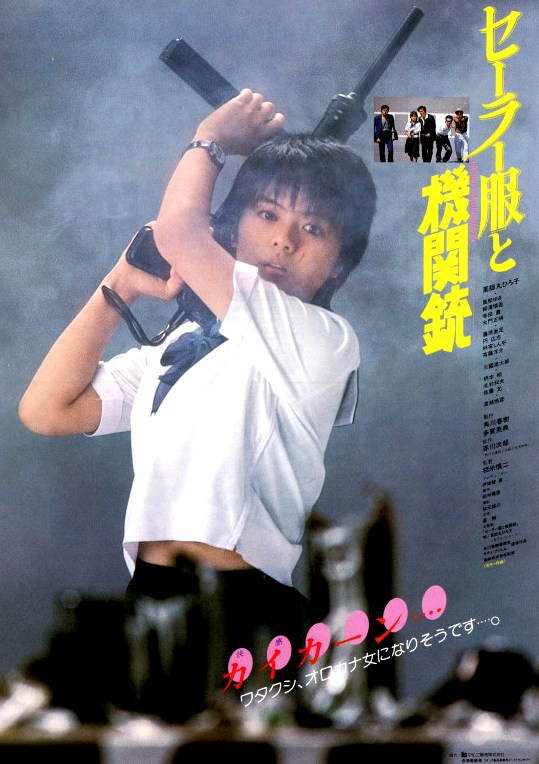
 1973 is the year the ninkyo eiga died. Or that is to say, staggered off into an alleyway clutching its stomach and vowing revenge whilst simultaneously seeking forgiveness from its beloved oyabun after being cruelly betrayed by the changing times! You might think it was Kinji Fukasaku who turned traitor and hammered the final nail into the coffin of Toei’s most popular genre, but Sadao Nakajima helped ram it home with the riotous explosion of proto-punk youth movie and jitsuroku-style naturalistic look at the pettiness and squalor inherent in the yakuza life – Aesthetics of a Bullet (鉄砲玉の美学, Teppodama no Bigaku). This tale of a small time loser playing the supercool big shot with no clue that he’s a sacrificial pawn in a much larger power struggle is one that has universal resonance despite the unpleasantness of its “hero”.
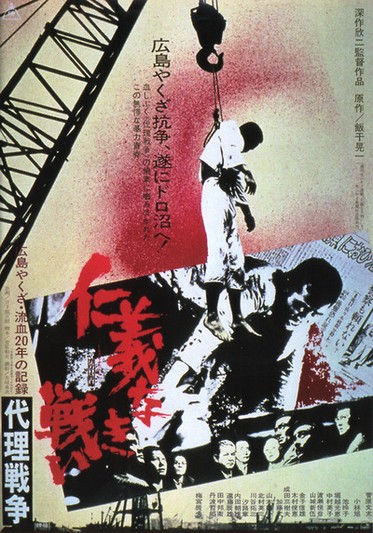 Three films into The Yakuza Papers or Battles Without Honour and Humanity series, Fukasaku slackens the place slightly and brings us a little more intrigue and behind the scenes machinations rather than the wholesale carnage of the first two films. In Proxy War we move on in terms of time period and region following Shozo Hirono into the ’60s where he’s still a petty yakuza, but his fortunes have improved slightly.
 When it comes to the history of the yakuza movie, there are few titles as important or as influential both in Japan and the wider world than Kinji Fukasaku’s Battles Without Honour and Humanity (仁義なき戦い, Jingi Naki Tatakai). The first in what would become a series of similarly themed movies later known as The Yakuza Papers, Battles without Honour is a radical rebooting of the Japanese gangster movie. The English title is, infact, a literal translation of the Japanese which accounts for the slightly unnatural “and” rather than “or” where the “honour and humanity” are collected in a single Japanese word, “jingi”. Jingi is the ancient moral code by which old-style yakuza had abided and up to now the big studio gangster pictures had all depicted their yakuza as being honourable criminals. However, in Fukasaku’s reimagining of the gangster world this adherence to any kind of conventional morality was yet another casualty of Japan’s wartime defeat.
