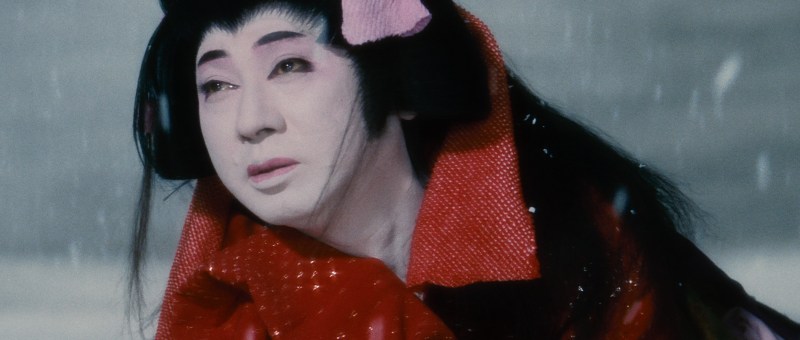
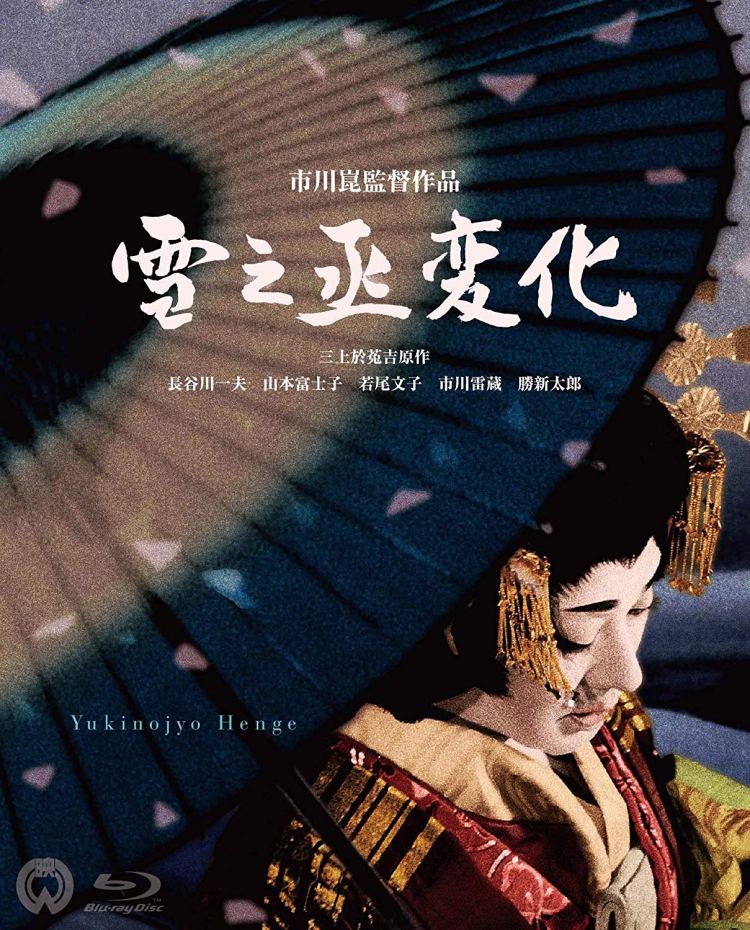
 “Revenge is difficult even for an actor” our secret observer tells us, watching quietly from the rooftops like a spectator at a play. In celebration of his 300th screen appearance, Kazuo Hasegawa stars once again as vengeful onnagata Yukinojo in another version of An Actor’s Revenge (雪之丞変化, Yukinojo Henge), this time directed by Kon Ichikawa with a script written by his wife, Natto Wada, which was itself based on the earlier film with minor adaptations. Recasting the scope frame for the Kabuki stage, Ichikawa shows us a maddening world of theatricality, defined by artifice and governed by the rules of narrative determinism.
Orphaned after his parents were driven to suicide, Yukinojo (Kazuo Hasegawa) was taken in by an actor at a young age and trained as an “onnagata” – an actor specialising in female roles on the kabuki stage where women were forbidden to tread. Years later Yukinojo is one of the most popular actors of the age and lives more or less as a woman on stage and off. Having brought his Osakan theatre company to the Edo capital he finally sees his chance for revenge against the trio of corrupt and ambitious merchants who conspired to ruin his father for personal gain. He is, however, conflicted – not in his desire for vengeance but in the strain it continues to place on his mental state as well as the moral corruption need for it provokes.
Despite his feminine appearance, Yukinojo is regarded as male and most assume that his (volitional) romantic attachments will be with women. His gender ambiguity is, however, a problem for some such as the spiky pickpocket Ohatsu (Fujiko Yamamoto) who describes him as “creepy” in being neither male nor female. Then again, Ohatsu’s gender presentation is also atypical in that though she dresses and acts as a woman, most regard her as inappropriately masculine in the independence and authority which make it possible for her to act as the leader of a gang of street thieves. Lamenting her tomboyishness, some of her minions make the suggestion common in these kinds of films that Ohatsu will rediscover her femininity on falling in love (with a man). Despite her supposed hatred of men, Ohatsu finds herself falling for Yukinojo possibly precisely because of his gender ambiguity in that she is in some sense permitted to fall in love with him as a woman because he is a man.
Meanwhile, Yumitaro (also played by Kazuo Hasegawa) – another street thief only a much more egalitarian one, has no desire for women and has also developed some kind of fascination with Yukinojo as man who presents as female. Yukinojo is remarkably uninterested in Ohatsu, but seems drawn both to the mysterious Yumitaro and to the pawn in his revenge plot, lady Namiji (Ayako Wakao). The daughter of Dobe (Ganjiro Nakamura), the ambitious lord who orchestrated the plot against Yukinojo’s father, who has sold her to the Shogun as a concubine in order to buy influence, Namiji develops a deep fascination with the feminine actor which is then manipulated both by Yukinojo who plans to break her heart solely to get at Dobe, and by Dobe who intends to indulge her fascination in order to persuade her to return to the Shogun. Namiji is entirely innocent and effectively powerless. Involving her in the plot weighs on Yukinojo’s conscience but he refuses to look back, preparing to sacrifice her solely in order to a strike blow towards her father.
Meanwhile, chaos reigns in Edo as the corruption of the ruling elite provokes a rebellion by the ordinary people fed up with their persistent profiteering. This too Yukinojo harnesses as a part of his plot, setting his greedy merchants one against the other as they weigh up the benefits of making themselves look good to the people and the Shogun through engineering a crash in the price of rice by dumping the stocks they’ve been hoarding. The theatrical world and the “real” begin to overlap as Yukinojo performs the ghosts of his parents to bring the merchants’ crimes home to them, but his revenge plot has devastating and unforeseen consequences which perhaps begin to eat away at his carefully crafted chameleonism. Possessing no true identity of his own, Yukinojo passes into legend, retreating back to his natural home of the stage the shadow of an avenger disappearing over the horizon.
Original trailer (no subtitles)


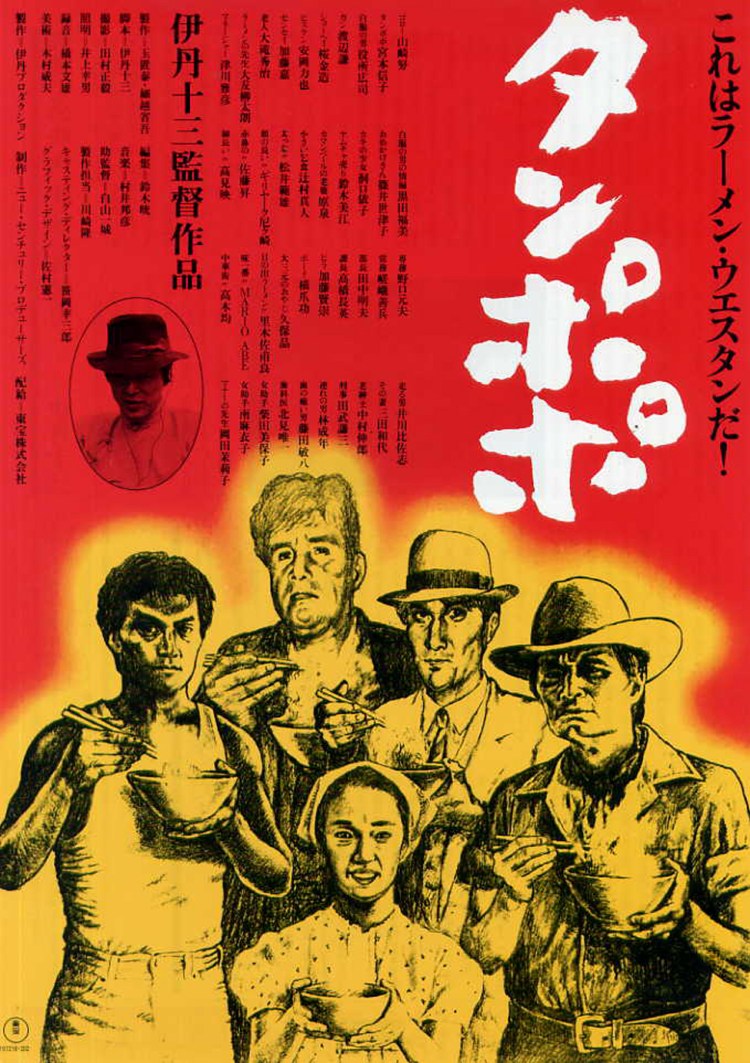 Some people love ramen so much that the idea of a “bad” bowl hardly occurs to them – all ramen is, at least, ramen. Then again, some love ramen so much that it’s almost a religious experience, bound up with ritual and the need to do things properly. A brief vignette at the beginning of Juzo Itami’s Tampopo (タンポポ) introduces us to one such ramen expert who runs through the proper way of enjoying a bowl of noodle soup which involves a lot of talking to your food whilst caressing it gently before finally consuming it with the utmost respect. Ramen is serious business, but for widowed mother Tampopo it’s a case of the watched pot never boiling. Thanks to a cowboy loner and a few other waifs and strays who eventually become friends and allies, Tampopo is about to get some schooling in the quest for the perfect noodle whilst the world goes on around her. Food becomes something used and misused but remains, ultimately, the source of all life and the thing which unites all living things.
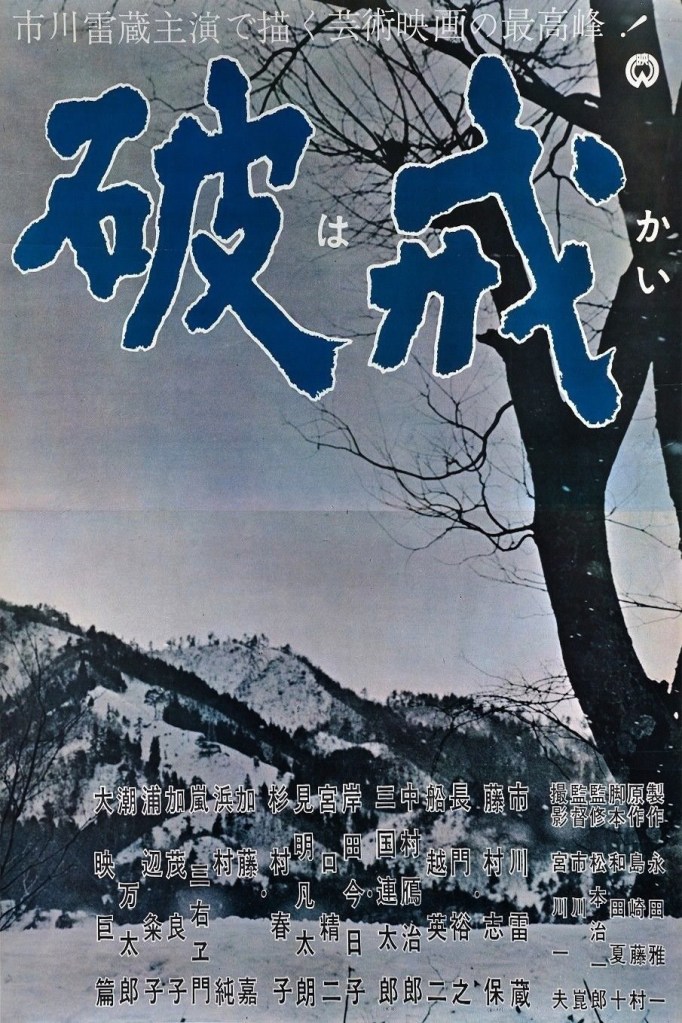 Kon Ichikawa’s approach to critiquing his society was often laced with a delicious slice of biting irony but he puts sarcasm to one side for this all too rare attempt to address the uncomfortable subject of Japan’s hidden underclass – the burakumin. The term itself simply means “people who live in hamlets” but from feudal times onwards it came to denote the kinds of people with whom others did not want to associate – notably those whose occupations dealt in some way with death from executioners and undertakers, to butchers and leatherworkers. Though outright discrimination against such people was outlawed during the Meiji restoration, social stigma and informal harassment remained common with some lingering tendency remaining even today.
 Windows on Worlds