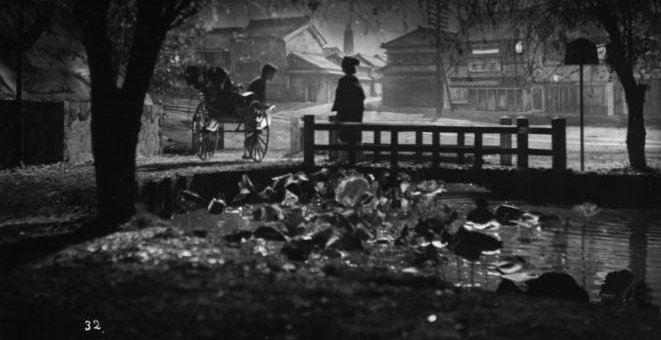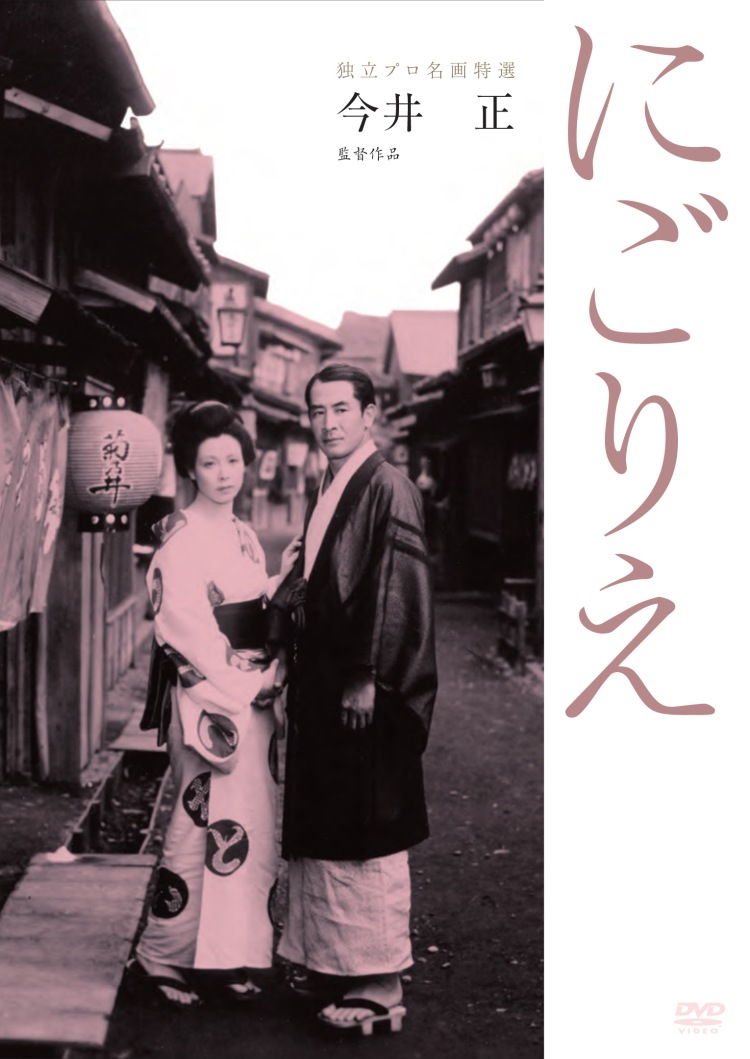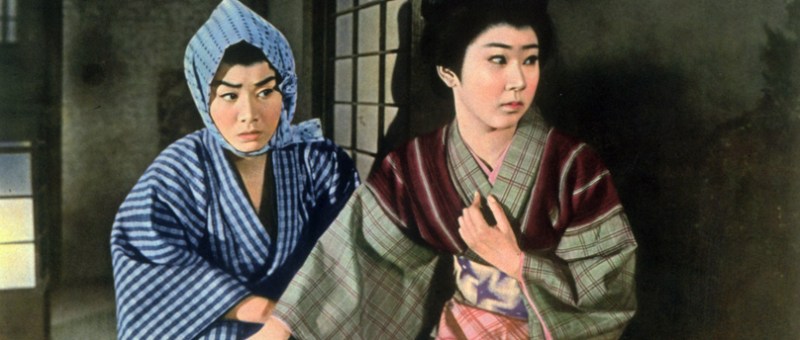
“It’s not all about tofu!” screams the heroine of Akanezora: Beyond the Crimson Sky (あかね空), a film which is all about tofu. Like tofu though, it has its own subtle flavour, gradually becoming richer by absorbing the spice of life. Based on a novel by Ichiriki Yamamoto, Akanezora is co-scripted by veteran of the Japanese New Wave, Masahiro Shinoda and directed by Masaki Hamamoto who had worked with Shinoda on Owl’s Castle and Spy Sorge prior to the director’s retirement in 2003. Like the majority of Shinoda’s work, Akanezora takes place in the past but echoes the future as it takes a sideways look at the nation’s most representative genre – the family drama. Fathers, sons, legacy and innovation come together in the story of a young man travelling from an old capital to a new one with a traditional craft he will have to make his own in order to succeed.
The story opens in the early 18th century when a couple stop to chat to a friend and, while they aren’t paying attention, their small son Shokichi wanders off after a doll show. Fastforward a decade or so and a young man, Eikichi (Masaaki Uchino), arrives from Kyoto intent on opening up a tofu shop in the capital. Enjoying the delicious local water, he runs into cheerful local girl, Ofumi (Miki Nakatani), who insists on helping him find his way around an unfamiliar city.
Ofumi proves invaluable in helping him set up his small neighbourhood store, but as skilled as Eikichi is, Kyoto tofu and Edo tofu are much more different than one might think. Eikichi’s tofu is smaller in size and fluffy where Edo tofu is larger yet solid, and though its flavour is superior, it does not suit the local taste or cuisine. Ofumi helps him out again, and once the shop is doing better the two marry. Flashforward another 18 years and the couple have three children, two sons and a daughter, but as successful as they are, they are no longer free of familial disharmony.
Strange coincidences are in play, such as Eikichi’s tofu making heritage lining up perfectly with that of a lonely couple, Oshino (Shima Iwashita) and Seibe (Renji Ishibashi), still grieving the loss of their little boy whose fate remains an open mystery. Though their son remains lost to them, Oshino and Seibe see something of the man he might have been in Eikichi who is also a practitioner of the trade they intended to pass on to him. Eikichi is a down to Earth southerner – naive, in one sense, yet honest, straighforward, kind and courteous. Though all agree his craftsmanship is first rate and his tofu excellently made, they privately advise he consider firming it up in keeping with local tastes. Eikichi is as stubborn as he is genial – he will not betray the “tradition” which has been passed down to him from his master and which he fully intends to hand down to his sons, purveyors of refined Kyoto tofu in fashionable Edo.
Thanks to Seibe’s generous patronage and Ofumi’s perseverance, Eikichi is a success but clashes with his eldest son and presumptive heir, Eitaro (Kohei Takeda), who resents his role as a kind of sales rep for his dad’s company. Following a volcanic eruption and subsequent poor harvest, grain prices are at a premium yet Eikichi, following the “Kyoto way”, refuses to raise prices, much to the consternation of fellow merchants who take out their displeasure on the young and impressionable Eitaro. One in particular launches a plan to ruin Eikichi’s tofu shop and gain access to the best of the city’s wells by befriending the lonely young son, getting him hooked on gambling and then bankrupting him with the help of local gangster boss Denzo (Masaaki Uchino).
Eikichi’s tofu, as someone later puts it, prospered not only because of his hard work and dedication, but because it was made with the heart. His overwhelming dedication to his craft might seem to blunt his dedication to those he loves but he cares deeply about his wife and children even if his “straightforward” character means he has a funny way of showing it. A running joke circles around Eikichi’s country bumpkin Kyoto accent and though the culture clash goes further than debating the proper texture of tofu, he finds himself a home thanks to the kindness of strangers. Akanezora, like Eikichi’s tofu, proves a little too spongy, its narrative connections too subtle in flavour to make much of an impact when fed only with Hamamoto’s serviceable if plain visuals, the unexpectedly chirpy performance of Miki Nakatani as the energetic Ofumi, and Masaaki Uchino’s impressive double duty as the earnest Eikichi and omnipotent Denzo. Tragedy breaks one family only to bring another back together, somehow restoring a once broken cycle yet even if Akanezora’s rosy skies suggest a resurgent warmth, it isn’t quite enough to solidify its otherwise watery brew.
Screened as part of the Japan Foundation Summer Explorers 3 season dedicated to films about food.
In a time of crisis, the populace looks to the government to take action and save the innocent from danger. A government, however, is often forced to consider the problem from a different angle – not simply saving lives but how their success or failure, decision-making process, and ability to handle the situation will be viewed by the electorate the next time they are asked who best deserves their faith and respect. Pandora (판도라) arrives at a time of particularly strained relations between the state and its people during which faith in the ruling elite is at an all time low following a tragic disaster badly mishandled and seemingly aided by the government’s failure to ensure public safety. Faced with an encroaching nuclear disaster to which their own failure to heed the warnings has played no small part, Pandora’s officials are left in a difficult position tasked with the dilemma of sacrificing a small town to save a nation or accepting their responsibility to their citizens as named individuals. Unsurprisingly, they are far from united in their final decision.
Times change and then they don’t. 2001 was a strange year, once a byword for the future it soon became the past but rather than ushering us into a new era of space exploration and a utopia born of technological advance, it brought us only new anxieties forged by ongoing political instabilities, changes in the world order, and a discomfort in those same advances we were assured would make us free. Japanese cinema, by this time, had become synonymous with horror defined by dripping wet, longhaired ghosts wreaking vengeance against an uncaring world. The genre was almost played out by the time Kiyoshi Kurosawa’s Pulse (回路, Kairo) rolled around, but rather than submitting himself to the inevitability of its demise, Kurosawa took the moribund form and pushed it as far as it could possibility go. Much like the film’s protagonists, Kurosawa determines to go as far as he can in the knowledge that standing still or turning back is consenting to your own obsolescence.
Until the later part of his career, Hideo Gosha had mostly been known for his violent action films centring on self destructive men who bore their sadnesses with macho restraint. During the 1980s, however, he began to explore a new side to his filmmaking with a string of female centred dramas focussing on the suffering of women which is largely caused by men walking the “manly way” of his earlier movies. Partly a response to his regular troupe of action stars ageing, Gosha’s new focus was also inspired by his failed marriage and difficult relationship with his daughter which convinced him that women can be just as devious and calculating as men. 1985’s Oar (櫂, Kai) is adapted from the novel by Tomiko Miyao – a writer Gosha particularly liked and identified with whose books also inspired
Depictions of wartime and the privation of the immediate post-war period in Japanese cinema run the gamut from kind hearted people helping each other through straitened times, to tales of amorality and despair as black-marketeers and unscrupulous crooks take advantage of the vulnerable and the desperate. In This Corner of the World (この世界の片隅に, Kono Sekai no Katasumi ni), adapted from the manga by Hiroshima native Fumiyo Kouno, is very much of the former variety as its dreamy, fantasy-prone heroine is dragged into a very real nightmare with the frontier drawing ever closer and the threat of death from the skies ever more present but manages to preserve something of herself even in such difficult times.
Now in its 21st year, Montreal’s 


The criticism levelled most often against Japanese cinema is its readiness to send established franchises to the big screen. Manga adaptations make up a significant proportion of mainstream films, but most adaptations are constructed from scratch for maximum accessibility to a general audience – sometimes to the irritation of the franchise’s fans. When it comes to the cinematic instalments of popular TV shows the question is more difficult but most attempt to make some concession to those who are not familiar with the already established universe. Mozu (劇場版MOZU) does not do this. It makes no attempt to recap or explain itself, it simply continues from the end of the second series of the TV drama in which the “Mozu” or shrike of the title was resolved leaving the shady spectre of “Daruma” hanging for the inevitable conclusion.
Anocha Suwichakornpong’s second feature, By the Time it Gets Dark (ดาวคะนอง.Dao Khanong), bills itself as an exploration of a traumatic moment from the recent past but quickly subverts this conceit for a wider meditation on the veracity of cinema. Beginning in a manner typical of indie-leaning Thai films, Anocha gently undercuts herself as her images prism into their separate “realities”, informing and commenting on each other but perhaps not fully interacting. The Thammasat University student massacre of 1976 is the dark genesis of this fracturing future, but it’s also in the process of becoming a collective legend, cementing a “historical truth” as cultural currency even whilst expunged from the history books, leaving its young lost in a black hole of memory from which they are powerless to emerge.
Some situations are destined to end in tears. Kaze Shindo’s Love Juice adopts the popular theme of unrequited love but complicates it with the peculiar circumstances of Tokyo at the turn of the century which requires two young women to be not just housemates but bedmates and workmates too. One is straight, one is gay and in love with her friend who seems to get off on manipulating her emotions and is overly dependent on her more responsible approach to life, but both are trapped in a low rent world of grungy nightclubs and sleazy hostess bars.
North Koreans have become the go to bad guys recently, and so North Korean spies have become the instigators of fear and paranoia in many a contemporary political thriller. The Suspect (용의자, Yonguija), however, is quick to point the finger at a larger evil – personal greed, dodgy morals, and the all powerful reach of global corporations. Opting for a high octane action fest rather than a convoluted plot structure, Won’s approach is (mostly) an uncomplicated one as a wronged man pursues his revenge or redemption with no thought for his own future, only to be presented with the unexpected offering of one anyway alongside the equally unexpected bonus of exposing an international conspiracy.