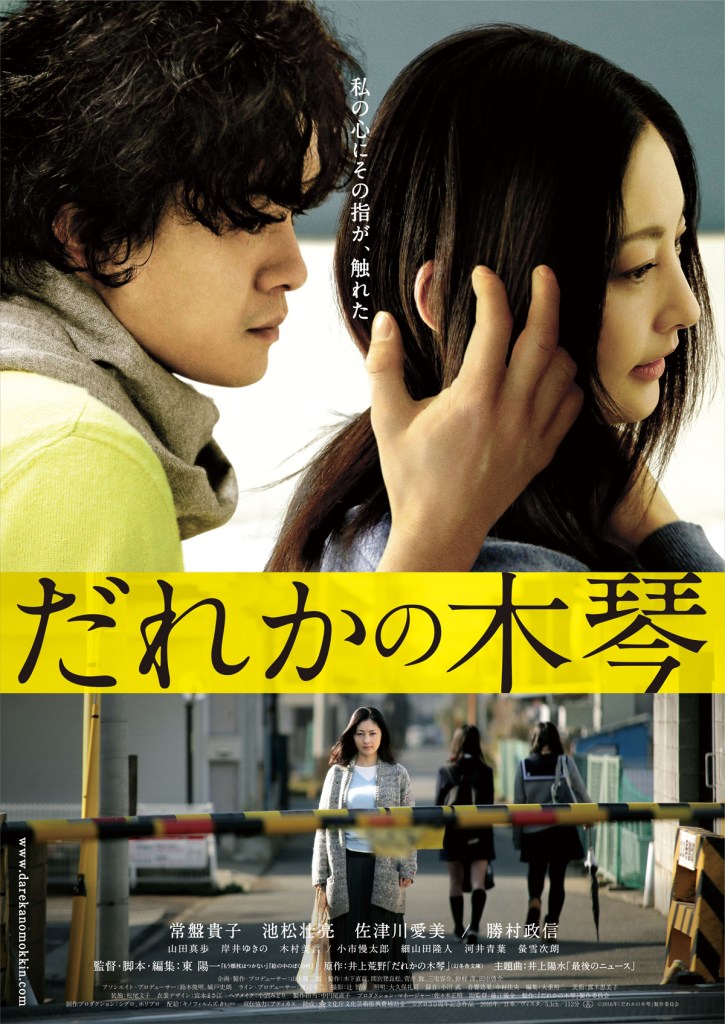
Someone’s Xylophone (だれかの木琴, Yoichi Higashi, 2016)

someones-xylophoneYoichi Higashi has had a long and varied career, deliberately rejecting a particular style or home genre which is one reason he’s never become quite as well known internationally as some of his contemporaries. This slightly anonymous quality serves the veteran director well in his adaptation of Arane Inoue’s novel which takes a long hard look at those living lives of quiet desperation in modern Japan. Though sometimes filled with a strange sense of dread, the world of Someone’s Xylophone (だれかの木琴, Dareka no Mokkin) is a gentle and forgiving one in which people are basically good though driven to the brink by loneliness and disconnection.

Middle aged housewife Sayoko (Takako Tokiwa) has just moved into a new area with her security alarm salesman husband, Kotaro (Masanobu Katsumura), and teenage daughter, Kanna (Mikoto Kimura). By all appearances the home seems to be a happy one, and the atmosphere is pleasant, if ordinary. Even so, stopping into an upscale salon one day Sayoko gets a haircut from the very good looking and warm hearted hairdresser Kaito (Sosuke Ikematsu). Hoping for repeat business Kaito gives her a business card and she reciprocates with one of her own so that she can be added to the mailing list. After some awkward chitchat, she leaves but when she gets a typical “thank you for visiting, please come again” text message, Sayoko makes the unusual decision to reply. Not wanting to seem rude, Kaito continues the strange text correspondence but Sayoko’s growing interest in the good looking young man, and later even in his girlfriend, soon crosses the line from harmless fixation to inappropriate obsession, threatening to derail her otherwise “normal” happy family life.

Higashi begins the film with a naturalistic sequence travelling from early morning light to bright sunshine as Kaito takes his bike out for a ride before returning to make breakfast for his still sleeping girlfriend, Yui (Aimi Satsukawa) – a model/store assistant at the upscale Lolita brand Baby the Stars Shine Bright. Accompanied by a thrumming, modern jazz funk soundtrack, these scenes reflect the film’s baseline reality. Kaito and Yui may live in the real world, to a point at least, whereas Sayoko has her head in the clouds and almost lives there too. A middle aged housewife, her life has begun to lose its purpose now that her daughter is almost grown and needs her much less than she ever has before. Though Sayoko and her husband appear to have a good relationship, she seems to want something more – bored with his caresses and long since past the point where there is nothing left to talk about.

The delivery of a new bed prompts a very particular fantasy of being fondled by both men at the same time though what exactly she wants from Kaito remains unclear. If her original decision to reply to a standard confirmation email could be dismissed as friendly innocence, sending a picture of your new bed to someone you just met is decidedly strange. Nevertheless, Kaito feels the need to keep replying even once it becomes clear that Sayoko has also tracked down his apartment and seems intent on further infiltrating his life. When she takes the decision to visit Yui at her work (the brand is not one which ordinarily caters to women of Sayoko’s age), the younger woman starts to get worried and eventually takes some direct action of her own.

Sayoko remains something of a cypher, a woman who can’t seem to figure herself out. The xylophone of the title refers to a dream or vision she has of a girl in far off window banging away at the instrument but never quite getting the tune – eventually she realises the girl is her, still trying to find her inner rhythm all these years later. Kotaro, by contrast, seems to have more worldly anxieties despite his outwardly calm and kindly manner. When his daughter asks him if they really need the security system they have at home he tells her about a long unsolved family murder before explaining that it just makes him feel safer when he can’t be there in person to protect his wife and daughter. Kanna, a bright child, points out that more threat is posed by accidents in the home than by intruders – to which Kotaro is forced to agree, lamenting that there is no alarm system to prevent a domestic accident. Thus when Kanna calls him to say that there has been an “incident” at home, the metaphor is an apt one – nobody was looking, and now everything’s falling apart.

Despite the expectation for grand scenes or bloody violence, Someone’s Xylophone consistently refuses to follow the signposted direction preferring a more adult resolution born of self reflection and mutual understanding. A subplot involving a very particular young man who comes to the salon solely for female contact hints at a darker path for unresolved loneliness and repressed emotion, but even if Sayoko and Kotaro make ill advised decisions in search of closeness their sojourns in alternate realities ultimately allow them to rediscover their mutual universe (for a time, at least). The xylophone finally plays out a recognisable tune as a more settled Sayoko fantasises about a phantom blanket rather than an illicit ménage à trois but whether this craving for warmth will provoke a similar crisis as the need for passion remains to be seen.


Screened as part of the Japan Foundation Touring Film Programme 2017.

Original trailer (no subtitles)
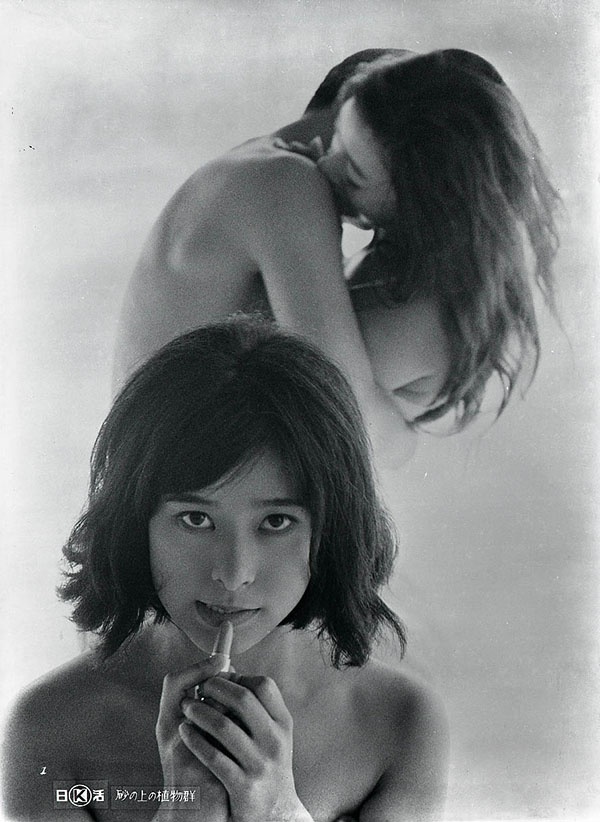
Flora on the Sand (砂の上の植物群, Ko Nakahira, 1964)

© 1964 Nikkatsu CorporationDespite being among the directors who helped to usher in what would later be called the Japanese New Wave, Ko Nakahira remains in relative obscurity with only his landmark movie of the Sun Tribe era, Crazed Fruit, widely seen abroad. Like the other directors of his generation Nakahira served his time in the studio system working on impersonal commercial projects but by 1964 which saw the release of another of his most well regarded films Only on Mondays, Nakahira had begun to give free reign to experimentation much to the studio boss’ chagrin. Flora on the Sand (砂の上の植物群, Suna no Ue no Shokubutsu-gun), adapted from the novel by Junnosuke Yoshiyuki, puts an absurd, surreal twist on the oft revisited salaryman midlife crisis as its conflicted hero muses on the legacy of his womanising father while indulging in a strange ménage à trois with two sisters, one of whom to he comes to believe he may also be related to.
After a brief prologue in which our hero, cosmetics salesman Ichiro Igi (Noboru Nakaya), imagines a scenario for a novel in which a dying husband becomes so jealous of the man that may succeed him in his wife’s life that he sets about plotting to make her the weapon of that very man’s destruction, Igi heads to his regular barber and longtime family friend where he takes the time to probe him about his late father’s womanising habits. Igi’s father died young at only 34 for years of age, three years younger than the age Igi is now. His father’s spitting image, Igi cannot help seeing him everywhere he goes and feels unable to evade his ongoing influence, almost as if he were possessed by his father’s (un)departed spirit.

The major preoccupation Igi has is that his wife (Yukiko Shimazaki) may have slept with his father before they were married while she was just a teenager. The barber tells him he’s pretty sure not, but Igi cannot let the idea go and repeatedly brings it up with his wife, creating discord in the family home. Meeting a precocious schoolgirl at the Marine Tower one evening, Igi finds himself taking her to a hotel and deflowering her even though she begins to resist him at the last minute. The girl, Akiko (Mieko Nishio), then makes a strange request of him – she wants Igi to seduce and “hurt” her older sister Kyoko (Kazuko Inano) whose sanctimonious attitude she can no longer stand. Igi does indeed visit the bar where Kyoko works as a hostess and embarks on an intense affair with her but Akiko’s pleas to “hurt” her sister are complicated by Kyoko’s masochistic tendencies and Igi’s descent into a kind of madness.

Beginning with the painting by Paul Klee which gives the film its name, Nakahira asks us to imagine what would happen if a large dash of red were suddenly to appear, disrupting the comforting harmony of Klee’s perfectly matched colours. The discomforting redness does dutifully appear as strangely shaped squares on the canvas but the symbolic value of the colour is felt throughout the black and white narrative from the dark stain of Akiko’s broken maidenhead to the affectation of her lipstick and constant references to red seas and suns.

Though Igi’s world may have seemed just as perfectly ordered as Klee’s painting from the outside, his constant preoccupations with his father become the disruptive influence which leads to all of the redness later leaking in. Haunted by his father as he is, seeing his face everywhere from train windows to the barber shop mirror, Igi’s attempt at a plot for a murder mystery takes on a strangely Oedipal quality as we begin to wonder if it’s his father rather than Igi himself who has assumed the role of the “protagonist”, leaving a time bomb for his wayward son, the inheritor of his woman, just as Igi laid out in his prologue. Bizarre reality or another symptom of Igi’s increasingly fractured mind, the plot seems likely to succeed at least in a sense as Igi declines into a dishevelled mess, prone to hallucinations and uncertain visions.

Nakahira gives us several of these as Igi panics and struggles with a key only to open a door into bright white light and nothingness or another in which he and Kyoko dine in an empty restaurant which is suddenly filled with the noisy chatter of other diners. Strange touches such as the German beerhall with a Spanish guitarist, or the odd peepshow in which Igi and his two friends take on the appearance of demons or impassive Buddhist statues thanks to the light reflected into their eyes, add to the unbalanced atmosphere as do the frequent closeups of lips and hands, and the symbolic value of seeds never meant to be planted which nevertheless flower at an unintended moment. Shooting in black and white, Nakahira begins with a colour sequence featuring the abstract artwork with occasional flashes of colour as well as voice over and occasional intertitle-style captions adding to the absurdist atmosphere.

A surreal and complex psychological exploration of sex, power, obsession, identity, and legacy Flora on the Sand finds Nakahira flexing his experimental mussels for a drama rife with ambiguity and strangeness. Sadly this brand of innovation was not entirely welcome at Nikkatsu head offices and so he found himself left out in the cold eventually ending up in Hong Kong making action movies for Shaw Brothers. Despite some later success at international festivals, Nakahira’s work remains sadly neglected but the unusual degree of sophistication and almost playful atmosphere seen in Flora on the Sand make him worthy of attention as more than just an almost was of the rising New Wave.


Screened as part of the Japan Foundation Touring Film Programme 2017.

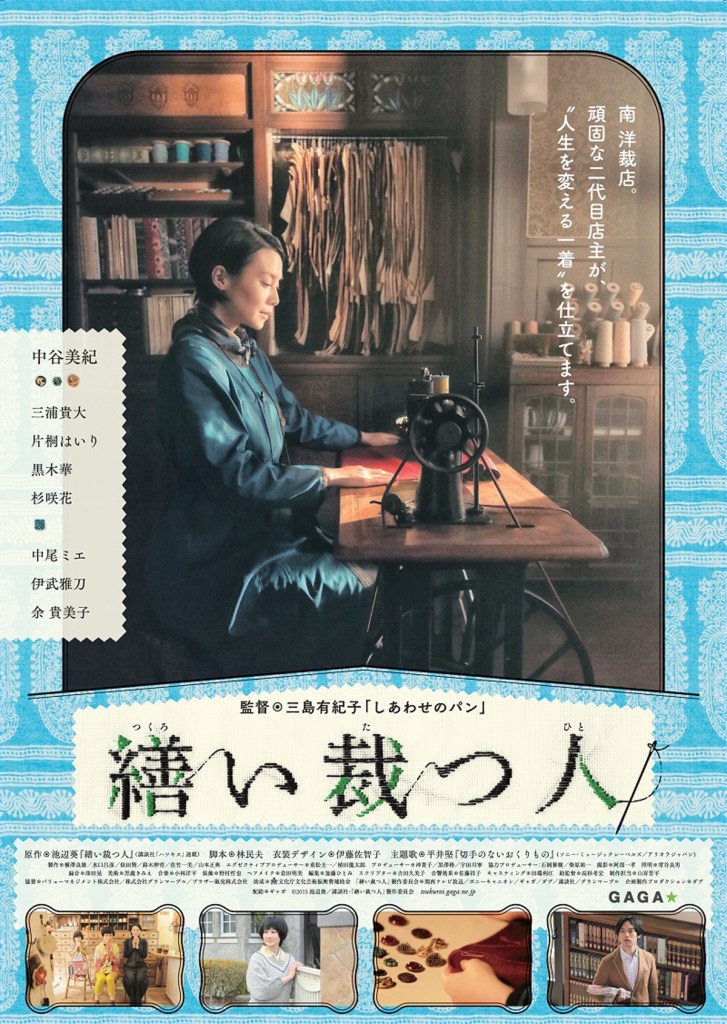
A Stitch of Life (繕い裁つ人, Yukiko Mishima, 2015)

stitch-of-lifeTradition vs modernity is not so much of theme in Japanese cinema as an ever present trope. The characters at the centre of Yukiko Mishima’s adaptation of Aoi Ikebe’s manga, A Stitch of Life (繕い裁つ人, Tsukuroi Tatsu Hito), might as well be frozen in amber, so determined are they to continuing living in the same old way despite whatever personal need for change they may be feeling. The arrival of an unexpected visitor from what might as well be the future begins to loosen some of the perfectly executed stitches which have kept the heroine’s heart constrained all this time but this is less a romance than a gentle blossoming as love of craftsmanship comes to the fore and an artist begins to realise that moving forward does not necessarily entail a betrayal of the past.
Ichie Minami (Miki Nakatani) has taken over the tailoring business started by her grandmother, using her grandmother’s vintage treadle sewing machine and mostly occupying her time by making alterations on her grandmother’s existing patterns. To make ends meet, she’s also been reproducing some of her grandmother’s designs for sale at a local shop which brings her to the attention of department store employee and fashion enthusiast Fujii (Takahiro Miura) who has the idea of getting Ichie to work on some new items for a branded fashion line. Ichie, however, is devoted to her grandmother’s legacy and has committed herself to continuing the work her grandmother started with no deviation from the current model. Undeterred, Fujii continues to visit Ichie while she works, reaching even deeper levels of understanding both of her craft and of her person. Something inside Ichie begins to move too, but the pull back to the past is a strong one and it takes more than just courage to decide to finally embrace all of your hopes and dreams.

When Fujii hands the portfolio pitch he’s designed to his boss at the department store she loves the clothes and exclaims that the person who made them must be nice too, to which Fujii sheepishly admits that Ichie is more like a stubborn old man. Rigid in her habits and a little standoffish, perhaps even austere, Ichie does indeed seem harsh and unforgiving. Yet the irony is that her work requires the opposite of her. The clothes Ichie makes, and those her grandmother made before her, are perfectly tailored to the person in question, not just in terms of their measurements but designed to bring out each person’s personality, to help them become more of themselves and live a little happier in beautifully made outfits. Thus, Ichie must look closely at each person she meets in order to understand them fully and arrange her craft in perfect symbiosis with their individual needs. Perhaps for this reason Ichie finds her solitary time listening to the rhythmical beat of the sewing machine particularly relaxing, but the shop remains somewhere the local people gather in search of something more than just a simple hem repair.

Ichie’s grandmother sought to create clothes that could be worn for a lifetime, remaining long after both she and the person they were made for have disappeared. This approach may seem odd from a modern perspective of wash and wear disposable clothing intended to be replaced in a matter of months, but the idea here was never about the fashionable but one of engineering personal happiness through attire. The clothes make the man, in a sense, but the man also makes the clothes. As she made her alterations, Ichie’s grandmother recorded the various goings on in her customers’ lives in her notebook, allowing the clothes themselves to become the story of someone’s life. As Ichie’s former teacher puts it when trying to explain the art of making tea, it takes more than just heart – it takes experience, and care, and dedication. Ichie’s grandmother was meticulous – a trait which her granddaughter has inherited, with every stitch perfectly placed, each hem perfectly straight, and garment perfectly tailored for its intended wearer.

Ichie may keep herself contained for good reason, but now and then something else comes through such as a love of truly giant cheesecakes or a sudden bout of worry on being asked to craft a funeral dress for a good friend, but Fujii’s gentle prodding does indeed lead her towards a period of self reflection on what exactly it is she wants to do with her grandmother’s legacy. A cynical person might regard the annual “soirees” Ichie’s grandmother began in the small town as an excuse to get people to buy an outfit they’ll only wear once a year but the event, like the clothes, becomes an occasion for the artifice which lays bare the truth. Eventually, her grandmother’s gentle spell works on Ichie too (with a little help from Fujii) as the love of the craft of tailoring helps her to become herself, cast off her grandmother’s shadow whilst honouring her legacy, and learn to take pleasure in doing the things which only she can do.


Screened as part of the Japan Foundation Touring Film Programme 2017.

Original trailer (no subtitles)

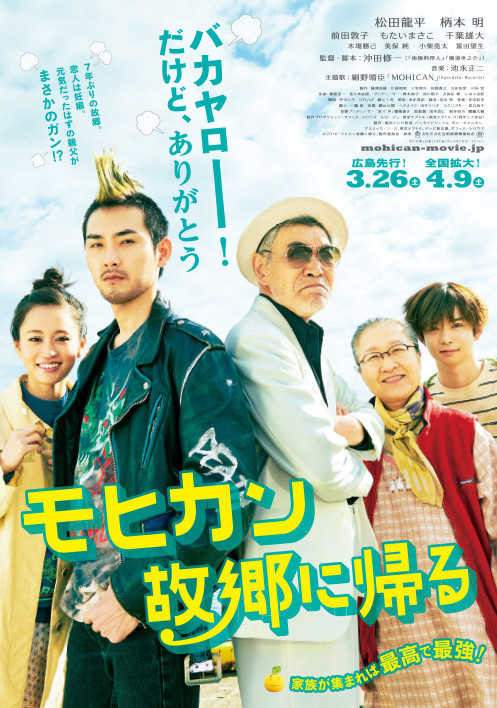
The Mohican Comes Home (モヒカン故郷に帰る, Shuichi Okita, 2016)

mohican-comes-homeJapan may be famous for its family dramas, but there is a significant substrain of these warm and gentle comedies which sees a prodigal child return to their childhood home either to rediscover some lost aspect of themselves or realise that they no longer belong in the place which raised them. Shuichi Okita’s The Mohican Comes Home (モヒカン故郷に帰る, Mohican Kokyo ni Kaeru) includes an obvious reference in its title to Keisuke Kinoshita’s colourful 1954 escapade Carmen Comes Home which cast legendary actress Hideko Takamine somewhat against type as a ditsy airhead show girl eager to show off all her city sophistications to the rural backwater she abruptly ran out of some years before. Like Carmen, the hero of Mohican Comes Home makes an unexpected trip to visit his family in the picturesque Hiroshima island village where he grew up only to find not very much has changed but an equally unexpected tragedy prompts him into a wider consideration of his past and future as he faces life’s two extremes in the very same moment.
Eikichi (Ryuhei Matsuda) left his island home some years ago for the bright lights of Tokyo where he fronts a punk band by the name of Grim Reapers. The band has some moderate underground success, but the guys are getting old for the punk scene and finding themselves with real world responsibilities from healthcare costs to the prospects of supporting wives and children. Eikichi, sporting a prominent bleached mohawk, feels this more than most as he’s soon to become a father and is intending to marry his pregnant girlfriend, Yuka (Atsuko Maeda), if only he had the money. He’s been promising to take his future wife to meet his parents for some time but so far they’ve never actually made the trip.

This time, things are different and so Eikichi makes a shocking return after seven years only to wander in during an awkward scene as his mother and younger brother try to manoeuvre his drunken father into a more convenient position whilst protecting his precious white suit from alcohol born ruin. Eikichi’s family own the village liquor store but his father’s passion is for music and he also coaches the local middle school band. A devotee of legendary Hiroshima born superstar Eikichi Yazawa, Osamu (Akira Emoto) insists the kids play his favourite tune ad nauseam to much eye rolling from the youngsters forced to associate themselves with such an uncool and old fashioned song.

Eikichi’s homecoming has not got off to the best start, especially after his father begins to sober up and recommends a hair cut and real job, both of which Eikichi resolutely refuses. Things take a more serious turn when Osamu realises his son is being financially supported by his girlfriend whom he has also got pregnant but is not yet married to. Experiencing extreme moral outrage at his responsibility shirking son, Osamu chases him around the table in what appears to be a scene often repeated during Eikichi’s childhood but the situation soon ends in an unexpected way foreshadowing Osamu’s decline into ill health.

Deciding to stay a little longer than intended, Eikichi and Yuka blend into the family home trying to help mother Haruko (Masako Motai) and boomerang younger brother Koji (Yudai Chiba) adjust while Osamu is in the hospital. The contrast between town and country, traditional and modern is never far from view whether in Yuka’s kindhearted decision to finish off preparing the family dinner though she has to consult a youtube video to find out how to gut fish, or in her astonishment at the very ordinary way in which her future in-laws met (i.e. simple propinquity). While the women begin to bond over their shared concern for their men as Haruko decides to teach Yuka some home style tips and tricks, Eikichi and his father spar with each other warmly as Eikichi takes charge of a band rehearsal and allows them to let loose on the much hated song with an energised punk fuelled twist.

Despite a strained relationship with his father, Eikichi is a good person who also wants to offer some kind of comfort to the old man in his final days. Going to great lengths to track down a particular pizza Osamu suddenly requests (the last time he ate pizza was on his 60th birthday) or eventually pretending to be Yazawa himself whom Osamu is very proud to have made eye contact with during a Tokyo concert in 1977, Eikichi comes to a kind of understanding of the man his father was as well as the man he is. Full of warm, naturalistic humour giving way to two elaborately constructed set pieces, The Mohican Comes Home is a typically well observed family drama from Okita which neatly undercuts its essentially melancholy set up with a layer of stoical perseverance.


Screened as part of the Japan Foundation Touring Film Programme 2017.

Original trailer (no subtitles)

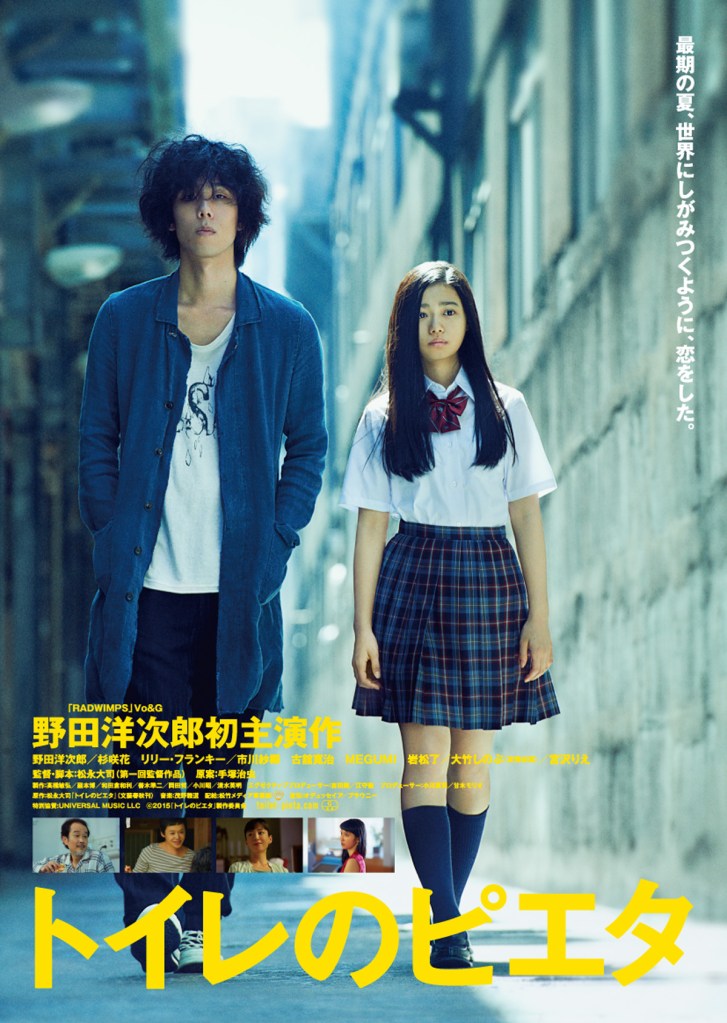
Pieta in the Toilet (トイレのピエタ, Daishi Matsunaga, 2015)

pieta-in-the-toiletSomewhere near the beginning of Daishi Matsunaga’s debut feature, Pieta in the Toilet (トイレのピエタ, Toire no Pieta), the high rise window washing hero is attempting to school a nervous newbie by “reassuring” him that the worst thing that could happen up here is that you could die. This early attempt at black humour signals Hiroshi’s already aloof and standoffish nature but his fateful remark comes back to haunt him after he is diagnosed with an aggressive and debilitating condition of his own. Noticeably restrained in contrast with the often melodramatic approach of similarly themed mainstream pictures, Pieta in the Toilet is less a contemplation of death than of life, its purpose and its possibilities.

Having left his country home for Tokyo to become a painter, Hiroshi (Yojiro Noda) has become a bitter man, wilfully drowning in his own broken dreams. A chance encounter with an old flame, Satstuki (Saya Ichikawa), further deepens Hiroshi’s sense of inadequacy – she is about to open a solo exhibition in the very building which Hiroshi is currently engaged in washing the windows of. After having so sarcastically made fun of his new colleague’s fear of the rig, it’s Hiroshi who finds himself collapsing on the job and requiring medical treatment.

Seeing as the hospital have requested he bring a family member along with him for the results of the examination, it’s probably not good news. Not wanting to involve his parents, Hiroshi persuades Satsuki to masquerade as his younger sister only to restart an old argument in the waiting room prompting his former love to remember why they aren’t together anymore and hightail it out of there. Spotting a high school girl arguing with a salaryman she says has torn her uniform, Hiroshi decides to offer the job to her. Mai (Hana Sugisaki) plays her part to perfection but the news is even worse than he’d feared – aggressive stomach cancer requiring immediate hospitalisation and sustained chemotherapy if he is to have any chance at all of surviving more than a couple of months at most.

Prior to his illness, Hiroshi is a difficult man, permanently grumpy and irritated as if carrying a great sense of injustice. Despite several different voices reminding him that he had talent, Hiroshi has given up drawing in the belief that his artistic career was always doomed to failure. Intent on punishing himself for just not being good enough to succeed, Hiroshi’s decision to make window washing his career signals his lack of personal ambition, content to simply keep existing while a silent rage bubbles under the surface.

After the original failed reconnection with Satsuki who, we later discover, has moved in another direction using her society connections to advance her career in a way of which Hiroshi does not approve, Hiroshi’s illness brings him into contact with a number of people who each do their bit to reopen his heart. The most important of these is the feisty high school girl, Mai, who refuses to simply disappear from Hiroshi’s life after the awkward bonding experience of being present at the cancer diagnosis of a total stranger. As angry and defeated as Hiroshi, Mai’s difficult homelife has brought her untold suffering but unlike the brooding painter, hers in an externalised rage which sends her reeling into the world, looking for reaction and recognition rather than the introspective craving for disappointment and indifference which marks Hiroshi’s approach to his internalised sense of inadequacy.

Hiroshi’s hospital stay produces twin motivators from both ends of the spectrum in the form of an older man in the next bed, Yokota (Lily Franky), who enjoys taking photographs (especially of pretty girls), and a terminally ill little boy who remains cheerful, polite and friendly despite Hiroshi’s rather rude attempt to shake him off. It’s on a visit to the hospital chapel with the boy, Takuto (Riku Sawada), and his mother (Rie Miyazawa) that Hiroshi first comes across the statue of the pieta which inspires his ultimate, life affirming act which sees him turn the smallest room of the house into a new Sistine Chapel with a large scale installation recasting Mai as Mary, arms outstretched ready to receive her sorrowful burden.

Hiroshi’s life had been mere existence but reaching an acceptance of its end forces him into a process of more positive self reflection and a desire to leave something more permanent behind. Inspired by a few words found on the final page of the diary kept by the godfather of manga, Osamu Tezuka, himself battling stomach cancer at the time, Pieta in the Toilet puts art at the core of life as Hiroshi picks up his paint brush, Yokota his camera (albeit with slightly less than artful intentions), and Takuto his painstakingly collected colour-in heroes. Necessarily melancholy yet somehow life affirming Pieta in the Toilet offers a nuanced though no less powerful contemplation of life, death and art in which each gives meaning to the other, ensuring the richness of a life fully lived.


Screened as part of the Japan Foundation Touring Film Programme 2017.

Original trailer (English subtitles)

Odd Obsession (鍵, Kon Ichikawa, 1959)

odd-obsessionJunichiro Tanizaki is widely regarded as one of the major Japanese literary figures of the twentieth century with his work frequently adapted for the cinema screen. Those most familiar with Kon Ichikawa’s art house leaning pictures such as war films The Burmese Harp or Fires on the Plain might find it quite an odd proposition but in many ways, there could be no finer match for Tanizaki’s subversive, darkly comic critiques of the baser elements of human nature than the otherwise wry director. Odd Obsession (鍵, Kagi) may be a strange title for this adaptation of Tanizaki’s well known later work The Key, but then again “odd obsessions” is good way of describing the majority of Tanizaki’s career. A tale of destructive sexuality, the odd obsession here is not so much pleasure or even dominance but a misplaced hope of sexuality as salvation, that the sheer force of stimulation arising from desire can in some way be harnessed to stave off the inevitable even if it entails a kind of personal abstinence.
Our narrator for this sardonic tale is an ambitious young doctor, Kimura (Tatsuya Nakadai), who opens the film in an unusually meta fashion with a direct to camera address taking the form of a brief lecture on the decline of the human body (which begins at age ten and then gets progressively worse). Kimura reminds us that we too will grow old, but his warning is intended less to engender sympathy for the elderly patriarch who will become our secondary protagonist than it is to raise a grim spectre of the inescapability of death.

The story Kimura wants to tell us of a man who fought against senility centres on antiques expert and respected cultural critic Kenmochi (Ganjiro Nakamura). Advanced in years, Kenmochi is beginning to feel the darkness encroaching along with the desire to resist it through restored virility. For this reason, he’s been making regular appointments at Kimura’s clinic which he keeps secret from his wife who would be unhappy to know he’s been getting mysterious injections to help with his sex drive but which also come with a number of side effects including dangerously raising his blood pressure.

Eventually Ikuko (Machiko Kyo), Kenmochi’s slightly younger wife and mother of his grown up daughter Toshiko (Junko Kano), does indeed find out though what she does not appear to know is that Kenmochi has also been drugging her so that he can take photos of her naked body and enjoy his rights as her husband without her needing to be 100% present at the time. Kenmochi’s plan is to lure Kimura into having an affair with his wife so that the resultant jealousy will stimulate his system, staving off senility and other unwelcome effects of ageing. This would be strange enough on its own were it not that Kenmochi has also been trying to set up a marriage between Toshiko and Kimura who are already engaged in a discreet affair.

In contrast with the source material which takes the form of a number of diary entries providing differing perspectives on events, the film takes the point of view of the cynical and morally bankrupt doctor Kimura who feels himself above this “pathetic” old man with his sexual preoccupations and diminished prospects. As the narrator, Kimura evidently believes himself in control but Ichikawa is keen to play with our sense of the rules of storytelling to show him just how wrong he could be. Intrigue is everywhere. Kenmochi may think he’s using all around him in a clever game to prolong his own life but he’s entirely blind to a series of counter games which may be taking place behind his back.

Sex is quite literally a weapon – aimed at the heart of death. Kimura recounts a dream he sometimes has in which he is shot through the heart in an arid desert, only for this same scene to invade the mind of a paralysed Kenmochi on gazing at the naked body of his wife. The marriage of Kenmochi and Ikuko has apparently been a cold (and perhaps unhappy) one with Kenmochi berating his wife for remaining “priest’s daughter” all these years later, prudish and conventional. Nevertheless, Ikuko – the kimonoed figure of the traditional Japanese wife, subservient yet mysterious and melancholy, becomes the central pivot around which all the men turn, eclipsing her own daughter – a Westernised, sexually liberated young woman rendered undesirable in her very availability. Kimura is not quite the destructive interloper of Pasolini’s Theorem so much as he is a “key” used by Kenmochi to “unlock” a hidden capacity within himself but one which, as it turns out, opens many doors not all of them leading to intended, or expected, destinations.

Ichikawa continues with a more experimental approach than was his norm following the bold opening scene in which Kimura directly addresses the audience with a straight to camera monologue. A pointed symbolic sequence of a train coupling, freeze frames, dissolves and montages add to his alienated perspective as he adopts Kimura’s arch commentary on the ongoing disaster which is the extremely dysfunctional Kenmochi family home. Middle class and well to do, the Kenmochis’ lives are nevertheless empty – the house is mortgaged and the beautiful statues which taunt Kenmochi with their physical perfection have all already been sold though Kenmochi refuses to let the buyer take them home. Old age should burn and rave at close of day, but as the beautifully ironic ending makes plain it will be of little use, death is in the house wearing an all too familiar face which you will always fail to recognise.


Screened as part of the Japan Foundation Touring Film Programme 2017.

Opening scene (no subtitles)

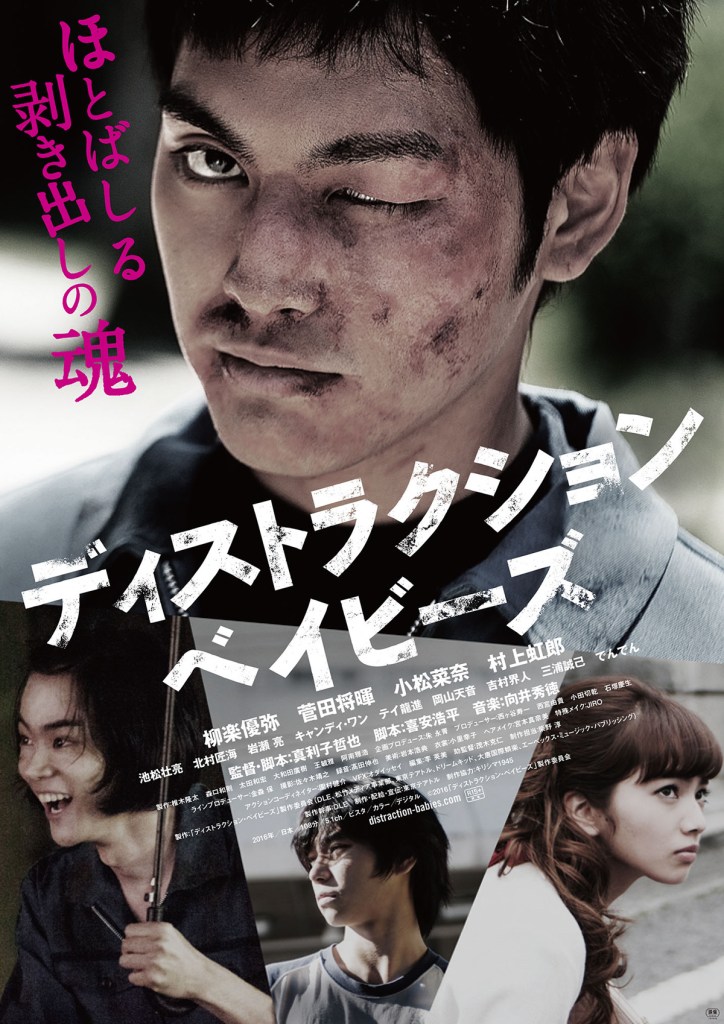
Destruction Babies (ディストラクション・ベイビーズ, Tetsuya Mariko, 2016)

destruction-babiesPost-golden age, Japanese cinema has arguably had a preoccupation with the angry young man. From the ever present tension of the seishun eiga to the frustrations of ‘70s art films and the punk nihilism of the 1980s which only seemed to deepen after the bubble burst, the young men of Japanese cinema have most often gone to war with themselves in violent intensity, prepared to burn the world which they feel holds no place for them. Tetsuya Mariko’s Destruction Babies (ディストラクション・ベイビーズ) is a fine addition to this tradition but also an urgent one. Stepping somehow beyond nihilism, Mariko’s vision of his country’s future is a bleak one in which young, fatherless men inherit the traditions of their ancestors all the while desperately trying to destroy them. Devoid of hope, of purpose, and of human connection the youth of the day get their kicks vicariously, so busy sharing their experiences online that reality has become an obsolete concept and the physical sensation of violence the only remaining truth.
The rundown port towns of Shikoku are an apt place to stage this battle. Panning over the depressingly quiet harbour, urgent, thrumming electric guitars bring tension to the air as the younger of two brothers, Shota (Nijiro Murakami), catches sight of his only remaining family member, older brother Taira (Yuya Yagira). Currently in the middle of getting a beating from local thugs, Taira signals his intention to leave town, which he does after his boss breaks up the fight and tells him to get lost.

By the time Shota has crossed the river, his brother is already lost to him. A vengeful, crazed demon with strange, burning eyes, Taira has taken the same path as many an angry young man and headed into town spoiling for a fight. Driven by rage, Taira fights back but only to be fought with – he craves pain, is energised by it, and rises again with every fall stronger but a little less human.

As he says, he has his rules (as mysterious as they may be), but Taira’s violent exploits eventually find a disciple in previously cowardly high school boy Yuya (Masaki Suda) who discovers the potential violence has to create power from fear in witnessing Taira’s one man war of stubbornness with the local yakuza. Yuya, a coward at heart, is without code, fears pain, and seeks only domination to ease his lack of self confidence. Taira, random as his violence is, attacks only other males capable of giving him what he needs but Yuya makes a point of attacking those least likely to offer resistance. Proclaiming that he always wanted to hit a woman, Yuya drop kicks schoolgirls and sends middle aged housewives and their shopping flying.

The sole female voice, Nana (Nana Komatsu) – a kleptomaniac yakuza moll who finds her validation though shoplifting unneeded items selected for the pleasure of stealing them, originally finds the ongoing violence exciting as she watches the viral videos but feels very differently when confronted with its real, physical presence and each of the implied threats to her person it presents. Tough and wily, Nana is a survivor. Where Taira staked his life on violence and Yuya on the threat of it, Nana survives through cunning. The victory is hers, as hollow as it may turn out to be.

Mariko’s chilling vision paints the ongoing crime spree as a natural result of a series of long standing cultural norms in which contradictory notions of masculinity compete with a conformist, constraining society. The entire founding principle of the small town in which the film takes place is that men come of age through violence, though the older man who has (or claims to have) provided the bulk of parental input for these parentless brothers describes Taira as if he were the very demon such festivals are often created to expel. Men of 18 years carry the portable shrines, he repeatedly says, but 18 year old Taira is a “troublemaker” and “troublemakers” must leave the town altogether.

If Taira sought connection through violence, Shota continues to seek it through human emotions – searching for his brother, hanging out with his friends, and drawing closer to his brother’s boss who offers him differing degrees of fatherly input. In contrast to his peers, Shota seems to disapprove of the way his cocksure (false) friend Kenji (Takumi Kitamura) treats women though it is also true that Kenji is actively frustrating his attempts to find his brother whilst dangling a clue right before his eyes. Nevertheless, the harshness of this unforgiving world seems determined to turn Shota into the same rage filled creature of despair as his older brother as injustice piles on injustice with no hope of respite.

Destruction Babies is apt name for the current society – born of chaos, trapped in perpetual childhood, and thriving on violence. Taira and Shota were always outsiders in a world which organises itself entirely around the family unit but the force which drives their world is not love but pain, this world is one underpinned by the physical at the expense of the spiritual. Metaphorically or literally, the lives of the young men of today will entail repeated blows to the face while those of the young women will require ingenious sideward motions to avoid them. Oblique, ambiguous, and soaked in blood, Destruction Babies is a rebel yell for a forlorn hope, as raw as it is disturbing.


Screened as part of the Japan Foundation Touring Film Programme 2017 and set for UK release from Third Window Films later in the year.

Original trailer (English subtitles)

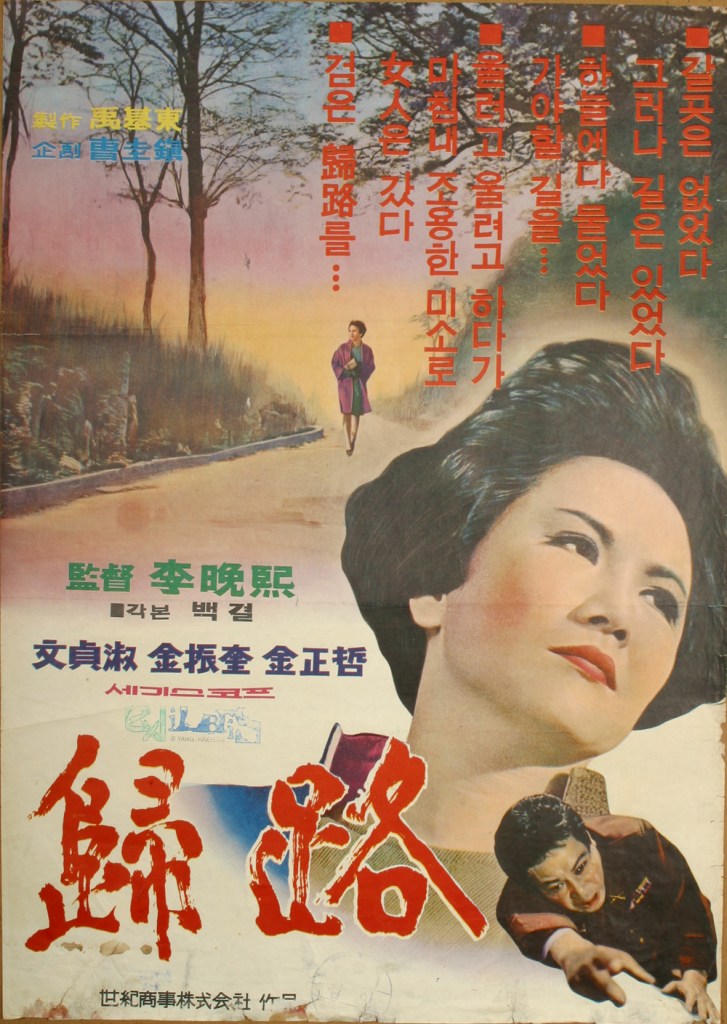
Homebound (歸路 / 귀로, Lee Man-hee, 1967)

homeboundLee Man-hee was one of the most prolific and high profile filmmakers of Korea’s golden age until his untimely death at the age of 43 in 1975. Like many directors of the era he had his fare share of struggles with the censorship regime enduring more than most when he was arrested for contravention of the code with his 1965 film Seven Female POWs and later decided to shelve an entire project in 1968’s A Day Off rather than tailor it to the concerns of the day. For these reasons it’s not difficult to read a political message into Lee’s 1967 tale of the (im)possibility of escape from a moribund marriage, Homebound (歸路 / 귀로, Gwiro). Like her country, Ji-yoen finds herself at a crossroads in the battle scarred post-war world which asks her to choose between a life of miserable servitude in fulfilment of her duty or one of accepting the painfulness of public disapproval in choosing to strike out for a happier future.

For fourteen years, Ji-yeon (Moon Jeong-suk) has been more caretaker than wife to her paralysed war hero husband, Dong-u (Kim Jin-gyu), who is so absorbed in his own sense of impotence that he has almost come to resent the extreme sacrifice he feels his wife has made for him. Dong-u is now a writer earning his living through serialised newspaper stories which at least affords Ji-yoen the opportunity of frequent trips into the city to deliver his manuscripts and meet with the publishers.

As it happens, the novel Dong-u is currently writing has a meta-dimension in that it’s extremely close to his own life. The ongoing story of a paralysed writer and his “saintly” wife who endures all hardships to stay at her husband’s side has proved popular with readers but now the editor is minded to warn Ji-yoen that some are becoming bored with the wife’s unrealistic goodness. They want something more human, he says, that sort of devotedness is nothing short of dull. Offended (the editor is almost talking about her real life, after all), Ji-yeon storms out leaving her bag behind. A young reporter, Gang Uk (Kim Jeong-cheol), runs out after her and becomes instantly smitten. This fateful meeting will lead to a number of subsequent ones but like the heroine of the story the jury is out on whether Ji-yeon should leave her embittered husband for a better life with a younger man, or accept the vow she made as his wife and stay by his side no matter how unhappy it will ultimately make her.

Ji-yeon’s life is undoubtedly a difficult one despite her frequent protestations that she’s happy with her husband and could never love anyone else. Dong-u is forever trapped in the past, dreaming of his military glory and unable to accept his new life to move forward into the increasingly modern world. An early scene sees Ji-yeon deliver a letter congratulating him on the fourteenth anniversary of his wartime service. Dong-u asks Ji-yeon to help him into his uniform after which he puts on a recording of a parade and attempts to stand and salute only to immediately fall over, leading to a brief flashback of the battlefield as Ji-yeon cowers to the side, only later lifting the needle to end the ordeal.

Trapped within his own history, Dong-u berates himself for his physical failings in being unable to be a “full” husband to his self sacrificing wife. The couple have separate bedrooms and share no particular intimacy, barely even friends let alone husband and wife. Dong-u’s bitterness is all encompassing, claiming to be in regret of a sacrifice he feels has been made on his behalf which only brings him additional guilt for destroying his wife’s future happiness as the childless wife of a paralysed man. This same internalised frustration leads him to treat Ji-yeon coldly in intense resentment for the way in which she forces him to feel all of these negative emotions.

Receiving affection only from the family dog, few would blame Ji-yeon if she did find herself a way out through romance. Even Dong-u’s sister who confronts Ji-yeon after catching sight of her with Gang Uk expresses sympathy for her situation, but urges the couple to divorce in order to prevent greater suffering further down the line. Ji-yeon is torn between her uncertain feelings for Gang Uk and her duty as a wife to her husband. At one point, Ji-yeon asks a question about who in the world is the most unfortunate only to answer that it is the person who can neither be respected or hated. She can’t bear the idea of being the woman who abandoned her disabled husband for a younger man, but neither can she endure untold years of respect as his devoted wife trapped in that lonely, claustrophobic house forever.

Torn between modernity in the form of her young lover, and tradition in the form of her embittered former soldier, Ji-yeon is in a similar dilemma to her nation as she looks out at a transformed Seoul standing ready to strike out onto the world stage only to return home to her dark and dingy Incheon cottage which almost seems to exist in the never was of fourteen years before. Her final decision is an ambiguous one, paralysed in indecision as she longs for forward movement but is terrified to accept it. Lee’s film is subtle and subversive, not least in its social messages which lean towards individual freedom and happiness over duty bound tradition even whilst suggesting that those two ideals may be impossible to achieve. Shot in a crisp black and white, Homebound is a study in alienation with its claustrophobic angles and wide sweeping shots of the prospering city which seems to warn that those caught between the past and the future are likely to find themselves crushed by fear and memory in equal measure.


My Love Story!! (俺物語!!, Hayato Kawai, 2015)

my-love-storyThey say the way to a man’s heart is through his stomach, but for some guys you’ll have to do a whole lot of baking. Based on the popular manga which was also recently adapted into a hit anime (as is the current trend) My Love Story!! (俺物語!!, Ore Monogatari!!) is the classic tale of innocent young love between a pretty young girl and her strapping suitor only both of them are too reticent and have too many issues to be able to come round to the idea that their feelings may actually be requited after all. This is going to be a long courtship but faint heart never won fair maiden.
Takeo (Ryohei Suzuki) has been best friends with next-door neighbour Suna (Kentaro Sakaguchi) ever since they were small and he made a point of becoming his defender when Suna was the new kid in town and the other boys made fun of him. However, Taeko is a big lug of a guy, adored by the his male classmates for his off the charts level of coolness, but often shunned by the ladies thanks to his impulsive nature and booming voice. Suna, by contrast, is massively popular and finds himself surrounded by swooning girls everywhere he goes. Being the big hearted guy he is, when Takeo notices his middle school crush confessing her love to Suna on graduation day, he makes sure Suna lets her down gentle and chooses to break his own heart instead.

You see, being the big guy is not exactly easy. A little slow on the uptake but also extremely sensitive, Takeo has been hearing gorilla jokes his whole life and so has internalised an intense feeling of being completely unloveable. Despite this, he remains an extremely good person who just wants everyone else to be happy even if he’s convinced himself he’s not allowed to be. Thus when he saves timid high school girl Rinko (Mei Nagano) from a persistent street harasser and falls in love at first sight, it doesn’t really occur to him that the same thing might have happened to her. Mistaking Rinko’s attempts to get his attention for a backhanded way to get to his more conventionally handsome friend, Takeo resolves to get the two together no matter what!

It would be difficult to find a romance quite as innocent as My Love Story!! which (successfully) strings out one wilful misunderstanding for around two hours. There are no great scenes of jealous exes or sudden arranged marriages to contend with, just two people entirely incapable of speaking plainly. Takeo is so invested in the idea of his own ugliness that it just doesn’t make sense to him that anyone would choose him over the conventionally handsome Suna. Likewise Rinko is quite a timid girl, bowled over by the cool way Takeo dealt with her street harasser and subsequent acts of heroism throughout the film. Though her friends may crack gorilla jokes behind her back, Rinko can see straight through to Takeo’s giant heart and is always ready to defend him, even if her own diffidence means she can’t just tell Takeo how she really feels in a way he understands.

Meanwhile, Suna is very bored by all of these missed messages as his well meaning buddy tries to foist the girl he himself loves on his obviously disinterested friend. As for why Suna is so disinterested, the film is also a somewhat coy. A little shy and awkward himself, Suna is uncomfortable with all the attention his ridiculous good looks bring him, as well as additional resentment from the other guys and often needing to deflect praise for Takeo’s heroism which people often seem to attribute to him. It may just be that Suna is over the superficial and is waiting for someone to see past his pretty boy face but his refusal to talk about the kind of girl he likes aside from going for “big and strong” perhaps hints at an altogether different reason. In any case, Suna getting fed up with being persistantly gooseberried becomes the final catalyst for finally explaining to Takeo what exactly has been going on these past few months.

Before you know it, enough baked goods to feed a small army have been consumed but Takeo is still having trouble realising that they each had a secret ingredient – love! Sometimes nice guys do get the girl, even if it involves shielding them from a falling coffin in a haunted house that’s on fire which is not as good of a metaphor as you’d think but it’ll do for now. Old fashioned and innocent, My Love Story isn’t going to set the world on fire, but it might just light a flame in your heart.


Original trailer (no subtitles)

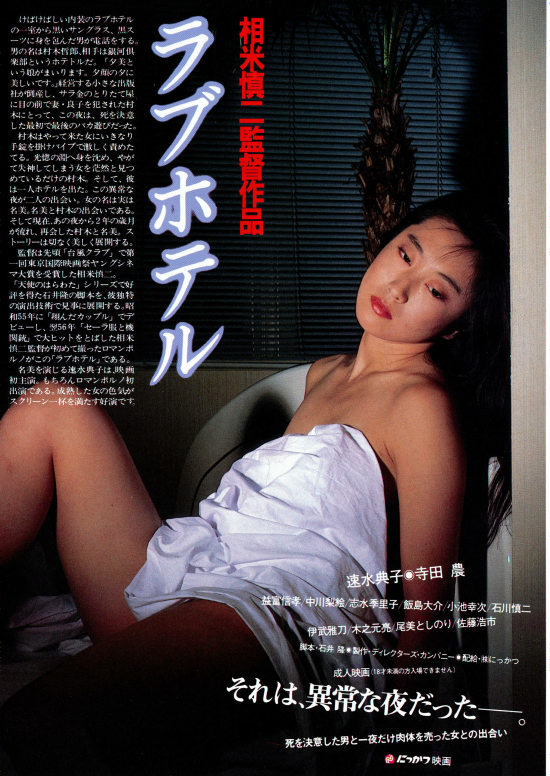
Love Hotel (ラブホテル, Shinji Somai, 1985)

love-hotel

Shinji Somai is not particularly well known outside of Japan but where his work is celebrated it’s mostly for his youth films of teen alienation and pop culture cool. Released in the same year as his iconic Typhoon Club, Love Hotel (ラブホテル) seems like something of an aberration in Somai’s career which leans towards the melancholic rather than the passionate. Somai had begun his working life apprenticing with Nikkatsu during their Roman Porno years and Love Hotel is, in someways, a return to this genre but is only accidentally a “pink film”, produced with Director’s Company and later acquired by the pink film giant. As such it contains a number of explicit sex scenes but maintains Somai’s characteristic long takes and contemplative approach rather than adhering to the often formulaic nature of the Roman Porno.

Failed businessman Muraki (Minori Terada) returns one day to find his office full of gangsters in the middle of raping his wife. Distraught, his first thought is suicide but then he decides on a little roundabout revenge before he goes. Dressed in a dark suit and sunglasses like some ‘60s Nikkatsu bad guy, Muraki holes up in a love hotel and calls down for a girl. “Yumi” (Noriko Hayami) arrives not long after. Handing the girl a vast sum of money, Muraki then instructs her to close her eyes because he’s also brought “a present”. He handcuffs her and reveals his true purpose by tearing off her clothes, tying her up and fitting her with a vibrator. He’s going to kill himself tonight, but he doesn’t want to go alone. In the end, he can’t go through with it, something in Yumi’s face changes his mind and he leaves her there, tied up and handcuffed.

Two years later, Muraki has divorced his wife (apparently to keep her safe from the yakuza who are still after him for his debts) and is now living an intentionally dull life as a taxi driver. One fateful day he runs into Yumi again, only she’s no longer “Yumi” but “Nami”, an office lady at a top company. Eventually recognising each other, the pair are each forced to face the circumstances surrounding the traumatic night of two years previously but doing so means risking everything they have now.

Love Hotel is a film of seeing and not seeing, of looking and refusal to look. The film opens with a semi-explicit sexual scene in which Muraki’s wife is raped by a loanshark in which we watch both Muraki’s horrified expression and the act itself by means of a well positioned mirror. Somai repeats the mirroring motif throughout the film both by showing us Nami repeatedly caught in mirrors and by the obvious tripartite glass arrangement of the love hotel’s headboard. Both Muraki and Nami have elements of themselves at which they’d rather not look but the ever present mirrors constantly prompt them into areas of self-reflection, ironically possible only by looking at the other.

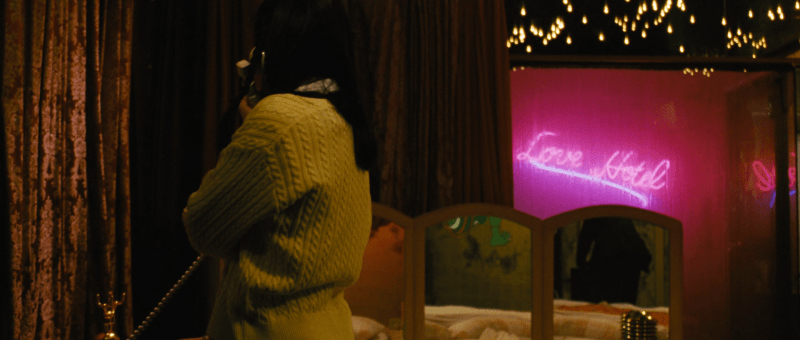
Where Muraki has chosen a life of austerity, separating from his wife who nevertheless continues stopping by to look after him in all of the wifely ways, Nami has tried and failed to put her traumatic past behind her by hopping into the consumerist revolution. Having supported herself through prostitution as a student, she’s managed to swing a pretty good job at top company only to find herself “prostituted” again through an ill-advised affair with her married boss. After his wife finds out and Nami loses her job and the entire life she’d begun to build for herself, she tries to call her former lover for consolation only to have him cruelly hang up on her. Nami continues her lamentations to the alarming trill of the dial tone in a heartbreaking moment of true loneliness.

Left with nothing else, the pair decide to revisit their unfinished love hotel business but their much more normal encounter changes each of them in different ways. It’s clear something has passed between the two, but Muraki’s final glance into the mirror perhaps shows him something he’d rather not have seen. Nami’s face, like Yumi’s face, may well have been “angelic” but cannot “save” Muraki in the same way twice – or at least, not in the way the restored Nami would have liked to save him. Dark, melancholy and fatalistic, Somai’s stab at Roman Porno is a sad tale of frustrated love, destroyed by the use and misuse of bodies speaking against each other and becoming a barrier to true connection. The Love Hotel is a place romance goes to die, and what the pair of damaged lovers at the centre of his noir-tinged tale of despair find there is only emptiness and pain devoid of any sign of hope.


Opening scene (no subtitles)

Masterfully constructed one take final scene (dialogue free)