The Ghost of the Hunchback (怪談せむし男, Hajime Sato, 1965)

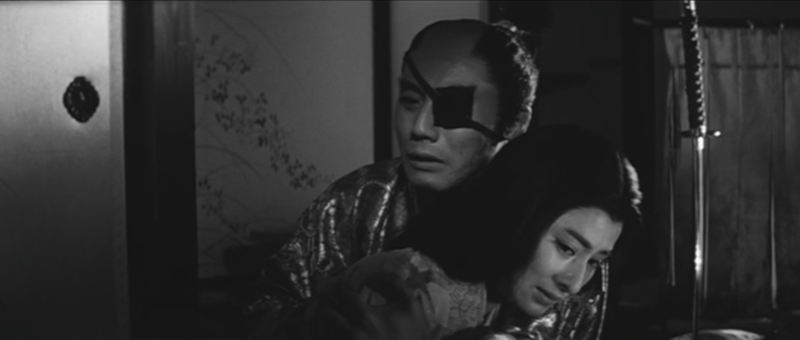
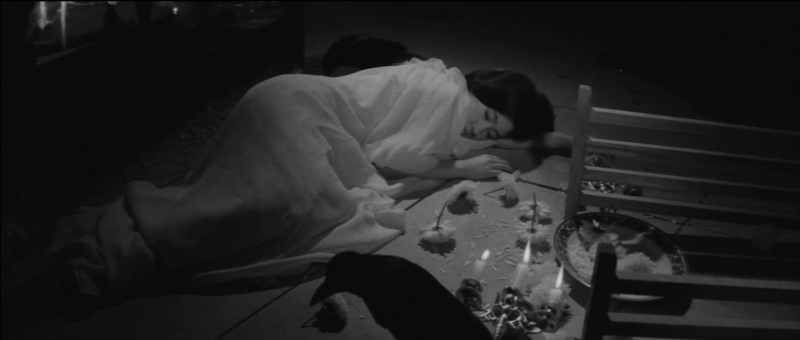
The old, dark house fetches up in Japan in Hajime Sato’s slice of weird, gothic horror The Ghost of the Hunchback (怪談せむし男, Kaidan Semushi Otoko, AKA House of Terrors). Long in circulation only in an Italian dub, Sato’s B-movie romp owes an obvious debt to Mario Bava but also to similarly themed gothic chillers such as Robert Wise’s The Haunting somewhat repurposing the central nexus of the cursed mansion as a black hole of morality sucking into its orbit the sinners of the post-war society each it seems both victims and embodiments of their times. 

Opening in true gothic fashion with lightning and a full moon, Sato zooms in to a strangely creepy yet ordinary Western-style villa where the soon-to-be widowed Yoshie (Yuko Kusunoki) is woken from a dream in which she had a premonition that her husband, who we learn has been in a vegetative state for some time, had something he desperately wanted to tell her. Shinichi has indeed passed away while apparently imprisoned under the care of his father, Munekata (Kazuo Kitamura), a psychiatrist who seems less than moved by his son’s death describing it as the least he could do to repay the debt he owed to his parents. It seems that Shinichi had been in the hospital following an “incident” some time previously and though Munekata insists that his brain had been “destroyed”, younger doctor Yamashita (Shinjiro Ebara) echoes Yoshie’s dream in informing her that immediately before he died it seemed that Shinichi, who had long been mute, was desperately trying to tell him something. Meanwhile, Yoshie begins hearing strange noises emanating from the coffin and opens it to find a chrysanthemum clenched between her husband’s teeth. 

After the funeral, she’s visited by a lawyer claiming that Shinichi entrusted a key to him to be given to his wife in the event of his death along with the deed for a mountain villa where “the incident” took place. Later, everyone comes to the conclusion that what Shinichi wanted to tell them was not to go to the mansion, but of course what else was Yoshie supposed to do other than investigate. A classic gothic estate swathed in fog and hidden behind ornate iron gates, the remote country house also turns out to have a hunchback custodian (Ko Nishimura) as well as a weird, demonic statue standing inconveniently in the hallway. Soon after arriving Yoshie is attacked by a crow, told of “the incident” by the hunchback, and begins to hear strange noises including disembodied laughter before she is eventually joined by Munekata, Yamashita, and her niece Kazuko (Yoko Hayama).

Yamashita tries to rationalise that the noises are just the normal kinds of creaking born of “deformation” as a building naturally ages, literally becoming warped with time, while the stress of living in such an environment, he claims, can eventually drive one mad. He’s come along to investigate believing that Shinichi’s illness is connected to the mansion. Yet the old, dark house in this case is somewhat divorced from its gothic roots in being transported to Japan where it is in a sense “new” and “foreign” rather than an ancient relic weighing heavily on the shoulders of declining aristocracy. Even so we do indeed have something of that in the later revelations of previous owner Baron Tominaga and his particular grudges which, in this case, are if only partially rooted in wartime trauma, the mansion apparently also once home to an anti-aircraft depot the remains of which can be seen in the grounds. 

The war may not be the corrupting force in play but it’s certainly a factor, especially the surprising accusation thrown at Dr. Munekata that he participated in wartime atrocity in being party to vivisection, a claim he does not dispute but defends in insisting his actions were justified in the name of science. The house has not so much called them, but each of the “guests” is in their own way morally compromised, Munekata not only a war criminal but a venal, lecherous old man hoping to get his hands on the house to open a sanatorium by fulfilling his quasi-incestuous desire for Yoshie. Yamashita, meanwhile, is not exactly pure hearted either, using what he knows about Munekata to blackmail him into standing down so he can become the director in his place and marry his wealthy girlfriend, Akiko (Keiko Yumi), who has also turned up to join in the haunted house fun. As far as sin goes, Yoshie is largely without it but perhaps pays for daring to own her sexuality, rejecting Munekata’s advances but apparently having made a habit of getting into bed with her comatose husband despite knowing of his many affairs which may be the reason for his punishment by the house. Only Kazuko remains pure and innocent save her one-sided attraction to Yamashita, the only one of the gang to show any kind of compassion towards the admittedly strange hunchback. 

In keeping with the house, Tominaga and the hunchback are later revealed to be Christians, though in a gothic inversion they are also the source of the “evil” that infects the creepy old mansion once again positioning Christianity as a foreign corruption but also in this case punishing post-war moral failure. Sato conjures an atmosphere of pure gothic chill complete with oversize cobwebs, doors which open and close on their own, a crow infestation, and even a passing shinto priestess (Mitsue Suzuki) who just had to drop in because of the powerful emanations of evil echoing from the mansion but leaves his collection of extremely flawed humans very much at the mercy of their own demons as they desperately try to escape from the House of Terrors. 


Snake Woman’s Curse (怪談蛇女, Nobuo Nakagawa, 1968)

The landed gentry find themselves haunted by the feudal legacy in Nobuo Nakagawa’s Meiji-era ghost story, Snake Woman’s Curse (怪談蛇女, Kaidan Hebi-onna). Though the figure of the vengeful ghost is rightly feared, they are rarely directly dangerous pushing their targets to damn themselves as they rail against the manifestation of their deeply buried guilt, yet the guilt here is perhaps buried deeper still as those who once had power find themselves floundering in the death throws of feudalism. 

As the opening voice over explains, the screen oppressively letterboxed to an extreme degree, the tale takes place in Onuma, a small village yet to be Westernised where the ruling family brutally exploit the tenant farmers still regarded as part of their fief. Old Yasuke (Ko Nishimura) chases after the local lord Onuma (Seizaburo Kawazu) and begs him not to kick him off his land, vowing that even if he has to eat dirt he will repay his debts. Onuma pays him no attention and Yasuke is soon thrown by the wayside after trying to catch hold of his cart. Concussed, all he can do is repeat his pleas not to lose the farm, and though he seems to recover passes away some days later leaving his wife Sue (Chiaki Tsukioka) and daughter Asa (Yukiko Kuwahara) alone. Heartless, Onuma evicts the women and knocks the house down to plant mulberry trees in its place while offering them “jobs” in his household for which they will not be paid for at least 10 years while they work off Yasuke’s debts. 

In addition to terrorising the peasants on the land, we discover that the Onumas are also running a sweatshop, a sign on the wall of Asa’s new place of employment reading that she must rise at 4am and be at work by 5 where she must stay until 9pm. There is to be no talking between the women in the workplace. Sue meanwhile is enlisted as a maid, but Onuma’s wife Masae (Akemi Negishi) immediately takes against her while she is continually sexually harassed by Onuma. Like father like son, the young master Takeo (Shingo Yamashiro) has also taken a fancy to Asa, though he is soon to be married to the daughter of the local mayor (Yukie Kagawa), a match all seem to regard as auspicious. 

Immediately after his soul vacates his body, Yasuke fetches up to haunt Onuma who is perhaps more affected by his guilt than his feudal upbringing would allow him to admit. Questioned later, he likens the peasants on his land to worms in the earth claiming that the deaths of one or two are no real matter and in any case nothing at all to do with him. “You people can survive drinking water and eating anything” he cruelly snaps back seconds after exclaiming he will fire the entire weaving staff as if that would put an end to the curse, paying little consideration to the fact he’s likely just condemned them to starvation. An exploitative landlord, he cares nothing for his feudal responsibility and all for his privileges. He and his son reserve the right to do as they please, regarding peasant women as theirs to be taken and having no real right to refuse. They do not believe there are any consequences for their actions because they are in a sense above the law of the land. 

Yet modernity is coming. We see our first uniformed policemen descend on the village after Sutematsu (Kunio Murai), Asa’s intended before her virtual enslavement through debt bondage, creates a scene at Takeo’s wedding in protest of the family’s treatment of Asa. Onuma’s attempts to reject the authority of the police in refusing their summons, describing it as “rude”, roundly fail, as do his attempts to leverage his feudal privilege in threatening to have the police chief fired in order to avoid answering his questions. His grip on authority is weakening as power necessarily reverts to the mechanisms of the state rendering him in some senses equal with those who till the soil. 

Even so, it’s spiritual rather than Earthly justice which will eventually do for him. The ghosts, such as they are, are mere echoes of time repeating the essential messages of the moments in which they died. Yasuke pleads for his land, he does not harm Onuma directly but causes Onuma to harm himself as he thrashes around trying in vain to vanquish a ghost with his gentleman’s cane. The family is, essentially, crushed under the weight of their feudal injustices as their noble house collapses all around them with modernity knocking on the door. Shooting in unusually lush colour, Nakagawa makes the most of his famously effective ghostly apparitions, finally drenching the screen itself in blood, but closes with an image of serenity in which justice of a kind at least has been served leaving the wronged to walk peacefully towards salvation while their tormentors will perhaps be travelling in another direction condemned not only for their own heartless venality but for that of the system that allowed them so ruthlessly to exploit those they ought to have protected. 


Original trailer (no subtitles)

I Didn’t Dare to Tell You (不敢跟你講, Mou Tun-Fei, 1969)

Born on the Mainland in 1941, Mou Tun-Fei was one of many making the move to Taiwan with his family following the Chinese Civil War in 1949. In fact, he made only two films in Taiwan, neither of which were ever released, and spent the bulk of his career in Hong Kong working for Shaw Brothers where he became associated with a brand of extreme exploitation cinema before finally returning to the Mainland, later working on the notorious co-production Men Behind the Sun. 

His debut, however, I Didn’t Dare to Tell You (不敢跟你講, Bù Gǎn Gēn Nǐ Jiǎng), is a gritty social drama inspired by the neorealist movement and the French New Wave even throwing in a few nods to The 400 Blows. No single reason is offered as to why it ultimately went unreleased, it was apparently not because Mou was unhappy with the film, though its mildly subversively digs at contemporary authoritarianism and perhaps problematically left-wing take on structural inequalities may have made it unpalatable to the censors even if its unexpectedly rosy coda feels like a concession made for their benefit. 

The hero, Da-Yuan (Hsu Jian-Sheng), is a lonely little boy tormented by playground bullies and raised by an often absent single-father (Chen Kuo-Chun) who has despite himself pledged his son as an apprentice in settlement for his gambling debts. Da-Yuan, however, wants to stay in education after middle school and is wary of an older man, Uncle Chen, who often drops by the house inspecting his teeth as if he were a horse at market. Consumed by guilt, Da-Yuan’s father eventually decides to honour his son’s wishes and send him to the public high school telling Uncle Chen that the deal is off. Uncle Chen, however, is less than sympathetic insisting that Da-Yuan’s father pay back the money he owes within the month. Spying on his father Da-Yuan overhears their conversation and begins to feel guilty himself, wondering if he should give up on staying at school but later deciding to look for work to help his father pay off the debt entering an arrangement with another boy who had to drop out of education to work in a print house, pulling his shifts while his friend does Da-Yuan’s homework to prepare for entering the high school the next year as his older brother had promised him he could. 

The subject of child labour seems to have been the controversial element that may have upset the censor’s board, suggesting a series of economic and social problems at the heart of a developing society as kids like Da-Yuan find themselves exploited while at the mercy of an irresponsible parent, in this case his father’s gambling which sees him berated by their no-nonsense landlady who makes no secret of her disapproval of his parenting style. Da-Yuan’s father, meanwhile, desperately tries to make amends by thrusting himself into overwork in low pay, exploitative conditions which have left him exhausted and in poor health as his constant coughing hints. Discovering that Da-Yuan has been neglecting his studies to work, he is crushed and betrayed, feeling as if all his sacrifices have been for nothing throwing his son out never knowing that he did it only in an attempt to ease his burden. The truth is eventually only revealed by Da-Yuan’s staunchly loyal friends who eventually “dare” to tell in the interests of justice. 

Meanwhile, a parallel conflict is going on in the heart of Da-Yuan’s school teacher (Grace Gua Ah-leh) who first appears as an austere figure with her hair in a tight bun wearing thick-framed glasses and dressed in a severe suit. Outside of school she finds herself at odds with her beatnik artist fiancé who complains that she’s travelled too far to the dark side and that her newfound conservatism is turning the kids into identical mindless drones devoid of life or creativity. She meanwhile, intensely resents his beard and shaggy hair complaining that he wasn’t “like this” when they first met two years previously, but once he smashes her unfashionable glasses which were merely an affectation designed to add to her sense of authority, her outlook does indeed begin to change. Letting her hair down and dressing in a more comfortable fashion she begins to bond with the kids and develops a sympathy for Da-Yuan investigating why it is he’s always falling asleep in class now determined to help rather than punish. 

In the end, authoritarianism loses out, the teacher’s earlier assertion that pupils need to be obedient members of society replaced by a more compassionate desire to nurture their individual talents and personal happiness. Nevertheless, the coda occurring after a poignant freeze-frame a little after the boy utters the film’s title to his chastened father, seems improbably optimistic, subtly re-enforcing the power of the state in its parade of pristine public high schools as if to say the system works in direct contrast to everything we’ve just seen implying that the dissatisfying reality of boys like Da-Yuan can be fixed by a simple act of truth sharing and an acceptance of mutual responsibility. Shot with unflinching though never preachy naturalism, Mou’s steely drama is otherwise resolute in its anti-authoritarianism condemning both the deadening effects of a rigid educational system and an unforgiving society that actively frustrates the hopes and dreams of ordinary kids like Da-Yuan and his friends. 


I Didn’t Dare to Tell You streamed as part of Electric Shadows.

Prison Boss (獄中の顔役, Yasuo Furuhata, 1968)

“Both you and I must do what a man must do and live this life to the very end” according to the melancholy theme song of Yasuo Furuhata’s fatalistic tale of gangster nobility, Prison Boss (獄中の顔役, Gokuchu no Kaoyaku). Another vehicle for tough guy star Ken Takakura, this post-war drama despite the name spends less time in a cell than one might imagine but casts its melancholy hero as a man imprisoned by the times in which he lives, too good to survive in an ignoble society and eventually brought down by his self-destructive need for retributive justice. 

As the film opens, Hayami (Ken Takakura) is goaded into a knife fight with a foot soldier from the evil Honma gang, Tetsu the Viper, and eventually kills him. Stumbling into a nearby bar, his only intention is to do the right thing and turn himself in filled with remorse as he is that he’s offed Tetsu in territory which belongs to “good” mob boss Tajima (Ichiro Ryuzaki). Tajima lives up to his name when some of his guys rescue Hayami and take him to their HQ where the old man insists that he rest and recover from his wounds. Whilst there, Hayami is cared for by Tajima’s teenage daughter Toshiko (Junko Fuji) who falls in love with him and vows to wait while he honours his word and spends seven years in jail for the killing of Tetsu. 

Meanwhile, awkward small-town politics is destabilising the precarious post-war environment as the Honma, embodiments of the new, venal and violent yakuza who care nothing for honour or humanity, are intent on squeezing Tajima’s influence mostly through muscling in on the running of the local bike races for which Tajima currently runs security. Though the Tajima gang is presented as an unambiguous good, the old style noble yakuza who live by a code and care about protecting the little guy, you can’t deny the levels of nepotistic corruption on display at the local council meetings given that the mayor and Tajima are apparently childhood friends while his rival shouts about allowing yakuza too much sway in politics while in the pay of Honma. 

Nevertheless, the central drama exists solely in the soul of Hayami who emerges from seven years in prison into this already destabilised environment owing a debt of honour to Tajima. Not quite a yakuza, he feels himself a perpetual other forever tainted by his crime having lost the right to live as other men live. Thus he struggles with discovering that Toshiko has also remained true to her word, having waited for him all this time running a small coffee bar rather than getting married. Even so, he finds himself dragged back into yakuza drama avenging the death of a Tajima man gunned down by Honma and thereby ending up back inside where he’s reunited with another childhood friend, Kurosaki (Ryo Ikebe), who’s been far less fortunate and is now affiliated with Honma.  

Kurosaki and veteran prisoner Pops (Shogo Shimada) are perhaps both mirrors of Hayami’s internal conflict, Kurosaki like him bound by a code but forced to act in ways which betray his own sense of honour and humanity and eventually paying a heavy price for doing so. Pops meanwhile as a man nearing the end of his life tries to talk him down from the road of destructive nobility, reminding him that he has a choice and ought to choose himself rather continuing to suffer for an outdated ideal. Hayami’s selflessness, his oft remarked tendency to disregard his own interest to protect others (the true mark of the noble gangster), is his weakness and fatal flaw. A yakuza’s daughter, Toshiko understands the code of manliness well enough and even she eventually tells him to run, to abandon his revenge and live free rather than becoming just another sacrifice on the altar of yakuza honour, but of course a man has to do what a man has to do. 

Though Hayami himself becomes a big man in prison, it’s Honma to whom the film’s title primarily refers hinting at the corruption involved in a society in which it is perfectly possible (and in some ways advantageous) to continue running a yakuza gang from behind bars, while the central crisis also turns on post-war desperation in betting all on controlling the lucrative bicycle races. In such a world as this, there’s precious little room for the noble gangster who must in the end damn himself if only to redeem it. 


Tokyo Bay (東京湾, Yoshitaro Nomura, 1962)

Yoshitaro Nomura is most closely associated with the thriller and particularly with its lower end as a purveyor of B-movie noir, yet look a little closer and his films are perhaps not really about crime at all but about the complicated relationships between people in the ever changing post-war society. Just as Stakeout is really about a policeman’s marriage, Tokyo Bay (東京湾, Tokyowan) is less concerned with the radiating corruption of the smuggling ring at its centre than with frustrated male friendship and the wartime legacy.

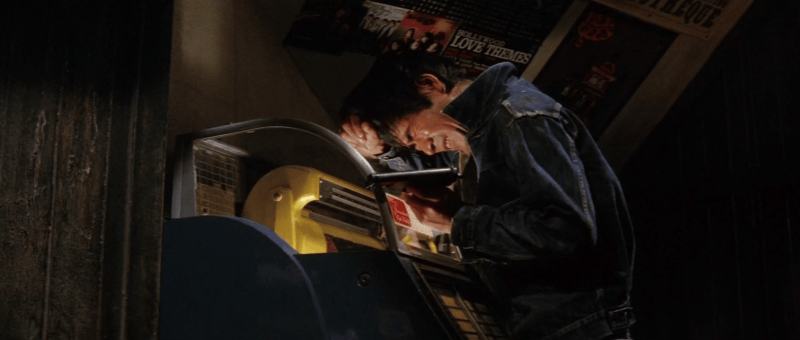
Opening with an aerial pan over post-war Tokyo, a title card informs us that this is just one frame in the “intense struggle for existence” in a city of 10 million before we arrive at the titular bay and a boat which is presumably carrying drugs later passed from one hand to another. The fixer, Takeyama (Kei Sato), talks to a man in a car and instructs him to be in front of the Taiyo building before 10am to pick up a golf bag from his contact. Gazing up at a post-war construction site, however, the man, Saeki (Jun Hamamura), is shot in the head and killed by a bullet piercing the roof of his car, Nomura suddenly switching to a disorientating POV shot as he twists in a sudden death spiral. 

As it turns out, Saeki was a plant, an undercover cop with the drugs squad sent to expose the smuggling ring the shadowy owners of which will predictably turn out to have Chinese connections in another echo of post-war cinema’s continuing Sinophobia. Two officers are assigned to the case, the young and earnest Akine (Jiro Ishizaki), and the veteran Sumikawa (Ko Nishimura) who acts largely on a series of inexplicable policeman’s hunches. Their major lead, however, comes as a stroke either of dumb luck or dark fate as Sumikawa, dodging into a dodgy mahjong parlour while tailing Takeyama, runs into an old army buddy, Inoue (Isao Tamagawa), who just happens to be a left-handed sniper perfectly matching the profile of the man they’ve been looking for. 

While Sumikawa keeps tabs on his old friend, somehow feeling he has something to do with all this but ambivalent in his torn responsibilities, Akine travels to Inoue’s hometown of Onomichi and sympathetically concludes that he was merely “rather unfortunate”. His life derailed by the war, Inoue returned to discover the girl he hoped to marry had married someone else. Giving evidence at Inoue’s trial for pulling a knife on her husband, the young woman remarks that she never promised him anything and did not consider their relationship to be serious, merely treating him with the politeness due to someone about to leave for war. In any case, she asks, even if she had been in love and intended to wait for him, as an orphaned woman there were only two choices open to her to survive, marriage or sex work, what else could she have done?

Back in Tokyo, Sumikawa begins to catch up with his old friend, realising that his romantic disappointment set him on a dark course of bad relationships and a drift towards crime but that he seems to have turned himself around. He is now happily married to a woman he describes as “simple” who seems devoted to him and if he did this, he did it to start again. His one last job intended to take him back to Onomichi, a pleasant coastal town the bay of which he describes as far more beautiful than that of the grimy, industrial Tokyo and largely untouched by urban corruption. Sumikawa feels himself torn, not least on account of the debt that exists between the two men because Inoue once saved his life, but also knowing that he may have to arrest this man and destroy his attempt to return to a more innocent world leaving his wife alone. Disapproving of the nascent relationship between his younger sister Yukiko (Hiromi Sakaki) and his partner, Sumikawa worries Akine may be becoming the kind of man who cares more for making an arrest than friendship, a conflict presumably weighing on his mind, even as he agrees he’s a good man and a good police officer. Yukiko meanwhile fires back that Sumikawa’s wife left him not because he is a policeman but because he is selfish and arrogant, and more to the point incapable of understanding a woman’s feelings. 

Nevertheless, he’s acutely aware of the effect his actions or inactions may have on Inoue’s wife Yoshiko (Kyoko Aoi), especially as it’s suggested she may need a degree of looking after. Inoue, careful to admit nothing, reveals that the man who carried out the hit may not have known he was killing a police officer but may have assumed the target was fair game being, like themselves, a denizen of the underworld. Largely a MacGuffin, the smuggling ring is not as important as one might assume, the two men locked into a cycle of guilt and retribution each marked by wartime trauma and in a sense unable to claim their place in the post-war society. Twin betrayals lead to a fateful, train-bound showdown shot with fraught claustrophobia as each man engages in an intense struggle for his survival but also perhaps already defeated in a shared sense of fatalistic nihilism. Trekking through the half-constructed streets of the post-war city with shaky handheld Nomura hints at the radiating corruption exemplified by the growth of the trade in drugs, but perhaps one corruption is merely the result of another which may in turn be far less easy to cure. 


Monkey King: Havoc in Heaven (大闹天宫, Wan Laiming, 1961/1964)

The late 1950s to mid-1960s would come to be known as a golden age of Chinese animation ushered in by the pioneering Shanghai Animation Film Studio under the aegis of Wan Laiming who along with his brothers had produced China’s very first animated feature Princess Iron Fan in 1941. Monkey King: Havoc in Heaven (大闹天宫, Dànào Tiāngōng) was conceived soon after Iron Fan’s release but its production was derailed firstly by the continuing Sino-Japanese War and then by the Chinese Civil War that eventually brought Mao Zedong to power. Produced in two parts released in 1961 and 1964 but screened together only in 1965, the film would ironically prove to be the studio’s last before being closed down during the Cultural Revolution. 

Most particularly in this context, the story of Sun Wukong might seem ill-advised even in its definitive cultural capital adapted like Princess Iron Fan from the well-known Journey to the West. The Monkey King as all know is a mischievous scamp forever causing trouble because of his resistance to following the accepted rules of mainstream society, something one might think anathema to a rigid, increasingly authoritarian regime. Yet in the Wans’ characterisation, Sun Wukong is also a good, socialist hero in the guise of a chaotic Robin Hood robbing the Heavens not for himself but to share with all the little monkeys waiting for his return on The Mountain of Flowers and Fruits certain that such luxuries should not be limited to the gods alone and seeking to redistribute them on Earth (if only among his friends). 

Even so, at the heart of the story is a challenge to the celestial authoritarianism of the Jade Emperor and the godly elites who live quite literally in another realm. Lamenting that he is unable to train the little monkeys properly because he can’t get his hands on a weapon befitting his majesty, Sun Wukong is advised to swim to the underwater palace of the East China Sea Dragon and ask him to find something suitable, which he does, but nothing proves up to the talents of the great Monkey King. Finally, hoping to get rid of him, the Dragon King shows Sun Wukong the Gold Cudgel which calms the sea and tells him he can have it if he can take it away. Annoyingly, the Cudgel responds exactly to Sun Wukong’s magic and becomes his trademark giant staff leaving the Dragon King with a problem he can only take to the Jade Emperor. Thereafter succeeds a continuing debate as to how to deal with the Monkey King problem which begins with the decision to tempt Sun Wukong to Heaven by offering him a fancy title and position so they can hopefully keep an eye on him. 

This is perhaps a minor irony and element of subversive satire amid the corruptions of a newly collectivist society in which flattery and title inflation are becoming a persistent problem. Put in charge of the stables, Sun Wukong immediately sets all the horses free which is less of a problem than it sounds and considerably improves conditions for all, only it annoys the austere Horse General who makes the mistake of revealing to Sun Wukong that he’s not really “in charge” at all, sending him right back down to the mountains where he offends the gods by appointing himself “Great Sage Equal to Heaven” in an affront not only to their majesty but the celestial order itself. Some still feel appeasement is the way, that humouring Sun Wukong by pretending to respect his made-up title and convincing him to come back with a better position is the best way to minimise his rebellion but they fail to learn their lessons. On being told he can’t eat the fruit in his garden until a banquet is held and then discovering he’s the only one not invited and everyone is merely humouring him with The Great Sage stuff Sun Wukong is once again offended, deciding he’ll go anyway and then getting extremely drunk and trashing the whole place. 

For this some feel he must die, but Sun Wukong refuses to expire even surviving being baked alive in a pot. Drawing inspiration from classic Peking Opera, the Wan brothers allow Sun Wukong to defeat each of the gods’ various challengers using both his cunning and agility in a series of beautifully choreographed action sequences which leave him standing defiant a thorn in the side of authoritarian power if perhaps one with his heart in the right place, living for the anarchic joy of sharing all his spoils with the ordinary monkeys of the Mountain of Flowers and Fruit. The 2012 restoration of the film keeps both halves together but also reformats the aspect ratio from the original 4:3 to a “modern” widescreen in addition to giving it a 3D makeover. Nevertheless, the flawless and inventive animation along with beautifully painted backgrounds drawing inspiration from classic ink paintings coupled with the use of Peking Opera instrumentation and choreography lend the film a charmingly timeless quality while the subversive themes of resistance to rigid authoritarianism seem to take on new import most particularly in the present day. 


Monkey King: Havoc in Heaven is currently available to stream in the UK as part of the Chinese Cinema Season.

Restoration trailer (no subtitles)

Big Shots Die at Dawn (顔役暁に死す, Kihachi Okamoto, 1961)

“Assassins make the world an unfit place to live in” according to a random gas station attendant clueing our errant hero in to the fact his small-town home is now a “den of yakuza” and unlikely tourist hotspot. An early, delightfully absurdist yakuza romp from Kichachi Okamoto, Big Shots Die at Dawn (顔役暁に死す, Kaoyaku Akatsukini Shisu) is part Nikkatsu parody, part ironic western, and all cartoonish fun as a prodigal son returns to find his father murdered and his uncle on the throne. Sound familiar? 

Jiro (Yuzo Kayama) has been working for the forestry commission in Alaska and has not returned to his small-town home of Kuraoka in some time which is why he didn’t even know his father, the mayor, was dead let alone that he was apparently assassinated in a manner which strongly anticipates the Kennedy assassination though the film was released in 1961. He also had no idea his father, a widower, had remarried and his family home is now occupied by his stepmother Hisako (Yukiko Shimazaki), a former secretary who scandalously lounges around in her underwear all day. His uncle Imamura (Eijiro Yanagi) is now the mayor, and as he explains to him, the town is a hotbed of gangster activity apparently a consequence of his attempt to turn it into a tourist hotspot. In trying to find out who killed his father, Jiro finds himself quite literally in the middle of a petty yakuza gang war aided and abetted by corrupt police. 

Quite clearly influenced by American cinema, Big Shots Die at Dawn situates itself in the new frontier of small-town Japan in which a war is being fought over the spoils of the post-war era. Uncle Imamura’s legacy is apparently a children’s theme park with the distinctly pregnant name Dreamland. Apparently a man who just loves the children but was unable to have any of his own, he’s also opened a pre-school for the local kids. Meanwhile, in the yakuza-backed casino, obsessive gamblers brush their teeth at the tables while local kingpin Goto (Akihiko Hirata) attempts to fend off the incursion of the rival Handa gang. Jiro’s return puts the cat among the pigeons as both sides attempt to use him as a way to take out the other.

The dark heart of small-town Japan is however present in the greed and double dealing which extends even to the police, a corrupt officer offering to sell Jiro a key piece of evidence he had concealed in the hope of profit. Just about everyone tries to sell the evidence to someone else at one time or another, leveraging an idea of justice alongside greed and self-interest. Meanwhile, Yoshiko (Kumi Mizuno), a quasi-love interest and former girlfriend of a fallen foot soldier, reports that she gave the police valuable evidence that her fiancé’s death wasn’t a suicide but they ignored her.

Jiro’s come to clean up the town, but the showdown takes place incongruously in the children’s theme park complete with its cutesy mascot characters and adverts for chocolate in the background making plain that these venal gangsters are really just boys playing war, taking pot shots at each other from tiny trains. What could be a dark comment on a loss of innocence is more cartoonish irony from Okamoto who shoots in extreme closeup with intentionally humorous composition and slapstick choreography. Nevertheless the message is unmistakable as we piece together the connections between small-town government and organised crime underpinned with a rather creepy all for the kids justification. 

Then again, the world has its share of misogyny, everything coming down to the incursion of transgressive femininity as one duplicitous woman manipulating her feminine wiles becomes the common link between each of the warring factions, as if this is all her fault and Jiro’s return is a way of clearing up the pollution her arrival provoked. Nevertheless as even he says, his father, and implicitly his father’s generation, must share some of the blame. Filled with stylish action sequences, car chases, self-consciously cool dialogue, and scored with a mix of moody jazz and dreamy childlike melodies, Okamoto’s cartoonish takedown of the zeitgeisty youth movie is very much in keeping with Toho’s spoofier side but chock full of charm even if its hero’s particular brand of smugness occasionally borders on the insufferable. 


Lady Sen and Hideyori (千姫と秀頼, Masahiro Makino, 1962)

Son of cinema pioneer Shozo Makino, Masahiro Makino is most closely associated with the jidaigeki though he also had a reputation for highly entertaining, innovatively choreographed musicals some of which starred post-war marquee singing star Hibari Misora. The somewhat misleadingly titled Lady Sen and Hideyori (千姫と秀頼, Sen-hime to Hideyori), however, is pure historical melodrama playing fast and loose with the accepted narrative and acting as a star vehicle for Misora to showcase her acting talent in a rare dramatic role in which she neither sings nor engages in the feisty swordplay for which her otherwise generally lighthearted work at Toei was usually known. 

Lady Sen (Hibari Misora) is herself a well-known historical figure though Hideyori (Kinnosuke Nakamura) will not feature in the film beyond his presumed demise (his body was never found leading to various rumours that he had actually survived and gone into hiding) during the siege of Osaka in 1615. Born the granddaughter of Tokugawa Ieyasu (Eijiro Tono) who would later defeat the Toyotomi to bring Japan’s Warring States era to an end, Sen was sent to the Toyotomi as Hideyori’s future wife at seven years old (he was only four years older than she was and 21 at the presumed date of his death) and therefore perhaps far more Toyotomi that Tokugawa. In contrast to other portrayals of Sen’s life which centre on her understandable identity conflict and lack of agency in the fiercely patriarchal feudal society, Misora’s Lady Sen is clear in her loyalty to her husband whom she dearly loved and feels her father and grandfather who were directly responsible for his death are her natural enemies.  

Old Ieyasu and his son meanwhile do at least appear to care about Sen’s welfare, loudly crying out for a retainer to save her during their assault on the castle offering unrealistic rewards to any who manage a rescue. Unfortunately, however, having retrieved his granddaughter Ieyasu immediately marries her off to someone else demonstrating just how little control Sen has over her own destiny and how ridiculous it might be that she should have any loyalty to the family of her birth. His decision backfires on two levels, the first being that Dewa (Tetsunosuke Tsukigata), a lowly retainer responsible for Sen’s rescue from the falling castle, has taken a liking to her himself and fully expected to become her husband as a reward. While originally annoyed and hurt to think that perhaps she has rejected him because of the prominent facial scarring sustained while he was rescuing her, Dewa finally realises he just wants her to be happy only to be offended on realising that they’ve rerouted her bridal procession past his home which he takes as a personal slight. Nevertheless, in contrast with real life (Sen’s marriage to Honda Tadatoki was apparently amicable and produced two children though only one survived to adulthood) Sen’s relationship with her new husband is not a success, in part because she resents being used as a dynastic tool and in part because she remains loyal to Hideyori. In consequence, she makes full use of her only tool of resistance in refusing to consummate the marriage with the result that her new husband, Heihachi (Kantaro Suga), slowly drinks himself to death. 

Her other act of rebellion is however darker, striking down an old man who made the mistake of telling her with pride how he informed on retreating Toyotomi soldiers after the siege. Determining to become an “evil woman” she deliberately blackens the Tokugawa name by killing random commoners, chastened when confronted by a grieving widow but banking on the fact her relatives will not move against her and will therefore gradually lose public sympathy for failing to enforce the law against one of their own. The spell is only broken by the arrival of a former Toyotomi retainer (played by Misora’s frequent co-star in her contemporary films Ken Takakura) who reminds her of her loyalty to her husband’s legacy and prompts her retreat into religious life as a Buddhist nun mirroring the real Lady Sen who entered a convent after her second husband died of tuberculosis. Like most of Misora’s film’s Lady Sen ends with a softening, a rebuke to her transgressive femininity which in this case has admittedly turned worryingly dark her murder spree apparently a form of resistance to the entrenched patriarchy of the world around her and most particularly to her continued misuse at the hands of her father and grandfather. Despite the absence of large-scale musical numbers, Makino makes space for a fair few dance sequences along with festival parades and well-populated battle scenes but makes sure to place Misora centre stage as if countering the continual marginalisation of Lady Sen and all the women of feudal Japan. 


Clip (English subtitles)

The Scarlet Camellia (五瓣の椿, Yoshitaro Nomura, 1964)

Little known outside of Japan, Yoshitaro Nomura is most closely associated with post-war noir and particularly with adaptations of Seicho Matsumoto’s detective novels, yet he had a wide and varied filmography directing in several genres including musicals and period dramas. The son of silent movie director Hotei Nomura, he spent the bulk of his career at Shochiku which had and to some degree still has a strong studio brand which leans towards the wholesome even if his own work was often in someway controversial such as in the shocking child abuse drama The Demon or foregrounding of leprosy in Castle of Sand. Part of the studio’s series of double-length epics, 1964’s Scarlet Camellia (五瓣の椿, Goben no Tsubaki) is nevertheless an unusual entry in Nomura’s filmography, adapting a novel by Shugoro Yamamoto essentially setting a policier in feudal Japan and perhaps consequently shot largely on stage sets rather than on location. 

Nomura opens with artifice as Shino (Shima Iwashita) stares daggers at an actor on the stage but later returns to his rooms every inch the giggling fan before finally offing him with her ornate silver hairpin leaving behind only the blood red camellia of the title. The first in a series of killings later branded the Camellia Murders, we later realise that the actor had to die because of his illicit relationship with Shino’s mother whom he brands a “nympho” and as we later discover had several extra-marital lovers. Extremely close to her father who, as we’re told, perished in a fire while resting in the country due to his terminal tuberculosis, Shino is apparently on a quest for revenge against the faithless men who humiliated him though her feelings towards her mother seem far more complex. 

Indeed, Shino regards her mother’s carrying on as “dirty” and seems particularly prudish even as she wields her sex appeal as a weapon in her quest for vengeance. Yet it’s not so much the free expression of sexuality which seems to be at fault but excess and irresponsibility. Shino resents her mother primarily for the ways in which she made her father suffer, off having fun with random men while he shouldered the burden of her family business which, Shino might assume, has contributed to his illness. Aoki (Go Kato), the Edo-era policeman to whose narrative perspective the second half turns, advances a similar philosophy in that there’s nothing wrong with having fun, he has fun at times too, but people have or at least should have responsibilities towards each other which the caddish targets of the Camellia Killer have resolutely ignored. He can’t say that he condones the killer’s actions, but neither can he condemn them because her motivations are in a sense morally justifiable. 

Realising the end is near, Shino indulges in a very modern serial killer trope in leaving a note for Aoki alongside one of her camellias in which she claims that she is exacting vengeance for “crimes not punishable by law”. There was nothing legally wrong in the way these men treated her mother or any other woman, but it is in a sense a moral crime. “You’re a woman and I’m a woman too” she later tells another scorned lover, a mistress thrown over by her patron with two small children after he tired of her, as she hands over a large sum of money and encourages her to return to her family in the country. Shino’s quest is essentially feminist, directed against a cruel and patriarchal society in which the use and abuse of women is entirely normalised, yet it is also slightly problematic in her characterisation of her mother as monstrous in her corrupted femininity for daring to embrace her sexuality in exactly the same way as her male counterparts though they, ironically, mainly seem to have been after her money rather than her body. 

Shino’s mother’s death is indeed regarded as “punishment from heaven” presumably for her sexual transgressions and neglect of her family, rejecting both the roles of wife and mother in a ceaseless quest for pleasure. Yet even in her resentment, Shino’s ire is directed firmly at the men taking the last of her targets to task when he justifies himself that women enjoy sex too and are therefore equally complicit by reminding him that he gets his moment of pleasure for free but the woman may pay for it for the rest of her life. Just as Shino’s mother neglected her family, the men harm not only their wives in their illicit affairs but cause concurrent damage to the mistresses they may later disown and the illegitimate children they leave behind. Abandoning the naturalism of his contemporary crime dramas for something much more akin to a ghost film with his eerie lighting transitions and grim tableaux of the skewered victims, Nomura crafts a melancholy morality tale in which the wronged heroine turns the symbol of constrained femininity back on the forces of oppression but is eventually undone by the unintended consequences of her quest for vengeance even as she condemns the architect of her misfortune to madness and ruin. 


I, the Executioner (みな殺しの霊歌, Tai Kato, 1968)

Nephew of Sadao Yamanaka, Tai Kato joined Toho as an apprentice in 1937, returning after the war training under Daisuke Ito and Akira Kurosawa, but later moved to Toei where he became closely associated with ninkyo eiga yakuza movies and jidaigeki. From the mid-1960s, however, he made several movies at Shochiku which had, it has to be said, a house style that was almost the polar opposite with a clear focus on polite, family-friendly melodrama. 1968’s I, the Executioner (みな殺しの霊歌, Minagoroshi no Reika) meanwhile is a surprisingly dark affair even among the grittier examples of Shochiku’s similarly themed B-movie thrillers, an avant-garde noir and proto-giallo in which the fugitive, serial killer antihero sees himself as an agent of divine justice in a hellish and immoral post-war landscape. 

Kato opens with a shocking scene of sexualised violence in which a woman is knocked unconscious, stripped, bound with telephone cord, and finally revived, forced to write down the names of four other women before being brutally raped and murdered by a killer whose voice we have not yet heard nor face seen. The police are mystified, attributing the woman’s death to the fact that she had worked as a bar hostess and maybe things like this are an occupational hazard for women who are surrounded by too many men. Her landlord, however, laments that hers is the second death to occur recently after a laundry boy threw himself off the roof. All things considered, he wishes the boy had picked somewhere else. 

The police have no reason to connect the two unfortunate events and so remain largely clueless, but we gradually become aware that the killer, Kawashima (Makoto Sato), is targeting the women because he holds them directly responsible for the boy’s death. He is the inspector that calls, avenging the death of this young man who, he has learned, like him hailed from Hokkaido and had come to the city at only 16 years old to earn money to support his family, saving almost all of his wages in the hope of opening a shop. Kato shows us scenes of a city under construction, a land of girders casting shadows on the ground like prison bars trapping men like these who are building the new Japan but will be discarded as soon the job is done and their labour no longer so much in demand. Kawashima has another reason for living like this, but he perhaps admires something pure and innocent in the desire of a young man leaving home to seek his fortune so that he might take care of those he loves and that this world betrayed that desire is something he finds impossible to forgive.

The five women have apparently done quite well for themselves, despite the fact that more than one of them has worked on the fringes of the sex trade. Their treatment of the boy is attributed to their boredom in the relative ease of their lives as monied women with little to occupy their time other than getting their kicks abusing the less powerful. It’s an uncomfortable role reversal that places women in a position of power and then sees them abuse it in the exact same way that men do, slinging back the same pithy justifications that men offer for sexual violence while the police meditate on the relative connotations of rape when the word is applied to a man at the hands of women rather than the other way around. If it were their sister, they could understand the desire to kill the men who had done it but a part of them struggles to see that a teenage boy may still find unwanted sexual contact a traumatic enough experience to push him towards suicide. 

Yet Kawshima appears to have no real connection to the boy, and his “revenge” is also a product of his misogyny in that as we later learn he also has reason to feel betrayed by womanhood and is already on the run from previous crime. Nevertheless, he is drawn to the innocent Haruko (Chieko Baisho), a girl-next-door type who works in his favourite ramen restaurant, only to discover that she too has a dark and violent past which may be why she seems to be drawn to him. He struggles with himself, but believes that he is taking revenge on a brutalising society defined by violence and abuse while sublimating his sense of emasculation in the face of women’s growing social and sexual freedoms in the post-war era. It is perhaps the post-war era which is cast as the major villain, one of the women later escaping her protective custody to dance furiously a hip nightclub only to return to the scene of her crime while refusing to see that she has done anything so “wrong” as to merit this kind of persecution. 

“The cycle of divine punishment must be fulfilled” Kawashima finally laments, acknowledging his grim place within this series of post-war tragedies. Surprisingly avant-garde, Kato experiments with blown out negatives, extreme close up, and deep focus mixed with his characteristic low angle composition to add to the sense of noirish dread which paints the modern city as an inescapable hellscape while even the romantic place of refuge shared by Kawashima and Haruko is a gothic moorland lit by moonlight and filled with eerie mist. Lurid and sweaty, the film has a grim sense of humour even in its oppressive atmosphere with a running gag devoted to the lead investigator’s painful case of piles, but its overriding fatalism nevertheless offers the hero a sense of redemption if only in acceptance of his narrative destiny.