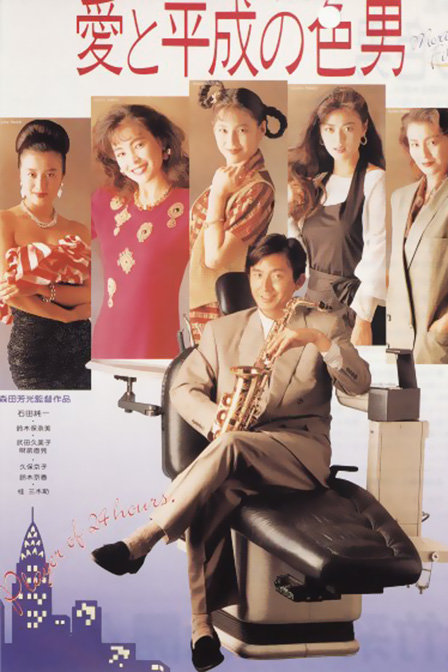
24 Hour Playboy (愛と平成の色男, Yoshimitsu Morita, 1989)

24-hour-playboyYoshimitsu Morita is an enigma. While directing some of the most acclaimed Japanese films of the 80s including The Family Game or the Soseki adaptation Sorekara, his primary dedication was to the “popular” which meant he did his share of more commercial projects such as the Kadokawa idol movie Main Theme or Banana Yoshimoto adaption Kitchen. As might be discerned from the title, 24 Hour Playboy (愛と平成の色男, Ai to Heisei no Irootoko) is among his more populist efforts and is most concerned with capturing the unique quality of its time as mid-bubble Japan said goodbye to the traumatic Showa era for the (hopefully) more prosperous Heisei.

After opening with a series of scenes of the luxury to be found in the modern era from expensive rolexes to elegant yachts, the film zooms in on its hero, Nagashima (Junichi Ishida), as he receives a call from his girlfriend to the effect that she will be visiting him shortly. However, Nagashima’s first action is to leap over his balcony and run down the hill below to hide out in his car and play his saxophone before taking refuge at his younger sister’s place. Nagashima has a serious problem in that he finds himself unable to sleep and is longing for a woman who can really tire him out. Consequently he’s become the “24 hour playboy” of the title, flirting with women here there and everywhere all day long hoping to find the one who can send him straight to bed.

Unusually for a film set in the age of consumerism, Nagashima is not a high powered executive or something more glamorous like an actor or a singer, he is, in fact, a dentist. When not inappropriately flirting with the young women who end up in his dentist’s chair, Nagashima also has a sideline as a jazz saxophonist which seems to be what he’d really like to do with his life but presumably is not as lucrative as the unexpectedly elite world of dentistry.

The consumerist society runs as background throughout the film as Nagashima enjoys a fairly upscale lifestyle perfect for a playboy with visits to trendy nightclubs and late night driving ranges, but the film also gets a lot of milage out of the literal change in era occurring just at the time the film was made. The traditional Japanese dating system takes its name from the emperor – the Showa era began in 1926 and was witness to both Japan’s tragic affair with militarism and expansionist warfare and the beginnings of its return to prosperity in the now nostalgic ‘70s and ‘80s. With the death of Hirohito in January 1989, his son Akihito assumed the throne and began the “Heisei” era. The film was released in 1989 but “Heisei” is referenced several times throughout both as a joke on the fact that “Heisei” means “peace everywhere” and in Nagashima’s comments that some things have already improved in the extremely young new regime.

In keeping with Morita’s determination to stay up to the minute, the film is very much of its time but paints its transitional moment as one of excitement and possibility but also of confusion and inertia. When Nagashima tells a late night barman that he doesn’t know what he wants, he’s talking about more than drinks though he seems happy enough with the gimlet the bar tender picks out for him. Nagashima’s insomnia is apparently caused by not having a good woman to share his bed, but he spends the film playing four women off against each other without ever being really serious about any of them.

After his sometime girlfriend whom he ran out on in the beginning starts talking marriage, Nagashima hatches a plan to get his sister to pretend to be a religious nutcase to put her off. Later he gets another girlfriend to pretend to be his wife and mother of his three children to rid himself of one of the others, gets rid of another by telling her he’s off to “dentists without borders”, and even ends up treating two of his simultaneous girlfriends at the same time in adjacent dental surgeries. Nagashima’s behaviour is caddish in the extreme, thinking only of himself and never really seeing the women in front of him as entities separate from their relationship with him.

A throwback to feckless ‘60s male heroes whose casual womanising represented aspirational male fantasy, Nagashima’s exploits are depicted in a light hearted and humorous way eased by the fact that the women don’t seem to mind very much even after they discover that they aren’t Nagashima’s one and only. Eventually outed as a love rat in the papers, Nagashima’s accidental fame, far from causing outcry and condemnation, attracts a vast crowd of ladies wanting in on the action for themselves.

Oddly the one woman Nagashima does seem to be able to connect with is his sister whom he ironically describes as the one woman he doesn’t understand. Frequently staying over at her apartment, Nagashima often remarks that he wishes all women like her or that all women were his sister, which is an extremely odd thing to say in the circumstances but she is the one woman he seems to have a fully realised conception of and is able to relate to on a human level.

Necessarily very much of its time – the Heisei era is even referenced in the slightly ironic title, 24hr Playboy is one of Morita’s most disposable efforts but is also a perfect reflection of contemporary society in its increasingly consumerist fervour where dentists can live like playboy millionaires and the sheer abundance of choice leaves young men paralysed with indecision. Nagashima’s playboy lifestyle is mined for comic value as he plays the melancholic hero who doesn’t know what he wants and and so has a massive fear of (and yet intense desire for) commitment, but Morita is always careful to point out his essential ridiculousness as Nagashima’s “Heisei” lifestyle becomes less “peaceful” with each additional girlfriend and the increasingly elaborate excuses needed to jilt them.


Virus (復活の日, Kinji Fukasaku, 1980)

virusThe ‘70s. It was a bleak time when everyone was frightened of everything and desperately needed to be reminded why everything was so terrifying by sitting in a dark room and watching a disaster unfold on-screen. Thank goodness everything is so different now! Being the extraordinarily savvy guy he was, Hiroki Kadokawa decided he could harness this wave of cold war paranoia to make his move into international cinema with the still fledgling film arm he’d added to the publishing company inherited from his father.
Adapted from a pessimistic, post-plague novel in the vein of Andromeda Strain penned by Japan Sinks’ Sakyo Komatsu, Virus (復活の日, Fukkatsu no Hi) was, at that time, the most expensive Japanese movie ever made. Using an international cast with the bulk of the dialogue in English, Kadokawa’s hopes were high but his dream was ultimately dashed when the film bombed at the box office and ended up being unceremoniously sold off to cable TV in a re-edited international version which removed almost all of the Japanese scenes. Since its original release, the film has accrued something of a negative reputation and left a stain on the resume of its otherwise popular director Kinji Fukasaku  (whose other international effort, Tora! Tora! Tora! didn’t do him any favours either) but Virus is far from the disaster it’s often regarded to be, even if extremely flawed.

Seismologist Yoshizumi (Masao Kusakari) witnesses the ruined state of his homeland in December 1983 from the comfort of a British submarine. Reminiscing about the woman who left him because of his scientific obsessions, Yoshizumi becomes our catalyst for a flashback to learn exactly how the world was destroyed in just a couple of years. Genetic experiments to create new viruses were banned in 1981 but in the following February a dodgy deal goes down in East Germany and the most dangerous biological weapon ever created is accidentally unleashed when the plane it was travelling on crashes into the Alps. It’s not long before “Italian flu” is laying waste to half of Europe before reaching Asia and the Americas. The virus is all powerful and no serious attempts to combat it are possible given the lack of time, but, the virus is dormant at below zero temperatures so the antarctic polar research station becomes humanity’s last hope for survival.

Though the film is funded and produced by Japan, it clearly positions America as its global leader. This is, however, countered by the fact that the weapon itself was being developed in America as a “credible deterrent” against Russian aggression now that Russia and the US are about even on Nukes. The bad guys are the American intelligence officials who have been continuing the research illegally without the President’s knowledge. In a touch of ironic Soviet-style manoeuvring, a research scientist trying to blow the whistle on this frighteningly destructive project is thrown into a mental hospital.

Rather than the struggle to find a cure, Virus prefers to focus on the immediate effects of the epidemic as the civilised world crumbles with alarming speed. Zipping around the major world capitals with death tolls placed against picturesque landmarks, Fukasaku mixes in stock footage of real rioting and civil unrest (of which he had a lot to choose from by 1980) as people take to the streets in desperation. Hospitals overflow with the infected, and the bodies pile up unceasingly.

The situation in Antartica is calmer if concerned. Some researchers opt for suicide whilst others club together to discuss possible plans for the survival of the human race. Unfortunately, this being a scientific community in the 1980s, there are 800 men and just 8 women, which leads to a number of obvious social problems. The remaining women are quickly convinced to become a kind of comfort team “accommodating” the needs of the attendant men. If the need really was to repopulate as quickly as possible, such an extreme re-imagining of current social mores would hardly be necessary, but strangely the women seem to accept their sudden conversion to forced prostitution with stoic pragmatism. Civility is maintained, and the outpost colony survives without too many problems but another threat arrives when Yoshizumi predicts a major earthquake event set to hit Washington that may activate its secret nuclear weapons which are trained on Moscow. That hardly matters now except that Moscow’s nukes are pointed at their research base owing to a slight political misunderstanding.

The research base is a testament to international cooperation with representatives from all continents, all working together peacefully (well, mostly – Lopez (Edward James Olmos) is…a passionate man) for the betterment of science. When it comes down to it, Yoshizumi and the American soldier Carter (Bo Svenson) are the lone duo heading back into plague infested Washington in an attempt to shut down the nuclear weapons systems before it’s too late.

Where Virus differs from many of the similarly themed films of the time is in its generally benevolent view of humanity. Despite the fact that the virus was man made, constructed to perpetuate an ongoing arms race, and was released due to bad luck and avarice, the majority of people are good, progressive sorts who want to work together to figure all of this out. Where the re-edited US version opts for a bleaker than bleak ending, the Japanese version does at least demonstrate the strength of human endurance as Yoshizumi trudges south in search of the survivors. The world is not restored, but there is still a kind of life possible if only those left behind can choose to live it.

Fukasaku opts for a more straightforward approach than some of his more frenetic work, but introduces an interesting device when the exhausted, hungry, and lonely Yoshizumi passes through a church. A mental dialogue with Christ on the cross is offered entirely in subtitles, as is the later “conversation” with a skeleton lying next to it who asks Yoshizumi some tough questions about his relationships and intentions.

These more spiritual enquiries play into the secondary theme of Yoshizumi’s ongoing guilt over abandoning his pregnant girlfriend to head off to Antarctica. Though adding to Yoshizumi’s backstory, his lost love in Japan occupies slightly more of the running time than is comfortable only to end on an ambiguous, if bleak, note which has little to do with anything else going on at the time. It does, however, feed into the mirroring developments at the research station when Yoshizumi is charged with looking after a pregnant woman and then becomes attached both to her and to the baby. It’s Yoshizumi’s love for another man’s wife and child coupled with the failure to save his own which drive him onward, but the romantic subplot often feels like an after thought and never achieves the kind of impact it hopes for.

Though a meandering, unwieldy beast, Virus is undoubtedly ambitious and often successful even if its production values don’t always live up to its famously high budget. Despite odd casting decisions which find Americans commanding British submarines and Brits playing Norwegians with English accents the largely international cast acquits itself well. Virus’ world is an oddly rational one where those left behind are willing to put aside their differences to work together rather than selfishly try to save themselves (though the film offers no ideas on how anyone is going to survive on Antartica when the supplies run out). As such, its vision is as bleak as many ‘70s dystopias but it also offers a brief glimmer of hope in allowing Yoshizumi to trudge to a kind of home, even if it’s one of ongoing uncertainty and primitive survival.


This review refers to the full 156 minute cut rather than the 108 minute US version.

Original trailer (no subtitles)

Blue Lake Woman (青い沼の女, Akio Jissoji, 1986)

vlcsnap-2016-11-15-01h56m08s744Akio Jissoji had a wide ranging career which encompassed everything from the Buddhist trilogy of avant-garde films he made for ATG to the Ultraman TV show. Post-ATG, he found himself increasingly working in television but aside from the children’s special effects heavy TV series, Jissoji also made time for a number of small screen movies including Blue Lake Woman (青い沼の女, Aoi Numa no Onna), an adaptation of a classic story from Japan’s master of the ghost story, Kyoka Izumi. Unsettling and filled with surrealist imagery, Blue Lake Woman makes few concessions to the small screen other than in its slightly lower production values.
Successful artist Nagare had a serious following out with one of his oldest friends five years ago and is so rather stunned to receive an invitation to his wedding. Nagare had been invited to paint the portrait of Takigawa’s father and then asked to stay at his home for an extended period whilst Takigawa travelled in Europe buying art. Tokigawa’s father was old and frail and therefore retired to an annex each night at 8pm leaving Nagare entirely alone in the house alongside Takigawa’s wife, Mizue. The inevitable occurs when the lonely and neglected Mizue falls for the handsome painter but the romance turns dark when she talks Nagare into a double suicide at Blue Lake. Mizue drowns herself but Nagare survives only to be rescued and confined to a mental hospital.

Now five years later Takigawa wants to forget (if not quite forgive) the past and start again with a new wife by his side. The funny thing is wife number two, Ameko, is the spitting image of Mizue. When Takigawa once again asks him to stay alone in the house with his new wife whilst he jets off to America, Nagare begins to wonder exactly what’s going on. Staying at the house a second time, Nagare finds himself haunted by the ghost of the woman who died for him, but whose sacrifice he ultimately rejected. Mizue seems to want him to come to her at the bottom of Blue Lake, but Nagare still lacks the courage to take his own life, if not the inclination. Thinking of Mizue but inevitably becoming closer to Ameko, Nagare is trapped between the living and the dead but it turns out there may be more than supernatural intrigue to his darkly romantic adventures.

Jissoji creates an oppressive and creepy atmosphere for the woodland mansion noisy with the sound of a hundred ticking clocks, filled with shadows and shot from odd angles. Nagare begins to dream strange dreams in which Mizue comes to him, leaving watery footprints and her signature comb behind her to indicate that her presence is not limited to the dream world. Complaining that she’s “alive” beneath the mud next to Blue Lake where she’s cold and lonely, Mizue waits for him to make good on his promise and join her there. Nagare remains unsure if this Mizue is a manifestation of her grudge towards him, or simply a manifestation of his own guilt in allowing her to die alone.

Trapped in Vertigo-esque conundrum torn between the living Ameko and the dead Mizue, Nagare
finds himself in an impossible position unable to clearly distinguish between the two women, at one point physically attacking Ameko believing her to be Mizue’s ghost. It remains unclear if the resemblance between Mizue and Ameko is real or a figment of Nagare’s imagination prompted by both women’s position as Takigawa’s wife and by their watery names (“mizue” literally meaning “water picture” and “Ameko” “rain child”) both of which lead him straight back to Blue Lake. If it’s death Nagare is chasing rather than either women or friendship, he is ultimately unable to follow through on his desires all the while protesting that it’s “desire” which holds him among the living.

The supernatural elements are emphasised and undercut by turns as Nagare discovers their may be a more solid, real world cause for the strange events plaguing him. Still, the past continues to haunt Nagare in one form or another leaving unexplained and half remembered events to linger in his memory, rendering his reality continually unstable. As her name suggests, the ghostly Mizue is always shown in a hazy, watery blue, radiating waves of unease designed to pull Nagare back to the failure of his love suicide and at least as far as his art life in concerned, there’s part of him always submerged beneath the waters of Blue Lake. Even if not quite reaching big screen standards, Blue Lake Woman displays high production values for a 1980s television special anchored by naturalistic performances and innovative camera technique. Filled with Jissoji’s idiosyncratic surrealist imagery, Blue Lake Woman is a haunting, gothic ghost story which refuses to give up on its supernatural chills even whilst proffering a more rational explanation for all of its strange goings on.


The Beast Must Die (野獣死すべし, Toru Murakawa, 1980)

LP Soundrack record cover

Yusaku Matsuda was the action icon of the ‘70s, well known for his counter cultural, rebellious performances as maverick detectives or unlucky criminals. By the early 1980s he was ready to shed his action star image for more challenging character roles as his performances for Yoshimitsu Morita in The Family Game and Sorekara or in Seijun Suzuki’s Kagero-za demonstrate. The Beast Must Die (野獣死すべし, Yaju Shisubeshi, AKA Beast to Die) is among his earliest attempts to break out of the action movie cage and reunites him with director Toru Murakawa with whom he’d previously worked on Resurrection of the Golden Wolf also adapted from a novel by the author of The Beast Must Die, Haruhiko Oyabu. A strange and surreal experience which owes a large amount to the  “New Hollywood” movement of the previous decade, The Beast Must Die also represents a possible new direction for its all powerful producer, Haruki Kadokawa, in making space for smaller, art house inspired mainstream films.

Shedding 25 pounds and having four of his molars removed to play the role, Matsuda inhabits the figure of former war zone photo journalist Kazuhiro Date whose experiences have reduced him to state of living death. After getting into a fight with a policeman he seems to know, Date kills him, steals his gun, and heads to a local casino where he goes on a shooting rampage and takes off with the takings. Date, now working as a translator, does not seem to need or even want the money though if he had a particular grudge against the casino or the men who gather there the reasons are far from clear.

Remaining inscrutable, Date spends much of his time alone at home listening to classical music. Attending a concert, he runs into a woman he used to know who seems to have fond feelings for him, but Date is being pulled in another direction as his experiences in war zones have left him with a need for release through physical violence. Eventually meeting up with a similarly disaffected young man, Date plans an odd kind of revenge in robbing a local bank for, again, unclear motives, finally executing the last parts of himself clinging onto the world of order and humanity once and for all.

Throughout the film Date recites a kind of poem, almost a him to his demon of violence in which he speaks of loneliness and of a faith only in his own rage. Later, in one of his increasingly crazed speeches to his only disciple, Date recounts the first time he killed a man – no longer a mere observer in someone else’s war, now a transgressor himself taking a life to save his own. The violence begins to excite him, he claims to have “surpassed god” in his bloodlust, entering an ecstatic state which places him above mere mortals. A bullet, he says, stops time in that it alters a course of events which was fated to continue. A life ends, and with it all of that time which should have elapsed is dissolved in the ultimate act of theft and destruction. His acts of violence are “beautiful demonic moments” available only to those who have rejected the world of law.

Murakawa allows Matsuda to carry the film with a characteristically intense, near silent performance of a man driven mad by continued exposure to human cruelty. Hiding out in Date’s elegant apartment, Matsuda moves oddly, beast-like, his baseness contrasting perfectly with the classical music which momentarily calms his world. Mixing in stock footage of contemporary war zones, Murakawa makes plain the effect of this ongoing violence on Date’s psyche as the sound of helicopters and gunfire resounds within his own head. The imagery becomes increasingly surreal culminating in the moment of consecration for Date’s pupil in which he finally murders his girlfriend while she furiously performs flamenco during an dramatic thunderstorm. Date is, to borrow a phrase, no longer human, any last remnants of human feeling are extinguished in his decision to kill the only possibility of salvation during the bank robbery.

Anchored by Matsuda’s powerful presence, The Beast Must Die is a fascinating, if often incomprehensible, experience filled with surreal imagery and an ever present sense of dread. Its world is one of neo noir, the darkness and modern jazz score adding to a sense of alienation which contrasts with the brightness and elegance of the classical music world. At the end of his transformation, there is only one destination left to Date though his path there is a strange one. Fittingly enough for a tale which began with with darkness we exit through blinding white light.


There’s also another adaptation of this novel from 1959 starring Tatsuya Nakadai which I’d love to see but doesn’t seem to be available on DVD even without subtitles. This film has a selection of English language titles but I’ve used The Beast Must Die as this is the one which appears on Kadokawa’s 4K restoration blu-ray release (sadly Japanese subtitles ony).

Original trailer (no subtitles)

Actress (映画女優, Kon Ichikawa, 1987)

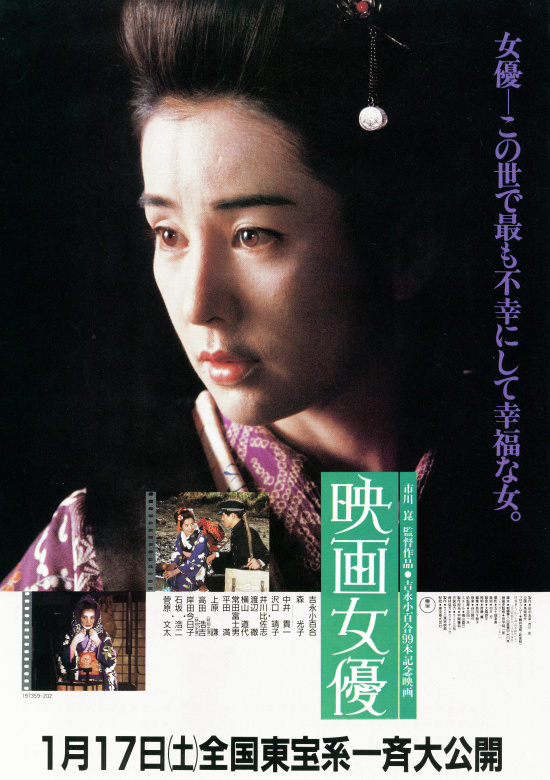
actressKon Ichikawa was born in 1915, just four years later than the subject of his 1989 film Actress (映画女優, Eiga Joyu) which uses the pre-directorial career of one of Japanese cinema’s most respected actresses, Kinuyo Tanaka, to explore the development of Japanese cinema itself. Tanaka was born in poverty in 1909 and worked as a jobbing film actress before being “discovered” by Hiroshi Shimizu and becoming one of Shochiku’s most bankable stars. The script is co-written by Kaneto Shindo who was fairly close to the action as an assistant under Kenji Mizoguchi at Shochiku in the ‘40s before being drafted into the war. A commemorative exercise marking the tenth anniversary of Tanaka’s death from a brain tumour in 1977, Ichikawa’s film never quite escapes from the biopic straightjacket and only gives a superficial picture of its star but seems content to revel in the nostalgia of a, by then, forgotten golden age.
The film begins with the young Tanaka awaiting a visit from her mentor, Hiroshi Shimizu (Toru Watanabe), whom her family are keen to thank for bringing them all to Tokyo away from their life of hardship. Although everyone is very happy for Tanaka’s success, there is shadow hanging over the party in the form of missing oldest brother Ryosuke who went on the run to avoid the draft and has not been heard of since.

Shimizu gives Tanaka (Sayuri Yoshinaga) her first roles at Shochiku where she becomes a contract player but is put out when another director, Heinosuke Gosho (Kiichi Nakai), wants to give her a leading role. Overruled by studio bosses, Shimizu becomes increasingly jealous of Tanaka’s career – a situation which is further complicated by the couple’s growing romantic entanglement which sees them living together in an unofficial marriage allowing Tanaka to continue acting. However, Shimizu continues to meddle in Tanaka’s professional life whilst also continuing his hard drinking, womanising playboy lifestyle. The couple eventually divorce but reunite from time to time on the film set.

Vowing never to marry again, the rest of Tanaka’s life is dedicated to acting and sees her working with some of the best directors of the age including Ozu (Shigemitsu Ogi) and later Mizoguchi (Bunta Sugawara). It is Tanaka’s professional and personal relationship with Mizoguchi which occupies the second half of the film. Judging by the first experience on the now lost Woman of Osaka in 1940, you wouldn’t think the two would ever wish to work together again though they eventually completed fifteen films together over the next fifteen years.

Mizoguchi’s process is completely different from any other Tanaka had worked with. Rather than meeting to rehearse and discuss the work, Mizoguchi abruptly sends her a lifetime’s supply of books about bunraku and changes the script that she has painstakingly committed to memory with on set rewrites communicated via a large blackboard he expects the actors to read from. Exasperated, Tanaka finally asks him for actual direction but he coldly states that she’s the actress and her acting is not part of his job description. Mizoguchi and Tanaka are very different people but each driven and ambitious so their frequent locking of horns produces a fiercely creative collaboration in which each was able to find worth even if it was frequently difficult.

The film ends around the time of Life of Oharu which would mark the final time the pair would work together. In terms of the film’s narrative, this unspoken development is foreshadowed by the idea that the two artists are heading in different directions but in the real world the reasons are a little less clear. Tanaka became the second woman to direct a feature film with Love Letters in 1953 which was even featured at Cannes, but for reasons unknown Mizoguchi attempted to block her access to the Director’s Guild of Japan, effectively ending both their friendship and any professional relationship. Ironically enough, Actress seems to imply that Tanaka’s desire to direct may have been inspired by Mizoguchi and his all powerful on set status prompting her to wonder how he does it, and, perhaps how she could do it too.

Ichikawa weaves the history of Japan through its cinema into the narrative to recount the changing tastes of the eras as naturalism came in and out of fashion and Japanese films began to experience international as well as domestic acclaim. Skipping huge portions of time to focus on the two directors – Shimizu and Mizoguchi, Ichikawa avoids mentioning Tanaka’s post-war visit to America which had a profound impact on her later career, not only in what she learned there but also in the extremely hostile reception she received on returning home. The main takeaway from his depiction of Tanaka is a woman ahead of her time, independent and headstrong, willing to work hard to achieve the things she wanted to achieve even if flying in the face of social convention though it makes no particular judgement on her character other than in her success as an actress.

Taking on the conceit of being a film about film, Ichikawa’s sets are theatrical, creating a deliberately artificial, half unreal world. This also extends into the scriptwriting which is extremely talky and more like a stage play than film, offering pointed, long stretches of monologuing which are already far away from the more naturalistic approach of early talking cinema. Characters have improbable, exposition filled conversations in which they each tell each other things they already know for the audience’s benefit – an effect which enhances the overall theatricality, but does draw attention to itself and eventually becomes wearing. Ichikawa’s picture of Tanaka is one of steely determination and of a woman ahead of her time, but even if Actress proves less than enlightening regarding its subject it does help to shed some light on both classic Japanese cinema and that of the late 1980s.


Original trailer (traditional Chinese subs only)

Behind the Yellow Line (緣份, Taylor Wong, 1984)

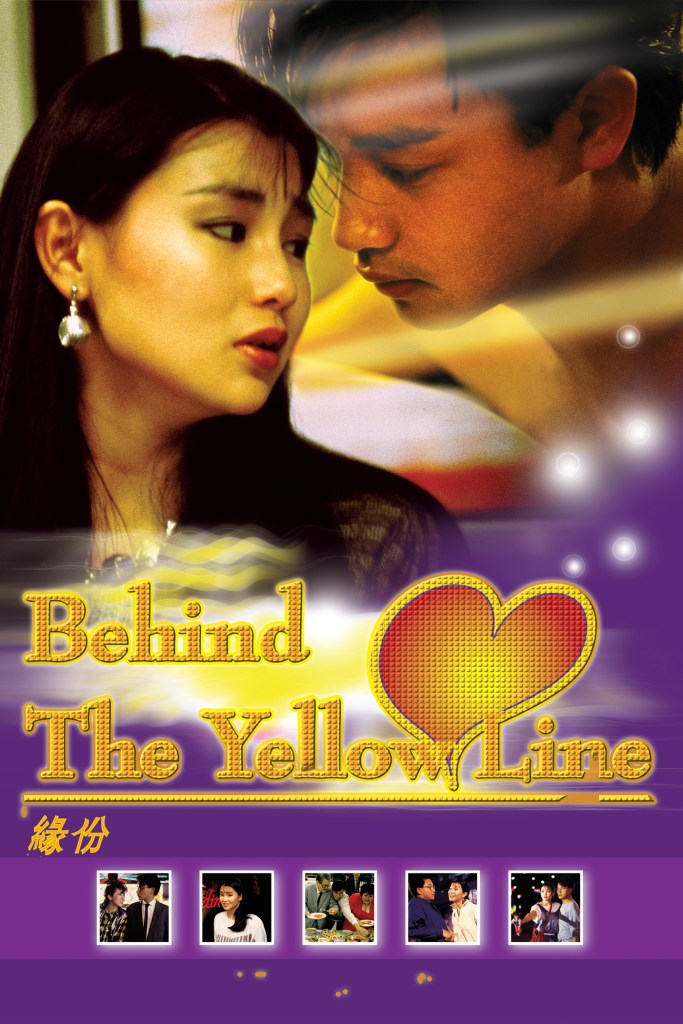
behind-yellow-lineBack in the 1980s, you could make a film that’s actually no good at all but because of its fluffy, non-sensical cheesiness still manages to salvage something and capture the viewer’s good will in the process. In the intervening thirty years, this is a skill that seems to have been lost but at least we have films like Taylor Wong’s Behind the Yellow Line (緣份, Yuan Fen) to remind us this kind of disposable mainstream youth comedy was once possible. Starring three youngsters who would go on to become some of Hong Kong’s biggest stars over the next two decades, Behind the Yellow Line is no lost classic but is an enjoyable time capsule of its mid-80s setting.
Paul (Leslie Cheung) is a mild mannered guy trying to get to work on time and make a good impression on his first day on the job but after having a taxi stolen out from under him and having to run some of the way, he rushes onto the underground where he has a meet cute with Monica (Maggie Cheung) – a sad looking lady who barely notices his presence. Paul is smitten and follows her onto the train where she continues to ignore him. Despite his best efforts he makes more of an impression on Anita (Anita Mui) – a wealthy and extremely fashionably dressed woman with giant 80s hair! Anita makes a play for Paul but he only has eyes for Monica. Monica is just getting over a failed affair with a married man and isn’t really sure of anything anymore. It’s all in the hands of fate and the mass transit authority but will true love really run its course?

Behind the Yellow Line (presumably so named for its train station setting, the chinese title is simply “fate”) is meandering mess of a picture though very much typical of its time. Paul and Monica get together but she’s still torn over her married lover who resurfaces at the most inconvenient moment whilst also fighting off the attentions of her flirtatious boss causing Paul to overreact in fit of jealously and almost ruin everything in the process. Eventually they decide to sort things out with a game of fate as Monica hides on the MTR expecting Paul to successfully pin point her location before the last train rolls so that she knows they are truly destined to be together.

This central spine of the film works well enough as Paul and Monica tempt fate with their true love romance but where does Anita fit into all this? Popping up now and then almost at random, Anita seems like a strange after thought or a refugee from another film. A stock ‘80s style kooky character, she’s all big hair and bold makeup but she’s also a wealthy woman trying to buy Paul (or more particularly his parents) with the promise of material security. ‘80s setting aside, consumerism is only a mild bi-product and neither Paul nor Monica is particularly pressed over material concerns – all that matters here is true love destiny and the successful resolution of their romantic difficulties. Anita becomes a kind of cupid, forsaking her own feelings in order to satisfy Paul’s in gesture of true love that also recognises having lost out in the great game of fate as her feelings are not returned. Or, there are things money cannot fix (at least, not in the way you want it to).

In this way Behind the Yellow line becomes more interesting as it’s Anita and Monica who begin to move the plot. Monica is quick to remind us that she’s a single woman and she has the right to choose – in this case, she feels sorry for both of her potential partners (whilst completely disinterested in her boss) and so is inclined to decide to remain alone. The film obviously doesn’t go this way, but it does present her choice as a perfectly valid one whilst also affording her the agency to choose her own destiny right the way through. Anita largely wields her power through her money (which appears to be inherited, the gang of other young people she hangs round with seem to be wealthy too making her choice of Paul a relatively strange one), but she exercises her individuality through her unconventional behaviour and bold fashion choices, refusing to give in to social norms but submitting to “destiny” in acknowledging that her feelings are unrequited.

Very much of its time, Behind the Yellow Line is an obvious piece of disposable entertainment designed to appeal to a very specific audience. Filled with cheerful ‘80s cantopop and bright neon lighting there’s relatively little angst in this tale of youthful romance. Everything bounces along much as one would expect with no melodramatic intrusions save Monica’s sometimes melancholy indecisiveness and Paul’s diffidence. Structurally the film is riddled with problems not least with its use of Anita who seems to appear and disappear as needed with no clear indication of her precise function yet it provides enough silly humour and good natured drama to coast though without too many problems. No great lost classic but enjoyable enough, Behind the Yellow is worth seeking out if only to witness the genesis of these three soon to be giants of the entertainment world whose careers became curiously intertwined before ending much too soon in the early years of the following century.


2003 Celestial Pictures trailer (English subtitles)

Original 1984 Cantonese trailer (English subtitles for onscreen text only, no subtitles for dialogue)

Maison Ikkoku: Apartment Fantasy (めぞん一刻, Shinichiro Sawai, 1986)

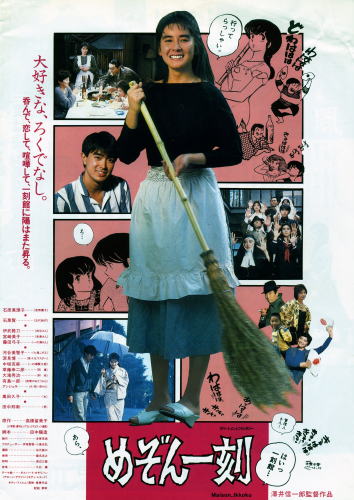
Maison IkkouIf you’ve always fancied a stay at that inn the Katakuris run but aren’t really into zombies and murder etc, you could think about spending some time at Maison Ikkoku (めぞん一刻). Based on the classic 1980s manga by Rumiko Takahashi, the 1986 live action adaptation is every bit as zany as you’d hope. Eccentric tenants, women pulled from ponds, bank robbers, and an all star dog. It’s a pretty full house, but if anything’s for certain it’s the more the merrier over at Maison Ikkoku.
Godai (Ken Ishiguro), a would-be student retaking his university entrance exams, has finally had enough and vowed to move out of Maison Ikkoku for good but just as he’s made his decision, an elegant woman arrives with a big white dog. The beautiful lady, Kyoko (Mariko Ishihara), is their new building manager. Godai falls instantly in love with her and decides to stay, but Kyoko has her own reasons for coming to Maison Ikkoku and isn’t quite ready to engage in a romance with a feckless student.

Kyoko also makes the mistake of reminding the collection of eccentric tenants that they’re behind on their rent. There are currently four residents occupying the apartment building including Godai. He’s joined by the mysterious Yotsuya (Masato Ibu) who seems to have several different jobs and speaks in an overly formal manner, Ichinose (Yumiko Fujita) – a gossipy middle aged housewife, and Akemi (Yoshiko Miyazaki) who works at a nearby bar and is almost always in her underwear. They don’t want to pay so they start coming up with plans to stop Kyoko coming after them for the money – the first one being to drug and assault her so she’ll be too embarrassed to talk to them again! Went dark quickly, didn’t it?

Despite the quirky goings on, the presence of death is constant. Kyoko is an extremely young widow sill mourning the death of her husband and has even named her dog after him. Shinichiro keeps making his ghostly presence known to her by ringing the nearby shrine bells or stealing her umbrella, making it impossible for Kyoko to move on. A non-resident but frequent visitor (played by Kunie Tanaka) recounts that his wife left him and took part in a double suicide with another man, whilst the gang also picks up another member in the form of a woman that Yotsuya claims to have fished out of the lake after she “got caught on his pole” and is now a little obsessed with him thinking that he’s the boyfriend she tried to commit suicide over.

If that all sounds a little heavy, Sawai makes sure to pile on the absurdism to keep things light and even includes a few visual gags such as a floating geisha doll during Yotsuya’s “I regret preventing a woman’s suicide because it turns out she’s quite annoying” speech. About half way through the film the entire gang suddenly decides they’re going to perform an “Ikkoku speciality” in celebration of Godai’s success which turns out to be a full scale song and dance number with everyone dressed in outfits that reflect their personality from Yotsuya in his temple singer garb, Ichinose in her wedding dress, Akemi in a nurses outfit, and Godai and Kyoto both in a school uniform, to the mysterious man dressed as a hardboiled detective the failed suicide woman for some reason dressed as a nun. Just when a big “The End” sign pops up we get yet another song accompanied by glow sticks waving in the background.

The main “drama” revolves around Godai’s attempts to pass his university entrance exams and win the heart of Kyoko though there are also various subplots concerning the odd rivalry between Yotsuya and the mysterious man over a bank robbery as well as their attempts to evade the police. Maison Ikkoku becomes a kind of sanctuary where those with wounded hearts can find a place to heal themselves. Occasionally bleak, such as in the frequent references to death and suicide, Maison Ikkoku is an absurd place filled with larger than life characters acting out their surreal existence in this shared paradise of a rundown boarding house in a quiet backwater. The film ends on another ironic note as the party goes on but the Gilbert O’Sullivan track Alone Again, Naturally plays over the end credits which is, of course, about the singer’s intention to commit suicide after being jilted at the altar. A strange if well crafted film, Maison Ikkoku is in someways ahead of its time in the quirky humour stakes but also makes use of a typically ‘80s kind of absurdism which fuses black humour with innocent, youthful charm.


Original Trailer(s) (No subtitles)

Memories of You (ラブ・ストーリーを君に, Shinichiro Sawai, 1988)

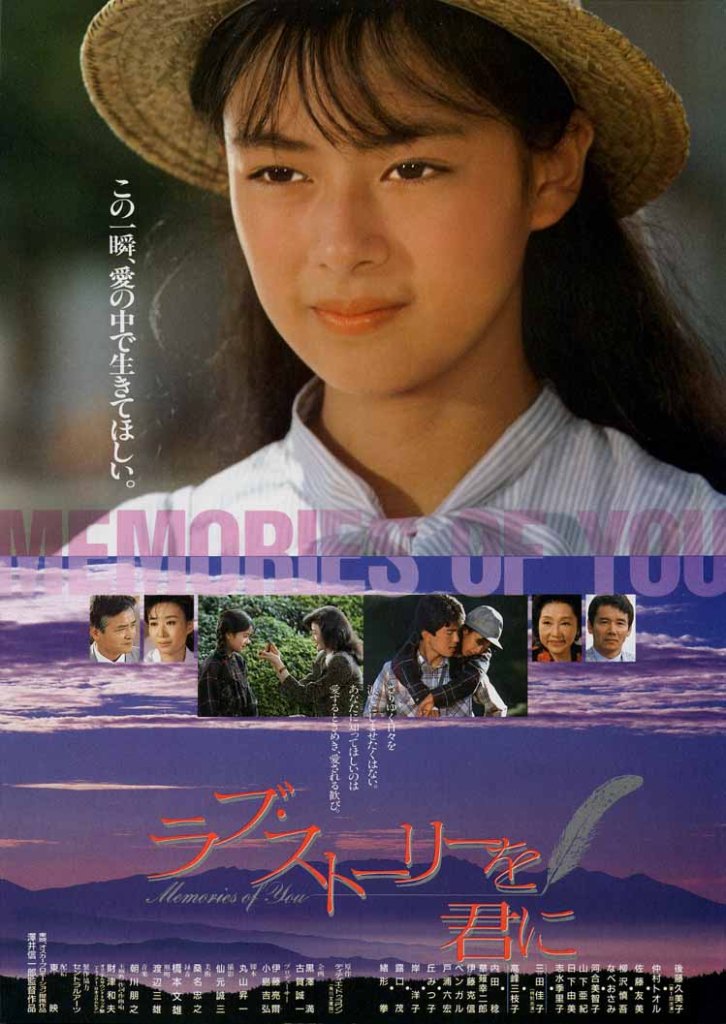
Memories of youIf you thought idol movies were all cute and quirky stories of eccentric high school girls with pretty, poppy voices then think again because Memories of You is coming for you and your faith in idols to make everything better. Directed by W’s Tragedy‘s Shinichiro Sawai, Memories of You (ラブ・ストーリーを君に, Love Story wo Kimi Ni) stars one of the biggest idols of them all – Kumiko Goto, only 14 years old at the time of filming. Seemingly inspired by classic Hollywood melodramas of the ‘50s, Sawai’s film finds its innocent protagonist attempting to live an entire lifetime in only six months as she succumbs to a cruel and relentless disease.

Giving no clue as to its eventual destination, Memories of You begins with two young men returning from a hiking trip. You can tell the pair are committed alpinists because of their distinctly alpine attire and by the way they look at a glockenspiel. In this early comic scene, Araki (Shingo Yanagisawa) is heading straight to an important job interview that he hopes will help him get his girl back if he’s hired so he’s talking a mile a minute whilst awkwardly changing into a business suit inside a photo booth.

The other young man, Akira (Toru Nakamura), runs into the star of film, Yumi (Kumiko Goto), on her way back from the hospital. Akira used to be Yumi’s tutor and it’s obvious she has kind of a crush on him. Unbeknownst to Yumi, the results of her tests are much more serious than might be assumed from her cheerful persona. Yumi has leukaemia and the doctors do not expect her to survive for more than six months at most.

Yumi’s devasted mother shifts her grief away from the pain of losing her only child, to that of her stolen future – no high school, no romance, no love, marriage, or children. Accordingly she asks teacher in training Akira for a considerable sacrifice – essentially, pretend to date Yumi and give her the kind of love story that she will never now be able to experience.

Needless to say, this is a little creepy given that Akira is in in his mid-twenties and Yumi is only fourteen. Of course, it’s all very chaste and innocent like something out of a shoujo manga but still even in 1988 the scenario rings alarm bells. Akira is conflicted about his new role as a fake boyfriend for a dying teenager but it would be heartless to refuse, though one may wonder about what effect all of this may have on his future chosen career.

The world of 1988 is noticeably sexist in that Yumi’s mother works as a cookery teacher, reminding her pupil’s that this is the most important course because they’ll all be competing with their future mother-in-laws in the great culinary battle to win their husband’s hearts. These girls are raised to be housewives and nothing more, although, Yumi’s mother is divorced and now has a career, is taking care of Yumi alone and is not particularly looking to remarry. So, swings and roundabouts in terms of social progress.

The film flits between the viewpoints of Yumi and Akira as they both try to adapt to this unusual situation. As is common in these kinds of films, Yumi is not quite as in the dark as everyone had assumed and is readying herself to say her final goodbyes. This also brings about a reunion with her long absent father who has emigrated to Canada where he has a new wife and younger daughter. Yumi’s family status is an uncommon one for 1988, yet there is relatively little stigma surrounding it. Perhaps her father’s return after three years is one factor in Yumi’s realisation of the seriousness of her condition (as her mother feared it might be) but the final reconciliation does at least bring her a little more calmness and stability.

Yumi’s illness is a mountain which cannot be conquered. The beauty of the natural world and the desire to overcome it, in a sense, through physical exertion are the chief motifs of the film as Yumi dreams of travelling to Switzerland – the spiritual home of alpinism (it would seem). The loving looks at the glockenspiel in the opening scenes develop into an underlying musical theme as they also recur during the lengthy cabaret sequence close to the film’s climax. Of course, Yumi finally attempts to climb her mountain with Akira as her guide but there is only so far she can proceed.

Despite its melodramatic touches and desire to be a grand tearjerker, Memories of You is too restrained to make the full force of its tragedy achieve the kind of emotional effect that it aims for. Filled with syrupy, orchestral music very much like that employed by classic Hollywood examples of the genre, Memories of You really wants the viewer to experience the intense sadness of such a young life taken by a cruel and indiscriminating disease but often overplays its hand. This isn’t helped by the unsettling nature of the “romance” between Akira and Yumi or the (entirely understandable) lack of chemistry between the leads who each give independently high quality performances. An interesting example of an “idol movie” which steps outside the genre norms, Memories of You doesn’t quite have the courage of its convictions but is another nicely photographed effort from Sawai.


End credits and title song (not sung by Kumiko Goto)

Young Girls in Love (恋する女たち, Kazuki Omori, 1986)

young women in loveThe friends you make in high school are the friends you’ll have the rest of your life, says Takako – the heroine of Kazuki Omori’s Young Girls in Love (恋する女たち, Koisuru Onnatachi). Only she doesn’t quite want hers – they’re weird and cause her nothing but trouble. Also one of them is too pretty so she soaks up all of the attention – where’s the fun in that? Takako is not altogether happy in her adolescence but at least she has her friends there beside her, right?

Takako’s two best friends have both recently fallen in love leaving her feeling a little left out. Midoriko (Mamiko Takai), the most “unusual” girl in her group (but also thought to be the prettiest), had fallen in love with a teacher and even struck up something of a friendship with him as evidenced by her collection of cute photos of them together. However, he’s recently got married leaving her heartbroken so Midoriko is having another one of her trademark “funerals” in which she buries painful memories from her past. Previously she’s had funerals for an unfortunate PE related incident in which she ripped her shorts during gymnastics, and another for when her grades got so bad that the teachers told her she probably wouldn’t graduate from high school.

Teiko has a difficult homelife as her literature professor father has left the family for unspecified reasons and her mother is still mourning the end of the marriage. However, she has found herself and older poet who formerly wrote lyrics for cheesy teen idol pop songs (though he’s a serious poet now so that’s all beneath and behind him). Teiko knows that this relationship is doomed to failure but is pursuing it in any case.

Takako is so wound up by her friend’s series of love stories that she finds herself visiting “raunchy” movies like 9 1/2 weeks. This is where she encounters possible crush and high school baseball star Kutsukake (Toshiro Yanagiba), but does she really like him or is she just lovesick and jealous of her friends? A new complication also arises in the form of fellow student Kanzake (Yusuke Kawazu) who previously had a crush on older sister Hiroko (Kiwako Harada) but seems to have shifted his attentions on to Takako.

Young Girls in Love is a little broader than the average idol drama though it maintains an overall quirky tone with a few swings towards melodrama. Takako continues with her romantic dilemma although in contrast to what she says towards the opening of the film she mostly does so alone. Rather than her similarly romantically troubled friends, Takako confides in a painter friend, Kinuko (Satomi Kobayashi) who has some rather more grown up advice for her than other friends (or sister) are willing or able to offer.

During her troubles Takako also goes to visit another girl who is kind of involved with low level bosozoku motorcycle gangs, and finds out that her morbid friend Midoriko has gone seriously off the rails. Leading some kind of double life, Midoriko is a disco queen in another town, dancing her troubles away and enchanting all the boys in the club (including the other girl’s biker boyfriend). Distressed, yet a little envious of Midoriko’s ability to soak up all the attention for herself, Takako is the only one to try and intervene during a drag race duel though little heed is given to her desperate plea for sanity and she is only one that gets hurt during the proceedings.

It’s all fairly innocent stuff even though biker gangs, older boyfriends, and boyfriend stealing, all fall into the mix. Omori keeps things simple and brings his idols to the fore to do what they do best though he does overly rely on TV style reaction shots for some of his gags. According to the anecdote Takako offers at the end, none of the various love stories have worked out they way the girls hoped (at least for now) but everything carries on more or less as normal. The three girls have another of their traditional extreme tea ceremonies dressed in kimono and sitting on the edge of a cliff, but they’re all still together despite their recent romantic adventures. The real love story is between three childhood friends who may have temporarily drifted apart over teenage drama, but their bonds are strong enough to withstand the storm and, as Takako stated in the beginning of the film, they’ll be together for the rest of their lives.


Original trailer (no subtitles)

Miss Lonely (さびしんぼう, Nobuhiko Obayashi, 1985)

Miss LonelyMiss Lonely (さびしんぼう, Sabishinbou, AKA Lonelyheart) is the final film in Obayashi’s Onomichi Trilogy all of which are set in his own hometown of Onomichi. This time Obayashi casts up and coming idol of the time, Yasuko Tomita, in a dual role of a reserved high school student and a mysterious spirit known as Miss Lonely. In typical idol film fashion, Tomita also sings the theme tune though this is a much more male lead effort than many an idol themed teen movie.

Obayashi begins with an intertitle-like tribute to a “brusied, brilliant boyhood” before giving way to a wistful voiceover from the film’s protagonist Hiroki Inoue (played by frequent Obayashi collaborator, Toshinori Omi). His life is a fairly ordinary one of high school days spent with his two good friends, getting up to energetic mischief as teenage boys are want to do. The only thing that’s a little different about Hiroki is that his father is a Buddhist priest so he lives in the temple with his feisty mother who is always urging him to study more, and he’ll one day be expected to start training to take over the temple from his father (he has no particular aversion to this idea).

Hiroki’s big hobby is photography and he’s recently splashed out on a zoom lens but rarely has money for film to put in the camera so he’s mostly just playing around, accidentally spying on people. The main object of his interest is a sad looking high school girl who spends her days playing the piano. Hiroki, as an observer of human nature, has decided that she must be just as lonely as he is and has given her the name of “Miss Lonely”. It comes as a shock to him then that a very similar looking sprite appears, also called “Miss Lonely” and proceeds to cause havoc in his very ordinary life.

Although the film is filled with Obayashi’s trademark melancholy nostalgia, there is also ample room for quirky teen comedy as the central trio of boys amuse them selves with practical jokes. The best of these involves a lengthly sequence with the headmaster’s prized parrot which he has painstakingly taught to recite poetry. On being sent to clean up the headmaster’s office after misbehaving in class, the boys quickly set about teaching it a bawdy song instead causing the poor bird to hopelessly mangle both speeches into one very strange recitation. This comes to light when the headmaster attempts to show off his prowess with the parrot to an important visitor but when the mothers of the three boys are called in to account for their sons’ behaviour, they cannot control their laughter. That’s in addition to a repeated motif of the boys’ teacher’s loose skirt always falling off at impromptu moments, and a tendency to head off into surreal set pieces such as the anarchic musical number which erupts at the stall where one of the boys works part time.

Miss Lonely herself appears in a classic mime inspired clown outfit, dressed as if she’d just walked out of an audition for a Fellini film. To begin with, Hiroki can only see Miss Lonely through his camera lens, but she quickly incarnates and eventually even becomes visible to others as well as Hiroki himself. Past and present overlap as Miss Lonely takes on a ghostly quality, perhaps reliving a former romance of memory which may be easily destroyed by water and is sure to be short lived. Love makes you lonely, Hiroki tells us, revelling in the failure to launch of his first love story. Though, if the epilogue he offers us is to be believed, perhaps he is over romanticising his teenage heartbreak and is heading for a happy ending after all.

Chopin also becomes a repeated motif in the film, bringing our trio of lovesick teens together with his music and adding to their romantic malaise with his own history of a difficult yet intense relationship with French novelist George Sand. There’s a necessarily sad quality to Hiroki’s tale, an acceptance of lost love and lost opportunities leaving their scars across otherwise not unhappy lifetimes. Set in Obayashi’s own hometown Miss Lonely takes on a very heartfelt quality, marking a final farewell to youth whilst also acknowledging the traces of sadness left behind when it’s time to say goodbye.


Original trailer (no subtitles)

And here’s idol star Yasuko Tomita singing the title song on a variety show from way back in 1985