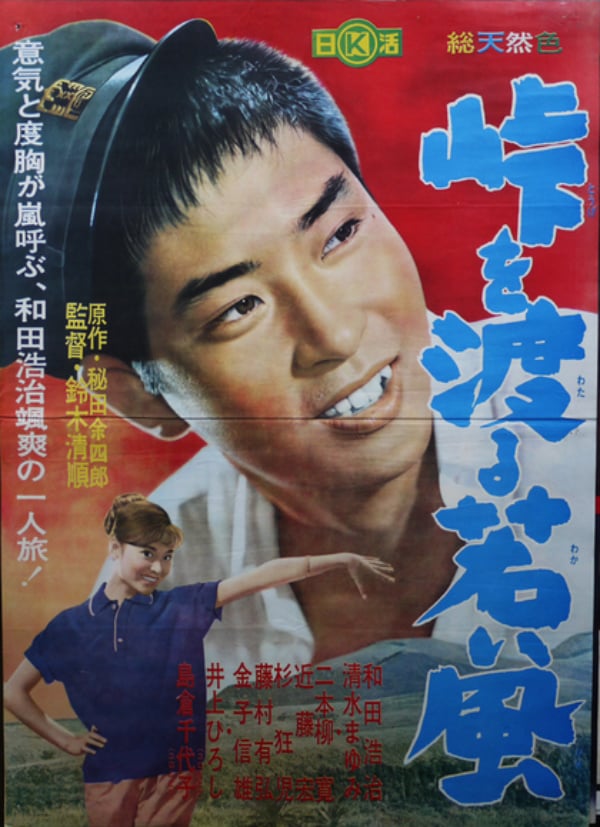
The Wind-of-Youth Group Crosses the Mountain Pass (峠を渡る若い風, Seijun Suzuki, 1961)

The Wind-of-Youth Group Crosses the Mountain Pass posterSeijun Suzuki made his first colour film in 1960 – Fighting Delinquents starred young matinee idol Koji Wada as a noble hearted construction worker with a temper who suddenly learns that he is the heir to an aristocratic fortune. Suzuki would make another two youth dramas starring Wada before getting to 1961’s The Wind-of-Youth Group Crosses the Mountain Pass (峠を渡る若い風, Toge wo Wataru Wakai Kaze, AKA Breeze on the Ridge) – this slice of colourful anarchy is a world away from Nikkatsu’s usual action fare though it does make space for the odd pop song or two.

Naive and cheerful university student Shintaro (Koji Wada) loves to travel and has taken off to wander around alone during the summer break. Getting thrown off a regular city bus for not having the cash for a ticket (his request to defer payment is not looked on kindly), Shintaro catches a lift with a group of travelling performers heading into the summer festival in the next town. Once there Shintaro showcases his lack of forethought once again when he happily sets down to start selling some of the “merchandise” he was given as a salary when the last place he worked at went bust. Not having realised that one generally needs a permit to sell goods in a market, Shintaro gets into an argument about the evils of monopolies and freedom verses regulation with the guy on the next stand all of which brings him to the attention of the yakuza. Luckily for Shintaro, he’s run into the nice kind of yakuza who just think he’s funny and invite him to travel on with them for a bit. Being so essentially good hearted and innocent, Shintaro agrees without thinking about all the reasons travelling around with a bunch of shady yakuza might not be a good idea.

Connecting with both the yakuza and the travelling players, Shintaro becomes involved in a number of interconnected crises – the biggest being the fate of the performers when a local gangster type swipes their headline act. The head of the troupe, Kinyo Imai (Shin Morikawa), is a traditional magician who performs in exaggerated Chinese dress complete with Fu Manchu moustache, but it doesn’t really matter how good he is, the rural audience is only here for the strip show. No stripper means no bookings which Kinyo knew already but it’s still a huge blow to his self esteem to realise that his magic doesn’t do the business anymore, especially as he’d always been conflicted about the strippers anyway.

Shintaro is one of Nikkatsu’s wandering heroes but unlike most he’s a cheerful soul who wanders out of a sense of curiosity and adventure rather than a need to escape something or someone at home. He likes meeting new people, even if the relationships are transitory and necessarily shallow, and treats everyone he meets with kindness and an open mind. In return he meets only kind and open people – even the yakuza are a generally decent sort who treat him like a new friend and can be relied upon to come to his aid if called. The only note of sourness arrives in the form of shady gangster Akita (Hiroshi Kondo) who pinches the troupe’s stripper, and their sometime patron who makes an indecent proposal to Kinyo as a kind of bet to decide whether he continues to fund their moribund performing career.

This being a regular program picture there’s not a lot of scope for experimentation but as it’s also a slightly odd entry to the Nikkatsu catalogue Suzuki does have the freedom to spice things up in his own particular way. Making the best use of colour film, Suzuki has a ball capturing Japan’s unique summer festival culture with its giant floats and cheerful market atmosphere. Wandering around the festival in a lengthy POV shot manages to exoticise something which would be quite ordinary to many viewers (at least those not born in large cities) but Suzuki’s other innovations are mostly relegated to one extremely interesting sequence in which Shintaro has a paint fight with yakuza he’s fallen out with (don’t worry, they both end up laughing like school boys). Every time Shintaro gets hit with paint, the entire screen tints to match neatly intensifying the effect and marking an early example of Suzuki’s love of colour play. Warm and goodnatured, The Wind-of-Youth Group Crosses the Mountain Pass is a gentle tale of youth finding its path but also one in which Suzuki takes advantage of the travelling motif to break from the regular programming and present an anarchic carnivale of music and song.


The Wind-of-Youth Group Crosses the Mountain Pass is the second of five films included in Arrow’s Seijun Suzuki: The Early Years. Vol. 1 Seijun Rising: The Youth Movies box set.

Original trailer (English subtitles)

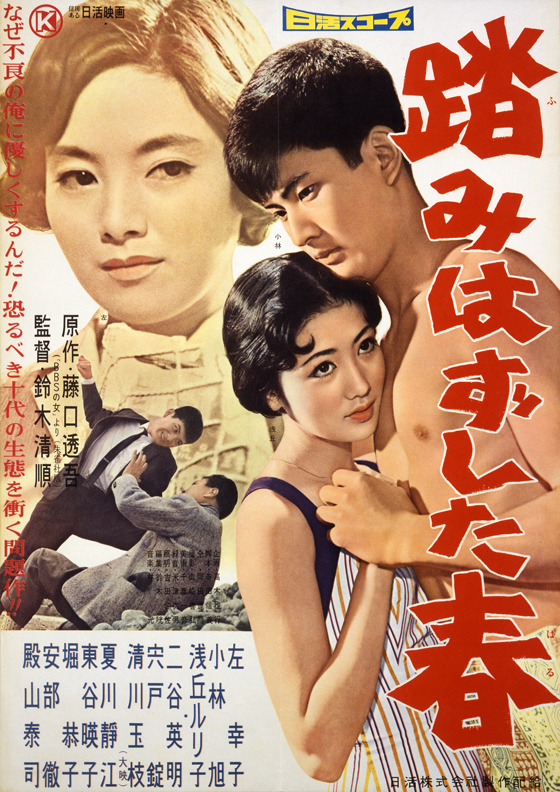
The Boy Who Came Back (踏みはずした春, Seijun Suzuki, 1958)

the boy who came back posterSeijun Suzuki may have been fired for making films that made no sense and no money, but he had to start somewhere before getting the opportunity to push the boat out. Suzuki’s early career was much like that of any low ranking director at Nikkatsu in that he was handed a number of program pictures often intended to push a pop song or starring one of the up and coming stars in the studio’s expanding youth output. The Boy Who Came Back (踏みはずした春, Fumihazushita Haru, AKA The Spring that Never Came) is among these early efforts and marks an early leading role for later pinup star Akira Kobayashi paired with his soon to be frequent leading lady, Ruriko Asaoka. A reform school tale, the film is a restrained affair for Suzuki who keeps the rage quelled for the most part while his hero struggles ever onward in a world which just won’t let him be.

Keiko (Sachiko Hidari) is a conductress on a tour bus, but she has aspirations towards doing good in the world and is also a member of the volunteer organisation, Big Brothers and Sisters. While the other girls are busy gossiping about one of their number who has just got engaged (but doesn’t look too happy about it), Keiko gets a message to call in to “BBS” and is excited to learn she’s earned her first assignment. Keiko will be mentoring Nobuo (Akira Kobayashi) – a young man getting out of reform school after his second offence (assault & battery + trying to throttle his father with a necktie, time added for plotting a mass escape). Nobuo, however, is an angry young man who’s done all this before, he’s not much interested in being reformed and just wants to be left alone to get back to being the cool as ice lone wolf that he’s convinced himself he really is.

Made to appeal to young men, The Boy Who Came Back has a strong social justice theme with Keiko’s well meaning desire to help held up as a public service even if her friends and family worry for her safety and think she’s wasting her time on a load of ne’er do wells. Apparently an extra-governmental organisation, BBS has no religious agenda but is committed to working with troubled young people to help them overcome their problems and reintegrate into society.

Reintegration is Nobuo’s biggest problem. He’s committed to going straight but he’s proud and unwilling to accept the help of others. He turns down Keiko’s offer to help him find work because he assumes it will be easy enough to find a job, but there are no jobs to be had in the economically straightened world of 1958 – one of the reasons Keiko’s mother thinks the BBS is pointless is because no matter how many you save there will always be more tempted by crime because of the “difficult times”. When he calms down and comes back, agreeing to an interview for work at his mother’s factory Nobuo leaves in a rage after an employee gives him a funny look. There are few jobs for young men, but there are none for “punks” who’ve been in juvie. Every time things are looking up for Nobuo, his delinquent past comes back to haunt him.

This is more literally true when an old enemy re-enters Nobuo’s life with the express intention of derailing it. His punk buddies don’t like it that he’s gone straight, and his arch rival is still after Nobuo’s girl, Kazue (Ruriko Asaoka). If Nobuo is going to get “reformed” he’ll have to solve the problem with Kajita (Jo Shishido) and his guys, but if he does it in the usual way, he’ll land up right in the slammer. Keiko’s dilemma is one of getting too involved or not involved enough – she needs to teach Nobuo to fix his self image issues (which are largely social issues too seeing as they relate to familial dysfunction – a violent father and emotionally distant mother creating an angry, fragile young man who thinks he’s worthless and no one will ever really love him) for himself, rather than try to fix them for him.

A typical program picture of the time, The Boy Who Came Back does not provide much scope for Suzuki’s rampant imagination, but it does feature his gift for unusual framing and editing techniques as well as his comparatively more liberal use of song and dance sequences in the (not quite so sleazy) bars and cabarets that Nobuo and his ilk frequent. Unlike many a Nikkatsu youth movie, The Boy Who Came Back has a happy ending as everyone, including the earnest Keiko, learns to sort out their various difficulties and walks cheerfully out into the suddenly brighter future with a much more certain footing.


The Boy Who Came Back is the first of five films included in Arrow’s Seijun Suzuki: The Early Years. Vol. 1 Seijun Rising: The Youth Movies box set.

Original trailer (English subtitles)
Doberman Cop (ドーベルマン刑事, Kinji Fukasaku, 1977)

Doberman cop J DVD coverAll things considered, a live pig is a rather insensitive gift to present to your local police station, though any gift at all might be considered in appropriate even if offered by a well meaning colleague keen to help out when a horrific murder may be connected to his missing person case. By 1977 Kinji Fukasaku had made a name for himself through the wildly successful “jitsuroku” or “true record” genre of yakuza movies kickstarted by his own Battles Without Honour and Humanity. Doberman Cop (ドーベルマン刑事, Doberman Deka) is then quite an odd move as its brings him back to the looser, exploitation leaning B-movie action which featured heavily in the earlier part of his career and which the “jitsuroku” movement was set on displacing. Fittingly enough, Doberman Cop also sees Fukasaku reuniting with the frequent star of those early films – Sonny Chiba, now considerably older but still an impressive action star willing to put himself in danger to achieve the heart stopping stunts his fans had come to expect.

Chiba plays Okinawan “crazy cop” Kano, the stranger in town currently on a mission to find a childhood friend at the request of her sickly priestess mother. A body has been discovered, so horribly charred that visual identification is not possible but based on the clues found in the room the police are convinced the woman is Kano’s missing person, Yuna, who had been living as a prostitute under another name. Kano is not convinced, the priestess has conducted rituals which suggest her daughter is alive and there’s something not quite right about this case which the police have attributed to a spate of serial killings targeting prostitutes in the Tokyo area. An encounter with a shady yakuza turned music promoter brings Kano into contact with Miki (Janet Hatta) – an aspiring singer who bears a striking resemblance to the missing Yuna.

Doberman Cop is, loosely, based on the manga by Buronson. Part of the “gekiga” movement which prided itself on gritty, adult stories, Doberman Cop owed much to Dirty Harry with its sarcastic, tough as nails policeman armed with a .44 Magnum and a rock hard desire for justice. Fukasaku’s Kano is reimagined as a genial country bumpkin, a toughened farm boy in a straw hat displaced in the Tokyo jungle. Turning up like a strange relative, Kano has brought along a local delicacy in the form of a live pig he offers to the Tokyo police precinct with the promise that all they need to do is snap its neck and light the barbecue. Unsurprisingly, the city policemen decline his polite offer leaving him trailing the squealing piggy around with him like a burdensome sidekick.

Kano’s Yuna is not the only young woman of Okinawa fetching up in the mainland capital in search of a “better” life, but finding only failure and despair. The country detective alienates the city police with his arcane divinatory ritual which involves tipping out a large bag of small seashells and counting them to ascertain the answer to a binary question, but his methods convince him than Yuna is still alive while another Okinawan woman is dead. That a woman from his island has met such a grim end is of no small regret to Kano, be she Yuna or not, and his quest is one of vengeance for both women ruined by the false promise of city life, tempted from simple village existence by bright lights and urban sophistication.

Miki’s path has followed this pattern to the letter. City life turned her into a prostitute and drug addict, eventually running all the way to New York but failing to escape her ongoing despair. Running into a similarly depressed former yakuza, Hidemori (Hiroki Matsukata), who falls in love with her, reawakens her desire for life, and becomes determined to rescue both of their futures by turning her into a singing star, Miki is at a turning point as she prepares for TV stardom as the winner of a signing competition while Hidemori backtracks to his gangster days to make it happen.

Kano begins to piece things together and comes to realise his worst fears are true. Nevertheless, if he could he’d take Yuna home with him to the village to forget her city ordeal rather than hand her over to the Tokyo police to face justice whatever she might have done. Though the tone is largely a comic one, laced with Fukasaku’s characteristically bleak sense of humour, the conclusion is just as melancholy as any of his other sad stories of broken men as Kano is forced to conclude that whatever the facts, the Yuna who left the village is no longer in this world. Putting a lead on his piggy friend, he resigns himself to leaving the city to take care of itself while he returns home, his mission a failure.

Necessarily less serious than Fukasaku’s other work of the ‘70s, Doberman Cop is a return to the nonsensical B-movie action fests of the past which leaves ample room for Chiba to show off his still potent skills including the famous scene of him abseiling down a tall building to bust into a hotel room where Miki is being held captive by a crazed yakuza. The country bumpkin adapts to this part of city life well enough, karate kicking bad guys and loudly disapproving of drug peddling misogynists (not to mention “righteous” serial killers hellbent on “cleansing” the city of sleaziness). Bonding with the “salt of the earth” residents of the lower class neighbourhoods, including a stripper who takes a fancy to the pig during her routine, and a member a biker gang unfairly hauled in as a suspect, Kano concludes that city life is not all it’s cracked up to be much as he comes to admire these basically “good” people who have gone out of their way to help him for mostly altruistic reasons. Still, the world is a darker place for Kano following his city adventure, and all he can do in the end is return to the relative safety of a sunny Okinawan village, pig in tow.


Available now from Arrow Video!

Original trailer (no subtitles)

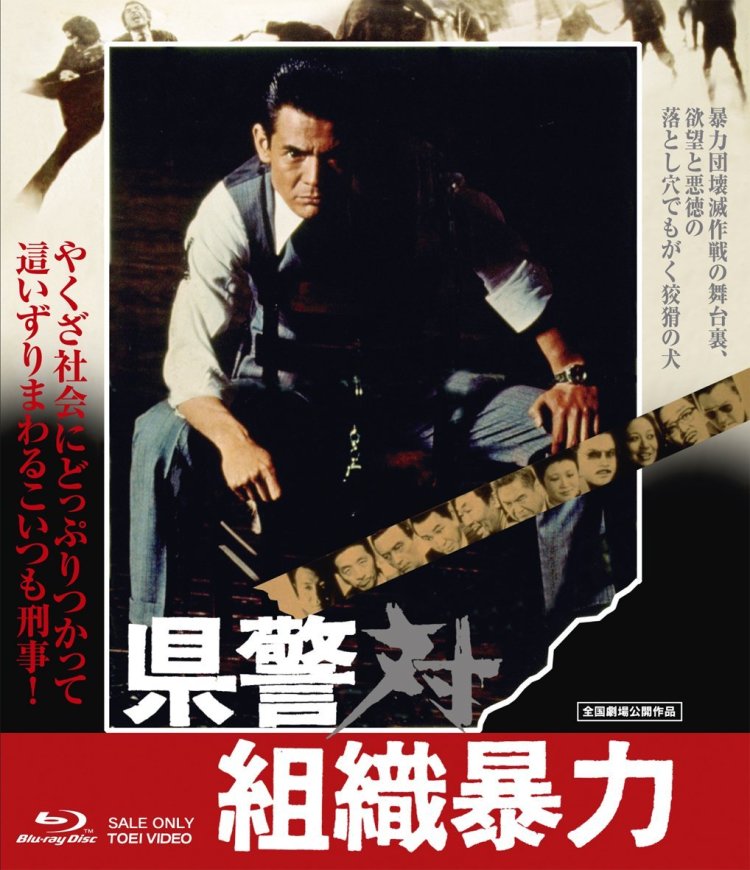
Cops vs. Thugs (県警対組織暴力, Kinji Fukasaku, 1975)

cops vs thugs J BDCops vs Thugs – a battle fraught with friendly fire. Arising from additional research conducted for the first Battles Without Honour and Humanity series and scripted by the author of the first four films, Kazuo Kasahara, Cops vs Thugs (県警対組織暴力, Kenkei tai Soshiki Boryoku) shifts the action west but otherwise remains firmly within the same universe. This is a world of cops and robbers, but like bored little boys everyone seems to forget which side it was they were on – if they truly were on any other side than their own. There are few winners, and losers hit the ground before feeling the humiliation, but the one thing which is clear is that the thin blue line is so thin as to almost be transparent and if you have to choose your defenders, a thug may do as well as a cop.

A dodgy looking guy in a dirty mac roughs up some equally dodgy looking kids. Given that the shady looking fella is played by Bunta Sugawara you’d peg him for a petty thug, but against the odds Kuno is a cop – just one with a taste for crumpled raincoats. The town he’s policing is one in the midst of ongoing gang strife following a series of breakaways and civil wars throughout the ‘50s. Things are coming to a head as rival bosses of the two breakaway factions, Hirotani (Hiroki Matsukata) and Kawade (Mikio Narita), vie for power while a former yakuza politician, Tomoyasu (Nobuo Kaneko), does his best to stir up trouble between them that Kuno is trying to keep from exploding into all out war.

Cops vs Thugs is as cynical as they come but slightly more sympathetic to its desperate, now middle aged men whose youth was wasted in the post-war wasteland. The central tenet of the film is neatly exposed by a drunken gangster who points out that at heart there’s little difference between a cop and a yakuza aside from their choice of uniform. Policemen, like gangsters, follow a code – the law, carry a gun, are fiercely loyal to their brotherhood, and at the mercy of their superiors. Good jobs were hard to come by in the devastation following the surrender, in fact one of the reasons company uniforms became so popular was that no one had decent clothes to wear and a providing a uniform was a small thing that a company could to do increase someone’s sense of wellbeing, community, and engender the feeling of family within a corporate context. The police uniform, even if it’s reduced to a badge and a gun, does something similar, as do a yakuza’s tattoos. They literally say someone has your back and will come running when you’re in trouble.

These drop outs with nowhere left to turn eventually found themselves one side of a line or on the other – the choice may have been arbitrary. Kuno says he became a cop because he wanted to carry a gun, something he could have done either way but for one reason or another he chose authority over misrule. Cops being friends with yakuza sounds counter intuitive, but many of these men grew up alongside each other, attended the same schools, perhaps even have relatives in common.

Both the police and the yakuza claim to be the defenders of honest, working people but neither of them quite means what they say. Police brutality is rife while yakuza battles reach new levels of violent chaos including, at one point, a beheading in the middle of a sunlit street. Yet the greatest threats to the population at large aren’t coming from such obvious sources, they’re hardwired into the system. Sleazy politico Tomoyasu spends his time in hostess bars and schmoozes with gangsters he uses to do his dirty work while the press look on gleefully at having something to report. Kuno may not be a candidate for police officer of the year, but he tells himself that his policy is one of appeasement, and that working with organised crime is the best way to protect the ordinary citizen. When you’re forced to work within a corrupt system, perhaps there is something to be said for flexibility.

For all of the nihilistic cynicism Fukasaku retains his ironic sense of humour, staging a violent, inefficient, and bloody murder in a tiny room where a sweet song about maternal love in which a woman sings of her hopes for the bright future of her son is playing a healthy volume. Corruption defines this world but more than that it’s the legacy of post-war desperation that says on the one hand that it’s every man for himself, but that it’s also necessary to pick a side. Cops, thugs – the distinction is often unimportant. There is sympathy for these men, and sadness for the world that built them, but there’s anger here too for those who play the system for their own ends and are content to see others pay the price for it.


Available now from Arrow Video!

Original trailer (English subtitles)

Originally published by UK Anime Network.

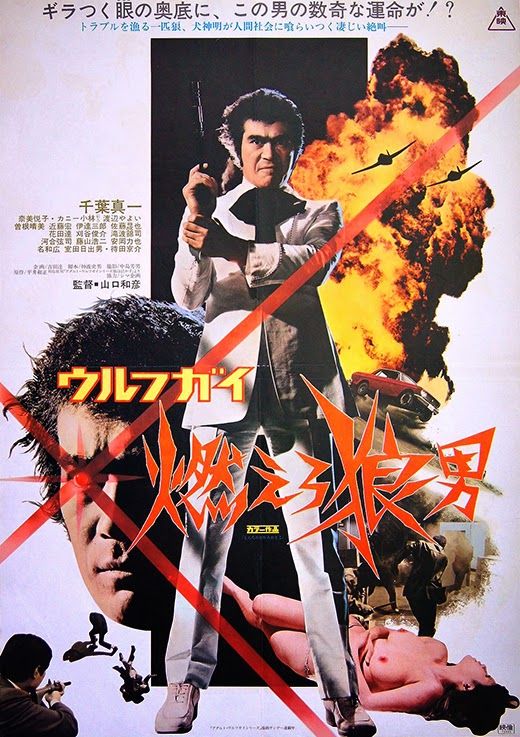
Wolf Guy (ウルフガイ 燃えよ狼男, Kazuhiko Yamaguchi, 1975)

Wolf Guy posterUniversal’s Monster series might have a lot to answer for in creating a cinematic canon of ambiguous “heroes” who are by turns both worthy of pity and the embodiment of somehow unnatural evil. Despite the enduring popularity of Dracula, Frankenstein (dropping his “monster” monicker and acceding to his master’s name even if not quite his identity), and even The Mummy, the Wolf Man has, appropriately enough, remained a shadowy figure relegated to a substratum of second-rate classics. Kazuhiko Yamaguchi’s Wolf Guy (ウルフガイ 燃えよ狼男, Wolf Guy: Moero Okami Otoko, AKA Wolfguy: Enraged Lycanthrope) is no exception to this rule and in any case pays little more than lip service to werewolf lore. An adaptation of a popular manga, Wolf Guy is one among dozens of disposable B-movies starring action hero Sonny Chiba which have languished in obscurity save for the attentions of dedicated superfans, but sure as a full moon its time has come again.
Chiba plays Inugami (literally “dog god”, in Japanese folklore an Inugami is a vengeful dog spirit which can possess people in times of emotional extremity), a melancholy reporter with a reputation for getting himself into trouble who comes across a strange scene in the street in which a white suited man begins raving about a tiger before being gored to death by invisible forces. The police, dragging in Inugami for questioning, can’t come up with anything better than demons to explain such strange events but Inugami’s interest is piqued – more so when he runs into a shady paparazzo who tips him off to similar crimes all targeting a rock band run by a prominent talent agency.

Wolf Guy is not the most coherent of films, it explains itself piecemeal as it goes along and mostly through Inugami’s own world-weary voiceover. Despite this immediate access to Inugami’s psyche, he remains aloof, brooding, and distant. Literally a lone wolf, Inugami is the last of his kind – the little boy saved from a massacre in the black and white still frames of the opening sequence. Yamaguchi chooses not to engage with this theme on much more than a surface level though he maintains a low-level anger towards corrupt authority and those who attempt to wield power from the shadows, targeting the different or the weak.

Through this deeply held feeling of alienated otherness, Inugami comes to feel an intense kinship with the wronged woman at the centre of the curse. Miki (Etsuko Nami) is even more a victim of this intense authoritarianism than Inugami himself. A working class nightclub singer in love with a politician’s son, Miki becomes a problem for her potential father-in-law, one which he solves with gang rape and infection with syphilis. Dumped, alone, infected, and also hooked on drugs, Miki’s mental state is understandably volatile but her troubles are not yet over. The mysterious tiger and Inugami’s wolf man attributes bring the pair to the attentions of a shady group intent on harnessing these unique supernatural powers for themselves with no regard for the “human” cost involved.

Inugami sympathises with Miki out of a shared hatred for “humans” who can treat each other in such inhumane ways. Humans massacred his family and when he tries to go home, the sons of the men who did it seem to know who he is and want to finish the job. Lonely and afraid, Inugami starts to wonder if humans and his own kind will ever be able to live together in harmony. Though he does begin to form brief romantic relationships, none of them end well. It’s almost a running joke that he’s irresistible to every woman in the film, but as much as they run to him they run to death – his love is toxic and even the invulnerability conferred by the moon is unable to save the women in his life from the violence of mortal men. Yet for all his sadness and internalised rage, the Wolf Guy is a hippy hero, the kind who throws away his gun and chooses to retreat in peace rather than fight on in a pointless and internecine quest for vengeance.

Rather than a story of humanity overturned by overwhelming, irrational emotional forces, Wolf Guy presents a hero perfectly in tune with his emotional life even if imbued with Chiba’s iconic coolness. This is not a “werewolf” story, Chiba never transforms nor does he lose himself at the sight of a full moon – rather it strengthens, sustains, and protects him. This almost new age idea gels well with the generally psychedelic approach filled with groovy ‘70s guitar, whip pans, zooms and crazy action though the film certainly goes to some dark places including an extremely unsettling surgery scene followed by an equally disturbing one of healing body horror in which exposed intestines rearrange themselves neatly inside the stomach cavity which then begins to knit itself together again. An eccentric, essentially disposable offering, Wolf Guy makes no real attempt at coherence but is willing to embrace just about every kind of madcap idea which presents itself. Strange, absurd, and all the better for it Wolf Guy is one wild ride but also has its heart in the right place as its melancholy hero heads out into the mountains, a self-exile from a cruel and unforgiving world.


Wolf Guy is released on Dual Format DVD & Blu-ray in the US and UK on 22nd/23rd May 2017 courtesy of Arrow Video.

Arrow release EPK video


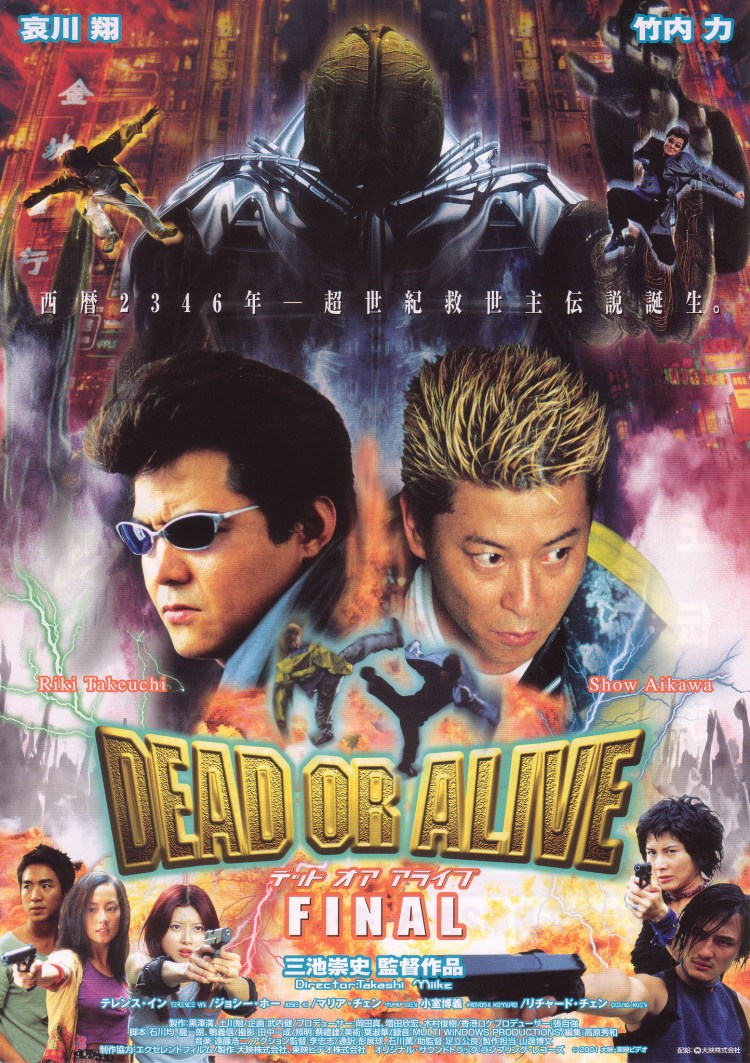
Dead or Alive: Final (Takashi Miike, 2002)

dead_or_alive_final_jap_chirashiThe Dead or Alive Trilogy began in a furious, drug fuelled hymn to violence in which a petty vendetta between the opposing forces of good and evil (mingled and bloody) eventually destroyed the entire world. Dead or Alive 2: Birds was an altogether more contemplative affair in which two orphaned boys rediscover each other as jaded hitmen and decide to put their talents to “good” use by donating the hit money to pay for medicinal drugs for impoverished children around the world. Strange and surreal, Birds moved beyond the first film’s absurd ending for an altogether more abstract approach to universe building but Final pushes the idea to its limit in a cyberpunk infused far future tale of rogue robots and sexual dictatorship.

Yokohama, 2346. A new society is being forged, a new social order has been created. All powerful Mayor Wu (Richard Chen) has decreed that the only true love is gay love and made heterosexuality taboo. Births are strictly controlled to maintain population numbers with contraception ruled mandatory. The heterosexual resistance has gone into hiding in a ruined part of the city, living in a free love commune in which the birth of children is a primary goal. Lead by Fong and his first lady Jun, the resistance aims to liberate the people from the yoke of the crazed dictator and create a better, freer world for the as yet unborn children of the future. Teaming up with a rogue “Replicant”, Ryo, (Sho Aikawa) the gang attempt to further their cause by kidnapping the young son of Wu’s chief of police, Honda (Riki Takeuchi), who later discovers some uncomfortable truths about his own existence.

The use of the world “Replicant” is a pointed one and an overt reference to Final’s key text – Blade Runner, though its intentions amount much more to a pastiche than an examination of the existential questions so central to the seminal cyberpunk classic. Online captions state the action is taking place in Yokohama – an industrial harbour town close to Tokyo, but is in reality a thinly disguised Hong Kong with a green tint. Nevertheless, Miike makes the most of rundown industrial complexes now overrun by nature and the symbols of historical hubris. Aside from the flying cars and other CGI touches, the dystopianism is all too real in its sense of economic and social failures which have allowed a man like Wu to run a strange fascist police state even in the absence of the necessary infrastructure.

In keeping with the Hong Kong setting the Yokohama of 2346 is largely Chinese with broad mix of intermingled languages. Once again the nature of family is called into question but this time more through a large scale change in the social order which sees birth strictly controlled through medical and cultural enforcement. The largely Cantonese speaking resistance movement want to create a world where children can be born and then grow up freely, neatly echoing the previous films’ preoccupation with the fates of children as considered by orphans. Aside from their idealism, the Resistance turns out not to be so far removed from the petty gangsters of the previous instalments as they ultimately turn on each other with deadly consequences.

Sho Aikawa and Riki Takeuchi face off once again with Aikawa playing a Rutger Hauer-esque android who proves his “humanity” through his affiliation with children. A “Replicant” from a long forgotten war, Ryo has superpowers which allow him to stop bullets in mid-air or send out sparks of energy but is also at home playing the clown as he brushes his teeth nonchalantly in the middle a fist fight or plays dead to entertain a little boy. Takeuchi’s Honda, by contrast, is the stereotypical gestapo inspired secret police chief whose family life is a hollow one devoid of genuine feeling and maintained solely for professional expectation.

If Miike has been playing Blade Runner all along, his finale jumps ship for Tetsuo: The Iron Man as the trilogy’s leading men relive the totality of their experiences across three different plains of existence before merging into one as a kind of angel of destruction. The cycle of violence has reached its apotheosis as the twin angels are sent to wreak revenge on those who have misused their authority. Shot on high grade video, Final makes the most of its more modest production values but can’t help suffering in comparison to its predecessors. The B-movie opening is a helpful clue to Miike’s intentions as he creates his own kind of sci-fi dystopia inspired by pop culture memories, but even if the overarching themes lack integrity, Final provides the perfect ending for this often frustratingly absurd series, defying rational explanations until the end of time.


Available now in UK from Arrow Video!

Original trailer (English subtitles)

Dead or Alive 2: Birds (DEAD OR ALIVE 2 逃亡者, Takashi Miike, 2000)

dead-or-alive-2-birds

How do you make a sequel to a film which ended with the apocalypse? Takashi Miike is no stranger to strange logic, but he gets around this obvious problem by neatly sidestepping it. Dead or Alive 2: Birds (DEAD OR ALIVE 2 逃亡者, Dead or Alive 2: Tobosha) is, in many ways, entirely unconnected with its predecessor, sharing only its title and lead actors yet there’s something in its sensibility which ties it in very strongly with the overarching universe of the trilogy. If Dead or Alive was the story of humanity gradually eroded by internecine vendetta, Dead or Alive 2 is one of humanity restored through a return to childhood innocence though its prognosis for its pair of altruistic hitmen is just as bleak as it was for the policeman who’d crossed the line and the petty Triad who came to meet him.

Signalling the continuous notions of unreality, we’re introduced to this strange world by a magician (Shinya Tsukamoto) who uses packets of cigarettes to explain the true purpose of a hit ordered on a local gangster which just happens to be not so different from the plot of the first film. Because the gangster world has its own kind of proportional representation, neither the yakuza nor the Triads can rule the roost alone – they need to enter a “coalition” with a smaller outfit no doubt desperate to carve out a little more power for themselves. The free agents, however, have decided on a way to even the power share – hire a hitman to knock off a high ranking Chinese gangster and engineer a turf war in which a proportion of either side will die, leaving the third gang a much more credible player.

Mizuki (Sho Aikawa), bleach blond and fond of Hawaiian shirts, is an odd choice for a secret mission but his sniper rifle is rendered redundant when a man in a dark suit does the job for him – loudly and publicly. So much the better, thinks Mizuki, but the memory of the strangely familiar figure haunts him. Finding himself needing to get out of town, Mizuki has a sudden urge to go home where he encounters the suited man again and confirms that he is indeed who he thinks he is – childhood friend, Shuichi (Riki Takeuchi).

Revisiting an old theme, Mizuki and Shuichi are orphans but rather than being taken directly into the yakuza world they each spent a part of their childhood in a village orphanage on an idyllic island. Miike frequently cuts back between the violent, nihilistic lives of the grown men and the innocent boyhood of long hot summers spent at the beach. The island almost represents childhood in its perpetual safety, bathed in a warm and golden light at once unchanging and eternal. Reconnecting with fellow orphan Kohei (Kenichi Endo) who has married another childhood friend, Chi (Noriko Aota), the three men regress to their pre-adolescent states playing on the climbing bars and kicking a football around just like old times.

Returning to this more innocent age, Mizuki hatches on an ingenious idea – reclaim their dark trade by knocking off those the world would be better off without and use their ill gotten gains to buy vaccines for the impoverished children of the world. In their innocent naivety, neither Mizuki nor Shuichi has considered the effect of their decision on local gangland politics (not to mention Big Pharma) and their desire to kill two “birds” with one stone will ultimately boomerang right back at them.

Innocence is the film’s biggest casualty as Miike juxtaposes a children’s play in which Mizuki and Shuichi have ended up playing a prominent role, with violent rape and murder going on in the city. Whether suggesting that the posturing of a gang war is another kind of playacting, though one with far more destructive consequences, or merely contrasting the island’s pure hearted fantasy with the cold, hard, gangland reality, Miike indulges in a nostalgic longing for the simplicity of childhood with its straightforward goodness filled with friendship and brotherhood rather than the constant betrayals and changing alliances of the criminal fraternity.

The question “Where are you going?” appears several times throughout the film and perhaps occurred to Mizuki and Shuichi at several points during their journeys from abandoned children to outcast men. Neither had much choice in their eventual destination and if they asked themselves that same question the answer was probably that they did not know or chose not to think about it. All of these hopes and ruined dreams linger somewhere around the island’s shore. Kohei is about to become a father but the birth of a child now takes on a melancholy air, the shadow of despair already hanging over him. There is no way out, no path back to a time before the compromises of adulthood but for two angelic hitmen, the road ends with meeting themselves again and, in a sense, regaining lost innocence in shedding their city-based skins.


Out now in the UK from Arrow Video!

Original trailer (English subtitles)

Dead or Alive (DEAD OR ALIVE 犯罪者, Takashi Miike, 1999)

dead or alive
Prolific as always, Takashi Miike released four feature length films in 1999, in addition to working in TV and video. Dead or Alive (DEAD OR ALIVE 犯罪者, Dead or Alive: Hanzaisha) came out within the same year as Miike’s seminal Audition and though it is the latter which has gone on to define his reputation, the Dead or Alive Trilogy is equally responsible for the director’s ongoing popularity. Following the Black Society Trilogy the finale of which, Ley Lines, was also released in 1999, Dead or Alive returns to the world of orphaned exiles and Chinese gangsters, men looking for family in all the wrong places and finding only loneliness, rage, and disappointment. Criminal or cop, everyone is looking for the same old thing but for one reason or another it continually evades their grasp.

Late ‘90s, Shinjuku night life. Miike captures all of its sordid glory in a wordlessly frenetic opening sequence which begins with a naked woman falling off a building and ends with the exploding belly of a noodle loving Triad. The Shinjuku gang scene is a large and complex one but this tiny corner is about to be torn apart by the opposing forces of petty Chinese gangster Ryuichi (Riki Takeuchi) and veteran policeman Jojima (Sho Aikawa).

A little later, the major antagonist – yakuza boss Aoki (Renji Ishibashi), asks a drugged up woman he’s immersed in a pool of her own excrement he himself extricated by means of a series of enemas if she’s high or if she’s come down. Drugs are always on the periphery from the bag in the hands of the falling woman to the deluded hopes and dreams of everyone who’s had the misfortune to find themselves here but Miike takes things one step further and structures his film like the inverted bell curve of a strange trip. The relentless pace of the opening sequence with its constant noodle refills, cocaine excess, and eventual bathroom sex and murder combo gradually winds down giving way to the comfortably numb central section in which Jojima and Ryuichi mirror and circle each other in the murky Shinjuku streets but, as he often does, Miike refuels for an angry, increasingly bizarre final sequence as two men whose quests have cost them everything they were fighting to protect prepare to burn the world rather than see the other live another day.

Ryuichi, like many a gangster hero, is an orphan. His major motivation is a desire to protect his delicate younger brother whom he has sent abroad to study in the hope that he will be catapulted into a successful middle class life while Ryuichi takes over the criminal underworld. Toji (Michisuke Kashiwaya) has returned, but such close proximity to his brother’s darkness may have destabilising consequences for both of them. Ryuichi’s “family” is a constructed one made of other similarly lost or discarded kids of Chinese descent, all looking for a home when neither of the two which present themselves is willing to offer them full acceptance but there is no unconditional love here, betrayal is an easily applied judgement met with a harsh and irreversible punishment.

Even if Ryuichi’s world is cold, Jojima’s may be colder. Despite his wife’s pleas he sleeps on the sofa and seems to have a difficult, strained relationship with the family his life is founded on protecting. Jojima’s reasons for continuing to avoid his marital bed are unclear whether from simple consideration of his strange policeman’s hours or the hushed phone call his wife receives which suggests she may be seeking comfort outside the home, but the one thing which is clear is that this is a family already deeply fractured. Adding to the strain, Jojima’s daughter is seriously ill and his wife has worked out that they will need an enormous amount of money for her treatment. Jojima continues to proclaim that he is “working on it” and will find the money somewhere, reacting angrily to his wife’s desperate suggestion of asking her family for a loan. Wanting to save his daughter himself, he ventures ever deeper into the criminal underworld, crossing the line from law enforcer to law breaker.

Miike operates a tightly controlled approach to pacing after the frenetic opening, slowing right down before exploding in a flurry of gun fire for the climactic shootout (flying chicken feathers and all) and then taking a break until the bonkers finale with its self amputations, mysterious bazookas and strange power orbs. Dead or alive, these are men living in a furious purgatory each denied the very thing they’ve been searching for, but in the end they mirror each other, locked in a vicious cycle of rage and violence which threatens to engulf us all.


Out now in the UK from Arrow Video!

Original trailer (English subtitles)

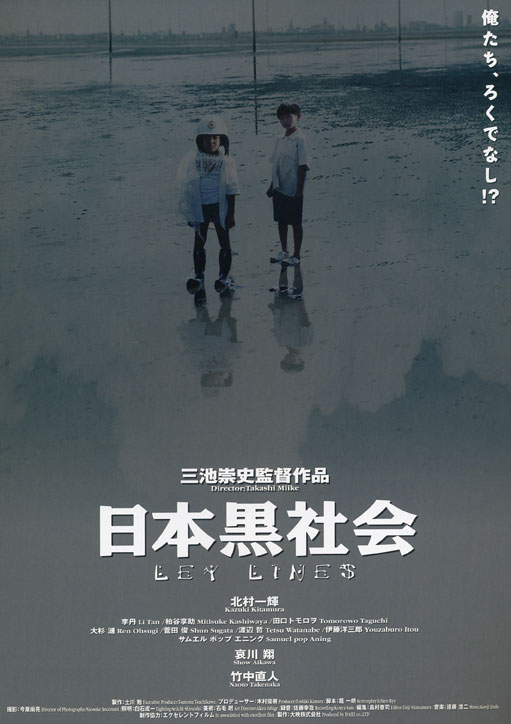
Ley Lines (日本黒社会 LEY LINES, Takashi Miike, 1999)

ley-linesThe three films loosely banded together under the retrospectively applied title of the Black Society Trilogy are not connected in terms of narrative, characters, tone, or location but they do all reflect on attitudes to foreignness, both of a national and of a spiritual kind. Like Tatsuhito in the first film, Shinjuku Triad Society, the three young men at the centre of the final instalment, Ley Lines (日本黒社会 LEY LINES, Nihon Kuroshakai LEY LINES), have each faced prejudice and discrimination due to their Chinese heritage. Fleeing their small town blues and heading for the big city, they want out of the homeland which can find no place for them to try their luck in pastures new, but desperation breeds poor choices and if they find their freedom it may not be in the way they might have hoped.
Angry young man Ryuichi (Kazuki Kitamura) seems to have been in some trouble with the law recently, at least that’s the reason the pedantic government official gives for rudely rejecting Ryuichi’s attempts to get a passport whilst subtly underlining the fact that a “real” Japanese person would know you can’t have one whilst on probation. Offended, Ryuichi picks up a small potted tree and hits the uncooperative desk jockey on the head with it. With Brazil off the cards and no work or prospects on the horizon, Ryuichi decides to blow town with some friends. All but three of them change their minds at the train station but Ryuichi, his sensitive younger brother Shunrei (Michisuke Kashiwaya), and their friend the impulsive Chan (Tomorowo Taguchi) head for the sleazy streets of Shinjuku hoping to find someone to forge their papers for passage overseas.

Once there, hotheaded Ryuichi immediately begins to cause trouble and the trio get mixed up in an ongoing series of gang problems with the traditionally minded Chinese gangsters and a petty thug (Show Aikawa) selling what he claims is a new wonder drug, Toluelene. Teaming up with a brutalised local prostitute, Anita (who previously ripped them off leading to their ill advised Tolulene adventures), also desperate to get the hell out of Shinjuku, the four form an unconventional mini family but a last ditch solution to their dilemma will turn out to be a gamble too far.

Neatly uniting the themes of the previous two movies in the Black Society Trilogy, Ley Lines casts its heroes as multilayered outsiders. Miike begins the film with deliberately retro, aged footage of the brothers as young boys playing happily on a beach until some Japanese kids turn up and remind them that they’re different. Never allowed to just fit in, Ryuichi has become angry and frustrated whereas Shunrei studies harder than anyone trying to earn his place in a competitive society. If their Chinese heritage had set them at odds with their small town peers, the boys are just as much adrift in the big city, a trio of bumpkins wandering into all the wrong places naively thinking they can scrap their way out of Japan. Anita, also Chinese, shares in their desperation as her situation has become unsustainable. Shackled to a useless pimp and forced to endure frightening and barbaric treatment, Anita needs out of the flesh trade and the guys might just be her ticket to ride.

As he would later do so splendidly in Audition, Miike deliberately wrong foots us in the beginning as if he’s about to embark on a standard tale of a young man making his first big set of mistakes which will set him on a path to becoming a better person, but of course this isn’t where we’re going. The original Japanese title, “Japan Black Society” hints at the all pervading darkness which exists below the everyday world into which our trio of hapless dreamers have fallen. The guys are ordinary young men making ordinary mistakes which have a familiar, often comedic quality which only serves to deepen the agony they’re about to face.This underworld belongs to people like the mad gangster Wang (Naoto Takenaka) dreaming of his Chinese homeland and forcing young women to tell him folktales to remind him of it, the pimp the who mishandles the desperate Anita, and the deluded drug dealer Ikeda convinced he’s onto the next big thing. The boys don’t stand a chance. Ending with a typically poetic, bittersweet set of images as some of our heroes find a kind of freedom in an endless sea, Miike does not stint on the irony but his sympathy is very much with these disenfranchised youngsters, denied their futures at every turn and finally backed into a corner by the cruel and unforgiving nature of the Black Society which they inhabit.


Original trailer (English subtitles)

https://www.youtube.com/watch?v=9hB0d_u-6Zk&t=3s

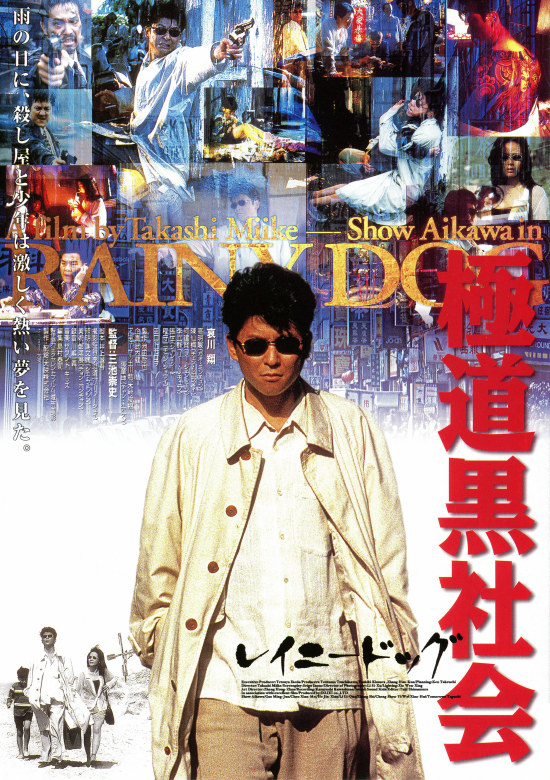
Rainy Dog (極道黒社会, Takashi Miike, 1997)

rainy-dogThey say dogs get disorientated by the rain, all those useful smells they use to navigate the world get washed away as if someone had suddenly crumpled up their internal maps and thrown them in the waste paper bin. Yuji (Show Aikawa), the hero of Rainy Dog (極道黒社会, Gokudo Kuroshakai) – the second instalment in what is loosely thought of as Takashi Miike’s Black Society Trilogy, appears to be in a similar position as he hides out in Taipei only to find himself with no home to return to. Miike is not generally known for contemplative mood pieces, but Rainy Dog finds him feeling introspective. A noir inflected, western inspired tale of existential reckoning, this is Miike at his most melancholy but perhaps also at his most forgiving as his weary hitman lays down his burdens to open his heart only to embrace the cold steel of his destiny rather than the warmth of his redemption.

Yuji’s day job seems to be hulking pig carcasses around at the meat market but he’s also still acting as a button man for the local Taiwanese mob while he lies low and avoids trouble in Taipei following some kind of incident with his clan in Japan. Receiving a call to the effect that following a change of management it will never be safe for him to go home, Yuji is as lost as a dog after the rain but if there’s one thing he hadn’t banked on it was the appearance of a rather sharp Taiwanese woman who suddenly introduces him to a mute little boy who is supposedly his son. Yuji is not the fatherly type and does not exactly take to his new responsibilities. He half remembers the woman, but can’t place her name and isn’t even sure he ever slept with her in the first place. Nevertheless, Ah Chen follows Yuji around like a lost little puppy.

Two more meetings will conspire to change Yuji’s life – firstly a strange, besuited Japanese man (Tomorowo Taguchi) who seems to snooze on rooftops in a sleeping bag and is intent on getting the drop of Yuji for undisclosed reasons, and the proverbial hooker with a heart of gold (and a fancy computer for running an internet blog) with whom he will form a temporary makeshift family. Getting mixed up in something he shouldn’t Yuji’s cards are numbered, but then it couldn’t have been any other way.

As in Shinjuku Triad Society, Miike returns to the nature of family and of the tentative bonds which emerge between people who have been rejected from mainstream society. Yuji is a displaced person, forced out of his homeland and lost in a foreign city. Though he appears to have a good grasp of the local language, the landscape confuses him as he wanders through it like the man with no name, adrift and permanently shielded by his sunglasses. The Taiwanese gangster he’s been freelancing for repeatedly describes him as “like a son” despite the fact that they seem to be around the same age but it’s clear that he could have Yuji eliminated in a heartbeat if he found he’d outlived his usefulness.

Similarly, Yuji does not immediately jump into a paternal mindset when presented with this strangely cheerful young boy. Eventually he lets him come out of the rain and presents him with a towel, greeting him with the words “you’re not a dog” but subsequently abandons him for what seems like ages during his time with the prostitute, Lily, who describes his tattoos as beautiful and shares his dislike of the intense Taipei rain. Asked if she’s ever considered going somewhere sunnier, Lily admits that she has but the fear that perhaps it would all be the same (only less wet) has put her off. Perhaps it’s better to live in hope, than test it and find out it was misplaced.

Gradually, Yuji begins to a least develop a protective instinct for Ah Chen as well as some kind of feeling for Lily which leads him to carry out another hit in order to give her the money to escape on the condition that she take Ah Chen with her. However the trio get ambushed on their way out ending up at a beach leaving them with nowhere left to run, signalling the impossibility of getting off this inescapable island. Just when it seems all hope is lost, Ah Chen finds a buried scooter which he and Lilly begin to dig up. Eventually, Yuji joins them, fully confirming his commitment to the mini family they’ve accidentally formed as they work together to build themselves a way out. Yuji’s decision separate from them and return to the world of crime, albeit temporary, will be a final one in which he, by accident or design, rejects the possibility of a more conventional family life with Ah Chen and Lilly for the destiny which has been dogging him all along.

Birth and death become one as Yuji regains his humanity only to have it taken from him by a man exactly mirroring his journey. There are no theatrics here, this is Miike in paired down, naturalistic mode willing to let this classic story play out for all that it is. Working with a Taiwanese crew and capturing the depressed backstreet world of our three outcasts trapped by a Taipei typhoon for all of its existential angst, Rainy Dog is Miike at his most melancholic, ending on a note of futility in which all hope for any kind of change or salvation has been well and truly extinguished.


Original trailer (English subtitles)

https://www.youtube.com/watch?v=bgN0BnrwruQ