Still the Water (2つ目の窓, Naomi Kawase, 2014)

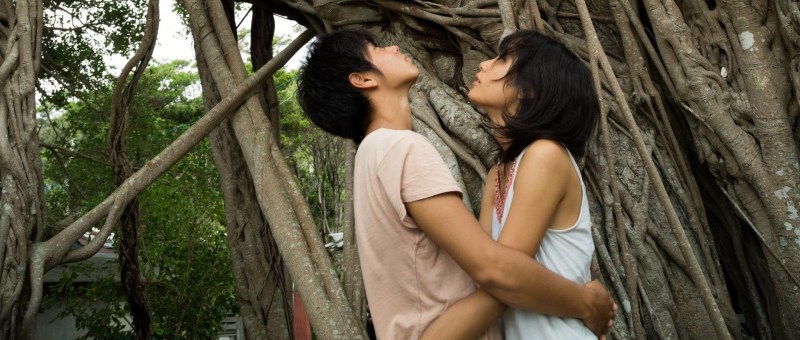
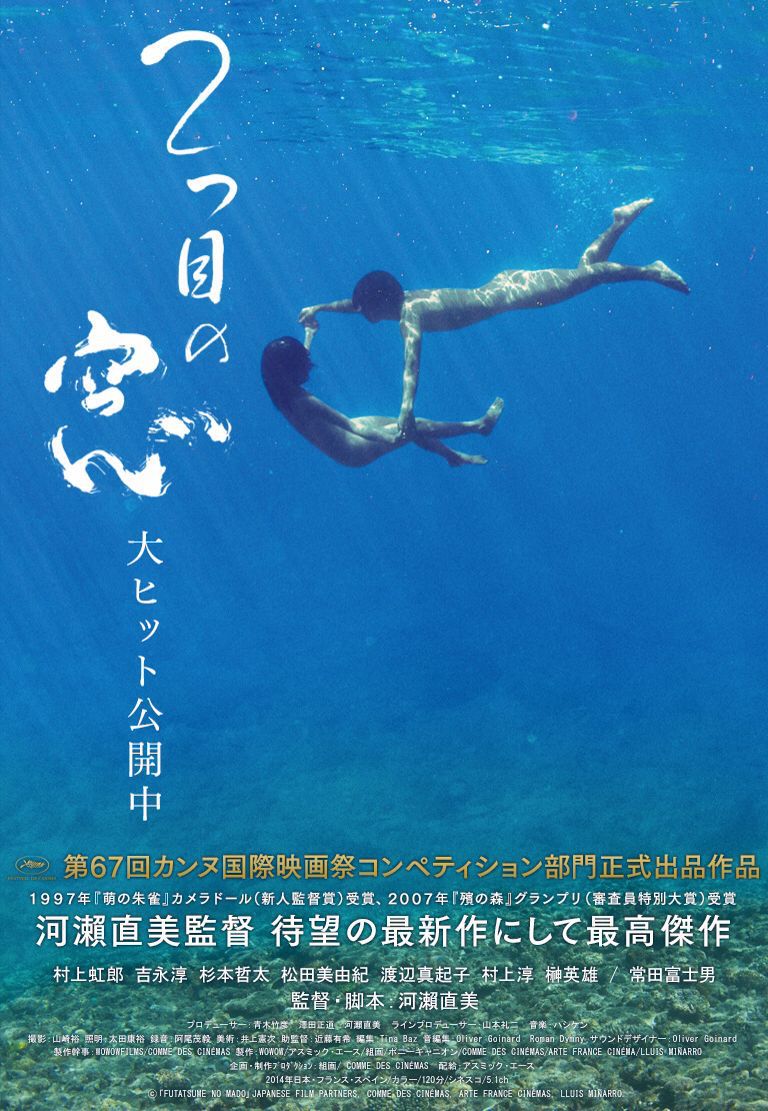
“Why is it that people are born and die?” asks the heroine of Naomi Kawase’s existential odyssey Still the Water (2つ目の窓, Futatsume no Mado). It’s a question with which the director has long been wrestling, though this time more directly as her adolescent protagonists ponder life’s big questions as they prepare to come of age. Moving away from the verdant forests of Nara Prefecture with which her work is most closely associated, Kawase shifts to the tropical beaches of Amami Oshima, a small island somewhere between Kyushu and Okinawa as two youngsters discover life and death on the shore while contemplating what lies beneath the sea. 

Opening with rolling waves and the graphic death of a goat, Kawase’s trademark visions of nature soon give way to night and the discovery of a tattooed man washed up on the shore made by moody teen Kaito (Nijiro Murakami) who leaves abruptly, walking past the confused figure of his tentative love interest Kyoko (Jun Yoshinaga) with whom he was supposed to meet. The next morning the townspeople are all aflutter with news of the body, confused by the sight seeing as there are few crimes in this community but admittedly many accidents. The cause of death however is an irrelevance, the import is in the body and what it represents. 

First and foremost, it turns the ocean into an active “crime” scene, placed off limits to the locals but Kyoko, a bold and precocious young woman, dives right in in her school uniform and all merely laughing as Kaito remains on the jetty asking her if she isn’t afraid. Raised in they city, Kaito finds the sea disquieting, apparently squeamish of its “stickiness”, describing it as something “alive” only for the bemused Kyoko to point out that she is a living thing too, exposing his essential fear of her as she kisses him and he freezes. On the brink of adulthood, Kaito is afraid to live, afraid of the “death” that change represents, and most of all afraid of the sea inside in the infinite confusion of human feeling. 

That confusion spills over into animosity towards his mother, Misaki (Makiko Watanabe), who, obviously at a different stage of life, exists in a world inaccessible to him. He’s at school during the day while she works evenings at a restaurant so they are rarely together and he’s quietly resentful on coming to the realisation that his mother is also a woman, berating her for daring to have a sex life and flying to Tokyo to attempt a man-to-man conversation with his absent father to figure out why their marriage failed. His dad, however, spins him some poetic lines about fate and romance which don’t really explain anything, paradoxically affirming that he feels more connected to Misaki now that they’re apart while admitting that age has shown him “fate” is less soaring emotion and more an expression of something which endures. 

Kyoko meanwhile is considering something much the same as she tries to come to terms with her shaman mother’s terminal illness, reassured by another priest that although her mother’s body will leave this world her warmth will survive. She and Kaito are treated to a lesson in nature red in tooth and claw as an old man slits the throat of a goat while the pair of them watch something die. “How long will it take?” Kaito asks in irritation, while Kyoko looks on intently until finally exclaiming that “the spirit has left”. Later she is forced to watch as her mother dies but even on her deathbed is painfully full of life, listening to plaintive traditional folksongs and moving her arms in motion with the music as the others dance. 

The old man, Kame, tells the youngsters that as young people they should live life to the full without regret, do what they want to do, say what they want to say, cry when they want to cry, and leave it to the old folks to pick up the pieces. But he also admonishes them for not yet understanding what lies in the sea. It’s Toru, Kyoko’s equally new age father, who eventually talks Kaito out of his fear which is in reality a fear of life, explaining that the ocean is great and terrible swallowing many things but that when he surfs it’s akin to becoming one with that energy and achieving finally a moment of complete stillness. Kaito needs to learn to “still the water”, to bear the “stickiness” of being alive to enjoy its transient rewards while the far more active Kyoko finds solace in her mother’s words that they are each part of a great chain of womanhood which is in itself endless, something Kame also hints at in mistaking the figure of Kyoko walking on the sand for that of her long departed great grandmother. 

Nature eventually takes its course and in the most beautiful of ways as the young lovers learn to swim in the sea in spite of whatever it is that might be lurking under the surface. Death and life, joy and fear and misery, the sea holds all of these and more but they roll in and out like waves hitting the shore and the key it seems is learning to find the stillness amid the chaos in which there lies its own kind of eternity.


Trailer (English subtitles)

The Sea of Genkai (任侠外伝 玄海灘, Juro Kara, 1976)

Juro Kara was an avant-garde playwright and theatre practitioner whose work was a part of the Little Theatre Movement which rejected conventional naturalism and prioritised the physicality of the actor over text and dialogue. Though he performed as an actor in films by other avant-garde filmmakers such as Shuji Terayama and Nagisa Oshima, he directed only one film. By these standards, the The Sea of Genkai (任侠外伝 玄海灘, Ninkyo Gaiden: Genkai Nada), a co-production with the Art Theatre Guild, may seem surprisingly conventional, but is also highly unusual not only in ATG’s filmography but also in its subversions of the yakuza film. 

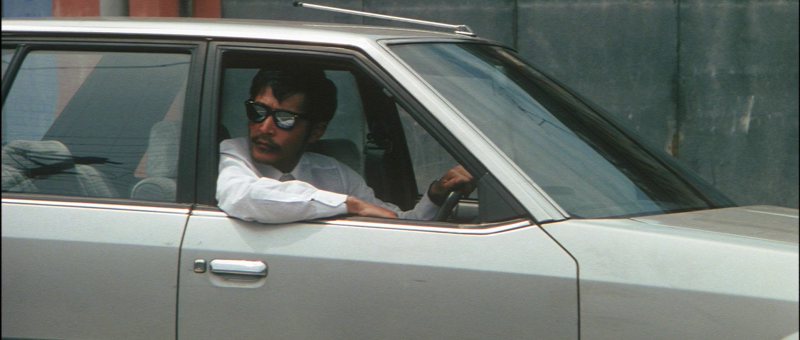
The Japanese title is prefaced by “ninkyo gaiden” which makes it sound like a spin-off to a ninkyo eiga or chivalrous gangster movie, which turns out to be incredibly ironic because there is no chivalry or honour here only cruelty and exploitation. Set in the port of Shimonoseki where boats leave for Korea, the film follows dejected petty yakuza Kondo (Noboru Ando) as fate finally catches up with him. He and his boss Sawaki (Jo Shishido) were once students together and took a job in Busan dealing with the corpses of American soldiers killed in the Korean War. Sent to deliver dog tags to widows, Sawaki spits in a distraught woman’s face and then attempts to rape her, only there is another couple in her home and the man soon wakes to challenge him. Kondo and Sawaki are then drawn into a brutal and ugly fight during which Kondo knocks out the man while Sawaki rapes the widow. The other woman then threatens them with a knife, taking back the dog tag only for Sawaki to pounce and strangle her. Sawaki then flees the scene confused by what he’s done, but Kondo stays behind and rapes the second woman’s corpse before leaving her for dead. 

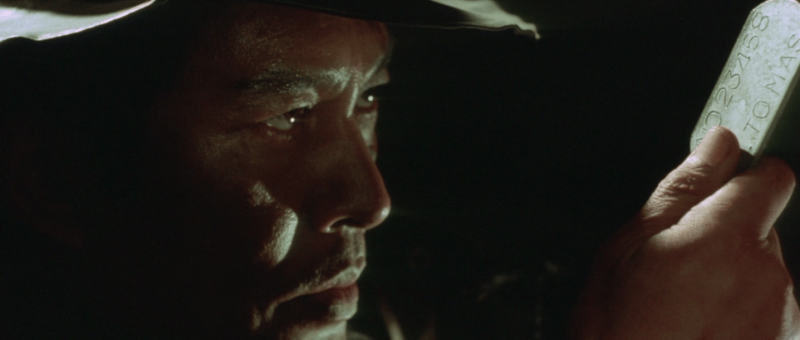
Kondo later relates that he’s been unable to sleep with women ever since his experience of necrophilia in Korea in 1951. Kura often cuts back to the bundle of dog tags Kondo has been keeping all this time which hang by his window like a wind chime. He watches them sway and hears them jingle with the violent motion of Sawaki’s raping the woman, hanging that of, presumably, a random man around the second woman’s neck as he in turn rapes her body. He later finds a woman who reminds him of the one he raped while dead among a cohort of those he’s in the process of sex trafficking who has unwittingly put on one of the dog tags like an ironic necklace while taking a bath in his apartment on the invitation of his more sensitive associate Taguchi (Jinpachi Nezu). On catching sight of Kojun (Reisen Ri), he’s struck by a literal flashback that is a clear homage to Henri-Georges Clouzot’s Les Diaboliques as he watches a “dead” woman rise from a bath. Later he rapes her too, presumably the first (though not the last) “living” woman he’s had sexual contact with in 25 years. 

The dog tags take on a still more ironic relevance in the Korean song which plays over the opening titles and is sung frequently by the trafficked women. The song is sweet and innocent, narrated by a woman who is preparing a “flower garland” for someone that she loves, but its imagery is subverted in Kondo’s grim necklace of dog tags taken from fallen men. Even Sawaki describes him as someone who has been dead for 20 years while preparing to sacrifice him to curry favour with their creepy Tokyo boss Tahara (Taka Ohkubo) who permanently wears black gloves on both hands even while shirtless, while Kondo later sings a song characterising himself as a “black dog” who never stood a chance in this broken world of ruined dreams. Penned by Kura himself and performed by Ando, this song more clearly reflects his absurdist dialogue style in its deeply melancholy imagery as Kondo fully succumbs to his image of death. 

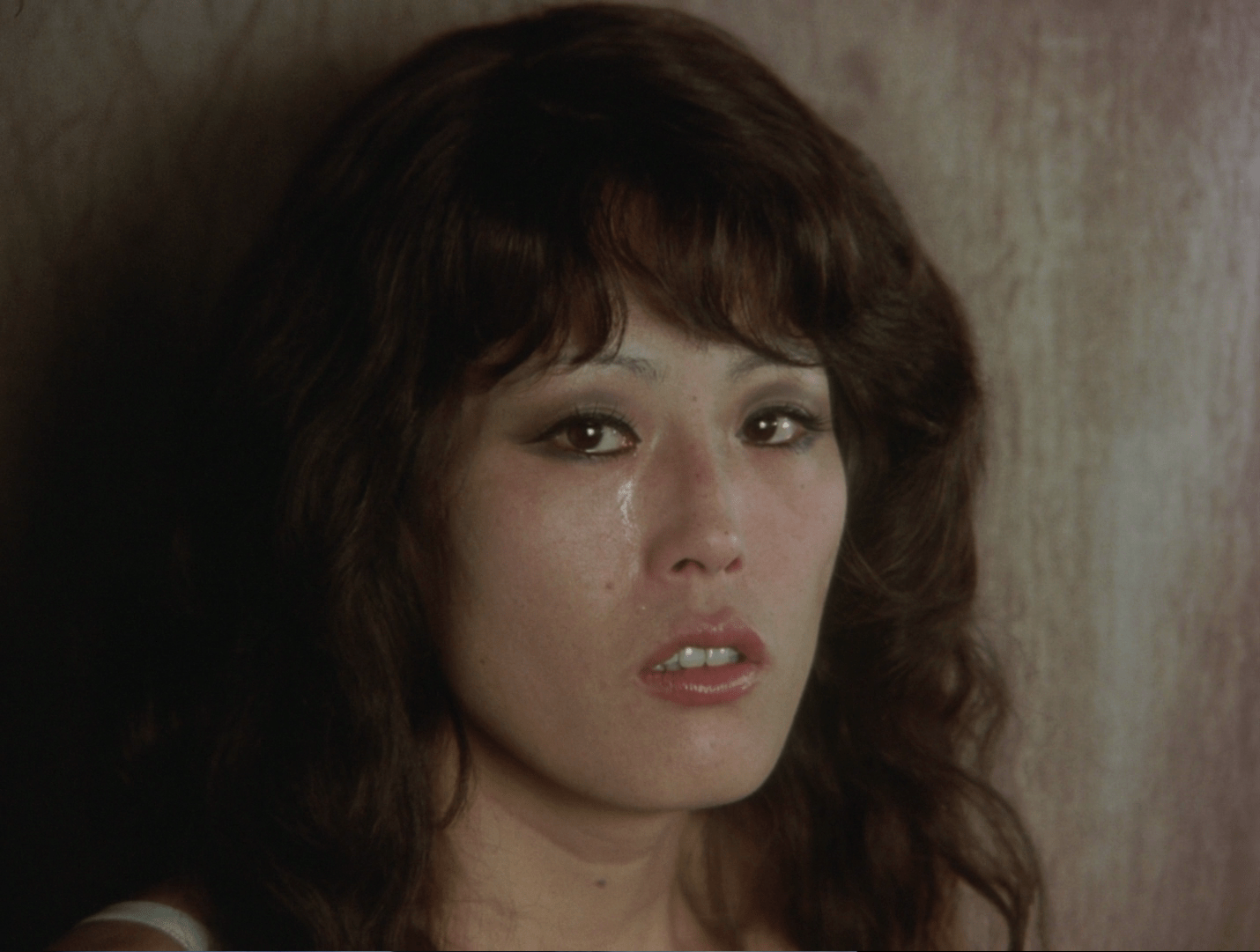
Kondo’s actions come to emblematise the continued violence inflicted on the bodies of Korean women by Japanese men from the colonial era onwards. The woman from the bath, Kojun, suffers continually throughout the film and is later forced to perform in strip shows by the Sawaki gang. She is clever, and fierce, but the world is all against her and the only answers that she ever gets as to why her “uncle” forced her to stowaway on a smuggling boat to Japan only further deepen the wounds inflicted by a deeply corrupted, imperialistic patriarchy. Kojun develops a fondess for Taguchi because he is the only man who doesn’t try to rape her and in fact saves her from being raped though later said to be impotent and rejected by the other gang members for his refusal to participate in their despoiling of the Korean women. Bloodstained underwear becomes a symbol of sexualised violence countered only by the plain white pairs Kojun later buys for Taguchi after replacing her own ruined clothing.  

She and Taguchi attempt to protect themselves by bringing the receipts, threatening to release the smuggling account books and expose a host of dodgy dealings if the Sawaki gang come for them, but in the end there is no escape. Taguchi finds himself wading through oil-soaked waters with his dreams in ruins before finally breaking the chain though it’s unclear if it will really free him. Bleak beyond measure in its deeply tragic denouement, Kara’s intense drama offers no respite from its nihilistic world of violence and exploitation and leaves us quite literally floundering in a dark sea of inevitable corruption. 


Trailer (no subtitles)

꽃목걸이 – 이영숙 (1972)

(꽃목걸이 = “flower necklace”. There doesn’t seem to be an official romanisation of singer 이영숙 (李英淑)’s name, but it does appear in a few places as “‘Iyeongsuk”, or “Lee Young Sook”. A contemporary romanisation would render it as “Lee Yeong-suk”)

Black Rain (黒い雨, Shohei Imamura, 1989)

Caught in a moment of transition, post-war Japan struggles to free itself from the lingering feudal legacy and the trauma of the immediate past in Shohei Imamura’s contemplative adaptation of the novel by Masuji Ibuse, Black Rain (黒い雨, Kuroi Ame). As many things change others stay the same, the Shizuma family burdened not only by the anxiety of a ghostly illness symptomless until it isn’t and the unfair prejudice of a wounded society, but the pressure of outdated patriarchal social codes along with a sense of filial failure in the inability to protect their ancestral estate. 

Imamura opens on the fateful morning the atomic bomb struck Hiroshima, voiceovers from 20-year-old niece Yasuko (Yoshiko Tanaka) and her uncle Shigematsu (Kazuo Kitamura), a soldier severing at a factory in the city, detailing what they were doing on that very ordinary day. What unfolds is a scene of hell, the train Shigematsu is riding on blown apart while he crawls free and tries to look for his wife, Shigeko (Kazuo Kitamura), packing up their house preparing for evacuation, eventually reuniting with Yasuko who had come into town to find them. Hoping to get to the factory, they make their way past charred and hideously warped bodies, a woman cradling her carbonised infant, a little boy overjoyed to have found his big brother only to go unrecognised because his face is melted away while skin hangs painfully from his forearms and fingertips. The brother only accepts him after checking his belt which has somehow miraculously survived. The trio eventually make it to comparative safety at the factory with relatively few injuries, only later learning of the implications of having been in such close proximity to the blast. 

Jumping ahead five years, the Shizumas are living quite comfortably in their ancestral home on a mountain estate largely spared the post-war agricultural land reforms because of its location, though Shigematsu attributes his mother’s dementia to an inability to accept the changing times not only their loss of a semi-aristocratic status but the essential failure of having proved unable to protect their ancestral lands. His immediate problem is however the marriage of the now 25-year-old Yasuko. We see him triumphantly leave a doctor’s office with a certificate stating that Yasuko is in good health he hopes will reassure her current suitor’s family in the face of persistent rumours that she too was a direct victim of the “flash”, rather than an indirect victim simply of the rain which Shigematsu mistakenly believes to have been less dangerous. 

At 25 this is Yasuko’s last chance, she’s aged out of the arranged marriage market. She has also had a promising job offer from the local post office but is minded to turn it down in the hopes of being married. Taking the post office job may be the most sensible option, but it also seems like defeat, an acceptance that she is unfit for marriage and a clear sign that Shigematsu and Shigeko have failed in their patriarchal duties to ensure that Yasuko finds a good husband and will be well looked after for the rest of her life. In this age, it is difficult for a woman to support herself alone even leaving aside the social stigma of being an unmarried woman. A marriage is therefore also a job, and the families fear one Yasuko may not be able to perform if as the rumours suggest her exposure to radiation may have left her unable to bear children. The situation is further complicated seeing as Shigematsu and Shigeko were not able to have children of their own, and with Yasuko’s mother Kiyoko having died young Yasuko is the last of the Shizuma line even if she technically may not bear their name. 

Lost in old memories and mistaking Yasuko for her mother, grandma (Hisako Hara) may have it right when she tells her not to marry for marriage only leads to death. Yet in an odd way, Yasuko’s liminal status perhaps grants her the right to turn away from these old-fashioned patriarchal expectations in making her own decision not marry even if she orients herself back towards the filial in requesting to stay with the aunt and uncle who raised her in order to care for them should they suddenly begin to experience symptoms of their exposure to “the flash”. Shigematsu continues to treat the notion of radiation sickness with an almost supernatural mentality, convinced that having seen the light or not is all that matters constantly trying to provide evidence that Yasuko was not there when the bomb went off while ignoring her exposure to the black rain which fell afterwards even while himself filled with the anxiety of not knowing if he may someday become ill even if he and Shigeko are in otherwise good health. 

He watches friends with secondary exposure become ill and die before him, recalling being asked to read sutras for the dead in the aftermath of the bomb though feeling himself unqualified, while some in the village perhaps jokingly accuse them of playing on their status as bomb victims as if they are merely lazy rather than actively sick. Meanwhile, across the way a young man with intense PTSD suffers flashbacks every time he hears an engine running and is compelled to throw himself in front of it as if it were an enemy tank. Yuichi (Keisuke Ishida) is ironically enough “a veteran of the suicide squad”, otherwise alright if fragile spending his days carving Buddhist Jizo statues may of which have grotesque, anguished expressions in contrast to the comforting, almost cute faces such statues usually bear. Just as the wider society distances itself from the survivors of the bomb, so they reject men like Yuichi. When Yuichi’s mother comes to propose an unlikely marriage between the two lonely youngsters who have become close after bonding through their shared anxieties, Shigematsu is offended, resenting the implication that they must believe Yasuko is a poor catch if daring to suggest she marry a man of a lower social class who is also in need of assistance in living with his mental illness. 

Yet her marriage continues to weigh heavily on Shigeko’s mind, feeling as if she has failed the Shizuma family in being unable to provide an heir and subsequently failing to secure a match for Yasuko. It is perhaps this anxiety that finally makes her ill, taking strange medicines provided by a dubious Shinto priestess who tells her it’s all her own fault for not being able to visit Kiyoko’s grave because someone has to stay at home to look after grandma. Only Shigematsu sees the writing on the wall, advising Yasuko that after grandma dies she should sell the estate and take the money as her dowry freeing her from the feudal and familial legacy and giving her permission to move into the modern post-war future even as she begins to doubt that the future has a place for her. 

Shooting in black and white and in a much more classical style than that which is found in his other work, Imamura adopts the aesthetics of Golden Age cinema to comment on the contemporary era now perhaps feeling itself sufficiently distanced from the toxicity of wartime trauma, suggesting that the entire society is in a sense soaked in black rain its inability to confront the recent past a poison slowly eating away at its foundations. “An unjust peace is better than a just war” Shigematsu is fond of saying, quoting Cicero dismayed by the heated geopolitical debates he hears on the radio he uses to set the clock, his friend dying without ever really understanding why the bomb was dropped, why on Hiroshima, why at that particular moment. Imamura denies us closure too, leaving on a note of anxiety if tempered with an all but forlorn hope for signs of a miracle on the horizon that the sickness can be healed and a better world will someday arrive.


Black Rain screens at the BFI on 28th December as part of BFI Japan and is also available on blu-ray as part of Arrow’s Imamura boxset or to stream in the UK via Arrow Player

The House of Hanging (病院坂の首縊りの家, Kon Ichikawa, 1979)

Unlike many directors of his generation who either shifted into television or saw their careers stall, Kon Ichikawa was able to continue working throughout the difficult 70s and 80s precisely because he was less averse to taking on commercial projects such as 1976’s The Inugami Family, an ensemble mystery adapted from the bestselling book by Seishi Yokomizo and starring his famed detective Kosuke Kindaichi. The film proved an unexpected hit, an early success for Haruki Kadokawa’s new multimedia marketing model which would allow him to dominate cinema screens throughout the bubble era, and spawned a series of Kindaichi adaptations produced for Toho boasting a host of A-list stars. By 1979, however, the age of the prestige country house mystery was perhaps coming to a close and The House of Hanging (病院坂の首縊りの家, Byoinzaka no Kubikukuri no Ie) would be the last in the cycle of movies starring Koji Ishizaka who would eventually return to the role in Ichikawa’s 2006 remake of the original Inugami Family. 

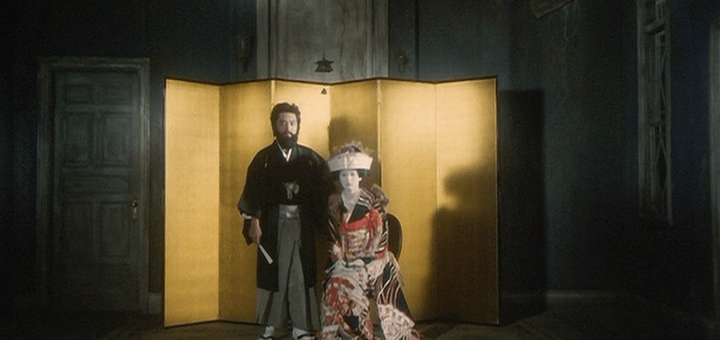
Set quite specifically in 1951 (Showa 26), House of Hanging is among the more complex of Kindaichi’s cases and rests not on war trauma, which is only a background presence in the present venality of the post-war society, but on the decline of a once noble house ruined, as we find out, through the legacy of sexual immorality and abuse. For the moment, however, Kindaichi gets roped into the mystery after visiting an author friend (played by Seishi Yokomizo himself in a cameo) who recommends a photo studio he could visit in order to get a picture taken for his passport as he plans to travel to America. The photographer, Naokichi (Koji Shimizu), takes on an odd job from a strange young woman who asks them to take wedding photos of her sister but abruptly leaves explaining she’ll send a car later to bring them to an undisclosed location. That turns out to be the bombed-out former home of the Hogen family who own the local hospital. Escorted by a creepy young man, Naokichi finds himself in front of a traditional gold screen backdrop but feels uncomfortable because the bride does not seem to be very present and he worries that perhaps she’s been drugged and something untoward may have been going on. He shows the photo to Kindaichi for advice and is later called back to the same location to discover the severed head of the groom hanging from a ceiling light.  

In slightly comedic fashion, the circumstances of the case are so confusing that they have even Kindaichi admitting that he doesn’t quite follow while his temporary sidekick, photographer’s apprentice Mokutaro (Masao Kusakari), proudly holds up a chart he’s made to help keep track. Though the why is in this case more important than it might usually be, it boils down to the same old problem of buried secrets and past shame. We learn that the Hogen family is descended from a line of prominent doctors, though the family tree is complicated because it appears many of the sons of previous generations had illegitimate children, some of whom were later adopted or married to other adopted children in a quasi-incestuous union. With no one quite sure whose children are whose, incest appears to be the original sin which condemns the family, though as we later realise it’s another kind of abuse which sets the present events in motion.

The murdered man, Toshio (Teruhiko Aoi), was apparently part of travelling jazz band earning their living playing on American bases (the photographer also has a sideline in blackmarket army surplus). Aside from the original sin that connects the murders with melancholy fatalism, the additional victims damn themselves through their amoral greed, foolishly engaging in blackmail in the hope of improving their circumstances. Nevertheless, the sin remains the same, the theory being that Toshio was murdered by missing sister Koyuki who killed him in order to escape his inappropriate romantic obsession with her. The additional complication is that Koyuki looks near identical to Yukari (Junko Sakurada), daughter of the Hogen family, connecting the crime with the traumatic events of some years’ previously which led to the cottage becoming known as the “house of hanging” when the body of a young woman was found there having taken her own life. 

As in many of the other Kindaichi mysteries, the detective has only sympathy for those caught up in this complicated murder plot, many of whom are also victims acting simply to protect themselves ironically enough from the past trauma that has in a sense led to this sorry turn of events. Justice, in the end, takes care of itself though Kindaichi will also do his bit to protect those in need acting from a place of moral compassion rather than judicial censure. This final instalment in the Kindaichi cycle has slightly lower production values and a much less starry ensemble but sees Ichikawa adding a few idiosyncratic touches such as his fast, multi-angle cuts to a single person’s speech and a brief theatrical reconstruction sequence, while making time for the return of bumbling inspector Todoroki (Takeshi Kato) and the ironic comedy the series is known for. “Old things pass, that’s when new things are born” Yokomizo sagely advises in his cameo, Kindaichi apparently taking his leave from a corrupted post-war Japan for the bright lights of San Francisco, perhaps never to return. 


Original trailers (no subtitles)

Sasuke and His Comedians (真田風雲録, Tai Kato, 1963)

Criminally unknown in the Anglophone world, where Tai Kato is remembered at all it’s for his contribution to Toei’s ninkyo eiga series though his best known piece is likely to be post-war take on High Noon made at Shochiku, By a Man’s Face Shall You Know Him in which a jaded doctor finds himself caught in the middle of rising tensions between local Japanese gangsters and Zainichi Koreans. Kato’s distinctive visual style shooting from extreme low angles with a preference for long takes, closeups and deep focus already make him an unusual presence in the Toei roster, but there can be few more unusual entries in the studio’s back catalogue than the wilfully anarchic Sasuke and his Comedians (真田風雲録, Sanada Fuunroku), a bizarre mix of musical comedy, historical chanbara, and ninja movie, loosely satirising the present day student movement and the limits revolutionary idealism. 

An opening crawl introduces us to the scene at Sekigahara, a legendary battle of 1600 that brought an end to Japan’s warring states period and ushered in centuries of peace under the Tokugawa. Onscreen text explains that this is the story of the boys of who came of age in such a warlike era, giving way to a small gang of war orphans looting the bodies of fallen soldiers and later teaming up with a 19-year-old former samurai realising that the world as he knew it has come to an end. Soon the gang is introduced to the titular Sasuke who, as he explains, has special powers having been irradiated during a meteor strike as a baby. Recognising him as one of them, the war orphans offer to let Sasuke join their gang, but he declines because he’s convinced they’ll eventually reject him in fear of his awesome capabilities. Flashing forward 15 years, the kids are all grown up and the only girl, Okiri (Misako Watanabe), is still carrying a torch for Sasuke (Kinnosuke Nakamura) who dutifully reappears as the gang find themselves drawn into a revolutionary movement led by Sanada Yukimura (Minoru Chiaki) culminating in the Siege of Osaka in 1614. 

Don’t worry, this is not a history lesson though these are obviously extremely well known historical events the target audience will be well familiar with. A parallel is being drawn with the young people of early ‘60s Japan who too came of age in a warlike era and who are now also engaging in minor revolutionary thought most clearly expressed in the mass protests against the ANPO treaty in 1960 which in a sense failed because the treaty was indeed signed in spite of public opinion. Kato’s Sanada Yukimura is a slightly bumbling figure, first introduced banging his head on a low-hanging beam, wandering the land in search of talented ronin to join up with the Toyotomi rebellion against the already repressive Tokugawa regime. His underling sells this to the gang as they overlook a mile long parade of peasants headed to Osaka Castle as a means of bringing about a different future that they can’t quite define but imply will be less feudal and more egalitarian which is how they’ve caught the attention of so many exploited farmers. 

Of course, we all already know how the Siege of Osaka worked out (not particularly well for anyone other than the Tokugawa) so we know that this version of the 16th century better world did not come to pass the implication being that the 1960s one won’t either. The nobles are playing their own game, the Toyotomi trying to cut deals but ultimately being betrayed, while the gang fight bravely for their ideals naively believing in the possibility of victory. Sasuke, for his part, is a well known ahistorical figure popular in children’s literature and this post-modern adventure is in essence a kids’ serial aimed at a student audience, filled with humorous anachronisms and silliness while Kato actively mimics manga-style storytelling mixed with kabuki-esque effects. Boasting slightly higher production values than your average Toei programmer, location shooting gives way to obvious stage sets and fantastical set pieces of colour and light which are a far cry from the studio’s grittier fare with which Kato was most closely associated. That might be one reason that the studio was reportedly so unhappy with the film that it almost got Kato fired, but nevertheless its strange mix of musical satire and general craziness remain an enduring cult classic even in its ironic defeatism. 


Original trailer (no subtitles)

Rex: Dinosaur Story (REX 恐竜物語, Haruki Kadokawa, 1993)

Like him or loathe him, Haruki Kadokawa was the dominant force in commercial Japanese cinema from the mid-70s to the end of the Bubble era. Thanks to his circular marketing approach which involved producing movie adaptations of books his company published starring idols he had under contract at his movie studio and releasing the theme songs they often sang to accompany them on his record label, Kadokawa had a virtual stranglehold on ‘80s pop culture. All that came to an end, however, in 1993 when he was arrested for cocaine use/smuggling and accused of embezzling money to pay for his habit, eventually winding up with a four-year jail sentence. Despite all of that, Rex: Dinosaur Story (REX 恐竜物語, Rex: Kyoryu Monogatari) was until the release of Lord of the Rings in 2002 the highest grossing movie distributed by veteran studio Shochiku and was due to extend its 10-week run but was ultimately pulled early because of the “moral embarrassment” surrounding its director’s arrest. 

That moral panic might be all the more acute because as the title and poster might imply, Rex: Dinosaur Story is a tentpole family film released, despite its Christmas setting, at the height of the summer season and in the wake of Jurassic Park with an obvious eye on merchandising (much of which actually appears in the movie). The slightly ridiculous story revolves around 10-year-old Chie (Yumi Adachi) whose parents have recently split up with her mother Naomi (Shinobu Otake), a professor of veterinary medicine, heading to New York for an exciting work opportunity while she’s stayed behind with her nerdy father Akira (Tsunehiko Watase), a researcher of Japan’s Jomon period, and moved in with her maternal grandmother (Mitsuko Kusabue) at a Hokkaido ranch. Little Chie is it seems finding it hard to adjust and has become very withdrawn, refusing to answer when expected to introduce herself at her new school. Mostly she spends her time alone on the farm hanging out with the family dog and riding a horse while drawing pictures of her longed-for mother in a stylish Edwardian outfit with the farmhouse in the background. 

Meanwhile, Akira has made a discovery. A Jomon statue appearing to feature a boy riding on the back of a dinosaur along with a collection of shards he thinks are from a dinosaur egg have convinced him that dinosaurs may have survived in Japan until the Jomon period and perhaps may survive still. Intrigued by a message on a stele that advises one should not advance any further because a giant god is living further up the mountain, Akira takes his daughter and a handful of researchers to meet an Ainu priest (Fujio Tokita) who eventually leads them to a grotto where they find a giant dinosaur egg, narrowly escaping with it after having angered the gods. Akira and the researchers eventually hatch the egg, giving birth to Rex and allowing Chie to become his “mother”.

The egg’s discovery eventually hastens Naomi’s return, but she virtually ignores her daughter greeting her with nothing more than a curt hello while making it plain she’s only here to work on the historically significant discovery not patch up her family. Chie’s relationship with Rex is, in many ways, a way of bonding with her aloof mother who, it has to be said, comes in for a lot of slightly misogynistic criticism as a woman who “abandoned” her daughter to chase career success. Nevertheless, through parenting Rex Chie comes to understand something of motherhood while recognising that she and Rex are essentially the same and that he is most likely lonely missing his dinosaur birth mother. 

Meanwhile, she’s also acutely aware that not everyone has Rex’s best interests at heart. The birth of a cute baby dinosaur is obviously front page news with the consequence that Rex becomes the moment’s biggest celebrity trotted out for a host of TV commercials (featuring a cameo by Kirin Kiki) one of which has Chie and Rex perhaps insensitively sitting down to enjoy a wholesome family meal of Japanese curry. Aside from the irony, Chie’s attempt to suggest that they take break because Rex is after all a baby and he’s tired results in one of the other scientists, Morioka (Mitsuru Hirata), physically abusing him. Sidelined from the project, he enacts a dastardly plan to steal Rex for himself, turning up with four minions dressing like he’s just joined the Gestapo. 

In typical kids movie fashion, Chie and Rex end up on the run through a weird Christmas wonderland in which religious ceremonies and Santa mingle freely, a choir full of children led by her schoolfriend Kenta (Yuta Yamazaki) eventually aiding their escape by throwing snowballs at the bad guys. Chie’s attempts at “disguise” may be laughably bad, but it seems so many people are indulging in Rex cosplay that it becomes possible to blend in even while travelling with a dinosaur companion wearing a Santa hat and sunglasses. Nevertheless, the lesson that Chie begins to learn is that sometimes mothers have to separate from their children but it doesn’t mean they love them any less or that it doesn’t make them sad. Incongruously relegating the “happy ending” to a post-credits sequence, Rex’s distinctly Mid-Western aesthetic with its Dorothy-esque Hokkaido ranch coupled with the fantastical Jomon-era/Ainu mythology lend it a rather strange flavour but it remains an oddly nostalgic experience even as it lifts gleefully from its Hollywood contemporaries. 


Original trailer (no subtitles)

Let Him Rest in Peace (友よ、静かに瞑れ, Yoichi Sai, 1985)

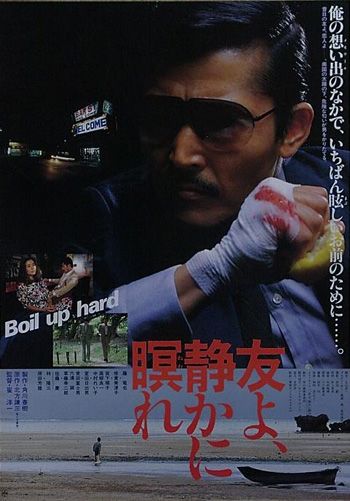
“There are times when you need to stand for something” according to an ultra masculine avenger giving a few lessons in manliness to the already defeated teenage son of a friend. A noirish, stranger in town affair, Yoichi Sai’s Let Him Rest in Peace (友よ、静かに瞑れ, Tomo yo, Shizukani Nemure) locates itself in an awkward frontier landscape, moribund small-town Okinawa seemingly devoid of life now that the Americans have pulled out and moved on. The Americans have, however, been “replaced” by beefed up corporate thugs backed by yakuza muscle and corrupt police. Sometimes you have to take a stand, if only to show them that you won’t be pushed around because if you give in once you’ll never be free. 

Disgraced doctor Shindo (Tatsuya Fuji) has come to Okinawa in search of the Freein, but every time he tries to ask someone for directions, he is met with intense hostility, the last man even telling him “You shouldn’t go there, that place is no good”. This is not because the Freein is mostly home to a collection of brassy sex workers, but because its owner and Shindo’s old friend whom he has come to help has become a local pariah. Sakaguchi (Ryuzo Hayashi) is currently in jail because he apparently went crazy and started waving a knife around at construction magnate Shimoyama (Kei Sato). As Shindo quickly finds out, Shimoyama is in the process of buying up the whole town and Sakaguchi is the last remaining hold out. As such, he is hated by most of the other residents and the subject of persistent harassment by Shimoyama goons who have not only thrown bricks through the windows but gone so far as to kill his son’s dog, later kidnapping the boy to put pressure on the pair of them. 

What’s not lost on Shindo is the extent to which Shimoyama’s corruption has already seeped into the town. Meeting Sakaguchi’s son Ryuta (Makoto Mutsuura) by chance, Shindo takes the boy to see his dad but is again met with hostility by the local bobby, Tokuda (Hideo Murota), who tells him that “Shimoyama Construction is the savour of this town”. “There’s no other company that is so giving”, he goes on, “to have the employees of a company like that working here, I can’t have a wild man like Sakaguchi running about”. According to Tokuda, Sakaguchi is the odd man out, an inconvenience to all those around him who believe in Shimoyama and are trying to save the town. Tokuda looks sheepish when Shindo asks him why he’s so into Shimoyama, confirming the mild suspicion aroused by his improbably fancy watch. 

Tokuda’s warning is however borne out by the townspeople who continue to shun and ignore Shindo while the other kids mercilessly bully Ryuta, calling him the “craziest kid in Japan” and calling for his dad to get the death penalty despite the fact that all he seems to have done is aggressively wave a fruit knife at the wrong person. The local cafe owner describes him as an embarrassment and accuses him of holding out to get more money. After all there’s no future in this tinpot town which seems to exist in the ruins of the post-war era and Shimoyama is already offering triple the going rate so Sakaguchi is only being greedy and selfish. Komiya (Ryoichi Takayanagi), the bellboy, if you could call him that, at Freein, spins it slightly differently, explaining that no one supported Shimoyama in the beginning but they’ve all been harassed themselves and have long since given in. Shindo convinces Ryuta to talk about his kidnapping, but Ryuta tells him that on his return he told his father they should leave, that it was pointless to resist. Shindo asks him if he’s ever been in a fight, but the boy asks what the point is if you know you’re going to lose, “the strong are always strong”. 

That kind of defeatist thinking is anathema to Shindo’s conception of manhood. Despite his father’s incarceration, Ryuta is too afraid of being kidnapped again to go to school. Trying to be nice about it, Shindo calls him a coward for telling his father to leave even though he wants to stay because he allowed himself to be threatened into sumbmission. He tells him that he has to stand up for himself, report his kidnapping to the police. Ryuta tells him he’s crazy, the police are in on it, but Shindo counters that it’s worth trying to get his father out of jail because if they don’t they’ll never know. Ryuta snaps back that he knows already, and indeed bottles his chance when Shindo manipulates Tokuda into “helping” him oppose Shimoyama’s cult-like hold over the town.  

Shindo might not be that much better, he’s prepared to fight dirty, getting hard evidence of Tokuda’s corruption and trying to use it against him but even these methods prove ineffective against such a vast and entrenched mechanism of control. Shindo also realises that Shimoyama’s minion Takahata (Yoshio Harada) is another old university classmate, a member of the boxing club, bringing this widening drama down to the level of three men who went to the same prestigious university but all ended up here, pretty much at rock bottom. Though ironically enough Shindo’s broody silence and dedication to his friend have a few of the women wondering if he might be gay, his preoccupation is with a failure of masculinity. He doesn’t think Shindo was actually capable of threatening anyone, and knows that he had reasons that he might have wanted to try and sort this out sooner rather than later. His son’s words pushed him over the edge. He used his body as a weapon, tried to make Shimoyama damn himself, but his efforts were frustrated. Shindo acknowledges that “saving” his friend might look quite different than one might think, inadvertently teaching young Ryuta a few problematic lessons about what it means to be a man. Still, the town might have been “saved” in one sense at least in being freed of this particular oppressor. A stand has been taken, and a man’s self worth restored, but as Sakaguchi’s wife (Mitsuko Baisho) points out even while fully understanding the codes by which the men around her live, what is to become of those left behind?


TV spots (no subtitles)

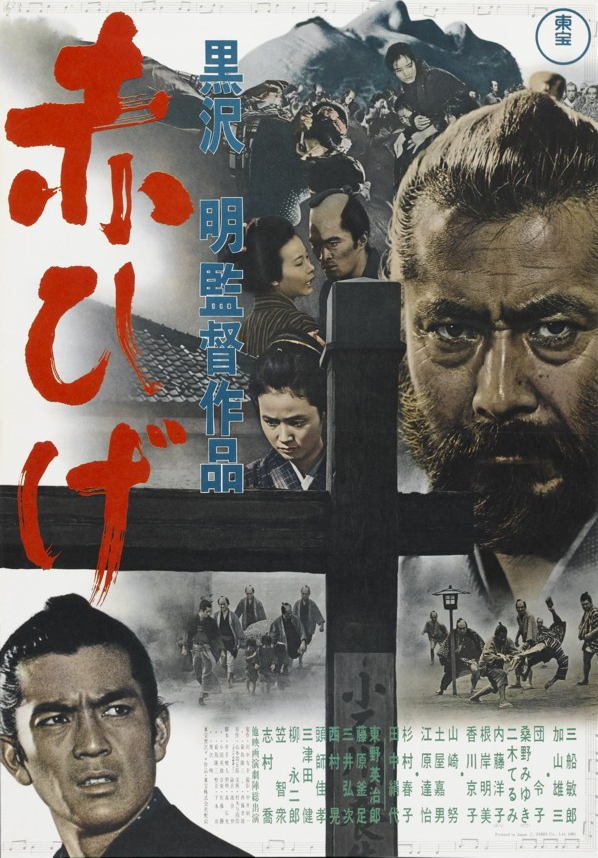
Red Beard (赤ひげ, Akira Kurosawa, 1965)

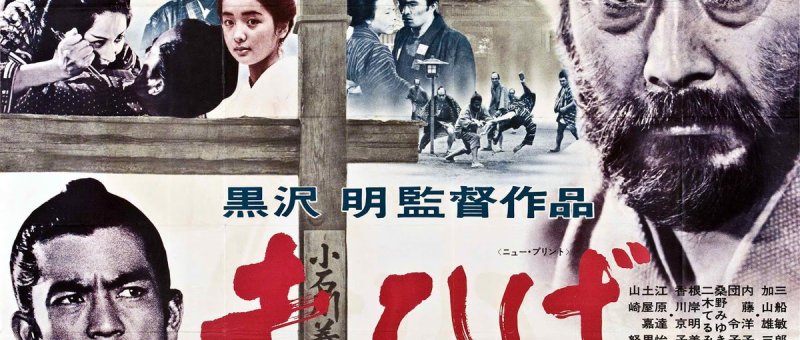
Red Beard posterAkira Kurosawa may be the most familiar golden age director of Japanese cinema to international audiences, but he was in many senses somewhat atypical. Where many of his contemporaries were eager to tell the stories of women, Kurosawa’s films are resolutely male and where many were keen to find the good among the bad, Kurosawa was often keen on the reverse. Nevertheless, that does not mean that he did not see goodness, merely that it was something which needed to be rooted out and fought for rather than simply permitted to exist. His final collaboration with Toshiro Mifune, Red Beard (赤ひげ, Akahige) finds the director at his most optimistic, fully embracing his natural tendency towards humanism even while making plain that goodness can often be hard to find, especially within yourself, and there may be no real cure for injustice but you have to treat the symptoms anyway.

The tale begins at the close of the Tokugawa era as a young doctor, Yasumoto (Yuzo Kayama), pays a courtesy call to the Koishikawa public clinic presided over by an old friend of his father’s, Doctor Niide (Toshiro Mifune) – otherwise known as “Red Beard”. Yasumoto, having just graduated from studying under the Dutch in Nagasaki, had only intended to make a brief visit on his way home and is therefore shocked to realise that he has been tricked into accepting a position at a hospital for the poor.

Our introduction to the Koishikawa clinic is through the eyes of Yasumoto as he receives a tour from another doctor who loudly remarks that he is glad that Yasumoto has now arrived because that means he can finally be free of this wretched place. Yasumoto’s nose wrinkles on smelling the “rotting fruit” of the poor waiting for afternoon appointments, while one of the patients complains about the “sterility” of the environment and his plain hospital clothes before a genial inpatient, Sahachi (Tsutomu Yamazaki), explains the reasoning behind such austerity and praises the attention to detail of head doctor Red Beard who has thought carefully about the best way to ensure his patients experience the best of care.

Yasumoto is extremely displeased by his predicament. He had believed himself on track to become a royal doctor working for the Emperor and being sent to poor clinic seems like a poor joke. He is indeed extremely full of himself, refusing to surrender his medical notes from Nagasaki as if he had made some great discovery and hoped to profit from it. Hoping Red Beard will fire him, Yasumoto behaves like a petulant child – refusing to wear his uniform, deliberately stepping into areas he knows are out of bounds, refusing to see patients, and just generally being unpleasant to have around. Red Beard is stoic and patient, though it gradually becomes apparent that perhaps Yasumoto has been sent here deliberately for a humbling everyone believes he had coming to him. Asked to perform the most routine of tasks, Yasumoto is forced to realise that the medical knowledge of which he was so proud is mostly book learning. He doesn’t know how to diagnose a living patient, has never been present at an operation, and has never sat with someone while they died knowing there was nothing more he could do for them. Reluctantly, he has to accept that the advice he received from the other doctors on his first day, that there was much to be learned here for those who wanted to learn it, was as true as it could be.

The first half of the film is indeed Yasumoto’s humbling as he begins to come around to the mysterious workings of Red Beard who gradually leads him to understand his first duty as a doctor is help those in need. Then again, Red Beard is an unwilling mentor. He is fully aware of the corruptions of the world in which he lives but has made a decision with which he remains conflicted to bend them to his advantage. Enraged to discover his government funding is being cut, Red Beard deliberately over charges the local lord whom he, amusingly enough, puts on a diet as he snorts like a piggy short of breath thanks to his unhealthy life of luxury. He also blackmails another local lord to save a young mother who turned a knife on an abusive husband, and later uses his medical knowledge to unfair advantage to take out a whole gang of yakuza. Red Beard isn’t sure he’s in a position to become anyone’s role model, but that only seems to make Yasumoto respect him more.

Nevertheless, there is darkness too in Red Beard’s philosophy. The real enemy here and perhaps everywhere is poverty and the selfishness which enables it. Most of the diseases Red Beard treats in his clinic are a direct result of impoverished living, mostly those of malnutrition and overwork as well as the necessity of living in cramped, unsanitary conditions. Yasumoto, a young man of means, has a puffed up sense of self and a natural ambition that tells him he is destined for the court and so he looks down on these unfortunate people as something other, something that does not concern him and is not worthy of his attention. He won’t put on his uniform out of spite, but eventually relents when Sahachi explains to him that the uniform marks him out as member of the clinic meaning that ordinary people who cannot afford to pay a doctor know that he is someone they can ask for help when no one else will help them.

As Red Beard says, there may be no real cures for disease. All they can do is fight poverty and mask their ignorance. Yasumoto learns by experience. He discovers the rampant injustice of his society in the sad stories that he hears. A “mad” woman who became a serial killer after years of childhood abuse, a woman who rejected a good father out of fear and allowed a bad mother to marry her to a bad man who was also her mother’s lover, a little girl adopted by a cruel madam who turned in on herself when she tried to press her into sex work at only 12 years old, a sex worker suffering with syphilis but too valuable to be released and sent home. This world is built is built on female suffering which is not, perhaps, something which Red Beard is in much of a position to treat.

The mad woman tries to hang herself and Red Beard wonders if it would have been kinder let her die, while the mother of a family who decided on group suicide asks him what the point was in saving her. The world is not an easy place to live in, but Red Beard’s prescription is refreshingly simple. One heals oneself by helping others, as he proves to Yasumoto through making him both doctor and patient to a wounded little girl who then passes her new found humanity on to another needy soul eventually reformed by kindness alone. Day by day, Red Beard goes to war against selfishness and indifference, treating the symptoms in order to undermine the disease which has infected his society in the hope that it might eventually decide to cure itself.


Original trailer (No subtitles)

The Devil’s Ballad (悪魔の手毬唄, Kon Ichikawa, 1977)

Devil's Ballad posterA year after his box office smash The Inugami Family, Kon Ichikawa returns to the world of eccentric detective Kosuke Kindaichi with The Devil’s Ballad (悪魔の手毬唄, Akuma no Temari Uta). Like many a Kindaichi mystery, Devil’s Ballad finds him called upon to delve back into the past to satisfy an ageing detective’s anxiety about an old case, only to be faced with a series of new ones as a consequence. This time, however, the mystery leans less on buried secrets than deeply held grudges, betrayals, and lingering feudal feuds as the post-war society tries and fails to free itself from ancient oppressions.

The film opens with a tryst between two adolescent lovers in the ominously named “Devil’s Skull Village” in 1950. Yasu (Yoko Takahashi), the girl, is at pains to let her boyfriend, Kanao (Koji Kita), know that she is keen to take the relationship to the next level but he is old fashioned and wants to wait until their union is formalised. The pair are interrupted by some of their friends who are in the middle of planning a celebration for a visit from a girl who moved to the city, Chie (Akiko Nishina). Meanwhile, Kindaichi (Koji Ishizaka) has arrived at the inn owned by Kanao’s mother Rika (Keiko Kishi) on invitation from a retired policeman, Isokawa (Tomisaburo Wakayama), who wants Kindaichi to look into the murder of Rika’s husband twenty years ago. Isokawa, then a young rookie, is convinced that Rika’s husband was not the victim but the murderer and the corpse actually belonged to another man entirely – Onda, a drifter who defrauded half the village with a wreath making scam.

Rika and her children – 20-year-old Kanao and his younger sister Satoko (Eiko Nagashima) who has prominent facial birthmarks and rarely leaves the house, came to the village with her husband and are therefore slightly divorced from the longstanding social rivalries. The village has two noble families – the Yuras and the Nires. Feeling the need to modernise, the Nires bet everything on vineyards and it paid off. The Yuras, by contrast, were defrauded by Onda’s wreath scam and lost their fortune and social standing. Yasu, Kanao’s girlfriend, is a daughter of the Yuras, but the Nire’s have been petitioning Rika for quite some time to have her son marry their daughter, Fumiko (Yukiko Nagano), who also has a crush on him (though this is largely irrelevant to her father’s dynastic ambitions). When the younger generation start getting bumped off in ways eerily similar to a local folk song, Kindaichi and Isokawa are on the case, wondering if these new murders have anything to do with their old one.

Despite its 1950 setting, Devil’s Ballad is unusual in resolutely making an irrelevance of the war which only receives a brief mention as an explanation for why some of the case files have been destroyed and for why marriage is such a hot button issue given the lack of men and abundance of women. Nevertheless, the crimes span a turbulent 20 years of Japanese history with the original murder taking place in the early ‘30s during a period of economic instability following the Manchurian Incident. In the socially conservative pre-war era, it seems Onda also got around and may have fathered several illegitimate children with women in the village, some of them noble, some not. These buried secrets seem primed to bubble to the surface now that the children are coming of age and marriage again becomes an issue as worried parents try to think of acceptable ways to block potentially “inappropriate” matches without sending their children off into ruinous elopements or tipping off the wrong people that their kids may not be their kids.

The crimes themselves, old fashioned as they are, are partly reactions to a changing society. We discover that the reason Rika and her husband were forced to come back to the village was that their showbiz careers were stalling – she was a vaudeville performer specialising in shamisen, and he a “benshi” (narrator of silent films) who became convinced his job was obsolete after witnessing a subtitled print of Morocco. Likewise, the two rival families cannot let go of their petty provincial privileges, and as Kanao angrily snaps back at his mother, Japan is now a democratic country and he is free to choose his own wife at a time of his own choosing with or without parental blessing. This remote village is perhaps isolated from the privations of the post-war world but it’s also stuck in the past, hung up on past transgressions and unable to move forward into the new era. However, the primary motivations for murder are as old as time – guilt, humiliation, and self preservation.

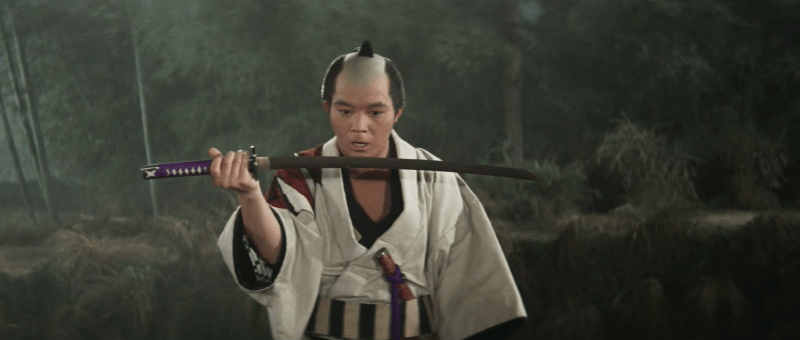
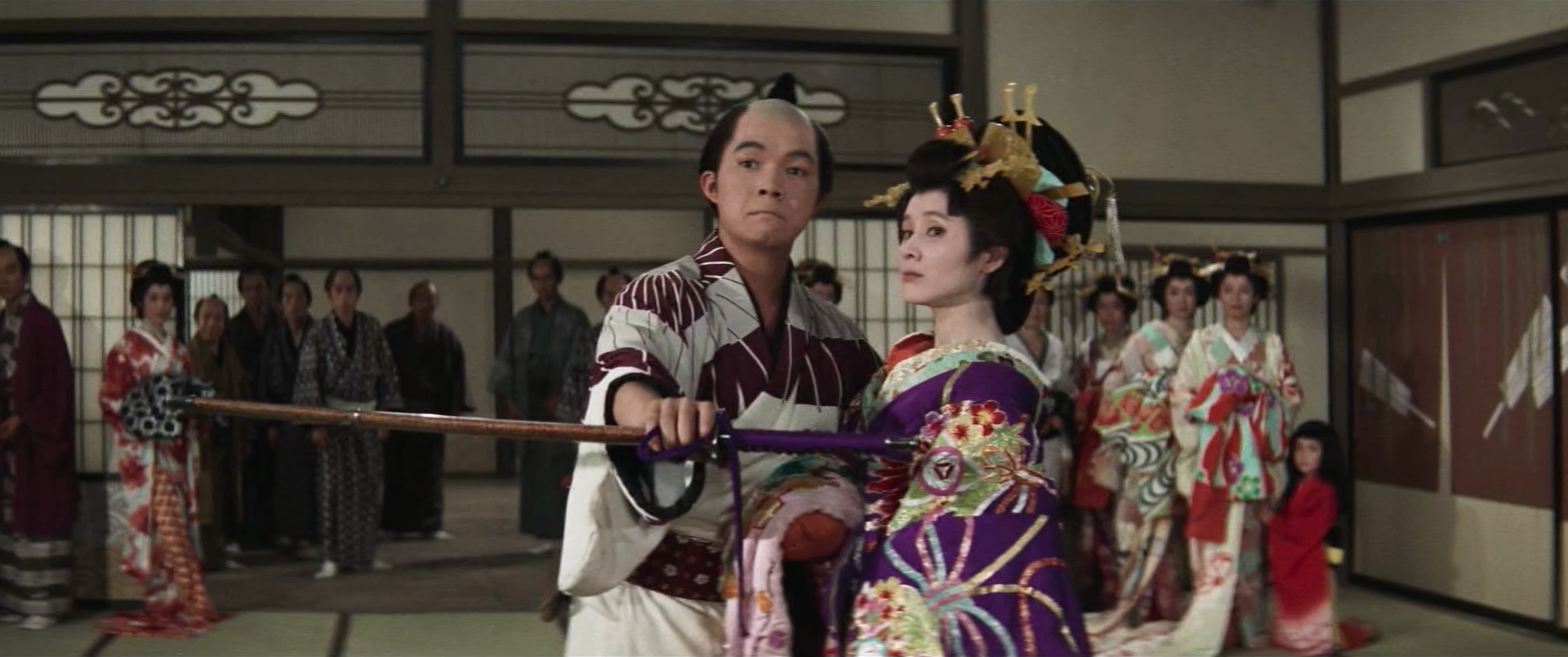
Ichikawa keeps things simple but splices in a few strange, avant-garde sequences of kokeshi dolls menacingly bouncing balls coupled with shifts to black and white, fast-paced reaction shots, and stuttering still frame sequences all while Kindaichi showers innocent passersby with his famous dandruff, the idiot police officer continues to offer ridiculous theories while his sergeant dutifully follows him around, and the local bobby perfects a line in hilarious pratfalls. Overlong at two and a half hours and falling prey to the curse of the prestige crime drama in spoiling its mystery through casting, the Devil’s Ballad may not be the best of the Kindaichi mysteries but offers enough of a satisfying twist to prove worthy of the Kindaichi name.


Original trailer (no subtitles)

The Ballad of Narayama (楢山節考, Shohei Imamura, 1983)

ballad of narayama imamura 1983 posterWhen Keisuke Kinoshita decided to dramatise The Ballad of Narayama (楢山節考, Narayama Bushiko), adapted from a recent novel inspired by the ancient legend of “ubasute”, he recast it is as myth – a parabolic morality play adopting the trappings of kabuki to tell a timeless tale of transience and sacrifice. As much as Kinoshita praised the heroine’s kindness and altruistic sense of duty, he also questioned her failure to question the cruel and arbitrary social codes which defined her life, sacrificing her deep familial love for the cold austerity of religious reward. Shohei Imamura, slightly younger than Kinoshita, had also read the novel when it came out though he was not sufficiently progressed in his career to have considered adapting it for the screen. Unlike Kinoshita’s highly stylised approach, Imamura opts for his trademark sense of realism, exposing nature red in tooth and claw as he attempts to restore rural earthiness to the rarefied cinema screen.

Deep in the mountains, a small village does what it can to survive in harsh terrain. 69-year-old Orin (Sumiko Sakamoto) is as strong as they come but she is preparing to meet her end. In the villages of these parts, men and women of 70 are carried by their children to summit of Mount Narayama where they are left as a sacrifice to the god, praying for snow to hasten an otherwise long and drawn out death. Orin’s husband disappeared 30 years ago, the laughing stock of the village for his sentimental aversion to carrying his own mother up the mountain, and her son, Tatsuhei (Ken Ogata) seems equally reluctant to accept that Orin will making her own journey as soon as the next snows arrive.

Existence is indeed cruel. The custom of “obasute” or “throwing away” one’s old people, originated because of a lack of food. There not being enough sustenance to support a large population, the old sacrifice themselves in the name of the young. Life is cheap and of little consequence. Tatsuhei’s simple-minded younger brother, Risuke (Tonpei Hidari), notices the body of a newborn baby emerging from the melting snow to the edge of his rice paddy but the sight does not disturb or sadden him – he is annoyed that someone has “dumped” their “rubbish” on his land. Baby boys, oddly, are worthless – just another mouth to feed until it becomes strong enough to work, but baby girls are a boon because they can be sold. Orin herself sold her baby daughter in desperation following a bad harvest, and when the salt seller calls in unexpectedly Orin is at pains to tell him they’ve still not made a decision as to whether to sell her granddaughter who has been left without a mother following the death of Orin’s daughter-in-law in a freak accident.

She needn’t have worried however because the salt seller is bringing good news – a new wife for Tatsuhei, meaning Orin can make her final journey with an unburdened heart knowing that the household will be taken care of. Tamayan (Aki Takejo), a kind and cheerful woman much like Orin herself, fits right in despite the objections of Tatsuhei’s teenage son, Kesakichi (Seiji Kurasaki), who has got his girlfriend pregnant and wants to “marry” her – bringing not one but two extra mouths into his household. Orin loves him dearly, but all Kesakichi can do is make fun of his granny for still having all her teeth and resentfully enquire if she isn’t needed somewhere up a mountain sometime about now.

Kesakichi’s coldness and selfishness is contrasted with the goodness and warmth of Orin and her son. Hardship, far from bringing people together in their shared struggle, has made beasts of all. Imamura splices in frequent shots of animals copulating or feasting on each other – rats gnawing on the body of a snake giving way to a snake swallowing the body of a twitching grey mouse. Yet it is nature that will win in the end. Early on the village men chase a hare in the snow, Tatsuhei shooting it dead, only for an eagle to swoop down and make off with the prize. On the mountain, strewn with bones, a host of flapping crows emerges from a battered rib cage. 

Catching a thief is no different to catching a hare. Convinced that the thief’s family is a curse on the village, the villagers determine that they must all be eliminated – the roots of a poisoned tree must be burned away. Breaking into the home, friends and former neighbours tie up and kidnap an entire family, burying them alive and then redistributing all their worldly goods in “recompense” for what they’d “lost”. The cycles of loss and redistribution continue, as Tatsuhei observes finding Orin’s belongings draped around other shoulders. Kesakichi, having lost one lover, quickly takes another forgetting the first while Tatsuhei struggles to come to terms with the loss of his mother and the knowledge that someday he too, and Kesakichi, and the sons of Kesakichi, will make this same journey to this same spot.

Kinoshita’s secondary concern had been with the cruelty of the custom and the mechanisms of social conformity which enforced it, but Imamura almost seems to be in agreement with the villagers, finding horror but also beauty in the sacrifice of Orin who accepts her fate with transcendent beatification and willingly sacrifices herself to the mountain gods. The world is cruel, and tender. A son’s acceptance of his mother’s sacrifice becomes the greatest expression of a love he must destroy by honouring.


Original trailer (no subtitles)