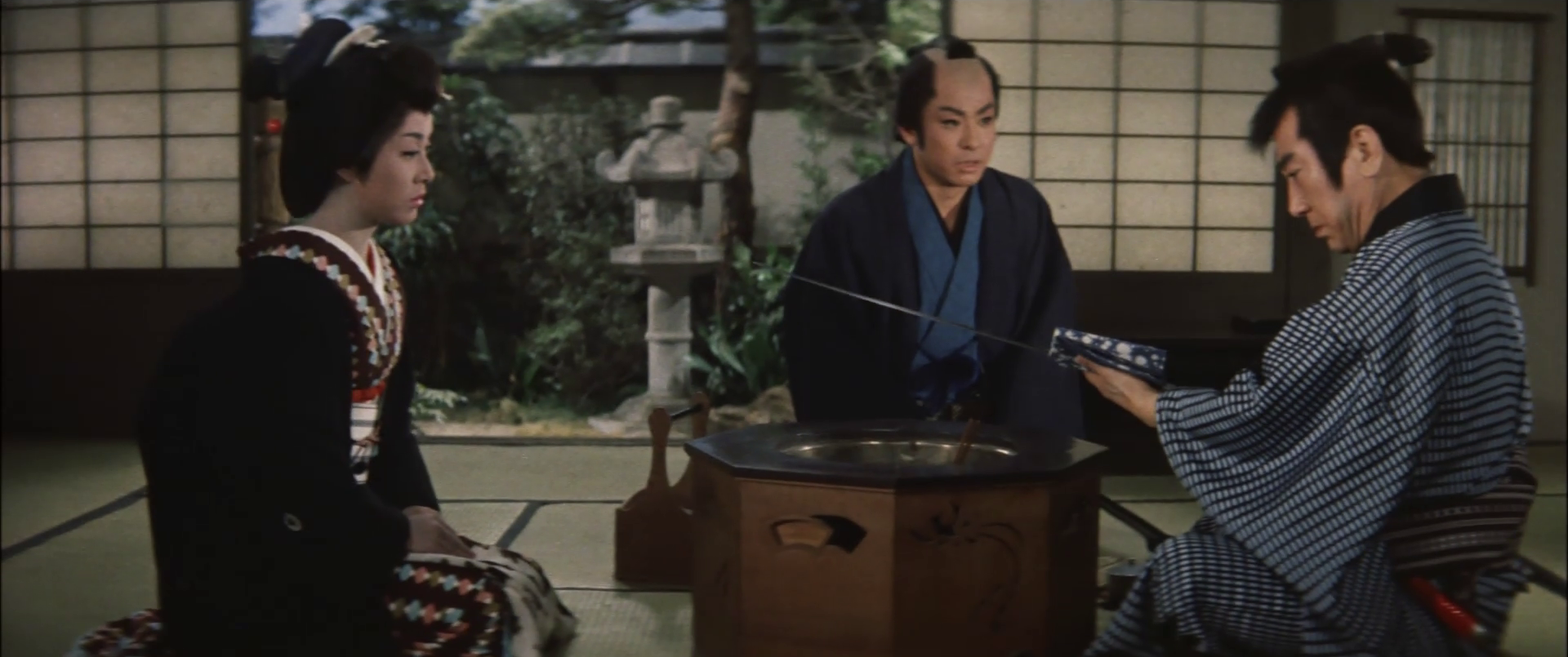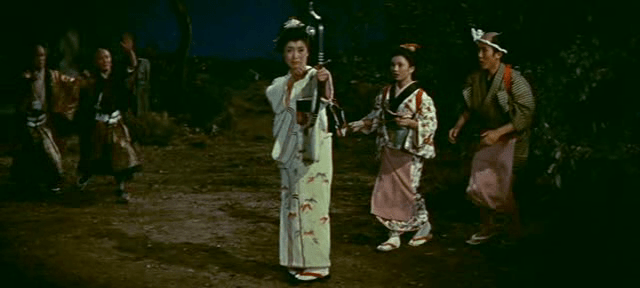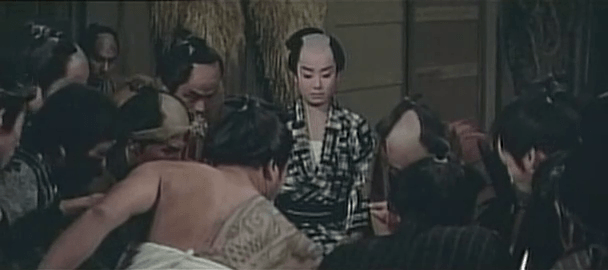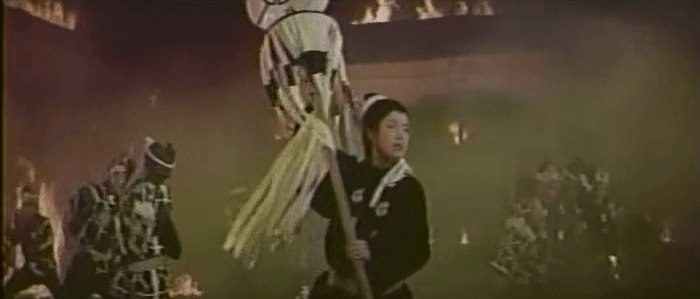
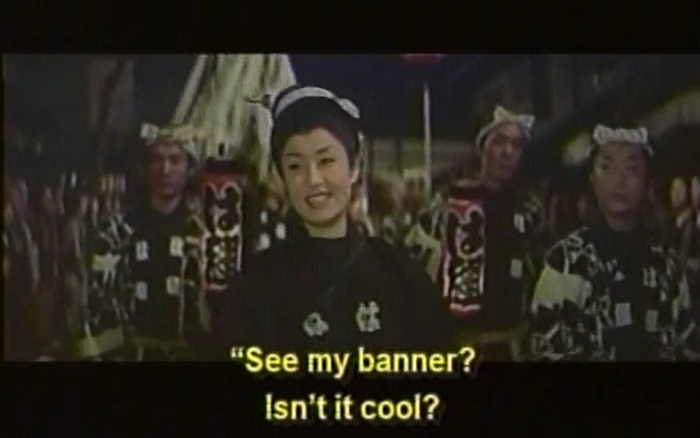
Girl with the Fire Banner (唄祭りかんざし纏, Kinnosuke Fukada, 1958)

Hibari Misora puts out the fires of the Bakumatsu in another musical jidaigeki adventure, Girl with the Fire Banner (唄祭りかんざし纏, Utamatsuri Kanzashi Matoi). Once again co-starring with Chiyonosuke Azuma, Misora plays another feisty young woman taking over the family business from a sickly father only this time the business is the fire brigade and while she calmly points out to those of a differing opinion that firefighting is an equal opportunities, apolitical occupation, she also finds herself at the centre of a coming revolution caught between corrupt Shogunate loyalists and the imperialist advance. 

Set in Edo in the climactic year of 1868 in which the Shogunate ultimately falls, the action opens with a fire at a townhouse owned by a member of the Satsuma clan, the leaders of the imperialists aiming to topple the Tokugawa and restore power to the emperor. While Haru (Hibari Misora) and her top team of firefighters rush to the scene, others actively refuse to fight the fire even going so far as to try to stop her. While she reminds them that it doesn’t matter who the house belongs to they have a duty to fight fire if only to prevent it engulfing the rest of the town, a dashing young samurai turns up and fights off the loyalists before daringly retrieving their firefighter’s banner from a burning roof asking only five ryo in return. The mysterious man soon disappears only to turn up a few days later having attempted to charge them for a new kimono and a shave in order to ask for a job as a fireman. Haru tries to dissuade him, not least because of his samurai arrogance as he explains he’s not come to join at the bottom and serve out the three year probationary period but to lead, but eventually relents only to find him continuing to behave like an entitled twit flouting all of their rules. 

Nevertheless, as someone later puts it, Japan will shortly be a “classless society” or at least samurai privilege is about to dissolve. This appears to be the central preoccupation of the villainous lords who describe themselves as Shogunate loyalists but in reality care only for their own cause. Not content with running an obvious protection racket with local vendors, threatening to burn down their stores if they don’t agree to contribute to their fund for restoring the Shogunate, they’ve also been buying up rifles to sell at inflated prices to “young hotheads” eager to die for the Shogun, and stockpiling rice hoping to profit when the city burns as they assume it will when imperialist troops arrive. Realising that their gambles may not pay off as the Shogunate may be planning to cut a deal and surrender in order to protect the people of Edo, the lords, who are technically in charge of the fire brigades, consider burning the city to the ground themselves under the cover of avenging the Shogunate’s honour. 

Of course, Haru, a firefighter through and through, could never support such duplicity though it’s clear many of the others would have gone along with it if no one had resisted. In contrast to some of Misora’s other Bakumatsu-era movies, the Shogunate and more particularly the loyalists are definitely the bad guys though in a rather strange turn of events we also see real life sumo wrestlers Asashio Taro III and Wakamaeda Eiichiro arrive to stand up for justice by knocking some of the loyalists heads together, returning later armed with giant poles and dressed only in their mawashi loincloths while throwing hay bales followed by the actual cart (!) at the arsonist loyalists before physically holding them back with the firefighters’ ladders. 

Misora, meanwhile, remains largely on the sidelines uncharacteristically elbowed out of the fight by the guys while lowkey falling for Shintaro despite his samurai arrogance. Musical numbers are fewer than might be expected, the title Edo Firefighter song reprised at the end while Misora gets a second love song wistfully sewing a kimono for Shintaro in the company of a cat wearing a fancy ruff. Shintaro gets his own number before handing back to Misora for another reprise of the title song. Nevertheless, the pair manage to salvage Edo from the flames of the revolution purifying the corruption while furthering progress towards a more equal society even if the closing scenes leave us clearly still on the march. 
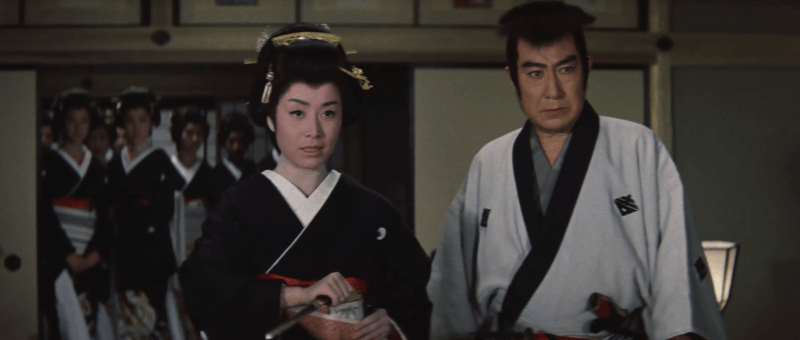

Tengu Priest (お坊主天狗, Yasushi Sasaki, 1962)

Disparate denizens of Edo are united in one thing in Yasushi Sasaki’s light hearted jidaigeki, Tengu Priest (お坊主天狗, Obozu tengu), revenge. Like many jidaigeki, what they really want is revenge against the evils of feudalism to which they have each fallen victim, but also acknowledge that they have found something better in being outside it in the solidarity that exists between them as outsiders free from the obligations of samurai society if also with loose ends waiting to be tied.

Once a hatamoto with a 1000 Koku stipend, Obo Kichiza (Chiezo Kataoka) is now a much feared figure keeping order in Edo. When some yakuza toughs are hassling the geisha Kozome (Hibari Misora) at the theatre, insisting that she serve them sake even as she reminds them she’s off the clock, one look from him stops them dead though Kichizo is also impressed with Kozome’s nerve. Like him, Kozome is also in Edo for revenge. Formerly a samurai’s daughter, she became a geisha to look for the man who killed her father in a stupid quarrel over a fencing duel. Kichiza, meanwhile, seeks revenge against the local lord, Honda Etsu (Masao Mishima), who killed his father in a fit of temper when he ordered him to commit seppuku for causing his son-in-law to fall off his horse but he refused. 

Loyal retainer Kinpei (Ryutaro Otomo) had begged for his forgiveness and insisted that he could get Etsu to reform but three years have passed and not only has he bribed his way to head office but his behaviour has declined still further. We see him cruelly cut down a maid seemingly for no reason, simply ordering his men to get rid of the body. Etsu has a reputation for random violence while drunk, but as he is the lord, there are no real consequences for him. His retainers cover up his crimes, and Kinpei’s sole attempt to talk some sense into him goes nowhere, meanwhile his chief adviser Shichinosuke (Sentaro Fushimi) is basically running the show telling others the lord is not in his right mind and cannot make decisions so he must make them for him.

They are all, including Etsu himself, victims of the feudal order in which the systems of power are necessarily corrupt. In his yakuza persona, Kichiza has struck up a friendship with another geisha, Kozuru (Naoko Kubo), who was actually a lady in waiting working as a maid at his estate. She has long been in love with him, but the class difference would have made any union impossible. Ironically, she remarks to Kozome that even in their present state they are still a Hatamoto and a lady in waiting so she dare not express her love for him. Only once his revenge is concluded and he’s fully abandoned his samurai status can Kichiza truly be free to embrace a relationship with Kozuru while conversely Kozome regains her life as a samurai’s daughter by avenging the death of her father.

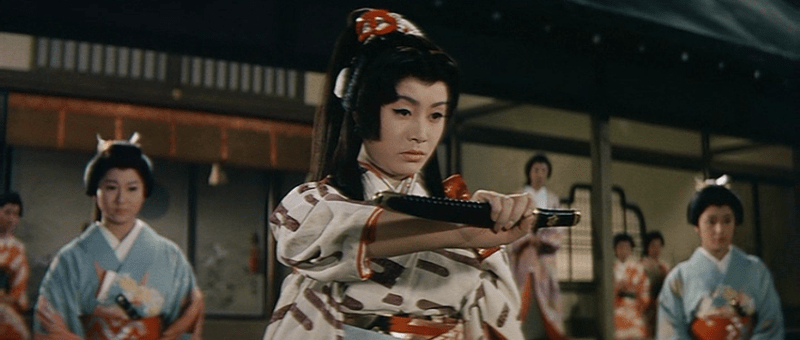
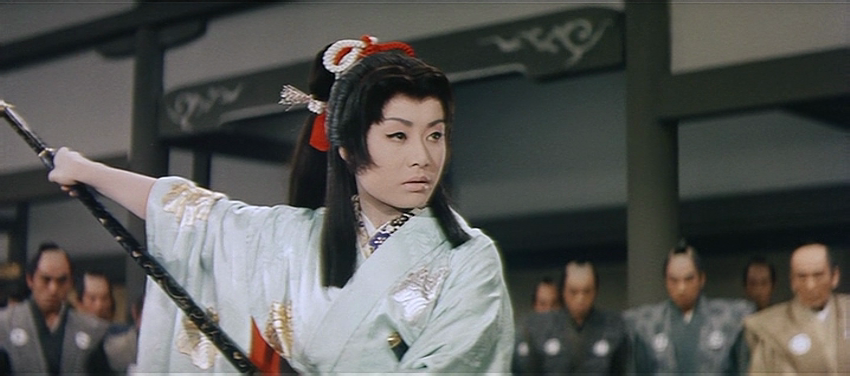
Kozome asks for Kichiza’s help to track down the target of her revenge, but he also respects her wishes and understands that it’s something she must do herself as does eccentric sword sharpener Shinzaburo (Hashizo Okawa ) who actively stands back so she, another wronged woman, can stick the knife in. Hibari Misora’s role in the film is smaller than one might expect as her revenge subplot is secondary to Kichiza’s and she has relatively little screen time with only a brief musical sequence during a naginata dance though she does participate in the high octane final showdown in which all grievances are exorcised and a kind of order returned to the samurai realm even if it must be destroyed to so as Kinpei resolves to protect both the lives and livelihoods of their many retainers and the integrity of Kichiza, going so far as to congratulate Kozome on the successful completion of her revenge. 

Yet what made the whole thing possible was Kichiza’s own band of outlaw drifters whom he allowed to live in his home he later says just so that they would have a place to come and be together so that they might more easily reintegrate into mainstream society. He might have lost his domain and samurai status but has discovered something better in this accidental community. They may be in a sense almost like retainers to him, but if so they stay by choice rather than obligation and help out of a genuine sense of loyalty and affection. In essence, in taking his revenge, he frees himself from the oppressive nature of the samurai code and is able to live like an ordinary man lamenting that if only he and Kinpei had both been ronin they could have enjoyed their time together for longer. Lighthearted and cheerful despite its dark themes, the film is nevertheless a condemnation of the hypocrisies and abuses of a feudal society in which freedom is to be found only among those who live outside it.


Sword of Destiny (孤剣は折れず 月影一刀流, Yasushi Sasaki, 1960)

A wandering swordsman winds up in intrigue on returning to his fencing school to find his old master murdered in Yasushi Sasaki’s Sword of Destiny (孤剣は折れず 月影一刀流, Koken wa Arezu: Tsukage Ittoryu). A classic jidaigeki adventure, it nevertheless has to be said that this one is a little more sexist than most in actively pushing its series of female warriors into the background as the hero by turns sends them all back to typically feminine roles while declaring that he will be the one to claim vengeance and clear up corruption in the court itself caused by a woman’s apparent forgetting of her place. 

At least, this is what Mikogami Genshiro (Koji Tsuruta) is told by an old friend, Izu, after an altercation with the fiery princess Kazu (Hibari Misora). The Shogun’s nurse, Lady Kasuga, has apparently taken an interest in politics and has most of the inner palace in her grasp enriching herself in the process. Izu believes that she may also be behind the assassination of Geshiro’s former mentor Ono while working in league with the Yagyu who coveted the position of fencing master to the Shogun. He asks Genshiro to kill her which he’s only too happy to do while seeking vengeance for Ono, but later gains a second reason after meeting the two orphaned daughters of a former retainer forced to take his own life thanks to Lady Kasuga’s machinations. 

Itoya (Yoshiko Fujita) wanders round with a gun and disrupts Genshiro’s first assassination attempt. He later tells her to leave the killing business to him and live “the life of a woman” insisting that one girl has no power to kill Lady Kasuga anyway. Meanwhile, he also makes an enemy of the Shogun’s sister Princess Kazu after challenging her in the street on seeing her callous disregard for a peasant her horse had run over. Princess Kazu falls in love with him after he defeats her in a duel, temporarily rebelling in insisting she will resist a dynastic marriage and take no other husband though he eventually rejects her partly on the grounds of their class difference and partly because he is a wandering sword who lives in the moment and may know no tomorrow. 

Nevertheless, she is later seen capitulating to her proper role as a princess who exists largely to continue the family line, marrying a man chosen by the Shogun and his advisors with no real power to chose anything other than her obedience. In much the same way he does with Itoya, Genshiro pushes her back towards the typically feminine while falling for Itoya’s meek, sickly sister Mine (Hiroko Sakuramachi) who is otherwise an idealised image of femininity in her softness and naivety while like every other woman in the picture falling for Genshiro because of his robust manliness and ability to protect her by gaining the sisters’ vengeance on their behalf. 

Meanwhile, Genshiro also facing off against the rival Yagyu school whom he suspects of having killed Ono to usurp his place as the shogunate fencing master with the assistance of underling Takagaki who has now taken over leading to a mass exit of students fed up with his authoritarian teaching methods. Interestingly enough, Genshiro is temporarily imprisoned by the Yagyu alongside a dissident Christian whose death they’d faked while keeping him alive in order to torture the names of other Christians out of him. On fulfilling his request to take his cross to his daughter who has become a sex worker, Genshiro succeeds only in endangering her while she also falls in love with him. 

All in all, he’s not much of a responsible hero also reckless with the life of his former burglar sidekick Kurobei (Shin Tokudaiji) who uses his ninja tricks to get him out of prison. As expected, it all ends with in a battle against a treacherous swordsman and the spineless Takagaki with the final revelation that Lady Kasuga (who just dies of old age) had not much to do with anything anyway despite having been a “meddling” old woman who forgot her proper place. Even Mine is forced to admit that she can’t come between Genshiro and his sword so she plans to become a nun while Kazu sends him an elaborate katana to remember her by certain that he will not accept a place in the Shogun’s household but will return to the road to continuing his training. In any case, a kind of justice is done and order restored even if that order is in itself fairly unideal. 


Cantankerous Edo (大江戸喧嘩纏, Kiyoshi Saeki, 1957)

A noble-hearted samurai on the run falls for a fireman’s sister in Kiyoshi Saeki’s hugely enjoyable jidaigeki musical adventure Cantankerous Edo (大江戸喧嘩纏, Oedo Kenka Matoi). Another vehicle for Hibari Misora and samurai movie star Hashizo Okawa, Saeki’s wholesome drama finds its heroes not only standing up to the oppressions of a rigid class system but also taking on a bunch of entitled sumo wrestlers intent on throwing their weight around having apparently lost sight of the tenets of traditional sumo wrestling such as fighting for justice and having a kind heart. 

To begin at the beginning, however, young samurai Shinzaburo (Hashizo Okawa) is on the run believing that he has accidentally killed another man who attacked him in order to clear the path towards his fiancée, Otae (Hiroko Sakuramachi), whom he wasn’t going to marry anyway because he realised she was in love with someone else and wanted to help marry him instead. Having escaped to Edo, he takes refuge inside a parade of firemen lead by Tatsugoro (Ryutaro Otomo) and his feisty sister Oyuki (Hibari Misora) who decide to take him in after hearing his story. Adopting the simpler, common name of “Shinza” he begins life as a fireman and gradually falls for Oyuki but remains a wanted man constantly dodging the attentions of his uncle, the local inquisitor, and the magistrates. 

More a vehicle for Okawa than Misora who plays a relatively subdued role save for boldly stealing the standard and climbing a roof herself when the others are delayed, Cantankerous Edo takes aim not particularly at a corrupt social order but of the oppressive nature of class divisions as Shinza discovers a sense of freedom and possibility he was previously denied as a samurai while living as a common man. It’s this desire for personal autonomy and the freedom to follow one’s heart that led to his exile from his clan, unwilling to marry a woman he knew not only did not love him but in fact loved someone else and would have been forever miserable if forced to marry him out of duty alone. “The life of a samurai who has to be somebody or not to suit another’s convenience is utterly stupid” he bluntly tells his uncle and Otae’s father, “how you cling onto family status, heritage, and honour. All that fuss, I hate it.” he adds before turning to Otae and encouraging her too to stand up to her father and insist on marrying the man she loves rather than be traded to another. 

Meanwhile, the two women exchange some contradictory messages about the nature of class and womanhood, the samurai lady Otae confessing that she isn’t sure she’s strong enough to fight for love in the face of tradition and filial duty in contrast to Oyuki’s spirited defence of Shinza the fireman insisting that firemen don’t think about such trivial things as name or family status before throwing themselves into harm’s way for the public good. “All women are weak” Otae sighs, Oyuki replying that they need to be strong for the men they love, “that’s what it means to be a woman”. Love may be in this sense a force of liberation, destabilising the social order but also a means of improving it, yet it still reduces women to a supporting role ironically as perhaps the film does to Misora who in contrast to some of her feistier performances takes something of a back seat. 

Romance aside, the main drama revolves around a conflict between the local sumo wrestlers who have turned into thuggish louts under their boorish leader Yotsuguruma (Nakajiro Tomita), taking against the fireman and forever spoiling for a fight. The samurai proving unexpectedly understanding, the sumo wrestlers become the main source of oppression in usurping a class status they don’t really have. The noble Tatusgoro tries to stave off the fight insisting that they aren’t brawling yakuza but responsible firemen here to serve the public good and should save their energy for fighting fires rather than their obnoxious neighbours. Nevertheless the fight cannot be held off forever. Tatsugoro is forced to redefine the nature of “fire” after hearing a warning bell informing him one of his men is in grave danger unable to manage their anger anymore.  

Saeki’s jidaigeki musical has surprisingly good production values for a Toei programmer, making space for a few songs along the way celebrating the valour of the firemen while Oyuki meditates on her potentially impossible romance and the perils of love across the class divide. While the conclusion may end up ironically reinforcing the hierarchical society, it does however make the case for the right to romantic freedom along with the necessity of human compassion in the face of inconsiderate arrogance and intimidation.


Note: This film is sometimes titled “Fight Festival in Edo” but according to Eirin’s database, the official English-language title is “Cantankerous Edo”. Rather confusingly, a very similar film with a very similar title (大江戸喧嘩まつり) was produced in colour at Toei in 1961 and is known as “Fight Festival in Edo” in English. Meanwhile, Hibari Misora also starred in another colour film with a very similar storyline in 1958 (唄祭りかんざし纏) which is known as “Girl with the Fire Banner” in English but listed as “Festival of Song” on Eirin’s database.

The Swordsman and the Actress (大江戸千両囃子, Yasushi Sasaki, 1955)

Working mainly with Toei, singer Hibari Misora was able to carve out for herself a distinctive career as a tentpole movie star in the early post-war period. In contrast to other female stars of the day, Misora’s leading women are generally feisty and rebellious standing up against injustice in period films and contemporary dramas alike while she also made a point of subverting societal gender norms often crossdressing or playing with gender ambiguity. 1955’s The Swordsman and the Actress (大江戸千両囃子, Oedo Senryo Bayashi) meanwhile sees her taking a backseat to the main action but sowing the seeds for her later career as she stops a cruel samurai plot in its tracks and even gets to participate in the final showdown. 

The drama starts when young actress Koharu (Hibari Misora) misplaces her fan and is lent one by another performer which attracts the attention of bad samurai Shuzen Ogaki (Kyu Sazanaka) who recognises it as having once belonged to the Shogun. As it turns out, Koharu’s friend Hanji (Rentaro Kita) was gifted the fan by a childhood friend, a noble woman, Okyo (Keiko Yashioji), for whom he may have had feelings which would could never be returned seeing as he was the son of a maid. Having seen him in a play but feeling it would be inappropriate to meet, Okyo sent the fan in fondness but had not realised it to be valuable and is now in a difficult position as the Shogun will soon be visiting and if he does not see the fan will be offended. Shuzen wants the fan for himself to embarrass Okyo and her husband and advance his own position. Just as Okyo dispatches trusted retainer Gennojo (Chiyonosuke Azuma) to ask Hanji to return the fan, Shuzen sends in his goons killing Hanji but only after he manages to substitute a fake fan for the real one. 

What follows is a complicated game of find the lady as the fake fan and the real are swapped between Gennojo and Shuzen often via a pair of pickpockets, Oryu (Ayuko Saijo) and sidekick, who alternately help and hinder largely because Oryu develops a crush on the extremely disinterested Gennojo. As usual, Koharu is on the side of right trying to fulfil Hanji’s dying wish by returning the fan to Okyo before the Shogun’s New Year visit but is also on a side quest of her own in looking for her long lost sister. It would be tempting in a sense to view the fan as cursed as it indeed provokes nothing but trouble, not only getting Hanji killed and endangering the lives of Okyo and her son, but also provoking discord wherever it’s mentioned sending a pair of married shopkeepers into a blazing row when they realise their young son may have walked off with the priceless object (and later sold it so his mum can buy sake). 

In the quest for the fan, Koharu takes a backseat while Gennojo does most of the leg work played as he is by jidaigeki star Chiyonosuke Azuma with whom Misora would frequently co-star. Though there are hints of a romance it is not the main thrust of the drama considering Misora’s relative youth, though she does get to wistfully sing the title song several times over. Meanwhile the pair are finally joined by a late in the game appearance from veteran Ryutaro Otomo as a typically raucous ronin, Jubei, who steals the screen to such an extent it almost seems as if the film is part of a series revolving around his character who turns out to be another victim of Shuzen’s plot having been exiled from his clan supposedly for having turned down the advances of his now mistress Oren. “I, Fujisaki Jubei, may be unemployed but mine is still the sword of righteousness and it doesn’t like evil doers!” he snarls apparently quite fed up with samurai corruption. 

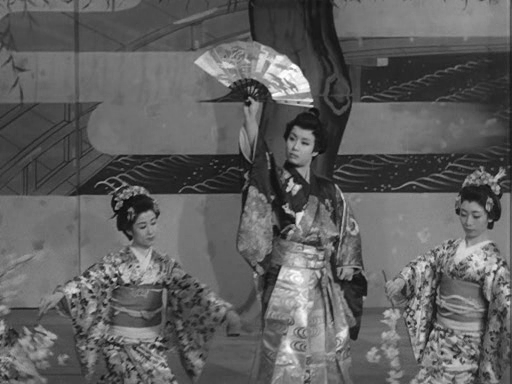
Sasaki certainly has a lot of fun with his fan swapping shenanigans, even going slightly experimental in an excuse to give Chiyonosuke Azuma a fan dance while throwing in additional comic relief from the bumbling pickpockets and some strangely comic death scenes but does not disappoint as the major heroes and villains reunite in the final showdown taking place as it does on stage and allowing Koharu’s troupe mistress to show off her sword skills while Oryu redeems herself and the evil samurai plot is finally defeated by the forces of righteousness. An anarchic affair, Swordsman and the Actress never takes itself too seriously but nevertheless sows the seeds for many of Misora’s subsequent adventures as she sets the world to rights again with the aid of her two complementary samurai sidekicks. 


Musical clip (no subtitles)

The Young Boss (花笠若衆, Kiyoshi Saeki, 1958)

Hibari Misora takes on yet more Edo-era corruption in Kiyoshi Saeki’s musical adventure, The Young Boss (花笠若衆, Hanagasa Wakashu, AKA A Martial Crowd, Twin Princesses). A program picture director at Toei, Saeki mainly worked on jidaigeki and ninkyo eiga launching the Brutal Tales of Chivalry series, though he also became a frequent collaborator with Misora ironically enough mostly working on her contemporary films in which she often starred opposite Ken Takakura, representative actor in the noble gangster genre. Young Boss, however, is a jidaigeki musical adventure very much typical of those Misora was making at Toei at the time and once again finds her playing dual roles as a pair of twins separated at birth because of superstition and social stigma.

Opening and closing at a local Edo festival, the film introduces us to the second generation of Edoya Kichibei, Kichisaburo (Hibari Misora), as he steps in to protect a young woman who has accidentally annoyed a bunch of yakuza fulfilling his sidekick’s introduction that he “helps the weak and crushes the strong”. Kinpachi (Juro Hoshi) also describes him as a “man’s man”, though as we discover Kichisaburo is not a man at all but the niece/adopted daughter of a prominent merchant apparently raised as a boy. Kichisaburo, however, only learns this when a pair of samurai turn up to badger Kichibei about the whereabouts of his younger sister, Sano, who apparently served as a maid to the Ogiyama clan 18 years previously but was cast out with her younger daughter Yuki after giving birth to twin girls fathered by the lord. The other twin, Chiyo (also Hibari Misora), was raised in luxury in the palace and in the absence of a male heir and the lord’s failing health is in line to inherit the clan. As usual, however, courtly intrigue has led some to conclude that Yuki’s is the proper the claim. Kichibei attempts to convince them that Yuki passed away in infancy shortly after her mother and that he burnt her birth certificate, but the resemblance between the effete Kichisaburo and the lady Chiyo has not gone unnoticed both by the visiting samurai and the handsome Matanojo (Hashizo Okawa) who joins in with Kichisaburo’s battle against the yakuza and is in fact the betrothed husband of Chiyo. 

Lady Chiyo appears only briefly but is the soul of courtly kindness, hugely regretting what has befallen her absent sister and affirming that should she return she would instantly surrender her claim to the clan in guilt that she has been raised in such luxury when Yuki was cast out to live with strangers. The dual roles in a sense reflect a perfect whole, Lady Chiyo’s feminine elegance contrasted with the rough Kichisaburo who has not been raised as a samurai but a merchant’s son like his sister set to inherit the family business. He is very attached to his adopted father, but also possesses a strong sense of justice often ignoring his pleas to stop getting into fights. Other than perhaps to disguise her true identity, there is no real explanation for why Kichisaburo has been raised as a boy though it seems that there would have been a time the ruse came to an end, Kichibei sadly lamenting that perhaps he has been jealously attempting to keep the child he loved so much with him against her better interests but explaining that he would have found her a nice husband in time, perhaps like that gallant samurai Matanojo.

Teaming up with him for purposes of revenge and justice, Kichisaburo begins to develop feelings for Matanojo though Kichibei reminds him that a townsperson would be “unfit to be a samurai’s wife”. Most of Misora’s films in which she stars as a feisty young woman see her undergoing a softening, drawing closer to conventional femininity often with marriage or at least a romance with a manly man on the horizon. The Young Boss meanwhile flirts with just this conclusion as Kichisaburo becomes Yuki while out on the road with Matanojo, dressing as an elegant princess and experiencing a vivid dream sequence in which she becomes his wife, but ultimately highlights the class rather than gender barriers between them in allowing to Yuki to return to her previous life as Kichisaburo while Chiyo remains a samurai noblewoman in a seemingly perfect mirroring which also represents a return to order. 

Nevertheless, Misora finds numerous occasions for a cheerful song even in her manly guise finally even beating a taiko drum at the closing festival while joining in with several elaborately choreographed sword fights along the way with her customary gusto. A bittersweet ending, perhaps, but one in which Misora makes division of herself and unusually is allowed to remain feisty, defiant, and independent helping the weak and crushing the strong in an ever duplicitous Edo.


Musical number (no subtitles)

Lady Sen and Hideyori (千姫と秀頼, Masahiro Makino, 1962)

Son of cinema pioneer Shozo Makino, Masahiro Makino is most closely associated with the jidaigeki though he also had a reputation for highly entertaining, innovatively choreographed musicals some of which starred post-war marquee singing star Hibari Misora. The somewhat misleadingly titled Lady Sen and Hideyori (千姫と秀頼, Sen-hime to Hideyori), however, is pure historical melodrama playing fast and loose with the accepted narrative and acting as a star vehicle for Misora to showcase her acting talent in a rare dramatic role in which she neither sings nor engages in the feisty swordplay for which her otherwise generally lighthearted work at Toei was usually known. 

Lady Sen (Hibari Misora) is herself a well-known historical figure though Hideyori (Kinnosuke Nakamura) will not feature in the film beyond his presumed demise (his body was never found leading to various rumours that he had actually survived and gone into hiding) during the siege of Osaka in 1615. Born the granddaughter of Tokugawa Ieyasu (Eijiro Tono) who would later defeat the Toyotomi to bring Japan’s Warring States era to an end, Sen was sent to the Toyotomi as Hideyori’s future wife at seven years old (he was only four years older than she was and 21 at the presumed date of his death) and therefore perhaps far more Toyotomi that Tokugawa. In contrast to other portrayals of Sen’s life which centre on her understandable identity conflict and lack of agency in the fiercely patriarchal feudal society, Misora’s Lady Sen is clear in her loyalty to her husband whom she dearly loved and feels her father and grandfather who were directly responsible for his death are her natural enemies.  

Old Ieyasu and his son meanwhile do at least appear to care about Sen’s welfare, loudly crying out for a retainer to save her during their assault on the castle offering unrealistic rewards to any who manage a rescue. Unfortunately, however, having retrieved his granddaughter Ieyasu immediately marries her off to someone else demonstrating just how little control Sen has over her own destiny and how ridiculous it might be that she should have any loyalty to the family of her birth. His decision backfires on two levels, the first being that Dewa (Tetsunosuke Tsukigata), a lowly retainer responsible for Sen’s rescue from the falling castle, has taken a liking to her himself and fully expected to become her husband as a reward. While originally annoyed and hurt to think that perhaps she has rejected him because of the prominent facial scarring sustained while he was rescuing her, Dewa finally realises he just wants her to be happy only to be offended on realising that they’ve rerouted her bridal procession past his home which he takes as a personal slight. Nevertheless, in contrast with real life (Sen’s marriage to Honda Tadatoki was apparently amicable and produced two children though only one survived to adulthood) Sen’s relationship with her new husband is not a success, in part because she resents being used as a dynastic tool and in part because she remains loyal to Hideyori. In consequence, she makes full use of her only tool of resistance in refusing to consummate the marriage with the result that her new husband, Heihachi (Kantaro Suga), slowly drinks himself to death. 

Her other act of rebellion is however darker, striking down an old man who made the mistake of telling her with pride how he informed on retreating Toyotomi soldiers after the siege. Determining to become an “evil woman” she deliberately blackens the Tokugawa name by killing random commoners, chastened when confronted by a grieving widow but banking on the fact her relatives will not move against her and will therefore gradually lose public sympathy for failing to enforce the law against one of their own. The spell is only broken by the arrival of a former Toyotomi retainer (played by Misora’s frequent co-star in her contemporary films Ken Takakura) who reminds her of her loyalty to her husband’s legacy and prompts her retreat into religious life as a Buddhist nun mirroring the real Lady Sen who entered a convent after her second husband died of tuberculosis. Like most of Misora’s film’s Lady Sen ends with a softening, a rebuke to her transgressive femininity which in this case has admittedly turned worryingly dark her murder spree apparently a form of resistance to the entrenched patriarchy of the world around her and most particularly to her continued misuse at the hands of her father and grandfather. Despite the absence of large-scale musical numbers, Makino makes space for a fair few dance sequences along with festival parades and well-populated battle scenes but makes sure to place Misora centre stage as if countering the continual marginalisation of Lady Sen and all the women of feudal Japan. 


Clip (English subtitles)

Snake Princess (新蛇姫様 お島千太郎, Tadashi Sawashima, 1965)

Hibari Misora fights Edo-era corruption once again in another jidaigeki musical adventure from Tadashi Sawashima. Snake Princess (新蛇姫様 お島千太郎, Shin Hebihimesama Oshima Sentaro) sees her doing double duty as a sake-loving stage performer in love with a reluctant revenger, and an austere princess mourning the murder of her confidant and only friend but, as in some of her other films, the resemblance is never remarked upon nor is it any kind of plot point. There isn’t even really a “snake princess”, though snakes and the supernatural do play their part and there is perhaps less space for the derring-do and swashbuckling musical numbers which typically characterise a Hibari picture. 

The film opens with stage performer Oshima (Hibari Misora) waking up from a drunken snooze on a riverbank and realising she’s been left behind by her acting troupe. Running into the mysterious Ittosai (Minoru Oki) on her way, she hurries on to the next town to catch them up while he heads in the opposite direction towards Karasuyama and the Princess Koto (also played by Hibari Misora). Meanwhile, in the town, a rowdy samurai starts a drunken fight in an inn, demanding to drink with the innkeeper’s pretty daughter Suga (Tomoko Ogawa). The innkeeper refuses, offering the excuse that his daughter is at the palace with the princess, but the samurai doesn’t take no for an answer and starts thrashing about with his sword eventually killing the innkeeper for the offence he feels has been caused to him. The innkeeper’s son Sentaro (Yoichi Hayashi), a former pupil of Ittosai, then kills the samurai in revenge and is forced on the run, taken in by the leader of Oshima’s acting troupe, Juzo (Takashi Shimura), who apparently knew his father well. 

What ensues is of course a tale of intrigue and revenge mixed with mild romantic melodrama. Oshima begins to fall for Sentaro, but is warned that he is from a prominent non-samurai family and as such is unlikely to marry a travelling actress, itinerant players then belonging to a kind of underclass which is in part one reason why it is so easy for Sentaro to hide among them. Even so he is also subjugated by the samurai who frequently object to being ordered around by “commoners”, insistent on their privilege the refusal of which is the reason Sentaro’s father had to die. 

Meanwhile,  the Princess Koto is herself oppressed within the feudal system as a female ruling a clan in the absence of her father who has placed her in charge while he remains in the city. While Oshima falls for Sentaro, the relationship between Koto and Suga is perhaps transgressively equally close, Koto describing Suga as the only one she can trust within her own court and plaintively asking her to stay by her side forever. Unfortunately however Suga is murdered by the male court conspirators attempting to wrest power from the princess on her way back with evidence of their smuggling plot after meeting Ittosai on Koto’s behalf. Misled into thinking that Koto had his sister killed, Sentaro plots revenge but on learning the truth asks her why she hasn’t dealt with the wrongdoing among her own retainers, only later realising that even as the leader of the clan she lacks the power to do so and remains in a precarious position. 

Arguably, Oshima has more freedom, fearlessly walking the roads alone, drinking and gambling with the men refusing to abide by traditional social codes though perhaps in some ways permitted to do so precisely because of her position within the entertainer underclass. A further gender reversal sees the fallen Sentaro temporarily resorting to sex work as a host at an inn drinking with a melancholy noblewoman who fully expects to bed him for her five Ryo only for Sentaro to become indignant and throw the money back in her face, much to Oshima’s approval though she later becomes jealous and irritated questioning him if he’s ever done this sort of work before as if it would actually change her feelings for him. While Sentaro is forced into but then rejects the subjugated female role, Oshima chooses the male solution of trying her luck at the gaming tables, occasionally charging into a fight wielding a nearby object such as a handy water bucket. 

The snake theme of the title links back to the supernatural appearances of Suga’s silent ghost, protecting the princess with a wall of serpents when Sentaro plans to attack under the false assumption that she was responsible for his sister’s death. Musical numbers are largely restricted to a lengthy stage performance featuring Oshima and Sentaro’s evolving act utilising several sets and elaborate design while Sawashima ups the game a little from the lower tier Toei norm with varying locations shifting from a set-bound snowscape as Oshima is carted off by local goons, to a shot-on-location set piece as the conspirators take down a spy in the rocky desert. Revenge is eventually taken not only for the murders of Sentaro’s father and sister, but for the samurai transgressions of the Edo era, restoring order by wiping out the bad apples but also allowing Sentaro to free himself from his class-bound destiny and pursue a life, and love, of his choosing regardless of contemporary social codes.


Musical sequences (no subtitles)

Bull’s Eye of Love (おしどり駕篭, Masahiro Makino, 1958)

Masahiro Makino was best known for jidaigeki and ninkyo eiga but also had an interesting sideline in cheerful period musicals including many collaborations with post-war singing sensation Hibari Misora. Bull’s Eye of Love (おしどり駕篭, Oshidori Kago) is, like Singing Lovebirds, a musical comedy in which a samurai (in disguise) and a feisty young woman fall in love while battling the corruption of their times. Though in this case Hibari takes a back seat in fighting samurai hypocrisy, she still gives as good as she gets as she fights for love across the class divide even while accepting that she can only have her love if he consents to renounce his nobility and live as a humble plasterer. 

The trouble starts when the old lord dies and a prominent retainer, Hyobu, leaps into action, taking control of the situation in fast tracking the accession of second son Sannojo (Sentaro Fushimi) who many feel to be too immature, weak willed, and naive to lead effectively. Top servant Zenbei complains, pointing out that Sannojo has an older brother, Genjiro (Yorozuya Kinnosuke), who should be first in line. But Genjiro has long been absent from the court, apparently intent on escaping the “stuffy” samurai lifestyle. Hyobu claims not that Genjiro has forfeited his position, but that he has actively renounced it in favour of Sannojo. Zenbei is not convinced, at the very least he feels they should find Genjiro and explain the situation to find out for sure what it is he intends to do with the rest of his life. 

It happens that Genjiro is living humbly as Genta the plasterer and has fallen in love with Kocho (Hibari Misora), the proprietress of an archery parlour who also likes to put on a show every now and then. The major problem in his life is that both he and Kocho are too stubborn and proud to say “I love you” which is making them bicker endlessly as a kind of substitute. The arrival of Zenbei and another retainer blows his cover and sends his new life into disarray. He has no desire to return to the samurai world, but also knows his brother is too susceptible to manipulation to be allowed to succeed unadvised, especially as Hyobu seems to be manoeuvring to get him married to his troubled daughter Chidori (Hiroko Sakuramachi) who seems to have some kind of ongoing mental disturbance which renders her distant and childlike. His romantic hopes will have to go on the back burner for a while as he becomes “Genjiro” once again to sort out Hyobu before hopefully returning to the simple life of an Edo plasterer. 

From Kocho’s point of view, the news that Genta has hidden his true status from her is alarming on two fronts, not only that he’s “lied” about who he is, but that if he is a noble lord then they can never be together because samurai don’t marry outside of their order. Genta, however, seems to be a fairly atypical sort of samurai who is entirely uninterested in wealth, status, and the restrictive codes which bind the noble. He looks for freedom in living as an ordinary man, which may be a bit disingenuous because there’s little freedom in starving and being constantly oppressed by the cruel order he was born into, but there is truth in it. It’s also unlikely that his clan would allow him to just up and leave, disappearing into Edo era society and abnegating his responsibility, but Bull’s Eye of Love is intent on a more cheerful depiction of the samurai world than that found in many contemporary period dramas in which its heroes are allowed to choose love and freedom without being forced to sacrifice their feelings in the name of duty. 

Kocho finally confesses her love but makes clear it is for Genta, not for Genjiro, only to end up falling for Genjiro too because of his manly samurai charms coupled with an unusual sense of compassion. Despite being told to stay at home, she takes her bow and arrow and follows him, relieved to discover she didn’t need to join the fight because he’d already handled it. In a fairly strange turn of events, however, Genjiro wipes out most of the treacherous retainers but then more or less enables Hyobu’s plan by putting Sannojo in charge and agreeing that he should marry Chidori who was only playing mad to undermine her father’s nefarious schemes. Having sorted everything out, the pair leave on a more equal footing after confirming their feelings towards each other and their intentions for the future. Genjiro renounces his samurai status to live “free” in Edo, cheerfully proceeding out of the palace and into the streets singing as he goes rejecting elitist authoritarianism in favour of the earthy pleasures of warmth and friendship to live as an ordinary man unburdened by the cruel hypocrisies of samurai soceity. 


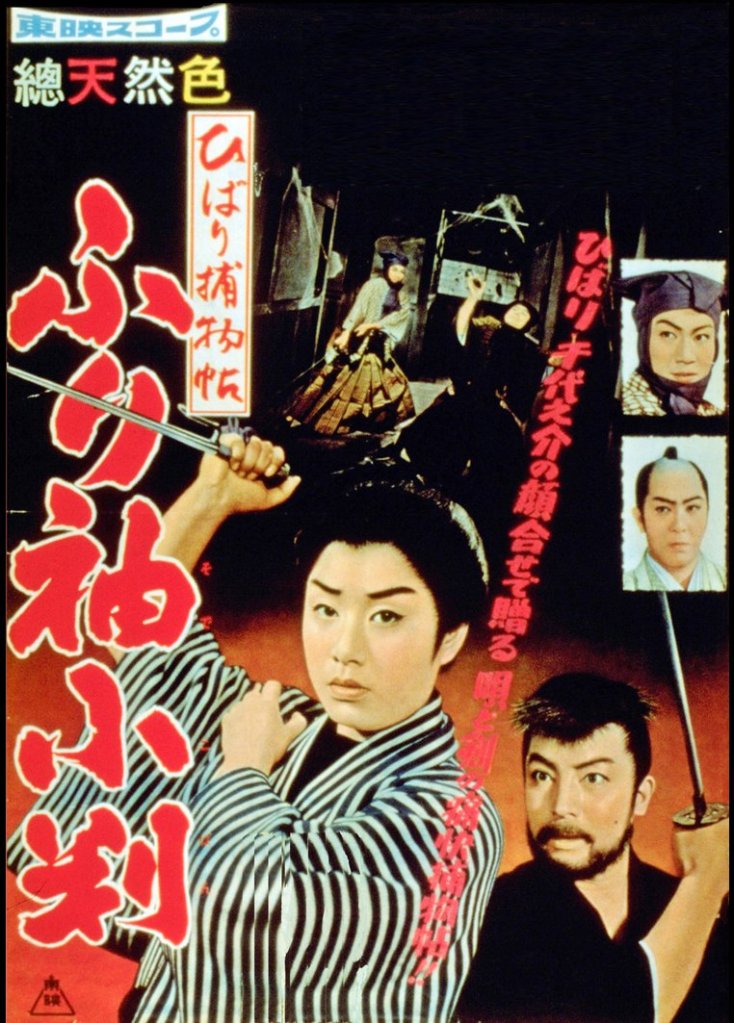
Detective Hibari 3: Hidden Coin (ひばり捕物帖 ふり袖小判, Kokichi Uchide, 1959)

Hibari Misora returns as Oshichi in another adventure for the Edo detective, this time becoming embroiled in a conspiracy against the Shogunate which she continues to serve. By this third instalment in the Detective Hibari series, Hidden Coin (ひばり捕物帖 ふり袖小判, Hibari Torimonocho: Furisode Koban), Oshichi is no longer hiding her noble birth as an esteemed princess, but is living as a singer/law enforcement officer under her “common” name, and upholding the interests of “common” people suffering under “corrupt” samurai oppression but, paradoxically, very much upholding the system which enables it.

The conspiracy in which Oshichi becomes involved this time around is concerned with the plot to overthrow the Shogunate. Rebel forces manage to ambush a convoy carrying tax money to the government, hoping to use the money to buy guns from the Dutch to aid their revolution. As only one of the retainers survives, he will be held responsible for the loss of the money and almost certainly asked to commit ritual suicide, but the Ota clan and most particularly retainer Kennoshin (Kotaro Satomi), are worried about the man’s daughter, Misuzu (Atsuko Nakazato), to whom he was very close. Oshichi becomes involved when she hears of an entire household being murdered and their funds stolen, while a lone pickpocket is found dead with a precious gold coin lying nearby. 

Before discovering the crime, Oshichi and her trusty sidekick Gorohachi (Takehiko Kayama) are talking to a kabuki actor who is about to undergo a succession ceremony which will cost a significant amount of money – 1000 Ryo. Gorohachi is mystified, wondering how many years he’d have to work in order to find that kind of money, while the two pickpockets outside wonder something much the same. The older of the two, Oshima (Keiko Yukishiro), wants to make sure the actor gets his money and has been desperately trying to get in touch with him but he is too snooty to see her. Oshichi starts connecting the dots between the pickpockets and the conspiracy to find a vital clue, but once again is keen to stress that “the law can be merciful too” as she both ensures that Oshima faces justice and allows her to find emotional fulfilment in revealing her true identity and finally seeing the show. 

Meanwhile, despite outwardly dressing in manly, action friendly outfits, this Oshichi is one more romantically inclined, fretting over the fate of her brother’s retainer Hyoma (Chiyonosuke Azuma) who, she thinks, has left his employ and become a drunkard. The drunken downward spiral of his life turns out to be a kind of undercover assignment, but provokes a little jealousy in Oshichi as she sees him “protecting” other women at a nearby restaurant, one of whom turns out to be Misuzu who holds a few more pieces of the puzzle. Vowing to save Misuzu and stop the conspiracy, Oshichi adopts a male persona complete with top knotted wig and takes on an entire boatload of sailors who stupidly tell her that they’re shipping out that very night. 

Oshichi rescues Misuzu and gets the money back, saving her father and “restoring” the status quo, but it’s difficult to see which side she should be on in this fight. As Gorohachi perhaps implies, it’s not exactly fair or responsible for the samurai class to be hoarding all these vast amounts of money, or for it to be necessary to spend the annual salaries of several ordinary people on an extravagant celebration for an actor’s promotion. We’re told that the rebels are “evil” and villainous, and they do indeed seem to be cruel and self-interested, willing to sacrifice anyone and everyone to achieve their goal, but it’s difficult to argue with the desire to stand up to this inherently oppressive system in which samurai corruption is the expected norm. 

Insisting that “the law can be merciful”, Oshichi serves a kind of moral justice, rescuing the innocent Misuzu and saving her wrongfully abused father while unmasking samurai corruption, but she remains a loyal servant of the Shogunate and a part of the system into which she was born. Oshichi has been permitted escape from her own oppression thanks to her “compassionate” brother who has allowed her to live freely in the city rather than pressuring her to marry and conform to the feminine norm, but living outside it herself seemingly has no sympathy for those who wish to reform the system and seeks only to preserve it. Having successfully solved the mystery, she reassumes her femininity and retreats into the cheerful festival atmosphere arm in arm with a clean shaven Hyoma finally embracing her romantic dream in an Edo freed from immediate strife. 


Short clip (no subtitles)