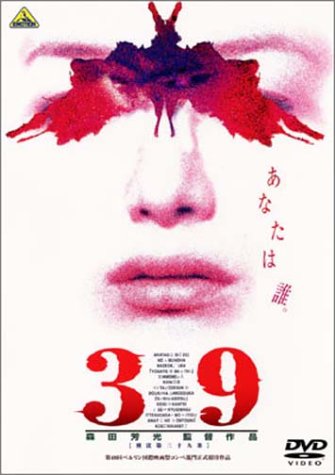
Keiho (39 刑法第三十九条, Yoshimitsu Morita, 1999)

keihoArticle 39 of Japan’s Penal Code states that a person cannot be held responsible for a crime if they are found to be “insane” though a person who commits a crime during a period of “diminished responsibility” can be held accountable and will receive a reduced sentence. Yoshimitsu Morita’s 1999 courtroom drama/psychological thriller Keiho (39 刑法第三十九条, 39 Keiho Dai Sanjukyu Jo) puts this very aspect of the law on trial. During this period (and still in 2016) Japan does nominally have the death penalty (though rarely practiced) and it is only right in a fair and humane society that those people whom the state deems as incapable of understanding the law should receive its protection and, if necessary, assistance. However, the law itself is also open to abuse and as it’s largely left to the discretion of the psychologists and lawyers, the judgement of sane or insane might be a matter of interpretation.

The case at the centre of the film centres around a young actor, Masaki Shibata, who has confessed to the murder of a pregnant woman and her husband after he argued with the woman at her place of work. Shibata acts strangely and makes a point of asking for the death penalty before spouting off about angels and demons and later displays evidence of a split personality. Everyone seems convinced he’s suffering from MPD and committed the murders during a dissociative episode but the assistant psychologist is convinced he’s faking. At the same time, one of the lead policemen on the case also thinks there’s more to this. On investigating further, he discovers the strange irony that the murdered man himself escaped prosecution by reason of insanity after committing a horrifying crime that lead to the death of a six year old girl.

The film may be about a murder but what’s really on trial here is the law itself. The murdered man, Hatada, committed a heinous crime but was a child himself at the time so received only a brief sentence served in a hospital. He was released, went to university, got a good job and got married – a normal life. The family of the little girl he killed, by contrast, will never be able to return to normality and will continue to live in torment for the rest of their lives knowing the man who so brutally took their child from them is still out there living just like one of us. The film does not go into why Hatada committed the original crime or the reasons he was later declared fit to return to society, but the film wants to question the idea of releasing back into the world someone who has done something as horrifying as the rape, murder and dismemberment of a child.

The case at hand is a complicated one which has so many layers coupled with twists and turns that it becomes unavoidably confusing. Playing with several literary allusions from the frequent quotations from the “mad prince” Hamlet to naming the assistant psychologist “Kafuka”, Keiho also wants to delve deep into human psychology with its questions of identity and self realisation. Both the accused and the psychologist have deeply buried memories of trauma the suppression of which has cast a shadow through the rest of their lives. Both of them are, in a sense (even if not quite in the way it originally appears), haunted by a shadow of themselves.

When it comes to the procedural aspects, the final “twist” is a step too far and perhaps undermines the groundwork which has gone before it. Something which is presented as an elaborate revenge plot against both the state and the original instigator of a crime also appears to originate with a clumsy motion of self preservation. The state’s failure to properly deal with the criminal in the first case has resulted the death of another innocent bystander, all of which might have been avoided if Article 39 had not come into play.

Kafka-esque is, in fact, a good way to describe the circularity of the narrative as the notion of an insanity plea becomes a recurrent plot device. Backstories are constructed and discarded, identities are shed and adopted at will and the past becomes a thorn in the side of the future that has to be removed so everyone can comfortably move on. Morita relies heavily on dissolves to create a floating, dreamlike atmosphere as memories (imaginary or otherwise) segue in and out like tides but he also shows us images reflected in other surfaces such as the Strangers on a Train inspired sequence which literally shows us events through someone else’s eyes as we’re watching them reflected doubly on the lenses of a pair of sunglasses.

Difficult, complicated and ultimately flawed Keiho proves an elusive and intriguing piece that is put together with some truly beautiful cinematography and interesting editing choices. Fascinating and frustrating in equal points Keiho is another characteristically probing effort from the wry pen of Morita which continues to echo in the mind long after the credits have rolled.


Keiho is available with English subtitles via HK R3 DVD as part of Panorama’s 100 Years of Japanese Cinema Collection.
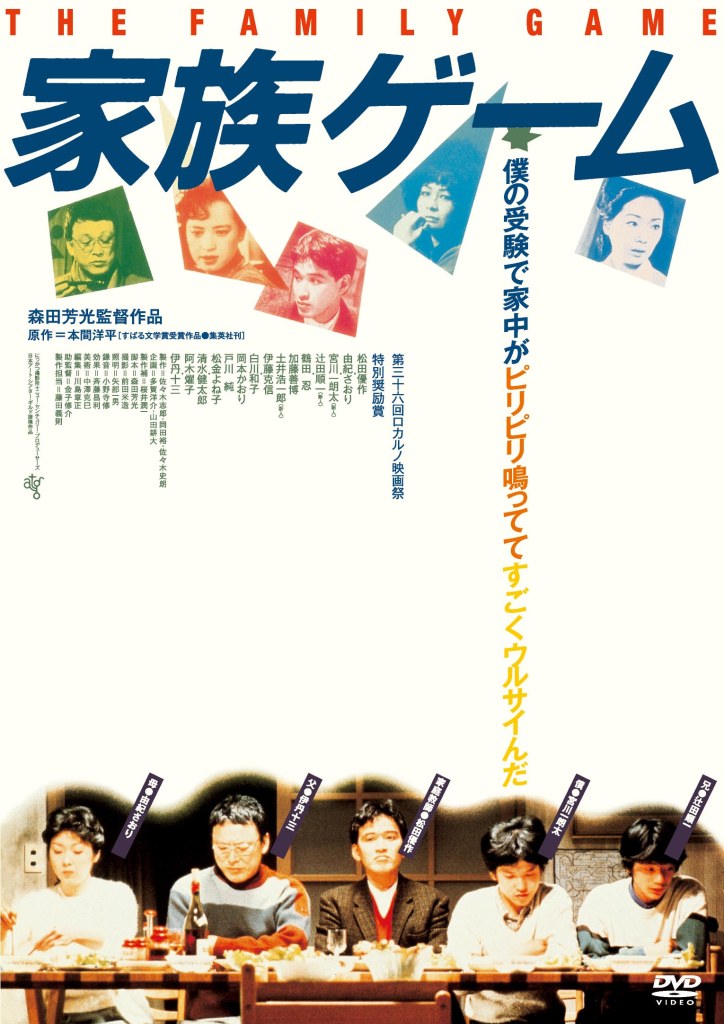
 

The Family Game (家族ゲーム, Yoshimitsu Morita, 1983)

TFG_DVD_jk_ol“Why do we have to make such sacrifices for our children?”. It sounds a little cold, doesn’t it, but none the less true. Yoshimitsu Morita’s 1983 social satire The Family Game (家族ゲーム, Kazoku Game) takes that most Japanese of genres, the family drama, and turns it inside out whilst vigorously shaking it to see what else falls from the pockets.

The “ordinary” middle class Numata family consists of the salaryman father Kosuke, the regular housewife mother Chikako and their two sons – older brother Shinichi and younger brother Shigeyuki. Right now the focus of attention is very much on Shigeyuki as he approaches the difficult period of sitting entrance exams for high school. To be frank, Shigeyuki’s prospects are dismal. He ranks near the bottom of the class and though certainly bright has little interest in studying. Therefore, the family have decided to bring in a home tutor to help boost his grades. They’ve already tried several to no avail but have high hopes for Mr. Yoshimoto, a local university student, but little do they know that he’s going to end up teaching each of them a little more than they cared to learn.

Morita breaks down the modern family into its component parts and finds only archetypes representing the kinds of roles which are rigidly enforced by Japan’s conformist society. Let’s start with the “father” who is supposedly the head of the household yet barely has anything at all to do with it. He believes his role is simply to go to work and shout commands which his “family” are supposed to follow unquestioningly. His realm is everything outside the house, everything inside is the responsibility of his wife and he won’t in any way get involved with that. When he has a problem with the kids (and this problem will only be that they aren’t performing to expectation), he will tell his wife and she is expected to take care of it on her own. Of course, his authority is hollow and dependent on his family falling in with his preconceived ideas of their “individual” roles.

The wife, then, is more or less a glorified housekeeper in charge of domestic arrangements and expected to remain within the home. Barked at by her husband and treated like a servant by her own children, her existence is often a fairly miserable one. She remarks that she wishes she’d had her children later – there were so many things so wanted to do that now are denied her because she’s forced to “play the role” that’s expected of her as a wife and mother.

Of the two kids, the older brother, Shinichi, starts the film as the one who plays his pre-ordained role to the level that’s expected of him. He’s a bright boy who studies hard and got into the top high school no problem. As the film goes on and everyone’s obsessed with Shigeyuki, Shinichi’s mask begins to drop as he encounters various typically teenage phenomenons which interfere with his role as over achieving big brother.

Shigeyuki, however, refuses to play the game at all. He just does not care. He loves to get under people’s skin and takes pleasure in annoying or outsmarting them such as when he cons his mother into letting him skip school (his pancreas hurts!) which she lets him do probably knowingly because she’s still playing her role as the worried mother. Finally he only begins to study when he realises it annoys a fellow pupil when his grades improve.

When tutor Yoshimoto enters the picture he tears a great big hole through the centre of this perfect family photo. He starts by behaving very strangely with Mr. Numata by grabbing his hand and calling him “father” whilst leaning in far too close for a casual acquaintance. Similarly when he first meets Shigeyuki he leans right in and then remarks that he has “a cute face”. He proceeds to invade Shigeyuki’s physical space by regularly touching him to a degree which is odd for a teacher/pupil relationship and is almost a prelude to molestation. When Shigeyuki tries to troll him by filling pages of his notebook with the same word over and over again, Yoshimoto reacts coolly before punching him in the face. From now on, when Shigeyuki isn’t pulling his weight, he’ll get a bloody nose.

Gradually Yoshimoto begins to take over the parental roles of the household firstly by instigating the masculine discipline through violence that Mr Numata is never there to deal out as well as offering the original role of teacher/mentor which might ordinarily be found in a grandfather or uncle. Later he usurps the big brother’s place by trying to talk frankly about sex and teaching Shigeyuki how to defend himself against playground bullies which also helps the boy cement a friendship with a sometime rival. Finally, he takes on the maternal mantle too when Mrs Numata asks him to go down to the school and talk to Shigeyuki’s teachers on her behalf. By the time that his original mission is completed he’s well and truly infiltrated the household allowing him to, literally, overturn its sense of stability.

Morita’s screenplay is witty affair full of one liners and humour born of unusual frankness. Family is a fake concept which forces each of its members into predefined roles and is largely divorced from genuine feeling. What matters is the appearance of normality and the acquisition of status – i.e getting into the better university, not so much as a path to success but as a way of avoiding the embarrassment of not getting there. An absurdist social satire, The Family Game is a biting critique of the social mores of the early 1980s which punches a gaping hole through the foundation of traditional Japanese society.


Audition (オーディション, Takashi Miike, 1999)

audition-posterReview of Takashi Miike’s Audition (オーディション) – first published by UK Anime Network.


The world was a much more innocent place back in 1999. Takashi Miike already had 34 films to his name before Audition became his breakout hit even whilst seeing him branded “sick” by a disgusted audience member at the film’s otherwise successful screening at the Rotterdam film festival. Based on the book of the same name by Japan’s master of the nasty psychological thriller Ryu Murakami, Audition is the twisted romantic nightmare to end all twisted romantic nightmares.

Aoyama is a widower with an almost grown-up child. Now that his parental responsibilities are changing, and spurred on by his encouraging son, Aoyama perhaps feels ready to move into another phase of his life by considering the idea of getting married again. However, Aoyama is a sensitive and romantic man who’s actually a little naive when it comes to matters of the heart and obviously hasn’t had much experience in the dating world in the last twenty years. He turns to an old friend who happens to be a casting director and comes up with the novel (if somewhat inappropriate) idea of letting Aoyama sit in on an audition to look for a new wife.

In glancing over the headshot resumés, one catches his eye – that of a former ballet dancer who equates having had to abandon her dream of becoming a professional dancer because of an injury with a sort of spiritual death. This deep sense of loss strikes a chord in the widowed Aoyama and despite his friend’s warnings that she gives him the creeps, Asami is the one he’s set his heart on. However, Asami is not the sweet and innocent girl she first appears to be…

In the intervening 15 years since its original release, Audition has amassed something of a reputation which is to say that viewers will almost certainly be aware of its “extreme” nature. However, Audition arguably works best when seen blind as it begins as a fairly straightforward romantic drama in which a broken hearted widower begins to live again thanks to the attentions of a shy young woman. Of course, Miike is peppering the otherwise anodyne love story with subtle (and not so subtle) clues all the way through, planting doubts in our minds right away. Is Aoyama just an old fool who’s lost his head over a young beauty or is he right to grow suspicious in the face of the ever increasing, yet circumstantial, evidence of Asami’s strangeness?

Is Asami hiding a dark secret, or is Aoyama projecting his fears of romantic entanglements onto her  silhouette and therefore creating, in some sense, a villainess worthy of his anxieties? According to Miike himself, Audition is not a horror movie (Japanese horror movies are linked with the supernatural and Audition’s terrors are very much of the real world) – Murakami in fact wrote the book as a strange kind of “love letter” to a woman he had wronged. Miike sought to envisage her reply and gives her an opportunity to offer a series of extremely dark explanations of her own. Neither Aoyama or Asami have been honest with themselves or each other. Aoyama is looking for a cookie cutter ideal to fit into the pre-made box marked “wife”, and well, it would be better not to go into all the various ways Asami has misrepresented herself but she does have a point when she calls Aoyama on how easy it was to make him fall for her meek and feeble innocent act.

Asami and Aoyama are always working at cross purposes to each other, engaged in a macabre dance where Asami leads by stealth, waltzing Aoyama into her spider’s web of vengeance by neatly subverting his ideas of femininity. However, this is not to cast Asami as a vile temptress or the predatory female born of male fears of emasculation (though these ideas are definitely in play), nor is she an avenging feminist warrior so much as a lonely, damaged woman. At the very end of the film the pair have perhaps reached a kind of understanding as, according to Asami, only in extreme pain does one understand one’s own mind. Left maimed and helpless, each is scarred and broken but alive and, perhaps, at peace at last.


Audition is now re-released on blu-ray in the UK from Arrow Films in a significantly better transfer than the previous US blu-ray from Shout Factory.


Panic High School (高校大パニック, Sogo Ishii, 1978)

Panic High SchoolSogo (now Gakyruu) Ishii was only 20 years old when Nikkatsu commissioned him to turn his smash hit 8mm short into a full scale studio picture. Perhaps that’s why they partnered him with one of their steadiest hands in Yukihiro Sawada as a co-director though the youthful punk attitude that would become Ishii’s signature is very much in evidence here despite the otherwise mainstream studio production. That said, Nikkatsu in this period was a far less sophisticated operation than it had been a decade before and, surprisingly, Panic High School (高校大パニック, Koukou Dai Panic) neatly avoids the kind of exploitative schlock that its title might suggest.
Back in 1977, though sadly little has changed in the intervening 40 years, schools are little more than pressure cookers slowly squeezing out every inch of individuality from the young people trapped within them as they cram for tests in subjects they might not actually understand. When a pupil commits suicide, the head master offers a few words of condolence over the tannoy system which the form tutor later backs up by emphasising that no one knows why the boy did this and that it probably has nothing at all to do with the school, exam pressure, or his performance in the recent mock exams. The school expect a line to be drawn here and for everyone to forget about it and get back to work.

However, when the teacher, Ihara, starts going on about the league tables suffering if the kids don’t buckle down some of them have had enough. One young man, Jono, looses it completely and takes a swing at the teacher only to miss and run out of the school in a panic. Whilst wandering around town he passes a gun shop and swipes a rifle before returning to the classroom and assassinating the maths tyrant. Not knowing what to do next, Jono hides out in the school building taking some of his friends hostage and then all hell breaks loose.

At its core, Panic High School is satire laying bare the crisis in Japan’s educational system which places undue emphasis on one particular set of exams which will determine the entirety of a person’s life. The teachers are cruel and heartless, little more than cogs in a machine. They don’t care about the kids, they only care about the statistics and the prestige associated with being the top high school in the area. All of these kids are bright, they already passed the stressful middle school entrance exams to get here, and the school just expects them to succeed but offers no support if they can’t.

Indeed, Ihara isn’t even teaching them anything. At the beginning of the film he asks a female student to solve an equation on the board. When she can’t, not only does he not explain the solution to her, he sends her outside adding to her original humiliation in front of the entire class and preventing her from actually learning how to solve the problem. When the next boy can’t solve it either he simply berates him for not studying, saying a “student at this high school should be able to solve this problem”. When the boy points out he did study but just doesn’t understand all he gets is abuse, no actual teaching at all.

Even when the police have been called, all anyone cares about is the reputation of the school. The headmaster keeps harping on about their status as the top school in the area and how “unfortunate” it would be if a student is killed inside the school – which is completely ignoring the fact that a teacher has already been murdered by a shotgun toting teenager right in the classroom. The police bungle the entire affair, starting by tearing apart Jono’s desk for clues including going right through his lunchbox and pointlessly cutting a hole in the bottom of his schoolbag. Bringing even more guns and riot police into the school to deal with one frightened boy who doesn’t want to shoot anyone else but is only trying to effect his escape (so he can take his entrance exams next year) is far from a good idea.

The kids are mad as hell and they aren’t going to take this anymore. The pressure is extreme and in the face of adult hypocrisy, it’s unsurprising that Jono and the other young people like him find themselves lashing out in extreme ways. Their teachers see them only as products, or even as components in the building of a “future” but never as people. Even if some of them start out wanting to help Jono, by the end even a teacher is trying to grab a gun screaming “That kid! I hate him now – I’ll kill him, he’s abandoned the most important thing – his education! He should never have come here in the first place!” putting the blame firmly on the boy and not on the system. In fact, the other teachers are busy in a huddle talking about how this is going to raise questions about the educational establishment and how they intend to mitigate that (they do not intend to address the “problems” in themselves).

While not as loud or as dynamic as some of Ishii’s later work, Panic High School displays much of his punkish sensibility even if it takes a form closer to ‘70s youth drama complete with all the zooms, whips and pans associated with the exploitation era. However, perhaps because Ishii’s own age is so close that of his protagonists the film is firmly on the side of youth. Far from a “youth in crisis” film, Panic High School places the blame firmly at the feet of the system which forces its young people into extreme and absurd situations. Notably different from Ishii’s later work in terms of tone and style, Panic High School is nevertheless an impressive studio debut feature and a strong indicator of the director’s continuing preoccupations.


Climatic scene from towards the beginning of the film (unsubtitled)


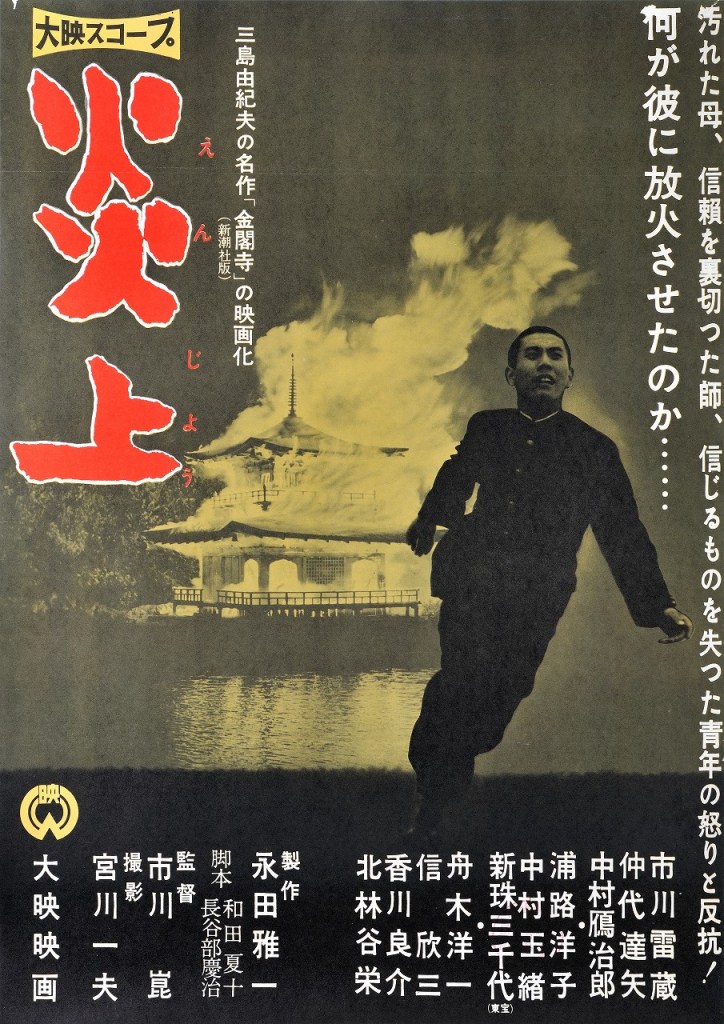
Enjo (炎上, Kon Ichikawa, 1958)

a0212807_23483150Kon Ichikawa turns his unflinching eyes to the hypocrisy of the post-war world and its tormented youth in adapting one of Yukio Mishima’s most acclaimed works, The Temple of the Golden Pavilion. Inspired by the real life burning of the Kinkaku-ji temple in 1950 by a “disturbed” monk, Enjo (炎上, AKA Conflagration / Flame of Torment) examines the spiritual and moral disintegration of a young man obsessed with beauty but shunned by society because of a disability.

The film begins near its ending as a young boy with a monk’s haircut sits in a police interrogation room. He was found passed out in the woods behind a burning temple with two knife wounds on his chest plus the knife and a packet of matches lying next to him. The police would quite like to know why he, obviously, set fire to one of Japan’s most popular historical monuments, but the boy refuses to speak.

At this point we enter a series of extended flashbacks as the boy, Goichi (Raizo Ichikawa), enters the Soen Temple after his father’s death as an apprentice to the head monk there, Tayama, who was a friend of his father’s. The assistant chief monk is unhappy about this as he’s long wanted his own son to be accepted as a novice with an eye to one day inheriting the temple as the current head monk is not married and has no son of his own. When the other monks find out that the reason Goichi rarely speaks is his stammer, they begin to doubt his suitability to become a representative of their organisation.

Having grown up in a temple, Goichi idolised his father and wants nothing other than to become a monk himself. His father also loved the golden temple, “Shukaku-ji” more than anything else in the world and so it has come to symbolise a shining pillar of purity for the young Goichi who will stop at nothing to protect it. Simply being allowed to be near it is enough for him. That the temple survived the wartime air raids and subsequent chaos is nothing short of a miracle, if not proof of the gods’ love for it.

Yet, Goichi burns it down. He destroys this thing that he loved above all else, so why did he do it? The temple is too good for the world, too pure to be permitted to exist. Simply put, we don’t deserve it. One of Goichi’s earliest attempts to protect the sacred environs of the monument sees him physically push a woman away from its doors. The woman, dressed in a very modern style, had been having an argument with a GI and though it originally looks as if Goichi may come to her rescue it’s the temple he runs for. After the woman lands flat on her back, the GI thanks him for saving them “a lot of trouble with the baby”.

After having committed an unintended sin in defending his beloved temple from being defiled by an impure woman, Goichi has the urge to confess but never quite brings himself to do it. This begins to create a rift between himself and his mentor the head priest. Though the priest had been his champion, Goichi always doubted that he really saw him as a possible successor because of his stammer and only now realises that the priest has lost faith in him because of his cowardliness in not informing him of the incident with woman outside Shukaku-ji. After this slight the priest goes on supporting Goichi but not with the same warmth as before and Goichi eventually comes to resent him.

The priest has feet of clay – though it’s not unusual for priests to marry and have families, Tayama has nominally dedicated himself to the temple only, leaving himself with a problem as to its succession. However, Goichi discovers that the priest has a mistress in one of the most popular geisha houses in Kyoto. The monks are some of the wealthiest people around thanks to pimping out Shukaku-ji as a major tourist attraction and Tayama has already forgotten himself, becoming lost in the “worldliness” necessary to manage a religious establishment which is actually a lucrative business enterprise. The temple is itself defiled, prostituted, by the very people who are supposed to be protecting it and the proceeds fed back into funding an “immoral” lifestyle for its “CEO”.

This hypocrisy adds to the injustice dealt Goichi by the uncharitable nature of the monks who also, like just about everyone else, shun him because of his stammer. Though he never stammers reading the sutras and can even speak English plainly, his lifelong stutter has left him reluctant to speak and he finds only one friend at the temple. Later he meets another bad tempered man with a lame leg and the two develop an odd bond based on their shared “deformities”. Kashiwagi (Tatsuya Nakadai) is at odds with the world and encourages Goichi further onto the course of mistaken anger born of insecurity. He urges Goichi to test Tayama’s true virtue by constantly provoking him which only leads to a further fall in Goichi’s fortunes. However, Kashiwagi is also shown up for a hypocrite who exploits other people’s reactions to his disability for his own advantage.

All of Goichi’s idols fall. His parents – his mother an adulteress and his father a sickly heartbroken monk, his mentor a lecherous hypocrite and his friend a self hating coward. The world he saw in Shukaku-ji can never exist, humans are fallible and always will be including Goichi himself who is tormented by dark thoughts. An idealistic absolutist, the existence of Shukaku-ji in this imperfect world becomes to much for him to bear.

Ichikawa tells his story in a fractured, dreamlike way full of gentle dissolves as one period segues into another without warning. Goichi’s memories become more disparate and keenly focussed at the same time as his spiritual health deteriorates. Ichikawa tries to capture some of Goichi’s inner claustrophobia through the oppressive architecture of the temple environment but can’t get close to the pervading sense of dread in Mishima’s novel. Enjo is the dissection of one man’s self immolation in the fire of his own spiritual disintegration but is also a condemnation of the corrupting modern world which enables such pollution to take place and its tale of the doomed innocence of the idealist is one which is retold throughout history.


I can’t seem to find any video clips of this film, but as a side note 炎上 is current Japanese netslang for a flamewar so I did find a bunch of other “interesting” stuff.

Here’s a short video featuring clips from several of Ichikawa’s films including Enjo which you’ll be able to spot what with the temple on fire and everything…

Attack! Hakata Street Gang (突撃!博多愚連隊, Sogo Ishii, 1978)

hakataSogo Ishii (now Gakuryu Ishii) was one of the foremost filmmakers in Japan’s punk movement of the late ‘70s and ‘80s though his later work drifted further away from his youthful subculture roots. Perhaps best known for his absurdist look at modern middle class society in The Crazy Family or his noisy musical epics Crazy Thunder Road and Burst City, Ishii’s first feature length film is a quieter, if no less energetic, effort.
Like his other films from the period, Attack! Hakata Street Gang (突撃!博多愚連隊, Totsugeki! Hakata Gurentai) is fairly light on actual plot but broadly follows a group of low level street punks who get themselves into trouble after accidentally shooting the son of a yakuza boss in the leg and leaving him to bleed to death. In trouble with both the law and the gangs the guys find themselves in the midst of a turf war they are ill equipped to handle.

Very clearly an early effort, Attack! Hakata Street Gang is an ultra low budget production filmed on the real streets starring Ishii’s friends rather than professional actors. It can’t claim to any level of aesthetic beauty and, in truth, is not particularly interesting in terms of look or style but is filled with Ishii’s characteristic energy and runs fast even given its brief 67 minute run time.

Generally, Ishii sticks to a naturalistic representation of the street punk world. Taking his cue from the realistic action genre pioneered by Fukasaku et al not long before the film’s release, Ishii employs a similar approach to the fight scenes shooting from the middle of the action and often from low angles. Full of handheld camera and shakey, unfocused shots Attack! Hakata Street Gang is filled with the kind of youthful freshness that was very in vogue at the time.

Ishii does not appear to want to offer any kind of critique of this extremely masculine, violent world but solely to capture it on film. The street punks themselves are not particularly well drawn but there is a notably strange set of characters including an ultranationalist and his younger brother with learning difficulties who wears an SS helmet and rides around on a pushbike with a large nazi flag flying on the back. Nicknamed “manji” (the word for the Japanese “swastika”) the boy is obsessed with warfare and dangerously gets hold of one of the guns his older brother has adapted from a toy to be able to fire real bullets. He’s more of a plot point than anything else but still offers a convincingly weird sample of modern street life.

Also in keeping with the recent brand of cool action dramas, the film has an energetic score which is perhaps more jazz fusion or blues rock than outright punk which gives it more of a nihilistic, sophisticated tone than the full on noise explosion of some of Ishii’s later efforts. By the time the guys have taken their final stand by capturing hostages and occupying the local kindergarten (literally kids with guns) it’s pretty clear that there is no way back for this collection of down and out street rats.

Perhaps more interesting as an early work of a master than in its own right, Attack! Hakata Street Gang is an energetic and youthful exploration of a little seen late 1970s subculture. Literally playing fast and loose, Ishii’s debut is in many ways a statement of intent and none the worse for it.


Trailer for the Sogo Ishii The Punk Years 1976 – 1983 box which includes this film (though unfortunatly does not include any subtitles).


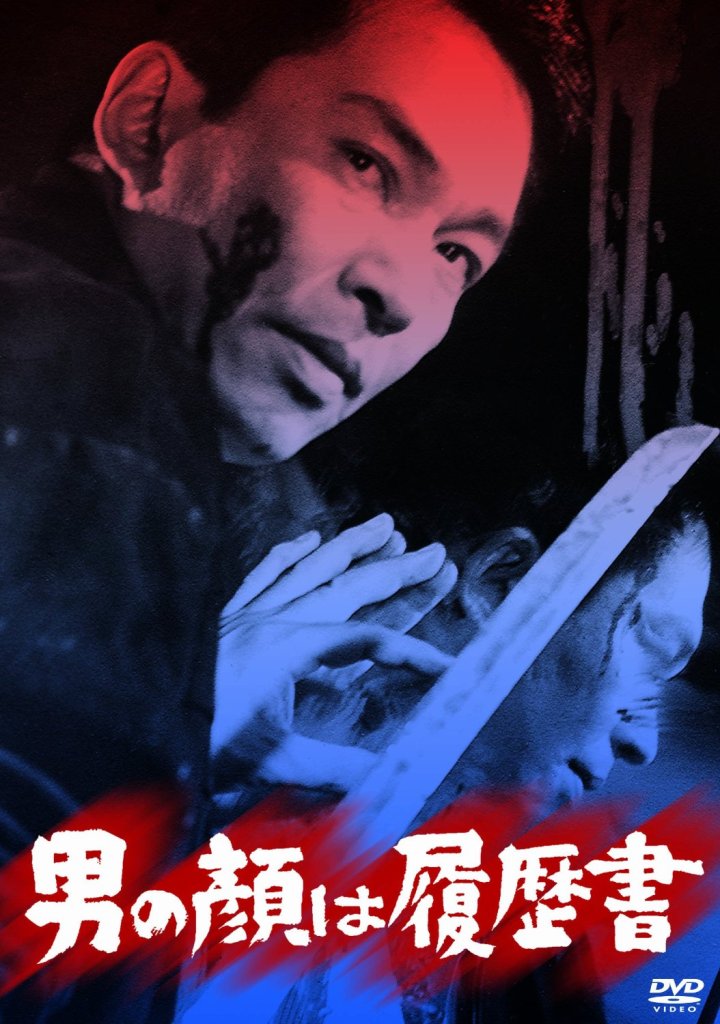
By a Man’s Face Shall You Know Him (男の顔は履歴書, Tai Kato, 1966)

by a man's faceJapanese cinema has not been as shy as might be supposed in examining uncomfortable topics concerning the nation’s mid 20th century history but perhaps prefers to tackle them from a subtle, sideways viewpoint. By a Man’s Face Shall You Know Him (男の顔は履歴書, Otokonokao wa Rirekisho) is, in essence, a fairly straightforward gangster pic – save that the rampaging gangsters are a mob of “zainichi” Koreans rather than post-war yakuza or petty hoodlums. Less about what it is to be an outsider or the quest for identity in second generation immigrants, Kato’s film is about what it says it is about – a man’s face.
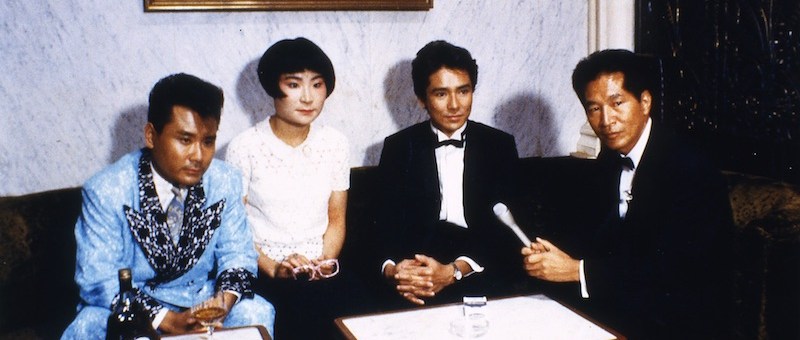
The film begins in the contemporary era when morose doctor Amamiya is contemplating a transfer to an island posting which proves unappealing to him. Shortly after, a badly injured man is brought in following a car accident and, though Amamiya originally suggests the man be taken to a hospital as his chances of survival are slim, he changes his mind after lifting the sheet and recognising the man on the stretcher. The two men go back a long way – firstly to the battlefield where “Shibata” was a private in the army serving alongside Amamiya and secondly to an incident which dictated the rest of Amamiya’s life when he ran the local GP’s office and also happened to own the deeds to some land a bunch of Korean gangsters wanted to get their hands on. Thanks to their earlier association, “Shibata” now returning to his Korean name “Choi” was able to assist Amamiya in mitigating the gangster onslaught as he himself was a member of the gang.

Perhaps more to do with the production styles of the time, all of the “Korean” gangsters are played by Japanese actors and only ever speak Japanese even to each other. Nevertheless, they all want “revenge” for Japan’s treatment of Korea and Koreans during the years of occupation and warfare. In 1949 Japan is still in ruins and the gangsters see this as a prime opportunity to finally take Japan apart and presumably also profit in the process. The leader of this particular gang has set his sights on taking over the “New Life Marketplace” (a pregnant title if ever there was one) with the intention of turning it into an “entertainment district”. His guys, including one totally crazy foot soldier played by a particularly manic Bunta Sugawara, run roughshod over the town until finally raping and murdering Japanese women which they dismiss as par for the course given Japan’s treatment of Korean women over the past thirty years.

This is not a subtle examination of Korean Japanese relations in the post-war environment, these are gangsters and movie gangsters are generally all the same. They say they want to destroy Japan but ultimately they want what all gangs want – to control the area and extort maximum profit. Choi, and the young female Korean Gye, were born in Japan, have never even been to Korea and can’t really claim to have a great deal of Korean cultural knowledge. All they have are their names, now reclaimed after Japan’s wartime defeat. Throughout the war years, Choi used the Japanese version of his name “Shibata” and tried to pass himself off as Japanese (apparently successfully) but is now committed to embracing his Korean heritage even if it once again sees him placed in a subjugated position.

Amamiya returned from the war and took over his father’s medical clinic in his home town. He’s cynical and apathetic. He treats the people who come in to his clinic without discrimination but he doesn’t care very much about the area either. The only thing he really cares about is his nurse, Maki, with whom he’s been having a passionate affair and seems to be deeply in love. Amamiya makes an enemy of the Koreans early on when he fights off some guys who are hassling his nurse proving that he’s no pushover. The title deeds for the land the market is built on also belong to Amamiya who is unlikely to surrender them. The townspeople first turn to the regular Japanese yakuza who are unable to help with their currently depleted manpower leaving Amamiya as their only form of salvation.

When Amamiya’s hotheaded brother turns up and starts causing all sorts of trouble with the Koreans as a way of avenging Japan’s wartime defeat, Amamiya is dragged into a battle he had no desire to fight. Shunji was too young to fight in the war but is a representative of the younger generation who can’t accept the new post-war society and what they see as their older siblings failure to support the nation. Though a strong attraction develops between Shunji and Gye, their love story becomes another casualty of the harsh post-war world. Reluctantly, Amamiya becomes the last defender of these put upon people leading to a High Noon style solo stand against the Koreans whilst the terrified populace look on in fear and hope.

Kato creates a colourful world rich in symbolism such as the early scene in which Choi’s red blood drips down the white sheet accidentally recreating the Japanese flag. Amamiya’s prominent scar becomes both a plot point and a symbolic motif as it echoes the film’s title in bearing out his “history”. A man’s life is indeed written on his face, and Choi’s wife’s urging to her daughter that they watch Choi’s face as he fights for his life is another indication that one’s true nature is seen most clearly in times of duress. The film closes on an ambiguous note, in one sense, but closes its thematic line neatly. Amamiya faces a choice and no choice at the same time but through his face we know him and so we understand.


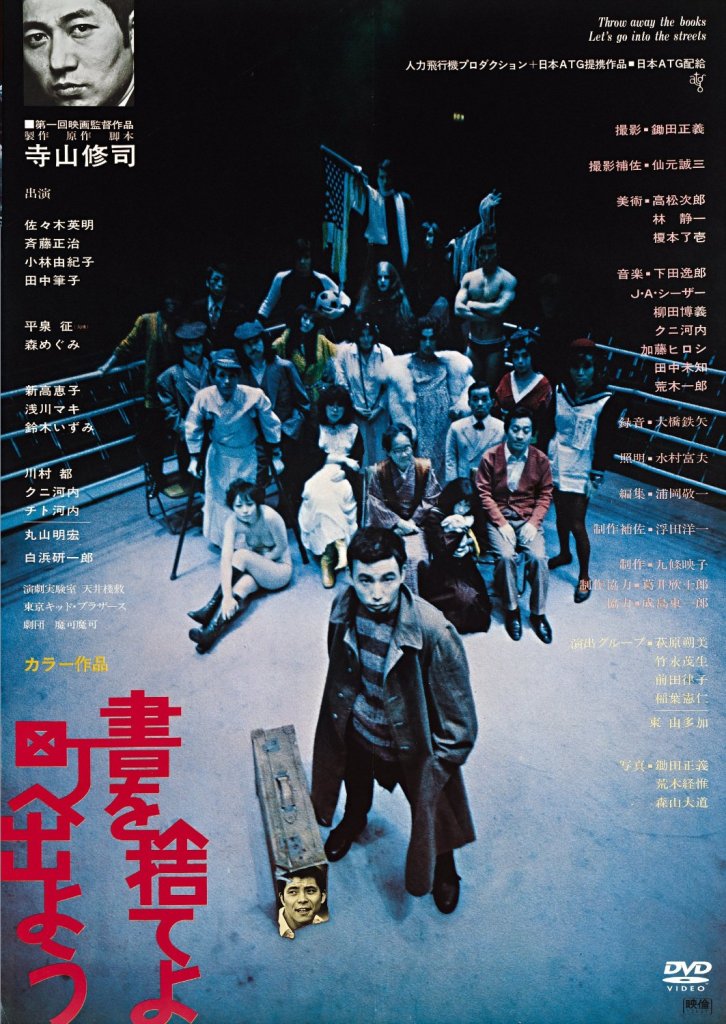
Throw Away Your Books, Rally in the Streets (書を捨てよ町へ出よう, Shuji Terayama, 1971)

throw away your booksCaught in a moment of transition in more ways than one, Throw Away Your Books, Rally in the Streets (書を捨てよ町へ出よう, Sho o Suteyo Machi e Deyo) is a clarion call to apathetic youth in the dying days of ‘60s youthful rebellion. Neatly bridging the gap between post-war avant-garde and the punk cinema of the ‘70s and ‘80s, Terayama experiments gleefully with a psychedelic, surreal rock musical which is first and foremost a sensory rather than a cerebral experience.
The film opens with an uncomfortably long black screen which has a subtle soundscape running behind it. Just when you begin to think there’s something wrong with the video, a young man dressed in a trench coat (collar turned up) appears and berates our idiocy for haven fallen for the trick. What are we doing here, sitting in a dark room waiting for something to happen when the real action is, and always has been, out in the streets? We’re trapped in here – we’re the ones inside the screen, the boy is free to smoke and we are free only to watch him do it.

It becomes clear that we are also trapped within the realm of his unrealisable dreams. He worked at a factory but he didn’t like it so he quit. He wanted to be a boxer but it frightened him so he gave up. He hears a story of a Korean boy who built a glider and tried to fly home on his own only to crash somewhere over the ocean. He envies the moments of blue skies the Korean boy flew through as the brief fulfilment of a dream. From this point on he builds a glider in his mind but is perpetually unable to launch finally seeing it too go up in flames.

The boy says he comes from a dead end place where he lives with his unemployed father, needy grandmother and younger sister whose attachment to her pet rabbit is beginning to raise eyebrows. He finds another outlet for his youthful masculinity in the local football team (football is the most manly because the ball is bigger) where an older brother substitute tries to introduce him to the better things in life including sending him to a local prostitute to “make him a man” and teaching him about “sophisticated” western dining and marxist discourse. Throughout all of this the boy remains alone, perpetually observing from the outside but never successfully finding his way in. There’s a repeated riddle – what has one way in and two ways out? We expect an answer that carries some profound weight about the nature of human existence but, no, after all it’s just a pair of trousers.

Terayama travels from black to white – beginning with the bleak opening which is all darkness and silence, he takes us to an ending of blinding white light and the eclipse that will come to us all. The boy tells us the the film will be over soon and no one will remember him – that’s all that’s left to show, a blank white screen and the images of men who will shortly disappear. However, this is not the end though we see the white screen interrupt us a few more times, the boy has another monologue in which he tells us how the film has consumed him so that the lines between reality and fantasy have become indistinguishable. The film crew have become his family, the actor playing his father is, in a sense, his father, the 28 day shoot has become an entire universe which lives and dies inside the film. A film is something which only lives in the dark, when we flick on the lights, the magic is broken and it dies.

The boy says he loved this world but does not love the cinema yet the film is rife with cinematic references and Terayama is always careful to remind us we’re watching a film by deliberately making us aware of the camera. He calls out Polanski, Oshima, and Antonioni by name and even sings a love song to Ken Takakura as well as pledging his devotion to female leading yakuza actress Junko Fuji. Yet the world of the film is totally its own encompassing proto-punk rock songs, surrealistic imagery and inserted street art quoting artists and dreamers including the Russian futurist poet Mayakovsky. As in his other work Terayama also employs Godard style colour filters from the violent green of the boy’s family life to the standard colouring of the football club and the purple tinged insert scene in which a group of hopefuls read out classified ads featuring men seeking men, missing wives and mothers, and finally a couple of obvious scams.

Way ahead of its time and successfully anticipating the anarchic pop-punk movement which was to come some years later Terayama’s youthful masterpiece remains one of the most important if inscrutable films of the era. Sadly, Terayama died at the young age of 47 in 1983 walking into his own blank white screen but even in this first feature length effort he imprinted all the pain and rage of his times into a story of a young man lost and confused in the modern consumerist era. It calls on youth to awaken, go out into the streets and do something, anything, but also has little faith that it will. We’ll go on watching Ken Takakura to feel like a tough guy before going back to being vaguely disappointed with our circumstances but doing nothing much of anything at all about it. We too, live only in the film, inside the dream, until the screen burns white and our dreams dissolve with it.


This trailer was created for a specific film screening (The North Star Ballroom is where the screening took place) but does have subtitles. It’s a little NSFW though, be warned.

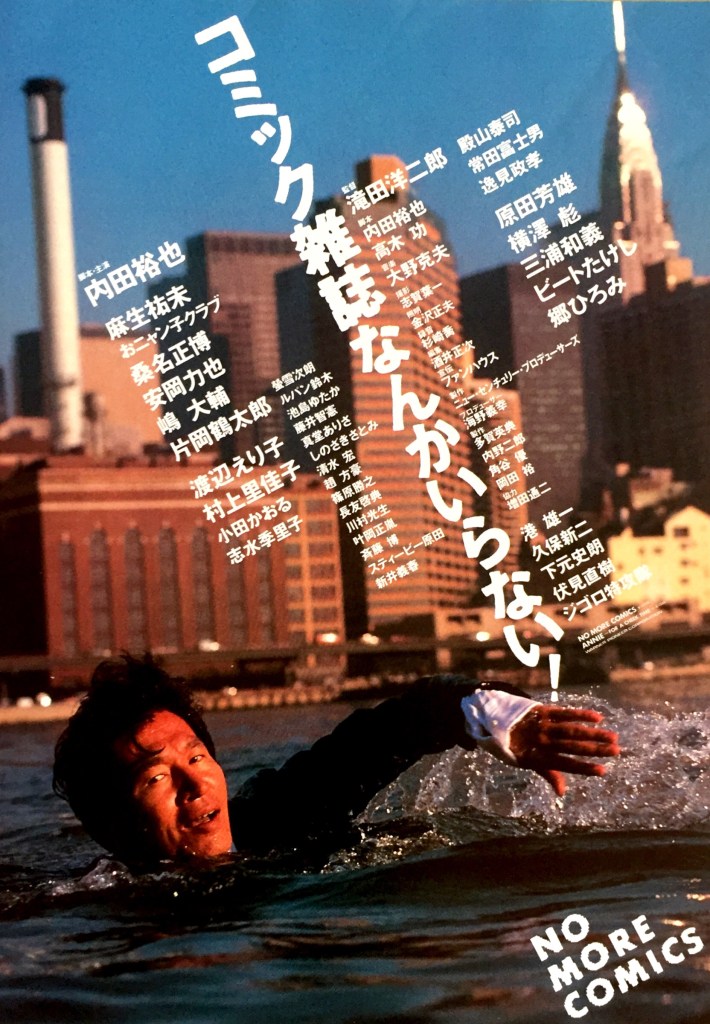
No More Comics! (コミック雑誌なんかいらない!, Yojiro Takita, 1986)

No More ComicsThe word “paparazzo” might have been born with La Dolce Vita but the gossip hungry newshound has been with us since long before the invention of the camera. Yojiro Takita’s 1986 film No More Comics! (コミック雑誌なんかいらない, Komikku zasshi nanka iranai AKA Comic Magazine) proves that the media’s obsession with celebrity and “first on the scene” coverage is not a new phenomenon nor one which is likely to change any time soon.
Kinameri (Yuya Uchida) is a hack reporter on a gossipy news magazine programme which reports on all the sordid personal details of the private lives of celebrities. In a bit of neat meta commentary, we first meet him when he’s doggedly following real life top actress of the time Kaori Momoi (making a brief self cameo) as she tries to board a plane at the airport. Kinameri keeps on asking his inappropriate questions about her alleged relationship with a screenwriter whilst Momoi successfully ignores him before finally reaching the relative sanctuary of the security cordon preventing Kinameri from actually boarding the plane with her. Of course, his interview attempt has failed but he plays the footage on the programme anyway justifying her silence as a lack of denial and that he has therefore “proved” that the rumours are true.

Kinameri is both respected and ridiculed by his colleagues who praise his probing journalistic techniques which see him doggedly refusing to give up on a story but also find his intensity amusing seeing as he’s mostly chasing cheating spouses rather than uncovering the next great political scandal like his heroes who exposed Watergate. Having graduated from a top Japanese university in political sciences, this is far from the line of work Kinameri would want to be doing and its vacuity coupled with his own failed ambitions push him further and further into a spiral of self loathing and depression.

It’s not only celebrities either. Even if you could make a case that those in the entertainment industry have entered into a pact with the media and are, therefore, fair game, civilians and particularly victims of crime should be off limits. Kinameri will literally stop at nothing to scratch a up a story including attending the funeral of a murdered 14 year old girl and quizzing her mother over the rumours that the girl had been engaging in prostitution to try and elicit some kind of social commentary about the youth of today. After his programming starts to decline in popularity he’s relegated to the late night slot which involves visiting various shady places such as strip clubs, snack bars that are actually yakuza hang outs, and even the set of a porn film where he gets a cameo feeling up the lead actress in the front of a convertible.

While all of this is going on, Kinameri is also receiving some bothersome cold calls offering to sell him gold as an investment proposal. His elderly neighbour is visited by a woman from the company and does actually buy some but Kinameri smells a rat and his journalistic instincts kick back in. His bosses at the network aren’t convinced though – dodgy gold dealers doesn’t sound like a ratings winner after all and even when Kinameri agrees to even shadier assignments so he can pursue his leads, they still aren’t really behind him. Eventually they catch up but it’s almost too late.

Kinameri keeps doing what he’s paid to do, even if he clearly despises everything about it. Asking trivial and ridiculous questions and being ignored anyway, conducting a vacuous meet and greet with a gang of up and coming idol stars, even posing as a gigolo – there are no lengths to which he will not sink in pursuit of his story. By the film’s finale he’s still the frontline reporter, looking on while a vicious yakuza (played by a young Takeshi Kitano) commits a brutal murder right in front of the cameras. No one is moving, no one is trying to stop this, everyone is manoeuvring to get the best coverage. Kinameri has had enough and, with a look of rage and contempt on his face, he launches himself through the widow in a last minute attempt to make a difference but once again, lands up flat on his face and, finally, excluded from the action.

Years ahead of its time, No More Comics! takes an ironic look at invasive media coverage of celebrity gossip which clogs the airwaves while the real story is wilfully ignored. Ironically, Kinameri even becomes something of a celebrity himself, well known for his dogged interviewing style. He receives countless answerphone messages from “fans” (somehow ringing his personal phone number) either praising his efforts or berating him for not pushing his targets harder. When a young aspiring journalist stops him in the street and asks for advice, Kinameri doesn’t even answer but just walks away with a look of contempt and sadness on his face. Finally, after his mad dash into a crime scene in the final reel, he becomes the news himself. All of his fellow reporters suddenly want to know “what happened”, “what was it like”, “did you go in to save him or for the story?” etc. Still stunned and probably in need of medical attention, Kinameri looks directly into the camera, puts his hand across the lens and states “I can’t speak fucking Japanese”.

Filled with rage and shame, No More Comics! is a Network-esque satire on the world of live broadcast reporting exposing the seedier sides of journalistic desperation. Ahead of its time and sadly still timely in the age of 24hr coverage which mainly consists of the same trivial stories repeated ad nauseum, its messages are needed more than ever.


Unsubtitled trailer:


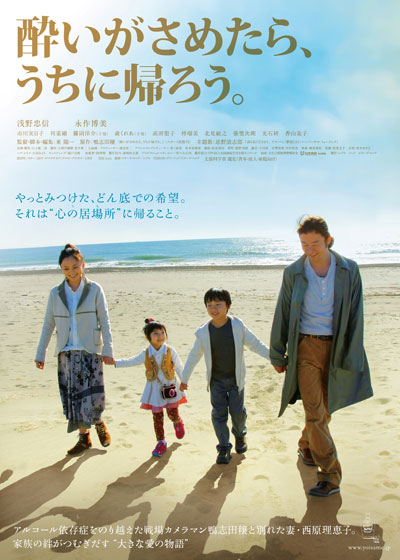
Wandering Home (酔いがさめたら、うちに帰ろう, Yoichi Higashi, 2010)

wandering homeAlcoholism is not a theme which has exactly been absent from the history of cinema. From the booze drenched regret of Days of Wine and Roses to the melancholic inevitability of Leaving Las Vegas and the disdaining irony of Barfly, there has been no shortage of unsympathetic portrayals of drunkenness when it comes to the silver screen. Yoichi Higashi’s Wandering Home (酔いがさめたら、うちに帰ろう, Yoi Ga Sametara, Uchi Ni Kaerou) walks something of a middle road here as it embraces the classic “issue drama” mould but also aims for a naturalistic character study in adapting the true life memoirs of photojournalist Yutaka Kamoshida (husband of well known mangaka Reiko Saibara).

The film begins with a touch of magical realism as Tsukahara (Tadanobu Asano) literally falls off his barstool and has a vision of his wife and two children urging him to get up. Of course, they aren’t “real”. Tsukara lives with his mother after his marriage to a successful mangaka broke down due to his alcoholism. Returning home and ignoring his mother’s advice to get something to eat, Tsukarahara has another drink whilst swearing that this time he’ll be sober when he sees his kids but shortly after retreats to the bathroom to vomit where he experiences a massive haemorrhage and is taken to hospital. Things have already gone too far, he’s told he’s lucky to be alive and the next time this happens he will die.

Swearing to finally come off the booze, Tsukahara goes home but is immediately tempted by a side dish in a restaurant which contains alcohol. He makes the wise choice not to buy the vodka in the off-licence but eventually talks himself into buying beer which he drinks right away and then falls over and hits his head on the way home. His ex-wife, Yuki (Hiromi Nagasaku), and his long suffering mother have gone through this too many times before to even be disappointed. Eventually, they ship Tsukahara off to a residential facility in the hope that they can finally help him beat the booze for good.

Wandering Home is inspired by the real life story of a photojournalist which has also inspired a few other films including the following year’s Kaasan which told the same story from the point of view of Kamoshida’s mangaka wife. Therefore, the ending of this story might perhaps be known to you already but needless to say it isn’t an altogether happy one. The film doesn’t go into the reasons Tsukahara started drinking save for emphasising that it’s rarely one root cause that starts someone on the road to alcohol addiction. Tsukahara’s father had been an alcoholic and had also behaved violently in the home – something which Tsukahara despised and yet he ultimately became exactly like his dad. Having started to drink as a young teenager he drifted into an aimless life and then witnessed a number of traumatic events in his career as a photojournalist which also left their mark on him.

Though the film is never shy about the disruption Tsukahara’s drunkeness causes to his family, it mitigates the effects by casting them as surreal episodes such as the only scene in the film where Tsukahara is shown to be violent towards his wife in which another soot covered version of himself emerges from a zipper in his back to shout abuse and trash the place as his children retreat in horror to their bedroom. It’s not Tsukahara, it’s the alcohol, the film tries to say but actually lays the message on a little thick and often neglects the trauma that his behaviour is, in turn, causing to his own son and daughter.

That said, there is remarkably little animosity between Yuki and her ex-husband despite the way that he has behaved. Yes, the pair are divorced but Yuki is called right away when Tsukahara is taken to hospital and when she brings the children to visit him the couple talk warmly with no bitterness or recrimination. The children too are happy to see their father and do not seem afraid of him in any way at all.

Higashi does, however, fall into standard “issue drama” tropes and perhaps spends too much time exploring the rehab facility where Tsukahara is sent for treatment. Though hearing something of the other characters’ paths to alcohol dependency is enlightening, it can’t help but feel more like a public information film at times than the affecting character drama it should be. Small touches like Tsukahara’s longing for something a simple as being able to enjoy curry again like everyone else on the ward or his more frequent difficulties of being able to distinguish a hallucination from something he’s doing for real lend weight to the central story but they can’t quite save it.

Higashi’s tone is generally straightforward and mostly avoids melodrama or sentimentality except during the film’s ending. This sounds like a strength but turns out to be a weakness as something about Tsukahara’s plight never quite grabs the heartstrings in the way it seems to want to. The film’s unsentimental depiction of alcohol dependency and one man’s struggle to try and regain his place within his own family is an admirable one, but Wandering Home ultimately falls far short of its intended destination.


The Japanese dvd/blu-ray release of Wandering Home includes English subtitles!

Unsubtitled trailer: