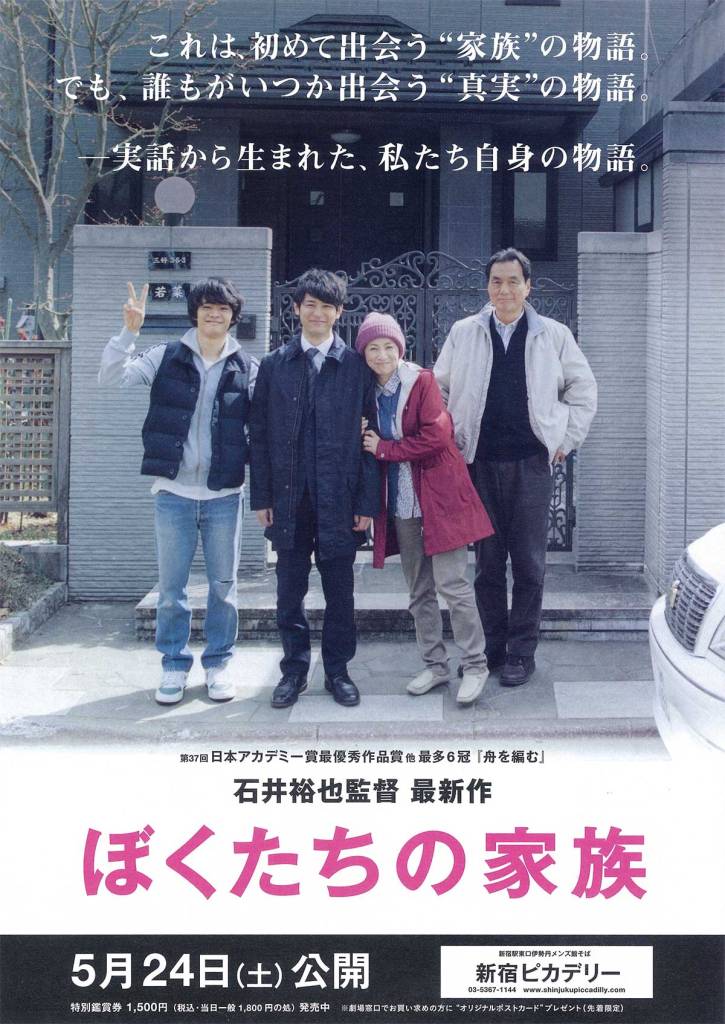
 Yuya Ishii’s early work generally took the form of quirky social comedies, but underlying them all was that classic bastion of Japanese cinema, the family drama. If Ishii was in some senses subverting this iconic genre in his youthful exuberance, recent efforts have seen him come around to a more conventional take on the form which is often thought to symbolise his nation’s cinema. In Our Family Ishii is making specific reference to the familial relations of a father and two sons who orbit around the mother but also hints at wider concerns in a state of the nation address as regards the contemporary Japanese family.
Reiko (Mieko Harada) is an ordinary Japanese housewife in late middle age with a husband still working and two grown up children. She’s been worrying lately that she seems to forget things and she also has periodic trances almost like someone pressed the paused button. This all comes to a head when she and her husband Katsuaki attend a family dinner with their in-laws to celebrate the news that their eldest son, Kousuke (Satoshi Tsumabuki), and his wife are expecting their first child. Having behaved quite strangely all night long, Reiko finally ends by repeatedly addressing her daughter in law by the wrong name and muddling up details about the baby. Reiko’s still young but the natural assumption is perhaps that she’s slipping into senility, dementia or possibly even Alzheimer’s but a visit to the doctor turns up something that no one was expecting as they’re eventually made to understand that Reiko may only have a week left to live.
This devastating news of course sends shock waves through each member of the family and not least Kousuke who’s just learned he’s about to become a father. One of the things Reiko was most distressed about was that she’d wake up one day and her family would have fallen apart. It seems she grew up in an unhappy home and was determined not to replicate the experience for her children. Perhaps she did have cause to worry as there were definite cracks in the foundation of this household even before Reiko’s illness in that youngest son Shunpei (Sosuke Ikematsu) seems to have had a strained relationship with both his father and his older brother. In contrast to the other two men, Shunpei, still a student, is much more laid back and easy going though his father perhaps thinks him feckless and irresponsible. He meets his mother sometimes and she lends him money behind the father’s back but they talk more like friends than a mother and son.
Perhaps this division between the men in her life has been playing on Reiko’s mind but there are other problems too. Part of the bubble generation, Reiko and Katsuaki have been living well beyond their means for years and have amassed considerable personal debt. In fact, Katsuaki remortgaged the house a while back and made Kousuke a guarantor on their loan. Their best option would be to file for bankruptcy but doing that would leave Kosuke liable for the return of the mortgage so Katsuaki is reluctant to pursue that option. Now that Reiko’s in hospital money is at the forefront of everyone’s mind as they contemplate paying not only astronomical medical fees but potentially also paying for a funeral too.
This financial strain spills over into Kousuke’s new family as, when talking to his wife about needing to help out his parents, Kousuke discovers that Miyuki is just about as unsupportive as one could be. She brands Kousuke’s parents as irresponsible dreamers still living in the bubble era and suggests their predicament is both their own fault and their responsibility as, at their age, they should have been saving money for just these kinds of situations. Scornfully she insists that she doesn’t want to be “that kind of parent” and retires to bed in outrage. Having also refused to even accompany Kosuke to visit his mother in hospital (seeming to miss the point that he might be looking for her support rather than asking for appearance’s sake), poor Kousuke is left all alone trying to deal with the impending birth of his child and death of his mother all in a few short weeks.
The crisis does, at least, bring the three men a little closer together as it requires a kind of unilateral action that pushes previous resentments and ill feeling into the background. Reiko’s condition also means that she says some things that she would never have revealed directly to her family which both hint at some of her suffering over the last thirty years but also the deep love she has for her them. Katsuaki is revealed as a fairly ineffectual man who cares deeply but is blindsided by his wife’s condition and unable to face the facts leaving the bulk of responsibility to his oldest son. This kind of family abnegation is anathema in Japan – one would never want to be a burden to one’s children but Katsuaki is now both financially and morally dependent on Kousuke. Kousuke himself is not quite mature enough for this level of responsibility despite his impending fatherhood and his younger brother Shunpei may appear indifferent to everything but is merely putting a brave face on things though he may be the most dependable (and emotionally intelligent) of the three.
By the end, there is a glimmer of hope. The family can be repaired if you’re willing to work at it which means being willing to face the problems together and without any secrecy. Everyone, including the older generation, has in some senses “grown up”, facing the future together having accepted themselves and each other for who they are. Like applying a touch of kintsugi, their glittering wounds have only made them stronger and made each refocus on what’s really important. Neatly moving into a more dramatic arena, Ishii proves he’s still among Japan’s most promising young directors able to marry an idiosyncratic indie spirit with a more mainstream mentality.
The Hong Kong DVD/blu-ray release of Our Family includes English Subtitles!
Unsubtitled trailer:
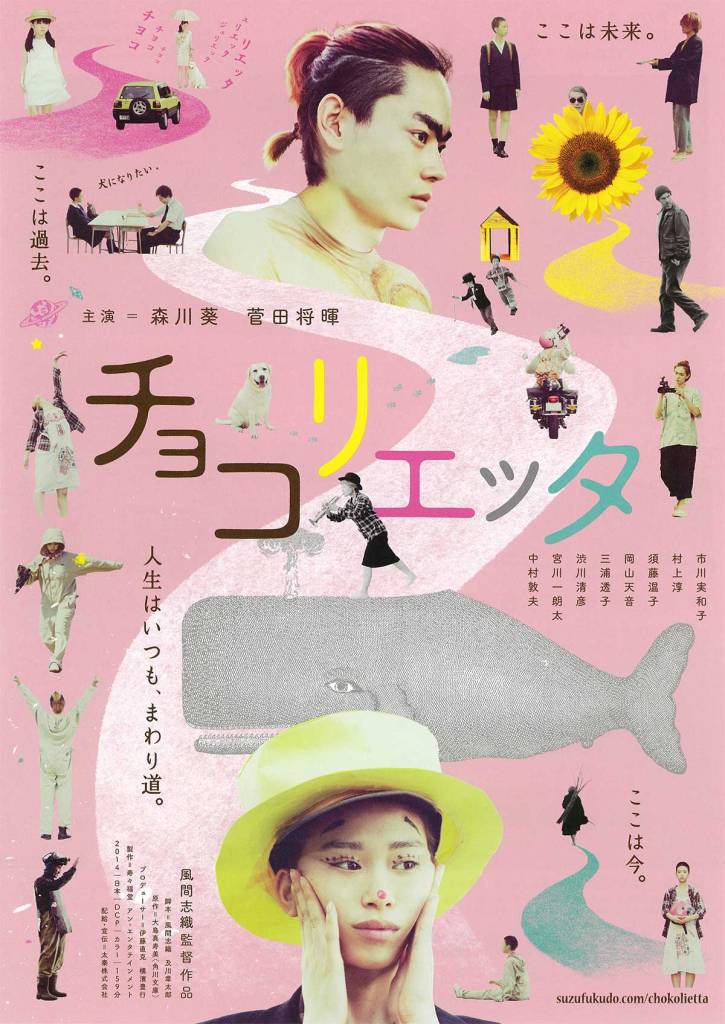 When examining the influences of classic European cinema on Japanese filmmaking, you rarely end up with Fellini. Nevertheless, Fellini looms large over the indie comedy Choklietta (チョコリエッタ) and the director, Shiori Kazama, even leaves a post-credits dedication to Italy’s master of the surreal as a thank you for inspiring the fifteen year old her to make movies. Full of knowing nods to the world of classic cinema, Chokolietta is a charming, if over long, coming of age drama which becomes a meditation on both personal and national notions of loss.
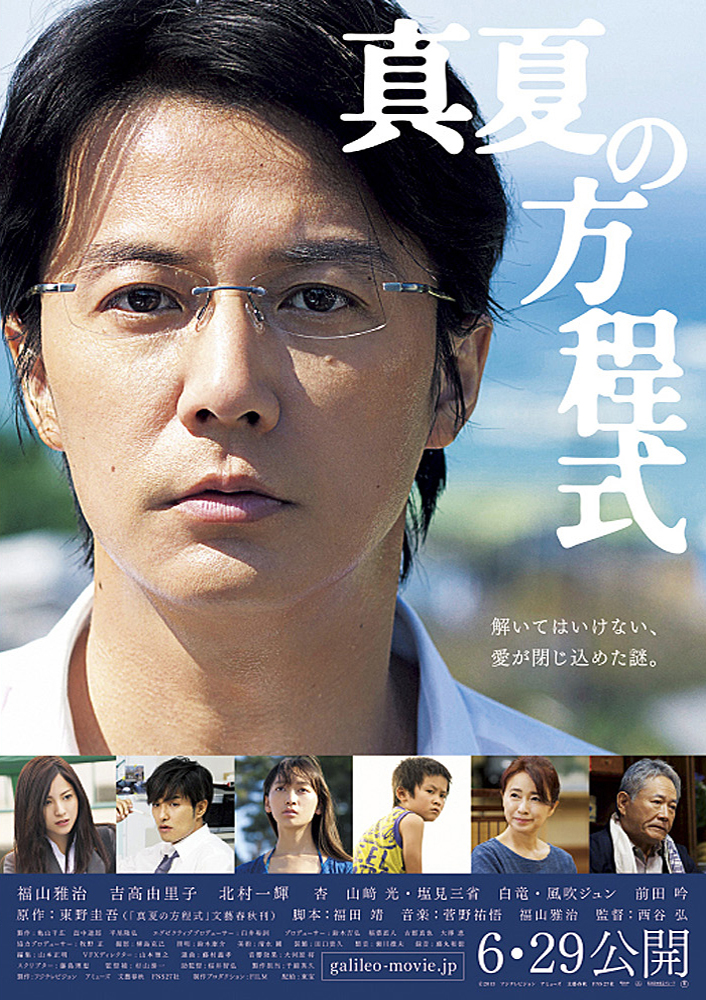 Sometimes it’s handy to know an omniscient genius detective, but then again sometimes it’s not. You have to wonder why people keep inviting famous detectives to their parties given what’s obviously going to unfold – they do rather seem to be a magnet for murders. Anyhow, the famous physicist and sometime consultant to Japan’s police force, “Galileo”, is about to have another busman’s holiday as he travels to a small coastal town which is currently holding a mediation between an offshore mining company and the local residents who are worried about the development’s effects on the area’s sea life.
 As you read the words “adapted from the novel by Kanae Minato” you know that however cute and cuddly the blurb on the back may make it sound, there will be pain and suffering at its foundation. So it is with A Chorus of Angels (北のカナリアたち, Kita no Kanariatachi) which sells itself as a kind of mini-take on Twenty-Four Eyes (“Twelve Eyes” – if you will) as a middle aged former school mistress meets up with her six former charges only to discover that her own actions have cast an irrevocable shadow over the very sunlight she was determined to shine on their otherwise troubled young lives.
 Despite being one of the most prolific directors of the ‘80s and ‘90s, the work of Yoshimitsu Morita has not often travelled extensively overseas. Though frequently appearing at high profile international film festivals, few of Morita’s films have been released outside of Japan and largely he’s still best remembered for his hugely influential (and oft re-visited) 1983 black comedy, The Family Game. In part, this has to be down to Morita’s own zigzagging career which saw him mixing arthouse aesthetics with more populist projects. Main Theme is definitely in the latter category and is one of the many commercial teen idol vehicles he tackled in the 1980s.
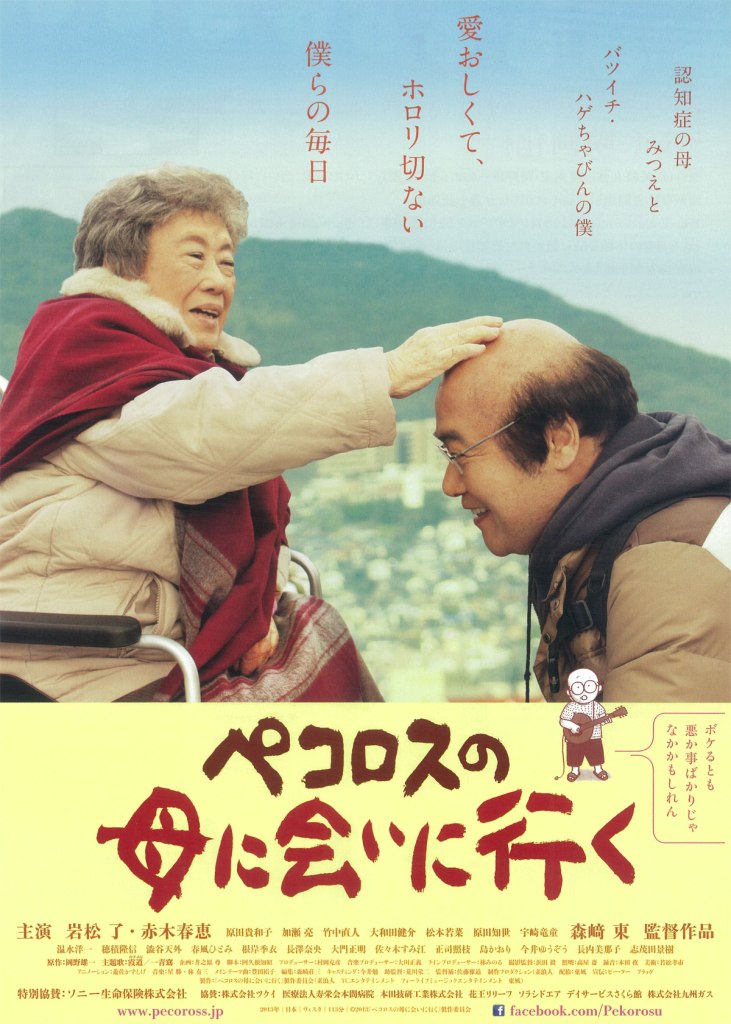 Topping the “best of 2013” lists in both Kinema Junpo and Eiga Geijitsu (something of a feat in itself), Pecoross’ Mother and Her Days (ペコロスの母に会いに行く, Pecoross no Haha ni Ai ni Iku) is a much more populist offering than might be supposed but nevertheless effectively pulls at the heartstrings. Addressing the themes of elder care and senile dementia in Japan’s rapidly ageing society, the film is both a tribute to a son’s love for his mother and to the personal suffering that coloured the majority of the mid-twentieth century in Japan.
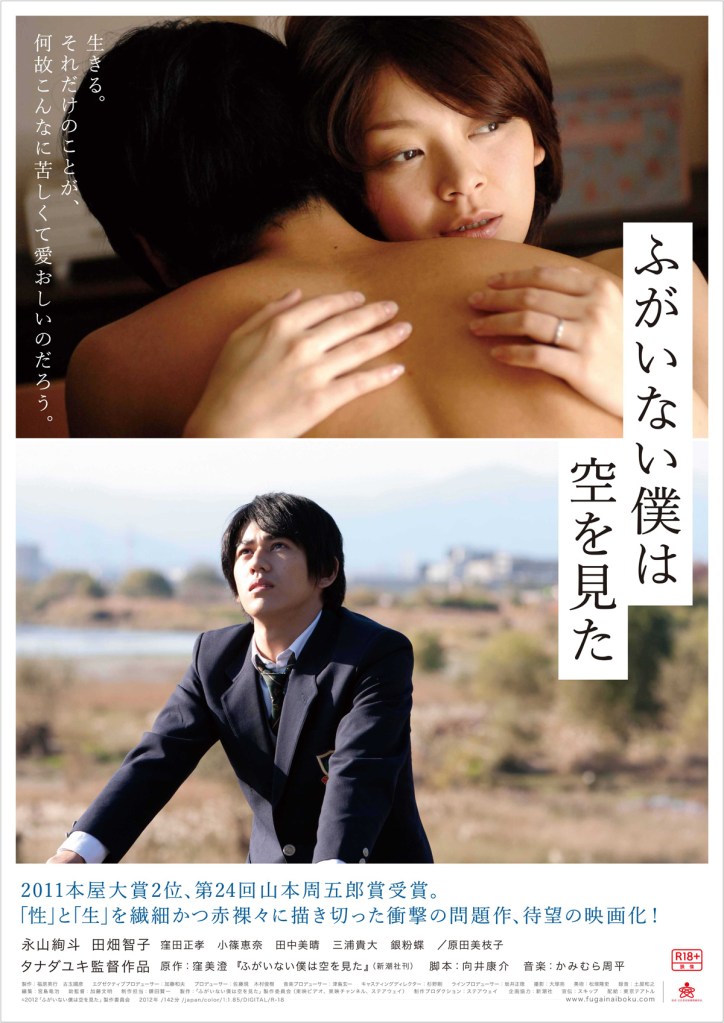 The work of director Yuki Tanada has had a predominant focus on the stories of independent young women but The Cowards Who Looked to the Sky sees her shift focus slightly as the troubled relationship between a middle aged housewife who escapes her humdrum life through cosplay and an ordinary high school boy takes centre stage. Based on the novel of the same name by Misumi Kubo, The Cowards Who Looked to the Sky (ふがいない僕は空を見た, Fugainai Boku wa Sora wo Mita) also tackles the difficult themes of social stigma, the power of rumour, teenage poverty, elder care, childbirth and even pedophilia which is, to be frank, a little too much to be going on with.
 It used to be that movies about marital discord typically ended in a tearful reconciliation and the promise of greater love and understanding between two people who’ve taken a vow to spend their lives together. These endings reinforce the importance of the traditional family which is, after all, what a lot of Japanese cinema is based on. However, times have changed and now there’s more room for different narratives – stories of women who’ve had enough with their useless, deadbeat man children and decide to make a go of things on their own.
 “Being good”. What does that mean? Is it as simple as “not being bad” (whatever that means) or perhaps it’s just abiding by the moral conventions of your society though those may be, no – are, questionable ideas in themselves. Mipo O follows up her hard hitting modern romance The Light Shines Only There by attempting to answer this question through looking at the stories of three ordinary people whose lives are touched by human cruelty.
 Windows on Worlds