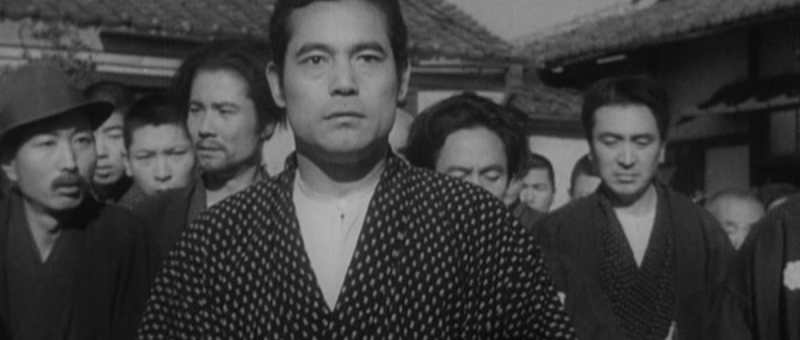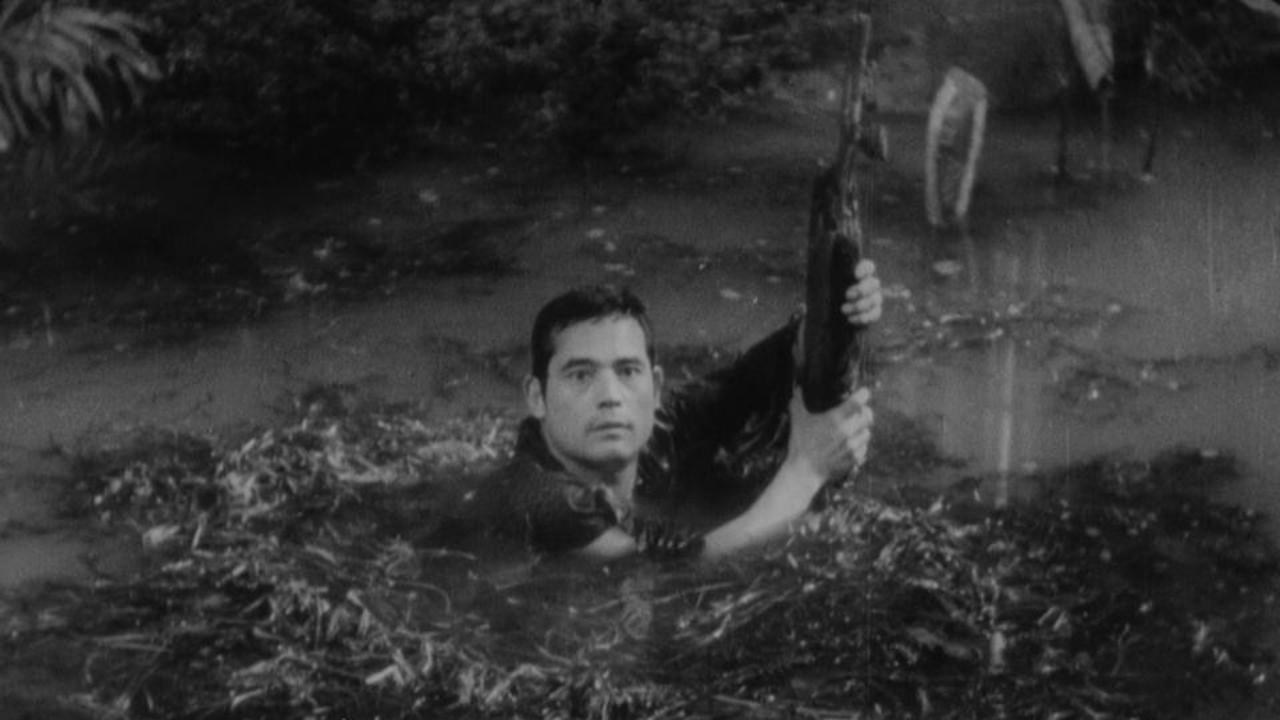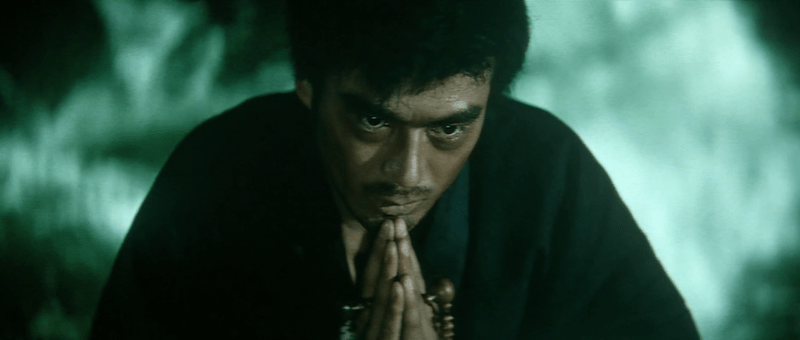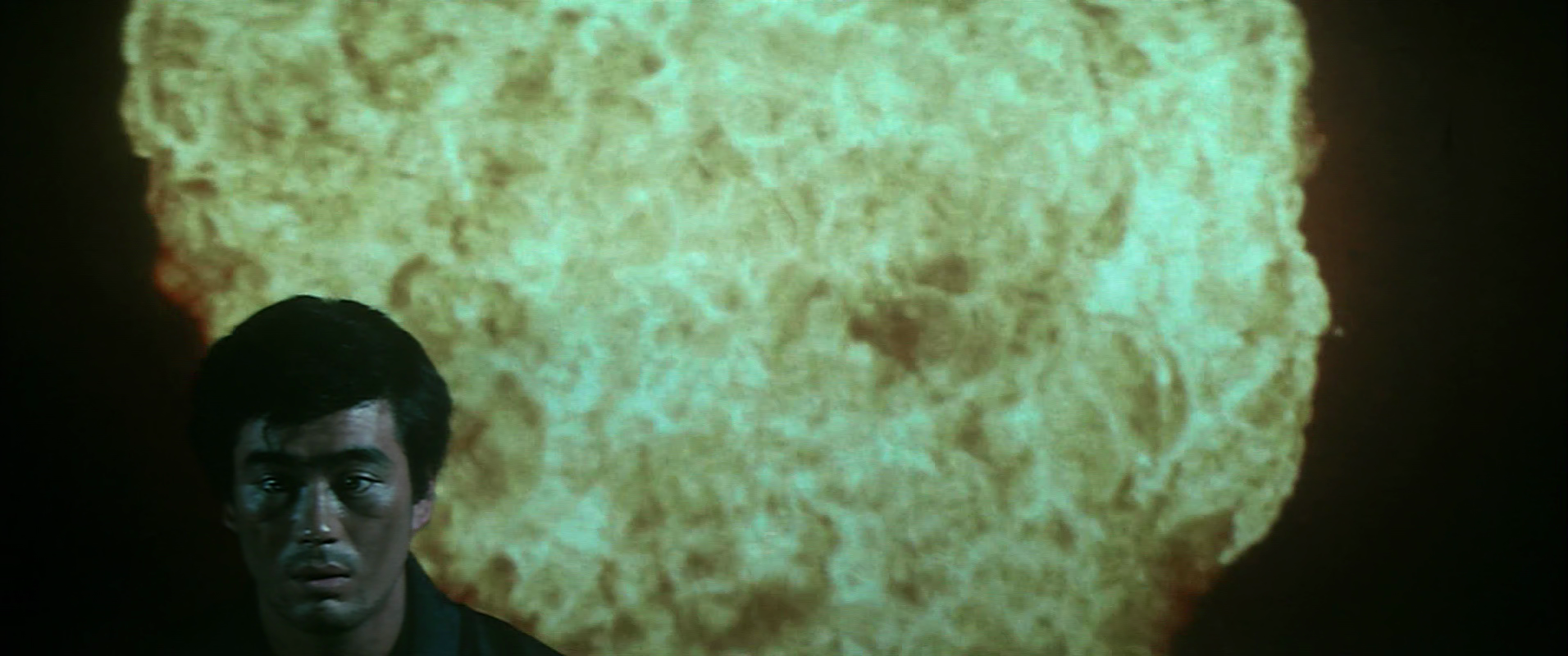
Eight Men to Kill (賞金首 一瞬八人斬り, Shigehiro Ozawa, 1972)

In the first instalment of the Bounty Hunter series, Shikoro Ichibei (Tomisaburo Wakayama) had been a shogunate spy intent on putting down rebellion to their oppression, but by the third, it seems he’s thoroughly fed up with the ills of feudalism and apparently no admirer of the Tokugawa who he feels to have failed in their responsibility to the people along with their personal greed and desire to hold on to their power.

Ichibei’s chief objection is their lack of healthcare provision, seeing as he is a doctor who mainly cares for the poor. That’s one reason he agrees to the job, asking for a large percentage of the gold he’s been asked to retrieve by a worried retainer who explains that the Edo government is relying on it to bridge a gap on their finances. If the gold’s not returned, the entire economy may crash. The government’s heartlessness is further borne out by the retainer’s words that it’s not the time to be concerned about one boy whose importance pales in contrast to that of the Tokugawa Shogunate when a rogue ronin kidnaps the son of the man responsible for the theft of the gold from a local mine. 

In a repeated motif, men attempt to swallow the gold as a means either of stealing or hiding it but it gets stuck in their digestive system and causes them a great deal of pain that could lead to death. The cruel mine owner Kanoke Tatsu (Minoru Oki) forces Ichibei to cut open the man’s stomach to get the gold out, while he insists on sewing him back up again because as a doctor it would be wrong not to. What he’s really performed maybe a kind of gold-ectomy, removing the toxic substance from the men’s stomachs even if he may not be able to save their lives or improve their circumstances.

Ichibei tells the bandit, Yasha the Wolf (Kenji Imai), who is held responsible for the theft of the gold, that he is as bad as him and is only looking for a fast way to make money, yet he wants it to use to build better hospitals for the poor, ironically using the government’s cash to make up for their failing. Meanwhile, he finds himself coming up against a man much like himself only inverted in the form of wandering assassin Yajuro (Shigeru Amachi), a former secret policeman in the rebellious Bishu domain who doubt crosses everyone he comes across in an attempt to get his hands on the gold. Ichibei asks the man who hired him why they don’t want to use government spies but he tells him that it’s because they’d run out. The ones they sent to investigate have all been killed, presumably by the treacherous Yajuro.

All around him, Ichibei discovers only omnipresent greed. A geisha he comes across is working with the mine owner to steal the cash, but simultaneously seducing Ichibei and the apparently won over by his bedroom prowess though it’s difficult to know which is an act, her fondness for Ichibei or pledges to sell him out to Kanoke. Meanwhile, Kanoke vacillates when presented with a binary choice by Yajuro, his adorable three-year-old son, or the gold. As always, it’s the innocent who suffer while personal greed and governmental indifference leave ordinary people little room to manoeuvre. 

This time around, the righteous Ichibei cuts a solitary figure. He no longer has a posse and is supported only by an older gentleman who is mute. As a result of his mission, he even ends up on a wanted poster himself with the shogunate, presumably unwilling recognise him, yet eventually congratulating him on a job well done, much to his shame and embarrassment having witnessed shogunate soldiers committing an atrocity. Very much in the western vein, Ozawa lends the dusty old mining town a sense of dread and decay as it rots from the inside out thanks to the corrupt authority of a weakened shogunate seeking only ways to cement its own power. The red-tinted final taking place during a solar eclipse seems to emphasise the hellishness of the situation even as Ichibei announces that they can all go to hell but he’s sending the money to heaven where it can be put to better use. 


The Fort of Death (五人の賞金稼ぎ, Eiichi Kudo, 1969)

Shikoro Ichibei (Tomisaburo Wakayama) returns yet this time seemingly on the opposite side in the second in the Bounty Hunter series, The Fort of Death (五人の賞金稼ぎ, Gonin no Shokin Kasegi) this time directed by Eiichi Kudo. If the first film had been an Edo-era take on James Bond, the second is very much Spaghetti Western and feudal tragedy as Ichibei finds himself coming to, if not quite the rescue of the oppressed farmers, then at least moral support in taking stand against corrupt and self-interested lords.

This might be surprising in that in the first film Ichibei had been a shogunate spy and seemingly close friend of the man himself, yet this time around he’s working as a doctor while taking bounty hunter jobs to earn extra money to support the poor people who come to him for help. Like a true western hero, he has a small posse which includes the ninja lady, Kagero (Tomoko Mayama), from the first film only she’s being played by the actress who previously starred as his other love interest. In any case, he’s approached by a young man from a small village which is making a last-ditch appeal to the local lord to lower their tax burdens so they don’t all starve, though so far the lord’s response has been to add additional taxes and kill people for not paying them. 

On his arrival, Ichibei soon realises that the man who recommended him was actually the leader of the government forces during a previous peasant uprising at which Ichibei had also tried to help the farmers. In that case, Bessho (Shin Tokudaiji) had won, but it didn’t do him any good. His clan was dissolved and he became a wanderer, taken in by the village and now indebted to them, hoping Ichibei can help but fully aware of the brutality with which such challenges to the feudal order are put down. 

The lord later suggests it’s not really his fault. He has to curry favour with Edo to protect the domain, which is why he agreed to participate in a construction project that led him to confiscate all of his farmers’ rice and wheat. But then it’s also true that he is vain, and cruel. On realising the village has hired a man like Ichibei, some of the retainers suggest reopening negotiations but others complain that they must now crush the farmers or face ruin themselves while trying to ensure the strife in their domain does not come to the attention of the government in Edo. 

Part of their problem is that Ichibei simply has better technology in the form of gatling guns. Tying into the western themes, Ichibei is well versed in the use of firearms, while the samurai are mostly reliant on traditional weaponry such as arrows and swords. The lord later insists on using some canons, but is oblivious to the risk as the shogun has banned the use of gunpowder and using them may end up bringing him to his attention and thereby landing him in a lot of possible fatal trouble. 

In any case, it’s the villagers who suffer. Ichibei encounters a woman who has lost her mind, refusing to give up her baby who has died of malnutrition while her husband was executed for non payment of taxes. Meanwhile, some of the other ronin they hired attempt to rape a villager, and a young couple are prevented from marrying because the headman is worried that it would send the wrong message in a time so much strife. Then again, a woman basically attempts to rape Ichibei, descending on him while he’s still asleep which otherwise leads into a fairly comic sequence in which Ichibei must fight of a bunch of ninjas intent on stealing the gatling gun while dressed only his underwear.

Darkly comic it may be, but also surprisingly violent with a ninja at one point using a dead body as a Molotov cocktail not to mention the severed heads and limbs of the battle scenes. Ichibei is fully aware that the battle is a forlorn hope, but also that the villagers have no choice and perhaps this is better for them than simply accepting their fate and starving to death. Even so, he reserves his final words for the Edo inspector who arrives only when the battle is done to survey the scene, berating him that he ought to know what happened here from looking at the battlefield and deducing that this domain has not been run particularly well. It’s a tragedy of feudalism that provokes a tearful rage from the compassionate bounty hunter trying his best to heal the sickness in his society, though perhaps like the patient who visits him with a venereal complaint concluding the best solution is to cut it right off.


Killer’s Mission (賞金稼ぎ, Shigehiro Ozawa, 1969)

According to the title card at the beginning of Shigehiro Ozawa’s Killer’s Mission (賞金稼ぎ, Shokin Kasegi), none of the events it depicts have been recorded in history because the shogunate decided to erase them all in fear of the effect they may have on the nation’s geopolitical stability. Nevertheless, it gives some very concrete dates for its historical action, even if they may not make complete sense while foreshadowing the political turbulence of the following century. 

What it essentially attempts to do is tell a James Bond-style tale of political intrigue in a feudal Japan in which perpetual peace has begun to create its own problems. Here played in a cameo appearance from Koji Tsuruta, the Shogun Ieshige was weak in part because he was in poor health and had a speech impediment which led him to be rejected by his retainers. The problem here, however, is with Satsuma which has been on bad terms with the Tokugawa shogunate since the Battle of Sekigahara after which they took power. Satsuma will in fact be at the centre of the conspiracy to overthrow the government in the following century, but for the purposes of the film have fallen foul of a rumour that the plan to do an arms deal with some Dutch sailors who sailed South to Kyushu after being rebuffed in Edo. 

A civil war is feared and in the interests of maintaining peace, Ieshige sends his trusted spy Ichibei (Tomisaburo Wakayama) to protect Satsuma official Ijuin Ukiyo (Chiezo Kataoka) in the hope that he will be able to talk his young and naive lord out of doing the deal. Ostensibly a doctor by trade, Ichibei has a series of spy gadgets such as hidden blades and collapsible guns stored in a secret room at his surgery which he then carries in a black leather utility belt. He keeps the nature of his mission close to his chest, but often double bluffs by simply telling people he is a shogunate spy or otherwise adopting a disguise as he does in a moment of meta comedy impersonating the signature role of his brother Shintaro Katsu by posing as a Zatoichi-style blind masseur. 

As if to signal the cruelty of the feudal world, Ichibei comes across the corpses of suspected spies abandoned outside Satsuma territory while his enemies meditate on their ancient slight and consider taking the deal in the hope of avenging their defeat and overthrowing the Tokugawa. They are warned that creating unrest and sowing division may be exactly what foreign powers like the Dutch crave, but aren’t particularly bothered, preferring to take their chances with them rather than curry favour with the Shogun and possibly destabilising the entire society along with it. 

Of course, much of this is anachronistic with the Dutch sailors appearing in a distinctly 19th century fashion carrying weapons which are also too advanced for the era as are Ichibei’s folding pistols. Through his travels, he runs into a female Iga spy who too can do some nifty ninja tricks and has a gadget of her own in a comb which can shoot poison darts, though luckily it’s one of the poisons Ichibei has already developed an immunity to. Ichibei is fond of crying that you kill him he’ll simply come back to life, barrelling through the air with feats of improbable human agility and generally behaving like some kind of supernatural entity with a secondary talent for violent seduction. 

Though ironic and often darkly comic, there is an unavoidable poignancy in the inner conflict of Ijuin who knows his clan is about to do something very foolish but is torn between his duty to obey them and that to act in their best interests, eventually backed into a corner and left with no real way out of his predicament. As Ichibei points out, it’s difficult to keep the peace, especially when restless young samurai spot opportunities to cause chaos and the outside world knocks on the door of a closed community. Even so, Ozawa ends on a romantic image of a beach at sunset somehow undercutting the violence and tragedy with the restoration of an order that might itself be imperfect in its peacefulness.


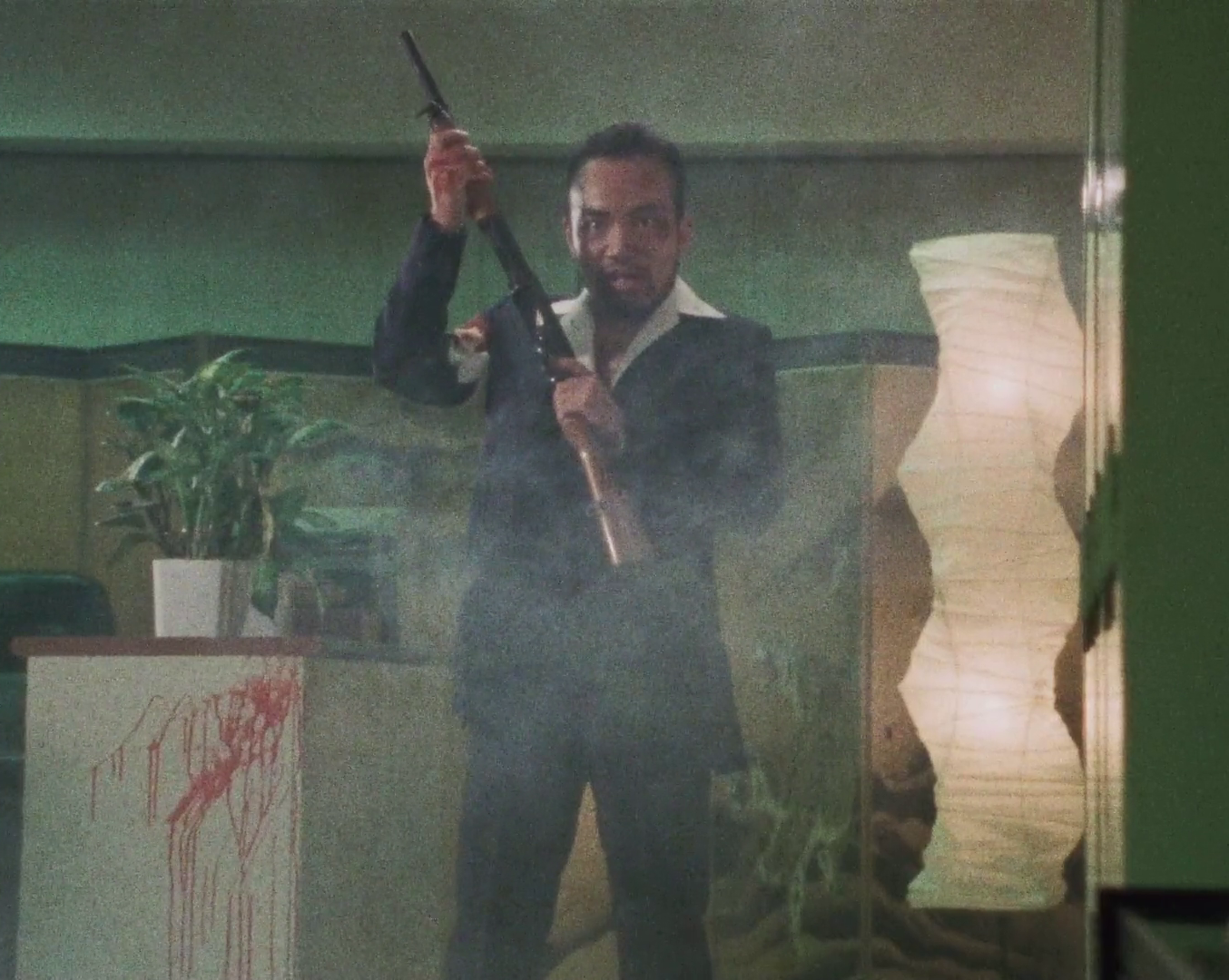
Visitor Q (ビジターQ, Takashi Miike, 2001)

As Japan emerged from post-war privation into bubble-era comfort, the family underwent something of a reassessment. Remoulding Teorema, Yoshimitsu Morita’s The Family Game had punched a hole through the concept of the family in sending in a mysterious teacher who slowly proved to them all they were merely involved in a prolonged act of performance unpinned by social convention rather than genuine feeling. Sogo Ishii’s The Crazy Family did something much the same but ultimately opted to save the family unit by allowing them to find peace literally “outside” of the contemporary rat race. And then there comes Takashi Miike who, ever the ironist, runs the whole thing in reverse as Visitor Q (ビジターQ) comes to put the family back together again by giving them permission to bond through satisfying their previously unanswered emotional needs.

As the film opens, however, patriarch Kiyoshi (Kenichi Endo) is in a hotel room interviewing a young woman as part of a documentary investigating the youth of today. She replies only that what the youth can tell him about the future of Japan is that it’s hopeless, before getting back to business and elaborating on her price list for a menu of sex acts. Though originally unwilling, Kiyoshi ends up having apparently very exciting sex with her, but comes to his senses after climaxing too early. The girl, we later learn, is his runaway daughter, Miki (Fujiko), who has been living a life of casual sex work in the city. Kiyoshi determines to pay her in full, but explains that that he’ll give the rest of the money to her mother and she must keep everything that happened between them in that room a secret (a minor problem being Kiyoshi left the camera on and ended up documenting the whole thing, something that he will repeat later but quite deliberately). 

Stunned by his transgressive encounter, Kiyoshi looks on at a happy family with a degree of confusion while a strange young man leans through the window of the train station waiting room and whacks him on the head with a rock. Before he finally arrives home, the man hits him again just to be sure, but eventually follows him for dinner where he is introduced as an “acquaintance” who will be staying with him for an unspecified amount of time. 

Kiyoshi’s household is already falling apart, and quite literally seeing as the shoji are full of holes, partly because of the attacks of the “big bullies” who torment his teenage son Takuya (Jun Muto) by launching fireworks into his bedroom, but also because the boy takes his humiliated frustration out on his mother Keiko (Shungiku Uchida) who is covered in scars from previous beatings and has taken to using heroin to escape the misery of her family and doing part-time sex work to pay for it. 

Like the intruder of The Family Game, Visitor Q gradually infiltrates the family by usurping a place within it but begins to reawaken and reinvigorate each of the members as he goes. The first thing he takes hold of is Kiyoshi’s camera, literally observing the family and helping to document the Japan of today through the eyes of this very strange yet “ordinary” family. A man of the post-bubble era, he’s another failed provider whose career continues to flounder while his home spirals out of control, shorn of paternal authority. He feels insecure in his manhood, humiliated by his tendency towards premature ejaculation, and is raped with his own microphone by the “youth of today” while trying to interview them, which leaves him, according to his boss and former lover, looking like a fool. 

Kiyoshi is convinced he can get his mojo back through career success in making himself the subject of his own documentary, or more accurately his observation of his son’s bullying which he later reveals perversely turns him on. When his boss shuts his idea down, he rapes her, feeling humiliated again in complaining that she dumped him because of the premature ejaculation and vowing to prove himself but accidentally strangling her. Meanwhile, Visitor Q is back home getting busy with the under appreciated Keiko who describes herself as neither special nor pathetic but an ordinary woman, longing to be loved and wanted. Even one of her clients, exclaiming surprise to discover that a “nice woman” like her does stuff like this, appears to have a disability fetish remarking that is feels different with someone who has a limp. Visitor Q gets her juices running again, literally, reactivating her maternity and perhaps allowing her to reclaim her position within the household. 

“I’ve never seen her so competent since we married,” Kiyoshi exclaims after she employs some top housewife logic to help him deal with his dead body problem, after which they take a rather more active stance against Takuya’s snotty bullies, pulling together to protect him in a way they never have before. Takuya may remain outside of the family hive, but he’s drenched in mother’s milk and perhaps the only one to truly recognise Visitor Q for who he is. Nevertheless, the Yamazakis are an “ordinary” family, just taken to extremes. Dad’s an emasculated salaryman broken in spirit by economic failure, mum’s an unhappy housewife lonely in repressed desire, son is an angry young man like his dad humiliated by the big boys, and daughter is a melancholy runaway who has tried to seize agency through using her body as a weapon but still feels that the future is hopeless and that her gesture may be one of self harm. Nevertheless, through the exposure of their myriad transgressions, they begin to bond in shared perversity. Thanks to Visitor Q, the family is “restored”, not “cured” but reaching its natural state of being as a collection of individuals assume their complete selves and in mutual acceptance rediscover a home.


Trailer (English subtitles)

Evil Dead Trap (死霊の罠, Toshiharu Ikeda, 1988)

The embattled host of a late-night TV show is confronted by the image of corrupted maternity after receiving a snuff film in the mail that seems to feature herself in Toshiharu Ikeda’s body horror slasher, Evil Dead Trap (死霊の罠, Shiryo no Wana). A giallo-esque slasher echoing alternately by Argento and Cronenberg, the film is in part an exploration of changing gender norms at the height of the Bubble era in which the career woman hero is essentially stalked by a monster baby because she reminds him of a mother he for some reason hates.

Nami’s (Miyuki Ono) late night TV show “for those who can’t sleep” relies on viewers for its content, making use of newfangled VHS technology to play videos sent in to the studio. Her bosses are thinking of canning it for being too “fluffy” which might be one reason Nami does not immediately call the police after receiving a disturbing video of a woman being tortured and killed who is later revealed to have her own face. Instead, she gets the all female (plus one “bodyguard” who is the boyfriend of one of the team) crew together and heads out to the abandoned US military base which appears to feature in the video. 

At several points, the women remark on how difficult it is for them working in the TV industry where they need a big story just to earn their place in their room. Nami even jokes that if she were to die investigating the tape it would only boost the ratings while simultaneously putting her life on the line for the sake of her career. Meanwhile, we later realise that Nami is being targeted in part because the killer, who has a child’s voice, thinks she looks like his mother whose voice is frequently heard playing on a loop via reel to reel tape. He later attempts to kill Nami by wrapping what appears to be an umbilical cord around her neck, while she is finally subjected to a forced birth as maternity is visited on her almost as an act of rape even as she resists it. It could even be said that she is a kind of mother to the group, and one who ultimately fails to take care of family as each of her team falls victim to one of the traps set by the killer.

Meanwhile, the film adopts a slasher-esque morality in which the first victim is killed shortly after having sex with her “bodyguard” boyfriend, assistant director Kondo (Masahiko Abe), who had up until that point been suffering with erectile dysfunction only to be sexually revived thanks to the violent and eerie space of the abandoned military base. Another of the women attempts to leave the compound, but is caught by a random man claiming to be working for the killer who violently rapes her but also strangely answers some of her questions about what’s really going on as he does he does so. Nami is also less than shocked by the video after putting it in the machine, giving a response which suggests it’s not unusual to receive this kind of material or to witness such brutal treatment of women. 

The killer does indeed make good and ironic use of new technology, at one point putting one of the victims on TV begging for their life to taunt Nami and having a giant set up featuring several screens plus the reel to reel tape. A mysterious man also lurking around the military base suggests to Nami that the sender of the video is likely a crazed stalker, a pervert who wanted to see her naked who lured her to this remote location and then murdered all her friends when actually it’s almost the reverse that’s true and Nami is being targeted both for and not being a mother. Often switching to a Testuo-style shuttling camera and blue-tinted filter, Ikeda enlivens his genre adventure with interesting composition and a fantastic use of lighting right down to the oscillating blue police light in the killer’s lair as Nami attempts to retake control of her image and escape the penetrating gaze of her audience along with the patriarchal cage of an oppressive society.


Trailer (dialogue free)

Roppa’s Honeymoon (ロッパの新婚旅行, Kajiro Yamamoto, 1940)

One of the most surprising things about Kajiro Yamamoto’s defiantly silly comedy Roppa’s Honeymoon (ロッパの新婚旅行) is how devoid it seems to be of political import with no overt patriotic content or references to the ongoing conflict even if the central messages of the necessity of enduring hardship are otherwise very on brand. Likewise and contrary to expectation, the film is clearly influenced by Hollywood comedies and heavily features American ragtime music presented largely without prejudice. 

In fact it’s the confrontation of these different influences which eventually sparks a crisis between father and son. As the film opens, beer magnate Garamasa is sitting in his bath practicing his gidayu recitation with the help of a shamisen player in an adjacent room, but his idiot son Ichiro (Roppa Furukawa) keeps singing “stupid Western songs,” which is very annoying for him but apparently not enough to actually get out of his bath which is why he rings an employee and gets him to ring Ichiro to tell him to shut up. This seems in part to be a slightly subversive gag poking fun at fat cat CEOs with Garamasa weirdly berating the staff member for being lazy and suggesting that he’s probably only just got up despite it being already 7am even if Garasama himself is still in the bath. The employee has, however, been busily at work for quite some time and spends the rest of the film toadying up to Garamasa. Later on, Yamamoto includes a similar gag in which a maid is forced to run back and forth between Ichiro’s annex and Garamasa’s office to deliver messages between the two.

In any case, Garamasa’s grand plan to get his son to be quiet is to marry him off to someone who also likes Western music which is why he visits a pair of servants he actually kicked out of the house when they decided to get married 20 years previously but have since opened a shop selling Western records. They suggest a young woman, Eiko, known as the nightingale of Japan (real life opera singer Hamako Watanabe) who is also a member of the nobility and the daughter of one of Garamasa’s friends, yet Ichiro has been seeing a young woman, Chiyo, who works in an oden restaurant and in fact finds out he is “engaged” from the same newspaper article she does. Eventually he makes the decision to run away from home and elope only to flounder while being entirely ill-equipped to live a “normal” life in which he must attempt to support himself financially.

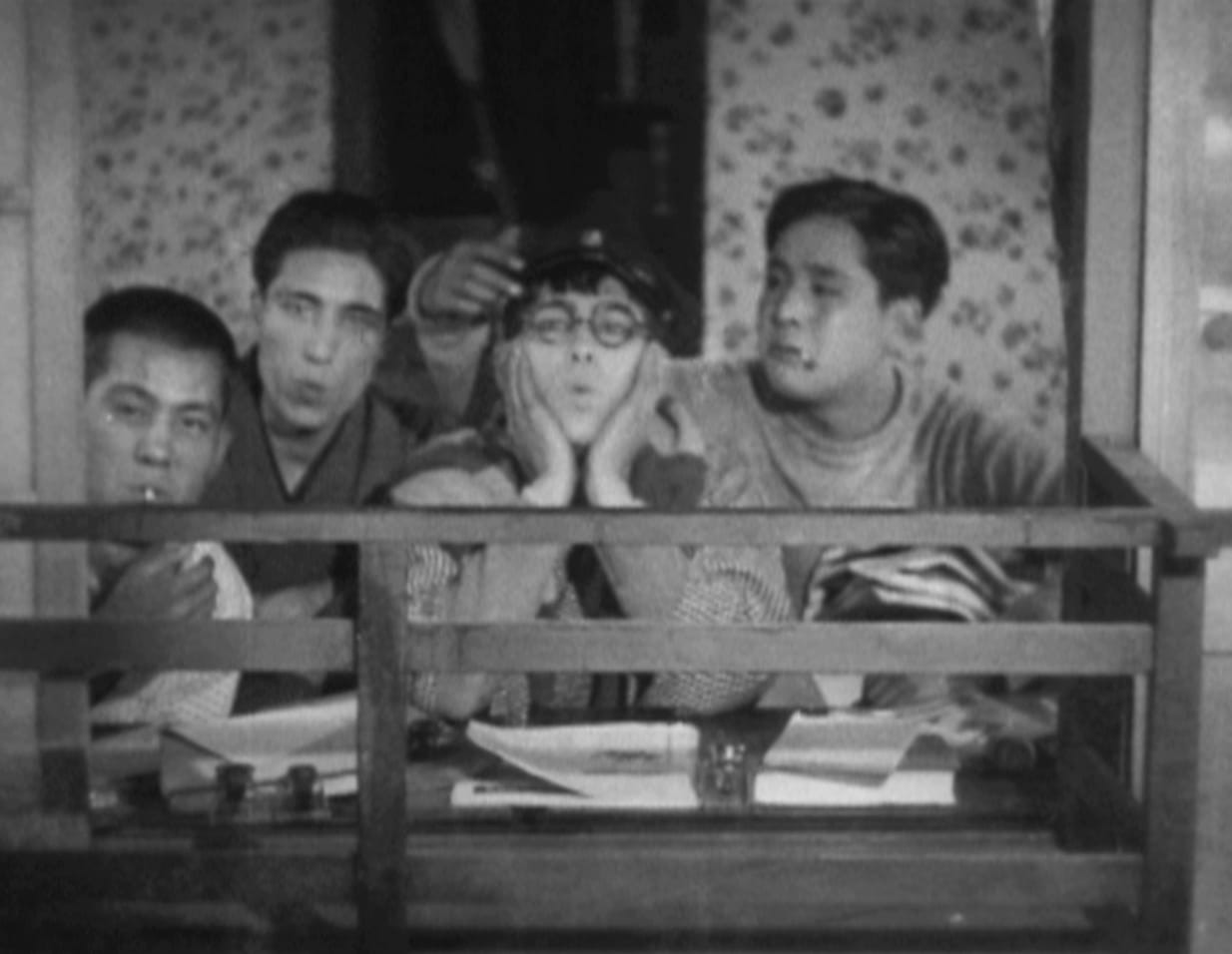
Star Roppa Furukawa was himself a member of the aristocracy and one of a small number of performers popular enough in the 1930s that their names were often inserted into the titles of the files in which they appeared even if their characters did not share it. Roppa was well known for his rather comical face, round and a little pudgy with big round glasses which seem to capture something of the zeitgeist of the interwar years. He was also an excellent singer and the film is quite notable for its use of an ironic song in which Roppa narrates his “honeymoon” in which he and Chiyo are forced to move several times, first sitting in their living room on the back of a truck before their belongings slowly decrease from truck to cart to hand. Chiyo is eventually forced to return to work at the oden restaurant while the relationship suffers because of Ichiro’s refusal to do a common man’’s job. Ironically, he is disturbed by the singing of Eiko who lives close by and on visiting to tell her to be quiet is talked into buying a pair of charity concert tickets.

Chiyo actually approves because she doesn’t like the idea of people looking down on them for not having the money to pay, but is then jealous, insisting that she’ll pay for the tickets herself while forbidding Ichiro to go. It’s this that forces him to accept a job he previously thought demeaning as the leader of a marching band singing a ragtime-themed jingle for a brand of toothpaste. All of this absurd silliness might be thought too trivial for the early 1940s in which censorship concerns usually some kind of patriotic content (aside from gidayu) but there is a message to be found in Garamasa’s eventual acceptance of their relationship in which he thanks Chiyo for introducing his son to hardship and thereby making a man of him as reminding the audience that a little bit of suffering is character building though doubtless they don’t have such wealthy parents to bail them out nor can they really look forward to better days any time soon. In any case it paints a rather rosy of picture of life in the early ‘40s, harking back to a distinctly ‘30s brand of foppish comedy with Ichiro a kind of Bertie Wooster suddenly plunged into “real” life and realising being the stupid son of a CEO obsessed with gidayu recitative wasn’t so bad after all.


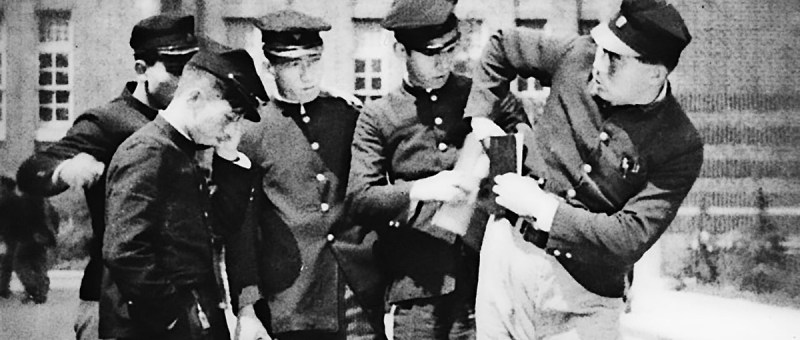
Madadayo (まあだだよ, Akira Kurosawa, 1993)

It’s tempting to read Akira Kurosawa’s final film Madadayo (まあだだよ) as a kind of valediction, though he may not have thought of it as a “final” film and if he had, it would have been ironically for film’s title means “not yet” and thematically hints at a desire on hold to a life that is admittedly fleeting. Much of the film is indeed bound up with transience and the difficulties of accepting it, but it’s also a humorous tale of a man who was “pure gold” and managed to maintain his childish heart even into his 77th year. 

Inspired by the life of the writer Hyakka Uchida (Tatsuo Matsumura), the film rather curiously opens with his retirement as he abandons his teaching position to pursue writing full-time much to the disappointment of his doting students. The relationship between Uchida and the boys he taught is at the heart of the film, for much like Mr Chips he had no children of his own and is cared for in his old age by a collection of old boys who almost venerate him as if he were something precious which cannot be allowed to slip from the world. Soon after his retirement, Uchida achieves his Kanreki, that is his 60th birthday or the completion of one cycle of the Chinese zodiac which is also the beginning of a second never to be completed round, which some consider as a second childhood or the beginning of old age.

Uchida is indeed childishly innocent and generally lighthearted forever making incredibly silly puns and approaching even potentially serious situations with good humour. When his wife remarks that the rent may be reasonable on their new home because it is unlucky and prone to being burgled, Uchida simply puts up a series of signs directing thieves to the “burglars entrance” through the “burglars corridor” to the “burglars lounge” and “burglars exit” reasoning any potential robber would find the situation so odd as to want to leave as soon as possible. The house does turn out to be unlucky in a sense as it is burned down during the fire bombing of Tokyo leaving the Uchida and his wife to move into a tiny shack on the grounds of a ruined mansion. 

Signs of a sense of irony and an underlying darkness are, however, present in his improvised version of a march he would have taught the students during the years of militarism on which he comments on the disillusioning realities of new era of “democracy” under the Occupation ruled by bribery and corruption. The students decide to hold a birthday party for the professor they christen the “Not Yet Fest”, taking the lines from a child’s game of hide and seek to ironically ask if he’s ready to throw in the towel first, actually featuring a performance of his funeral which might seem insensitive but Uchida can be relied upon to see the funny side. During the party the former students give various speeches, one announcing he will recite the names of all the stations from one end of the country to the other, but no one really pays very much attention to them. The students even track on a large white dinner plate during a children’s song about the moon to hold behind Uchida’s head as if he were a buddha achieving enlightenment. 

Yet the crisis comes when, shortly after the students buy Uchida and his wife a new house to live in, their beloved cat Alley disappears, plunging the professor into a well of existential despair that leaves him unable to sleep or eat. The depths of his sorrow perhaps hint at his childish sincerity, though there is an undeniable poignancy in the attachment of the childless couple to this cat that chose them as its family. Despite the best efforts of the students along with the local community, Alley never returns though the professor and his wife learn to love a new cat who like Alley wandered into their garden and found a home. As in the poem that inspires Uchida in his “ascetic” life in the hut, life is an ever-flowing river. The waves of students that flowed through his classroom, the homes that were destroyed and rebuilt, the cats who stayed as long as they could and then made way for the new visitor all of them small circles of life that will continue long after he is gone. 

But as Uchida says, “Not Yet”. Like Kurosawa himself who feels the light dimming he asks for more time as if playing hide and seek with death whose presence he must eventually acknowledge even if he’s not quite ready to welcome him in. At the last Not Yet Fest that we see times have clearly changed. Uchida’s wife is now present along with the daughters and granddaughters of the students, one of whom points out they’ll soon be genuine old geezers themselves. For a moment we think we see the boy from 1943. Uchida tells the children to find their passion and give their lives to it, imparting one final not quite lesson while gifting them the cake they’ve just brought him in order of his 77th birthday. A 77th birthday is supposed to be lucky, though seven sevens are also 49 which is the length of a Buddhist mourning period and the time it takes to be reborn. The cycle begins again, as Uchida may know as he dreams of childhood hide and seek only to be distracted by a surrealist sky in its pinks and blues, a vista apparently painted by Kurosawa himself who lets the clouds roll into the credits an endless stream of dream and memory on which our lives are mere bubbles that disappear and form anew. But perhaps, not yet. 


Scorpion: Double Venom 2 (サソリ 殺す天使, Ryoji Niimura, 1998)

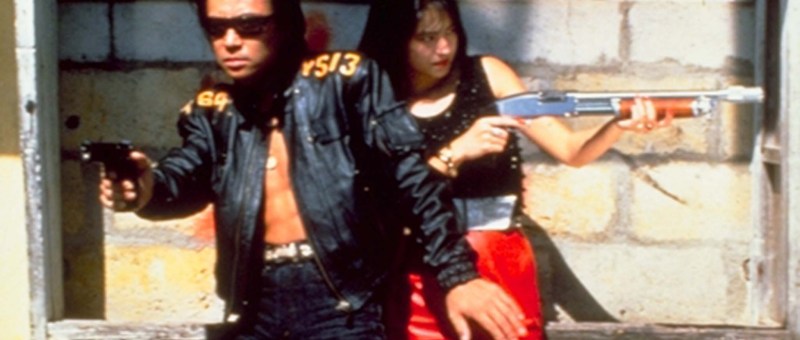
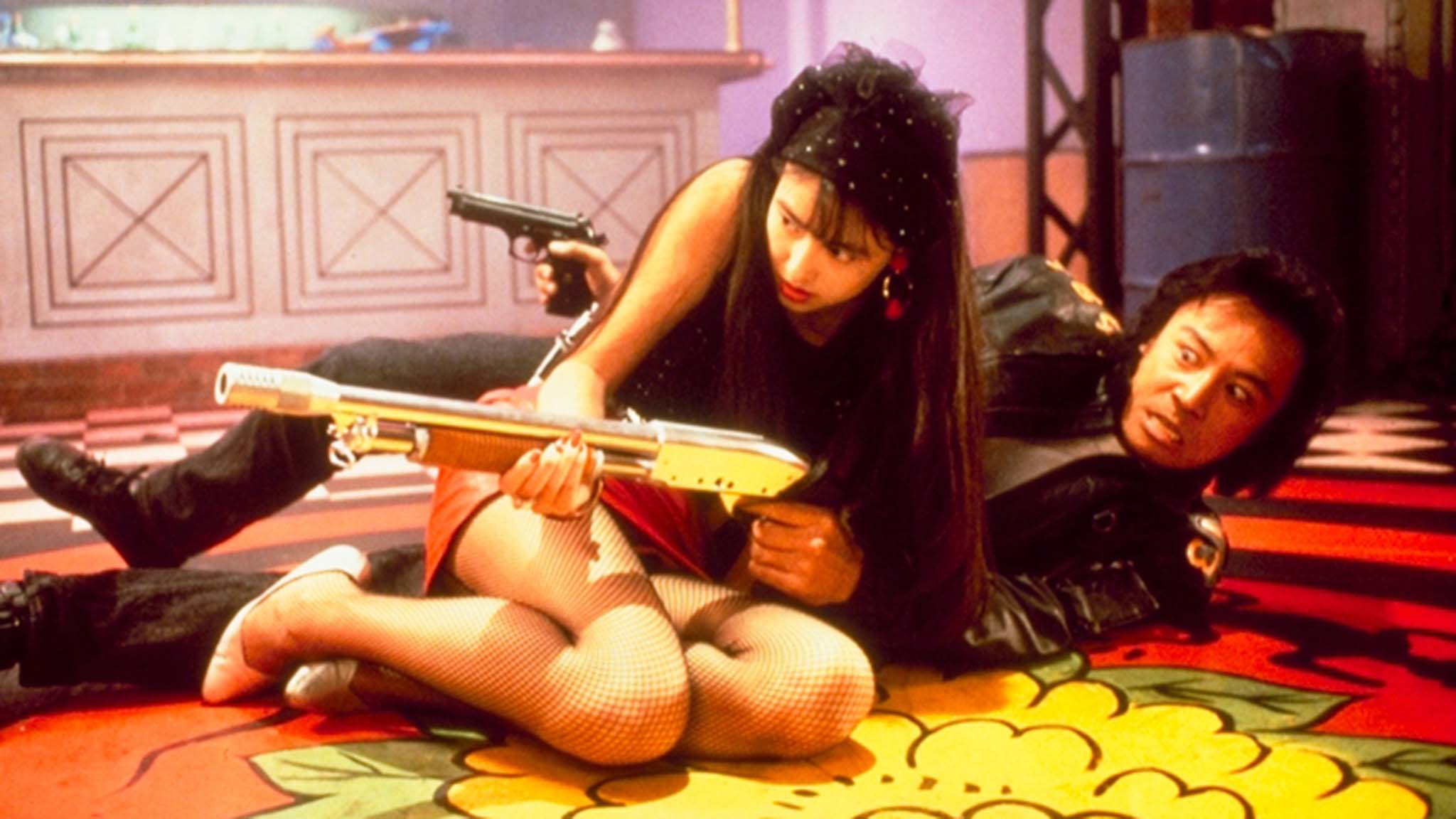
Some years after the conclusion of Scorpion Double Venom, Nami (Chiharu Komatsu) is still on the run. Now apparently using the name Sayuri, that of the surrogate sister she again failed to save in the previous film, she’s been working as a dancer in a club while continuing to look for the one-armed man she believes killed her younger sister. Spotting a one-armed gang boss on TV, she becomes convinced that Goda is the man she’s looking for and becomes a cabaret hostess to get close to him. But before she can pull the trigger, Goda is gunned down by a man in a police uniform who turns out to be a hitman hired by a local gang. 

This leaves Scorpion: Double Venom with a problem because Nami no longer has a clear target for her revenge and therefore no reason to live. She takes the gun used to kill Goda and at one point tries to use it to kill herself but is saved by Eiji (Ryo Karato), the hitman she rescued from the scene of the crime. Eiji’s mission of vengeance is however not yet over. Hoping to escape the gangland life, he robbed a bank with his girlfriend Ichiko (Aya Sasaki), but when she got shot in the leg, he ran off with the money and left her there. Nami then becomes determined to rescue Ichiko instead, making use of her old boyfriend, who has since married someone else, to get her a job as the prison doctor.

This is another break with the pattern, as Nami is not a woman in prison but undercover among the corrupt authorities who are in league with the rival yakuza gang to buy cheap drugs to use on the inmates while forcing released prisoners to deal for them. Forced into a straitjacket and sedated, Ichiko is repeatedly raped by the warden’s henchman. A female guard then takes her own life because she can no longer bear to listen to Ichiko’s screams, only the prison get a backstreets doctor to falsify the death certificate to eliminate evidence they’d been drugging her too and make it look like she died in an accident. 

Sucked into a yakuza gang war, Nami is constrained by the darkness of the world around her and once again uses her medical skills for the purposes of revenge. The irony of her using a scalpel to kill is not lost on anyone, though this time she does also use healing abilities to nurse Eiji back to health which might explain the Japanese title “Killing Angel” even if there’s a serious plot hole along given some vague sci-fi style justifications in the film’s closing moments as Nami finally learns some unwelcome information about her sister’s death. In a way, the ending the brings the cycle full circle as Nami is one again betrayed by a man she had trusted and bonded with in a shared desire for justice and liberation.

In essence, they’re all trying to escape the prison of the wider society but as Nami discovers, society is not exactly tolerant of fugitives from order and the implications of the ambiguous ending are fairly bleak. It seems that once again, Nami has been denied her vengeance and granted only a cruel irony that suggests there can be no escape or starting over for those like Nami nor can there be closure for the traumatic past. While trying to rescue Ichiko, she’d encountered one of her former cellmates who had become a turncoat, taking the place of the guard who had killed themselves to facilitate Ichiko’s perpetual rapes. She at first refuses to help Nami because her parole is coming up, but then changes her mind, takes a shot at her own vengeful protest and pays a heavy price for it. 

Moving away from the exploitation roots of the franchise, Niimura takes the sequel in an artier direction with its love scene montage and melancholy blue-tinged colour palette while scaling back a little on the action preferring to focus on Nami’s non-romance with Eiji until her daring attempt to break Ichiko out of prison. But as has become abundantly clear, no one is able to escape from the prison of contemporary Japan and least of all Nami who remains trapped by her desire for vengeance and perhaps a willing victim of it.


Scorpion: Double Venom (サソリ・女囚701号, Ryoji Niimura, 1998)

Scripted by Sasori in USA’s Daisuke Goto, Scorpion: Double Venom (サソリ・女囚701号, Sasori: Joshuu 701-go) brings Nami back to Japan but with an all new backstory and motivation for revenge. In the films up to this point, Nami is betrayed by a man she loves and thereafter seeks a revenge that becomes progressively less personal, striking out against entrenched patriarchy and societal misogyny. This time, however, she’s to avenge the death of a girl she couldn’t save, her sister, Yumi, who was kidnapped and murdered as a child.

Like that of Sasori in the USA, this Nami (Chiharu Komatsu) is a highly educated woman, in fact a doctor. Immediately recognising a patient as the man responsible for abducting her sister all those years ago she is left with a dilemma. She confronts him and he laughs at her. As it turns out, the statute of limitations on his crime ran out the day before, so Nami’s plan to turn him in to the police is rendered a no go. As he continues to taunt her and makes suggestive comments about the little girl inexplicably in the next bed sharing a ward with an adult man, Nami ends up stabbing him to death with her scalpel but just before he dies, he tells her that he didn’t kill her sister after all. It was his accomplice, a one-armed man!

Nevertheless, Nami’s revenge will be delayed because she’s quickly carted off to prison for 10 years of hard labour. Unlike those in the other films, this prison is mainly run by women but the warden is a predatory lesbian who extracts sexual favours from the inmates with the vague promise of early parole and claims that this place is like heaven if you play by the rules. After getting sent to solitary for fighting, Nami befriends another woman, Sayuri (Miho Kiuchi), who reminds her of her younger sister, and discovers that she is shortly to be executed at the gallows hidden in the deepest recesses of the prison. Sayuri is apparently not guilty of the crime for which she is serving her sentence but was talked into taking the fall for a sleazy politician who murdered her friend so that her older sister’s medical bills would be covered. Her death sentence is for accidentally killing a guard during a previous escape attempt. All her subsequent attempts to escape have been so that she could see her sister one last time before she dies.

The theme this time is then sisterhood as the two women fill in the missing half for the other and bond in their shared misuse at the hands of the justice system. Nami becomes determined to save Sayuri in the way she couldn’t save Yumi, but her struggle eventually takes on a larger dimension in keeping with those of the previous films as she tries to get revenge for Sayuri too after discovering that her death sentence was partly handed down by the murderous politician trying to tidy up loose ends as he plans career advancement with the aid of his entire amoral aide, Naruse (Tomorowo Taguchi). Escaping from the prison, she literally and symbolically frees all of the women who then take their own revenge on the sadistic warden.

For all of its seriousness, the film does have its faintly ridiculous qualities such as Nami’s use of electrical wiring as a defibrillator that allows her to resuscitate Sayuri after she’s hanged by the warden at the politician’s instigation. She later uses these same wires ripped from the wall to electrocute the warden’s bruiser male guard though it’s Sayuri who hot wires the prison van so they can escape. Eventually, she’s hunted down by a man with a crossbow and in a nod to the original trilogy, stabs him in the eye. Still, with her own revenge still in progress, Nami effectively avenges all her sisters while fighting for justice. Tracking down the videotape Sayuri had hidden proving the politician’s guilt, she eventually exposes him along with all his corruption bringing down the complex network that had extended out into the prison and trapped so many other women. Now a fugitive, Nami chases the one-armed man and has once again become an avenger of women bringing justice to those failed by an inherently corrupt and misogynistic justice system.


ChaO (Yasuhiro Aoki, 2025) [Fantasia 2025]

Given the chance to achieve his dreams, a young man can hardly say no when he’s pressured into marrying the daughter of the king of the Mermen, but soon finds himself increasingly conflicted in Yasuhiro Aoki’s gorgeously animated fable, ChaO. Set in Shanghai, the film’s timely themes embrace an environmental imperative along with critiquing the capitalistic drive that is slowly devouring our world in its all-encompassing lust for profit.

But as Stephan’s father was keen to tell him, we live in harmony with nature and not everything is ours to take. You should leave it at the bare necessities and never take more than you need, which is ironically Chao’s approach to life while living with Stephan. She soon sells off her vast royal treasures and declares herself happy enough just with Stephan himself and life of simple pleasures. But Stephan does seem to want more, or more to the point, he can’t see anything past the achievement of his dreams in keeping a promise to his father to invent a new air jet boat that would be safer and kinder to wildlife.

His evil boss Mr Sea, however, points out that no one’s going to want to pay more just to be kind to sea creatures so seeing as his air jets won’t save them any money, the project’s a non-starter. He only gets a shot at it because of ChaO and the light she casts on the company who are now very keen to look good, especially as they’re currently negotiating with Merman king Neptunus about compensation for the sea creatures injured by propellers on their boats. It’s clear that this bothers Stephan, especially as he overhears a pair of co-workers making fun of him in the bathroom. They think he’s an idiot too and that he’s only being indulged because he’s ChaO’s husband and agreed to humiliate himself by marrying a fish.

Stephan too refers to Chao at times as a “fish”, hinting at xenophobic notions within the contemporary society. He sees her as “ugly” and alien, but is also captivated by her human form which is to say, he can only appreciate her when she assimilates fully and becomes properly human. For Chao’s part, she does her best to be what she sees as the ideal wife to Stephan by human standards but struggles to adjust to life on land. Stephan clearly expects her to fulfil a feminine role by cooking and cleaning for him, but only belatedly notices that she’s injured her fins in an attempt to cook food he might find more palatable.

His obsession with his quest prevents Stephan from ever really seeing Chao for who she is or noticing how difficult it’s been for her to adjust to life in a new culture while he’s given her very little in the way of support. But it’s precisely through her that Stephan begins to unlock the buried secrets of his childhood and reacquaint himself with the boy he once was. What he really wanted was to be a bridge between humanity and sea creatures, which is something he can do in a different way if he weren’t so hung up on air jets which themselves also have their own dangers. 

Nevertheless, it’s telling that Stephan eventually chose to make his life on the sea, simultaneously accepting a liminal place and implying it is not yet possible to live on land. He’s approached in the framing sequence by a hapless journalist, Juno, who was fascinated by their story as a child and keen to know whether the improbable fairytale is actually true in part because he’s facing a similar dilemma and can’t work up the courage to tell the person he loves how he really feels. What he learns is that he should tell them as soon he can while he still can so he’ll have no regrets for the future. Aoki’s backgrounds teem with detail, each packed out with whimsey that alternately paints Shanghai as kind of charming pirate village and captures a sense of the real city in rainy water colours hinting at its lonely streets. The message is clear that coexistence is never guaranteed and requires more of a respect for nature and the natural world along with the thoughts and feelings of others if we are truly to live in peace and happiness.


ChaO screened as part of this year’s Fantasia International Film Festival.

Trailer (no subtitles)