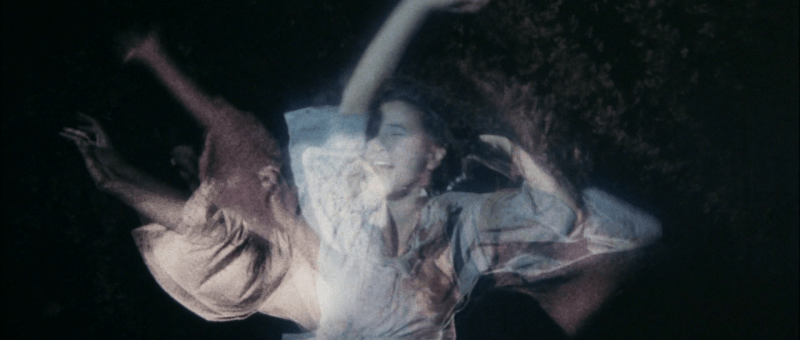
The Inferno (地獄, Tatsumi Kumashiro, 1979)

No one can escape from their sins according to the ominous voiceover that opens Tatsumi Kumashiro’s loose reimagining of Nobuo Nakagawa’s Jigoku, The Inferno (地獄, Jigoku). Then again, some of these “sins” seem worse than others, so why is it that a woman must bear a heavy burden for adulterous transgression while the man who killed her seemingly suffers far less? Perhaps hell, in this case, is born of conservative social attitudes more than anything else besides the darker elements of the human heart such as jealousy and romantic humiliation. 

Those negative emotions are however as old as time as reflected in the folk song which opens the film about a young couple, though not the young couple currently onscreen, who are eloping because their incestuous desire is not accepted by the world around them. The connection between the couple onscreen might also be deemed semi-incestuous for Ryuzo (Ken Nishida) has run off with the wife of his brother, Miho (Mieko Harada), who is carrying (what she claims to be) Ryuzo’s child. Unpei (Kunie Tanaka), the brother, finally catches up with them and shoots Ryuzo with a shot gun. Miho tries to escape, but her foot is caught in a bear trap and Unpei decides to leave here there to die, while Ryuzo’s jealous wife Shima (Kyoko Kishida) later does the same. The body is found by local hunters, and in a strange miracle the baby is born from Miho’s dead body while Miho is dragged to hell for her “sins” where she learns that her baby has been born in hell but remains above. Not knowing what to do, the locals give the baby, Aki, to Shima but she obviously doesn’t want it and so swaps it with a foundling thanks to a weird old man, Yamachi, coming to love this other child, Kumi, as a daughter. 

This is quite literally a tale of the sins of the parents being visited on the child, the 20-year old Aki (Mieko Harada) later lamenting that she has no identity of her own and is solely a vehicle for her mother’s revenge. Though she apparently ends up in the same rural town “by chance” knowing nothing of her past, she resembles her mother physically and discovers she has some of her talents such as an innate ability to play the shamisen. What she also has is a trance-like lust that bewitches the men around her, though this is in a sense complicated by the fact it does not seem to be of her own volition so much so as a manifestation of her mother’s curse. Thus she ends up sleeping with the vulgar younger brother of the man she actually likes, Suchio, who in truly ironic fashion is actually her half-brother. She describes herself as having her mother’s “tainted blood”, while Shima later adds in a degree of class and social snobbery revealing that Miho had been a geisha Unpei unwisely fell for and was unworthy even of being a maid in their upper-middle class household let alone the wife of the second son. 

For all of her resentment, Shima is otherwise a loving mother to her sons and even to Kumi whom she is able to accept as a daughter in a way she would never have accepted Aki who was after all an embodiment of her husband’s betrayal. Colder and more austere than Aki or Miho would seem to be, she clings to the mummified body of her husband kept in a secret vault as a secret triumph over her humiliation laughingly remarking that now he’s hers forever and will never cheat on her again. Even if she left Miho to die, Shima does not particularly resist her fate well aware that her son has fallen for his half-sister (which probably wouldn’t have happened if she hadn’t swapped babies) and merely hoping Aki can be convinced to leave town alone rather than plotting any more drastic action. 

But the inferno of hell envelopes them all, crying out for retribution as the cycles of repressed or inappropriate attractions repeat themselves. Kumi realises that her love for her brother, Suchio, is actually not inappropriate because they are not related after all but is then consumed by her own hell in realising that he does in fact love his biological half-sister but is uncertain if he accept damnation in order to pursue it. What she, Miho, and Aki are punished for is female sexual desire aside the arguably taboo qualities of its direction though in hell it seems men are punished for this too, or more accurately for giving in to it, in a way they often aren’t in the mortal realm. “They cut their own flesh and blood for the vision of a woman in the future,” the guide explains as the brothers and Unpei literally climb over each other reaching for an illusionary representation of Aki/Miho at the top of the tree. In the mortal world they do something similar, grappling with each other, mired in competitions of masculinity as mediated through sexual dominance, conquest, or humiliation. 

Yet Aki’s path to hell is also a confrontation with her femininity and her search for an identity as a woman by reuniting with the birth mother who died before she was born. Kumashiro’s visions of hell are terrifying and outlandish, a giant land in which the dead are thrown into a huge meat grinder they then have to push themselves. For the sin of eating meat, others are condemned to spend eternity eating human flesh. Miho has lost all sense of reason and is incapable of recognising her daughter seeing her only as another source of food but there is a kind of rebirth that takes place even if it’s only once again to be born in the underworld. Surreal and harrowing, Kumashiro’s eerie land of giant demons and shuffling corpses does indeed suggest that as the opening titles put it we all live our lives alongside hell.


Original trailer (no subtitles)

Sword of Destiny (孤剣は折れず 月影一刀流, Yasushi Sasaki, 1960)

A wandering swordsman winds up in intrigue on returning to his fencing school to find his old master murdered in Yasushi Sasaki’s Sword of Destiny (孤剣は折れず 月影一刀流, Koken wa Arezu: Tsukage Ittoryu). A classic jidaigeki adventure, it nevertheless has to be said that this one is a little more sexist than most in actively pushing its series of female warriors into the background as the hero by turns sends them all back to typically feminine roles while declaring that he will be the one to claim vengeance and clear up corruption in the court itself caused by a woman’s apparent forgetting of her place. 

At least, this is what Mikogami Genshiro (Koji Tsuruta) is told by an old friend, Izu, after an altercation with the fiery princess Kazu (Hibari Misora). The Shogun’s nurse, Lady Kasuga, has apparently taken an interest in politics and has most of the inner palace in her grasp enriching herself in the process. Izu believes that she may also be behind the assassination of Geshiro’s former mentor Ono while working in league with the Yagyu who coveted the position of fencing master to the Shogun. He asks Genshiro to kill her which he’s only too happy to do while seeking vengeance for Ono, but later gains a second reason after meeting the two orphaned daughters of a former retainer forced to take his own life thanks to Lady Kasuga’s machinations. 

Itoya (Yoshiko Fujita) wanders round with a gun and disrupts Genshiro’s first assassination attempt. He later tells her to leave the killing business to him and live “the life of a woman” insisting that one girl has no power to kill Lady Kasuga anyway. Meanwhile, he also makes an enemy of the Shogun’s sister Princess Kazu after challenging her in the street on seeing her callous disregard for a peasant her horse had run over. Princess Kazu falls in love with him after he defeats her in a duel, temporarily rebelling in insisting she will resist a dynastic marriage and take no other husband though he eventually rejects her partly on the grounds of their class difference and partly because he is a wandering sword who lives in the moment and may know no tomorrow. 

Nevertheless, she is later seen capitulating to her proper role as a princess who exists largely to continue the family line, marrying a man chosen by the Shogun and his advisors with no real power to chose anything other than her obedience. In much the same way he does with Itoya, Genshiro pushes her back towards the typically feminine while falling for Itoya’s meek, sickly sister Mine (Hiroko Sakuramachi) who is otherwise an idealised image of femininity in her softness and naivety while like every other woman in the picture falling for Genshiro because of his robust manliness and ability to protect her by gaining the sisters’ vengeance on their behalf. 

Meanwhile, Genshiro also facing off against the rival Yagyu school whom he suspects of having killed Ono to usurp his place as the shogunate fencing master with the assistance of underling Takagaki who has now taken over leading to a mass exit of students fed up with his authoritarian teaching methods. Interestingly enough, Genshiro is temporarily imprisoned by the Yagyu alongside a dissident Christian whose death they’d faked while keeping him alive in order to torture the names of other Christians out of him. On fulfilling his request to take his cross to his daughter who has become a sex worker, Genshiro succeeds only in endangering her while she also falls in love with him. 

All in all, he’s not much of a responsible hero also reckless with the life of his former burglar sidekick Kurobei (Shin Tokudaiji) who uses his ninja tricks to get him out of prison. As expected, it all ends with in a battle against a treacherous swordsman and the spineless Takagaki with the final revelation that Lady Kasuga (who just dies of old age) had not much to do with anything anyway despite having been a “meddling” old woman who forgot her proper place. Even Mine is forced to admit that she can’t come between Genshiro and his sword so she plans to become a nun while Kazu sends him an elaborate katana to remember her by certain that he will not accept a place in the Shogun’s household but will return to the road to continuing his training. In any case, a kind of justice is done and order restored even if that order is in itself fairly unideal. 


Father of the Kamikaze (ゝ決戦航空隊, Kosaku Yamashita, 1974)

By the mid-1970s, Japanese cinema at least had become much more comfortable with critiquing the wartime past, considering it from a greater distance than the often raw depictions of war in the films from the previous two decades. 1974’s Father of the Kamikaze (ゝ決戦航空隊, A Kessen Kokutai), however, is among the few to skew towards the nationalist rather than the ambivalence or simple anti-war messages of other similarly themed films of its era. 

Starring ninkyo icon Koji Tsuruta who served in the air force himself, the film is a kind of biopic dedicated to Admiral Onishi who oversaw the kamikaze operations at the end of the war. As is pointed out, Onishi had been against the war in general terms even before its inception and is originally against the philosophy behind the kamikaze squadrons but as Japan’s fortunes continue to decline he becomes its biggest advocate citing a kind of sunk cost fallacy that it would be in someway unfair to the men that have already died to surrender while insisting that suicide missions are the only feasible way to turn the tide because one kamikaze could take out a hundred men by destroying battleships singlehandedly. 

The film in part attributes this extreme solution to the prevailing with your shield or on it philosophy of the contemporary society which placed extreme shame on the act of being taken prisoner. In the prologue that opens the film, a squadron of downed pilots whose heroic deaths have already been recorded is discovered alive in an American prisoner of war camp but as being a prisoner of war is so shameful and would reflect badly on the military, the decision is taken to fix the books by sending the men on a mission from which they are not intended to return. Onishi is opposed to the plan, he asks why they can’t find a way for the men to live, but the decision is already made. In any case, he describes the action of a suicide mission as a “beautiful ideal” even when insisting that a war cannot be fought in that way not least for purely practical reasons in that they do not have the resources to be wilfully sacrificing skilled pilots and their planes. 

Having come round to the idea, however, Onishi is a crazed zealot who cannot accept the idea of surrender and even goes so far as to barge into a cabinet meeting to urge ministers against a truce even though the war is clearly lost. To his mind, the only way to honour the sacrifices of those who’ve died is to fight to the last man. Kozono (Bunta Sugawara), another officer opposed to the kamikaze, eventually meets a similar fate in refusing to obey the order to lay down his arms and ending up in a psychiatric hospital. His objection had partly been that it’s wrong to turn men into ammunition, but also that the kamikaze project is itself defeatist and self-defeating when there are men such as himself who are committed to fighting on.  

In this the film leans into the image of militarism as a death cult in which dying for the emperor is the only noble goal of the whole imperial expansion. In its eventual lionising of Onishi’s image, his bloody suicide atop a white cloth resembling the flag of Japan while his parting words scroll across the screen in text, it does not shy away from his more problematic aspects in which he fails to object to a request from a junior officer that soldiers should be allowed to test their swords on American prisoners of war, roundly telling a subordinate who breaks protocol to insist that such a thing is not only morally wrong but will ruin their international reputation that he has no need to think of consequences because Japan will win this war. He claims to want to find a way of defeat that will satisfy the living and the dead, but in reality cannot accept it not least in that it would entail admitting that he sent 2600 young men to their deaths for nothing. 

Tsuruta brings the same level of pathos to his performance as he did in playing conflicted yakuza stoically committed to a destructive code, but there’s no getting away from the fact that the film focuses mainly on Onishi’s personal suffering as a man who sent other men to die for a mistaken ideal and then could not admit his mistake offering an apology only in his death in which he urged the young people of Japan to work to rebuild the nation in the name of peace. In switching to the present day and showing us Onishi’s dilapidated former residence and in fact the room in which he died with its tattered shoji and peeling paintwork, he veers towards the nationalistic in uncomfortably reinforcing the nobility of his death rather than the folly of war or absurdist tragedy of the kamikaze programme. Adopting a quasi-jitsuroku approach with frequent use of onscreen text, a narratorial voiceover, and stock footage of kamikaze in action Yamashita may portray war as madness in Onishi’s crazed devotion but cannot help depicting it as a “beautiful ideal” even in the undignified violence of Onishi’s ritual suicide. 


Gate of Hell (地獄門, Teinosuke Kinugasa, 1953)

Which is the greater challenge to the social order, love or ambition, or are they in the end facets of the same destabilising forces? Teinosuke Kinugasa’s Gate of Hell (地獄門, Jigokumon) is, from one angle, the story of a man driven mad by “love”, reduced to the depravity of a crazed stalker betraying his samurai honour in order to affirm his status, but it also paints his need as a response to the chaos of his age along with its many repressions while the heroine is, once again, convinced that the only freedom she possesses lies in death. Yet in the midst of all that, Kinugasa ends with a triumph of nobility as the compassionate samurai restores order by rejecting the heat of raw emotion for an internalised contemplation of the greater good. 

Set in the 12th century, the film opens in revolt as two ambitious lords combine forces to attack the Sanjo Palace in what would become known as the Heiji Rebellion. The lords have attacked knowing that Taira no Kiyomori (Koreya Senda) is not in residence, having departed on a pilgrimage. Fearful for the safety of his sister and father, retainers order decoys to be sent out to distract the rebels. Kesa (Machiko Kyo), a court lady in service to the emperor’s sister, agrees to be her decoy and Morito (Kazuo Hasegawa), a minor retainer, is ordered to protect her. He manages to escort her back to his family compound where he assumes she will be safe, transgressively giving her a kiss of life, pouring water into her mouth with his own, after she has fainted during the journey. Unfortunately, Morito has miscalculated. His brother has sided with the rebels and they are not safe here. During the chaos they go their separate ways, and as soon as Kiyomori returns he puts an end to the rebellion restoring the status quo.  

Shocked at his brother’s betrayal, Morito tells him that only a coward betrays a man to whom he has sworn an oath of loyalty but he explains that he is acting not out of cowardice but self interest. He has made an individualist choice to advance his status in direct opposition to the samurai code. Morito doesn’t yet know it but he is about to do something much the same. He has fallen in love with Kesa and after meeting her again at the Gate of Hell where they are each paying their respects to the fallen, his brother among them, is determined to marry her, so much so that he asks Kiyomori directly during a public ceremony rewarding loyal retainers for their service. The other men giggle at such an inappropriate, unmanly show of emotion but the joke soon fades once another retainer anxiously points out that Kesa is already married to one of the lord’s favoured retainers. Kiyomori apologises and tries to laugh it off, but Morito doubles down, requesting that Kiyomori give him another man’s wife. 

This series of challenges to the accepted order is compounded by a necessity for politeness. Morito is mocked and derided, told that his conduct is inappropriate and embarrassing, but never definitively ordered to stop. Making mischief or hoping to defuse the situation, Kiyomori engineers a meeting between Morito and Kesa, cautioning him that the matter rests with her and should she refuse him he should take it like a man and bow out gracefully. Kesa, for her part, has only ever been polite to Morito and is extremely confused, not to mention distressed, by this unexpected turn of events. She is quite happily married to Wataru (Isao Yamagata) who is the soul of samurai honour, kind, honest, and always acting with the utmost propriety. That might be why he too treats Morito with politeness, never directly telling him to back off but refusing to engage with his inappropriate conduct. That sense of being ignored, however, merely fuels Morito’s resentment. He accuses Kesa of not leaving her husband because Wataru is of a higher rank, as if she rejects him out of snobbishness, rather than accept the fact she does not like him. 

Morito continues in destructive fashion. We see him repeatedly, break, smash, and snap things out of a sense of violent frustration with the oppressions of his age until finally forced to realise that he has “destroyed a beautiful soul” in his attempt to conquer it. “One cannot change a person’s feelings by force” Wataru advises, but is that not the aim of every rebellion, convincing others they must follow one man and not another because he is in someway stronger? The priest whose head was cut off and displayed at the Gate of Hell was killed in part because he reaped what he had sown in beheading the defeated soldiers of a previous failed revolution. Morito kills a traitor and he falls seemingly into rolling waves which transition to an unrolling scroll reminding us that rebellions ebb and flow through time and all of this is of course transient. Only Wataru, perhaps ironically, as the unambiguously good samurai is able to end the cycle, refusing his revenge in the knowledge it would do no real good. Morito is forced to live on in the knowledge of the destruction his misplaced passion has wrought, standing at his own Gate of Hell as a man now exiled from his code and renouncing the world as one unfit to live in it. 


Gate of Hell is currently streaming on BFI Player as part of the BFI’s Japan season.

Poem (哥, Akio Jissoji, 1972)

Poem dvd coverThere might be a temptation to view Akio Jissoji’s “Buddhist Trilogy” as an intensely Japanese affair given its obvious preoccupation with Eastern religious thought and background dialogue with the political confusion of the day, but like fellow New Wave outsider Kiju Yoshida, Jissoji had studied French literature and there is something classically European about his nihilistic ennui in the midst of a decaying social order. Poem (, Uta), the trilogy’s final instalment, bears this out most of all as the servant boy of a noble house, secretly its spiritual heir, alone attempts to resist the march of time to save the natural essence of a culture about to eclipse itself in consumerist emptiness.

Jun (Saburo Shinoda), a strange young man, is a servant/legal clerk to a lawyer, Yasushi (Shin Kishida), who is the oldest son of the Moriyama family. Though he has inherited stewardship of the house and mountains, Yasushi and his wife Natsuko (Eiko Yanami) long to break free of its traditionalist constraints by ripping it apart and replacing tatami mat comfort with Western modernity. They can’t do that, however, because old Moriyama (Kanjuro Arashi), Yasushi’s father, is still alive and Yasushi doesn’t particularly want to have to talk to him. Meanwhile, the spacious mansion is also shared by a legal student, Wada (Ryo Tamura), who is kind of interning with Yasushi while repeatedly failing the bar exam, and the family’s maid Fujino (Hiroko Sakurai).   

Unlike Yasushi, Jun sees his life’s purpose as serving the Moriyama family. Intensely worried that a fire may engulf this fine house built with only the best Japanese cedar, Jun gets up every night at midnight and patrols with an electric torch, looking for loose sparks. One night he finds some, though not the kind he was expecting, on accidentally witnessing Wada make love to Fujino. Apparently uninterested, Jun looks it over and moves on while the lady of the house, Natsuko, starved of affection by her impotent husband, finds herself stirred by such unexpected eroticism.

Yasushi’s physical impotence is perhaps merely a manifestation emasculated powerlessness as the oldest son of a noble house who, nevertheless, wields no real power and is entirely unable to make decisions for himself. Yet his big case at work is thrown into confusion when his social climbing client suddenly tries to have his partner, Arita (Haruhiko Okamura), removed days before the court hearing because it might look nicer to have someone of Moriyama’s standing representing him. Even so, Yasushi is so clueless with the modern world that he needs Jun, a calligraphy enthusiast and advocate for the old, to operate the photocopier because he doesn’t know how (and neither does Wada). Only Jun, in another contradiction, insists on working to rule and leaving at 5pm because his “main job” is protecting the house and serving the Moriyama family, not Yasushi. Jun allows himself to be seduced by Natusko on the grounds that if she does not receive sexual satisfaction inside the house she will need to look for it outside which could bring shame on the Moriyama name. Finding out his wife is sleeping with another man, the weird servant boy no less, Yasushi doesn’t even care (besides being mildly turned on), as long as she doesn’t do anything which might arouse “rumours”.

The dirty secret that neither Yasushi or his debauched brother Toru (Eishin Tono) know is that Jun, whose name means “pure”, is their illegitimate half-brother that their father had with a maid. As we later discover, old Moriyama plans to divide his estate not in two but three, believing that it hardly matters anyway because division, in a break with the system of traditional succession by the oldest son, will be the end of the Moriyama family. He may well have a point as neither Yasushi, who eventually abandons the house to Toru and escapes to Kyoto, or his brother are interested in legacy. Once Moriyama passes, they plan to sell the entire plot, mountains and trees and all, to developers. In fact, the house already technically belongs to someone else because as soon as he moved in Toru started taking out exorbitant loans to fund his wastrel playboy lifestyle and has already figured out the jig is up and they’re all broke. Only Jun, who hears the voice of the mountains as if it were the voice of existence itself, is desperate to save the family name though he is at this point almost beyond saving himself.

Looking for the “absolute” in tombstones, Jun is told that only darkness exists inside. Yet he is certain that as long as form survives, content can return. He sees the Moriyamas’ forests as the essence of an older Japan and their untouched natural beauty the rock on which their souls are anchored. Yet his half-brothers oppose him. For them, Japan, even the world, is already ruined and nothing worth protecting remains. Existence itself is nothing more than a dream, and suicide no different. They no longer feel they can live “in such an age”.

Yet Jun, his father’s spiritual heir even if he doesn’t know it, keeps reaching, perhaps not quite hoping but demanding even in his powerlessness which may, in a sense result in a kind of transcendence in its purity. Unlike the ambiguously hopeful ending of This Transient Life, or the urgent ominousness of that of Mandala, Poem ends in defeat and futility, suggesting that time cannot be stopped or progress arrested even by those who seek the eternity of enlightenment. And so Jissoji brings us full circle by showing us a world in entropy unsalvageable in the cruelty of its contradictions.


Poem is the third of four films included in Arrow’s Akio Jissoji: The Buddhist Trilogy box set which also features an introduction and selected scene commentaries by scholar of the Japanese New Wave David Desser plus a 60-page booklet with new writing by Tom Mes and Anton Bitel.

Original trailer (English subtitles)

An Actor’s Revenge (雪之丞変化, Kon Ichikawa, 1963)

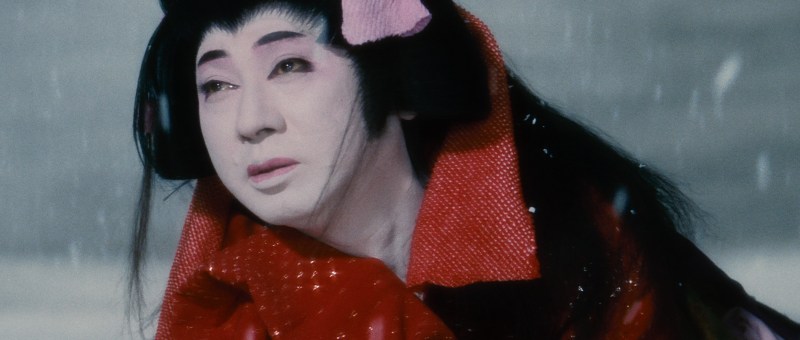
An Actor's Revenge blu-ray cover“Revenge is difficult even for an actor” our secret observer tells us, watching quietly from the rooftops like a spectator at a play. In celebration of his 300th screen appearance, Kazuo Hasegawa stars once again as vengeful onnagata Yukinojo in another version of An Actor’s Revenge (雪之丞変化, Yukinojo Henge), this time directed by Kon Ichikawa with a script written by his wife, Natto Wada, which was itself based on the earlier film with minor adaptations. Recasting the scope frame for the Kabuki stage, Ichikawa shows us a maddening world of theatricality, defined by artifice and governed by the rules of narrative determinism.

Orphaned after his parents were driven to suicide, Yukinojo (Kazuo Hasegawa) was taken in by an actor at a young age and trained as an “onnagata” – an actor specialising in female roles on the kabuki stage where women were forbidden to tread. Years later Yukinojo is one of the most popular actors of the age and lives more or less as a woman on stage and off. Having brought his Osakan theatre company to the Edo capital he finally sees his chance for revenge against the trio of corrupt and ambitious merchants who conspired to ruin his father for personal gain. He is, however, conflicted – not in his desire for vengeance but in the strain it continues to place on his mental state as well as the moral corruption need for it provokes.

Despite his feminine appearance, Yukinojo is regarded as male and most assume that his (volitional) romantic attachments will be with women. His gender ambiguity is, however, a problem for some such as the spiky pickpocket Ohatsu (Fujiko Yamamoto) who describes him as “creepy” in being neither male nor female. Then again, Ohatsu’s gender presentation is also atypical in that though she dresses and acts as a woman, most regard her as inappropriately masculine in the independence and authority which make it possible for her to act as the leader of a gang of street thieves. Lamenting her tomboyishness, some of her minions make the suggestion common in these kinds of films that Ohatsu will rediscover her femininity on falling in love (with a man). Despite her supposed hatred of men, Ohatsu finds herself falling for Yukinojo possibly precisely because of his gender ambiguity in that she is in some sense permitted to fall in love with him as a woman because he is a man.

Meanwhile, Yumitaro (also played by Kazuo Hasegawa) – another street thief only a much more egalitarian one, has no desire for women and has also developed some kind of fascination with Yukinojo as man who presents as female. Yukinojo is remarkably uninterested in Ohatsu, but seems drawn both to the mysterious Yumitaro and to the pawn in his revenge plot, lady Namiji (Ayako Wakao). The daughter of Dobe (Ganjiro Nakamura), the ambitious lord who orchestrated the plot against Yukinojo’s father, who has sold her to the Shogun as a concubine in order to buy influence, Namiji develops a deep fascination with the feminine actor which is then manipulated both by Yukinojo who plans to break her heart solely to get at Dobe, and by Dobe who intends to indulge her fascination in order to persuade her to return to the Shogun. Namiji is entirely innocent and effectively powerless. Involving her in the plot weighs on Yukinojo’s conscience but he refuses to look back, preparing to sacrifice her solely in order to a strike blow towards her father.

Meanwhile, chaos reigns in Edo as the corruption of the ruling elite provokes a rebellion by the ordinary people fed up with their persistent profiteering. This too Yukinojo harnesses as a part of his plot, setting his greedy merchants one against the other as they weigh up the benefits of making themselves look good to the people and the Shogun through engineering a crash in the price of rice by dumping the stocks they’ve been hoarding. The theatrical world and the “real” begin to overlap as Yukinojo performs the ghosts of his parents to bring the merchants’ crimes home to them, but his revenge plot has devastating and unforeseen consequences which perhaps begin to eat away at his carefully crafted chameleonism. Possessing no true identity of his own, Yukinojo passes into legend, retreating back to his natural home of the stage the shadow of an avenger disappearing over the horizon.


Original trailer (no subtitles)
The Love of the Actress Sumako (女優須磨子の恋, Kenji Mizoguchi, 1947)

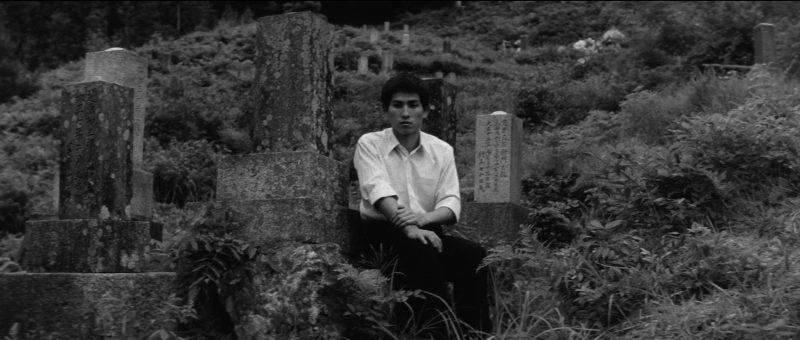
vlcsnap-2019-03-27-01h39m45s435The Taisho era was, like that of the post-war, a time both of confusion and possibility in which the young, in particular, looked for new paths and new freedoms as the world got wider and ideas flowed in from every corner of the globe. In The Love of the Actress Sumako (女優須磨子の恋, Joyu Sumako no koi), the second of a loose trilogy films about female emancipation, Kenji Mizoguchi took the real life story of a pioneering actress of Western theatre and used it to explore the progress of lack there of in terms of social freedoms not only for women but for artists and for society as a whole.

We begin in late Meiji as theatre director Shimamura (So Yamamura) fights to establish a foothold of Western-style “art theatre”, moving away from the theatricality of kabuki for something more immediate and naturalistic. He has, however, a problem in that as women were not allowed to take to the kabuki stage all of his students are male and casting a man to play a woman’s role would run counter to his desires to create a truly representative theatre. It is therefore lucky that he runs into Sumako Matsui (Kinuyo Tanaka) – a feisty, determined young woman who had divorced her first husband for infidelity and then left the second when he complained about her desire to pursue a career on the stage. In Sumako, Shimamura finds a muse and the ideal woman to portray the extremely controversial figure of Nora in his dream production of Ibsen’s incendiary A Doll’s House.

Shimamura casts Sumako because he sees in her some of Nora’s defiance and eventual desire to be free from illusionary social constraints, but it is in fact he who ends up embodying her spirit in real life. Somewhat feminised, Shimamura is in a difficult position in having married into his wife’s family, leaving him without real agency inside his own home as evidenced by his mild opposition to his daughter’s arranged marriage. While he wishes that his daughter be happy and if possible marry for love, Shimamura’s wife is very much of the old school and wants to make the best possible match in terms of financial gain and social status, viewing emotional compatibility as a low priority (the daughter herself as relatively little say). Unwisely falling in love with Sumako, it is he who eventually decides to follow Nora’s example by walking out not only on his family but also on the theatre company. He does this not quite because the scales have been lifted from his eyes – he was never under any illusion that his arranged marriage was “real” and there is of course an accepted degree of performance involved in all such unions, but because he finally sees possibility enough in his love for Sumako and the viability of emotionally honest Western art to allow him to break free of outdated feudal ideas of familial obligation.

Nevertheless, making a career as an artist is a difficult prospect in any age and Shimamura’s emotional freedom quickly becomes tied up with that of his art. Sumako’s Nora proves a hit (in the last year of Meiji), but he is ahead of his times both in terms of his liberal, left-wing philosophy and his determination to embrace modern drama in a still traditional society. The roles we see Sumako perform, including that in Tolstoy’s Resurrection which was another of those that helped to make her name, are all from proto-feminist plays which revolve around women who, like herself, had chosen to challenge the patriarchal status quo in pursuit of their own freedom and agency. Shimamura’s wife makes no secret of her outrage to her husband’s desire to stage A Doll’s House, viewing Nora’s decision as “selfish” and perhaps of a subversion of every notion she associates with idealised femininity. Though not so far apart in age, Sumako is a woman of Taisho who left not one but two unfulfilling marriages and is determined to forge her own path even if that path eventually leads her to subsume her own desires within those of her lover as the pair attempt to put their social revolution on the stage.

The revolution, however, does not quite take off. Despite good early notices, Shimamura’s Art Theatre company quickly runs into trouble. Faced with financial ruin, he does what any sensible theatre producer would do – he begins to prioritise bums on seats and acknowledges that if he’s to keep his company afloat and facilitate his dream of making Western theatre a success in Japan he’ll have to compromise his artistic aims  by putting on some populist plays. Of course, this sudden concession to commercial demands does not go down well with all and some of his hardline actors begin to leave in protest not just of his selling out but of his twinned desire to make Sumako his star.

Tellingly, the pair are eventually forced out of Japan entirely to tour the beginnings of empire from Korea to China and on to Taiwan. Their ideas are too radical and their society not quite ready for their messages even if not initially as hostile as it would later become. Shimamura works himself to the bone trying to keep his dream alive, eventually damaging his health. Sumako remains somewhat petulant about being forced into an itinerant lifestyle while her onstage personas come increasingly to influence her offstage life until it is said of her that her performance is “no longer an interpretation but an extension of reality”. In this, Sumako has, in a sense, achieved Shimamura’s dreams of a truly naturalistic theatre, but it comes at a cost, as perhaps all art does, and, Mizoguchi seems to suggest, becomes a kind of sacrifice laid down to a society still too rigid and unforgiving to appreciate its sincerity. Nevertheless, their boldness, as fruitless as it was, has started a flame which others intend to keep burning, eventually becoming a beacon for another new world looking to rebuild itself better and freer than before.


Short clip featuring Sumako’s performance as Carmen.

A Legend or Was It? (死闘の伝説, Keisuke Kinoshita, 1963)

A Legend or Was it posterIn 1951’s Boyhood, Kinoshita had painted a less than idealised portrait of village life during wartime. With pressure mounting ranks were closing, “outsiders” were not welcome. The family at the centre of Boyhood had more reasons to worry in that they had, by necessity, removed themselves from a commonality in their ideological opposition to imperialism but newcomers are always vulnerable when they find themselves undefended and without friends. 1963’s A Legend or Was It? (死闘の伝説, Shito no Densetsu, AKA Legend of a Duel to the Death) tells a similar story, but darker as a family of evacuees fall foul not only of lingering feudal mores but a growing resentment in which they find themselves held responsible for all the evils of war.

Beginning with a brief colour framing sequence, Kinoshita shows us a contemporary Hokkaido village filled with cheerful rural folk who mourn each other’s losses and share each other’s joys while shouldering communal burdens. A voice over, however, reminds us that something ugly happened in this beautiful place twenty years previously. Something of which all are too ashamed to speak. Switching back to black and white and the same village in the summer of 1945, he introduces us to Hideyuki Sonobe (Go Kato) who has just come home from the war to convalesce from a battlefield injury. Hideyuki’s engineer father went off to serve his country and hasn’t been heard from since, and neither has his brother who joined the air corp. His mother (Kinuyo Tanaka), sister Kieko (Shima Iwashita), and younger brother Norio (Tsutomu Matsukawa) have evacuated from Tokyo to this small Hokkaido village where they live in a disused cottage some distance from the main settlement.

The family had been getting by in the village thanks to the support of its mayor, Takamori, but relations have soured of late following an unexpected marriage proposal. Takamori’s son Goichi (Bunta Sugawara), a war veteran with a ruined hand and young master complex, wants to marry Kieko. She doesn’t want to marry him, but the family worry about possible repercussions if they turn him down. It just so happens that Hideyuki recognises Goichi and doesn’t like what he sees – he once witnessed him committing an atrocity in China and knows he is not the sort of man he would want his sister to marry, let alone marry out of fear and practicality. Hideyuki, as the head of the family, turns the proposal down and it turns out they were right to worry. The family’s field is soon vandalised and the police won’t help. When other fields meet the same fate, a rumour spreads that the Sonobes are behind it – taking revenge on the village on as a whole. The villagers swing behind Goichi, using the feud as a cover to ease their own petty grievances.

City dwellers by nature, the Sonobes have wandered into a land little understood in which feudal bonds still matter and mob mentality is only few misplaced words away. The village serves a microcosm of Japanese society at war in which Takamori becomes the unassailable authority and his cruel son the embodiment of militarism. Goichi embraces his role as a young master with relish, riding around the town on horse back and occasionally barking orders at his obedient peasants, stopping only to issue a beating to anyone he feels has slighted him – even taking offence at an innocuous folksong about a man who was rejected in love and subsequently incurred a disability. Despite all of that, however, few can find the strength to resist the pull of the old masters and the majority resolutely fall behind Goichi, willing to die for him if necessary.

As the desperation intensifies and it appears the war, far off as it is, is all but lost, a kind of creeping madness takes hold in which the Sonobes become somehow responsible for the greater madness that has stolen so many sons and husbands from this tiny village otherwise untouched by violence or famine. An embodiment of city civilisation the Sonobes come to represent everything the village feels threatened by, branded as “bandits” and blamed for everything from murder to vegetable theft. The central issue, one of a weak and violent man who felt himself entitled to any woman he wanted and refused to accept the legitimacy of her right to refuse, falls by the wayside as just another facet of the spiralling madness born of corrupted male pride and misplaced loyalties.

Kinoshita returns to the idyllic countryside to close his framing sequence, reminding us that these events may have been unthought to the level of myth but such things did happen even if those who remember are too ashamed to recall them. Tense and inevitable, A Legend or Was It? reframes an age of fear and madness as a timeless village story in which the corrupted bonds of feudalism fuel the fires of resentment and impotence until all that remains is the irrationality of violence.


Original trailer (no subtitles)

The Garden of Women (女の園, Keisuke Kinoshita, 1954)

garden of women still 1Things changed after the war, but not as much as some might have hoped. Sadly still topical, Keisuke Kinoshita’s Garden of Women (女の園, Onna no Sono) takes aim both at persistent and oppressive patriarchal social structures and at a compromised educational system which, intentionally or otherwise, systematically stifles attempts at progressive social change. A short few years before student protests would plunge education into crisis, Kinoshita’s film asks why it is that the establishment finds itself in conflict with the prevailing moods of the time and discovers that youth intends to have its brighter future even if it has to fight for it all the way.

The setting is an exclusive private woman’s university in the elegant historical city of Kyoto. The ladies who attend this establishment are mostly from very wealthy families who have decided to educate their daughters at the college precisely because of its image of properness. As one student will later put it, there are two kinds of girls at the school – those who genuinely want to study in order to make an independent life for themselves and intend to look for work after graduation, and those who are merely adding to their accomplishments in order to hook a better class of husband. Everyone, however, is subject to a stringent set of rules which revolves around the formation of the ideal Japanese woman through strictly enforced “moral education” which runs to opening the girls’ private letters and informing their families of any “untoward” content, and requiring that permission be sought should the girls wish to attend “dances” or anything of that nature.

As might be expected, not all of the girls are fully compliant even if they superficially conform to the school’s rigid social code. Scolded for her “gaudy” hair ribbon on the first day of school, Tomiko (Keiko Kishi) rolls her eyes at the over the top regulations and enlists the aid of the other girls to cover for her when she stays out late with friends but her resistance is only passive and she has no real ideological objection towards the ethos of the school other than annoyance in being inconvenienced. Tomiko is therefore mildly irritated by the presence of the melancholy Yoshie (Hideko Takamine). Three years older, she’s come to college late and is struggling to keep up with classes but is, ironically enough, prevented from studying by the same school rules which insist she go to bed early.

Meanwhile, dorm mate Akiko (Yoshiko Kuga), from an extraordinarily wealthy and well connected family, is becoming increasingly opposed to the oppressive atmosphere at the school. However, as another already politically active student points out, Akiko’s background means there are absolutely no stakes for her in this fight. She has never suffered, and likely never will, because she always has been and always will be protected by her privilege. Fumie (Kazuko Yamamoto), a hardline socialist, doubts Akiko’s commitment to the cause, worrying that in the end she is only staging a minor protest against her family and will eventually drift away back to her world of ski lodges and summer houses. Despite her ardour, Akiko finds it hard to entirely dispute Fumie’s reasoning and is at constant battle with herself over her true feelings about the state of the modern world as it relates to herself individually and for women in general.

This is certainly a fiercely patriarchal society. Even though these women are in higher education, they are mostly there to perfect the feminine arts which are, in the main, domestic. They are not being prepared for the world of work or to become influential people in their own right, but merely to support husbands and sons as pillars of the rapidly declining social order that those who sent them there are desperate to preserve. For many of the girls, however, times are changing though more for some than others. Tomiko rolls her eyes and does as she pleases, within reason, and even if she eventually wants to see things change at the school it is mostly for her own benefit. She sees no sense in Akiko’s desire for reform as a stepping stone to wider social change, and perhaps even fears the kinds of changes that Akiko and Fumie are seeking.

Akiko and Fumie, and to an extent, Tomiko, seem to have a degree of agency that others do not as seen in the tragic story of Yoshie whose life has been largely ruined thanks to the selfish and heartless actions of her father. From a comparatively less wealthy family, Yoshie worked in a bank for three years during which time she met and fell in love with an earnest young man named Shimoda (Takahiro Tamura). However, her father, having become moderately successful, developed an appetite for social climbing and is determined she marry “well” to increase his own sense of superiority as a fully fledged member of the middle classes. He sees his daughter as nothing more than a tool or extension of himself and cares nothing for her thoughts or feelings. In order to resist his demands for an arranged marriage, Yoshie enrolled in school and is desperate to stay long enough for Shimoda to finish his education so they can marry.

Yoshie is trapped at every turn – she cannot rely on her family, she cannot simply leave them, she cannot yet marry, if she leaves the school she will be reliant on a man who effectively intends to sell her, but her life here is miserable and there is no one who can help her. All she receives from the educational establishment is censure and the instruction to buck up or get kicked out. She feels herself a burden to the other girls who regard her as dim and out of place thanks to their relatively minor age gap and cannot fully comprehend her sense of anxiety and frustration.

Finally standing up to the uncomfortably fascistic school board the girls band together to demand freedoms both academic and social, insisting that there can be no education without liberty, but the old ways die hard as they discover most care only for appearances, neatly shifting the blame onto others in order to support their cause. “Why must we suffer so?” Yoshie decries at a particularly low point as she laments her impossible circumstances. Why indeed. The oppressive stricture of the old regime may eventually cause its demise but it intends to fight back by doubling down and the fight for freedom will be a long one even if youth intends to stand firm.


Titles and opening scene (no subtitles)

Growing Up (たけくらべ, Heinosuke Gosho, 1955)

Gosho Growing UpCaught in a moment of transition, it’s no great mystery that post-war Japanese cinema began to look back at the Meiji past. Progress had indeed been rapid but ended in national tragedy and collective madness. The post-war humanists were eager for a different outcome, to avoid the mistakes of the last fifty years and build a society that was kinder and freer than that which had come before. Though on the surface it might seem as if much had changed since the dawn of a new century, the problems were still the same and a failure to address them only likely to add new tragedies in place of the better future many hoped for. Among the foremost proponents of post-war humanism, Heinosuke Gosho made a rare trip back into the Meiji past in 1955’s Growing Up (たけくらべ, Takekurabe), an adaptation of the well known short story by Ichiyo Higuchi, finding that nothing much had really changed when it came to the fates of women and the poor in an often wilfully indifferent society.

The action opens on the outskirts of the Yoshiwara in 1894. Our heroes are a collection of children who find themselves dealing with typically adolescent problems but also, by modern standards, expected to grow up all too fast. Chief among them is 13-year-old Midori (Hibari Misora) whose sister, Omaki (Keiko Kishi), is the most famous courtesan of the red light district. Although she knows on some level that her parents have already sold her to the brothel owner in whose house they live as servants, Midori has not yet quite processed the full implications of her destiny or that her world of childhood innocence is rapidly drawing to a close. She is in love with a local boy, Shinnyo (Takashi Kitahara), who seems to return her feelings but is as awkward and confused by them as any teenage boy and treats her by turns with coldness and contempt mixed with grudging affection.

Shinnyo, meanwhile, is the son of a greedy and heartless monk (Takamaru Sasaki) who has decided to sell his older sister as a concubine to a wealthy man who already has a wife. As he loves his sister dearly and has a naive, childish sense of absolute morality, this is a sin Shinnyo cannot forgive. He argues with his father but has no real power to change the situation and then decides on rebelling against his father’s wishes that he not become a monk by leaving for the main temple in Kyoto to take holy orders. Of course, this also means he must sacrifice any youthful idea he might have had of pursuing his love for Midori.

The title, in a sense, could refer not only to the increasingly melancholy youngsters coming of age in an oppressive society, but also to Japan itself as it emerged into modernity in an effort to prove itself the equal of any other major power in the late 19th century. It is, however, an ironic a title as any could be. To “grow up” here is to abandon one’s humanity and conform to the kind of “real world” thinking that codifies cruelty and makes a virtue of heartlessness. Still an innocent child, Midori bounces her ball and basks in her somewhat elevated position as a wealthy young girl and sister of a “notorious” woman without fully understanding all that entails. When her sister tells her about a dream she had of climbing trees and picking persimmons, she is incapable of understanding her warning about the loss of innocence she’s about to experience, but her world is brought crashing down when a gang of rival boys rudely attack her and point out that all her finery was bought through “whoring” and that she is nothing more than a “whore” in waiting.

Another of the boys, Sangoro (Masanori Nakamura), whose family is poor, says he can’t wait to be “grown up”, reacting with less than sensitivity to Midori’s pained pleas that she wishes everything could stay as it was and they could be children forever. Sangoro sees adulthood as freedom. He’ll be free to earn his own living and maybe he won’t have to be like his father, too afraid to stand up to people with money because when you don’t have any you’re always reliant on their kindness. Sangoro may be poor, but he’s a man (or will be) and can’t process the total lack of agency that comes with being an adult female whose future is decided entirely by her closest male relative. Midori, like Shinnyo’s sister, has been sold by her father and there’s nothing she or anyone else can do about it now.

Nevertheless, confronted by her fate, Midori decides to own it. She encourages her parents to think of her as dead, cooly hitting back at their callousness but acknowledging an obligation as she goes. The final scenes preceding her passage across the small bridge which will forever sever her from her childhood are filled with dread and anger as if crying out for someone to stop the inevitable from happening, but of course, no one can. An old woman and former courtesan, Okichi (Isuzu Yamada), who owns a shop where Midori used to spend time and is indirectly responsible for Midori’s acceptance of her fate in some cruel, drunken words she threw at her, puts it best when she briefly feels as if she could have done something in affirming that it isn’t her fault, and it isn’t Midori’s, it’s simply “the world”.

Midori meets her fate not with resignation but rage and defiance. Shinnyo, who runs away from his inability to help his sister by becoming a monk, is forever incapable of declaring his real feelings in words but leaves a flower in front of her window in echo of another he gave her long ago. At first Midori picks it up and cherishes it for the innocent symbol of love that it is, but by the time she has travelled half way along the bridge which will take her to the Yoshiwara, she has realised this kind of innocence does not belong inside. She throws the flower to the mud and leaves her youthful dreams of love and happiness behind as she prepares to step through the doorway into a future which is not of her making and over which she has no say. To “grow up”, in this world, is a kind of spiritual death in which there exists nothing other than emptiness and indifference.