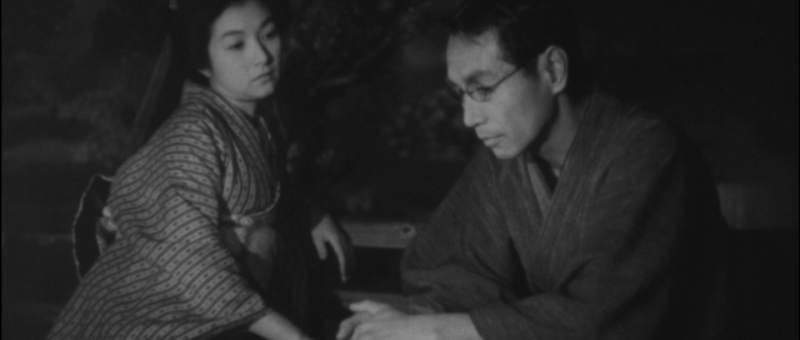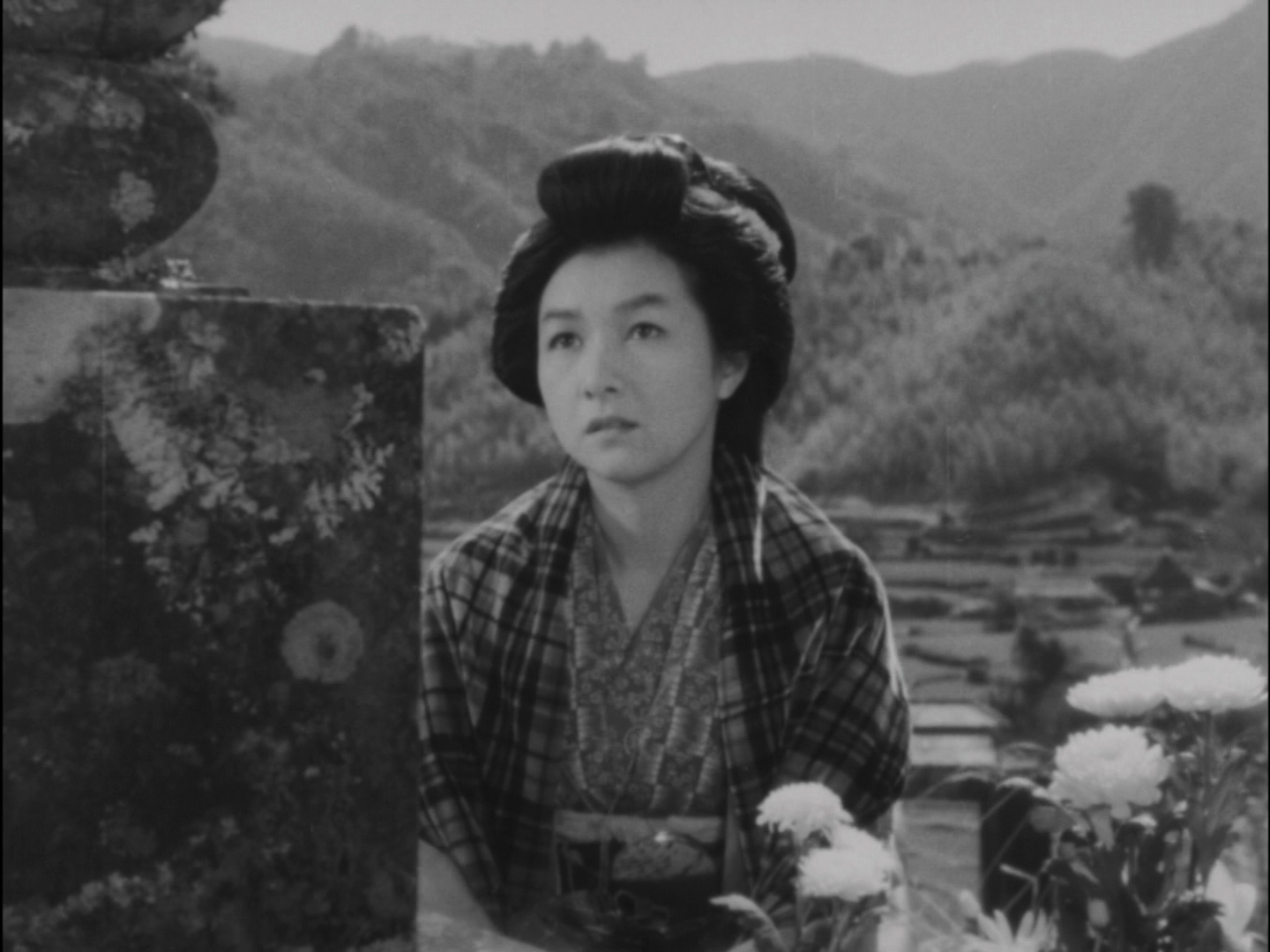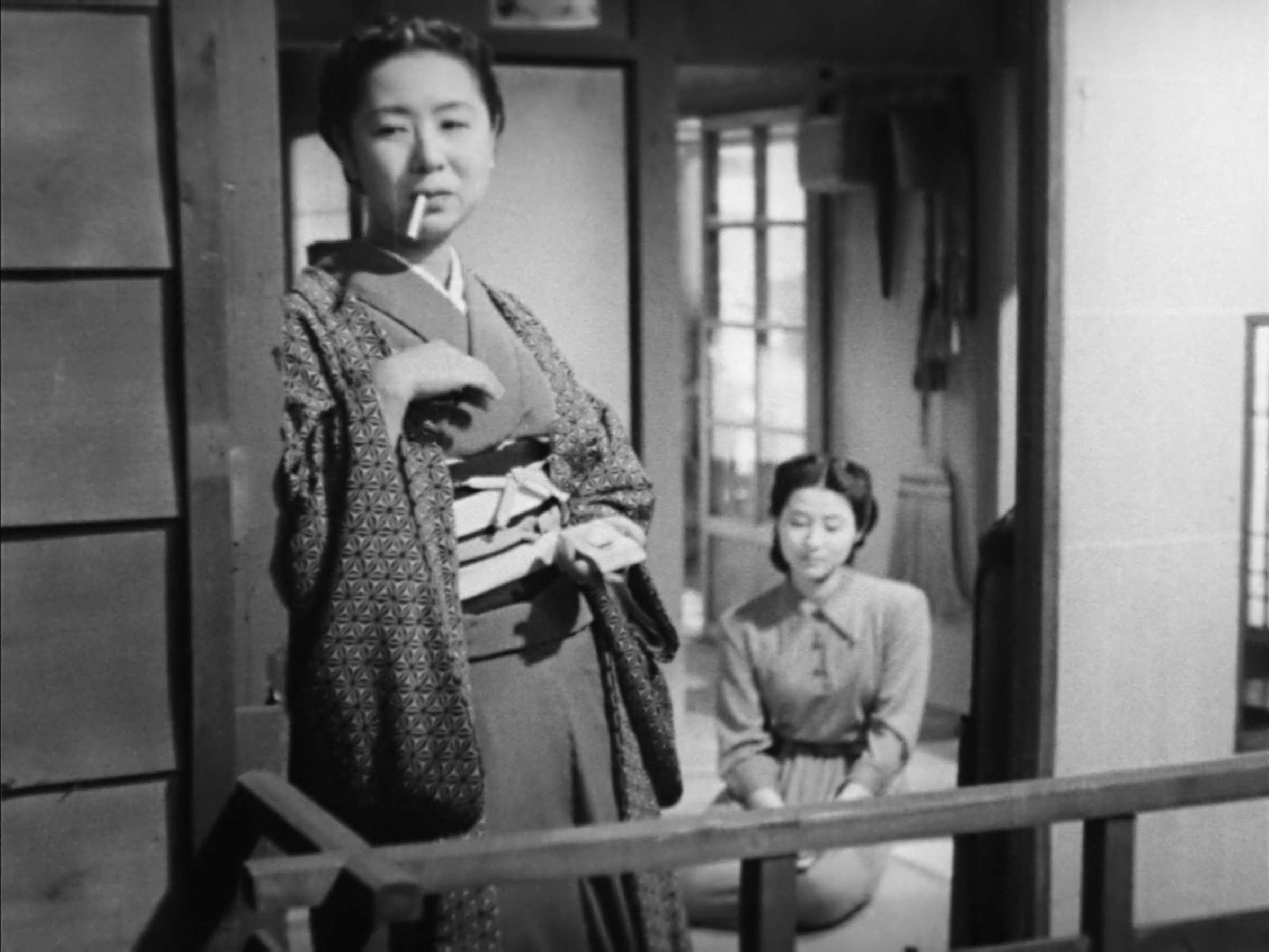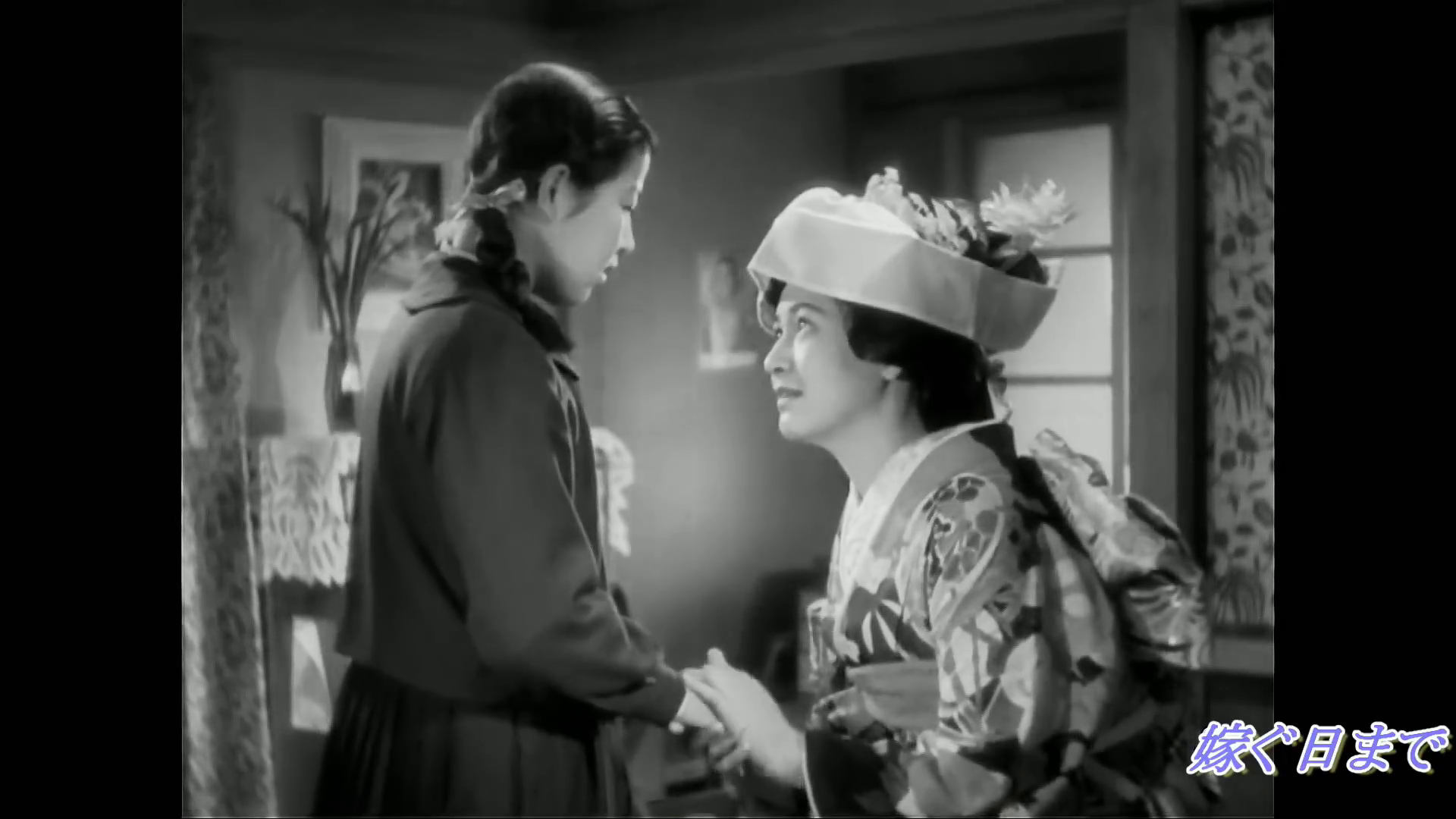
Morning’s Tree-Lined Street (朝の並木路, Mikio Naruse, 1936)

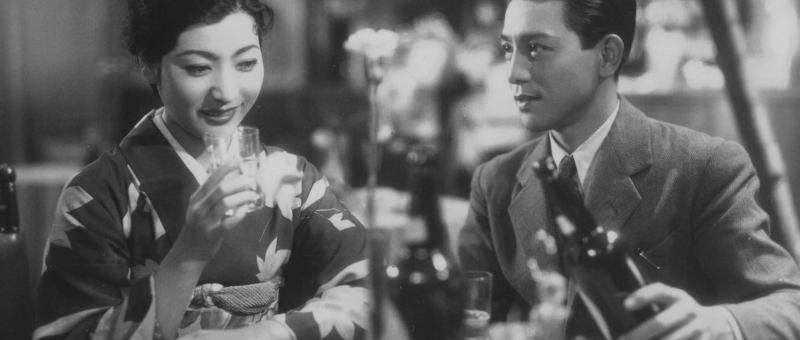
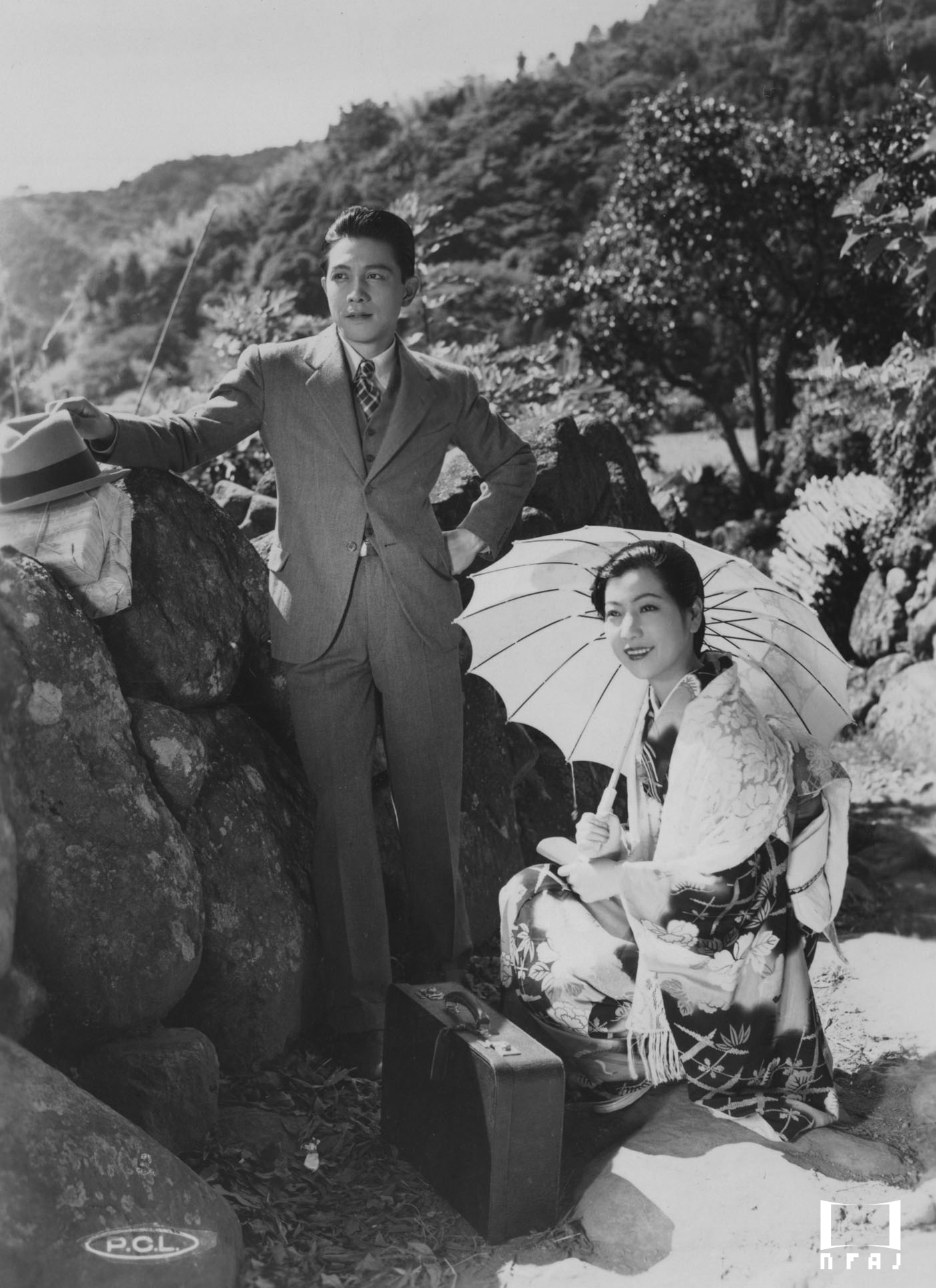
A country girl comes to the city in search of a more glamorous life but largely finds only disillusionment and disappointment in Naruse’s 1936 drama Morning’s Tree-lined Street (朝の並木路, Ashita no Namikimichi). Naruse depicts Chiyo’s (Sachiko Chiba) spiritual journey literally as she takes the bus from her rural hometown all wide-eyed wonder and then arrives in the city to be bothered by a homeless man and then walk into a less salubrious area of the city with only her friend’s address to go on. 

In her hometown, everyone thinks Hisako (Ranko Akagi) works in a big office in Marunouchi, but in reality she’s now working in a hostess bar under the name “Shigeko.” Nevertheless, despite a degree of shame in her circumstances, Hisako doesn’t reject Chiyo and isn’t angry that she’s come and found out her secret. She talks her landlady, Okada, into letting her stay but discourages her from working in the bar. The current economic depression is evident in the fact that the bar isn’t doing so well and never has many customers, yet the “help wanted’ sign keeps going up and down outside. There’s even a running gag that the cook makes a permanent version so they won’t waste so much paper, only he spells “hostess” wrong, so they have to take it down anyway. 

The help wanted sign is a harbinger of doom for Chiyo who, it seems, is being drawn towards this kind of life. As Hisako had told her, it’s impossible for a country girl to find a job when there are already so many “desperate” people in Tokyo, and at the grand old age of 22 Chiyo is worried that she’s simply too old to find employment. By the standards of the time, she may be considered on the older side not to be married, and indeed Hisako tells her she’d be better off to go home and find a husband, but Chiyo wants both more and to find a grand romance. She romanticises an idea of poverty believing that she could be happy with a man she truly loved even if they had no money. Hisako doesn’t disillusion her, but may be inwardly rolling her eyes at her naivety. She has a boyfriend already, but he’s no good. He keeps turning up and pestering her for money which might be one reason Hisako can’t escape the life of a bar girl.

It is indeed money that gets in the way everyone’s relationships. Hisako reads in the paper about a salaryman who embezzled money to spend at a hostess bar and then died in a double suicide with one of the women who worked there. The dark fantasy the bar represents echoes the wider despair in the society coloured by economic depression and broken dreams in which the fantasy version of Ogawa admits that his life was without hope or joy. Chiyo gets close to a nice young man who comes into the bar who tries but fails to find her a legit job in an office in attempt to save her from becoming a bar girl. In the end, she gives in and becomes one. Ogawa says he thinks no less of her, but begins coming to the bar more often and appears to be spending beyond his means even while Chiyo warns him not to waste his money. 

What happens next turns out to be a cinematic fantasy informed by Chiyo’s naive desires in which Ogawa agrees to marry her but has already ruined himself by embezzling public funds and later asks her to die with him while she pleads that as long as they have love poverty is nothing to fear. In many ways, the dream shatters her illusions and confronts her with the stark reality of her life in playing out a best/worst scenario in which Ogawa is so deeply in love with her that willingly walks to his destruction, which is at least preferable to the truth, which is as Hisako says that a man may seem honest and sincere but will turn out to be a coward or else he’ll cheat on you.

Unable to find employment nor rely on men, the women have only each other and the solidarity of those like Mrs Okada her running a small bar in this rundown corner of the city where dreams go to die. Chiyo takes to her new life a little more than to her liking. She turns to Hisako and asks if she looks like a bad girl, fearful that it’s already changed her and it’s no longer possible to go back to being the innocent country girl who wanted a bigger life in the city. Her conviction might be brought home to her by the fact that Ogawa is promoted and sent out of Tokyo but doesn’t ask her to come with him, only leave his address in case she ever feels like writing. But at the same time it spurs her into a flurry of false positivity, committing herself to the job search despite knowing that it’s almost certainly futile. Throwing his note into the river and letting it flow away, she both sees through the naivety of her dream of escape through romance and also resigns herself to the life of a bar girl, like Hisako with nowhere else to go and no possibility of return only the vague and far off hope of salvation through employment.


Morning’s Tree-Lined Street screens 21st June at New York’s Metrograph as part of Mikio Naruse: The World Betrays Us – Part II.

Images: Collection of National Film Archive of Japan.

Image of a Mother (母のおもかげ, Hiroshi Shimizu, 1959)

“Does happiness even exist nowadays?” replies a still youngish widow pushed towards the prospect of remarriage but for her own reasons reluctant. The final film from Hiroshi Shimizu, Image of a Mother (母のおもかげ, Haha no Omokage) examines the changing nature of family dynamics through the experiences of a blended family and a little boy whose grief and loneliness in the wake of his mother’s death are little acknowledged by those around him who are unable to understand why he cannot simply just move on.

This may partly be down a practical mindset having not so long ago experienced a time in which there was so much death it would not have been possible to grieve it all, but there is something nevertheless quite insensitive in the way little Michio (Michihiro Mori) is more or less told he must forget his late mother. Though it appears she only passed away less than year previously, Michio’s father Sadao (Jun Negami) is under immense pressure from his uncle to remarry so that Michio will have a mother. The latest prospect in what seems to be a long running series of possible matches is a widow Sadao’s own age with a young daughter. Sonoko (Chikage Awashima) works in the canteen at the local hospital where Sadao’s uncle delivers the tofu from his shop but is originally quite resistant to his attempts at matchmaking before finally giving in. Neither of them really wanted to marry again and the meeting itself is quite awkward but against the odds they do actually get on and eventually decide to get married. 

Sonoko is a very nice woman and kind to Michio, determined care for him as if he were her own son but hurt by his continuing distance towards her. Aside from the emotional distress, it’s also true that Sonoko is under a lot of pressure to present herself as the perfect image of motherhood especially having joined a larger extended family from whom she may fear judgement though are actually very fond of her and glad they found someone so nice. The extended family in particular are quite put out that Michio has yet to call Sonoko “mum,” and are cross with him for not doing so while Sonoko too is forced to feel as if it’s a slight on her character, that she’s not living up to her new role and the otherwise happy family they’ve begun to build may fall apart if she can’t completely win Michio over. 

The family don’t seem to understand at all that Michio is still attached to his late mother’s memory, and the insensitive attitude of Sadao’s younger cousin Keiko (Satoko Minami) does much to fuel the fire in her insistence that Michio hide the photograph of his mother to which he is still saying goodbye when he leaves each morning for school. They tell him that because he has a new mother now he must forget the old, but to him it seems like a betrayal. He likes Sonoko, and he likes being mothered, but he can’t bring himself accept her in the place of the mother he’s lost. It’s not Sonoko who tells him he must do any of this, and in fact she is the one who tries to suggest that there’s room for more than one mother even if the idea is immediately rejected by her daughter Emiko (Sachiyo Yasumoto). But it’s many ways this attempt to hide the past, to avoid dealing with it that prevents the new family from cementing itself. Only once the adults have listened to and fully accepted Michio’s feelings does he finally feel comfortable enough to call Sonoko his mother. 

Even so, Michio’s bullying at the hands of his classmates who keep feeding him stories about evil stepmothers points to a lingering stigma towards remarriage and families that might differ from the norm. In this he finds himself doubly conflicted, defending Sonoko to his obnoxious classmates while unable to accept her at home. Maintaining the lateral tracking shots that become increasingly prevalent in his later career, Shimizu makes the most of the scope frame to capture Michio’s loneliness and isolation if also that of Sonoko who finds herself in an awkward situation trying to adjust to this new family life in what was another woman’s home knowing she can’t ever take her place but must try to find her own within it. Yet what he gives them in the end is a kind of mutual salvation that promises new futures for both and that even nowadays happiness may still exist.


Image of a Mother screens at Japan Society New York on May 23/30 as part of Hiroshi Shimizu Part 2: The Postwar and Independent Years.

The Wolves (狼, Kaneto Shindo, 1955)

Post-war desperation drives a collection of otherwise honest men and women towards a criminal act that for all its politeness they are ill-equipped to live with in Kaneto Shindo’s biting social drama The Wolves (狼, Okami). “Wolves” is what the criminals are branded, but the title hints more at the wolfish society which threatens to swallow them whole. After all, it’s eat or be eaten in this dog eat dog world, at least according to a cynical insurance salesman hellbent on exploiting those without means. 

Each of the five “criminals” is an employee at Toyo Insurance where they’re immediately pitted against each other, reminded that in order to qualify for a full-time position they need to meet their quotas for six months. The orientation meeting is cultilke in its intensity, the boss insisting that only in insurance can you become a self-made man while recounting his own epiphany as to the worthiness of his profession. They are told that the only two things they need are “faith and honesty”, and then “faith and pursuasion”, while encouraged to think of their work as an act of “worship”, “for the salvation of everyone”. 

Yet they’re also told to exploit their friends and family by pressuring them into taking out life insurance policies in order to help them meet their quotas. As one man points out, friends and relatives of the poor are likely to be poor themselves, but these are exactly the kind of people they’re expected to target. They’re told there’s no point going after the weathly because they’re already insured, but there’s something doubly insidious in trying to coax desperate people who can’t quite afford to feed themselves into paying out money they don’t have on the promise of protecting their families from ruin. One man even asks if the policy covers suicide and is told it does if you pay in for a year, sighing that he doesn’t want to wait that long.

“Suicide or robbery, choose one,” one of the salespeople reflects after failing to make their quota once again. They each have reasons to be desperate, all of them already excluded from the mainstream society and uncertain how they will find work if the job falls through. Akiko (Nobuko Otowa) is a war widow with a young son who is being bullied at school because of his cleft palate for which he needs an expensive operation. She’s already tried working as a bar hostess but is quiet by nature and found little success with it. Fujibayashi (Sanae Takasugi) is widowed too with two children and five months behind rent for a dingy flat in a bomb damaged slum where the landlord is about to turn off her electric. Harajima (Jun Hamamura) used to work in a bank but was fired for joining a union and is trapped in a toxic marriage to woman looking for material comfort he can’t offer. Mikawa (Taiji Tonoyama) too is resented by his wife, a former dancer, having lost his factory job to a workplace injury while the ageing Yoshikawa (Ichiro Sugai) was once a famous screenwriter but as he explains people in the film industry turn cold when you’re not hot stuff any more. 

Their unlikely descent into crime has its own kind of inevitability in the crushing impossibility of their lives. They may rationalise that what they’re doing is no different from the insurance company that exploits the vulnerable for its own gain, thinking that if they can just get a little ahead they’d be alright while feeling as if robbery and suicide are the only choices left to them and at the end of the day they want to survive. Perhaps you could call them “wolves” for that, but they’re the kind of wolves that give the guards from the cash van they robbed their train fare home after bowing profusely in apology. The real wolves are those like Toyo who think nothing of devouring the weakness of others, promising the poor the future they can’t afford while draining what little they have left out of them. As the film opens, Akiko looks down at a bug writhing in the dirt attacked by ants from all sides and perhaps recognises herself in that image as the sun beats down oppressively on both of them. Breaking into expressionistic storms and unsubtly driving past a US airbase to make clear the source of the decline, Shindo paints a bleak picture of the post-war world as a land of venal wolves which makes criminals of us all. 


Nightshade Flower (夜来香, Kon Ichikawa, 1951)

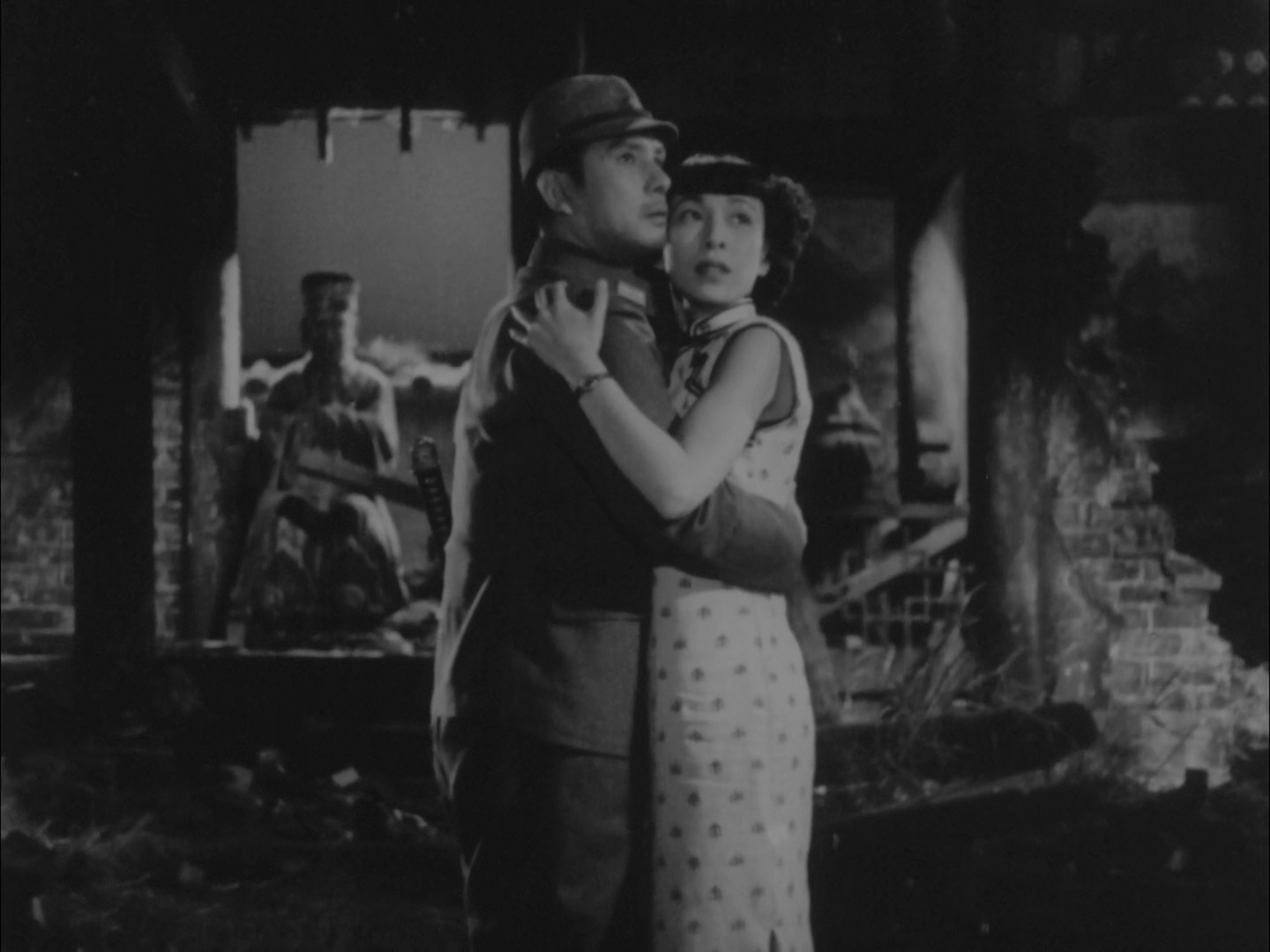
A couple who met briefly in Manchuria are reunited in Kobe five years later but find their joy short-lived amid the vagaries of the post-war society in Kon Ichikawa’s tragic romance, Nightshade Flower (夜来香, Ieraishan). The film takes its name from a song “夜来香” known as “Ieraishan” in Japanese, a transliteration of the Mandarin pronunciation (yèláixiāng) in katakana, which was released in a Chinese-language version in Shanghai in 1944 performed by Manchurian Japanese actress Yoshiko Yamaguchi (山口淑子) who also went by the names Ri Koran/Li Hsiang-lan (李香蘭) and later Shirley Yamaguchi at various times in her career. A song of lost love, it seems to echo a sense of despair among the wartime generation who cannot reconcile their pasts with the post-war present. 

Akiko (Asami Kuji), a sex worker, first meets Seki (Ken Uehara), an army doctor, when he pulls her out of the way of an oncoming vehicle in a crowded market place in Northern China in June, 1944. As she is dressed in cheongsam and angrily shouts at him in Mandarin, he assumes her to be Chinese and carries on along his way while she remains ambivalent about the encounter especially as the sleeve of her dress has been torn. In any case, it’s clear that the situation has become precarious and most of the Japanese population are preparing for evacuation. The owner of the brothel where Akiko and her friend Gin (Harue Tone) are employed has hopes of carrying on her business further behind the lines where army bases are still in operation though the pair would prefer to head home as soon as possible, jumping off the repatriation truck organised for them by the madam with the intention of returning to the city and boarding the next one bound straight for the mainland. 

But Gin falls off a cliff and injures her leg, leaving Akiko to go in search of a doctor incongruously rocking up at Seki’s medical clinic. Though she is originally unwilling to have him treat Gin, she soon comes around and the pair begin seeing each other with Akiko pledging to stay behind after putting Gin on a truck. Nevertheless the pair are separated during an air raid with Akiko believing that Seki has been killed in a direct hit to the shrine they were sheltering in when he left their foxhole to check on a crying baby. Five years later, Seki has returned to Kobe to look for Akiko but has had no luck while staying with the family of one of his men, Toshio (Yuji Kawakita), who has fallen into post-war despair and given up his promising future in medicine to peddle black market drugs with shady fixer Kameyama (Reikichi Kawamura). 

The crisis comes when Seki realises he is losing his sight, apparently a delayed reaction to the head injury he sustained in Manchuria which was not fully treated due to the war’s end. Though he reunites with Akiko, he believes that he can no longer have a future with her because of his impending blindness and in fact that his life is now over. Akiko meanwhile has also fallen into despair. Believing Seki was dead she gave up on the idea of finding him and has returned to sex work, she and Gin working in a small backstreet bar and living in adjacent rooms of a rundown tenement block. Seki had always known that she was a sex worker, but she believes he may now reject her because she has failed to live up to the promise she made him of living a more “honest” life ironically because without him she had no reason to do so. 

Meanwhile, Seki is intent of saving Toshio whom he had first met as a naive private openly crying over the death of his mother having picked up a venereal disease after losing his virginity to a sex worker in an attempt to overcome his grief. Toshio is an embodiment of the despair felt by young men who went to war as innocent teenagers and are filled with disillusionment and confusion. Though Toshio is luckier than most who struggle to find work in the difficult post-war economy, he came from a middle-class medical family and if he finishes his training of which he only has a year left he would inherit his father’s clinic, he no longer sees a future for himself and actively rejects his privilege as an act of self-harm by taking up with Kameyama and becoming involved with crime. He resents his father for remarrying soon after his mother died, taking the family maid as his second wife, and is reluctant to marry their nurse, Chiyo (Chiaki Tsukioka), who is also Kameyama’s younger sister, as everyone expects him to despite otherwise carrying on an affair with her which later results in a pregnancy. He says that he wants to earn his own living and be his own man but claims he cannot see the bright future Seki speaks of for him and continues along a dark path of crime and vice. 

The constant rumblings of the train along with its flickering light strongly foreshadow the tragic denouement but also hint at the automatic motion of society that damns the trio and frustrates their attempts to move on from the war and find happiness in its aftermath. Even so, to modern eyes the motif of Seki’s literal blindness which robs him of the ability to perceive a happy future with Akiko cannot but seem a little ableist even as Akiko points out that many men lost their sight in the war but are living good lives with wives and children and that she does not see his disability as a barrier to their ability to make new lives for themselves in the post-war society much as he doesn’t regard her past in sex work as a reason to reject her.

Even so, Seki is dragged into the post-war morass after becoming involved with Kameyama in a futile attempt to save Toshio only to discover that Kameyama has betrayed them by getting them both to work on the same job as a payment for a debt taken out by Seki on Toshio’s behalf to free him from his life of crime. Ichikawa embraces a sense of melodrama with frequent closeups and an underlying theatricality, but also captures something of post-war confusion in the noirish fog that surrounds Akiko as she considers one last job to pay for probably useless medical treatment to save Seki’s sight. The cruelty of the ending is in its way too difficult to bear but perhaps apt for the view from 1951 in which the possibility of escaping the legacy of wartime corruption lies only in painful memories. 


Untamed (あらくれ, Mikio Naruse, 1957)

“Don’t let guys control you. You have to make them men” the heroine of Mikio Naruse’s Taisho-era drama Untamed (あらくれ, Arakure, AKA Untamed Woman) advises a former rival, yet largely fails to do so herself in the fiercely patriarchal post-Meiji society. Based on a serialised novel by Shusei Tokuda published in 1915 but set in late Meiji rather than early Taisho, Naruse’s adaptation essentially drops a contemporary post-war woman into a by then almost unrecognisable Japan, but finds her hamstrung firstly by feckless and entitled men and then by complicit women who themselves cannot accept her transgressive femininity. 

As the film opens, a teenage Shima (Hideko Takamine) has just married wealthy grocery store owner Tsuru (Ken Uehara) but the marriage is already a failure. Though Shima is compared favourably with Tsuru’s previous wife who was apparently in poor health, presumably suffering with TB which required a sojourn by the sea, it soon becomes clear that Tsuru is as trapped by the archaic patriarchal social system as she is. He was apparently in love with a woman from a higher social class he was too afraid to pursue and despite still seeing her also has a mistress near their factory in Hokkaido whom he often visits under the guise of a business trip. Yet when Shima tells him she thinks she may be pregnant, he is unimpressed, immediately questioning the paternity of the child while harping on about her having been married before which it seems is not quite true. Perhaps the reason that she has ended up a second wife despite her youth and beauty, Shima ran out on a marriage to a childhood friend arranged for her by her adoptive parents the night before the wedding not realising they had already registered the union without her knowledge or consent. 

This transgressive act at once signals Shima’s total disregard for conventionality and insistence on her own autonomy, yet it is also indicative of the fact she married Tsuru in search of a better life, knowing that to marry her adoptive parents’ choice meant only a life of servitude on the family farm. She is not always a terribly likeable figure, coldly explaining that she didn’t mind being fostered out because the adoptive family were wealthier and could give her a better life than she had with her birth parents. Yet it’s this sense of familial dislocation and the liminal status it gives her that allow her to take agency over her life in the way other women might not, unwilling to lose the familial security Shima may not feel she ever had. Tsuru is also an adopted son, but the price for disobedience for him may be even higher and indeed as we later hear his inability to sort out his love life eventually sees him out on his ear. His pettiness in refusing to accept the child is his leads to an argument which causes Shima to slip on the stairs and miscarry, the implication being that she may not be able to bear more children leaving her unlikely to remarry and thereby spurring her desire for a tempered independence. 

The fall is the last straw. Tsuru divorces Shima citing her inability to play the role of the proper wife while her birth family, from whom she is emotionally estranged, refuse to take her back as do the adoptive parents because of the embarrassment she caused them with the marriage stunt. She is often described as “like a man”, unable to win as Tsuru at once insists she wear the frumpy kimonos left behind by his previous wife who was a decade older, complains she wears too much makeup, and tells her to loosen her kimono belt to de-emphasises her figure, while criticising her for being unfeminine in her refusal to simply put up with his bad behaviour as is expected for a wife in this era. Shima fulfils all her wifely duties and as we see is in fact running his business as the women of the family are often seen to do while their husbands spend the money they earn for them on other women whether drinking with geishas or supporting mistresses in second homes. When her husband hits her, she fights back rather than shrinking away chastened as intended. 

Yet she cannot overcome the sense that a man is necessary for her success which cannot be accomplished alone. Cast out from her family, her brother installs her in the mountains to work in a geisha house if only as kitchen staff but soon does a flit to reunite with his married lover who has left her husband for him. While there she falls for the quiet and sensitive inn owner Hamaya (Masayuki Mori), also an adopted heir, whose wife is again ill with TB. Hamaya may be treating his wife a little better than Tsuru did his, but quite clearly assumes she’ll die in starting an affair with Shima who is then sent away to an even more remote inn to avoid a potential scandal. As Tsuru did with the woman he apparently loved, Shima continues to see Hamaya until he too succumbs to TB as an ideal of an impossible love while simultaneously accepting that he failed her in being too weak and cowardly to fight for their romance, outright refusing to become his mistress. 

This may be one reason she is determined never again to be an employee but to own her own store which is why she ends up marrying tailor Onoda (Daisuke Kato) who introduces her to textiles and seamstressing at which she quickly proves adept having mastered the modern sewing machine. She marries Onoda in believing him “reliable”, but soon comes to regard him as lazy and feckless. The first shop fails because he can’t keep up with her. The male employees are always taking breaks to drink tea and play shogi, Onoda complaining that he’s tired while she does all his work for him and the housework too. Yet he also criticises her for a lack of femininity, snapping back that it must be her time of the month when she berates him in front of their employees while later after they’ve become successful complaining it’s “embarrassing” that his workhorse wife doesn’t know the things a sophisticated society woman would such as ikebana while flirting with the teacher he’s hired ostensibility to teach her. He even forces her to wear a frumpy and already somewhat dated classically Edwardian dress with a fancy bonnet which more resembles something a country girl might wear to church than the latest in Western fashions in an attempt to advertise their tailoring which seems primed to backfire. 

That she learns to ride a bicycle in this rather ridiculous outfit is again a symbol of her desire to seize and manipulate modernity even giving rise to a piece of innuendo from her much younger assistant Kimura (Tatsuya Nakadai) as to the pounding she’s been getting from the saddle. Kimura seems to think the problem with the business is that Onoda’s patterns are outdated, offering her a new modernity while she prepares to cut Onoda out on catching him with his mistress taking their best employee with her to ruin his business and start another of her own. Though once again she cannot leave alone only with a man the ending is perhaps more hopeful than might be expected from a Naruse film allowing Shima to commit herself fully to the sense of industry she embodies always ready to start again, work harder, and achieve her desires unwilling to be bound by conventional ideas of femininity or to simply put up with useless men who refuse to accept her for all she is. Yet she largely fails to make men of them, each of her various suitors failing to live up to her, ruined by an oppressive social system that encourages them to exploit female labour while taking it for granted in their intense sense of patriarchal entitlement. 


Ghost Cat of Nabeshima (鍋島怪猫伝, Kunio Watanabe, 1949)

When is a ghost cat not a ghost cat? Drawing inspiration from classic folklore and kabuki theatre, the ghost cat movie had been a popular genre of pre-war cinema yet thereafter fell out of favour before a brief resurgence in the 50s and 60s. Inspired by the classic vampire cat legend, 1949’s Ghost Cat of Nabeshima (鍋島怪猫伝, Nabeshima Kaibyo-den) was part of a wave of post-war kaibyo yet in a slightly meta touch features no actual “ghost cat” leveraging instead the superstitious fear of their existence along with a mild prejudice towards otherwise supernaturally cute kitties. 

Set in the feudal era, the central drama revolves around a weakened lord, a supposedly cursed Go board, and local hysteria about a dangerous ghost cat lurking round the palace that has the townspeople nervous enough to have organised a patrol on the look out for suspicious-looking felines. A store owner has recently taken in an ornate Go board which has sent his wife into a minor frenzy because it looks just like the one from the local temple which she knows to be haunted by the vengeful spirit of a man who was killed during a dispute over a particularly heated game. As such, she pushes him to sell it as quickly as possible which he does to a lower level samurai whose gaming companion is so weirded out by the bad vibes emanating from the board that he gives it away to villainous retainer Tanuma (Ureo Egawa). Tanuma then gifts it to the rather effete lord ignoring the advice of his noble rival Komori (Denjiro Okochi) that Go is bad for the lord’s health both mental and physical. 

Komori may in a sense be proved right when, lacking a companion, the lord decides to summon Matashichiro (Haruo Tanaka) who is reputed to be a good player. Matashichiro is something of a Go obsessive and had been planning to leave for Edo in order to train with a true master partly it seems because he is carrying a chip on his shoulder as his family has been reduced in circumstances leaving him with few opportunities. On seeing the board, however, he appears to have something of an episode repeating the earlier tragedy in insisting the lord is playing “unfairly” before starting a fight during which the lord accidentally kills him, Matashichiro’s adorable black kitten Kuro leaving tiny bloody footprints as he scuttles away to relative safety glaring at the lord as he goes.

The lord thereafter develops an intense fear of cats, half-believing Kuro has become a bakeneko out to get him. All of this plays directly into the hands of Tanuma who is secretly plotting against the lord and hopes to capitalise on the ghost cat rumours while simultaneously making the lord seem mad in order to usurp and manipulate him. Tanuma had rejected concern over the cursed nature of the board insisting that “supernatural things don’t exist” while suggesting “weak government” is the reason such rumours were allowed to arise in the first place though it later becomes clear he too is manipulating them later sending out one of his minions in a ghost cat outfit with the instruction to cause trouble to keep the townspeople afraid. Komori, meanwhile, the good samurai later reminds the lord that he brought some of this on himself in his selfishness, failing to properly care for his subjects such as the rebellious Sanpei (Yataro Kurokawa) who openly disparages him while encouraging a peasant revolt in the face of samurai indifference. 

In this, there is perhaps a message for the immediate post-war world in the peasants’ frequent mistaken assertion that greed is good and a necessary tool for survival, Sanpei and the others half-heartedly taking part in a cat cull ordered by the increasingly paranoid lord which creates further animosity towards the samurai authorities from local people who love their cats and won’t stand for their beloved pets being sold off and killed because of a bizarre rumour about a vengeful feline spirit. One of the reasons cited for the decline in popularity of the ghost cat film is that post-war audiences simply no longer took such things seriously and some of that flippancy is indeed seen in the attitudes of some of the townspeople who are quick to dismiss such ridiculous superstition. Yet there are ghostly apparitions only they’re very much human if perhaps mildly linked to feline activity, a dishevelled Matashichiro appearing in front of the lord to remind him of his crime while Tanuma does his best to cover it up. Here more than most, there’s a heavy implication that the spirits of the deceased are mere hallucinations of a guilty mind, but could the Go board really be responsible, it did provoke a violent rage in the otherwise dejected Matashichiro after all?

Then again, when the townspeople regain it, they realise the Go board is just a Go board experiencing very few supernatural incidents despite having it in their possession for over two months and as any cat owner knows, footprints on the tatami are hardly an unusual occurrence. “Did anyone actually see the ghost that everyone was fussing about?” a woman asks to confused silence before someone jokingly points at Matashichiro’s former girlfriend Otoyo (Michiyo Kogure) now guardian to the adorable Kuro looking like butter wound’t melt. Order has in any case been restored, the disruptive Tanuma’s schemes unmasked, the lord reminded of his proper responsibilities whether by supernatural intervention or not, and the townspeople laying aside their “greed” while rediscovering a sense of mutual solidarity not to mention affection for their feline companions. Playful to the last, Watanabe closes with a handheld zoom into the cute kitten sitting innocently atop the cursed board while the drunken townsmen snooze all around him in ominous tranquility. 


Snake Woman’s Curse (怪談蛇女, Nobuo Nakagawa, 1968)

The landed gentry find themselves haunted by the feudal legacy in Nobuo Nakagawa’s Meiji-era ghost story, Snake Woman’s Curse (怪談蛇女, Kaidan Hebi-onna). Though the figure of the vengeful ghost is rightly feared, they are rarely directly dangerous pushing their targets to damn themselves as they rail against the manifestation of their deeply buried guilt, yet the guilt here is perhaps buried deeper still as those who once had power find themselves floundering in the death throws of feudalism. 

As the opening voice over explains, the screen oppressively letterboxed to an extreme degree, the tale takes place in Onuma, a small village yet to be Westernised where the ruling family brutally exploit the tenant farmers still regarded as part of their fief. Old Yasuke (Ko Nishimura) chases after the local lord Onuma (Seizaburo Kawazu) and begs him not to kick him off his land, vowing that even if he has to eat dirt he will repay his debts. Onuma pays him no attention and Yasuke is soon thrown by the wayside after trying to catch hold of his cart. Concussed, all he can do is repeat his pleas not to lose the farm, and though he seems to recover passes away some days later leaving his wife Sue (Chiaki Tsukioka) and daughter Asa (Yukiko Kuwahara) alone. Heartless, Onuma evicts the women and knocks the house down to plant mulberry trees in its place while offering them “jobs” in his household for which they will not be paid for at least 10 years while they work off Yasuke’s debts. 

In addition to terrorising the peasants on the land, we discover that the Onumas are also running a sweatshop, a sign on the wall of Asa’s new place of employment reading that she must rise at 4am and be at work by 5 where she must stay until 9pm. There is to be no talking between the women in the workplace. Sue meanwhile is enlisted as a maid, but Onuma’s wife Masae (Akemi Negishi) immediately takes against her while she is continually sexually harassed by Onuma. Like father like son, the young master Takeo (Shingo Yamashiro) has also taken a fancy to Asa, though he is soon to be married to the daughter of the local mayor (Yukie Kagawa), a match all seem to regard as auspicious. 

Immediately after his soul vacates his body, Yasuke fetches up to haunt Onuma who is perhaps more affected by his guilt than his feudal upbringing would allow him to admit. Questioned later, he likens the peasants on his land to worms in the earth claiming that the deaths of one or two are no real matter and in any case nothing at all to do with him. “You people can survive drinking water and eating anything” he cruelly snaps back seconds after exclaiming he will fire the entire weaving staff as if that would put an end to the curse, paying little consideration to the fact he’s likely just condemned them to starvation. An exploitative landlord, he cares nothing for his feudal responsibility and all for his privileges. He and his son reserve the right to do as they please, regarding peasant women as theirs to be taken and having no real right to refuse. They do not believe there are any consequences for their actions because they are in a sense above the law of the land. 

Yet modernity is coming. We see our first uniformed policemen descend on the village after Sutematsu (Kunio Murai), Asa’s intended before her virtual enslavement through debt bondage, creates a scene at Takeo’s wedding in protest of the family’s treatment of Asa. Onuma’s attempts to reject the authority of the police in refusing their summons, describing it as “rude”, roundly fail, as do his attempts to leverage his feudal privilege in threatening to have the police chief fired in order to avoid answering his questions. His grip on authority is weakening as power necessarily reverts to the mechanisms of the state rendering him in some senses equal with those who till the soil. 

Even so, it’s spiritual rather than Earthly justice which will eventually do for him. The ghosts, such as they are, are mere echoes of time repeating the essential messages of the moments in which they died. Yasuke pleads for his land, he does not harm Onuma directly but causes Onuma to harm himself as he thrashes around trying in vain to vanquish a ghost with his gentleman’s cane. The family is, essentially, crushed under the weight of their feudal injustices as their noble house collapses all around them with modernity knocking on the door. Shooting in unusually lush colour, Nakagawa makes the most of his famously effective ghostly apparitions, finally drenching the screen itself in blood, but closes with an image of serenity in which justice of a kind at least has been served leaving the wronged to walk peacefully towards salvation while their tormentors will perhaps be travelling in another direction condemned not only for their own heartless venality but for that of the system that allowed them so ruthlessly to exploit those they ought to have protected. 


Original trailer (no subtitles)

Ginza Cosmetics (銀座化粧, Mikio Naruse, 1951)

1951’s Ginza Cosmetics (銀座化粧, Ginza Kesho) is often said to mark a kind of rebirth in the career of director Mikio Naruse whose output in the 1940s was perhaps unfairly denigrated not least by Naruse himself. As in much of his golden age work and in anticipation of When a Woman Ascends the Stairs, Ginza’s heroine is a resilient bar hostess whose brief hopes of escape through romance are doomed to failure, but it’s also, like the slightly later Tokyo Profile (Hiroshi Shimizu, 1953) and Tales of Ginza (Yuzo Kawashima, 1955) an ode to the upscale district and all the defeated hopes of its illusionary glitz and glamour. 

Yukiko (Kinuyo Tanaka), the heroine, is a single-mother approaching middle age and working as a hostess in a Ginza bar. Her landlady who runs a nagauta school on the ground floor and constantly complains about her feckless though goodnatured unemployed husband seems to think she could do better, pointing out that she is an educated woman who seems slightly out of place in the rundown backstreets of this otherwise aspirational area. Even for educated women, however, there may not be many other opportunities in the straitened and socially conservative post-war economy especially for those without connections, and Yukiko also needs to provide for her young son Haruo (Yoshihiro Nishikubo), born out of wedlock after an affair with a customer with whom she had fallen in love but abandoned her when she became pregnant. 

As a slightly older woman who has been working at the Bel Ami bar for many years, seemingly from war to occupation, Yukiko is both looked up to by the younger women and resented as a stern older sister who does not approve of the way some of them ply their trade. She’s taken one, Kyoko (Kyoko Kagawa), who often babysits for her, under her wing, cautioning her against making the same mistakes that she once made in taking the kinds of men that come into the bar at their word. “Men are all animals” she warns her, supporting her desire not to give in to her parents’ attempts to arrange for her not a marriage but a “position” as a mistress. Unlike Yukiko, Kyoko still has hope of leaving the Ginza bar world behind to become a respectable wife even if those hopes are fading with the relative unlikelihood of finding a “good” man with a salary good enough to support a wife who is not already married and can be understanding of her bar girl past. 

The bar world may be on the fringes of the sex trade, but the bar girls are not necessarily sex workers even if some of the younger women are clearly engaging in the kinds of casual sex work of which Yukiko clearly disapproves even while not against consensual romantic liaisons. For her own part, she finds herself in the awkward situation of a continuing non-relationship with a failed businessman, Fujimura (Masao Mishima), who was fairly wealthy during the war but apparently no longer. Yukiko attributes this to him being in someway too good to prosper, though having money in the war which disappeared afterwards perhaps implies the opposite. She does not love him and seems to find his presence a little irritating, but feels indebted because he stood by her when she was pregnant and alone. In any case, he has a wife (whom he apparently resents) and children (whom he claims to adore) and so she feels at best conflicted, especially as the tables have turned and it’s him now constantly asking her for money. Money is not something Yukiko has a lot of, but she isn’t mean and often consents to losing it with a resigned shrug as she does by taking on Kyoko’s bar debt after a customer runs out on the bill and then tricks Yukiko into buying more drinks while waiting for a “friend” to arrive. 

Men, it seems, will always be predatory and unreliable. On hearing from her boss and longtime friend that the bar is in trouble and may have to close, Yukiko ends up acting on an introduction from an acquaintance, Shizue (Ranko Hanai), to meet a “stingy” industrialist who had expressed an interest in her. Shizue has escaped the bar world by becoming a wealthy man’s mistress and with it has claimed a kind of independence. He splits his time between Tokyo and Osaka, leaving her free to do whatever she likes (including meeting other men) for most of her time with none of the strings that go with being a wife. Yukiko is perhaps too “pure” for that kind of arrangement, hinting at the Ginza paradox that only those who learn to accept a certain level of complicity can ever truly be happy there. She agrees to meet Kanno (Eijiro Tono), the businessman, in order to ask him to “invest” in the bar, suggesting they talk things over in a coffeeshop while he tries to pull her into various shady establishments before pushing her into a warehouse and attempting to rape her to get his money’s worth. Yukiko escapes and resolves not to see him again. After all, the point of getting the money to keep the bar open was precisely to avoid having to make arrangements with men like Kanno. 

It’s Shizue, however, who later gives her a last shot at escape when she introduces her to her “true love”, Ishikawa (Yuji Hori), making a brief trip into the city. Shizue can’t entertain him herself because her patron is in town and so entrusts him to Yukiko with the strict instruction not to try it on. Despite herself, however, Yukiko becomes fond of him, reassuming something of a past persona in engaging in intellectual conversation, once again an educated, middle-class woman rather than a bar hostess used to telling men what they want to hear. She has been warned, however, that Ishikawa hates anything “low culture” which is why Shizue has told him they are both war widows and discovers that he has a strong dislike for Ginza which sees him longing for the wholesome charms of home. 

The crisis occurs when Yukiko has to break a promise to Haruo to take him to the zoo in order to look after Ishikawa, causing him to go temporarily missing when he wanders off on his own roaming all over the endless construction site of the contemporary city standing in for the makeshift, in-progress reconstruction of the post-war society. She perhaps feels she’s being punished for choosing to disappoint her son in order to pursue a dream of romantic escape she might also feel is somehow undeserved, but pays in quite a different way after accidentally setting Ishikawa up with Kyoko whom she introduced as her “sister”. Originally angry and resentful, proclaiming herself disappointed with Kyoko in assuming she is the same as the other young women at the bar, Yukiko’s good nature eventually wins out as she realises that Kyoko and Ishikawa seem to have fallen in love in a single night. She has told him everything, and he apparently wants to marry her anyway. Kyoko, at least, is getting out, and Yukiko can be happy about that while privately internalising defeat. Acknowledging that Haruo is the only one on whom she can depend, she resolves to live on as a mother only, trapped in the deceptive diminishing returns of a Ginza bar life even while knowing it has increasingly little place for her.  


A Woman’s Sorrows (女人哀愁, Mikio Naruse, 1937)

Arriving perhaps in a moment preceding a major change, Mikio Naruse’s A Woman’s Sorrows (女人哀愁, Nyonin Aishu) finds itself on one side of a divide in which it is, paradoxically, a woman’s conservatism that is thought a barrier to her marriage. As usual slightly ahead of his times, Naruse doesn’t so much attack the idea of marriage either arranged or love, but subtly arcs out the patriarchal cage the bars of which only become visible to his conflicted heroine after she has wilfully allowed herself to be locked inside. 

Opening on location, a thriving Tokyo street scene, Naruse introduces us to the “conservative and indecisive” heroine Hiroko (Takako Irie) at her part-time job at a record store. We learn that Hiroko has recently been to an omiai marriage meeting, and that at least according to her friend she has been harbouring a longterm crush on her sensitive, progressive cousin Ryosuke. Hiroko denies having feelings for her cousin claiming that she thinks of him as a brother and that he dislikes her for being too “conservative”. One might think that a truly conservative woman wouldn’t be working in something as modern as selling records, but Hiroko is indeed a kimono-wearing holdout who has almost fully internalised the properness of the patriarchal order. Her indecisiveness, however, perhaps tells us that she isn’t quite as comfortable with it as she seems and is in a sense forcing herself to accept something she thinks she has no power to resist. 

It is also true that Hiroko’s family is poor. Despite confiding to Ryosuke that her husband gave her trouble, failing in one sense at least by dying and leaving his family with debts, Hiroko’s mother is keen that she marry and marry well. Her prospective match Shinichi is from a well to do family and has also offered to pay for the education of Hiroko’s younger brother Masao, so the marriage is undoubtedly financially advantageous if not immediately essential. “Since I cannot marry someone I love, anyone will do” Hiroko silently sighs, resigning herself to a conservative vision of a woman’s life. For his part, Ryosuke rejects Hiroko because he believes her conservatism runs so deep as to lead her to reject love as improper, that love would in fact be a barrier to her marriage which she would feel duty-bound to refuse. 

Hiroko feels that the match is in a sense too good for her, much better than she had a right to expect. Nevertheless, it’s her seeming conservatism that presents a potential problem in that it is assumed that despite working in a record shop she wouldn’t know how to dance in the modern fashion. Far from censorious, Hiroko’s mother is worried that the young girls these days all go to “dance halls” while Hiroko is quiet and demure. As it happens, Hiroko knows how to dance, though perhaps they should have been thinking about the problem from the other side in that men who like going to dance halls don’t necessarily like to go with their wives, and those looking for “conservative” women often do so because they want to lead “modern” lives outside the home. Having agreed to the marriage, Hiroko finds herself an outsider, treated as unwaged maid by her new in-laws who all exclaim how glad they are to have someone so reliable as their new daughter-in-law especially as they’ve recently disowned oldest daughter Yoko (Ranko Sawa) for running off with her lower class fiancé. 

As so often in Naruse’s cinema, modern girl Yoko acts as a mirror for the outwardly conservative Hiroko. Yoko determines to marry for love, but is actually far more conservative than she seems in that she is entirely unwilling to surrender her comfortable middle class life and continues to resent the man she married, Masuda, because he cannot keep her in the manner to which she had become accustomed. Shinichi had warned Yoko about “frivolous” men, an ironic comment seeing as we’d just heard him dismiss a woman he’d been seeing as “just a girlfriend” laying bare his rather misogynistic view of women as a means of passing time, but Masuda is the very opposite of frivolous, serious in his intentions even while Yoko rejects him solely because of his lack of socioeconomic status. Yet like Hiroko Yoko is perhaps herself also conflicted, forcing herself to reject Masuda whom she loves out of a mistaken pride that tells her it would be wrong to suffer for love when she could have done as Hiroko did and married well for a comfortable but emotionally unfulfilling life. 

Unhappy in her marriage, Hiroko claims that she could have put up with being treated as a maid but can’t stand being treated as a doll, believing herself mere decoration in Shinichi’s life. Nevertheless she continues to believe it’s her duty to “manage” as good wife, bearing her sorrow and loneliness gracefully until pushed into a moment of crisis by Yoko’s rather melodramatic love life. Overhearing the family declining to invite her to join their game of mahjong on the grounds she’s too conservative and is perfectly happy with her life of drudgery, Hiroko is stirred by Yoko’s assertion that she’d never be so “submissive” despite the fact that’s exactly what she’s been in leaving Masuda to return to her upper middle class life with the Hories who are not perhaps as grand as they seem with only the one maid and Mrs. Horie’s constant penny pinching. 

Yet the subversive conclusion isn’t so much that Hiroko begins to realise she has choices and agency after all along with the right to leave a marriage that isn’t working, but that she, temporarily at least, rejects marriage itself in favour of independence while Yoko chooses love in defying her family to return to Masuda who, by then, has done something quite foolish in a mistaken attempt to prove himself worthy of her. Rather than leaving Shinichi for Ryosuke, she tells him that she needs time to figure herself out, to “reconstruct my life by myself”, vowing to find out what is the most beautiful thing in the world so that she can see something more important in herself. It’s a startlingly progressive statement for the Japan of 1937 which is edging closer towards a kind of darkness despite the otherwise cheerfully internationalist atmosphere with its Western jazz music and record shops, dance halls, department stores, trains, and telephones, the contradictions of the age symbolised in the Horie’s awkward home with its mix of Western and Japanese furnishings. It turns out, Hiroko is the most “modern” woman of all, who ever would have thought?  


Sing, Young People (歌え若人達, Keisuke Kinoshita, 1963)

Keisuke Kinoshita has sometimes been dismissed by Western critics for his supposed sentimentality, but his mid-career comedies can be surprisingly cynical. Scripted not by Kinoshita but Taichi Yamada, 1963’s Sing, Young People (歌え若人達, Utae Wakodotachi) is in someways an exception to the rule, a breezy take on the student comedy updated for the present day, but underneath all the absurdist humour and jibs about youthful ennui is a real sense of adolescent hopelessness as these aimless young men ponder their “pitch-black” futures in a rapidly changing Japan where the best they can hope for is fulfilling the salaryman dream.  

Shooting in glorious colour, Kinoshita opens with a lengthly pan over contemporary Tokyo which the jaunty voice over describes as “the number-one city in the world” before homing in on the incongruous figure of a strangely dressed man holding a sign advertising “sensual massage beauties”. A relic of an earlier advertising age, the wandering sign man nevertheless catches sight of someone even “weirder” than he is, a student wearing a student’s cap! Kinoshita then takes us on a brief detour through Japan’s major universities demonstrating that no one is so uncool as to wear a student’s cap in the age of protest, drawing a direct contrast to the student comedies of old while showing us a series of scenes of students “playing” hard with part-time jobs in bands or as models, training hard in preparation for the upcoming Olympics, fomenting the revolution, or fighting in the streets. In the first of many meta touches, our hero, Mori, is eventually woken by the narrator after falling asleep in class, his eyes “gleaming with hopes for the future”. 

Or, perhaps not, he’s just tired. Mori (Tsutomu Matsukawa) is as he describes himself a man without hopes or dreams who believes that the road ahead of him is “pitch black”. Dropping a brush from the window washers’ platform at one of his part-time jobs, he asks himself if there shouldn’t be more to life than this. The only son of his widowed mother, he’s pinned everything on graduating from a top university but feels powerless and empty, adrift in the post-war landscape. Where his calculating friend Miyamoto (Yusuke Kawazu) fills the void with romance and a determination to “get lots of As” and then land a top job, his roommate Okada (Shinichiro Mikami) earnestly studies hard afraid to disappoint his austere family but also quietly resentful in his lack of autonomy, and the dopey Hirao (Kei Yamamoto) simply goes about being nice to people more or less forcing them to eat the traditional treats his loving mother is forever sending. 

Yet for all the bleakness Mori seems to see in his future, he only ever falls up. Luck follows him and he’s presented with ever more fantastic opportunities at every turn. In fact, it’s his slightly grumpy expression as he cleans the windows of an office building that leads to them snapping a picture and making him a cover star without ever bothering to ask his permission though they do eventually pay. Still Mori remains indifferent, telling a reporter who tries to interview him that he had nothing to do with the cover, he has no dreams or aspirations for the future but lives his life day by day. He describes himself only as “nervous”. His words run ironically over the magazine literally becoming tomorrow’s chip paper, used by a stall owner to wrap her croquettes, as a stand for a hot pot, and otherwise bundled up to be pulped. Nevertheless, the cover leads to great opportunities from a TV network looking for a fresh face to front their new youth-orientated drama serial. 

Despite all the promise, Mori remains indifferent, later irritating a new colleague and potential love interest (Shima Iwashita) when he idly suggests he might just give up acting and fall back on the salaryman dream. As she points out, she had to fight all the way to achieve her dreams of becoming an actress so hearing someone say they’re going to throw away a tremendous opportunity that came to them entirely by chance is mildly offensive. Miyamoto meanwhile is growing lowkey resentful, realising that maybe nothing matters after all it’s all just dumb luck. Mori deliberately didn’t do anything because he thought his life was pointless but everything has landed right at his feet while Miyamoto’s life is crumbling. He’s lost all his girlfriends and endured a lonely New Year alone in the dorm, coming to the conclusion that his future really is “pitch black”.

Nevertheless, it’s difficult to remain resentful about a friend’s accidental success and so each of the men eventually finds direction in even in directionlessness. Mori realises that he might as well ride his wave of fame for as long as it lasts, accepting in part at least his sense of powerlessness, while Okada does the reverse in deciding to rebel against his authoritarian family by marrying in secret. Miyamoto resolves to make a success of himself in his own way, and Hirao seemingly accepts the hand fate has dealt him with good humour. Kinoshita ramps up the meta comedy with Mori joining Shochiku, encouraged to try and work for that “excellent” director Keisuke Kinoshita, later referencing Garden of Women, while Mariko Okada and Keiji Sada turn up as onstage guests at an event launching him as a young actor. Playfully using outdated, quirky screen wipes and opening with an artsy title sequence featuring colourful confetti falling up, Kinoshita perhaps adopts a slightly ironic tone in satirising the all pervasive sense of confusion and hopelessness among the younger generation but does so with only sympathy for those coming of age in uncertain times.