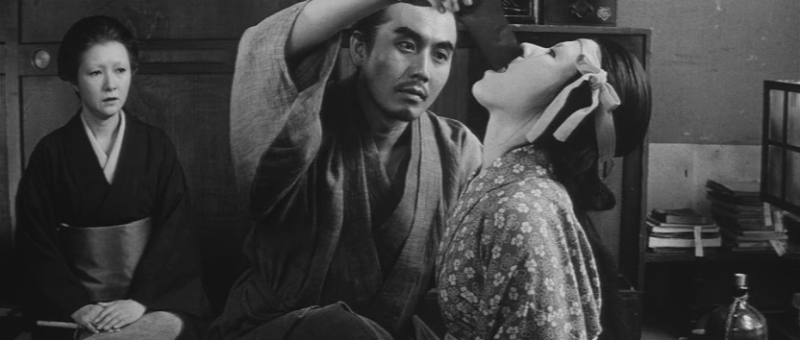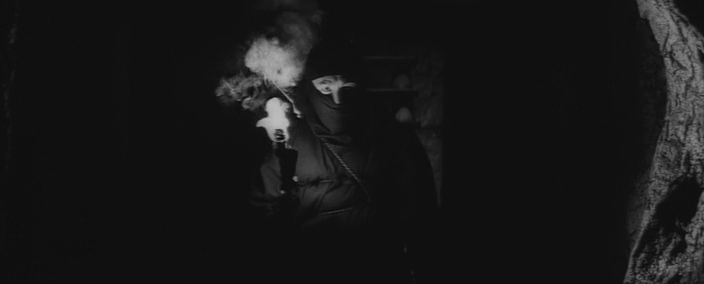
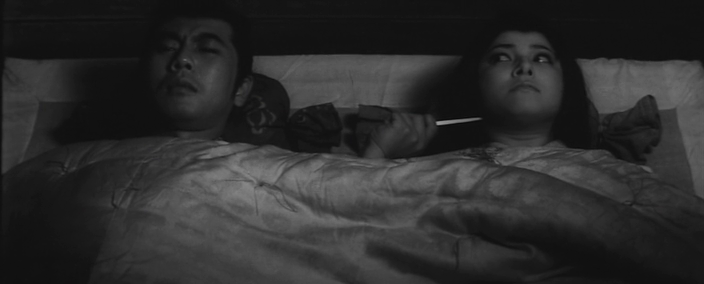
Shinobi no mono 8: The Three Enemies (新書・忍びの者, Kazuo Ikehiro, 1966)

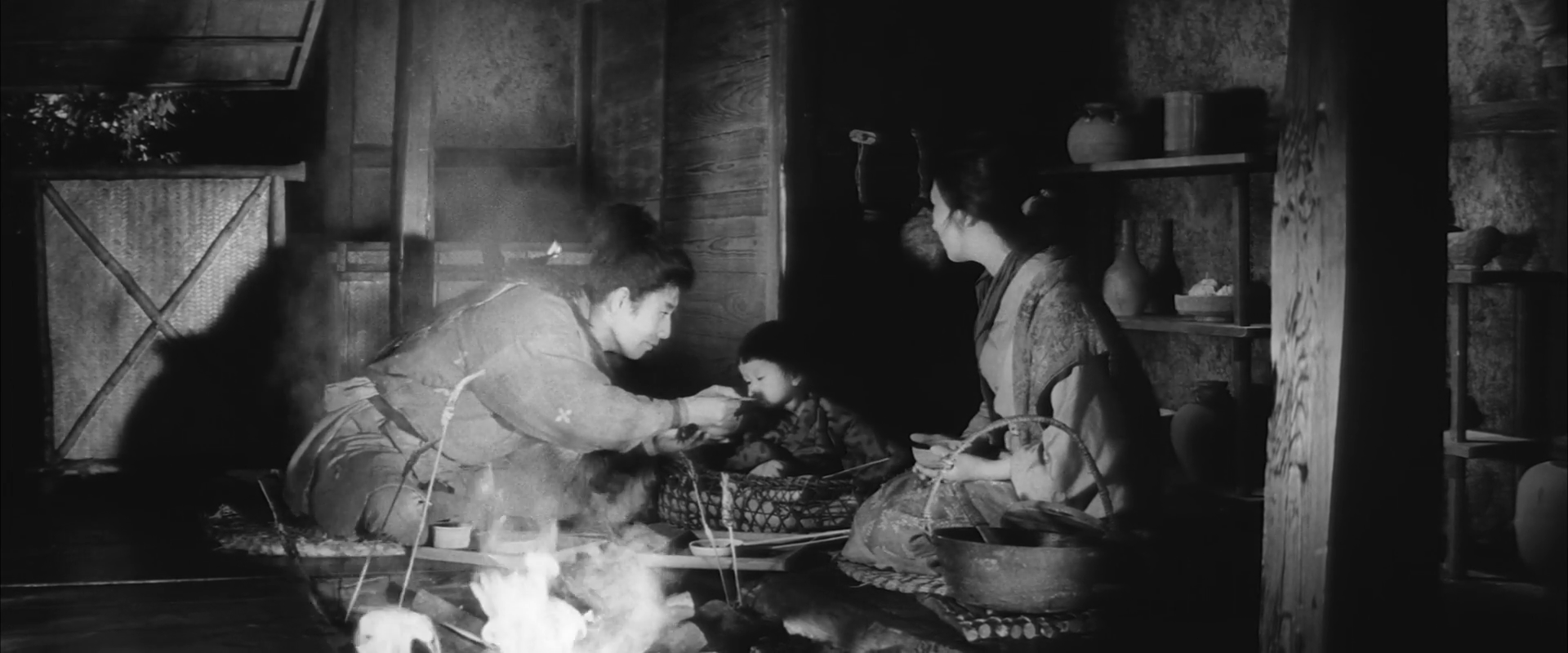
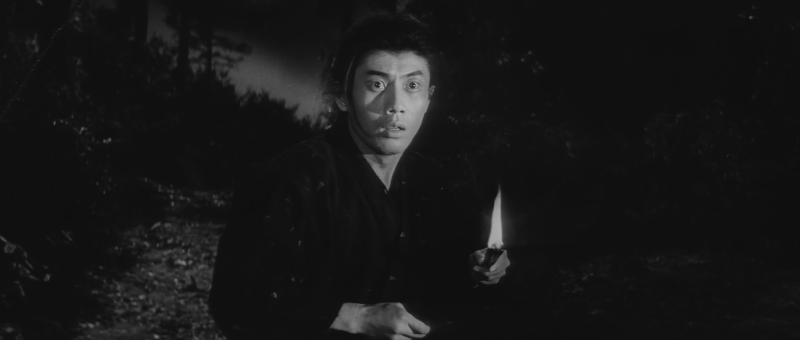
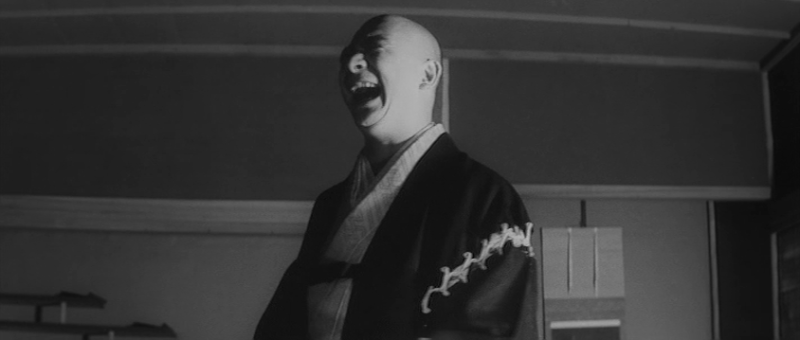
The abiding constant of the Shinobi Mono series had been its continual forward motion, at least up until instalment seven which had backtracked to the death of Ieyasu. This eighth and final film (save for a further sequel released in 1970 starring Hiroki Matsukata replacing Raizo Ichikawa who had sadly passed away a couple of years earlier at the young age of 37) however reaches even further back into the mists of time setting itself a few years before the original trilogy had begun.

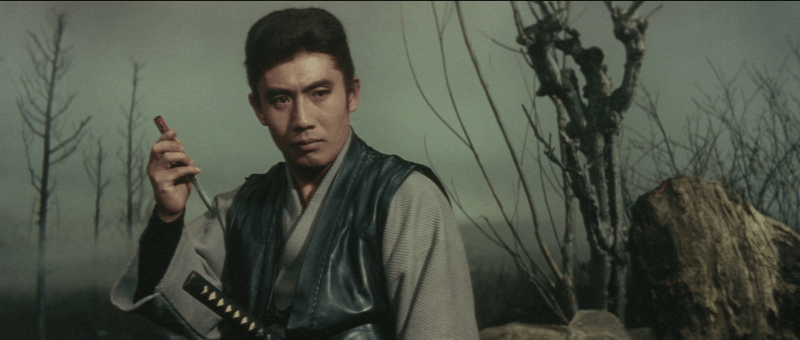
This time around, we follow young Kojiro (Raizo Ichikawa) on what is a more stereotypical tale of personal revenge albeit that one that eventually becomes embroiled in politics as he joins a ninja band that’s working for Takeda Shingen (Kenjiro Ishiyama). In slightly surprising turn of events, Ieyasu (Taketoshi Naito) turns out to be what passes for a good guy at least in contrast to Shingen’s duplicity though Ieyasu himself is still young and at the very beginning of his military career which is why unlike his older self he’s a little more proactive and willing to start a fight as well as finish one. In any case, Shingen thinks he’s an easy target largely because he simply hasn’t been in post long enough to have begun making connections with local lords, bribing them with gifts to secure their loyalty. 

In any case, Kojiro’s journey begins as something more like a martial arts film as he surpasses his current teacher and is told to find a man called Sadayu (Yunosuke Ito) in the mountains if wants to be up to gaining his revenge against the three men who killed his father while trying to steal his gunpowder. Perhaps there’s something a little ironic in the fact that Kojiro’s father was killed in a fight over what amounts to the substance of the future engineering a wholesale change in samurai warfare and edging towards the oppressive peace of the Tokugawa shogunate. But to get she revenge, Kojiro commits himself to learning true ninjutsu as the film demonstrates in a lengthy training montage. Unlike previous instalments, however, there is left emphasis place on the prohibition of emotion with the reason Kojiro cannot romance Sandayu’s adopted daughter down to her father’s whim forbidding her from marrying a ninja.

Apparently not the Sandayu of the earlier films despite the similarity of the name, this one has decided to side with Shingen because he’s mistakenly concluded that he is a “fair person who understands us ninja” when in reality he just using them and is no better than Nobunaga or Ieyasu. Shingen hires them to tunnel into a castle through the well, but is entirely indifferent to their complaints about safety leaving a Sandayu voiwing vengeance. The ninja, he says, generally serve themselves and are bound to no master but he seems to have thought Shingen was different only to be proved wrong once again.

Of course, Kojiro continues looking for the men who killed his father though they obviously guide him back towards conflict anyway. When he tracks some of them down, one remarks that all he did was finish him off which was an act of kindness to end his suffering not that he necessary approved of what his fallow gang members had done. Kojiro finds a surrogate father in Sadayu much as Goemon had though this time a slightly better one even if Sandayu is also a man with a lot on his conscience. Even more so than the other films, this one takes place in a largely lawless land too consumed with perpetual warfare to notice the starving and the desperate let alone the inherent corruption of the feudal era. The bad of ninjas has a rather scrappy quality, not quite as sleek as the Iga of previous films while also a little naive. Shooting more like a standard jidaigeki, Ikehiro uses relatively few ninja tricks generally sticking to smoke and blow tarts with a few shrunken battles. Nevertheless, the violence itself is surprisingly visceral beginning with unexpected severing of an arm and leading to a man getting stabbed in both eyes. Then again, the film ends in the characteristically upbeat way which has become somewhat familiar only this time Kojiro runs back towards romantic destiny now freed of his mission of vengeance and the oppressive ninja code. 
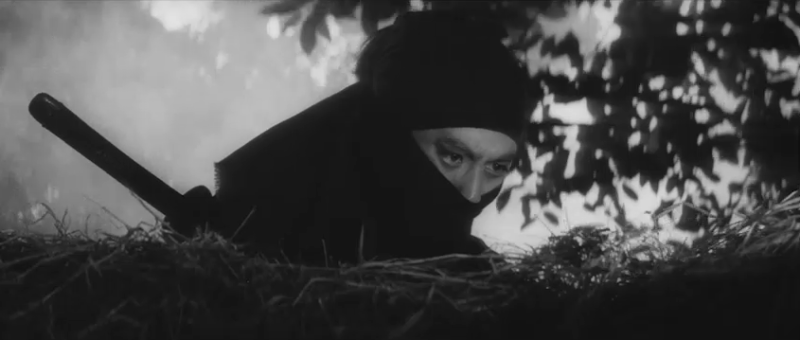

Shinobi no Mono 4: Siege (忍びの者 霧隠才蔵, Tokuzo Tanaka, 1964)

When he began what would become the Shinobi no Mono series, Satsuo Yamamoto had wanted to put a more realistic spin on the ninja movie, shifting from the fantasy-esque wuxia with which the genre had been associated since the silent days to something that was largely devoid of romanticism. In the films he directed, the ninja are powerless manipulators doomed to live unhappy lives defined by a cruel and heartless code. Though still based on the same novel, the third film began to compromise that vision in the hero’s miraculous escape from certain death, ending on a note of ambivalent positivity in which Goemon declines the offer to join Ieyasu and instead walks out into independent freedom. 

The first three films had covered all of the action in Tomoyoshi Murayama’s serialised novel, and so the following four are based on original ideas by screenwriter Hajime Takaiwa save for episode six which is scripted by Kei Hattori and Kinya Naoi. Many of the same actors appear but in different roles while the action has moved on 15 years, skipping ahead from the unseen battle of Sekigahara to the siege of Osaka and the end of the Toyotomi. Raizo Ichikawa stars as another displaced Iga ninja nominally in the service of the Toyotomi but secretly longing to bump off Ieyasu not for reasons of revenge but because there is no place for ninja in his new and peaceful society. If they’re able to unseat him, they assume the situation will revert to the civil war society with the effete Hideyori (Junichiro Narita) too ineffective to assume control over the nascent nation. 

It has to be said, this version of events has rather misogynistic overtones with frequent speeches from Sanada Yukimura (Tomisaburo Wakayama) avowing that it’s all Lady’s Yodo’s (Otome Tsukimiya) fault for giving her son bad advice that he is too naive to know not to follow. In negotiating to end the siege at Osaka castle, Yukimura had advised it was better to strike back against Ieyasu and kill him as soon as possible, but Lady Yodo vetoed it and insisted she and her son remain locked up in relative safety. His conviction is somewhat born out seeing as Ieyasu had deliberately targeted the area of the castle where they assumed she was staying in order to further frighten her.

Nevertheless, he’s astute in realising it was all essentially a ruse and part of Ieyasu’s plan to force the Toyotomi into submission. The attack on the castle was only ever intended to engineer a peace treaty which Ieasyu himself presented and forced Hideyori to sign. Then again, there’s some strange symmetry in play. When Saizo enters the castle in an attempt to assassinate Ieyasu he mangles to trick him into killing his double instead, then when Ieyasu’s ninja try to assassinate Yukimura after following Saizo having known he would pretend to be dead and dig himself out of his own grave they also kill his double much to Ieyasu’s consternation. 

It’s this similarity that Saizo hints at when he pities a retainer of Ieyasu’s explaining that Nobunaga and Hideyoshi had tried to eliminate them but they survived while Ieyasu now wants to use them for his own ends but will likely do the same when they are no longer necessary to him. Thus what they want is a kind of chaos, desperate to assassinate Ieyasu to return to the world in which the ninja are able to influence events from the shadows. Even so his conviction is apparently shaken. As in the previous series, Saizo gains a love interest, Lady Akane (Midori Isomura), who has become a sex worker as an apparent act of self-harm after being raped by Tokugawa soldiers during the fall of Osaka castle. But as we’ve been repeatedly told, a ninja’s heart lies under the blade. Born in darkness, they shall die in darkness and are not permitted to fall in love. Thus Saizo rejects her affections, but eventually declares himself corrupted by wanting to die alongside Yukimura as a loyal soldier. The in-film lore would have us believe that Yukimura did not in fact die during the final assault but was spirited away by Saizo to plot Ieyasu’s downfall in the shadows. 

Directed by Tokuzo Tanaka in his only instalment in the series, the film is shot more like a conventional jidaigeki but returns something of the fantasy aesthetic to the ninja as they somersault through the forest. Saizo’s surname effectively means “hidden in the mist”, which is partly ironic seeing as Akane also describes her rape as being overcome by a thick fog, but is also symbolic of his frequent use of smoke bombs as a disappearing trick which again undermines the sense of realism with which the series began. Yukimura is fond of declaring that the clock cannot be turned back, a sentiment echoed by Akane and emphasising the sense of melancholy fatalism that cannot be avoided in a historical drama in which the outcome is already very well known, imbuing Tanaka’s take with the sense of elegy and legend Yamamoto had so deliberately rejected. 


Shinobi no Mono 2: Vengeance (続・忍びの者, Satsuo Yamamoto, 1963)

Though Goemon might have thought himself free of his ninja past at the conclusion of the first film, he was unfortunately mistaken. Shinobi no Mono 2: Vengeance (続・忍びの者, Zoku Shinobi no Mono) sees him trying to live quietly with Maki and their son in a cabin in the woods, but Nobunaga is more powerful than ever. He’s wiped out the Iga ninja and is currently hunting down stragglers. Try as he might, what Goemon discovers the impossibility of living outside of the chaos of the feudal era. 

After he’s caught and suffers a family tragedy, Goemon and Maki (Shiho Fujimura) move to her home village in Saiga which is the last refuge of the Ikko rebels who oppose Nobunaga. This time around, the film, based on the novel by Tomoyoshi Murayama, even more depicts the ninja as backstage actors silently shuffling history into place. Thus Goemon takes advantage of a rift between the steady Mitsuhide (So Yamamura) and loose cannon Nobunaga (Tomisabur0 Wakayama) in an attempt to push him into rebellion. But what he may discover is that even with one tyrant gone, another will soon rise in its place. Hideyoshi (Eijiro Tono) seems to be forever lurking in the background, while Ieyasu makes a few experiences explaining that he intends to wait it out, allowing his rivals to destroy each other so he can swoop down and snatch the throne at minimal cost. 

But he too has his ninja such as the legendary Hanzo Hattori (Saburo Date) who arrives to complicate the intrigue and tempt Goemon away from his attempts to live a normal life. Interestingly enough, one of the factors leading to Nobunaga’s downfall is his disregard for Buddhism in frequently burning temples associated with ninja along with everyone inside them. Burning with a desire for vengeance, Goemon describes Nobunaga as inhuman, a demon, though he also embodies the vagaries of the feudal era in which no one is really free. Nobunaga has built a large castle estate for himself while ordinary people continue to suffer under onerous demands from local lords. Hideyoshi has also done something similar in an attempt to bolster his status and prepare for his own inevitable bid for national hegemony. 

The implication is that though the constant warfare of the Sengoku era is of course bad for farmers in particular, the political machinations which revolve around the egos of three men are far removed from the lives of ordinary people. Even so, the code of the ninja continues to be severe as we’re reminded that love and human happiness are not permitted to them. A female ninja spy working for Hanzo is despatched to Nobunaga’s castle to seduce his retainer Ranmaru but is cautioned that she must not allow her heart to be stirred. Predictably this seems to be a promise she couldn’t keep, eventually dying alongside him during an all out attack on the castle. 

Goemon discovers something much the same in encountering further losses and personal tragedies, but takes on a somewhat crazed persona in his continuing pursuit of Nobunaga, grinning wildly amid the fires of his burning castle while taunting Nobunaga that he is the ghost of the Iga ninjas he has killed. Then again, he’s laid low by his own ninja tricks on discovering that Hideyoshi has had a special “nightingale floor” installed that lets out a song whenever someone crosses it, instantly ruining his attempt to infiltrate the castle. “The days when a few ninja could control the fate of the world are over,” Ieyasu ironically reflects though perhaps signalling the transition he embodies from the chaos of the Sengoku era to the oppress peace of the Tokugawa shogunate.

Somehow even bleaker than its predecessor, Yamamoto deepens the sense of nihilistic dread with increasing scenes of surreal violence and human cruelty from a baby been thrown on a fire to a dying commander teetering on his one leg and holding out just long enough to gesture at a sign requesting vengeance against those who have wronged him. Echoing the fate of the real Goemon, dubbed the Robin Hood of Japan for his tendency to steal from the rich to give to the poor, the conclusion is in its own way shocking but then again perhaps not for there can be no other in this incredibly duplicitous world of constant cruelty and petty violence. 


Ninja, A Band of Assassins (忍びの者, Satsuo Yamamoto, 1962)

Ninja in Japanese cinema had largely been relegated to the realms of childish fantasy prior to Satsuo Yamamoto’s Ninja, A Band of Assassins (忍びの者, Shinobi no Mono) which cast a distinctly less heroic light on the famed mercenary spies of the feudal era. Indeed, there’s something reminiscent of the cult of militarism in the repressive nature of the ninja code and the hero Goemon’s (Raizo Ichikawa) original allegiance to it despite his father’s wariness and attempt to warn him that human happiness has no place in the life of a ninja. 

As the leader of Goemon’s clan, Sandayu (Yunosuke Ito), explains the ninja are obliged to serve whichever lords require their service, but he refuses to work with Oda Nobunaga (Tomisaburo Wakayama, billed as Kenzaburo Jo) owing to his famous animosity towards them. He even goes so far as to call Nobunaga a greater threat to the ninja than demons or devils. Opening in 1573, the film takes place at a tumultuous moment as Nobunaga continues to solidify his plan to unite the whole of the land under his banner by absorbing or defeating rival clans. The pre-credits sequence finds Goemon playing dead on a battlefield surrounded by ominous crows and encountering another ninja from a rival clan, Kizaru (Ko Nishimura), who has become a more literal kind of vulture in stealing from the dead.

Stealing is against the ninja code and something of which the young and idealistic Goemon fiercely disapproves. Nevertheless, in a cruel irony he’s forced to become a burglar in an effort to raise funds for more weapons to combat Nobunaga whom he has also been ordered to assassinate in return for his life after having been caught having an affair with Sandayu’s wife, Inone (Kyoko Kishida). Goemon is inspired by the legendary figure dubbed the Japanese Robin Hood for his mission stealing money from the rich to give to the poor, but here is far from heroic. When his affair with Inone is discovered by a servant, Goemon kills him to maintain the silence. He then believes that Inone has also been killed after falling into a well and attempts to flee the scene only to be confronted by Sandayu. 

Only too late does to he begin to understand what his father tried to warn him about, that the code of the ninja is cruel and unforgiving. It cannot grant him pride or happiness despite the self-satisfied glow he feels on having been singled out by Sandayu as a protege. A ninja must be ready to sever all ties to those he loves and endure intense torture without speaking. If caught in an impossible situation he must scar his face and take his own life as one of Goemon’s acquaintances eventually does after being captured by Nobunaga. Goemon assumes he has no reason to be afraid because he is the most skilled ninja in the garrison and a single ninja can take down a fortress all on his own, but in reality he is powerless, merely a puppet manipulated by Sandayu for his own ends. After falling in love with a sex worker, Maki (Shiho Fujimura), he grows tired of his missions, gives up on burglary, and makes no move to assassinate Nobunaga but is pursued by Sandayu’s minions, the irony being that not even a ninja can escape from the confined space of ninjadom.

This world is so steeped in secrecy that nothing is as it seems and Goemon discovers the rug pulled out from under him in more ways than one before beginning to realise that Sandayu has deliberately engineered his downfall and was most likely behind his father’s murder in an attempt to get his hands on his recipe for gunpowder which is, as Nobunaga says, the future of warfare. Nevertheless, even within its commitment to realism the film contains plenty of ninja tricks from sudden appearances to superhuman leaps and expert shuriken throwing and grappling hooks.  The sense of melancholy futility implied by the presence of the crows in the opening scenes never recedes, Yamamoto frequently descending into mists as Goemon sinks into his confusion and eventual disillusionment with the tenets of ninjadom. Rival ninja clans more obsessed with their reputation and status vie for the head of Nobunga while all Goemon wants is the right to live a quiet life with Maki though that’s something that largely cannot be found amid the constant chaos of the feudal era. 

Bloody Shuriken (赤い手裏剣, Tokuzo Tanaka, 1965)

A cynical ronin spots a business opportunity when he rides into a town beset by gangsters in Tokuzo Tanaka’s samurai western, Bloody Shuriken (赤い手裏剣, Akai Shuriken). Despite the name, this is not a ninja movie. The title refers to the knives the hero throws with almost supernatural skill. Adapted from a short story by noir master Haruhiko Oyabu, the action may sound reminiscent of Yojimbo but there’s a different kind of irony in its humour and a lightheartedness to its cynicism even if its final message is that the wages of greed are death.

We can tell that Ibuki (Raizo Ichikawa) is both good man and bad in that he immediately breaks up a fight between rival gangs on entering town, depriving the men in question of their money, but then handing it straight to the owner of the bar they were fighting in to cover the damage. He’s concerned about his horse too, but can’t quite afford the lodging fees at the stable run by the grumpy Yuki (Chitose Kobayashi) who loathes samurai, and with good reason. After hearing about the complicated makeup of the town’s hierarchy, Ibuki decides to stay and make some money by essentially playing each of the three gang leaders off against each other so they end up taking care of themselves. 

So far, so Yojimbo. But this town seems to be even further out, much more like a decrepit western outpost filled with scum and villainy. When the wind picks up, the dust blows through as if signalling the murky air and sense of futility. We’re told that the leader of the biggest gang, Hotoke (Isao Yamagata), is also the police chief, while his rival Sumiya (Yoshio Yoshida) complains that he’s usurped his position as his family has been there longer. Hotoke arrived a starving man three years previously and got back on his feet thanks to the support of the community, but then he turned around and got rich running a gambling den targeting local miners. Kinuya (Fujio Suga) has been here a little longer, but is otherwise biding his time until the other gangs fall from grace.

Of course, Ibuki foments conflict and strikes deals with all of them, but the real trouble is some missing gold that was stolen from the government causing even more disruption in the town with inspectors targeting ordinary people who weren’t even involved. Bar owner Chinami (Masumi Harukawa) is one of many interested in finding out what happened to the money, but she’s also in a precarious position, on the one hand throwing her lot in with Hotoke but on the other hating him and approaching both Ibuki and moody ronin Masa (Koji Nanbara ) to help her be free of the troublesome gangster. 

The fact that the two most prominent business owners are women is perhaps uncomfortably intended to signal the breakdown of the town in which Ibuki becomes the only real “proper” man amid bumbling gangsters and crazed ronin. Yet Chinami is directly contrasted with the pure and innocent Yuki who hates all the gangsters, as well as the samurai and generally everyone who isn’t a horse. Cynical and greedy, Chinami wants the gold and she’s prepared to use her body to manipulate men into doing what she wants, whereas Yuki defiantly keeps her head down and refuses to participate in gangster nonsense because she just wants to run her stables in peace. Only later does she develop a fondness for Ibuki on realising that he’s not so cynical after all and is interested in a kind of justice and getting rid of the corruption in the town for reasons other than money. Having discovered the location for the gold, he leaves the knowledge to Yuki so she can avenge her father who was killed during the robbery. 

But in other ways, this is already a post-apocalyptic hellscape as Ibuki discovers on spotting a pair of crows feeding on a corpse in a river. Perhaps taking pity on one less fortunate than himself, he throws one of his darts and skewers them. Ibuki’s knife supply seems to be inexhaustible, and he never appears to go back and retrieve the ones he’s thrown though his skill does seem to lend him an almost supernatural quality. In any case, Tanaka injects a degree of weird humour in the strange town with its eccentric residents including ronin Masa who looks permanently evil yet has a strange love of dolls, while the fight scenes themselves are often somewhat comical as the gangs seem to clash like a pair of cats slapping each other. There’s even something quite funny about the way the film bluntly drops exposition at unexpected moments even in the midst of the farcical scheming between the gangsters and Ibuki running back and forth to stoke the fires of conflict. This land is so bleak, it seems to say, all you can do is laugh or you’ll end up face down in a river with crows picking at your back too, so you might as well ride off into the sunset like Ibuki looking for the next corrupt town to purify and onward towards the bounty on the horizon. 


Trailer (no subtitles)

The Blind Menace (不知火検校, Kazuo Mori, 1960)

Two years before finding fame as Zatoichi, Shintaro Katsu starred as his mirror image in a tale of pure villainy, The Blind Menace (不知火検校, Shiranui Kengyo). As the title suggests, the film follows the upward trajectory and eventual downfall of an unsighted man who gleefully rapes and pillages his way to becoming the leader of his community aided and abetted by the ills of the feudal era which allow him to profit from his crimes until the past finally catches up with him.

After all as he later says, “as long you as you keep rising in the world, past misdeeds don’t matter.” In any case, even as a child the man who would later be known as Suginoichi (Shintaro Katsu) is incredibly unpleasant. In the opening festival sequence he picks his nose and flicks it in a barrel of sake so that the men drinking will abandon it. The only sign of possible goodness in him is that he takes the sake home for his mother to enjoy, though he seems to relish the idea of her unwittingly drinking his snot so perhaps that was the real purpose. Other hobbies of his include conning wealthy passersby out of a ryo with a well worn scam in which he asks them to read a letter from his uncle which mentions that it should include one ryo only what’s in there is a stone. When the reader explains the situation, he accuses them of trying to take advantage of his blindness and makes a fuss about it until they’re embarrassed into coughing up a ryo of their own (not a small sum for the time period). 

In some ways his poverty and disability might explain his behaviour. His family set up is subverted with his mother much like him money hungry and willing to do anything to get it while his saintly, henpecked father is gentle and honest. This might have taught him the wrong lessons about masculinity that lead him to see his father as weak in allowing the world to trample him while taking his mother’s advice to heart that if they only had a 1000 ryo they could get him trained up properly so that he might one day become a Kengyo which is a little bit like a community leader for the blind with social status and political influence. 

It’s this kind of social affirmation he seems to crave, but is essentially a narcissistic sociopath who takes advantage a stereotype that in some ways infantilises the blind and those with other disabilities who are believed to be pure-hearted and incapable of intrigue or evil. He seems to come to the rescue of a noblewoman who asked his boss, the Kengyo, to lend her money secretly because her brother has been caught embezzling but then rapes her, asks for the money back, and blackmails her into further acts of sexual exploitation offering her only 5 ryo a time knowing she needs 50. He thinks nothing of using his acupuncture skills to kill a man who was carrying 200 ryo to buy a “boneless girl” for a freak show and then framing a man who saw him do it but agreed to say nothing for a 50% cut for the crime. Suginoichi later teams up with “Severed Head” Kurakichi (Fujio Suga) to commit a series of burglaries including that of the Kengyo master who he also has killed to usurp his postion. 

But as he said, once his recognition is in sight with an invitation from the shogun everything begins to fall apart as all his wrongdoing starts to catch up with him. The feudal world had allowed him to prosper partly because of other people’s greed but also the social codes that favour shame and secrecy along with people’s unwillingness to accept that a blind man can also be selfish and evil despite a lot of evidence to the contrary. Elegantly lensed by Kazuo Mori who brings a sense of realism to the hardbitten backstreets of the feudal poor, the film may suggest that the wealthy only get that way by trickery and exploitation and the only way to rise to the loftiest place is to be like Suginoichi and not care what you do to get there but is clear that once you arrive you won’t stay very long because one day the past will really will come back to bite you. 


4K restoration trailer (no subtitles)

The Wife of Seishu Hanaoka (華岡青洲の妻, Yasuzo Masumura, 1967)

The close relationship between two women is disrupted by the reintroduction of a man in Yasuzo Masumura’s fictionalised account of the rivalry between the wife and mother of pioneering Japanese doctor Seishu Hanaoka. Scripted by Kaneto Shindo and adapted from the novel by Sawako Ariyoshi, the refocusing of the narrative is apparent in its title, not the life of but The Wife of Seishu Hanaoka (華岡青洲の妻, Hanaoka Seishu no Tsuma) less a tale of scientific endeavour than of domestic rivalry born of the inherently patriarchal social codes of the feudal society which cannot but help pit one woman against another while forcing each of them to play a role they may not wish to fulfil in order to secure their status and therefore their survival. 

Samurai’s daughter Kae (Ayako Wakao) first catches sight of the beautiful Otsugi (Hideko Takamine) at only eight years old and is instantly captivated by her, a fascination which persists well into adulthood when she is approached to marry into the Hanaoka household as wife to oldest son Seishu (Raizo Ichikawa) away studying to become a doctor like his father. Kae’s father originally objects to the match because of the class difference between the two families, Seishu’s father Naomichi (Yunosuke Ito) being only a humble country doctor of peasant stock whereas they had envisaged a grander station for their only daughter. Yet Kae is already old not to be married and continues to decline prospective suitors and so her mother and nanny (Chieko Naniwa) are minded to put it directly to her discovering that she is in fact more than willing to become a Hanaoka though mostly it seems in order to get close to Otsugi whom she has continued to idolise. 

The strange thing is that the wedding is conducted in Seishu’s absence, a medical text standing in for him while Kae in effect marries her mother-in-law Otsugi. These early days are spent in blissful tranquility as Kae does her best to be the ideal daughter-in-law, Otsugi even remarking that she’s come to love her more than a daughter. The two women share a room, Kae often staring longingly at the back of Otsugi’s head, their relationship one of mutual respect and affection that allows them to forget their respective stations but when three years later Seishu finally returns, it forces them apart in reverting to the roles of wife and mother their statuses conferred only by proximity to a man. 

Pregnant with her first child and about to become a mother herself, Kae’s resentment towards Otsugi begins to boil over. In an ironic premonition of the way the relationship between Masumura and his muse would eventually break down, she claims to have seen through Otsugi’s beauty and concluded that she is cold and calculating believing that she only brought her into the household as an unpaid servant forcing her to work a loom to raise money for Seishu’s medical training. Alternately jealous and condescending, Otsugi’s resentment is mediated through attempts to undermine her daughter-in-law’s authority finally leading to an ironic and absurdist battle between the two as they attempt to outdo each other volunteering to become test subjects for Seishu’s ongoing experiments to discover a safe anaesthetic in order save patients who require surgery but cannot endure the trauma. 

The marriage itself perhaps represents a moment of change in the feudal society, it becoming clear that the samurai are on their way down while skill and knowledge will define success in this new age of enlightenment. While Seishu works on his anaesthetic, the superstitious local community begins to view the Hanaokas with suspicion, believing that the misfortune that befalls them is the result of a curse owing to the large number of cats and dogs which have become casualties of Seishu’s failed experiments while a pedlar brings news of a mysterious disease attributed to the rain which is in fact due to mass malnutrition following a famine caused by the bad weather. When news of Seishu’s prowess as a doctor spreads they are soon overwhelmed with patients, many of whom cannot pay but are seemingly treated anyway. 

Seishu’s eventual victory is one of science over superstition, but it also requires faith which is the battleground contested between wife and mother. Having found a successful solution in cats, Seishu needs human test subjects with both instantly volunteering only to become locked into an absurd, internecine contest to prove who is the most self-sacrificing. The competition goes so far that it effectively becomes a game of dare with each determined to be the one to die for Seishu’s discovery but later realising that the stakes are even higher than first assumed because the winner will be dead but the loser saddled with guilt and possible ostracisation as someone who allowed their mother/daughter-in-law to die to in their place. 

Even so, the pair of them are described as “wonderful examples of womanhood” in their willingness to risk their lives for their “master’s success”. Kae is reminded that a woman’s job is to give birth to a healthy baby, later weaponising her ability to do so as currency in realising that Otsugi has all the control but the one thing she can’t do is bear Seishu’s child. Ironically enough, the cases Seishu is trying to treat are of aggressive breast cancer, the oft repeated maxim being that a woman’s breasts are her life and to remove them is as good as killing her contributing to the sense that maternity is the only thing that gives a woman’s life meaning. It’s not without irony that the first successful surgery under anaesthesia directly juxtaposes a massive tumour removed from a woman’s breast with a baby being removed from a pregnant Kae who, at this point having lost her sight as a consequence of Seishu’s experiments, must bear the pain with no relief. 

Brought together by tragedy, Kae comes to a better understanding of her relationship with her mother-in-law only after she dies learning to see her once again as the kind and beautiful woman she met at eight years old while her unmarried sister-in-law having witnessed their painful war of attrition prays that she won’t be reborn as a woman glad that she was never forced to become a bride nor a mother-in-law. “The struggles of the women in this house were in the end just to bring up one man” she laments, suggesting that Seishu most likely noticed the conflict between the two and used it to his advantage in getting them to participate in his experiments as they desperately tried to prove themselves the better through dying for his love. 

Going one step further, it seems that being a woman is an exercise in futility the only source of success lying paradoxically in birth or death alone, the natural affection between Otsugi and Kae neutered by the presence of Seishu who inserts himself as the pole around which they must dance for their survival. Kae becomes a local legend, a woman who sacrificed her sight in service of her husband but now rejects this mischaracterisation of her life along with the implication that it’s somehow a wife’s duty to deplete herself for her husband’s gain retreating entirely from the society of others while Seishu’s practice continues to prosper. Even so Masumura ends on a note of irony in the literal transformation of Kae into the figure of Otsugi recreating the opening scene as she walks among the bright flowers she can no longer see.


Original trailer (no subtitles)

A Lustful Man (好色一代男, Yasuzo Masumura, 1961)

“Why are women in Japan so unhappy?” the carefree Casanova at the centre of Yasuzo Masumura’s 1961 sex romp A Lustful Man (好色一代男, Koshoku Ichidai Otoko) laments, never quite grasping the essential inequalities of the world in which he lives. Masumura is best known for extremity, a wilful iconoclast who flew in the face of golden age cinema’s genial classism, but shock was not his only weapon and he could also be surprisingly playful. Adapted from a well known novel by creator of the “floating world” Ihara Saikaku, A Lustful Man finds him indulging in ironic satire as his hero sets out to “make all the women in Japan happy” chiefly by satisfying their unfulfilled sexual desire while resolutely ignoring all of the entrenched patriarchal social codes which ensure that their lives will be miserable. 

Set in the Edo era, the film opens not with the hero Yonosuke (Raizo Ichikawa) but with his miserly father who berates a servant after discovering a single grain of rice on the hall floor. According to him, the central virtues necessary to become rich are endurance, diligence, and vitality. You must treasure each and every grain of rice in order to accumulate. A cruel and austere man who only thinks of money, Yonosuke’s father keeps his wife in earnest poverty despite their wealth, angrily grabbing an obviously worn kimono out of her hands and insisting that it’s still good for another year, apparently caring nothing for appearances in the otherwise class conscious Kyoto society. It’s this meanness that Yonosuke can’t seem to stand. He hates the way his father disrespects his mother, and her misery is a primary motivator in his lifelong quest to cheer up Japan’s melancholy women though the weapon he has chosen is sex, a convenient excuse to live as a genial libertine to whom money means essentially nothing. 

Yonosuke’s father has set him up with an arranged marriage into a much wealthier family, which is not something he’s very interested in despite the fact she seems to be quite pretty but on learning that she has transgressively found love with the family butler he determines to help her instead, ending the marriage meeting by chasing her round the garden like a dog in heat. Several similar stunts eventually get him sent away from his native Kyoto to Edo but he takes the opportunity to escape, travelling all over Japan making women “happy” as he goes. 

As the first example proves, Yonosuke genuinely hates to see women suffer. His own pleasure, though perhaps not far from his mind, is secondary and he never seeks to take advantage of a woman’s vulnerability only to ease her loneliness. Despite that, however, he remains essentially superficial opting for the transience of postcoital bliss while ignoring the very real societal factors which make an escape from misery all but impossible. During an early adventure, he spends all of the money he conned out of his new employer on redeeming a geisha (at more than three times the asking price) so that she can be with the man she loves, but he continues to visit sex workers without interrogating their existence as indentured servants, “merchandise” which is bought and sold, traded between men and entirely deprived of freedom. In fact, he proudly collects hair cuttings from the various geishas he has known as a kind of trophy only to later discover the grim truth, that the hair likely doesn’t belong to the geisha herself but is sold to them by middlemen who get it by digging up dead bodies. 

Yonosuke remains seemingly oblivious to the duplicitous hypocrisy of the yoshiwara, but is repeatedly confronted by the evils of Edo-era feudalism with its proto-capitalist cruelty where everything is status and transaction. He is often told that as he is not a samurai he would not understand, but seems to understand pretty well that “samurai are idiots” and that their heartless elitism is the leading cause of all the world’s misery. To some a feckless fool, Yonosuke refuses to give in to the false allure of worldly riches. As soon as he gets money he spends it, and does so in ways he believes enrich the lives of women (even if that only extends to paying them for sex), eventually getting himself into trouble once again reneging on his taxes after trying to prove a geisha is worth her weight in gold. 

Yogiri (Ayako Wakao) complains that women are but “merchandise”, valued only as toys for men. “Japan is not a good country for women” Yonosuke agrees, suggesting they run away together to find a place where women are respected, indifferent to Yogiri’s rebuttal “no, wherever you go, no one can change women’s sad fate”. Yonosuke’s naive attempts to rescue women from their misery often end in disaster, a runaway mistress is dragged back and hanged, the woman he was set to marry goes mad after her father and lover are beheaded for having the temerity to speak out about corrupt lords, Yogiri is killed by a samurai intent on arresting him for tax evasion, and his own mother dies seconds after his father only to be immediately praised as “the epitome of a Japanese wife”. Yet he remains undaunted, wandering around like an Edo-era Candide, setting off into exile to look for a supposed female paradise without ever really engaging with the systems which propagate misery or with his own accidental complicity with them. Nevertheless, he does perhaps enact his own resistance in refusing to conform to the rules of a society he knows to be cruel and unfair even if his resistance is essentially superficial, self-involved, and usually counterproductive which is, in its own way, perfectly in keeping with Masumura’s central philosophies on the impossibilities of individual freedom within an inherently oppressive social order.


Bronze Magician (妖僧, Teinosuke Kinugasa, 1963)

Even when you’re the empress, a woman has little freedom. Teinosuke Kinugasa’s Bronze Magician (妖僧, Yoso) is loosely based on a historical scandal concerning Nara-era empress Koken/Shotoku and a Rasputin-like monk, Dokyo, who unlike his counterpart in the film, eventually tried to seize the throne for himself alone only to have his ambitions frustrated by the empress’ death and the fierce resistance of her courtiers. As the title implies, Kinugasa is more interested in Dokyo than he is in the perilous position of Nara-era women even in power, painting his fall from grace as a Buddhist parable about a man who pays a heavy price for succumbing to worldly passions. 

As the film opens, Dokyo (Raizo Ichikawa) emerges from a shallow cave amid many other caves after meditating for 10 years during which he reached a higher level of enlightenment and obtained mystic powers. Now he thinks it’s time to continue the teachings of departed mentor Doen and use his abilities to “actively do good and save the masses”. Before that, however, he does some not quite Buddhist things like turning a rat into a living skeleton, and twisting a snake into a tangle. In any case, he begins roaming the land, miraculously healing the sick. While reviving a thief who had been killed by samurai after trying to make off with a bird they shot, Dokyo is spotted by a retainer of the empress who brings news of his miracles back to her closest advisors. 

Empress Koken (Yukiko Fuji), in the film at least, was a sickly child and even after ascending the throne has often been ill. She is currently bedridden with a painful respiratory complaint that is giving her servants cause for concern. None of the priests they’ve brought in to pray for her (apparently how you treat serious illness in the Nara era) has been of much use. The empress’ steward Mabito (Tatsuya Ishiguro) orders that Dokyo be found and brought to the palace to see if he can cure Koken, which he does while stressing that he’s helping her not because she’s the empress but in the same way as he would anyone else. 

As might be expected, the empress’ prolonged illness has made her a weak leader and left the door open for unscrupulous retainers intent on manipulating her position for themselves. There is intrigue in the court. The prime minister (Tomisaburo Wakayama) is colluding with a young prince to depose Koken and sieze power. Left with little oversight, he’s been embezzling state funds to bolster his position while secretly paying priests to engineer Koken’s illness continue. Dokyo’s arrival is then a huge threat to his plans, not only in Koken’s recovery and a subsequent reactivation of government but because Dokyo, like Koken, is of a compassionate, egalitarian mindset. She genuinely cares that the peasants are suffering under a bad and self-interested government and sees it as her job to do something about it, which is obviously bad news if you’re a venal elite intent on abusing your power to fill your pockets while the nation starves. 

As the prime minister puts it, however, the empress and most of her courtiers are mere puppets, “naive children”. At this point in history, power lies in the oligarchical executive who are only advised by the empress and don’t actually have to do what she says. As she is also a woman, they don’t necessarily feel they have to listen to her which is one reason why the prime minister assumes it will be easy to manoeuvre the young prince toward the throne. Koken’s short reign during which she overcame two coups is often used to support the argument against female succession because it can be claimed as a temporary aberration before power passed to the nearest male heir. Nevertheless, Koken tries to rule, even while she falls in love with the conflicted Dokyo. Her right to a romantic future, however, is also something not within her control. Many find the gossip scandalous and use it as an excuse to circumvent her authority, especially after she gives Dokyo an official title which allows them to argue she has been bewitched by him and he is merely manipulating her to gain access to power. 

Dokyo, meanwhile, is in the middle of a spiritual crisis. After 10 years of study he as reached a certain level of enlightenment and attained great powers which he intended to use for the good of mankind. He is happy to discover that Koken is also trying to do good in the world but she is, ironically, powerless while the elitist lords “indulge in debauchery”, abusing their power to enrich themselves while the people starve. He begins to fall in love with her but the palace corrupts him. He accepts a gift of a beautiful robe despite his vows of asceticism, and then later gives in to his physical desire for Koken only to plunge himself into suffering in the knowledge that he has broken his commandments. He loses his magic, but chooses to love all the same while rendered powerless to hold back Koken’s illness or to protect her from treachery. 

The pair mutually decide they cannot “abandon this happiness”, and Dokyo’s fate is sealed in the acceptance of the extremely ironic gift of golden prayer beads which once belonged to Koken’s father. He is reborn with a new name in the same way as the historical Koken was reborn as Shotoku after surviving insurrection, embracing bodily happiness while attempting to do good but battling an increasing emotional volatility. The lords continue to overrule the empress’ commands, insisting that they are really commands from Dokyo, while Dokyo’s “New Deal” involving a 2 year tax break for impoverished peasants finds support among the young radicals of the court who universally decide that they must stand behind him, protecting the ideal even if they are unable to save the man.

This troubles the elders greatly. Declaring that Dokyo has used “black magic” to bewitch the empress, they determine to eliminate him, but Dokyo never wanted power. “Power is not the final truth” he tells them, “those blindly pursuing status and power only destroy themselves”. Yet Dokyo has also destroyed himself in stepping off the path of righteousness. He damns himself by falling in love, failing to overcome emotion and embracing physical happiness in this life rather than maintaining his Buddhist teachings and doing small acts of good among the poor. Nevertheless, he is perhaps happy, and his shared happiness seems to have started a compassionate revolution among the young who resolve to work together to see that his ideal becomes a reality even in the face of entrenched societal corruption.


Original trailer (no subtitles)

Gate of Hell (地獄門, Teinosuke Kinugasa, 1953)

Which is the greater challenge to the social order, love or ambition, or are they in the end facets of the same destabilising forces? Teinosuke Kinugasa’s Gate of Hell (地獄門, Jigokumon) is, from one angle, the story of a man driven mad by “love”, reduced to the depravity of a crazed stalker betraying his samurai honour in order to affirm his status, but it also paints his need as a response to the chaos of his age along with its many repressions while the heroine is, once again, convinced that the only freedom she possesses lies in death. Yet in the midst of all that, Kinugasa ends with a triumph of nobility as the compassionate samurai restores order by rejecting the heat of raw emotion for an internalised contemplation of the greater good. 

Set in the 12th century, the film opens in revolt as two ambitious lords combine forces to attack the Sanjo Palace in what would become known as the Heiji Rebellion. The lords have attacked knowing that Taira no Kiyomori (Koreya Senda) is not in residence, having departed on a pilgrimage. Fearful for the safety of his sister and father, retainers order decoys to be sent out to distract the rebels. Kesa (Machiko Kyo), a court lady in service to the emperor’s sister, agrees to be her decoy and Morito (Kazuo Hasegawa), a minor retainer, is ordered to protect her. He manages to escort her back to his family compound where he assumes she will be safe, transgressively giving her a kiss of life, pouring water into her mouth with his own, after she has fainted during the journey. Unfortunately, Morito has miscalculated. His brother has sided with the rebels and they are not safe here. During the chaos they go their separate ways, and as soon as Kiyomori returns he puts an end to the rebellion restoring the status quo.  

Shocked at his brother’s betrayal, Morito tells him that only a coward betrays a man to whom he has sworn an oath of loyalty but he explains that he is acting not out of cowardice but self interest. He has made an individualist choice to advance his status in direct opposition to the samurai code. Morito doesn’t yet know it but he is about to do something much the same. He has fallen in love with Kesa and after meeting her again at the Gate of Hell where they are each paying their respects to the fallen, his brother among them, is determined to marry her, so much so that he asks Kiyomori directly during a public ceremony rewarding loyal retainers for their service. The other men giggle at such an inappropriate, unmanly show of emotion but the joke soon fades once another retainer anxiously points out that Kesa is already married to one of the lord’s favoured retainers. Kiyomori apologises and tries to laugh it off, but Morito doubles down, requesting that Kiyomori give him another man’s wife. 

This series of challenges to the accepted order is compounded by a necessity for politeness. Morito is mocked and derided, told that his conduct is inappropriate and embarrassing, but never definitively ordered to stop. Making mischief or hoping to defuse the situation, Kiyomori engineers a meeting between Morito and Kesa, cautioning him that the matter rests with her and should she refuse him he should take it like a man and bow out gracefully. Kesa, for her part, has only ever been polite to Morito and is extremely confused, not to mention distressed, by this unexpected turn of events. She is quite happily married to Wataru (Isao Yamagata) who is the soul of samurai honour, kind, honest, and always acting with the utmost propriety. That might be why he too treats Morito with politeness, never directly telling him to back off but refusing to engage with his inappropriate conduct. That sense of being ignored, however, merely fuels Morito’s resentment. He accuses Kesa of not leaving her husband because Wataru is of a higher rank, as if she rejects him out of snobbishness, rather than accept the fact she does not like him. 

Morito continues in destructive fashion. We see him repeatedly, break, smash, and snap things out of a sense of violent frustration with the oppressions of his age until finally forced to realise that he has “destroyed a beautiful soul” in his attempt to conquer it. “One cannot change a person’s feelings by force” Wataru advises, but is that not the aim of every rebellion, convincing others they must follow one man and not another because he is in someway stronger? The priest whose head was cut off and displayed at the Gate of Hell was killed in part because he reaped what he had sown in beheading the defeated soldiers of a previous failed revolution. Morito kills a traitor and he falls seemingly into rolling waves which transition to an unrolling scroll reminding us that rebellions ebb and flow through time and all of this is of course transient. Only Wataru, perhaps ironically, as the unambiguously good samurai is able to end the cycle, refusing his revenge in the knowledge it would do no real good. Morito is forced to live on in the knowledge of the destruction his misplaced passion has wrought, standing at his own Gate of Hell as a man now exiled from his code and renouncing the world as one unfit to live in it. 


Gate of Hell is currently streaming on BFI Player as part of the BFI’s Japan season.