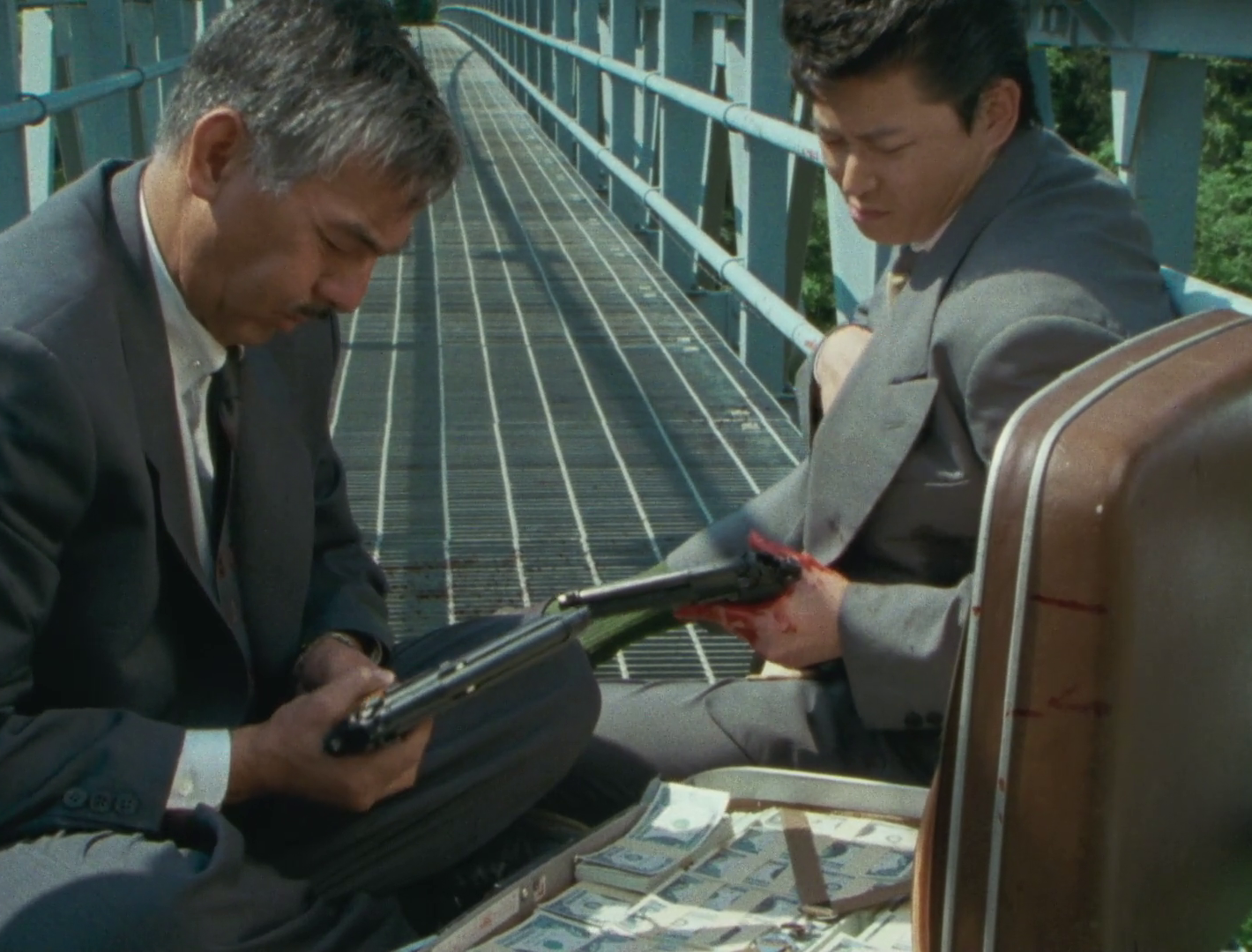
Danger Point: The Road to Hell (Danger Point: 地獄への道, Yasuharu Hasebe, 1991)

A pair of hitmen find themselves conflicted when their latest target dies gripping the photo of an innocent-looking nurse. Who was this man, what’s his relationship to the woman in the photo, and why did he have to die? Asking questions is taboo when you’re a hired killer, and you’re probably better off not knowing anyway, but there’s something that’s bugging veteran executioner Joji (Jo Shishido) and it’s not just the missing 20 million dollars.

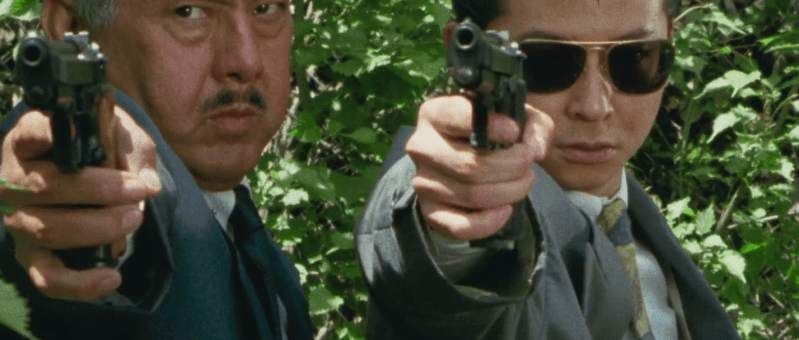
Nikkatsu veteran Yasuharu Hasebe’s V-Cinema noir Danger Point (Danger Point: 地獄への道, Jigoku e no Michi) is a classic tale of nihilistic fatalism in which the bond between the two assassins is tested by the intervention of greed and mystery. Shishido’s Joji is the more old-fashioned of the pair yet fascinated by the mystery behind Sakai’s death, not necessarily wondering if he bears any culpability but confused about why he had to die despite not actually having the missing money. This puts Joji partially at odds with the younger Ken, a more dynamic and less morally ambivalent figure played by the contemporary star Show Aikawa who’d come to represent for V-Cinema what Shishido once had for Nikkatsu action. Together, the chase the various clues they’ve been given looking for the person behind the job and, of course, the missing money.

But the money presents a problem too. Ken begins to wonder if Joji will abandon him and take the prize for himself, though that doesn’t seem to be something that Joji is actively considering. The relationship between the two men is more brotherly than paternal, though Joji does scold Ken for his treatment of Yumi (Nana Okada), the nurse from the hospital and their key witness. He beats and sexually assaults her, though it’s less his lack of chivalry that Joji criticises than the wisdom of bringing a woman into their business. He’s suspicious of Yumi in a way Ken does not seem to be, though they both agree that eventually she’ll have to go before she does them any harm because now she knows too much.

Ultimately, the money turns out to be from a bank job in the Philippines that the American criminals were hoping to convert to US dollars in Japan, though predictably everyone wants the whole amount for themselves, not least Joji and Ken along with the kingpin’s horse-loving girlfriend Saeko (Miyuki Ono) who is playing her own side of the game. Neither Saeko nor Yumi do very well out of this particular affair and are each constrained by the men around them. While Yumi was apparently seduced and abandoned by corrupt cop Sakai, Saeko is hemmed in by her gangster boyfriend Takamura (Hideo Murota) and seeks escape through stealing the money with the help of Sakai, one way or another, at least. Though this world doesn’t seem to want to let either of them have it while the  men fight over the spoils in a desperate struggle to assert dominance over the situation.

As the ironic “Dead End” sign at the film’s conclusion implies, however, that chasing money is a fool’s errand and leads only to hell. A chase past the no entry signs into an industrial complex suggests that this world is not quite fully formed or in the process of falling apart. The ironic and strangely obvious product placement for Perrier sparkling mineral water might hint at a more sophisticated world the hitmen are on one level trying to inhabit, but in other ways their presence is incongruous. They belong to an earlier time as does this hidden world of bank robberies, smuggled cash, criminal gangs and fixers that seem out of place amid the tail end of the Bubble era. Or in that sense at least, perhaps it’s Japan heading for a crash desperately chasing the riches that seem only slightly out of reach. Nevertheless, there’s a genuine sense of mystery that leads Ken and Joji to their final destination in which they discover that it might not be greed that does for them after all, but in an odd way, love. Their desire for togetherness and fear of separation in the end can have only one conclusion and as much as it is the money that leads them to their doom, it’s loneliness and brotherhood that eventually seal their fate.
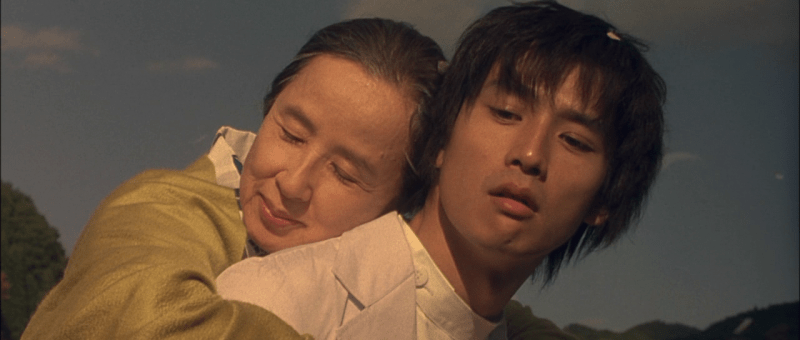

Transparent: Tribute to a Sad Genius (サトラレ, Katsuyuki Motohiro, 2001)

What would life be like if your every thought were audible for miles? Adapted from the manga by Makoto Sato, Katsuyuki Motohiro’s Transparent: Tribute to a Sad Genius (サトラレ, Satorare) considers how ironically isolating such a talent may turn out to be as the sufferer finds themselves withdrawing from others in embarrassment while wider society begins to resent being unable to tune out of their every inane thought or avoid being hurt by hearing something no one would ever say out loud even if they thought it privately. 

The “Committee for the Preservation of the Specially Gifted” is dedicated to protecting the so-called “Transparents” whose thoughts are audible for a 10m radius though they have no control or even idea that it is happening. They’ve started an extensive public information campaign to reduce the stigma held against them because as they claim Transparents are a valuable natural resource mainly as they all have super high IQ and are at the forefront of technological advancement. Then again this extensive campaign seems like overkill as there are only currently seven confirmed Transparents on record, but in a minor twist the campaign is necessary because it’s essential that the Transparents never find out that their thoughts are public, the first apparently having taken their own life because of the intense embarrassment of trying to live without any kind of privacy. 

This is the first ethical problem with the Transparent program which is curiously contradictory in its approach. The government could easily have said that Kenichi (Masanobu Ando), the sole survivor of a plane crash at three years old plucked from the wreckage when rescuers heard his internal monologue begging for help, had died and raised him in a lab, but instead they choose to return him to his grandmother in a designated Transparent town where they provide him with the illusion of a “normal” life while simultaneously micromanaging his existence. Their problem now is that he’s qualified as a doctor and wants to practice, but clinical medicine is obviously an occupation which requires discretion. Patients overhearing his “real” thoughts might not be helpful to their recovery, while he can hardly claim patient doctor confidentially when he’s likely to leak private medical details simply in the course of his work. Meanwhile, it tuns out that he’s already invented a revolutionary cure for athlete’s foot which is another reason why the council want to manipulate him into shifting towards research rather than clinical practice. 

That’s why they’ve dispatched military psychologist Yoko (Kyoka Suzuki) who specialises in Transparents hoping that she can find a way to bend him to their will, but gradually she begins to come to a new understanding of what his life is like even while he has no idea everyone knows what he’s thinking. For example, no one wants to date a Transparent because they don’t want the intimate details of their love lives broadcast all over town, while the perfectly ordinary thoughts which should definitely stay in his head on catching sight of crush Megumi (Rina Uchiyama) can’t help but make her feel uncomfortable. The entire town is forced to pretend that they can’t hear him think, which seems somewhat unfair, leaving him at a disadvantage and more often at not at a loss as to why someone might seem hurt or upset by him when didn’t even say anything. Meanwhile, much of Yoko’s role lies in gently manipulating him, the entire committee decamping to a summer festival in a nearby town so they can let him down gently by leading him to believe Megumi already has a steady boyfriend who is kind to children and the elderly so he’s forced to be happy for her that’s she’s found such a great guy and can give up on his romantic aspirations. 

The tone is in general admirably progressive in that it ultimately argues for a greater sense of acceptance for all minorities, but it’s difficult to square the positive message with the ways the Transparents are also being uncritically manipulated, forced to live a simulacrum of a life in an engineered small-town Japan which grateful to have them only for the massive subsidies they receive for local development in return for making sure the Transparents are kept in the dark about their condition so that the committee can exploit their genius as they plan to do with Kenichi after getting him to the research institution. Even so what they discover is that Kenichi knew what his genius was and only through letting him follow his dreams can they truly unlock it, while the committee is forced to reckon with the various ways they’ve dehumanised him, the chairman eventually referring to him as a person as opposed #7 as he’d always called him before. Somewhat contradictory and more than a little uncomfortable in its implications, Transparent: Tribute to a Sad Genius is presented as heartwarming drama and it does indeed warm the heart with this its messages of equality and acceptance not to mention the right to follow one’s dreams whatever they may be but never really reckons with its central thesis in which the authorities pat themselves on the back for being kind and doing the right thing while simultaneously exploiting those they claim to care for without their knowledge or consent. 


Ghost Man (幽霊男, Motoyoshi Oda, 1954)

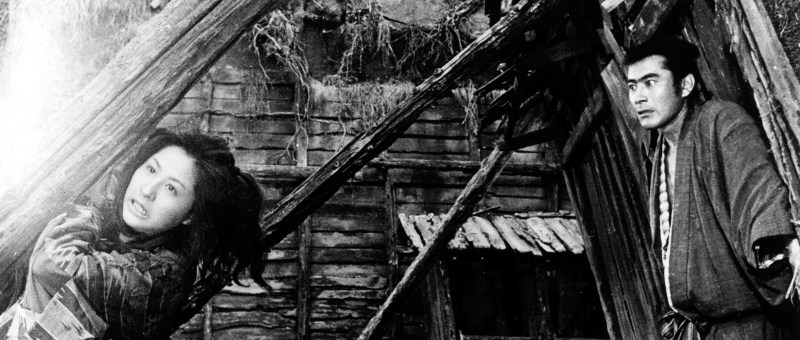
Employees at a small nude modelling agency find themselves in the firing line when a “bloodsucking painter” escapes from a psychiatric institution in Motoyoshi Oda’s adaptation of Seishi Yokomizo’s Ghost Man (幽霊男, Yurei Otoko). Though produced by Toho and helmed by the director of The Invisible Man, the film does not particularly make use of special effects and as it turns out, Ghost Man is just a creepy name for a weird villain rather than an accurate description of a supernatural threat. 

Even so, you’d expect someone who runs a modelling agency to be on high alert after hearing that a crazed painter who is a danger to women is on the loose, but the manager of the Mutual Art Club simply assumes it must be an eccentric artist thing when he’s presented with a business card from “Ghost Man” Sugawa. Ghost Man is dressed in an unsettling outfit and is immediately rough with the model he picks out, Keiko, all of which you would think would have the manager thinking twice about allowing her to go with him. Some of the other girls urge her to turn the job down, but Keiko is the breadwinner for her family and work has been thin on the ground so she agrees to take it only to realise Ghost Man does indeed intend to kill her on arrival at an abandoned house way out in the country. 

“What a single woman has to do to earn a living, it’s both thrilling…and terrifying,” one of the other women, Ayuko, tells her boyfriend Ken (Yu Fujiki) after she quits the agency to become a stripper and decides to take to the stage despite knowing that Ghost Man may try to kill her during the show. Her words hint at a transgressive frisson of danger which she at least has chosen to embrace, an icy glint in her eye as she encourages Ken to pay close attention to her performance which she claims will be “wonderful”. Nevertheless, it also makes clear that the work the women do at the agency is necessarily unsafe given that it involves travelling to the home of a man they don’t know where they will be expected to undress. 

For reasons the film doesn’t quite explain, the models are also members of the “Bizarro Enthusiast Club” led by Dr. Kano (Joji Oka) who is the head doctor at the psychiatric hospital from which the bloodsucking painter, Tsumura (Ren Yamamoto), escaped. Meanwhile, Dr. Kano also seems to have a sideline in taking the girls to remote locations for nude photoshoot parties. In all honesty, he’s quite suspicious especially seeing as he seems to instinctively know how to open the tricky door at the abandoned house where Keiko’s body is found. Then again, we’re also told that Tsumura was once a member of the club with at least some suggesting that he ended up getting too into the bizarre and going out of his mind to the extent that he began committing weird acts of crime of his own. 

The lesson might be that getting overly obsessed with the occult and esoteric is unhealthy, only it turns there’s something else going on entirely that isn’t really about anything “weird” but caused by completely banal negative human emotions resulting from spurned romantic interest and the fear of parental disappointment. This being a Kindaichi mystery, the famous detective soon makes his appearance (played by a hardboiled Seizaburo Kawazu) only in a less eccentric guise and accompanied by a more efficient Todoroki who assists him as he begins to put the pieces together to solve the mystery. 

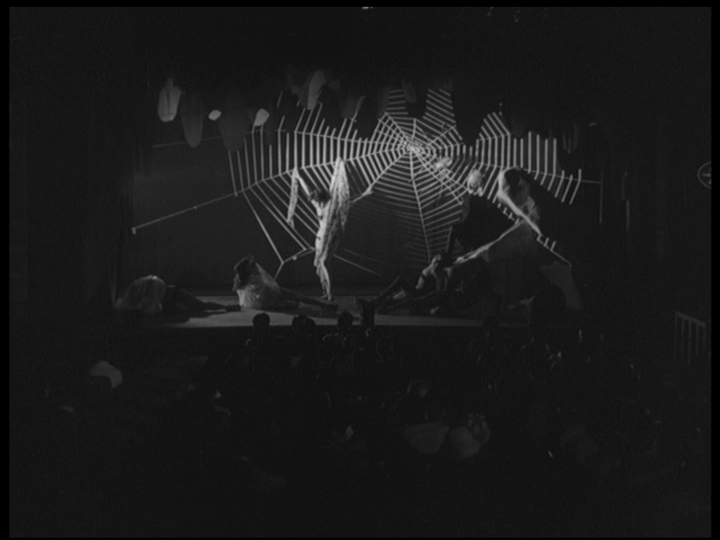
The villain may be taking advantage of a historical moment in allowing others to think his face is bandaged to disguise a disfigurement like those of many men wounded in the war, as was the case in another Kindaichi case The Inugami Family, but is also harking back to the Invisible Man while his accomplice adopts a much more “monstrous” appearance with buck teeth and the two missing fingers on his hand along with the insectile movements that play into the spider-themed finale. Oda has a lot of fun with the villain’s Phantom of the Opera-esque antics which include recording a tape to taunt the police along with a public announcement of “Act 3” of his ongoing drama to be staged at the “Reijin Theatre” which literally means “the beautiful lady show” but is also a minor pun that makes it sound a little “Ghost Man Theatre” in true B-movie villain fashion. Even so, there’s an underlying darkness in the serial killer drama most particularly in the scrapbook the villain makes with photos of the dead women posed and titled as works of art as if they were never any more alive than the mannequins he often substitutes for them. Striking in its set pieces and unsettling design, Oda’s strange drama is surprisingly nasty and actually quite cynical even as it unmasks its villain as little more than a ghost of man who hid behind the spectre of unease to mask his cowardice and insecurity.


Throne of Blood (蜘蛛巣城, Akira Kurosawa, 1957)

In many ways, the underlying theme in Akira Kurosawa’s films of the 1950s is that we are incapable of knowing ourselves and are, as a forest spirit remarks in Throne of Blood (蜘蛛巣城, Kumonosu-jo), afraid to look into our own hearts and admit our darkest desires. In adapting Shakespeare’s Macbeth, Kurosawa is less interested in the pull of ambition than the insecurity that drives it along with the inability to transcend himself that precipitates the hero’s decline. 

Indeed, after Washizu (Toshiro Mifune) and his best friend Miki (Minoru Chiaki) ride into the misty forest domain of the witch-like seer who ominously turns her spinning while offering a moral lesson that neither of them heed, they sit on the ground and laugh about what they’ve heard. Yet as Washizu partly admits the old woman revealed something of himself to him in that she echoed a dream of which he was unwilling to speak. Miki asks what warrior would not want to be placed in charge of a castle, but for Washizu it’s almost a primal need to prove himself in surpassing other men. Miki, by contrast, is not so nakedly ambitious but he doesn’t really need to be because he has a son. Washizu has no heir, his line will end with him and so he has only this life to make something of his name. 

Having no heir also undermines his sense of masculinity, just as it undermines the femininity of his wife, Lady Asaji (Isuzu Yamada), who as a woman now likely too old to bear a child may fear for her position. Kurosawa styles Yamada’s face as a perfect noh mask while she delivers her lines with the intonation of noh theatre all of which lends her a fairly eerie presence which only deepens as she descends into the darkness and back out again hovering like a ghost. She is in a sense perhaps already dead if not otherwise possessed by some malignant spirit as she urges her husband on in their dark deeds like a demon on his shoulder even going so far as to present him with the spear he will use to murder his lord, the ultimate act of samurai transgression. 

Yet as Lady Asaji points out, the present lord killed the lord before him for the right to sit on the dais. When the lord comes to stay with them on a pretext of hunting while preparing to launch an attack on a potential rival, the couple are moved into a room previously inhabited by a retainer who’d tried to mount a rebellion but was defeated. He took his own life and the room is still stained with his blood which covers both walls and floor. Washizu ought to realise that this is his fate too, but deep down he wants the prophecy to be true, which it is if more in the letter than the spirit. Would he have done it if he had not met the forest spirit, or would he only idly have thought of it but never followed through? It’s not something that can be known, but his eventual failure is born more of his inability to accept this side of himself than it is the price of ambition in itself. “If you’re going to choose ambition choose it honestly with cruelty” the forest spirit later advises, and Washizu might have been more successful if had he done so earlier. 

Then again, the world he lives in is as Lady Asaji describes it a wicked one in which betrayal is an all but inevitable certainty. Washizu insists that Miki is his friend, and that making Miki’s son his heir satisfies the prophecy while binding him to him so that he cannot rebel even if he were minded to. But Lady Asaji assumes that Miki is ambitious too, suggesting that he may strike first or report his treachery in the hope of personal advancement. For the prophecy to come true, someone has to betray the lord though it need not have been either of them but there can be no trust or friendship in this world of fierce hierarchy and internecine violence. 

Both men should perhaps have realised that when they were trapped riding around the eerie lair of the forest spirit with its mists and cobwebs not to mention heaps of piled skeletons still in their armour all victims of ambition and the spirit’s false promises if also echoing the legacy of wartime folly. “Look upon the ruins of the castle of delusion” the noh chant that opens and closes the film intones, warning of illusionary riches and the price of deluding oneself along with the destruction wrought by those unable to break free of the spider’s web of human desire. 


Throne of Blood screens at the BFI Southbank, London on 21st February 2023 as part of the Kurosawa season.

Original trailer (no subtitles)

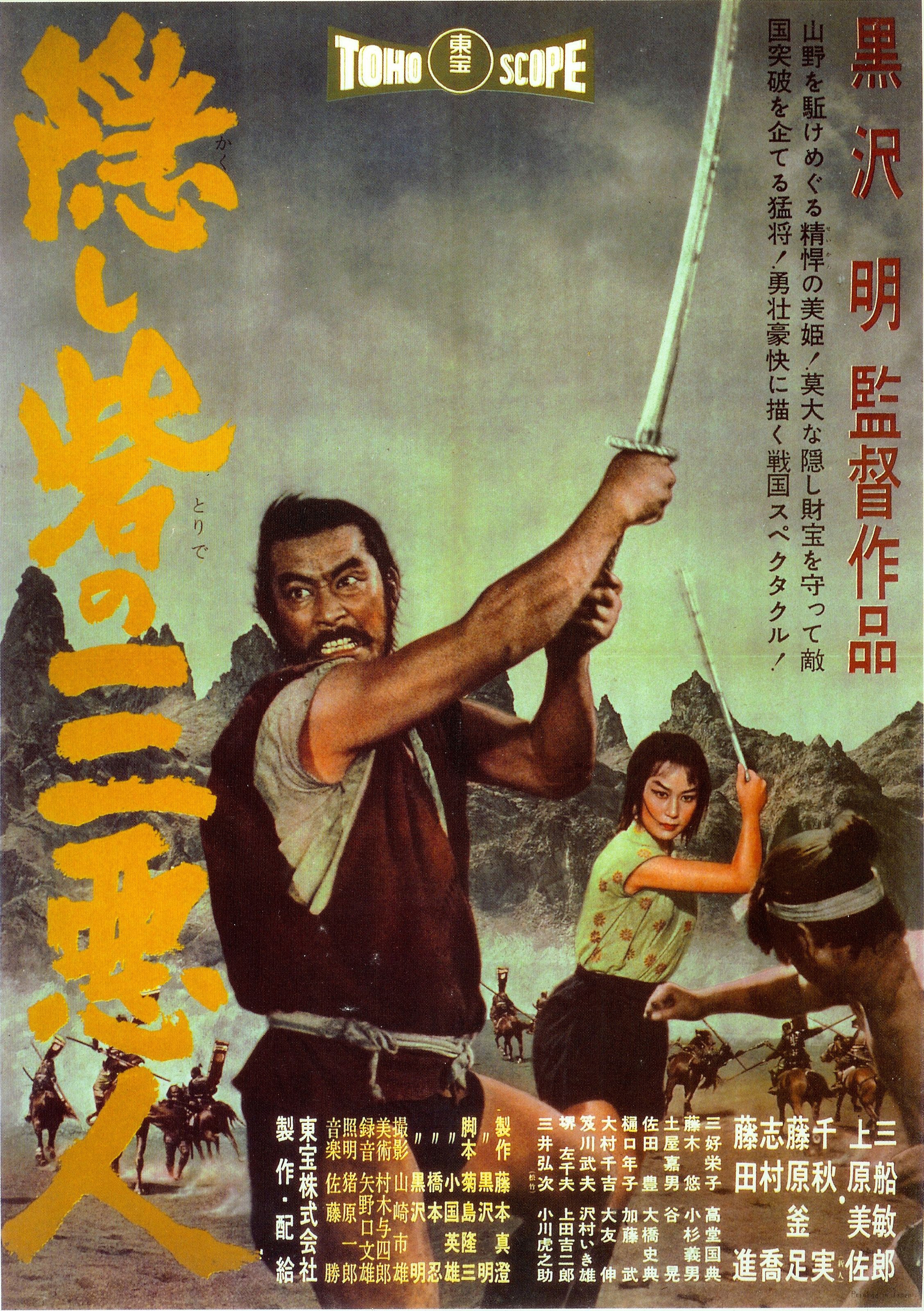
The Hidden Fortress (隠し砦の三悪人, Akira Kurosawa, 1958)

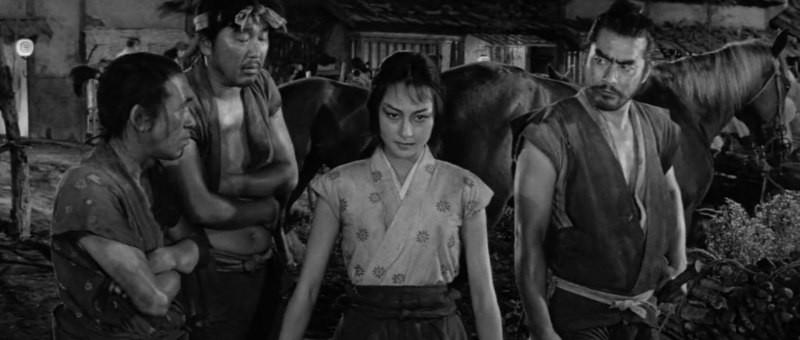
“Your kindness will harm you” a well-meaning retainer advises his charge, but in the end it is her kindness which saves her along with numerous others in Akira Kurosawa’s Sengoku-era epic, The Hidden Fortress (隠し砦の三悪人, Kakushi Toride no San Akunin). Largely told from the point of view of two bumbling peasants trying to get rich quick by exploiting the hierarchal fluidity of a time of war, the film nevertheless cuts against the grain of the democratic era in advocating not so much the destruction of the class-bound feudal order as benevolent authority. 

This can quite clearly be seen in the dynamic figure of displaced princess Yuki (Misa Uehara), the successor of her routed clan protected by a hidden fortress in the mountains which she must eventually leave. Her female servant laments that her father raised her as a boy which has given her a haughty and dominant manner at odds with the polite submissiveness usually expected of upperclass women. While often exerting her authority, she is otherwise uncomfortable with the uncritical servitude of her retainers, chief among them the talented general Makabe (Toshiro Mifune) who sacrificed the life of his own sister, allowing her to be executed in Yuki’s place buying them some time. “Kofuyu was 16. I am 16. What difference is there in our souls?” she asks, yet even if she believes their souls are equal she is not quite so egalitarian as to forget her position or the power and privilege that comes with it. 

Nevertheless, hers is an authority that is tempered by compassion and in the end chosen. Her salvation comes in speaking her mind to an enemy retainer, Tadokoro (Susumu Fujita), who has been savagely beaten by his own lord for losing a duel with Makabe who, to the mind of some, humiliated him with kindness in refusing to take his life leaving him to live in defeat. Yuki says she doesn’t know who is stupider, Tadokoro or his lord, for never would she punish a man in such a way simply for losing to an enemy. She tells him that there is another way, and that he need not serve a lord who does not serve him leading Tadokoro to defect and choose to follow her instead. 

She also inspires confidence in a young woman she insists on redeeming after discovering that she is a former member of the Akizuka clan sold into sexual slavery after being taken prisoner by the Yamane. Kurosawa presents the girl with a dilemma on realising that the mysterious woman who saved her is the fugitive princess, knowing that she could betray her and pocket the gold, but finds her resolving to serve Yuki all the more. In a moment of irony, we learn that the girl was bought for five silver coins, the same amount of money a wealthy traveller offers for Makabe’s horse, but displeases her master in refusing to speak or serve customers. For Yuki he offers gold, though withdraws on being told that she is mute. Knowing that she would be unable to disguise her speech or accent which would instantly give her away as a haughty princess, Makabe convinces her to stay silent though as she tells him he cannot make her heart mute too. 

Even the peasants, oblivious to her true identity, view Yuki as part of the spoils insisting that they should be entitled to a third of her too and at one point preparing to rape her only to be fought off by the rescued girl. “We can rely on their greed” Makabe had said, knowing that their material desires make them easy to manipulate and that their loyalties are otherwise fickle. Matashichi (Kamatari Fujiwara) and his friend Tahei (Minoru Chiaki) sold their houses in their village to buy armour in the hope of achieving social mobility through distinguishing themselves in war, but have largely been humiliated, robbed of their armour, mistaken for captured members of the enemy, and forced to dig the graves of others. They pledge eternal friendship but their bond is continually disrupted by the promise of monetary gain. They fall out over a moral quandary, one willing to plunder the body of a fallen soldier and the other not, while even on reuniting squabbling about how to divide the money first deciding it should be equal and immediately disagreeing as soon as they get their hands on it. At the film’s conclusion it rests on Yuki to play mother, telling them that they must be good and share the boon she’s given them equally without complaint each then too only quick to be generous insisting that the other can keep it. 

The implication is still, however, that Matashichi and Tahei should return to their village to live as peasants while Yuki assumes her place in a castle no longer hidden as its ruler. Order has returned and the old system remains in place, all that changes is that this is now a compassionate autocracy ruled by a benevolent lord who views her subjects lives as equal to her own yet not perhaps their status. Where it might prompt Tadokoro to conclude that he need serve no lord at all for there should be no leaders only equals, the film concludes that a leader should be just and if they are not they should not be followed. Then again, the disagreement between firm friends Matashichi and Tahei is ended when they each have enough and no longer find themselves fighting for a bigger slice of the pie content in the validation of their equality. As Makabe puts it, heavy is the head that wears the crown. Yuki’s suffering is in the responsibility of rebuilding her clan though she does so with compassion and empathy ruling with respect rather than fear or austerity. Kurosawa utilises the novel scope format to hint at the wide open vistas that extend ahead of the peasants as they make their way towards the castle in search of gold only to leave with something that while more valuable may also shine so brightly as to blind them to the inherent inequalities of the feudal order. 


The Hidden Fortress screens at the BFI Southbank, London on 20th & 27th January 2023 as part of the Kurosawa season.

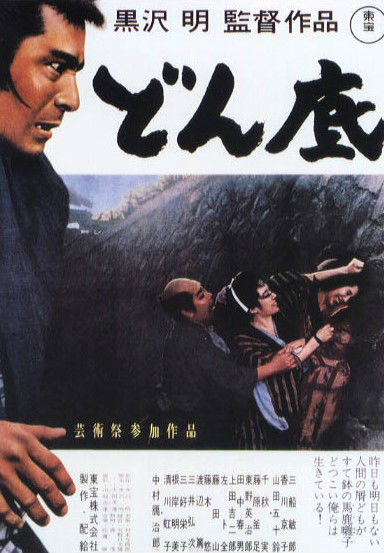
The Lower Depths (どん底, Akira Kurosawa, 1957)

“How can you go to hell if you’re already there?” quips a stoical gangster, perhaps the only denizen of a rundown tenement block no longer looking for escape in Akira Kurosawa’s adaptation of the Gorky play The Lower Depths (どん底, Donzoko). In general, much of Kurosawa’s post-war work decries deliberate falsehood but paradoxically suggests that some degree of self-delusion is essential for surviving an otherwise hopeless world. The wandering pilgrim who arrives like some kind of emissary from the land above says as much as he offers what may turn out to be false promises of a better world to come, but as one of his charges points out he does so “out of pity for those beyond hope.”

Then again, perhaps spirituality won’t save you either. As the film opens, it’s two monks who are seen throwing leaves over a cliff describing the settlement below as “just an old rubbish dump”, which in a sense it is if that were not such a cruel thing to say. In any case, the people who live here are all those who have already fallen into desperation, exiled from mainstream society and caught between a fierce desire to claw their way back up and the despair of knowing that in all likelihood they never will. A man who claims to be a former samurai waxes on his illustrious past, while a melancholy sex worker meditates on the lost love that reduced her to current position, and a stage actor laments his failing memory his mind now fogged by years of alcohol abuse that he says have already poisoned his “bitol organs”. A tinker secretly thinks he’s better than those around him. He’s only been here six months and insists that he’s a skilled craftsman who can continue working, but blames his desperate circumstances on the sickly wife whose death he quietly awaits assuming it will free him of this burden and thereafter this place.

It doesn’t, of course. He sells his tools to pay for her funeral, and otherwise appears lost no longer a husband to a dying wife. In essence the film revolves around a confrontation between the pilgrim who offers what may well be an illusion of salvation and the thief Sutekichi (Toshiro Mifune) who challenges him but begins to believe that it really may be possible for him to leave this place and take the woman he loves, Okayo (Kyoko Kagawa), with him or else fall further and remain trapped in this mortal hellscape. The problem there is that Sutekichi had previously been having an affair with the landlord’s wife Osugi (Isuzu Yamada) who is Okayo’s sister. Though Osugi, whose hope of escape through romance is dashed, first takes against her sister, she later offers to surrender her to Sutekichi if only he will assist her by killing her greedy husband Rokubei (Ganjiro Nakamura). 

In this cold and austere place which is in effect a living hell, there is a sense that many of the residents are already dead. Rokubei’s face is the palest of them all, suggesting that he is already too far gone ever to be saved and most likely doesn’t want to be anyway for in this terrible place he is in effect the king. Osugi is the queen, but often framed behind bars now a prisoner already too corrupt to leave the tenement behind. Her uncle, Deputy Shimazo (Kichijiro Ueda), has a largely illusionary sense of power in his position in a policeman which he prosecutes selectively and mostly at the service of the landlord. In the climactic closing scenes, his policeman’s baton is stolen by the drunkard Unokichi (Yu Fujiki) who dances through the streets with it demonstrating just how little authority he actually wields finally losing his position when the landlord is deposed and his familial connections become irrelevant. He inherits the landlord’s residence, but is reduced to the husband of the sweet seller Otaki (Nijiko Kiyokawa) whose status as a working woman is perhaps higher than his. 

Yet the pilgrim seems to think there is still time to save Sutekichi who at heart wants to go straight but is also resentful admitting that in a world where swindlers prosper perhaps it is foolish not to be a swindler. The pilgrim promises all of them a “better place”. “As long as you believe you’ll find it, you surely will”, he explains telling the actor about a temple that can help him cure his alcoholism while simultaneously urging the tinker’s suffering wife to give in to her fate and go to Buddha’s embrace as soon as possible. Perhaps he sincerely believes these things to be true, but also seems to have a sense that even if they weren’t these hopeless people could not go on if they knew there was no way out. They all say they’ll leave, but discover there are only two means of escape, to die or fall still further in banishment from this already banished place. Only Okayo whose final whereabouts remain unknown may finally have been able to free herself. Staying almost exclusively with the claustrophobic confines of the drafty tenement as wind the whistles through it, Kurosawa frames the space of one of existential purgatory but perhaps suggests that in the absence of salvation a comforting falsehood is the only means of survival.


The Lower Depths screens at the BFI Southbank, London on 19th & 30th January 2023 as part of the Kurosawa season.

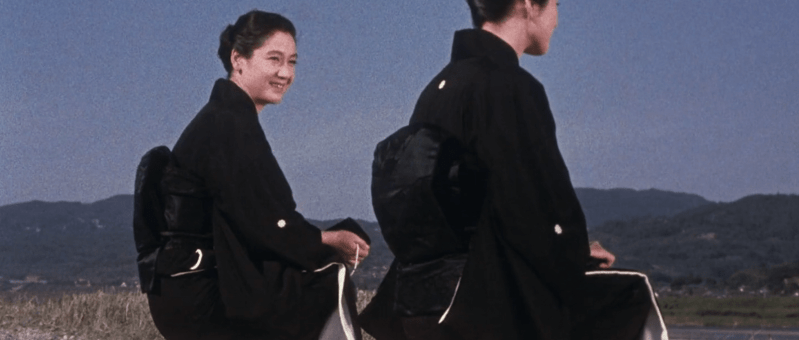
The End of Summer (小早川家の秋, Yasujiro Ozu, 1961)

Fathers in Ozu are usually sentimental and doting, sometimes insensitive or austere, but by and large responsible. The crises the family faces are generally emotional more than they are practical, few Ozu fathers fail in a duty of care towards their wives and children. And then, there’s Manbei (Ganjiro Nakamura). The hero of Ozu’s penultimate film, The End of Summer (小早川家の秋, Kohayagawa-ke no Aki), is quite the opposite. He does as he pleases and enjoys his life to the fullest without really noticing the effect his behaviour has those around him. But then, as his sister later puts it, he was a very happy man which is rare thing in this society so perhaps he had something right after all. 

Produced for Toho and set in Osaka rather than the usual Shochiku and Tokyo, the film opens not with Manbei but with his brother-in-law Kitagawa (Daisuke Kato) trying to set up Manbei’s widowed daughter-in-law Akiko (Setsuko Hara) with a widowed industrialist obsessed with cows. Meanwhile, the family is also trying to find a match for his youngest daughter, Noriko (Yoko Tsukasa), who is put off by the whole idea of an arranged marriage and worried that Manbei and her older sister Fumiko (Michiyo Aratama) may try to pressure her into accepting because their family sake brewery is trouble. Fumiko’s husband Hisao (Keiju Kobayashi) is technically running the brewery and favours a merger to save the business but Manbei is resistant. Manbei himself is largely absent and his increasing habit of skipping out during the day is beginning to worry the family, especially when they discover he’s been visiting an old mistress with a 21-year-old daughter he thinks is his. 

Followed to a cafe, Manbei exclaims that summer refuses to end in an accidental metaphor for his life. For him everything is sunshine and rainbows, scuttling away from the family home like a little boy sneaking out after dark while the now grownup kids are left behind to clean up his messes. Manbei is a widower, and aside from the financial dimension, perhaps it’s not a huge problem if he wants to go and hang out with an old flame, but Fumiko in particular is scandalised remembering the various humiliations he put her late mother through when she was just a child. Hisao advises her that perhaps it’s best not to bring it up. Manbei isn’t going to change his behaviour and it’s only going to create more drama whereas it might be more manageable if they all pretend not know. Fumiko, however, can’t stay silent even if she knows her father isn’t going to listen to her and in fact lies quite baldly about what he’s been doing in Kyoto. 

Fumiko is on the side of marrying Noriko off, but unlike her husband, father, and uncle, is keen to emphasise that they should move slowly and be sure to take her feelings into account. Rather than her sister, Noriko turns to Akiko for support. Originally in favour of meeting the prospective husband, after all you can always turn it down if you don’t like him, she cautions Noriko that the most important thing is character rather than behaviour and that it’s essential to marry without regret. Noriko feels as if she’s obliged to do as everyone says, but is secretly in love with a young man she met on a skiing holiday who has just been transferred to Sapporo. Akiko, meanwhile, was not altogether taken with the cow-loving widower, but in any case would prefer to maintain her present way of life as a single mother even while others pressure her to remarry. 

The conclusion Noriko comes to is, perhaps strangely, inspired by her carefree father in that she decides it’s best to do what will make her the most happy rather than simply going along with what everyone else wants her to do which may or may not be in her best interest. Fumiko grudgingly admits that though her father was often exasperating perhaps he was the only thing holding the family together. Ozu broadly lends the irresponsible but never malicious Manbei tacit approval in celebrating the fact that he lived the life he wanted to live and he was at least defiantly happy in his own eternal summer, but then ends on an uncharacteristically morbid note as two farmers wash vegetables in the river opposite a crematorium remarking on the increasing number of crows while resigning themselves to the cycle of life. Smoke and crows await us all, perhaps Manbei had it right and the thing is to be happy while you can without taking much notice of what others might have to say about it. 


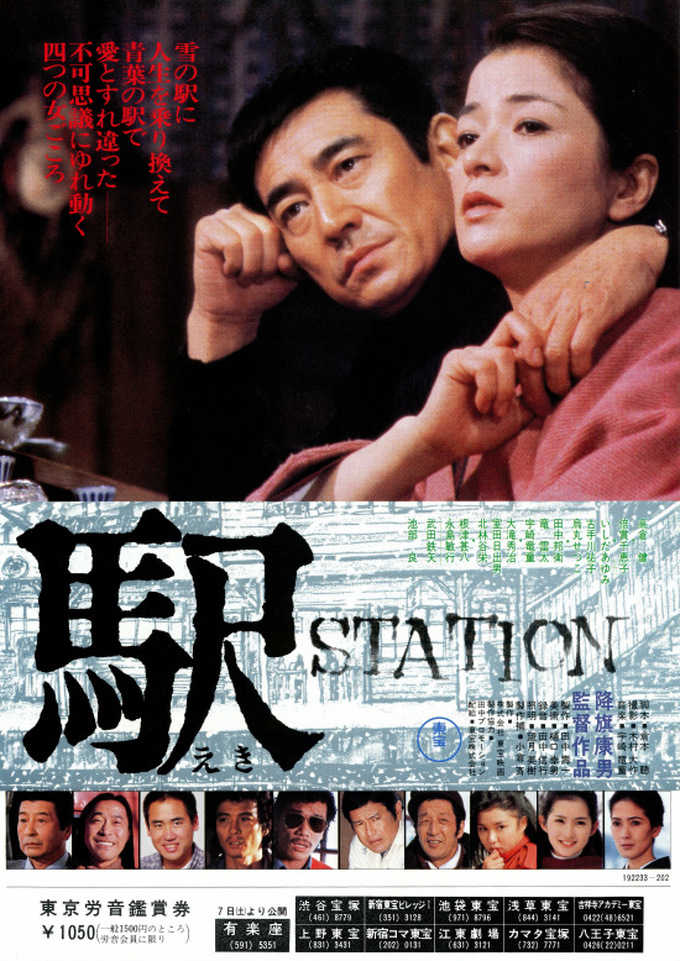
Station (駅, Yasuo Furuhata, 1981)

The thing about trains is, you can get off and wander round for a bit, but sooner or later you’ll have to go where the rails take you. You never have as much control as you think you have. The hero of Yasuo Furuhata’s Station (駅, Eki) is beginning to come to that conclusion himself, addressing the various stations of his life, the choices he made and didn’t make that have led him into a dejected middle-age, defeated, and finding finally that any illusion he may have entertained of living differently will not come to pass. 

In 1968, police detective Eiji Mikami (Ken Takakura) sends his wife (Ayumi Ishida) and son away for reasons which aren’t entirely clear. At this point in his life, he’s an aspiring marksman on Japan’s shooting team intensively training for the Mexico Olympics, which is perhaps why he felt he could no longer be a husband and a father, or at least not while also being a policeman. All that changes, however, when his friend and mentor is gunned down during a routine job, shot in the chest at point blank range by a man in a white Corolla while operating a check point to catch a killer on the run. In 1976, he goes to see his sister (Yuko Kotegawa) marry a man she might not love to escape a violent boyfriend and investigates a serial killer of women who rapes and murders girls in red skirts. In 1979, he’s haunted by the serial killing case coupled with his cool execution of hostage takers during a siege. Holing up in a small fishing village waiting for a boat home for New Year, he strikes up a relationship with a barmaid who is just as sad, lonely, and defeated as he is. 

When Mikami’s friend is shot, his wife tells the reporters that she thinks shooting at targets, which her husband had been training others to do, is a different thing than shooting at living beings. “One shouldn’t shoot at people” she tearfully insists, accidentally forcing Mikami into a double dilemma, knowing that his marksmanship skills were on one level useless in that they couldn’t save his friend while paradoxically told that they shouldn’t be used for that purpose anyway. But what really is the point in shooting holes in paper targets just to test your skill? Wandering into the hostage situation while posing as a ramen deliveryman, he cooly shoots the two bad guys without even really thinking about it, as if they were nothing more than paper. 

The Olympics overshadow his life. He gave up his wife and son for them, but no matter how hard you train, the Olympics eventually pass. Mikami is told he’s supposed to bring honour to Japan, representing not only the nation but the police force. He’s not allowed to investigate his friend’s death because they want him to concentrate on his shooting, but he is and was a policeman who wants to serve justice. While he’s waiting for the funeral, he sees a report on the news about a former Olympic marathon runner who’s taken his own life because he got injured and fell into a depression feeling as if he’d let down an entire nation. Mikami perhaps feels something the same, drained by responsibility, by the feeling of inadequacy, and by the potential for disappointment. After the Olympics he feels deflated and useless, wondering what the point of police work is while quietly rueful in suspecting the committee is about to replace him on the team after all. 

When he wanders into the only bar open on a snowy December evening, that is perhaps why he bonds so immediately with its melancholy proprietress, Kiriko (Chieko Baisho). The conversation turns dark. Kiriko tells him that a friend of hers who worked in a bar in the red light district killed herself last New Year, that it’s the most dangerous time for those who do this sort of work, not for any poetical reason but simply because it’s when their men come home. She tells him that she’s a lone woman, no virginal spinster but weighed down by the failure of old love. Swept up in the New Year spirit, Mikami starts to fall for her, but is also called back to the past by an old colleague who passes him his wife’s phone number and tells him she’s now a bar hostess in Ikebukuro. He starts to think about leaving the police and getting a local job, but fate will not allow it. Kiriko too sees her dream of love destroyed precisely by her desire to escape the pull of toxic romance. Back in 1976, Mikami had been party to a similar dilemma as the sister of his suspect kept her brother’s secret but secretly longed to escape its burden. Suzuko (Setsuko Karasuma) too lost love in trying to claim it and now works as a waitress in a small cafe in this tiny town, only latterly making an impulsive decision to try to leave and make a new future somewhere else. 

Mikami tears up the letter of resignation that declared him too tired of life to be a good policeman, once again boarding a train back to his rightful destination, knowing that a policeman’s what he is and will always be. He watched his wife wave goodbye from a station platform, saw a man betrayed on the tracks, and finally boarded the train himself, letting go of any idea he might have had about going somewhere else. Stations are after all transitory places, you can’t stay there forever. 


Original trailers (no subtitles)

Aki Yashiro’s Funauta which plays frequently throughout the film

The Hotelman’s Holiday (駅前旅館, Shiro Toyoda, 1958)

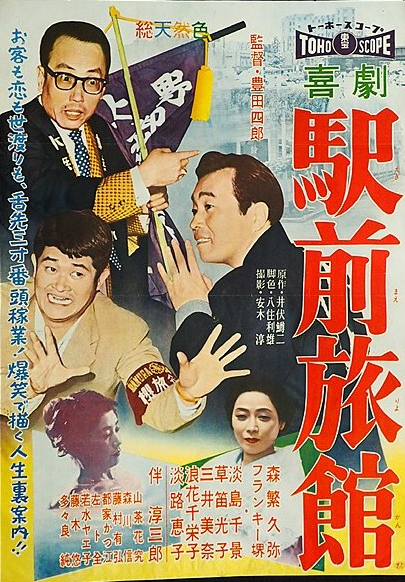
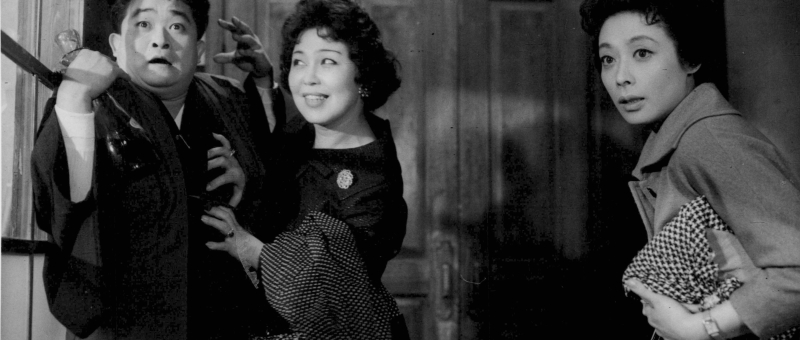
Hotelman's holiday poster 1The post-war world was one rife with trouble. By 1958, however, the horizon was perhaps beginning to brighten which means it was no longer too soon have a good laugh about how awful life could be. Nothing particularly awful happens in Shiro Toyoda’s cheerful comedy The Hotelman’s Holiday (駅前旅館, Ekimae Ryokan), the first in a series of “Ekimae” or “station front” movies produced by Toho, but it does amusingly rip a leaf out of Toei’s book in having its community of feckless hoteliers band together to stand up to greedy yakuza stand-in barkers who are actively destabilising the local economy with their underhanded ways.

Our hero, “born in a maid’s room” Jihei (Hisaya Morishige), is the manager of the Kukimoto inn near Tokyo’s Ueno station. Kukimoto seems to get most of its business from large tour groups, particularly school children on trips to the city and religious organisations, seemingly unperturbed by the area’s then scrappy working class earthiness. The problem is that there are rather a lot of inns in this small area (it is after all near a major rail station) and they’re all competing for the same walk-in guests which means they’re increasingly at the mercy of the local “barkers” who target travellers at points of transit and take them to certain inns in return for commissions. Even so, Jihei himself can often be found outside enticing passersby into the hotel to prove his managerial prowess.

The barkers know their worth and are beginning to get too big for their boots in shifting into the human trafficking business. Not to go into the finer details, the inns have a lot of ladies living on their premises on whom some of their trade relies. The barkers have been tempting the girls from the inns away from their homes and into potentially more lucrative though almost certainly less friendly occupations.

The central drama kicks off when the barkers try to abduct Kukimoto’s maid Okyo (Mina Mitsui) who is saved at the last minute by intellectual student Mannen (Frankie Sakai). Mannen is studying law and working illicitly for several tourist information companies in order to pay his way through college. As such he’s just another of the scrappy young guys trying to forge ahead in the precarious post-war environment. Jihei is, in a sense, pretty much the same. Born in a maid’s room, as he says, he’s very much part of the inn business and is proud to be a manager but also resents his subordinate position to the owner and the way they often treat him like a servant rather than the dependable employee he really is. His position leaves him feeling as if he’s already reached his peak and there is no real future for him other than the status quo. That feeling of futility might be why he, Mannen, and some of the other hotel managers eventually decide that they need to “cleanse” the Ueno Station area of the barker threat.

Their resistance has a pleasantly pithy quality in that it relies on a perfectly peaceful method of putting up banners to encourage customers not to trust the barkers and to approach inns directly. As might be assumed, the barkers aren’t very happy about their business being undermined and immediately begin threatening the Kukimoto inn, whom they assume to be the instigators, with destruction if they do not immediately cease and desist. Jihei thinks he has a solid plan and it does indeed defuse the situation but cannot ultimately rectify it. What it does do is give the inn’s owners the excuse they’ve been looking for to part with him, and Jihei the impetus he perhaps needed to rethink his life.

As Mannen puts it, “our reality is preposterous and absurd”, but we have to go on resisting because “happiness exists even in this world”. The inn managers stand up against the barker oppression in the same way communities stand up against yakuza in Toei’s modern gangster dramas, but like many of anti-gangster narratives, the corruption is so deeply ingrained that it cannot be entirely eliminated, only managed. Thus Jihei, also involved in a series of romantic subplots involving an intense former geisha (Keiko Awaji) and a diffident bar owner (Chikage Awashima), eventually realises that if he cannot change his environment he might be better to leave it, escaping to the sort of place where they still grow barley and travel by cart. Mannen too, their revolution failed, eventually takes off with Okyo to go into business in Osaka, giving up on his imagined future for a more solid present. Meanwhile, chaos rules in Ueno as crowds of travellers pour out of the station towards an uncertain future with only the barkers to guide them.


Original trailer (no subtitles)

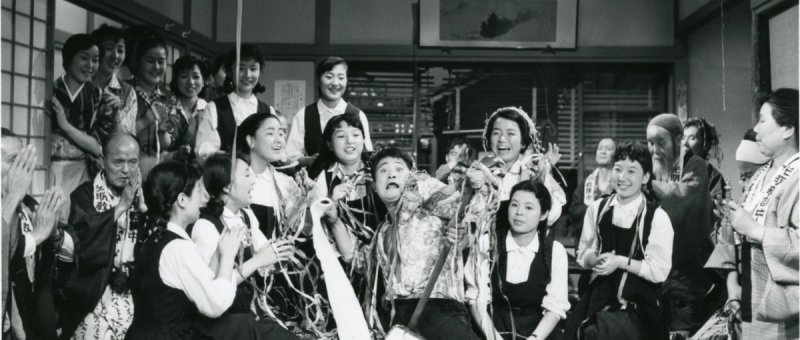
Room for Let (貸間あり, Yuzo Kawashima, 1959)

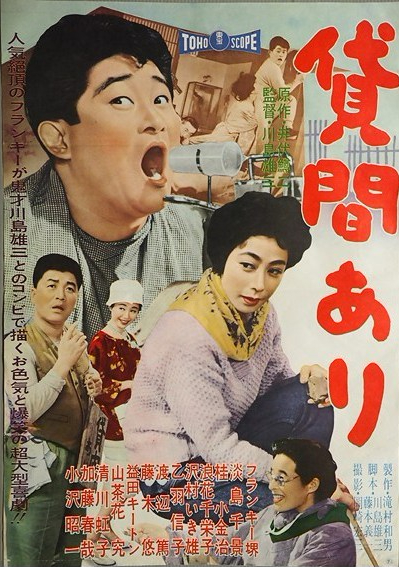
room for rent poster“Life is just goodbyes” exclaims a tenant of the small, rundown boarding house at the centre of Yuzo Kawashima’s Room for Let (貸間あり, Kashima Ari). Best remembered for his anarchic farces, Kawashima takes a trip down south to the comedy capital of Japan for an exploration of life on the margins of a major metropolis as a host of eccentric characters attempt to negotiate the difficult post-war economy, each in someway having failed badly enough to end up here. Though the setting is perhaps depressing, the lively atmosphere of the boarding house is anything but and the residents, depending on each other as a community of solidarity, know they have the ultimate resource at their disposal in the form of infinitely kind hearted, multi-talented fixer Goro Yoda.

Our introduction to the boarding house follows the passage of an outsider, Yumiko Tsuyama (Chikage Awashima) – a ceramicist who wants to make use of Goro’s printing facilities, but to find him she’ll first have to run the gamut of eccentric residents from the batty bee keeper to the geisha currently trying to fumigate one of her patrons by riding him around the room and the henpecked husband who responds to his wife’s frequent shouts of “Darling!” with a military style “yes, sir!”. On her way to Goro’s jam packed annex, Yumiko notices a room to let sign along with a kiln in the courtyard which catches her eye. Taking a liking both to the room and to Goro, Yumiko moves in and subsequently gets herself involved in the oddly exciting world of an old-fashioned courtyard standing on a ridge above a rapidly evolving city.

Played by well known comedian Frankie Sakai (who played a similar role in Kawashima’s Bakumatsu Taiyoden of two years earlier), Goro is an awkward symbol of post-war malaise and confusion. Goro, a jack of all trades, is the man everyone turns to when they run into a seemingly unsolvable problem, and Goro almost always knows a way to solve them (for a price). His sign in the marketplace proclaims that he speaks several languages and is available for tutoring students, he’s written “how to” books on just about everything you can imagine, he knows how to make the perfect cabbage rolls and konyaku, ghostwrites serial fiction, and runs a small printing enterprise, yet Goro is not a scholar, (licensed) lawyer, doctor, or successful businessman he’s a goodhearted chancer living on his wits. He runs away from success and eventually from love because he doesn’t think he deserves it due his continuing “fakery”.

Despite his minor shadiness, Goro’s kindness and sincerity stand in stark contrast to the evils of his age. Like Goro, many of the boarding house residents are trying to get ahead through somewhat unconventional means including the bawdy lady from upstairs whose main business is blackmarket booze, the peeping-tom street punk who peddles dirty pictures near the station, and the sad young woman working as an independent geisha (Nobuko Otowa) to save enough money to marry her betrothed whom she hopes is still waiting for her at home in her tiny village. That’s not to mention the mad scientist bee keeper who can’t help describing everything he sees in terms of bees and has attempted to turn their apian secretions into a cream which increases sexual potency, or the enterprising landlady who realises she could charge a few more pennies for patrons who want to sit in a fancy seat or watch TV while they eat dinner.

Yumiko isn’t the only outsider sending shockwaves through the community, a young student armed with a camera and the determination to avoid parental disapproval, intends to petition Goro to take his exams for him. The aptly named Eto (Shoichi Ozawa) is a dim boy with seemingly infinite wealth who’d rather scheme his way to the top than invest his energy in getting there the honest way. In this he’s the inverse of Goro whose simple sincerity and easy going nature are, it is subtly suggested, partly the reason he hasn’t made his way in the increasingly duplicitous post-war society. Goro does, however, give in to Eto’s nefarious plan even if it conflicts with his otherwise solid honour code which also sees him turn down the “opportunity” of sleeping with his neighbour’s seemingly insatiable wife in one of the stranger requests coming in to his do anything shop.

Kawashima’s true mastery lies not in the myriad moments of small comedy that pepper the main narrative, but in the glorious way he brings them all together as a perfectly constructed farce. The residents of the boarding house (one of whom is so proud of the “room to let” sign he made that he doesn’t want to rent the room because then he’d have to take the sign down) each face their own difficulties and disappointments but even when darkness creeps in (suicides, arrest, sexual assault, and animal cruelty all raising their ugly heads) the absurd positivity and warmth of these ordinary Osakans seems to be enough to combat it. Life may be a series of goodbyes, but it must still be lived, at least to the best of one’s ability.


 Screened as part of the Japan Foundation Touring Film Programme 2018.

Also screening at: