Dragon in Jail (獄中龍, Kent Cheng Jak-Si, 1990)

“For the poor life is a punishment” according to Henry (Andy Lau Tak-Wah), the embattled hero of Kent Cheng Jak-si’s Dragon in Jail (獄中龍), a subdued heroic bloodshed offshoot in which a poor boy and rich kid meet in juvie and become best friends for life even though fate seems to have very different paths in store for them. Less a critical expose of the cruelties of an increasingly stratified society than an ode to intense male friendship, Dragon in Jail puts its hero in a different kind of cell as he tries to escape the triad net but finds himself ensnared by past crime and present rage. 

Rich kid Wayne (Kenny Ho Ka-King) ends up in a reformatory for pulling petty stunts supposedly because he doesn’t like it that his widowed mother has remarried. Different from the other boys, he’s immediately hazed and asked for his gang affiliation, only he doesn’t have one. Tough boy Henry stands up for him, roping in his other friend Skinny (John Ching Tung) to take on the cell’s Mr. Big after which the boys become firm friends as they study together to sit their A Levels while inside. Wayne wasn’t planning to take his exams as a way of getting back to his mother, but Henry convinces him that education is the one way to show the world who’s boss. The boys come top in their class, Wayne gets out and decides to go the UK to study law, while Henry serves out the remainder of his sentence in an adult prison, sentenced to four years for manslaughter after accidentally killing a triad member during a fight over protection money at his family’s kiosk. 

Despite the differences in the scope of their possibilities, Henry and Wayne remain good friends, but once Henry gets out of prison he’s nothing much to look forward to. His hopes of attending a university are dashed by his defeatist father who thinks education is pointless and blames him for the failure of their business, while he struggles to find steady employment as a man with a criminal record. Eventually he decides to work as a mechanic by day and a cram school teacher by night with the aim of saving enough to apply for uni at later date so he can marry his longstanding girlfriend, Winnie (Gigi Lai Chi). Skinny, meanwhile, gets out of jail and heads straight back to the triads, trying to convince Henry he should join too. Henry doesn’t want to, but faces constant harassment from Brother Charlie (William Ho Ka-Kui), the boss of the man he killed in the fight. When his little brother is badly burned in a triad attack, he decides his only option is to become one himself to earn the protection of Boss Sean (Leung Gam-San) who mediates an uneasy truce with the psychopathic Charlie. 

When Wayne returns from the UK after graduating law school, Henry is married and a father-to-be living in a swanky apartment having risen in the triad ranks, but he’s also a hotheaded opium addict still sparring with the very present Charlie. “I’m a bad egg! I deserve it!” Henry wails on being confronted by Wayne who points out that it was he who was always encouraging him to study so that no one would ever look down on him. Henry thinks he’s not good enough to be Wayne’s friend and fully expects to be abandoned, but after some strong words of defence from Winnie, Wayne comes around, resolving to help get his friend off the stuff. The problem is the sense of futility which has already set in. Henry has become what everyone expected him to be, a thuggish triad, because they convinced him he could become nothing else.

Winnie berates Henry for keeping his sorrows to himself, remaining sullen and resentful at his inability to escape the triad world for an honest life of safety with his new family, though he once told Wayne that he should “speak up if you feel unhappy”. Despite everything the intense friendship between the two men endures. Cheng adds to the faintly homoerotic tone by shooting his early prison scenes with a lingering romantic gaze, while Wayne seems to pine for his broody friend, affirming that “no matter what you are, you are my buddy”. A caged dragon, Henry’s vengeance is swift and brutal but he retains his nobility even in the depths of his despair, eventually taking refuge in an unconditional friendship which transcends the forces which imprison him.


Onibaba (鬼婆, Kaneto Shindo, 1964)

How do you go on living in a world turned upside-down? It may be the central theme of post-war cinema, but few have tackled it in such a direct if allegorical way as Kaneto Shindo, repurposing a Buddhist parable about the perils of duplicity as a lesson in the dangers of the age, defined by a cruel hunger which could not be satisfied by bread alone even if there were bread to satisfy it. Onibaba (鬼婆), as the title implies, makes a villainess of an old woman driven to extremes by her chaotic times, but perhaps suggests that the times make villains of us all.

Deep in the war-torn country of 14th century Japan the imperial capital of Kyoto has been razed, a horse is said to have given birth to a cow, and the sun rose black in the sky leaving day as dark as night. With farmers dragged away from their fields to fight in a war they barely understand on behalf of distant lords, the grain basket of the nation is close to empty. An old woman (Nobuko Otowa) and her daughter-in-law (Jitsuko Yoshimura) have learned to make ends meet by hunting battle-weary samurai, stripping them of their armour, and throwing their bodies into a gigantic pit sitting right in the middle of the tall grass like a gravitational black hole of human compassion. The old woman has been patiently waiting for the return of her son, Kichi, who was taken away by the samurai, certain that everything is going back to normal when the war is over. Kichi, however, will not be returning. Hachi (Kei Sato), another young man from the village taken along with him, brings the sad news that the old woman’s son was beaten to death by a mob of farmers much like herself resentful of the war’s intrusion onto their land. 

Everything becomes food, Hachi explains, a sentiment extremely familiar to those who lived through the chaos of the immediate post-war era. Pointing at a baseline problem in the feudal economy, the war starves the poor and makes the wealthy hungry. The fields run wild with no men to tend them, as if symbolising the madness of the times. Lost in the tall grass, samurai and peasant alike search for an exit but are drawn only towards that black pit of human cruelty, more beasts than men driven by the need to survive alone. 

Without her son, the old woman is unable to farm, and without her daughter-in-law she is unable to survive through killing. She knows that these are times without feeling and that if Kichi will not return there is no reason for her daughter-in-law to stay. Ushi (Taiji Tonoyama), the broker for the looted samurai armour, makes an indecent proposal of extra millet for sexual favours but the old woman defiantly turns him down, perhaps not quite realising the offer was likely not intended for her. Which is to say that Hachi is not the only man in town, but is perhaps the only “desirable” one. Such desires that there are apparently cannot be satisfied by a crusty old man like Ushi, but are there all the same. Hachi presents a triple threat. The old woman knows her survival depends on the younger one, but also that she has no means to keep her now that her son is dead. She offers Hachi her body instead but he, as she did Ushi, baulks at the idea of slaking his lust on such an old woman. 

When a strange samurai wanders into her hut and orders her at the point of his sword to lead him out of the tall grass a solution presents itself. The old woman lures him to the black pit and prises away the ornate oni mask which he claimed he wore to protect his beautiful face from the ravages of war. Despite the fact that the samurai appears to have suffered from some kind of aggressive skin disease, the old woman unwisely decides to put the mask on her own face, convincing her daughter-in-law that her relationship with Hachi is sinful and appearing out of nowhere dressed as a demon to remind her that she’s going to hell. The mask’s crazed expression becomes fused with her own face, cementing her transformation into a “demoness” which it seems had already begun with stretch of white disrupting the uniformity of her hair and the kabuki-esque exaggeration of her eyebrows. Running desperately through the tall grass she cries out that she’s human, but this world has made demons of them all. The black pit of hunger knows no fill, and there can be no satisfaction in a world so devoid of human feeling.


Onibaba is currently streaming on BFI Player as part of the BFI’s Japan season.

Original trailer (dialogue free)

Blood End (天狗党, Satsuo Yamamoto, 1969)

When the black ships appeared off the coast of Japan in 1853, it provoked a moment of crisis which eventually led to the fall of the Tokugawa Shogunate and the Meiji Restoration. Between those two events however lay a period of intense confusion as several groups and movements attempted to lay claim to the future direction of the nation. Many, such as the legendary figure Sakamoto Ryoma, held that above all else Japan needed to Westernise as quickly as possible in order to defend itself against foreign powers now far more technologically advanced than the Japan which had attempted to hold back time for over 200 years. Others felt quite the opposite, that what was needed was an end to the corrupt rule of the Shogunate and the restoration of power to the emperor while expelling foreign influence and going back into isolation. 

Satsuo Yamamoto’s Blood End (天狗党, Teng-to) dramatises this debate through the melancholy tale of the Mito Rebellion as a brutalised peasant farmer is sucked in by the idea of revolution but eventually betrayed by it in discovering that the samurai, even revolutionary samurai, will never change. They may claim they want an end to the feudal caste system and to live in a world where all men are equal, but continue to feel themselves entitled to more equality than others and insist on deference from those they still believe to be inferior. 

The action begins with a scene familiar from many a jidaigeki in that a small farming community is being pressed to provide the usual amount of rice despite the failure of the harvest. Revolutionary yakuza Jingoza (Kanemon Nakamura) and egalitarian samurai Kada (Go Gato) stumble on the scene of a “stubborn” peasant being subjected to 100 blows as punishment for the village’s raising the unfairness of their situation with the local lord. Surviving his ordeal, Sentaro (Tatsuya Nakadai) asks only for water but is denied by his cruel samurai tormentor. Jingoza intervenes and offers him his flask along with some money by way of an apology on behalf of these savage nobles, a gesture for which Sentaro remains grateful. While many of his friends are exiled and lose their lands, Sentaro disappears from the village and becomes a yakuza himself, learning the art of the sword in preparation for his mission of revenge. 

Meeting Jingoza by chance, he takes the opportunity to thank him and agrees to transport some money back to his family in a nearby village while he engages in urgent business in the mountains. While there, Sentaro ends up defending Jingoza’s steely daughter Tae (Yukiyo Toake) who is running something like an orphanage for children rendered fatherless by the ongoing chaos. It’s at Tae’s that he ends up running into Kada, who is a member of revolutionary movement “Tengu-to”, named for the mythical ogres with long noses and bright red faces. Sentaro ends up joining the movement, but gradually discovers that Tengo-to is not all he thought it to be. In the modern parlance, many of their actions are terrorist, they care little for human life and have no issue with looting wealthy houses as they prove after helping Sentaro assassinate the man who beat him, killing the man’s wife and servants and making off with his money as “military funds”. Sentaro is shocked, but only manages to get some of the money for himself to take back to Tae as a way of making amends. He continues to associate with Tengu-to despite his growing disillusionment with their philosophy. 

The Mito clan were perhaps outliers in the great Bakumatsu culture war, running under the “Sonno Joi” banner but doing so alone and forcefully advocating that the emperor’s instruction to expel all foreigners with immediate effect be enforced. At least as far as Yamamoto’s revolutionaries go, they advocate for this not so much because they reject foreign influence but because they resent the country’s elites maintaining a stranglehold on the riches to be gained by foreign trade. Kada, however, claims to have a more revolutionary spirit in that he wants to improve conditions for farmers like Sentaro, protecting them from the “corrupt system” but he’s still a product of his society and finds the programming increasingly hard to break. Having recruited vast numbers of peasants to their cause and witnessing the failure of their campaign, the other leaders want to go to Kyoto to talk to the emperor but are embarrassed to go there in the company of so many men who are not samurai. The solution is that they simply kill them, because peasants aren’t really people anyway. 

Sentaro thought they were “doing something good for peasants and the poor”, but samurai will always be “samurai” and eventually they will betray him. He wavers when Kada and the others ask him to assassinate Jingoza because he’s gone over to the Westernising cause, and is half talked round by his insistence that he’s acting blindly without thinking far enough ahead but himself finds it hard to break with the idea that samurai are honest and know what they’re doing. 

Yamamoto is perhaps making a direct allusion to the imminent failure of the student movement in Japan which finds itself in much the same place as the Tengu-to, torn apart by infighting and increasingly corrupted by duplicitous dogma. Kada has a lot of fine ideas but he doesn’t act on them, doubling down on ruthlessness in complaining that Sentaro is too sentimental, insisting that emotion is the enemy. Sentaro, however, has figured out that the enemy is the sword and everything it represents. Jingoza’s “Restoration” is the one he should have been fighting for if he wanted to see a classless Japan, but the Tengu-to have misused his idealism for their own ends and turned him into a defender of his own oppression. Still, the Tengu-to are the ones who pay the price, their entreaties to the emperor falling on deaf ears with 353 retainers beheaded as punishment. Sentaro lives on, vowing he will never die, as he walks towards the “Restoration” of the future and away from the Blood End of an inherently corrupt insurrection. 


Farewell Song (さよならくちびる, Akihiko Shiota, 2019)

Repressed desire and toxic resentment conspire against a trio of melancholy musicians in Akihiko Shiota’s delicate indie drama, Farewell Song (さよならくちびる, Sayonara Kuchibiru). As the title implies, this is a tale of learning to let go, but then again perhaps not. As an over earnest interviewer suggests there are many ways to interpret the title song, but it also carries with it an unmistakable hint of defeatism as the singer songwriter heroine finds herself perpetually preparing to say goodbye, no longer believing in a positive future and unwittingly sabotaging its existence in an intense desire for protective distance. 

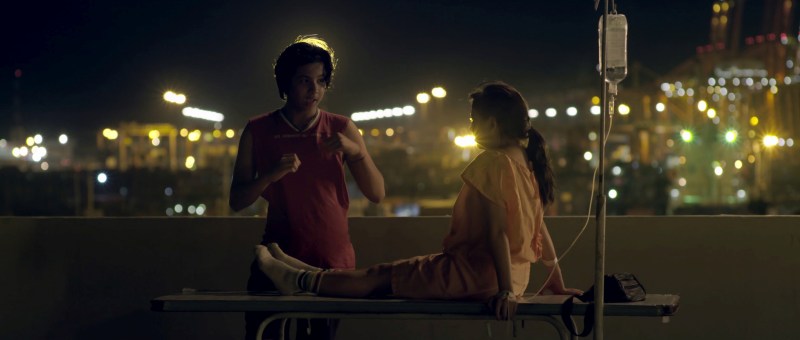
As the film opens in the summer of 2018, folk duo Haruleo is about to set off on a “farewell tour” though it’s not been advertised as such. The atmosphere is extremely awkward and emotionally volatile. Something has obviously gone very wrong in the previously close relationship between bandmates Haru (Mugi Kadowaki) and Leo (Nana Komatsu), while roadie Shima (Ryo Narita) seems to be doing his best to stay out of it and keep the peace if only until after they’ve played their final show in Hakodate way up in Hokkaido. 

That might be difficult however because Leo’s self-destructive streak is out in full force, wandering off with a rough-looking man from the petrol station where they stopped to use the facilities. “Aren’t you going to stop her?” Haru asks of Shima, entirely mistaken in the nature of their relationship, “What would be the point?” he replies, open mouthed in exasperation. Sure enough Leo turns up late to the gig and sporting a nasty bruise on her face after another encounter with a dark and violent man. “I don’t want to watch you fall apart”, Haru had told her on a previous occasion in an awkward attempt at comfort that finally backfired, Leo firing back that hearing that from her only made her feel even worse. Haru echoes those words herself when Shima tries something similar with her, only charged with a somewhat inappropriate fervour driven by misplaced desire. 

Desire is indeed circulating, but in an emotionally difficult and seemingly irresolvable love triangle between three people with extremely low self esteem. Struggling to accept love, they act on self-destructive impulse and only wound where they mean to console. Haru strikes up a conversation with Leo because she says that her “eyes wanted to sing”, seemingly captivated and taking the young woman in but still somehow maintaining a distance. Leo, who seems to have no family and is incapable of looking after herself, quickly bonds with Haru but is frustrated by her resistance to connection. When Haru interviews Shima for a position as their roadie, she’s quick to tell him that romance is prohibited, but later claims that she always expected he and Leo to run off together while silently pining for her in a mistaken belief that her love is hopeless. 

Filled with internalised shame, Haru takes Shima home as a beard to show off to her mother at her father’s memorial service, unable to disclose her sexuality and trying not to look hurt when her mother whips out a postcard from her first love who has since married abroad and had a child. Shima, strangely perhaps the most emotionally astute, is drawn to Haru even after learning that she is gay and realising that all of her songs are really about her unrealisable longing for Leo, who claims to be in love with him though it’s not exactly clear if that, like her tendency to disappear with dangerous men, isn’t a misdirected way of connecting with Haru.

Shima may have failed once and resolved to do better in avoiding making the same old mistakes, but is still an awkward third wheel in this increasingly difficult relationship despite his attempts to mitigate the effects of his presence while perhaps biased towards preserving Haru’s happiness in trying to “save” Leo. Learning that a close friend and former bandmate has passed away forces him, and perhaps the girls too, to reflect on what’s lost if you let important relationships fall by the wayside out of pettiness or pride. Shima’s friend apparently told his young son never to become a musician because it will rob you of the things that are most important. Still, Shima, echoing the words of Haruleo’s signature song, affirms that he regrets nothing. If it all ends in tears, Haru’s lyrics imply that she’s happy to live with the thorn in her side as a reminder of past love. The jury’s out on whether the Farewell Song leads to a new beginning or merely more of the same, perpetually trapped in an inescapable cycle of emotional frustration, but Haruleo seems resigned to weathering the storm whatever it is that might emerge on the other side. 


Original trailer (English subtitles)

Farewell Song music video

Cruel Story of Youth (青春残酷物語, Nagisa Oshima, 1960)

More interested in politics than cinema and never quite at home in the studio system, Nagisa Oshima began his career at Shochiku as one of a small group of directors promoted as part of the studio’s effort to reach a youth audience they feared their particular brand of inoffensive melodrama was failing to capture. Like The Sun’s Burial, Cruel Story of Youth (青春残酷物語, Seishun Zankoku Monogatari) is a nihilistic tale of a fracturing society, but it also looks forward to Night and Fog in Japan in its insistence that youth itself is a failed revolution and this generation is no more likely to escape existential disappointment than the last. 

The film opens with teenager Makoto (Miyuki Kuwano) and her friend Yoko (Aki Morishima) trying to get free rides from skeevy middle-aged men rather than having to pay for a cab. As you might expect, that’s a fairly dangerous game and while it might be alright while there’s two of you, as soon as Yoko has been dropped off, the driver changes course and suggests going for dinner only to park in front of a love hotel and try to drag Makoto inside. Luckily, or perhaps not as we will see, she is “rescued” by young tough Kiyoshi (Yusuke Kawazu), a student and angry if politically apathetic young man. Struck by his manly white knight act, Makoto takes a liking to Kiyoshi but he too later rapes her under the guise of satisfying her curiosity about sex to which he attributes her ride hailing activities. After this violent genesis, they fall in “love” but continue to struggle against an oppressive society.

We assume that the “cruel story of youth”, and it is indeed cruel, that we are witnessing is that of Makoto and Kiyoshi, but it’s also that of her slightly older sister Yuki (Yoshiko Kuga) and her former lover Akimoto (Fumio Watanabe) who has become a conflicted doctor to the poor betraying himself by financing the clinic through charging for backstreet abortions. Yuki complains to her apathetic father that they were strict with her in her youth, that she’d get a hiding just for coming home after dark, whereas Makoto can stay out all night and not get much more than a stern look. Her father explains that times were different then, “We thought we had new horizons. We started again as a democratic nation, and it was a responsibility that went hand in hand with freedom. What can I say to this girl today?” admitting both the failures of the past and the mistaken future of a society that actively resists change. 

Yuki and Akimoto were part of the post-war resistance, left-wing students like the older generation of Night and Fog in Japan, who’d actively fought for real social change but had seen that change elude them. Yuki, we hear, left Akimoto for an older man but perhaps now regrets it along with her half-finished revolution. She may not approve of her sister’s choices, but she also on some level admires her for them or at least for the strength of her rebellion even if it will ultimately be as fruitless as her own. “This is a cruel world and it destroyed our love” Akimoto laments, mildly censuring the youngsters in suggesting that his love was pure and chaste because they vented their youthful frustrations through political action whereas this generation is already lost to the mindless hedonism of unbridled sexuality. 

He forgives them, because he feels that their plight is a direct result of his failure to bring about the better world, but there is also a suggestion that it is a lack of political awareness which is somehow trapping the young. Oshima cuts from footage of the April Revolution in Korea which is described as a “student riot” in the news to a protest against the Anpo treaty at which Kiyoshi and Makoto look on passively from the sidelines. “I think taking part in the demonstrations is stupid”, Makoto’s friend Yoko tells a prospective boyfriend, “why don’t we think about getting married instead?”, drawing a direct line between social conservatism and political inaction. 

Makoto and Kiyoshi rebel by using, or to a point not using, their bodies as a direct attack on the society. Following their rather odd and troubling meeting, the pair earn their keep through repeating the experience. Makoto picks up men who will inevitably have an ulterior motive, and Kiyoshi rescues her, extorting money from their targets. Yet it is Kiyoshi who is forced to prostitute himself, gaining financial support as a gigalo kept by a wealthy middle-aged housewife who is just as sad and defeated as Yuki and Akimoto, dissatisfied with the path her life has taken and in her case attempting to escape it through passion and control exerted over the body of a young man. Though the consequences of a becoming a kept man may be different than those Makoto would face should the less “nice” delinquents get their hands on her, they do perhaps fuel his sense of violent emasculation which he channels into a pointless act of revenge against the society in the form of its most powerful, wealthy middle-aged men whose misogyny he claims to abhor while simultaneously mirroring and directly exploiting.

“Someone needs to be responsible” a strangely sympathetic policeman insists, chiding Kiyoshi that at heart he’s just a petty criminal who liked having money no matter how he might have tried to dress it up. “You’re just like them, you’re a victim of money too”, he adds correctly diagnosing the flaws of an increasingly consumerist society. Only, no one takes responsibility. Kiyoshi’s lady friend pulls stings. It turns out her husband does business with Horio, one of Makoto’s pick ups who despite being nice and kind still had his way with her and then reported Kiyoshi for extortion. Akimoto explained that their failures would drive them apart, but Kiyoshi swore they’d always be together only to wonder if in his love for her the only thing to do is save Makoto from his corrupting influence though she does not want to leave him. We won’t be like you, Kiyoshi countered, because we have no dreams with which to become disillusioned. But youth itself is a failed revolution, and the force which destroys them is perhaps love as they meet their shared destinies at the hands of an increasingly cruel society.


Cruel Story of Youth is currently streaming on BFI Player as part of the BFI’s Japan season.

Original trailer (no subtitles)

The Old Potter (독짓는 늙은이, Choi Ha-won, 1969)

“The man of the house shouldn’t covet and touch what belongs to others even if he is starving to death” laments an old potter admonishing his well-meaning son but also commenting on the folly of his life. A melancholy tale of illusionary futures, Choi Ha-won’s The Old Potter (독짓는 늙은이, Dokjitneun Neulgeuni) is a deeply felt meditation on loneliness and regret as a wandering son finally comes “home” to look for himself in the ruins of his family which seems to have existed as briefly as a dream. 

The young man (Kim Hee-ra), apparently from a nearby village, is a wandering soul struck by the familiar sight of traditional pots which he has not seen in some years seeing as he has just returned from the war. Stepping into a house he finds it not quite as empty as he thought and strikes up a conversation with an elderly gentleman (Heo Jang-gang) who invites him to stay the night among a small community of beggars congregating around a disused kiln. The old man tells him that he comes here every 15th day to spend time with a late friend of his, Song (Hwang Hae), to whom he seems to feel some sort of debt. 

Back in the 1920s, Song, the old potter, joked that he was married to his pots, living a lonely life devoted to his craft. One winter he happened upon a young woman collapsed in the snow, rescuing her and nursing her back to health in his shack. The young woman, Ok-soo (Yoon Jeong-hee), does not exactly fall in love with him but is grateful and, it turns out, has nowhere else to go and so the pair marry. The potter becomes a father to a son, Dang-son, at the age of 61. For seven years, the family is perfectly happy. Old Song truly loves the young Ok-soo and takes good care of her. He is a kind man and patient father keen to pass on his skills to his young son. 

And then, a strong and handsome young man arrives. He is is Sok-hyun (Nam Gung-won), Ok-soo’s first love for whom she left her family, heading off to look for him but fainting in the snow where she was rescued by Song. When Song’s friend made fun of him for washing Ok-soo’s clothes in a nearby stream and prompted him to ask her to stay, he said he’d let her go if that was what she chose, and to that extent he’s true to his word. Having overheard the couple talking and realised their past relationship, he says nothing but silently hopes that Ok-soo will choose to stay with them. 

Ok-soo meanwhile is torn. Her old lover has returned, the man she’d been searching for, but he’s come at an inconvenient time when she is now a wife and a mother with a settled home. She is not unhappy with the potter who, though elderly, is kind and has always taken care of her and their son, but she’s drawn back towards passion and romance with Sok-hyun who is young and strong, able to split logs with a single blow. Song hears the sound of the axe echoing in his mind as a grim reminder that Sok-hyun is everything he is not – young and handsome and full of life. He can offer only the warmth of their home and the feeling of duty towards family as reasons for Ok-soo to stay, but knows in his heart that she will choose the love of her youth over the security they have built together. 

Song’s late life happiness is shattered like one of his imperfect pots. He cautions his son that one should not covet things which belong to others as if blaming himself for daring to “borrow” Ok-soo all these years when she “belonged” to someone else. He gives Dang-son another pottery lesson which is really life philosophy, explaining that it’s fire that makes the pot, not the man. A man is made by the fires he endures, and perhaps, Song starts to think, he should give in and allow Dang-son to be adopted by a noble family so that he might live an easier life as a gentleman rather than struggle here with him with no real hope for the future seeing as all his pots are cracked. 

Of course, as we already know, the sad young man who returned from the war is Dang-son, so perhaps Song’s choice did not buy him the easy life that he hoped it would. Meanwhile, the old man explains that Ok-soo later returned and bitterly regretted her choice, begging to be told where Dang-son had been taken, but the old man turned her away which is why he feels so guilty. “I deserve the severest punishment as a woman who deserted her husband and son” Ok-soo laments, having spent the last 20 years trying to atone for her decision to choose passion over her maternal responsibility. Song’s brief moment of happiness left him unable to return to his cold and lonely life as the master potter, his hopes shattered by life’s imperfections. Fire has shaped them all, but after it’s cooled all that remains is bitter regret for the frustrated desires of youth and a painful longing for forgiveness. 


The Old Potter is available on English subtitled DVD courtesy of the Korean Film Archive in a set which also includes a bilingual booklet featuring an essay by director Choi Ha-won on the making of the film as well as writing by film critic Kim Jong-won. It is also available to stream online via the Korean Film Archive’s YouTube Channel.

The Flavour of Green Tea Over Rice (お茶漬けの味, Yasujiro Ozu, 1952)

Famously, many of Yasujiro Ozu’s films end with a young woman getting married and the emotional desolation that it provokes in those left behind. Ozu, unlike some of his contemporaries, generally comes down on the side of marriage. His heroines always succumb, rarely finding independence or resignation and settling for a second choice even if their first proved unavailable. The Flavour of Green Tea Over Rice (お茶漬けの味, Ochazuke no Aji), however, takes him in a slightly different direction in asking what, if anything, is to blame when a marriage is unhappy, repurposing the arranged married debate to perhaps imply that wedded bliss is less about romance than it is about endurance and mutual understanding. 

Taeko (Michiyo Kogure), a middle-aged woman, consented to an arranged marriage to Mokichi (Shin Saburi) at the usual age but seems to feel little more than contempt for him. A friend from school, Aya (Chikage Awashima), invites her on an impromptu trip to an onsen and for reasons not entirely clear, Taeko feels she has to lie rather than simply telling Mokichi that she would like to go away with a friend for a couple of days. Aya encourages her to spin a tale that her niece, Setsuko (Keiko Tsushima), who often stays with them in the city, has been taken ill and is in need of urgent care, but the plan is foiled when she swans into their home right as rain before Aya could give her instructions. Caught on the hoof, Taeko is forced to improvise that a different friend is ill, the four women eventually heading off on a girls’ trip leaving Mokichi at home alone and apparently none the wiser. 

Perhaps surprisingly, Mokichi turns out to be a kind and considerate, if perhaps dull, kind of man. We later discover that he knew all along that Taeko was lying but thought it wasn’t worth making a fuss over. He makes a point of chatting with the maid, asking after her family and is apparently well acquainted with her circumstances. Unlike other men, he doesn’t spend his time out drinking or gambling or even overworking, coming home to read instead, but still Taeko is put out when she phones him at work to kickstart the onsen plan and discovers his desk to be empty. It turns out that he met up with the younger brother of an old friend killed in the war who had asked for his help with a recruitment exam. Non-chan (Koji Tsuruta), as everyone calls him, is a cheerful sort guy who openly admits he wears army surplus suits and likes to eat in restaurants which are “good and cheap”, all of which suits Mokichi much better than his wife’s rather more sophisticated tastes. The younger man is quick to introduce him to the pleasures of the age including bicycle racing and pachinko parlours which is where he runs into an old army buddy, Hirayama. 

While Taeko and her old friends break into a rendition of a song from their student days with Setsuko looking on in minor confusion, Mokichi sits around a small table with Hirayama and an equally out of place Non-chan recalling his glory days in Singapore and singing old army songs. They are each, in their own and infinitely parallel ways, mourning the promise of their youth. Taeko’s friends, Aya and Takako, have an equally cynical view of marriage. Takako’s husband has gone to Paris and she, it seems, couldn’t be happier with her newfound freedom, while Aya runs a small boutique and regards hers as little more than a necessary inconvenience. When the ladies take in a baseball game, Aya is surprised to spot her sports-hating husband on the bleachers apparently escorting a woman she recognises from a nearby bar, but she isn’t in any way jealous or angry merely amused and planning to use it as extra leverage to persuade him to buy her a new kimono despite the fact that we later see him asking her for money (which she snatches back as punishment). 

Despite all of that however Taeko’s tragedy maybe that somewhere deep down she wanted her marriage to work. Her open contempt for Mokichi, likening him to a big fat carp and referring to him as “Mr. Bonehead” in assuming he is stupid enough to believe all her lies, annoys the otherwise modern Setsuko who sees their unhappy union as definitive proof that arranged marriages do not work. Interrogated by her exasperated niece who was sure her aunt would support her in her resistance to her parents’ matchmaking, Taeko claims that she is happy and perhaps she is even if in her unhappiness, but Setsuko’s unexpected seizure of her agency though rudely walking out on the omiai brings her own marriage to a crisis point. Mokichi cannot quite say so but tacitly supports Setsuko’s desire to decide her own romantic future even if he disapproves of her irresponsible rudeness to her prospective suitor. “Forcing her to marry against her will would just create another couple like us” he eventually explains to Taeko in boldly saying that which should not be said. 

It would be easy to think that the problem is Taeko and Mokichi simply aren’t suited. There is an obvious class difference that seems to be a continuing problem for the snooty Taeko. It annoys her that he insists on pouring his miso soup into his rice bowl which she feels is common, like his cheap cigarettes and preference for third class rail travel. He explains that it’s not that he’s cheap, simply that these are the things he likes, that he’s familiar with, that make him feel relaxed. Their upbringings are different. Taeko feels relaxed in first class because that’s how she’s always travelled and she likes the finer things because they reassure her in her status. That might be one reason they occupy different areas of a shared home, he with a traditional futon in a tatami mat room, she in a well appointed Western-style boudoir even as she exclusively wears kimono. 

Yet the problem isn’t that they like different things so much as an essential misconnection. Without perhaps knowing, Taeko is so filled with resentment over her lack of control of her romantic destiny that she’s never warmed to her husband or felt secure in her marital home. It’s a cliche to say she doesn’t understand him, but perhaps she wanted something different to what she eventually got. A sudden crisis after the Setsuko episode sees Taeko make a temporary retreat only for Mokichi to be abruptly sent abroad. Sharing the homely comfort food of green tea poured over rice, she finally begins to understand that what she took for indifference was perhaps merely a different way of showing love. Mokichi really is a man who likes the simple things, affection without ceremony, like the flavour of green tea over rice. She knows that unlike Aya’s husband Mokichi will never betray or hurt her. He is infinitely “reliable” which might not sound romantic, but is perhaps the only solid basis for a successful marriage. 

That’s the advice she eventually offers to Setsuko, walking back on her commitment to arranged marriage, a “feudal” tradition she and all the other women had been determined to force onto her despite the fear and pain it caused them in their own youth and beyond, to remind her that marriage is for life. Find someone “reliable”. A flashy suit and a handsome face might look good now, but they might not in 20 years’ time. Setsuko has taken a liking to Non-chan who claims to be “reliable” but his taste for pachinko and bicycle races might suggest otherwise. In any case, after a heartwarming resolution that repairs the fractured marriage of Mokichi and Taeko, Ozu ends on a moment of cheeky ambivalence in which Non-chan says the wrong thing, upsetting Setsuko who retreats into a small hut. Non-chan repeatedly apologises and tries to enter, while she pushes him back out, neatly symbolising the arc of a marriage as an accidental battleground of intimacy though in this case one with a playful resolution. 


The Flavour of Green Tea Over Rice is released on blu-ray in the UK on 18th May courtesy of BFI in a set which also includes an audio commentary by Tony Rayns. The first press edition also comes with a booklet featuring an essay by Tom Milne.

Short clip (English subtitles)

Funeral Parade of Roses (薔薇の葬列, Toshio Matsumoto, 1969)

“The spirit of an individual reaches its absolute through infinite negation” according to the title card which concludes Toshio Matsumoto’s anarchic voyage through the counter culture underworld of late ‘60s Tokyo, Funeral Parade of Roses (薔薇の葬列, Bara no Soretsu). Repurposing Oedipus Rex as mediated through Pasolini as an exploration of the crushing impossibility of true authenticity, Funeral Parade of Roses is also an atypical portrait of a city in transition. Like many a post-war melodrama, it’s a story of Tokyo bar hostesses only we find ourselves not in the comparatively upscale Ginza where unlucky women dream of escape into more conventional lives, but the grungier Shinjuku in which those who have no desire to attain conventionality, of that kind at least, have found a kind of freedom to become their truer selves. 

Our hero, Eddie (Peter), is something of an ephebe pursuing his destiny as a “gay boy” (cross-dressing bar hostess) at bar Genet where he has entered a relationship with the much older proprietor, Gonda (Yoshio Tsuchiya), who is growing tired of his current lover, Leda (Osamu Ogasawara), the bar’s mama-san. At the risk of mixing our metaphors, or at least allegories, in Greek mythology Leda was the mother of Helen of Troy, raped by Zeus in the guise of a swan. In any case, the primary crisis is one familiar from any other bar girl drama where Leda might be the melancholy heroine, facing the tragedy of her fading youth and an increasingly uncertain future. We see Eddie leave an apartment arm in arm with Gonda, a hearse passing ominously in front of them, while Leda looks on with scorn perching in front of a street corner convenience store to confirm that her suspicions are in fact correct. 

Leda is or will be the victim of Eddie’s quest for a place of his own, displaced within a world of displacement. She will eventually find her own kind of escape, dressed in a wedding dress and surrounded by white roses but drenched in romantic tragedy. Eddie meanwhile is plagued by visions of a traumatic past and a feeling of alienation. “I feel abandoned by life” he later complains to a counter culture friend, Guevara (Toyosaburo Uchiyama), who has adopted a strange fake beard in addition to his fake name. In the gallery in which Eddie meets him, a record is playing to remind us that we are each wearing a mask and that perhaps our mask may fit us so comfortably that we have forgotten the shape of our own face. We can never be sure if we are seeing those in front of us as they truly are or merely observing the masks they have chosen to wear. Beneath one mask may lie another, and another, into infinity hiding even from ourselves our truest identity in the truest form of loneliness.

Eddie too is searching for himself, though the implication that his present persona is just that may be an uncomfortable one. To undercut it, Matsumoto frequently breaks the fourth wall to interview some of his non-professional actors and other men in the street in this particular corner of Shinjuku. They tell him that perhaps they don’t have a “reason” for becoming a “gay boy”, only that it’s who they are and have always been and in that it makes them happy (aside from one self contradictory woman who gives answers only filled with nihilistic despair). The central thesis, however, is that an identity only reaches its absolute through its own negation, which is to say that Eddie must destroy himself to become himself. Something which he perhaps does on learning the ironic truth to which he was blind that has led him towards his grim destiny. 

A film critic making an unexpected, meta appearance talks to us of the “cursed destiny of man” while Eddie walks through a burial ground sinking into the sea and casually wishes that the whole country would sink to the bottom of the ocean. A student protestor justifies his use of violence as an essential good because it works towards the end of violence and not its perpetuation, but Eddie’s violence solves nothing and eventually becomes an act of self harm that propels him towards his nihilistic destiny. Yet this is a violent age in which opposition is the only sign of life. Eddie rebels against himself to rebel against the society, a rose wounded by his own thorns, whose only refuge lies in the artifice which mirrors authenticity. 


Funeral Parade of Roses is released on blu-ray in the UK on 18th of May courtesy of the BFI in a new 4K restoration. The set also includes an audio commentary by Chris D, the original Japanese trailer plus the US trailer for the 2017 restoration, and eight Toshio Matsumoto shorts including Nishijin (1961), The Song of Stone (1963), Ecstasis (1969), Metastasis (1971), Expansion (1972), Mona Lisa (1973), Siki Soku Ze Ku (1975) and Atman (1975). The two-disc edition also comes with a 34-page booklet featuring essays by Jim O’Rourke, the BFI’s Espen Bale, Hirofumi Sakamoto with Hiroshi Eguchi, and Koji Kawasaki.

Original trailer (English subtitles)

Stakeout (張込み, Yoshitaro Nomura, 1958)

Most closely associated with the crime genre, Yoshitaro Nomura was, like his frequent source of inspiration Seicho Matsumoto, also an insightful chronicler of the lives of ordinary people in the complicated post-war society. Stakeout (張込み, Harikomi), once again inspired by a Matsumoto short story, is on the surface a police procedural but underneath it’s not so much about the fugitive criminal as a policeman on the run, vacillating in his choice of bride, torn between the woman he loves who is afraid to marry him because her family is poor, and the pressure to accept an arranged marriage with the perfectly nice daughter of a local bathhouse. The stakeout becomes, in his eyes, a kind of illustrated parable, going against the socially conventional grain to convince him that making the “sensible” choice may only lead to long years of regret, misery, and loneliness. 

The film opens, as so many of Nomura’s films do, with a journey as two dogged Tokyo cops board a long distance train from Yokohoma travelling all the way down to provincial Kyushu which might as well be a world away from the bustling metropolis. Posing as motor salesmen, they take a room at a local inn overlooking the home of a melancholy housewife, Sadako (Hideko Takamine), the former girlfriend of a man on the run, Ishii (Takahiro Tamura), suspected of being in possession of a gun used to kill the owner of a pawn shop during a robbery. The younger of the policemen, Yuki (Minoru Oki), declares himself faintly disappointed with Sadako, complaining that she looks older than her years and is in fact quite boring, “the epitome of ordinary”. 

His older colleague, Shimooka (Seiji Miyaguchi), reminds him that most people are boring and ordinary, but as he watches her Yuki comes to feel a kind of sympathy for Sadako, seeing her less as a suspect than a fellow human being. Later we hear from Sadako that her marriage has left her feeling tired every day, aimless, and with nothing to live for, that her decision to marry was like a kind of suicide. “A married woman is miserable” Yuki laments on observing Sadako’s life as she earnestly tries to do her best as a model housewife, married to a miserly middle-aged banker who padlocks the rice, berates her for not starting the bath fire earlier to save on coal, and gives only 100 yen daily in housekeeping money while she cares for his three children from a previous marriage. Trying to coax him back towards the proper path, Shimooka admits that marriage is no picnic, but many are willing to endure hardship at the side of the right man. 

The “right man” gets Yuki thinking. Sadako has obviously not ended up with the right man which is why he sees no sign of life in her as if she simply sleepwalks through her existence. He is obviously keen that he wouldn’t want to make another woman feel like that, or perhaps that he would not like to be left feeling as she does at the side of the wrong woman. We discover that his dilemma is particularly acute because he finds himself at a crossroads dithering between two women, faced with a similar choice to the one he increasingly realises Sadako regrets. Shimooka’s wife is acting as a go-between, pressuring him to agree to an arranged marriage with a very nice girl whose family own the local bathhouse. She makes it clear that she’s not trying to force him into a marriage he doesn’t want, but would like an answer even if the answer is no so they can all move forward, but for some reason he hasn’t turned it down. Yuki is in love with Yumiko (Hizuru Takachiho), but Yumiko has turned him down once before because her family is desperately poor, so much so that they’re about to be evicted and all six of them will have to move into a tiny one room flat. She feels embarrassed to explain to her prospective husband that she will need to continue working after they marry but send almost all of her money to her parents rather than committing to their new family. 

Meditating on his romantic dilemma, Yuki begins to sympathise even more with Sadako, resenting their fugitive for having placed her in such a difficult position and repeatedly cautioning the other officers to make sure that the press don’t get hold of Sadako’s name and potentially mess up her comfortable middle class life with scandal when she is entirely blameless. The fugitive, Ishii, is not a bad man but a sorry and desperate one. He went to Tokyo to find work, but became one of many young men lost in the complicated post-war economy, shuffling from one poorly paid casual job to another. Now suffering with what seems to be incurable tuberculosis, he finds himself dreaming of his first love, the gentle tones of famous folksong Furusato wafting over the pair as they lament lost love at a picturesque hot springs while Yuki continues to spy on them from behind a nearby tree. 

They both bitterly regret their youthful decision to part, she not to go and he not to stay. The failure to fight for love is what has brought them here, to lives of desperate and incurable misery filled only with regret and lonliness. Sadako views her present life as a kind of punishment, finally resolving to leave her husband and runaway with Ishii who has told her that he plans to go to Okinawa to drive bulldozers for the next three years, though we can perhaps guess he has a different destination in mind. “That’s the way the world is, things don’t go the way you want” Ishii laments, but the truth is choices have already been made and your course is as set as a railway track. Sadako plots escape, but all Yuki can do is send her back to her husband with sympathy and train fare, leaving us worried that perhaps she won’t go back after all. Buying tickets for his own return journey, Yuki pauses to send a telegram. He’s made his choice. It’s not the same as Sadako’s, a lesson has been learnt. He goes back to Tokyo with marriage on his mind, but does so with lightness in his step in walking away from the socially rigid past towards a freer future, staking all on love as an anchor in an increasingly confusing world.


Original trailer (no subtitles)

Beautiful Days (美わしき歳月, Masaki Kobayashi, 1955)

“Life is unpredictable” according to the protagonists of Masaki Kobayashi’s Beautiful Days (美わしき歳月, Uruwashiki Saigetsu, AKA The Beautiful Years), becoming something of refrain in the face of constant change. Among the most quietly angry of post-war humanists, Masaki Kobayashi’s later work is defined by a central question of how the conscientious individual can survive in an oppressive society. Like many directors, however, he had to do his time making regular studio programmers, in his case at Shochiku which was then, and to some extent still is, the home of polite melodrama. Like Kobayashi’s other films from this period, Beautiful Days conforms to the studio’s classic shomin-geki formula, but does perhaps display something of his resistance to the system in its tale of three former school friends scattered by the complicated post-war society but each in his own way attempting to make a break with the past in order to move into a more positive future. 

The action opens, however, with the old. Grandma Mrs. Tokioka (Akiko Tamura) is hit by a fancy car while out shopping, but the owner, retired CEO Shigaki (Eitaro Ozawa), turns out to be a kind and considerate man who insists on taking her to a hospital despite her protestations that she’s absolutely fine. Finally she gives in and asks Shigaki to take her to her regular doctor, Imanishi (Isao Kimura), only when she gets to the clinic Imanishi is getting a dressing down from his boss who accuses him of vanity in insisting on treating an emergency patient without checking his finances first. Imanishi storms out, recklessly quitting yet another job on a matter of principle. 

Mrs. Tokioka wanted to see Imanishi because he was a close friend of her grandson who was killed in the war, along with her son and his wife who were explosives experts, leaving her to care for her only remaining relative, 22-year-old Sakurako (Yoshiko Kuga) who works alongside her at their florist’s shop. Imanishi is from a relatively wealthy family of doctors which is perhaps why he feels so free to prioritise his integrity because the economic consequences are relatively marginal. For his friends, Hakamada (Junkichi Orimoto) and Nakao (Keiji Sada) the situation is different. Hakamada’s family are poor, living in a makeshift shack in the slums while he supports them all with a job in a factory run by an unscrupulous and exploitive boss standing in for heartless post-war capitalism. Nakao, meanwhile, graduated with a law degree but hasn’t been able to find any steady work since coming home from the war and is earning a living playing drums in a cabaret bar for 600 yen a night. 

Formerly close friends since their middle school days, the men maintain a deep yet increasingly distant connection not least because Tokioka’s death has left them with a sense of sad incompleteness. As the others say, Nakao has indeed changed. His experiences in the war along with the death of a close friend who was killed while trying to seek a better life in Brazil, have made him embittered and cynical. He buries himself in the inconsequential pleasures of pool halls and nightclubs to avoid having to think about a future he feels he doesn’t deserve. As Imanishi puts it, he struggles with his kindness towards others, pushing people away, overly cautious in choosing a policy of self-isolation rather than risk potential hurt. It seems he was in love before the war, but she (Toshiko Kobayashi) married someone else and is now a widowed single-mother. He wants to help her, getting Imanishi to visit her mother who was diagnosed with asthma that is most likely TB, and helping her with a job as a tea dancer at the club but feeling conflicted in inviting her into such a low environment while also resisting his continuing love for her, partly in resentment over her past, and partly in a lingering sense of hopelessness about the future. 

Imanishi’s problems meanwhile are mostly born of stubborn male pride. He refuses to work for the increasingly capitalist hospitals of the contemporary era and wants to be a socially responsible doctor but realises that he can’t go on quitting one job after another. He and Sakurako, Mrs. Tokioka’s granddaughter and the sister of his late friend, are in love and want to marry, but he’s too shy to ask for her hand as a man without a steady salary or future prospects. “Men always like to think things over on their own” Sakurako complains, immediately before Imanishi announces he’s about to do just that and wants to take a “break” in their relationship to sort himself out. He’s been offered a place in a research facility in Akita far in the North, but isn’t sure if he should ask Sakurako to go with him because Mrs. Tokioka won’t leave Tokyo, possibly won’t approve of their marriage, and will be disappointed if Sakurako chooses a life of hardship in the remoteness of snow country when all she’s ever wanted is for her to live happily. 

Mrs. Tokioka is in fact entirely ignorant of their relationship, which is why she’s receptive when Shigaki proposes a potential marriage between Sakurako and his younger son Yuji (Akio Satake). She thinks that’s a nice idea, but also acknowledges that times have changed and Sakurako’s marriage isn’t something she should have much say over. Shigaki agrees, and so they decide to introduce the young people casually and see if they hit it off, which they do but Sakurako remains conflicted in her relationship with the distant, to his mind noble, Imanishi who leaves her to think he’s got someone else rather than clear up a simple misunderstanding. 

In a strange way, it’s Mrs. Tokioka and Mr. Shigaki who are perhaps slipping into a romance, Sakurako even jokingly refers to him as her grandmother’s “boyfriend” using the trendy English word which adds an additional layer of incongruity. They each profess a deep confusion with the way the youngsters think, Mr. Shigaki disappointed with his older son who prioritises the bottom line and is cutting corners buying cheaper materials and reducing the quality of the product he worked so hard to perfect. Rampant and irresponsible capitalism is also the force which is currently destabilising Hakamada’s life as he finds himself exploited by his heartless boss but unable to simply quit as Imanishi has repeatedly done because jobs are hard to come by and he’s also supporting his parents. His boss even tries to frame him for stealing materials from the factory, later berating him for “talking like a freeloader” when he tries to bring up workplace conditions, and calling the police to have him charged with assault when he fights back after he hits him. 

Inverting the melancholy flower metaphor, Imanishi describes himself and his friends as horsetail in a field crushed when a dog comes by and defecates on it, but later remembers that horsetail eventually springs back up, while Mrs. Tokioka had wanted to see if her damaged bulbs would grow when planted in the right soil. The three friends are forced into a realisation that they’re heading out on different paths and will inevitably be scattered but they are at least finding their way, learning to come to an acceptance of the traumatic past to move into a happier future. “Life is unpredictable” but sometimes people surprise you and it’s best to give them the opportunity or risk losing your chance to seize happiness wherever you find it.