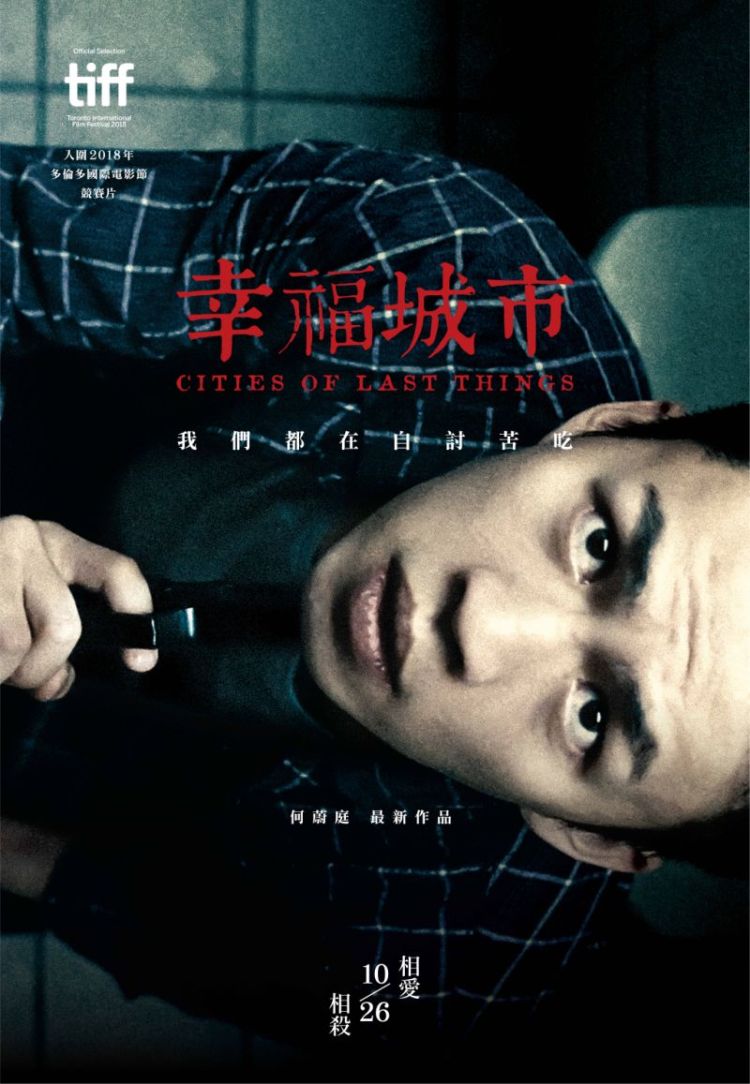
Cities of Last Things (幸福城市, Ho Wi Ding, 2018)

Cities of last things poster 1A sense of finality defines the appropriately titled Cities of Last Things (幸福城市, Xìngfú Chéngshì), even as it works itself backwards from the darkness towards the light. Still more ironic, the Chinese title hints at “Happiness City” (neatly subverting Hou Hsiao-hsien’s “City of Sadness”) but that, it seems, is somewhere its hero has never quite felt himself to be. Embittered by a series of abandonments, betrayals, and impossibilities, he grows resentful of the brave new world in which old age has marooned him. 

Ho opens with a bouncy, retro track advising that one should never be too generous with love only for a body to suddenly rain down from above. As we later discover, the body belongs to 60-something former policeman Dong-ling (Jack Kao) who has grown disillusioned with his futuristic, digital world, stubbornly smoking cigarettes and growing old gracefully while surrounded by vapers and ads for rejuvenating drugs. For reasons we don’t yet understand, he ventures into the red light district to buy a gun, punches his wife’s dance partner, and visits a hard-nosed sex worker who reminds him of a woman he loved and lost thirty years previously.

Love, guns, death and revenge become persistent themes for the older Dong-ling whose only bright spot seems to be a grownup daughter preparing to move abroad with her foreign boyfriend. Thirty years previously Dong-ling (Lee Hong-chi) too dreamed of running overseas. Consumed with rage on discovering his wife’s infidelity, he imagines himself killing her, her lover, and himself but settles only for a petty revenge against a colleague which exposes the entrenched police corruption he had refused to participate in, alienating his fellow officers. Bonding with a French kleptomaniac (Louise Grinberg) on the run from some kind of unresolved conflict with her father, he sees a way out only to have the door cruelly closed on him just as it was so many years before when he was just a teenager picked up for trying to steal a scooter.

In true film noir style, all women are perhaps one woman. Abruptly shifting tone in venturing into the recent past, we are introduced to Big Sister Wang (Ding Ning) – an embittered, disappointed femme fatale running out of road, hemmed in by the choices she has already made. She may already know there’s no way out for her, little needing the policeman’s warning that after her arrest everyone in gangland will assume she talked when they let her go, but she refuses to give in, repeatedly insisting on cigarettes and asserting her dominance while the unsympathetic policemen get on with their grim business.

Cornered, Ara, the shoplifting free spirit, decides to interrogate her interrogator, calling back to the later version of herself in asking why it is that prostitution is illegal. The policeman has no answer for her, save that he does not make the rules only follow them. Dong-ling too wanted to be a force of order, perhaps taking Big Sister Wang’s impassioned pleas to be a good person and not end up like her a little too much to heart. He follows the rules too closely for the comfort of his colleagues but finds himself dangerously exposed by an inability to regulate his feelings, a victim of toxic masculinity humiliated by his wife’s betrayal but unable to stand up to the corrupt superior who so casually closes down the only escape route he has been able to find.

The older Dong-ling is horrified by his daughter’s revelation that she lasered away a birthmark. How else can you recognise someone you lost long ago in the great wide world other than by a mark placed on them when they were born? His daughter rolls her eyes and reminds him that these days everyone is chipped, but there may be something in his rationale that everyone is marked at birth. Dong-ling is surrounded by handcuffs, self-driving vehicles, and locked doors. His fate is sealed, as we know, because we saw him fall, yet like Big Sister Wang he fought back only his resistance was violent and vengeful, abhorrent in its enraged pettiness. His is a tale of fatalistic resentment and of an existence consumed by a sense of hopeless abandonment, coloured only by a longing for lost love. Ho’s decision to end the film with its happiest moment, bright sunshine in place of rain soaked night, is ironic in the extreme but returns us to the grim serenity of the opening as the cheerful retro strains re-echo and Dong-ling catapults himself into a life of misery in the cities of last things where all hope is futile and all love loss. 


Screened as part of the 2019 London East Asia Film Festival, Cities of Last Things is also available to stream online via Netflix.

TIFF trailer (English subtitles)

Liu Wen-cheng – Don’t Be Too Generous About Love
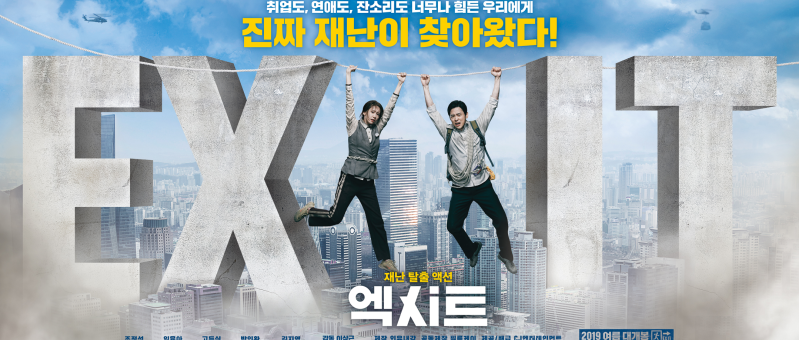
EXIT (엑시트, Lee Sang-geun, 2019)

Exit poster 2“Hell Joseon” manifests as “toxic gas” in Lee Sang-geun’s Exit (엑시트). Millennial “slackers” losing out in Korea’s increasingly cutthroat economy find themselves consumed by their own sense of failure while those around them only compound the problem by branding them useless, no-good layabouts, writing off the current generation as lazy rather than acknowledging that the society they have created is often cruel and unforgiving. Yet, oftentimes those “useless” skills learned while having fun are more transferable than one might think and the ability to find innovative solutions to complex problems something not often found in the world of hierarchical corporate drudgery.

30-something Yong-nam (Jo Jung-suk) spends his days in the park surrounded by grannies and has earned the nickname “IBM” – Iron Bar Man, for his athletic pursuits. The local kids have even come up with an origin story for him that his girlfriend must have died after falling off one and so now Yong-nam is some kind of “village idiot” with an overwhelming need to master the monkey bars. The truth is, however, that Yong-nam has nothing much of anything else in his life. His continual failures to find employment are an embarrassment to his family, and even his little nephew (Kim Kang-hoon) is so ashamed of him that he routinely blanks Young-nam in the street. With mum’s (Go Doo-shim) 70th coming up, everyone is very keen that Yong-nam look the part and try not to embarrass them.

Yong-nam is also quite invested in not being an embarrassment because the only reason he booked this fancy restaurant that’s a two hour drive away is that he’s heard his university crush Eui-ju (Im Yoon-ah) works there. Back in uni when they were both members of the rock climbing club, Yong-nam asked Eui-ju out but she was only interested in friendship so he started avoiding her out of embarrassment. Not really any more mature, he lies that he’s a high flying hedge fund manager rather than admit that his life has not been going well. Eui-ju, meanwhile, is the vice-manager of this events centre but shrugs the job off as not much better than part-time when in reality she’s really running the place while her sleazy boss (Kang Ki-young) who’s only in the position because it’s his dad’s company constantly sexually harasses her and shows no signs of taking no for an answer.

When toxic gas floods the city, however, the pair are instantly in their element. They know how to conjure makeshift stretchers from stuff that’s lying around and how to try and draw attention to yourself when you’re in need of rescue, but find their ideas dismissed by Yong-nam’s confused, conventional family members well used to ignoring crazy uncle Yong-nam. To survive they’ll have to trust him and his rock climbing prowess as he shins his way to the top of the building where salvation seems more of a possibility.

Crisis aside, Yong-nam lives in a world of constant anxiety where he’s forever receiving disaster alerts on his phone for things he never thought he’d have to worry about, and his mother spends her evenings diligently copying down ways to prevent cancer from TV documentaries. Yong-nam’s dad (Park In-hwan) would rather chill out with some soap operas, but it seems you can’t drown out existential dread with vicarious drama. Having more or less given up, Young-nam hasn’t even been going to his climbing club. After all, if you can’t get a foot on the ladder, what use is the ability to climb? “Our lives are the disaster” Yong-nam’s similarly troubled friend exclaims, but the sudden threat of toxic gas does at least give the dejected young man motivation to prove himself in demonstrating that his skills are useful, even essential, rather than frivolous or eccentric as his family members previously believed them to be.

Eui-ju, meanwhile, is kept in her place by a combination of sexism and the demands of a hierarchical society which prevent her from fulfilling her true potential by convincing her that she has to be polite to her odious boss. Teaming up with Young-nam, the pair work as equals and support each other as they try to find ways to survive. No damsel in distress, Eui-ju is finally able to take an active role in her own destiny while also making sure to save other people along the way, often at the expense of the pair’s own chance to escape.

In a loose moment, Yong-nam declares that he’s only applying for jobs in one of the shiny skyscrapers from now on because those guys probably got saved first, but in the end it’s their plucky never say die spirit which saves them, in more ways than one, as their exploits go viral with their millennial brethren who eventually motivate the drone squad to try and keep them safe. There may be no exit from Hell Joseon, but as Yong-nam and Eui-ju discover, you don’t have to listen when people tell you there’s no way out because the only way is up and you won’t know unless you go.


EXIT was screened as the opening night gala of the 2019 London East Asia Film Festival.

Original trailer (English subtitles)

An Inn at Osaka (大阪の宿, Heinosuke Gosho, 1954)

inn at osaka cap 2Heinosuke Gosho may be most closely associated with the Chekhovian interplay between laughter and tears, but what are you to do when life is so unutterably miserable that levity seems almost offensive? By 1954, many might have assumed that society was on the way to recovery, that the promises of the new democracy so proudly affirmed in the post-war constitution would be available to all paving the way for a freer and fairer society. Of course, that wasn’t quite the case and many found themselves trapped on the periphery of the burgeoning economic miracle in which unemployment was high and the bitterness of the times had led many to believe that human decency was a luxury they couldn’t afford.

Made a year after his renowned masterpiece Where Chimneys are Seen, An Inn at Osaka (大阪の宿, Osaka no Yado) is a much less cheerful affair in which suicide and degradation linger permanently on the horizon. The hero, Mita (Shuji Sano), has been exiled from Tokyo, demoted to the Osaka office after slapping his boss in argument over immoral business practices. Much reduced in circumstances, he has been unable to find a lodging house that suits his budget, the local barman lamenting that these days most of the hotels in the area have been co-opted by sex workers. Just at that moment, a dishevelled old man pops up and says he knows of a good place where the rent is reasonable and the innkeeper kind. As you might expect, it turns out that he works there. The innkeeper is his sister and though she is not particularly nice, the place is warm and friendly with three kindly maids – Orika (Mitsuko Mito) who is constantly pressed for money by her no-good husband, Otsugi (Hiroko Kawasaki) who is forced to live apart from her son, and “modern girl” Oyone (Sachiko Hidari) who is much younger and having a fling with the inn’s other longterm resident, Noro (Jun Tatara), a sleazy gentleman who likes to throw his weight around because he co-signed the loan on the hotel.

In one sense, the city of Osaka itself is being painted as a “fall” from sophisticated Tokyo, an earthier place where people do what they have to to survive. This Mita learns to his cost when drunken geisha Uwabami (Nobuko Otowa) picks up his “luxury English-made blanket” and peels off a thread which she burns to expose its smell. Wilier than the innocent Mita she tells him he’s been had, lamenting that it’s “Osaka’s shame” that they wilfully trick people from Tokyo. Mita is irritated, slightly hurt and embarrassed to have been deceived, but affirms that it hasn’t damaged his views on Osaka because in the present society everyone is being cheated by someone somewhere. In any case, he allows himself to be bamboozled by the innkeeper’s brother (Kamatari Fujiwara) into tracking down the teenage girl who sold it to him, Omitsu (Kyoko Anzai), who seems upset, explaining that she bought the blanket in good faith and has been tricked herself. During their visit, Mita notices that they’re in the middle of some sort of shamanistic ritual over the sickbed of her ailing father and feels pity for her but stops short of cancelling the debt there and then.

Not cancelling the debt even though he can see Omitsu never meant to trick him and cannot afford to pay him back, is part of his rather sanctimonious rebellion against the immoralities of the post-war society. He feels wronged and thinks that getting the money back for the blanket will somehow put things right, but like many of his attempts to help those in need it eventually backfires. Mita is a good man, compassionate and honest, but he’s also disappointingly conservative in ways he hasn’t quite realised. Uwabami, who has fallen in love with him, later chides Mita that he is like a star looking down on everything from above. He doesn’t quite understand what she means, failing to grasp that what she’s telling him is that though she can see that he cares, he has a tendency to view himself as somehow “better” than the world around him and lives in silent judgement of those he believes to be fundamentally different from himself.

After a brief argument, Uwabami confesses that she feels trapped and miserable in her impossible geisha existence, just trying to make enough money to survive when too old to ply her trade. She can’t quit because she’s responsible for her whole family – her younger brother has just been laid off from his railway job and his children will go hungry without her money. She provokes Mita a little, chastising him for not caring about her on a human level only for Mita to counter that he likes her but they live in “different worlds”. Disappointed, she laments that she thought they were the same, realising that Mita’s conception of the world is defined by ideas of middle-class respectability and that he views her as occupying a lower order, forever walled off from “decent” people like himself. Though he treats her warmly and regards her as a friend, there can never be anything more between them than that.

Omitsu later shows him something similar. Having scraped together some of the money to pay him back, she arrives at the inn only for Mita to try to refuse it. Otsugi offers her some sewing work for Noro who later takes advantage of her, gossiping with the maids that she was a “bargain”. To make matters worse, Omitsu gets caught on the way out and is berated by the innkeeper for bringing the hotel into disrepute. Mita starts to feel guilty. This is, after all, largely his fault – he pushed her about the blanket out of pettiness and brought her to the inn where she has debased herself to get back the money he took from her. He tries to return it but it’s already too late. “Why do you always insist on being good?” she asks him, partly offended that he won’t take her money because he now thinks it’s tainted by immorality. “I just want to trust in people” he tells her, beginning to realise that his well-meaning gesture is both patronising and futile because if he’d really cared about helping Omitsu, he could have done it before.

Mita is good person, but like everyone else he’s flawed and human. He genuinely wants to help, for the world to be better than it is, but in his goodness allows himself to be self-involved and insensitive. The reason he didn’t get fired from his job even for so great a transgression as slapping the boss, is that his grandfather founded the company. In an effort to break with the past, he decides to sell his grandfather’s expensive French pocket watch, but retains the chain as if unable to definitively sever the connection to his privilege. To prove that he’s done it for symbolic and not financial reasons, he spends the money taking Otsugi and Orika on a day trip to Osaka castle after Orika declines his offer of money of which she is in desperate need.

“Money’s everything, what happened to humanity?” Mita asks himself, still not quite aware of his position within the system. Mita refuses to conform to the demands of the post-war era as exemplified by his boorish boss who sneeringly asks if he’s a “socialist” while dismissing him as an “intellectual” and doing illicit backroom deals to get ahead, but he does so largely passively and with little more than resentment. At his farewell dinner, he reflects that had he not come to Osaka he might have quit his job but now he’s determined to stay and try to make things better. There might be something a little sanctimonious in his new found fire born of living among the poor now he’s on his way back to Tokyo, but he has perhaps awakened to his failings and is resolving to do better.

Meanwhile, the innkeeper finds the strength to break with the odious Noro, but unlike Mita decides to throw herself into the abyss of modernity by turning the hotel in a rent by the hour kind of place complete with Western beds and tacky decor. She too feels there are two kinds of people, refusing Otsugi time off to see her son, barking that “a dog doesn’t forget what it owes its master”, while Otsugi remains powerless, aware she’s entirely out of options as a young widow in the cruel post-war economy. Orika too gives up on changing her life after finding herself unable to separate from her no-good, drunken, violent, husband, while Oyone alone seems excited by the new job possibilities at the inn, and Omitsu, despite having coldly exclaimed that she’d do whatever it takes to survive, throws herself into “honest” work, unable to attend Mita’s leaving do because now her life is one of ceaseless industry which provides her no opportunity for rest. “None of us can say we’re really happy”, Mita laments, “let’s have the dignity to laugh in the face of unhappiness”. Everybody’s tired, everybody’s disappointed and afraid, but they haven’t lost their humanity and when there’s really nothing else, all you can do is laugh. 


Short clip (no subtitles)

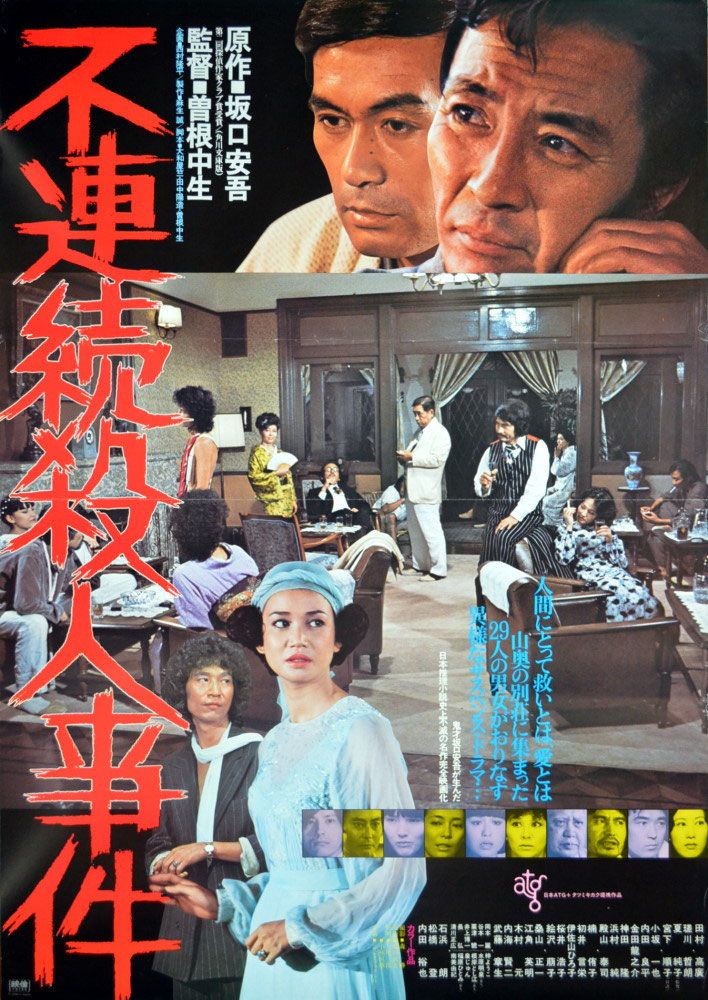
Case of the Disjointed Murder (不連続殺人事件, Chusei Sone, 1977)

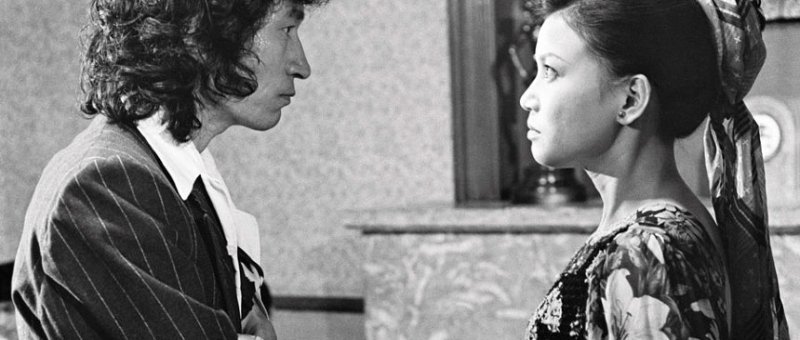
Case of the disjointed murders posterJapanese cinema of the 1970s fell hard for the prestige murder mystery. Following the success of The Inugami Family, an early and unexpected hit thanks to Kadokawa’s “innovative” marketing strategy, multi-cast detective dramas dominated the box office for the rest of the decade. Meanwhile, ATG had been known for serious and high-minded avant-garde cinema throughout the 1960s but its brand of left-leaning, politically conscious, arthouse-fare was tantamount to box office poison in the increasingly consumerist post-Asama-Sanso world. ATG’s Kindaichi-centric Death at an Old Mansion, updated to the present day, pre-dated Ichikawa’s series for Toho by a whole year and perhaps signalled their resignation to shifting into the mainstream. By 1977, that transition was perhaps complete with former Nikkatsu Roman Porno director Chusei Sone’s adaptation of a classic serial penned by Ango Sakaguchi, an author of the “Buraiha“ school well known for chronicling post-war aimlessness.

Set in the summer of 1947, Case of the Disjointed Murder (不連続殺人事件, Furenzoku Satsujin Jiken, AKA Unrelated Murder Cases) is a classic country house mystery in which a series of high profile writers are invited to a mansion owned by a wealthy family, the Utagawas. Only, as it turns out, many of the letters of invitation are forgeries or have been doctored so that several unexpected guests have arrived including dissolute artist Doi (Yuya Uchida) whose presence is particularly awkward because he is the former husband of the host Kazuma’s (Tetsuro Sagawa) new wife Ayaka (Junko Natsu). Soon enough, one of the guests is murdered, and then another, and still more, seemingly for no real reason. Amateur detective Kose (Kazuya Kosaka), one of the “unexpected” guests, tries to piece the crime together to prevent its expansion but finds himself outflanked by a lack of material evidence.

Sakaguchi’s original tale ran as a newspaper serial which promised a cash prize for anyone clever enough to identify the murderer(s) before the truth was revealed as it eventually is in true country house mystery fashion with the detective explaining everything in a lengthy monologue while all the interested parties sit around a dinner table. The gamified nature of the serial is perhaps the reason for the large cast of characters comprising of Utagawa family members, the literary house guests, and staff all of whom become mixed up in the ongoing crime drama which Kose comes increasingly to believe is engineered rather than random as it might originally seem.

The “supposed” random chaos of the the “unconnected” murders is a key part of Sakaguchi’s interrogation of post-war anxiety. For a time it seems as if these mostly quite unpleasant people have taken the opportunity of being trapped within a claustrophobic environment to air out their own grievances with each other in an atmosphere already tainted with violence and resentment. Meanwhile, the moral corruption of the Utagawa household continues to come back to haunt them in the sexual transgressions of the late grandfather who apparently fathered several illegitimate children in addition to those from multiple marriages. The half-siblings bring additional strife into the Utagawa home in Kazuma’s incestuous desire for his half-sister Kayoko (Hitomi Fukuhara) who returns his affections and even hopes to marry her brother, while he has also transgressed by “buying” Ayaka from her venal first husband Doi.

As in most Japanese mysteries, however, the motives for murder turn out to be banal – simply monetary greed and seemingly nothing more even if backed up by a peculiar kind of romanticism. Such unbound desire for riches is perhaps another symptom of the precariousness of the post-war world in which individual survival is all in a chaotic environment where financial security is more or less impossible for those not already born into wealth. Kose begins to solve the crimes through the “psychological traces” the killer(s) leave behind, the various ways in which “scenes” are calculated and contrived but fail to entirely mask the truth which lies behind them.

Which is to say that the mechanics behind the killings ultimately become secondary to their psychological import in which Kose analyses superficial relationships to uncover the depths which underpin them and their implications for a conspiracy of crime. This persistent amorality in which human relationships and connections are subverted for personal gain is yet another example of post-war inhumanity in which the corruption of the war has destroyed the “innocence” of pre-modern Japan and provoked nothing more than a moral decline born of a confused anxiety and a generation struggling to adjust itself to a new reality.

Death at an Old Mansion aside, the ‘70s mystery boom had a peculiar obsession with post-war crime in the comparative comfort of the economic miracle. 30 years on, society was perhaps ready to ask more questions about an intensely traumatic moment in time but equally keen to ask what they might say about another anxious moment of social change only opposite in nature. No longer quite so burdened by post-war regret or confusion, some began to wonder if consumerism was as dangerous as poverty for the health of the national soul, but nevertheless seem content to bask in the essential cosiness of a country house mystery in which the detective will always return at the end to offer a full and frank explanation to a roomful of compromised suspects. If only real life were so easy to explain.


Original trailer (no subtitles)

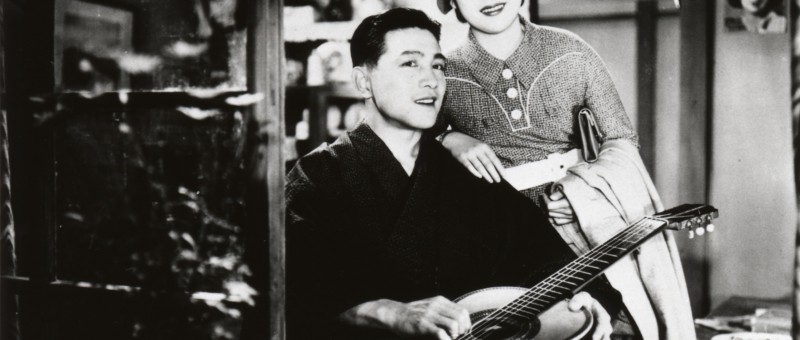
Eternal Heart (不壊の白珠, Hiroshi Shimizu, 1929)

Eternal Heart still 1

Hiroshi Shimizu is most often remembered for his sensitive depictions of childhood, but his career, which spanned more than 160 films many of which are presumed lost, was much more varied than might be assumed. His earliest completely extant feature, 1929’s Eternal Heart (不壊の白珠, Fue no Shiratama, AKA Undying Pearl), is a case in point. Set in the heady days of early Showa long before militarism took hold, Eternal Heart bears early witness to Shimizu’s distrust of romantic solutions as its wounded protagonists are forced to accept that they have lost out in the great game of love and there’s nothing they can do about it except learn to endure their sadness.

The heroine, Toshie (Emiko Yagumo), is an earnest young woman working as a typist. She has developed a crush on a nice young man, Shozo (Minoru Takada), who works at the same company but unfortunately for her, her “modern girl” sister Reiko (Michiko Oikawa) has taken a liking to him too. To Reiko, Shozo is just one of the guys she likes to string along, but to the seriously minded Toshie he’s the only man she’ll ever love. Plucking up the courage, Toshie writes a cryptic note asking to talk to Shozo about something important and has it sent to him in the interoffice mail to avoid the embarrassment of giving it to him directly. In a spectacular case of bad timing, however, she discovers that Shozo has proposed to Reiko. He thinks the letter is about the possible marriage and that perhaps Toshie is worried he’s not a suitable person to become her brother-in-law, never dreaming that Toshie herself meant to declare her love to him. Hugely embarrassed, Toshie does not handle the situation well but agrees to put a good word in with her mother, after all she does think that Shozo is the best of men and so could never speak ill of him.

The marriage is agreed and Toshie tries to make her peace with it, only to have some kind of episode at the wedding party that leaves Shozo feeling guilty, as if he might have somehow alienated his new sister-in-law. Meanwhile, Toshie also receives the solicitous attentions of the company’s boss, Katayama (Arai Atsushi), a middle-aged widower with three children who makes a clumsy pass at her in the coach home but later apologises and embarks on a more appropriate style of courtship.

The irony is that Shozo and Toshie are actually perfectly suited, only he never saw her because he was distracted by her sister’s modern sparkle. It would be easy enough to see the contrast between the two women as one between tradition and modernity, Toshie the perfect exemplification of traditional Japanese values and her sister the avarice of the flapper generation, but the distinction is more nuanced than it might at first seem. Despite her presentation as a “traditional” woman, Toshie is more progressive than her sister in that she has made a free choice to be a working woman and takes her job seriously, quickly becoming irritated by those who don’t, whereas Reiko is never in search of direct independence only of the freedom to move between one man of means and another. Toshie wants real love, but also her independence and perhaps does not feel that one must necessarily conflict with another.

While the relationship between Shozo and Reiko sours as she becomes bored with his niceness and lack of consumerist avarice, Toshie finds herself filled with hostility towards her former object of affection and consenting to date Katayama partly in romantic rebound. Though he eventually turns out to be a little nicer than that first unpleasant incident in the taxi might have suggested, Toshie cannot escape the sense of social inferiority which keeps her in a subordinate position to a man who ought, in her view it seems, to be her equal if they were married. On an abrupt visit to his family home, she finds herself waiting in the hallway where Katayama’s precocious son (Shoichi Kofujita) mistakes her for the new maid, while his daughters and nieces, dressed in the modern style, openly mock her for being a career woman, suggesting that “typist” is a synonym for “loose woman” while Katayama fails to help the situation by countering only that “some of them are decent”. In response, Toshie calmly and confidently reaffirms that she is proud of her job and ashamed of nothing, only for the kids to chime in with a show of banging a keyboard as if it were something that a baby could do for amusement and little more than noisemaking.

Toshie leaves humiliated, but seemingly continues seeing Katayama at least superficially. It’s at this point she re-ecounters Shozo, who now has something important he wants to discuss with her. Having married Reiko believing her to be playful and innocent, Shozo has awoken to her coquetry and figured out she’s been going on drives with the moustachioed man we saw her glare at on the train on her honeymoon. The implication is that Reiko is only dating the other guy, whom she knows to be married with children, because he has a fancy car – something Shozo showed no interest in getting even if he had the money because like Toshie what he wanted was love. Shozo is understandably hurt and angry but wants to reconcile. Toshie vows to help him, overcoming her timidity to head into one of the modern bars frequented by her sister to convince her to come home, which she does but only to collect her things. Reiko claims that it’s Shozo who is being “selfish” for asking about her life before their marriage. In that she might have had a point, but it’s not something Shozo particularly cared about and he is not in that sense jealous only confused and embarrassed. Reiko refuses to accept her role as a wife, but unlike Toshie she never means to be independent and decamps to the home of her married lover, presumably intending to live off him until something better comes along.

In that sense, Reiko’s “modernity” is not so much the problem as her innate selfishness which the modern world perhaps enables. Reiko, amoral, claims her individuality by reserving the right to do as she pleases ignoring both social convention and other people’s feelings. She married Shozo because he was kind of a catch only to grow bored with him and wonder if she might do better. Toshie, meanwhile, nurses her broken heart with as much grace as she can manage, desperately trying to save her sister’s failing marriage in order to preserve Shozo’s happiness more than to avoid the scandal of marital breakdown. Despite his disillusionment with Reiko’s Westernised “modernity” Shozo finds himself considering emigrating to America in order to escape his heartbreak, resolving that a separation would be “socially unacceptable” and hoping that Reiko will continue to live as “Mrs. Narita” at least superficially even in his absence. Toshie loses Shozo twice. Having married her sister there was no longer any way for her be with him other than as a relative, but now she must watch the pearl her sister cast aside sail away from her never to be seen again. United only in heartbreak they part, Toshie selflessly reflecting on Shozo’s sadness rather than her own, but in even in the midst of her disappointment she stands stoically alone, independent and self-possessed like truly “modern” woman.


Tsukigata Hanpeita (月形半平太, Kokichi Uchide, 1952)

Tusgikata Hanpeita still 1In the midst of post-war confusion, Japanese cinema increasingly looked back to Meiji in all of its chaotic possibility in order to ask what went wrong and what lessons it might have for a second kind of revolution as the nation tried to rebuild itself after decades of militarist folly and chastened wartime defeat. “Tsukigata Hanpeita” (月形半平太) is a “legendary” fictional character first imagined for a kabuki play in 1919 who finds himself swept up in Bakumatsu intrigue as he tries, along with daring revolutionaries Sakamoto Ryoma and Katsura Kogoro, to forge an alliance between the clans of Choshu and Satsuma in order to take on the corrupt shogun in defence of the Emperor and foster a new era of peace in an increasingly uncertain world.

When we first meet him, Tsukigata Hanpeita (Utaemon Ichikawa) is on the run from Kyoto-based special police force the Mimawarigumi but also making time for his mistress, Umematsu (Chizuru Kitagawa) – a geisha. This in particular is a problem which has left him dangerously exposed, even the Mimawarigumi leader Okudaira (Joji Kaieda) seems to be aware of the relationship and is apparently not above using it to his advantage. Meanwhile, he’s not only threatened by shogunate defenders, but by his own side – both by those who remain unconvinced by Sakamoto’s (Jotaro Togami) internationalist philosophy, and by those who simply hold a grudge against Satsuma because of a previous conflict and regard Tsukigata as a traitor for daring to talk to them at all. Despite everything, Tsukigata hides in the shadows and commits himself to living, and if necessary dying, to bring about a better world free of shogunate oppression.

Unlike other revolutionary legends, however, Tsukigata’s fervour has not made him cold or cruel even if he must sometimes act in ways which are mysterious and confuse those around him. Meeting a young man on a bridge, he applauds his studious nature, agreeing that “nothing is more important than to understand advanced civilisation”, and is as polite as he could be when the man tells him he has just joined the Mimawarigumi. Rather than attack or berate him, Tsukigata cheerfully wishes the young man well, allowing him the space to see that his present allegiance to the shogunate is perhaps misguided and out of line with his personal beliefs.

Indeed, his compassion extends even to Okudaira – his mortal enemy. Offering his condolences to a grieving Somehachi (Isuzu Yamada), Tsugikata laments that in a better world he and Okudaira may have been friends, that he had no personal grudge against him despite the fact that they clearly lived on different sides of an ideological divide. He could perhaps even harbour a kind of professional respect for him in his dogged defence of his duty for all he believes it to be misguided. “It’s so unfortunate”, he exclaims, “We have to make the world a better place”.

His desire to change the world is what keeps Tsukigata alive. Several times he faces certain death, but declares but he cannot die now with his great work left unfinished. He is not afraid of death and would gladly give his life in the service of his cause, only not just yet. “Would you please spare my life until I change the world?” he begs of someone he fully believes has a right to kill him, eventually winning their support and unexpected allegiance solely through his guileless goodness.

Yet for all that, his moral austerity does at times perhaps cause him problems in giving rise to emotional confusion. So it is that he winds up in an accidental love triangle with the smitten Somehachi – a former geisha turned madam whose patron is none other than Okudaira, and Umematsu an ageing courtesan with whom he has developed a more or less settled relationship. This is clearly the story of Tsukigata Hanpeita, but more than that it’s the story of the three women who support him without whom the revolution may even be impossible. Somehachi, despite her allegiance to Okudaira, has been a longstanding Tsukigata ally several times helping him escape from the oncoming Mimawarigumi, while Umematsu provides him with safe harbour and occasional message carrying services which is where teenage geisha Hinagiku (Hibari Misora) comes in, acting as a revolutionary go-between with deep-seated political passion.

Speaking strongly of female solidarity, the fallout from the love triangle is eventually minimised by the sisterly geishas who later bond in their shared support of Tsukigata and resolve to put past pettiness behind them. Meanwhile, Tsukigata is deceived by male treachery, only to finally receive the message he’s been waiting for which seems to make everything worthwhile. “I can see the dawn of a new era”, he exclaims, “the new era will be peaceful”. Suddenly he’s not just talking of himself anymore, but directly to the post-war era as he begins to see the way out of a “chaotic society” towards a prosperous future in the faces of his friends united in mutual support and the belief that his better world will soon be a reality.


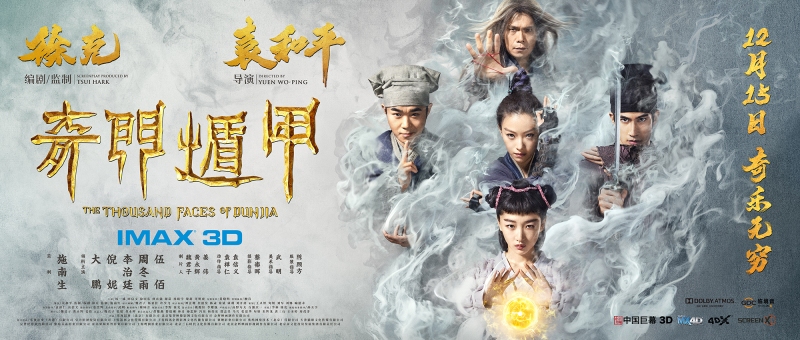
The Thousand Faces of Dunjia (奇門遁甲, Yuen Woo-ping, 2017)

Thousand faces of Dunjia poster 6The Dunjia has a thousand faces. Or maybe not. Yuen Woo-ping teams up with Tsui Hark for a “remake” of Yuen’s 1982 classic The Miracle Fighters retitled The Thousand Faces of Dunjia (奇門遁甲, Qíméndùnjiǎ), only it isn’t much of a remake at all and simply pinches the idea of supernaturally-charged heroes fighting for justice which, it has to be said, is hardly original or at least not enough to justify Tsui’s claim that the two films are linked by a desire to push the boundaries of the wuxia film. Nevertheless, Yuen does his best to craft a tale of brotherhood and rebirth for his noble warriors newly re-energised by a life-giving phoenix, but struggles under the weight of an otherwise incoherent narrative.

So, in fantasy medieval China, the land is beset by a stealth invasion from otherworldly powers. Our heroes, the Wuyin clan, are the last line of defence against the increasingly powerful alien marauders. In order to beat them, they need to unlock the mysterious power of Dunjia, which, according to a prophecy, can only be done by a very specific person. Accordingly, the clan’s “big brother”, Zhuge (Da Peng), has gone out looking. Unfortunately, not everyone is convinced by what he brings back – a young woman he found in some kind of institution who has a childish, ethereal quality and a surprising ability to suddenly morph into a giant colourful phoenix.

Yuen opens with a brief discussion of Qimen and the Dunjia which seems to have something to do with interdimensional co-ordinates but truth to tell it turns out not to be very important. The main thrust is that weird alien beings have been living amongst us for centuries and are quietly waiting for us to die out so that they can inherit the Earth. Only some of them have lost patience. The aliens might be about to get their hands on a world destroying device, something the Wuyin are desperate to prevent but the aliens keep using their abilities against them and their prospects look increasingly hopeless.

With the narrative in disarray, Yuen relies on the camaraderie between the members of the Wuyin to carry the film (which it largely does). There’s history between the de facto leader Dragonfly (Ni Ni) and healer Zhuge despite the Wuyin’s increasingly silly code which forbids affection between comrades and punishes it with mutual slapping. Accordingly the pair spend most of the film bickering while conflicted by the arrival of romantic rivals in the form of the mysterious Circle (Zhou Dongyu) and an earnest young policeman, Dao (Aarif Lee), who keeps stumbling on the activities of the Wuyin but has his memory wiped to prevent the truth getting out. Despite the plot holes and inconsistencies, the Wuyin are an intriguing bunch who do their best to earn our sympathies even whilst shouldered with a series of incomprehensible events.

Incomprehensibility is not necessarily a problem in a wuxia film, in fact it can sometimes be an asset, but the concept is continually let down by over reliance on poor quality CGI and bland production design. Yuen opens with an engaging, if surprisingly cutesy, sequence of Dao and Dragonfly enjoying a (re)meet cute while chasing a giant three-eyed fish through the streets of an ordinary city, but despite the resurgent beauty of Circle’s colourful phoenix the cartoonish battles between soulless alien mecha giants largely fail to convince.

Cartoonish though it may be, there is charm in Dunjia’s lowbrow humour as the gang bicker amongst themselves and engage in a comically romantic tug of war. Yuen breaks the tale into a series of chapters as if mimicking an old fashioned wuxia serial and there is certainly a strain of meandering fairytale nonsense in the film’s refusal to pick a direction and follow it even if it takes things too far with an all too abrupt ending designed only as an inelegant hook for an upcoming sequel. Ironically enough, Dunjia is a film about coming “full circle” and then being reborn anew like a phoenix from the flames but pushes itself too far in threatening to set the wheel turning again just when it ought to be hitting its stride. Flawed but intermittently entertaining, the first adventure fo the Wuyin clan is off to a rocky start but sheer charisma alone may be enough to ensure repeat custom.


Currently available to stream in the UK (and possibly other territories) via Netflix.

Original trailer (English subtitles)

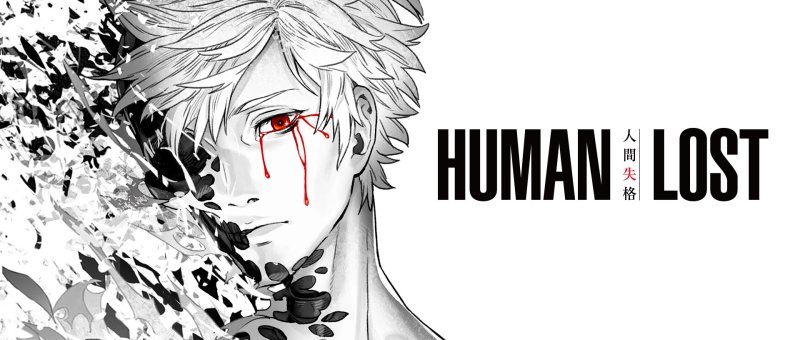
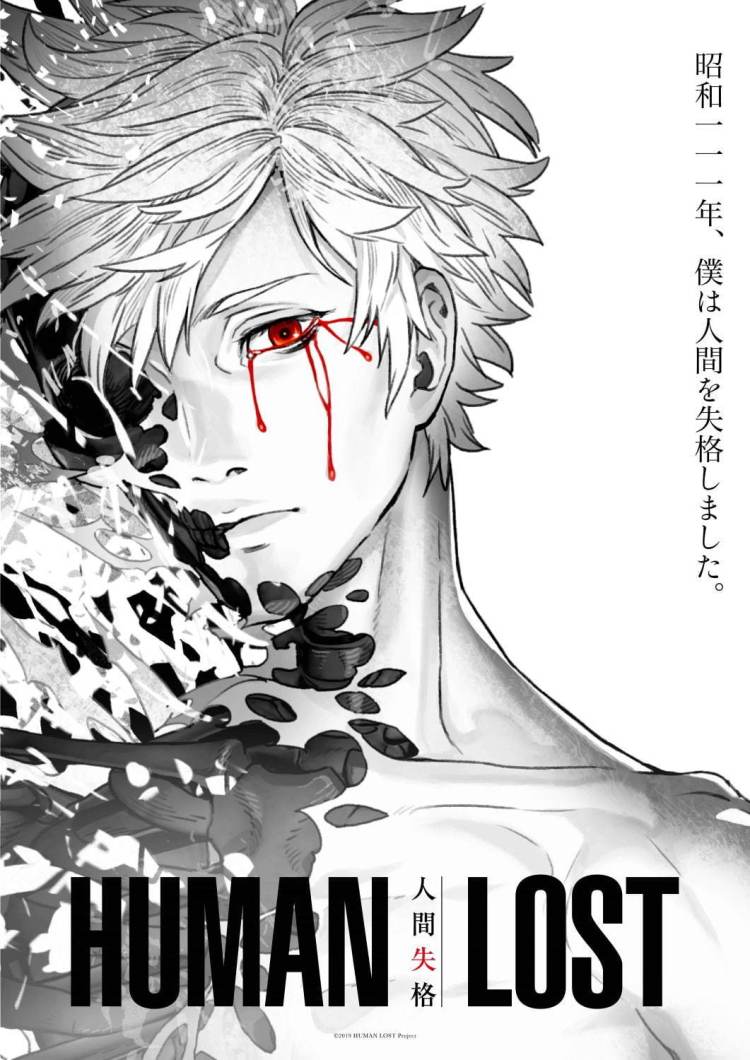
Human Lost (人間失格, Fuminori Kizaki, 2019)

Human lost animeOsamu Dazai’s 1948 masterpiece No Longer Human spins a tale of intense alienation in which a young man unable to connect with the world around him feels himself obliged to put on a mask of buffoonery. Years of trying and failing to fit in eventually take their toll. After meeting a man who turns out to be a bad influence in a painting class, he drifts into a life of dissipation and is committed to a mental institution. After his release, the hero reflects on the harm his actions have caused to others and declares that he is “no longer human”, electing to live a life of isolation rather than risk hurting anyone else.

Human Lost (人間失格, Ningen Shikkaku) is about as loose an adaptation as it’s possible to be, taking only the outlines of Dazai’s original and springing off from the midway point in which the protagonist, Yozo Oba (Mamoru Miyano), is living as a starving, drug addicted artist above a seedy bar. The year is Showa 111 (2036). A series of momentous advances have made natural death a thing of the past and thanks to the S.H.E.L.L. system suffering from disease has been eliminated. However, the future has not been equally distributed and while a cohort of increasingly elderly men and women rule the elite “Inside” as a kind of oligarchy, an oppressed underclass has formed on the outskirts of the city, their “immortal” bodies continually exploited in order to prop up the Inside economy but forever denied the full benefits of system they are prevented from accessing in its entirety.

Meanwhile, those who wilfully disconnect descend into a kind of monstrous barbarity becoming what is known as a “Lost”, a threat to “civilisation” which much be combatted by H.I.L.A.M. – a military organisation which exists to ensure the survival of the S.H.E.L.L. system. When Oba is dragged along by his childhood friend Takeichi (Jun Fukuyama) on a revolutionary raid instigated by the mysterious Masao (Takahiro Sakurai) targeting the Inside, he comes into contact with Yoshiko (Kana Hanazawa) – a young woman who deeply believes in the benefits and possibilities of the S.H.E.L.L. system, convinced that a utopian world in which its benefits are available to all will eventually come to pass.

What ensues is a battle between Yoshiko’s pure hearted idealism, Oba’s despair-fuelled cynicism, and Masao’s embittered nihilism in which he seeks to destroy the S.H.E.L.L. system and “reset” humanity to its original condition. Masao believes that humans need death in order to be human and that its absence from the modern world is an aberration which must be corrected at all costs. He encourages Oba and Takeichi to “take back” their “true form” as a revolutionary act designed to provoke the advent of a saviour who can help him destroy a system he himself created out of love but which later failed him. 

In an ageing society such as Japan’s, it’s impossible to ignore the subtext of a world in which the elderly cling on to power well beyond their right and relegate the young and healthy to a kind of underclass as a consequence. While some humans are “qualified” and afforded special rights, others are labeled as “unqualified” and exist in a kind of underworld locked out from the benefits of a modern society. As Masao points out, those who call themselves “happy” largely do so because of the S.H.E.L.L. system’s programming, while the only truly “free” are those like Oba and Takeichi who wilfully reject it and live a life of suffering.

Of course, Masao exploits them too. He brands Oba his Orpheus, but ironically forgets that the thing everyone knows about Orpheus is that his faith was weak and so he looked back and lost. Yoshiko sacrifices herself for Oba’s potential, further adding to Masao’s awkward metaphor as he declares that “the fate of this woman is to be used”, pushing Oba towards dragging her back from the hell they maybe creating together. Unlike Dazai’s original novel in which the hero is consumed by his sense of otherness and opts for self-exile, Human Lost finds a more positive solution in which Oba commits himself to fighting for Yoshiko’s better world where health and happiness are gifts given to all and not just a privileged few. A mild critique of a hierarchical, inherently unequal society Human Lost makes a passionate plea for idealistic utopianism over introverted despair while suggesting that technological advances set us free only when we share them freely.


Human Lost screens in select US cinemas on Oct. 22 (subtitled) and 23 (dubbed), and in Canada on Nov. 6 (subtitled) and 9 (dubbed) courtesy of Funimation. Check the official website to find out where it’s playing near you!

Original trailer (English subtitles)

Wife! Be Like a Rose! (妻よ薔薇のやうに, Mikio Naruse, 1935)

Wife be like a rose posterIt’s tempting to view the cinema of the 1930s as a gloomy affair, facilitating the rise of militarism and increasingly at mercy of the censors, but the early sound era was nothing if not playful and generously open to international influences. It was also often surprisingly progressive, evidencing the fact that pre-war Japan was also changing or, at least, that there was an appetite for change especially among the young. Mikio Naruse’s delightfully charming (perhaps uncharacteristically so) comedy, Wife! Be Like a Rose! (妻よ薔薇のやうに, Tsuma yo bara no yo ni) dramatises just this change as its modern girl heroine tries to process the definitive end of her parents’ relationship as she prepares to marry.

Kimiko (Sachiko Chiba) has a job in an office which is more or less supporting herself and her mother seeing as her father, Shunsaku (Sadao Maruyama), left the family over 15 years previously and has been living with former geisha with whom he has two other children. Despite his long absence, Kimiko’s mother Etsuko (Toshiko Ito) has continued to pine for her absent husband and makes a little money on the side writing sad love poems for the newspapers. A request to stand as a go between at a wedding, traditionally a role only performed by married women, forces Etsuko to accept that she has been abandoned but the snag is that Kimiko and her boyfriend Seiji (Heihachiro Okawa) want to get married themselves and so his father wants to meet Kimiko’s dad which is obviously a problem.

Despite her “modern girl” appearance, Kimiko has some quite old fashioned ideas. She looks down on her maudlin mother, believing that she’s brought her apparent romantic heartbreak on herself through being a bad wife. Etsuko never seemed very interested in Shunsaku when he was around and never did any of the little wifely things Kimiko thinks a wife ought to do like vacuous chat and helping her husband change out of his work clothes. Kimiko thinks a good wife “acts childish and cajoling, or jealous sometimes, or motherly and protective”, believing that Etsuko knows this and has the ability to play the part of the ideal spouse but refuses to and therefore has only herself to blame. Kimiko’s uncle (Kamatari Fujiwara), however, corrects her. He piles the blame on the irresponsible Shunsaku who ran out on a wife and daughter to shack up with geisha.

Shunsaku, meanwhile, may be irresponsible in one sense, but perhaps it’s equally irresponsible to stay in an unhappy marriage. Now a gold prospector in the mountains, he is poor and unsuccessful but has built a happy family home with a kindly wife and two sweet children. Kimiko’s desire to drag him back to the city is partly practical in that she needs him to be her father so she can marry Seiji, but there’s also a part of her that thinks that her father’s transgression must be corrected by forcing him to resume his paternal role. Unlike Etsuko, however, Oyuki (Yuriko Hanabusa) is the classically “good” wife and Kimiko can’t deny she’s good for her father. Seeing him in the mountains and remembering him at home, Kimiko begins to realise that it would be wrong to take him away from his new family even if she thinks she has the better claim, especially when she finds out that it’s Oyuki who’s been sending her mother maintenance cheques every month for the past few years.

In fact, Oyuki feels so guilty about stealing Shunsaku away that she’s been putting money aside to pay for Kimiko’s wedding/education while keeping her own daughter home from school. Far from the gold digger Kimiko had assumed her to be, she’s been the one supporting the feckless Shunsaku as he pursues his get rich quick dream of gold prospecting. Realising that the pair of them “act in perfect harmony”, Kimiko comes to the conclusion that her father belongs in the mountains but finds her resolve wavering after returning to civilisation. She begins to wish he’d stay and hatches a plan to get her parents back together only to see how out of sync they are after 15 years apart. They swap pleasantries like strangers, and the mild-mannered Shunsaku visibly shrinks in the presence of the shrewish Etsuko who allows her pride to ruin any attempt at reconciliation.

What the modern girl Kimiko discovers is that sometimes things don’t work out like they’re supposed to, and that’s OK. Though it is in one sense a “happy” ending in that it obeys a justice born of human feeling, it’s also a melancholy moment of defeat both for the lovelorn Etsuko who has, as Kimiko says “lost”, and the now resigned Kimiko who harbours a degree of contempt towards her mother for not fighting harder for love. Standing at a crossroads of modernity, Kimiko looks both forward and back. She vows to be a “good wife” but her foundations have been shaken. Is this tragedy, or farce? She asks herself. It’s almost impossible to say.


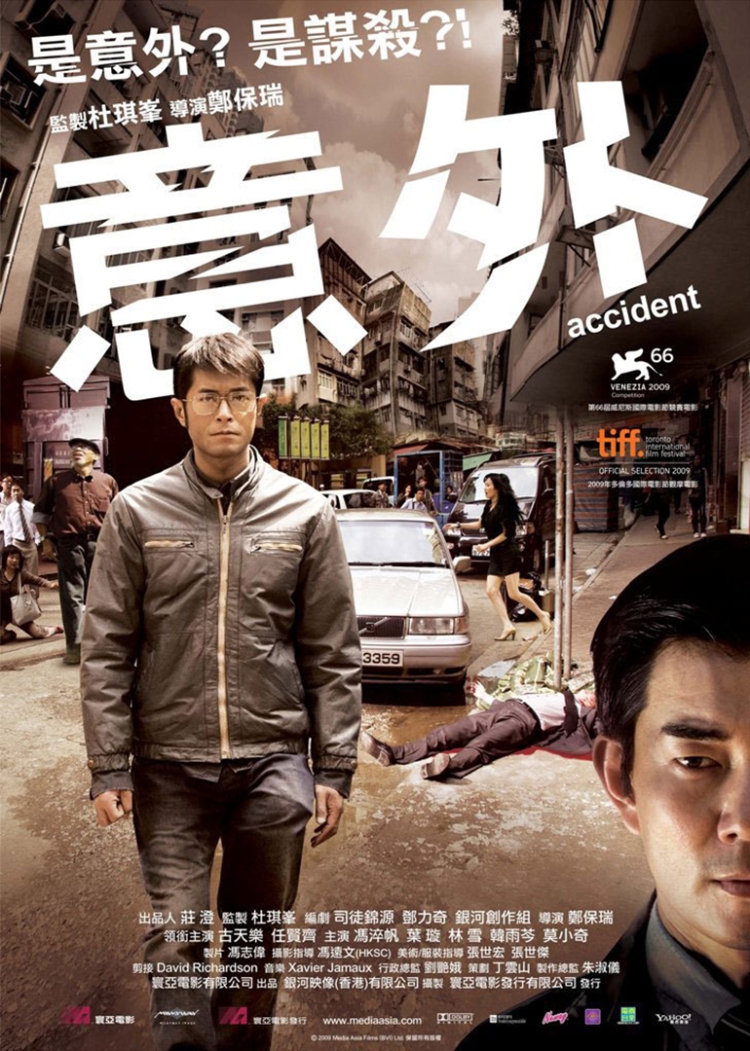
Accident (意外, Cheang Pou-Soi, 2009)

Accident poster 1Is an accident ever really just an accident? The cosmos may be conspiring against us, but one can’t rule out a man-made conspiracy in a world as venal and corrupt as ours has become. Riffing off The Conversation, Cheang Pou-Soi’s The Accident (意外) stops to ask if you really do reap what you sow or if you merely think you do as its increasingly paranoid hero attempts to manipulate fate for his own ends only to find himself encircled by a net of his own making.

The Brain (Louis Koo Tin-lok) is the head of a very particular gang. A hitman of sorts, he specialises in untraceable crimes, choreographing elaborate pathways to death that appear indistinguishable from accidents. He knows that he is not the only such orchestrator of endings and that he has likely made enemies and rivals as a result of his activities and so is extraordinarily careful when it comes to the execution of his work.

It is, therefore, a concern when a bug appears in a routine job. Uncle (Stanley Fung Shui-fan), the oldest member of the team, drops a cigarette butt. It might seem like a small thing, but it makes a mark and leaves a little piece of Uncle at the crime scene – a tiny fragment that could become a part of a larger whole exposing the entire enterprise. The Brain is so careful that he even uses a hankie to funnel change into the bus driver’s ticket box, but he’s known Uncle a long time and is loath to cut him loose for a “minor” infraction even if the buzzing in the back of his head reminds him that maybe Uncle’s lapse of judgement wasn’t mere sloppiness.

A man attempting to live with tragedy by imposing order on a chaotic world, The Brain’s sense of cosmic coherence begins to unravel after the next job goes horribly wrong. Someone is plotting against him and one (or more) of the team must be in on it. He tracks his mark to an insurance broker (Richie Jen Hsien-chi) who is his mirror image in every respect as another gambler against the random, spies on him, and almost becomes him in installing himself in the apartment beneath his and literally tracking his every move thanks to a madman’s map on the ceiling and some carefully placed bugs.

Yet, is his assumption right? This could all just be a series of coincidences ranging from an old man’s dementia, to inauspicious weather, and unforeseen tragedy. The Brain, however, needs to believe in his own primacy of agency, that there are no “coincidences” and everything that befalls him is a product of his own actions. He wants revenge – against the man he believes has deliberately punctured his carefully controlled world, but also against the universe itself and the various ways it has misused him.

Fate, however, has other ideas and history later repeats itself with relentless and horrifying cruelty. The Brain, perhaps himself wandering into an “accident” of his own making, chases death in his double who finds himself touched by The Brain’s curse – uncertain yet convinced that he has been the victim of more than circumstance and vowing revenge on the (presumed) orchestrator of his fate, becoming just as strung out and paranoid as The Brain himself.

Produced by Milky Way, Accident does indeed share something with To’s whimsical worldview in which it is the random, inexplicable acts of chance which govern our lives. Fate cannot be outrun or out-thought, there is an accident waiting for all of us (who are each products of the accident of birth). Free will is an illusion, and The Brain will pay a heavy price for the depth of his faith its efficacy and rebellion against a chaotic universe through his attempt to use its propensity for random chance against it and for his own ends. A heady mood piece filled with the intense anxiety of existential unease, Cheang Pou-Soi’s perfectly crafted chronicle of a fragmenting consciousness spinning ever deeper into an entropic well of self-destruction is as melancholy an encapsulation of the human condition as one may hope to see as its hero battles valiantly against the inevitable while secretly perhaps longing to lose, like a degenerate gambler betting against fate.


Currently streaming via Netflix in the UK (and possibly other territories).

Original trailer (Cantonese with Traditional Chinese & English subtitles)