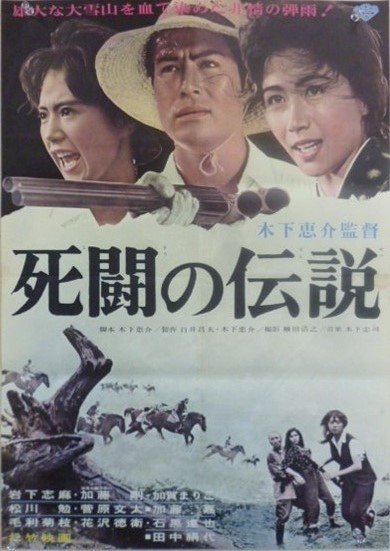
A Legend or Was It? (死闘の伝説, Keisuke Kinoshita, 1963)

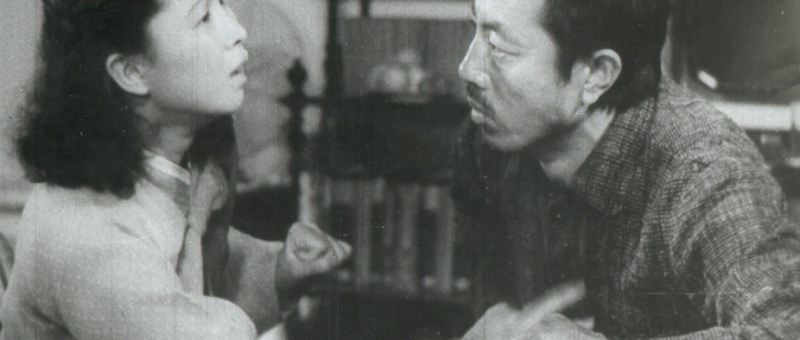
A Legend or Was it posterIn 1951’s Boyhood, Kinoshita had painted a less than idealised portrait of village life during wartime. With pressure mounting ranks were closing, “outsiders” were not welcome. The family at the centre of Boyhood had more reasons to worry in that they had, by necessity, removed themselves from a commonality in their ideological opposition to imperialism but newcomers are always vulnerable when they find themselves undefended and without friends. 1963’s A Legend or Was It? (死闘の伝説, Shito no Densetsu, AKA Legend of a Duel to the Death) tells a similar story, but darker as a family of evacuees fall foul not only of lingering feudal mores but a growing resentment in which they find themselves held responsible for all the evils of war.

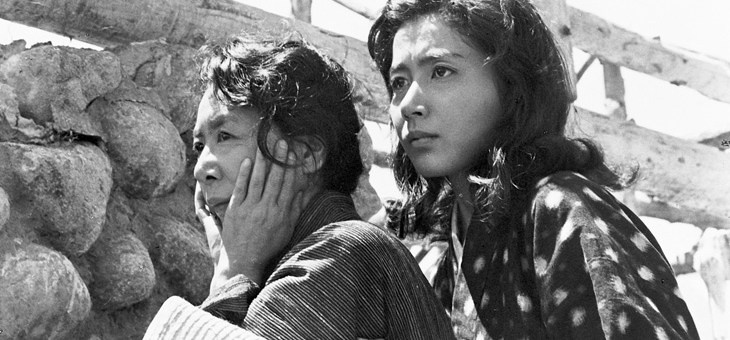
Beginning with a brief colour framing sequence, Kinoshita shows us a contemporary Hokkaido village filled with cheerful rural folk who mourn each other’s losses and share each other’s joys while shouldering communal burdens. A voice over, however, reminds us that something ugly happened in this beautiful place twenty years previously. Something of which all are too ashamed to speak. Switching back to black and white and the same village in the summer of 1945, he introduces us to Hideyuki Sonobe (Go Kato) who has just come home from the war to convalesce from a battlefield injury. Hideyuki’s engineer father went off to serve his country and hasn’t been heard from since, and neither has his brother who joined the air corp. His mother (Kinuyo Tanaka), sister Kieko (Shima Iwashita), and younger brother Norio (Tsutomu Matsukawa) have evacuated from Tokyo to this small Hokkaido village where they live in a disused cottage some distance from the main settlement.

The family had been getting by in the village thanks to the support of its mayor, Takamori, but relations have soured of late following an unexpected marriage proposal. Takamori’s son Goichi (Bunta Sugawara), a war veteran with a ruined hand and young master complex, wants to marry Kieko. She doesn’t want to marry him, but the family worry about possible repercussions if they turn him down. It just so happens that Hideyuki recognises Goichi and doesn’t like what he sees – he once witnessed him committing an atrocity in China and knows he is not the sort of man he would want his sister to marry, let alone marry out of fear and practicality. Hideyuki, as the head of the family, turns the proposal down and it turns out they were right to worry. The family’s field is soon vandalised and the police won’t help. When other fields meet the same fate, a rumour spreads that the Sonobes are behind it – taking revenge on the village on as a whole. The villagers swing behind Goichi, using the feud as a cover to ease their own petty grievances.

City dwellers by nature, the Sonobes have wandered into a land little understood in which feudal bonds still matter and mob mentality is only few misplaced words away. The village serves a microcosm of Japanese society at war in which Takamori becomes the unassailable authority and his cruel son the embodiment of militarism. Goichi embraces his role as a young master with relish, riding around the town on horse back and occasionally barking orders at his obedient peasants, stopping only to issue a beating to anyone he feels has slighted him – even taking offence at an innocuous folksong about a man who was rejected in love and subsequently incurred a disability. Despite all of that, however, few can find the strength to resist the pull of the old masters and the majority resolutely fall behind Goichi, willing to die for him if necessary.

As the desperation intensifies and it appears the war, far off as it is, is all but lost, a kind of creeping madness takes hold in which the Sonobes become somehow responsible for the greater madness that has stolen so many sons and husbands from this tiny village otherwise untouched by violence or famine. An embodiment of city civilisation the Sonobes come to represent everything the village feels threatened by, branded as “bandits” and blamed for everything from murder to vegetable theft. The central issue, one of a weak and violent man who felt himself entitled to any woman he wanted and refused to accept the legitimacy of her right to refuse, falls by the wayside as just another facet of the spiralling madness born of corrupted male pride and misplaced loyalties.

Kinoshita returns to the idyllic countryside to close his framing sequence, reminding us that these events may have been unthought to the level of myth but such things did happen even if those who remember are too ashamed to recall them. Tense and inevitable, A Legend or Was It? reframes an age of fear and madness as a timeless village story in which the corrupted bonds of feudalism fuel the fires of resentment and impotence until all that remains is the irrationality of violence.


Original trailer (no subtitles)

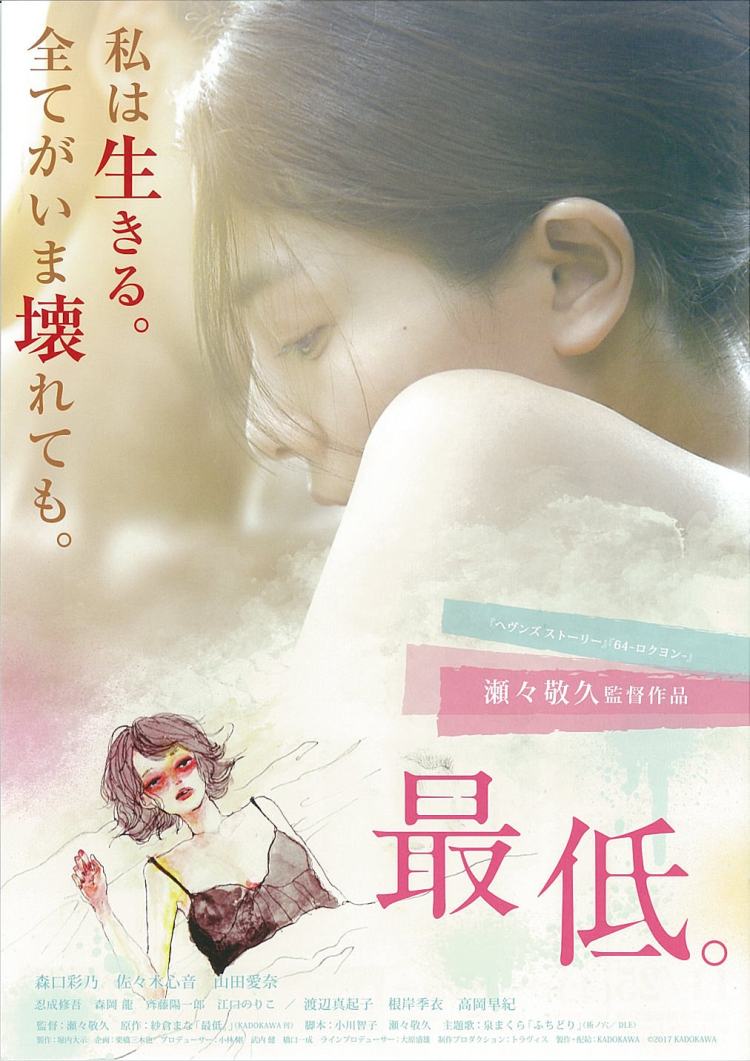
The Lowlife (最低, Takahisa Zeze, 2017)

The Lowlife 2017In terms of the mainstream cinema industry, the AV (“adult video”) world is viewed with suspicion and distain. AV is where unlucky women end up after having the misfortune to encounter unscrupulous yakuza or be born to feckless parents whose debts they are forced to pay with their bodies. However, mainstream cinema perhaps has a reason to demonise its rival on top of reflecting persistent social stigmas relating to the expression of sexuality. Takahisa Zeze began his career in “pink film”, which is to say softcore pornography, and casts a non-judgemental eye over the modern hardcore porn scene in The Lowlife (最低, Saitei), adapting a novel by AV actress and gravure model Mana Sakura which explores the lives of three women who each have been impacted by the industry.

The first two of our heroines – college dropout Ayano (Kokone Sasaki), and melancholy housewife Miho (Ayano Moriguchi), have made a free choice to enter the AV industry mostly out of loneliness and insecurity. Ayano, who claims to be the only “ugly” one among her many sisters, is convinced to take part in a porn shoot by an unscrupulous boyfriend but finds herself reassured in being adored by the camera and appreciated on set, if only briefly. Miho, meanwhile, is trapped in an unsatisfying marriage to a man who has begun sleeping in his study and continually puts off the discussion of starting a family despite Miho’s intense desire to become a mother. Checking on her husband one morning she is dismayed to find a porn DVD in the open tray of his laptop which feels like a double betrayal in that he has obviously not been “working” all night and has avoided intimacy with her while finding release somewhere else. Irritated, Miho takes the extreme decision of becoming a porn star herself as a strange kind of revenge and motion towards personal fulfilment.

Our third heroine, Ayako (Aina Yamada), however, is looking at the same problem from a different angle in that she is daughter of a single-mother who had previously worked in the porn industry before returning home to her own single-mother to start again and raise her daughter. Takako (Saki Takaoka) is a difficult, flighty woman who still likes to live the high life drinking with random guys and rolling in late or sometimes not at all to the constant worry of her anxious daughter. A gifted artist, Ayako is a shy, gloomy girl who finds it hard to connect with her peers and resents her mother for her unconventional lifestyle. Her problems intensify when she wins a prominent art prize and irritates a classmate who seems to be stalking her causing him to spread the rumour of Takako’s past all over the school.

Social stigma is indeed one of the main problems each of the women face. Ayano, who seems to be otherwise happy enough with her life AV, gets an unexpected visit from her concerned mother and scornful sister when someone presumably spots her in a video and decides to have a word. As Ayano points out to her annoyingly judgemental sister, that means whoever told them just outed themselves as an AV-watcher so perhaps she should ask her boyfriend about that before making sarky comments. Nevertheless, nobody really says anything about the men who consume pornography, only about the “immoral” women who star in them. Ayano’s mother Izumi (Makiko Watanabe) blames herself, complaining that Ayano was the only one of her daughters she never quite bonded with, by turns angry with her for “shaming” the family and concerned that she has “thrown her life away” by becoming forever tainted with the stigma of having been involved in the sex industry.

Corrupted maternity becomes a somewhat uncomfortable theme as each of the women assesses their relationships with other women in the context of the traditional family. Having given up work and become a housewife as society expects, Miho has done everything right but is intensely unhappy because her husband will not move to the next step by starting a family. At 35, she feels her life stagnating, that everything is already settled and nothing will change from now until the time she dies. Neglected by a husband who seems to have lost interest in her as a woman as well as in their shared endeavour of building a home, she finds herself drawn to AV as a path to sexual fulfilment which isn’t really infidelity while also subverting her image of superficial perfection and embracing another identity outside of the home. She remains, however, conflicted as she gazes jealously at a happy family out on holiday at the pleasant mountain lodge where they’ll shoot the movie away from prying eyes. Her involvement in AV is, in a way, also an act of self harm as she punishes herself for her inability to become a mother, while also getting back at her disinterested husband.

Even so, Zeze is careful to frame the AV industry in a positive light. On arrival at the agency, Miho is greeted by an extremely sensitive and sympathetic manager who does his best to ease her concerns while making her feel safe at her most vulnerable. Having felt so neglected and lonely at home, the AV world provides her with a place that she is appreciated, desired as a woman and treated like a star. Similarly, Ayano who had believed herself “ugly” and unlovable begins to gain confidence in herself thanks to being appreciated by the camera, eventually striking up a relationship with a nice guy journalist in a bar which seems like it might develop into something more. While some might argue that the industry is merely exploiting feminine insecurities, it cannot be denied that both women find in it a path towards self acceptance and actualisation.

Despite the fiercely non-judgemental tone, a late plot twist further casts Miho’s transgression as a fall rather than a rise while an eventual connection with Ayako further deepens the maternal subtext as she completes the circle by mothering the lost young woman trying to come to terms with her atypical family situation. Ayako’s grandmother too seems to prescribe motherhood as the answer to all life’s mysteries even if the answer is often that they can’t be solved and all that remains is the urgency of living. Zeze’s depiction of the porn industry might be a rosy one glossing over the seamier side in favour of presenting a world built on empowerment rather than exploitation, but its infinitely sympathetic eye makes plain that porn is just a job like any other and the women who work in it do not deserve the scorn that society often chooses to heap on them.


Original trailer (no subtitles)

Prince Charming (青蛙王子, Wong Jing, 1984)

Prince charming 84 poster“This isn’t a film from the 1930s!” a confused sidekick exclaims part way through Wong Jing’s zany ‘80s comedy Prince Charming (青蛙王子). He’s right, it isn’t, but it might as well be for all the farcical goings on in Wong’s hugely populist, unabashedly zeitgeisty romp through a rapidly modernising society. Starring popstar Kenny Bee, Prince Charming also marks the feature film debut of the later legendary Maggie Cheung who would find herself making a fair few disposable comedies in the early part of her career. All the Wong trademarks are very much in evidence from the sometimes crude humour to the random narrative developments and deliberate theatricality but it has its charms, even if perhaps despite itself.

Signalling the “aspirational” atmosphere right away, Wong opens in “Hawaii” with Kenny Bee performing one of the many musical numbers which will be heard throughout the film (which is also a kind of idol movie as well as a populist Shaw Brothers Comedy). Chen Li Pen (Kenny Bee) is the son of an oil magnate and hotel chain manager but unlike his father, is a sensitive, nerdy young man who gets the hiccups around attractive women and has never had any luck with the opposite sex. Nevertheless, his mother wants to set him up with an arranged marriage – something which he vehemently opposes but understands will become harder for him fend off if he can’t find himself a love match in good time. Enter his old friend Lolanto (Nat Chan Pak-Cheung) who is a self-styled ladies man if a bit “common”. Lolanto has come to Hawaii on holiday and to hang out with Li Pen, but like any young guy he also wants to meet some girls.

The guys end up in a kind of sparring match with the two ladies staying in an adjacent room at the hotel, May (Cherie Chung Cho-Hung) and Kitty, (Maggie Cheung Man-Yuk) following a series of misunderstandings. When the girls drug them and then somehow leave them on a rock in the middle of the ocean, the boys are humiliated but don’t have too long to nurse their wounds because Li Pen’s dad sends them back to Hong Kong to investigate suspected embezzlement at head office. As luck would have it, both May and Kitty work for Li Pen’s family firm (which was perhaps why they were staying in the hotel). Another misunderstanding sees May assume Li Pen is a former triad looking for a new start, so she “bribes” the hiring department to get him a job as a chauffeur, while Lolanto ends up in the boss’ office posing as Li Pen. Hilarity ensues.

Aiming a squarely for the populist, Wong’s defiantly aspirational vision revolves around the fabulously wealthy and internationalised Li Pen who went to college in the US and lives most of his life in Hawaii, perhaps not quite understanding Hong Kong in the same way Lolanto does, both because of his outsider status and because of the freedom his wealth gives him. When the two swap roles they each get a kind of education, but their real quest (while halfheartedly investigating the embezzlement scandal) is winning over Kitty and May who think they’re dating a CEO and a chauffeur respectively. Despite their irritation when they realise their mistake, both May and Kitty perhaps come to realise that the deception is a part of what eventually drew them to the guys and they’re a better match than they might otherwise have imagined.

Meanwhile, Wong finally remembers the embezzlement plot and introduces a third woman, Puipui (Rosamund Kwan Chi-Lam), who is secretly a plant set up to seduce the pure hearted Li Pen and marry him because this will in some way prevent the embezzlement scam from coming to light. Puipui’s scheme eventually kicks off the ridiculous finale in which the gang find themselves chased by goons and having to play pool for their lives with hostages hooked up to electric chairs which will be triggered when a certain number of points are scored. Wong adds a host of cutesy touches from cartoon hearts around our lovelorn heroes and adorable doodles popping up as on screen graphics while Kenny Bee and Cherie Chung also get a completely bizarre musical number at the midway point where they pretend to be happy frogs marooned on a private lily pad. It doesn’t make any sense, but it really doesn’t matter. Completely throw away, but strangely fun.


Currently streaming on Netflix UK (and perhaps other territories)

Celestial Pictures trailer (English subtitles)

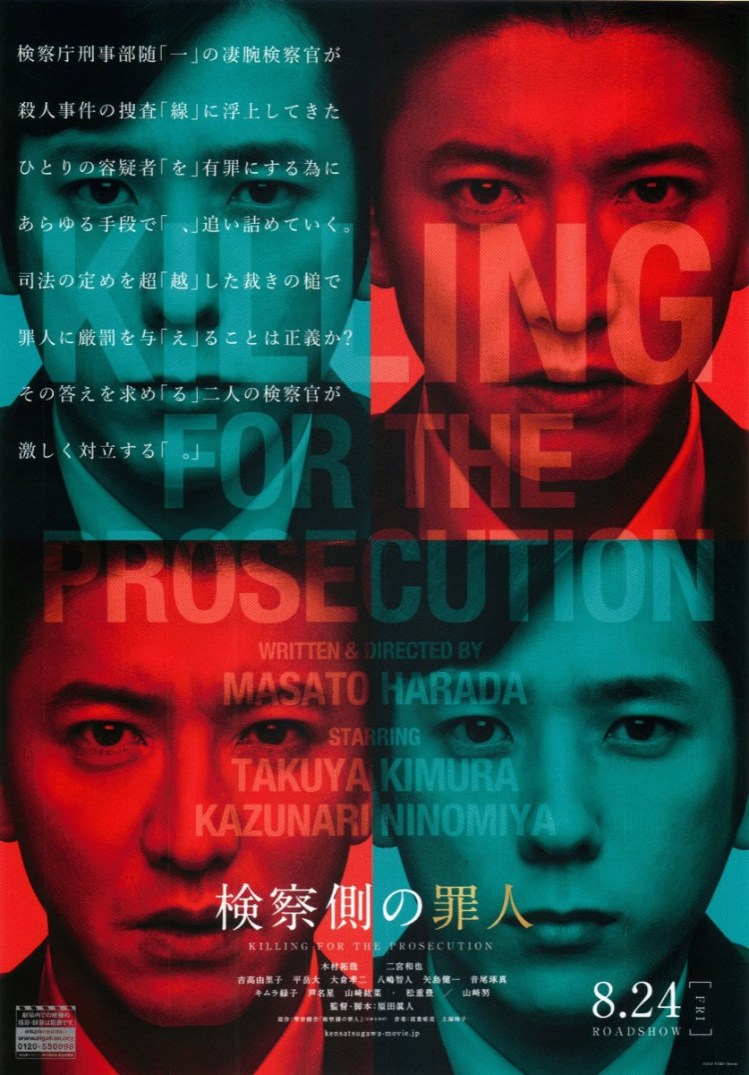
Killing for the Prosecution (検察側の罪人, Masato Harada, 2018)

Killing for the Prosecution posterThe vagaries of the Japanese legal system have become a persistent preoccupation for anxious filmmakers keen to interrogate the continuing rightward shift of the contemporary society. Stretching right back into the post-war world, filmmakers from Yoji Yamada and Yoshitaro Nomura to the more contemporary Masayuki Suo and Gen Takahashi all had their questions to ask about the courts system before Hirokazu Koreeda pushed the dialogue in a slightly different direction with the probing The Third Murder. Killing for the Prosecution (検察側の罪人, Kensatsugawa no Zainin) picks up Koreeda’s baton and brings with it all the baggage of the aforementioned films in asking similar questions about the nature of justice and most particularly within the context of Japan under the conservative government of Shinzo Abe.

In the contemporary era, rookie prosector Okino (Kazunari Ninomiya) gets a prime Tokyo job working for his mentor Mogami (Takuya Kimura) which begins with investigating a bloody double murder of an elderly couple who were apparently running an illicit side business in usurious loans. The suspect list includes a series of shady characters, but one catches Mogami’s eye – Matsukura (Yoshi Sako), a man arrested and subsequently released in relation to a brutal murder of a school girl Mogami had known and liked while he was a student. Unable to let the case rest, Mogami finds himself fixated on the idea of nailing Matsukura for the pensioner murder in order to get justice for the previous killing which has now passed the statute of limitations.

Meanwhile, Mogami himself is also embroiled in a conspiracy surrounding an old friend, Tanno (Takehiro Hira), now a senator accused of corruption. Harada opens with a brief prologue set during Okino’s final pre-graduation briefing in which Mogami offers a somewhat cynical lecture on the role of the prosecution and the nature of justice. Like the lawyers at the centre of The Third Murder, he is keen to emphasise that the truth is rarely relevant in the face of the law and that justice is a game won by constructing impenetrable narrative. He insists that “there is no such thing as rain which washes away guilt”. Yet his love of justice is so fierce that he collects and displays gavels – a complicated symbol seeing as Japan doesn’t use them but like many other countries has internalised an association with them thanks to American movies.

America, in itself, becomes a complicated facet of Mogami’s judicial confusion as he finds himself pulled between left and right. In his meetings with Tanno, we originally find him complicit with the regime, presumably acting to protect his friend and thereby enabling his corruption but we later come to realise that the opposite is true – that the pair of them are complicit in the system in order to undermine it. Tanno, apparently disillusioned with right wing politics and committed to pacifist ideals, attempted to blow the whistle on systemic political corruption and has been hung out to dry. Lamenting that there is no press freedom in Japan, he has been unsuccessful in his attempts to frustrate a persistent shift towards remilitarisation (apparently hastened by his own wife who has embarrassingly enough been photographed at a neo-nazi rally) but coldly cuts off Mogami’s offer of further assistance by reminding him that he too is “part of the system”.

Mogami goes rogue, but he does so more for reasons of personal vengeance than pursuit of justice. Desperate to nail Matsukura he begins to bend his narrative while his earnest rookie underling, Okino, remains conflicted about his boss’ increasingly suspicious behaviour. Yet the possibility remains, if Matsukura didn’t do it someone else did. If Mogami has Matsukura pay for this crime rather than another one, perhaps a kind of justice is served but a dangerous man would still be out there. In the end, Mogami transgresses in pursuit of his own kind of justice becoming the kind of “criminal” prosecutor he cautioned Okino against becoming in his already cynical opening speech.

That aside, Mogami ties his crimes to a long history of injustice and oppression in allusion to his grandfather’s accidental survival of the battle of Imphal thanks to a kind of purgatorial space known as “Hotel Tanang” to which he returns in an oddly surreal dream sequence which places himself and Tanno as descendants of men who refused to die for oppressive imperialistic concerns. The “Skeleton Road” buys him an uneasy alliance with a genial yakuza (Yutaka Matsushige) who provides another source of temptation to turn to the dark side, but the question he seems to be left with is whether it’s acceptable to pursue one’s own kind of justice in the knowledge that the justice system is inherently corrupt.

Okino, who might ordinarily be our hero, seems to say no but lacks the courage to resist – unlike his steadfast assistant, Saho (Yuriko Yoshitaka), who is combating injustice in her own though perhaps no more ethical (and still less than altruistic) ways. “People die, things break, all the same”, Matsukura rambles as if to lay bare the film’s nihilistic leanings as it points out a litany of seemingly irreparable social ills. Mogami breaks cover for an instant when meeting with a police officer after overhearing a woman trying to press a rape charge and being rebuffed, stopping briefly on his way out to encourage her to keep pressing her case in solidarity with her solitary quest against a seemingly impenetrable wall of indifference, while the mild foreshadowing of a contemporary preoccupation about what to do with the problem of elderly drivers in an ageing society becomes an odd kind of punchline in a bleak existential joke. Dark and cynical, Killing for the Prosecution sees little cause for hope in the increasing murkiness of its constantly declining moral universe, finding release only in its final, frustrated scream.


Original trailer (no subtitles)
Lumberjack and Lady (與太者と小町娘, Hiromasa Nomura, 1935)

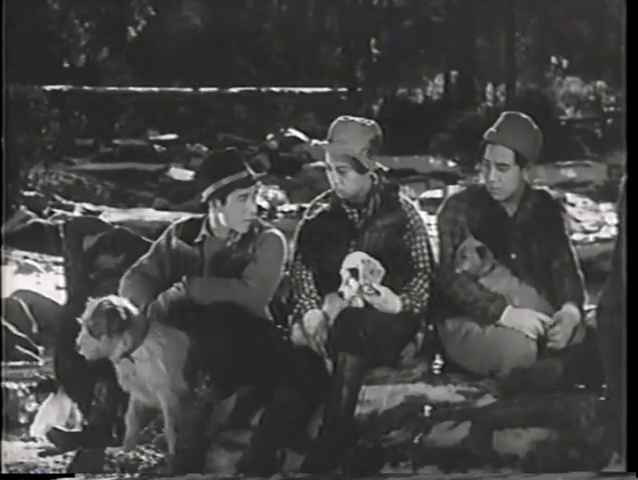
vlcsnap-2019-03-01-23h23m29s757Remembered mostly for his 1938 melodrama Aizen Katsura starring Kinuyo Tanaka and Ken Uehara, Hiromasa Nomura was a prominent studio director at Shochiku in the pre-war period before decamping to Shintoho in 1948 and then to Daiei in the mid-50s before shifting back to Shintoho and then to TV for the final part of his career. Much of his earlier work is presumed lost, but a late silent effort from 1935 Lumberjack and Lady (與太者と小町娘, Yotamono to Komachi Musume, AKA The Layabout and the Town Belle – part of the “yotamono” (layabout) series) seems to showcase a talent for slapstick comedy while perhaps engaging with the concerns of the time in its three heroes’ quest to defend their mountain against an evil upstart from the opposing peak.

The trouble begins when our three “stooges” get themselves stuck on a logging cart and accidentally end up on the other mountain where a rival logging group run by the fabulously moustachioed Torazou (Isamu Yamaguchi) are not exactly happy to see them. Just when things look grim for our heroes, Torazou himself shows up and saves the day, handing them a letter to take back to their boss, Kaheiji (Sojin Kamiyama). The letter, however, contains ill tidings – Torazou wants the hand of Kaheiji’s pretty daughter Kayo (Yoshiko Tsubouchi) and makes plain that he’s not about to take no for an answer.

The early part of the film revolves around the comical exploits of our three bumpkins who are always accompanied by their three adorable dogs. The guys are all, predictably, in love with Kayo but in a dreamy, innocent sort of way – there is no conflict between them over their shared love of the boss’ daughter, only a sort of pure hearted camaraderie and a desire to make sure the best is done for her which means putting paid to the evil Torazou once and for all.

In a mildly interesting twist, it’s clear that the Kaheiji gang are the poor but honest crowd. Our guys dress in torn and battered clothing, remaining unable to pay off their tabs with the wily old lady who runs the local store even after old Kaheiji has given them some money to go out on the town. Torazou’s boys, however, seem to be doing much better. Torazou himself is portly man in early middle age who is always accompanied by his bizarrely tiny henchman who is always ready to repeat whatever it was his boss just said only with additional menace. It’s clear we don’t want Kayo to fall into his clutches lest her innocence be polluted by his grubby little hands. A mustache twirling villain, Torazou is perhaps as close as you might be able to get in 1935 to a personification of the evils of the age as an exploitative capitalist fat cat who thinks he can do as he pleases because he has the most minions and the most friends in handy places. Not much of strategist, he thinks nothing of trying to force himself on the grieving Kayo as she bends over a grave, somehow convinced that this will be a surefire way to win her love and pave the way to a happy marriage.

The action takes an unexpected direction in the second act after a key player mysteriously falls off a cliff in true silent movie fashion. Realising they need to find a “suitable” husband for Kayo (i.e. someone not like them but of a higher social class), the guys run into “Mr. Yamazaki” (Den Obinata) from Tokyo who, unbeknownst to them, is Kaheiji’s chosen successor and a potential fiancé. Kenji brings some Tokyo class out to the mountains along with a little youthful hotheadedness in which he cannot help but refuse to back down in the face of Torazou’s continuous shenanigans – an act which accidentally puts Kayo in danger while he fixates on proving himself the bigger the man.

A light and fluffy escapade, albeit one which perhaps subtly reinforces some of the ideas many maybe seeking escape from, Lady and Lumberjack is largely built around the slapstick adventures of our three idiot heroes which are enlivened by the fresh mountain air and beautiful location shooting. Drawing inspiration from popular Hollywood silent comedies, Nomura perhaps fails to tie his series of set pieces together in a suitably coherent fashion but fully embraces the film’s sense of silly fun (mostly had at the expense of the decidedly dim, if essentially good, lumberjacks) while ensuring a victory for the honest little guy against the forces of selfishness and corruption.


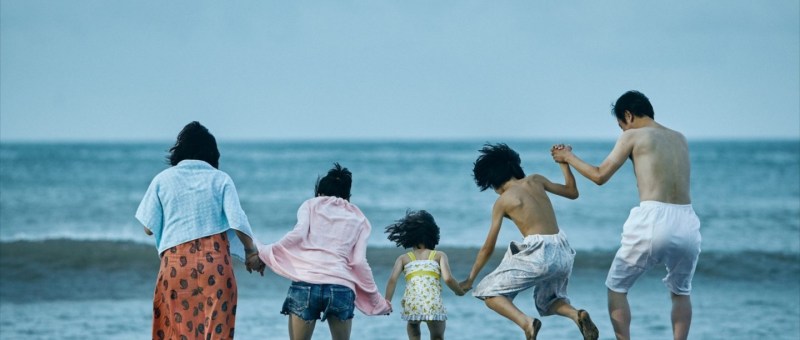
Shoplifters Sweeps 42nd Japan Academy Prize

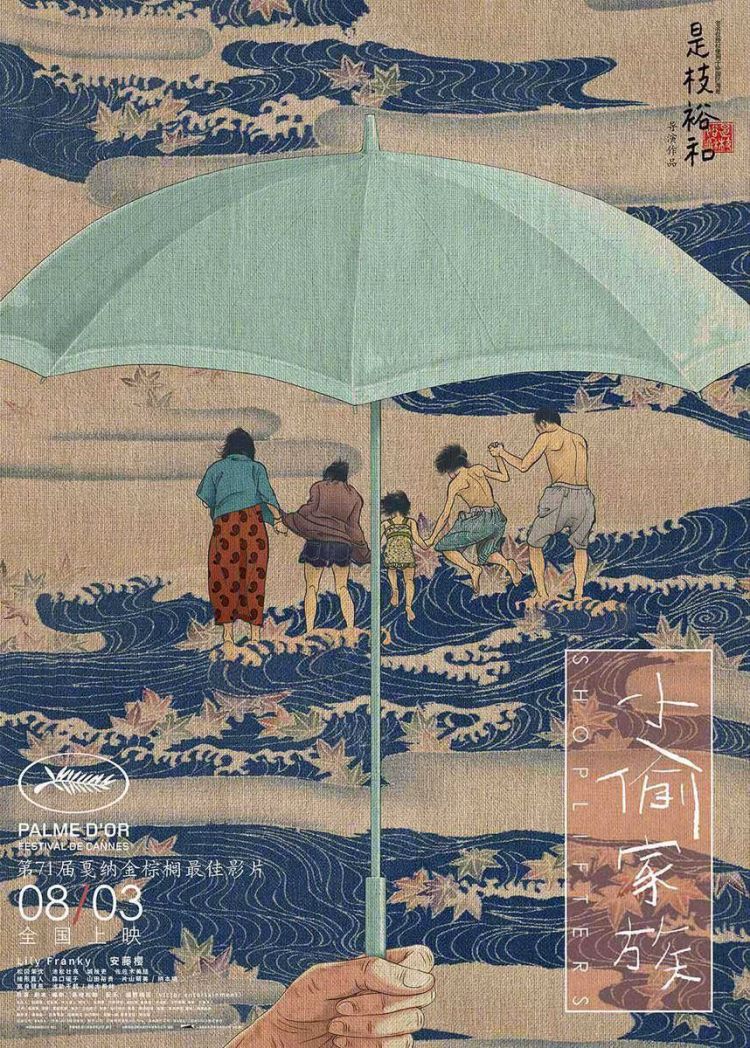
Shoplifters poster 2The 42nd Japan Academy Prize was presented at Grand Prince Hotel New Takanawa on 1st March, 2019. Hirokazu Koreeda swept the board for a second year in a row with his Palme d’Or winning family drama Shoplifters which picked up eight awards including Picture, Director, Actress, and Supporting Actress. Meanwhile, Kazuya Shirashi’s retro gangster epic The Blood of Wolves picked up prizes for both of its leading men as well as a handful of technical awards.

Picture of the Year

Shoplifters still 2

Animation of the Year

Mirai banner

  • Dragon Ball Super: Broly (Tatsuya Nagamine)
  • Penguin Highway (Hiroyasu Ishida)
  • Mirai (Mamoru Hosoda)
  • Detective Conan: Zero The Enforcer (Yuzuru Tachikawa)
  • Okko’s Inn (Kitaro Kosaka)

Director of the Year

shoplifters still 5.jpg

Best Screenplay

Shoplifters still 6

Outstanding Performance by an Actor in a Leading Role

Blood of Wolves still 2

Outstanding Performance by an Actress in a Leading Role

Shoplifters still 3

  • Sakura Ando (Shoplifters)
  • Haru Kuroki (Every Day a Good Day)
  • Ryoko Shinohara (The House Where the Mermaid Sleeps)
  • Mayu Matsuoka (Tremble All You Want)
  • Sayuri Yoshinaga (Sakura Guardian in the North)

Outstanding Performance by an Actor in a Supporting Role

blood of wolves still 1

  • Ittoku Kishibe (Sakura Guardian in the North)
  • Dean Fujioka (Recall)
  • Hidetoshi Nishijima (Life in Overtime)
  • Kazunari Ninomiya (Killing for the Prosecution)
  • Tori Matsuzaka (The Blood of Wolves)

Outstanding Performance by an Actress in a Supporting Role

every day a good day still 1

Outstanding Achievement in Music

Shoplifters still 4

Outstanding Achievement in Cinematography

Shoplifters still 8

Outstanding Achievement in Lighting Direction

Shoplifters still 9

Outstanding Achievement in Art Direction

Blood of Wolves still 3

  • Tsutomu Imamura (The Blood of Wolves)
  • Takashi Nishimura (Recall)
  • Mitsuo Harada (Samurai’s Promise)
  • Kyoko Heya (Sakura Guardian in the North)
  • Keiko Mitsumatsu (Shoplifters)

Outstanding Achievement in Sound Recording

Blood of Wolves still 4

Outstanding Achievement in Film Editing

One Cut of the Dead still 1

Newcomer of the Year 

(awarded to all nominees equally – announced along with nominations)

  • Moka Kamishiraishi (A Forest of Wool and Steel)
  • Shuri (Love At Least)
  • Yurina Hirate (Hibiki)
  • Kyoko Yoshine (Kasane, Samurai’s Promise)
  • Kentaro (Cafe Funiculi Funicula)
  • Taishi Nakagawa (Kids on the Slope, Lock-On Love)
  • Ryo Narita (Stolen Identity, The Antique)
  • Ryo Yoshizawa (River’s Edge)

Special Award of Honour from the Association

(Lifetime achievement awards – technical fields)

  • Yasuo Otsuka (animator)
  • Tadashi Kanada (still photography)
  • Tsutomu Sakurai (producer)
  • Keisuke Chiyoda (costuming)

Special Award of Honour from the Chairman

(Lifetime achievement awards celebrating contribution to the film industry)

  • Mariko Okada (actress and producer)
  • Keiko Kishi (actress)
  • Junya Sato (director and screenwriter)
  • Kiju Yoshida (director and screenwriter)

Special Award from the Chairman 

(Lifetime achievement award presented to members of the film industry who passed away during 2018)

  • Isao Takahata (animation director)
  • Yuriko Hoshi (actress)
  • Masahito Tsugawa (actor)
  • Kirin Kiki (actress)
  • Sadaji Yoshida (cinematographer)
  • Mitsuru Kurosawa (producer)

In Memoriam 

(special section commemorating previous winners of the special awards who passed away in 2018)

  • Tadashi Sawashima (director)
  • Chuji Kinoshita (composer)
  • Shinobu Hashimoto (screenwriter, director, and producer)

Special In Memoriam 

  • Masayuki Nagare (world renowned sculptor and founding member of the Japan Academy Prize as well as the designer of the trophy).

Popularity Awards

(nominated by an All Night Nippon audience poll)

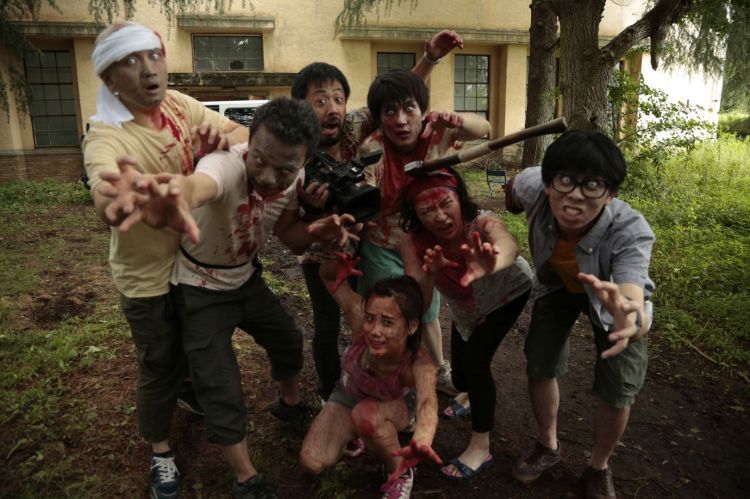
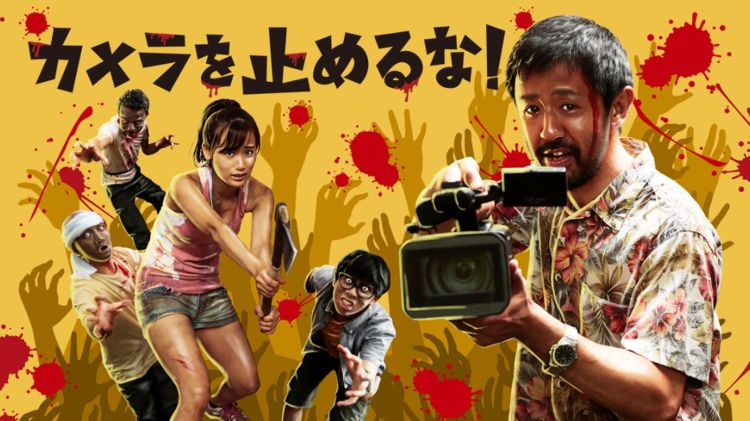
Movie: One Cut of the Dead

one cut banner

Actor: Kentaro (Cafe Funiculi Funicula)

Kentaro Cafe Funiculi Funicular

Source: Japan Academy Prize official website

Hurrah! For Freedom (自由万歲 / 자유만세, Choi In-kyu, 1946)

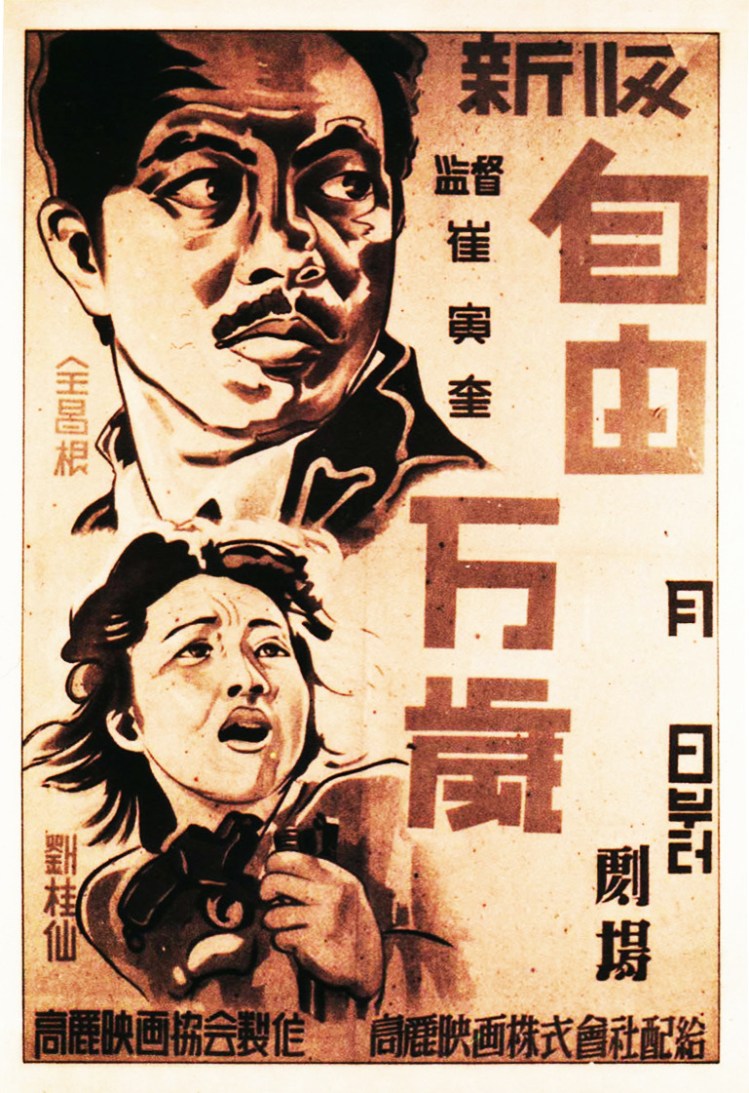
hurrah for freedom posterAttempts to foster a Korean film industry had often been frustrated during the colonial era throughout which aspiring filmmakers found themselves dependent on the Japanese film industry for financial and technological assistance while forced to produce increasingly overt Imperial propaganda under the ever tightening grip of the militarist colonial government. Hurrah! For Freedom (自由万歲 / 자유만세, Jayu Manse), the first film produced after the liberation, was then an aptly titled chance to start anew, create a new film language for a new young nation finally free of what some saw as decades of brutal oppression which made successive attempts to erase a national character.

Sadly, we cannot quite know exactly what director Choi In-kyu intended to create with this the first truly “Korean” film because so little of it survives intact, not because like much colonial cinema it was simply lost but because it bears witness to the next chapter in Korea’s unhappy 20th century history in undergoing severe editing during the oppressive era of Park Chung-hee’s military government who decided to remove scenes featuring popular pre-war actor Dok Eun-gi who, like many in his position, eventually defected to the North after the Korean war. As for Choi himself, he perhaps felt he had some atonement to do for having remained complicit with the Imperial machine. Following the completion of 1941’s Angels on the Street, he’d vowed to never to direct another pro-Japanese film but was eventually persuaded to return by the right-wing Han Hyung-mo (also the cinematographer on this film) and made a further three propaganda movies the last of them in 1945.

Nevertheless, Hurrah! For Freedom opens with a tribute to those brave Resistance fighters who gave their lives for liberty. Our hero is cell leader Choi Han-joong (Jeon Chang-geun – also the film’s scriptwriter) whose friend is killed while fleeing from Japanese police after being denounced by collaborator Nam-bu (Dok Eun-gi). Forced into hiding, Han-joong is lodged with a friendly nurse, Hye-ja (Hwang Ryuh-hee), who seems to have become fond of him though he remains distracted by his Resistance activities even if he does eventually notice the flowers that she bought him as a token of affection. While saving another comrade from the police and rescuing some explosives in the process, Han-joong ends up taking refuge in the flat of none other than Nam-bu’s main squeeze Mi-hyang (Yoo Kye-sun) who also develops a crush on him.

Though Nam-bu, an obvious bad guy antagonist, is sidelined by the demands of ‘70s censorship, the main thrust of the drama is conveyed by the melancholy figure of Mi-hyang who eventually becomes a symbol of betrayed, thwarted ambition and the relative impossibility of redemption for those who made “weak” choices during the colonial era (as you could perhaps accuse Choi himself along with the entire film industry of having done). Mi-hyang, having fallen for Han-joong’s passionate intensity, decides to betray Nam-bu by giving valuable information she has obtained from him to the Resistance, little knowing she has been weaponised in a plot laid by her vindictive former lover.

Nevertheless, her true love confession is rejected by Han-joong whose only lover is the revolution. Han-joong, reminding her that he is a man who could be killed at any moment flits between talking of his bright future and his dark end. He reassures Mi-hyang that, despite her past, she like everyone else has the right to start again but coldly insists that she does not have what it takes to join the cause and should return to her hometown and safety. Denied the right to be by his side in life, Mi-hyang affirms that she will be the one to tend Han-joong’s grave, suddenly returning this talk of new beginnings to the nihilistic struggle which seems to define Han-joong’s existence.

Nevertheless, in contrast with the defeated figure of Mi-hyang who must pay not only for her “weakness” in complicity with the colonial regime but also for her sexual transgression with an “enemy”, the saintly Hye-ja remains pure and brave – a brighter mirror for the gloomy Han-joong who seems surely destined to be her romantic hero as the pair of them fight earnestly for a freer future. Sadly, this is where we leave them – in media res as the film cuts out just at its most climactic moment as if affirming that this is a revolution very much in progress. Choi, shifting away from the realism that defined his earlier work, seems to be reaching for a new cinematic language with which to begin a new era free of colonial constraints. History, however, would defeat them all as this short period of hard won liberty would lead eventually to another conflict and another oppressive dictatorship. Choi himself went missing during the Korean War, presumably either killed or fled to the North. Nevertheless, what we can discern from the extant lessons of Hurrah! For Freedom is that there was perhaps more appetite for nuance than might have been expected even if sympathy for the collaborator does not quite extend to forgiveness.


Hurrah! For Freedom was screened as part of the Early Korean Cinema: Lost Films from the Japanese Colonial Period season currently running at BFI Southbank. Also available to stream online via the Korean Film Archive’s YouTube Channel.

What’s For Dinner, Mom? (ママ、ごはんまだ?, Mitsuhito Shiraha, 2016)

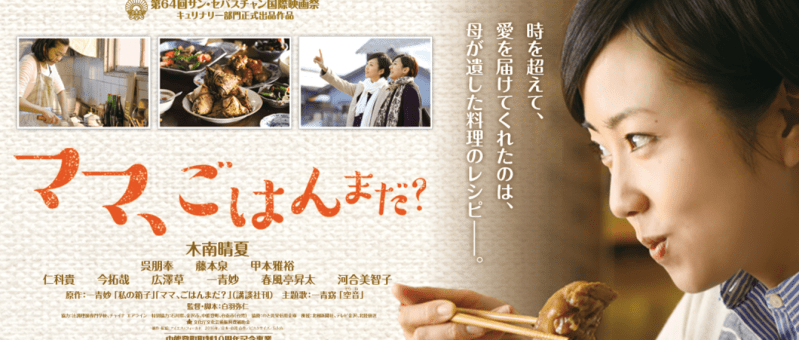
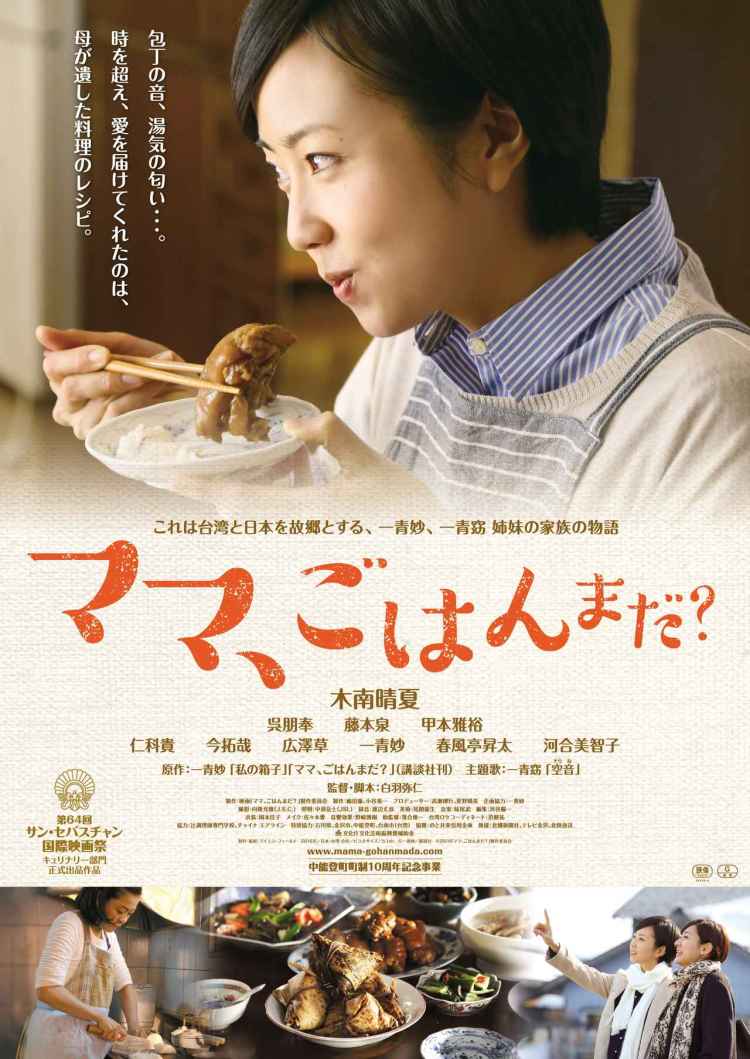
What's for Dinner Mom posterJapanese cinema has a preoccupation with mothers and the nature of motherhood, but the mothers of the typical “hahamono” tend to be either saintly, self sacrificing figures whose selfless love often goes unrecognised, or problematic matriarchs whose fierce love and desire to protect their children has caused them to transgress and perhaps lose their children’s love. The mother at the centre of What’s For Dinner, Mom? (ママ、ごはんまだ?, Mama, Gohan Mada?) falls into a more realistic category – loving, self sacrificing, imperfect and perhaps sometimes misunderstood but always doing the best for her two daughters even in difficult circumstances. Where What’s For Dinner, Mom? differs from the accepted pattern is in its use of the domestic world to ask questions about culture and identity, and about all the various ways one never quite knows one’s family.

Tae (Haruka Kinami) and Yo (Izumi Fujimoto), sisters and now middle-aged women, are preparing to clear their family home 20 years after the death of their mother (Michiko Kawai). What’s taken them so long to make the decision is never revealed but both are as happy as possible about the idea and it seems Tae and her husband plan to knock the house down and build their own on the same plot – not quite so radical a thing as it might sound, Japan has no real housing market and “modern” houses are often knocked down and rebuilt every 20 to 30 years. Whilst packing things away, Tae finds a small box full of her mother’s keepsakes – chiefly letters and photographs along with a handwritten recipe book she began keeping in 1972.

Though Tae has lived in Japan for all her adult life, she was born in Taiwan and is half Taiwanese. Tae’s father passed away from lung cancer when she was small, but was a depressed, sometimes difficult man with ambivalent feelings towards his home nation. His own family had come from the mainland, but he’d lived in Taiwan under Japanese rule and attended university in Japan. He felt himself to be Japanese and was constantly upset and angry about the turbulent political situation of the post-war nation, facing its own series of identity crises and a protracted period of oppressive martial law.

Nevertheless, after their unpredictable whirlwind romance, Tae’s mother Kazue moved to Taiwan to live with her husband’s family and became determined to adapt to the local culture – chiefly through food. After her husband died in Japan, Kazue kept Taiwan alive for her daughters through continuing to cook the dishes she’d learned from her friends and family in Taiwan (even though her intensely “Japanese” husband only ever wanted to eat yudofu). Though Tae at one point urged to her mother to stop cooking Taiwanese and give her stereotypically cute high school bento, she quickly realised her mistake and Kazue’s unusual Taiwanese cooking became a local hit (even boosting the availability of the previously unobtainable pig’s trotters).

Despite her love of the food, Tae has all but forgotten her Taiwanese roots since her mother’s death and doesn’t know how to cook any of the dishes herself. Tae’s mild identity crisis comes to the fore in the second half of the film, though it’s an oddly under developed plot strand given the centrality of the cuisine. When she eventually makes the decision to visit her father’s remaining family, Tae seems to understand Taiwanese Mandarin but usually replies in Japanese (her uncle, accompanying her, is fluent). Like Kazue’s diary, Tae’s reminiscences are accompanied by on screen intertitles written in Chinese characters drawn childishly (even the characters which are identical to those used in Japanese are somewhat awkwardly rendered), which points to a kind of duality but is never really resolved even if Tae is able to explain a strange childhood memory and bring a piece of her past home with her.

Through her food odyssey and return to source, Tae is able to appreciate her mother’s love and sacrifice from an adult perspective, no longer left with teenage resentment and unfair anger over her early death but reclaiming her happy memories and appreciating the hardship her mother must have faced as a single mother in pre-bubble Japan. Despite its warm and fuzzy tone, What’s For Dinner, Mom? occasionally seems as if it wants to do something bigger by briefly introducing larger themes – Tae’s father’s depression, illness, the difficult political situation of post-war Taiwan, and the complex interplay between the two nations, but is content to settle back into a comforting “hahamono” tale of selfless motherhood finally appreciated only when it’s too late. Nevertheless it does what it set out to do in telling the story of a warm and loving family anchored by a kind yet determined woman and tables full of wholesome home cooking offered with an open, internationalist, heart.


Original trailer (English subtitles)

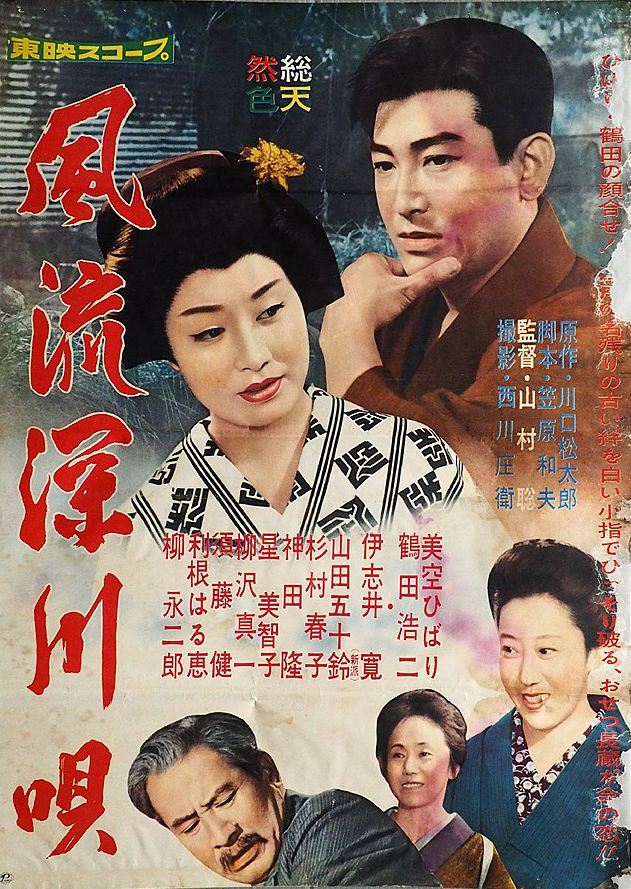
Deep River Melody (風流深川唄, So Yamamura, 1960)

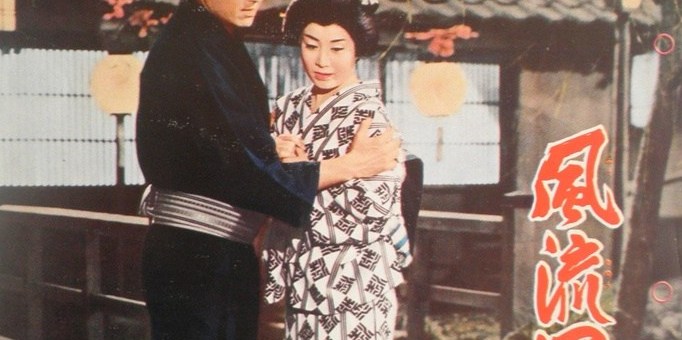
Deep River Melody poster 2An actor with a long and distinguished career, So Yamamura first stepped behind the camera in 1953 with an adaptation of the famous proletarian novel by Takeji Kobayashi, The Crab Cannery Ship (later adapted by Sabu in 2009), and eventually completed six features. Deep River Melody (風流深川唄, Furyu Fukagawa Uta), released in 1960 and adapted from a novel by Matsutaro Kawaguchi, was last among them and starred post-war singing sensation Hibari Misora in the leading role. Hibari Misora was a frequent presence at Toei through the ‘50s and ‘60s, appearing in a series of musical dramas both period and contemporary but Deep River Melody is among the small number of purely dramatic pieces in which she starred which do not feature any musical numbers even over the opening and closing.

Set in the early years of militarism, the story revolves around Setsu (Hibari Misora) – the daughter of a restaurant owner, and her head chef, Cho (Koji Tsuruta). Having grown up together, Setsu and Cho have quietly fallen in love but these are times in which it is difficult to state one’s feelings plainly. Luckily, Setsu’s father, Isaburo (Kan Ishii), and his warm hearted mistress (Isuzu Yamada), have noticed the growing affection between the pair and are only too happy for them. What could be better after all than the head chef marrying into the family? Despite some qualms on Cho’s side in breaking a class ceiling taboo, the matter appears to be settled and both he and Setsu are blissfully happy.

However, tragedy soon strikes. Isaburo unwisely agreed to become the guarantor of a loan taken out by Shunsuke Ohta (So Yamamura) – the leader of the communist party in Japan (not an easy thing to be amid the rising tides of militarism). He, of course, defaults on the loan putting the restaurant at risk. The other relatives, learning of the prospective marriage between Setsu and Cho are extremely unhappy, viewing it as improper for mere servant to inherit the restaurant. Isaburo stands firm, but matters are pushed to crisis point by grumpy uncle Koshikawa who is determined to act as a go-between for the wealthy son of a rival restaurant who has long had designs on Setsu.

Though this is definitively a pre-war story, many of the problems faced by Setsu and Cho are the same as those in Hibari Misora’s contemporary movies in that she, in particular, finds herself trapped by a series of outdated social codes in which her extended family expect her to consent to marry a man she does even like for money in order to save their “good” name. They believe Isaburo is a feckless fool who has lost the restaurant through a needless gesture of loyalty towards a man who had been good to him in the past and was now in trouble. Isaburo places human relationships above money and politics, remaining uninterested in the relatives’ insistence on class hierarchies and preservation of the family’s good standing. Though he may, to a degree at least, be sympathetic towards Ohta’s political intentions, he acts as guarantor out of respect and gratitude rather than deep belief in a cause.

Nevertheless, the barriers between Cho and Setsu are less physical than they are psychological. Cho, raised as a servant, feels himself inferior and has difficulty accepting Isaburo’s talk of marriage owing to their differing social status. Isaburo, somewhat embarrassed, has not yet spoken with Setsu, but then knows his daughter well and is right in assuming the pair will eventually sort things out on their own if given a gentle push. When the relationship is tested by the restaurant’s failure, Isaburo and Setsu stand firm. No one entered this relationship for the wrong reasons – Cho loves the restaurant and everyone who works in it, but he fell in love with Setsu independently and would marry her for nothing. He remains uncertain, however, if his devotion is selfish and if the best way to love her is to leave her and allow her to save her familial legacy by marrying a man with money.

Like many post-war films, Deep River Melody is essentially about learning to let go of outdated ideas and that the maintenance of tradition is less important than individual happiness. Setsu and her father are ready to let go rather than commit themselves to a course of lifelong unhappiness solely to please their snooty relatives. Cho, however, struggles to free himself of a feeling of social inferiority. His own family tell him that his desire to marry Setsu is not only wrong but dangerous, that they have built a life for themselves though being loyal servants and that crossing the class divide risks all of their futures. Conflicted, Cho remains unwilling to fight for his love because he does not believe he can win and not only that, he feels it would be inappropriate to even try. If the pair are to find true happiness, they will have to find the courage to move on from the past and build their own future free of feudal ideas but to do so will require both sacrifice and support in the belief that a better life is possible.


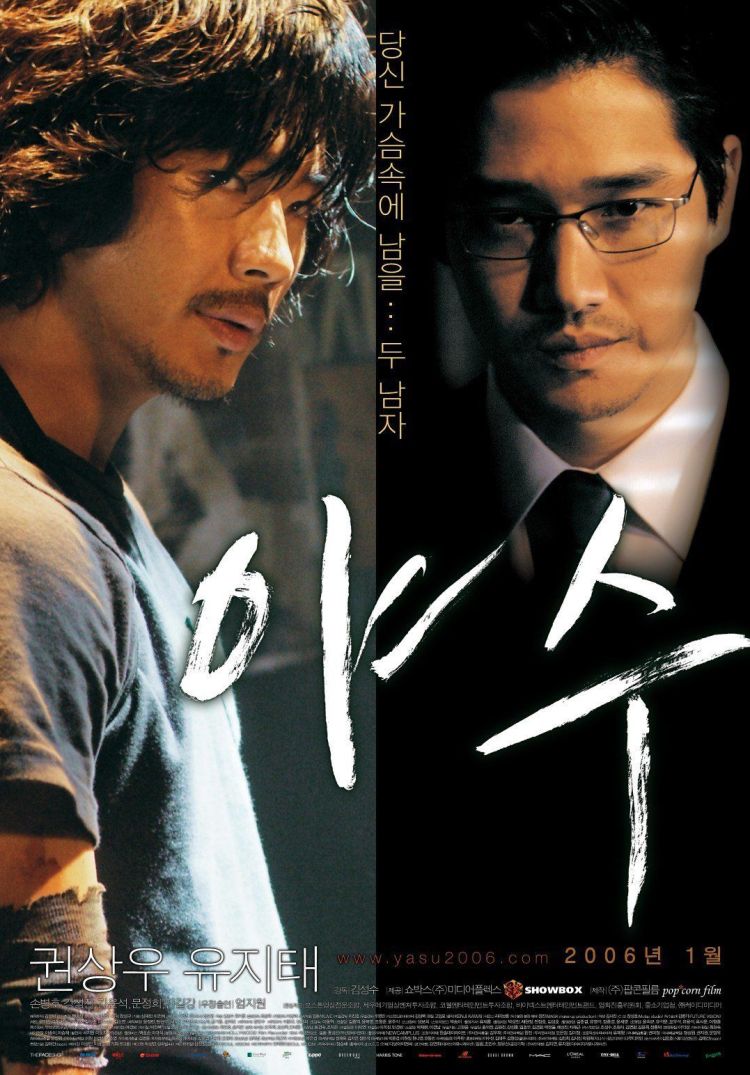
Running Wild (야수, Kim Sung-soo, 2006)

Running wild posterHeroic bloodshed meets corruption drama in the retro debut feature from Kim Sung-soo (b. 1971 – not to be confused with the director of Beat/Asura), Running Wild (야수, Yasu). Over the top macho action mingles with saccharine family drama as two seemingly very different law enforcement officials realise they aren’t that different after all as their relentless pursuit of a mob boss turned “legitimate businessman” with political aspirations becomes increasingly intense. Filled with typically 70s touches from split screens to zooms and descents into ridiculous displays of male aggression set against the pounding rhythms of an action score, Running Wild is a story of the law on fire but one which never quite knows which side it’s on.

Straight-laced prosecutor Oh (Yoo Ji-tae) has been slumming it in the boonies for the last few years after his attempt to bring down top gangster Yoo Kang-jin (Son Byong-ho) was derailed because of the dirt Yoo has on a selection of important people. Stopping only to take out a local big wig mobster, Oh is finally on his way back to Seoul with settling scores firmly on his mind. Meanwhile, maverick cop Jang (Kwon Sang-woo) collects his younger half-brother from jail and takes him to see their seriously ill mother in hospital. While Jang is busy meticulously filling in a lottery ticket, Dong-jik (Lee Joong-moon) is knifed by his old buddies and so Jang now has his own score to settle with the Dokang family.

Eventually teaming up to take down their common enemy, Jang and Oh have very different approaches to law enforcement. Oh hates the likes of Yoo because they break the social order while Yoo is a bully who profits from the suffering of others and laughs at the likes of Oh while he does it. Oh believes in the supremacy of the law, that the law is his greatest weapon and the one unassailable force that even men like Yoo will eventually have to submit to. Yoo feels differently. For Yoo the law is an irrelevance or even a symbol of other men’s naivety; he will overcome it and live outside of its control.

While Oh pins his hopes on the proper operation of the law, Jang pins his on his fists. Flailing wildly, Jang is more thug than cop – urging Oh to abandon his ridiculous righteousness and do what it takes to take the bad guys down even if that means planting evidence and beating information out of suspects. He is a classic angry man, frustrated by his powerlessness in the face of his mother’s illness and his inability to protect his makeshift family. Blaming himself for Dong-jik’s death and for failing to prevent his flirtation with criminality, Jang spars with his step-sister, half rejecting her role as primary care-giver to the mother he can’t save and part longing to see her as a true and permanent member of the family which constantly eludes him.

Family becomes a recurrent theme as both Jang and Oh ruin their respective relationships through their unconventional working lives. Despite finally getting back to Seoul, Oh’s wife plans to leave the husband whose obsession with his work, or more particularly his vendetta with Yoo, has consumed him while Jang’s family life remains a total mess. Yoo, by contrast, now a legitimised CEO playing golf with the rich and famous, enjoys lovely family meals with his elegantly dressed wife and cute little children who seem to adore him.

The law, it seems, is not robust enough to withstand the finagling of the corrupt criminal class who ride the waves of their power and influence all the way to the top. Oh steps further towards the edges of his noble goal, at which point he has to admit his quest is also one of personal revenge more than of truth or justice. Both men ruin themselves in stupid acts of self destruction, turning themselves into grenades thrown against a regime content to protect its inherent injustices. Running Wild, the pair fight fire with fire but also become victims of the system which oppresses them. Kim piles on the retro style but lets the old fashioned heroics run away from him abetted by the bombastic Kenji Kawai score. Nevertheless, Running Wild is a stylish enough calling card even if its aesthetics trump its sincerity.


Currently streaming on Netflix UK (and possibly other territories)

Original trailer (English subtitles)