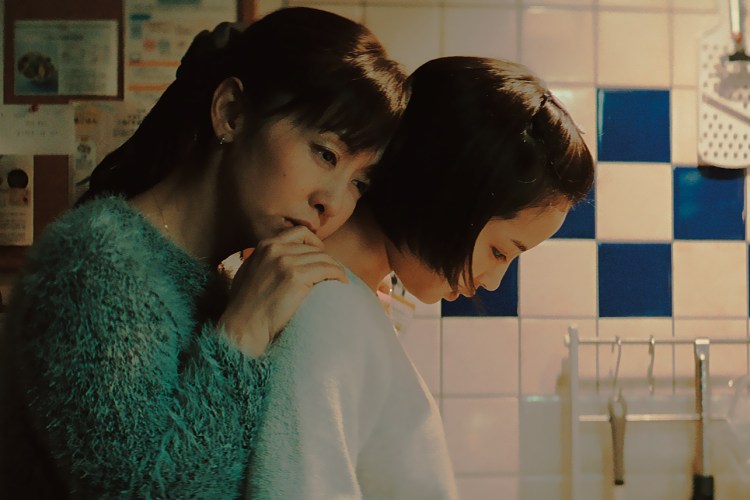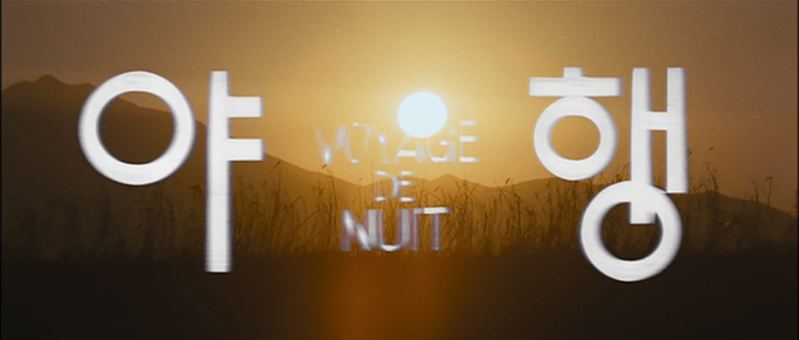
Night Journey (야행 / 夜行, Kim Soo-yong, 1977)

Night Journey posterIncreasing economic prosperity dangles tantalising rewards for the young and ambitious, but for women trapped by outdated social codes the pleasures of success are largely off limits. Director Kim Soo-yong was well known for literary adaptations and Night Journey (야행 / 夜行, Yahaeng) is, like Mist, inspired by a Kim Seung-ok novel but Kim makes a point of shifting the focus, telling the story not just of a jaded bank clerk but also of the effects of living under an authoritarian regime which demands (superficial) conformity, insists on productivity, and slowly destroys the souls of all those caught in its perilous march forwards into the corporate future.

Lee Hyeon-ju (Yoon Jeong-hee) is a woman of a certain age, unmarried, and working as a teller in a bank in Seoul. One of two “old maids” in the office, Hyeon-ju is shocked to find out that her fellow bachelorette from the adjacent desk is about to marry Mr. Choi – the couple had kept their relationship a secret but now that the engagement is public, Miss Oh will be quitting her job the day before the wedding. Alongside the joy such news surely brings, everyone seems to be making a point of being “sensitive” around Hyeon-ju, worried she will be hurt or embarrassed to learn of another woman getting married while she remains single and alone. Hyeon-ju seems more annoyed by the attempts at sympathy than anything else, but accepts her boss’ offer of a few days vacation even if she seems aware it’s mostly to get her out of the way and avoid any potential awkwardness.

Awkwardness is not something that’s going to go away though because Hyeon-ju is leading a double life in which she is actually living with bank clerk Mr. Park (Shin Seong-il) who manages the desk behind her but doesn’t want anyone at work to know about their relationship. Hyeon-ju goes home early to make dinner, but Park plays the after work drinking game, rolling in drunk and collecting the sleeping Hyeon-ju off the couch to deposit on the bed where he climbs on top of her and sates himself before rolling over in a drunken snooze. The relationship between the pair is, effectively, that of a bored middle-aged couple only they do not have the security of a marriage certificate and live in constant uncertainty.

When Hyeon-ju returns home from her brief trip back to the town where she grew up, Park does not say that he missed her, just that things have been very “inconvenient” with her away. “Convenient” is something Hyeon-ju worries defines Park’s feelings towards her, that he regards her as a part of the furniture, as something merely to serve his own desires. A rare evening at home together finds them enjoying a boxing match on TV which later leads to an amorous moment on the floor but just as he did before, Park gives up half way through to go back to the boxing, almost forgetting Hyeon-ju is even there. The other marriage at work prompts Hyeon-ju to wonder if it isn’t time they too made things official, but Park lazily brushes the question off, claiming to find marriage and all that sort of thing very boring. Spying on her partner at work, Hyeon-ju perhaps worries he plans to dump her for a match more advantageous to his career while she remains trapped in her dead-end bank teller job with a marriage her only realistic path to a successful middle age.

Hyeon-ju craves satisfaction – some real connection with Park that makes her feel alive, needed, wanted, and seen as a distinct individual. Returning to her hometown she reverts to her teenage self – putting on her high school uniform and taking her little sister down to the beach to ride her bike just as she had done. It is however not all happy memories – Hyeon-ju was drummed out of town as a hussy, the entire community know and remember her sordid past and if she were to consider an arranged marriage back home she could not expect to marry very well. Nevertheless, a now widowed son of a wealthy family takes an interest but Hyeon-ju is disappointed to realise that despite his bad boy exterior and fancy motorbike, her suitor is a small-town boy after all with a bashful attitude to love and sex which stands in contrast to Heyon-ju’s own passionate, seemingly free nature.

Freedom, however, is something she seems to have little of. We catch her catching sight of a man being handcuffed as she stands atop a busy bridge and we assume she recognises it as a echo of her own oppression but in actuality she fetishes the act of being manacled, almost compelled to place herself in a position of relative powerlessness. Later, on the same bridge, she’s dragged off by a rough man who apparently takes her to a nearby hotel and assaults her while her attempts to resist read more like playing along. Later she goes back to the same bridge, perhaps hoping to see the man again, violent acts of passion seemingly the only ones that wake her from her restlessness.

Fed up with Park, she roams the city streets alone – something respectable women rarely do as she proves when an attempt to enjoy a solo drink arouses the interest of an entire room filled with drunk salarymen in which she is the only female. Drunk men in the street attempt to pick her up and again she seems to enjoy deflecting them, often with little more than a glare though she is mildly surprised when one of them turns out to be the recently married Choi who reveals to her that he is disappointed with married life after discovering Miss Oh was not a virgin during their honeymoon.

The separation of the sexes seems to dictate that men spend the majority of their lives in the deliberately homosocial world of work with its frequent after-hours drinking sessions, while women (excluded) are left with little to occupy their time outside of becoming wives and mothers. Hyeon-ju seems to want something more, but her nighttime catwalk affords her only the mild sensation of pleasure in attracting attention solely so she can exercise the power to reject it.

Yet her attitude to men and sex is perhaps also due to having experienced betrayal and manipulation at a young age. The reason for her expulsion from her hometown was an illicit affair with her middle-aged teacher whose deflowering of her on that same beach on which she rode her bike seems to have occurred with a degree of violence which she continues to crave in all her subsequent couplings. The teacher, with whom she seems to have shared some kind of wedding ritual, was killed in Vietnam, ruining both her reputation and her future prospects through a relationship that was certainly unethical but she alone has payed the price for. He lies in the military cemetery opposite her apartment where she makes awkward, flirtatious eye contact with the soldier on guard each time she walks past.

Hyeon-ju’s hometown ruminations and odyssey through nighttime Seoul only serve to ram home to her how impotent she has been in her dull yet ordinary city life. Seoul may seem like a bustling metropolis of burgeoning modernity but it’s still full of the same tired old ideas where men are men and women are not much of anything. She fantasises about going on a crime spree with a rough looking guy from a cafe but ends up paying for his coffee before becoming the only grownup in an arcade among a group of kids in an attempt to dissolve some of her frustration. Eventually getting what she thought it was she wanted, Hyeon-ju has come too far not realise she doesn’t want it anymore. Literally railroaded into conventionality, she makes the staggering decision to just get off the train altogether, leaving her lover only the cryptic message that the holiday is now over.


Available on DVD as part of the Korean Film Archive’s Kim Soo-yong box set. Also available to stream for free via the Korean Film Archive’s YouTube Channel.

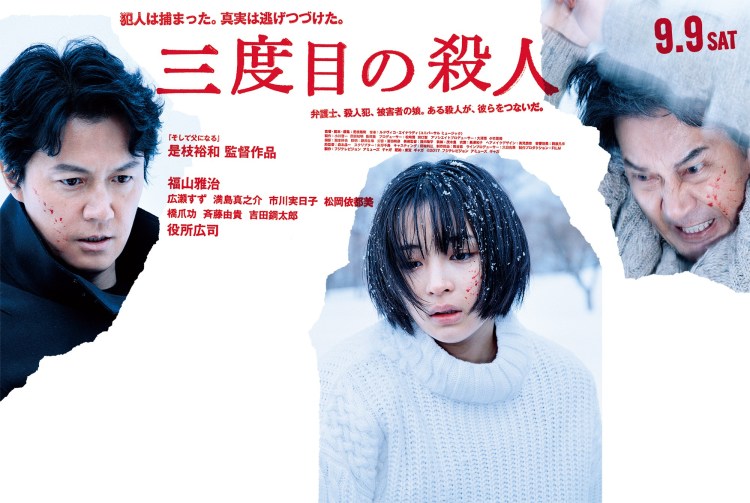
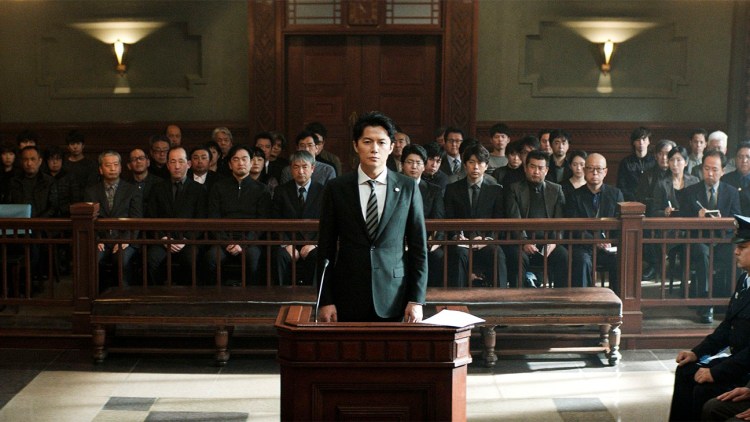
The Third Murder Sweeps 41st Japan Academy Prize

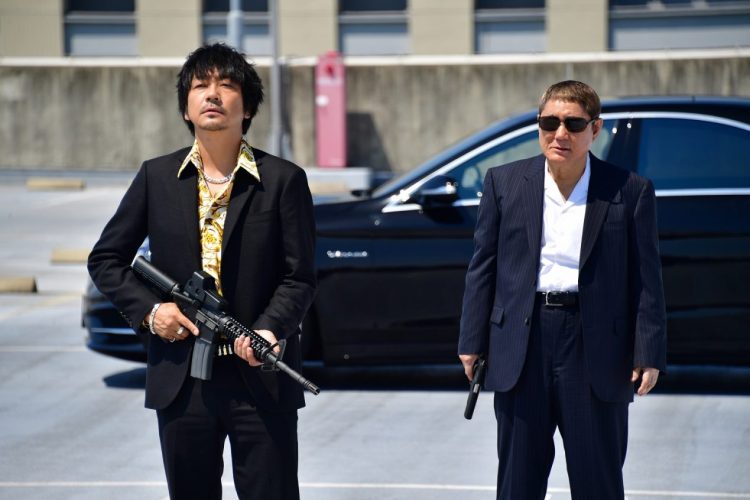
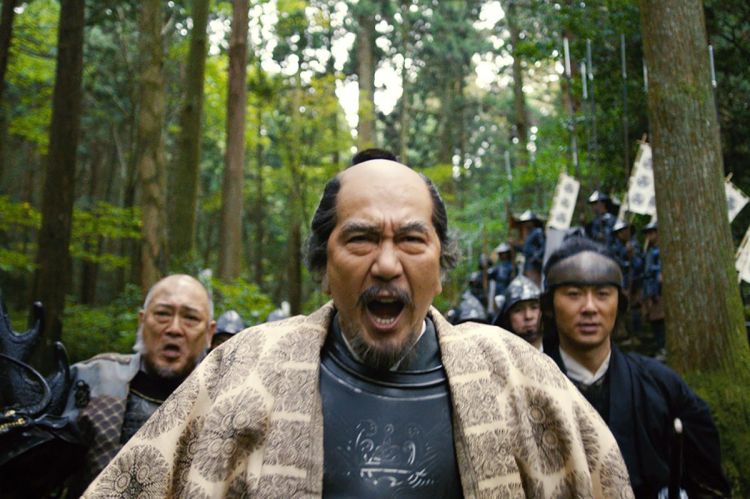
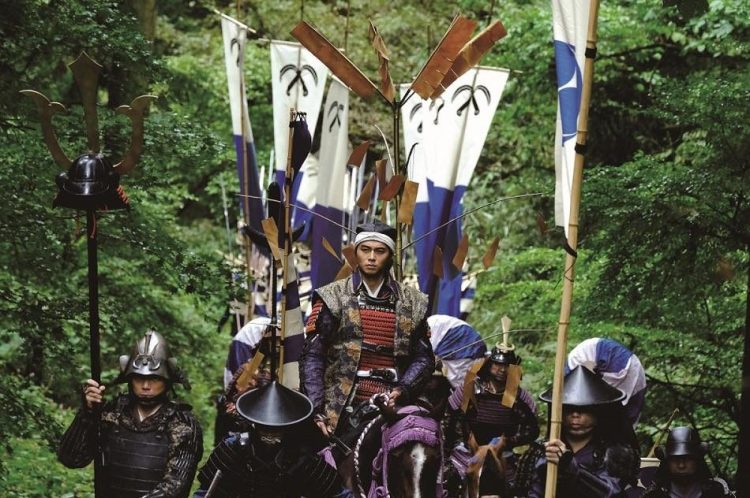
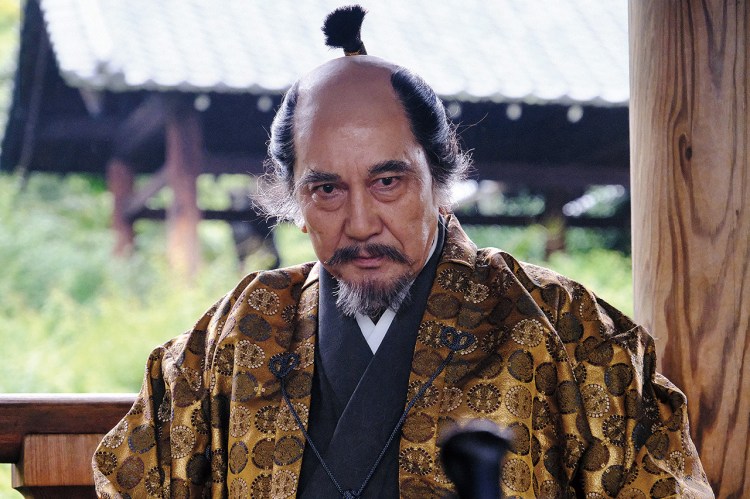
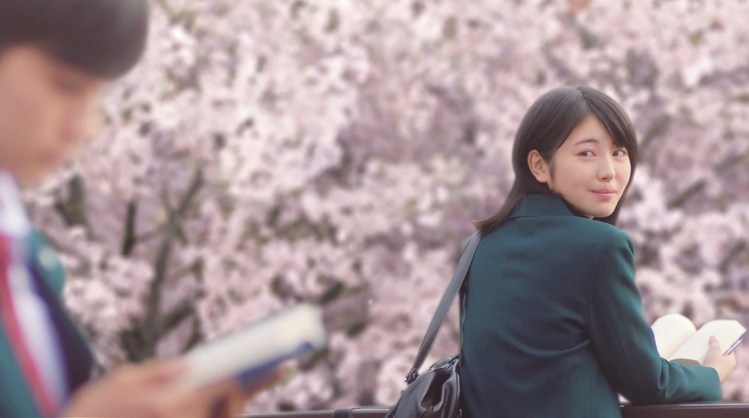
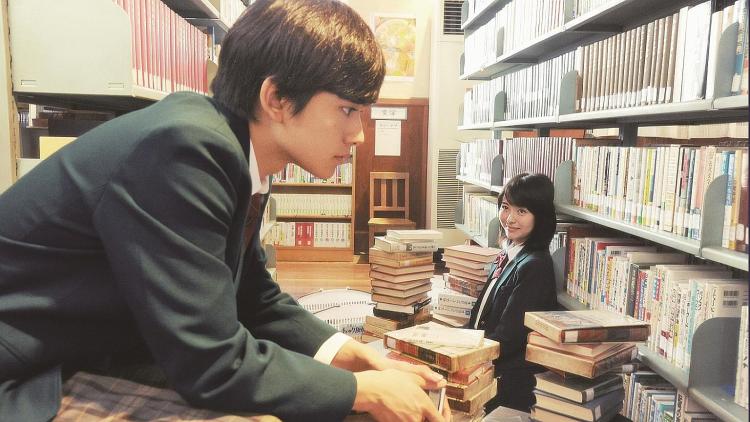
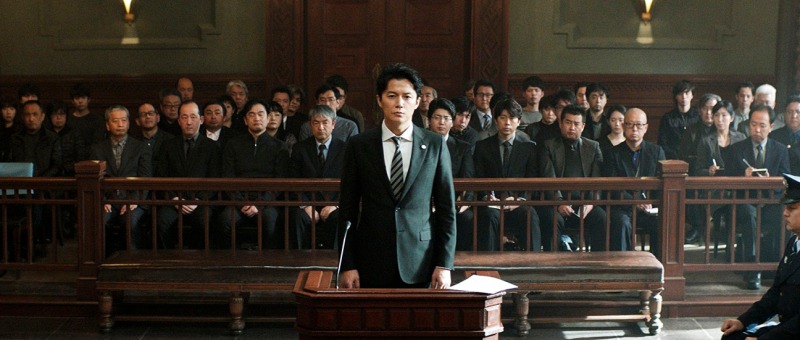
The Third Murder still 2The 41st Japan Academy Prize was presented at Grand Prince Hotel New Takanawa on 2nd March 2018. Hirokazu Koreeda’s latest, his first foray into the murder mystery, swept the board with six awards including the big ticket items of best picture, director, supporting actor and supporting actress. Despite numerous nominations popular hit Let Me Eat Your Pancreas went away with only the previously announced newcomer awards while period epic Sekigahara had some success in technical categories.

Winners and nominees in full:

Picture of the Year

third murder horizontal poster

Animation of the Year

The night is short still

Director of the Year

The third murder still 1

Best Screenplay

third murder still 3

Outstanding Performance by an Actor in a Leading Role

wilderness still 2

Outstanding Performance by an Actress in a Leading Role

birds without names still 2

Outstanding Performance by an Actor in a Supporting Role

third murder still 4

Outstanding Performance by an Actress in a Supporting Role

third murder still siz

Outstanding Achievement in Music

outrage coda still

Outstanding Achievement in Cinematography

Sekigahara still 1

Outstanding Achievement in Lighting Direction

Sekigahara still 2

Outstanding Achievement in Art Direction

flower and sword poster horizontal

Outstanding Achievement in Sound Recording

Sekigahara still 3

  • Satoshi Ozaki (Flower and Sword)
  • Kazumi Kishida (What a Wonderful Family! 2)
  • Yoshifumi Kureishi (Outrage Coda)
  • Kazuhiko Toyama (The Third Murder)
  • Masahito Yano (Sekigahara)

Outstanding Achievement in Film Editing

Third murder still 5

  • Hirohide Abe (Flower and Sword)
  • Iwao Ishii (What a Wonderful Family! 2)
  • Takeshi Kitano & Yoshinori Ohta (Outrage Coda)
  • Hirokazu Koreeda (The Third Murder)
  • Eugene Harada (Sekigahara)

Newcomer of the Year 

let me eat your pancreas still 1

(awarded to all four nominees equally – announced along with nominations)

Special Award of Honour from the Association

(Lifetime achievement awards – technical fields)

  • Etsuko Egawa (makeup & prosthetics)
  • Katsutoshi Osawa (art direction)
  • Midori Onuma (hair & makeup)
  • Hiroshi Koto (costumes)
  • Takefumi Yoshikawa (casting)

Special Award of Honour from the Chairman

(Lifetime achievement awards celebrating contribution to the film industry)

  • Kyoko Kagawa (actress)
  • Takashi Kawamata (cinematographer)
  • Masahiro Shinoda (director)
  • Kenichi Benitani (sound engineer)
  • Toshio Masuda (director)
  • Fujiko Yamamoto (actress)

Special Award from the Chairman 

(Lifetime achievement award presented to members of the film industry who passed away during 2017)

  • Iwao Otani (audio engineer)
  • Hiroki Matsukata (actor)
  • Tsunehiko Watase (actor)
  • Akira Hayasaka (screenwriter)

In Memoriam 

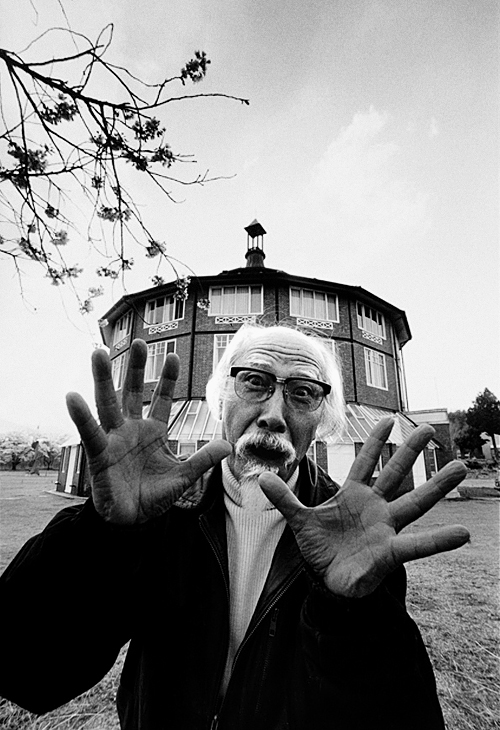
suzukiSeijun Suzuki (director) – As a previous recipient of the Special Award of Honour, Suzuki is ineligible for a second lifetime achievement award but his passing is marked with this special mention.

Popularity Awards

(nominated by an All Night Nippon audience poll)

Movie: Let Me Eat Your Pancreas

let me eat your pancreas still 2

Actor: Masaki Suda (Teiichi: Battle of Supreme High)

teiichi still

Source: Japan Academy Prize official website

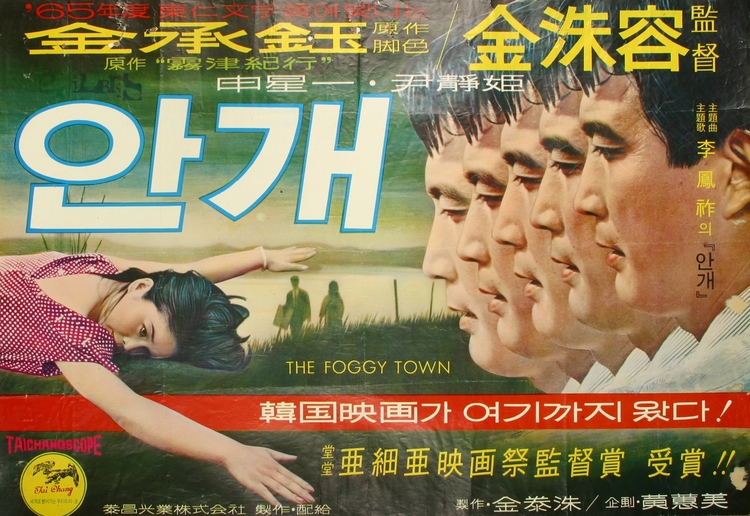
Mist (안개, Kim Soo-yong, 1967)

Mist 1967 posterBy 1967 Korea’s fortunes were beginning to expand. For the young, the future held promise but the nature of that promise was still indistinct. Often considered his masterpiece, 1967’s Mist (안개, Angae, AKA The Foggy Town) was another in the series of literary adaptations for which director Kim Soo-yong had become well known but its avant-garde mise-en-scène and gloomy outlook stand in stark contrast to the heartrending melodramas with which the genre was synonymous. Economic prosperity and superficial success have provoked only emptiness and despair, but a return to source provides little clarity for one harried salaryman lost in the expanding landscape of Korea’s global ambitions.

A poor boy from a remote coastal village, Gi-joon (Shin Seong-il) is now a successful salaryman in the capital where the constant clacking of typewriters, ringing of telephones, and racing of traffic rub at his tired mind. The fact of the matter is Gi-joon is not all that successful – he owes his position to having married the widowed daughter of the CEO. His wife and father-in-law, however, have relatively little faith in his business acumen and so, with the annual shareholders meeting on the horizon, they suggest he get out of the way by paying a visit to his hometown. Gi-joon is not all that happy to be going back, he hated Mujin with its unrelenting fog and general air of existential malaise, but he’s spineless and so he goes, despite himself.

Taking the train, Gi-joon has plenty of time to dwell on his past, literally seeing reflections of his younger self and entering extended flashbacks of memory. Mimicking the stream of consciousness approach of the novel, Gi-joon provides frequent voiceover, introducing his hometown in a less than favourable light as a place which traps its young who yearn to be free of its oppressive boredom. According to the irritated dialogue of two passengers on the bus (which Gi-joon has to take after his lengthy train journey), Mujin is a nothing sort of town where the sea is too shallow for fishing and the fields to narrow for farming, yet the population is large and largely survives on desperation alone, isolated by the oppressive fog that envelops the landscape each and every morning.

Gi-joon characterises the residents of Mujin as petty and materialistic. Having longed to escape, he thought he’d achieved his dreams in Seoul but a trip home forces him to reconsider what it is he’s become. In truth he’s no different from the petty and materialistic villagers he looked down on in their need to look down on each other. Powerlessness has defined his life. As a young man, he resorted to hiding in a cupboard to escape the draft on the orders of his terrified mother and later suffered from weak lungs which made him something of a local laughing stock. Now he’s set for a big promotion in the city but, as his wife reminds him, he wouldn’t even be there if it weren’t for her. Gi-joon’s marriage is one of convenience but it’s clear his wife holds all the cards – a wealthy widow with ambition needs a husband to act as a foil, and a weak willed man like Gi-joon is just the sort to submit himself to her authority in return for the obvious benefits she can offer him. Gi-joon has gained everything he ever dreamed of, but he feels only despair, oppressed by the very system he longed to be a part of.

Back in Mujin his various self delusions are rammed home to him. Trapped once again by the unrelenting fog, he longs to escape from his Seoul life and free himself from the yoke of his marriage and career. Whilst in town he meets up with old friends who introduce him to recent arrival Ha In-sook ( Yoon Jeong-hee) – an opera student turned music teacher who has joined the local school. In-sook is by far the most exciting thing in the extremely boring town, but Gi-joon is worried he’s stepped into the middle of something when he realises his old friend, Park, now a teacher, has a crush on In-sook while another old friend, Cho, now a status obsessed tax inspector, may also have marital designs.

Gi-joon didn’t need to worry about the tax inspector – as it turns out, he thinks he can do better than a mere music teacher and plans to marry up, much like Gi-joon has. Gi-joon bristles slightly at this, as he does to Cho’s lewd story about how he trapped In-sook on an overnight trip and planned to have a fling with her but she managed to get away (much to Gi-joon’s relief). Back home Gi-joon sees reflections of himself everywhere and particularly doesn’t like this alignment of himself with the ugly ambition of men like Cho who only want to lord it over their former friends. More flatteringly he sees his younger self in the depressed, conflicted In-sook who is already going half mad in the stultifying rural town and longs to go back to Seoul. Despite mild qualms about his friends’ feelings, Gi-joon finds himself bonding with the melancholy young woman who again forces him to see himself the way he really is rather than as the idealised personality he’d constructed for himself as a successful Seoul salaryman.

Bonding in their existential loneliness, the two eventually embark on a tender if melancholy affair which, despite their protestations to the contrary, is built on self delusions if not exactly on lies. Gi-joon intends to take In-sook to Seoul, but he won’t, and In-sook knows she won’t leave even if she wants to believe in the possibility of rescue. The world for them is as foggy and indistinct as the mists around the beaches of Mujin. Filled with emptiness and despair, they remain adrift in the post-war society unable to accept the soulless compromises of conventionality but finding no escape from their self imposed prisons.


Available on DVD as part of the Korean Film Archive’s Kim Soo-yong box set. Also available to stream for free via the Korean Film Archive’s YouTube Channel.

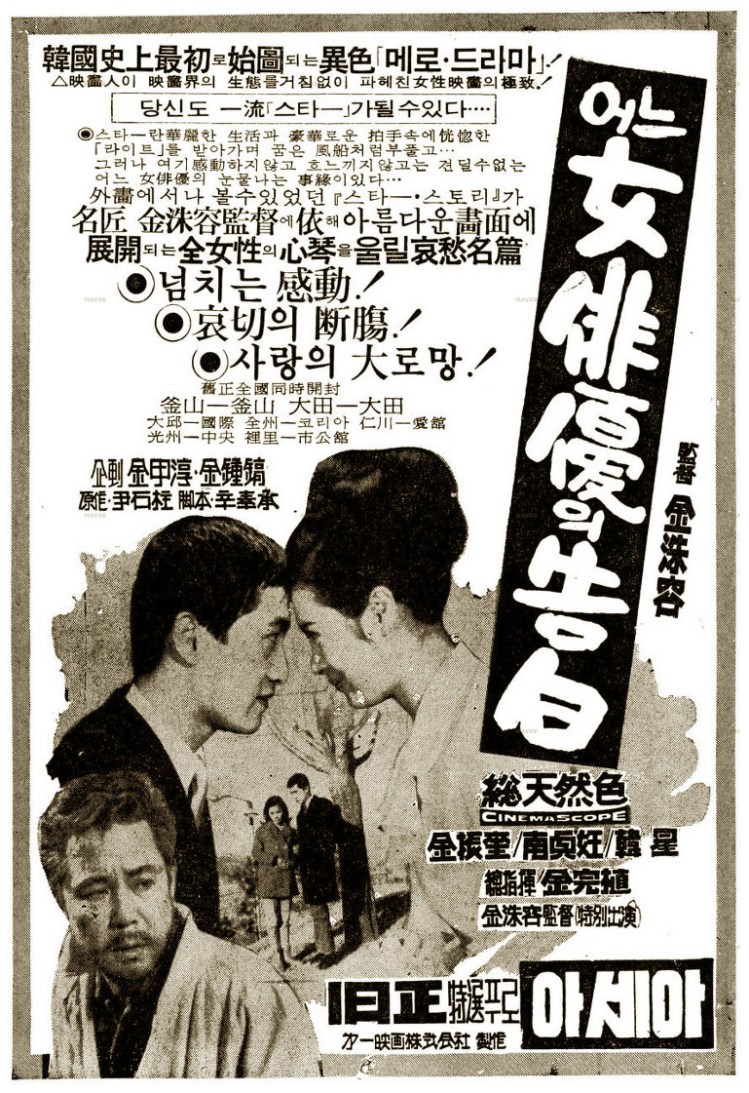
Confession of an Actress (어느 여배우의 고백 / 어느女俳優의告白, Kim Soo-yong, 1967)

Confession of an actress posterKorean filmmaking of the 1960s is sometimes referred to as a “golden age”, but the reality is that films were often churned out at a rapid pace for immediate distribution. Producers got an advance from local distributors, picked a scenario, assigned a suitable director and slotted in big name stars they already had under contract. For this reason production values are often low, but performance standard high despite the fact that many stars are bouncing around from one film to another shooting a scene here and a scene there. Director Kim Soo-yong filmed 10 features in 1967 – including his masterpiece Mist. Confessions of an Actress (어느 여배우의 고백 / 어느女俳優의告白, Eoneu Yeobaeu-ui Gobaek), inspired by a novel by Yun Seok-ju, is the kind of straightforward melodrama that was going out of style – a virtual remake of Chaplin’s Limelight with a little Phantom of the Opera thrown in, but Kim neatly repurposes it as a meta take on the Korean film industry of the day.

Kim Jin-kyu (played by the actor of the same name) was once a famous movie star, but heartbreaking tragedy ruined his career and now he’s a washed up drunk dreaming of the past. Hearing the dreaded “hey mister, didn’t you used to be somebody?”, Jin-kyu wanders into a film shoot and is thrown back to a happier time when he starred in prestige pictures with his regular co-star who was also his lover. Sadly, Miyong died of an illness leaving their last picture unfinished. The studio producers wanted to replace her and complete the movie, but Jin-kyu wouldn’t have it. They sued him for obstruction and his career was ruined. Jin-kyu was told that the child Miyong was carrying had died, but unbeknownst to him, a daughter was born and Miyong asked her friend Hwang Jung-seun to give the baby up for adoption and save it from the stigma of being illegitimate. Running into Jung-Seung at the shoot, Jin-kyu finds out his daughter is alive and determines to turn her into a great star – the only thing he can do for her as her father now that he is in such a sorry state.

Almost all of the characters in the film are named for their actors, though they are obviously not playing themselves in any biographical sense. Nevertheless, there is an intentional reflexivity in Kim’s decision to shift away from his literary source to towards one more immediately cinematic. Much as in Chaplin’s Limelight which does seem to provide a blueprint for the narrative, the arc is one of tragedy and redemption as Jin-kyu attempts to make up for lost time by imparting all his professional knowledge to the daughter he never knew and ensuring her success even at the cost of his own. Ashamed to introduce himself to her as a father given that long years of lonely drinking have reduced him to a broken old man, Jin-kyu gives his advice via letter and avoids seeing Jeong-im, longing to embrace her but afraid he’ll bring shame on her growing fortunes.

When Jin-kyu gets Jeong-im into show business, Kim gets a chance to put the Korean film industry on screen. He starts with a mildly sleazy producer and the established star who’s getting too old for ingenue roles but is desperate to hang on to her leading lady status. Nevertheless, she does have the option, as she points out, of a dignified escape through marriage should her career fail – something that is not an option for her male co-stars. As a young hopeful with no experience and nothing to recommend her beyond a pretty face, Jeong-im’s entry into the world of film is a baptism of fire. Rushed through makeup with its uncomfortable fake eyelashes and into an unfamiliar costume, Jeong-im’s rabbit in the headlights performance does not endear her to the director or more particularly the producer who is looking on from the wings in exasperation quietly calculating how much all of these extra takes are costing in wasted film. Nevertheless, the film is a success and, thanks to Jin-kyu’s careful tutoring, Jeong-im is on track for stardom.

Kim fetishises the camera, the process of filming with its bright artificial lights, tricks and techniques from the ice cold studio shoots to the difficult trips out on location. He makes full use of the relatively rare colour format utilising frequent superimpositions and montages, overlaying the bright neon lights of Seoul with the interior journey of our leading lady as she begins to find her voice. Making a final self cameo, Kim gives in to the inherently melodramatic quality of the underlying narrative but he does so somewhat ironically, rolling his eyes at the need for overly dramatic emotionality while actively embracing it, and lamenting the hardships of filmmaking while churning out his third picture in as many months. Confession of an Actress is not the salacious exposé promised by the title, but it is an illicit look at the decidedly unglamorous side of film production a world away from the bright lights and glossy magazines. 


Available on DVD as part of the Korean Film Archive’s Kim Soo-yong box set. Not currently available to stream online.

The Seashore Village (갯마을, Kim Soo-yong, 1965)

The Seashore village posterKorean cinema of the 1960s was a tightly controlled affair. The authoritarian government of Park Chung-hee had instituted the Motion Picture Law of 1962 which insisted on a studio system with stars under contract and a turnover of at least 15 films a year. The law intended to increase the amount of films produced for mass consumption, giving free reign to the melodrama and thereby accidentally undermining its more censorious aims. Nevertheless, The Seashore Village (갯마을, Gaenma-eul), adapted from a novel by Oh Yeong-su and part of the “literature film” genre for which director Kim Soo-yong would remain famous, goes much further than one would reasonably expect given the conservative nature of Korean filmmaking across the ages. A story of village life with all of its various superstitions and primitive practices, Kim’s film is a daring exploration of female sexuality and the collective power of women away from men.

An opening voice over introduces us to a melancholy fishing village where the life is hard and the people resigned to loss. The boats depart to great fanfare, but just as they are leaving someone remarks that he’s had a bad dream – bad dreams are one of many bad omens for sailors. New wife Hae-sun (Ko Eun-ah) doesn’t wait to watch her husband disappear over the horizon, she takes to the clifftop shrine of the Dragon King and prays for his safe return.

Her prayers are unanswered. A typhoon strikes and Hae-sun’s husband, along with another sailor, is killed. So young a widow, Hae-sun becomes an awkward problem for the villagers. Sang-su (Shin Young-kyun), a shady drifter, begins making subtle overtures which eventually turn into outright harassment and attempted rape. Hae-sun likes the family she married into and wants to stay true to her husband’s memory, but the forces of nature conspire against her.

While Hae-sun is a classically “good” woman who rejects the advances of Sang-su, the other village wives feel rather differently. Everyone except Hae-sun’s widowed mother-in-law (Hwang Jung-seun) knows about Sang-su’s obvious desire for Hae-sun but they see nothing wrong in it. Rather than the conservative atmosphere of the middle-class urban melodrama in which bodies of surrounding middle-aged women act as enforcers of moral discipline, these literal fishwives are of an earthier disposition. Many of them have been widowed with husbands lost at sea – the way they see it, you’d best take your pleasures where you can and there’s nothing wrong with a quick roll in the hay if it eases frustration and aids productivity. They laugh at Hae-sun’s prudery and marvel at her ability to carry on as normal after losing her husband not because of the grief, but because of the lack of intimacy.

It might be 1965 outside of the village, but the old ways still rule here even if they’re on their way out. In the old days, women did not remarry – a serious problem in a small village with few men around to replace those lost at sea. Hence, women have learned to live alone, supporting each other in place of men and often forced to do without them. In a surprising development, Kim flirts with the taboo of lesbianism – something which is addressed half-jokingly by the gossipy widows but eventually gives way to a literal roll in the hay with half the village women looking on in hilarity rather than horror. The women joke about living together but lesbianism does seem to be presented as an imperfect solution to their present problem in the lack of satisfaction available to them due to the absence of men. Far from a taboo, sexual desire is a normal part of life in the village – something ranked alongside eating and sleeping and no more or less embarrassing than any other bodily function. The widows crave men and are unafraid to say so even if some of them are content to make do with each other in resignation to their awkward status as older single women.

Hae-sun is in a slightly better position given that remarriage is apparently no longer so much of a taboo. Unfortunately that presents a problem for her as all she wants to do is stay with her family just as she is. She doesn’t like Sang-su and his increasingly aggressive behaviour towards her is unlikely to change that but nevertheless she eventually finds herself given to him almost against her will. Despite becoming a wife once again, Hae-sun’s beauty continues to curse her by causing problems between men wherever she sets foot. The problems, however, are definitively on the male side – men long to possess her, with violence if necessary, and ruin themselves in their immoral pursuit of a “pure” woman. The village widows rejoice in their earthy pleasures, finding comfort and release in each other but the male impulse, by contrast, is always towards conquest and control, domination rather than mutual support.

Life in the village is hard and often sad, but the women are happy and optimistic. They live the lives that are given to them, and do the best they can with what they have. The very antithesis of the lurch towards modernity, the simple life of the villagers harks back to something purer and more honest without the pretension of urban civility and apparently free from the political concerns of the day. Bold in its outlook, The Seashore Village is a surprisingly progressive effort from the Korea of 1965, subverting its “primitive” setting to present a positive picture of female power and sexuality.


Available on DVD as part of the Korean Film Archive’s Kim Soo-yong box set. Also available to stream for free via the Korean Film Archive’s YouTube Channel.
Ambiguous Places (うろんなところ, Akira Ikeda, 2017)

Ambiguous places poster

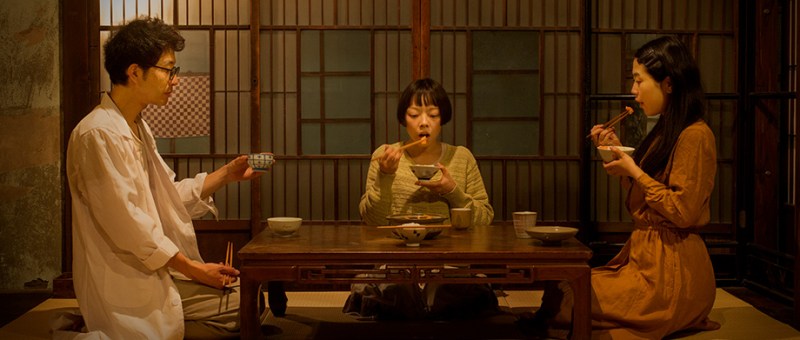
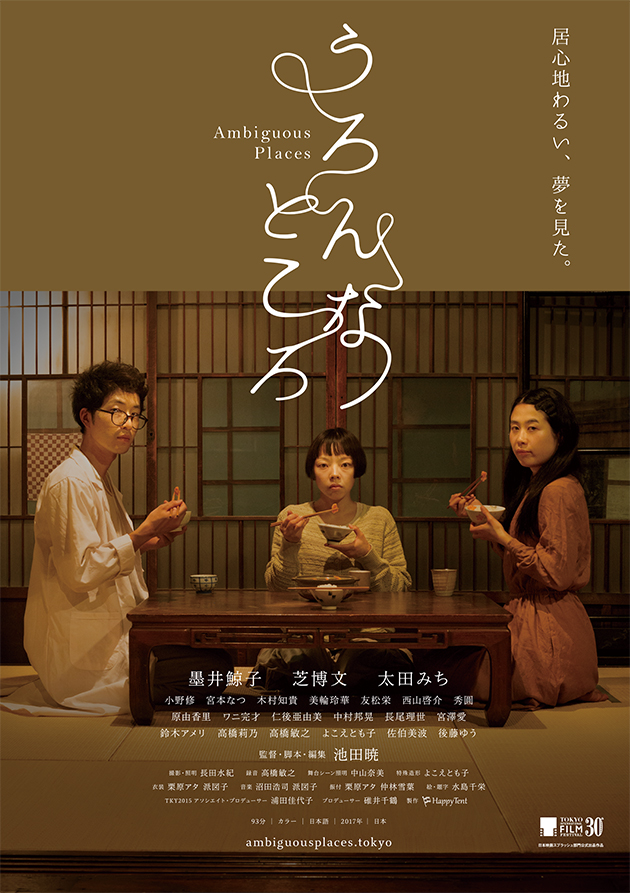
The world is quite a strange place at the best of times, but for a small collection of people living in between some Ambiguous Places (うろんなところ, Uronna Tokoro) everything seems pretty much normal. Akira Ikeda whose Anatomy of a Paperclip won a Tiger Award at International Film Festival Rotterdam, returns with another surreal tale inspired by the land of dreams. 

Konoko (lit. “this girl”) washes up on a beach trapped in a net and tries to sing but the other people on the beach tell her to stop, because she’s rubbish. Konoko’s other problem is that she’s got a bug stuck in her hair and will need to find a barber to take it out. Travelling with a man whom a strange lady looking for “nuts” on a beach assures her is her dad, Konoko wanders off to look for a hairdresser only to sell her “dad” to a couple of near silent dango makers and then discover that the only barber’s in town is actually a soba shop (which serves udon) and she needs to go the pharmacy only the pharmacist is out at the moment because he had to get some gloves made in celebration of his wife’s pregnancy…

Ambiguous Places is actually a cyclical collection of three stories running more or less concurrently in which the same collection of strange people reappear in different stages of their own adventures. Konoko’s “Meeting Nyoraga” segues into the pharmacist’s odyssey of glove making and forced marriage “Celebrate with Gloves”, and that in turn leads into “Get My Hair Washed” which pops out of the pharmacist’s dream about a girl with foamy hair and features a quest to rid one’s home of scary blue ghosts only to end with everyone sitting down and having dinner together instead.

To begin with everything seems very strange but like the best of dreams it eventually starts to make sense and though there is more than a little violence and hostility, broadly everyone seems to accept things just the way they are. Still, from our point of view this is all terribly surreal. At one point the pharmacist, who has just spent ages having gloves knitted around his hands in a bizarre ritual encounters the man who will later own the dango shop just as he’s carting his wife around covered by a sheet and sitting in a wheel barrow filled with vegetables. The man explains that this is his people’s way of celebrating. The pharmacist looks him dead in the eye and remarks “strange custom”. Well, quite. Mozart’s The Magic Flute also plays a large role in the proceedings in somewhat mangled German with bits of Japanese creeping in until a young lady is forced to have a go after criticising Konoko’s singing and finds she is able to sing the Queen of the Night aria complete with coloratura almost faultlessly.

The atmosphere is indeed dreamlike as the various tales weave in and out of each other with a kind of surreal logic that has its own internal consistency even if it’s quite hard to pin down. Absurd in the extreme, Ikeda opts for deadpan delivery that adds to the bizarre humour and ethereal quality of the strange “ambiguous places” which seem to exist in this odd little seaside town. Yet also like dreams the deeper meaning (if there is any) is hard to discern. Nevertheless, even if it is all random and essentially meaningless, Ambiguous Places is unexpectedly warm and filled with enough zany humour to keep things ticking along even when wondering if one needs to be afraid of the postman or if Nyoraga is really as dangerous as they say…


Streamed via Festival Scope as part of their International Film Festival Rotterdam tie-up.

Original trailer (English subtitles)

Monster Hunt 2 (捉妖記2, Raman Hui, 2018)

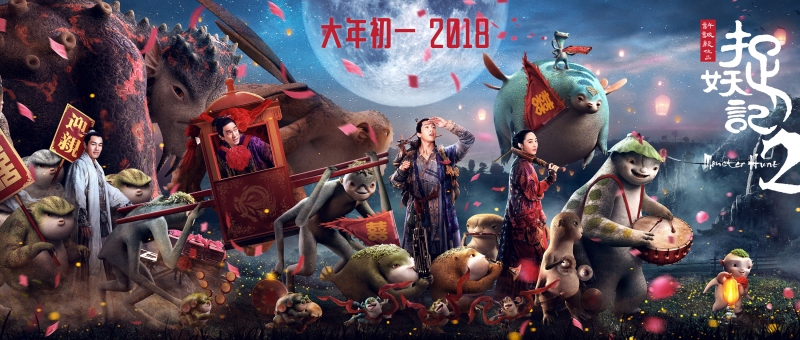
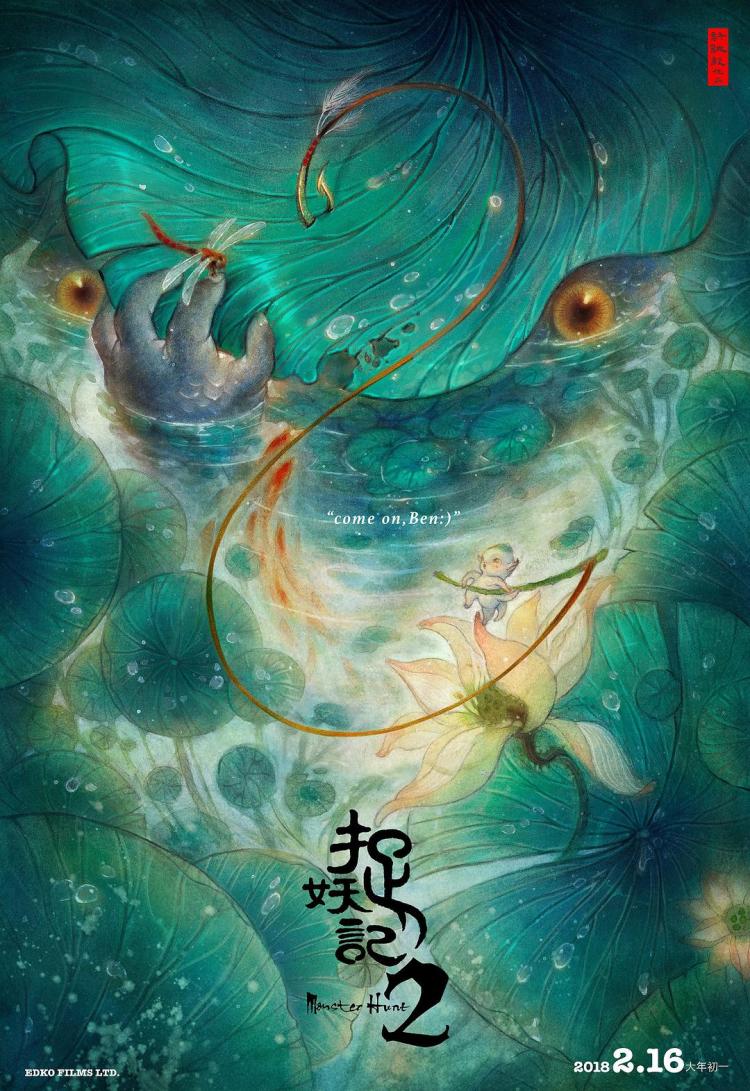
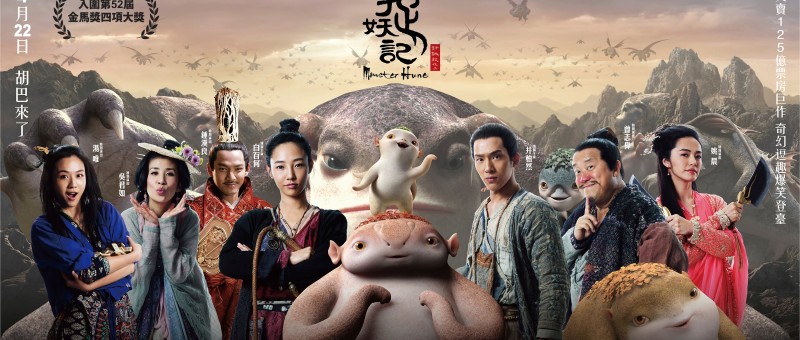
Monster Hunt Poster 2Despite numerous production difficulties, Monster Hunt went on to become a bona fide box office smash and international pop culture phenomenon on its release in 2015. Children and adults alike fell in love with the adorable little radish monster Wuba who, in grand fairytale tradition, is the secret heir to all of Monsterdom and the subject of a prophecy which posits him as the long awaited unifying force set to restore equality between humans and their Monster brethren. By the time this sequel, Monster Hunt 2 (捉妖記2, Zhuō Yāo Jì 2), rolls around, things are looking up for Wuba seeing as no one’s actively trying to eat him, but like so many kids in modern China he misses his human mum and dad who made a difficult decision at the end of the last film that Wuba should live with Monsters in Monsterland because it just wasn’t safe for him in the human realm.

Consequently Wuba has been living happily in the forest where the Monsters have made a little village for themselves. The Monster village is a place of laughter and song where everyone is welcome and they dance cheerfully all night long. That is, until evil monsters turn up looking for Wuba again, destroying the village and leaving him on the run all alone back in the human world. Meanwhile, Tianyin (Jing Boran) and Xiaolan (Bai Baihe) are on a quest to look for Tianyin’s long lost dad – a famous monster hunter who left Tianyin behind as a child to keep him safe, just like Tianyin had to leave Wuba. Nevertheless, though Tianyin and Xiaolan have developed a sparky domesticity, they’re both unwilling to admit how much they miss little Wuba and wish they could go get him back from Monsterland even if they know he’s probably safer hidden away from those who might want to do him harm. While looking for Tianyu and Xiaolan, Wuba gets himself semi-adopted by a very odd couple of chancers in the form of shady gambler Tu (Tony Leung) and his monster partner Ben-Ben.

Once again the theme is family. Monster Hunt spoke, perhaps, to all those separated families in modern China or more particularly to the children in revealing that parents sometimes have to make difficult choices and end up living apart from their kids so that they can give them a better life. Monster Hunt 2 accepts the premise but then provides an emotional correction in making plain the pain Tianyu and Xiaolan feel on being separated (perhaps forever) from Wuba, until they eventually settle on tracking him down and facing whatever dangers come their way together. They come to this realisation after saving a mother and son who’ve been (unfairly) arrested by the Monster Hunt Bureau and witnessing their happiness just in being together despite the sticky situation they may be in.

Meanwhile Wuba, sad and alone, is happy to have found himself a surrogate family in the form of kindly Ben-Ben and the spiky Tu – a virtual mirror of Tianyu and Xiaolan when they first met. As in the first film, Tu originally takes Wuba in because he wants to sell him to Madame Zhu (Li Yuchun) – a woman he has cheated in both love and money, whose patience apparently knows no end. This brief episode of Wuba and his two new uncles is a subversive one in terms of mainstream Chinese cinema, and unlike the early union of Tianyu and Xiaolan there is little comedy in the easy coupledom of Ben-Ben and Tu who become two men raising a child together in relative happiness. This is perhaps the reason for the strange coda in which Tu and Ben-Ben have a brief chat about girls, relegating Tu’s earlier awkward admission of affection one more of brotherhood than love and affirming their total heterosexuality (both the female love interests are also from the same species, just to make things crystal clear).

Yet the message is strong – families want to stay together, parents want to be with their kids and kids want to be with their parents so maybe the world should just let them, even if those families aren’t quite like everyone else’s. With much better production values than the first film and a much more consistent tone, Monster Hunt 2 is a vast improvement on its predecessor though it treads more or less the same ground and is content to meander between several set pieces with more than a few seemingly extraneous sequences of Tu getting up to mischief or Xiaolan using her feminine wiles on a nerdy inventor (though these at least add to the more complex arc of the feminised Tianyu and masculine Xiaolan each moving towards a gender neutral centre). Monster Hunt 2 maybe more of the same and little more than the next instalment in a series, but nevertheless its winning charm and gentle warmth are enough to ensure there will still be devotees of Wuba ready to reserve their seats for the inevitable part three.


Currently on limited release in UK cinemas. Screening locations for the UK, Ireland, US and Canada available via the official website.

International trailer (English subtitles)

Monster Hunt (捉妖記, Raman Hui, 2015)

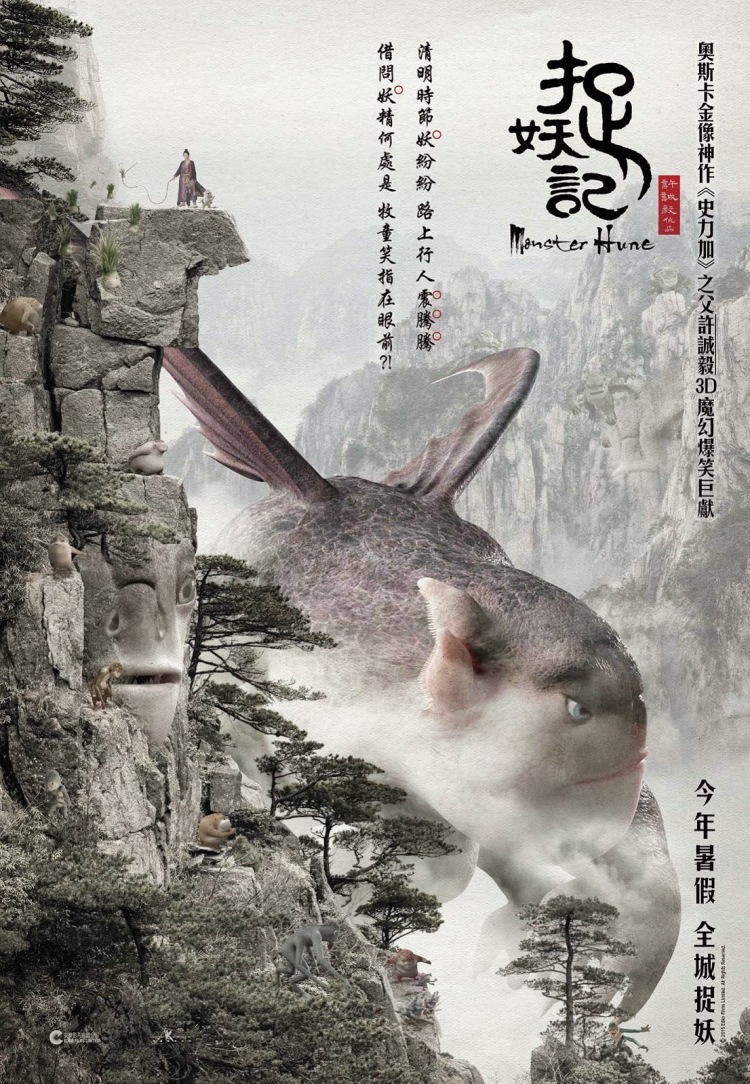
Monster Hunt posterA runaway box office hit and veritable pop culture phenomenon, you’d be forgiven for assuming that 2015’s Monster Hunt (捉妖記, Zhuō Yāo Jì) is nothing more than a slice of family friendly entertainment in the vein of a dozen other live-action/animation hybrid fantasy films. The monsters are cute, yes, and there is enough darkness here to rival Lord of the Rings, but there’s a little more going on under the surface of this otherwise heartwarming tale of a persecuted minority and its hidden princeling. A family drama of epic proportions, Monster Hunt speaks directly to China’s left behind children and to those who, perhaps, were worried their destiny had always been misplaced.

Set sometime in the distant fantasy past, Monster Hunt takes place in a universe in which men and Monsters co-exist but, owing to their defeat in a war, the Monsters have been forced back into the forests and mountains away from humankind many of whom no longer even believe they exist. However, there is fresh strife among the Monsters forcing a pregnant Queen to flee along with her retainers, straying into the human world in hope of saving her baby. Luckily she finds herself in a small village presided over by a kindly mayor with a limp, Tianyin (Jing Boran), who is also the son of a long missing Monster Hunter but much prefers domestic tasks such as cooking and sewing to hunting Monsters. The Queen manages to “transfer” her baby to Tianyin just before she dies, leaving him quite literally holding the baby assisted only by cynical bounty hunter Xiaolan (Bai Baihe).

Inspired by ancient folklore, Monster Hunt plays the chosen one trope to the max as Tianyin wrestles with his destiny while the baby, a true king displaced from his throne, awaits in ignorance. Like many contemporary fantasy tales, Monster Hunt also revels in subverting genre norms with its noticeably feminised hero. Tianyin is the son of a great warrior, but it’s his grandmother who practices kung fu and goes out looking for her long lost son, while Tianyin professes his love of domesticity, staying home cooking and sewing. His simplicity and softness is contrasted with the more masculine figure of the cynical Monster Hunter Xiaolan who becomes Tianyin’s casual love interest and the putative “father” in the loose family unit they form with the tiny baby radish-like figure they eventually christen Wuba.

The formation of a family unit in itself proves a problematic development for both Tianyin and Xiaolan who have both been abandoned by their own families and left to fend for themselves (with almost opposite results). Resentful at having been cast out by his apparently “heroic” father, Tianyin has definite views about the nature of fatherhood and the mistakes he does not wish to repeat with his own children while Xiaolan has grown wary of forming attachments altogether and strives to remind herself that she is only looking after Wuba until he’s big enough to sell on the Monster Hunter black market. Nevertheless, the pair cannot help becoming “accidental” parents even if they must first make a mistake they later need to rectify in trying to abandon their charge for financial gain. Tianyin “repeats” the “mistake” of his own father but finally comes to understand it for what it was – a father’s sacrifice of his paternal love to keep his child safe. Something that will certainly ring true for children who may be living apart from their own parents for reasons they don’t quite understand.

Yet a fairytale darkness is never far away as Tianyin and Xiaolan consider selling off little Wuba to a dodgy mahjong obsessed Monster fence (Tang Wei) who apparently knows how valuable he is but is planning to sell him to a local restaurant anyway. Despite the fact that everyone has forgotten Monsters exist, Monster meat is a delicacy reserved for the super rich (a subtle dig at China’s eat anything that can’t run faster than you philosophy ushered in by the sight of caged monkeys at the roadside) and little Wuba does look quite like a tasty daikon radish.

Cute monsters getting chopped up and eaten may be a horror too far for sensitive young children (if it weren’t for the fact the Monsters are all inspired by veggies Monster Hunt might be the greatest proselytising mechanism for vegetarianism the world has ever seen) but rest assured, little Wuba is quite the resourceful little tyke and he does after all have a grand destiny awaiting him. A tribute to unlikely heroes, gentle men, feisty women, and atypical families, Monster Hunt is an oddly subversive family friendly adventure and one which has clearly hit its mark in capturing the hearts of a whole generation who will doubtless be excited for the further adventures of Wuba as he moves closer towards his own Messianic destiny.


International trailer (English captions)

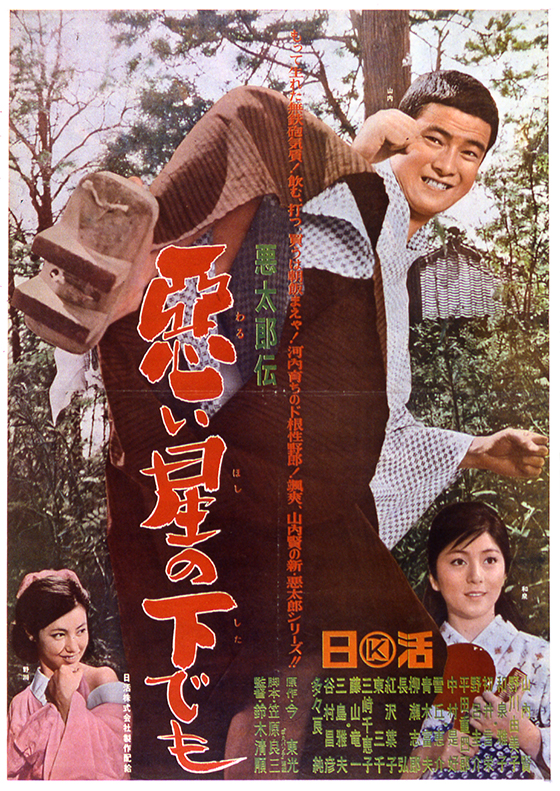
Born Under Crossed Stars (悪太郎伝 悪い星の下でも, Seijun Suzuki, 1965)

Born Under Crossed Stars posterFollowing his 1963 breakthrough, The Incorrigible, Seijun Suzuki returns to the work of Toko Kon for another tale of rural adolescent confusion in Born Under Crossed Stars (悪太郎伝 悪い星の下でも, Akutaro-den: Warui Hoshi no Shita demo). The Japanese title ties the film more closely to the earlier Kon adaptation by adding the preface “Stories of Bastards”, and once again stars Ken Yamauchi and Masako Izumi in leading roles though this time the setting is early Showa, swapping the promise and openness of Taisho for the rapidly closing doors of militarism. Much more obviously comedic than The Incorrigible, Born Under Crossed Stars is another anarchic coming of age tale in which an “incorrigible” youngster learns to find himself but is neatly undercut by the times in which he lives, his final triumph both a victory and a symbol of incoming tragedy.

Farmboy Jukichi (Ken Yamauchi) dreams of a way out of his lowly Osakan roots by getting into a prestigious local school, though his drunken father hardly sees the point of education and would prefer his son go out and earn some money. Jukichi is earning quite a bit working as a milkman for a local “cowboy” dairy farmer who’s recently returned from America but his sights are firmly set on university and a move into the city. Meanwhile, he experiences some personal turbulence thanks to his old friend, Yoshio (Jushiro Hirata). Yoshio gets himself into trouble with the Public Morals committee at school when he’s spotted out with a young lady – something which is against school regulations, but that’s not why he was stopped. Another boy, Oka (Keisuke Noro), wrote a letter to the girl Yoshio was with (who happens to be his cousin) but was rejected. Oka is abusing his position for personal point scoring. Jukichi can’t let it go and takes Oka to task, but his actions have serious repercussions when the humiliated Oka suddenly quits the school altogether.

Jukichi thinks Oka’s actions are very “manly”. Manliness is certainly something important to the boys at the school which has a noticeably militarist song along with various rituals involving fire and taiko drums, not to mention the shiny cap badges and weapons drills they seem to perform. As in Fighting Elegy released the following year, “manliness” precludes fraternising with women – sex has been placed off limits as the ultimate frivolity and a kind of theft of the zest of life which should be going towards more “productive” causes. Jukichi however, like The Incorrigible’s Konno has a taste for the ladies even if he reacts somewhat harshly to discovering Yoshio in flagrante with a girl in a park which turns out to be some kind of mass makeout spot behind a shrine. Uncovering the hypocrisy in his friend sets the two at odds and eventually turns them into enemies with disastrous consequences.     

Jukichi finds himself caught between two lovers – the elegant, shy sister of Yoshio, Suzuko (Masako Izumi), and the liberated, provocative Taneko (Yumiko Nogawa). Though resistant, Jukichi eventually succumbs to seduction and forever ruins his dreams in the process. Overcome with youthful frustrations, he channels his need for justice in a dangerous and destructive direction when he decides to start something with a bunch of local gangsters in a misguided attempt to avenge a wrong done to the father that has never supported him. Later seeing off an attack from the gangsters (tipped off by a remorseful Yoshio) Jukichi seals his fate, gives up on the “decent” life promised by a place at the prestigious middle school and commits himself to wandering, taking to the sea as one of many young men raised on nationalist myths finding their place in the military.

Another programme picture, Born Under Crossed Stars provides ample opportunity for Suzuki to embrace his taste for the strange – notably in his milk patter opening with its literal baby monkey, but also finding room for beetles on strings, “poisoned” manju buns, and illusionary visions. Sticking mainly to static camera, Suzuki nevertheless showcases his taste for unusual composition and editing, making use of rapid focus pulls, side wipes and dissolves to convey the passage of time. He closes with a voice over mimicking the one at the end of The Incorrigible only this time with a much more defiant (but in hindsight only tragic) declaration that Jukichi will continue living under his self made philosophy, vowing to do what ever it takes to survive and scale any wall which places itself in his path towards the achievement of his freedom.


Born Under Crossed Stars is the fifth of five films included in Arrow’s Seijun Suzuki: The Early Years. Vol. 1 Seijun Rising: The Youth Movies box set.

Original trailer (English Subtitles)

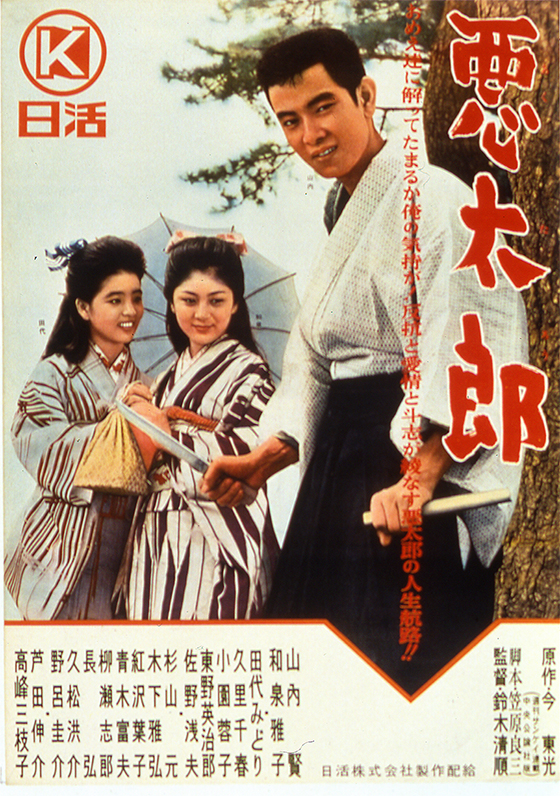
The Incorrigible (悪太郎, AKA The Bastard, Seijun Suzuki, 1963)

(C) Nikkatsu 1963

(C) Nikkatsu 1963

Seijun Suzuki often credits 1963’s Youth of the Beast as the real turning point in his directorial career, believing that it marked the first time he was ever really able to indulge his taste for the surreal to the extent that he truly wanted. The Incorrigible (悪太郎, Akutato, AKA Bastard), completed directly after Youth of the Beast, is another turning point of a kind in that it marks Suzuki’s first collaboration with set designer Takeo Kimura who would accompany him through his ‘60s masterpieces contributing to the uniquely theatrical aesthetic which came to be the director’s trademark.

Inspired by an autobiographical novel by Toko Kon, The Incorrigible of the title, Togo Konno (Ken Yamauchi), is a young man coming of age in the early Taisho era. He’s of noble birth and enjoys both wealth and privilege – something of which he is well aware, but is also of a rebellious, individualist character believing himself above the normal rules of civil society. Expelled from his posh Kyoto school after getting into a dalliance with a teacher’s daughter (she’s been sent off to a convent), Konno is then abruptly abandoned by his mother who has tricked him into travelling to a remote rural town where a friend of a family friend has promised to reform him at his military middle school. Konno thinks he’s too clever for this, he makes a point of deliberately failing his entrance exam in the mistaken belief that failing to get in would make him free to travel to Tokyo and start life on his own. He’s wrong, and failure to pass the exam would only entail being held back a year. Konno capitulates and agrees to start his new life as one among many in a backward little village in Southern Japan.

Though set in the Taisho era, Konno’s youth seems to suffer from the same problems that would plague the young men of 30 years later. His school is proto-militarist and hot on discipline. The boys are trained to be strong rather than smart and have inherited all the petty prejudices of their parents which they hone to the point of weaponry. The “Public Morals” department operates almost like a mini military police for students – making routine inspections of students’ home lives and keeping an eye out for “illicit” activities round and about town. Konno sees himself as grown man with a rebellious heart – he smokes openly, keeps a picture of the girl who got him into this mess in his room, and tells bawdy, probably made up stories about how he lost his virginity to a geisha (for free). He will not bow to the morality police, or any authority but his own.

Authority is something Konno seems to be good at. Picked on for his continuing preference for Japanese dress, Konno neatly deflects the attentions of the Public Morals division and comes out on top. When they raid his room and complain about his novel reading habit, he shouts them all down and gets them to sit on the floor while he “educates” them about foreign literature. Militarism has not yet arrived, but anti-intellectualism is already on the up and up. Konno’s love of literature is one of his many “deficient” qualities as teachers and students alike bemoan his “frivolous” hobbies, seeing his sensitivity and disregard for the commonly accepted ideals as signs of his unwelcome “unmanliness”.

Konno’s other big problem is, as might be expected, girls. Having been in town only moments Konno takes a fancy to doctor’s daughter Emiko (Masako Izumi) – his desire is only further inflamed after catching sight of her in the book shop and realising she too has bought a copy of Strindberg’s Red Room. She doesn’t care for Strindberg’s misanthropy, but a bond is quickly forged between the two sensitive souls trapped in this “traditional” small town where feelings are forbidden and youth constrained by social stricture.

It is, however, a love doomed to fail. The majority of Suzuki’s early work for Nikkatsu had been contemporary youth dramas, yet the artfully composed black and white photography of the Taisho setting is a melancholic affair which rejects both the rage of the modern action dramas and Suzuki’s trademark detached irony. Using frequent dissolves, The Incorrigible conjures a strong air of nostalgia and regret, a sad love story without end. Yet at its conclusion it makes sure to inject a note of uplifting inspiration as our hero wanders off into a fog of confusion, filled with a passion for pursuing truth and vowing to live without losing hope.


The Incorrigible is the fourth of five films included in Arrow’s Seijun Suzuki: The Early Years. Vol. 1 Seijun Rising: The Youth Movies box set.

Original trailer (English subtitles)