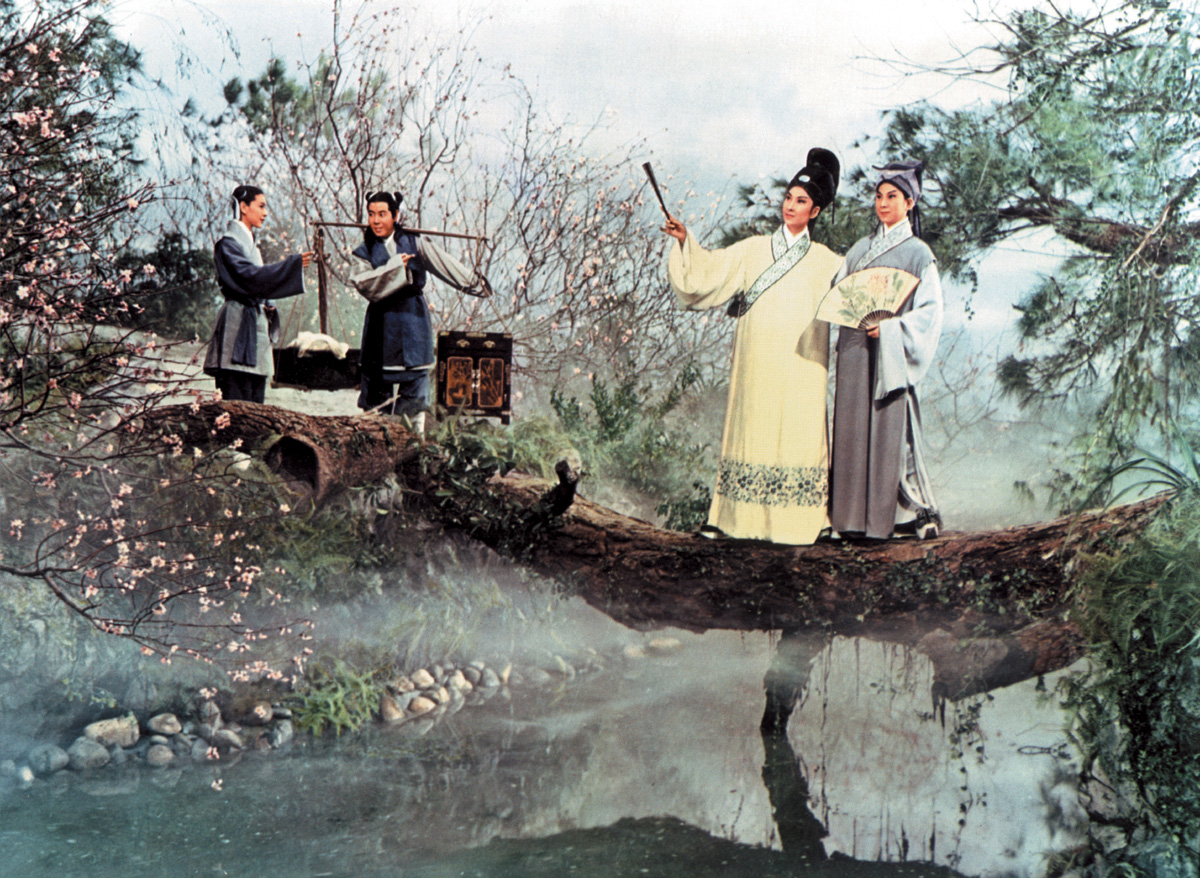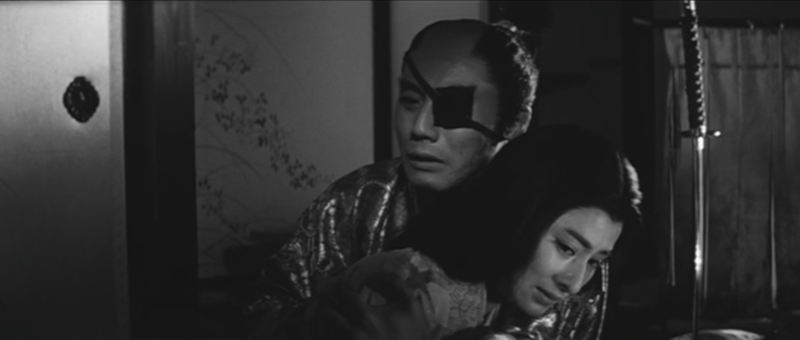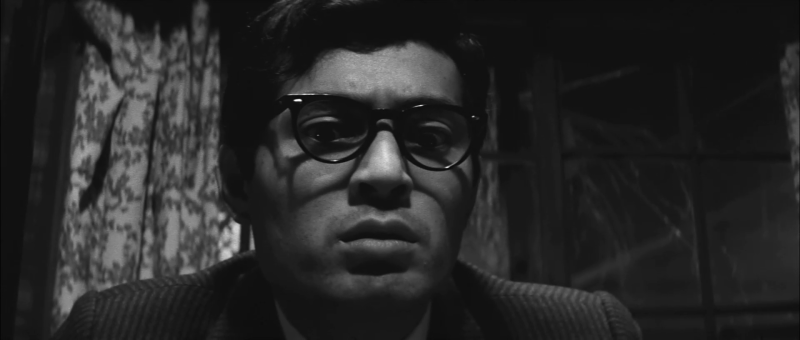
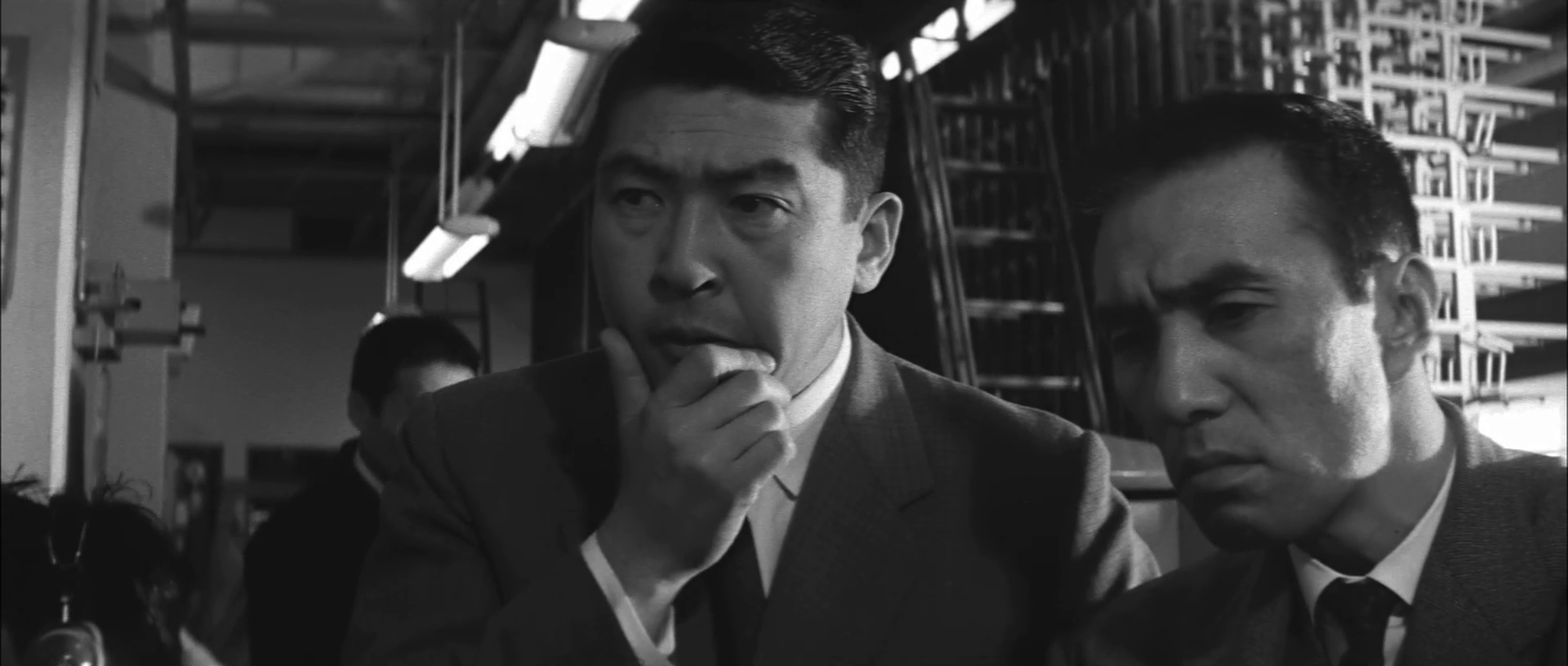
Castle of Owls (忍者秘帖 梟の城, Eiichi Kudo, 1963)

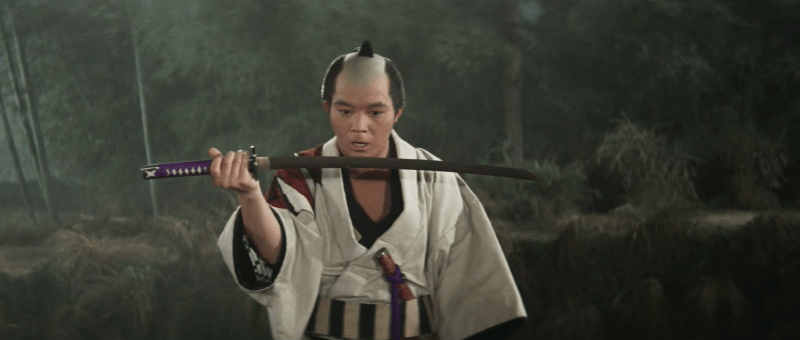
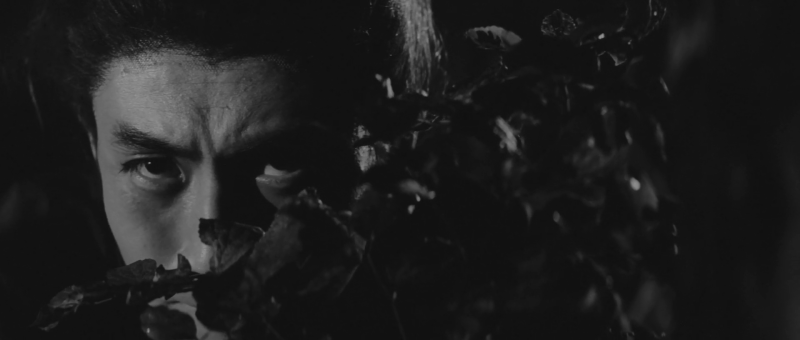
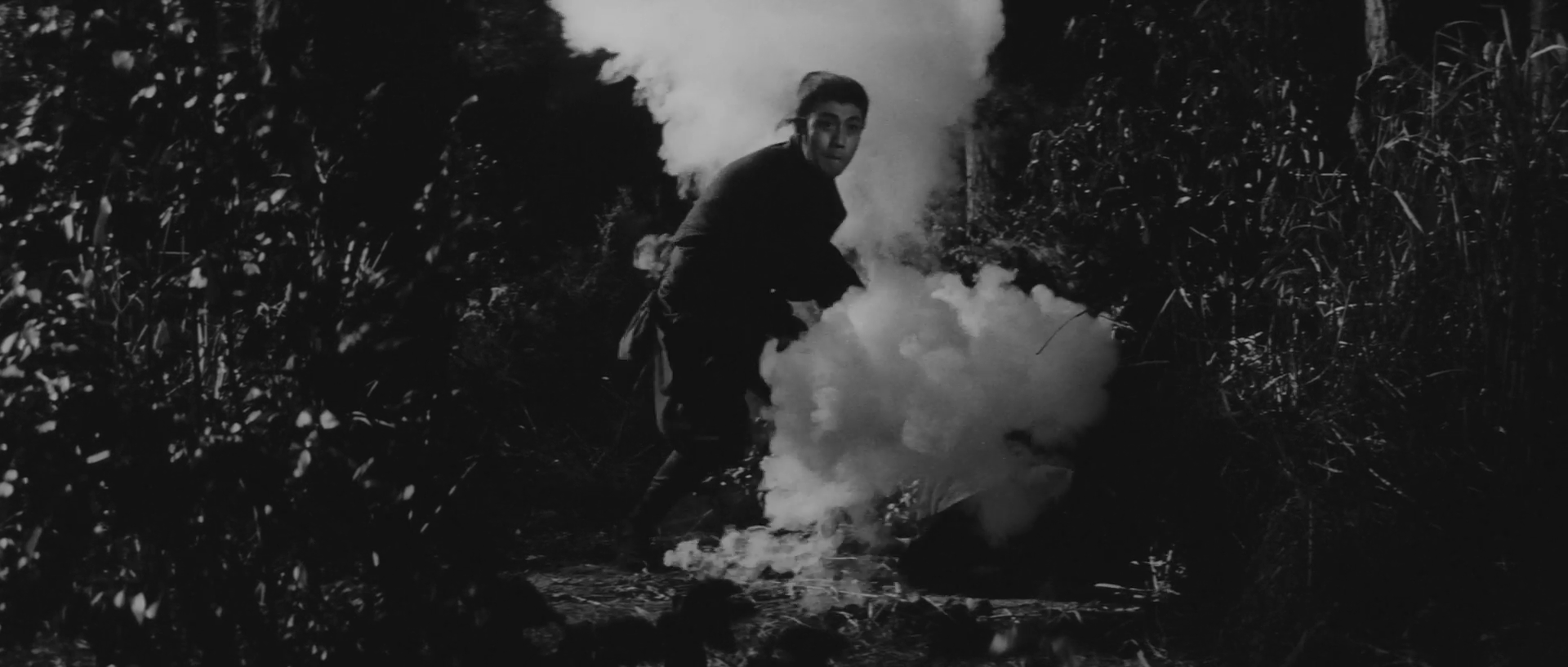
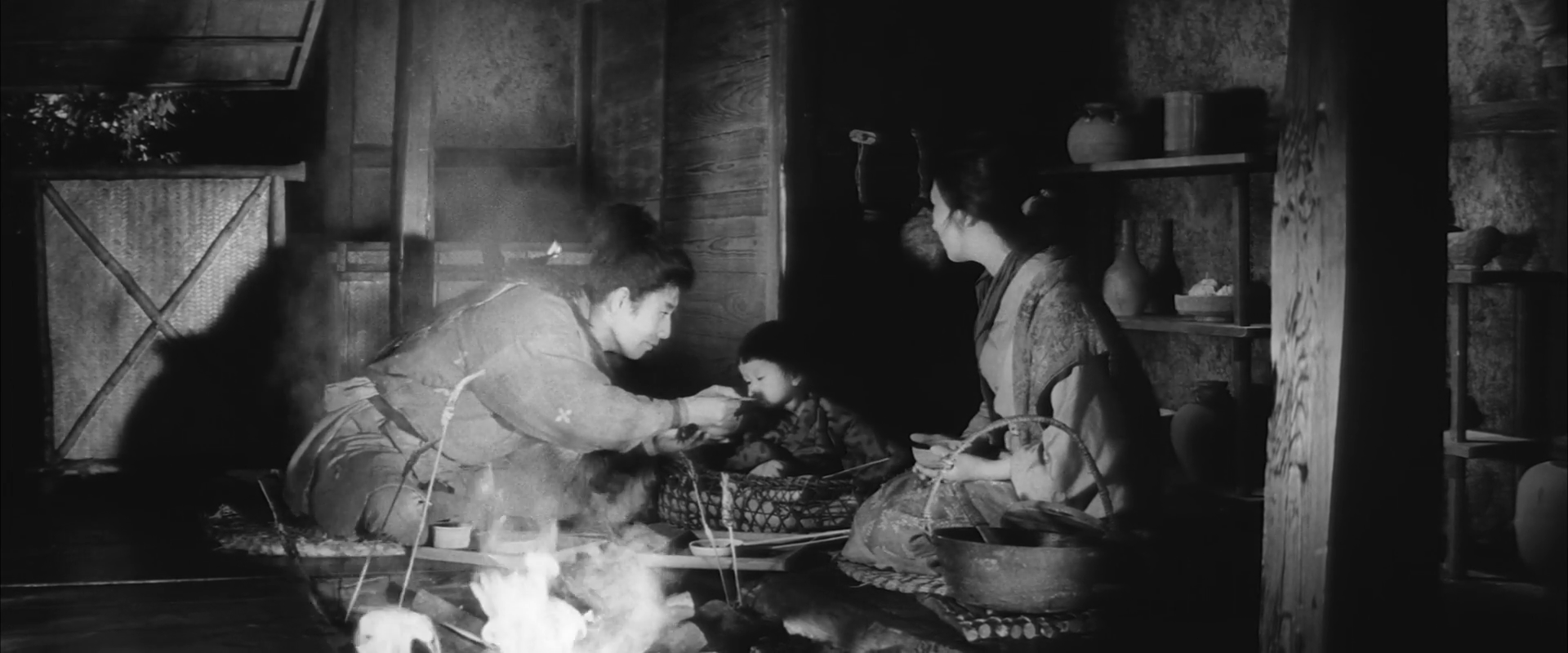
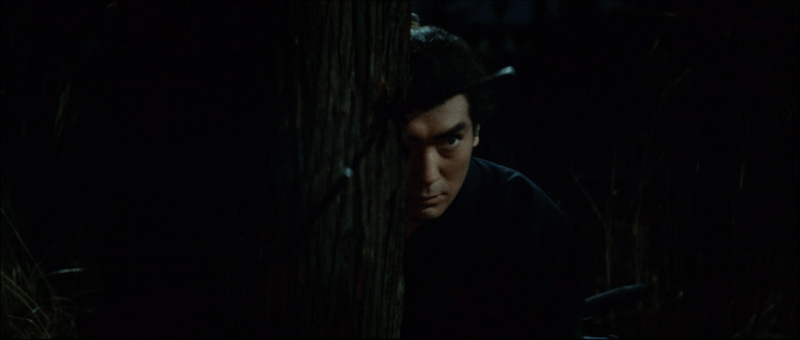
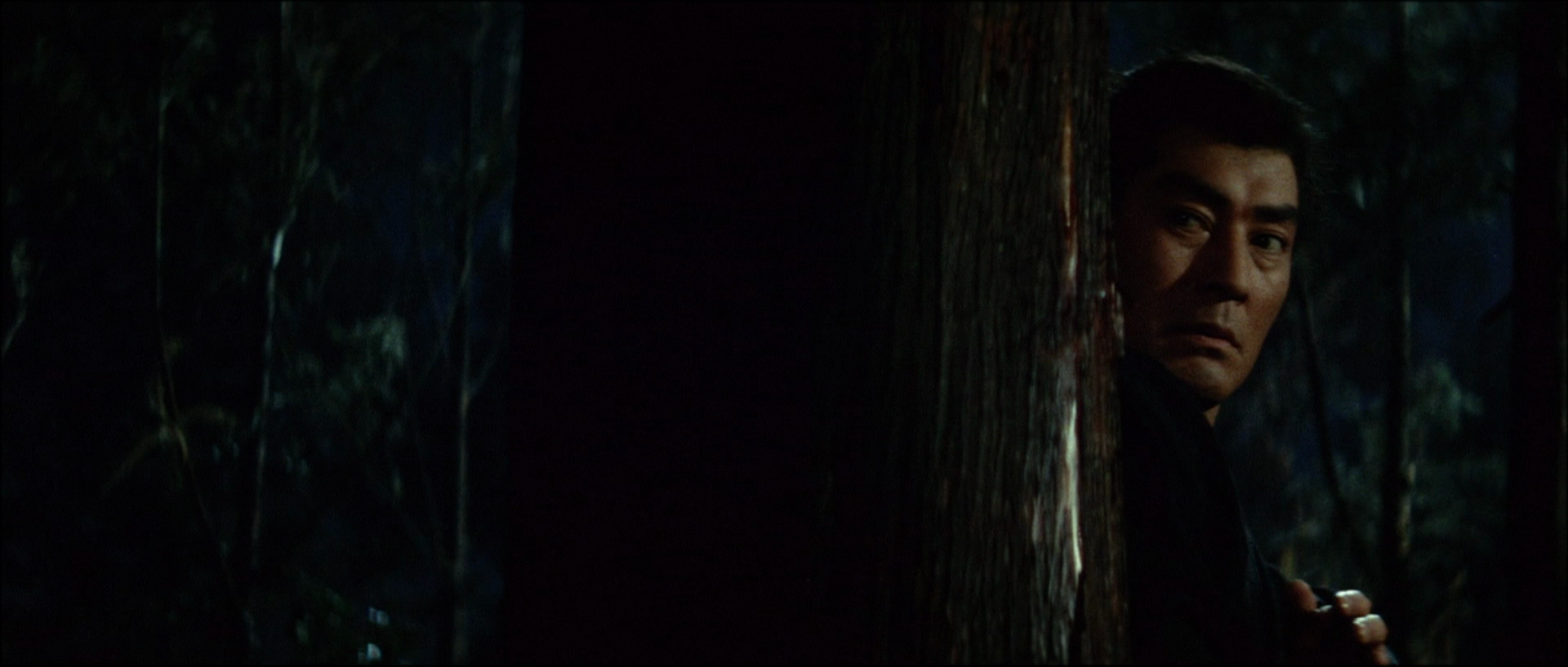
A surviving member of the Iga clan swears vengeance on Toyotomi Hideyoshi only to slowly come to the realisation that the best revenge is living well in Eiichi Kudo’s ninja drama, Castle of Owls (忍者秘帖 梟の城, Ninja Hicho: Fukuro no Shiro). Adapted from the novel by Ryotaro Shiba, the film is somewhat unusual in its positivity in allowing its hero to first reject the codes by which he was raised and then those of the prevailing times in eventually choosing love and happiness over the internecine obligation to gain vengeance against a corrupt social order.

Hoping to solidify his grip on power, Oda Nobunaga has his right-hand man Toyotomi Hideyoshi massacre the Iga clan of ninjas who are then almost entirely wiped out. Juzo (Ryutaro Otomo) and his friend Gohei (Minoru Oki) both survive, but Juzo’s entire family is brutally murdered while his sister takes her own life after being gang raped by Hideyoshi’s soldiers, using her final breath to tell her brother to avenge her. Overwhelmed by grief, Juzo is chastised by veteran ninja Jiroza (Kensaku Hara) for his show of emotion. He reminds him that a ninja should be as unbreakable as stone and that he should abandon all human sentiment. Juzo, however, insists that he may be a ninja but is also human and refuses to apologise for his feelings. 

This is it seems the major conflict. Jiroza has already signalled his own heartlessness and practicality when he advised the surviving ninja to flee, for escape is less dishonourable than death. Those who refuse are welcome to surrender, and those who cannot run must be left behind to their fate. For Jiroza, all that matters is survival for both himself and his small daughter Kizaru (Chiyoko Honma) who is currently tied to his back (no mention is made of her mother, perhaps she had already passed away). Now that his family are dead, Juzo has a new mission and reason for survival insisting that what the living can do for the dead is vengeance, though in his case it is personal rather than principled for he mostly wanted revenge for his sister rather than the Iga clan as a whole or anything it represents which he otherwise seems to be at odds with. 

10 years later, Oda Nobunaga has already been bumped off in an act of betrayal by one of his own men leaving Toyotomi Hideyoshi in charge and now the target for Juzo’s revenge. Around this time, Hideyoshi is planning an invasion of Korea against the advice of most of his courtiers in order to legitimise his rule through imperial ambition and military dominance. Juzo has been trying to assassinate him, and has apparently failed five times already. A surprise visit from Jiroza and his now teenage daughter involves a job opportunity promising a monetary reward should he succeed, but Juzo is wary. The merchant who hires him says he wants Hideyoshi out of the way because a war in Korea will damage his business prospects, but as Juzo points out Hideyoshi’s death will leave a power vacuum resulting in another civil war. The merchant, however, giggles childishly and remarks that domestic wars are good for business, leading Juzo to suspect he’s here on behalf of Tokugawa Ieyasu, the most likely to assume power in the event of Hideyoshi’s death.

The irony is though Juzo very definitely wants Hideyoshi dead, when someone else suggests it he becomes conflicted because he knows it will lead to another period of chaos in which even more people will die. Meanwhile, a ninja’s allegiance should belong to his client, who is always the highest bidder, so this is both a win-win situation and a mild conflict of interest. Conversely, Gohei (Minoru Oki), who was betrothed to Kizaru, has apparently betrayed the clan and taken a position as a retainer for one of Hideyoshi’s lords. He agrees to betray the Iga, inform on the plan to assassinate Hideyoshi, and even bring in Juzo in return for a 300-koku stipend and a shot of advancement under the new regime.

Now, on one level this might be understandable. Japan has emerged from a couple of hundred years of constant warfare, there’s no place for ninja in a world of peace as former Iga man Mimi (Tokue Hanasawa) remarks revealing that he’s survived the last 10 years through begging. It’s also understandable given that a ninja is expected to be duplicitous and act in self-interest. Even Juzo applaud’s Jiroza’s ninjutsu on realising that he’s teamed up with Gohei to betray him in order to take out the leader of the Koga ninjas. In essence, he’s only really done what Juzo later does but also the opposite in choosing his individual happiness through betraying those around him to throw his lot in with the person who murdered his entire clan. 

Juzo meanwhile is shaken by his unexpected attraction to female ninja Kohagi (Hizuru Takachiho), a daughter of the Koga,  who like him finds herself conflicted in her mission because of her growing affection for Juzo. Kohagi asks him if they really have to live on hate when they could live happily together instead, but even while conflicted Juzo can’t bring himself to let go of the idea of vengeance and is haunted by images of his friends and family dying. Even so, having decided to give up on a happy future and risk his life to kill Hideyoshi he finds that it ceases to matter. Confronting him, his hatred melts away. He begins to recognise the futility of revenge and that it would be silly to cause a war and make a merchant rich to prove a point. Gohei, meanwhile, pays a heavy price for his choices when his lord disowns him. Even when Juzo comes to rescue him from jail, he laughs that he’s caught him at last. Having escaped from the Iga life to live in the sun, he finds himself in darkness once again. Juzo, however, rides off into the sunshine with Kohagi to live in peace that’s divorced from the wider world. They choose to exile themselves from this world of darkness and duplicity, to live freely in the sunlight rather than be consumed by the internecine codes by which they were raised. Kudo films his ninja battles in near total silence with an almost balletic intensity and paints this world as one of infinite mistrust and uncertainty but equally affirms that it is possible to simply walk away and choose happiness over duty or hate.


The Lost World of Sinbad: Samurai Pirate (大盗賊, Senkichi Taniguchi, 1963)

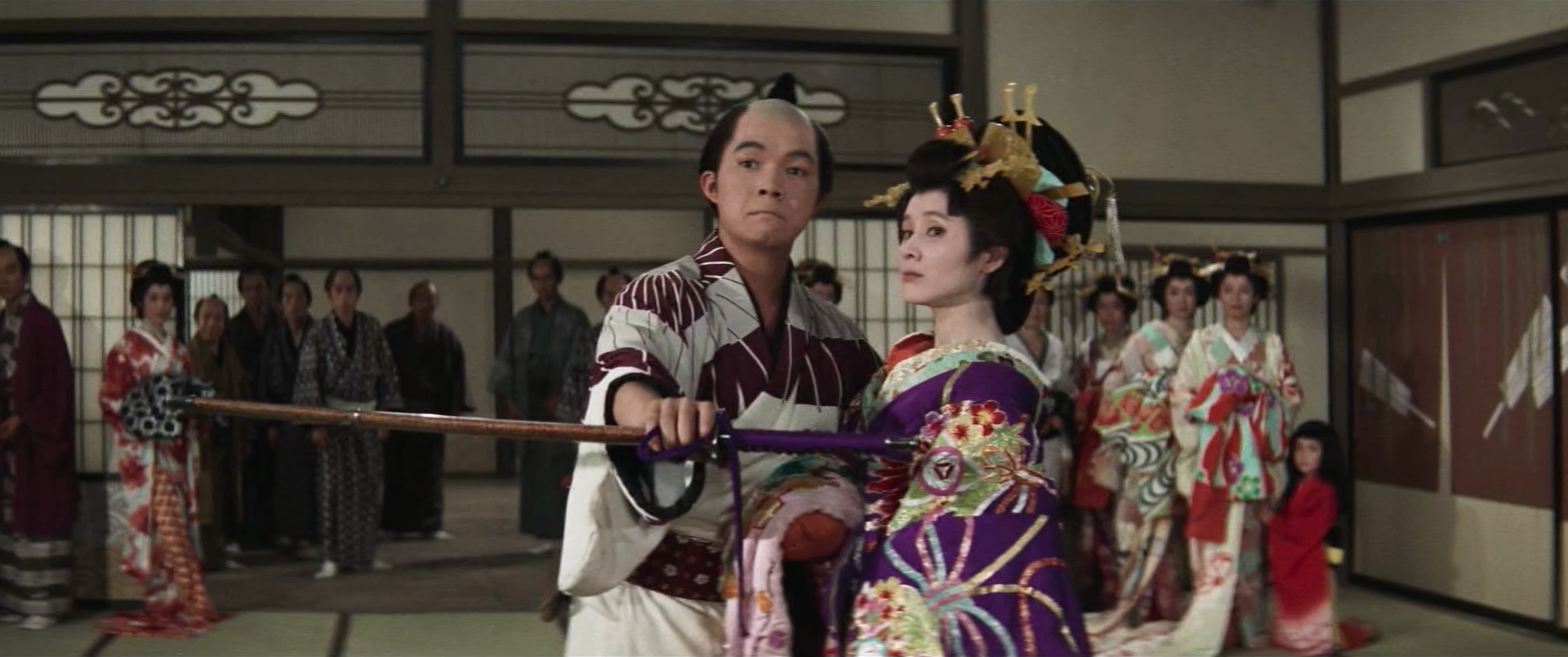
Seemingly drawing influence from the series of Arabian fantasy films from Hollywood, Senkichi Taniguchi’s Lost World of Sinbad: Samurai Pirate (大盗賊, Dai Tozoku), sees the director reunite with Toshiro Mifune who had made his debut in the director’s Snow Trail which could not be more different from this crowd-pleasing adventure movie. The film is loosely based on the life of 16th century merchant Luzon Sukezaemon who eventually fled to Cambodia after all his possessions were seized by Hideyoshi Toyotomi and he was condemned on some trumped up charges.

The film’s opening scenes perhaps reflect this incident as Luzon (Toshiro Mifune) is branded a pirate and set to be burned at the stake, narrowly escaping after bribing an official with drugs. Resentful, Luzon decides he might as well become a pirate after all as he’s pretty sick of Japan and fancies seeking his fortune on the open seas only his ship is quickly destroyed in a storm and all his crew killed while the treasure he was carrying is seized by the fearsome Black Pirate (Makoto Sato). Washing up in a mysterious place aesthetically a mashup between South East Asia and the Middle East, Luzon is cared for by a hermit and then becomes embroiled in intrigue on finding out that the tyrannical king has been seizing local women in exchange for unpaid taxes and imprisoning them within his harem.

Luzon’s dreams are for riches and status so his sudden discovery of a love of justice is a bit of a surprise, but then he’s also most interested in the princess Yaya (Mie Hama) because he spotted one the necklaces from his treasure chest around her neck which suggests she might have a lead on the Black Pirate. Princess Yaya is engaged to a prince from the Ming kingdom which threatens a wider kind of geopolitical destabilisation should anything go wrong with this marriage which is a distinct possibility seeing as the corrupt Chancellor (Tadao Nakamaru) has been colluding with an evil witch to kill the king and seize the kingdom.

Rather than a pure pirate movie the film contains fantasy elements such as the presence of a Western-style castle which is clearly modelled on the one from Disney’s Snow White along with a weird hermit whose powers are weakened every time he sees an attractive woman. It is not, however, the kind of tokusatsu the English title bestowed by the US release implies as it contains no real monsters instead focussing its special effects on the magic used by the witch, who can turn people to stone with her eyes, and the hermit who can turn himself into a fly or disappear in a puff of blue smoke. Despite the prominent inclusion of SFX master Eiji Tsuburaya these effects are repeated several times are really the only ones featured in the film. 

In any case, what’s in play is famous merchant Luzon’s redemption arc in which he recovers the treasure but gives it back to the people, symbolically abandoning his dreams of wealth and status for something a little more community minded in vowing to sail the seven seas pursuing justice throughout the world. Having been a victim of authoritarianism in Japan, he rises up against tyranny abroad while teaming up with a group of local bandits and several times proudly proclaiming himself as Japanese though in a movie conceit everyone speaks his language including the Black Pirate who is later exposed as a snivelling fool tricked by the Chancellor on the promise of a chance to marry the Princess Yaya. Most of the derring do is reserved for the final sequence in which Luzon and the bandits storm the castle to defeat the evil chancellor but the screenplay also packs in genre elements such as trap doors and secret dungeons which keep Luzon busy as he does his best to overthrow an oppressive regime if only to put the rightful king back on the throne in the hope that might be better. Taniguchi certainly makes the most of his elaborate sets and costumes, creating a sense of tempered opulence along Middle-Eastern themes while adding a touch of the mythic in the attempt to weave a legend around the real life figure of Luzon Sukezaemon as a bandit revolutionary selling dreams of freedom on the sea as a pirate more interested in justice than money in otherwise corrupt society.


The Love Eterne (梁山伯與祝英台, Li Han-Hsiang, 1963)

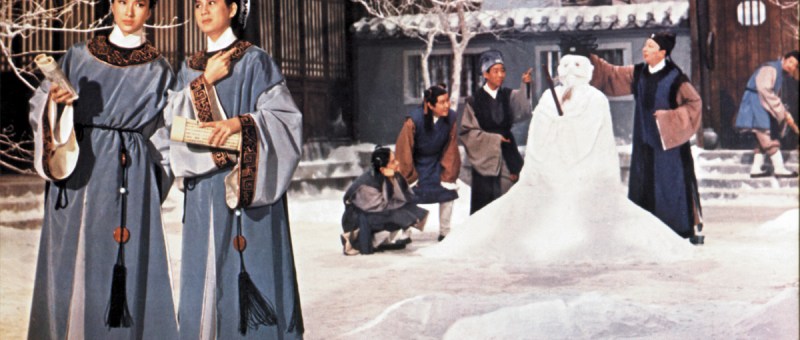
“We two have chosen ourselves. Others don’t recognise it.” “Even though others don’t recognise it, I still want to live and die with you.” This exchange occurs fairly late into Li Han-Hsiang’s retelling of the classic legend of the butterfly lovers, The Love Eterne (梁山伯與祝英台, Liáng Shānbóyǔ Zhù Yīngtái). One of several Huangmei opera films Li made at Shaw Brothers, where he was regarded as a pioneer and master of the genre, the film is despite its seeming traditionalism defiantly progressive not just in the undeniably queer undertones of its central love story but in its all but total rejection of patriarchal Confucianist thinking. 

Nowhere does Li make this more clear than in a brief cutaway in which birdcage hangs on a wall next to a tattered orange poster bearing the “double happiness” Chinese character synonymous with marriage. Marriage is the cage the heroine cannot escape. Her father tells her that she must marry and the choice not to do so does not belong to her, but neither does she have the right to choose a husband for herself for to do so would be to contravene the codes of filiality. Finally she is unable to go against her father’s wishes and agrees to sacrifice her pure love for a poor scholar to save her father’s reputation by marrying the son of a wealthy and influential family who is otherwise known to be a “playboy” unlikely to treat her well. 

The forces that separate noblewomen Ying-tai (Betty Loh Ti) and lowly student Shan-bo (Ivy Ling Po) are those of class and patriarchy, but the film invites another reading in their yearning to have their impossible love accepted by the world around them. In contrast to other tellings of the tragedy of the butterfly lovers, Li casts actresses in each of the leading roles one playing a woman who dresses as a man to acquire knowledge otherwise denied her because of her gender, and the other simply a woman playing a man. The romance between them is played with ironic coyness and good humour that deepens the tragedy that is to come in the incredible denseness of Shan-bo who takes none of the hints Ying-tai attempts to give him that she is really a woman but otherwise develops what occurs to him to be a deep yet platonic and brotherly love he only later comes to recognise as romantic on learning the truth. 

Nevertheless, it is impossible not to read their doomed romance as an attack on social conservatism and an advocation for romantic freedom. Though the final symbolism of flowers blossoming under a rainbow bridge is not one which would have occurred to a contemporary audience, the love between Ying-tai and Shan-bo is most transgressive because they have dared to choose it for themselves in the face of social hostility and if they cannot have it they will have death because to live without it is all but the same. Ying-tai’s response is to turn her wedding into a funeral and to marry in death, but the film does not present this as an inevitable tragedy of a love that cannot be but its reverse. The Heavens open and take pity on the lovers, condemning the world that would not allow them happiness in life by granting it in eternity. 

Rather than “women” as he would have it, the film places the blame firmly and directly on Confucianist thinking with the disguised Ying-tai directly challenging the teachings of the university where she is asked to recite the tenets that women are “insolent and ungrateful” while “charming girls make good companions”. It is Ying-tai’s father (Ching Miao) who is the true villain in caring little for his daughter’s feelings, firstly nearly letting her die in a hunger strike over not being allowed to go to school, and then refusing to listen to her rejection of his chosen suitor preferring to trade her for the social kudos of having married his daughter off to the most eligible of bachelors content to use her as a tool for his own advancement while indifferent to her prospects for future happiness. Li begins with his heroine “worried and confused” and captures something of the sense of constraint even within the sumptuous environment of her gilded cage before granting her freedom in the expanse of the natural world which thinks nothing of the “absurd rules of man”. 


The Love Eterne screens at the Barbican 25th April as part of this year’s Queer East in collaboration with Hong Kong Film Festival UK.

Trailer (no subtitles)

High and Low (天国と地獄, Akira Kurosawa, 1963)

A self-made man is landed with an unthinkable dilemma when his chauffeur’s son is kidnapped in place of his own just at the moment he’s staked his entire fortune on a manoeuvre to outsmart cynical executives set on taking over his company in Kurosawa’s post-war crime film, High and Low (天国と地獄, Tengoku to Jigoku). The movie’s Japanese title, Heaven and Hell, might hint more strongly at the growing economic disparities in the era of the economic miracle but also at the dualities embodied in the hero’s choices. “Success isn’t worth losing your humanity” his wife tells him, but he still struggles with the validity of choosing his heart over his head knowing that to pay anyway even though it’s another man’s son means financial ruin, the final question being if he is really prepared to allow a child to die simply to maintain his own wealth and status. 

The problem is that Gondo (Toshiro Mifune) has attempted to mount a rebellion against the evils of consumerism, incurring the ire of the cynical executives who attempt to get him on their side in their attempt to oust the boss whose outdated ideas are running the business into the ground. Though Gondo appears sympathetic, hinting that he might be interested if there’s a good enough promotion in it, he later tells them where to go on seeing that their business plan is to start producing poor quality disposable footwear. Gondo started on the factory floor and he doesn’t want to put the company’s name on such shoddy produce nor does he think that their admittedly fair point that if the shoes are well made and last a long time no one will need to buy any is a good way to do business. He doesn’t think the boss is right either and wants to make shoes his own way which is why he’s remortgaged the sizeable mansion he owns on top of a hill overlooking the city and has pretty much run through his wife’s dowry to buy a majority stake in the company.

On top of a hill is a good place to live if you want a good vantage point to oversee the land below, but while you’re looking down others look up and not all of them kindly. Gondo is as he says a self-made man, but also out of touch with contemporary society and not so far from an ambitious courtier always after a little more. He says it isn’t about getting the top job but getting shoes made right, but it seems he too had been bitten by the consumerist bug and is otherwise unable to affirm his status without material proof. When he thinks it’s his own son that’s been kidnapped, he’d have given it all away but when it’s the driver’s boy it’s a different question. Shinichi (Masahiko Shimazu) isn’t his responsibility and as he points out there are plenty of other wealthy men, why is he the only one to pay? While his wife (Kyoko Kagawa) tearfully urges him to do the right thing, his assistant (Tatsuya Mihashi) tries stop him, insisting he should take the sizeable cheque they’ve had drawn up to Osaka and the stakeholder he’s buying the shares from. 

While he vacillates, the driver, Aoki (Yutaka Sada), is humiliated and forced into servitude. Gondo seems to have the old-fashioned idea that the kidnappers would simply let Shinichi go on realising they’ve got the wrong boy and his father can’t pay, but Aoki knows there’s nothing he can do to save his son but throw himself on Gondo’s mercy. He falls to the ground and prostrates himself, but later retracts all telling Gondo it doesn’t matter, that he hadn’t realised what he was asking of him, and insisting that Shinichi is a bright boy who will look for a chance to escape on his own. Once the boy is returned he treats him harshly, interrogating him about anything he might have forgotten and later driving him around looking for the hideout where he was kept in an attempt to do something and repay the debt he now feels he owes to Gondo by helping the police retrieve the money Gondo eventually agreed to pay for him. 

In agreeing to give up the money, Gondo is in a sense unburdened knowing he has made the right choice and realising that he would never live a comfortable life in that house if cost a child’s life to keep it. Part of his rationale for not wanting to pay had been that though he had been poor before and might be again, his wife had not been and does not truly understand what it is to live in poverty much as she says her life of luxury means nothing to her. She has never wanted for anything, after all. As for the kidnapper, Ginjiro (Tsutomu Yamazaki), we know little of his motives save for his intense resentment living quite literally in the shadow of Gondo’s mansion and feeling as if it were mocking him. Then again, though his life is hard Ginjiro already had a path to success in that he would soon have completed his medical studies implying at least that he or someone else was able to cover his tuition and costs of living, that he was able to continue in education, and really had no need to take such drastic action in rebellion against the antagonistic capitalism of the post-war society. “Do you think we have to hate each other?” Gondo asks him, but Ginjiro has no answer only his intense resentment for everything he represents.

The “hell” that Gondo inhabits is a backstreet wasteland peopled by the hopeless. Tokura (Tatsuya Nakadai), the earnest policeman, follows him through thronging clubs and on into “dope alley” where Ginjiro picked up his accomplices so desperate to escape their suffering that they’d agree to help him kidnap a child. Though it costs him his job, Gondo decision to do the right thing makes him a national hero, the working class millionaire who mows his own lawn and can still knock up a pair of shoes should the occasion call while women across the country decide to boycott the company in protest at his treatment. Ginjiro can only howl like a caged animal while facing a death sentence for the coldblooded murder of his accomplices. The light bouncing off his mirrored sunshades gives him an eerie supernatural quality, a demon arising from depths of hell to wreak havoc in heaven but finding only infinite tragedy in the contradictions of the consumerist post-war society.


High and Low screens at the BFI Southbank, London on 19th January 2023 as part of the Kurosawa season.

Original trailer (English subtitles)

The Third Shadow Warrior (第三の影武者, Umetsugu Inoue, 1963)

“In this world the weak are playthings of the strong” according to the hidden villain concealing himself slightly to the side in Umetsugu Inoue’s dark identity drama The Third Shadow Warrior (第三の影武者, Daisan no Kagemusha). Adapting a novel by Norio Nanjo, Inoue, most closely associated with sophisticated musicals, shoots in the manner of a ghost story adapting the trappings of a minor parable on the consequences of selling one’s soul for advancement in complicity with an inherently broken feudal order. 

Opening in 1564, the film wastes no time reminding us that the samurai were cruel and duplicitous, a troop of them riding through the contested mountain territory of Hida bearing the severed heads of their enemies casually insulting peasants as they go. Young farmer Kyonosuke (Raizo Ichikawa), however, can’t help but think that they’re heroic and dashing, longing like many young men as the voiceover explains to make his fortune as a samurai in this the age of war. Kyonosuke gets his wish when retainer Shinomura (Nobuo Kaneko) turns up and offers him a job at the castle, only it’s not quite what he expected. Bearing a striking similarity to lord Yasutaka, he has been hired as his third “shadow”, a decoy intended to shield the lord from harm. 

Sitting down with his two new brothers, Kyonosuke remarks how ironic it is that he’s here to escape the land but Kuwano (Katsuhiko Kobayashi) is patiently saving up his pay with the intention of using it to buy a farm and settle down with a beautiful wife. His is the most dangerous of doubling roles as the lord’s battlefield stand-in, while Ishihara (Yuji Hamada), a former actor apparently not much good with the sword, takes his place behind closed walls. Kyonosuke is quite taken with the world of the samurai, but Ishihara cautions that he’ll soon tire of this “phoney life”. In accepting this devil’s bargain, Kyonosuke has in essence consented to his own murder. A shadow man, he can no longer call himself Kyonosuke, but nor can he say he is Yasutaka. He has no fixed identity and is merely in waiting for a veil. Worse still as Ishihara has begun to suspect, they no longer have bodily autonomy because their physicality must match that of the lord. When he is blinded in a battlefield mishap with an arrow, so must they be. Deciding he’d rather not lose an arm, Kyonosuke finds himself in an altercation with his other self which leads to his demise. He intends to make a life for himself under his own name with another clan, but is forced to permanently assume Yasutaka’s identity after being cornered by Shinomura intent on manipulating him for his own ends. 

“I’m no puppet, I no longer need a puppeteer” Kyonosuke exclaims drawing strength from embracing his new identity as a samurai lord, but perhaps overreaches himself in ambitious desire failing to see the various ways he is still merely a pawn in a bigger game as Yasutaka himself once was because the lord is only ever an empty vessel and far more expendable than might be assumed. Princess Teru (Hizuru Takachiho), Yasutaka’s conquest bride, declares that she is “just a doll, the strongest will win me” but is of course playing a role herself, one which she does not desire but has been thrust upon her while her cousin, Sadamitsu (Shigeru Amachi), is engaged in a much more active piece of long form role play. Only the lord’s concubine (Masayo Banri) sees through him, falling for the gentle peasant after the rough lord who toyed with her, but their complicated love eventually seals his fate even as he believes it offers him victory. Kyonosuke became a samurai to escape his lack of agency but is arguably much less free than he ever was, driven slowly out of his mind by his fractured sense of identity and realising that in killing the only man who knew who he “really” was, he also killed himself. 

Quite literally imprisoned, Kyonosuke finds himself a shadow once again neither one man nor another, denied an identity and forever a puppet of duplicitous game players better versed in the realities of the samurai existence. “How ugly fighting over this transient kingdom” the princess disdainfully remarks while herself engaging this apparently meaningless foolishness, reminded by her cousin that a princess may hold the keys to a castle or even a nation even if he implies she is little more than his tool, a puppet to be manipulated if knowingly. Shooting with deep, expressionist shadows, chiaroscuro lighting, and a melancholy voiceover Inoue frames his tale as a parabolic caution against selling one’s soul for gold but also a crushing indictment of the inequalities of the feudal order built on wilful hypocrisy and cynical exploitation. 


Sasuke and His Comedians (真田風雲録, Tai Kato, 1963)

Criminally unknown in the Anglophone world, where Tai Kato is remembered at all it’s for his contribution to Toei’s ninkyo eiga series though his best known piece is likely to be post-war take on High Noon made at Shochiku, By a Man’s Face Shall You Know Him in which a jaded doctor finds himself caught in the middle of rising tensions between local Japanese gangsters and Zainichi Koreans. Kato’s distinctive visual style shooting from extreme low angles with a preference for long takes, closeups and deep focus already make him an unusual presence in the Toei roster, but there can be few more unusual entries in the studio’s back catalogue than the wilfully anarchic Sasuke and his Comedians (真田風雲録, Sanada Fuunroku), a bizarre mix of musical comedy, historical chanbara, and ninja movie, loosely satirising the present day student movement and the limits revolutionary idealism. 

An opening crawl introduces us to the scene at Sekigahara, a legendary battle of 1600 that brought an end to Japan’s warring states period and ushered in centuries of peace under the Tokugawa. Onscreen text explains that this is the story of the boys of who came of age in such a warlike era, giving way to a small gang of war orphans looting the bodies of fallen soldiers and later teaming up with a 19-year-old former samurai realising that the world as he knew it has come to an end. Soon the gang is introduced to the titular Sasuke who, as he explains, has special powers having been irradiated during a meteor strike as a baby. Recognising him as one of them, the war orphans offer to let Sasuke join their gang, but he declines because he’s convinced they’ll eventually reject him in fear of his awesome capabilities. Flashing forward 15 years, the kids are all grown up and the only girl, Okiri (Misako Watanabe), is still carrying a torch for Sasuke (Kinnosuke Nakamura) who dutifully reappears as the gang find themselves drawn into a revolutionary movement led by Sanada Yukimura (Minoru Chiaki) culminating in the Siege of Osaka in 1614. 

Don’t worry, this is not a history lesson though these are obviously extremely well known historical events the target audience will be well familiar with. A parallel is being drawn with the young people of early ‘60s Japan who too came of age in a warlike era and who are now also engaging in minor revolutionary thought most clearly expressed in the mass protests against the ANPO treaty in 1960 which in a sense failed because the treaty was indeed signed in spite of public opinion. Kato’s Sanada Yukimura is a slightly bumbling figure, first introduced banging his head on a low-hanging beam, wandering the land in search of talented ronin to join up with the Toyotomi rebellion against the already repressive Tokugawa regime. His underling sells this to the gang as they overlook a mile long parade of peasants headed to Osaka Castle as a means of bringing about a different future that they can’t quite define but imply will be less feudal and more egalitarian which is how they’ve caught the attention of so many exploited farmers. 

Of course, we all already know how the Siege of Osaka worked out (not particularly well for anyone other than the Tokugawa) so we know that this version of the 16th century better world did not come to pass the implication being that the 1960s one won’t either. The nobles are playing their own game, the Toyotomi trying to cut deals but ultimately being betrayed, while the gang fight bravely for their ideals naively believing in the possibility of victory. Sasuke, for his part, is a well known ahistorical figure popular in children’s literature and this post-modern adventure is in essence a kids’ serial aimed at a student audience, filled with humorous anachronisms and silliness while Kato actively mimics manga-style storytelling mixed with kabuki-esque effects. Boasting slightly higher production values than your average Toei programmer, location shooting gives way to obvious stage sets and fantastical set pieces of colour and light which are a far cry from the studio’s grittier fare with which Kato was most closely associated. That might be one reason that the studio was reportedly so unhappy with the film that it almost got Kato fired, but nevertheless its strange mix of musical satire and general craziness remain an enduring cult classic even in its ironic defeatism. 


Original trailer (no subtitles)

Sing, Young People (歌え若人達, Keisuke Kinoshita, 1963)

Keisuke Kinoshita has sometimes been dismissed by Western critics for his supposed sentimentality, but his mid-career comedies can be surprisingly cynical. Scripted not by Kinoshita but Taichi Yamada, 1963’s Sing, Young People (歌え若人達, Utae Wakodotachi) is in someways an exception to the rule, a breezy take on the student comedy updated for the present day, but underneath all the absurdist humour and jibs about youthful ennui is a real sense of adolescent hopelessness as these aimless young men ponder their “pitch-black” futures in a rapidly changing Japan where the best they can hope for is fulfilling the salaryman dream.  

Shooting in glorious colour, Kinoshita opens with a lengthly pan over contemporary Tokyo which the jaunty voice over describes as “the number-one city in the world” before homing in on the incongruous figure of a strangely dressed man holding a sign advertising “sensual massage beauties”. A relic of an earlier advertising age, the wandering sign man nevertheless catches sight of someone even “weirder” than he is, a student wearing a student’s cap! Kinoshita then takes us on a brief detour through Japan’s major universities demonstrating that no one is so uncool as to wear a student’s cap in the age of protest, drawing a direct contrast to the student comedies of old while showing us a series of scenes of students “playing” hard with part-time jobs in bands or as models, training hard in preparation for the upcoming Olympics, fomenting the revolution, or fighting in the streets. In the first of many meta touches, our hero, Mori, is eventually woken by the narrator after falling asleep in class, his eyes “gleaming with hopes for the future”. 

Or, perhaps not, he’s just tired. Mori (Tsutomu Matsukawa) is as he describes himself a man without hopes or dreams who believes that the road ahead of him is “pitch black”. Dropping a brush from the window washers’ platform at one of his part-time jobs, he asks himself if there shouldn’t be more to life than this. The only son of his widowed mother, he’s pinned everything on graduating from a top university but feels powerless and empty, adrift in the post-war landscape. Where his calculating friend Miyamoto (Yusuke Kawazu) fills the void with romance and a determination to “get lots of As” and then land a top job, his roommate Okada (Shinichiro Mikami) earnestly studies hard afraid to disappoint his austere family but also quietly resentful in his lack of autonomy, and the dopey Hirao (Kei Yamamoto) simply goes about being nice to people more or less forcing them to eat the traditional treats his loving mother is forever sending. 

Yet for all the bleakness Mori seems to see in his future, he only ever falls up. Luck follows him and he’s presented with ever more fantastic opportunities at every turn. In fact, it’s his slightly grumpy expression as he cleans the windows of an office building that leads to them snapping a picture and making him a cover star without ever bothering to ask his permission though they do eventually pay. Still Mori remains indifferent, telling a reporter who tries to interview him that he had nothing to do with the cover, he has no dreams or aspirations for the future but lives his life day by day. He describes himself only as “nervous”. His words run ironically over the magazine literally becoming tomorrow’s chip paper, used by a stall owner to wrap her croquettes, as a stand for a hot pot, and otherwise bundled up to be pulped. Nevertheless, the cover leads to great opportunities from a TV network looking for a fresh face to front their new youth-orientated drama serial. 

Despite all the promise, Mori remains indifferent, later irritating a new colleague and potential love interest (Shima Iwashita) when he idly suggests he might just give up acting and fall back on the salaryman dream. As she points out, she had to fight all the way to achieve her dreams of becoming an actress so hearing someone say they’re going to throw away a tremendous opportunity that came to them entirely by chance is mildly offensive. Miyamoto meanwhile is growing lowkey resentful, realising that maybe nothing matters after all it’s all just dumb luck. Mori deliberately didn’t do anything because he thought his life was pointless but everything has landed right at his feet while Miyamoto’s life is crumbling. He’s lost all his girlfriends and endured a lonely New Year alone in the dorm, coming to the conclusion that his future really is “pitch black”.

Nevertheless, it’s difficult to remain resentful about a friend’s accidental success and so each of the men eventually finds direction in even in directionlessness. Mori realises that he might as well ride his wave of fame for as long as it lasts, accepting in part at least his sense of powerlessness, while Okada does the reverse in deciding to rebel against his authoritarian family by marrying in secret. Miyamoto resolves to make a success of himself in his own way, and Hirao seemingly accepts the hand fate has dealt him with good humour. Kinoshita ramps up the meta comedy with Mori joining Shochiku, encouraged to try and work for that “excellent” director Keisuke Kinoshita, later referencing Garden of Women, while Mariko Okada and Keiji Sada turn up as onstage guests at an event launching him as a young actor. Playfully using outdated, quirky screen wipes and opening with an artsy title sequence featuring colourful confetti falling up, Kinoshita perhaps adopts a slightly ironic tone in satirising the all pervasive sense of confusion and hopelessness among the younger generation but does so with only sympathy for those coming of age in uncertain times. 


Bad Girl (非行少女, Kirio Urayama, 1963)

“It’s all because of poverty” according to the not-quite hero of Kirio Urayama’s Bad Girl (非行少女, Hiko shojo), and he’s right to an extent but then again not. Following his factory tale Cupola, Where the Furnaces Glow, Urayama shifts further into social realism, exploring small-town life at a midpoint in the post-war era in which the economic prosperity which was beginning to take root in a Tokyo about to host the Olympic Games had not yet been evenly distributed. The titular “bad girl” of the title is no Nikkatsu delinquent, merely a lonely young woman undermined by parental neglect and societal disdain who scandalously smokes, drinks, and steals the things she could never hope to afford. 

Wakae (Masako Izumi) claims she does these things in part because she hates her step-mother (Sumie Sasaki) whom she blames for her own mother’s death after returning from the hospital to tell her father that her mother had died only to find him with another woman. Emotionally neglected, she spends her time in bars enjoying the attentions of men without perhaps understanding the dangers. It’s in trying to escape two young toughs who think they haven’t got what they paid for when they took her to the cinema that Wakae runs into childhood friend Saburo (Mitsuo Hamada), recently returned from Tokyo after the factory he was working at went bust. Now 21, Saburo has a little education and was hoping for an office job but discovers that positions are generally open only to new graduates and is advised that his best option is to work for his brother (Asao Koike) with whom he does not get on. 

Where his brother is currently running for political office on a conservative ticket, Saburo is of a more liberal, progressive outlook, thinking back on the divisions in the town caused by protests against an American artillery test site which once occupied the local beach. He is extremely concerned that Wakae has been skipping school and is keen to help her study, even giving her money to help pay the fees as well as buying her a fashionable skirt to replace the worn through trousers which left her too ashamed to go. Unfortunately, Wakae loses the money after she’s accosted by a delinquent boy who tries to press her into sex work, leaving her both unable to attend school and embarrassed to see Saburo who is the only one encouraging her to think that she is worth something and can have a bright future. 

Poverty is in itself only one problem, the wider one being that everyone has already decided that Wakae is “bad girl” and that bad girls aren’t worth anything. Her disinterested father (Jun Hamamura) and stepmother are content to send her to her aunt who wants to make her a geisha, reinforcing an image of herself as somehow unfit for regular society and suited only to sex work. After losing Saburo’s money, she tries to rob the school but is caught by a caretaker who feigns sympathy but later offers her money for sex and then tells everyone that she tried it on with him so he wouldn’t turn her in. This coupled with a misunderstanding that she frittered away the money he gave her for the fees makes even Saburo lose faith in her, convincing him that they must have some time apart after he agrees to take a job on the chicken farm of a family friend to get away from his brother’s conservative authoritarianism. 

After accidentally setting fire to a chicken coop, Wakae is sent to a home for troubled children which turns out to be perhaps the best thing for her. Although she does not immediately bond with some of the other residents, she finds there what she never had at home – a supportive family, while the couple who run the facility do their best to instil confidence by teaching her skills that will allow her to reintegrate into regular society. Even there, however, members of the board are primed to write her off as a lost cause, just another “bad girl” not worth the effort. Only the head of the facility argues the problem is that no one’s ever given her a chance and if no one ever does then she’ll never have the opportunity to prove them wrong. 

Meanwhile, many of the other girls find themselves in the same position. Wakae’s friend Tomiko (Shizuka Yoshida) who ran away when she discovered that her parents were going to sell her, believes her future is hopeless because she’ll never be able to escape the “bad girl” label, but given courage by her time at the centre Wakae is able to tell her to stay strong, because you’ll never know if you don’t try. Wakae becomes an uncomfortable standard-bearer for the others, her eventual graduation another sign of hope but also perhaps a burden in knowing that if she fails to capitalise on her success she will only deepen their sense of despair. 

Yet her path forward begins to take her away from Saburo who makes a late night, romantic visit to the centre to apologise and tell her he’ll be waiting for her when she gets out. After a crisis of his own in which he too commits a crime in an attempt to buy a better future only to return beaten both literally and spiritually, Saburo has perhaps given in, agreed to work for his ultraconservative brother and bought his line of earnest hard work as the only path towards salvation. Wakae decides to take a promising job offer in Osaka and to leave without saying goodbye in case Saburo tries to convince her to stay local. That’s something he eventually tries to do in a last minute station dash, leaving Wakae torn and confused, enduring a public breakdown in a train station cafe literally stuck between one place and another. 

Saburo had complained that his problem was that he didn’t know what to do, confused by the volatile post-war society. Rather than a source of salvation he becomes a feckless suitor who can offer only a vague ideal of “love”, unable to protect Wakae and perhaps selfishly holding her back. As she tells him, she has made her decision, but ironically lacks agency. Her destiny is still to an extent in Saburo’s hands in his desire either to trap or free her. Meanwhile, there is also something insidiously uncomfortable in the fact that the only way to escape her “bad girl” image is by becoming economically productive, redeeming herself through honest hard work, while the desire to reject the label so totally also tacitly reinforces the idea of there being such a thing as a “bad girl” and that “bad girls” are worthless. Perhaps Saburo’s brother wins after all in his aspirational conservatism and its insistence on properness and industry. Nevertheless, Urayama leaves Wakae in a better place than we found her, given the confidence to pursue an individual destiny in the knowledge that she is not worthless, is deserving of love and happiness, and has a place to which to return as she makes her way into a promising post-war future.


Bronze Magician (妖僧, Teinosuke Kinugasa, 1963)

Even when you’re the empress, a woman has little freedom. Teinosuke Kinugasa’s Bronze Magician (妖僧, Yoso) is loosely based on a historical scandal concerning Nara-era empress Koken/Shotoku and a Rasputin-like monk, Dokyo, who unlike his counterpart in the film, eventually tried to seize the throne for himself alone only to have his ambitions frustrated by the empress’ death and the fierce resistance of her courtiers. As the title implies, Kinugasa is more interested in Dokyo than he is in the perilous position of Nara-era women even in power, painting his fall from grace as a Buddhist parable about a man who pays a heavy price for succumbing to worldly passions. 

As the film opens, Dokyo (Raizo Ichikawa) emerges from a shallow cave amid many other caves after meditating for 10 years during which he reached a higher level of enlightenment and obtained mystic powers. Now he thinks it’s time to continue the teachings of departed mentor Doen and use his abilities to “actively do good and save the masses”. Before that, however, he does some not quite Buddhist things like turning a rat into a living skeleton, and twisting a snake into a tangle. In any case, he begins roaming the land, miraculously healing the sick. While reviving a thief who had been killed by samurai after trying to make off with a bird they shot, Dokyo is spotted by a retainer of the empress who brings news of his miracles back to her closest advisors. 

Empress Koken (Yukiko Fuji), in the film at least, was a sickly child and even after ascending the throne has often been ill. She is currently bedridden with a painful respiratory complaint that is giving her servants cause for concern. None of the priests they’ve brought in to pray for her (apparently how you treat serious illness in the Nara era) has been of much use. The empress’ steward Mabito (Tatsuya Ishiguro) orders that Dokyo be found and brought to the palace to see if he can cure Koken, which he does while stressing that he’s helping her not because she’s the empress but in the same way as he would anyone else. 

As might be expected, the empress’ prolonged illness has made her a weak leader and left the door open for unscrupulous retainers intent on manipulating her position for themselves. There is intrigue in the court. The prime minister (Tomisaburo Wakayama) is colluding with a young prince to depose Koken and sieze power. Left with little oversight, he’s been embezzling state funds to bolster his position while secretly paying priests to engineer Koken’s illness continue. Dokyo’s arrival is then a huge threat to his plans, not only in Koken’s recovery and a subsequent reactivation of government but because Dokyo, like Koken, is of a compassionate, egalitarian mindset. She genuinely cares that the peasants are suffering under a bad and self-interested government and sees it as her job to do something about it, which is obviously bad news if you’re a venal elite intent on abusing your power to fill your pockets while the nation starves. 

As the prime minister puts it, however, the empress and most of her courtiers are mere puppets, “naive children”. At this point in history, power lies in the oligarchical executive who are only advised by the empress and don’t actually have to do what she says. As she is also a woman, they don’t necessarily feel they have to listen to her which is one reason why the prime minister assumes it will be easy to manoeuvre the young prince toward the throne. Koken’s short reign during which she overcame two coups is often used to support the argument against female succession because it can be claimed as a temporary aberration before power passed to the nearest male heir. Nevertheless, Koken tries to rule, even while she falls in love with the conflicted Dokyo. Her right to a romantic future, however, is also something not within her control. Many find the gossip scandalous and use it as an excuse to circumvent her authority, especially after she gives Dokyo an official title which allows them to argue she has been bewitched by him and he is merely manipulating her to gain access to power. 

Dokyo, meanwhile, is in the middle of a spiritual crisis. After 10 years of study he as reached a certain level of enlightenment and attained great powers which he intended to use for the good of mankind. He is happy to discover that Koken is also trying to do good in the world but she is, ironically, powerless while the elitist lords “indulge in debauchery”, abusing their power to enrich themselves while the people starve. He begins to fall in love with her but the palace corrupts him. He accepts a gift of a beautiful robe despite his vows of asceticism, and then later gives in to his physical desire for Koken only to plunge himself into suffering in the knowledge that he has broken his commandments. He loses his magic, but chooses to love all the same while rendered powerless to hold back Koken’s illness or to protect her from treachery. 

The pair mutually decide they cannot “abandon this happiness”, and Dokyo’s fate is sealed in the acceptance of the extremely ironic gift of golden prayer beads which once belonged to Koken’s father. He is reborn with a new name in the same way as the historical Koken was reborn as Shotoku after surviving insurrection, embracing bodily happiness while attempting to do good but battling an increasing emotional volatility. The lords continue to overrule the empress’ commands, insisting that they are really commands from Dokyo, while Dokyo’s “New Deal” involving a 2 year tax break for impoverished peasants finds support among the young radicals of the court who universally decide that they must stand behind him, protecting the ideal even if they are unable to save the man.

This troubles the elders greatly. Declaring that Dokyo has used “black magic” to bewitch the empress, they determine to eliminate him, but Dokyo never wanted power. “Power is not the final truth” he tells them, “those blindly pursuing status and power only destroy themselves”. Yet Dokyo has also destroyed himself in stepping off the path of righteousness. He damns himself by falling in love, failing to overcome emotion and embracing physical happiness in this life rather than maintaining his Buddhist teachings and doing small acts of good among the poor. Nevertheless, he is perhaps happy, and his shared happiness seems to have started a compassionate revolution among the young who resolve to work together to see that his ideal becomes a reality even in the face of entrenched societal corruption.


Original trailer (no subtitles)

Tosuni: The Birth of Happiness (또순이, Park Sang-ho, 1963)

Korean Cinema had enjoyed a small window of freedom following the April Revolution that brought down the government of Rhee Syngman, but that window was closed all too soon by the Motion Picture Law brought in under Park Chung-hee which reformed the film industry and instituted an increasingly stringent censorship regime. Despite that, however, 1963 was something of a banner year which saw the release of such enduring classics as The Marines Who Never Returned, Bloodline, and Goryeojang. In comparison, Park Sang-ho’s Tosuni: The Birth of Happiness (또순이) seems like a much smaller film but was the fourth highest grossing that year, possibly because it was inspired by a hugely popular radio serial. Standing in direct contrast to contemporary melodrama, Tosuni puts a positive spin on go getting capitalistic individualism as its salt of the earth working class heroine defiantly makes her dream come true on her own despite the parade of useless men that attempt to drag her down. 

The cheerful Tosun (Do Kum-bong) is the daughter of Choi Jang-dae (Choi Nam-hyeon) who came from the North with nothing but the shirt on his back and now owns a bus company. A difficult, miserly old man, Jang-dae has a loathing for people who depend on others which is why he sends a young hopeful, Jae-gu (Lee Dae-yeop), packing when he turns up with a letter of recommendation and asks for a job as a temporary driver. Unbeknowst to Jang-dae, Tosun had already encountered Jae-gu on the bus where her father had sent her on an errand only to complain she’s not come back with as much money as he hoped. Tosun asks her father for a 50 won payment for her work but he refuses, leading to a blazing row during which Tosun points out that while both her parents were out working she was basically their housekeeper so he owes her around 15 years in back pay and is also in contravention of the child labour laws. Seeing as she was looking after them all these years, she feels she’s already well acquainted with the “independence” her father always seems so keen on. Eventually she storms out, vowing to become a success on her own. Jang-dae is annoyed to have lost the argument but also oddly proud, realising that he brought Tosun up right and impressed that she actually stood up to him and can obviously take care of herself. 

Tosun certainly is a very capable woman, working hard, taking every job going, and making money wherever she goes. Jae-gu, meanwhile, turns out to be something of a layabout, never really looking for a job but spending all his money drinking with the madam, Su-wol (Na Ae-sim), in a local cafe. Tosun carries on doing her own thing but also wants to help Jae-gu, not least because they pledged to try and achieve their dream of owning a modern motor car together. Jae-gu knows that Tosun is perfectly capable of getting the car on her own and is mildly put out by it, sore over wounded male pride despite her assurances that even if she’s the one who gets the money together he’s the one who’ll be driving. That’s perhaps why he’s so easily suckered by an obvious scam when he gets together with a friend who’s met a guy who needs to shift some tyres, but only after dark when there’s no one around. Tosun thinks it’s fishy, especially if they can’t take the tyres right away, but goes along with it to make Jae-gu feel better. 

Like Jae-gu, most of the other young men are also selfish and feckless, dependent on and exploitative of female labour to get them out of trouble. Tosun’s brother-in-law (Yang Il-min) is forever lying to his in-laws to get loans for spurious business opportunities which never work out, complaining that he can’t “slave away as a temporary driver forever” but taking no proactive steps to change his circumstances despite the responsibilities of being a husband and father. Jae-gu’s friend, meanwhile, takes the opportunity of his wife being in hospital waiting to give birth to their child to try it on with Tosun who manages to fend him off but has a major loss of confidence because of the shock of his betrayal. 

Tosun’s mother hadn’t wanted her to move out not only because that means she’s alone in the house with the difficult Jang-dae, but because being an “independent” woman was somewhat unheard of and she’s worried her daughter will lose her virtue, or at least be assumed to be a loose woman, after leaving home before marriage. Tosun might be a little naive and extremely good hearted, she keeps unwisely lending money to people who obviously aren’t going to pay her back, but as she keeps pointing out she didn’t move out for fun she wants her independence. That’s one reason she keeps Jae-gu at arms length even though she’s fallen in love with him despite her constant exasperation. 

Tosun is in many ways the embodiment of a capitalistic work ethic, proving that you really can make it if you just knuckle down. The car represents both independence itself and a sense of modernity, as demonstrated by the excited commotion among Tosun’s friends and neighbours when she finally gets one and arrives to take her parents for a drive. Even the brother-in-law suddenly realises he might be better off working for Jang-dae rather than living a feckless existence of constant and humiliating failures trying to get rich quick. That’s the problem with the younger men, apparently, they want everything right away, like Jae-gu and his tyre deal, and aren’t really prepared to work at it. Tosun sorted the tyre problem in her own cooly handled fashion, outwitting the unscrupulous vendor but doing it without malice and only showing him she won’t be had. Is the motor car and everything it represents the birth of happiness? Maybe not, but it doesn’t hurt, and Tosun unlike her father seems to have retained her good heart, setting off into an admittedly consumerist but hopefully comfortable future, a back seat driver but behind her own wheel. 


Tosuni: The Birth of Happiness is available on English subtitled DVD from the Korean Film Archive in a set which also includes a digital restoration before/after comparison and stills gallery plus a bilingual booklet featuring essays by Kim Jong-won (film critic & professor), and Park Yu-hee (film critic & research professor). It is also available stream online via the Korean Film Archive’s YouTube Channel.