Ending Note: Death of a Japanese Salesman (エンディングノート, Mami Sunada, 2011)

emi_3For various reasons, external commentators on Japanese culture have long held the view that the idea of “death” takes on a much more central position in the lives of ordinary people than it might elsewhere. Death is, however, as much of a taboo in Japan as it is elsewhere – few want to talk about the process of death and dying, of illness and of caring for the sick. Perhaps as a way to evade this particular paradox, there is another tradition in which those aware of their own impending death write a kind of letter for those they will leave behind. Like a testament which accompanies a will, the “isho” can include biographical details, confessions, advice and apologies by way of a final word of parting and a demonstration of having accepted one’s death.

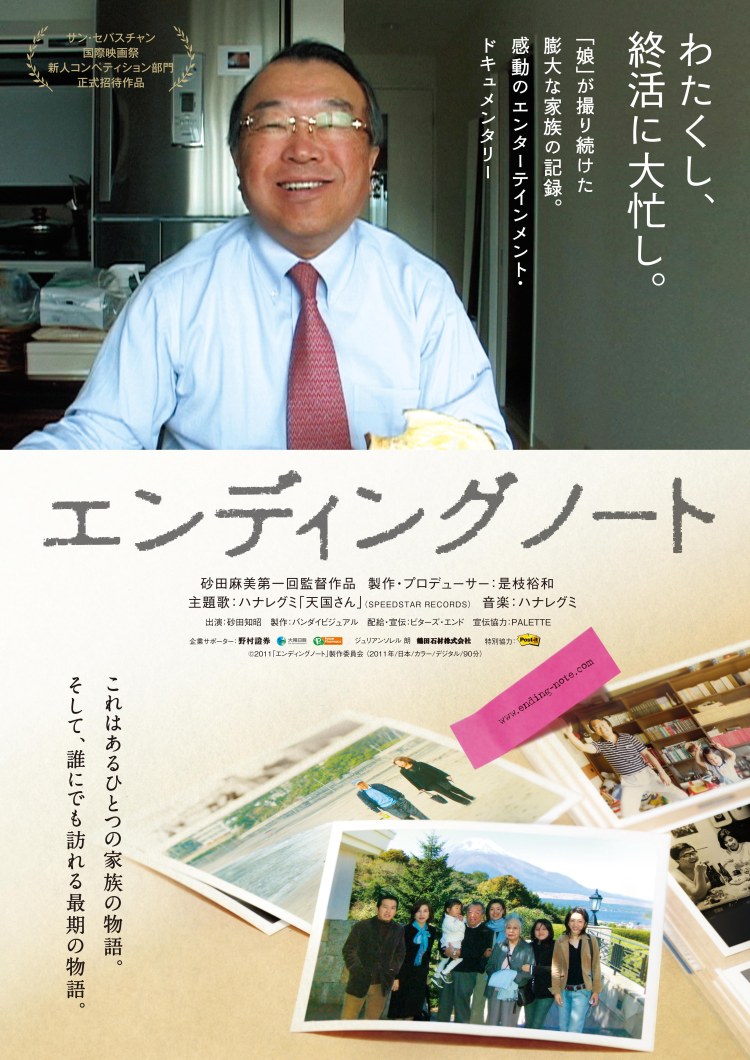
This concept is what inspires the subject of Mami Sunada’s documentary, Death of a Japanese Salesman (エンディングノート, Ending Note), in his desire to create an “Ending Note” when diagnosed with terminal stomach cancer shortly after retiring from a lifetime spent as a regular salaryman. Tomoaki Sunada’s “Ending Note” is intended to be something warmer than an isho and completely divorced from any legal concept but nevertheless a kind of letter saying the things it was too hard to say out loud.

Sunada captures her father’s last days with equal parts affection and detachment. Tomoaki is a humorous man whose wide grin and dry wit help to alleviate what is an unavoidably heavy subject as he comes to terms with the aggressive nature of his illness. The thing is, Tomoaki never gets round to writing that “Ending Note” because he’s just too busy living to think about dying. What he writes is a kind of bucket list which runs from typically practical concerns such as looking at venues in which his funeral might be held and talking over converting to Christianity, to definitively patching things up with his wife and getting to see his three grandchildren again who live abroad in America because of his son’s job.

Living in America Tomoaki’s son perhaps has things a little easier than his father did (even if he’s inherited Tomoaki’s notorious attention to detail and meticulous planning). As Tomoaki puts it in one of Sunada’s flashback moments, middle-aged men like him built the modern Japan. Exclaiming “The company is life!”, albeit with an ironic smile on his face he leaves for work just as he did every morning for over forty years at the same company and for most of it in marketing and sales. The traditional Japanese family demanded a strict division of labour with men pouring their efforts and emotions into their careers and women, supposedly, subsuming their hopes and desires into creating a happy family home. During their working lives, therefore, men like Tomoaki rarely got to see the families they were working to support, placing undue burdens on their wives and appearing as little more than absent disciplinarians to their children. Retirement offers an opportunity to finally become a part of family life, enjoying the days out and long lunches often so impossible for a company man, but Tomoaki has been robbed of the right to enjoy his old age by a cancer diagnosis received almost immediately after the end of his career.

Sunada in effect writes her father’s Ending Note for him, both through the film and the voice over narration she herself delivers written in her father’s playfully ironic authorial voice. Taking cheeky potshots at herself as the “accidental” youngest child whose still unmarried state apparently weighs on her dying father’s mind, Sunada adds both bite and warmth to her “father’s” final words as he waxes philosophical on death and the afterlife while trying to plan pragmatically for his own eventual end. The whimsical indie score also lends to the lightness of the exercise but Sunada does not shy away from the rapidity of her father’s decline or cruelty of his illness, taking her camera away only at the moment of death. Raw and painful, Sunada’s fearsome exploration of the process of dying is one of ordinary tragedy but also becomes a glorious celebration of life from all of its sadness and difficulties to shared laughter and the joy of new arrivals.


Screened as part of Archipelago: Exploring the Landscape of Contemporary Japanese Women Filmmakers.

Original trailer (no subtitles)

Trivisa (樹大招風, Frank Hui & Jevons Au & Vicky Wong, 2016)

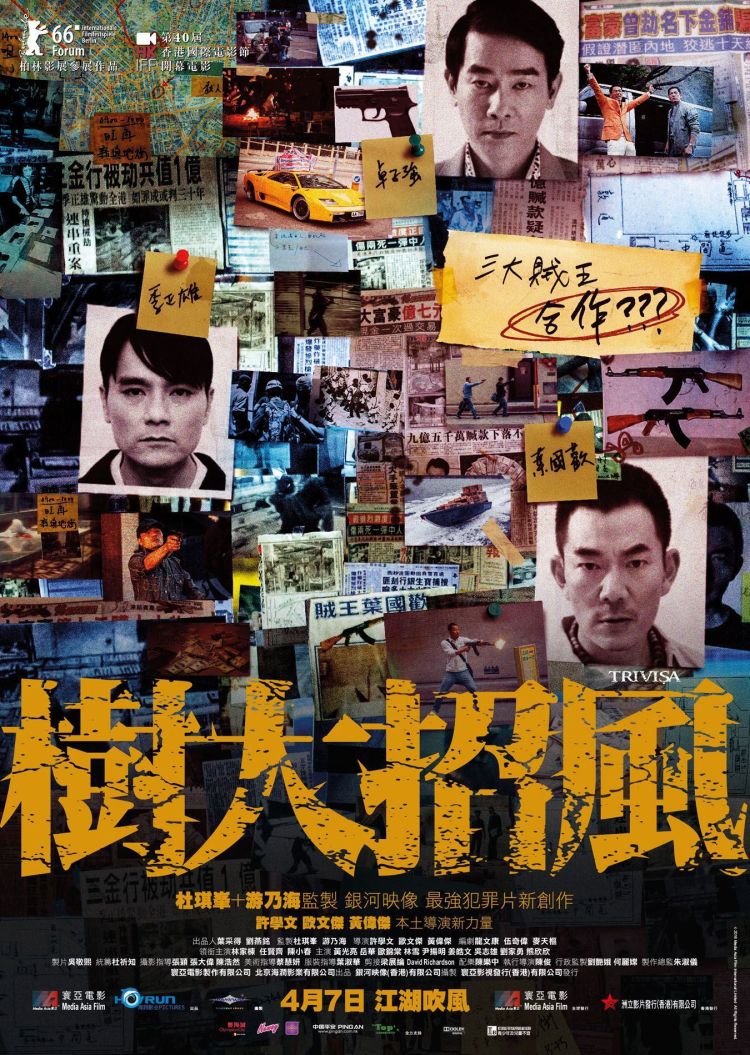
Trivisa posterIt’s worth just taking a moment to appreciate the fact that a film named for the three Buddhist poisons – delusion, desire, and fury, is intended as a criticism of Hong Kong as an SAR that revels in the glory and subsequent downfall of three famous criminals who discover that crime does not pay right on the eve of the handover. Mentored by Johnnie To, Trivisa (樹大招風) is directed by three young hopefuls discovered through his Fresh Wave program each of whom directs one of the film’s three story strands which revolve around a trio of famous Hong Kong criminals.

Back in the ‘80s, as Mrs. Thatcher delivers her pledges on the Hong Kong handover, King of Thieves Kwai Ching-hung (Gordon Lam) gets stopped by a random police patrol, kills the officers, and then has to fake his identity to escape. 15 years later he’s a petty mobile phone trafficker dreaming of pulling off a big score. Meanwhile, Yip Kwok Foon (Richie Jen), once known for his AK47 brandishing robberies is a “legitimate businessman” smuggling black market electronics into Hong Kong and bribing Mainland officials to do it, while Cheuk Tze Keung (Jordan Chan) is a flamboyant gangster revelling in underworld glory and dreaming of eternal fame.

Rather than weave the three stories into one coherent whole or run them as entirely separate episodes, the three strands run across and through each other only to briefly reunite in the ironic conclusion. The most famous of the three real life criminals, Kwai Ching-hung’s arc is perhaps the most familiar though rather than fighting an existential battle against his bad self, Kwai’s quest is to regain his title as Hong Kong’s most audacious thief. To do this, he’s reunited with an old friend and comrade in arms who’s retired from the life and married a Thai woman with whom he has an adorable little daughter. Unbeknownst to him, Kwai has not come for old times’ sake but is taking advantage of the fact that the family live directly opposite his latest score. Employing two Mainland mercenaries, Kwai has his eyes on the prize but his friend is wilier than he remembered, is quickly suspicious of Kwai’s friendship with his daughter, and has his suspicions confirmed when he finds his kid’s backpack full of guns.

Yip’s story, by contrast, is one of diminished expectations and ongoing financial woes. An early scene at a restaurant finds Yip in the company of Mainland officials to whom he must scrape and bow, placating them with various bribes and engaging in the strange trade of precious vases which seems to pass as currency among corrupt civil servants. Corporate shenanigans and business disputes, however, are no substitute for good old fashioned firefights and Yip’s frustration with his new career is sure to lead to some kind of explosion at some point in time.

Cheuk becomes the lynchpin of the three as he takes an advantage of a rumour that the three “Kings of Thieves” are getting together to plan a giant heist to track down the other two and see if he can make it work for real. The most successful and happiest in his life, Cheuk has made his fortune out of ostentatious crime – kidnapping the sons of the extremely wealthy for hearty ransoms. He is, however, bored and dreams of making a giant splash which will ensure his name remains in the history books for evermore – i.e., blowing up the Queen.

Facing the approaching handover, each is aware the world will change, unsure as to how they’re in the process of trying to secure their futures either way. Kwai wants one last heist, Yip has already begun courting Chinese business, and Cheuk just wants to be the face in all the papers across the entire Chinese world. Kwai’s sin is “desire” – he wants one last hit as a criminal mastermind and he’s willing to take advantage of his friend (and even his friend’s young daughter) to get it, Yip’s sin is “fury” as dealing with constant humiliation leaves him longing for his AK 47, and Cheuk’s failing is “delusion” in his all encompassing need to be the big dog around town, all flashy suits and toothy grins. On the eve of the handover they all meet a reckoning – betrayal, a stupid and pointless death, or merely ridiculous downfall.

The heyday of crime has, it seems, ended but that’s definitely a bad thing, laying bare a change in dynamics between nations and a decline in the kind of independence which allows the flourishing of a criminal enterprise. Bearing To’s hallmark in its tripartite structure, ironic comments on fate and connection, and eventual decent into random gun battle, Trivisa is a ramshackle exploration of a watershed moment in which even hardened criminals must learn to live in a brave new world or risk being consumed by it.


Screened at Creative Visions: Hong Kong Cinema 1997 – 2017

Original trailer (English subtitles)

Gallants (打擂台, Derek Kwok & Clement Cheng, 2010)

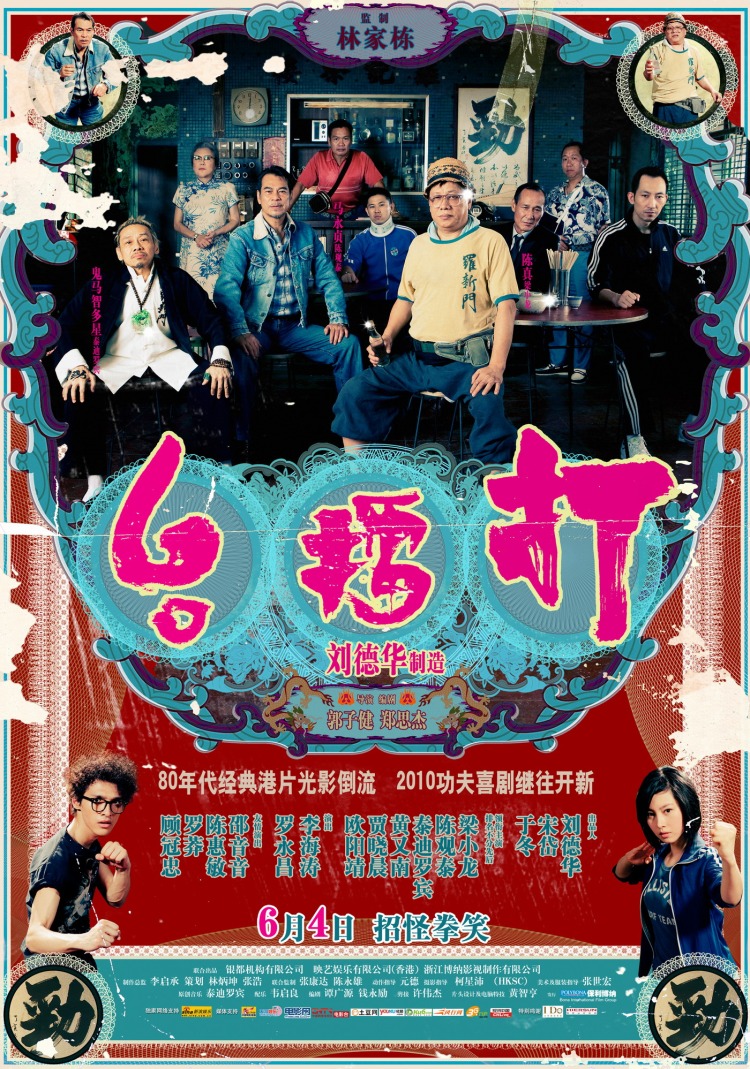
Gallants PosterLike the master at the centre of Derek Kwok and Clement Cheng’s Gallants (打擂台), old school martial arts movies have been in a deep sleep since their Shaw Brothers heyday. Drawing inspiration from the kung fu films of old, Gallants is a tale of buried heroism suddenly reawakening and the risks of writing off veteran challengers just because of their age. It’s also a tribute to those perhaps more innocent times and, in contrast to a prevailing trend, a true Hong Kong film filled with typically Cantonese (sometimes untranslatable humour) and meta references to the area’s long cinematic history.

For a brief moment in his childhood, Cheung (Wong You-nam) was the unbeatable superhero who never lost a fight. These days, he’s a nerdy loser who sometimes hides under his desk to escape his angry boss. Despatched by the shady real estate company he works for, Cheung is sent back to his rural hometown entrusted with the mission of convincing the local population to surrender their homes so the developers can build a large scale complex. Whilst there he gets attacked by local punks only to be saved by an old guy who has immense kung fu skills.

The old guy turns out to be one of two living in a ramshackle tea house that used to be a martial arts studio. Tiger (Leung Siu-lung) and Dragon (Chen Kuan-tai) turned the Gate of Law into a teahouse to make ends meet while their legendary sifu, Master Law (Teddy Robin), has been in a coma for the last 30 years. When a fight breaks out and the old guys get to strut their stuff against a local kingpin, Cheung decides to petition them to take him on as a pupil. In a classic case of bad timing, Cheung is around when the teahouse is raided again and someone attacks Master Law causing him to wake up and act as if the last 30 years never happened. He thinks Cheung is both of his young pupils, Tiger and Dragon, in one and that the real 30 years older versions of Tiger and Dragon are some random old guys Cheung has agreed to train out of pity.

If you don’t fight, you won’t lose quips Law, but if you fight you have to win. Like any good martial movie, Gallants is more about the journey than the destination. Rather than focussing solely on Cheung who experiences several conflicts of the heart when he realises that his adversary is the childhood friend he used to bully and that he was technically on the wrong side to begin with, Kwok and Cheng broaden the canvas to allow Tiger, Dragon, and Law to take centre stage. Still skilled martial artists, the guys give it their all in the knowledge that they’ll have to work far harder now that they aren’t as agile as they once were. Still, they have the true spirit of kung fu and resolve to keep getting back up each time they’re knocked down.

This oddly defeatist attitude which presupposes humiliation but insists on perseverance gives the film much of its warmhearted, ironic tone as the hapless martial arts heroes repeatedly fail yet refuse to back down. The other source of comedy lies in the hilarious performance of the tiny Teddy Robin as the supposedly all powerful Law. Law, as it turns out, is a wisecracking lecher who sets about flirting with just about every young girl he lays eyes on before decamping to a hostess bar and asking for the ladies from 30 years ago. Former starlet Susan Shaw makes an amusing cameo as the long suffering, lovelorn doctor apparently in love with Law since their youth who has continued to care for him throughout his illness but is entirely forgotten when Law wakes up in full on sleaze mode.

Bizarre gags including one about a missing preserved duck, jostle with impressive action sequences performed by two veterans proving they’ve still got what it takes all these years later. The aesthetic is pure ‘70s Shaw Brothers complete with speedy zooms and whip pans accompanied by an overly dramatic score, lovingly echoing the classic kung fu era rather than trying to attack it through parody. As funny as it all is, and it is, Gallants is also surprisingly warmhearted as it finds space to value the skills of its elderly protagonists as well as the enduring bonds of friendship which connect them.


Screened at Creative Visions: Hong Kong Cinema 1997 – 2017

Original trailer (English subtitles)

Wet Woman in the Wind (風に濡れた女, Akihiko Shiota, 2016)

wet woman in the wind poster largeBack in the early ‘70s, Nikkatsu reacted to the gradual box office decline of Japanese cinema by taking things one step further than their already edgy youth output in rebranding themselves as a purveyor of softcore pornography known as Roman Porno. Unlike the familiar “pink film”, Roman Porno was made with the assets of a major studio behind it including better actors, production values, and distribution power but it still obeyed strict genre rules calling for speedy turnarounds, minimal running times and the requisite amount of nudity (to the permitted parameters) at set intervals. 45 years later Roman Porno is back in a series of films directed by some of today’s most interesting directors who attempt to recreate the genre anew for modern audiences whilst paying homage to the originals.

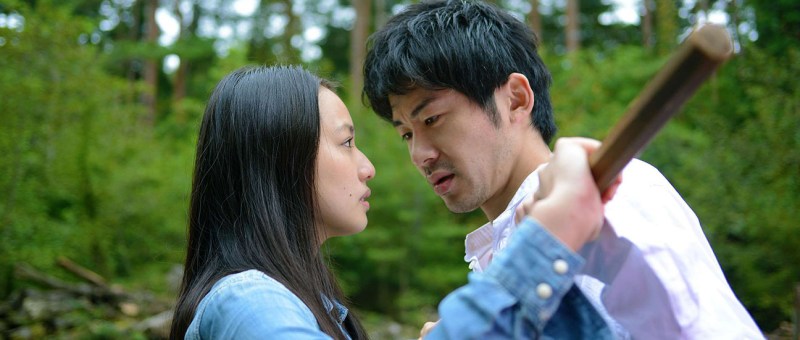
Akihiko Shiota’s Wet Woman in the Wind (風に濡れた女, Kaze ni Nureta Onna) starts as it means to go on with hapless protagonist Kosuke (Tasuku Nagaoka) sitting by a river looking sad just as a strange young woman suddenly rides her bicycle directly into the nearby lake before climbing out and stripping off her T-shirt (which, amusingly enough reads “you need tissues for your issues”), revealing her bare breasts to a complete stranger. Kosuke is baffled and confused. He tries to leave but the woman follows him, asking if she can stay with him tonight because she has nowhere else to go. Kosuke is resolved, he’s given up girls and wants nothing whatsoever to do with weird women from ponds but Shiori (Yuki Mamiya) is not one to take no for an answer.

It’s never made clear but something unpleasant has obviously happened to Kosuke that has made him retreat from the city with his tail between his legs (so to speak). A respected playwright, Kosuke seems to have had something of an existential crisis and has decided to condemn himself to a life of self-imposed isolation because “you have to be alone if you really want to think deeply about things”. His isolation is, however, only up to a point. Kosuke’s semi-primitive lifestyle sees him living in a shack in the woods but he has electric lighting provided by generator batteries and grinds his own coffee beans by hand after buying them from a local cafe owned by a man Kosuke went to university with but claims not to have known at the time. The cafe owner’s wife has recently left and he blames Kosuke for reawakening a desire in her that had apparently lain dormant with her husband.

In a shocking coincidence, Shiori has also taken a job at the cafe and has set about seducing the recently lonely owner who has now become fixated and jealous, once again afraid Kosuke in particular is going to steal away his new plaything just like he stole his wife. This is a fallacy on several levels, not least that Shiori is not a woman to be constrained by any man but a true free spirit who gives her love freely to whomever that she chooses.

Spirit might be the best way to describe Shiori who arrives and departs with the wind, a force of nature with the sole intent of freeing her targets of the burden of repressed desires. A radio broadcast later reveals that a tiger has been on the run from the nearby zoo and if this were a fable, you could almost believe the tiger to be Shiori, sinking her teeth into soft centre of human weakness and leaving right after she tears its throat out.

Free spirit as she is, Shiori does find herself in moments of danger as the the threat of sexual violence rears its ugly head. Kosuke likes to think of himself as an enlightened kind of man, an intellectual, but he’s also a self-involved womaniser not above attempting to force himself on a woman he feels to be his for the taking or, half in jest, threatening to rape a former lover. Yet for Shiori much of this is sport – she sees through Kosuke and neatly undercuts all of his self delusions and neuroses, but she’s also merely toying with him.

Finding himself literally kicked out of bed and rendered redundant when Shiori finds more pleasure in getting together with his former lover Kyoko, Kosuke wanders outside in confusion and seduces, with a degree of tenderness, Kyoko’s shy, bespectacled assistant, Yuko. When the morning comes, however, he feels he made a mistake. Yuko has become attached to him, sharing a traumatic childhood story only for Kosuke to brush it aside and encourage her to go out into the world to explore the rich pleasures on offer now that he has “awakened” her. Kosuke remains as self-centred as ever, but Yuko at least does perhaps find something in his words of “wisdom”.

As in all good sex comedy, the men are pathetic slaves to desires they find themselves unable to express, whether out of fear or cultural ideals of masculinity, while the women remain in control and must guide the men either towards a healthier outlook or their own destruction. Both Kosuke and the cafe owner conspire in their own downfall in misguided battles for possession or conquest. Having already suffered defeat, Kosuke has retreated from the field dejected and humiliated, but in his all out impassioned attempt to re-enter the world of carnality he literally brings his entire universe crashing down around his ears. Forced to realise his own ridiculousness, Kosuke is left alone with little else to do than survey the scale of the destruction his various delusions have wrought. A fun loving pastiche, Wet Woman in the Wind is an oddly whimsical tale, witty yet insightful even its seeming lightness.


Currently available to stream via Mubi.

Original trailer (English subtitles) NSFW!

Echoes of the Rainbow (歲月神偷, Alex Law, 2010)

echoes of the Rainbow posterThe tragedy of childhood is that you can’t quite see it on the ground. Looking back the truth is plainer but it’s also painful, containing all the warmth of those times but also the regrets and irreconcilable longings. Alex Law’s small scale personal tale of inevitable tragedies mixed with intense nostalgia, Echoes of the Rainbow (歲月神偷, Shui Yuet Sun Tau), is deeply sincere and more than earns its turn for the sentimental in its never wavering feeling of authenticity as it paints a picture of a rapidly disappearing Hong Kong and a childhood lived in a big brother’s shadow.

Eight-year-old “Big Ears” (Buzz Chung) lives with his cobbler father (Simon Yam) at the end of a long, run-down street of shopkeepers. Amusingly enough, Big Ears’ uncle (Paul Chun) lives at the other end of the street where he cuts hair so the family kind of has the full run of the place, head to toe. While Big Ears whiles his time away daydreaming,  putting a fish bowl on his head and pretending to be an astronaut or indulging in his favourite hobby – kleptomania, his big brother Desmond (Aarif Lee) is busy doing everything right. A tall, strong teenager with more than a passing resemblance to Bruce Lee, Desmond is a track and field star and academically gifted student at the prestigious Diocesan Boys’ School. Big Ears loves everything about his big brother, including his sort of girlfriend Flora (Evelyn Choi).

Law sketches the everyday lives of this ordinary family with the sort of details which randomly recall themselves years later – the tear on his father’s T-shirt from where it hits the end of his chisel, the taste of Autumn Moon Cake, the random conversations with passersby. The small community on this run-down street more is like an extended family in and of itself as the families take their meals on tables outside, each overhearing each other’s conversations and interfering in various family dramas. Big Ears quips that his mum (Sandra Ng) is known as “Mrs. Outlaw” because she’ll talk her way into or out of anything and has a talent for talking people around to her way of thinking, but the warmth and love between his parents is never shaken. Even in the midst of an encroaching tragedy, Mr. Law takes the time to design a pretty pair of ultra comfortable shoes for his harried wife who often complains about her corns.

Seen through little Big Ears’ eyes, the film avoids the bigger picture or any political concerns save for the presence of the corrupt colonial forces as represented by Sergeant Brian who speaks fluent Cantonese but stresses that English is essential for “getting on” in Hong Kong. Sergeant Brian is also going to get one whole box of the moon cakes Big Ears wanted all for himself and his mum has been paying for in instalments for the last few months, but the reason for his visit is a rise in the protection money the local police takes from shopkeepers. If the Laws can’t pay it (and they can’t, really) they’ll be evicted. Not that Big Ears would know, but business is bad and the family is spending most of its income on Desmond’s expensive school fees so it’s doubly galling to them when his grades and athletic success begin to decline.

Big Ears is a naughty little boy, but often gets away with it because he’s just so darn cute. His pilfering habit goes largely undetected even though he steals quite ostentatious items like a glowing goblet souvenir from a movie starring his favourite actress whose picture he also sells with a fake signatures attached, a British flag from a nearby base, and even a pottery statue of the Monkey King from an actual temple. Desmond has this theory about about double rainbows that are an inversion of each other – something that could easily work for himself and his brother with Desmond’s essential goodness contrasting nicely with Big Ears’ roguish adventures whilst also speaking for the enduring bond between the brothers.

Even before the literal typhoon rips through Big Ears’ idyllic childhood home, there are signs of trouble on the horizon – firstly in Desmond’s melancholy love story with fellow tropical fish enthusiast Flora who turns out to come from an entirely different world filled with all the ease and possibility so absent from the Law’s, and then in Desmond’s gradual slowing down. The respective catch phrases of Big Ears’ parents signify the twin pillars of the age with his father’s insistence that “nothing is more important than the roof” as he works steadily to keep one over his boys, and his mother’s instances that life is “half difficult, half wonderful” but “you have to keep believing”. Earning a right to melodrama through fierce authenticity, Echoes of the Rainbow does not negate its tearjerking premise but rings it for all of its joy and sorrow, revelling in nostalgia but also in a kind of hopefulness born of having weathered a storm and survived to witness the birth of new rainbows lighting up the sky.


Screened at Creative Visions: Hong Kong Cinema 1997 – 2017

Original trailer (English subtitles)

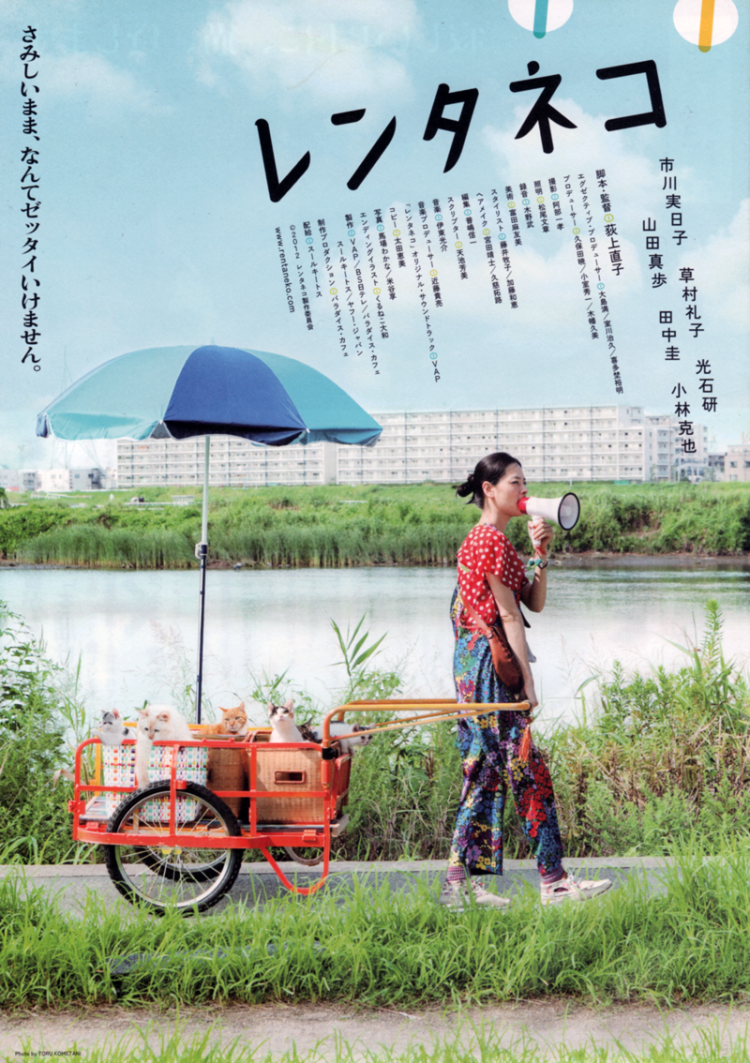
Rent-a-Cat (レンタネコ, Naoko Ogigami, 2012)

©2012レンタネコ製作委員会

rent-a-cat posterPreviously, Ogigami’s heroines (and hero, when one thinks about it) have had to go great distances in order to figure out what it was they were looking for and then finally find it. In Kamome Diner, Sachie went all the way to Helsinki to open up a Japanese cafe only to find herself accidentally attracting a collective of other runaway Japanese people whilst building a community of friendly Finns in her new home. Taeko, in Megane, went on a random holiday that turned out to be much more random than she ever would have expected but she did end up learning to slow down and enjoy the simple pleasures of life which is, presumably, why she ended up on holiday in the first place. Rent-a-Cat’s (レンタネコ, Rent-a-Neko) Sayoko (Mikako Ichikawa), by contrast, stubbornly stays put. In fact, she is the pillar around which all else turns as a fixed point for her various “stray cats” each in need of temporary support.

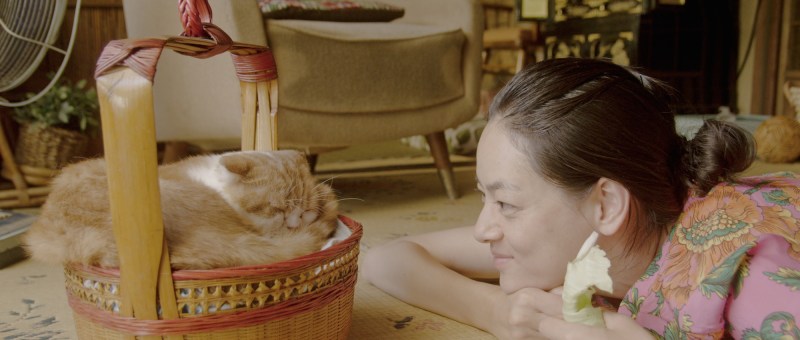
Since her grandmother died a few years ago, Sayoko’s life has been in free fall. A 30-something single woman with no “regular” employment, Sayoko lives in a spacious Japanese-style house with a small garden which is home to the various stray kitties which seem to seek her out when looking for a good place to crash. Sayoko has taken to writing out large banners declaring her immediate goals – getting married being the main one, and pasting them on the walls to encourage herself to keep going. The truth is, though Sayoko is not exactly unhappy she is unfulfilled. Since childhood she’s had the strange talent of attracting friendly cats but secretly longs to attract people too. Combining her strength and her weakness, Sayoko operates an unusual enterprise – cat rental! Walking along with a loud speaker and a trailer full of cats, she looks for lonely people who might want to borrow a fluffy friend for a while to help them out while they’re feeling low.

Of course, Sayoko’s quest to heal the hearts of others is also one to heal her own. Eccentric since childhood during which she was nicknamed “Jamiko” after a strange monster and mostly spent her time snoozing in the nurse’s office along with a kleptomaniac fellow student, Sayoko has never found her feet when it comes to building lasting relationships with people. Her voiceovers all refer back to her grandmother whom she misses deeply and seems slightly lost without. Appearing to have no real friends and spending a lot of time at home looking after her collection of needy cats, Sayoko’s main source of daily interaction comes from the horrible old woman who lives next door and turns up at random intervals to play Greek chorus in neatly reciting Sayoko’s various neuroses back to her over the garden fence.

Sayoko’s neighbour probably has a hole in her heart she fills by being deliberately insensitive to obviously sensitive people, but Sayoko offers her clients another solution in the form of a fluffy little cat who needs someone to look after it. Before lending one of her charges, Sayoko makes sure to vet the prospective cat guardian – after all, not everyone is nice and some people like to project their own suffering onto harmless little creatures. Through the house visits Sayoko gets to find out exactly what kind of hole it is that needs filling from dimples in jellies to holes in socks and even those in donuts, and being the sensitive soul she is, Sayoko usually knows what kind of help her customers need.

Structured around four different clients and bridged with Sayoko’s own neurotic journeys, Rent-a-Cat takes on a charming, fairytale quality in its repeated formulas. Each time someone asks to rent a cat they get the same speech about the inspection and then when it comes to talking money they each express surprise at the extremely good value, making sure to ask if Sayoko will be OK financially when she operates on these oddly beneficial terms. Don’t worry, she tells them – she has other income, a different one each time from stockbroking to fortune telling. The problems run from late life isolation as in a little old lady who loves making jellies for the son she never sees, to dejected fathers forced to work away from home and missing their kids grow up, and young women who feel trapped in a conservative society and would like nothing more than to jet off somewhere to follow their own path, if only they had the courage.

Social conservatism does seem to be something which particularly annoys Sayoko, if perhaps subconsciously. A strange dream sends her off to a Rent-a-Cat corporate clone where clients can rent cats of three different classes priced according to desirability. Sayoko is particularly anxious about the “Class C” cats whom the lady behind the counter disdainfully describes as “crossbreeds”. Sayoko is not having any of that and takes the woman to task for her need to “rank” things before insisting on renting a Class C cat at the Class A price to fully ram home the unpleasantness and absurdity of such a prejudiced world view.

Branded a “crazy cat lady” by the neighbourhood kids, Sayoko’s humanitarian mission of spreading love and kindness eventually does start to reel in a few humans even if they are mostly lonely souls in need of temporary support. Towards the end, when a promising reappearance provokes only disappointment, Sayoko wonders if perhaps there are holes cats cannot fill or sadnesses too great to be borne, but nevertheless she persists. A falling banner a suggests Sayoko may have already found the material to fill her own hole in helping other people fill theirs whilst surrounded by the by warm indifference of her feline brood.


You can catch Rent-a-Cat at the Japanese Embassy in London on 22nd November as the first in a series of events, Archipelago: Exploring the Landscape of Contemporary Japanese Women Filmmakers, which also includes screenings of Bare Essence of Life, Death of a Japanese Salesman, and Wild Berries from 30th November to 2nd December.

 Original trailer (no subtitles)

The Brink (狂獸, Jonathan Li, 2017)

the brink posterDesire makes beasts of us all. Longtime assistant director Jonathan Li makes his feature debut with a waterborne pulp noir which takes on more than a hint of gloomy sea shanty in its musings on sailors, their eternal brotherhoods, and ocean owned souls. The Brink (狂獸) mixes metaphysical drama with the more usual procedural tropes as a wounded, maverick cop chases his prey through hell and high water, refusing to acknowledge that his own “recklessness” is the single cause of the chaos he currently finds himself embroiled in.

The exhilarating opening sequence tracks around a ruined building before finding ruthless cop Sai Gau (Zhang Jin) engaged in a brutal fight with a suspect who later lands right on his police car after careering out of a top floor window. In addition to the death of the suspect, Sai Gau’s recklessness also causes the death of a fellow officer and sees him suspended from the police force after being charged with possible manslaughter. Six months later he’s absolved of guilt, released, and reinstated but clearly not forgiven by his colleagues and superiors who continue to regard him as a liability.

Hair dyed blond, Sai Gau sets about investigating a notorious gold smuggling operation operating under the cover of the local fishing trade. Meanwhile, smuggling underling Gui Cheng (Shawn Yue) has learned he’s about to be sidelined by his adopted father figure in favour of a feckless biological son and suspects his boss is about to have him offed. Gui Cheng preempts the situation by taking out the son’s guys and replacing them with his own before turning his would-be-assassin’s knife (or more accurately harpoon gun) back on him only for Sai Gau to arrive and ruin everything, unwittingly kicking off a series of unfortunate events for all concerned.

Li sets up Sai Gau and Gui Cheng as inverted mirrors of each other – hence Sai Gau’s ridiculous blond hair which sets him apart from the darkness of the long haired Gui Cheng. Where Sai Gau is all impulsive, instinctual action, Gui Cheng is calm and distance personified. Gui Cheng rarely speaks and when he does he’s concise and to the point, whereas Sai Gau, while not especially loquacious, is a classic wisecracker who speaks without thinking and is unafraid of the consequences of his words. Yet both men are also playing against themselves – Sai Gau has adopted the teenage daughter of the man he killed but refuses to allow himself to care for her, whereas the otherwise heartless Gui Cheng seems to have an intense yet platonic relationship with his female sidekick.

Twin betrayals set Sai Gau and Gui Cheng on an inevitable collision course leading towards a tussle over the gold which becomes more symbol than pure financial gain. Gui Cheng, once so calm and calculating, becomes fixated on harvesting what’s his, turning the buried treasure into his personal white whale while for Sai Gau it becomes the symbol of a long buried evil, a cursed charm designed to lure men to their doom by sending them into the centre of a storm it knows they cannot survive. Gui Cheng believes himself blessed by the goddess of the sea and that the gold is his for the taking, but it is ultimately the sea which claims him as he attempts to defy the elements to stake his claim on the cursed treasure which it has already swallowed. Sai Gau claims no particular spiritual affiliation but the gold, and its corrupting influence, reawakens his sense of morality as he becomes as convinced that the gold is evil as Gui Cheng is that it is his salvation.

The gold turns men into the “wild beasts” of the Chinese title though the English one seems to place them on the “brink” of losing themselves at any given time. Highly stylised, Li’s Hong Kong is one of neon lit darkness in which it is always raining and the air hangs heavy with despair and impossibility. The action scenes are impressively choreographed sequences of balletic beauty captured with Li’s gift for unusual composition and an urgent energy which acts as a harbinger for the coming storm. Pure pulp noir, The Brink has an almost Lynchian sense of lurking darkness creeping in from another, more mythical world the kind of which sailors sing about in their shanties and only talk about by candlelight.


Screened at Creative Visions: Hong Kong Cinema 1997 – 2017

Original trailer (dialogue free, English captions)

Mad World (一念无名, Wong Chun, 2016)

Mad World_posterThroughout the aptly titled Mad World (一念無明), the central character frequently asks if he is really the one who is “abnormal” or if everyone else is merely operating under some misguided notion of “normality”, either deluding themselves that they meet it or actively masking the fact that they don’t. The first feature from Wong Chun, Mad World is not only the story of a man attempting to live with mental illness in a society which is unwilling to confront it, but also a discourse on the various ills of modern life from the ageing population and breakdown of the “traditional” family to the high pressure nature of “successful” living. Carefully nuanced yet pointed, Wong Chun’s vision is at once bleak and hopeful, finding victory in the courage to move on in self acceptance rather than in a less ambiguous discovery of a more positive future.

Tung (Shawn Yue) has spent the last year institutionalised after being arrested in connection with the death of his mother (Elaine Jin). The doctors and courts have both absolved him of any blame, but Tung has also been diagnosed with bipolar disorder and is being released into the care of his estranged father, Wong (Eric Tsang), rather than simply released. When Wong picks Tung up at the hospital, the disconnect and anxiety between them is palpable, as is Wong’s embarrassment when he takes Tung back to the tiny room he inhabits in a low rent lodging house sharing a kitchen and a bathroom. Father and son will be sleeping on bunk beds with any idea of privacy or personal space firmly rejected.

Wong, a man in his 60s who’d all but abandoned his family for a career as a long-distance truck driver crossing the border into China, is ill-equipped to cope with caring for his son on several different levels. Perhaps a man of his times, he’s as ignorant and afraid of mental illness as anyone else, quickly getting fed up with Tung’s frequent crying fits and even stooping so low as to simply ask him why he can’t just be normal like everyone else. However, after getting more used to Tung’s new way of life, Wong does his best to get to grips with it, buying a number of books about depression and joining a support group for people who are caring for those with mental health needs.

Tung continues to struggle, finding it difficult to reintegrate into to society when society actively excludes those who don’t quite fit in. Attending a friend’s wedding shortly after having been discharged, Tung spots a few unpleasant social media posts referring to him under the nickname “Mr. Psychosis” while guests in the room mutter about the “nutjob” who must have just escaped the “loony bin”. Tung doesn’t do himself any favours when he grabs the mic and interrupts the groom’s speech to take the audience to task for their indifference, but the hostility he faces is entirely unwarranted. Later, experiencing another setback, Tung finds himself the subject of a viral video when he stops into a convenience store and guzzles Snickers bars in an attempt to improve his mood. It’s not long before someone has correctly identified him as the guy who was accused of killing his mother and put in a mental hospital, literally sending him right back to square one in terms of his recovery. To make matters worse, Tung can’t get any of his old contacts to look at his CV because they all have him branded as a dangerous madman and interviewing for new jobs never gets very far after they ask why there’s a one year gap in his employment history. 

Employment does seem to be a particular source of anxiety with frequent mentions of mass layoffs and even managerial suicides in the high pressure financial industries. Even before the events which led to his hospitalisation, Tung was undoubtedly under a lot of stress – planning a life with his fiancée, Jenny (Charmaine Fong), which adds the financial pressures of mortgages and saving to start a family. The sole carer for his elderly mother, Tung is also on the front line for her cruel, sometimes violent mood swings which, according to Wong, are a lifelong phenomenon rather than a symptom of the dementia she is also afflicted with. Tung lashes at out Jenny when she suggests putting his mother in a home where she can be better cared for, exhibiting a streak of unpredictable, frustrated violence of his own which also deeply worries him.

Tung may have inherited this impulsive volatility from his mother, in one sense or another, but his longstanding feelings of low self worth are as much to do with his parents’ seeming disregard for him as they are to do with anything else. His mother, unhappy in her marriage, blames her eldest son for trapping her in dead end existence while continuing to worship the younger one, Chun, who went to an Ivy League US university and has since left them all far behind. Constant, unfavourable comparisons to the golden boy only raise Tung’s levels of stress and resentment at being obliged to care for the woman who constantly rejects and belittles him after the “good” son and the “bad” husband both abandoned her. Wong “left” his wife because he couldn’t cope with her difficult personality and complicated emotional landscape, but now faces a similar dilemma with the son he had also left behind.

Hong Kong is, indeed, a maddening world as Tung and Wong find themselves crammed into a claustrophobic share house filled with similarly stressed and anxious people predisposed to see danger where there is none. Tung’s condition finds him semi-infantilised as the wiser than his years little boy from next-door becomes his only friend until his mother finds out about Tung’s condition and orders her son not to see him. Wong Chun’s central premise seems to be that the world will drive you crazy, but if there were more kindness and less hostility perhaps we could all stave off the madness for a little longer. Anchored by strong performances from Yue and Tsang, each playing somewhat against type, Mad World is a remarkably controlled debut feature which subtly underlines its core humanitarian message whilst taking care never to sugarcoat its less pleasant dimensions.


Screened at Creative Visions: Hong Kong Cinema 1997 – 2017

Original trailer (English subtitles)

Paradox (殺破狼・貪狼, Wilson Yip, 2017)

paradox posterLouis Koo, possibly the hardest working actor in Hong Kong, has played his fair share of heroic (and not so heroic) cops but you’d be hard pushed to describe him as an action star. Proving nothing if not his dedication, Koo gives it his all as the lead in Paradox (殺破狼・貪狼), the latest in the SPL franchise directed by Ip Man’s Wilson Yip. Yip also directed the first in the series but stepped away for the second, though there is no narrative continuity with any of the films and, confusingly enough, the SPL tag seems to have been dropped from the international title altogether. In any case, what Paradox shares with instalments one and two is a series of intensely kinetic action scenes built around a storm of three incompatible personality types coupled with a quest narrative as Koo searches for clues in the disappearance of his 16 year old daughter.

Yip begins the film inside the memories of Hong Kong cop Lee Chung-Chi (Louis Koo) as he remembers the golden time when his daughter was young and worshipped her dad, crawling into his bed in the morning with a video camera ready for a whole day of birthday fun. Lee buys a cute a silver bracelet with a teddy bear charm but it’s the 16 year old Wing-Chi (Hanna Chan) he gives it to. Lee and his daughter are in a restaurant, not at home, and the air between them is tense. A boy turns up and Wing-Chi introduces him as her boyfriend but if Lee is annoyed things are about to get worse. The pair want to get married because Wing-Chi wants “to keep the baby”. Lee barely reacts save for abruptly stepping away from the table. When he returns he seems as if he’s composed himself, but in reality he has already made a catastrophic error of judgement which will force his daughter away from him.

Wing-Chi goes to Thailand to visit a friend and disappears. Lee goes to look for her, breaking out his best investigator skills and teaming up with local cop Chui Kit (Wu Yue) who is soon to be a father himself, but what he finds there leads him onto a dark path of paternal guilt, regret, and suffering whilst wading through the corruption and cruelty of the Thai underworld.

Though the narrative is, in a sense, unimportant, Yip homes in on the nature of fatherhood and the sometimes difficult or conflicted position a father finds himself in when trying to protect his child. Lee may think he’s “doing the right thing” when he clamps down on his teenage daughter’s plans to start a family of her own way ahead of schedule, but then again perhaps this was not his decision to make and ruining three lives to suit himself is nothing more than selfishness masquerading as love. It is his own actions which send his daughter into the path of danger, and then later decide her fate on a split second decision.

Later, Kit’s father-in-law (Vithaya Pansringarm) faces a similar dilemma when he’s threatened by government big wigs and fears his own daughter (and unborn grandchild) may be in danger if he does not play along. Lee’s quest to find Wing-Chi runs in parallel with that of the local mayor to win re-election, only the mayor has a bad heart which causes him to collapse before an important rally. Shady fixer Cheng (Gordon Lam) decides the mayor needs a heart transplant (seemingly unaware of the complexity of the operation and the time needed for recovery) which all links back to a dodgy American ex-pat (Chris Collins) who operates a large scale meat factory as a front for illegal organ trafficking.

The stories of Kit and Lee are linked by the curious use of the classic Chinese pop song The Moon Represents My Heart made famous by Teresa Teng. The song with its constant references to the “heart” which is also visually represented by the cheerful cards around the mayor’s bed perhaps over does things in the metaphor stakes but does its best to tug at the heartstrings in its insistence on a fathomless love in this case of fathers for their children. Koo’s rage only intensifies the more desperate he becomes as his quest hits continual dead ends punctuated by the discovery of various unpleasant characters lurking not just in the backstreets but in the police stations and political institutions of Pattaya.

The action scenes are visceral and kinetic though Koo makes the most impact when acting with stone cold efficiency, leaving the most memorable sequences to rising star Wu and Tony Jaa whose extremely brief appearance as a psychic / extremely buddhist cop may disappoint those deceived by his top billing into expecting his role to be more than a cameo. Nevertheless, Paradox delivers what it promised in Koo’s unexpected metamorphosis into an ultra cool action star whilst sending his moody cop on a dark journey of the soul as he confronts the depths of his own complicity in the corruption which is consuming him.


Screened as the opening film of Creative Visions: Hong Kong Cinema 1997 – 2017

Original trailer (English subtitles)

Co-stars Louis Koo and Wu Yue recorded a new version of The Moon Represents My Heart especially for the film

Teresa Teng’s The Moon Represents My Heart

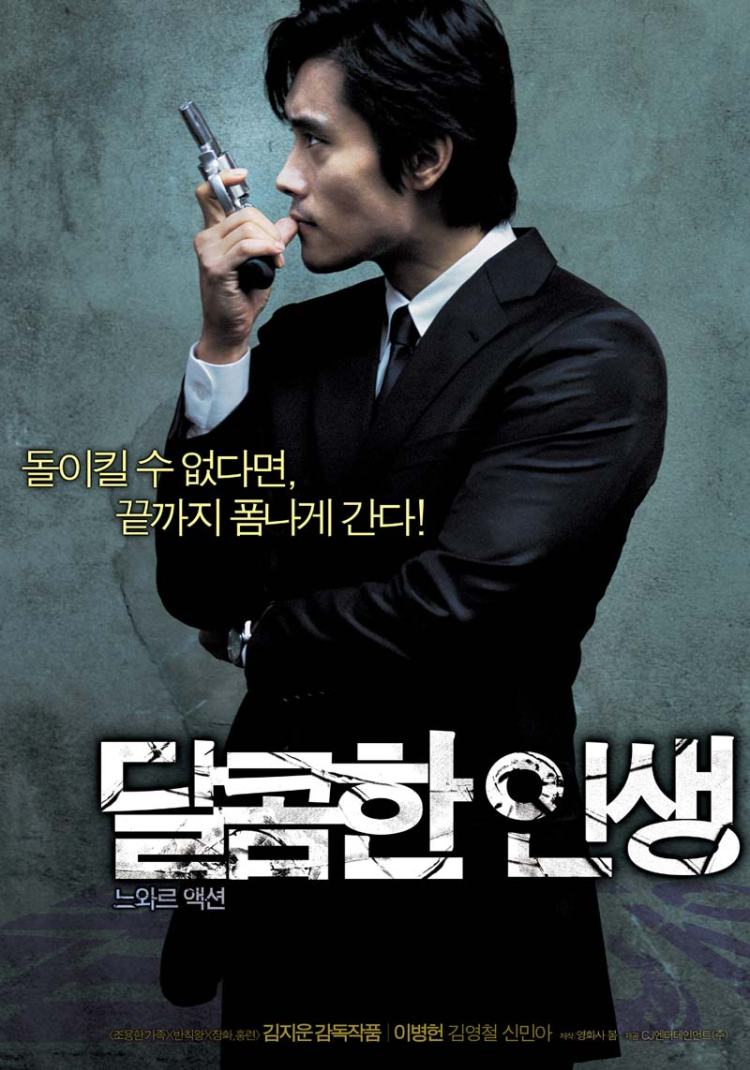
A Bittersweet Life (달콤한 인생, Kim Jee-woon, 2005)

bitterweet life posterAs Boss Kang (Kim Young-chul) tells the hero of Kim Jee-woon’s A Bittersweet Life (달콤한 인생, Dalkomhan Insaeng), no matter how well things are going, it only takes one mistake to make it all float away. Like any good film noir, the forces which conspire to ruin the quiet, orderly life of cooler than thou gangster Sun-woo (Lee Byung-hun) are those of desire as they come in conflict with codes of loyalty and decency. Sun-woo, like many a lonely hitman before him, finally wakes up to the emptiness of his life only to find no point of escape except the one he has often provided for others in precisely the same situation.

Smartly suited, Sun-woo is the trusted manager of the casino bar, Dolce Vita. Taken away from his elegant dessert in the upstairs restaurant, Sun-woo deals with a group of rowdy customers in true gangster fashion by launching in with a series of jump kicks and quickly thrown punches that reveal just why it is Sun-woo rules the roost. Sun-woo’s boss, Kang, has a special mission for his most trusted minion – keep an eye on his much younger girlfriend, Hee-soo (Shin Min-a), while he travels to Shanghai for three days. Kang thinks Hee-soo is having an affair. If she is, Sun-woo’s options are either to call Kang right away or take affirmative action on his own initiative.

Sun-woo investigates, but much to his surprise finds himself taken with Hee-soo. She is indeed having an affair, something which Sun-woo tries to ignore but finally has to be dealt with. A sudden pang of sympathy stops him from contacting Kang or pulling the trigger. Instead he decides to let the pair go on the condition they never see each other again. Thinking it’s all behind him, Sun-woo tries to go back to his regular job but he’s still dealing with the fallout from playing whistleblower on a high ranking gangster’s son.

Kim opens with an arty black and white sequence of tree branches swaying. In the story offered in voice over a disciple asks whether it is the trees or the wind which are moving, but the master replies that is is neither – it is the heart and mind which move. Like the branches, Sun-woo’s heart has begun to stir. Not love exactly, or lust, but movement. Sun-woo gazes at the way Hee-soo’s hair brushes her shoulder, at the way she walks and smiles at him. Listening to her cello rehearsal, his own emotional symphony begins, dangerously unbalancing his previously one-note existence with its identical suits and minimalist apartments.

Yet if Sun-woo’s downfall is Hee-soo and her alluring vitality, it was Kang’s first. An ageing gangster, Kang feels foolish taking up with a young girl but just can’t help himself. He loves the way Hee-soo couldn’t care less about what other people think, but that also worries him because she’ll never care what he thinks. Kang’s childishly romantic gift of a kitschy lamp with two owls huddling together on the base is the perfect symbol of his misplaced hopes – oddly innocent yet ultimately redundant. Notably, the lamp is one of many things shattered when Sun-woo takes Hee-soo’s lover to task.

Realising he has been betrayed, though not quite for the reasons he thinks, Sun-woo vows revenge. Everything has gone wrong, and he no longer believes in any kind of future which has him in it. Pausing only to send a more mature romantic gift to Hee-soo, an elegant lamp she’d admired on one of their shopping trips, he marches off towards certain death no longer caring for own life in his quest for vengeance and retribution. Repeating Kang’s questions back to him, asking for the real reason any of this happened, doesn’t get him very far but even if these two men have shared the same folly, they fail to understand each other even in death.

Returning to the master and his pupil, the closing coda recounts another story in which the pupil wakes up from a dream, weeping. The master asks him if he’s had a nightmare but the pupil says no, he’s had the sweetest of dreams. He’s crying because he’s awake and knows his dream can never come true. Sun-woo too has woken up, he knows there’s nothing for him now except to accept his fate. He has but been asleep, dreaming a sweet dream, and now he must wake and taste life’s bitterness just as he prepares to leave it.


Screened at London Korean Film Festival 2017.

Original trailer (English subtitles)