Sound in the Mist (霧の音, Hiroshi Shimizu, 1956)

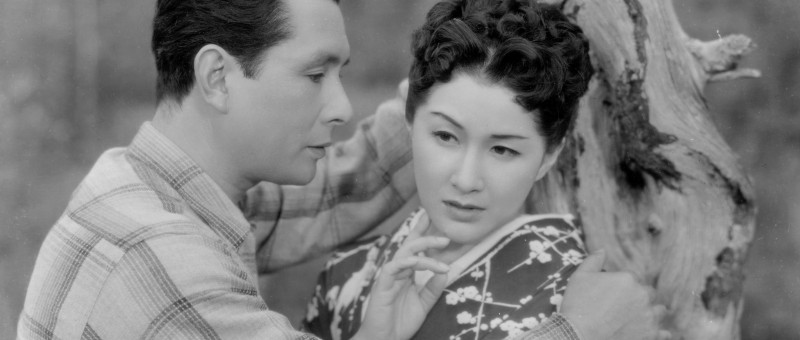
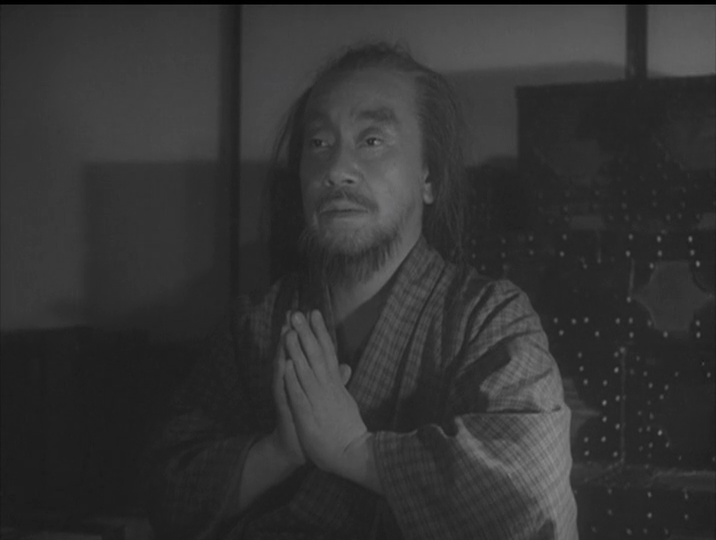
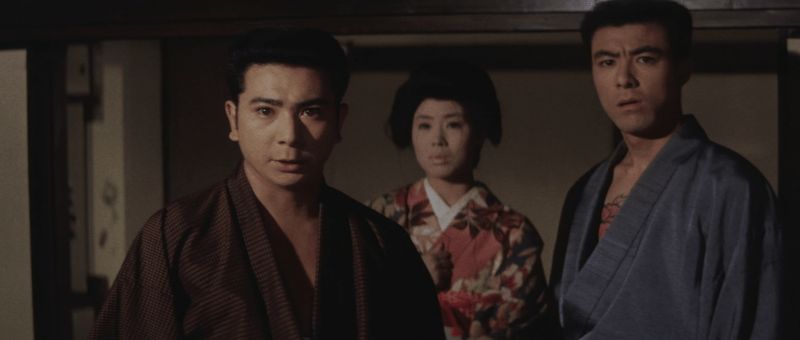
In the opening scenes of Hiroshi Shimizu’s Sound in the Mist (霧の音, Kiri no Oto), a young woman tells another that “as women, we need to create our own happiness,” though as it turns out it’s something that neither of them are really able to do. A classic melodrama, the film once again hints at Shimizu’s mistrust of romance and the frustrating inability of men and women to communicate or embrace their love for one another even when the seeming barriers preventing it have been removed.

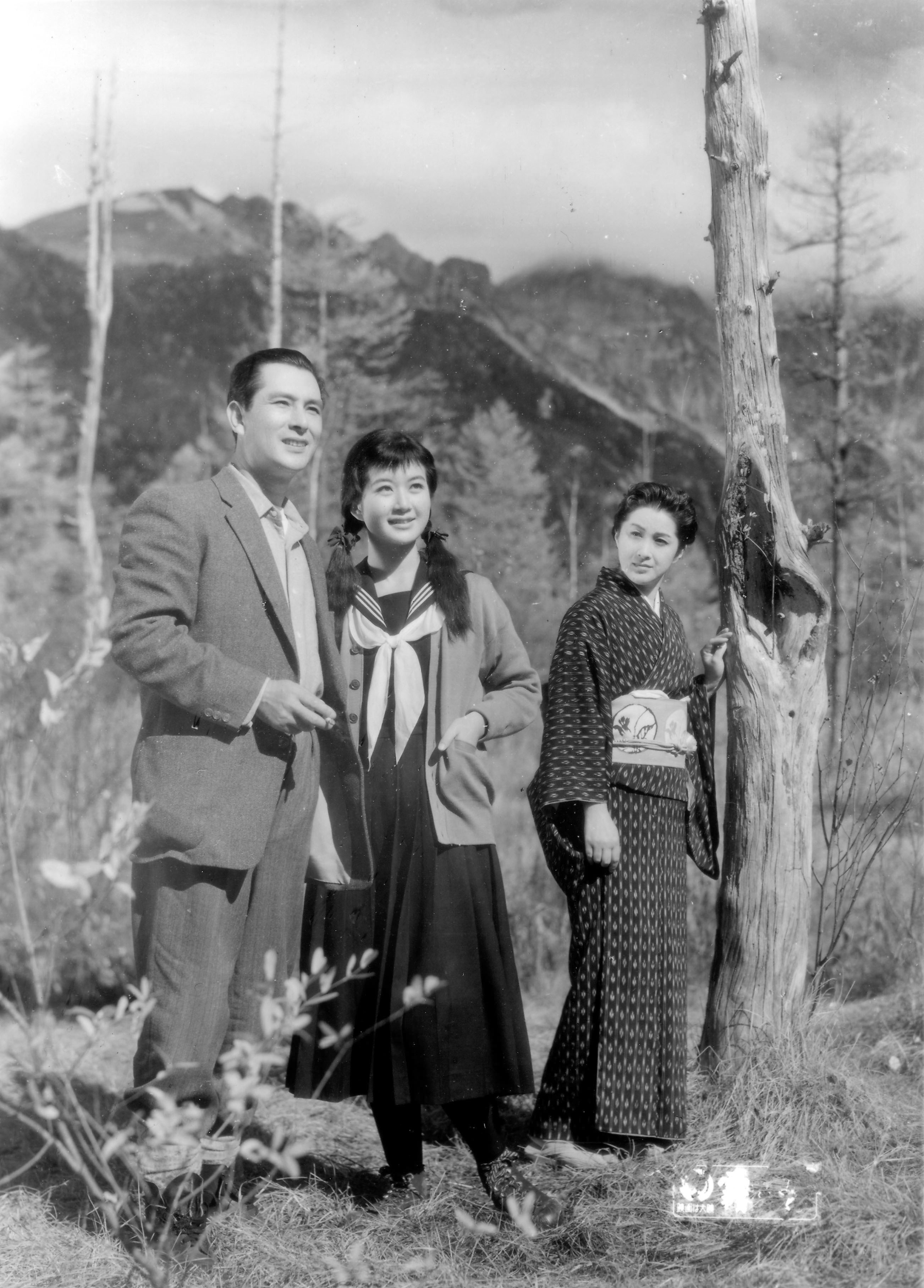
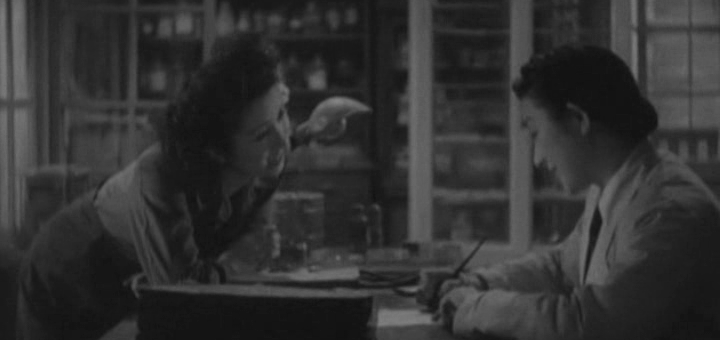
To that extent, it’s interesting that the chief disagreement between unhappily married botanist Kazuhiko (Ken Uehara) and his wife Katsuyo is over her feminist politics and desire to devote herself to women’s emancipation under the new post-war constitution. The main bone of contention is that she wants to sell a mountain owned by Kazuhiko’s family to fund her political career though as he later says this mountain is his life. In any case he lets her sell it, believing there’s no point putting up a fight. He puts up even less of one in his relationship with Tsuruko (Michiyo Kogure), his assistant who is hopelessly in love with him yet after his wife’s angry visit decides to absent herself feeling as if she’s in the way.

It was her friend Ayako, a Tokyo dancer, who told her that women need to make their own happiness but in the end she couldn’t do it either. She was similarly involved with a weak-willed married man who continued to vacillate over leaving his wife offering the justification that he didn’t want to mess things up for his children. Eventually the pair find escape through double suicide which only emphasises the futility of their romantic connection. Tsuruko similarly makes several comments about the idea of death and dying, stating that if she were to die she’d want to go to a particular spot in the mountain which seems like heaven to her.

Though Katsuyo describes it as a “filthy” place the cabin does indeed become a kind of haven, a bubble of apparently chaste love and longing inhabited only by Kazuhiko and Tsuruko as the voiceover says hiding out from post-war chaos. Tsuruko seems to be the kind of woman Kazuhiko regards as the ideal wife in that she cares for him and supports his work even if he tells Katsuyo he just needed someone to run errands and do the grocery shopping so Tsuruko is there as his maid. Both are at pains to emphasise that no physical relationship exists between them but are otherwise prevented from acting on the their love because of Kazuhiko’s marriage along the existence of his daughter, Yuko (Keiko Fujita), who may be adversely affected by her parents’ decision to divorce in an age when such things were less common.

Kazuhiko continues to return to the mountain cabin which has since become an inn at regular intervals to see the Harvest Moon, as does Tsuruko though she also carries a degree of shame that makes her fear re-encountering Kazuhiko having become a geisha apparently solely to ensure her proximity to the mountain. Once again filming with the gentle lateral motion familiar from his later films, Shimizu focuses on the landscape and suggests that these lovers are only free to love in the natural world unconstrained by the petty concerns of civilisation which prevent them from embracing their desires. The sound in the mist is perhaps that of Kazuhiko’s latent romanticism and the implication that to him it may be better to suffer for love than to accept it. The same may be true for Tsuruko who is equally powerless if filled with regret that in the end she gave up so easily rather than fight for the love of her life.

On the other hand, the cabin seems to have given rise to a love match between Kazuhiko’s daughter Yuko and her husband who vow to continue the tradition of coming to the inn on the occasion of the Harvest Moon which marks both their wedding anniversary and the time they met. Yuko’s melancholy expression on coming to an understanding of her father’s “special memories” suggests a gentle sympathy but also that this younger generation is freer to love though no less romantic.The poignant closing scenes in which Kazuhiko wanders into the mist are nevertheless filled with irresolution, regret, and a longing that express only a deep sadness for the misconnections and misunderstandings of a less open past.


Sound in the Mist screens at Japan Society New York on May 23/30 as part of Hiroshi Shimizu Part 2: The Postwar and Independent Years.

The Wolves (狼, Kaneto Shindo, 1955)

Post-war desperation drives a collection of otherwise honest men and women towards a criminal act that for all its politeness they are ill-equipped to live with in Kaneto Shindo’s biting social drama The Wolves (狼, Okami). “Wolves” is what the criminals are branded, but the title hints more at the wolfish society which threatens to swallow them whole. After all, it’s eat or be eaten in this dog eat dog world, at least according to a cynical insurance salesman hellbent on exploiting those without means. 

Each of the five “criminals” is an employee at Toyo Insurance where they’re immediately pitted against each other, reminded that in order to qualify for a full-time position they need to meet their quotas for six months. The orientation meeting is cultilke in its intensity, the boss insisting that only in insurance can you become a self-made man while recounting his own epiphany as to the worthiness of his profession. They are told that the only two things they need are “faith and honesty”, and then “faith and pursuasion”, while encouraged to think of their work as an act of “worship”, “for the salvation of everyone”. 

Yet they’re also told to exploit their friends and family by pressuring them into taking out life insurance policies in order to help them meet their quotas. As one man points out, friends and relatives of the poor are likely to be poor themselves, but these are exactly the kind of people they’re expected to target. They’re told there’s no point going after the weathly because they’re already insured, but there’s something doubly insidious in trying to coax desperate people who can’t quite afford to feed themselves into paying out money they don’t have on the promise of protecting their families from ruin. One man even asks if the policy covers suicide and is told it does if you pay in for a year, sighing that he doesn’t want to wait that long.

“Suicide or robbery, choose one,” one of the salespeople reflects after failing to make their quota once again. They each have reasons to be desperate, all of them already excluded from the mainstream society and uncertain how they will find work if the job falls through. Akiko (Nobuko Otowa) is a war widow with a young son who is being bullied at school because of his cleft palate for which he needs an expensive operation. She’s already tried working as a bar hostess but is quiet by nature and found little success with it. Fujibayashi (Sanae Takasugi) is widowed too with two children and five months behind rent for a dingy flat in a bomb damaged slum where the landlord is about to turn off her electric. Harajima (Jun Hamamura) used to work in a bank but was fired for joining a union and is trapped in a toxic marriage to woman looking for material comfort he can’t offer. Mikawa (Taiji Tonoyama) too is resented by his wife, a former dancer, having lost his factory job to a workplace injury while the ageing Yoshikawa (Ichiro Sugai) was once a famous screenwriter but as he explains people in the film industry turn cold when you’re not hot stuff any more. 

Their unlikely descent into crime has its own kind of inevitability in the crushing impossibility of their lives. They may rationalise that what they’re doing is no different from the insurance company that exploits the vulnerable for its own gain, thinking that if they can just get a little ahead they’d be alright while feeling as if robbery and suicide are the only choices left to them and at the end of the day they want to survive. Perhaps you could call them “wolves” for that, but they’re the kind of wolves that give the guards from the cash van they robbed their train fare home after bowing profusely in apology. The real wolves are those like Toyo who think nothing of devouring the weakness of others, promising the poor the future they can’t afford while draining what little they have left out of them. As the film opens, Akiko looks down at a bug writhing in the dirt attacked by ants from all sides and perhaps recognises herself in that image as the sun beats down oppressively on both of them. Breaking into expressionistic storms and unsubtly driving past a US airbase to make clear the source of the decline, Shindo paints a bleak picture of the post-war world as a land of venal wolves which makes criminals of us all. 


An Osaka Story (大阪物語, Kozaburo Yoshimura, 1957)

A man who tries to escape his poverty ends up imprisoning himself in Kozaburo Yoshimura’s tragicomedy An Osaka Story (大阪物語, Osaka Monogatari). Inspired by the work of Saikaku Ihara, Kenji Mizoguchi had intended to direct but sadly passed away before shooting started with Yoshimura appointed to take over. The broadly comic overtones may be at odds with Mizoguchi’s signature style but ultimately lend weight to the film’s ironic conclusion in which the hero finds himself essentially oppressed by his own wealth in being entirely unable to relate to other people or see the world in ways undefined by money. 

It may be possible to understand Omiya’s (Ganjiro Nakamura) mania as a reflection of his intense fear of poverty, that he is so terrified of possible destitution that he can never really have enough or allow himself to enjoy what he has in case there is no more to come in the future. Even as so his daughter later says, wealth changes him. As the film opens, Omiya is a peasant farmer with a bad harvest who can’t pay the onerous taxes demanded by his exploitative lord. He decides to flee to Osaka with his family but is soon rebuffed by the man he’s gone to see who has just become a samurai and wants nothing to do with him. Wandering around the city, the kids eventually discover a thin layer of discarded rice at a storage area they manage to sweep up giving Omiya a new idea of how to save their family. 

In some ways, his fate is foreshadowed when he alone is unable to slip through the fence while his wife and children mop up grains from the floor. The image of him on one side of the bars is repeated in the closing scene, while his loyalty to the family he tried so hard to save is weakened by the influence of money. Yoshimura shows us a world founded on exploitation. “Those who worked so hard to grow it won’t see a single grain,” Omiya bitterly laments watching workmen unload vast quantities of rice while the peasants starve. When the rest of the family have finished sweeping up what others so casually discarded, Omiya does not use the rice to feed them but sells it to a broker and gives them millet instead. His life is then ruled by the doctrine of good enough, living in painful, penny-pinching austerity even after becoming wealthy as a dodgy tea merchant/loan shark. 

Omiya is one of those people who know the price of everything but the value of nothing. Back at their farm, he’d firmly rejected his wife’s offer to sell herself into sex work to save the family, asking “How could I carry on happily knowing you were suffering for it?”, but this is exactly what he proceeds to do. Omiya no longer cares about his family’s feelings and thinks only abut money but simultaneously refuses to spend any of it. One has to wonder what the point of the money is when he’s living a life not all that different from a peasant farmer save being free of the anxiety of immediate starvation. The only person he has any kind of respect for is a widow much like himself who is equally obsessed with penny-pinching and maximising profits. 

The pair bond in their parsimonious natures, but the mutual desire to get a good deal necessarily comes between them especially when Omiya decides to marry off his daughter (Kyoko Kagawa) to Mrs. Abumiya’s foppish playboy son Ichinosuke (Shintaro Katsu) who has been secretly spending money in the red light district without her knowledge. He too is being exploited, in his case by a geisha who manipulates him into getting the money to buy out her contract by threatening suicide. Meanwhile, Omiya’s meanness means he’s never actually taught his son much about handling money. His invitation to the pleasure quarters by Innosuke eventually provokes his rebellion as he starts to question his father’s philosophy and what money is for if you still can’t live a comfortable life. 

HIs daughter Onatsu asks him something similar, pleading with him to learn to understand other people’s feelings before leaving the shop to be with a kindhearted clerk, Chunzaburo (Raizo Ichikawa), with whom she has fallen in love. So little does he care for people that Omiya doesn’t even bother to live up to the image of a wealthy man. The man who turned him away after becoming a samurai eventually racks up large debts and loses his title allowing Omiya to buy his house as an act of revenge despite his wife and daughter’s protestations that they already have “enough” and did not need more. He refuses contracts the previous owners had set up, throws out a hairdresser who comes to give the ladies a more class-appropriate haircut, and refuses a loan to the daimyo in incredibly rude fashion not to mention embarrassing just about everyone by refusing to serve any food at a wake. 

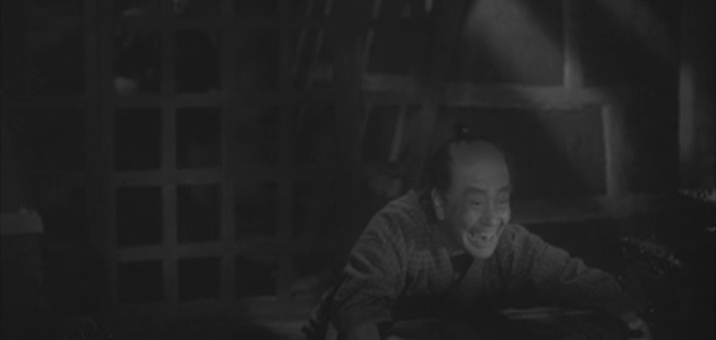
After ruining all of his personal relationships (except that with Mrs. Abumiya), Omiya experiences a kind of mental breakdown throwing himself over the chests of money in his vault and locking himself inside raving that everyone’s out to get their hands on his wealth. He’s just as much of a prisoner of this system as he was as a peasant farmer and has now imprisoned himself within a destructive delusion of capitalistic wealth. “Do what you have to do for a comfortable life,” Omiya’s son Kichitaro (Narutoshi Hayashi) had advised his sister, but this is what Omiya was trying to do too only for it massively backfire no matter what your personal definition of a “comfortable life” may be. Mrs. Abumiya tearfully wonders who’s going to inherit her money if not for her feckless son, but all Omiya can do is cackle wildly one like one possessed insisting that the money is his and his alone and not even death shall part him from it. In part a humorous take down of the contemporary society’s economic obsessions in a bid for ceaseless acquisition, the film is also a tragic tale of a man laid low by his addiction to money and the illusionary sense of comfort it provides him. 


The Beauty and the Dragon (美女と怪龍, Kozaburo Yoshimura, 1955)

A clever princess takes advantage of a courtly crisis to save the kingdom and arrange her own marriage in Kozaburo Yoshimura’s adaptation of the well-known kabuki play Narukami, The Beauty and the Dragon (美女と怪龍, Kabuki Juhachiban: Narukami – Bijo to Kairyu), produced in celebration of the 25th anniversary of the Zenshinza kabuki troupe and starring many of its actors. Scripted by Kaneto Shindo, the film mines a deep seam of irony in the classic tale while allowing its heroine to take centre stage outwitting most of the feckless men from the palace with some clever manoeuvring and utilising the key asset of her femininity.

In a meta touch, Yoshimura opens in a kabuki hall where young lord Toyohide (Chiyonosuke Azuma) is called to perform a dance for the regent, Mototsune, only the show is soon interrupted by a procession of peasants who’ve come to protest the ongoing drought. The earth is cracked and the rivers run dry, but still they are told that they will be informed about the outcome of their petition at a later date. The peasants clearly believe that the emperor really is a god and expect him to fix this problem as soon as possible but in private Motosune is irritated if perhaps accurate in stating that the weather is not their responsibility and they can’t seriously be expected to deal with it. Annoyed by the noise of the protests around the palace, he orders that the peasants be sent away though his courtiers are more sympathetic and know that the peasants simply have no one else to turn to for help. If something isn’t done they will have no choice but to escalate their rebellion.

But as it turns out, the problem actually is their responsibility and is rooted in the misogynicistc patriarchy of the feudal world along with a dose of courtly intrigue. When shinto priest Narukami (Chojuro Kawarasaki) was consulted about the birth of a royal child and prophesied that it would be female, he was hired to alter its destiny and miraculously changed its sex to male through the power of prayer. In return, he was promised that a shrine would be built for him but now it’s 30 years later and he’s sick of waiting. Accordingly, he’s taken the Dragon God who brings the rains hostage and refuses to release him so the rain can return until he gets what he was promised. 

It seems that Mototsune has a very bad habit of promising people whatever their heart desires but conveniently forgetting about it once the job is done. This time though the problem is that disgraced prince Hayakumo (Kunitaro Kawarazaki) stopped the building of the shrine in fear of offending a rival temple, Ezian, which contains a large number of very intimidating bandit monks. Hayakumo is intent on using the courtly chaos to improve his own position, hoping that other lords will fall from favour leaving a space for him to fill. He’s also been obsessively courting princess Taema (Nobuko Otowa) who refuses him because he’s so obviously oily, and in any case she’s in love with Toyohide but can’t marry him seeing as he is already betrothed to another woman whom he does not care for. In a bizarre twist of fate, a scholar insists that the only way to break Narukami’s magic is by learning to read a scroll that once belonged to Taema’s grandfather so they charge her with deciphering it offering to give her whatever her heart desires if she ends the drought which is of course Toyohide’s hand in marriage. 

The ironic thing is that Taema doesn’t for a second believe that reading the scroll will make any difference to anything and quite clearly thinks the scholar they brought in who said it would is a charlatan who actively looks down on her. Yet she, like everyone else, does in fact believe that the cause of the drought is the Dragon God’s imprisonment and Narukami’s dark magic. Advised by her trusty maid, she learns to see opportunity in what could otherwise be a dangerous situation and ably out manoeuvres the foolish men at the court. She wields her femininity, the reason they discount her, as a weapon against the repressed masculinity of Narukami who is said to have been a monk since childhood and has never touched a woman. 

After getting her maid to do a sexy dance for his underlings so that they get drunk and pass out, she then sells Narukami a tragic love story pretending that she simply wants to wash some clothes that belonged to her late husband. Essentially she seduces him, but also targets his weakness in his repressed desires as a monk causing him to transgress his vows and in effect break his own magic by destroying his powers. On seeing her bared ankles he faints, and then ends up telling her how to break the curse after becoming drunk and randomly assuming they are now married. 

As she’d somewhat dangerously told Toyohide, the real problem is that the Regent is weak. Indifferent to the fates of his people and in any case an ineffective leader, he invites intrigue in the court. Yet court itself is weak precisely because it is rooted in patriarchy and defined by male weakness. Even Taema’s beloved Toyohide is preening and jealous, suddenly irritated to discover that Hayakumo had been courting her while later suspicious that she will be alone with Narukami. He was also denied romantic freedom in an inability to escape the marriage arranged for him by his father at three and reliant on Taema finding a way for them subvert the feudal order and be together. The play in fact ends with the rage of a scorned man as the aptly named Narukami is transformed into the god of thunder and vows vengeance against the woman who humiliated him. 

Taema, by contrast, is able to seize control ridding herself of Hayakumo while securing her marriage to a man she choses (the betrothed bride is herself similarly freed and appears not to mind the dissolution of her engagement having had no particular feelings for Toyohide, a man she barely knew) in addition to saving the kingdom along with the lives of peasants by unleashing the Dragon God. Having begun in the theatre, Yoshimura soon moves out to the court and then the country but eventually cycles back for the climactic dance of anger with which the film closes as if echoing a howl of pain from the wounded feudal era circumvented, if not ended, by a clever woman leveraging her only sources of power in a world defined by corrupted male authority. 


The Silent Duel (静かなる決闘, Akira Kurosawa, 1949)

Amid the labour strikes crippling Toho in the late ‘40s, Akira Kurosawa formed an association with other directors and film professionals and began working with different studios, the first being Daiei on a loose adaptation of a popular play in which an idealistic doctor struggles with his repressed desires while watching others wilfully embrace post-war selfishness and cynicism. Like many of Kurosawa’s films from this period, The Silent Duel (静かなる決闘, Shizukanaru Ketto) is essentially a meditation on post-war moral decline and what’s needed to correct it but also if somewhat accidentally the destructive effects of secret keeping and miscommunication. 

Kurosawa opens the film in 1944 with exhausted field medic Kyoji (Toshiro Mifune) operating on a badly wounded solider, Nakata (Kenjiro Uemura). Distracted by the constant dripping of a leaky roof, the adverse weather conditions outside, and the general stressfulness of the situation, Kyoji makes the fateful decision to remove his gloves to better accomplish the fiddly operation he is performing only to drop a scalpel and cut himself. He continues with the surgery, but realises that Nakata is likely infected with syphilis which he may have contracted through the wound on his finger. Kyoji tells Nakata, otherwise recovering well, that he should make sure to seek treatment but overhears him boasting that his injuries may soon save him from the battlefield. Kyoji continues to serve but is unable to treat the infection effectively with the limited resources available to him as a frontline medic allowing the disease to continue its progression largely unmitigated.

Taking a job at his father’s obstetrics clinic on his return to Japan, Kyoji breaks off his longstanding engagement to pre-war girlfriend Misao (Miki Sanjo) who has been waiting for him the last six years but refuses to explain to her why he cannot go through with their marriage. She assumes it must in some way be related to his war trauma, and in a way it is. The syphilis is an obvious metaphor for the corruptions of militarism. He declines to explain, he claims, because he is certain that Misao would vow to go on waiting for him until the disease is cured which would take at least three to five years assuming it can be cured at all. As she is already 27, he would be taking away Misao’s opportunity to make a happy marriage and have children with another man. In any case, he makes her decision for her which ironically conflicts with his later statement that she should be free to seek happiness on her own, not least because it seems she has been pressured into an arranged marriage by her financially troubled father. The act of childbirth is symbolically relevant though he does not seem to consider the idea of a platonic marriage perhaps uncertain that he could go on repressing his desires as a married man. So morally upright is he, that he also refuses to lie, saying nothing rather than allowing Misao to believe that he has fallen out of love with her, met someone else, or has another war-related issue that prevents his marrying her. Nor does he seem to consider telling her that he has syphilis and allowing her to come to the same conclusion as everyone else, that he contracted it through sleeping with sex workers during his military service which is most likely how Nakata became infected. 

The stigma associated with the disease adds a further dimension to Kyoji’s frustration given that he describes himself as having wilfully sublimated his physical desires in order to be able to return to a “peaceful marriage” with Misao whereas as Nakata who satisfied himself without a second thought returned home symptomless, married, and is soon to be a father. Re-encountering him by chance, Nakata who seems to have become wealthy doing something that is likely immoral if not illegal, tells Kyoji that his sickness is cured but does eventually bring his wife in for a free checkup to discover that he has passed the disease to her and to their unborn child. Yet even confronted with the truth, Nakata lies again and suggests that Kyoji has made all this up as revenge for something that happened in the war keeping the fact that he infected him from his wife. He blames Kyoji for destroying his family rather than accept his own responsibility and sees nothing wrong in his actions until directly confronted with the body of his stillborn child apparently so deformed and monstrous that they wouldn’t let the mother see it. 

The two men have clearly taken different paths, Kyoji certain that he must put others before himself and suppressing his own desires to ensure he cannot pass the disease on while Nakata buries his head in the sand and ignores it. It is a kind of metaphor for the post-war future, those like Kyoji acknowledging that the legacy of wartime trauma is something that must be acknowledged and actively healed before happiness is possible while those like Nakata simply plow on like nothing ever happened with no thought or consideration for those around them. Yet it is also Kyoji who lies by omission even in his selflessness just Nakata lied to his wife while the truth is only discovered by accident, firstly by reluctant nurse Minegishi (Noriko Sengoku) who walks in on him injecting the remedy for syphilis, she in turn then overheard by Kyoji’s father (Takashi Shimura) while Minegishi then overhears the explanation Kyoji gives him. She in a sense completes the cycle when she asks Misao to apologise to Kyoji on her behalf as she is too embarrassed to do so herself after realising that she got him wrong having resolved to turn her life around after learning of the depths of his selflessness. 

Minegishi had been a nightclub dancer who tried to take her own life after becoming pregnant by a man who abandoned her but was saved by Kyoji who gave her a job at the clinic and convinced her to raise the child. It’s this child, at first unwanted but later loved and embraced by all despite the stigma of his being born out of wedlock, that offers the clearest path towards a healthier future suggesting that the solution lies in accepting the past with a willingness to make something new out of it rather than in wilful denial and resentful self-interest. Yet Kyoji is also human and privately resentful. “If I’d known it would happen to me I would’ve done things differently” he sneers petulantly suggesting that his properness may be an affectation rather than deeply felt conviction but equally frustrated in feeling his fate is unjust and that he’s suffering for someone else’s sin. 

“Because of the blood of a shameless guy, my body became dirty without knowing any pleasure” he complains, hinting at a metaphor for his wartime contamination dragged into a conflict by forces outside of his control. The roles he plays are ironic, firstly a healer in a place of death and destruction and then as a deliverer of life at his father’s obstetrics clinic though he fears he will never have children of his own. He is in a sense trapped by his past as shown in the repeated visual metaphor of the closed gates outside the clinic on which the flowers that represent his relationship with Misao and hope for the future gradually wither. Minegishi tells him she’s in love with him and is willing to accept the risk of his disease to alleviate his desire, but he once again chooses to say nothing, immediately returning to business. As his father points out, he has (for the most part) resolved to channel his resentment into helping those less happy than himself but if he had been happy he may have become a snob, indifferent to the suffering of others. In some ways his problem is the familiar giri/ninjo conflict as he fights a silent duel within himself between his natural desires and his better nature but it’s also a battle against the slow poison of the wartime legacy through compassion and selflessness that may, like his inescapable illness, eventually drive him into madness.


The Silent Duel screens at the BFI Southbank, London on 2nd & 11th February 2023 as part of the Kurosawa season.

The Big Boss (暗黒街の顔役, Kihachi Okamoto, 1959)

By 1959, Japan was well on the way towards economic recovery but this transitionary period brought with it its own dilemmas and particularly for those whose main line of business had in a sense depended on instability and desperation. The first of Kihachi Okamoto’s early crime capers, The Big Boss (暗黒街の顔役, Ankokugai no kaoyaku) finds the yakuza at just this moment of crisis, prescient in a sense in perhaps prematurely implying that post-war gangsterdom was already on its way out. 

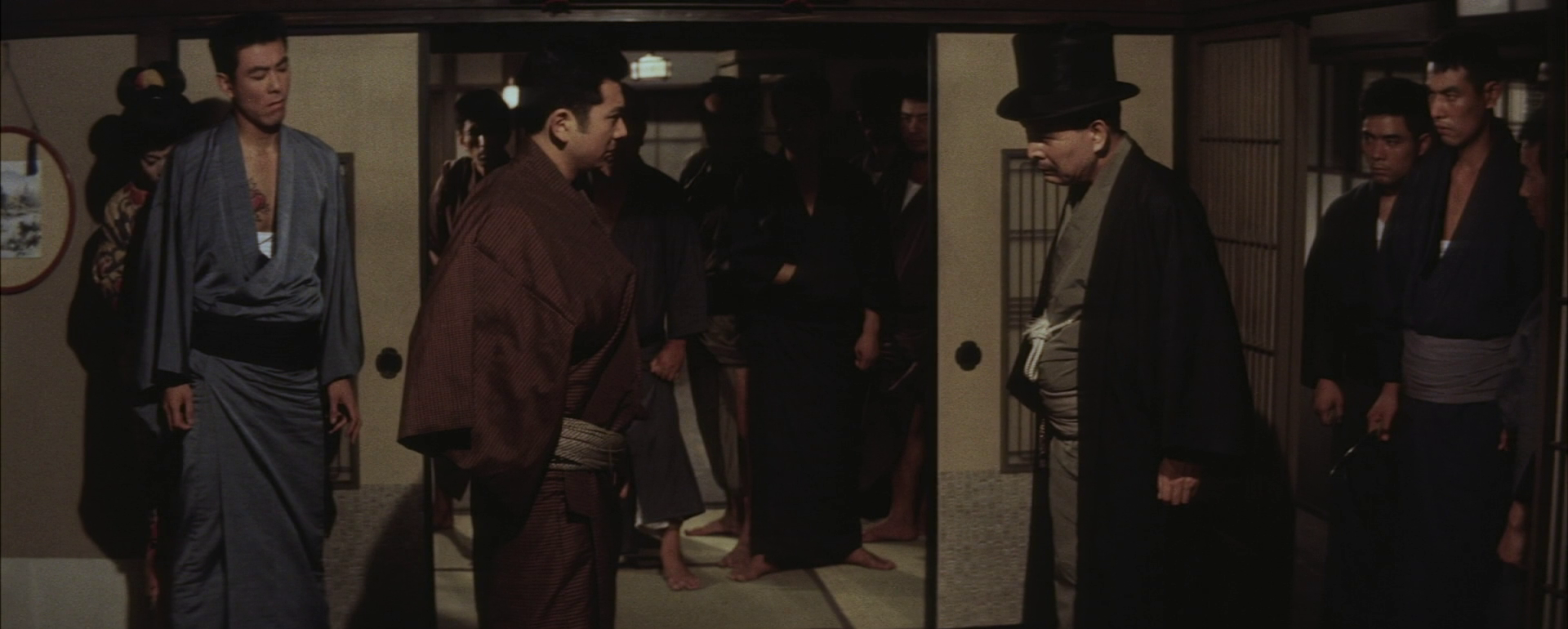
The film opens, however, with a piece of yakuza thuggery as a mysterious man guns down an industrialist before barreling down the stairs and into a waiting car occupied by getaway driver Mineo (Akira Takarada) who is inconveniently spotted by a passerby, 16-year-old ramen restaurant waitress Kana (Rumiko Sasa). As we discover, Mineo is the younger brother of veteran gangster Ryuta (Koji Tsuruta), a middle-ranking member of the newly rebranded, rapidly corporatising yakuza outfit Yokomitsu Trading who seem to specialise in legal debt collection and running the entertainment district. Torn between their desire for a degree of legitimacy and their thuggish instincts, Yokomitsu have evidently knocked off a rival using an external hitman but now have a problem on their hands especially as Mineo has apparently embarked on a career as a singer in a teen jazz bar located in the same area as Kana’s restaurant which is at the very least unwise. 

Mineo is in many ways the “innocent” seen in many other similarly themed yakuza dramas, still too young to have been corrupted by the underworld and only an accomplice in the crime for which he is being asked to pay. He wants to get out of the yakuza life and sees singing as his escape route, adopting the persona of “Eddie Mineo” and styling himself as a teen idol in the vein of the rock ’n roll American pop culture which seems to be dominiating the late ‘50s youth scene. Yet Okamoto is also clearly evoking the world of Hollywood crime cinema, the environment open and dusty while everyone seems to drive massive Cadillacs and his gangsters behave much more like those in American movies than traditional yakuza even as the traditional yakuza is also changing. 

“I can’t stand it anymore” Ryuta finally exclaims, “There’s neither righteousness nor rules among mobsters”, tipped over the edge by the gang’s plan to kill the teenage witness. He wants out too, but considers himself already too far gone while pulled in two directions in his desire to save both his brother and his young son who has a lame leg and is being cared for in a hospital. Ryuta wears his wedding ring throughout though there’s no mention of what happened to his wife, while he’s also pulled between two potential love interests in the sympathetic doctor who cares for his son, Sumiko (Yumi Shirakawa), and the brassy cabaret girl, Rie (Mitsuko Kusabue), who does her best to save him, but in the end is never very much interested in either of them. He’s constantly haunted by his crimes, knowing what happens to yakuza who fall from grace in his murder of a man who limped and walked with a crutch just like his son. 

The clan are also planning to off a former foot soldier, Ishiyama, who in fact commits suicide immediately after his release from prison realising the futility of his position. Ishiyama’s suicide note directly references that of notorious post-war gangster Rikio Ishikawa whose life inspired Kinji Fukasaku’s Graveyard of Honor 15 years later “I took too big a gamble. lt’s a big laugh. It’s been a thirty year long spree.“ Ryuta realises there’s no way out of his life of crime, but finds himself conflicted even in his desire to ensure his brother and son remain free of it. His sense of futility is however wider, witnessing the death and decline of the traditional yakuza in itself the film climaxing in a moment of yakuza apocalypse as those apparently sick and tired of violence and intimidation finally fight back making it clear that organised crime is no longer welcome in the increasingly prosperous society. 

Skewing darker in tone than Okamoto’s subsequent entries into the “ankokugai” or “underworld” series, The Big Boss is lighter on his characteristically absurdist sense of humour but does feature a little of the exaggerated, cartoonish violence otherwise his hallmark while adding a note of irony as in his use of a sign outlining the numbers for police and ambulance or the sight of a bunch of children playing with guns while a hitman has a go on the swings. There is perhaps a sense of resistance to the conventionality of the material or that his relative inexperience, this being only his third film (the first two both romantic comedy vehicles for Izumi Yukimura) prevented him from fully embracing his anarchic spirit but The Big Boss nevertheless sows the seeds of his later career in its insistence on the absurdity of violence. 


Original trailer (English subtitles)

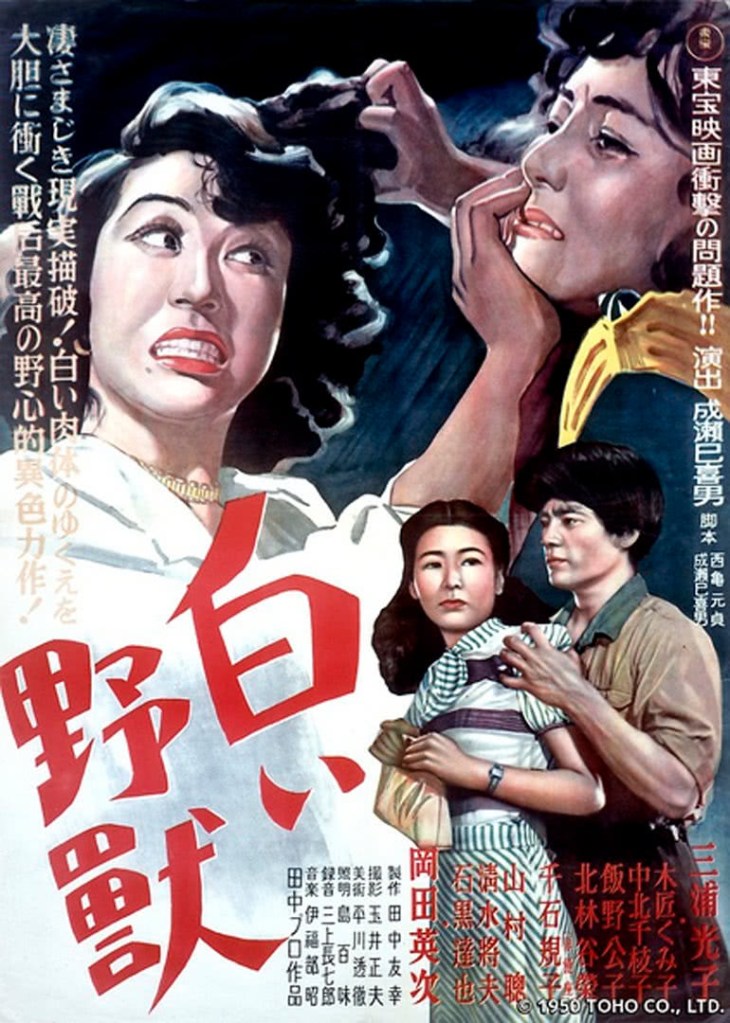
White Beast (白い野獣, Mikio Naruse, 1950)

Though motions were made towards criminalising sex work under the American occupation from as early as 1946, not that much changed until the passing of the Prostitution Prevention Law 10 years later. In the desperation of the later war years and their immediate aftermath, many women who’d lost husbands, families, and their homes, found themselves with no other way to survive than to engage in sex work, but the existence of these women who were only doing something that though not exactly well respected was fairly normalised five years previously became an acute source of embarrassment most especially given the views of the morally conservative Occupation forces. 

Slotting in right next to the pro-democracy films of the era, Mikio Naruse’s White Beast (白い野獣, Shiroi Yaju) is a surprisingly progressive effort which locates itself in a “home for wayward women”. The White Lily Residence is run with love and compassion and even if the older female warden is stern in a practical sort of way she is never unkind or uncaring, while the male governor Izumi (So Yamamura) is patient and supportive, always keen to tell the women in his care that they are not spoiled or dirty and are fully deserving of the bright new futures he is certain are waiting for them. Rather than lecturing the women, the home makes a point of teaching them new skills such seamstressing so that they will be able to find honest jobs on the outside, though the conviction that those jobs exist may be a little optimistic in itself. 

Our first introduction to the White Lily is through the eyes of Yukawa (Mitsuko Miura), an educated woman who claims she engaged in sex work simply because she enjoyed it and doesn’t see why she’s been arrested. She tries to leave and is told that she is technically free to do so, but they will have to call the police if she does. Yukawa decides to stay, especially once she locks eyes with cheerful female doctor Nakahara (Kimiko Iino). Perhaps surprisingly, the central drama revolves around an awkward love triangle between Yukawa who becomes fixated on the doctor who to be fair is unambiguously flirting back, and the bashful Izumi who has designs on Nakahara himself. 

Refreshingly direct and professional, Nakahara nevertheless has an engaging warmth that has made her a real asset to Izumi’s team as she deals with the sometimes quite difficult medical circumstances of the women at the centre, many of whom are understandably suffering with various STIs including syphilis. Never judging them she remains sympathetic and egalitarian, even joining in when Yukawa cheekily invites her to dance while some of the other women are listening to records. Appearing to understand what Yukawa is asking her, she tells her that she has remained single by choice and has no intention to marry because she’s prioritising her career. Yukawa’s confidence is, however, shaken when she hears a rumour that Nakahara and Izumi may be romantically involved. 

Yukawa looks to Nakahara to try and understand why she’s ended up at White Lily. She asks her what it means to have a “dirty” body and gets a diplomatic medical answer which nevertheless coyly places the blame on sexual repression. Nakahara admits that marital relationships can also be “dirty”, not because of infidelity but because of patriarchal inequalities – marriages in which the wife is treated as a “doll” or a “maid” for example. The answer seems to satisfy Yukawa, but Nakahara has also cut to the quick of her psychological trauma in asking her if she is not also internalising a sense of shame in secretly battling with the idea that she is somehow “dirty” because of the way she’s lived her life. 

Given her fixation with Nakahara, we might wonder what it is that Yukawa so struggles to accept about herself despite her outwardly liberated persona. Beginning to reflect on her past life, she sees the faces of the men she slept with looming over her but seems confused. Was she deflecting desire rather than embracing it, trying to prove or perhaps overwrite something? In any case, her time at the centre begins to soften her but, crucially, not towards accepting a social definition of herself as dirty but emerging with new degrees of self knowledge and acceptance. 

The one sour note in Izumi’s otherwise progressive philosophy sees him encourage one of his star pupils, Ono (Chieko Nakakita), to reunite with a man she was engaged to before the war who has just been repatriated and claims his feelings haven’t changed despite finding her at White Lily. Ono is reluctant, partly because she feels a sense of unworthiness, but also because she suspects that whatever Iwasaki (Eiji Okada) says now, he will someday hold her past against her. She’s proved right when she gets a day pass to visit him in his flat where he eventually rapes and then tries to strangle her. Ono vows not to see him again, but Izumi convinces her otherwise, as if this is all her fault, telling her that two people who love each other can work through anything, implying that it’s her job to fix his wartime trauma (if perhaps mildly implying the reverse is also true for him). For an otherwise compassionate man, telling a vulnerable woman to return to a violent partner because “love is enough” seems an oddly patriarchal gesture. 

Nevertheless, despite the late in the game swerve towards conservatism, White Beast presents a surprisingly progressive critique of an inherently misogynistic, hypocritically puritanical society. At one point, a wealthy big wig arrives to lecture the women, berating them for “bringing down Japanese womanhood” while insisting that women who justify sex work as a means of avoiding starvation are being disingenuous because most women are just “decadent” and wanting handbags etc. Yukawa, unable to control herself, fires back, asking him who it is he thinks buys their services in the first place. It’s very valid point, and one it seems few are willing to consider. 


Short clip (English subtitles)

Sandakan No. 8 (サンダカン八番娼館 望郷, Kei Kumai, 1974)

Sandakan 8 posterSome might argue that Japanese cinema has often been reluctant to examine the nation’s traumatic 20th century history with the proper rigour, but even if subtle and coming from unexpected angles there have been many and varied attempts to ask questions about the lingering consequences of feudalism. Sandakan No. 8 (サンダカン八番娼館 望郷, Sandakan Hachiban Shokan: Bokyo), inspired by a true life account of a woman unwittingly sold into sexual slavery as a child at the turn of the century, is not only a condemnation of socially approved people trafficking and its role in building the short-lived Japanese empire but a mild provocation of the contemporary society which refuses to engage with its traumatic past.

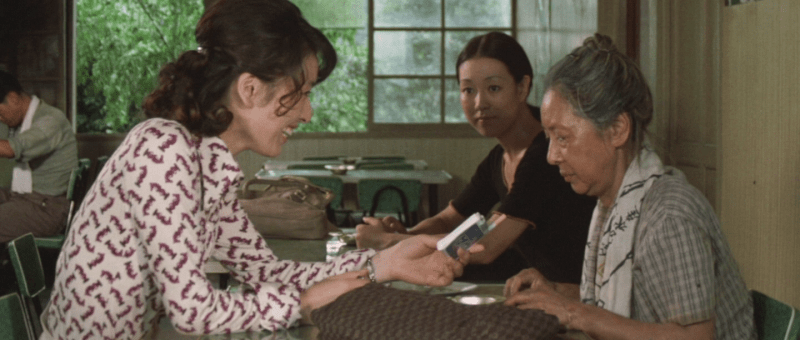
In the contemporary era, graduate student Keiko Mitani (Komaki Kurihara) is engaged in researching the “karayuki-san” – Japanese women who were sold into sexual slavery throughout Asia in the early 20th century. Almost forgotten, the karayuki-san are a taboo subject and even those still living in the areas from which women and girls were sent away are unwilling to speak of them. By chance, however, Keiko runs into an old woman in a cafe who speaks with a standard Tokyo accent and tells them that she spent most of her life “abroad”. Quickly realising she doesn’t mean she was a diplomat’s wife, Keiko wonders if the woman might be have been a karayuki-san and delays her return to Tokyo in order to find out.

There is something, it has to be said, ironically exploitative in Keiko’s determination to get the old woman, Osaki (Kinuyo Tanaka), to open up about a subject on which she so obviously does not want to be drawn. A visit to Osaki’s home reveals her to be living in a run-down hovel on the edge of town which is filled with stray cats whom Osaki feeds because “they’re all abandoned, but still they have to live”. Keiko gets herself brownie points by reacting politely to Osaki’s reduced living situation, eventually staying three weeks during which time she gradually teases out Osaki’s sad life story. Finally asking if there wasn’t anything Osaki might have liked to know about her, Keiko’s hypocrisy is fully brought home to her when Osaki admits that no one was more curious about Keiko than she was but that “people have reasons for not confiding in others” and if it’s something you need to ask about then it’s probably something that the other person may not want to share. In any case, Osaki seems to have known Keiko had an ulterior motive but does not regret sharing her story and has no worries about what Keiko might do with it as long as she makes sure to tell the truth.

The truth, in a sense, seems to be something the villagers feel themselves well acquainted with which is why Osaki lives in a shack on the edge of town. Tricked into sexual slavery as a child by an amoral people trafficker who lured her with promises of money to be made overseas, Osaki found herself in Borneo and a prisoner of “Sandakan No. 8” which was one of 10 numbered brothels on the island largely catering to Japanese travellers overseas, facilitating the expansion of the Japanese empire as accidental emissaries and ports of call. When Osaki was a child, Japan was a poor country and it was considered normal to sell one’s daughter in order to feed a family. Working overseas carried with it a kind of cache though no one, except perhaps her brother, seems to be fully aware of what Osaki is going to and she herself has not in any way chosen or consented to become a sex worker. When she eventually returns to Japan, she finds herself unwelcome in her brother’s house, which her money paid for, because of the shame associated with those who have “worked away”. Even 50 years later, she finds herself living alone, all but disowned by her only son, on the outskirts of her childhood village ostracised by the “respectable” townspeople who don’t for a second believe Osaki’s quick introduction of Keiko as her daughter-in-law.

The daughter-in-law deception is only one heartbreaking aspect of the complex relationship between the two women who are each, in a sense, hiding something from the other but end up forming a genuine connection anyway. Intensely lonely and having lived a life filled with suffering, Osaki is willing to pay for company with her story while Keiko is, not quite deliberately, using her loneliness against her in an attempt to earn her trust and get her to reveal her secrets. Nevertheless, Keiko is able to mine a rich and deep seem of 20th century trauma through the tragic story of just one woman which reaches out to hundreds like her some of whom rest in a graveyard in the forests of Borneo with their backs forever to Japan. The enemy is, once again, poverty more than it is patriarchy or even feudalism, a problem less of the essence in the rapidly improving post-war economy, but as Kumai is keen to point out, this system of state sanctioned people trafficking (finally outlawed only once Japan’s status on the world stage began to rise) had far wider implications than it might be thought which still echo into the present day and perhaps beyond if not for the efforts of women like Keiko who do not wish to forget.


Original trailer (no subtitles)

A Chain of Islands (日本列島, Kei Kumai, 1965)

nihon retto posterKei Kumai made just 19 films films in his 40 year career, but even since his earliest days he ranked among the most fearless of directors, ready to confront the most unpleasant or taboo aspects of contemporary Japan. His first film, The Long Death, interrogated wartime guilt through drawing inspiration from a real life 1948 mass poisoning case in which materials manufactured in a Manchurian lab may have led to the deaths of post-war civilians. Having begun in this possibly controversial vein, Kumai pressed on with 1965’s A Chain of Islands (日本列島, Nihon Retto, AKA The Japanese Archipelago) which he set in 1959 as Japanese youth protested the renewal of the ANPO treaty which placed Japan under the military protection of the American Armed forces in return for allowing the presence of those forces on Japanese soil.

Despite the contemporary setting Kumai opens with a explanatory voice over detailing the depth of the American military presence and the function of the CID which exists solely to investigate crimes committed by American servicemen. The CID is staffed by both Americans and Japanese nationals who, the voiceover explains, often feel conflicted in stepping onto American soil each morning as prolonged exposure gradually erodes their sense of difference and finally of “Japaneseness”. Akiyama (Jukichi Uno) is a translator/investigator at CID and he’s about to be handed an unusual request from his boss – reopen a cold case from the previous summer in which an American Sergeant was found floating in Tokyo bay. Akiyama’s new boss was a friend of the late soldier and would like to know what happened.

Akiyama’s investigations lead him down a dark path of corruption, murder, conspiracy, and governmental complicity. Beginning to investigate the case, Akiyama discovers that nothing is quite as it seems. A couple of policeman from the original investigation arrive to help him and echo their frustrations with the way the case was handled. Despite the police investigation, the American authorities did their best to interfere – commandeering the body and claiming jurisdiction in contravention of Japan’s standing as a sovereign nation. The Americans are no longer occupying forces but honoured guests who should obey international protocol in cases like these, but they rarely do. Despite the existence of the CID, crimes by American servicemen are generally covered up as the military insists the matter will be dealt with internally only for suspects to be suddenly “transferred” overseas.

Sgt. Limit was, however, one of the good ones and Akiyama’s investigation seems to point towards a murder and cover up instigated because Limit had got too close to the truth in investigating a sudden flood of counterfeit cash. The Americans, to the surprise of all, are only the middle man in the grand conspiracy which leads right back to the dark heart of Japan and the vast spy networks operated during the militarist era. As might be expected, these valuable networks are left wide open with the collapse of Japanese fascism but are perfectly primed to facilitate widespread crime spanning the Asian world and all with the tacit approval of the American and Japanese states.

Kumai also implicates the spy ring in a series of “mysterious” rail incidents, but makes sure to reserve some of his ire more the more usual injustices. Akiyama is caring for his young nephew whose father was killed in mining explosion which has claimed the lives of nearly every young man in the village leaving his sister unable to cope with her children alone. He is also battling a personal tragedy which is intensely connected to his decision to join CID which is currently inundated with cases of rape and murder in which American servicemen are implicated. The “foreign” becomes suspect but mostly for its hypocrisy as in the Catholic priest who becomes a major suspect in subverting the legitimate devotion of a Godly woman who only sought to live under the Christian teachings of love and kindness, while the American forces claim to stand for honour and justice but actively facilitate organised crime at an interstate level to further the progress of Capitalism whilst also facilitating civil unrest in volatile nations for financial and political gains.

That all of this happens immediately before the renewal of the ANPO treaty is no coincidence and Kumai even includes aerial footage of the mass protests filling the streets around the Diet building as the youth of Japan question why their nation has seen fit to make itself so complicit in the questionable foreign policy of another country. The outcome looks bleak for our protagonists who discover themselves to be mere pawns at the mercy of greater forces which cannot be circumvented or denied, but just as it all looks hopeless a new hope arises. Pledging to fight harder and continue the work which has been started, those left behind dedicate themselves to equipping the young with the tools to build a happier, fairer world in contrast to the one they seem primed to inherit from those who should know better. The final sequence shows us a young woman walking gloomily past the Diet building which seems to be looming over her as a veritable symbol of oppression but then her face brightens, her step quickens and she leaves the Diet far behind to walk forward towards the work which awaits her. 


A comprehensive overview of the 1960 ANPO protests.

A Woman in the Typhoon Area (颱風圏の女, Hideo Oba, 1948)

vlcsnap-2017-12-14-23h50m20s302Setsuko Hara acquired the nickname “the eternal virgin” from her fans inspired by the genial ingenue roles she was most associated with especially in her long career with Yasujiro Ozu in which she often played a reluctant daughter finally getting married (though only at the end of the picture). The nickname took on something of an ironic quality after her abrupt retirement from the acting world in which, rather than getting married, she remained single and locked herself away in her quaint little house in Kamakura, refusing all subsequent requests relating to showbiz. Woman in the Typhoon Area (颱風圏の女, Taifuken no Onna) is a rare entry in her filmography in which she plays completely against type (and does so brilliantly) as a damaged, brassy, and sensual woman caught up in a storm of her own as the sole female between a gang of vicious smugglers and a nerdy group of weather scientists marooned on an island by a typhoon.

As the film opens, the smugglers have been spotted by the coastguard and are engaged in a lengthy firefight trying to escape. Eventually they manage to evade government forces, but they’re way off course and running out of fuel while one of their number is also badly injured. Luckily they eventually run into an island which is home to a Japanese weather station. Unfortunately, the weather station has received a telegram from the coastguard and works out who the smugglers are. There isn’t enough fuel or food for the smugglers to steal and escape, but even if there were the approaching typhoon means it would be unwise to try.

The set-up is uncannily close to that of John Huston’s Key Largo, released the same year, though the tiny band of smugglers is nowhere near as intimidating as Edward G. Robinson’s band of thugs, nor are they particularly emblematic of a persistent lingering threat of fascism in the rise of bullies making their way through fear. What the smugglers are is mildly pathetic and intensely self interested. The weather station staff, government officials, are the good guys but they’re also easily cowed by three men (and a sympathetic/indifferent woman) with a single gun. The major conflict is over control of the radio which the smugglers have temporarily broken in fear of someone calling the coastguard. The weathermen want to repair it because it’s imperative they let the surrounding area know that a dangerous typhoon is on the way.

Like many films of the immediate post-war era, the central theme is one of the common good vs selfish interest. The radio operator, Amano (Jun Usami), is determined to act for “the common good” and is confident that he is the sort of person who will do the “right” thing at the right time. The smugglers don’t particularly care if a lot of people end up dying because they weren’t warned about the storm as long as they don’t get caught by the coast guard. For Kijima (So Yamamura), the boss of the smugglers, all that matters is strength – a strong man will never kneel but Amano would kneel if it meant he could get up later and do the right the thing even if it then costs him his life.

Where gangster narratives are often about surrogate families, the band of smugglers actively rejects familial bonds and only maintains cohesion through shared suspicion. Kuriko (Setsuko Hara) is Kijima’s girl, but Kataoka (Isao Yamaguchi) continually goes behind his boss’ back to seduce her finally even attempting rape. Though second mate Yoshii (Eijiro Tono) may seem more loyal, he too holds little love for his boss and will betray him if he thinks Kijima no longer strong enough to rule. Trapped within the claustrophobic environment of the weather station, the gang destroys itself in petty rivalries and long standing suspicions. Kijima was right when he said you couldn’t trust anyone on a ship, but he can’t trust his guys on land either.

The war is an obvious and recurrent theme but Kuriko’s troubles were only exacerbated rather than caused by it. An abandoned child, she recounts eating cold rice with strangers at 11 and it doesn’t take a lot of imagination to figure out what she means when she says she remembers the name of her first man but not his face. Kuriko is a good girl turned bad by persistent social indifference and subsequent trauma experienced as a nurse in frontline field hospitals. She’s distant and embittered, living as a man on ship, dressing in slacks and shirts and chain smoking her life away. Trapped in the station and exposed to the “goodness” of Amano she starts dressing in more feminine fashions and reconsidering her gangster lifestyle. Though she starts to change, helps the weather station to save the locals, it’s clear that it’s already too late for her to save herself other than through a final act of sacrifice in service of a new ideal and an old love.

Only 70 minutes long Woman in the Typhoon Area is a taught, tense character piece which doesn’t quite manage to make the most of its intensely claustrophobic settings but still manages to reinforce its central message of selfishness being bad and altruism good. Hara is a revelation in such an unusual role, stealing each and every scene in steely uncertainty, giving the impression of a woman whose ongoing fall is as much a willing act of self harm as it is a natural consequence of her impossible circumstances.