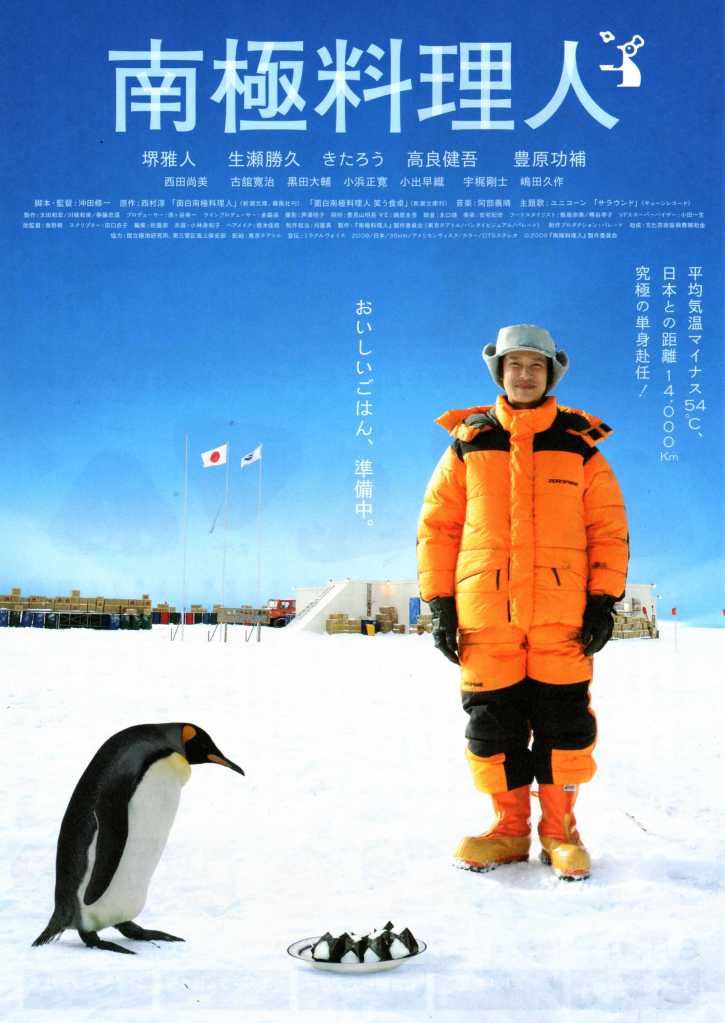
The Chef of South Polar (南極料理人, Shuichi Okita, 2009)

If there’s one thing which unites the universes present in the films of Shuichi Okita, aside from their warm and humorous atmosphere, it’s their tendency to take a generally genial, calm and laid-back protagonist and throw them into an inhospitable environment which they don’t quite understand. When it comes to “inhospitable”, the hero of The Chef of South Polar (南極料理人, Nankyoku Ryourinin) couldn’t have it much worse, unfairly transferred to a polar research station where the air temperature is so cold nothing, not even bacteria, can survive outside. Still, like all of Okita’s laid-back guys, he handles his difficult circumstances with a kind of stoical resignation until, of course, the situation can be handled no more.

Separated from his wife and children, Jun Nishimura (Masato Sakai) previously worked for the Japanese coastguard but has now been transferred (not altogether of his own volition) to a polar research station where he is responsible for all the culinary needs of the seven men who will be working together during the expedition which is intended to last one year. Each of the other men has his own part to play in the scientific endeavours but cooped up as they are, the greater issue is downtime as the guys revert to a kind of high school camp mentality, divided into various groups and activities from the “Chinese Research Club” to a bar being run by the doctor who is also training for a triathlon. 365 days in the freezing cold does eventually begin to take its toll but all of the crazy only serves to remind people how important it is that they all get on and make it through this together.

Based on the autobiographical writings of the real Jun Nishimura, Okita’s isolation experiment has a pleasantly authentic feeling as the titular chef laments the difficulties of the conditions but continues to churn out beautifully presented culinary treats despite the hostile environment. Resources are also strictly limited as the original provisions are intended to last the entire expedition, hence why most of the foodstuffs are canned, vacuum packed or frozen but there are a few luxuries on offer including some prize shrimp apparently left behind, uneaten, by a previous team which proves an additional occasion for celebration just as despair is beginning to set it in. Seeing as the men are all here for more than a year, celebratory occasions do present themselves with regularity from birthdays to “mid winter holiday” and even a good go at the Japanese festival of Setsubun with peanuts instead of beans.

Despite these brief moments of respite, being completely cut off from the outside world for such a long time with little natural light and hardly anything to do outside of research places its own kind of pressure on the minds of these top scientists. As their hair gets shaggier and their beards progressively less kempt, sanity also begins to slip. Each of the guys has their own particular marker, something they’re missing that’s playing on their minds until they eventually break completely. For some this could be realising they’ve eaten all of the ramen which exists in their tiny world and now have nothing left to live for, missing their kids, or realising that their girlfriend might have met someone else while they’ve been busy devoting themselves to science, but this being an Okita film even if an axe is raised it rarely falls where intended and the only cure for mass hysteria is guilt ridden kindness and a willingness to work together to put everything right again.

Of course, the other thing the guys have to put up with is the attitude of the outside world as everyone is very keen to ask them about the cute penguins and seals which they are sure must be everywhere at the South Pole, only to have to explain that it’s just too cold for cuteness though it does lead them to the epiphany that they are the only living creatures in this desolate place and so share a special kind of kinship. Filled with Okita’s usual brand of off the wall humour and gentle humanity, The Chef of South Polar is another warm and friendly tale of nice people triumphing over adversity through cooperation, mutual understanding and sustained belief in the healing power of ramen.


Original trailer (no subtitles)
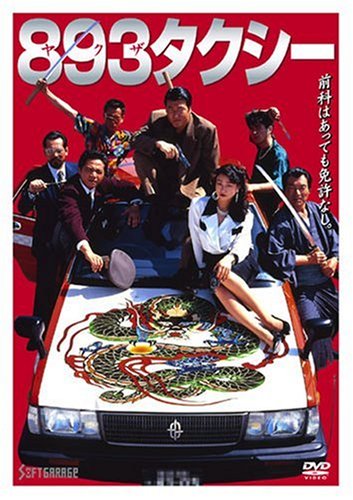
Yakuza Taxi (893 タクシー , Kiyoshi Kurosawa, 1994)

Like many fillmakers of his generation, Kiyoshi Kurosawa began directing commercially in the 1980s working in the pink genre but it was the early ‘90s straight to video boom which provided a career breakthrough. This relatively short lived movement was built on speed where the reliability of the familiar could be harnessed to produce and market low budget genre films with a necessarily high turnover. Kurosawa made his first foray into the V-cinema world in 1994 with the unlikely comedy vehicle Yakuza Taxi (893 タクシー, 893 Taxi). Although Kurosawa had originally accepted the project in the hope of being able to direct a large scale action film, his distaste for the company’s insistence on “jingi” (the yakuza code of honour and humanity) proved something of a barrier but it did, at least, lend free rein to the director’s rather ironic sense of humour.
The Tanaka taxi firm has hit on some hard times and is in trouble over a series of promissory notes owned by a former yakuza loanshark. Luckily, Tanaka is lifelong friends with a local yakuza boss who is angry about the dishonourable way his friend has been treated and is determined to help him. He also sees this as a rare opportunity to prove the yakuza can still be of help in an “honest” way and therefore instructs three of his guys to get some fake driving/taxi licenses and set about making enough money to fend off the loansharks. The guys are soon joined by the recently released Seiji who wasn’t really planning on a secondary career as a taxi driver after sacrificing precious time in service of his clan and is not happy with his current career track.

The set-up is, of course, primed for comedy as the yakuza, who are known for being rough, rowdy and rude, suddenly have to adapt to a job which requires absolute politeness and courtesy. The original trio do their best learning from the company’s only remaining professional driver, Kimura, and come to view radio girl and boss’ daughter Kanako as a kind of big sister figure. Once Seiji arrives things begin to become more complicated as he maintains a number of yakuza habits incompatible with taxi driving – namely all day drinking, hostess bars, and beating up the passengers.

Seiji and Kanako spit fire at each other in place of courtship though Kanako’s often surly attitude is later revealed as.partly driven by resentment at being forced to labour in a boring job at her father’s company. The guys are supposed to be earning the money back legally but Seiji has always been one for a short cut. His ill gotten gains are ultimately rejected by Kanako, but not before they’ve caused a lot more trouble. The situation becomes even more challenging when a corrupt policeman teams up with the loansharks to harass the guys, even going to far as to make them drive to remote places where they can be beaten up by motorcycle thugs. Finally the game appears to be up when Kanako attempts to renegotiate and is offered “alternative employment” with the threat of enslavement hanging over her head.

Despite the comedic tone, sleaze is never far from the screen with two quite odd and extremely gratuitous sequences of strange boob fondling, not to mention one set of passengers who are delighted that they’re “alone now” and decide to make the most of it with some distinctly kinky action (Seiji makes a point of giving the male customer a few lessons in taxi etiquette before they reach their destination). Comedy is the main draw, there are no gun battles and relatively few actual fights aside from failed jump kicks and the distant thud of crowbars. Remaining more or less straightforward in terms of style, Kurosawa nevertheless embraces his taste for the absurd as this gang of low level bad guys come together to help a friend and discover an unexpected affinity for the service industry in the process.


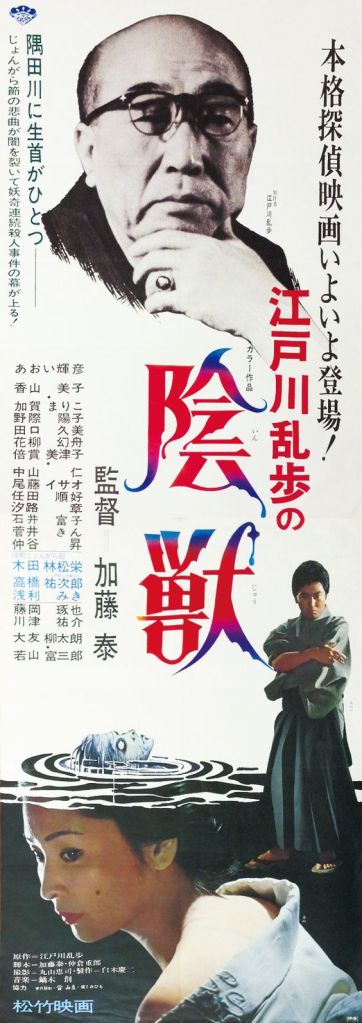
Edogawa Rampo’s Beast in the Shadows ( 江戸川乱歩の陰獣, Tai Kato, 1977)

Edogawa Rampo (a clever allusion to master of the gothic and detective story pioneer Edgar Allan Poe) has provided ample inspiration for many Japanese films from Blind Beast to Horrors of Malformed Men. So synonymous with kinky terror is his name, that it finds itself appended into the title of this 1977 adaptation of his novel Beast in the Shadows (江戸川乱歩の陰獣, Edogawa Rampo no Inju) by veteran director Tai Kato best known for his work in the yakuza genre. Mixing classic European detective intrigue with a more typically Japanese obsession with method over motive, Beast in the Shadows, like much of Edogawa Rampo’s work twists and turns around the idea of atypical sexuality, one side cerebral and another physical as the “Westernised” sadomasochism of the heroine’s husband becomes the driving force of the narrative.
Our hero, Koichiro Samukawa (Teruhiko Aoi), is a best selling author who likes to describe himself as the creator of “serious” mystery novels. In this he contrasts himself favourably with the coming younger generation who rely on sensationalised tricks and twists rather than the intricately plotted, traditionally constructed crime stories which Samukawa prides himself on writing. The particular object of his rage is a recently successful rival, Shundei Oe, who is making quite a splash in literary circles in part due to his mysterious persona. Refusing all in-person contact, Oe’s whereabouts are completely unknown and though he supplies a “real name” at the back of each book, there is great speculation as to who he really is, how he lives, and where he might be.

Down south to supervise a movie shoot based on one of his novels, Samukawa is thrilled to run into a fan – particularly as she’s such a beautiful young woman. Shizuko (Yoshiko Kayama) is the wife of a wealthy businessman, Oyamada, who has recently returned from an extended spell abroad though he doesn’t share her passion for literature even if he brings home such luxuries as fancy European gloves. The relationship moves beyond mutual appreciation when Shizuko asks for Samukawa’s help in investigating a series of threatening letters she’s been receiving from an old boyfriend who may or may not also be stalking her. The real kicker is that the letters purport to be from Shundei Oe – apparently the pen name being used by a man who fell deeply in love with Shizuko when he was a student but couldn’t take no for an answer when his creepy behaviour became too much for the then school girl. Though Samukawa is sure the letters are all talk and commits himself unmasking Oe for the perverted cretin he is, Shizuko’s husband is eventually murdered just as the letters threatened.

Though the final twist is one which most seasoned mystery lovers will have seen coming, Kato keeps the audience on its toes with plenty of intrigue and red herrings as Samukawa attempts to discover the truth behind the death of Shizuko’s husband as well as taking the opportunity to indulge in a little intellectual vanity by unmasking his rival. The movie subplot quickly gets forgotten but Samukawa is also helped/hindered by his publisher, Honda (Tomisaburo Wakayama), who keeps reminding him about the looming deadline for his latest work. The case at hand provides ample distraction for the harried writer whose writer’s block is only made worse by thoughts of Shundei Oe’s growing success and his resentment of this new, sensationalised form of crime novel which seems to be eclipsing his own.

If the way he acts in “real life” is anything to go by, Samukawa’s detective novels owe much to the European tradition but still, there’s a persistent fear of the foreign underlining much of the proceedings despite the heavy presence of Westernised clothing, music and culture which seems to diffuse itself throughout daily life. Shizuko’s husband may have just returned from abroad but it seems he brought back much more with him than some fancy gloves and an elegant English mistress (pointedly named Helen Christie). The English style riding crop in Oyamada’s study is not mere affectation but the cause of the nasty looking wound on Shizuko’s shoulder which first caught Samukawa’s attention. Oyamada’s sadistic tendencies are posited as a credible reason he could himself be masquerading as Oe, getting off on driving his wife half crazy with fear, but his eventual murder would seem to rule that out.

Nevertheless the game is one of pleasure and pain as Samukawa comes to the realisation that he is integral to the plot. Challenged by his literary rival to a game of minds, Samukawa is putting his detective abilities to the test as his rival is writing their latest story in reality rather than on the page. Love, lust, betrayal, violence and tragedy all come together for a classic gothic detective story which looks ahead to noir with its melancholy fatalism yet remains resolutely within the dark and ghoulish world of the gothic potboiler. Kato shoots a prestige picture with the undercurrent of repressed eroticism in his strange low level angles and unusual compositions which bind, tie and constrain the elusive Shizuko within the window panes and doorways of her home. Light levels fluctuate wildly, isolating the haunted protagonists in their supernatural gloom until we hit the expressionism of the theatrical finale which takes place in an entirely red, almost glowing attic space. The atmosphere is one of profound unease as Oe is thought to be perpetually watching, hidden somewhere in the house, out of sight.

The Beast in the Shadows does not just refer to the unseen voyeur but to the repressed eroticism which his actions symbolise and is perhaps brought out in the various sadomasochistic relationships created between each of the protagonists. Then again, where are we in all this – sitting in the dark, watching, undetected, seeing things we had no right to see. Kato takes our own voyeuristic tendencies and serves them back to us with visual flair in a late career masterpiece which perfectly captures Edogawa Rampo’s gothic world of repressed desire and brings it to its cinematic climax as two detectives go head to head in a game so high stakes neither of them quite realised what it was they were playing.


Original trailer (no subtitles, NSFW)

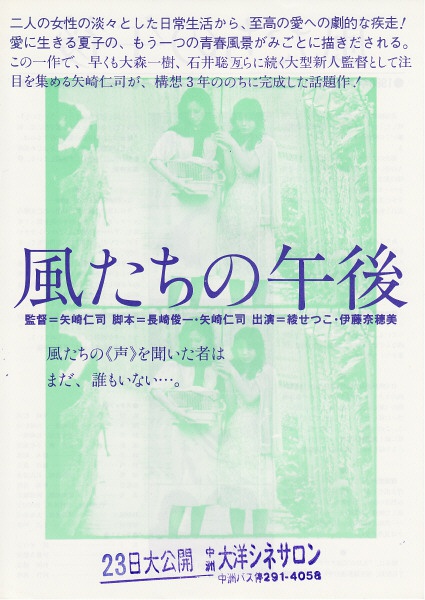
Afternoon Breezes (風たちの午後, Hitoshi Yazaki, 1980)

Even in the Japan of 1980, many kinds of love are impossible. Afternoon Breezes (風たちの午後, Kazetachi no gogo), the indie debut from Hitoshi Yazaki follows just one of them as a repressed gay nursery nurse falls hopelessly in love with her straight roommate. Based on a salacious newspaper report of the time, Afternoon Breezes is a textbook examination of obsessive unrequited love as its heroine is drawn ever deeper into a spiral of inescapable despair and incurable loneliness.

Nursery nurse Natsuko (Setsuko Aya) is in love with her hairdresser roommate Mitsu (Naomi Ito), who seems to be completely oblivious of her friend’s feelings. Mitsu has a boyfriend, Hideo (Hiroshi Sugita), and the relationship is becoming serious enough to have Natsuko worried. Hideo, unlike Mitsu, is pretty sure Natsuko is a lesbian and in love with his girlfriend but finds the situation amusing more than anything else. Beginning to go out of her mind with frustration, Natsuko tries just about everything she can to break Mitsu and Hideo up including introducing him to another pretty girl from the nursery, Etsuko (Mari Atake). Hideo is not exactly a great guy and shows interest in Etsuko though does not seem as intent on leaving Mitsu as Natsuko had hoped. Desperate times call for desperate measures and so Natsuko steels herself against her revulsion of men and seduces Hideo on the condition that he end things with her beloved Mitsu. He does, but the plan goes awry when Natsuko realises she is pregnant with Hideo’s child.

Less about lesbianism and more about love which can never be returned slowly eroding a mind, Afternoon Breezes perfectly captures the hopeless fate of its heroine as she idly dreams a future for herself which she knows she will never have. Natsuko buys expensive gifts for her roommate, returns home with flowers and courts her in all of the various ways a shy lover reveals themselves but if Mitsu ever recognises these overtures for what they are she never acknowledges them. Her boyfriend, Hideo, seems more worldly wise and makes a point of cracking jokes about Natsuko, asking Mitsu directly if her friend has a crush on her but Mitsu always laughs the questioning off. Mitsu may know on some level that Natsuko is in love with her, she seems to be aware of her distaste for men even if she tries to take her out to pick one up, but if she does it’s a truth she does not want to own and when it is finally impossible to ignore she will have nothing to do with it.

Despite Mitsu’s ongoing refusal to confront the situation, Natsuko basks in idealised visions of domesticity as she and Mitsu enjoy a romantic walk in the rain only to have their reverie interrupted by a passing pram containing a newborn baby. What Natsuko wants is a conventional family life with Mitsu, including children. After their walk, the pair adopt a pet mouse which Natsuko comes to think of as their “baby” but like a grim harbinger of her unrealisable dream, the mouse dies leading Mitsu to bundle it into a envelope and leave it on a rubbish heap along with Natsuko’s heart and dreams for the future.

When her colleagues at the nursery get stuck into the girl talk and ask Natsuko about boyfriends, her response is that she would not “degrade” herself yet that is exactly what she finally resorts to in an increasingly desperate effort to get close to Mitsu. After her attempts to get him to fall for another girl fail, Natsuko’s last sacrificial offering is her own body, surrendered on the altar of love as she pleads with the heartless Hideo to leave Mitsu for good. Though her bodily submission is painful to watch in her obvious discomfort her mental degradation has been steadily progressing as Hideo deliberately places himself between the two women, even going so far as to disrupt a seaside holiday planned for two by inviting himself along.

Yazaki perfectly captures Natsuko’s ever fracturing mental state through the inescapable presence of the dripping tap in the girls’ apartment which becomes a dangerous ticking in Natsuko’s time bomb mind. Occasionally gelling with clocks and doors and other oppressive noises, the internal banging inside Natsuko’s head only intensifies as she’s forced to endure the literal banging of Mitsu and Hideo’s lovemaking during her romantic getaway. Just as an earlier scene found Natsuko sitting on the swing outside embracing the flowers she’d brought for Mitsu only to find Hideo already there, Natsuko’s fate is to be perpetually left out in the cold, eventually resorting to rifling through her true love’s rubbish and biting into a half eaten apple in a desperate attempt at contact.

Natsuko’s love is an impossible one, not only because Mitsu is unable to return it, but because it is essentially unembraceable. In a society where her love is a taboo, Natsuko is not able to voice her desires clearly or live in an ordinary, straightforward way but is forced to act with clandestine subtlety. After Hideo unwittingly deflowers her and laughs about it, stating that she “must really be gay” Natsuko lunges at him with a knife, suddenly overburdened with one degradation too many. Though the prospect of the baby may raise the possibility of a happy family, albeit an unconventional one, the signs point more towards funerals than christenings, so devoid of hope does Natsuko’s world seem to be. Shot in a crisp 16mm black and white, Afternoon Breezes owes an obvious debt to the art films of twenty years before with its long takes, static camera giving way to handheld, and flower-filled conclusion, but adds an additional layer of youthful anxiety as its heroines find themselves moving into a more prosperous, socially liberal age only to discover some dreams are still off limits.


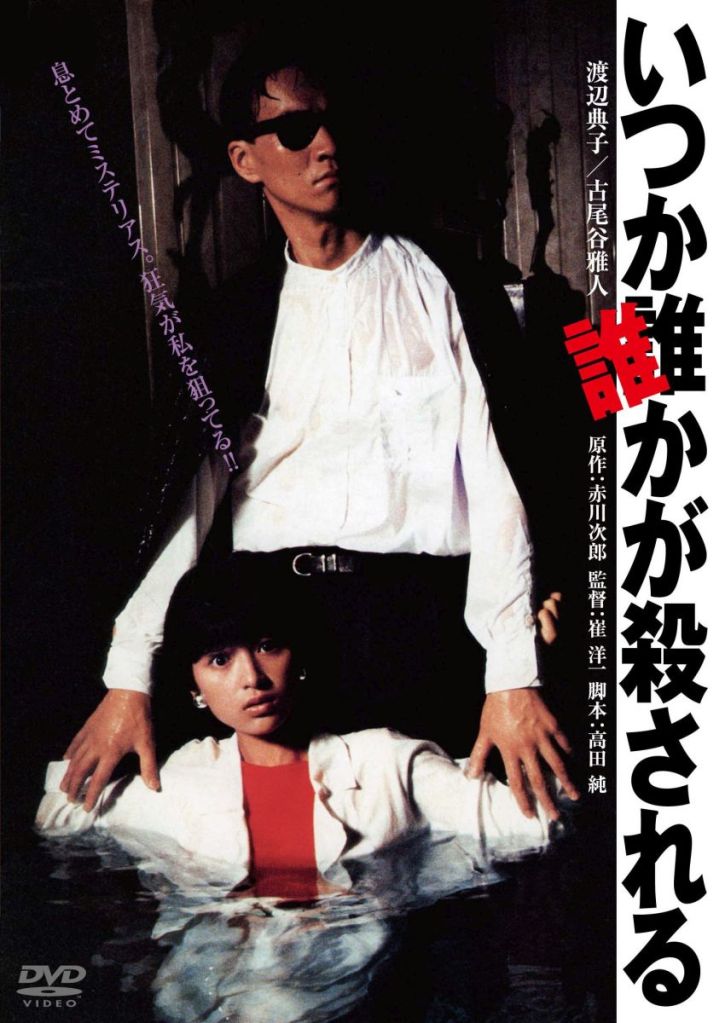
Someday, Someone Will Be Killed (いつか誰かが殺される, Yoichi Sai, 1984)

Haruki Kadokawa dominated much of mainstream 1980s cinema with his all encompassing media empire perpetuated by a constant cycle of movies, books, and songs all used to sell the other. 1984’s Someday, Someone Will be Killed (いつか誰かが殺される, Itsuka Dareka ga Korosareru) is another in this familiar pattern adapting the Kadokawa teen novel by Jiro Akagawa and starring lesser idol Noriko Watanabe in one of her rare leading performances in which she also sings the similarly titled theme song. The third film from Korean/Japanese director Yoichi Sai, Someday, Someone Will be Killed is an impressive mix of everything which makes the world Kadokawa idol movies so enticing as the heroine finds herself unexpectedly at the centre of an ongoing international conspiracy protected only by a selection of underground drop outs but faces her adversity with typical perkiness and determination safe in the knowledge that nothing really all that bad is going to happen.

The film opens with a strange, often forgotten subplot as an eccentric elderly lady, apparently loathed by her children who are taking bets on when she will die, celebrates her birthday by announcing a new game – taking the first syllables of her children’s names she comes up with that of our heroine – Atsuko Moriya (Noriko Watanabe), whom she intends to invite to her party. Approaching the end of high school, Atsuko is an ordinary girl of the time which is to say her interests are studying, shopping, and boys. Her father is a reporter for a newspaper who is often away but has returned to take her on a rare shopping trip. Revealing that he was actually born abroad, her father slips a floppy disc into her handbag and disappears after going to make a phonecall while Atsuko is occupied in the fitting room. Striking up a friendship with the store assistant, Cola (Masato Furuoya), Atsuko is taken in by a collection of fake fashion peddling drop outs from society while she tries to work out what’s going on with her dad and what she’s supposed to do with the much sought after floppy disk.

Like many a Kadokawa heroine, Atsuko is quickly plunged into a dark and complicated world she is ill equipped to understand but in keeping with the nature of the genre the atmosphere is largely dictated by her typically teenage outlook. Despite the increasingly high stakes, the film remains bright and cheerful as Atsuko continues in her quest without fear or danger. Her main allies are a computer nerd (Toshinori Omi) who has such a crush on her he’s created his own 8-bit Atsuko operating system complete with palm reader door lock for his base of operations, and the guys from the fashion store who, it transpires, are a gang of counterfeiting squatters. A thoroughly middle class girl, Atsuko reacts negatively to her new found friends and their unusual domestic arrangements but quickly warms to them as they show her nothing but kindness and acceptance, even risking their own existence in an attempt to help her uncover the circumstances surrounding her father’s disappearance.

Fathers become something of a running theme as Atsuko’s solid relationship with hers is contrasted both with Cola’s disconnection from his family and his new found role as a kind of surrogate father for a little girl at the commune. Later the same theme resurfaces as Atsuko uncovers the truth behind her father’s birth which explains the dreams she often has of a bright red sun setting over a wide river. These circumstances are echoed in the strange atmosphere of the mansion at which the film begins as its eccentric, regency dressing older lady engages with her seemingly resentful children in a cold and severe manner. An insert song playing as Atsuko and Cola take a drive wonders what the point of family is, but Atsuko’s concern is less than with the nature of familial bonds than with her own identity as filtered through that of her father and her discoveries of his apparently mysterious birth and career. Thus her final decision becomes one which sets her on a course of growing up in a quest for self knowledge and the creation of an identity which is both of her own making and takes into account her new found family history.

Making room for a musical sequence in which Atsuko picks up a guitar and embarks on a rendition of Summertime as well a few insert songs alongside the title track, Someday, Someone Will be Killed is pure Kadokawa idol movie but Sai makes sure to up the stakes with some genuinely exciting action sequences and mounting tension as Atsuko finds herself in way over her head. Of course there are a few comic moments too including the unfortunate detective charged with locating Atsuko to give her the invitation to the old lady’s ball who often finds himself beaten up by mistake by one side or the other. Very much of its time with its cold war paranoia coupled with up to the minute technology, Someday, Someone Will be Killed is among the darker of the idol dramas Kadokawa had to offer but nevertheless remains rosy and innocent in terms of outlook right up until Atsuko takes off on her motorbike in search of the woman she’ll eventually become.


Title track sung by Noriko Watanabe Itsuka Dareka ga…

Swing Girls (スウィングガールズ, Shinobu Yaguchi, 2004)

There are two kinds of people in the world, those who swing and those who…don’t – a metaphor which works just as well for baseball and, by implication, facing life’s challenges as it does for music. Shinobu Yaguchi returns after 2001’s Waterboys with a film that’s…almost exactly the same only with girls instead of boys and concert halls instead of swimming pools, but it’s all so warm and charming that it hardly matters. Taking the classic sports movie formula of eager underdogs triumphing against the odds but giving it a teen comedy drama spin, Yaguchi’s Swing Girls (スウィングガールズ) is a fitting addition to the small but much loved high school girls vs music genre which manages to bring warmth and humour to its admittedly familiar narrative.
It’s summer and it’s hot and sunny but the school is filled with yankis and dreamers, forced to spend this lovely day indoors. While one group is busy ignoring their maths teacher, the school band is getting ready to accompany the baseball team on an important match. Unfortunately, the bus leaves before the bento boxes they’ve ordered are delivered so enterprising high school girl Tomoko (Juri Ueno) suggests they blow off the maths class and show solidarity with those representing the school by making sure their fellow students are well fed. Unfortunately, they fall asleep and miss their stop on the train meaning by the time they get there it’s a very late lunch and these bento boxes containing fish and eggs etc have all been in the hot sun for a fair few hours. After nearly killing all their friends, the girls are forced to join the band in their stead, despite having almost no musical experience between them.

As might be expected, the girls start to get into their new activity even if they originally dismiss sole boy Takuo’s (Yuta Hiraoka) interest in big band jazz as the uncool hobby of pretentious old men. However, this is where Yaguchi throws in his first spanner to the works as the original band recover far sooner than expected leaving our girls oddly heartbroken. This allows us to go off on a tangent as the girls decide they want to carry on with their musical endeavours and form their own band but lack the necessary funds to do so. Being a madcap gang of wilful, if strange, people the schemes they come up with do not go well for them including their stint as supermarket assistants which they get fired from after nearly setting the place on fire, and a mushroom picking trip which leads to an encounter with a wild boar but eventually holds its own rewards.

The girls’ embittered maths teacher, Ozawa (Naoto Takenaka), who just happens to be a jazz aficionado offers some key advice in that it’s not so much hitting the notes that matters as getting into the swing of things. It might take a while for the Swing Girls (and a boy) to master their instruments, but the important thing is learning to find their common rhythm and ride the waves of communal connection. Tomoko quickly takes centre stage with her largely self centred tricks which involve pinching her little sister’s games system to pawn to buy a saxophone, and almost messing up the all important finale through absentmindedness and cowardice. Other characters have a tendency to fade into the background with only single characteristics such as “worried about her weight”, or “hopelessly awkward”, or even with “folk duo in love with punk rockers”. Other than the one girl lusting after the baseball star and the two punk rockers annoyed by their earnest suitors, Yaguchi avoids the usual high school plot devices of romantic drama, fallings out, and misunderstandings whilst cleverly making use of our expectation for them to provide additional comedy.

What Swing Girls lacks in originality it makes up for with warmth and good humour as the band bond through their recently acquired love of music, coming together to create a unified sound in perfect harmony. Ending somewhat abruptly as the gang win over their fellow musicians after having overcome several obstacles to be allowed to play, the finale does not prove quite as satisfying as might be hoped but is certainly impressive especially considering the music really is being provided by the cast who have each learned to play their intstruments throughout the course of the film just as their characters have been doing. Warm, funny and never less than entertaining, Swing Girls lacks the necessary depth for a truly moving experience but does provide enough lighthearted fun to linger in the memory.


Original trailer (English subtitles)

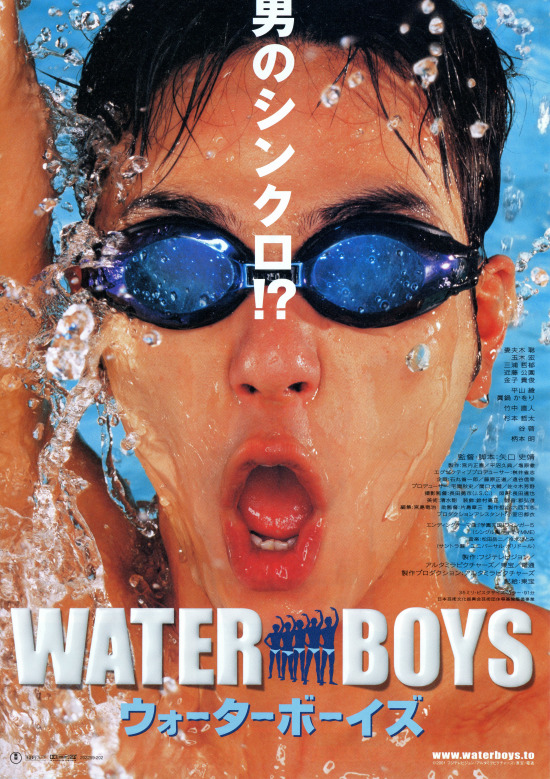
Waterboys (ウォーターボーイズ, Shinobu Yaguchi, 2001)

Japan has really taken the underdog triumphs genre of sports comedy to its heart but there can be few better examples than Shinobu Yaguchi’s 2001 teenage boys x synchronised swimming drama Waterboys (ウォーターボーイズ). Where the conventional sports movie may rely on the idea of individual triumph(s), Waterboys, like many similarly themed Japanese movies, has group unity at its core as our group of disparate and previously downtrodden high school boys must find their common rhythm in order to truly be themselves. Setting high school antics to one side and attempting to subvert the normal formula as much as possible, Yaguchi presents a celebration of acceptance and assimilation as difference is never elided but allowed to add to a growing harmony as the boys discover all new sides of themselves in their quest for water borne success.
Dreamy high school boy Suzuki (Satoshi Tsumabuki) is currently the only member of his high school’s swimming team, and unfortunately he’s not a particularly good swimmer. His interest is piqued when he spots a synchronised swim meet, but he forgets all about it until a new teacher arrives and pledges to revive the school’s fortunes in the pool. Seeing as their new teacher is a pretty young woman with an interest in swimming, the team suddenly becomes much more popular but when she reveals her synchronised swimmer past numbers dwindle once again. Unfortunately, the hot new teacher suddenly has to leave the school so the boys are left to fend for themselves in their new and possibly embarrassing career in a generally feminine sport.

Being teenage boys who only started this whole thing because of the pretty teacher, most of the other guys are are looking for a way out but they also don’t like to be called quitters and so they become determined to make a success of themselves. Suzuki, who secretly wanted to become a synchronised swimmer anyway, is the most committed but also, perhaps, the least confident in his choice of sport as he embarks on a tentative romance with a girl from another school – herself an enthusiast of the more masculine karate. Terrified that she will find out and laugh at him, Suzuki goes to great lengths to avoid telling her what it he really does in his club activities, possibly putting the growing romance at risk in the process.

This mild challenge to masculinity is the main joke of the film but Yaguchi neatly subverts as the guys become cool again thanks to mastering a difficult skill and creating an impressive spectacle through hard work and group mentality. The boys gain an unlikely mentor in the form of a dolphin trainer at Sea World who they hope will be able to train them in the same way he trains his marine creatures but quickly sets them off on some Karate Kid style practical training which involves a lot of menial tasks around the park before dumping them at the local arcade to play dance dance revolution until they learn the art of synchronicity through the power of idol pop. Waterboys is, essentially, a hymn to the harmonious society as the boys eventually find their common rhythm and the power that comes from many acting as one.

Unusually, this does not requite a loss of individuality or for any erasure of essential personality traits but rather a greater need for acceptance as difference merely adds to the strength of the whole. Though there are a fair few gay jokes in what is essentially a movie about high school boys in skimpy trunks, the joke is not homosexuality but reactions to it as Yaguchi adopts a “get over it” attitude and so when one of the boys does confess his love for another it’s treated with no particular reaction other than lack of surprise. Similarly the cross dressing mama-san from the local gay club (a surprising turn from Akira Emoto) becomes one of their greatest supporters and may provide comic relief but is never a figure of fun. In order to succeed the boys will need to be in tune with each other, but that in tune sounds better when it allows for harmony rather than insisting on dull monotony.

Visually inventive and often hilarious, Waterboys lacks the heart of Yaguchi’s similarly plotted Swing Girls but nevertheless succeeds in its tale of inexperienced young guys working hard and achieving the impossible, growing up and discovering new things about themselves as they do. Waterboys may be lighthearted, crowd pleasing fun, but its good natured message that great things are possible when determined people work hard at them together, and that group harmony does not necessarily require social conformity, only add to its warm and gentle tone.


Korean trailer (Korean captions/subtitles only)

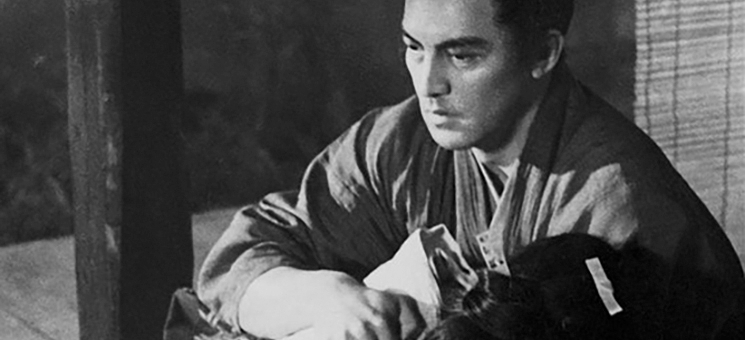
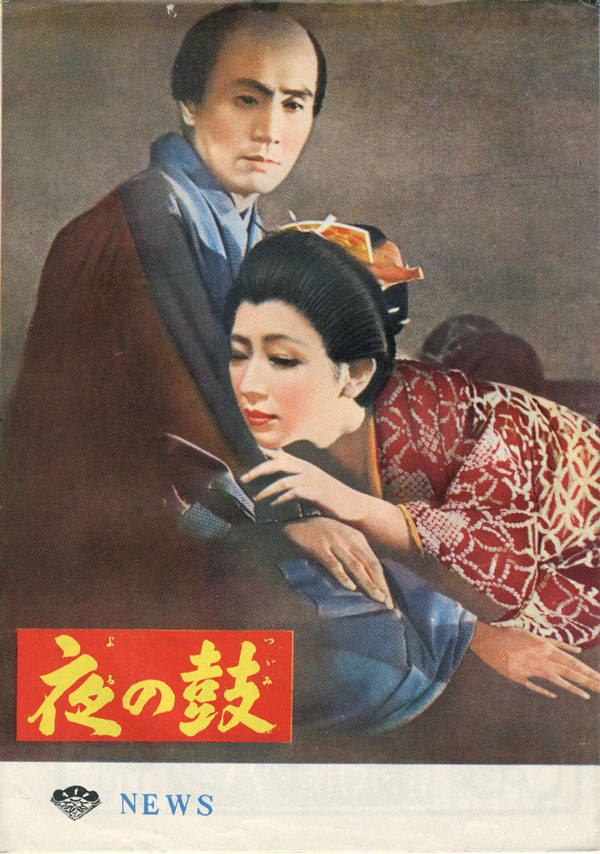
Night Drum (夜の鼓, Tadashi Imai, 1958)

night-drum

The works of Chikamatsu Monzaemon continue to have a large influence over Japanese drama even if not as frequently and directly adapted as they were in the immediate post-war period. Famous for tales of tragic love suicides and romantic heroes who risk all in the service of deep emotion, Chikamatsu’s works perhaps found even greater resonance in the turbulent years in which individual freedom and adherence to tradition found themselves in even greater conflict than ever before. Tadashi Imai makes the most of Chikamatsu’s melancholy fatalism to take a sword to the samurai order itself with all of its arcane rules and the essential hypocrisy which underlines its cruelty.

Hikokuro Ogura (Rentaro Mikuni) has been in Edo for a year with the shogun and is now on his way home. Stopping at an inn, he has a low level argument with his brother-in-law who warns him the men are getting restless and need to blow off some steam preferably with some sake. Hikokuro is in charge of the purse strings and knows all of this pageantry costs money the clan do not quite have hence he’s reluctant to fritter it away on alcohol no matter how much the men might resent him for it.

That’s not to say Hikokuro is a particularly officious person, he’s kind and cheerful by nature but also tired and eager to get home after such a long time away. His wife, Otane (Ineko Arima), is very happy to see him but something seems different about her and there’s a tension in the air among some of the other women. It seems, there are rumours about Otane and a travelling musician (Masayuki Mori) who frequented the house during the summer while Hikokuro was away. Rumours are often just that, especially in these petty circles of nobility, but female adultery is punishable by death and so is not something to be gossiped about idly.

Night Drum (夜の鼓, Yoru no Tsuzumi) begins with the ominous sound of the drum itself, beating out the inevitably tragic fate of all concerned with a melancholy fatality. The tale proceeds in a procedural fashion as the authorities become involved, hearing witness testimonies and trying to discover if there could be any truth at all in these unpleasant rumours. Matters are further complicated by the pecuniary difficulties the clan currently finds itself in – the elders are half hoping it is true because it would be a good excuse to expel the Ogura household and thereby save the money which goes on its upkeep. They are aware, however, that they’re talking about the life of a previously unblemished woman as well as the ruin of her extended family.

The life of a retainer is not as easy as it sounds and we’re constantly reminded of just how much money is necessary to keep up appearances. The clan authorities are dismayed when they hear of Otane earning money on the side through needlework though other retainers are quick to confess their wives also help out, they just can’t survive on such meagre stipends. Each lord is required to hire servants as befits their status but they aren’t given the money to do so. Hikokuro is also required to serve the shogun in Edo every other year for at least twelve months meaning Otane is left alone at home with almost nothing other than her needlework to do except wait patiently for her husband’s return.

Given these circumstances, it’s easy to understand how such pernicious rumours might begin. The sole basis of the evidence seems to rest on a tip off that Otane is thought to have been alone in a room with a man who is not her husband. That she may be put to death solely for the crime of sharing the same space as someone of the opposite sex seems extreme, but this is the feudal world where rules and propriety are all. The men can cavort with geishas to their heart’s content, but Caesar’s wife must be above suspicion.

The action unfolds piecemeal as each of the various witnesses offers their testimony of events. Given the gravity of the situation, few are eager to recount their suspicions – especially the other women who fear the rumour may be true but are also unwilling to believe it. Hikokuro does not want to believe it either but faced with such convincing, if circumstantial, evidence doubt creeps into his mind and finds an anchor in Otane’s guilt ridden behaviour. Ironically, this entire situation developed only because of Otane’s attempts to avoid it – remaining at an inn rather than travelling with a man on the road only for one of her husband’s friends to attempt to rape and blackmail her. Having had far too much to drink in an attempt to steel her nerves and cover up the embarrassing assault, Otane finds herself at the mercy of man who should have known better than to take advantage of another man’s wife in such a moment of weakness.

One stupid mistake born of alcohol, loneliness, and a series of male betrayals is enough to bring down the social order all on its own. Rentaro Mikuni plays the part of the previously affable wounded spouse with an exceptional level of nuance as he accepts his part in his wife’s downfall thanks to the the circumstances of their lives which have kept them apart and left her at the mercy of untrustworthy lords. There is anger here, and shame, but there is still love too which only makes the inevitable outcome all the more painful for everyone concerned. Hikokuro plays the part he’s expected to play, but it pains him and you can’t wipe a slate clean with blood. Imai has his eyes firmly on the civilised society with all of its rigid yet often cruel and unfair rules for living. Shot with a kind of hypnotic dreaminess in which each of our unfortunate players is swept along by events they are powerless to influence, Night Drum beats out the death knell of those who allow their individual desires to overwhelm their “civilised” conformity but it does so with a rhythm that is filled with anger rather than sorrow, for those who are forced to leave half their lives unlived in maintenance of the very system which oppresses them.


Flowers (フラワーズ, Norihiro Koizumi, 2010)

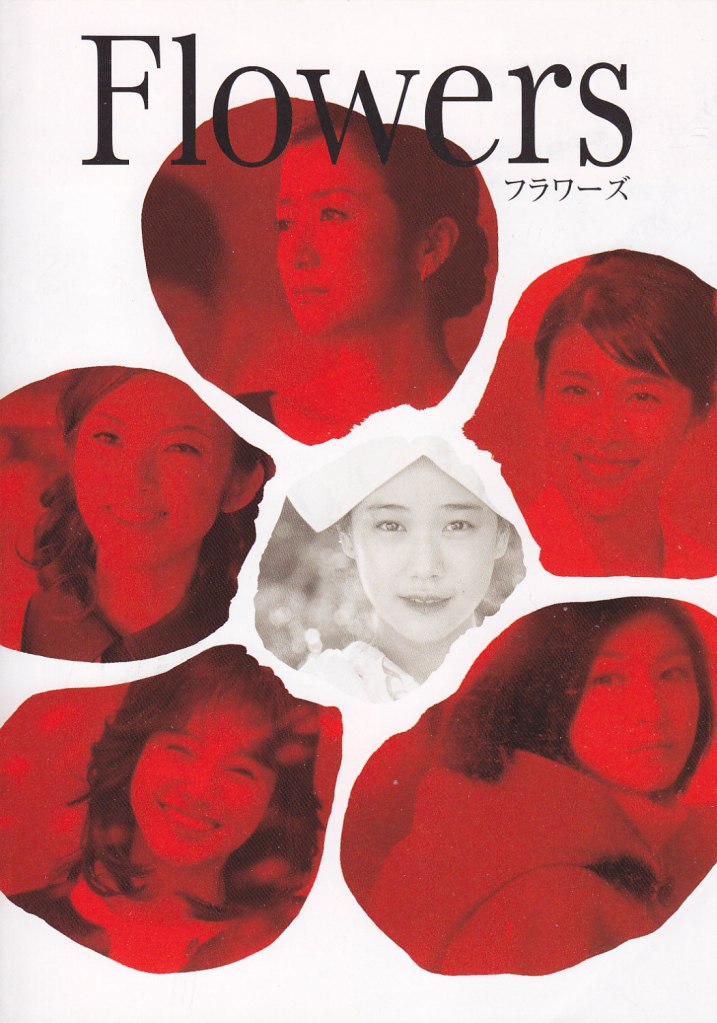
flowersThe rate of social change in the second half of the twentieth century was extreme throughout much of the world, but given that Japan had only emerged from centuries of isolation a hundred years before it’s almost as if they were riding their own bullet train into the future. Norihiro Koizumi’s Flowers (フラワーズ) attempts to chart these momentous times through examining the lives of three generations of women, from 1936 to 2009, or through Showa to Heisei, as the choices and responsibilities open to each of them grow and change with new freedoms offered in the post-war world. Or, at least, up to a point.
In 1936, oldest sister Rin (Yu Aoi) is to be married off against her will to a man picked by her father and whom she has never actually met. Bold and wilful, Rin finds herself more than usually torn between her intense resentment at being forced into a one time only life changing event simply on her father’s say so, and the guilt of rejecting centuries of tradition in rejecting her father’s authority. Minutes before the ceremony Rin makes a break for it fully done up in her wedding dress and makeup.

Flashing forward to her funeral in 2009, we learn that Rin did marry (someone, at least) and had three daughters. It’s her granddaughters we’re interested in now – happy mother Kei (Ryoko Hirosue), cheerful even at a wake, and the depressed Kanna (Kyoka Suzuki) – an unmarried former concert pianist who’s recently discovered she’s pregnant and is unsure what to do. In order to understand them we have to flashback a little again – to 1969, 1964, and 1977 to find out what happened to Rin’s three daughters – Kaoru (Yuko Takeuchi), Midori (Rena Tanaka), and Sato (Yukie Nakama).

Koizumi makes the most of his shifts in time periods to experiment with technical effects recreating the look of classic films of the era. Hence, 1936 is a desaturated monotone filled with classic silent movie compositions, seemingly owing a large debt to Ozu, Shimizu, and Mizoguchi. The difference between 1964 and 1969 might be thought slight but partly down to the different genre elements in the two vignettes, the contrast is marked with 1964 taking on the classic romantic melodramas of the period, and 1969 embracing bright and colourful salaryman comedy – only this time it’s a salary woman embarking on the era of having it all (though perhaps, tragically, ten too years to early to make the most of it). 1977 brings us back down with bump of realism as Sato lives an ordinary suburban life as a housewife and mother. Imbuing each of his eras with the warmth of nostalgia backed up with rich period detail, Koizumi has indeed framed his passage of womanhood narrative with an impressive degree of grounding.

This has been a period of intense social change, entirely for the better even if there is still a long way to go. Though marriages of 1936 were referred to as semi-arranged, families could and did place intense pressure on their children to consent or refuse to accept their refusal to do so (perhaps as true for sons as daughters, though sons were unlikely to find themselves in such a difficult position when things went wrong). Thus the course of Rin’s life is decided by her rigid, austere father leaving her with no possibility of choice in a world entirely controlled by men. Her daughters have more freedom and opportunities, marrying for love and choosing careers and/or motherhood as they see fit.

Midori, the most headstrong of the three sisters takes a job at a publishing house where she is the only female employee. Receiving a marriage proposal leads her to question her choices once again, wondering if accepting means jumping off the career ladder altogether. Wanting to get ahead, Midori has been behaving like her male colleagues – dressing in less feminine clothes and in subdued colours, heading off the inevitable sexist comments with aggression and violence but, eventually emboldened, she she finds herself blossoming when embracing her femininity within the workplace.

The world has moved on – women cannot be pushed in the same way Rin was pushed even if social mores can still be used to cajole them into conformity. The one big recent social change is in Kanna’s decision to proceed as a single mother. Though the question is still raised, there is broad approval for the idea which is met with no obvious stigma and only love and support from her immediate family. However, some things apparently don’t change as even if not all roads lead to marriage they all point towards motherhood which is still presented as the only marker of success as a woman. In this respect the closing montage accompanied by the odd choice of Olivia Newton John’s Have You Even Felt Mellow feels ill judged as the sister who’s experienced the ultimate heartbreak bounces around recreating the opening of Georgy Girl (only more successfully) with a new haircut and indulging in an ice-cream as a sort of antidote to eternal widowhood.

Nevertheless, Flowers does present a warm and broadly inspirational ode to the healing power of family and unbreakable female resilience even in the midst of such extreme social change. Painted with a keen eye for period detail and a deeply nostalgic longing for comforts long since passed, Koizumi’s exploration of womanhood through the ages is quick to acknowledge the pain and sacrifice experienced by women of all generations but is, in the end, too ready to accept it.


Original trailer (no subtitles)

Monday (マンデイ, SABU, 2000)

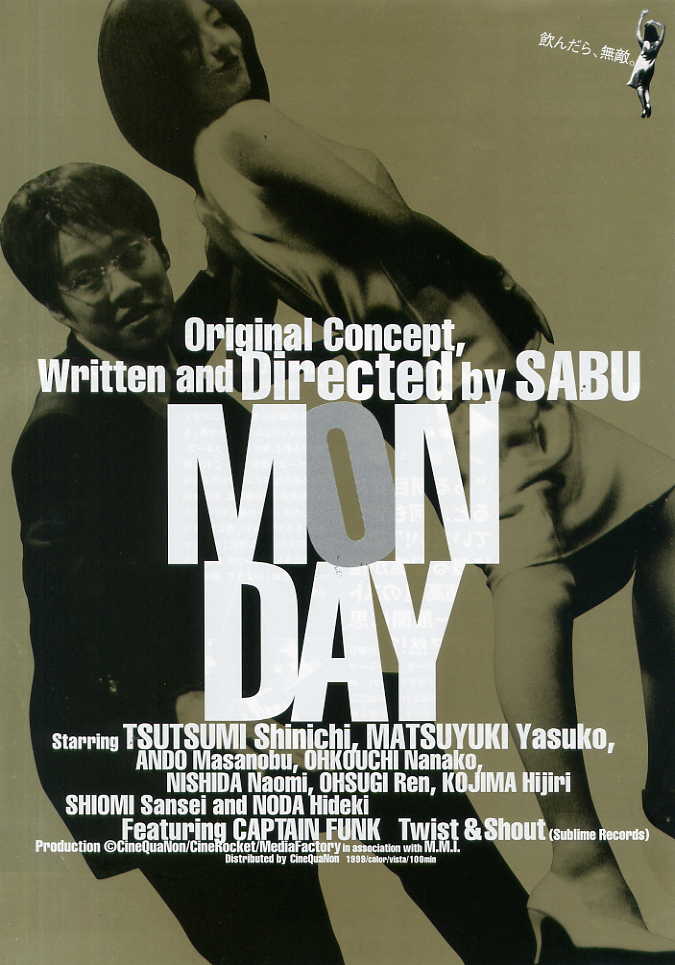
mondayWaking up in an unfamiliar hotel room can be a traumatic and confusing experience. The hero of SABU’s madcap amnesia sit in odyssey finds himself in just this position though he is, at least, fully clothed even if trying to think through the fog of a particularly opaque booze cloud. Monday (マンデイ) is film about Saturday night, not just literally but mentally – about a man meeting his internal Saturday night in which he suddenly lets loose with all that built up tension in an unexpected, and very unwelcome, way.

Mild mannered salaryman Takagi (Shinichi Tsutsumi) wakes up in his cheap hotel room dressed in a pitch black suit and with no recollection of how he got there. A packet of purification salt reminds him he was going to a funeral, but what happened after that? Takagi, it seems, enjoys a drink or two to ease that ever present sense of dread and impotence which dominates his life and so the events of the previous two days are lost in that pale space obscured by a booze drenched curtain of brain fog. Spotting various reminders hidden in his room Takagi begins to piece his strange adventure together from a bad date with the girlfriend whose birthday he blew off to go to the funeral, to a weird fortune teller, a beautiful woman, guns, gangsters and a homicidal killing spree. All in all, perhaps it was better when he couldn’t remember.

As usual, SABU weaves his complex comedy into a complicated cycle of interconnected gags. Takagi remains within the purgatory of his hotel room, furiously trying to remember how he got there but this otherwise anodyne space seems to be a reflection of his everyday persona in its inoffensive blandness, littered as it is with indications of the deeper layers implied by the still unknown actions of the previous few days. Judging by his appearance, Takagi is a shy, nervous man hidden behind his unstylish glasses and neatly swept back hair. Fearing his adventures are about to signal the end of his existence, Takagi suddenly gets the inspiration to make a proper will/suicide note which largely consists of a number of apologies firstly to his parents and siblings and finally to the girlfriend who walked out on him in the bar owing to his failure to appear for her birthday celebration and subsequently bizarre behaviour. The second portion of the letter also includes some advice to his siblings about how to look after the family pets and some horticultural tips but as he takes a few more drinks to steady his nerves, those deeper layers start to bleed through and so he takes this opportunity to advise his girlfriend that she should work on her anger issues and also avoid finishing other people’s sentences for them.

In Takagi’s defense, he has had a strange few days. The funeral of a close friend, especially one so young, might be enough to tip anyone into a spot of drunken introspection but the send off for former hair model Mitsuo (Masanobu Ando) is hardly a typical one given that it ends with the corpse exploding after Takagi is asked and then fails to “defuse” it. When he should probably take the opportunity to talk to someone about the things which are bothering him, Takagi has another drink, does his strange little laugh, and internalises his irritation with the very people who might be able to help him. Retreating to the bathroom carrying the memory of a stunning woman spotted at the bar with him, he returns to find a gloomy yakuza sitting in the adjacent seat intent on drinking and talking. Rather than saying a flat no and going home like a sensible person, Takagi keeps drinking until he feels like partying with the most dangerous guys in the room, even going so far as a raunchy dance with the gangster’s girl. The gangster, strangely, doesn’t mind and even seems to think he’s found a cool new friend but when everyone’s this drunk and there are guns around nothing is going to end well.

The finale finds SABU at his most sarcastic as the imprisoned Takagi indulges in a hero fantasy of taking the cops hostage and heading outside to meet the forces of authority head on only to give them a lecture about the danger of firearms and the necessity of love and kindness in a strange world. Needless to say, his message of peace is not universally well received. Takagi might have a point when he says that none of this would have happened if it hadn’t been for the shotgun – such a powerful and easy to use weapon in the hands of those who previously felt so powerless can indeed be a dangerous thing, but the fact remains that he harboured all of this fear and resentment inside himself, attempting to drown it with booze but continually failing. We leave Takagi trapped inside the hotel room, as he’s always been trapped inside his mind, holding a possibly empty shotgun at a flimsy hotel room door with all of that pressure pushing down outside it. The gun is one thing, and guns are bad, but the enemy will always be Monday – the modern world is driving people crazy and could use some of that love and kindness Takagi was so keen on during his hostage crisis but it probably won’t work until he puts the gun (and the booze) down and opens that hotel room door.


Original trailer (no subtitles)