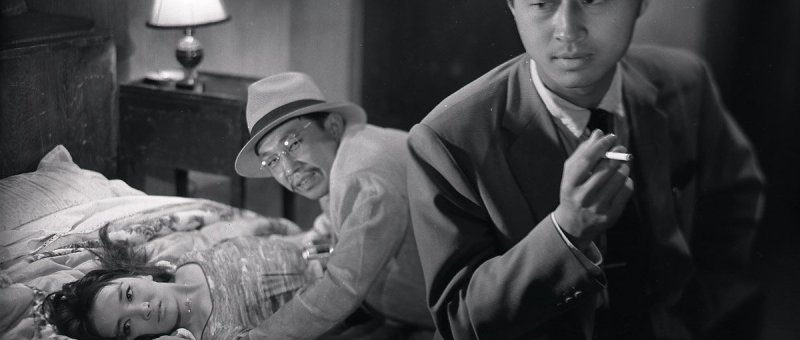
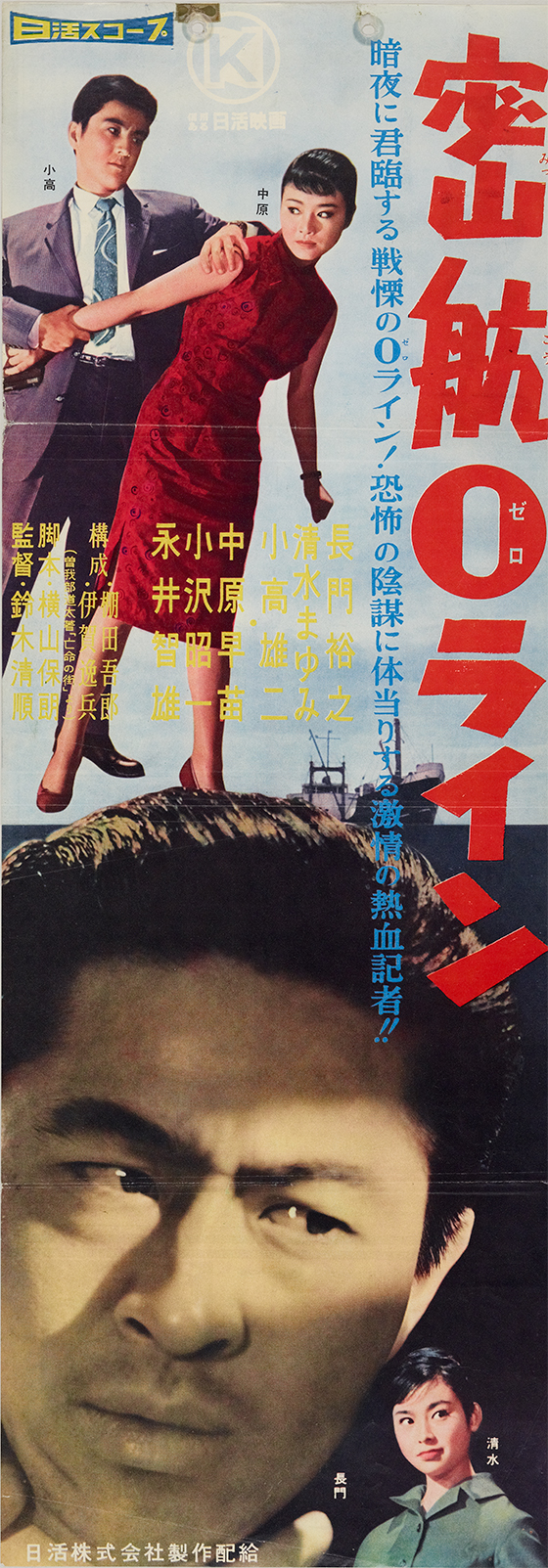
 Looking from the outside in, the Tokyo of 1960 seems to have been one of rising economic prosperity in which post-war anxiety was beginning to transition into a relentless surge towards modernity, but there also seems to have been a mild preoccupation with the various dangers that same modernity might present. Like The Sleeping Beast Within released just two months previously, Smashing the 0-Line (密航0ライン, Mikko Zero Line) centres on a mystery which leads straight back to Hong Kong and a dangerous, international smuggling ring – this time involving both drugs and people. Our heroes are both reporters, but at odds with each other despite being old friends in having diametrically opposed notions of professional ethics.
Katori (Hiroyuki Nagato), our anti-hero, is a man so desperate to get a scoop that he thinks little of engineering one. Thus we witness him making passionate love to a woman one minute before turning her into the police the next. The woman, Reiko (Sanae Nakahara), is also the little sister of one of his oldest friends, Saiko (Ryohei Uchida), whom he also decides to turn into the police in service of his story. Another old friend, Nishina (Yuji Kodaka), has also become a reporter but for a more respectable paper and is dating Katori’s little sister, Sumiko (Mayumi Shimizu), who is now the announcer at the local baseball stadium. Katori’s decision to turn on Reiko will have profoundly negative consequences for her former lover who is prepared to sacrifice all in pursuit of his goal.
Three men, once college friends, have chosen three radically different paths in the post-war world. Saiko has become a gangster while Katori has become an unscrupulous yet apparently publicly minded newshound and Nishina a pure hearted journalist who insists on doing everything by the book and abiding by conventional journalistic ethics. Yet despite himself, or possibly because of his love for Sumiko, Nishina tries to help Katori see the dangers of his extremely dangerous pattern of behaviour in which he has been content to use people like things to get what he wants.
Katori claims to be on the same side as Nishina – he thinks something is going sour in the city and that only he can stop it by exposing the various conspiracies in play. Katori’s chief fear is that Tokyo will become “another Hong Kong” – a crime ridden state of drug addled lawlessness (an extremely biased and seemingly inaccurate view of ‘60s Hong Kong but one that speaks of a certain fear of Japan’s new spot on the global scene). This particular conspiracy does indeed ping back to Hong Kong and the illegal traffic of drugs but also people heading in both directions. In the Japan of 1960, it was near impossible to get a passport and so smuggling yourself out might be the only way if you really need to get to Hong Kong which means you’ll need to pay a people trafficker to do it.
Katori, broadly, seems to think people trafficking is a bad thing he doesn’t want in Japan but is entirely blind to the same ways he himself uses people in pursuit of his goals. Not only does he bed Reiko (his friend’s little sister) only to make a speedy exit minutes before the police arrive, but he also palms off another mark on his informant only to turn them both in in hope of greater gain. He even manages to find time to seduce a doctor at the centre of the scandal who tries to pull a gun on him but later surrenders completely, only to fall victim to some proactive tidying up from the bad guys. Not content with sacrificing former lovers, Katori will not give in even for his sister, refusing to give up on his lead even when Sumiko is threatened with gang rape. When Nishina turns up and saves the day, Katori doesn’t even stop to ask how Sumiko is but walks off in the direction of the story with nary a second glance to his unconscious sister.
Yet Katori’s particular brand of nihilistic heroism consistently fails. His scoops are uninteresting and he only gets them by inserting himself into the story. Nishina, steadfast and honest – he even goes to the trouble of getting a proper passport to hide on his person in case he’s caught pretending to be a stowaway, is the one who gets there in the end, breaking the smuggling ring, rescuing Katori after he gets himself in trouble, and generally always being around to save the day. Mildly ironic themes of xenophobia aside, Smashing the 0-Line is a typically frenetic piece from Suzuki which offers only a few instances of unusual experimentation in his use of freeze frames and onscreen text but packs in plenty of punch in its amoral anti-hero and the dogged investigative reporter trailing along behind.
Available as part of Arrow’s Seijun Suzuki: The Early Years Vol. 2 Border Crossings box set (also features incisive audio commentary from Jasper Sharp providing a wealth of background information not just about Suzuki’s career but the state of the Japanese film industry at the time)
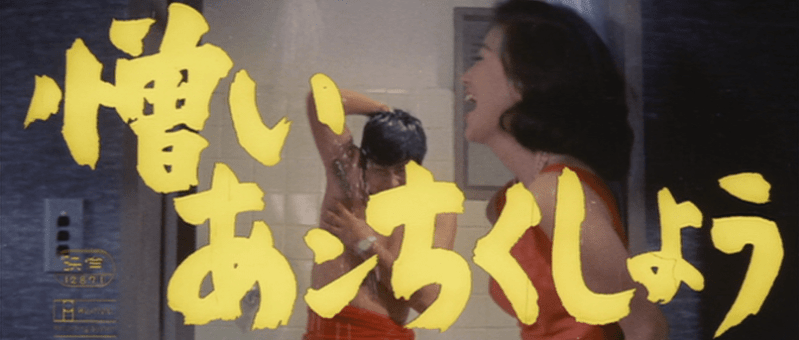
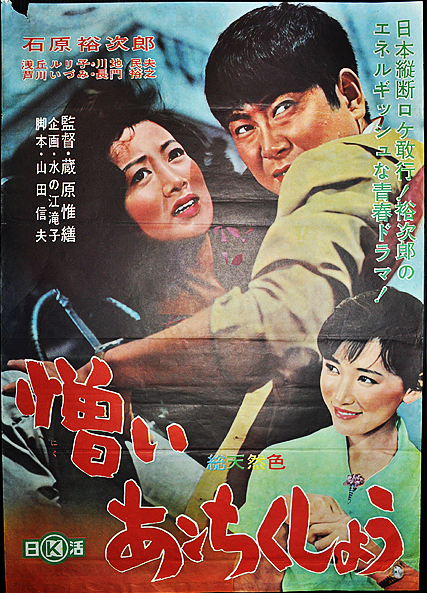


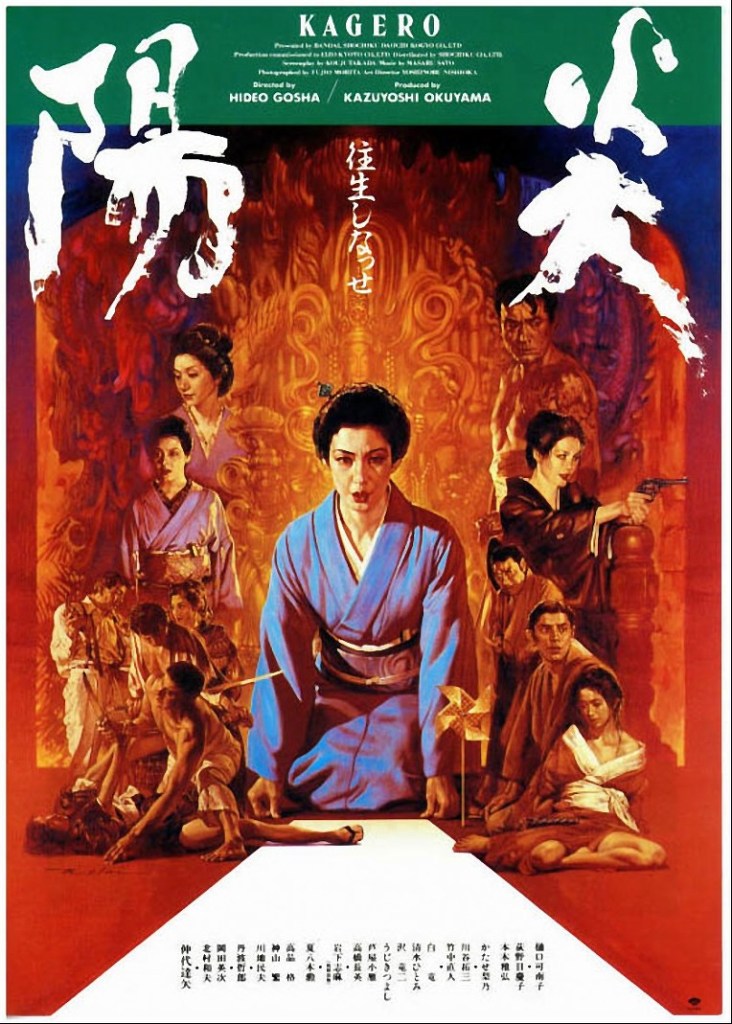 Hideo Gosha had something of a turbulent career, beginning with a series of films about male chivalry and the way that men work out all their personal issues through violence, but owing to the changing nature of cinematic tastes, he found himself at a loose end towards the end of the ‘70s. Things picked up for him in the ‘80s but the altered times brought with them a slightly different approach as Gosha’s films took on an increasingly female focus in which he reflected on how the themes he explored so fully with his male characters might also affect women. In part prompted by his divorce which apparently gave him the view that women were just as capable of deviousness as men are, and by a renewed relationship with his daughter, Gosha overcame the problem of his chanbara stars ageing beyond his demands of them by allowing his actresses to lead.
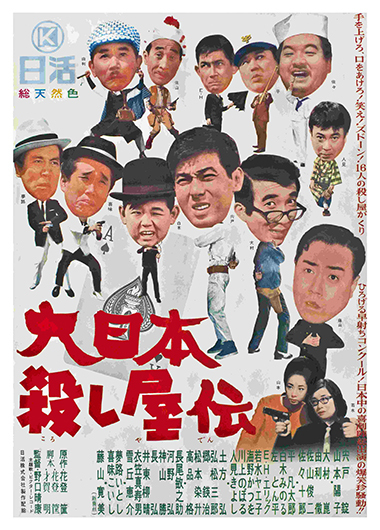 “If you don’t laugh when you see this movie, I’m going to execute you” abacus wielding hitman Komatsu warns us at the beginning of Haryasu Noguchi’s Murder Unincorporated (大日本殺し屋伝, Dai Nihon Koroshiya-den). Luckily for us, it’s unlikely he’ll be forced to perform any “calculations”, and the only risk we currently run is that of accidentally laughing ourselves to death as we witness the absurd slapstick adventures of Japan’s craziest hitman convention when the nation’s “best” (for best read “most unusual”) contract killers descend on a small town looking for “Joe of Spades” – a mysterious assassin known only by the mole on the sole of his foot.
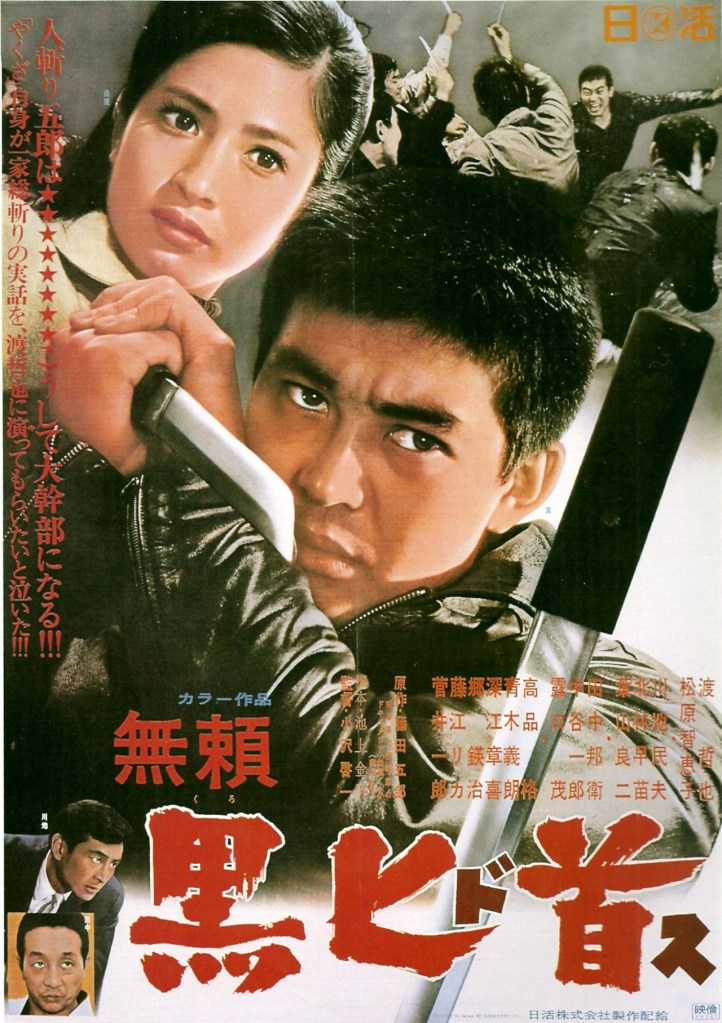 Goro (Tetsuya Watari) just can’t catch a break. He sends his one true love off on a train to safety only to see her dramatically return because she can’t bear to leave his side. Her devotion costs her her life as she places herself between Goro’s manly chest and an assassin’s knife. Heartbroken, Goro gets out of town only to run into another old flame who is now a mama-san and has apparently married another yakuza (despite the fact that Goro parted with her because of his chaotic yakuza lifestyle). As usual, the past won’t let him go – this time in a more literal sense as Goro encounters another woman who looks exactly like the girlfriend who died in his arms….
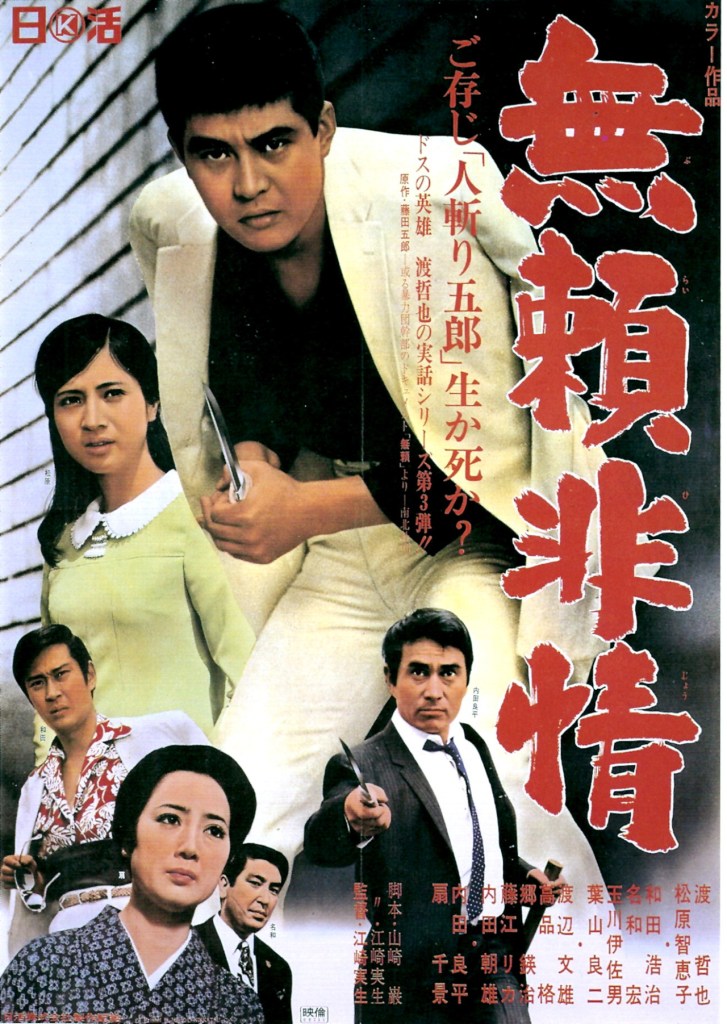 Things take a slight detour in the third of the Outlaw series this time titled “Heartless” (大幹部 無頼非情, Daikanbu Burai Hijo). Rather than picking up where we left Goro – collapsed on a high school volleyball court, it’s now 1956 and we’re with a guy called “Goro the Assassin” but it’s not exactly clear is this is a side story or perhaps an entirely different continuity for the story of the noble hearted gangster we’ve been following so far. The only constant is actor Tetsuya Watari who once again plays Goro Fujikawa but in an even more confusing touch the supporting characters are played by many of the actors who featured in the first two films but are actually playing entirely different people….
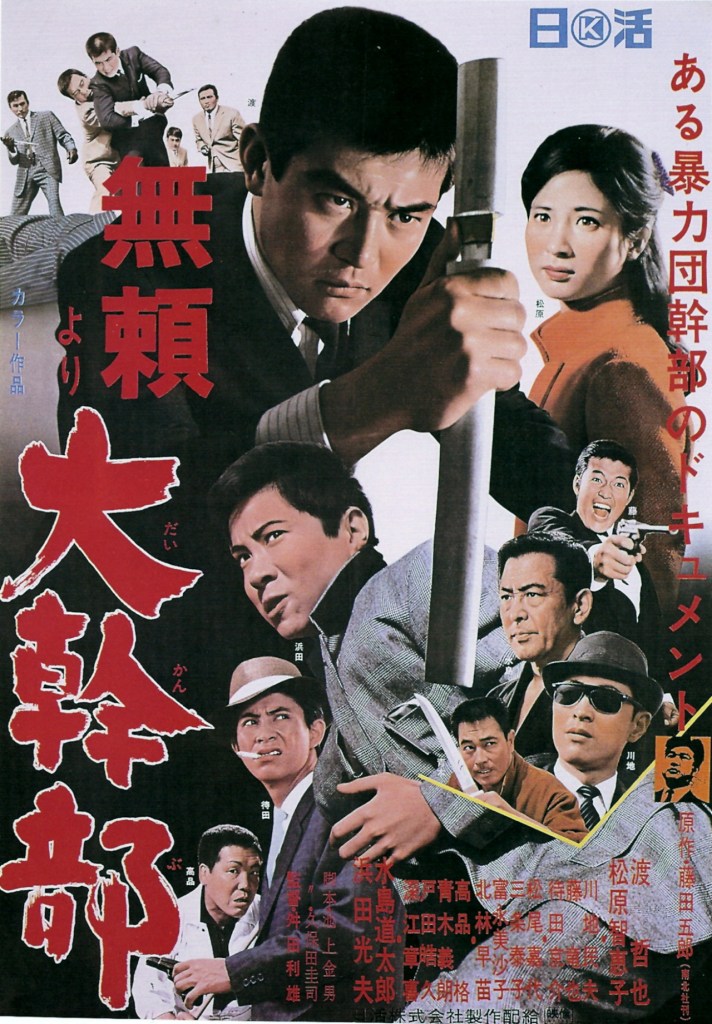 By 1968 the fate of the gangster movie was somewhat in flux as the old ninkyo style was on its way out yet the jitsuroku approach, later to find its zenith in the
  Windows on Worlds