Wind, Woman and Road (風と女と旅鴉, Tai Kato, 1958)

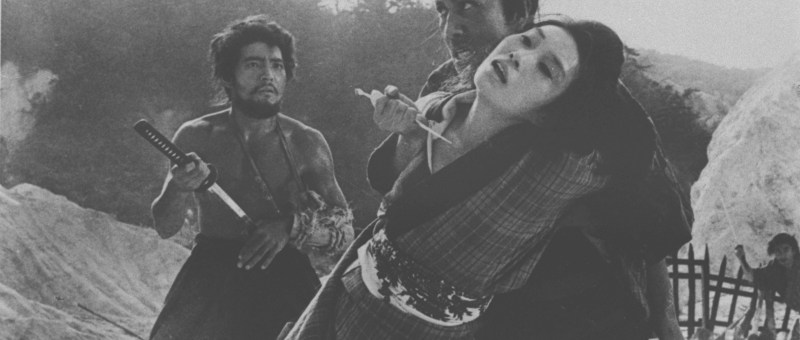
Tai Kato joined Toei’s Kyoto studio in 1956 having made his directorial debut at the independent production house Takara Productions in 1951 shortly after being letting go from Daiei in 1950 during the Red Purge (he had been chief secretary for studio’s the labour union). Heavily influenced by and a great admirer of Daisuke Ito, Kato had a passion for chanbara and jidaigeki which were Toei’s mainstays at the time, but even while making what were essentially programme pictures his approach was anything but conventional. With 1958’s Wind, Woman, and Road (風と女と旅鴉, Kaze to Onna to Tabigarasu), Kato embarked on what would become a signature style of “realistic” period drama otherwise at odds with the formulaic nature of the genre. 

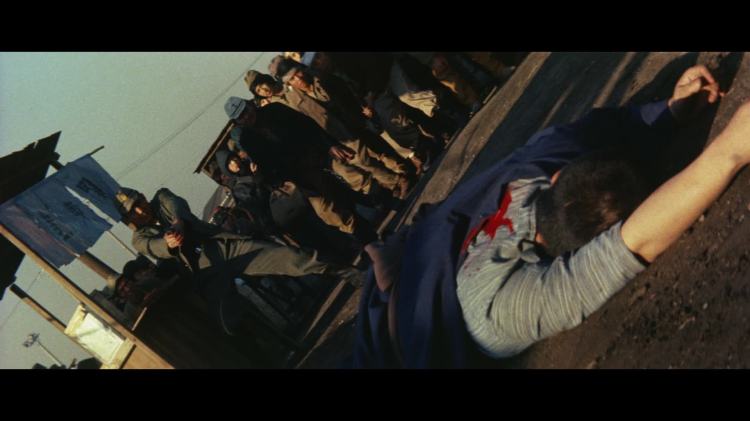
As he would continue to do, Kato instructed his cast not to wear makeup and while casting kabuki actor/chanbara megastar Kinnosuke Nakamura insisted on a more modern performance style than the sometimes mannered theatricality of the traditional samurai film. Ginji is cocksure young man living on the road after being kicked out of the hometown he is now travelling towards because of a crime supposedly committed by his long absent father. On the way, he runs into Sentaro (Rentaro Mikuni), a middle-aged man recently released from prison who is struck by his appearance and immediately asks how old he is realising that Ginji is about the same age as his own son who died as a result of a fight. 

The two begin walking together and Ginji tells Sentaro that his village sends gold to the governor around this time every year as a bribe to get lower taxes which doesn’t make a lot of economic sense but evidently works for them. Last year, the gold was stolen by notorious bandit Hanzo the Shark (Eitaro Shindo) and two villagers were killed during the robbery. Ginji half jokes about teaming up to steal it, and then playfully attacks Sentaro leading the entourage escorting this year’s payment to flee in terror leaving the gold behind. Sentaro encourages Ginji to take the money back to the village, but he is later shot by the returning villagers who think they must be Hanzo’s henchmen pulling the same stunt as last year. 

Unlike the typical chanbara hero, Ginji is petulant and resentful. He has a very modern way of speaking and is rebellious in character as you might well expect him to be given his life experiences. The other villagers are not happy to see him and continue tar him with his father’s brush, sure that the son of a thief can’t be any better while Ginji pines for his late mother claiming that the villagers’ harassment along with the inability to support herself economically led her to take her own life. Once a member of Hanzo’s gang he vacillates between a desire to be accepted by the village and that to take his revenge on it. Sentaro meanwhile is determined to save him, regretful that he could not save his own son from the life that he had led as a yazkuza and petty criminal. 

There is a persistent sense that everyone here is at heart a wanderer. The doctor’s daughter Ochika (Yumiko Hasegawa) who develops a fondness for both men relates that she was lured away from the village by an itinerant actor and fell into a life of ruin before returning to discover that her mother had passed away. The headman’s adopted daughter Oyuki (Satomi Oka) with whom Ginji falls in love tells him that she too is an orphan, her father was a medicine pedlar who dropped dead in the village which then took her in. Echoing a sense of rootlessness in the post-war world, they are all in someway displaced and looking to restore connections which have previously been broken but largely failing or unable to do so. Ginji is torn between his criminal past and the reformed future offered to him by the more positive paternal relationship he develops with Sentaro who, unlike his own father, is readily accepted by the village which is unaware that he previously spent time in prison. 

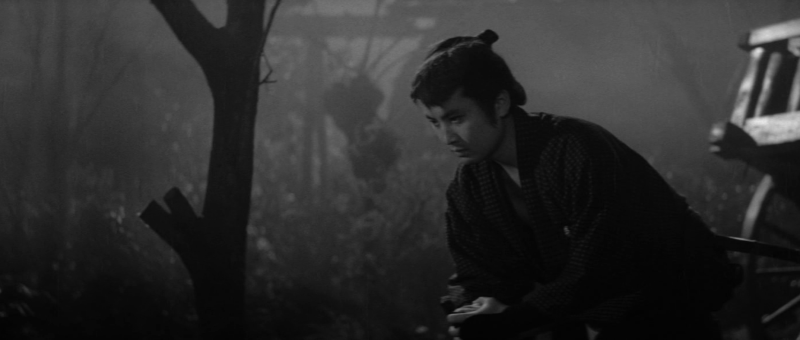
The final showdown takes place in a windswept clearing filled with Kato’s trademark mist as Ginji finally picks a side only to realise that that in the end he will always be a wanderer, a rootless figure whose only home is the road. Kato shoots a little higher than he would subsequently but still rests a little lower than the norm, emphasising a sense of destabilisation in Ginji’s volatility along with a painful longing that keeps him a lonely soul lost in the fog and on perpetual journey towards a long forgotten home. 


Father of the Kamikaze (ゝ決戦航空隊, Kosaku Yamashita, 1974)

By the mid-1970s, Japanese cinema at least had become much more comfortable with critiquing the wartime past, considering it from a greater distance than the often raw depictions of war in the films from the previous two decades. 1974’s Father of the Kamikaze (ゝ決戦航空隊, A Kessen Kokutai), however, is among the few to skew towards the nationalist rather than the ambivalence or simple anti-war messages of other similarly themed films of its era. 

Starring ninkyo icon Koji Tsuruta who served in the air force himself, the film is a kind of biopic dedicated to Admiral Onishi who oversaw the kamikaze operations at the end of the war. As is pointed out, Onishi had been against the war in general terms even before its inception and is originally against the philosophy behind the kamikaze squadrons but as Japan’s fortunes continue to decline he becomes its biggest advocate citing a kind of sunk cost fallacy that it would be in someway unfair to the men that have already died to surrender while insisting that suicide missions are the only feasible way to turn the tide because one kamikaze could take out a hundred men by destroying battleships singlehandedly. 

The film in part attributes this extreme solution to the prevailing with your shield or on it philosophy of the contemporary society which placed extreme shame on the act of being taken prisoner. In the prologue that opens the film, a squadron of downed pilots whose heroic deaths have already been recorded is discovered alive in an American prisoner of war camp but as being a prisoner of war is so shameful and would reflect badly on the military, the decision is taken to fix the books by sending the men on a mission from which they are not intended to return. Onishi is opposed to the plan, he asks why they can’t find a way for the men to live, but the decision is already made. In any case, he describes the action of a suicide mission as a “beautiful ideal” even when insisting that a war cannot be fought in that way not least for purely practical reasons in that they do not have the resources to be wilfully sacrificing skilled pilots and their planes. 

Having come round to the idea, however, Onishi is a crazed zealot who cannot accept the idea of surrender and even goes so far as to barge into a cabinet meeting to urge ministers against a truce even though the war is clearly lost. To his mind, the only way to honour the sacrifices of those who’ve died is to fight to the last man. Kozono (Bunta Sugawara), another officer opposed to the kamikaze, eventually meets a similar fate in refusing to obey the order to lay down his arms and ending up in a psychiatric hospital. His objection had partly been that it’s wrong to turn men into ammunition, but also that the kamikaze project is itself defeatist and self-defeating when there are men such as himself who are committed to fighting on.  

In this the film leans into the image of militarism as a death cult in which dying for the emperor is the only noble goal of the whole imperial expansion. In its eventual lionising of Onishi’s image, his bloody suicide atop a white cloth resembling the flag of Japan while his parting words scroll across the screen in text, it does not shy away from his more problematic aspects in which he fails to object to a request from a junior officer that soldiers should be allowed to test their swords on American prisoners of war, roundly telling a subordinate who breaks protocol to insist that such a thing is not only morally wrong but will ruin their international reputation that he has no need to think of consequences because Japan will win this war. He claims to want to find a way of defeat that will satisfy the living and the dead, but in reality cannot accept it not least in that it would entail admitting that he sent 2600 young men to their deaths for nothing. 

Tsuruta brings the same level of pathos to his performance as he did in playing conflicted yakuza stoically committed to a destructive code, but there’s no getting away from the fact that the film focuses mainly on Onishi’s personal suffering as a man who sent other men to die for a mistaken ideal and then could not admit his mistake offering an apology only in his death in which he urged the young people of Japan to work to rebuild the nation in the name of peace. In switching to the present day and showing us Onishi’s dilapidated former residence and in fact the room in which he died with its tattered shoji and peeling paintwork, he veers towards the nationalistic in uncomfortably reinforcing the nobility of his death rather than the folly of war or absurdist tragedy of the kamikaze programme. Adopting a quasi-jitsuroku approach with frequent use of onscreen text, a narratorial voiceover, and stock footage of kamikaze in action Yamashita may portray war as madness in Onishi’s crazed devotion but cannot help depicting it as a “beautiful ideal” even in the undignified violence of Onishi’s ritual suicide. 


Cantankerous Edo (大江戸喧嘩纏, Kiyoshi Saeki, 1957)

A noble-hearted samurai on the run falls for a fireman’s sister in Kiyoshi Saeki’s hugely enjoyable jidaigeki musical adventure Cantankerous Edo (大江戸喧嘩纏, Oedo Kenka Matoi). Another vehicle for Hibari Misora and samurai movie star Hashizo Okawa, Saeki’s wholesome drama finds its heroes not only standing up to the oppressions of a rigid class system but also taking on a bunch of entitled sumo wrestlers intent on throwing their weight around having apparently lost sight of the tenets of traditional sumo wrestling such as fighting for justice and having a kind heart. 

To begin at the beginning, however, young samurai Shinzaburo (Hashizo Okawa) is on the run believing that he has accidentally killed another man who attacked him in order to clear the path towards his fiancée, Otae (Hiroko Sakuramachi), whom he wasn’t going to marry anyway because he realised she was in love with someone else and wanted to help marry him instead. Having escaped to Edo, he takes refuge inside a parade of firemen lead by Tatsugoro (Ryutaro Otomo) and his feisty sister Oyuki (Hibari Misora) who decide to take him in after hearing his story. Adopting the simpler, common name of “Shinza” he begins life as a fireman and gradually falls for Oyuki but remains a wanted man constantly dodging the attentions of his uncle, the local inquisitor, and the magistrates. 

More a vehicle for Okawa than Misora who plays a relatively subdued role save for boldly stealing the standard and climbing a roof herself when the others are delayed, Cantankerous Edo takes aim not particularly at a corrupt social order but of the oppressive nature of class divisions as Shinza discovers a sense of freedom and possibility he was previously denied as a samurai while living as a common man. It’s this desire for personal autonomy and the freedom to follow one’s heart that led to his exile from his clan, unwilling to marry a woman he knew not only did not love him but in fact loved someone else and would have been forever miserable if forced to marry him out of duty alone. “The life of a samurai who has to be somebody or not to suit another’s convenience is utterly stupid” he bluntly tells his uncle and Otae’s father, “how you cling onto family status, heritage, and honour. All that fuss, I hate it.” he adds before turning to Otae and encouraging her too to stand up to her father and insist on marrying the man she loves rather than be traded to another. 

Meanwhile, the two women exchange some contradictory messages about the nature of class and womanhood, the samurai lady Otae confessing that she isn’t sure she’s strong enough to fight for love in the face of tradition and filial duty in contrast to Oyuki’s spirited defence of Shinza the fireman insisting that firemen don’t think about such trivial things as name or family status before throwing themselves into harm’s way for the public good. “All women are weak” Otae sighs, Oyuki replying that they need to be strong for the men they love, “that’s what it means to be a woman”. Love may be in this sense a force of liberation, destabilising the social order but also a means of improving it, yet it still reduces women to a supporting role ironically as perhaps the film does to Misora who in contrast to some of her feistier performances takes something of a back seat. 

Romance aside, the main drama revolves around a conflict between the local sumo wrestlers who have turned into thuggish louts under their boorish leader Yotsuguruma (Nakajiro Tomita), taking against the fireman and forever spoiling for a fight. The samurai proving unexpectedly understanding, the sumo wrestlers become the main source of oppression in usurping a class status they don’t really have. The noble Tatusgoro tries to stave off the fight insisting that they aren’t brawling yakuza but responsible firemen here to serve the public good and should save their energy for fighting fires rather than their obnoxious neighbours. Nevertheless the fight cannot be held off forever. Tatsugoro is forced to redefine the nature of “fire” after hearing a warning bell informing him one of his men is in grave danger unable to manage their anger anymore.  

Saeki’s jidaigeki musical has surprisingly good production values for a Toei programmer, making space for a few songs along the way celebrating the valour of the firemen while Oyuki meditates on her potentially impossible romance and the perils of love across the class divide. While the conclusion may end up ironically reinforcing the hierarchical society, it does however make the case for the right to romantic freedom along with the necessity of human compassion in the face of inconsiderate arrogance and intimidation.


Note: This film is sometimes titled “Fight Festival in Edo” but according to Eirin’s database, the official English-language title is “Cantankerous Edo”. Rather confusingly, a very similar film with a very similar title (大江戸喧嘩まつり) was produced in colour at Toei in 1961 and is known as “Fight Festival in Edo” in English. Meanwhile, Hibari Misora also starred in another colour film with a very similar storyline in 1958 (唄祭りかんざし纏) which is known as “Girl with the Fire Banner” in English but listed as “Festival of Song” on Eirin’s database.

Samurai Wolf 2: Hell Cut (牙狼之介 地獄斬り, Hideo Gosha, 1967)

“We ronin must live without mercy” insists a fugitive on a quest for vengeance and riches only to meet his match in the justice-loving wanderer Kiba (Isao Natsuyagi) making his return for Samurai Wolf II: Hell Cut (牙狼之介 地獄斬り, Kiba Okaminosuke: Jigoku Giri). Like the second instalment in many series, Gosha’s avant-garde chambara largely follows the same formula picking up several familiar elements from the first film if giving them a new spin as Kiba once again finds himself caught up in intrigue provoked by the amoral venality of late Meiji society. 

In this case, he makes a rod for his own back by humiliating some swordsmen after catching them harassing a young woman, mocking them when they try to claim that their treatment of her is part of their “training”. Kiba saves the girl, Oteru (Rumiko Fuji), who has some kind of etherial quality and doesn’t quite seem to know what’s going on immediately throwing herself at Kiba who turns her down in gentlemanly fashion. Sometime later, he runs into a convoy of officials transporting criminals to the nearest judicial centre and stops to give the prisoners some of his own water explaining that that from the stream is polluted thanks to leaks from a nearby goldmine. In any case, Kiba is struck by the appearance of one of the men, Magobei (Ko Nishimura), who reminds him of the father who was killed by swordsmen he’d humiliated with his skill. 

Magobei is in chains for murdering the manager of the mine which previously belonged to the shogun but has now been shut down, its seam apparently exhausted. But like the toxins that poured into the river, the mine is a poison to society and in more ways than one. Magobei tells Kiba that he’s been set up. He was hired to kill the manager by a duplicitous gang leader named Jinroku (Bin Amatsu) who has found a new seam and has been operating the mine illegally taking all the gold for himself so obviously Magobei wants revenge. After seeing off an ambush, Kiba agrees to act as a bodyguard delivering both Magobei and the other prisoner, Kihachi (Out Yokoyama) who claims to be a big time bandit in trouble for robbing a samurai family, to the nearest city but secretly seems to sympathise with the injustice dealt to Magobei and the female prisoner who later joins them, Oren the Thistle (Yuko Kusunoki), who murdered a judge who killed her lover. 

Yet Kiba’s memories of his father cloud his judgment about Magobei who is definitely not a man worthy of his faith in him. “What good would pity do?’ Magobei asks, certain that compassion is a weakness and that if he were to give in to human feeling he would immediately be betrayed. The men misunderstand each other, assuming they are alike when in reality they are opposites. Kiba bets on Magobei’s humanity and loses, while Magobei assumes that Kiba will easily be won over by the riches to be found in the goldmine and help to wipe out Jinroku’s gang which is also a family of which Oteru is a member. “Life’s tough that’s how it is” he justifies, but Kiba cannot forgive him not least for his callous murder of a man who was only a frightened braggart and could not have harmed him and a woman who was otherwise blameless. Just as Sanai had in the first film, Magobei tells him that “one day you will be like me” a future that Kiba once again violently rejects. 

But then again he can never escape the world where goldmines pollute the rivers and money can buy anything, even the hearts of men. Just like his father, he’s pursued by the swordsmen he’s unwittingly insulted while discovering his desire to serve justice backfiring, eventually robbing him of the only thing he actually wanted just as it had at the end of the previous film. Even so, Kiba retains his sense of humanity and unlike so many jidaigeki (anti-)heroes refuses to give in to nihilism or despair. A little less avantgarde than the previous instalment, Gosha nevertheless conjures a world of dazzling violence in freeze-frame and silence while once again leaving Kiba the furious wolf to wander, a lonely figure in an unforgiving landscape.


Samurai Wolf 2: Hell Cut opens at New York’s Metrograph on Dec. 26 as part of Hideo Gosha x 3

Original trailer (English subtitles)

The Thief in Black (黒の盗賊, Umetsugu Inoue, 1964)

Best known as a master of the musical, Umetsugu Inoue had a long and varied filmography embracing almost every genre imaginable. He began his career at Shintoho and later joined Nikkatsu where he quickly became an in demand director often working with top star Yujiro Ishihara, but took the somewhat unusual step of going freelance in 1960 thereafter working at various studios including Shaw Brothers in Hong Kong. 1964’s The Thief in Black (黒の盗賊, Kuro no Tozoku) is not a musical but is characteristically playful even within the confines of the lighter side of Toei’s jidaigeki adventures. 

Set between the Battle of Sekigahara and the Siege of Osaka, the samurai corruption in play is essentially the burgeoning Tokugawa dictatorship, the heroes eventually uncovering Ieyasu’s secret plan for making sure his line (well, more himself in essence) remains in power for perpetuity through an insidious plot to weaken the feudal lords and ensure their loyalty to him. Meanwhile, the still developing city of Edo is beginning to turn against the Tokugawa who seem to be intent on exploiting ordinary people to enrich themselves most obviously through forcing the local workforce to renovate Edo castle rather than cleaning up the town which is apparently rampant with crime. Faced with such lack of leadership, the townspeople have come to admire a Robin Hood-like vigilante known only as the Thief in Black who alone is resisting overreaching lords. 

Part of the problem is that Ieyasu’s rule is still insecure because of the potential threat of Hideyori Toyotomi in Osaka. Consequently, they are fearful that some of the men working on the castle may be Toyotomi spies or otherwise disclose information that might benefit him if he chose to attack which is why they’ve refused the workers permission to return home to their families during the pause before beginning the second phase of works leading to further unrest. Meanwhile, corrupt local lord Tadakatsu (Ryutaro Otomo) and his sleazy priest buddy Tenkai (Minoru Chiaki) have an even darker plan in mind, preparing to simply kill the five master craftsmen in charge to ensure they present no threat. Alerted to the situation on the ground by idealistic samurai Jiro (Hashizo Okawa), their boss instructs Tadakatsu in no uncertain terms that he must treat the workers fairly in order to prevent civil unrest and/or disillusionment with the Tokugawa regime but the pair are entirely unfazed and determined to go on with their nefarious plan getting rid of Jiro if the occasion arises. 

As we later discover and in a typical jidaigeki plot device, Jiro is one of a pair of twins with his brother Kotaro (also Hashizo Okawa) abandoned because of the superstitious belief that multiple births are inauspicious. Though both men unwittingly lay claim to the name, Kotaro turns out to be the masked vigilante, his primary cause to regain the lands of the family who raised him unfairly displaced from their estates on the Musashino plains because of Tokugawa greed. Though Jiro, raised as a member of the establishment, is originally loyal to the Tokugawa who have after all brought about an era of peace, he soon begins to see that their rule is no good for the people of Edo. In his more egalitarian worldview, only by enriching the poor can they secure their rule which means less castle building and more infrastructural development along with paying people fairly for their work and absolutely not killing them afterwards. Kotaro too claims that his rebellion is for the good of the common people though unlike Jiro is much more transgressive in his ideology prepared to shake off his samurai status to become a wandering outlaw rather than content himself with the restrictive life of the heir to a samurai clan. 

Such messages are perhaps common in Toei’s brand of jidaigeki but seem unusually pronounced as the peasant workers are often given voice to lament their fate and resist their oppression more directly, pointing the finger not just at a rogue rotten lord but at the entire system built on exploiting their labour. Nevertheless, Inoue injects a hearty dose of whimsical humour to the politically charged narrative even going so far as to include a bumbling ninja claiming to be the famous Hattori Hanzo along with a comic relief magistrate and former samurai brothel owner taking his own kind of ironic revenge in getting the cowardly lords hooked on modernity with a load of faulty rifles. Obviously, Ieyasu couldn’t be stopped, but perhaps they slowed him down and reminded him of the dangers of underestimating the people. Shot with Inoue’s characteristic flare if remaining largely within the Toei house style, Thief in Black is a surprisingly direct attack on corrupt and entitled government but also a righteous romp as its idealistic heroes shuffle themselves back into their ideal positions while fighting Tokugawa oppression all the way. 


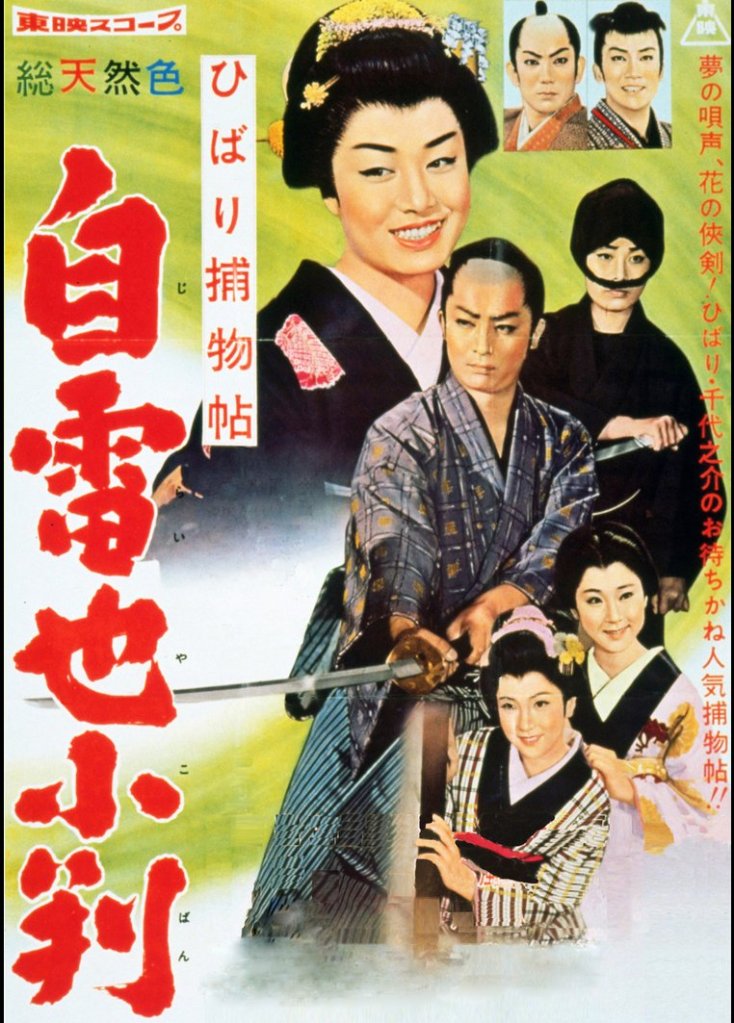
Detective Hibari 2: Secret of the Golden Coin (ひばり捕物帖 自雷也小判, Kinnosuke Fukada, 1958)

Oshichi returns! Two years after her first adventure, the princess in hiding has moved on, still living in the city hiding from the burdens of privilege but fiercely opposing injustice wherever she finds it as a detective in her own right. Unlike Mysteries of Edo and in keeping with Case of the Golden Hairpins, this Oshichi undergoes much less of a softening, remaining largely disinterested in the idea of romance, and cooly rebellious in her refusal to be cowed while strangely OK with Shogunate oppression as a quasi-agent of the state. 

As the film opens, a young woman impersonates Oshichi in order to gain entrance to a prison where her boyfriend is in jail for rebelling against the Shogunate. Meanwhile, Oshichi (Hibari Misora) is teaching a singing class as a favour to her boss who had to go out on an errand, after which she discovers that Hyoma (Chiyonosuke Azuma), currently a retainer of her brother’s, has been sent to bring her home. Once again she refuses because she likes her “ordinary” life. Shortly thereafter, a fire breaks out in the prison and the rebels escape. Oshichi becomes a prime suspect in the jailbreak, not only because the accomplice borrowed her name but because it’s advantageous to the plotters to blame her because they can use her guilt to tarnish her brother’s reputation and get him fired, usurping his position in the process. 

Oshichi, now working as a detective, is technically an agent of the Shogunate against which the rebels are rebelling for reasons which aren’t stated here but are probably easy to guess. They are, in many ways, the same sorts of reasons that Oshichi chose to become a detective, even if she’s coming at them from the other side. She doesn’t like bullies, or corruption, injustice or unfairness. Oshichi won’t stand for unkindness either, which is perhaps why she aligns so strongly behind the woman who blackened her name by impersonating her, knowing that she did it all for love and a little bit for justice, while also forgiving the rebel Seinosuke (Kotaro Satomi) who was preparing to kill the woman he loved because the corrupt samurai had kidnapped his dad and threatened to kill him if he didn’t. 

Despite all that however, Oshichi still insists that “the Shogunate can be compassionate too”, encouraging Seinosuke and his girlfriend Namiji (Hiromi Hanazono) to tell all so she can help them safe in the knowledge that they will be forgiven. It’s a slightly strange position for to her take, essentially authoritarian but arguing for a benevolent paternalism that is just and fair and kind, insisting that the corrupt samurai are bad apples which must be expelled rather than a product of an inherently oppressive social system as they are generally depicted in post-war jidaigeki. 

This insistence on the “compassion” of the Shogunate is perhaps the concession to Oshichi’s femininity which she has otherwise rejected in rejecting her life as a cosseted princess. As Kawashima had in Mysteries of Edo, Oshichi’s “protector” Hyoma asks her how she can take on all those men before challenging her to a contest of masculinity as mediated through a drinking competition which she does not exactly “win” but makes a minor victory all the same. Rather than rely on her brother or Hyoma, Oshichi vows to clear her name herself and starts investigating on her own dressing as a man and fighting bad guys while insisting on her independence. 

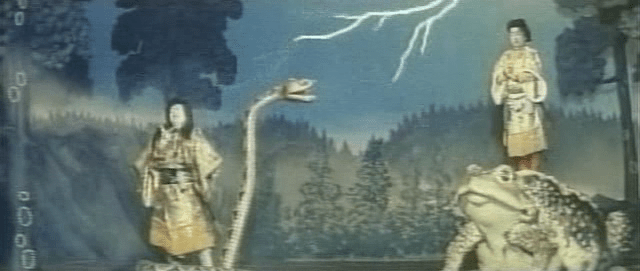
Nevertheless, she is but a pawn in a game of courtly intrigue, manipulated as a means of getting to her brother. The corrupt samurai think nothing of killing anyone who gets in their way, be they princesses or peasants, even going far as to mount an attack on the stage of a theatre mid-performance in front of a room full of spectators, many of whom join Oshichi by throwing projectiles as she tries to fend them off. Once again, she isn’t quite permitted to save herself but is “rescued” by the patriarchal forces representing the greater Shogunate including her protector Hyoma, and her brother, the embodiment of state authority. She is, however, the primary motivator in unmasking the corruption as she both clears her own name, and creates a better future for Namiji in which she can be with the man she loves, reminding her to always remember the compassion the Shogunate has shown her (in case she was minded to mount any more rebellions). As for herself, she manages to slip the loop once again, running off into the wild to claim her independence rather than be forced back into the golden cage of her princesshood while the loyal Hyoma contents himself with following her lead. 


Short clip (no subtitles)

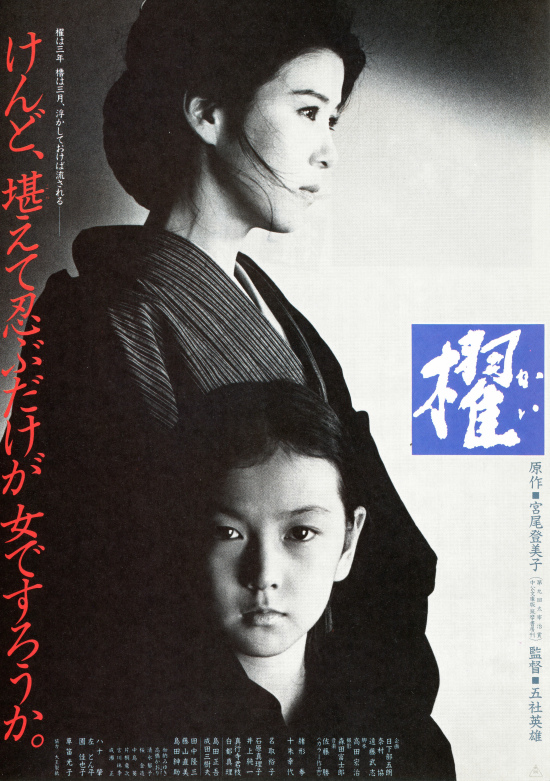
Oar (櫂, Hideo Gosha, 1985)

oar posterUntil the later part of his career, Hideo Gosha had mostly been known for his violent action films centring on self destructive men who bore their sadnesses with macho restraint. During the 1980s, however, he began to explore a new side to his filmmaking with a string of female centred dramas focussing on the suffering of women which is largely caused by men walking the “manly way” of his earlier movies. Partly a response to his regular troupe of action stars ageing, Gosha’s new focus was also inspired by his failed marriage and difficult relationship with his daughter which convinced him that women can be just as devious and calculating as men. 1985’s Oar (櫂, Kai) is adapted from the novel by Tomiko Miyao – a writer Gosha particularly liked and identified with whose books also inspired Onimasa and The Geisha. Like Onimasa, Oar also bridges around twenty years of pre-war history and centres around a once proud man discovering his era is passing, though it finds more space for his long suffering wife and the children who pay the price for his emotional volatility.
Kochi, 1914 (early Taisho), Iwago (Ken Ogata) is a kind hearted man living beyond his means. Previously a champion wrestler, he now earns his living as a kind of procurer for a nearby geisha house, chasing down poor girls and selling them into prostitution, justifying himself with the excuse that he’s “helping” the less fortunate who might starve if it were not for the existence of the red light district. He dislikes this work and finds it distasteful, but shows no signs of stopping. At home he has a wife and two sons whom he surprises one day by returning home with a little girl he “rescued” at the harbour after seeing her beaten by man who, it seemed, was trying to sell her to Chinese brokers who are notorious for child organ trafficking.

Iwago names the girl “Kiku” thanks to the chrysanthemums on her kimono and entrusts her to his irritated wife, Kiwa (Yukiyo Toake), who tries her best but Kiku is obviously traumatised by her experiences, does not speak, and takes a long time to become used to her new family circumstances. Parallel to his adoption of Kiku, Iwago is also working on a sale of a girl of a similar age who ends up staying in the house for a few days before moving to the red light district. Toyo captures Kiwa’s heart as she bears her sorry fate stoically, pausing only to remark on her guilt at eating good white rice three times a day at Iwago’s knowing that her siblings are stuck at home with nothing.

Iwago’s intentions are generally good, but his “manly” need for control and his repressed emotionality proceed to ruin his family’s life. He may say that poverty corrupts a person’s heart and his efforts are intended to help prevent the birth of more dysfunctional families, but deep down he finds it hard to reconcile his distasteful occupation with his traditional ideas of masculine chivalry. Apparently “bored” with the long suffering Kiwa he fathers a child with another woman which he then expects her to raise despite the fact that she has already left the family home after discovering the affair. Predictably her love for him and for the children brings her home, but Iwago continues to behave in a domineering, masterly fashion which is unlikely to repair his once happy household.

Kiwa is the classic long suffering wife, bearing all of Iwago’s mistreatments with stoic perseverance until his blatant adultery sends her running from marriage to refuge at the home of her brother. Despite the pain and humilation, Kiwa still loves, respects, and supports her husband, remembering him as he once was rather than the angry, frustrated brute which he has become. Despite her original hesitance, Kiwa’s maternal warmth makes a true daughter of Kiku and keeps her bonded to the eldest and more sensitive of her two sons, Ryutaro, even if the loose cannon that is Kentaro follows in his step-father’s footsteps as an unpredictable punk. Her goodheartedness later extends to Iwago’s illegitimate daughter Ayako whom she raises as her own until Iwago cruelly decides to separate them. For all of Iwago’s bluster and womanising, ironically enough Kiwa truly is the only woman for him as he realises only when she determines to leave. Smashing the relics of his “manly” past – his wrestling photos and trophies, Iwago is forced to confront the fact that his own macho posturing has cost him the only thing he ever valued.

Gosha tones down the more outlandish elements which contributed to his reputation as a “vulgar” director but still finds space for female nudity and frank sexuality as Iwago uses and misuses the various women who come to him for help or shelter. More conventional in shooting style than some of Gosha’s other work from the period and lacking any large scale or dramatic fight scenes save for one climactic ambush, Oar acts more as a summation of Gosha’s themes up until the mid-80s – men destroy themselves through their need to be men but also through destroying the women who have little choice but to stand back and watch them do it. Unless, like Kiwa, they realise they have finally had enough.


Short clip from near the beginning of the film (no subtitles)

https://www.youtube.com/watch?v=L5bAjoDl_iM

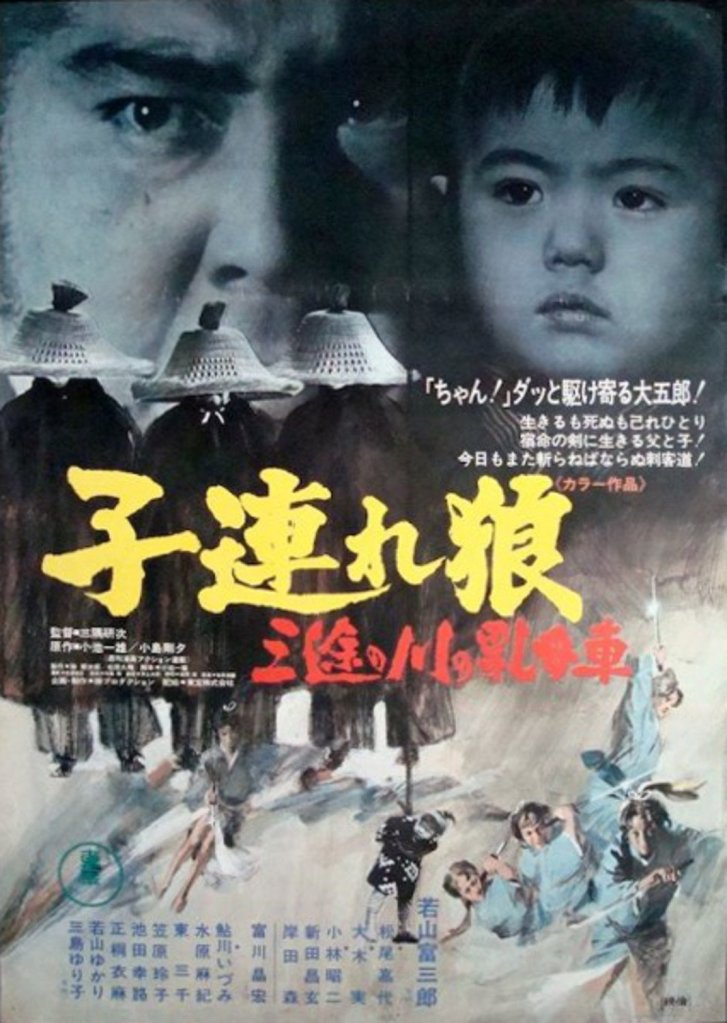
Lone Wolf and Cub: Baby Cart at the River Styx (子連れ狼 三途の川の乳母車, Kenji Misumi, 1972)

baby-cart-at-river-styxThe first instalment of the Lone Wolf and Cub series saw the former Shogun executioner framed for treason and cast down from his elite samurai world onto the “Demon’s Way” on a quest to clear his name and avenge the murder of his wife whilst caring for his young son, nominally also on the path of vengeance alongside his father. As far as progress goes, Ogami (Tomisaburo Wakayama) has made little other than dispatching a few of his enemy Yagyu foot soldiers and earning himself 500 ryou by ridding a spring town of some pesky gangsters. Well trained genre fans will correctly have guessed that chapter two in this six part series, Lone Wolf and Cub: Baby Cart at the River Styx (子連れ狼 三途の川の乳母車, Kozure Okami: Sanzu no Kawa no Ubaguruma), contains more of the same as Ogami trudges onward pushing his son Daigoro (Akihiro Tomikawa) in a bamboo cart earning a living by way of the sword with his sights set on the Yagyu stronghold.

After swiftly despatching a series of Yagyu agressors, Ogami and Daigoro procede along the Demon’s Way, jointly earning their living as hitmen for hire. The procedures for hiring the Lone Wolf and his Cub are complicated – talismans are positioned on the road calling for their services, and if the pair are interested, they’ll build a trail of rocks to indicate a meeting. Their mission this time is in the name of a put-upon clan whose income stems from a unique dyeing technique, only they’ve been “underestimating” their takings to avoid unfair taxation by the Shogun. Another clan found out about their practices and sent in undercover agents to agitate among the workforce who were already feeling oppressed and misused. The elite samurai took out most of the ringleaders, but their foreman has run off and taken refuge with a neighbouring clan who claim to know nothing about him. Ogami’s job is to kill the manager before he reaches the Shogun and blows the whistle on everything and everyone.

In addition to the Hidari brothers – a trio of skilled ronin acting as bodyguards to Ogami’s target, Ogami also has to contend with the Yagyu currently still angry over the foot soldiers he dispatched in the first film. Now that they know Ogami is not a man to be taken lightly, they’ve handed over the assignment to their crack troop of female ninja led by the expert swordswoman, Sayaka (Kayo Matsuo).

As in the first film the action scenes are impressively choreographed if filmed with a degree of absurd whimsy. Sayaka attempts to ambush Ogami by having her women hanging out in the country performing normal tasks such as washing daikon at the riverside, only the daikon are filled with knives and these are no ordinary housewives. Ogami is not fooled and quickly despatches the full complement of female warriors with ease (and a little help from Daigoro and his well equipped cart), leaving him to face Sayaka one-to-one. Their battle ends in a stalemate in which Sayaka effects a daring ninja escape (from her kimono no less) to retreat to fight another day.

As much as Ogami is on the road to hell, he maintains his honour – as do his opponents, the Hidaris, who take the time even whilst trapped on a burning boat to explain to him that they have no particular grudge towards Ogami and mean him no ill will. They will though respond without mercy if attacked. Unfortunately, Ogami will have to do battle with them as they stand between himself and his target but his philosophy is broadly the same. He will be ruthless in the execution of his mission but is not a ruthless man and will attempt to leave bystanders out of his quarrels.

This oddly stoical quality of his threatens to turn Ogami into something of a wandering heartbreaker as once again he attracts the admiration of a woman, this time his closely matched rival Sayaka, just as he had the prostitute in the first film. Though determined to gain revenge for her fallen clan members, Sayaka is uncomfortable with her clansmen’s plan to kidnap Daigoro and use him as bait to trap Ogami. As the plan offends her honour, she frustrates it at a crucial moment, allowing Ogami to escape with Daigoro in hand. Later following him and trying again to assassinate Ogami during his flight from the aforementioned burning boat, Sayaka finds herself rescued by the very man she was trying to kill. Though misunderstanding Ogami’s rough tearing off of her wet clothes – ever uncommunicative, Ogami is simply trying to prevent her dying of hypothermia and borrow some of her body heat to help himself and Daigoro do the same, Sayaka eventually finds herself literally and figuratively “disarmed” by her target.

Heading back into the world of the spaghetti western, the final fight takes place in the desert with enemies buried in the sand itself. Misumi’s approach is even more psychedelic this time round in which he has Ogami fighting shadows and even more elaborate blood sprays striking the camera as heads, limbs, ears and fingers are severed with glee abandon. The mood shifts slightly as one fallen warrior is allowed a long dying monologue about the sad wail emanating from his fatal wound and his lingering feelings of jealously that he was never able to inflict the kind of elegant kill which Ogami so effortlessly effected on him. Still, the road is long. Ogami remains on the Demon’s Way seemingly no closer to achieving his goal and with a trail of fallen enemies and broken hearts stretching out behind him, but continue he must, pushing his baby cart onwards towards hell in search of both redemption and revenge but with no guarantee of finding either.


Original trailer (intermittent German subtitles only)

The Yakuza Papers Vol. 1: Battles Without Honour and Humanity (仁義なき戦い, Kinji Fukasaku, 1973)

Snapshot-2015-12-07 at 11_06_36 PM-930280086When it comes to the history of the yakuza movie, there are few titles as important or as influential both in Japan and the wider world than Kinji Fukasaku’s Battles Without Honour and Humanity (仁義なき戦い, Jingi Naki Tatakai). The first in what would become a series of similarly themed movies later known as The Yakuza Papers, Battles without Honour is a radical rebooting of the Japanese gangster movie. The English title is, infact, a literal translation of the Japanese which accounts for the slightly unnatural “and” rather than “or” where the “honour and humanity” are collected in a single Japanese word, “jingi”. Jingi is the ancient moral code by which old-style yakuza had abided and up to now the big studio gangster pictures had all depicted their yakuza as being honourable criminals. However, in Fukasaku’s reimagining of the gangster world this adherence to any kind of conventional morality was yet another casualty of Japan’s wartime defeat.

The story begins with a black and white image of a mushroom cloud with the film’s bright red title card and now famous theme playing over the top. This is Hiroshima in 1946. Things are pretty desperate, the black market is rife and there are US troops everywhere. Shozo Hirono (Bunta Sugawara) has just returned from the war (in fact he’s still in his uniform). He gets himself into trouble when he intervenes as an American soldier attempts to rape a Japanese woman in broad daylight in the middle of a crowded marketplace. He manages to cause enough of a commotion for the woman to escape but the Japanese cops just tell him not to mess with the GIs. Things don’t get much better as one of Hirono’s friends is assaulted by a yakuza. They get some rival yakuza to help them get revenge and in the commotion Hirono accidentally kills someone and is sent to prison for 12 years. In prison he meets another yakuza who wants to escape by pretending to commit harakiri and promises to get his yakuza buddies to bail Hirono out if he helps. From this point on Hirono has become embroiled in the new and dangerous world of the Hiroshima criminal underground.

Battles Without Honour and Humanity has a famously complicated plot entered around the various power shifts and machinations between different groups of yakuza immediately after the end of World War II. The film begins in 1946 and ends in 1956 though many of its cast of tough guys don’t last anywhere near as long. The picture Fukasaku paints of Japan immediately after the war is a bleak one. Even if some of these guys are happy to have survived and finally reached home, they’ve seen and done terrible things. Not only that, they’ve been defeated and now they’re surrounded by foreign troops everywhere who can pretty much do what they want when they want. They just don’t have a lot of options – if they don’t have connections to help them find work when there’s not enough to go around then it isn’t surprising if they eventually fall into to crime. Also, having spent time in the military, the yakuza brotherhood provides a similar kind of camaraderie and surrogate family that you might also find in an army corps.

It all gets ugly quite fast. Largely the yakuza are making their money profiting from the political instability, resenting the US occupation yet reaching deals with them to support their efforts in the Korean war and then selling new and untested drugs at home (with less than brilliant results). Betrayals, executions, assassinations in previously safe places like a bath house or the barbers – these are a long way from the supposedly honourable gangsters of old. One minute Hirono is offering to cut off his finger as a traditional sign of atonement (though no one knows exactly what you’re supposed to do in this situation and it all ends up seeming a little silly) and taking the rap for everyone else’s mistakes, but his friend faked harakiri to get out of jail and everyone is double crossing everyone else whichever way you look.

The whole thing is filmed in an almost documentary style with captions identifying the various characters and giving the exact time of their demise (if necessary) as well as a voice over giving background information about the historical period. The film is inspired by real life yakuza memoirs and there are parts which feel quite like a bunch of old guys sitting in a drinking establishment and recounting some of their exploits.

This new postwar world of heartless gangsters is a tough one and almost devoid of the old honour-bound nobility, however somehow Fukasaku has managed to make it all look very cool at the same time as being totally unappealing. You wouldn’t want to live this way and you definitely don’t want to get involved with any of these guys but somehow their self determined way of life becomes something to be admired. That said, there’s a sadness too – that even in the criminal underworld there used to be something noble that’s been obliterated by the intense trauma of the war. You can rebuild, you can move on from the destruction left by the war’s wake but there’s no going back to those days of “honour and humanity” – if they ever existed, they’re gone forever now.


Battles without Honour and Humanity is available in blu-ray in the UK as part of Arrow Video’s Battles Without Honour and Humanity: The Complete Collection box set.