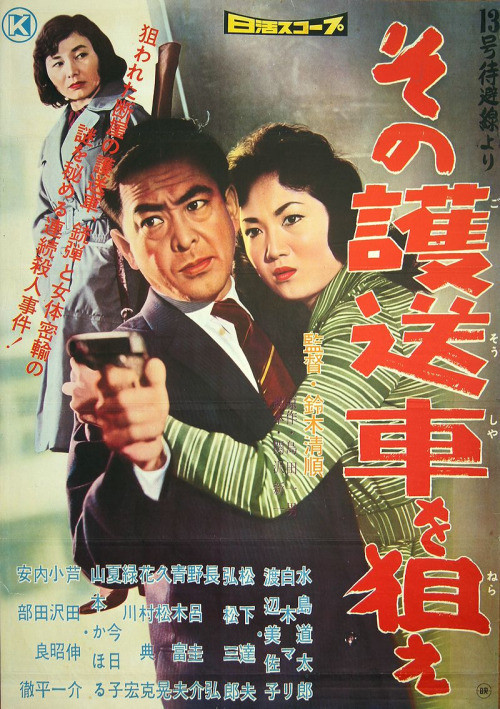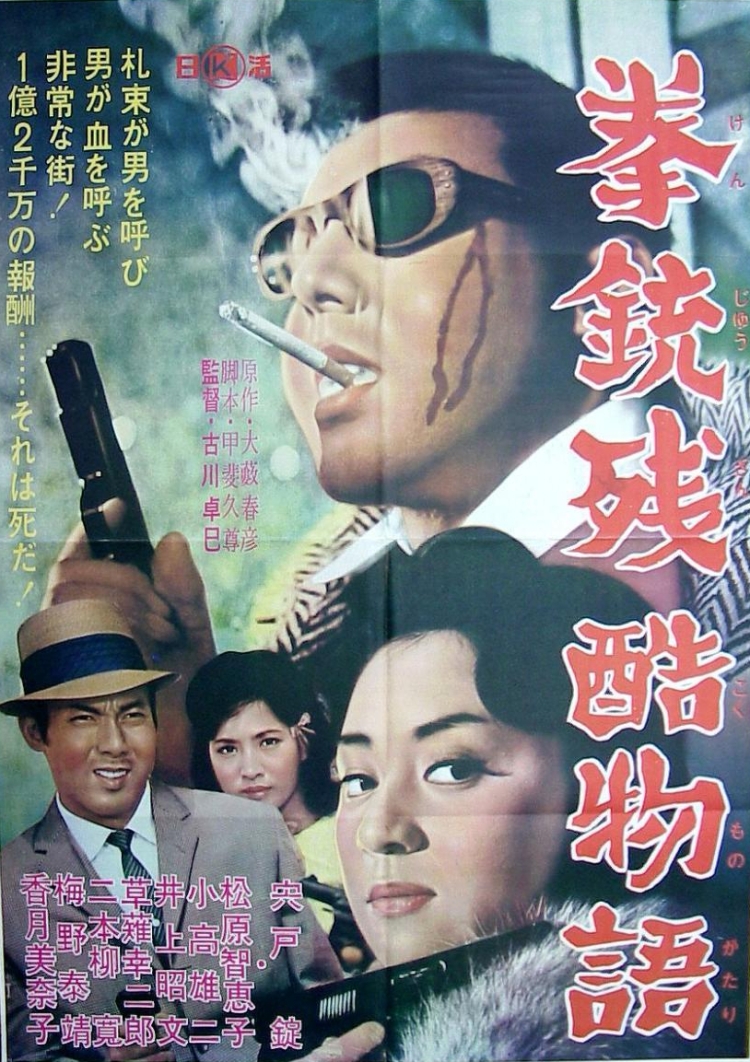
Take Aim at the Police Van (13号待避線より その護送車を狙え, Seijun Suzuki, 1960)

o0500070913581105946Nikkatsu’s main stock in trade during its 50s/60s heyday was the youth movie – films which captured the frustrations of being young (and usually male) in the scrappy post-war years. It’s a surprise then that the hero of Seijun Suzuki’s “action” movie Take Aim at the Police Van (13号待避線より その護送車を狙え, Jusango Taihisen Yori: Sono Gososha wo Nerae) is a genial middle-aged man who’s more Cary Grant in North by Northwest than Japanese James Dean. A programme picture, there’s nothing particularly interesting about the movie on paper but it’s among the first in which Suzuki indulges his talent for the surreal including a number of fantastically choreographed action sequences.

The film opens with a warning as a sniper trains his sights on a set of road signs which state that many accidents have occurred in this area. The one which is about to befall unlucky prison warden Tamon (Michitaro Mizushima) is however entirely man made. Momentarily confused by the figure of a woman watching the bus from the roadside, Tamon is blindsided when the sniper opens fire and kills several of the passengers while another, Goro (Shoichi Ozawa), cowers in the back. Tamon is suspended for six months but isn’t particularly upset about it. He’s not a detective and he knows he should leave it to the professionals, but he’s desperate to know why someone would bother attack such a lowly crew of petty criminals. Wondering who the woman was and how she fits into the case, who the snipers were aiming for and if they got them, and perhaps wanting to assuage his own feelings of powerlessness during the attack Tamon gets on the case.

Tamon is not your typical Nikkatsu action hero. He’s a little on the old side for starters – hardly the marquee face the studio was beginning to favour with its collection of “Diamond Guys”. He’s also not a policeman or a detective, he has no idea what he’s doing or what he’s getting himself into. What Tamon is is a righteous man. Almost immediately he’s sucked into the seedy underbelly of late ‘50s Tokyo with its strip clubs, trafficked women, and petty gangsters. This world is alien to him and he’s disgusted by it. Meeting the female manager of the “talent agency” which supplies in-room strippers to sleazy hotels where businessmen go when they’ve told their wives they’re at a conference, Tamon is horrified to hear her admit she thinks of the girls as “merchandise”. He pauses to explain to her that he always thought of the felons he looked after as “humans” rather than “criminals”, no matter what it was they’d done. Such naive humanitarianism is too much for Yuko (Misako Watanabe) – she’s instantly smitten, which is a problem because it means she needs to play both sides of her own game.

The pair end up in an uneasy alliance as Tamon’s goodness begins to work its magic. An unlikely white knight, Tamon finds himself wanting to save all the ladies threatened by “Akiba’s” dastardly plan from the icy charms of Yuko to Goro’s cabaret girl Tsunako (Mari Shiraki), and another young one, Shoko (Kyoko Natsu), about to get sucked into the Akiba web. What he discovers is a nasty trail of exploitation running from the bars and clubs of the city centre to the genial holiday spa towns where the moderately wealthy travel to pursue their discrete pleasures.

Tamon may be a little older than your average Nikkatsu action star, but he’s also a perfect fit for a film noir hero in wrong man mould. Tamon is not on the run, but he is out of place in this world, perhaps harking back to a presumably more innocent age where honesty and compassion still counted for something. He views his job as a prison warden as a public service, believing that there is goodness in everyone and it’s the job of people like him to find it and bring it to the surface. This he does at least seem to accomplish with Yuko who (despite her role in events so far) seems to have “reformed” and intends to follow Tamon’s lead in taking her “talent agency” in a more legitimate direction. 

Suzuki often claimed that Youth of the Beast was the first of his films where he was able to fully embrace his madcap desires, but Take Aim at the Police Van contains a fair few Suzuki touches of its own from the bold opening sequence shot through the sights of a sniper rifle, to the show girl killed by an arrow to her bare breast, bizarre murder by petrol tanker set piece, and exciting train station finale. Keeping the camera fluid, Suzuki captures a world in motion, seemingly running away from our noble hero until justice, in the form of an unstoppable steam train, finally arrives.


Attack on the police van clip (English subtitles)

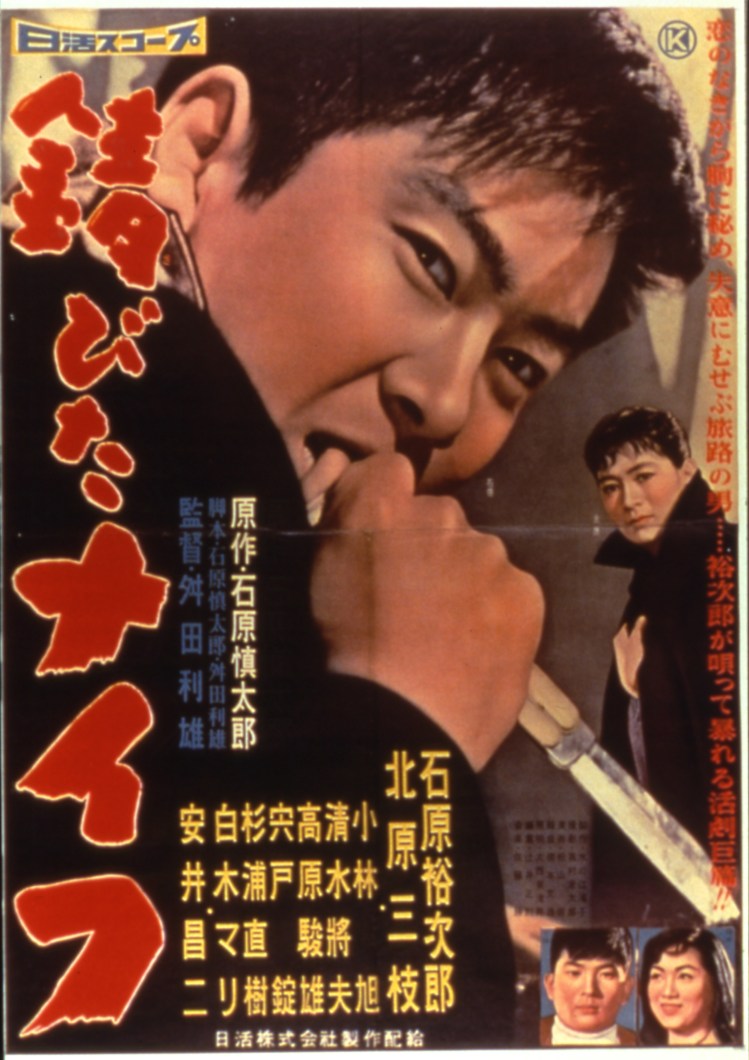
Rusty Knife (錆びたナイフ, Toshio Masuda, 1958)

rusty knife posterPost-war Japan was in a precarious place but by the mid-1950s, things were beginning to pick up. Unfortunately, this involved picking up a few bad habits too – namely, crime. The yakuza, as far as the movies went, were largely a pre-war affair – noble gangsters who had inherited the codes of samurai honour and were (nominally) committed to protecting the little guy. The first of many collaborations between up and coming director Toshio Masuda and the poster boy for alienated youth, Yujiro Ishihara, Rusty Knife (錆びたナイフ, Sabita Knife) shows us the other kind of movie mobster – the one that would stick for years to come. These petty thugs have no honour and are symptomatic parasites of Japan’s rapidly recovering economy, subverting the desperation of the immediate post-war era and turning it into a nihilistic struggle for total freedom from both laws and morals.
Public support is, largely, behind this new force of order as seen in the local uproar when top gangster Katsumata (Naoki Sugiura) is arrested in connection with an assault. Things being what they are, Katsumata is soon released to laugh at law enforcement from a safe distance but the past is coming for him. Some years ago Katsumata killed a local councillor, Nishida (Ikunosuke Koizumi), and made it look like suicide but three guys from a local gang saw him do it. He paid them to keep quiet, but now one of them feels like talking and thinks Katsumata might like to pay a little more to reseal the deal.

Chatty Tokyo thug Shima (Jo Shishido) gets pushed off a train for his pains but Katsumata is worried enough about the other two to send his guys out to make some enquires. He’s particularly worried about Tachibana (Yujiro Ishihara) – a “sleeping lion”, Tachibana is a hot head who’s now gone straight after coming out of jail for murdering a guy he thought was a direct cause of his girlfriend’s death. Luckily enough, Tachibana now runs a bar where he employs the other witness, Terada (Akira Kobayashi), to whom he acts as a stern big brother hoping to keep them both on the straight and narrow. Tachibana is unlikely to talk, he wants out of the gangster world for good, but Terada is young and ambitious with a girlfriend to impress. He takes more hush money from Katsumata, not realising what he’s getting himself into, and then lets it go to his head.

Tachibana is the rusty knife of the title. After letting his rage consume him in murdering a petty mobster in revenge for the rape of his girlfriend who later committed suicide, Tachibana has vowed to quell his anger and live a decent, peaceful life. Angry outbursts are, however, never far from the surface and following recent revelations, a rusty knife may find its cutting edge once again.

Keiko (Mie Kitahara), a customer at Tachibana’s bar, is making a documentary about violence in the city which coincidentally turns up a few clues as to Tachibana’s past, not to mention her own. The daughter of the murdered councilman, Nishida, and the niece of another powerful politician, Keiko is a figure of righteousness, charting her own course through the difficult post-war world and attempting to do so with dignity and elegance while refusing to abandon her sense of decency and compassion. Later a real life married couple, Kitahara and Ishihara were a frequent on screen romantic pairing though this time around the connection is more subtle as Keiko begins to sympathise with Tachibana’s plight and commits herself to saving him from destroying himself in becoming consumed by his barely suppressed rage.

Tachibana is indeed raging, though his rage is understandable. As someone later puts it “nothing in this city makes sense”. The systems are corrupt, the wartime generation continue to run the show and run it badly, or at least for their own ends, robbing youth of its rightful place at the forefront of economic recovery. Yet even if Ishihara is a symbol of youthful alienation, his rage is one which must be quelled. Even in this city where nothing makes sense, self control is one’s greatest weapon. If youth is to walk forward into the exciting post-war future, it will have to drop its rusty knives.


Original trailer (English subtitles)

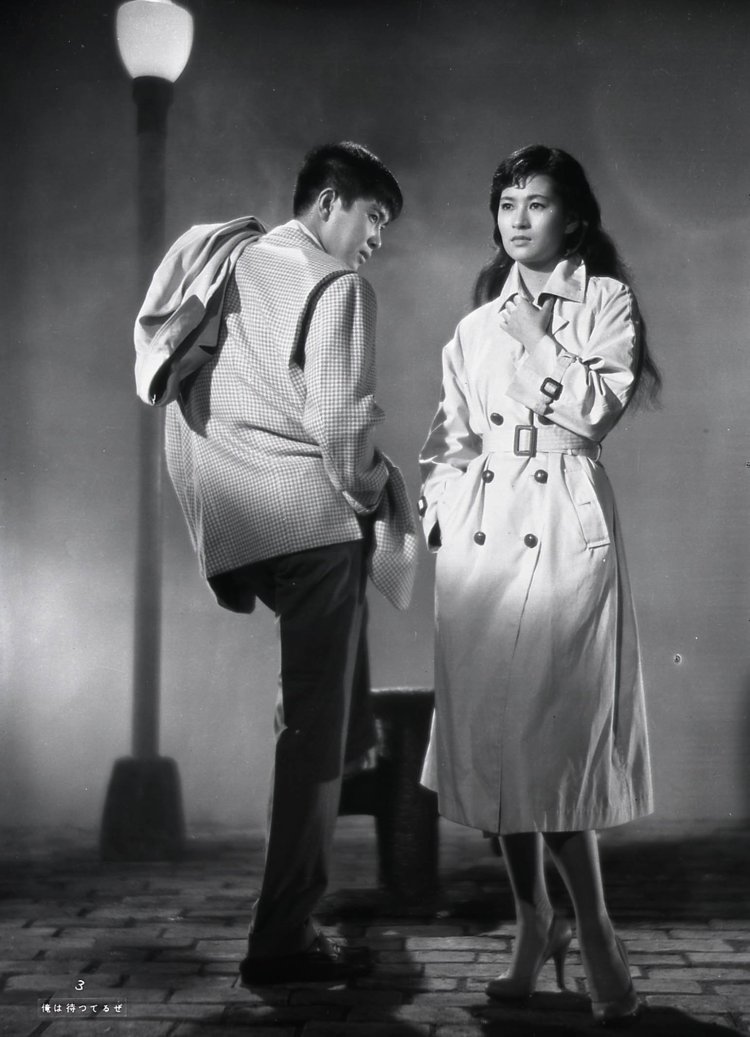
I Am Waiting (俺は待ってるぜ, Koreyoshi Kurahara, 1957)

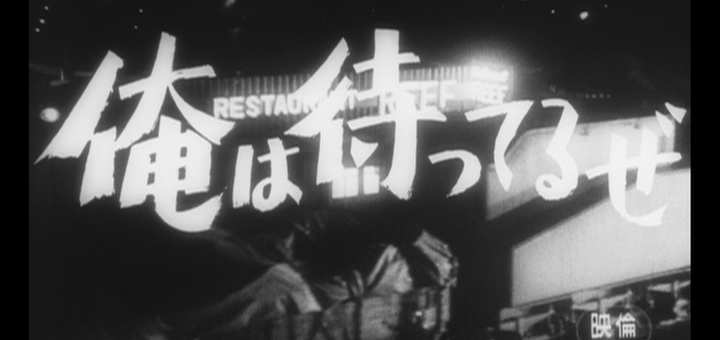
img_0Return to sender – address unknown. For the protagonists of I Am Waiting (俺は待ってるぜ, Ore wa Matteru ze), the debut feature from Koreyoshi Kurahara, all that’s left to them is to wait for uncertain answers, trapped in the limbo land of the desolate post-war landscape. With nothing to hope for and no clear direction out of their various predicaments, the pair bide their time until something, good or bad, comes for them but luckily enough what finds them is each other and suddenly a path towards resolution of their troubles. Reuniting newly minted matinee idol Yujiro Ishihara and future real life wife Mie Kitahara fresh off the red hot success of the youth on fire drama Crazed Fruit, I Am Waiting is an altogether more melancholy affair set in the down and out depression town of the American film noir.

One fateful night, Joji Shimaki (Yujiro Ishihara) steps out onto the Yokohama Harbour clutching a letter he nervously drops into a post-box, but is struck by the figure of a distressed young woman hanging around ominously close to the water’s edge. For reasons he doesn’t quite understand, Joji approaches the woman and convinces her to come back with him to the small cafe he runs right by the railway line. The girl, Saeko (Mie Kitahara), confesses to him that she thinks she may have killed a mobster who was making the moves on her and has no idea what to do now. Joji suggests she hide out with him, check the morning paper for news of a body, and then figure out the rest later. Left with no other options, Saeko agrees but it seems the past has a hold on them both which not even Joji’s powerful fists will be able to break.

Joji has been “waiting” for a letter from his older brother, supposedly in Brazil buying farmland. “Brazil” has become Joji’s main escape plan, but while he waits and waits his Japan life stagnates. A former prize fighter, Joji has been fighting his past self for the past couple of years ever since he lost his temper and killed a man in a bar brawl. Joji is afraid of his rage, convinced that he’s no good, a toxic influence to all around him, which explains why he’s so often abandoned by those he loves. When the letters he’d been sending to Brazil start coming back “no such person”, he fears the worst – that his brother has run off with their money and started a new life on his own without him.

In a noirish coincidence, Joji’s fate is bound up with that of melancholy nightclub singer Saeko. Once a respected opera singer, Saeko has been relegated to jazz cabaret in seedy harbour bars after losing her voice to illness and having her heart broken by her singing teacher whose affections were not as true as he claimed. “A canary that’s forgotten how to sing”, Saeko fears that her life is already over, there will be no escape from the gangsters who claim to own her and the only path left to her is the one she ruled out taking when she bopped the shady mobster on the head with a nearby vase. Saeko had no escape plan because she thought escape was impossible, but the unexpected nobility of a man like Joji has begun to change her mind, if only Joji’s heart weren’t already so battered and bruised.

Joji’s bar, the Reef Restaurant, is the gathering place for the battered and bruised. Located right on the railway line, it’s a literal waiting room through which pass all those who aren’t quite sure where they’re going. Everyone here is nursing the wounds of broken dreams – Joji’s chef used to be racing driver until he got injured, the doctor is a drunk, Joji’s an ex-boxer with anger issues, and Saeko’s a bird with a broken wing. This is not the departure lounge, it’s arrivals – the end of the line when there is no place else to go.

Still, a waiting room is a place you can choose to leave, no one has to wait forever. In meeting Saeko, Joji has already begun to move forward even if he doesn’t know it. Suddenly giving up on their melancholy passivity, the pair spur each other on towards a killer finale which offers them, if not exactly a way out, a possibility of a better life having resolved to leave the past in the past and reject its continuing hold over them. Kurahara co-opts the fatalism and lingering existential angst of the film noir with its rolling fog and permanent drizzle clouding the darkened horizons for our two pinned protagonists who relive their most fearful moments with the force of silent movie scored by the intense jazz soundtrack suddenly turned up to 11. An important missive to the post-war young, I Am Waiting offers the message that the past can be beaten, but only once one comes to believe in the existence of the future and makes a decision to walk towards it rather than waiting for it to arrive unbidden.   


Clip (English subtitles)

Youth of the Beast (野獣の青春, Seijun Suzuki, 1963)

youth of the beast posterSeijun Suzuki had been directing for seven years and had made almost 20 films by the time he got to 1963’s Youth of the Beast (野獣の青春, Yaju no Seishun). Despite his fairly well established career as a director, Youth of the Beast is often though to be Suzuki’s breakthrough – the first of many films displaying a recognisable style that would continue at least until the end of his days at Nikkatsu when that same style got him fired. Building on the frenetic, cartoonish noir of Detective Bureau 2-3: Go to Hell Bastards!, Suzuki once again casts Jo Shishido in the the lead only this time as an even more ambiguous figure playing double agent to engineer a gang war between two rival hoodlums.

Suzuki opens in black and white as the bodies of a man and a woman are discovered by a small team of policemen. Finding a note from the deceased female which states that she settled on taking her own life because she loved her man and thought death was the only way to keep him, the police assume it’s an ordinary double suicide or perhaps murder/suicide but either way not worthy of much more attention, though discovering a policeman’s warrant card on the nightstand does give them pause for thought.

Meanwhile, across town, cool as ice petty thug Jo Mizuno (Jo Shishido) is making trouble at a hostess bar but when he’s taken to see the boss, it transpires he was really just making an audition. The Nomoto gang take him in, but Mizuno uses his new found gang member status to make another deal with a rival organisation, the Sanko gang, to inform on all the goings on at Nomoto. So, what is Mizuno really up to?

As might be expected, that all goes back to the first scene of crime and some suicides that weren’t really suicides. Mizuno had a connection with the deceased cop, Takeshita (Ichiro Kijima), and feels he owes him something. For that reason he’s poking around in the local gang scene which is, ordinarily, not the sort of world straight laced policeman Takeshita operated in which makes his death next to a supposed office worker also thought to be a high class call girl all the stranger.

Like Detective Bureau 2-3: Go to Hell Bastards!, Youth of the Beast takes place in a thoroughly noirish world as Mizuno sinks ever deeper into the underbelly trying to find out what exactly happened to Takeshita. Also like Detective Bureau 2-3: Go to Hell Bastards!, Youth of the Beast is based on a novel by Haruhiko Oyabu – a pioneer of Japanese hardboiled whose work provided fertile ground for many ‘70s action classics such as The Beast Must Die and Resurrection of the Golden Wolf, but Suzuki’s ideas of noir owe a considerable debt to the gangster movies of the ‘30s rather than the moody crime dramas of twenty years later.

Jo Shishido’s Mizuno is a fairly typical ‘40s conflicted investigator, well aware of his own flaws and those of the world he lives in but determined to find the truth and set things right. The bad guys are a collection of eccentrics who have more in common with tommy gun toting prohibition defiers than real life yakuza and behave like cartoon villains, throwing sticks of dynamite into moving cars and driving off in hilarious laughter. Top guy Nomoto (Akiji Kobayashi) wears nerdy horn-rimmed glasses that make him look like an irritated accountant and carries round a fluffy cat he likes to wipe his knives on while his brother Hideo (Tamio Kawaji), the fixer, is a gay guy with a razor fetish who likes to carve up anyone who says mean stuff about his mum. The Sanko gang, by contrast, operate out of a Nikkatsu cinema with a series of Japanese and American films playing on the large screen behind their office.

The narrative in play may be generic (at least in retrospect) but Suzuki does his best to disrupt it as Mizuno plays the two sides against each other and is often left hiding in corners to see which side he’s going to have to pretend to be on get out of this one alive. Experimenting with colour as well as with form, Suzuki progresses from the madcap world of Detective Bureau 2-3: Go to Hell Bastards! to something weightier but maintains his essentially ironic world view for an absurd journey into the mild gloom of the nicer end of the Tokyo gangland scene.


Original trailer (no subtitles)

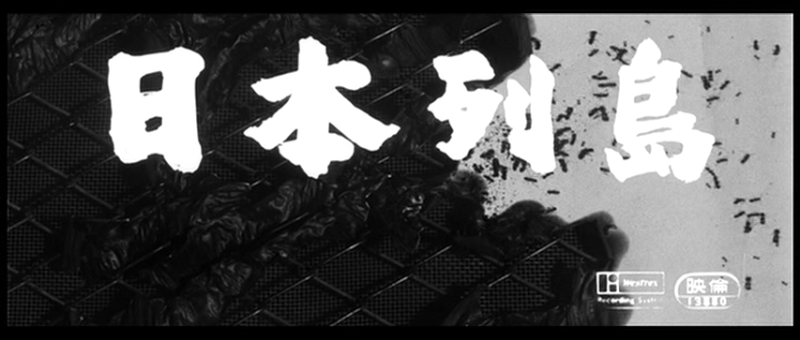
A Chain of Islands (日本列島, Kei Kumai, 1965)

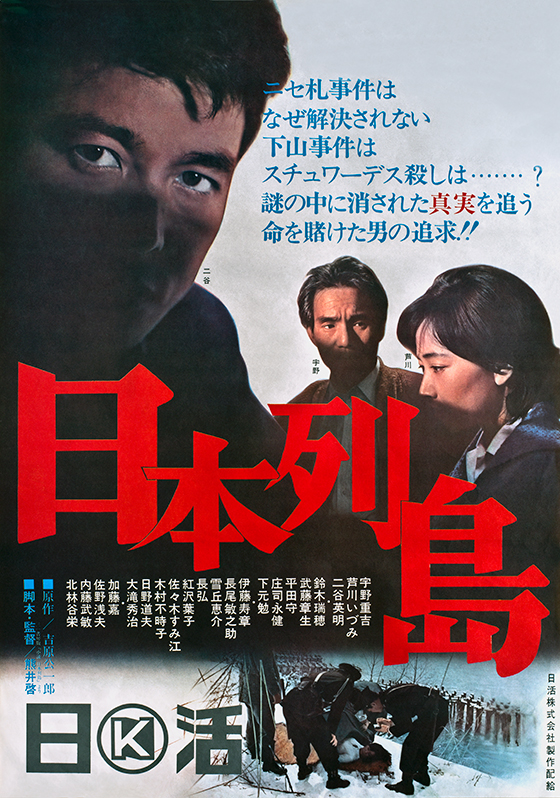
nihon retto posterKei Kumai made just 19 films films in his 40 year career, but even since his earliest days he ranked among the most fearless of directors, ready to confront the most unpleasant or taboo aspects of contemporary Japan. His first film, The Long Death, interrogated wartime guilt through drawing inspiration from a real life 1948 mass poisoning case in which materials manufactured in a Manchurian lab may have led to the deaths of post-war civilians. Having begun in this possibly controversial vein, Kumai pressed on with 1965’s A Chain of Islands (日本列島, Nihon Retto, AKA The Japanese Archipelago) which he set in 1959 as Japanese youth protested the renewal of the ANPO treaty which placed Japan under the military protection of the American Armed forces in return for allowing the presence of those forces on Japanese soil.

Despite the contemporary setting Kumai opens with a explanatory voice over detailing the depth of the American military presence and the function of the CID which exists solely to investigate crimes committed by American servicemen. The CID is staffed by both Americans and Japanese nationals who, the voiceover explains, often feel conflicted in stepping onto American soil each morning as prolonged exposure gradually erodes their sense of difference and finally of “Japaneseness”. Akiyama (Jukichi Uno) is a translator/investigator at CID and he’s about to be handed an unusual request from his boss – reopen a cold case from the previous summer in which an American Sergeant was found floating in Tokyo bay. Akiyama’s new boss was a friend of the late soldier and would like to know what happened.

Akiyama’s investigations lead him down a dark path of corruption, murder, conspiracy, and governmental complicity. Beginning to investigate the case, Akiyama discovers that nothing is quite as it seems. A couple of policeman from the original investigation arrive to help him and echo their frustrations with the way the case was handled. Despite the police investigation, the American authorities did their best to interfere – commandeering the body and claiming jurisdiction in contravention of Japan’s standing as a sovereign nation. The Americans are no longer occupying forces but honoured guests who should obey international protocol in cases like these, but they rarely do. Despite the existence of the CID, crimes by American servicemen are generally covered up as the military insists the matter will be dealt with internally only for suspects to be suddenly “transferred” overseas.

Sgt. Limit was, however, one of the good ones and Akiyama’s investigation seems to point towards a murder and cover up instigated because Limit had got too close to the truth in investigating a sudden flood of counterfeit cash. The Americans, to the surprise of all, are only the middle man in the grand conspiracy which leads right back to the dark heart of Japan and the vast spy networks operated during the militarist era. As might be expected, these valuable networks are left wide open with the collapse of Japanese fascism but are perfectly primed to facilitate widespread crime spanning the Asian world and all with the tacit approval of the American and Japanese states.

Kumai also implicates the spy ring in a series of “mysterious” rail incidents, but makes sure to reserve some of his ire more the more usual injustices. Akiyama is caring for his young nephew whose father was killed in mining explosion which has claimed the lives of nearly every young man in the village leaving his sister unable to cope with her children alone. He is also battling a personal tragedy which is intensely connected to his decision to join CID which is currently inundated with cases of rape and murder in which American servicemen are implicated. The “foreign” becomes suspect but mostly for its hypocrisy as in the Catholic priest who becomes a major suspect in subverting the legitimate devotion of a Godly woman who only sought to live under the Christian teachings of love and kindness, while the American forces claim to stand for honour and justice but actively facilitate organised crime at an interstate level to further the progress of Capitalism whilst also facilitating civil unrest in volatile nations for financial and political gains.

That all of this happens immediately before the renewal of the ANPO treaty is no coincidence and Kumai even includes aerial footage of the mass protests filling the streets around the Diet building as the youth of Japan question why their nation has seen fit to make itself so complicit in the questionable foreign policy of another country. The outcome looks bleak for our protagonists who discover themselves to be mere pawns at the mercy of greater forces which cannot be circumvented or denied, but just as it all looks hopeless a new hope arises. Pledging to fight harder and continue the work which has been started, those left behind dedicate themselves to equipping the young with the tools to build a happier, fairer world in contrast to the one they seem primed to inherit from those who should know better. The final sequence shows us a young woman walking gloomily past the Diet building which seems to be looming over her as a veritable symbol of oppression but then her face brightens, her step quickens and she leaves the Diet far behind to walk forward towards the work which awaits her. 


A comprehensive overview of the 1960 ANPO protests.

Antiporno (アンチポルノ, Sion Sono, 2016)

Antiporno posterIf freedom exists in Japanese cinema, it exists only through sexual liberation. Only in this most private of acts can true individual will be expressed. Sion Sono, ever the contrarian, wants to ask if that very idea of “freedom” is in itself oppressive and he’s chosen to do that through his contribution to the Roman Porno Reboot Project in which five contemporary directors attempt to recreate Nikkatsu’s line in ‘70s soft-core pornography.

Opening in a room of bold primary colours – the sunlit walls of the yellow bedchamber and the garish red of the doorless bathroom, Sono homes in on the figure of Kyoko (Ami Tomite) who lies face down on a bed with her underwear around her ankles. She seems somehow broken and exhausted, staring into a piece of glass from a shattered mirror and making ominous statements to herself. Suddenly her mood changes, no longer the maudlin woman she transforms into the cute and quirky high schooler so beloved of certain genres of Japanese entertainment. When her assistant arrives, Kyoko delights in humiliating her, forcing Noriko (Mariko Tsutsui) to crawl around on all fours wearing a dog collar and then ordering her to allow herself to be raped by an (all female) team of newspaper reporters.

So far, so Petra von Kant, but Sono doesn’t stop here. He shows us that this brightly coloured room is a stand-in for Kyoko’s fracturing psyche, a failed attempt to order her chaotic world. Someone shouts “cut” and we’re on a film set – roles are reversed, Kyoko is no longer in control. Her memories enter free fall as she flits between an awkward (possibly imagined) childhood, and her present predicament as, alternately, plaything and dominatrix.

The roots of Kyoko’s confusion stem back to the contradiction in her parents’, or really her society’s, attitude to sex. During a very strange family dinner, Kyoko and her younger sister have a frank discussion with mum and dad about male and female genitals and how they fit together. The language is pointed, but Kyoko’s father has very clear ideas about what is obscene and what isn’t – “Cocks” are what men stick into prostitutes and they’re obscene, but he has no sensible answer when pressed on how exactly “cocks” and “male genitalia” can be all that different. Her parents tell her sex is indecent and shameful while continuing to talk about their own sex life openly and refusing to shield their daughters from their obvious appetites. They offer no answer for this continuing paradox, only the affirmation that Kyoko’s desires are “indecent” and must be rejected.

Kyoko’s sister finds her freedom in another way, but Kyoko pursues hers through sexuality, looking for a connection in midst of true liberation. She wants to become a “whore” which the adult version of herself describes as “a woman so pure it breaks her own heart”, but what she’s looking for is the freedom which eludes her in her day to day living. Kyoko and later Noriko repeat the mantra that they will dismantle the “annoying freedoms which restrict me”,  lamenting that there is no freedom of speech in a country like Japan and that no woman has ever been able to attain their own freedom in a world entirely controlled by men. A protest against the renewal of the ANPO security treaty runs on the TV while Kyoko’s sister holds up a book of butterflies, exclaiming that all the free things fly away. The women of Japan, according to Noriko, praise free speech but reject their own freedom, forced to chase false liberations and endlessly allowing themselves to be manipulated by a culture they themselves willingly create.

The fly away butterflies hit the ceiling, and Kyoko’s captive lizard cannot escape its bottle. Sono seems to suggest that there is no true freedom, that the very idea of “true freedom” as mediated through the idea of sexual liberation is itself another fallacy used to manipulate women into doing what men want. Kyoko ends up in a “Roman Porno” to empower herself, but is disempowered by it – rendered an anonymous object trapped inside an entirely different kind of tube. Blinded by colours and memory she searches for an escape but finds none, groping for the mechanism to set herself free from the delusion of liberation but grasping only empty air.


Antiporno is available to stream in the UK via Mubi until 8th January and will be released on blu-ray by Third Window Films in April 2018.

Original trailer (English subtitles)

The Eternal Breasts (乳房よ永遠なれ, Kinuyo Tanaka, 1955)

(c) Nikkatsu 1955

(c) Nikkatsu 1955Having made her directorial debut for Shin Toho with the beautifully drawn post-war romantic melodrama Love Letter scripted by Keisuke Kinoshita, and then moving on to her second film after being accepted as a career director at Nikkatsu – the Ozu scripted humorous romantic family drama The Moon Has Risen, Tanaka chose to work with female script writer Sumie Tanaka (no relation) for a tale of female resilience and resistance in the face of extreme suffering. Fumiko Nakajo was a real life figure who had died of breast cancer at the age of 31 in 1954. The Eternal Breasts (乳房よ永遠なれ, Chibusa yo Eien Nare) , a biopic of sorts, was released in 1955, barely a year later but makes no concession to the recency of Nakajo’s passing in examining both the still taboo subject of breast cancer and the effects of the disease and its treatment on the heroine who, arguably, finally learns to become herself through battling her illness.

Fumiko Shimojo, née Nakajo, (Yumeji Tsukioka) is the wife of a grumpy, resentful stock broker and the mother of their two children, Noboru and Aiko. It’s clear that things in the Shimojo household are far from peaceful with the discord between husband and wife a talking point throughout the local community. Despite her husband’s claims to the contrary, Fumiko is the dutiful “good wife” of the period, trying hard to make her marriage work even in the face of her husband’s ongoing resentment and thinly veiled inferiority complex given Fumiko’s slightly elevated class credentials and education. To get away from her disappointing home life Fumiko has joined a local poetry circle specialising in tanka and is well known for the gritty realism of her poems in which she expresses all of her suffering and unhappiness in regards to life with her husband. When she comes home early one day and finds a woman dressed in kimono entertaining her man, she decides it’s time for a divorce, reverts to her maiden name of Nakajo, and goes back to live with her mother and soon-to-be-married brother, regretting only that her husband insists on custody of their son, Noboru.

The early part of the film deals with the equally taboo subjects of divorce and family breakdown as Fumiko struggles to adjust to her life as a single mother as well as coming to terms with being separated from her son. Though she is often approached by matchmakers and encouraged to remarry, her experience of married life has left her reluctant to commit to a second round of matrimonial subjugation. Her mother, whom she partly blames for pushing her into a marriage she never wanted in the first place, and her brother are fully on her side as are her friends, the Horis – a Christian couple who champion her poetry and act almost as a set of second parents despite being only a little older than she is.

Released from matrimonial shackles, Fumiko is free to embrace her life as a poetess even if she never dreams of any kind of literary success. As the tactless women at the poetry circle put it, pain is good for art and it’s certainly true that each advance in Fumiko’s fortunes is accompanied by emotional suffering. Struggling to cope with the divorce and the children, Fumiko neglects chest pains and a strange feeling in her breast only to keel over when an unpleasant woman arrives to reclaim Noboru with whom she thought she’d finally been reunited.

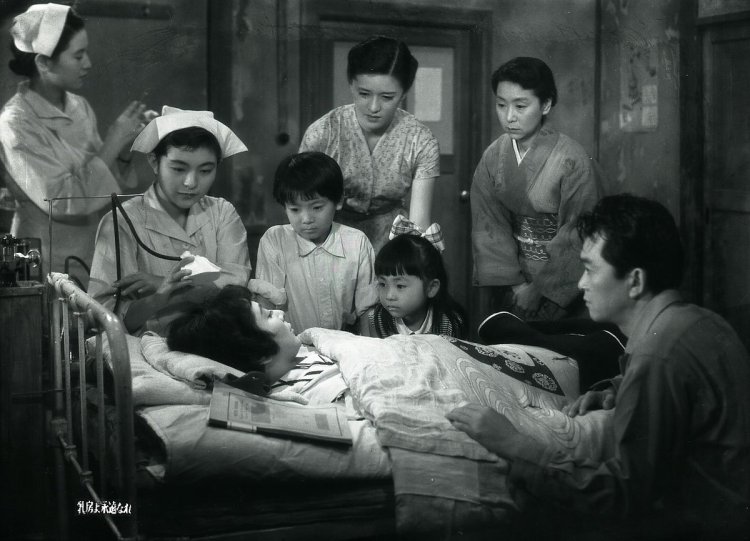
Diagnosed with late stage breast cancer, Fumiko undergoes a double mastectomy. Refusing to shy away from the medical consequences, Tanaka films the surgery as a kind of fever dream as the bright surgery lights loom over Fumiko whose breasts appear in full view as the surgeons prepare to do their work. The loss of Fumiko’s breasts results in one of her most famous poems, published in a national newspaper, but the physical and emotional consequences are not so easily defined. Before her illness we’re constantly told that young Fumiko was a “tom boy”, and at times it appears as if she has been unsexed after being shorn of her femininity. According to her brother, however, Fumiko has become more like a child – something that rings true as she gaily sings in the bath and almost delights in shocking her friend by flashing her surgery scars unannounced. Mrs. Hori, Kinuko (Yoko Sugi), generally a kind and progressive sort, can hardly bear to look and is unwilling to engage with the physical reality of Fumiko’s condition as much as she would like to help her.

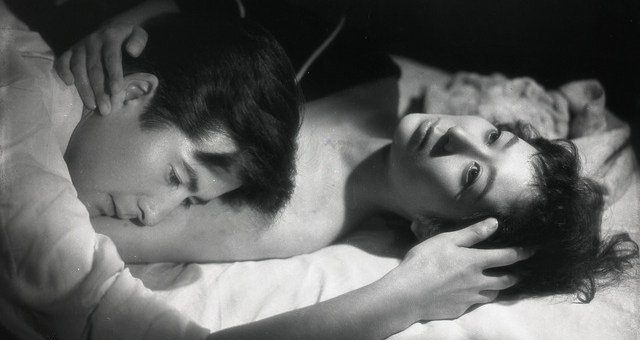
Despite proclaiming that at least she won’t be bothered with marriage proposals anymore, Fumiko’s “unsexing” appears to have the opposite effect in reawakening and intensifying her sense of desire. Earlier on, post-divorce and hiding out from her brother’s wedding at which she feels an awkward guest, Fumiko visits Hori (Masayuki Mori) and confesses her love for him though she knows nothing will come of it. Her love is, however, pure – she also loves and respects Hori’s wife Kinuko safe in the knowledge that Kinuko makes Hori happy. After her operation she returns to the Hori’s home and asks Kinuko to run her a bath so that she can bathe in the same water as her beloved – confessing to her friend that she had been in love with her husband. Kinuko seems to know already and is sympathetic, if a little embarrassed. This same boldness later manifests itself in Fumiko’s last great act of passion in which she embarks on a brief yet intense affair with the journalist (Ryoji Hayama) who is covering her career for a paper in Tokyo.

Fumiko’s relationship with the reporter is originally compromised by his overly gloomy copy which proclaims that her death is only a matter of time (then again, for whom is that not true?). Fearing that her death is being fetishised, that no one would be giving her a second glance if she were not dying, Fumiko refuses to write or have visitors. Just as she was “imprisoned” within her marriage, she is now “imprisoned’ by death. As she puts it in one of her poems, the hospital ward is a gloomy place in which she’s often framed by bars – through the windows, through the footboard of her bed, even the hospital kimono she is wearing is patterned with tiny railings. In an eerie, dream-like sequence she wanders out of her room and follows a parade of wailing relatives as a body is wheeled away but just as she is about to leave the metal gate slides shut in front of her, trapping Fumiko like a ghost in the purgatorial world of the hospital ward as she realises that that same gate will be her only exit route.

The same image is repeated at the end of the film as Fumiko’s own bed is wheeled through the mortuary gates which slam shut across the eyes of her confused children who have been left entirely on their own and without a proper explanation of where their mum is going. Fumiko’s final poem is crushing in its anger and ambivalence as it instructs her children to accept her death as the only thing she has to bequeath them. This terrible legacy seems too cruel, condemning her children to a life of grief and mourning even as she instructs them to “accept” her passing. Yet it also speaks of the final contradictions of her character – loving mother and passionate woman, fierce poet and shy genius. Unlike the sickly heroines of melodrama, Fumiko does not always bear her suffering with saintly stoicism but rages, finally embracing the “true self” she only dared to express through her poetry, learning to live only in the knowledge that she must die.


Screened at BFI as part of the Women in Japanese Melodrama season.

Wet Woman in the Wind (風に濡れた女, Akihiko Shiota, 2016)

wet woman in the wind poster largeBack in the early ‘70s, Nikkatsu reacted to the gradual box office decline of Japanese cinema by taking things one step further than their already edgy youth output in rebranding themselves as a purveyor of softcore pornography known as Roman Porno. Unlike the familiar “pink film”, Roman Porno was made with the assets of a major studio behind it including better actors, production values, and distribution power but it still obeyed strict genre rules calling for speedy turnarounds, minimal running times and the requisite amount of nudity (to the permitted parameters) at set intervals. 45 years later Roman Porno is back in a series of films directed by some of today’s most interesting directors who attempt to recreate the genre anew for modern audiences whilst paying homage to the originals.

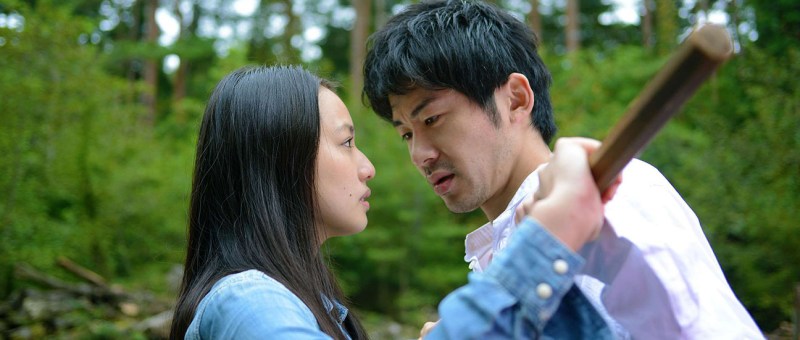
Akihiko Shiota’s Wet Woman in the Wind (風に濡れた女, Kaze ni Nureta Onna) starts as it means to go on with hapless protagonist Kosuke (Tasuku Nagaoka) sitting by a river looking sad just as a strange young woman suddenly rides her bicycle directly into the nearby lake before climbing out and stripping off her T-shirt (which, amusingly enough reads “you need tissues for your issues”), revealing her bare breasts to a complete stranger. Kosuke is baffled and confused. He tries to leave but the woman follows him, asking if she can stay with him tonight because she has nowhere else to go. Kosuke is resolved, he’s given up girls and wants nothing whatsoever to do with weird women from ponds but Shiori (Yuki Mamiya) is not one to take no for an answer.

It’s never made clear but something unpleasant has obviously happened to Kosuke that has made him retreat from the city with his tail between his legs (so to speak). A respected playwright, Kosuke seems to have had something of an existential crisis and has decided to condemn himself to a life of self-imposed isolation because “you have to be alone if you really want to think deeply about things”. His isolation is, however, only up to a point. Kosuke’s semi-primitive lifestyle sees him living in a shack in the woods but he has electric lighting provided by generator batteries and grinds his own coffee beans by hand after buying them from a local cafe owned by a man Kosuke went to university with but claims not to have known at the time. The cafe owner’s wife has recently left and he blames Kosuke for reawakening a desire in her that had apparently lain dormant with her husband.

In a shocking coincidence, Shiori has also taken a job at the cafe and has set about seducing the recently lonely owner who has now become fixated and jealous, once again afraid Kosuke in particular is going to steal away his new plaything just like he stole his wife. This is a fallacy on several levels, not least that Shiori is not a woman to be constrained by any man but a true free spirit who gives her love freely to whomever that she chooses.

Spirit might be the best way to describe Shiori who arrives and departs with the wind, a force of nature with the sole intent of freeing her targets of the burden of repressed desires. A radio broadcast later reveals that a tiger has been on the run from the nearby zoo and if this were a fable, you could almost believe the tiger to be Shiori, sinking her teeth into soft centre of human weakness and leaving right after she tears its throat out.

Free spirit as she is, Shiori does find herself in moments of danger as the the threat of sexual violence rears its ugly head. Kosuke likes to think of himself as an enlightened kind of man, an intellectual, but he’s also a self-involved womaniser not above attempting to force himself on a woman he feels to be his for the taking or, half in jest, threatening to rape a former lover. Yet for Shiori much of this is sport – she sees through Kosuke and neatly undercuts all of his self delusions and neuroses, but she’s also merely toying with him.

Finding himself literally kicked out of bed and rendered redundant when Shiori finds more pleasure in getting together with his former lover Kyoko, Kosuke wanders outside in confusion and seduces, with a degree of tenderness, Kyoko’s shy, bespectacled assistant, Yuko. When the morning comes, however, he feels he made a mistake. Yuko has become attached to him, sharing a traumatic childhood story only for Kosuke to brush it aside and encourage her to go out into the world to explore the rich pleasures on offer now that he has “awakened” her. Kosuke remains as self-centred as ever, but Yuko at least does perhaps find something in his words of “wisdom”.

As in all good sex comedy, the men are pathetic slaves to desires they find themselves unable to express, whether out of fear or cultural ideals of masculinity, while the women remain in control and must guide the men either towards a healthier outlook or their own destruction. Both Kosuke and the cafe owner conspire in their own downfall in misguided battles for possession or conquest. Having already suffered defeat, Kosuke has retreated from the field dejected and humiliated, but in his all out impassioned attempt to re-enter the world of carnality he literally brings his entire universe crashing down around his ears. Forced to realise his own ridiculousness, Kosuke is left alone with little else to do than survey the scale of the destruction his various delusions have wrought. A fun loving pastiche, Wet Woman in the Wind is an oddly whimsical tale, witty yet insightful even its seeming lightness.


Currently available to stream via Mubi.

Original trailer (English subtitles) NSFW!

Before We Vanish (散歩する侵略者, Kiyoshi Kurosawa, 2017)

©2017 BEFORE WE VANISH FILM PARTNERS

before we vanish posterKiyoshi Kurosawa is getting sentimental in his old age. In Journey to the Shore and Real, brokenhearted, left behind spouses went on long and difficult journeys of grief and salvation. In Before We Vanish (散歩する侵略者, Sanpo Suru Shinryakusha) we receive a visitation that presages our doom but wishes to know us before we go. An alien invasion movie which takes its cues from Invasion of the Body Snatchers and They Live, Kurosawa’s quirky drama is less about the enemy within than the hidden existential threat of a failure to understand oneself. As the Japanese title suggests, these invaders are merely out for a stroll, making time to smell the flowers before the big lawnmower arrives to cut them all down.

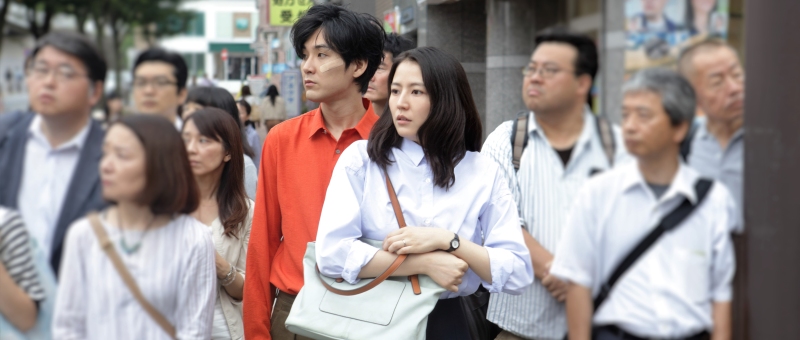
Strange events are afoot in Tokyo. A high school girl wanders home with a pair of goldfish in a plastic bag before brutally murdering her entire family, gazing at the scene of carnage with a beatific smile. Meanwhile, the estranged wife of Shinji Kase (Ryuhei Matsuda), Narumi (Masami Nagasawa), has been sent for to claim her presumably amnesiac husband from a medical facility. Shinji was brought in after wandering the streets cluelessly and seems to have lost certain sections of his memory. The doctor’s diagnosis is uncertain but leans towards some kind of temporary psychotic break or early onset Alzheimer’s. In any case, he is now Narumi’s responsibility, much to her consternation. Across town a down on his luck journalist (Hiroki Hasegawa) covering the brutal family murder finds himself the designated “guide” to another strange young man, Amano (Mahiro Takasugi), who seems to have done something very untoward to his parents.

These three “strangers” are really invaders from outer space – something which they freely confess to anyone who will listen, only everyone assumes they are joking. Exactly why they want to destroy the Earth is never revealed, nor is the the reason for the strange mission undertaken by the three researchers acting as the vanguard for the upcoming invasion. These three have been tasked with a thorough investigation of “humanity” in which they must learn and acquire certain “concepts”. They do this by requiring the subject to visualise their thinking behind a word or phrase and then tapping the head to pinch it causing that concept to be removed from the person’s interior cosmology.

The aliens learn as much from the effect of removing the concept as they do from its explanation. This being Japan, it’s not surprising that the first concept Shinji removes is that of “family” which he takes from Narumi’s younger sister, Asumi (Atsuko Maeda). Asumi had decamped to Narumi’s after an argument with her parents over their railroading her into a mainstream life she doesn’t really want. The removal of the concept of family means Asumi no longer needs to be bound by hollow obligation but her sudden coldness towards her sister immediately invites a series of other questions as to the true nature of their relationship. Similarly, Shinji removes a concept of “possession” from a young man. The young man does not immediately lose understanding of the word, but the concept ceases to be important to him. He is, in a sense, freed from the burden of materialism. Paying an unexpected visit to Narumi’s workplace and meeting her boss who, it seems, has just belittled her work on an important project after she rebuffed his attempt at sexual harassment, Shinji removes his concept of “work” leading him to play aeroplanes all around the office like an overexcited child.

There are positive effects of losing some of these centrally held ideas even if their loss seems tragic or painful on the surface. They are, however, what make us human whether that be attachment to family or an irrational desire to devote all to work and ceaseless acquisition. The final, most elusive concept is that of love – something alien and fascinating to the visitors which they find impossible to harvest due its essentially nebulous nature. Despite being part of a uniform hive mind, the invaders have each developed unique personality traits as a consequence of their “human” lives – the schoolgirl craves violence and destruction, Amano fatherly friendship, and Shinji something close to love with his own “guide” in the form of Narumi whose love for her husband apparently endured despite his betrayal.

Far from the gloomy nihilism of Pulse in which death is eternal loneliness, Before We Vanish suggests that what will survive of us is love. Salvation does, however, require a sacrifice which provokes the film’s romantic conclusion in which the absence of love becomes the “eternal loneliness” promised by Pulse but is tempered by patience and devotion. A gleefully absurdist exploration of the human soul, Before We Vanish finds Kurosawa at his most optimistic affirming the power of the human spirit at its most indestructible.


Screened at the London East Asia Film Festival 2017.

International trailer (English subtitles)

Alone Across the Pacific (太平洋ひとりぼっち, Kon Ichikawa, 1963)

Alone Across the PacficKon Ichikawa made two sorts of movies – the funny ones and the not so funny ones. Despite the seriousness of the title, Alone Across the Pacific (太平洋ひとりぼっち, Taiheiyo hitori-botchi) is one of the funny ones. Like many of Ichikawa’s heroes, Horie is a man who defies convention and longs for escape from the constraining forces of his society yet is unable to fully detach himself from its cultural norms. Based on the real life travelogue of solo sailor Kenichi Horie, Alone Across the Pacific is less the story of a man battling the elements, than a cheerful tale of a man battling himself in a floating isolation tank bound for the “land of the free”.

Kenichi (Yujiro Ishihara) is a strange man. He has few friends (aside from the family dog, Pearl) and is obsessed with the idea of running away to sea. Inspired by the tales of other intrepid sailors, his dream is to sail all alone across the Pacific Ocean from Osaka to San Fransisco. Despite the fact that it is illegal for small boats to leave Japanese waters (and that he is too impatient to wait for his passport to come through), Kenichi has custom made his own yacht, one without an engine, and has set off on his longed for voyage under the cover of darkness.

Rather than filming Kenichi’s journey naturalistically, Ichikawa opts for an adventurer’s tale as Kenichi provides an ironic voice over detailing some of his naive failings as a rookie sailor undertaking such a daunting mission. Each of Kenichi’s crises links back to a memory from his shore life, reminding us why he’s on this journey in the first place. Kenichi’s struggles are the same as many a young man in post-war Japan and, in fact, many of those previously played by the poster boy for youthful rebellion, Yujiro Ishihara.  Unwilling to live a life hemmed in by the predetermined path of a job for life, wife, children and total social conformity, Kenichi longs to be free of his cultural baggage by abandoning his civility during a long process of isolation therapy free of overbearing fathers, fretting mothers, indifferent sisters and a generally noisy world.

Kenichi’s father (Masayuki Mori) is the very personification of authority, berating his son for his fecklessness and pointless obsession with sailing – a sport a working class boy like Kenichi can barely afford. Kenichi’s determination to achieve his goal sees him leave school early, take a job in his father’s workshop only to quit suddenly for a more lucrative one delivering luggage for a travel agents, and quitting that too to work full time on his boat. While his father huffs and puffs his mother (Kinuyo Tanaka) worries, hoping her mad son won’t really go through with it but knowing that he will.

When Kenichi finally reaches San Fransisco, he’s assaulted by congratulatory voices from all directions. Towed into harbour by a motor boat, Kenichi first has to deal with mundane problems like the customs patrol wanting to know if he’s got any fruit left on the boat before a crowd gathers to shake his hand asking where he’s come from and why, what he wants to do now, and praising him for his daring feat of solo sailing glory. In Japan however, things are different. Dragged out for an interview by the press, Kenichi’s worried mother avows that she’s just happy to know her son is safe while his father bows deeply and reassures everyone that he will absolutely put a stop to any such random acts of individualism his wayward son may attempt in the future. 

Kenichi evades the twin pulls of his mother’s apron strings and his father’s handcuffs by taking off alone but even at sea he’s never free of his cultural programming, checking the wide empty ocean before removing his clothes and then stepping back down into the cabin to finish the job. Kenichi’s failure to acquire a passport is an ironic one seeing as part of what he’s running from is being Japanese but even as his quest is one for self determination it is also intensely selfish and self involved. In this Kenichi commits the ultimate act of individualism, caring nothing for the thoughts and feelings of others in the all encompassing need to achieve his goal. Kenichi may have found a home at sea, but on land he’s caged once again, a prisoner both of social conformity and his own need to defy it.


Available on R2 DVD from Eureka Masters of Cinema.

Original trailer (no subtitles)