Dirty Ho (爛頭何, Lau Kar-leung, 1979)

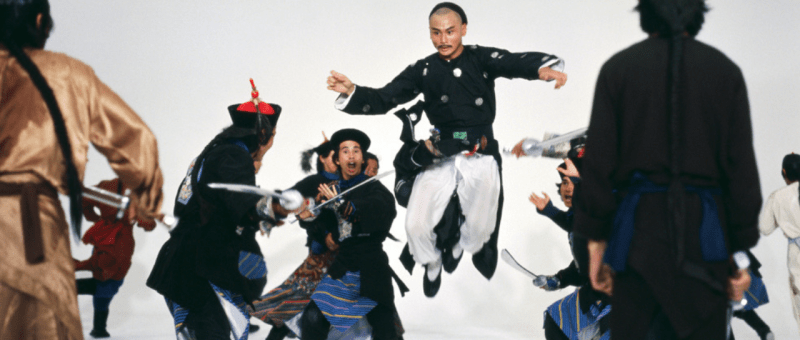
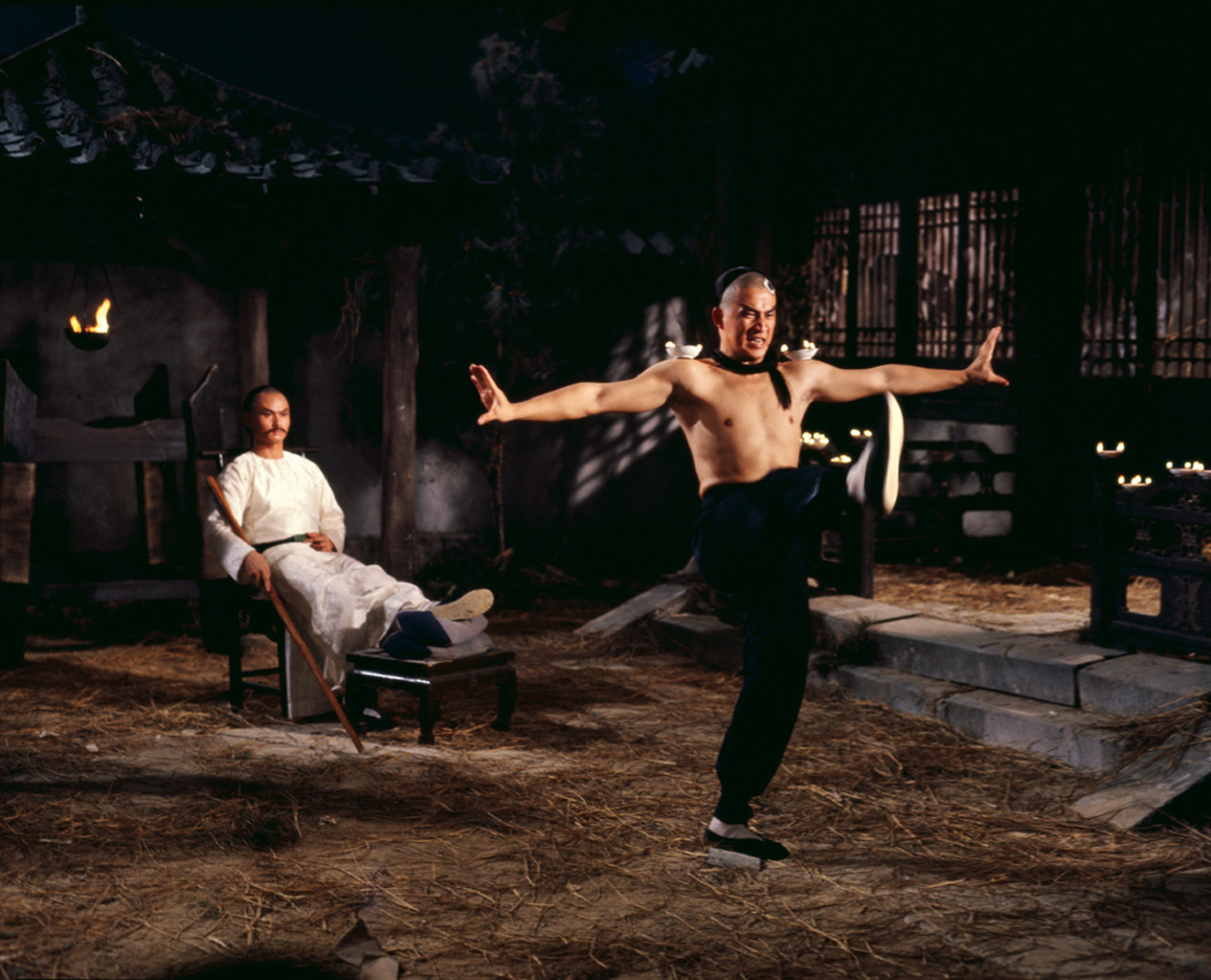
A prince in hiding develops a fondness for a bumbling jewel thief in Lau Kar-leung’s anarchic kung fu comedy, Dirty Ho (爛頭何). The English title is apparently intended as a Dirty Harry reference, though the film obviously has nothing at all to do with the Don Siegel procedural, the Chinese meaning something like “rotten head Ho”, and is in effect a homoerotic buddy movie as the various power balances begin to shift between the two men until they come to function in perfect synchronicity almost in fact as one.

The film opens, however, with a dispute over courtesans and a game of one-upmanship between prince in disguise Wang (Gordon Liu) and cocky jewel thief Ho (Wong Yue). The pair promise ever greater sums of riches in return for female company, eventually ending up in a fight interrupted when the police are called about some stolen treasure. However, at the last second, Wang says both the treasure chests are his and that he is a legitimate jewel seller from Beijing. He saves Ho from arrest, but also takes the stolen treasure chest with him, ensuring Ho will later return to take it back.

Why Wang takes a liking to him isn’t really clear, but even in his clumsy martial arts skills he seems to see something that could be polished if only he could turn him into an upright citizen. He does this partly by means of trickery, injuring Ho on the head with a poisoned sword and then promising him the antidote but only if he agrees to become his disciple and do exactly as he says. For the rest of the film, Ho wears a large black plaster on his head that slowly decreases in size as he begins to reform under Wang’s tutelage. But the power dynamic between them later shifts when Wang is injured and has to use a wheelchair with Ho now dependent on him for care and protection. 

What emerges between them is strangely like a marriage while the two of them are later accosted by the “Seven Agonies” led by a very effeminate man who also causes Ho to take on a camp persona until actively rejecting it. No one is really quite as they seem, Wang actually a prince in disguise hiding out from his 13 brothers, and in particular the fourth one, who really want him dead so they can inherit the kingdom. In true martial arts fashion, Wang isn’t interested in the throne, fame, or fortune, but rather than a commitment to resisting oppression simply wants to be free to enjoy the finer things in life like art, antiques, and strong liquor. 

Meanwhile, the two are also attacked by a gang of bandits faking disabilities and Wang at one point tries to pass off one of the concubines as his bodyguard to conceal the extent of his martial arts skills. Reuniting with Gordon Liu after 36th Chamber of Shaolin, Lau’s choreography has a playful, slapstick sensibility such as in the ongoing duel of swapped tankards with one of the assassins. The hand movements are fast and precise, a maze and flurry of moment culminating in the final showdown with Lo Lieh’s enemy general in which the two men are so perfectly in tune that they move almost as one. 

Lau stages an increasingly surreal sequence of events, including the pair sheltering under umbrellas in the middle of a dilapidated town while targeted by assassins hired by Wang’s brother, but ends in curiously ambiguous fashion with the matter of the court unresolved despite Wang’s desire to live freely as he chooses. Of course, a prince he is but Wang is also constrained by his social status in much the same way Ho is prevented from living his authentic life because of the obligations entailed with being a potential heir to the throne. Meanwhile, it seems the king is doddery and has unwittingly created a vacuum which has pit his 14 sons against each other, destabilising the society in the process. Not wanting the job actually makes Wang an ideal candidate though, he’d have to survive all the assassination attempts first. A riot of colour and witty humour, the film boats some of Lau’s most intricate choreography performed by two actors at the top of their game who are perfectly primed to bounce of each other in a humorous back and for between the shifting sands of master and pupil.
The Black Tavern (黑店, Teddy Yip Wing-Cho, 1972)

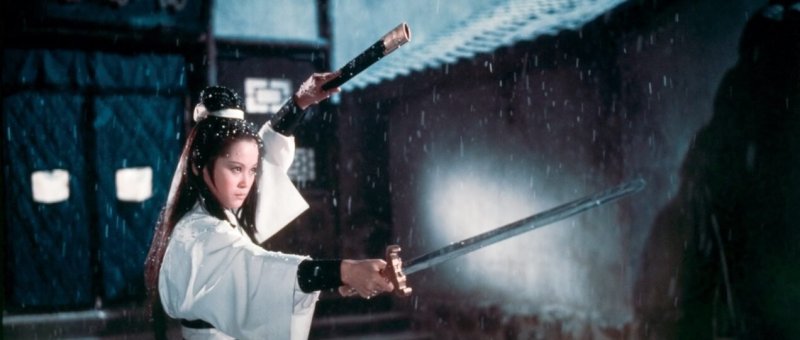
One of the reasons that martial arts films are so popular is that it’s often easy to tell who is good and who is bad. In general, the just hero vanquishes the source of evil and corruption, thereby restoring a sense of moral order to a world that may in other ways be chaotic. But chaotic is probably the best way to describe the world of The Black Tavern (黑店) in which the titular inn becomes a nexus of greed and villainy where it is impossible to tell who, if anyone, is good, while almost everyone is actually bad and the heroine only really intervenes in the closing scenes.

One way you can tell that something is very rotten at the Gao Family Inn is that the cook suddenly emerges from a pit underground carrying someone’s leg, which he then chops up and uses to make buns. No one ever mentions this again. It’s a just symbol of how corrupt and hellish this world has become. The inn is apparently the only staging post on this route, which is presumably how they continue to get custom despite bumping off their guests, taking all their stuff, and then chopping them up to put in buns to serve to the next unfortunate person who arrives in search of a bed for the night. 

But the reason so many venal bandits are drawn here is that a beggar monk (Dean Shek) tells them he saw vast riches fall out of a chest belonging to Hai Gangfeng, a former official returning to his home province with all his ill-gotten gains from accepting bribes. Assuming Gangfeng will be stopping at the inn, everyone who heard the monk is on their way there. Only, as it turns out, the man we thought was Hai Gangfeng is actually a bandit, “Whipmaster” Zheng Shoushan (Ku Feng), who cunningly pretended to be him to take over the inn and wait for the real Gangfeng’s arrival. He does not, however, seem to have anticipated so many other bandit gangs each more outlandish than the last having the same idea.

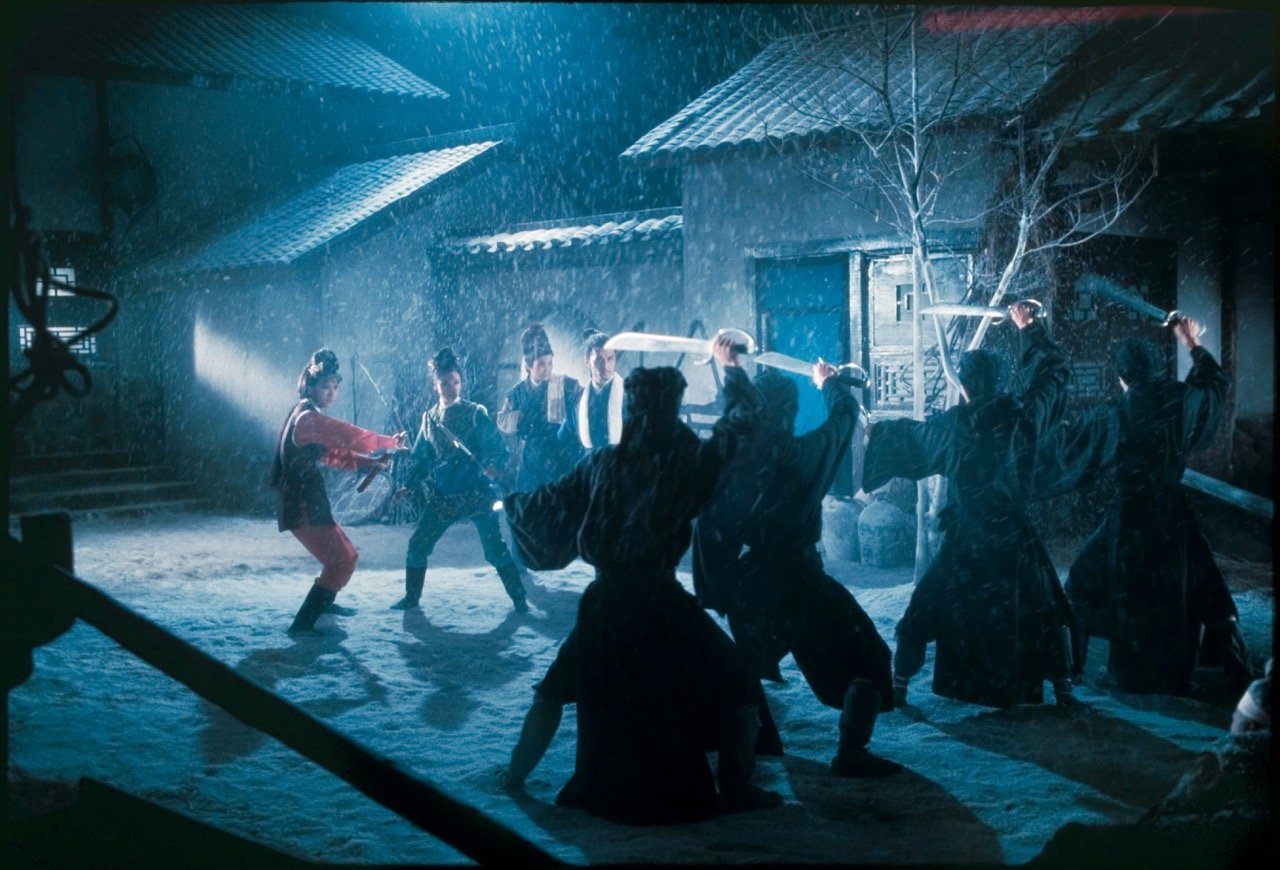
One turns up with a band of hopping vampires who turn out to be crooks in disguise, while another is wearing a horned helmet that gets stuck in things when he’s trying to fight. Of course, they’re all trying to kill each other so they can be the ones in control when Gangfeng finally arrives. What they don’t realise is that the whole thing’s a honeytrap designed to lure them all to the inn for just this purpose, so that they’ll all kill each other and spare the forces of justice some trouble. Those would be Zhang Caibing (Shih Szu), a disciple of the Lady Hermit making this a kind of extended universe film of the Cheng Pei-Pei classic. Continuing her mentor’s mission, she’s out to skim off the “scum of the martial arts world,” explaining to Shoushan that if he doesn’t like it, he should have thought of that before committing so many “evil deeds”. 

On the other hand, Caibing does seem to be enjoying this quite a lot so perhaps she’s not quite so entitled to the moral high ground as she’d like to think. While taking a leaf out of King Hu’s book, Yip adds an edge of slapstick absurdity in setting up elaborate action sequences with well-deserved pay offs and indulging in goreless yet extreme kills such as a series of surprise decapitations. Shoushan’s bladed whip becomes a versatile weapon but also an extension of his character in his cowardliness and lack of morality. It’s only really any good at long range, which means that he keeps his opponents at arms’ length rather than confront them directly as in the typical tests of skill that define a martial arts battle. He coils it around their necks, snake-like, then either pops their heads off or strangles them to death. Just like the innkeeper he killed off at the start, he seems to have genuine affection for his female companions but eventually meets a similar fate as his trademark whip is ironically turned against him. 

There’s also a genuine, if underplayed, sense of ambiguity in the attraction between the mysterious swordsman (Tung Li ) and Shoushan’s daughter that prevents him from killing her while suggesting that he too was on some level attracted to banditry. Even if he rides off in the end with Caibing, it does not appear that their relationship is romantic. Nor is he allowed to claim victory by swooping in when all seemed lost for Caibing during the final fight, immediately encountering difficulty with Shoushan who puts up a good fight that again seems contrary to his moral character in the amount of skill and effort needed to beat him. Indeed, it often seems as if he will win after all. This world will fall to men like him and turn into one giant Black Tavern. In the end, it’s a team effort that takes him down, including the strange intrusion of the beggar monk who was after all the person who started all this by repeating the rumour in the last rest stop and may or may not actually be working with Caibing. In any case, the incredibly fast-paced action sequences and the dark humour that accompanies them lend the film an epic quality despite its tight duration along with an ironic kind of cynicism that insists this world is simply too silly to be evil but that the scum of the martial arts world will pay all the same.


The Black Tavern screened as part of this year’s Focus Hong Kong.

The Love Eterne (梁山伯與祝英台, Li Han-Hsiang, 1963)

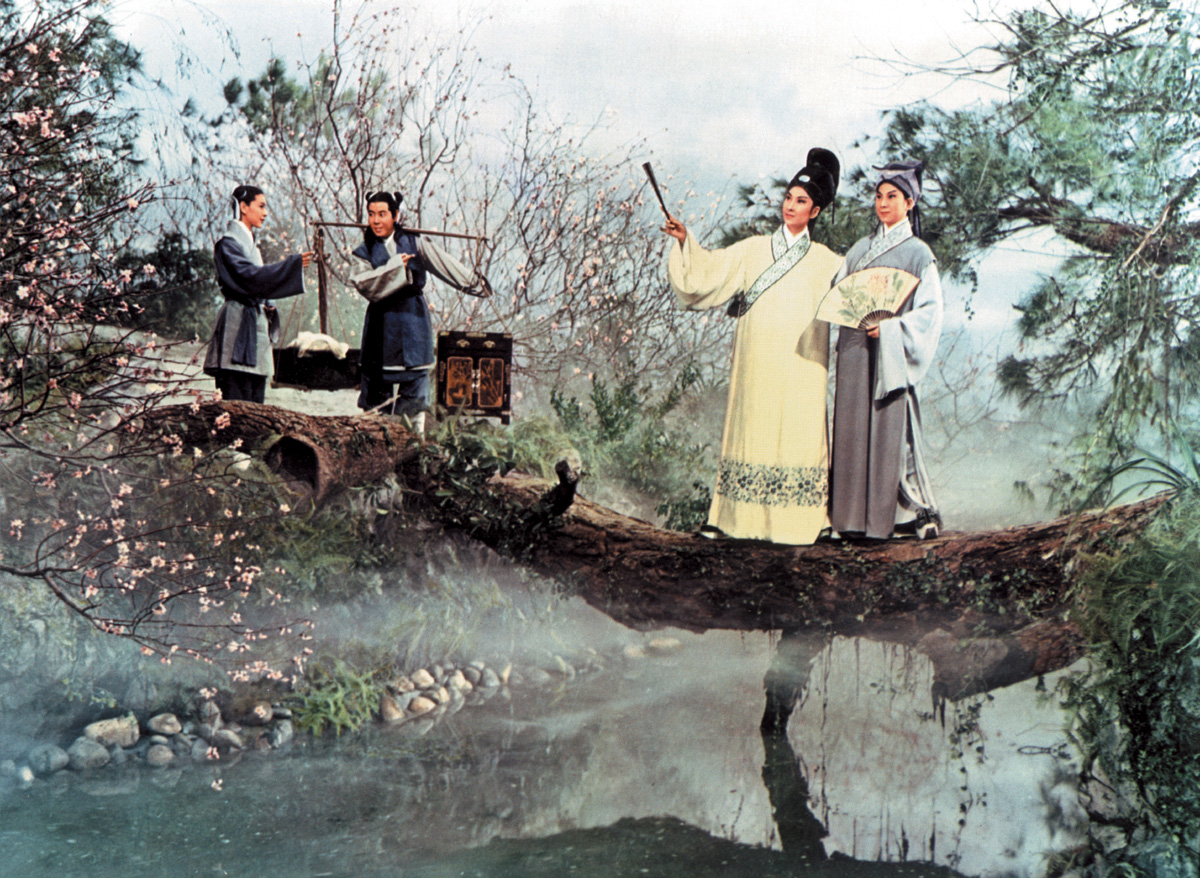
“We two have chosen ourselves. Others don’t recognise it.” “Even though others don’t recognise it, I still want to live and die with you.” This exchange occurs fairly late into Li Han-Hsiang’s retelling of the classic legend of the butterfly lovers, The Love Eterne (梁山伯與祝英台, Liáng Shānbóyǔ Zhù Yīngtái). One of several Huangmei opera films Li made at Shaw Brothers, where he was regarded as a pioneer and master of the genre, the film is despite its seeming traditionalism defiantly progressive not just in the undeniably queer undertones of its central love story but in its all but total rejection of patriarchal Confucianist thinking. 

Nowhere does Li make this more clear than in a brief cutaway in which birdcage hangs on a wall next to a tattered orange poster bearing the “double happiness” Chinese character synonymous with marriage. Marriage is the cage the heroine cannot escape. Her father tells her that she must marry and the choice not to do so does not belong to her, but neither does she have the right to choose a husband for herself for to do so would be to contravene the codes of filiality. Finally she is unable to go against her father’s wishes and agrees to sacrifice her pure love for a poor scholar to save her father’s reputation by marrying the son of a wealthy and influential family who is otherwise known to be a “playboy” unlikely to treat her well. 

The forces that separate noblewomen Ying-tai (Betty Loh Ti) and lowly student Shan-bo (Ivy Ling Po) are those of class and patriarchy, but the film invites another reading in their yearning to have their impossible love accepted by the world around them. In contrast to other tellings of the tragedy of the butterfly lovers, Li casts actresses in each of the leading roles one playing a woman who dresses as a man to acquire knowledge otherwise denied her because of her gender, and the other simply a woman playing a man. The romance between them is played with ironic coyness and good humour that deepens the tragedy that is to come in the incredible denseness of Shan-bo who takes none of the hints Ying-tai attempts to give him that she is really a woman but otherwise develops what occurs to him to be a deep yet platonic and brotherly love he only later comes to recognise as romantic on learning the truth. 

Nevertheless, it is impossible not to read their doomed romance as an attack on social conservatism and an advocation for romantic freedom. Though the final symbolism of flowers blossoming under a rainbow bridge is not one which would have occurred to a contemporary audience, the love between Ying-tai and Shan-bo is most transgressive because they have dared to choose it for themselves in the face of social hostility and if they cannot have it they will have death because to live without it is all but the same. Ying-tai’s response is to turn her wedding into a funeral and to marry in death, but the film does not present this as an inevitable tragedy of a love that cannot be but its reverse. The Heavens open and take pity on the lovers, condemning the world that would not allow them happiness in life by granting it in eternity. 

Rather than “women” as he would have it, the film places the blame firmly and directly on Confucianist thinking with the disguised Ying-tai directly challenging the teachings of the university where she is asked to recite the tenets that women are “insolent and ungrateful” while “charming girls make good companions”. It is Ying-tai’s father (Ching Miao) who is the true villain in caring little for his daughter’s feelings, firstly nearly letting her die in a hunger strike over not being allowed to go to school, and then refusing to listen to her rejection of his chosen suitor preferring to trade her for the social kudos of having married his daughter off to the most eligible of bachelors content to use her as a tool for his own advancement while indifferent to her prospects for future happiness. Li begins with his heroine “worried and confused” and captures something of the sense of constraint even within the sumptuous environment of her gilded cage before granting her freedom in the expanse of the natural world which thinks nothing of the “absurd rules of man”. 


The Love Eterne screens at the Barbican 25th April as part of this year’s Queer East in collaboration with Hong Kong Film Festival UK.

Trailer (no subtitles)

Mercenaries from Hong Kong (獵魔者, Wong Jing, 1982) [Fantasia 2022]

A former mercenary’s bid for revenge having failed in his responsibilities soon goes awry in Wong Jing’s third directorial feature Mercenaries from Hong Kong (獵魔者). As is constantly pointed out to the hero, perhaps he’s not so different from his target with his very selective brand of justice and morality. After all maybe the difference between medicine smuggler and drug trafficker is largely semantic and taking revenge after the fact hardly makes up for the failure to protect the innocent from a world you’ve helped create. 

Li Lok (Ti Lung) is a pretty big figure on the underworld scene and as the ultra macho title sequence reveals a former mercenary who served in Vietnam. In the daring opening scene he sneaks into a gang hideout disguised as a telephone repairman and takes out a gangster in the middle of drugging a young woman whom he and his friend intend to rape and then murder. But Li Lok isn’t here to save the girl and in fact he doesn’t. He’s there because the gangster has done this kind of thing before and the previous victim was his 15-year-old niece whose care he had been entrusted with by his late brother before he passed away. Later one of his comrades will make a similar request of him and he will fail again apparently taking little stock of his responsibilities. 

Nevertheless, having knocked off the gangster annoys local big boss Shen who intends to have Li Lok eliminated but Hong Kong’s richest woman Ho Ying (Candice Yu On-On) convinces him not to because she has a job for Lok assassinating a top Thai assassin who killed her father and is now apparently blackmailing her with a cassette tape full of corporate secrets. All Lok needs to do is round up a posse and head to Cambodia where “the devil” Naiman (Ching Miao) is hiding out, kidnap him, and retrieve the tape to receive a massive life-changing payout while permanently getting Shen off his back. It all sounds like a pretty good deal to Lok along with the former buddies he recruits to join him who are all trapped in desperate poverty one with a sick little girl who desperately needs a kidney transplant. 

This is a Wong Jing film and perhaps there’s no need to dig too deeply into it, but there is something in the power Ying wields over Lok and his team by virtue of her wealth and privilege that speaks to the city’s growing inequality though it’s also true that perhaps the guys have all fallen low through their mercenary choices and are now unable to get a foothold in the contemporary society without resorting to crime. Yet perversely, Ying leverages Lok’s chivalrous sense of honour as part of her plan playing damsel in distress rather than dangerous femme fatale while he assumes he’s on a righteous mission planning to turn Naiman over to the authorities rather than just killing him while little caring that his actions threaten to destabilise an already chaotic situation in Cambodia. 

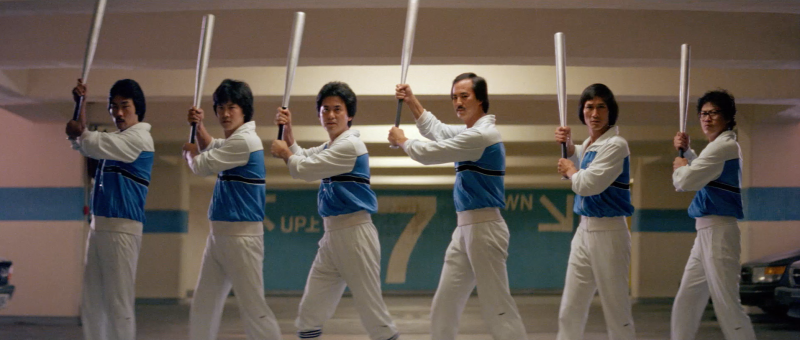
When one of the sworn brothers of the gangster that Lok killed in revenge is killed coming after him even after the truce, Lok is irritated that he died unnecessarily as if it offends his sense of justice that this man was not protected better by Shen. Yet as Naiman keeps pointing out to him, he’s no saint and perhaps no different. He could have saved the girl in the gang hideout but chose not to, escaping by jumping out of a window onto a van waiting below and riding off on a motorcycle (which is admittedly impressive). He claims to hate drug dealers but profited off war and misery in smuggling medicines across the border from Thailand into Cambodia even if he could tell himself he was running a kind of humanitarian service. Meanwhile Ying who is obviously involved in something shady if she’s dealing with people like Lok and his team, paying for their weapons and equipment which presumably includes the series of identical outfits the guys sport like some violent middle-aged boy band, wins an Outstanding Woman award and ironically pledges to use some of her wealth to fund community-based anti-drug programs. 

Li Lok may in a sense emerge victorious but also exactly where he started in failing to protect an innocent girl from a mercenary world. The Cantonese title might more literally be something like Devil Hunters, but Lok and his guys are certainly a mercenary bunch desperate to escape their poverty and hopelessness even if they may stand for a kind of justice and honour in brotherhood. This being a Wong Jing film there is plenty of crass humour including some that is very of its time along with gratuitous sex and female nudity but also a series of incredibly impressive action scenes and a bleaker than bleak conclusion which may suggest that the Loks of the world will be unable to protect the next generation from the violence they themselves have unleashed. 


Mercenaries from Hong Kong screened as part of this year’s Fantasia International Film Festival.

Original trailer (English subtitles)

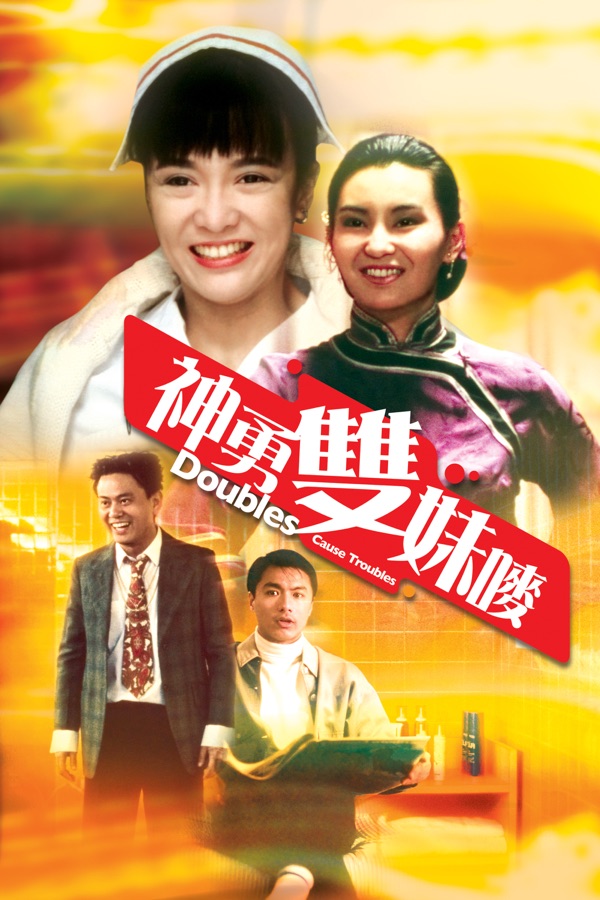
Doubles Cause Troubles (神勇雙妹嘜, Wong Jing, 1989)

Doubles cause troubleWould you be willing to live with someone you hate for a whole year just to get a share in an apartment? According to the sheer prevalence of this plot device in comedies throughout the ages, the chances are most people would, especially in a city like Hong Kong where competition is fierce. In any case the duelling cousins at the centre of Wong Jing’s disappointingly normal farce Doubles Cause Troubles (神勇雙妹嘜) find themselves doing just that, only the situation turns out to be much more complicated than one might imagine.

When self-centred nurse Liang Shanbo (Carol “Do Do” Cheng Yu-Ling) receives a visit from a lawyer informing her that her grandmother has passed away she’s a little put out because the old lady owed her money. She’s comforted with the news that she’s been left an apartment, but less so when she learns there’s a catch. Shanbo’s grandma really wanted her to patch things up with her cousin, actress Zhu Yingtai (Maggie Cheung Man-Yuk), and has left the apartment to both of them with the caveat that they have to live there together for a period of one year after which they can sell it and inherit 50% of the proceeds each or else it’ll all go to charity. Neither Yingtai or Shanbo is very happy about the idea but it’s too good an opportunity to pass up and after all, it’s only for a year. When they arrive, however, they discover there’s another tenant – Ben (Poon Chun-Wai), a suave businessman who leaves them both smitten. Ben, it turns out, is not quite what he seems and staggers home on the first night to die in Yingtai’s arms after muttering something about a code.

Unlike most Hong Kong comedies of the era, Wong plays things disappointingly straight while remaining as broad as it’s possible to be. Odd couple Shanbo and Yingtai bicker and trade childish insults while throwing themselves first at the handsome Ben and then at his equally good-looking “brother” Sam (Wilson Lam Jun-Yin) without really giving too much thought to anything else that’s going on until they find themselves well and truly embroiled in a conspiracy. It turns out that Ben had been involved in a smuggling operation in which he betrayed his team and made off with a priceless Taiwanese “national treasure” that the rest of the gang would like to recover which is why Shanbo and Yingtai are being followed around by a “flamboyant” rollerskating henchman and a butch female foot-soldier.

The political realities of 1989 were perhaps very different, but there is an unavoidable subtext in the fact that the dodgy gangsters are all from the Mainland and are desperate to get their hands on a precious Taiwanese national treasure (which they intend to sell for a significant amount of money). The girls find themselves with ever shifting loyalties as they reassess Ben, come to doubt Sam, and fall under the influence of mysterious “inspector” Xu (Kwan Ming-Yuk) whose warrant card is “in the wash”. Completely clueless, they are helped/hindered by useless petty gangster Handsome (Nat Chan Pak-Cheung) and his henchman Fly (Charlie Cho Cha-Lee) who’ve been chasing Shanbo all along while Yingtai falls victim to Wong himself in one of his characteristically sleazy cameos as a lecherous businessman who has toilets instead of furniture in his living room and a boxes full of date rape drugs behind the bar (poor taste even for a Wong Jing movie).

Of course the real message is that blood ties and immediate proximity to danger can do wonders for a “difficult” friendship and so granny gets her wish after all even if not quite in the way she might have planned. Then again, why was Ben staying in her luxury apartment in the first place? Who can say. Setting a low bar it may be, but Doubles Cause Troubles is not even among Wong Jing’s funniest comedies though it does have its moments mostly born of sheer absurdity and enlivened by the presence of a young Maggie Cheung alongside a defiantly committed cast desperately trying to make the best of the often “risible” material.


Currently streaming via Netflix in the UK and possibly other territories too.

Celestial pictures trailer (English/traditional Chinese subtitles)

Women (女人心, Stanley Kwan, 1985)

Women posterThings are changing in ‘80s Hong Kong, but when it comes right down to it are there really any more choices than there were in the past? Stanley Kwan would become known for his fiercely female led filmmaking and his debut, Women (女人心), is indeed a statement of intent if heeling close to the Shaw Brothers house style and possessed of a particularly mid-80s kind of cynicism. Marriage falls under the spotlight but for all of its minor oppressions and petty aggravations the net seems almost impossible to escape.

Kwan opens with a strangely cheerful family scene which quickly turns sour as housewife Bao-er (Cora Miao Chien-Jen) is excluded by her husband, Derek (Chow Yun-Fat), and son, Dang-dang (Leung Hoi-Leung), who close the bathroom door on her before declaring a pissing contest. Irked, Bao-er finds herself mildly enraged by the sight of her husband’s undies and decides to take this opportunity to tell him she wants a divorce. She’s found out all about Derek’s fancy woman Sha-niu (Cherie Chung Cho-Hung) and has had enough. Decamping to her mother’s with Dang-dang in tow, Bao-er finds herself the latest member of her friends’ “forever happy single women’s club” but remains conflicted when it comes to considering the further direction of her life.

The “forever happy single women’s club” is itself somewhat confused in its outlook in that most of Bao-er’s friends are not really intending to remain single forever but are hoping to find a new partner, if perhaps also enjoying playing the field while they look. None of them are really very happy with the status quo and the various get-togethers at which they enjoy lavish buffets and copious amounts of alcohol are mostly filled with bawdy discussions about men and sex, much to the consternation of the rather uptight Bao-er. 

In fact, Bao-er’s “refinement” seems to be one of the chief issues in her marriage which is perhaps why Derek has found himself intwined with a clingy free spirit who quickly moves into the family home and does her best to stake a claim on little Dang-dang but is unwilling to keep house with the consequence that the apartment is quickly overrun with old newspapers and empty food cartons – a sight which fair breaks Bao-er’s heart when she’s forced to visit only to be presented with some of Sha-niu’s patented “spicy soup”. During a candid conversation with her mother, Bao-er reveals that throughout her married life she’d gone to great lengths to preserve her feminine mystique only for Derek to take off with a woman prepared to let it all hang out. Her mother, broadly supportive of her choices, advises her to think carefully about her future. If the marriage was unhappy then it’s best to call it quits, but if Sha-niu is just a passing fad then perhaps she’s one worth putting up with in the absence of other options.

Bao-er’s mother seems to think that ignorance is bliss when it comes to a healthy marriage, but as a “modern” woman, Bao-er expected more. Even so, despite not requesting alimony (she only wants money to cover Dang-dang’s expensive private school fees), we don’t see Bao-er looking for work though it’s also clear she isn’t looking to remarry in the immediate future. Like many of her friends, Bao-er seems to have her doubts about living as an “independent” woman and continues to be irritated by Derek’s relationship with Sha-niu even while attempting to firmly close the door on her marriage.

The end of the relationship does however give her an opportunity to consider what it is that she wants, even if middle-class conservatism ultimately wins out. This is particularly true of an unexpected attraction to a lesbian friend which she chooses not to pursue seemingly because of the social taboo. Despite being fully out and accepted by the group, Terry (Cheung Yin-Gwan) is also pitied by some of the other members who believe she is locked out of the conventional family life most of them are looking for because she is looking for a woman and not a man. Even if it’s true that Bao-er can only really be fully herself with her female friends, she and the others still hanker after male companionship and do not feel complete without it.   

The major theme which emerges is that marriage and family are essential, if imperfect, and must be maintained even if perhaps superficially as the closing text which conveniently condones Derek’s poor behaviour while allowing Bao-er her “revenge” implies. A slightly cynical point, to be sure but undercut by Kwan’s sense of empathetic irony which asks what other real choices Bao-er has while refusing to condemn her for the ones she eventually makes. Socially conservative as it may be, the fact remains that possibilities are bleak for women of a certain age in ‘80s Hong Kong which remains a playground for men like Derek while women like Bao-er and her friends are left with only complicit means of personal rebellion.


Women screens as part of the 2019 Chinese Visual Festival on 5th May at King’s College London where director Stanley Kwan will be present for a Q&A.

Celestial Pictures trailer (English subtitles)

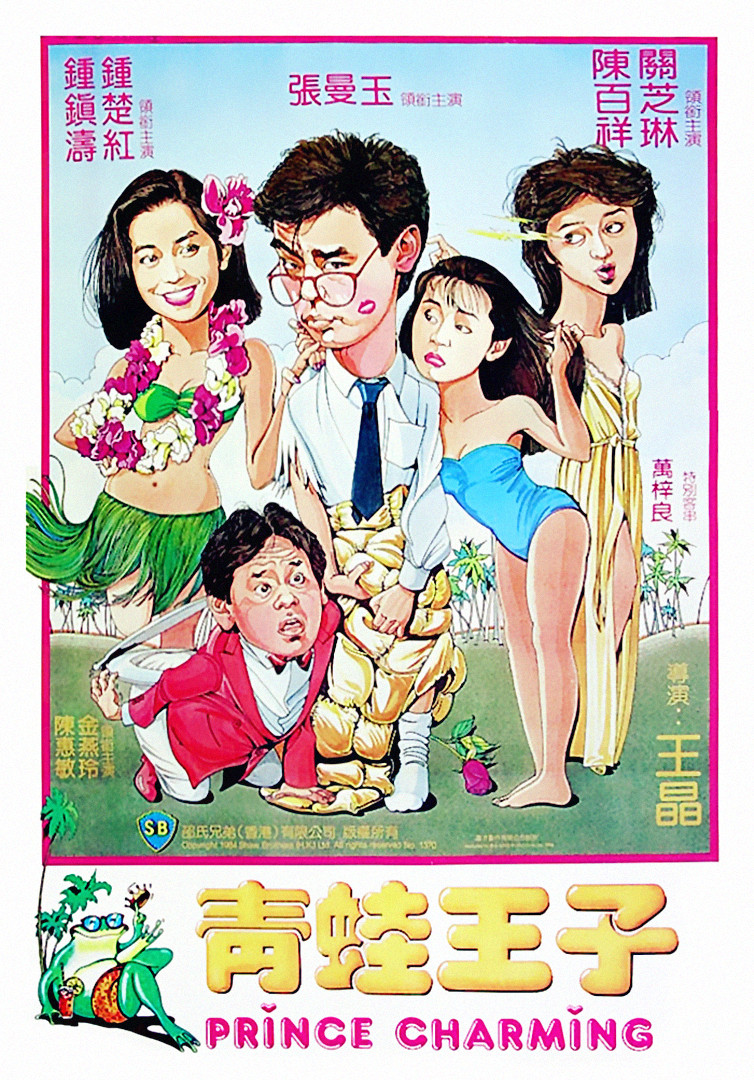
Prince Charming (青蛙王子, Wong Jing, 1984)

Prince charming 84 poster“This isn’t a film from the 1930s!” a confused sidekick exclaims part way through Wong Jing’s zany ‘80s comedy Prince Charming (青蛙王子). He’s right, it isn’t, but it might as well be for all the farcical goings on in Wong’s hugely populist, unabashedly zeitgeisty romp through a rapidly modernising society. Starring popstar Kenny Bee, Prince Charming also marks the feature film debut of the later legendary Maggie Cheung who would find herself making a fair few disposable comedies in the early part of her career. All the Wong trademarks are very much in evidence from the sometimes crude humour to the random narrative developments and deliberate theatricality but it has its charms, even if perhaps despite itself.

Signalling the “aspirational” atmosphere right away, Wong opens in “Hawaii” with Kenny Bee performing one of the many musical numbers which will be heard throughout the film (which is also a kind of idol movie as well as a populist Shaw Brothers Comedy). Chen Li Pen (Kenny Bee) is the son of an oil magnate and hotel chain manager but unlike his father, is a sensitive, nerdy young man who gets the hiccups around attractive women and has never had any luck with the opposite sex. Nevertheless, his mother wants to set him up with an arranged marriage – something which he vehemently opposes but understands will become harder for him fend off if he can’t find himself a love match in good time. Enter his old friend Lolanto (Nat Chan Pak-Cheung) who is a self-styled ladies man if a bit “common”. Lolanto has come to Hawaii on holiday and to hang out with Li Pen, but like any young guy he also wants to meet some girls.

The guys end up in a kind of sparring match with the two ladies staying in an adjacent room at the hotel, May (Cherie Chung Cho-Hung) and Kitty, (Maggie Cheung Man-Yuk) following a series of misunderstandings. When the girls drug them and then somehow leave them on a rock in the middle of the ocean, the boys are humiliated but don’t have too long to nurse their wounds because Li Pen’s dad sends them back to Hong Kong to investigate suspected embezzlement at head office. As luck would have it, both May and Kitty work for Li Pen’s family firm (which was perhaps why they were staying in the hotel). Another misunderstanding sees May assume Li Pen is a former triad looking for a new start, so she “bribes” the hiring department to get him a job as a chauffeur, while Lolanto ends up in the boss’ office posing as Li Pen. Hilarity ensues.

Aiming a squarely for the populist, Wong’s defiantly aspirational vision revolves around the fabulously wealthy and internationalised Li Pen who went to college in the US and lives most of his life in Hawaii, perhaps not quite understanding Hong Kong in the same way Lolanto does, both because of his outsider status and because of the freedom his wealth gives him. When the two swap roles they each get a kind of education, but their real quest (while halfheartedly investigating the embezzlement scandal) is winning over Kitty and May who think they’re dating a CEO and a chauffeur respectively. Despite their irritation when they realise their mistake, both May and Kitty perhaps come to realise that the deception is a part of what eventually drew them to the guys and they’re a better match than they might otherwise have imagined.

Meanwhile, Wong finally remembers the embezzlement plot and introduces a third woman, Puipui (Rosamund Kwan Chi-Lam), who is secretly a plant set up to seduce the pure hearted Li Pen and marry him because this will in some way prevent the embezzlement scam from coming to light. Puipui’s scheme eventually kicks off the ridiculous finale in which the gang find themselves chased by goons and having to play pool for their lives with hostages hooked up to electric chairs which will be triggered when a certain number of points are scored. Wong adds a host of cutesy touches from cartoon hearts around our lovelorn heroes and adorable doodles popping up as on screen graphics while Kenny Bee and Cherie Chung also get a completely bizarre musical number at the midway point where they pretend to be happy frogs marooned on a private lily pad. It doesn’t make any sense, but it really doesn’t matter. Completely throw away, but strangely fun.


Currently streaming on Netflix UK (and perhaps other territories)

Celestial Pictures trailer (English subtitles)

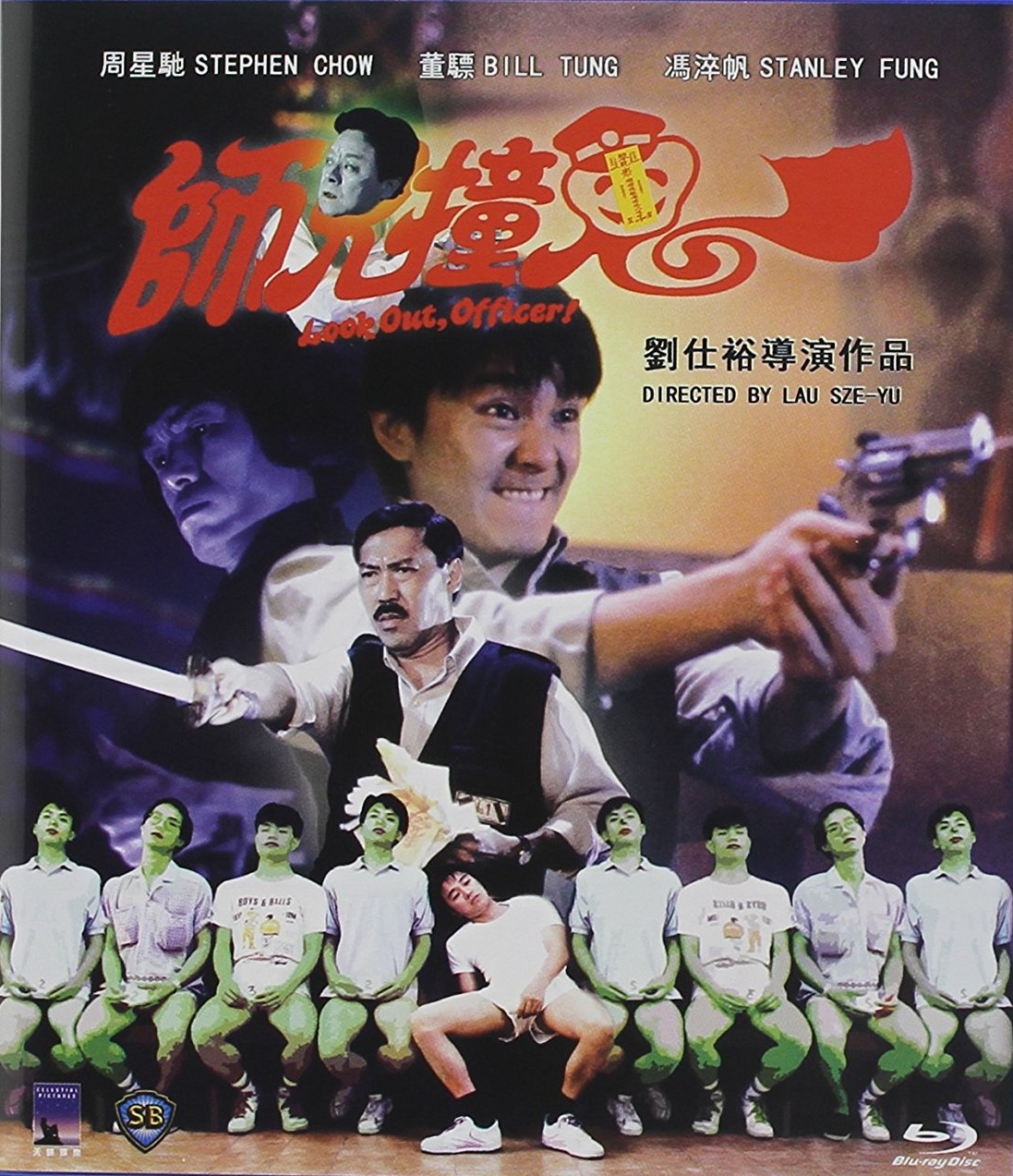
Look Out, Officer! (師兄撞鬼, Lau Sze-yue, 1990)

look out officer BD 1The thing about classic Hong Kong comedies is, they were made for a very specific time and place as a quick populist diversion not intended to have much of a life beyond their original release. Despite the thrown together, sketch show-style progression from one tenuously related set piece to the next held together by quick fire comedy, they could also be surprisingly subversive as in this 1990 comedy starring a young Stephen Chow. Look Out, Officer! (師兄撞鬼) is a silly buddy cop comedy and supernaturally tinged procedural but it also satirises the Hong Kong government’s response to the growing “boat people” crisis in which, as is declared in the film, those who’ve come from Vietnam for “economic reasons” will be regarded as illegal immigrants and deported. 

The film begins with two policeman as one berates the other for stopping to burn “ghost money” on the street, describing his need for ritual as like that of an old woman. The first policeman, Biao (Bill Tung), then gets a message on his pager to check out an abandoned warehouse. Piling into the police car, Biao and religious cop Chin (Stanley Fung) arrive but don’t find anything suspicious. Chin decides to leave while Biao wants to investigate further. Poking around, Biao finds himself directly above some kind of large scale drugs lab into which he heroically jumps and beats up most of the grunts waiting below before the head gangster turns up and throws him out of a window. Biao’s body lands directly on the top of Chin’s car who has returned after having second thoughts and wanting to make sure his partner is OK.

The “official” explanation is that Biao has killed himself because of his excessive gambling debts. Up in heaven he gets put on trial (alongside recently deceased dictators Ceausescu and Marcos) and the judges find that his death is indeed suicide despite his protestations. Eventually they agree to let him go back to Earth as a ghost to prove he was murdered and take revenge on the killer. Biao gets assigned a “saviour” whom he will know thanks to an unusual birthmark. The “saviour” turns out to be rookie cop, Sing (Stephen Chow), who is not exactly top of his graduating class but aided by Biao’s supernatural powers he just might be able to find the real killer after all.

As it turns out Chin dabbles in Taoist magic (to make his arms longer, for no particular reason) as do the gangsters who seem to have demonic forces on their side. Biao never saw the face of the man who killed him because he had him in a headlock, but he does remember his terrible body odour thanks to being shoved under his armpits. Victory in the final battle relies on conjuring a unique charm which consists of equally stinky ingredients including virgin’s urine, cat poo, and flatulence neatly bringing several of the film’s running jokes together into one satisfying punchline.

Running gags there are a plenty from the grumpy old cleaner at the police station they’ve nicknamed the 1000 year old virgin who likes to mop up the men’s toilets while they’re busy so she can assess the policemen’s “capabilities” for herself, to the cat who keeps defecting on the altar, and Sing’s general weediness. The supernatural procedural runs in tandem with the usual romantic comedy subplots including Chin’s over protective attitude to his grown up daughter who inevitably ends up in a relationship with Sing thanks to Biao’s supernatural wingman-ing. One of the “charms” Baio has been given to help him in his quest is a “lewd” spell which suddenly makes the victim randy for the first person they see. Biao uses this to get his own back on Chin for leaving him behind by making their austere superior officer suddenly come over all goey only to have her snap out of it and accuse him of sexual harassment.

The humour maybe distinctly lowbrow, but there is a degree of satire lurking in the background as Sing is sent into a “massage parlour” with a codeword in Vietnamese only to discover that all the girls in the place can understand it and immediately parrot back the recent ordinance of Vietnamese immigration. Later, a Vietnamese man threatens to commit suicide over the cruel and inhumane treatment he has received as a Vietnamese immigrant trying to make a life in Hong Kong, fearing he may be forcibly deported and will be killed if he has to go back to Vietnam losing everything he’s tried to build in Hong Kong.

When Biao eventually gets back to heaven they don’t want to let him in even though he’s cleared his name because heaven has a quota and he doesn’t meet the criteria. All is not lost, however, because you can buy your way in as an immigrant with ”special investor” status. In heaven, it seems, everything is fine so long as you have money. As above, so below. Another characteristically nonsensical, juvenile comedy from Shaw Brothers, Look Out, Officer! is as silly and of its time as one would expect but it is undeniably entertaining and unexpectedly moving in its final moments.


Remake of Philip Chan & Ricky Lau’s Where’s Officer Tuba? (1986)

Celestial Pictures trailer (English/traditional Chinese subtitles)

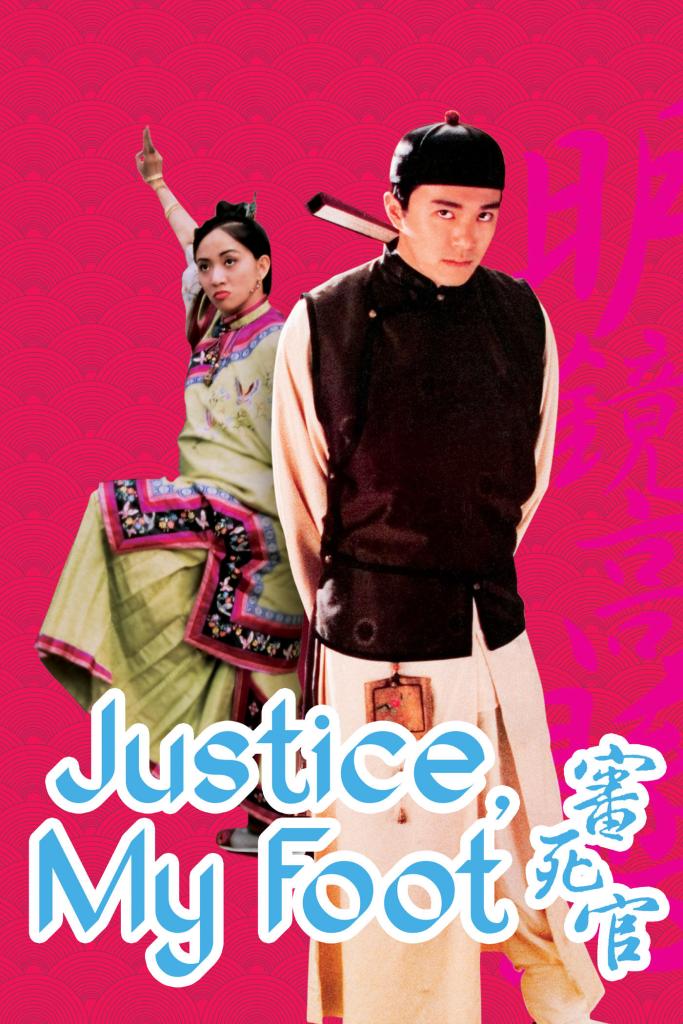
Justice, My Foot! (審死官, Johnnie To, 1992)

Stephen Chow has always been a force of nature but even before making his name as a director in the mid-90s, he contributed his madcap energy to some of the highest grossing movies of the era. Justice, My Foot! (審死官) is very much of the “makes no sense” comedy genre and, directed by Johnnie To for Shaw Brothers, makes great use of the collective propensity for whimsy on offer. Even if not quite managing to keep the momentum going until the closing scenes, Justice, My Foot! succeeds in delivering quick fire (often untranslatable) jokes and period martial arts action sure to keep genre fans happy.

Chow plays unscrupulous lawyer Sung Shih-Chieh who has built himself quite the reputation as a silver tongued advocate, able to talk his clients out of pretty much anything by bamboozling the judges with crazy logic offered at speed. However, his talents have a downside in that he and his wife (Anita Mui) have sadly lost 12 children already which he attributes to a karmic debt for all his finagling. She’s convinced him to retire and move to the country but Sung keeps getting himself involved in other people’s affairs and when his reckless to decision to defend the son of a wealthy man who has caused the death of a pauper in a street fight results in the death of their own infant son, Mrs. Sung has had enough.

That is, until she encounters a series of injustices of her own as a heavily pregnant woman visits her tea shop along with her shady seeming brother. Soon enough the brother tries to convince a random stranger to marry his sister, only to suddenly run off with all of the guy’s money leaving him alone and confused with the mother to be Madame Chou (Carrie Ng). The man gives chase but unfortunately Madam’s Chou’s brother falls off a cliff and creates a whole lot of problems for everyone in the process. Now feeling sorry for a pregnant woman who has been left so completely alone after her own brother tried to sell her and her in-laws murdered her husband, Mrs. Sung changes her mind and convinces her husband to return to the law in defence of this extremely desperate woman.

For a “nonsensical” film, there is actually quite a lot of plot which occasionally becomes hard to follow as it moves freely between set pieces. The jokes come thick and fast and are often of the idiosyncratic Cantonese variety which does not translate particularly well though the delivery helps make up for any lack of understanding. Aside from that Chow packs in as much of his trademark slapstick as possible as he cedes the spotlight to his co-star Anita Mui who provides the martial arts action whilst proving why Mrs. Sung is the more dominant partner. Accordingly there is some typically sexist humour in which Sung is criticised for his “effeminate” cowardice by Mrs. Sung as she dresses him in her clothes, makeup and hairstyle while he escapes. A running joke about two gay servants doesn’t really go anywhere but is actually sort of refreshing in its ordinariness.

Nonsense it may be but there’s a persistent layer of darkness from the throwaway references to the deaths of the Sungs’ children, to the violent punishments inflicted by the court which include both beatings and eye gouging, and then there’s the attempted suicide of Madame Chou apparently gathering enough energy to hang herself from the rafters mere minutes after unexpectedly giving birth in another extended gag. A judicial farce, the film mocks the very idea of justice as the judges are all corrupt noblemen, well known for taking bribes and looking after their own to further their positions. Sung is no better as he plays the system for his own gain, cynically affirming that there is no rule of law and it’s everyman for himself when you live in such an anarchic system. To’s direction is typically ironic with his canted angles and balletic camera even if he is, to a certain extent, playing the Shaw Brothers game. Justice, My Foot! is not a first rate Chow effort, sagging in the middle and getting bogged down in its own manoeuvring, but does bring both the laughs and the punches with a standout performance from Anita Mui to boot.


Celestial Pictures trailer (English subtitles)

The Teahouse (成記茶樓, Kuei Chih-Hung, 1974)

TheTeaHouse+1974-248-bWhere oh where are the put upon citizens of martial arts movies supposed to grab a quiet cup of tea and some dim sum? Definitely not at Boss Cheng’s teahouse as all hell is about to break loose in there when it becomes the centre of a turf war in gloomy director Kuei Chih-Hung’s social minded modern day kung-fu movie The Teahouse (成記茶樓, Cheng Ji Cha Lou).

Wang Cheng runs a small teahouse which prides itself on being the kind of progressive environment where everyone looks after each other as long as they play by the rules. Unfortunately, one of his young guys – Blackie, fresh off the boat from the mainland, has got himself into bad company and into trouble with the law. However, as he’s a minor, he gets off with barely any punishment at all. Cheng tells him he can stay at the teahouse only if he pays properly for his crime leading him to try and get himself arrested all over again so he can go to jail (which actually proves very difficult).

Another unfortunate side effect of Blackie’s adventure is that it brings some unwanted gangster attention and when two young thugs come looking for one of the waitresses, Boss Cheng is not going to stand for any nonsense. However, after his attempts to help the girl have failed, he finds himself in trouble with two different sets of gangsters and also a meddling police inspector who seems intent on using the teahouse to trap the triads.

Boss Cheng is a good and decent man but also someone with his own opinions on justice who is not afraid to take matters into his own hands. His rules for workers at the teahouse emphasise obeying the law and behaving like responsible citizens, but he’s not above carrying out a little corrective action of his own if the need arises.

The biggest theme of the film is the rising inequality and place of migrants from the mainland in contemporary Hong Kong society but the first target Kuei has his sights set on is out of control youth. Because of the lenient laws regarding child criminality, the young men of Hong Kong run rampant, safe in the knowledge that nothing is going to happen to them while they remain under the age of responsibility. The two gangsters accused of raping and attempting to force the teenage waitress at the teahouse into prostitution give their ages as 14 and 15 respectively to the trial judge and are released without charge to go back to their life of crime with impunity and no respect for the law or conventional morality. Sadly, this system just creates another child criminal but one who will receive a jail sentence even if a lighter one to be served in a reform school rather than a prison.

Blackie was seduced into crime by a lack of funds – having managed to make it over from the mainland he has nothing other than his job at the teahouse and the support of Boss Cheng. One day a ragged looking little boy leading his sister by the hand wanders into the teahouse to beg for food. It turns out his small family escaped from the mainland too but his father never made it to Hong Kong and his mother is ill, leaving the children to try and fend for themselves. Boss Cheng takes pity on them and gives the boy a job plus paying for his school fees but he still finds himself beaten up by thugs not much older than himself in the street.

All the while, corrupt fat cats are messing with the system to keep the poor in their place while the rich get richer. Cheng takes great pleasure in playing off a corrupt industrialist who tried to use him as a sacrificial pawn in his own war against the triads (well, the triads he doesn’t like, anyway). Amusingly, one of the triad bosses seems to think Cheng is also a brother forcing him to pretend to know all about triad rituals to attempt to make a truce with them. The teahouse is situated right between the territories of two rival gangs making it a prime spot for conflict. However, the real problem comes when the police start muscling in, giving off the impression that Cheng has turned traitor on the triads. Soon, Cheng becomes the single biggest threat to his own teahouse and the progressive environment he hoped it would foster.

The Teahouse is actually a little ahead of its time concentrating not on kung fu or street fighting but mixing in a little gun play and some bloody knife crime. The shooting style is impressive throughout with a realistic, gritty atmosphere which aims to put the real streets on screen. The film does, however, have a tendency to fall into an episodic rhythm and suffers from its abrupt and slightly odd, downbeat ending which finishes things on an unsatisfying note. That said, The Teahouse is a stylishly shot and socially engaged action extravaganza that makes up for its minor shortcomings with a degree of chutzpah which looks forward to the classic heroic bloodshed movies of the ‘80s.


Seen as part of HOME’s CRIME: Hong Kong Style touring season.

Unsubtitled trailer (Mandarin):