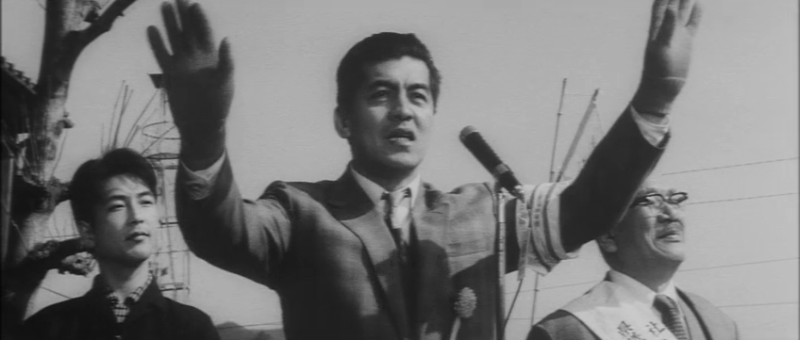
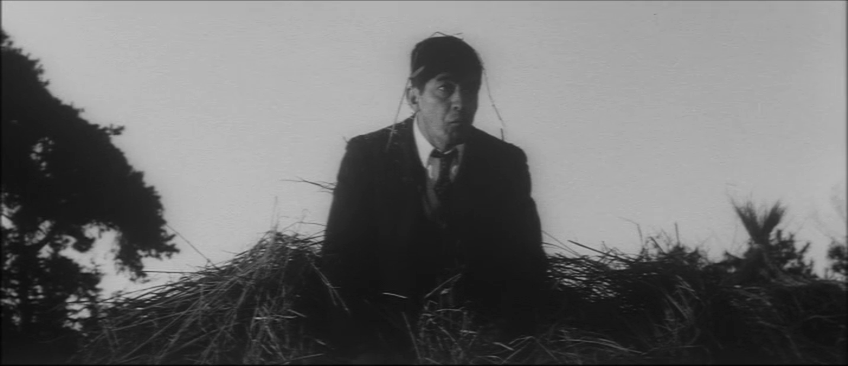
“Even the cops wouldn’t keep innocent people in prison” a prisoner ironically exclaims in Satsuo Yamamoto’s farcical crime drama Tale of Japanese Burglars (にっぽん泥棒物語, Nippon Dorobo Monogatari), displaying a strange sense of faith in the system for one who’s already been caught out by it. It is in many ways the system at which Yamamoto takes aim, refusing to blame even the guilty for their crimes while condemning the society that forever tars not only them but their entire families with the criminal brush, similarly defaming the innocent while the mechanisms of the State actively abuse their power to ensure they continue to maintain it.
Set in 1948, the action takes place as the opening voiceover explains in an exaggerated accent which at times lends itself to lowkey comedy, at a moment of societal collapse in which cash has become almost worthless and the only items of value are clothing and rice. Yet Gisuke (Rentaro Mikuni) it seems was living a life of crime even before the war, the youngest of five brothers left to look after his mother and sister after his father’s death. While operating as an amateur unlicensed dentist having picked up the basics from his dad, Gisuke makes his living peddling black market kimonos stolen from local warehouses. After bungling one particular job he finds himself spotting a strange site on the railway tracks, overwhelmed by shadowy figures of nine men he first fears have come to tackle him but in the end simply pass by even calmly returning his call of good evening as they discuss among themselves the best way to the local hot spring. Taking refuge in a haystack, it’s not until the next morning that Gisuke learns of a train derailment that took the lives of the engineer and two crew members. He realises that the men he saw must have been the ones who sabotaged the track but he’s not a snitch and it’s none of his business so he decides to keep quiet.
That is until he gets arrested for the botched burglary and ends up incarcerated alongside a member of the accused, Kimura (Mizuho Suzuki), who quickly befriends him and in fact becomes something of a labour activist even inside the prison negotiating better conditions for prisoners. Indebted, Gisuke maintains his silence strangely certain that Kimura and the others will soon be released because they are innocent despite already knowing that the judicial system is infinitely corrupt. The case at hand takes inspiration from the Matsukawa Derailment, a real life incident which Yamamoto had already dramatised in 1961’s Matsukawa Incident, in which suspicion had fallen on the Railway Union who, in the film, are seen leading a protest agitating for better working conditions. Kimura, a prominent unioniser, is picked up along with other members of the rail workers union and left-wing activists on largely spurious grounds solely to discredit their movement at the behest of an overly authoritarian police force.
The irony is that Gisuke ends up in prison for a crime that he technically is not quite guilty of in that he’s arrested after his wife, a geisha he redeemed with his ill-gotten gains, unwittingly sells some stolen kimonos which he was storing for a friend on the run. Kimura by contrast is in prison for something of which he is entirely innocent, in effect a political prisoner. Yet the force that imprisons both of them is not so much the law as social censure in the stigmatisation of crime. Gisuke feels acutely guilty knowing that his family members continue to suffer because of his criminality, his sister unable to marry as each of her engagements is eventually broken off when they find out her brother’s been in jail. After getting out and vowing to go straight, Gisuke marries again and has a child but is perpetually worried that someone will find out about his past and that his son will forever be stigmatised as a “burglar’s kid”. It’s for this reason that he finds himself torn, refusing to help Kimura by testifying as to what he saw that night even after hearing that he’s been sentenced to death, unwilling to risk his newfound happiness even at the expense of another man’s life.
Strangely, it’s the injustice of the situation which later changes his mind though in an unexpected way when he realises that his own son has escaped being tainted with his father’s criminal legacy while Kimura’s is bullied at school because his dad’s in jail even though he’s innocent. Pursued by authoritarian police officer Ando (Yunosuke Ito) who attempts to blackmail him into changing his story to incriminate Kimura he eventually decides to free himself by telling the truth despite realising that another witness was most likely murdered for signalling an intention to do the same. “But how is it that the police who are charged to catch us are even bigger liars than the thieves?” Gisuke asks the judge during his improbably humorous testimony, earning rapturous applause from the court in a touch of the absurd with even his wife, hitherto stoney faced despite the laughter all around her, cracking a smile seemingly warming up to his decision to play the hero even if it has taken him rather a long time to decide to do the right thing.
Yamamoto doesn’t hang around to hear the verdict, perhaps because it’s Gisuke who’s really on trial and the judge appears to be his wife whose forgiveness is the only acquittal necessary. His crimes are in a sense not really his fault, Yamamoto seems to argue, but the fault of an indifferent society which left him with no other choice in order to support himself, the same society which then frustrates his attempts to live an “honest” life by forever tainting him as a “burglar” and tarring his entire extended family with the same brush. Only by owning his stigmatisation can he free himself of it, rejecting the illusionary power corrupt authority has over him while refusing to be complicit in their constant battle to hang on to it by levelling his marginalisation against him. Extremely ironic in terms of tone, often employing archaic screen wipes for comic effect, Yamamoto’s strangely hopeful tale implies that justice can in fact prevail but only when imperfect men commit to it even at the expense of their personal happiness.


 By 1962 the Japanese economy had begun to improve and with the Olympics on the horizon the nation was beginning to look forward towards hoped for prosperity rather than back towards the intense suffering that had defined the post-war era. There would be, however, a kind of reckoning to be had if not quite yet. Yuzo Kawashima’s Elegant Beast (しとやかな獣, Shitoyakana Kemono) is perhaps among the first to start asking questions about what the legacy of the immediate aftermath of the war might be. It may have been impossible to survive with one’s integrity entirely intact, but how should one proceed now that there is less need to be so self serving, calculating, and cruel when there is more food on the table?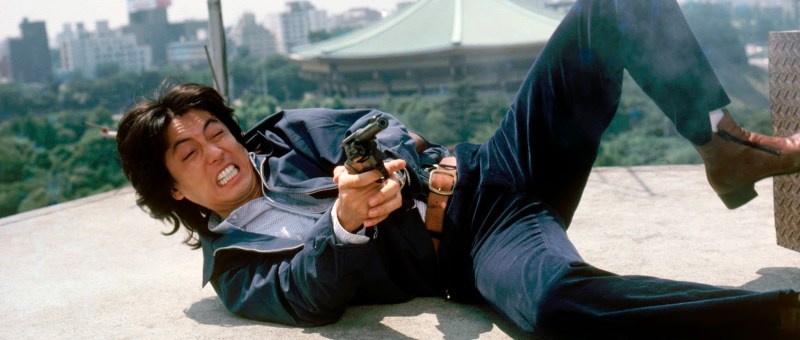
 In the post-


 Masaki Kobayashi had a relatively short career of only 22 films. Politically uncompromising and displaying an unflinching eye towards Japan’s recent history, his work was not always welcomed by studio bosses (or, at times, audiences). Beginning his post-war career as an assistant to Keisuke Kinoshita, Kobayashi’s first few films are perhaps closer to the veteran director’s trademark melodrama but in 1953 Kobayashi struck out with a more personal project in the form of
  When it comes to period exploitation films of the 1970s, one name looms large – Kazuo Koike. A prolific mangaka, Koike also moved into writing screenplays for the various adaptations of his manga including the much loved Lady Snowblood and an original series in the form of Hanzo the Razor. Lone Wolf and Cub was one of his earliest successes, published between 1970 and 1976 the series spanned 28 volumes and was quickly turned into a movie franchise following the usual pattern of the time which saw six instalments released from 1972 to 1974. Martial arts specialist Tomisaburo Wakayama starred as the ill fated “Lone Wolf”, Ogami, in each of the theatrical movies as the former shogun executioner fights to clear his name and get revenge on the people who framed him for treason and murdered his wife, all with his adorable little son ensconced in a bamboo cart.
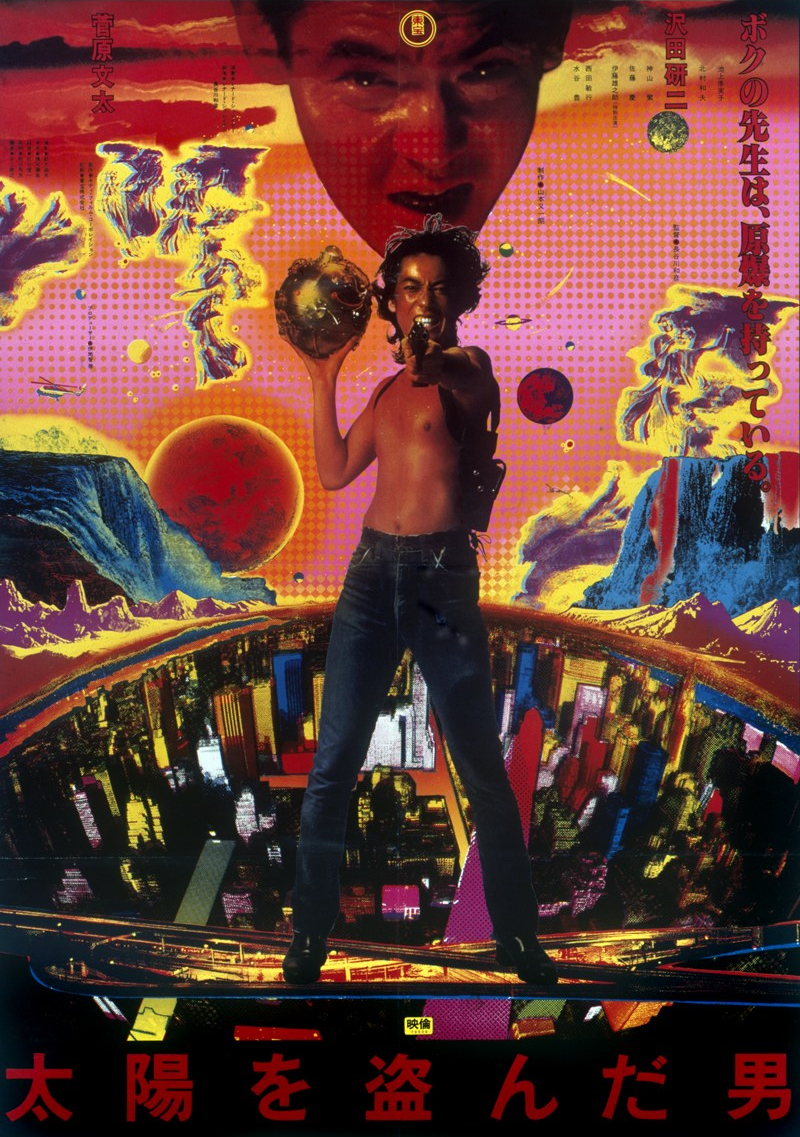
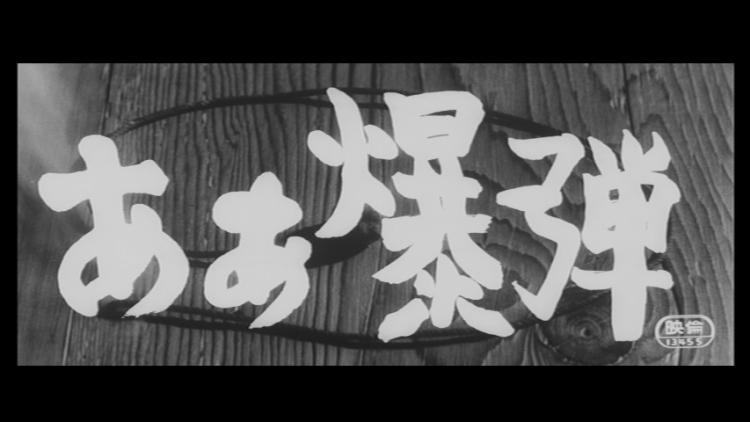 Being stood up is a painful experience at the best of times, but when you’ve been in prison for three whole years and no one comes to meet you, it is more than usually upsetting. Sixth generation Oyabun of the Ona clan, Daisaku, has made a new friend whilst inside – Taro is a younger man, slightly geeky and obsessed with bombs. Actually, he’s a bit wimpy and was in for public urination (he also threw a firecracker at the policeman who took issue with his call of nature) but will do as a henchman in a pinch. Daisaku wanted him to see all of his yakuza guys showering him with praise but only his son actually turns up and even that might have been an accident.
 Windows on Worlds