Pulse (回路, Kiyoshi Kurosawa, 2001)

pulse US posterTimes change and then they don’t. 2001 was a strange year, once a byword for the future it soon became the past but rather than ushering us into a new era of space exploration and a utopia born of technological advance, it brought us only new anxieties forged by ongoing political instabilities, changes in the world order, and a discomfort in those same advances we were assured would make us free. Japanese cinema, by this time, had become synonymous with horror defined by dripping wet, longhaired ghosts wreaking vengeance against an uncaring world. The genre was almost played out by the time Kiyoshi Kurosawa’s Pulse (回路, Kairo) rolled around, but rather than submitting himself to the inevitability of its demise, Kurosawa took the moribund form and pushed it as far as it could possibility go. Much like the film’s protagonists, Kurosawa determines to go as far as he can in the knowledge that standing still or turning back is consenting to your own obsolescence.

The end of the world starts with a young man staring at his computer screen and the strange images it conjures of the only half alive. Michi (Kumiko Aso), a young woman working at a rooftop plant centre, is dispatched to find out what’s happened to a colleague, Taguchi (Kenji Mizuhashi), who has some essential information stored on a floppy disk. Arriving at his flat she finds him distracted, informing her that the disk is somewhere in a pile scattered on the desk before disappearing off somewhere else. Having found what she came for, Michi looks for Taguchi to say goodbye but finds him hanged in an adjacent room. Barely reacting, Michi deals with the police before meeting up with her colleagues to relate the news, leaving each of them stunned. Another colleague, Yabe (Masatoshi Matsuo), then receives a strange phone call as a distorted voice repeatedly utters the words “help me”.

Meanwhile, economics student Kawashima (Haruhiko Kato) is attempting to set up this new fangled internet thing in his dorm but failing miserably. When he finally gets online and is greeted with the message “would you like to meet a real ghost?” he thinks he’s done something very wrong and hurriedly shuts his computer down. Seeking advice in the uni computer club he gets to know IT professor Harue (Koyuki) who tries to help him but may be beyond help herself.

The Japanese title, “Kairo”, literally means “circuit”, a fixed path of connectedness along which something flows continuously. A “pulse” is itself a circuit, or more accurately an observation of a fixed point in motion along it which maybe continuous or finite. Pulse, in its most immediate meaning is the life force by which we live, the thing which defines the states of life and death, but the “circuit” here is bigger than that which exists in one body alone, extending across the great confluence of humanity, or at least of that still regarded as “living”.

When Harue attempts to fix Kawashima’s internet she prompts him about why he wanted it in the first place (it was hardly necessary back in the still largely analogue world of 2001). He seems confused and replies he doesn’t quite know, it’s just that everyone seemed to be into it. Harue thinks she has his number – he thought he could use it to connect with people, but, she says, that is hopeless, people don’t truly connect, we all live in our separate bubbles. Harue is the most classically “disconnected” of our protagonists. Never having felt at home in the world, she talks of a lifelong fascination with the idea of death as a portal to another one in which it might be possible to live happily with others, only to realise as a teenager that it might also be a gateway to a land of perpetual nothingness and isolation. Terrified of being alone yet unwilling to submit herself to the inherent risks of connection, Harue exists in a permanent state of embittered longing and anxiety in which the cold embrace of death may prove the the only companion she will ever allow.

Harue may be an extreme case but she’s not the only example of disconnected youth. Michi, is also aloof and isolated – a child of divorced parents who has a close if imperfect relationship with her mother (Jun Fubuki) and an absent father she has already rejected. She says she’s OK in the city because she has her friends prompting her mother to warn her that she’s too trusting, too blind to the dangers of city life. Michi’s connections may turn out to be shallow, but unlike Harue she remains broadly open, seeking physical connections rather than digital ones. She visits her friend’s apartment, and makes a point of chasing after Yabe even after her boss warns her that friendly words can wound and that wounding a friend is also an act of self harm. Compelled to travel onwards, she resolves to keep on living, continue seeking connections until there are no more left to seek.

Kurosawa’s world is one of essential interconnectedness which finds itself frustrated by a mysterious forces leaking in. Yet the ghosts are not all on the other side, these are people who are spiritually dead while physically alive – isolated, defined by routine and expectation, and endlessly unfilled. “Trapped inside their own loneliness” as one character puts it, the disappeared gain a kind of immortality but it’s one filled with eternal longing and isolation. These “broken connections” are continually in search of vulnerable ports, flooding a system which has already begun to fail, and threatening to destroy that which they seek. The “ghosts” have destroyed the machine, but Kurosawa’s apocalyptic conclusion, melancholy as it seems to be, offers as much a hope for rebirth as it does a condemnation to existential loneliness.


Now available on blu-ray from Arrow Films!

Arrow release EPK

Oar (櫂, Hideo Gosha, 1985)

oar posterUntil the later part of his career, Hideo Gosha had mostly been known for his violent action films centring on self destructive men who bore their sadnesses with macho restraint. During the 1980s, however, he began to explore a new side to his filmmaking with a string of female centred dramas focussing on the suffering of women which is largely caused by men walking the “manly way” of his earlier movies. Partly a response to his regular troupe of action stars ageing, Gosha’s new focus was also inspired by his failed marriage and difficult relationship with his daughter which convinced him that women can be just as devious and calculating as men. 1985’s Oar (櫂, Kai) is adapted from the novel by Tomiko Miyao – a writer Gosha particularly liked and identified with whose books also inspired Onimasa and The Geisha. Like Onimasa, Oar also bridges around twenty years of pre-war history and centres around a once proud man discovering his era is passing, though it finds more space for his long suffering wife and the children who pay the price for his emotional volatility.

Kochi, 1914 (early Taisho), Iwago (Ken Ogata) is a kind hearted man living beyond his means. Previously a champion wrestler, he now earns his living as a kind of procurer for a nearby geisha house, chasing down poor girls and selling them into prostitution, justifying himself with the excuse that he’s “helping” the less fortunate who might starve if it were not for the existence of the red light district. He dislikes this work and finds it distasteful, but shows no signs of stopping. At home he has a wife and two sons whom he surprises one day by returning home with a little girl he “rescued” at the harbour after seeing her beaten by man who, it seemed, was trying to sell her to Chinese brokers who are notorious for child organ trafficking.

Iwago names the girl “Kiku” thanks to the chrysanthemums on her kimono and entrusts her to his irritated wife, Kiwa (Yukiyo Toake), who tries her best but Kiku is obviously traumatised by her experiences, does not speak, and takes a long time to become used to her new family circumstances. Parallel to his adoption of Kiku, Iwago is also working on a sale of a girl of a similar age who ends up staying in the house for a few days before moving to the red light district. Toyo captures Kiwa’s heart as she bears her sorry fate stoically, pausing only to remark on her guilt at eating good white rice three times a day at Iwago’s knowing that her siblings are stuck at home with nothing.

Iwago’s intentions are generally good, but his “manly” need for control and his repressed emotionality proceed to ruin his family’s life. He may say that poverty corrupts a person’s heart and his efforts are intended to help prevent the birth of more dysfunctional families, but deep down he finds it hard to reconcile his distasteful occupation with his traditional ideas of masculine chivalry. Apparently “bored” with the long suffering Kiwa he fathers a child with another woman which he then expects her to raise despite the fact that she has already left the family home after discovering the affair. Predictably her love for him and for the children brings her home, but Iwago continues to behave in a domineering, masterly fashion which is unlikely to repair his once happy household.

Kiwa is the classic long suffering wife, bearing all of Iwago’s mistreatments with stoic perseverance until his blatant adultery sends her running from marriage to refuge at the home of her brother. Despite the pain and humilation, Kiwa still loves, respects, and supports her husband, remembering him as he once was rather than the angry, frustrated brute which he has become. Despite her original hesitance, Kiwa’s maternal warmth makes a true daughter of Kiku and keeps her bonded to the eldest and more sensitive of her two sons, Ryutaro, even if the loose cannon that is Kentaro follows in his step-father’s footsteps as an unpredictable punk. Her goodheartedness later extends to Iwago’s illegitimate daughter Ayako whom she raises as her own until Iwago cruelly decides to separate them. For all of Iwago’s bluster and womanising, ironically enough Kiwa truly is the only woman for him as he realises only when she determines to leave. Smashing the relics of his “manly” past – his wrestling photos and trophies, Iwago is forced to confront the fact that his own macho posturing has cost him the only thing he ever valued.

Gosha tones down the more outlandish elements which contributed to his reputation as a “vulgar” director but still finds space for female nudity and frank sexuality as Iwago uses and misuses the various women who come to him for help or shelter. More conventional in shooting style than some of Gosha’s other work from the period and lacking any large scale or dramatic fight scenes save for one climactic ambush, Oar acts more as a summation of Gosha’s themes up until the mid-80s – men destroy themselves through their need to be men but also through destroying the women who have little choice but to stand back and watch them do it. Unless, like Kiwa, they realise they have finally had enough.


Short clip from near the beginning of the film (no subtitles)

In This Corner of the World (この世界の片隅に, Sunao Katabuchi, 2016)

in this corner of the world J posterDepictions of wartime and the privation of the immediate post-war period in Japanese cinema run the gamut from kind hearted people helping each other through straitened times, to tales of amorality and despair as black-marketeers and unscrupulous crooks take advantage of the vulnerable and the desperate. In This Corner of the World (この世界の片隅に, Kono Sekai no Katasumi ni), adapted from the manga by Hiroshima native Fumiyo Kouno, is very much of the former variety as its dreamy, fantasy-prone heroine is dragged into a very real nightmare with the frontier drawing ever closer and the threat of death from the skies ever more present but manages to preserve something of herself even in such difficult times.

We first meet Suzu (Non) in December 1933 when, due to her brother’s indisposition, she’s sent to deliver the seaweed from the family business to the city. Observing pre-war Hiroshima with the painful tinge of memory, Suzu, her head in the clouds as always, gets herself completely lost and is eventually “rescued” by a strange man who puts her in a basket with another boy he’s “found”. Life goes on for Suzu, the tides of militarism rising in the rest of the country but seemingly not in this tiny rural village where she dreams away her days sketching fantasy stories to entertain her younger sister.

Despite a putative romance with a melancholy local boy, Tetsu (Daisuke Ono), Suzu is soon married off and travels to the harbour town of Kure to be with her new husband, Shusaku (the boy from the basket who carried a torch all those years, tracked her down and sought her hand in marriage on the basis of a single encounter). Always a dreamy girl and still only in her late teens, Suzu struggles with the business of being a wife and, though Shusaku’s family are nice people and welcoming to their new daughter-in-law, she constantly provokes the wrath of her widowed sister-in-law Keiko (Minori Omi) while striking up a friendship with her daughter Harumi (Natsuki Inaba).

The atmosphere in the cities may have been tense, but here in a traditional rural backwater, politics rarely rears its ugly head. Suzu and her family are just ordinary people living ordinary lives, yet they are literally on the fringes of the battlefield, gazing in wonder at the impressive array of giant battleships in the harbour including, at one point, the Yamato which becomes a kind of symbol of the nation’s hubris in its claims of invincibility. Shusaku, like his father, works as a clerk at the local naval offices which means he’s present (and as safe as anyone else), but this is otherwise a land of women alone, waiting for brothers, husbands and sons to come home or learning to accept that they never will.

Suzu’s troubles are normal ones for a woman of her age and time in learning to adjust to a new life she has not exactly chosen and which has meant cutting herself off almost entirely from everything she’s known. The severed connection with troubled childhood sweetheart Tetsu lingers but Suzu learns to make Kure her home, developing a deep love both for her husband (to whom she was fated, in an odd way, by their fairytale meeting) and for his family. A mildly conservative message is advanced as Suzu learns to become “happy” even in the midst of such anxiety while her sister-in-law Keiko’s attempt to forge her own future by becoming a ‘20s city flapper and marrying a mild mannered man for love has brought her nothing but heartbreak. Keiko pays dearly for her acts of individualism, suffering (the film seems to say) unnecessarily through allowing her sorrow to make her bitter, though hers is undoubtedly the most tragic of fates only offered respite by the growing community and interconnectedness of the little house in Kure.

Time moves on a pace as Suzu climbs ever closer to the climactic event she has no idea is coming, but has been on the viewer’s mind all along. The bombings intensify, the losses mount, and the future recedes but sooner or later it has to become not about what has gone or what could have been but what there is and what there will be. Suzu’s dream world colours her vision and ours as explosions in the sky become beautiful splashes of paint and raining fire bombs fireflies blinking out in the night sky. The more unbearable everything becomes the more her picture-book illustrations take over until one particular event becomes so painful, so difficult visualise that it is only possible to describe in abstract, black and white line drawings. The bomb is almost a peripheral event to Suzu, considering leaving her new home for the old one. A tremor, a flash, and a feeling of unidentifiable dread. Katabuchi’s aim not to show the direct horror of war (though there is plenty of that), but its effect on the lives of ordinary people just trying to survive in difficult circumstances not of their making. Filled with a sense of essential goodness, In This Corner of the World is a tribute to those who endured the unendurable and remained kind, determined to build a better world in which such horrors belong only to the distant past.


UK trailer

Mozu the Movie (劇場版MOZU, Eiichiro Hasumi, 2015)

mozu-posterThe criticism levelled most often against Japanese cinema is its readiness to send established franchises to the big screen. Manga adaptations make up a significant proportion of mainstream films, but most adaptations are constructed from scratch for maximum accessibility to a general audience – sometimes to the irritation of the franchise’s fans. When it comes to the cinematic instalments of popular TV shows the question is more difficult but most attempt to make some concession to those who are not familiar with the already established universe. Mozu (劇場版MOZU) does not do this. It makes no attempt to recap or explain itself, it simply continues from the end of the second series of the TV drama in which the “Mozu” or shrike of the title was resolved leaving the shady spectre of “Daruma” hanging for the inevitable conclusion.

Six months on from the climatic events at the end of season two, Kuraki (Hidetoshi Nishijima) has become a drunk, Ohsugi (Teruyuki Kagawa) has left the force for the private sector, while Akeboshi (Yoko Maki) is still preoccupied with the strange phone calls she sometimes receives and the fate of her long lost father last seen on the deck of a sinking submarine. The dreams of the citizens of Tokyo are being haunted by the mysterious face of “Daruma”, but this is quickly superseded by an explosion in an office building which turns out to be a diversionary exercise as the autistic daughter of a refugee with diplomatic immunity is kidnapped by terrorists.

At this point, Kuraki appears at the scene, beats the bad guys into submission and rescues the girl, Elena, and her mother who are then taken into protective custody. However, things go south when Ohsugi’s daughter and Akeboshi are taken by the bad guys in the hope of an exchange forcing the gang to take Elena to a neighbouring Asian nation.

Mozu the movie suffers from many of the same problems which plagued the generally impressive TV series in its wildly inconsistent tone and increasingly convoluted, often bizarre plot twists. Assuming the audience will be familiar with the TV series, the film provides no recap, leaving the casual viewer completely lost amongst the numerous numbers of subplots held together by Kuraki’s need to find the answers behind the death of his wife at the site of a suicide bombing and the drowning of his daughter a year or so before. Likewise, Akeboshi’s familial concerns – her absentee father whose dark past was hinted at in the previous series and her close relationship with her two neices, is glossed over, as is Ohsugi’s ongoing battle to win back the respect of his teenage daughter. When a key character suddenly and quite unexpectedly appears to save the day (and then disappears again), the casual viewer has a right to be utterly baffled.

Where the central tone is one of cool noir supported by occasionally poetic camera work, Nishijima’s laid back minimalism gives way to broad, over the top villainy from Hasegawa’s Higashi as well as the punkish Mozu copycat who kickstarts the action. Kuraki remains an unbeatable super agent, taking out bad guys with well placed kicks to the chest and enduring numerous acts of torture whilst remaining doggedly fixed on his quest to find out the truth about his wife and a possible conspiracy plaguing Japanese society. Ohsugi is still the bumbling cop but equally committed to protecting his daughter while Akeboshi is underused, her slow burn romance with Kuraki simmering away in the background.

What remains is a collection of impressive action scenes and mysterious conversations offered with portentous seriousness. The purpose of Elena’s kidnapping is predictably grim yet reduced to a single sentence shortly before Kuraki apparently saves the day once again through undisclosed means. The central conspiracy in this conspiracy thriller, that Japan has been manipulated by a shadowy figure literally cannibalising his own children, fades into the background as Kuraki is left to affirm that all that remains now is chaos. Mozu the movie is season three with all the important bit stripped out – strange, confusing, and ultimately hollow. Yet for those well versed in the Mozu universe, it may provide a degree of closure to its ongoing mysteries, even if ultimately unsatisfying.


Original trailer (no subtitles)
Love/Juice (Kaze Shindo, 2000)

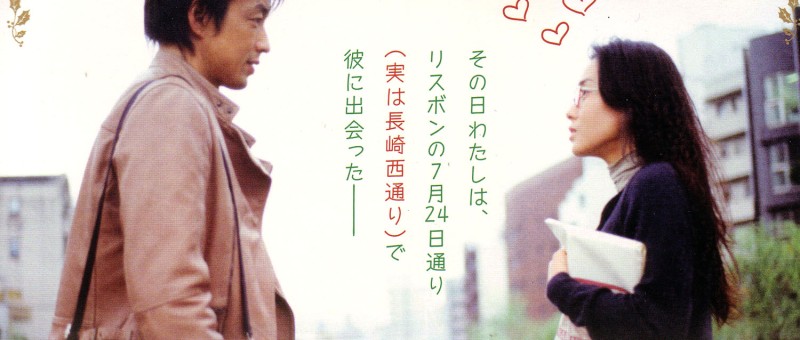
vlcsnap-2017-07-08-23h24m47s422Some situations are destined to end in tears. Kaze Shindo’s Love Juice adopts the popular theme of unrequited love but complicates it with the peculiar circumstances of Tokyo at the turn of the century which requires two young women to be not just housemates but bedmates and workmates too. One is straight, one is gay and in love with her friend who seems to get off on manipulating her emotions and is overly dependent on her more responsible approach to life, but both are trapped in a low rent world of grungy nightclubs and sleazy hostess bars.

Chinatsu (Mika Okuno) and Kyoko (Chika Fujimura) are roommates sharing not just a house but a bed and almost everything else too. Best friends, their relationship is necessarily close and broadly supportive save for a persistent level of tension when it comes to romance. Chinatsu, openly gay, is in love with Kyoko who isn’t interested but somehow keeps stringing her along and makes a point of flirting with every guy she meets. The back and fore continues until the girls are forced to take degrading work as bunny suited hostesses and Kyoko becomes obsessed with the boy working in the local tropical fish shop (Hidetoshi Nishijima).

Though living openly as a gay woman, Chinatsu is far from happy with her life as her constant complaints of “why was I born a girl” bear out. Attending clubs with her live-in non-lover, Chinatsu picks up dates but it never gets anywhere. Her heart belongs to Kyoko and so she tortures herself by continuing to pine after her emotionally manipulative roommate before adopting an unpleasant forcefulness as she tries to persuade her friend to acquiesce. Snapping away at her with her camera (which she refuses to be turned on herself), Chinatsu becomes jealous and possessive, irritated by Kyoko’s various suitors and wishing she and Kyoko could remain cooped up alone together like the two goldfish sitting in their makeshift bowl.

Where Chinatsu is down to earth and restrained, Kyoko is a lively free spirit adrift for reasons of aimlessness rather than the anxious wandering her friend. Living on the fringes of mainstream society, the women are forced into their inconvenient living arrangements thanks to ongoing poverty. This same poverty eventually forces them both into taking a humiliating job as waitresses at a bunny girl themed hostess bar. Much to Chinatsu’s consternation, Kyoko revels in the constant male attention, flirting awkwardly with the owner who seems to prefer her friend. Uncomfortable with the job and more particularly with the uniform, Chinatsu experiences yet more degrading treatment when she’s brutally assaulted by a colleague after work and can’t even turn to her friend and roommate for help and comfort.

Eventually matters come to a head, the situation can’t endure, suicide is considered, choices are made, sadness and regret litter the scene. Shindo creates a claustrophobic world for two into which the outside occasionally pokes its unwelcome nose. The whimsical score lends a quirky, romantic air to the less destructive side of the two women’s relationship even as it progresses further and further towards its inevitable conclusion. Painting an authentic picture of Tokyo as seen by the disillusioned and desperate turn of the century youth, Shindo’s tale of ordinary heartbreak in unusually difficult circumstances is a nuanced look at a toxic (non)relationship in all of its destructive glory.


Real (リアル 完全なる首長竜の日, Kiyoshi Kurosawa, 2013)

real posterKiyoshi Kurosawa has taken a turn for the romantic in his later career. Both 2013’s Real (リアル 完全なる首長竜の日, Real: Kanzen Naru Kubinagaryu no Hi) and Journey to the Shore follow an Orpheus into the underworld searching for a lost love stolen by death, but where Journey to the Shore is a tale of letting go, Real is very much the opposite (or so it would seem). Taking on much more of a science-fiction bent than Kurosawa’s previous work, Real adapts the Rokuro Inui novel A Perfect Day for a Pleisiosaur in which the boyfriend of a woman in a coma journeys into her subconscious through a process known as “sensing” in order to help her face up to whatever it is that’s keeping her asleep and lead her back towards the living world (or so we think). Strange and surreal, Real is a meditation on love, trauma, and the nature of consciousness in which “reality” itself is constantly in shift.

Koichi (Takeru Satoh) and Atsumi (Haruka Ayase) are childhood friends now living together as a couple. Despite their apparent happiness, one year after we see them enjoying a cheerful breakfast Atsumi is in a coma following a suicide attempt and Koichi is about to undergo an experimental procedure known as “sensing” to try and venture inside her consciousness to find out why she did it and possibly help her wake up.

Koichi makes contact and finds Atsumi living more or less as she had before, inhabiting their shared apartment and hard at work on a manga series, Roomi, which is now on hiatus following her indisposition. Roomi, like much of Atsumi’s work, is dark and macabre – the story of a serial killer who murders people in increasingly violent and disturbing ways. The brief flashes of bloody victims Koichi begins to notice in his peripheral vision soon give way to “philosophical zombies” or the NPCs of of the subconscious which take the form of badly animated third parties peopling Atsumi’s mind. What Atsumi wants from Koichi is to find a drawing of a Pleisiosaur she drew for him when they were children, because it was “perfect” and will help restore her faith in herself as an artist.

The Pleisiosaur turns out to be a little more significant than it first seems, taking Koichi and Atsumi back to the remote island where they first met. Almost like Stalker’s “The Zone” the island is a place of ruined dreams and frustrated inertia where some kind of accident related to the construction of a resort Koichi’s father was involved in building has permanently destroyed any idea of progress. This frozen, rubble strewn landscape perfectly reflects the lost world of the trapped dreamers as they battle the ghost of a shared yet half forgotten childhood trauma.

Though less obviously disturbing than some of Kurosawa’s previous forays into eerie psychological horror, Real has its share of typically J-horror tropes including a dripping wet ghost albeit this time one of a little boy popping up in unexpected places. Kurosawa opts for a hyperreal aesthetic, filming with harsh digital cameras which make little concession to the obviously cinematic, adding to the appropriately lifeless atmosphere of Koichi’s “real” world life and the surreal dreamworld of Atsumi. Koichi’s oddly pyjama-like clothing adds to the ongoing uncertainty as the two worlds blur into each other, becoming indistinct as the screen texture suddenly changes or the camera rolls to an unusual angle.

Shifting from Tarkovsky’s landscapes of desolation to Antonioni’s fog filled confusion, Kurosawa peels back the layers of repressed trauma to finally get to the core of what’s trapping the protagonist’s psyche within its frozen state. Childhood friends as they are, Koichi and Atsumi are trapped by a sense of guilt for something that they were both witness to all those years ago and so to overcome it, they will need to face it together. This time Orpheus descends but refuses to leave alone, battling literal dinosaurs from the distant past which must be placated with tokens of affection and, finally, heartfelt apologies. The “real” remains obscure, but Kurosawa does, at least, demonstrate his faith in love as salvation in a climax that echoes A Matter of Life and Death even if in a surreal and not altogether successful way.


International trailer (English subtitles)

Flag in the Mist (霧の旗, Yoji Yamada, 1965)

flag in the mist poster 2In theory, we’re all equal under the law, but the business of justice is anything but egalitarian. Yoji Yamada is generally known for his tearjerking melodramas or genial comedies but Flag in the Mist (霧の旗, Kiri no Hata) is a rare step away from his most representative genres, drawing inspiration from America film noir and adding a touch of typically Japanese cynical humour. Based on a novel by Japanese mystery master Seicho Matsumoto, Flag in the Mist is a tale of hopeless, mutually destructive revenge which sees a murderer walk free while the honest but selfish pay dearly for daring to ignore the poor in need of help. A powerful message in the increasing economic prosperity of 1965, but one that leaves no clear path for the successful revenger.

Kiriko (Chieko Baisho), a twenty year old typist from Kyushu, has taken an arduous train journey into Tokyo to get a meeting with a top lawyer she hopes will defend her older brother and only living relative from a trumped up murder charge. The clerk attempts to dissuade her – Mr. Otsuka (Osamu Takizawa) charges a hefty sum for his services and, in any case, his docket is too full to be travelling back and forth to Kyushu never mind the additional travel and accommodation costs. Kiriko is disappointed but undeterred – she thinks she can manage the expenses, but asks for a discount on the fee. The clerk finds this amusing and does at least ask Otsuka who finally agrees to see Kiriko seeing as she’s come all this way. She makes an impression on him but ultimately he tells her he’s just too busy and she’s better off looking for a lawyer closer to home.

Kiriko leaves disappointed but refuses to give up, missing her original train to try again by telephone but Otsuka has already gone out “to see clients” and so she finally has to accept her mission to save her brother may have stalled. While Kiriko was using the public phone, she was overheard by a reporter, Abe (Yosuke Kondo), who wants to write something on the case but his Tokyo based bosses aren’t so keen on a local interest story from halfway across the country.

A year later, Kiriko’s brother Masao (Shigeru Tsuyuguchi) has been convicted and sentenced to death. After his second appeal fails, Masao dies of illness in prison before the sentence could be carried out. Kiriko writes a bitter letter to Otsuka blaming him for her brother’s death which forces Otsuka to reconsider his decision not to take the case. He comes to the conclusion that the case was unwinable and therefore his decision not to take it made no difference but then, he spots something that no one else seems to have noticed.

A tenacious and strong willed young woman – you’d have to be to jump on a long distance train from a tiny village all the way to the big city on your own in 1965, Kiriko is determined to save her brother but finds herself facing an uphill battle against a society deliberately structured to ignore her voice and those of everyone like her. Kiriko is an orphan and so her older bother is also a kind of father figure as well as the only living relative she has left. Masao had been a primary school teacher, which is to say a respected member of society, but found himself involved with a loanshark who was later murdered after he lost some cash collected from students to pay for a school trip and borrowed money he couldn’t pay back from a ruthless old woman. Masao has made a mistake he’s going to pay for dearly – disgraced and humiliated, it was easy work to frame him for a violent crime and force him into a confession through the usual police methods. Kiriko won’t stand for it, but she’s powerless to help him.

Otsuka is, in a sense, entitled to charge what he wants for his services. He’s clearly a talented lawyer, very much in demand, and so why “should” he trek all the way out to Kyushu for a case that doesn’t interest him when he has enough clients already. He does, at least, bother to listen to Kiriko’s pitch before letting her down gently, but just when it seems he might be about to change his mind he tells his clerk to cancel all his appointments and winds up on the golf course with his girlfriend. So much for being too busy to save an innocent man’s life.

Kiriko’s “whole life has been desecrated by one incident” as she cuttingly writes later in a letter which forms a crucial part of her plot of revenge against the man who refused to save her brother’s life (half talking about something else). Forced out of her hometown where she’s the murderer’s sister, she finds work as hostess going by the club name of Rie in a Tokyo bar which has a Kyushu theme. This brings her back into contact with the reporter, Abe, and that isn’t the last of the coincidences as Kiriko finds herself swept up by circumstances which allow her to turn an unfortunate series of events into a cunning plan to ruin Otsuka by neatly echoing the precise circumstances of her brother’s case. Now it’s Otsuka forced to plead with her night after night, begging on his knees that she agree to testify and turn over key evidence that proves his client is innocent all while Kiriko adamantly sticks to her story.

Yamada conjures a tense and gloomy film noir world, following Kiriko down foggy passageways as she tries to navigate the city from the shadows, chasing the spectre of the unjust but losing herself in the process. Masao dies because he was too poor to hire a good lawyer to save him from the police who were supposed to be protecting him, but decided it was easier to stitch up someone without influence than find the real killer. His sister destroys herself to get revenge not just on lawyers more interested in fame and success than in serving justice but on an entire society which believes her existence is insufficiently important to merit full consideration. Otsuka is not a bad man, he is not corrupt or incompetent, he is merely selfish in all the ways his society encourages him to be. Originally letting himself off the hook with the excuse that his decision made no difference, he’s genuinely horrified when he realises he’s noticed a crucial clue which could have exonerated Masao even if it’s an equally selfish guilt he feels more than a recognition that he’s failed his duty to justice by letting an innocent man die while a guilty one lives to kill again. No one wins in this case, everyone emerges ruined and broken by the increasing inequalities and selfish individualism of the post-war world. Justice is blind, so they say, but perhaps she needs to open her eyes.


Original trailer (no subtitles)

Night’s Tightrope (少女, Yukiko Mishima, 2016)

night's tightrope japanese posterKanae Minato is known for her hard-hitting crime stories from Confessions to Chorus of Angels, The Snow White Murder Case, and Penance but in adapting her second novel, Shojo (少女), Yukiko Mishima has moved away from the mystery for a no less penetrating look at the death of childhood in the story of two best friends each dealing with traumatic pasts and presents. Childhood is a place of tightly controlled powerlessness, but adulthood offers little more than corruption and selfishness with its predatory teachers, abusive parents, and dirty old men so obsessed with school uniforms they barely see the girl inside them. Adolescent anxiety provokes a fascination with the idea of death which perhaps reflects this transitionary stage, but at its centre is the fracturing of a friendship which has endured all else.

The film opens with a strange avant-garde play being performed in a church by a group of girls in austere school uniforms. The monologue offered by the collective reads like an instruction booklet for the birth of fascism with its calls for genetically engineered test tube babies and universal childcare in which each child is “equal” and receives “exactly the same” education and resources. The girls are students at a strict Christian fundamentalist school where they’re also expected to participate in strange rituals including dancing round the maypole (incongruous as that may seem).

Atsuko (Mizuki Yamamoto) – a former kendo champion with a limp, and Yuki (Tsubasa Honda) who has a large scar across her hand resulting from domestic abuse, have been lifelong friends but have recently begun to drift apart. Given the overriding survival of the fittest atmosphere in the school, it’s not surprising that the other girls have turned on Atsuko and proceeded to make her life a misery by telling her to die either in person, on line, or in one particularly grim episode by shoving a sanitary towel into her locker with the message written on it in blood. Yuki is trying to help her but doesn’t know how and has taken to writing everything down in a book instead.

The world of teenage girls can often be a vicious one but there’s a strange kind of mania in the way Atsuko’s schoolmates set about pushing her towards the edge. Formerly a top kendo player, Atsuko has vivid, panic attack inducing flashbacks to her life changing accident in which she recalls her teammates prentending to comfort her but secretly hurling accusations under their breaths while Yuki looks on in horror from the stands.

Yuki has been writing their story in the form of a novel she calls Night’s Tightrope but the completed manuscript goes missing. The girls’ teacher who has longstanding dreams of literary stardom steals it, sends it to a magazine, and even wins a prestigious literary prize for brand new novelists. Yuki’s revenge is swift but has terrible, unforeseen consequences which add to her obsession with death and dying, eventually culminating in the worrying desire to see someone die in order to fully understand the nature of the “phenomenon”.

While Yuki develops a friendship with a boy she met in a library while she was destroying copies of the teacher’s stolen story, Atsuko goes in a different direction by falling under the spell of troubled transfer student Shiori (Ryo Sato). Recently witnessing a dead body herself, Shiori is just as death obsessed as the other girls but her vision is darker. Shiori introduces Atsuko to her world of blackmail and exploitation, pulling her into a high school girl scam in which they accuse a nearby salaryman of groping them and then blackmail him. Shiori may think she’s taking revenge on venal older men who lust after school uniforms – there are plenty of these on offer from skeevy old men luring school girls to abandoned houses and then trying to get them to do laundry, to teachers visiting love hotels with their students – but actions have consequences and ramifications can be severe.

The girls are caught in a kind of limbo, walking a tightrope into adulthood but doing it blind and alone. Splitting up they take similar paths with Atsuko volunteering at an old people’s home, and Yuki spending time with terminally ill children but soon enough their death obsession changes form as their twin causes eventually overlap. Stepping away from Minato’s sometimes nihilistic pessimism, Night’s Tightrope leaves a space for hope in the reconciliation of the protagonists who rediscover their shared pasts once the message buried in the novel is finally delivered. The adult world may be mired in the dark of night but the girls have recaptured the sunlight, taking solace in the depth of their friendship and stepping off the tightrope and into the world of adulthood hand in hand.


Original trailer (English subtitles)

Invisible Man (透明人間, Motoyoshi Oda, 1954)

invisible man 1954 posterThe Invisible Man is a frightening presence precisely because he isn’t there. The living manifestation of the fear of the unknown, he stalks and spies, lurking in our imaginations instilling terror of evil deeds we are powerless to stop. Daiei made Japan’s first Invisible Man movie back in 1949 – a fun crime romp with the underlying message that scientific research is important but not as important as ensuring knowledge is placed in the right hands. Toho brought Eiji Tsuburaya back for another go at the same material in 1954 as part of their burgeoning tokusaku industry fathered by Godzilla. The 1954 Invisible Man (透明人間, Toumei Ningen), directed by Motoyoshi Oda, is once again a criticism of Japan’s wartime past but also perhaps of its future. This Invisible Man is an invisible hero but one whose heroism is only recognised once the mask is removed.

Opening in grand style, the film gets off to a mysterious start when a speeding car hits “something” in the road. The “something” turns out to be a previously invisible man whose appearance is returned to him as blood leaks out from under the now stopped car. In his pocket, the man has a suicide note explaining that living life invisible is just too depressing and he can’t go on. Seeing as the note is addressed to a “friend” who is also apparently an Invisible Man that means there are more out there. Despite there being no real threat involved in any of this, the newscasters are alarmed and the public frightened.

This is quite useful for some – a shady gang quickly starts putting on Invisible Man suits including wrapping their heads in bandages just like in the movies, and robbing banks. Admittedly this makes no practical sense but adds to the ongoing fear of an “invisible” threat. An intrepid reporter, Komatsu (Yoshio Tsuchiya), links the crimes to a nightclub where the head of the gang is also trying to pressure the headline star, Michiyo (Miki Sanjo), into a career as a drug mule. Besides violence, their leverage is the little girl who lives across from Michiyo and is blind – the money they would be paying her could also be used to pay for the girl’s eye surgery. Mariko is waiting patiently for her grandfather to make the money, unaware that he has also fallen under the spell of the criminal gang.

The real “Invisible Man” is doing a good job of hiding in plain sight by proudly standing out in a traditional clown outfit complete with makeup and a fluffy nose. Nanjo (Seizaburo Kawazu) works as a promoter for the club and is also good friends with little Mariko who is unable to see him either with or without his clown suit. Unlike other Invisible Men, Nanjo is good and kind – the curse of his condition has not ruined soul.

He is, however, afraid of being exposed. Aside from social ostracism (perhaps someone who wears a clown suit 24/7 isn’t particularly bothered about that), Nanjo fears what his government would do to him if they discovered he was still alive. Like his friend who later committed suicide, Nanjo was a member of an experimental army squad recruited towards the end of the war as Japan sought to create the ultimate warriors to turn the tide in the battle against the Americans. The Invisible Men were born but the war lost, and it was assumed that they had all fallen. Nanjo, surviving, has been abandoned by the land that he fought for. His existence is a secret, an embarrassing relic of Japan’s attempt at scientific warfare, and something which no one wants to deal with. Nando’s friend could no longer cope with his non-existence. Unable to return home, unable to work, unable to marry, there was no “visible” future which presented itself to him.

In this sense, Nanjo represents a point of view many might have identified with in 1954. These men fought and risked their lives for a god they now say is only a man, to come home to a land ruled by the “enemy” in which they can neither criticise the occupation or the former authorities. These men may well feel “invisible” in the new post-war order in which the younger generation are beginning to break free while they suffer the continuing effects of their wartime service even if not quite as literally as Nanjo.

Yet there’s a kind of internalised resentment within Nanjo who describes himself as a “monster created by militarism”. Disguising himself as a clown he attempts to live a “normal” life though one segregated from mainstream society. A half-hearted romance with club girl Michiyo and a well meaning paternalism for the orphaned little blind girl point to Nanjo’s altruistic heroism but also to a reluctance to fully engage with either of them due to a lingering sense of guilt and shame.

The Invisible Man is the hero here while the bad guys subvert and misuse his name to do their evil deeds, terrorising women and threatening to burn the city down rather than surrender to authority. Even more than others in Toho’s expanding universe of tokusatsu heroes, Invisible Man is a defence of the other as not only valid but morally good even in the face of extreme prejudice and violence. It is, however, also one of their less well considered efforts and Tsuburaya’s effects remain few and far between, rarely moving beyond his work on Daiei’s Invisible Man five years previously. Bulked out with musical numbers and dance sequences, Toho’s Invisible Man is a less satisfying affair than Daei’s puply sci-fi adventure but is nevertheless interesting in its defence of the sad clown who all alone has decided to shoulder the burdens of his world.


The Liar and His Lover (カノジョは嘘を愛しすぎてる, Norihiro Koizumi, 2013)

liar and his lover posterDespite the potential raciness of the title, The Liar and his Lover (カノジョは嘘を愛しすぎてる, Kanojo wa Uso wo Aishisugiteru) is another innocent tale of youthful romance adapted from a shojo manga by Kotomi Aoki. As is customary in the genre, the heroine is cute yet earnest, emotionally honest and fiercely clear cut whereas the hero is a broken hearted artist much in the need of the love of a good woman. Innocent and chaste as it all is, Liar also imports the worst aspects of shojo in its unseemly age gap romance between a 25 year old musician and the 16 year old high school girl he picks up on a whim and then apparently falls for precisely because of her uncomplicated goodness.

Aki (Takeru Satoh) introduces himself through a film noir-style voice over in which he details his ongoing malaise. Now a ghost member of the band Crude Play, Aki feels conflicted over his artistic legacy as his carefully crafted tunes are repurposed as disposable idol pop and performed by the friends who were once his high school bandmates. His idol girlfriend, Mari (Saki Aibu), has also been seeing the band’s manager in an effort to get ahead leaving Aki feeling betrayed and devoid of purpose.

Soon after, Aki runs into grocer’s daughter Riko (Sakurako Ohara) who is captivated by the song he’s been humming whilst staring aimlessly out to sea. Aki, feeling mischievous, picks Riko up on a whim. He goes to great pains to remind us that he had no real feelings for her and was only in it for the kicks but a later meeting sets the pair off on a complicated romance.

Aki becomes the “liar” of the title when he gives Riko a false name – Shinya, the name of the bassist who has replaced him in his own band. Despite the supposed purity of music as a means of communication, it is, in many ways, another lie. When Aki and his bandmates were offered a contract straight after high school they were overjoyed but it was short lived. Listening to their demo tape, Aki spots the problem right away – it’s not them playing, they’ve been replaced by polished studio session musicians. Saddened, Aki quits the band and is replaced by a ringer but continues to write songs both for Crude Play and other artists while the band’s manager gets the credit.

Music conveys and complicates the romance as it brings the two together but also threatens to keep them apart. Riko, a Crude Play fan, does not know Aki’s true identity and is disappointed when he says he hates girls who sing because she herself is in a high school band. Sure enough, the band get scouted by odious producer Takagi (Takashi Sorimachi) and handed to the villainous Shinya (Masataka Kubota) who threatens to do the same thing to them as they did to Crude Play. Riko, like Aki, is a musical purist but also wants to make her rock star dreams come true.

Like many a shojo heroine, Riko is convinced only she sees the “real” Aki, pushing past his angry, distant persona to a deeper layer of sensitive vulnerability. This being shojo she is more or less right, as Aki tells us in his voice over detailing just how irritating it seems to be for him that he’s falling for this unusually perceptive young woman. Despite realising that almost everything Aki has told her has been a lie (intentional or otherwise), Riko ignores his duplicity precisely because she thinks she already knows the “real” Aki through the “truth” of his music.

Takagi, the band’s unscrupulous manager, prattles on about music not mattering if it doesn’t sell, avowing that it’s all a matter or marketing anyway. Aki’s central concern is the misuse of his artistic legacy, that his art form has been stripped of its meaning and repackaged for mass market consumption. The band is “fake”, a manufactured image based on the ruins of the truth. Aki believes himself to be the same – an empty vessel, devoid of meaning or purpose. His love of music is only reawakened by Riko’s innocent enthusiasm and her surprising promise of “protection”.

The conflict is one of essential truth betrayed by music in all senses of the word as it is used and misused by the various forces in play. Unlike most shojo adaptations, Aki leads the way with Riko a vaguer figure ready to absorb the projected personalities of the target audience but the central dynamic is still one of goodhearted girl and broody boy. The unseemly age gap issue is entirely ignored, as the troubling undercurrent of Riko’s most attractive quality being her all encompassing pureness, undermining the otherwise charming, wistful comedy of the innocent musical romance.


Original trailer (English subtitles)